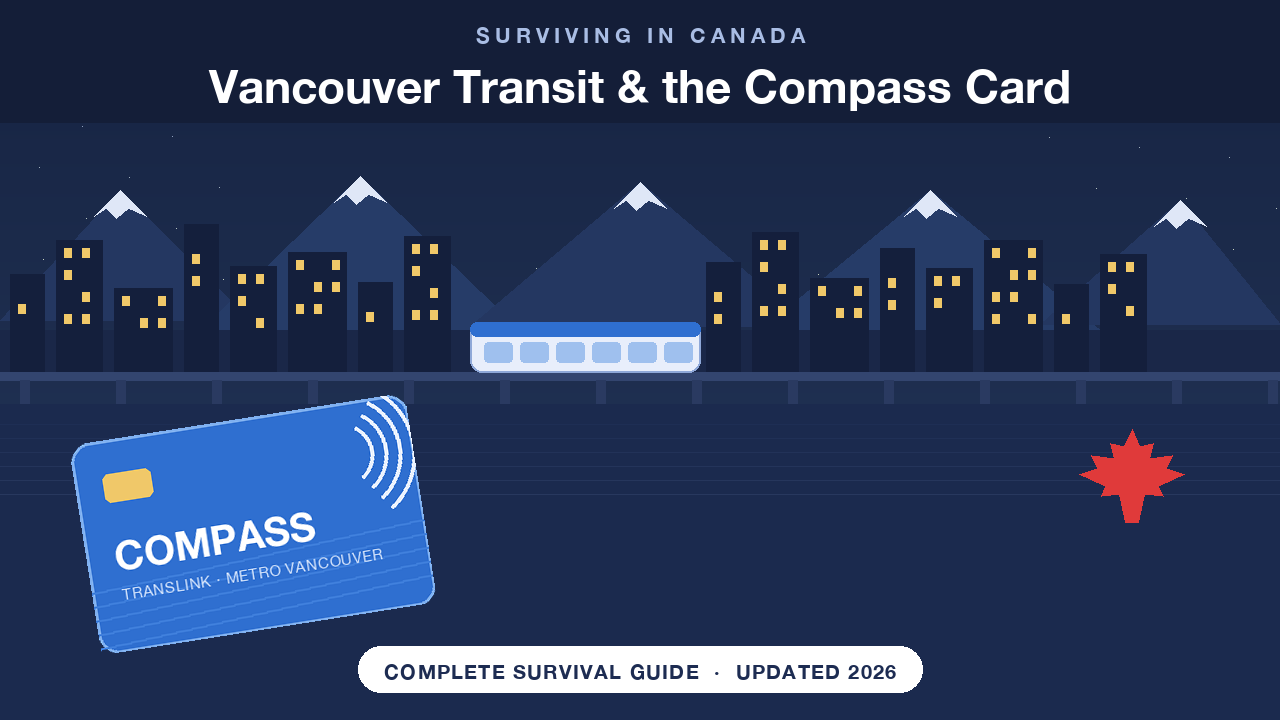
Vancouver Transit and the Compass Card: A Complete Guide for Newcomers
Just landed in Vancouver and have no idea how to get around? Relax. This one post will get you onto a bus, a SkyTrain and the SeaBus with confidence.
What Vancouver transit actually looks like
Everything here is run by TransLink. There are three things you will ride.
Bus — the workhorse. It covers not just the City of Vancouver but Burnaby, Richmond, Surrey and the rest of Metro Vancouver. You board at the front door, and to get off you pull the cord or press the stop button.
SkyTrain — a driverless light rail that acts as the city’s spine. Three lines: Expo, Millennium and Canada Line. During rush hour trains come every two to three minutes.
SeaBus — the passenger ferry between Waterfront and Lonsdale Quay in North Vancouver. About twelve minutes, and the skyline from the middle of the harbour is genuinely worth the trip.
The zone system
Fares run on zones. Metro Vancouver is split into three.
- Zone 1 — City of Vancouver (including UBC)
- Zone 2 — Burnaby, New Westminster, Richmond, North Vancouver and others
- Zone 3 — Surrey, Coquitlam, Langley and others
The part that saves you money: buses are always one-zone fare, no matter how many zones you cross. Zones only apply to SkyTrain and SeaBus. And after 6:30 p.m. on weekdays, plus all day on weekends and holidays, SkyTrain and SeaBus drop to one-zone fare too. Remember that one.
What a Compass Card is
The Compass Card is the transit card here. There is a $6 deposit, refundable, and you can buy one at a Compass Vending Machine in any SkyTrain station, at London Drugs, at 7-Eleven, or online.
You can load it two ways:
- Stored Value — load an amount, it deducts per trip
- Monthly Pass — unlimited riding for the month
Fares — Compass Card vs. tapping a credit card
This is the thing most newcomers miss. Stored Value on a Compass Card is cheaper than tapping a credit or debit card. Meaningfully cheaper.
Current fares — effective July 1, 2026
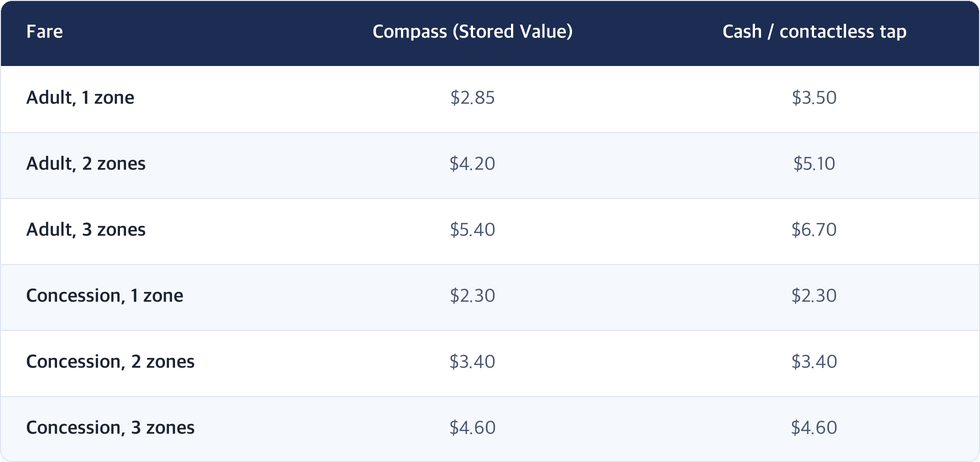
Note the concession rows: concession fares are now the same whether you use Stored Value or tap a bank card. The old split between the two is gone. The Compass discount still matters a great deal for adults.
Monthly Pass
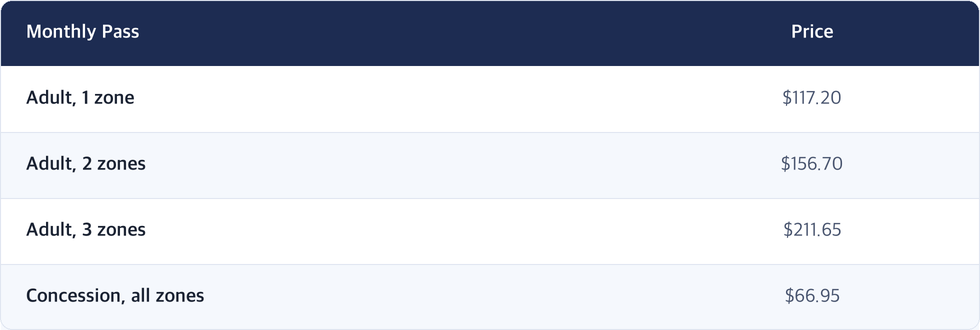
A Monthly Pass gives you unlimited SkyTrain and SeaBus within the zones you bought, and unlimited bus travel anywhere. After 6:30 p.m. on weekdays and all weekend, you can ride every zone freely regardless of which pass you hold.
DayPass — $12.55 adult, $9.75 concession, all zones. If you are taking three or more trips in a day, the DayPass wins.
Tap-to-pay with a credit or debit card
You may be thinking you can skip the Compass Card entirely. You can — but it costs you.
What works: Visa, Mastercard, American Express, Interac Debit (supported since 2023), Apple Pay, Google Pay, Samsung Pay.
Three catches:
- It is more expensive — if you are an adult. Tapping a bank card charges the cash fare: $0.65 more in one zone, $1.30 more across three. (Concession riders now pay the same either way.)
- No monthly cap. However much you ride, nothing behaves like a Monthly Pass.
- No concession discount on a bank card. To get the concession rate at all you need a Concession Compass Card — tapping a credit or debit card charges the adult cash fare.
Survival tip: tapping a card is fine for a tourist riding twice. If you actually live here and ride regularly, get the Compass Card. It is tens of dollars a month.
Concession fares — who qualifies
Concession runs about 20% below the adult Stored Value fare — $2.30 against $2.85 in one zone.
- Youth aged 13–18
- Seniors 65 and over
- HandyCard holders
- Children 12 and under ride free with an adult
Youth and seniors need a separate Concession Compass Card. A regular Compass Card will not apply the discount on its own — this catches people out.
Post-secondary students are usually better off through U-Pass BC, roughly $180–$200 per term depending on the school. Many schools enrol you automatically, so check.
Tap in, tap out — the rules differ by mode
This is where the system will quietly overcharge you if you guess.
Bus — tap in at the front door. No tap out. Just walk out the back. Buses are one-zone anyway, so there is nothing to calculate.
SkyTrain — tap in at the gate, and you must tap out. Skip the tap out and you get charged the maximum three-zone fare, even if you rode one stop.
SeaBus — same as SkyTrain. Tap in, tap out.
Monthly Pass holders have to tap out too. On tap in, the system provisionally deducts a three-zone fare, then reconciles it when you tap out. No tap out, no reconciliation — and if you hold a one-zone pass, the difference can come out of your Stored Value.
Transfers — the 90-minute rule
From the moment you tap in, you have 90 minutes of free transfers.
- Any combination — bus to SkyTrain to SeaBus — is fine
- No extra charge inside the window, except an AddFare if you move into a higher zone
- After 90 minutes, a new fare starts
Survival tip: if your errand takes less than 90 minutes, you get the round trip on one fare.
Practical notes
💳 Buying and loading
- Where — SkyTrain station vending machines, London Drugs, 7-Eleven, or compasscard.ca
- Auto-load — register the card at compasscard.ca and set it to top up automatically when the balance runs low. Strongly recommended.
- The $6 deposit comes back when you return the card at the Compass Customer Service Centre in Stadium–Chinatown station.
🚇 If you commute
- Five days a week, both ways, and the Monthly Pass almost always wins. Twenty-one commuting days in Zone 1 costs $119.70 on Stored Value against $117.20 for the pass — and any weekend trip puts you clearly ahead.
- Since everything is one-zone after 6:30 p.m. and on weekends, stack your long trips into those windows.
⚠️ Fare evasion
Riding without a valid fare can bring a $173 fine. Transit Police do spot checks on the SkyTrain, and having a Compass Card does not help if the balance is short. Watch your balance.
📱 Apps worth having
- The TransLink app — real-time arrivals and trip planning
- Google Maps — TransLink data is well integrated, so routing works fine
At a glance
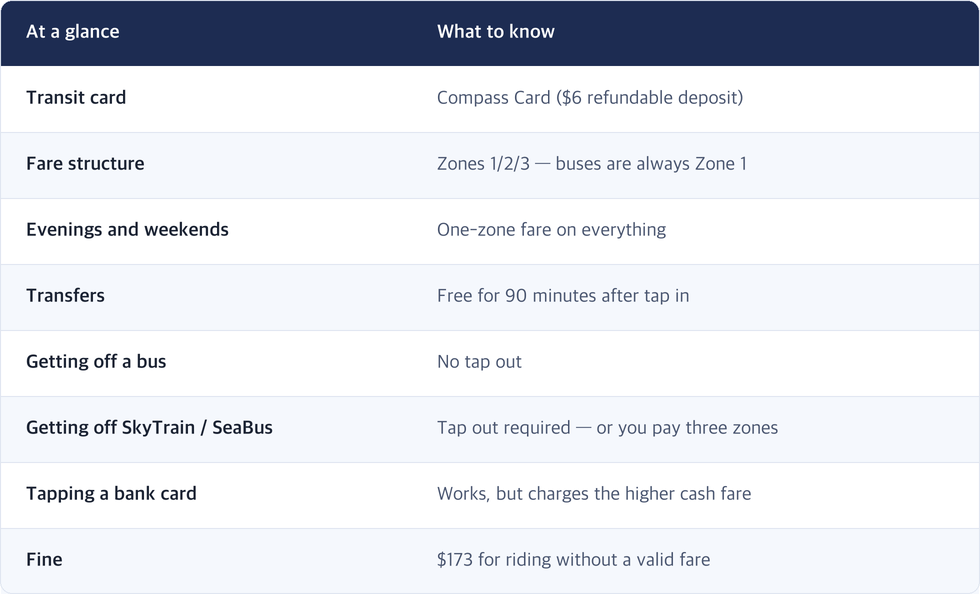
Vancouver transit feels foreign for about a week. After that you will realize you can live here perfectly well without a car — one Compass Card gets you into every corner of this city. 🍁
Fares in this post are the rates that took effect July 1, 2026, checked against TransLink’s official pricing page. Fares change every July, so confirm the current numbers on the TransLink website before you budget around them.
If this was useful, bookmark it or pass it along. It genuinely helps me write the next one.
I can survive. We can survive.