Why the Korean Won Hit 1,465 to the Dollar: A Plain Explanation
Turn on the news in Korea at the end of 2025 and it is all exchange rates. I wanted to understand what was actually wrong with 1,465 won to the dollar, and why everyone sounded worried, so I went looking for someone who could explain it properly.
This is Mr. Can. What follows is my write-up of an explanation by the commentator Park Si-dong on the Korean show Maebulshow, with some thoughts of my own added.
📺 Source — the Maebulshow exchange-rate special, broadcast 27 November 2025. Featuring commentator Park Si-dong, anchor Choi Wook, and director Ahn Jin-geol.
🎥 The whole thing in three lines
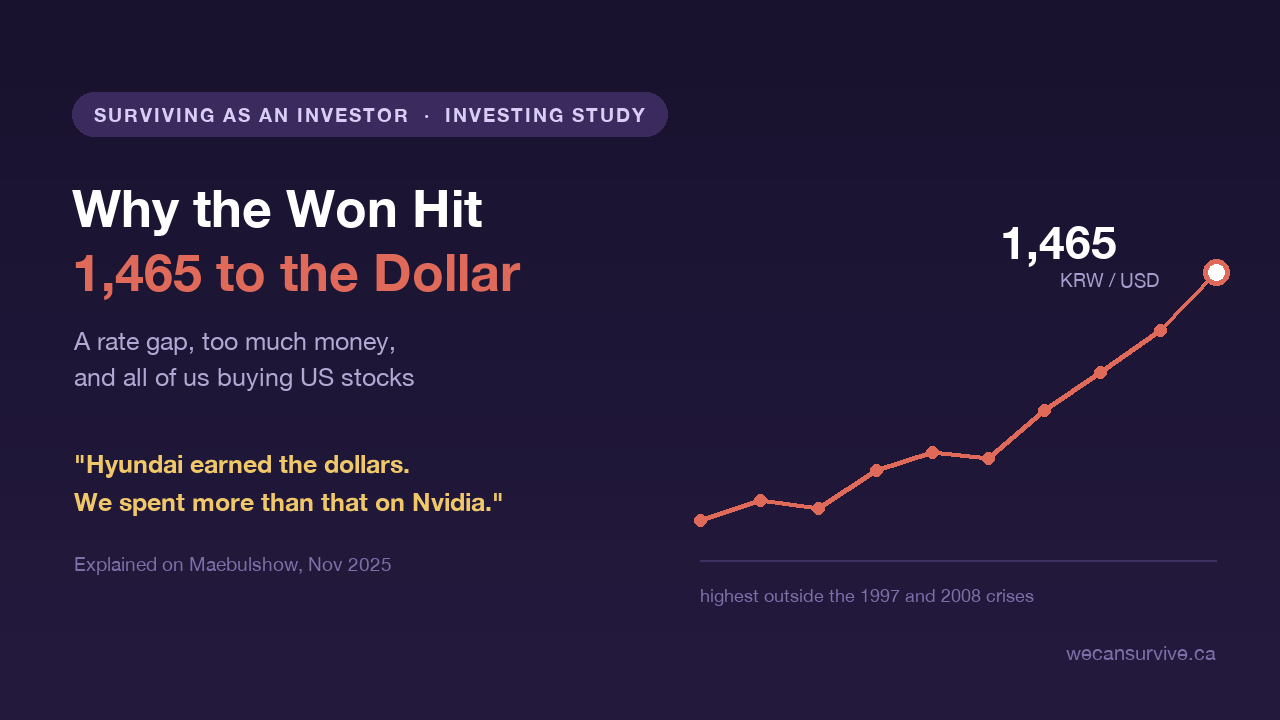
- The level is close to disaster territory — outside the IMF crisis and the global financial crisis, this is as high as it has ever been.
- The cause — US interest rates are higher, and Koreans are buying US stocks with dollars, in volume.
- The fix — there is no good one. Using the national pension fund is on the table.
💰 How bad is 1,465, really?
Put beside past crises:
- IMF currency crisis, 1997 — 2,000 won
- Global financial crisis, 2008 — 1,600 won
- The martial law episode under Yoon Suk-yeol — 1,483 won
Short of an outright disaster, this is the highest it has been.
More telling: the real effective exchange rate, which accounts for prices and purchasing power, is at a 16-year low. The money is genuinely worth less.
🤔 How did it get here?
Root cause 1 — the Korea–US rate gap
US policy rate around 4%. Korean policy rate around 2.5%. Money goes where the yield is, and this gap has been open for more than three years.
Root cause 2 — too much money was printed
Korea expanded its money supply about twice as fast as the US, with an enormous amount pushed into circulation through property lending under the Yoon administration.
The recent accelerant — retail investors going overseas
This is the part that stopped me.
Over the first nine months, as cited on the programme:
- What the country earned — current account surplus of $82.7 billion, a record
- What individuals spent on US stocks — $89.0 billion
In plain terms: Hyundai sold cars and brought dollars home, and we sent more than that back out buying Nvidia and Tesla.
Companies added to it:
- Expecting the rate to keep climbing, they held their dollars instead of converting
- Earnings made abroad were left abroad — roughly 490 trillion won parked offshore
💭 What I took from it
“What difference do my few shares make?”
As someone who invests in US stocks, this explanation genuinely rattled me.
Me buying one share of Nvidia is nothing. A few million people like me is an entirely different thing.
Small individual choices stack up, and the stack moves a national economy.
From an immigrant’s side of it
Living in Canada, the exchange rate is always somewhere in my head — when to convert Korean assets, how to hold them, what to do with the timing.
It is a small decision for one person. This was the month I felt how large the wave gets when those decisions pile up.
🛠️ What can the government even do?
❌ What does not work
- Spending reserves to intervene directly — when the ammunition runs out, it backfires
- Asking companies nicely to convert — no enforcement, no effect
- Raising rates — detonates the interest bill on household debt
⭐ Which is why the pension fund came up
- Option 1 — cut the fund’s overseas allocation: buy fewer dollars, more domestic equities
- Option 2 — deal directly with the Bank of Korea: take dollars from the central bank instead of buying them in the market
- Option 3 — encourage currency hedging: complicated, but it puts dollars back into the market
The objection: this is the nation’s retirement money. Should it be used as a policy instrument?
✅ What we can actually do
- Watch the timing — do not force a conversion when the rate is this high
- Expect imported goods to cost more — a higher rate shows up on the shelf
- Hold the long view — do not live and die by the daily print
- Keep learning — follow this kind of story rather than reacting to it
Closing
Park Si-dong put it like this:
Hyundai sold cars and earned dollars, and the public pulled out more dollars than that buying Nvidia.
One sentence, and the whole thing sits still.
Exchange rates feel remote. They are made out of what each of us decides to do.
If you read Korean, the original broadcast is worth watching in full.
If this was useful, bookmark it or pass it along. It genuinely helps me write the next one.
I can survive. We can survive.