How I Work With ADHD and AI: Turning a Scattered Brain Into a System
I will be honest: I think I have ADHD. I have never been formally diagnosed. But from the time I was a kid I heard “you are distracted,” “you cannot stay on one thing” until I was sick of it, and the pattern followed me into adulthood. Quiet makes me anxious. If I get interrupted mid-task, coming back is brutal. And when I do lock on to something, I can sit there for hours without getting up — and when that unstoppable run finally ends, I am wrecked.
So for a long time I have been building my own ways of surviving with this brain. That is what this post is about.
Let me be clear first. I am not a doctor, and this is not a diagnosis or a prescription — it is my own experience. If a similar pattern is disrupting your daily life, seeing a professional is the accurate move. But if you are like me and have spent years wondering “why am I like this,” maybe a way of living that actually runs will be more useful than a checklist.
A brain that gets anxious in the quiet
When things go quiet inside, I get anxious. Unless I am actually asleep, sitting alone in silence makes me uncomfortable. A podcast, music, anything — I need something playing before I settle. It turns out this is a commonly reported pattern with ADHD traits. A scattered brain cannot tolerate a lack of stimulation, so when it goes quiet, every thought crowds in at once, and it goes hunting for another stimulus to cover them.
When I was young this was just self-blame — why am I like this. I had been taught that being distracted was a defect to fix. But living with it long enough taught me something: you almost never win the fight against your own temperament. Change the point where that temperament turns into an outcome, though, and the same brain survives a lot better.
Getting memory out of my head
The first thing that actually worked was absurdly simple. Always put my wallet in the same spot.
I used to chase the memory of where I had set it down. Once I made the rule — the wallet goes here, no exceptions — losing it stopped happening.
Two things were going on. Losing objects with ADHD is not a matter of willpower or caring enough; working memory is just weak. So if you move the thing to be remembered out into the environment, you are not taxing a weak memory — the need to remember disappears entirely. The second thing: “comes in → goes here” became almost unconscious, which erased the decision point of “where should I put this” every single time.
I extended that to task management. Things I have to do but cannot do right now — or things I am deliberately setting aside to make room for something more important — go into Workflowy and I forget them. Holding several open items in my head is my single heaviest load, so writing one down sends the signal that the system is holding this, I do not have to, and I relax. In a scattered brain, unprocessed items floating around make the head noisy even when you are doing nothing. That connects straight back to the “quiet makes me anxious” problem.
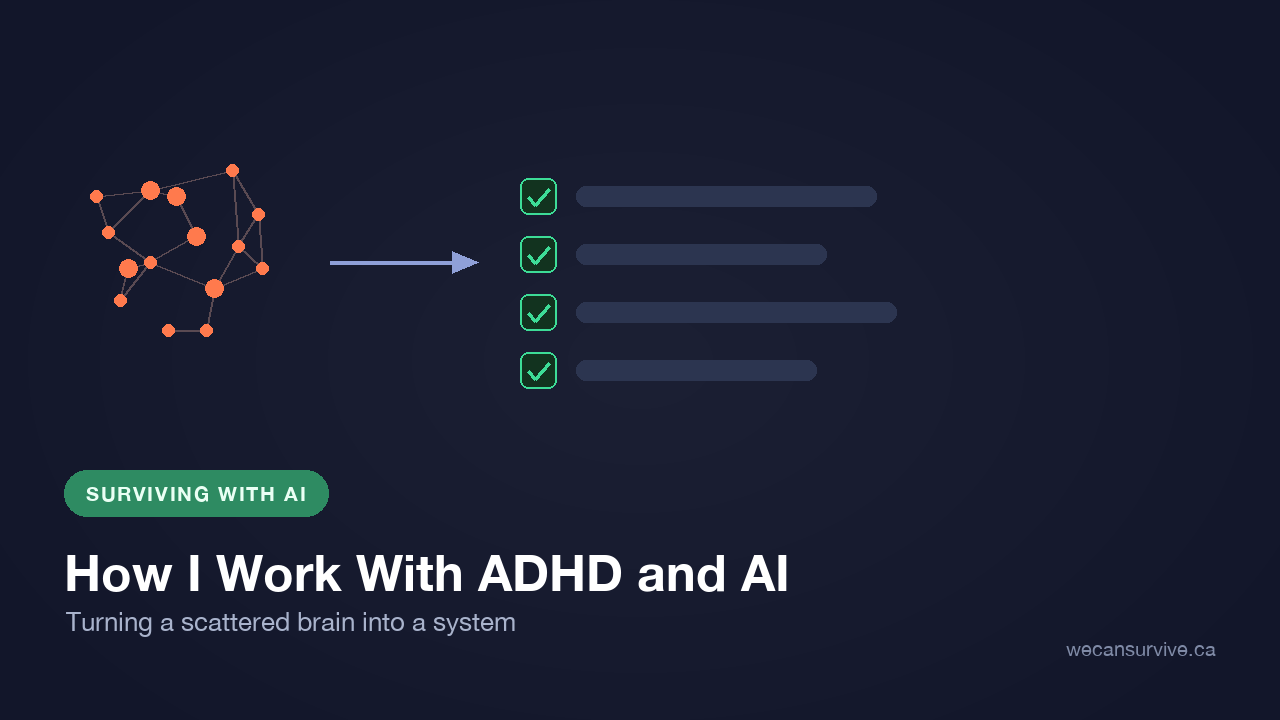
So I built the habit: everything goes in Workflowy, and every time I think “wait, what am I supposed to be doing,” I open it. I wired the moment the blankness rises up to be the trigger for opening the list. That solves the classic ADHD trap — you write it down and then forget the list exists — with a trigger instead of an alarm. Then I work through it, checking items off. Finished items clear out of view, so I can always see how far I have come, and the small hit of completion at each checkmark becomes the fuel for the next one. The ADHD brain is bad at “keep going without reward,” so I laid down a lot of tiny rewards to compensate. That is why I do not get lost.
The change that got intense once I started using AI
The real shift came when AI became a daily tool.
I am someone who genuinely struggles to return to a task after being cut off. Anyone loses time refocusing after an interruption, but with ADHD the entire context — what was I doing, how far did I get — vanishes wholesale, so the cost of coming back is far higher.
With AI, I became able to run two or three things at once. If an email or a phone call landed while I was in the middle of a long piece of writing, going back used to be agony. Now the flow of what I was working on is still sitting there in the conversation, so instead of reconstructing the broken context in my head, I pick it back up off the screen. It is exactly the same principle as the wallet. I handed my weak working memory to something outside me.
The more interesting part is separate. I carry two opposite weaknesses at the same time: distractibility and hyperfocus. I cannot tolerate a single monotonous task, and I also cannot pull out once I am in. But working by deliberately jumping between tasks makes those two cancel each other out. I fill the one-to-three minutes of waiting for AI to produce something with another task, so I never hit stimulus starvation — and because my attention is forced to move, I am also protected from sinking into one thing and not surfacing. I am using distractibility as fuel for task-switching instead of treating it as a flaw.
At first that one minute of sitting there waiting for a response was unbearable. I hated having another task intrude into the gap. Now I deliberately keep two or three going and jump from one to the next.
Waiting became a comma
The strangest part was that the meaning of “waiting time” flipped completely.
For relatively independent work — answering email, writing code — the jumping method clearly raises throughput, because when one task stalls or goes into a waiting state, there is not much context to lose by moving to another. And the burnout that used to follow hyperfocus dropped noticeably. Being forced to move my attention cut the sessions before hyperfocus could accumulate. A kind of natural pacing device appeared.
The empty time I used to be unable to tolerate is now the recovery stretch between two bouts of focus. Same one to ten minutes, opposite role.
Deep writing runs on long breaths
That said, I do not do everything by jumping. Building a single deep piece of writing, logically, layer by layer, has a different grain. At first I assumed the rule was “do not break this, hold it for a long stretch.” But when I actually looked at how I work, it was a bit different.
This kind of writing is really cycle work on a long-breath unit. I organize what I am going to give the AI and pour it out in one go (focus and output) → send → while waiting for the response I drink water, change the music, do something small → read the response and go into the next breath. One breath is one session, sometimes five minutes, sometimes ten.
The reason this does not turn into hyperfocus is that a comma gets placed structurally every time I exhale one breath. What must not be interrupted is the output inside a breath; between breaths, being cut off is actually better for me. The intensity of the output is high, but every cycle resets, so exhaustion never stacks up.
My brain as a computer chip
At some point I started comparing my brain to a computer chip. This is strictly about me, one person — but once I laid it out this way, why I work the way I do got a lot clearer.
First, the memory is small. Holding several things open at once is too much. So I keep dropping what I had loaded. That is why swapping to external storage — Workflowy, a conversation window — fit me so well.
There are few cores. Real parallel processing, genuinely running two or three things simultaneously, does not happen. So when I said earlier that I “run several things at once,” that was not concurrent processing at all. It is closer to moving a single core quickly from one task to another. Not many cores running together — one core jumping fast.
But the clock is high. Once it locks on to something, it processes fast and cuts deep. Pouring out a long piece of writing in one breath is exactly that state.
The problem is that the high clock means once it starts running, it gets out of hand. It picks up speed and cannot stop itself. Hours pass without getting up, and afterward I am wrecked. That is the explosive power of hyperfocus, and its danger.
Finally, restart cost is high. The higher the clock and the deeper the computation, the more is lost the moment someone interrupts, and the more expensive it is to climb back to that speed. The memory is small too, so reconstructing the broken context in my head is hard. That is why an interrupt makes restarting so uniquely painful.
The strange thing is that every method I have built over the years turns out to be a response to these chip specs. Small memory swaps to external storage. Few cores run by fast jumping instead of true concurrency. The high clock’s runaway gets broken and cooled on breath-sized units. The heavy restart cost gets cheaper by leaving the context on a screen. I cannot change the chip, so I wrote an operating system that fits it.
Last thought — not a weakness, an operating manual
So, to summarize. Work that has to be deeply integrated runs on long breaths, one breath at a time. Everyday work that can be parallelized runs on deliberate jumping. And in between, memory lives outside my head — in notes, on screens.
I think this is also why the common ADHD advice never fit me. A lot of it is “add cores” (multitask) or “lower the clock” (go slow and steady). What actually worked for me was leaving the clock alone and managing only the interrupts. The key was not trying to force my chip’s specs to match someone else’s.
For a long time I thought distractibility was a defect I had to fix. But once the goal stopped being “get rid of ADHD” and became building an environment and a toolset that fit the trait, things started running far better. The temperament is unchanged — I just blocked it from turning into the outcome called “never finishing anything.” Diagnosis or no diagnosis, what got me through was the system I built.
If you are running your own work alone here in Canada, and especially if you grew up hearing that you were scattered, give this a try. Instead of straining to fix your brain, read your chip’s specs and install an operating system that suits it. That is the way of surviving that I found.
If this was useful, bookmark it or pass it along. It genuinely helps me write the next one.
I can survive. We can survive.