I Sold Half My KODEX 200 — And Could Not Remember Why
Why did I sell?
A few days ago I was going back through my trade records. There it was: in November I took profit on half my KODEX 200 position in one go.
Bought at an average of 38,400 won. Sold at 57,760. Up 50%.
The act itself deserves credit. The problem is that I could not remember why I did it.
Leaning on records again
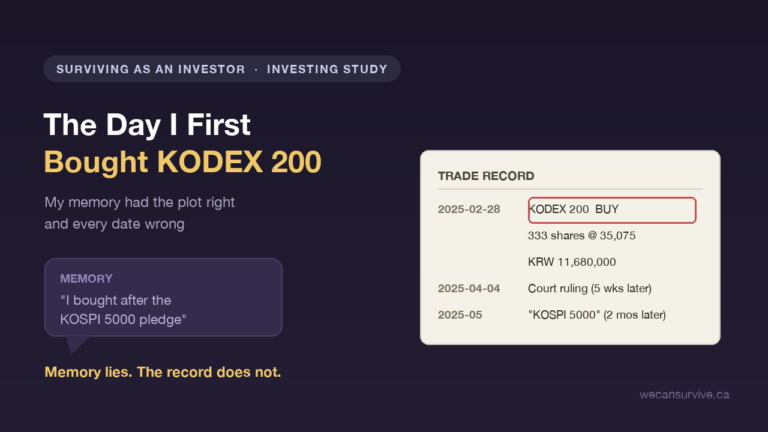
In my last post I wrote that memory lies — that once the brain knows the outcome, it reverse-engineers the motive. So I resolved to write a line before and after every trade.
This time it was the reverse. I had sold, and I was standing in the spot where I did not know why. I pressed that sell button. I was the person who made a judgment that day. And the content of the judgment was gone without a trace.
All that was left was one line: 2025/11/12, KODEX 200, sold half of holding, @57,760.
So I traced it from there.
The cycle the records showed me
I pulled my November trades in order.
- 11/3 — new KODEX 200 buy in account B (@57,415). KOSPI around 4,150.
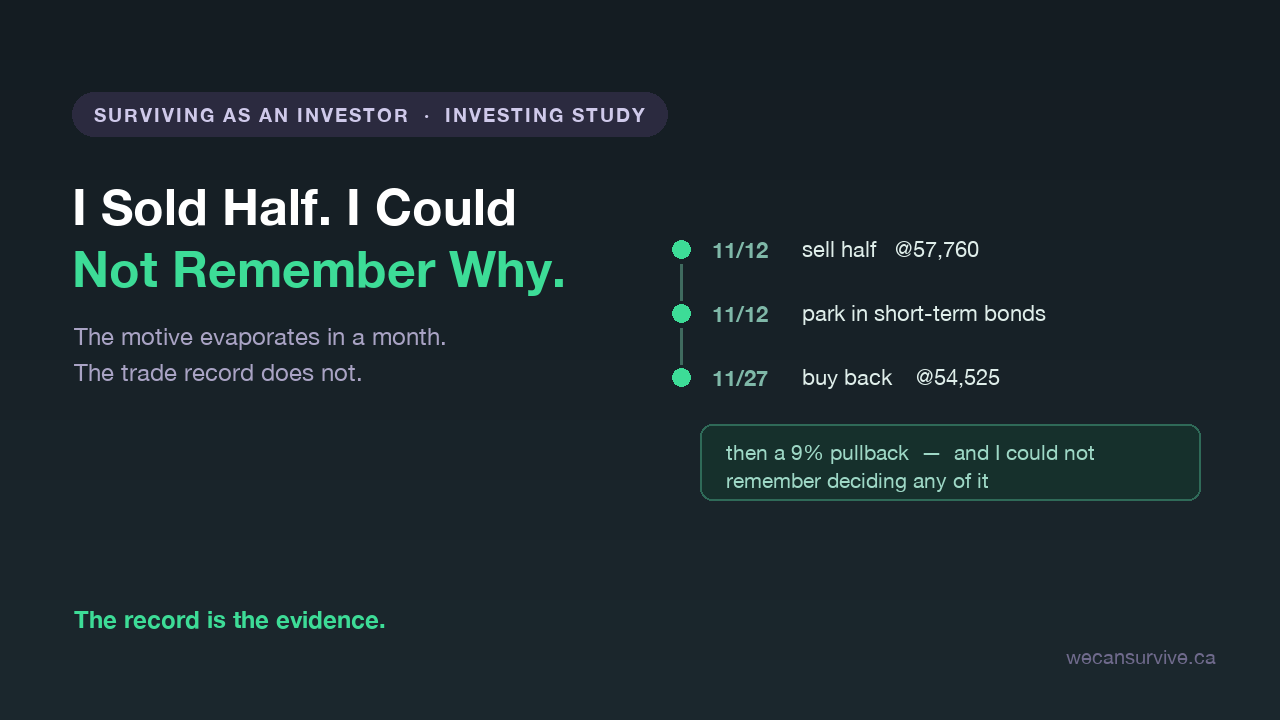
- 11/12 — sold half the KODEX 200 in account A (@57,760)
- 11/12, same day — moved most of the proceeds straight into KODEX KRW CASH PLUS, a short-term bond fund
- 11/20 — new position in Samsung Electronics in account B (@98,600)
- 11/25 — began clearing overseas ETFs. Sold SCHW US DIV and ST STR SPDR
- 11/27 — sold half the short-term bond fund → bought back part of KODEX 200 (@54,525), plus a new position in TIGER US S&P 500
- 12/1 — sold part of ACE KRX Gold
I stared at the pattern for a while before it came into focus.
Sell half → park it → re-enter on the dip
The money from the 11/12 sale did not sit as cash. Same day, it went into the short-term bond fund. Half out of the market, and the money still working while it waited.
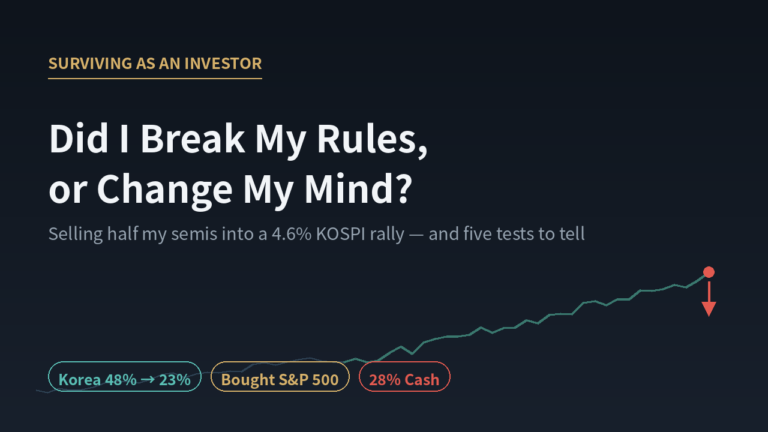
Exactly two weeks later, KODEX 200 had come off from my 57,760 sale price to 54,525 by 11/27 — about a 5.6% pullback. So I sold part of the bond fund and bought some KODEX 200 back cheaper. At the same time I added TIGER US S&P 500, diversifying once more.
Honestly, seeing this cycle surprised me a little. It looked like someone had handed me a manual. Take profit at a short-term high → preserve the ammunition → re-enter lower on the pullback → diversify. Practically textbook.
Except the person who did it was me.
What the market was doing
The memory is empty but the market data is not. From mid-November into early December, Korean equities pulled back about 9%. Talk of an AI bubble started in earnest in the US and foreign investors turned sellers. After 12 November it took roughly six trading sessions for the KOSPI to get back to 4,100. (The next recovery came on 22 December, when foreign buying returned.)
What news I read that day, what chart I looked at, whose video I watched — not one grain of it is left. But I clearly saw a short-term top signal somewhere, or there would have been no reason to clear half a position right before a 9% pullback.
I did not know what I had done
This is the strange part.
I pressed the buttons. I was the one who made a call that day. And the content of that call is not in my head. What remains is only the pattern, read backwards from the result.
Two things follow.
One. Give it six months and the basis for a decision evaporates almost entirely. Memory keeps how it turned out, not why you did it. The motive goes, the outcome stays.
Two. My hands were still moving on principle. Nobody made me memorize a manual — something my body had picked up through a year of trial and error in the market was working that day. My conscious mind cannot recall what it was, but a manual carved somewhere below it moved my hands.
So what do I do about it
Two resolutions hardened.
First, write one line about the signal on every trade — buy or sell. The motive really does evaporate inside a month. Without a record you cannot even tell what you did well. And if you cannot see what you did well, you cannot do it again.
Second, do not be too hard on yourself. Not remembering does not mean I acted mindlessly. A set of principles built over time was clearly running. The trade record proved it.
The record is the evidence
Memory makes stories. It rebuilds the motive to match the ending.
A trade record leaves evidence — what I actually did that day, raw, before hindsight got in.
When the two collide, believe the record. And when you open it and find a cycle you executed well, write one line so you can use it again.
You have to know what you did to be able to do it again.
The one who keeps records survives. Let’s survive together.
If this was useful, bookmark it or pass it along. It genuinely helps me write the next one.
I can survive. We can survive.