Approved for Google AdSense in 24 Days: The Whole Timeline
Approved.
About a month after I first encountered blogging in mid-October, and exactly 24 days after I started properly. Plenty of people say AdSense approval is hard, that it takes months. Approached with a plan, it can come faster than you expect.
This is Mr. Can. This morning my heart jumped when I opened my email and saw the word “Congratulations” in a subject line from Google. I clicked, and it was real. Google AdSense approval.
Here is the whole thing in order, in case it is useful as a concrete roadmap.
📅 The 24-day timeline
Mid-October — meeting blogging for the first time
I only really learned what blogging was in mid-October. Until then, the idea that you can make money from a blog was foreign to me.
I stumbled into a YouTube video about blog monetization and thought: this is it. As an immigrant on a restricted work permit, it was something I could actually do.
20 October — day one
On 20 October I decided. Let’s do this, and do it properly. And I acted the same day.
Step 1 — buy the domain (20 October)
Most beginners start on a default platform subdomain. I did not. I bought my own domain first.
The reasoning was simple:
- If I later move to WordPress on the same domain, no AdSense re-review is needed
- Starting on an independent domain is better for search engines
- It reads as professional
I bought wecansurvive.ca from GoDaddy. The cost was under twenty thousand won a year.
Step 2 — open the blog and connect the domain (week of 20 October)
That same week: opened a Tistory blog (a major Korean blogging platform), connected my own domain to it, set a basic theme and designed the category structure.
Step 3 — connect Search Console and AdSense (week of 20 October)
The moment the blog was ready:
- Connected Google Search Console
- Submitted the sitemap
- Created and connected the AdSense account
- Inserted the AdSense code
- Uploaded the ads.txt file
Most advice says to apply to AdSense only after you have built up posts. I did it differently — I wired everything up from day one.
Connected, but I held off on requesting review. You can press that button once the posts have accumulated. The code and ads.txt, though, are worth setting up early.
Step 4 — start writing (week of 20 October)
I started writing at the same time as all the technical setup. I did not wait for the plumbing to be finished. I wrote while connecting the domain and wrote while configuring Search Console. Technology and content in parallel.
✍️ Content strategy — consistency is the answer
My writing routine
From 20 October I published at least one post every day, Monday through Friday.
People ask how many posts a day. The count is not the point. Consistency is.
Why I could write daily
Writing is not, for me, an activity in service of a blog. Writing is my work.
Learning something, digging into it, organizing what I learned and writing it up — that is my ordinary day. So:
- I did not write in order to blog
- I blog because I am writing anyway
The blog is simply the platform where the writing I already do can reach more people. I mapped my job onto a blog.
What I wrote
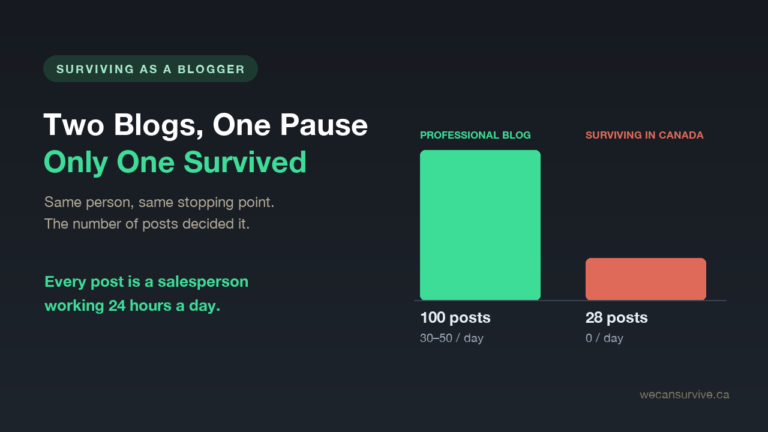
The first blog — my professional field. My first blog is about my actual work, an organized version of what I write regularly. That is the one that got AdSense approval first.
The second blog — Surviving in Canada. Then I started this one, with one strategy in mind: begin with a subject I can write about every single day.
On the first blog there is a subject I can produce a post on daily, and I concentrated there — one post a day, plus one or two special pieces a week.
On Surviving in Canada I narrowed to a single theme: Surviving as a Blogger, covering what a beginner actually runs into. Because:
- It makes the blog’s subject and identity obvious to Google
- It demonstrates depth in one area
- It keeps content quality consistent
Now that the second blog is through as well, I plan to open up — Canadian immigration information, living tips, news summaries.
🎯 The core of approval — unique content
What Google wants
The thing AdSense policy stresses most is unique and valuable content.
Writing that AI simply produces for you has a ceiling. I use AI to write too. But I do not consider a piece that anyone could have produced with AI to be my writing. I try to use AI as a tool to write the piece only I could write.
My content rules
1. Only write what I have experienced or learned myself. Even writing “how to connect AdSense to Tistory,” I recorded where I got stuck doing it and how I got past it. I did not copy other blogs.
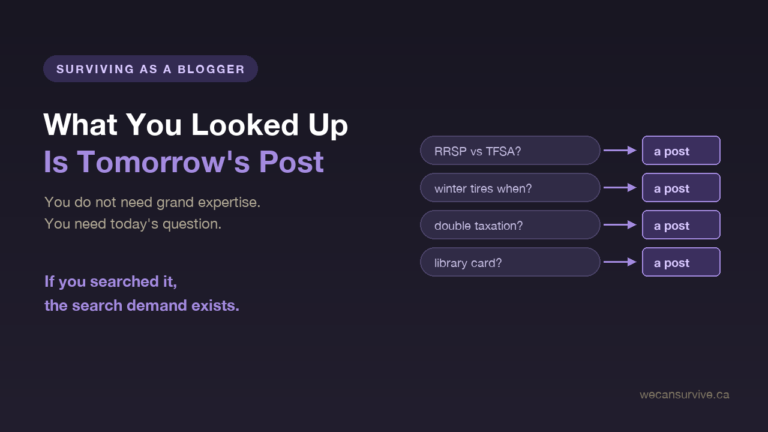
2. What I was curious about, someone else is curious about too. Content that has value to me starts from the assumption it will have value to someone else. I look into what I wondered about, then publish the result.
💡 The writing has to be the point
Revenue is secondary
Beginners fail because they are only looking at the money. How much can I make? What will a month bring in? Then the money does not come and they quit.
I came at it differently:
- The writing itself is my purpose
- Organizing my thinking through a blog is enjoyable
- Recording what I learn makes me understand it more deeply
- Writing something useful to someone is its own reward
Money from AdSense is nice; no money is also fine. The writing is worth doing on its own terms.
That mindset is why I could keep going for 24 straight days.
🚀 Next — a second and third blog
Surviving in Canada is actually my second blog. The first is tied to my profession and exists to record and share my field rather than to earn — its structure does not suit advertising.
So I needed a separate blog for the monetization experiment:
- Blog one — professional, pure content
- Blog two — immigrant life plus a record of growing as a blogger, monetization experiment
- Blog three — planned, another subject
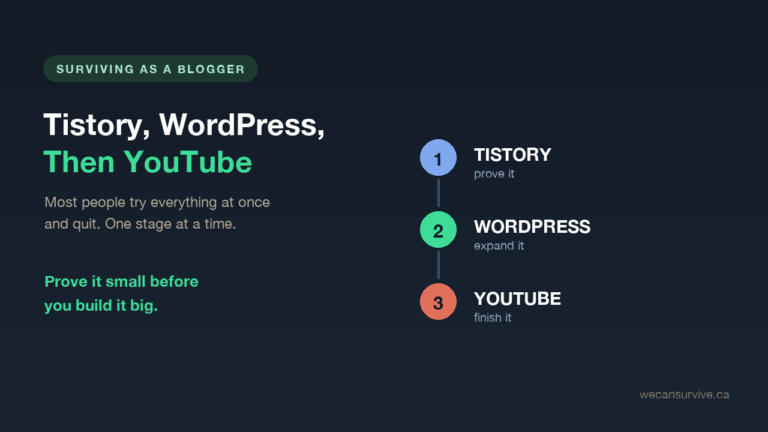
From here: run the revenue experiment, see which posts get clicks, optimize ad placement. Open the third blog with the same strategy. And prepare to move to WordPress once I have enough experience on Tistory, running several blogs at once.
🎯 AdSense approval is not that hard
Why I got approved in 24 days:
✅ Used my own domain from day one — credibility, and an easier platform migration later.
✅ Finished the technical setup first — Search Console, AdSense code, ads.txt.
✅ Published consistently, Monday to Friday — at least one a day, so Google reads the site as active. Possible because writing was already my work.
✅ Produced unique content — only what I experienced, real value for the reader, and a content structure I could sustain daily.
✅ Enjoyed the writing — the revenue was secondary, which is what made consistency possible.
You can do this too
If you are preparing for approval right now, remember one thing:
“Do not wait until you are perfectly ready. Start today.”
Buy the domain today. Open the blog today. Write the first post today. Apply today.
The technical parts are all a Google search away. What matters is doing it.
A month before this, I barely knew what a blog was. Twenty-four days later I was approved.
This is the start, not the finish
Approval is a starting line. The real questions begin now: will there actually be revenue, how do more people find the blog, what content is genuinely most useful.
I will keep recording all of it here.
Let’s survive together.
If this was useful, bookmark it or pass it along. It genuinely helps me write the next one.
I can survive. We can survive.