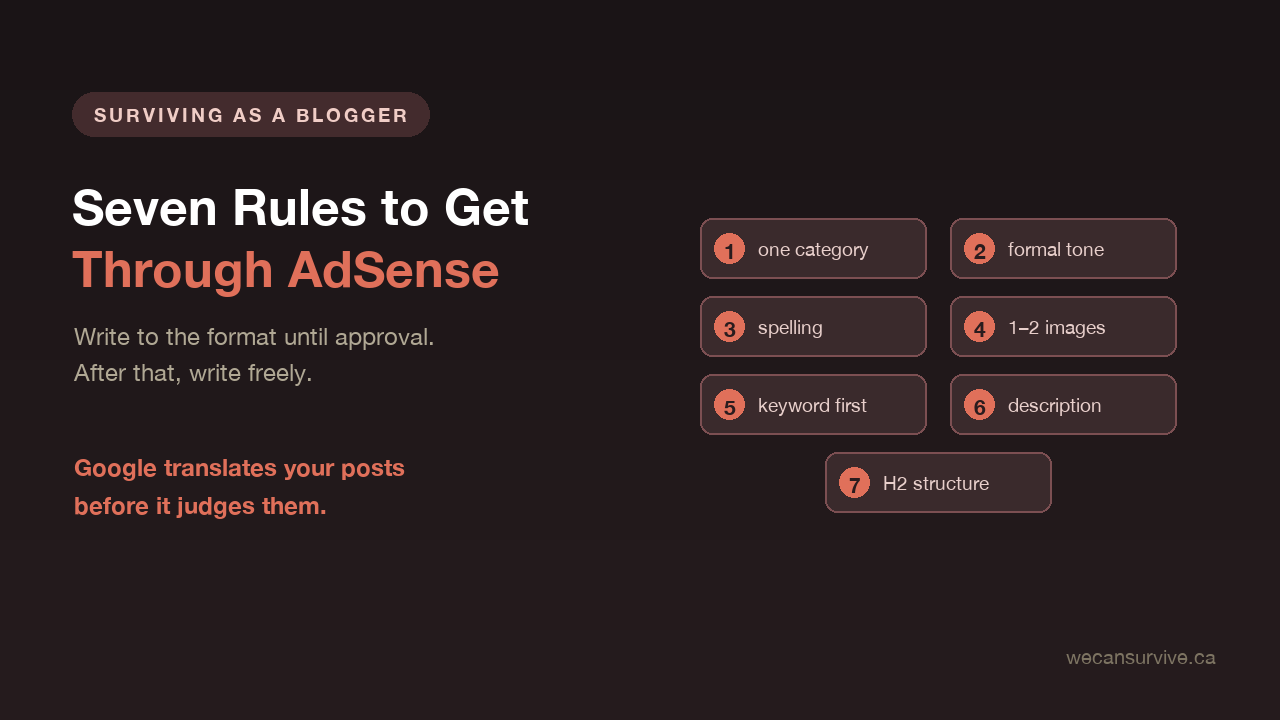
Seven Rules for Getting Through AdSense Review
This is Mr. Can.
I covered connecting AdSense to a blog previously. Today, something more important: how to write while you are waiting for approval.
I assumed you just write good posts. Then I watched a walkthrough by someone who has been through AdSense approval 330 times, and understood something. Writing before approval and writing after approval are two different jobs.
Here are the rules, as I learned them.
A note for English readers. I write mainly in Korean, and a few of these rules exist specifically because of that — Google translates non-English posts into English to assess them, so how the Korean reads matters. I have kept those rules in and marked them, because the reasoning behind them is useful whatever language you write in.
Start from Google’s point of view
Before the rules, the concept that makes them make sense.
Google works for advertisers. When it decides whether to place ads on a blog, the question it is answering is will advertising here work? So it filters for blogs that look professional and trustworthy.
And a detail that surprised me: Google translates Korean posts into English to analyze them. Once you know that, it becomes clear why writing style and spelling matter so much.
Follow the format strictly until you are approved. After that, you can write however you like.
Rule 1 — one category only
Use a single category until you are approved.
A blog covering many subjects reads as lacking expertise. Cooking, parenting and travel in one place, and Google is left asking what this blog even is.
A blog focused on one subject scores better on both ad effectiveness and trust.
In practice: post in one category until approval, add others afterwards.
Rule 2 — write formally (Korean-language specific)
This was the one that shook me.
Writing a blog, you naturally want to be friendly and conversational. During the approval window, do not.
Why? When Google translates the Korean into English, conversational forms distort. Korean laughter particles and casual sentence endings either fail to translate or come out strange.
Use the formal written endings. It feels stiff. Hold it for the approval window only.
Writing in English? The equivalent lesson is that the review reads your prose literally. Clear, plain, complete sentences beat chatty ones.
Rule 3 — check your spelling (Korean-language specific)
Wrong spelling distorts the English translation.
In Korean, confusing 되다 and 돼다, or 않 and 안, can make a translation engine read a completely different meaning.
Run a spell checker after you finish. The general point holds in any language: errors change what the reviewer reads.
Rule 4 — one or two images, no more
More photos feel better. During review, use one, at most two.
- Many images slow the blog down
- Google treats responsiveness as an assessment factor
- Slow blog = poor user experience = marks off
Use only images directly relevant to the post, source them from free image sites, and pick sensible file sizes over maximum resolution.
Rule 5 — structure the title
Keep titles short, and put the main keyword at the front.
Good
- “Gamjatang recipe — a 10,000-won meal for three”
- “Connecting AdSense to Tistory — a beginner’s guide”
Bad
- “Something I cooked today” — far too vague
- “Let me introduce a really delicious gamjatang recipe” — keyword buried at the back
Keyword first, and the search engine grasps the subject more cleanly.
Rule 6 — fill in the description
Fill the description field when you publish.
- About 160 characters
- The main keyword must appear exactly once, spacing included
- Summarize the core of the post
If the main keyword is “gamjatang recipe,” that exact phrase belongs in the description.
Rule 7 — standardize the body structure
Write as subheading + section, repeated.
- Subheading 1 (H2) + roughly 500 characters
- Subheading 2 (H2) + roughly 500 characters
- Subheading 3 (H2) + roughly 500 characters
Three or four subheadings puts the post at 1,500–1,800 Korean characters, which is enough.
Why the heading tags matter — title is H1, subheadings H2, sub-subheadings H3 and H4. Google’s crawler reads the structure of your post from those tags. Get them wrong and you can be judged as having no content value.
Posting standards
Length — 1,500–1,800 characters, about one A4 page. Neither too short nor too long.
Number of posts — at least 20 recommended. You can apply past 15. Keep posting until the decision comes.
Spacing between posts — this one matters a great deal
- ❌ Do not dump ten posts in one day
- ✅ Two or three a day is right
- ✅ Leave at least an hour between them
Why? Google assumes a human cannot properly write 1,500+ characters in under an hour. Several posts appearing in quick succession invites suspicion of auto-generated or copied content.
Subjects to avoid
These work against approval or get you rejected outright: adult content, violent content, gambling, discrimination and hate, and medical or health content — approach that last one carefully.
What about product reviews? Reviews themselves are fine. But add affiliate links only after approval. Affiliate links present before approval can get you classified as a sales blog and rejected.
Two more things
Use Chrome. Apply from Google’s own browser. It can only help.
Timing. Approval typically takes one to four weeks. Keep publishing throughout the review.
Closing
These rules feel constricting at first. You want to write comfortably, and instead you are being formal, rationing images, and confining yourself to one category.
But it is only until approval. Once through, you write freely again. So hold the line for that window and follow the rules properly.
I am working through them myself, step by step. Let’s get approved, and let’s survive together.
If this was useful, bookmark it or pass it along. It genuinely helps me write the next one.
I can survive. We can survive.