What You Were Curious About Today Is Tomorrow’s Blog Post
What on earth do I write about?
It is the question that arrives the moment you start a blog. Try to write daily and the material seems to run dry immediately; force a subject and the writing goes flat. I spent a lot of my first weeks stuck there.
This is Mr. Can. Today, the easiest and most natural way I have found to come up with material.
Your own curiosity is the content
About three weeks into blogging, something clicked.
What I am curious about, other people are curious about too.
That was a genuinely useful discovery. I did not need to hunt for grand subjects. The things I searched for in the course of an ordinary day — those were the material.
What I have actually been looking up lately
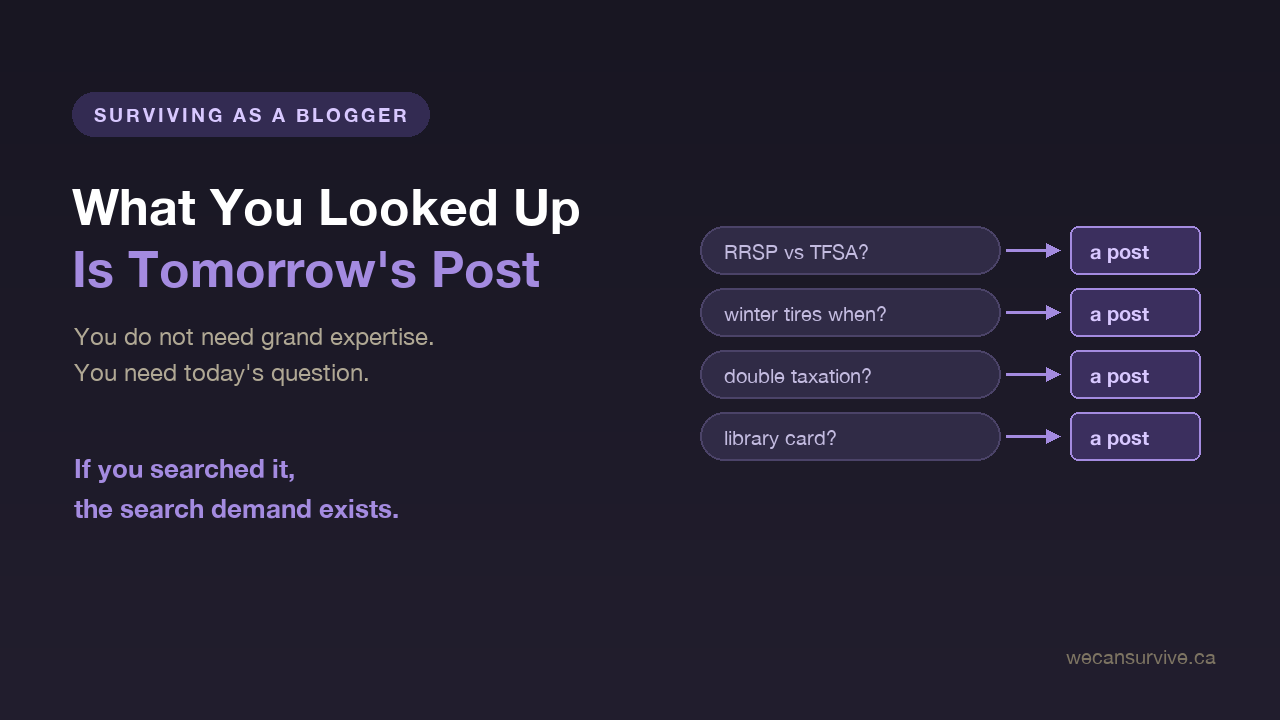
- Investing — opening a Canadian brokerage account, RRSP versus TFSA, timing a currency conversion
- Life in Canada — cutting winter heating costs, when groceries go on sale, getting the most out of a public library
- Taxes — avoiding double taxation between Korea and Canada, foreign account reporting obligations
- Immigration policy — changes to permanent residence requirements, moving from a work permit to PR
- Car maintenance — when to swap winter tires, which engine oil, how long a battery lasts
- Buying used cars — private sale versus dealership, how to pull a vehicle history
Every one of those is something I genuinely wanted to know and went looking for.
Why turn curiosity into posts
1. You can find it again
You search, you get the answer, and a few days later you need it again — and there you are searching a second time, wondering where you saw it.
Written on the blog, it becomes a knowledge store for yourself. Always retrievable, and the act of organizing it makes you understand it better.
2. Someone else has the same problem, guaranteed
What I want to know is not unique to me. Plenty of Koreans who moved to Canada are typing the same questions. People confused by car servicing, people who find the tax system opaque, people about to start investing — all looking for the same information.
The fact that I searched for it is proof that search demand exists.
3. Add your experience and it becomes worth something
This is not copy-pasting search results.
Add what you actually did, what you got wrong, how you worked around it, and it becomes original content.
For example:
- Buying a used car → what actually happened while buying one
- Filing taxes → where I got stuck doing it myself, and how I solved it
- Opening an investment account → the tips you only learn in the process
Real experience puts a piece in a different category from a plain information post.
The honest part — it takes longer than you think
I will be straight: this is not effortless.
Write a post every time something makes you curious is a simple sentence that costs real time and energy.
- Time to search and gather
- Time to organize and write
- Time to shape it into a post
- Time to prepare images or screenshots
One post takes longer than you expect. One to two hours if it goes fast; three or four if you do it properly.
And you keep doing it anyway
Because surviving as a blogger requires it.
It is slow and hard at first, then it speeds up. A pattern forms, a routine sets, it becomes something your body knows.
And above all, each post that stacks up becomes an asset. What you write today is still pulling in search traffic — and revenue — six months and a year from now.
But I am interested in too many things
Listing my interests, they are all over the place: investing, life in Canada, taxes, immigration policy, car maintenance, used cars.
If I cover all of that, doesn’t the blog lose its direction?
I worried about that too. Then I changed my mind.
A blog reflects a life
My blog is called Surviving in Canada.
To survive in Canada you have to know all of it. You invest, you pay taxes, you keep a car running, you track immigration policy.
So every one of those subjects connects naturally under the frame of surviving.
Categories do the tidying
Diverse subjects are fine if categories let readers find what they came for:
- Settling in Canada — immigration, daily life, culture
- Money — investing, taxes, banking
- Cars and driving — used cars, servicing, insurance
- Surviving as a blogger — how to run a blog
What I am doing from today
Simple: every thing I get curious enough to search, I leave as a post.
Obviously not every search. But anything that meets these three:
- I researched it properly
- I actually did it
- It looks useful to someone else
Small execution compounds
Each post looks small. Stacked, they become a serious asset.
Ten posts gather a hundred people; a hundred posts gather ten thousand. Revenue appears in there, influence appears, and an identity as a blogger settles into place.
Turn the curiosity into the content
Blog material is not far away.
You do not need grand expertise, and you do not need an unusual life.
The thing you looked up today, because you wanted to know — that is the material.
And recording it consistently is the way to survive as a blogger.
What were you curious about today? Leave it as a post. And let’s survive together.
If this was useful, bookmark it or pass it along. It genuinely helps me write the next one.
I can survive. We can survive.