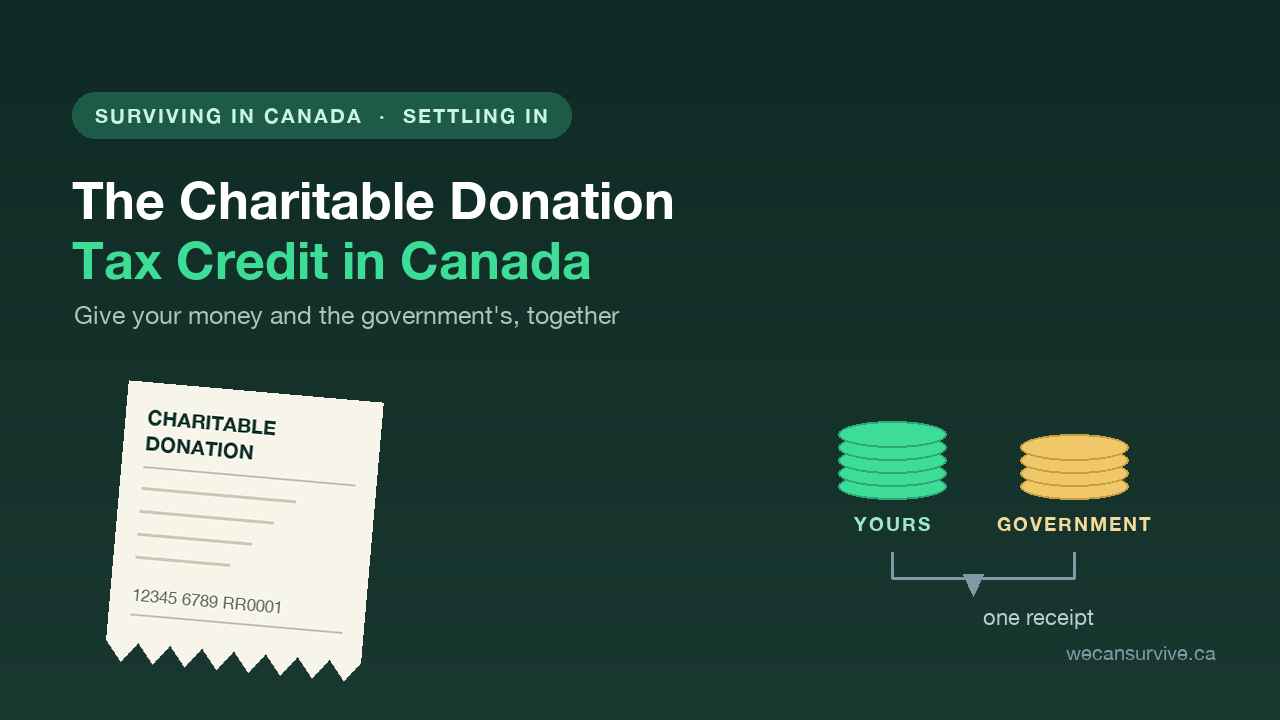
The Charitable Donation Tax Credit in Canada: Giving With the Government’s Money
Live in Canada long enough and every spring brings a tax return. Somewhere in that process you run into a phrase — the charitable donation tax credit.
Most people have heard of it. Far fewer can answer the actual question: so how much comes back? I could not either, for years.
Here is how one receipt turns into money off your tax bill, and who it helps most.
The one-line version
Canada’s donation credit is a system for giving your money and the government’s money together, to a charity you picked.
That sounds like an exaggeration until you run the numbers. The government covers close to half.
How it works — two bands
The credit has two tiers. For a BC resident, in the 2026 tax year:
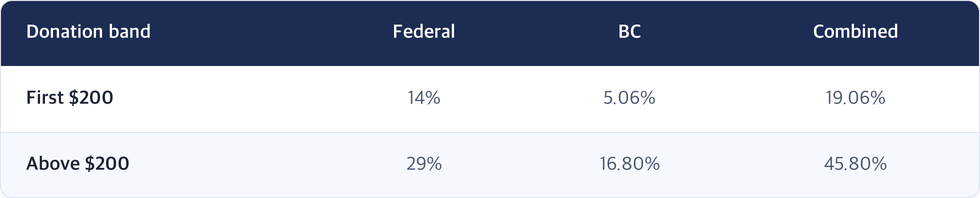
Say you gave $1,000 over the year:
- First $200 × 19.06% = $38
- Remaining $800 × 45.80% = $366
- About $404 comes straight off your tax
The important word is credit, not deduction. A deduction lowers your income, so it saves you only your own marginal rate. A credit is subtracted from tax already calculated, at a fixed percentage. That is a much better deal.
Why it is unusual — compared with your marginal rate
In BC, someone earning between $50K and $100K pays roughly 21% to 28% on the next dollar they earn. Ordinary tax tools — RRSP contributions, rental expenses — save you exactly that marginal rate and no more.
The donation credit above $200 runs at 45.8%. Close to double.
Same $1,000, three different places to put it, assuming a 21.7% marginal rate:
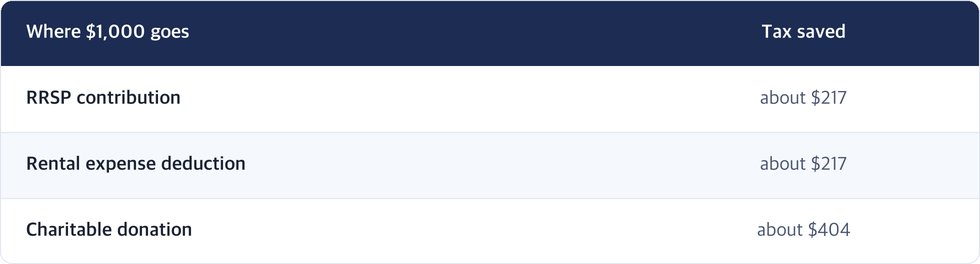
Which is why “giving alongside the government” is not really a stretch.
Who benefits most
Taxable income roughly $50K–$180K — the credit rate sits far above your marginal rate. This is the sweet spot.
Low income, or a spouse with no income — this is a non-refundable credit. If you owe little tax, leftover credit does nothing for you. Transfer the receipts to the higher-earning spouse and claim there.
High income, over about $246K — the gap narrows but it still works in your favour. And if you donate appreciated shares directly instead of selling them first, the capital gain is exempt as well.
Couples should always combine
It does not matter whose name is on the receipt — a couple can pool their donations and have one person claim all of them.
Do not split them. Put everything on whichever spouse owes more tax. Splitting means the low 19.06% first-$200 band gets applied twice, once on each return, and you lose the difference.
You can carry it forward five years
If your own tax bill was too small to absorb the credit, you can carry it forward for five years (Schedule 9). That said, if your income and marginal rate look about the same each year, there is no reason to bank it — just claim annually.
Do donations to Korean organizations count?
Usually not.
To generate a credit, the recipient has to be a qualified donee registered with the CRA. Most non-profits headquartered in Korea are not registered, so a Canadian credit does not follow.
Checking is easy. A registered charity’s receipt carries a nine-digit registration number — something like 12345 6789 RR0001. You can also search the organization by name in the CRA’s List of Charities.
Common misunderstandings
- “Donate and you get it all back” → No. If your tax is zero, nothing comes back. It is non-refundable.
- “Only the person named on the receipt can claim it” → No. Couples can combine.
- “Only cash counts” → No. Shares and securities count, and they are actually more efficient.
- “Use it or lose it” → No. Five-year carry-forward.
To sum up
- About 19% on the first $200, about 45.8% above that — straight off your tax, BC rates
- Give more than $200 in a year or the math never gets interesting
- Couples: pile it all onto whoever owes more tax
- Keep receipts and that nine-digit number for at least six years
- Large gifts or appreciated shares — talk to an accountant
Giving is about giving; the tax treatment is a side effect. But if the money was going somewhere anyway, it is worth knowing that a system exists here where the government carries almost half of it. Surviving in Canada is partly this — turning one system at a time into something that works for you.
General information for a BC resident, 2026 tax year. The federal rate on the first $200 follows the lowest personal income tax rate, which dropped to 14.5% in 2025 and 14% in 2026. Individual situations — large gifts, donated securities — warrant an accountant.
If this was useful, bookmark it or pass it along. It genuinely helps me write the next one.
I can survive. We can survive.