You Cannot Predict the Market, But You Can Respond: My Rebalancing System
What I have learned studying stocks is simple.
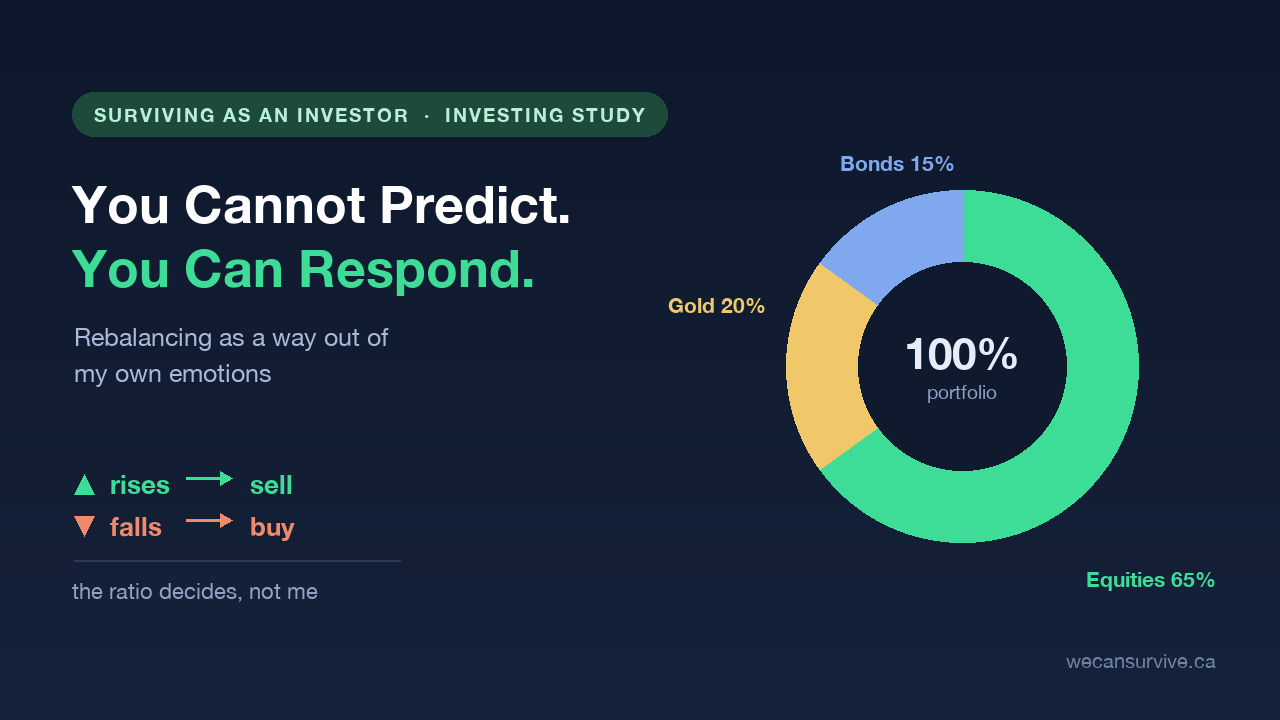
You cannot predict. But you can respond to what has already happened.
Sell when the market rises, buy when it falls. Easy to say, hard to do. So I decided to move it out of the territory of emotion and into the territory of structure.
The question I kept asking myself: how do I manufacture the courage to buy when things have fallen? How do I train the satisfaction it takes to sell when things are up? That question is what led me to rebalancing.
Why rebalancing
Rebalancing is not just a technique for keeping portfolio weights tidy. For me it is a framework for training my way out of my own emotions.
Everyone moves between greed and fear. When a price rises, the greed says it will rise further. When it falls, the fear says this is over.
Rebalancing means I do not have to judge in that moment. I just keep to a fixed ratio. The ratio buys and sells on my behalf.
My structure
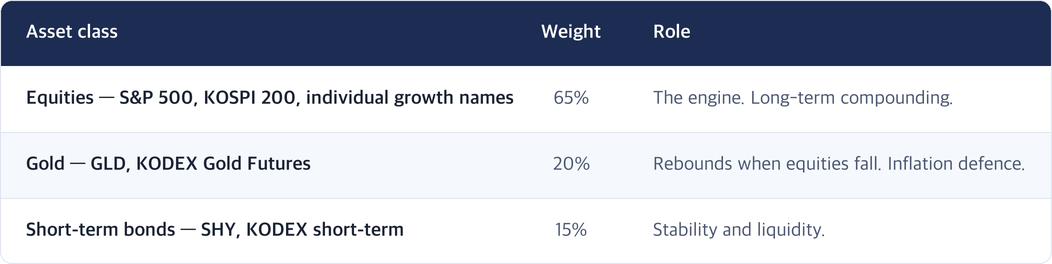
It looks simple, and it is strong precisely because these assets move against one another.
When equities rise, gold and bonds stall or weaken. So I sell some equities and top the other two back up.
When equities fall, gold or bonds rally. So I sell some of those and buy equities.
That is the machine: sell into strength, buy into weakness — without me deciding.
What the hedge is really for
The point of rebalancing is a response you prepared in advance.
So that I do not panic when prices fall, I always hold assets that move the other way. Gold and short-term bonds are the obvious ones — they tend to rise when the market is nervous. Which means my portfolio already contains, at all times, something that goes up when stocks go down.
That is why a shaky market does not frighten me. It is the moment my structure starts working. Gold or bonds rise, and that gain becomes the money I use to buy equities. The portfolio builds its own mechanism for buying cheap.
How I actually run it
Two layers.
1. The core portfolio
- Managed by rebalancing
- Full weight review once a year
- If any weight drifts more than 10 percentage points, adjust immediately
2. Monthly dollar-cost averaging
- A fixed amount into an S&P 500 ETF (SPLG or VOO), automatically, every month
- No forecasting. Just compounding, steadily
- This layer is not rebalanced at all
When both run together, I never have to predict the market. Time works for me, and the ratio stands in for my emotions.
Investing is a balance of mind
Investing looks like a numbers game. It is really a game of keeping your mind level — the capacity to be satisfied when things are up, and to find courage when they are down. Rebalancing is what holds that balance for me.
You cannot predict. But you can respond.
If this was useful, bookmark it or pass it along. It genuinely helps me write the next one.
I can survive. We can survive.