Did I Break My Rules, or Change My Mind? (Selling Half My Semis on a 4.6% KOSPI Rally)
Why selling into a 4% up day is harder than it sounds
The whole board is lit up and you’re the one hitting sell. I did it anyway today.
And when the orders filled, I asked myself a question. Did I just break the rules I wrote down, or did my view actually change? This post is my attempt to answer that. Short version: I ended up building five tests to tell the two apart.
This is a log, not a recommendation. I’m not an analyst, and I’m wrong often.
What the market did
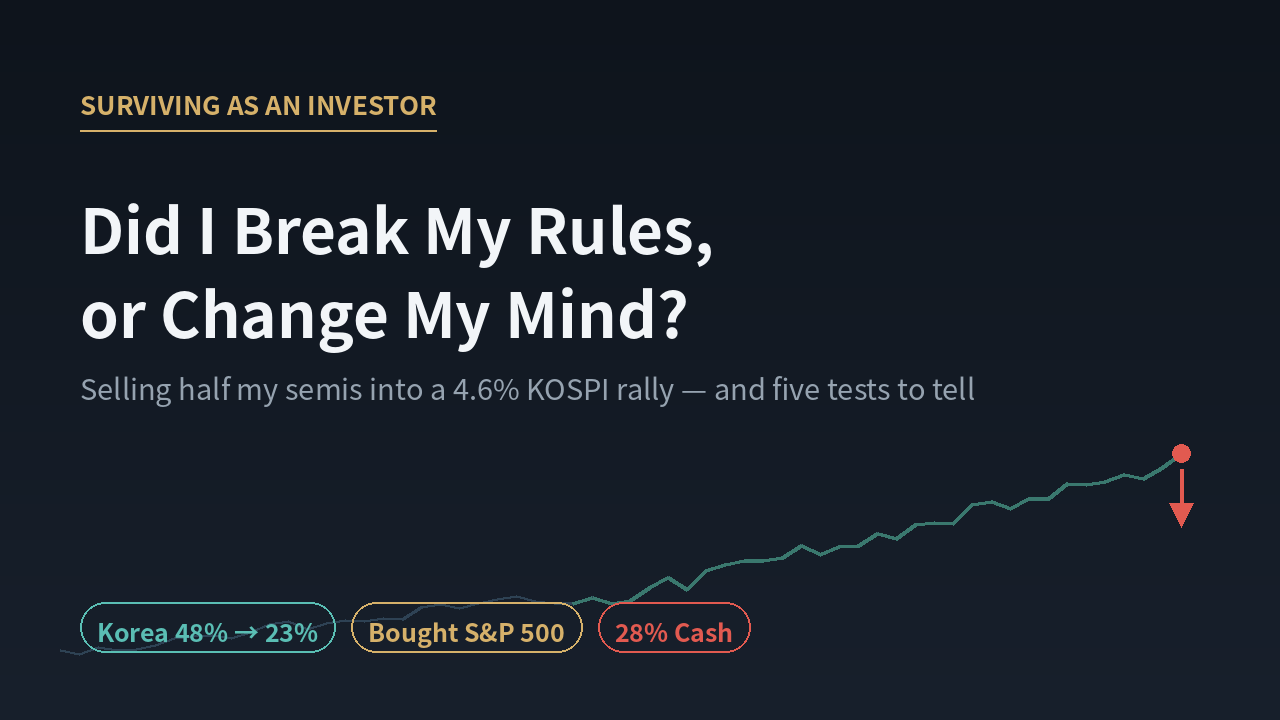
On September 7, 2026, the KOSPI closed at 6,995.39, up 308.18 points, or 4.61%. The rally carried over from a surge in U.S. semiconductor names after OpenAI unveiled its next-generation model. Intraday, SK Hynix rose more than 5% to around 1,740,000 KRW and Samsung Electronics gained over 3%.
On flows, foreigners and institutions each bought roughly 700 billion KRW net, while retail investors sold about 1.68 trillion KRW net. Today I stood on the retail side.
What I changed, and by how much
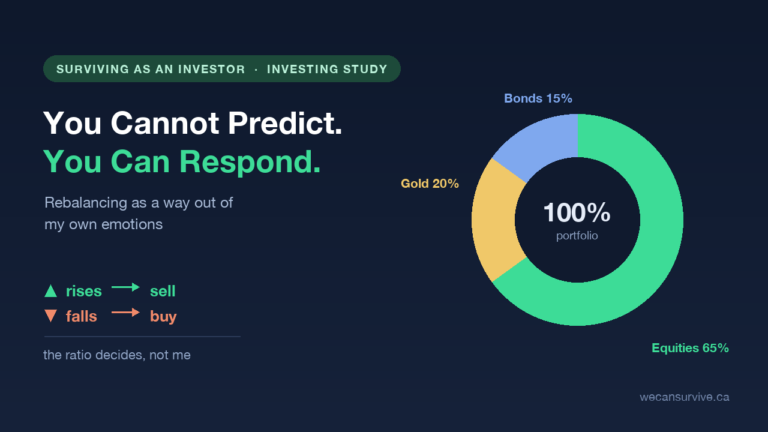
My portfolio runs on preset target weights. When a position drifts far from its target, I pull it back.
| Position | Target | Before | After | Action today |
|---|---|---|---|---|
| Samsung Electronics | 10% | ~26% | ~11% | Sold more than half |
| SK Hynix | 10% | ~11% | ~4% | Sold most of the position |
| KODEX 200 (KOSPI 200 ETF) | 15% | ~12% | ~8% | Partial sell |
| TIGER US S&P 500 | 25% | ~14% | ~17% | New buy |
| Cash | — | ~5% | ~28% | Raised from sale proceeds |
Fill prices: Samsung Electronics 269,000 KRW, SK Hynix 1,770,000 KRW, KODEX 200 110,805 KRW, TIGER US S&P 500 25,730 KRW.
I run accounts by role: Account A for individual stocks, Account B for the ETF core, and Accounts C and D for long-horizon accumulation. Today’s sells came out of A and B. The buy went into C and D.
Position by position it reads as “sold about half.” Added up, it reads differently. My Korean risk assets — Samsung, SK Hynix and the KOSPI 200 ETF combined — went from roughly 48% of the portfolio to roughly 23%. Cut by more than half in one session. I only understood the size of what I’d done after I ran the totals.
Why I sold — my view changed
If the only reason were “one position grew to 2.5 times its target, so I trimmed it,” this post wouldn’t exist. The real reasons are four.
- Sentiment is contracting.
- Korea could become a party to a war. Talk of a Korean naval deployment to the Strait of Hormuz moved fast over the past week. The U.S. has publicly said it is still waiting on Korea, and observers expect a consent bill could reach the National Assembly during September.
- So it will take time to get back to the old highs.
- But eventually it recovers, and grows further.
The fourth one is the key. I don’t think Samsung or SK Hynix are bad companies. I still think they’re good ones. What I changed isn’t “good or bad” — it’s how long it takes to get good.
That matters because it changes what kind of sale this is. Selling because the company got worse is a stop-loss. Selling because the price got expensive is taking profit. But selling because the recovery got further away is reclaiming the chance to earn somewhere else in the meantime. Three different actions that deserve three different scorecards.
Except I broke two of my own rules
Here’s where it gets uncomfortable. I write these things down in advance.
- SK Hynix: “Wait for the shareholder-return announcement at the end of September. Do not sell before it.“
- KODEX 200: still under target weight, so no selling.
I broke both today. I did the opposite of what I’d written.
And that’s a fork in the road. File it as a rule break and I’m an undisciplined investor. File it as a change of view and I’m a flexible one. The trouble is that the two look identical from the outside. Both are “acted differently than what I wrote down.”
Getting this distinction wrong is dangerous, because it lets you relabel every impulsive trade as “my view changed” after the fact. So you need tests.
Five tests for telling a rule break from a change of view
| Test | If it’s a rule break | If it’s a change of view |
|---|---|---|
| Timing | Impulsive, mid-session; reasons arrive later | Decided before acting, written down that day |
| Basis | The price moved | A fact outside the price changed |
| Scope | You touch one position | You touch every asset the logic applies to |
| Symmetry | Only the sell side moves | Assets outside that logic are held, or bought more |
| Aftermath | The rule stays as it was | The rule gets updated |
Running my own case through it:
- Timing — decided before the sells, written up the same day. ✅ (There’s more to this one. Next section.)
- Basis — not the price, but the deployment story. ✅
- Scope — not one name; three Korean risk assets at once. ✅
- Symmetry — same industry, but I didn’t sell my U.S. semiconductors, and I bought more U.S. index. ✅
- Aftermath — I haven’t updated the rules. ❌
Four out of five. Tests three and four are what convinced me. If I’d only sold Hynix, that’s just me being annoyed at Hynix. Instead I cut everything the logic touched and left alone — or added to — everything it didn’t. Impulse doesn’t produce that kind of consistency. Impulse hits one name.
The evidence that actually convinced me — I deleted my own better price
What settled it for me wasn’t the table. It was something I did right before selling.
Account B had standing sell orders on Samsung Electronics from last month: 295,000 KRW and 310,000 KRW, good-till-date orders that would fill automatically if the price got there. They still had about three weeks to run.
Today I cancelled those orders and sold at 269,000 on the market.
On the numbers that’s a strange thing to do. I deleted an order sitting at 295,000 and sold 8.8% lower instead. I had time to wait, and I had a better price waiting for me, and I erased it myself.
Which turned out to be the answer.
Someone still attached to the price doesn’t delete the order. They leave it and wait. Cancelling takes an extra deliberate step, and it’s the step that makes selling now possible. So the sequence was: decide to sell, then clear the obstacle. If the sequence had been the other way around, the orders would still be sitting there.
It’s also hard to call it panic. Panic sells when the price is collapsing. Today the index was up 4.6%.
Four things line up at once:
- Sold into a rally → not panic
- Deleted my own better price → not attached to price
- Cut everything the logic touched → not impulse
- Bought what the logic didn’t touch → not fear
Only one reading explains all four. What changed wasn’t my view of the price. It was my view of the time. That’s reason three above — it takes longer to get back.
So I failed the fifth test
Which means today’s actual homework isn’t “I broke a rule.” It’s “I changed my view and left the rules where they were.”
Leave that alone and here’s what happens: next time I open my notes, I grade today’s behavior against last month’s rules. I actually did exactly that once already. Writing up the trades right after the close, I logged them as “two rule violations” — because the rules on file were still the August version.
A change of view is only complete when three things happen: the action, the write-up, and the rule update. Do the first two and skip the third and you’re not finished.
My words and my trades didn’t match — and the trades were righter
One more thing I found while writing this up. I first described it to myself as “my view on semiconductors changed.” Then I looked at what I actually sold.
| Asset | Semiconductor? | Korean asset? | Today |
|---|---|---|---|
| SK Hynix | Yes | Yes | Cut sharply |
| Samsung Electronics | Yes | Yes | Cut sharply |
| KODEX 200 | Partly | Yes | Trimmed |
| U.S. large-cap semiconductor | Yes | No | Held |
| TIGER US S&P 500 | Partly | No | Bought |
If my semiconductor view had changed, I’d have cut the U.S. semis too. I didn’t. The real criterion behind my trades wasn’t “semiconductors.” It was “Korea.”
And the trades were more accurate than my words. All three reasons I gave — contracting sentiment, war risk, delayed recovery — are Korea variables. Semiconductor demand itself looks fine. That’s literally why the index rallied today.
What you name a decision determines your next decision. File this as “cutting semiconductors” and next time I’ll sell the U.S. names too. File it as “cutting Korean assets” and the buy-back condition sharpens into “when the Korea risk clears.” So I renamed it.
Why the S&P 500 specifically — the currency
The reason the proceeds went into a U.S. index is the exchange rate.
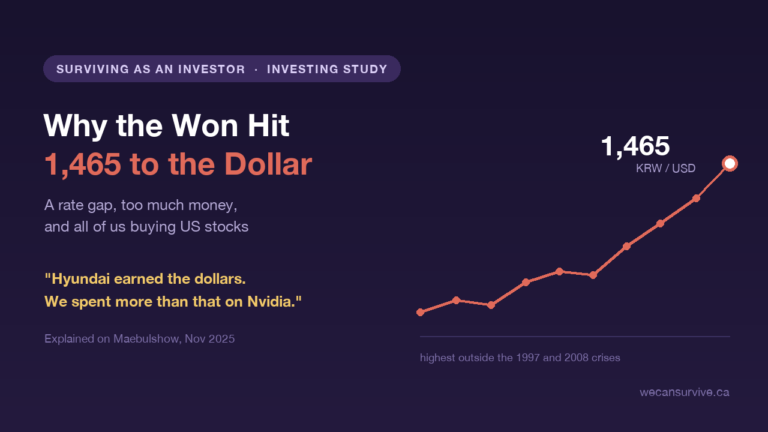
The won has strengthened to around 1,340 per U.S. dollar, roughly a two-year high. It was near 1,500 as recently as this spring, so the move is more than 10%.
For someone buying U.S. assets in won, that means the same money buys more. The S&P 500 you buy at 1,340 is not the same product as the S&P 500 you buy at 1,500. If the rate ever reverts, that gap lands directly on your return. Which also means the reverse: holding won while the won is strong is a slow, quiet loss.
So I put roughly half the idle cash in Accounts C and D into a U.S. S&P 500 ETF. Those accounts have a ten-year-plus horizon, and adding U.S. exposure while the currency is in my favor is exactly what that horizon is for.
What’s still open
First, I still haven’t updated the rules. That fifth test. This week’s job.
Second, I sold without buying. Today’s purchases came to barely 10% of what I sold. The rest sits in won. But look at what I wrote one section ago: holding won while the won is strong is a slow loss. By my own logic that cash should already be converted. Before the sales I had nothing to convert. Now I do.
Third, I wrote “buy the names where an opportunity shows up” without defining “opportunity.” A plan without a definition isn’t a plan, it’s a wish.
The one thing I learned today
Selling has triggers. Buying doesn’t.
On a big up day, “should I sell?” arrives on its own. On a big down day, what arrives first isn’t “should I buy?” but “what if it falls further?” So the market hands you your sell decisions and you have to manufacture your buy decisions. My 10% buy-to-sell ratio today wasn’t a willpower problem. It was structural: I had no mechanism attached to buying.
From now on the buys go in as standing orders too, so they execute whether the index is up or down.
If this was useful, bookmark it or pass it to someone wrestling with the same question. I learn from your logs too.
I can survive. We can survive.
This is a personal trading log, not investment advice. Investment decisions and their outcomes rest with the investor.