The Company Still Standing After the AI Race: Why I Stay an Apple Shareholder
Some people buy Tesla. Some people buy Nvidia. Lately the Korean market is hot and everyone is chasing SK Hynix. These are the names that move in big jumps, people say.
My hand never went there. It was strange. And today I finally understood why my own hand kept refusing.
This post is a record of that.
1. It started with one video
I watched a market analysis broadcast today — Kwak Sang-jun of Matrix Investment Advisory talking about the KOSPI, the US market, and where the AI industry goes next. I watched it twice, and pulled one message out of it.
📺 Source — News High Kick: the KOSPI hits another high on retail buying despite foreign selling (Kwak Sang-jun, MBC, 13 May 2026)
An era of inflation and high rates is coming. The companies that survive it are the ones with strong revenue and very little debt.
That sentence lodged itself in my head. Following it led me somewhere.
2. The AI race may end sooner than we think
Money is pouring into AI right now. Two hundred billion dollars per company just to build data centres. Nobody funds that out of pocket. They borrow from private equity, from asset managers, from the bond market. There have been reports of data centres where 90% of the build cost is borrowed.
And rates are going up. British politics is shaking the bond market, the Middle East is unresolved and pushing inflation back up, and Chinese producer prices are rising again. Global rates are moving up together.
Companies running on borrowed money die in that environment. Among the firms that jumped into the AI race, the ones without the balance sheet will not reach the finish line.
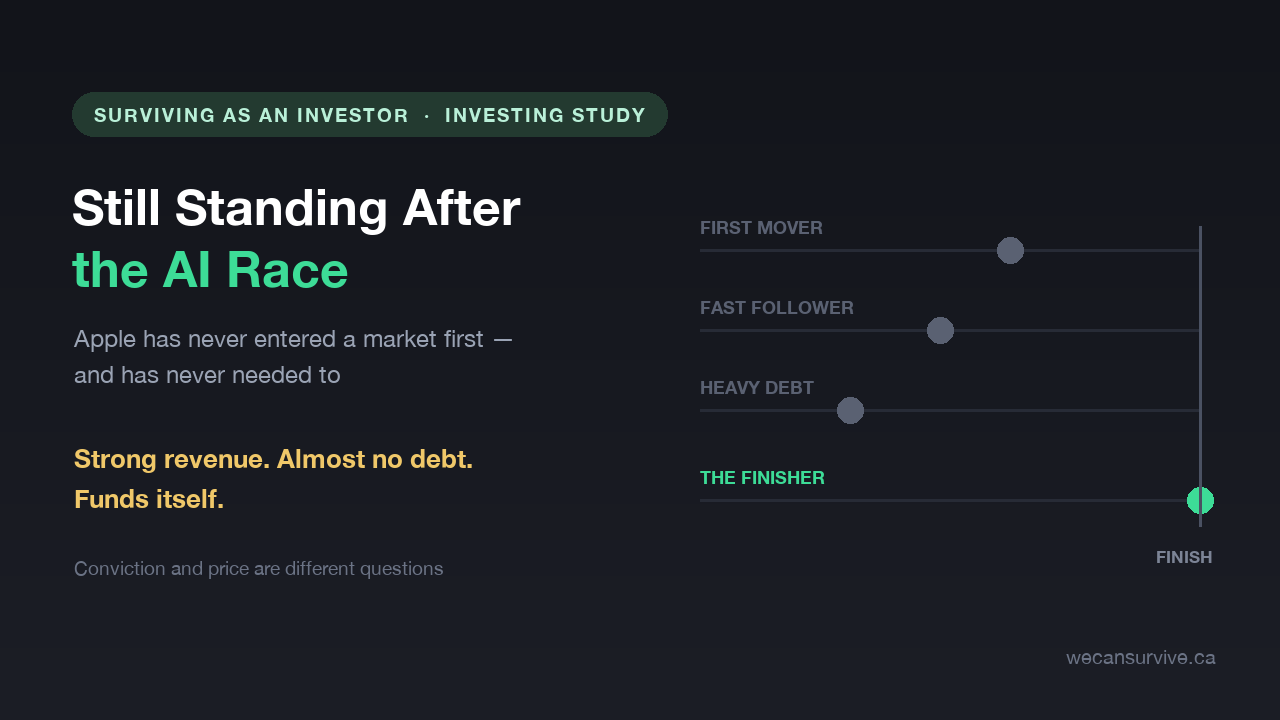
So who is left standing? Strong revenue, almost no debt, able to fund itself.
One company came to mind. Apple.
3. Everyone buys Tesla. Why couldn’t I?
I did reasonably well in this cycle of the Korean market — cutting on the crash, re-entering as it turned, running automatic top-ups. Some luck, but mostly the result of rules I set in advance.
Then came the question of where to move that money, and I could not make myself go where everyone else was going. Tesla swings too hard. So does Nvidia. Up in leaps and down in leaps. There are people who take money out of that well. I am not confident holding anything I would have to watch the chart of every day.
I live in Canada. There is a time difference, there is a day job, there is a family. I needed something that works while I am doing something else.
Today it finally settled into words. The stock I want is not the one that jumps. It is the one that is still standing in five years, moving slowly.
And that is not a weakness — it is my edge. There is a game of making money fast and a game of going slowly and solidly. They are different games, and I am built for the second one. I think the investors who get hurt worst are the ones who start without knowing which game they are in.
4. Apple has never once entered first
I spent a while on this part.
I wanted to know why Apple ended up behind in AI. While ChatGPT turned the world over, Google shipped Gemini, Meta released Llama and Musk built xAI — what was Apple doing? Holding on to Siri. People said Apple had fallen behind.
But look at Apple’s history. Apple has always been late.
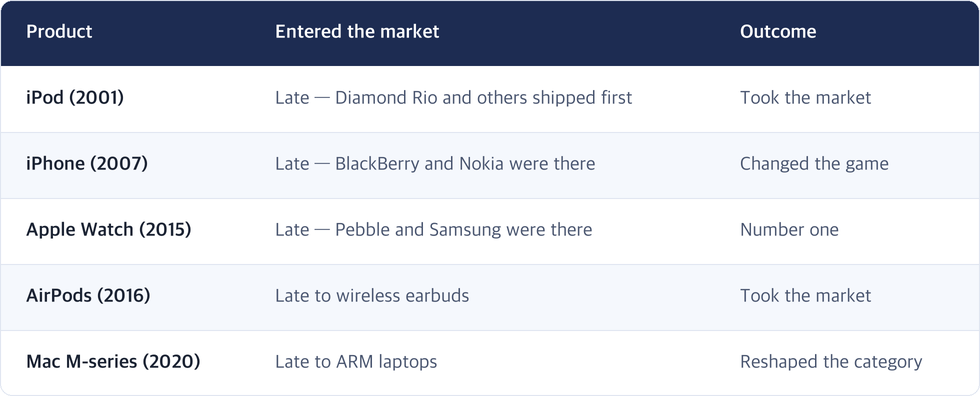
Apple has never been first. It arrives after the market has sorted itself out, and then takes the market on completeness.
I gave the pattern a name: the finisher model.
The first mover paves the road. The finisher puts the best car on it. People end up driving the good car.
The same pattern is running in AI. ChatGPT sprinted first, Google caught up, Musk pushed in, everyone is burning money on their own model. Meanwhile Apple has quietly been refining its own silicon — the M-series and A-series — building device integration and hardening a closed ecosystem.
5. Why not having its own model is fine
Someone will say Apple has no LLM of its own. True. Apple Intelligence currently embeds OpenAI’s ChatGPT. It has no brain of its own.
But think it through — does Apple need to build one from scratch?
AI has to run somewhere. On a phone, a tablet, a laptop, a watch, a car, a pair of glasses. And only one company owns all of those devices at once. Plenty of companies make models. One company makes the hardware every user is already holding.
So the real game is this: whose device does AI run on most naturally?
And at the end of that game, the company that builds hardware best is the one still there. A model can be licensed, bought, or built later — there is time to be late on models. A device ecosystem cannot be borrowed. It takes twenty years.
Privacy makes it sharper. As it matters more, we need AI that runs on the device without shipping data to someone’s server. The company preparing for that most seriously is Apple — the M-series’ processing headroom, the Private Cloud Compute architecture, the whole design of Apple Intelligence points that way.
So here is where I landed: Apple does not have to win the AI race. It has to own the devices AI ends up running on.
One more thing. When Apple properly ships a small form factor — glasses — I think that is the starting gun. At the moment the interface moves from phone to glasses, “first in device ecosystems” gets repriced.
6. Conviction and price are two different things
Let me be clear about something. Agreeing with Apple’s value is not a reason to buy it expensive today.
These have to stay separate.
- Conviction — the strength to sit still after you have bought
- Price — the standard for deciding when to buy. A different question entirely
Confusing them is dangerous. I like it, so I’ll pay up is where the biggest mistakes come from. The stronger your conviction, the colder you have to be about price. After earnings volatility, in a broad market correction, when the P/E slips under its average — that is when you go in.
Today was a good example. The KOSPI nearly touched 8,000 intraday (7,999) and closed down 2.29%. Foreign investors dumped 5.66 trillion won in a single session. Kwak’s line in the video — the pros have started taking some cash off the table — showed up in the market within hours.
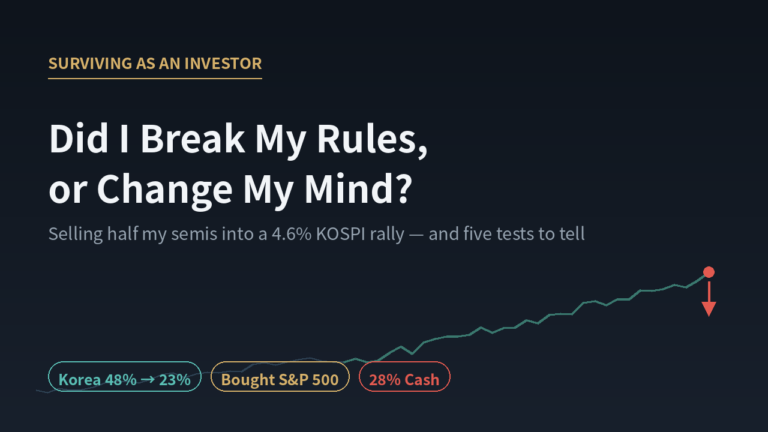
So I took some profit in Korea. That money is now sitting in USD cash, waiting — until Apple gives me a good price. I do not know when that is. Could be this week, could be six months. I will not wander into another name while I wait.
The waiting is the strategy.
7. The slow road
The biggest mistake in investing is entering a game that does not suit you. Everyone tolerates a different amount of volatility, works on a different time horizon, and knows a different field. Accept that, and play only your game.
I have chosen to go slowly. Instead of something that doubles in one move, I buy something that grinds forward over five years. During those five years I can put my attention elsewhere. I am fine without looking at the chart.
That is the investing I can endure, which makes it the investing I can hold to the end. You only get the return if you hold. Throw it away and it is over.
Some of you reading this do not fit the road everyone else is on. That is not a flaw. It is a signal to go find your own game. Slow is fine. The one who makes it to the end wins.
If this was useful, bookmark it or pass it along. It genuinely helps me write the next one.
I can survive. We can survive.