The Day I First Bought KODEX 200 — Memory Lies
A few days ago I got curious. When did I first buy KODEX 200?
I had a picture in my head. Yoon Suk-yeol declares martial law, the KOSPI gets wrecked. Much later the Constitutional Court removes him, and Lee Jae-myung starts talking about “KOSPI 5000.” Somewhere in there I steeled myself and put a fairly large amount into KODEX 200 for the first time. That is how I remembered it.
Then I sat down to write it out and the timing kept sliding. Martial law in December, impeachment passed in December, removal in April — and I could not place exactly where in that span I pressed buy.
How I remembered it
From autumn 2024 I was deep in studying markets. Buying books, working through YouTube channels, following the macro. I collected cases of how markets moved through the currency crisis, the financial crisis, the COVID crash. If a crash ever came, I would act differently from everyone else — I renewed that promise to myself daily.
Then the night of 3 December 2024. Emergency martial law was declared in Korea. I heard it in Canada and just stared at the screen for a long while. The declaration was lifted after six hours, but the market started coming apart that day and by 9 December the KOSPI had been smashed down to around 2,360. A market that had been weak all quarter finally broke.
Days later the National Assembly passed the impeachment motion. After that it was waiting. The Constitutional Court began hearings and each session dragged. Politicians guessed a different date every week — early March, mid-March, or later still. The market lurched with every guess.
Somewhere in that long, grinding stretch, I bought KODEX 200 in real size for the first time. Then Lee Jae-myung won, the KOSPI climbed steeply, and I rode it — taking profit on the US S&P 500 ETF I had been sitting on and moving properly into the Korean market.
Writing it down, the memory went soft
Having recalled all that, something felt wrong. The broad shape was right, but the order kept tangling.
- Did I buy KODEX 200 before the removal ruling, or after?
- Was it after I heard the “KOSPI 5000” line, or before?
- What was the index at that day?
My brain had a plausible plot. The actual facts ran out between my fingers like sand.
So I opened the trade records
Fortunately I had saved the transaction statement PDF from Samsung Securities — a full year of 2025 trades, buys, sells, deposits and withdrawals. I looked up the first KODEX 200 purchase.
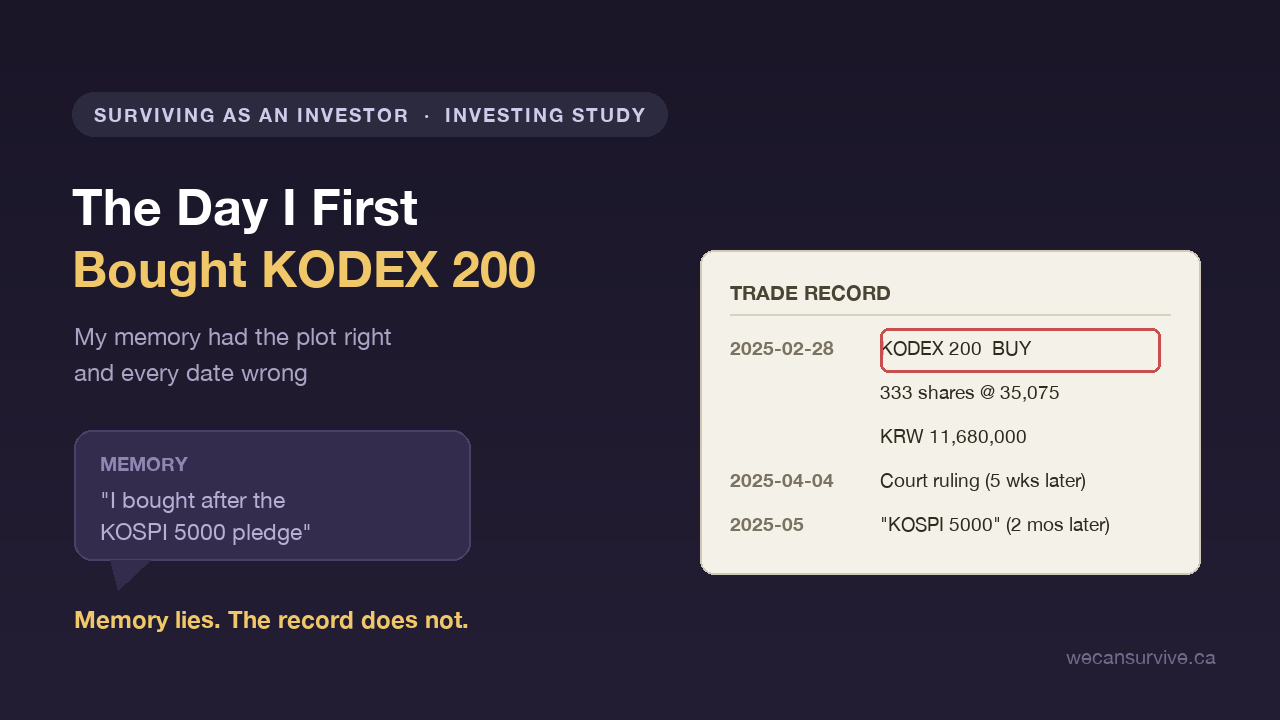
28 February 2025. 333 shares at 35,075 won. About 11.68 million won.
I sat there for a second, because it did not match my memory at all.
What was actually happening that week
I looked up the week either side of 28 February.
- 25 February — the Constitutional Court closed the 11th and final hearing of the impeachment trial, running 8 hours 16 minutes, and began deliberation. Politicians were guessing at a mid-March ruling.
- 28 February — prosecutors indicted nine military and police figures over the martial law declaration without detention. The day the signal the outcome is only a matter of time settled over the market.
- 4 April — the Court removed him from office. Five weeks after I bought.
- Early May — Lee Jae-myung began pushing “KOSPI 5000” in earnest. Two months after I bought.
So my reason for buying KODEX 200 was not “I heard the KOSPI 5000 pledge.” It was not “I felt safe once the Court ruled.” Both of those happened after I was already in.
The real reason: I watched the final hearing close and concluded the outcome was now only a matter of time, and that the market was already pricing it. I bought into the spot where the KOSPI had recovered about 7% off the December low of 2,360 to around 2,500.
Memory lies
It is not that memory is dishonest. Memory rewrites the plot after it learns the ending. It reverse-engineers a motive to fit the result.
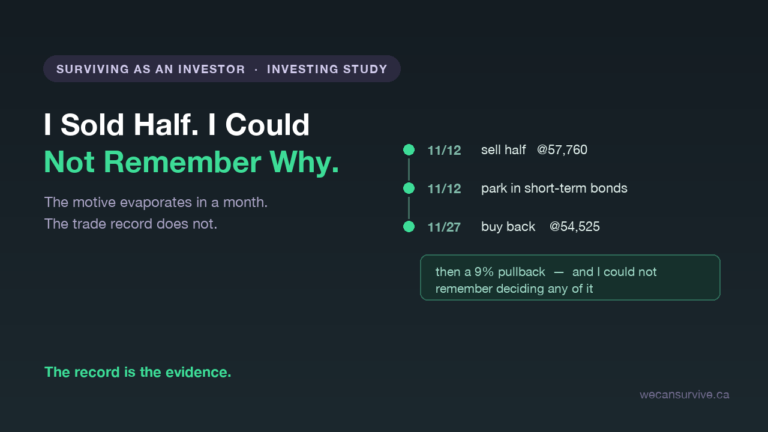
The KOSPI 5000 talk ended up justifying my bet. The index hit 4,100 in November, and on 12 November I took profit on half the KODEX 200 — bought at an average of 38,400, sold at 57,760. Fifty percent recovered.
It was such a good story that my brain built the motive backwards out of the result. I went in because I heard the pledge and thought we were going to 5000. The real reason quietly disappeared, and a motive that suited the ending moved into its place.
Without the record, I would have believed the lie for life
What if I had not had that PDF? What if I had never gone back to look up the news from that day?
I would have spent my life believing I put serious money in because of a politician’s line. And at the next crash I would have made another wrong decision on the back of that wrong memory — listening to a politician worked last time, so whose speech do I wait for now?
Without records you cannot learn. Without learning you restart from the same place every time. I think that is one of the biggest reasons compounding fails to show up in people’s investing.
Which is why I am writing this
No grander reason than this: the truth of that day surfaced, and I wanted to pin it down.
So that when I ask myself in a year, or in five, why did I go in then?, this post answers — with the real motive from that day, not a plot reassembled to match the outcome.
Memory becomes a more convincing lie the longer it sits. Writing it down is the only defence I know.
The one who keeps records survives
One resolution came out of this. Before a trade and right after it, write one line.
How the market looked that day, what news I saw, what I was feeling. Pin the motive next to the price.
That record is worth far more after a loss than after a gain. You have to be able to answer why did I buy this to avoid repeating the same mistake.
An investor’s memory gets stolen if you do not write it down — stolen by the outcome.
The one who keeps records survives. Let’s survive together.
If this was useful, bookmark it or pass it along. It genuinely helps me write the next one.
I can survive. We can survive.