September 28, 2026 KOSPI Market Brief — What to Watch Before the Korean Open
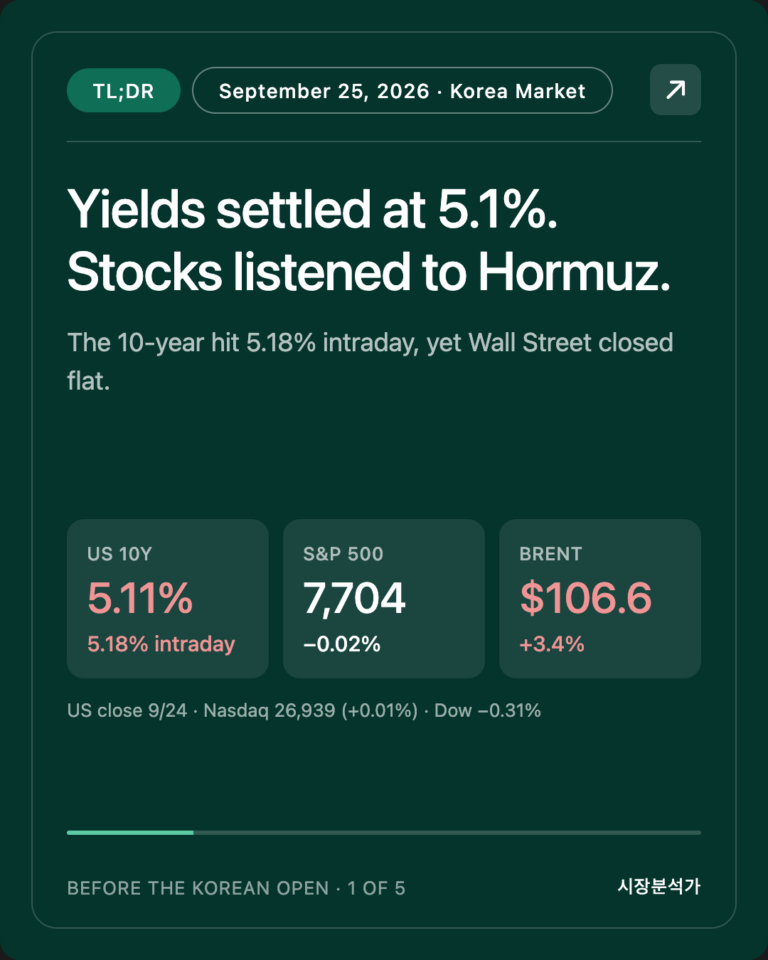
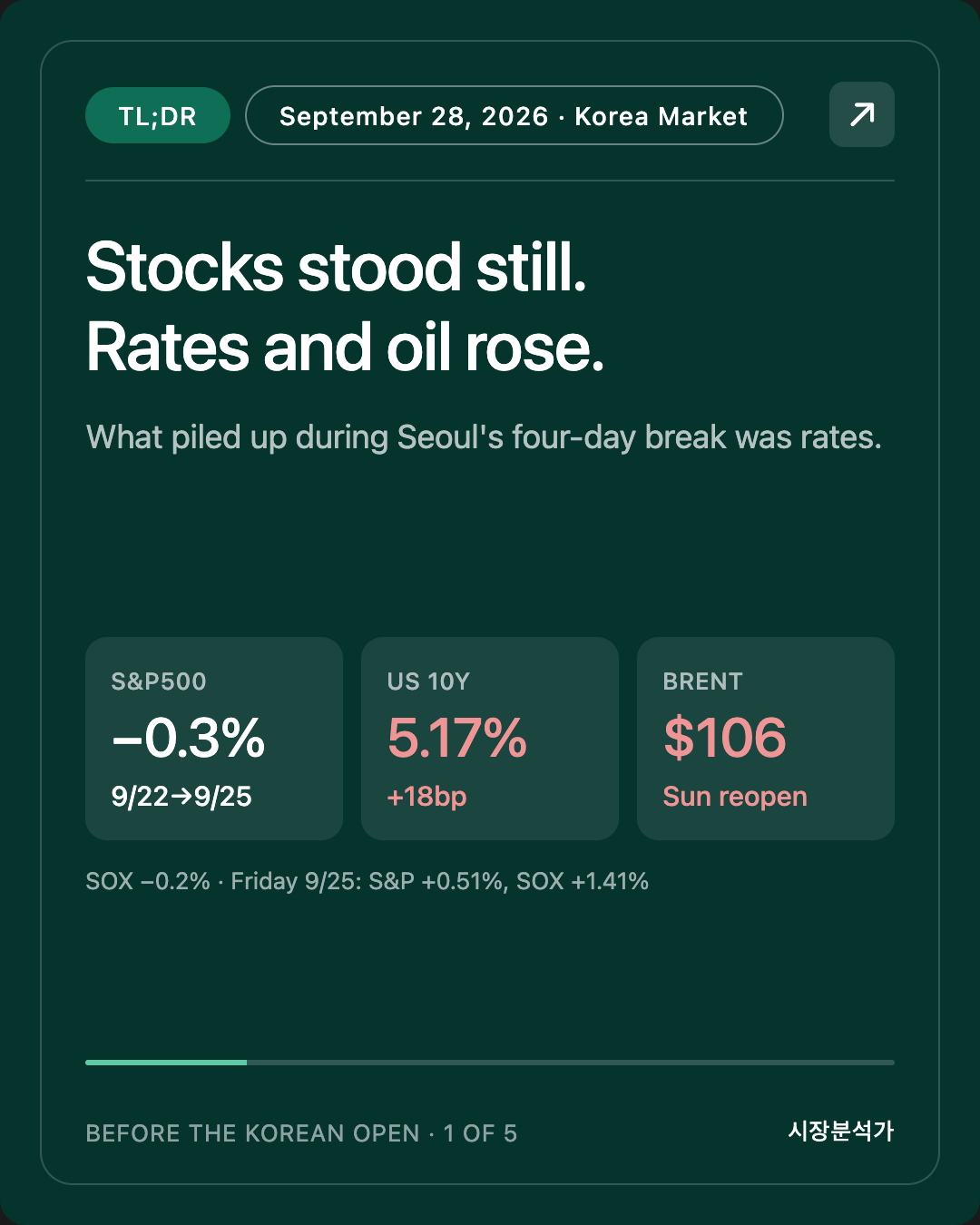
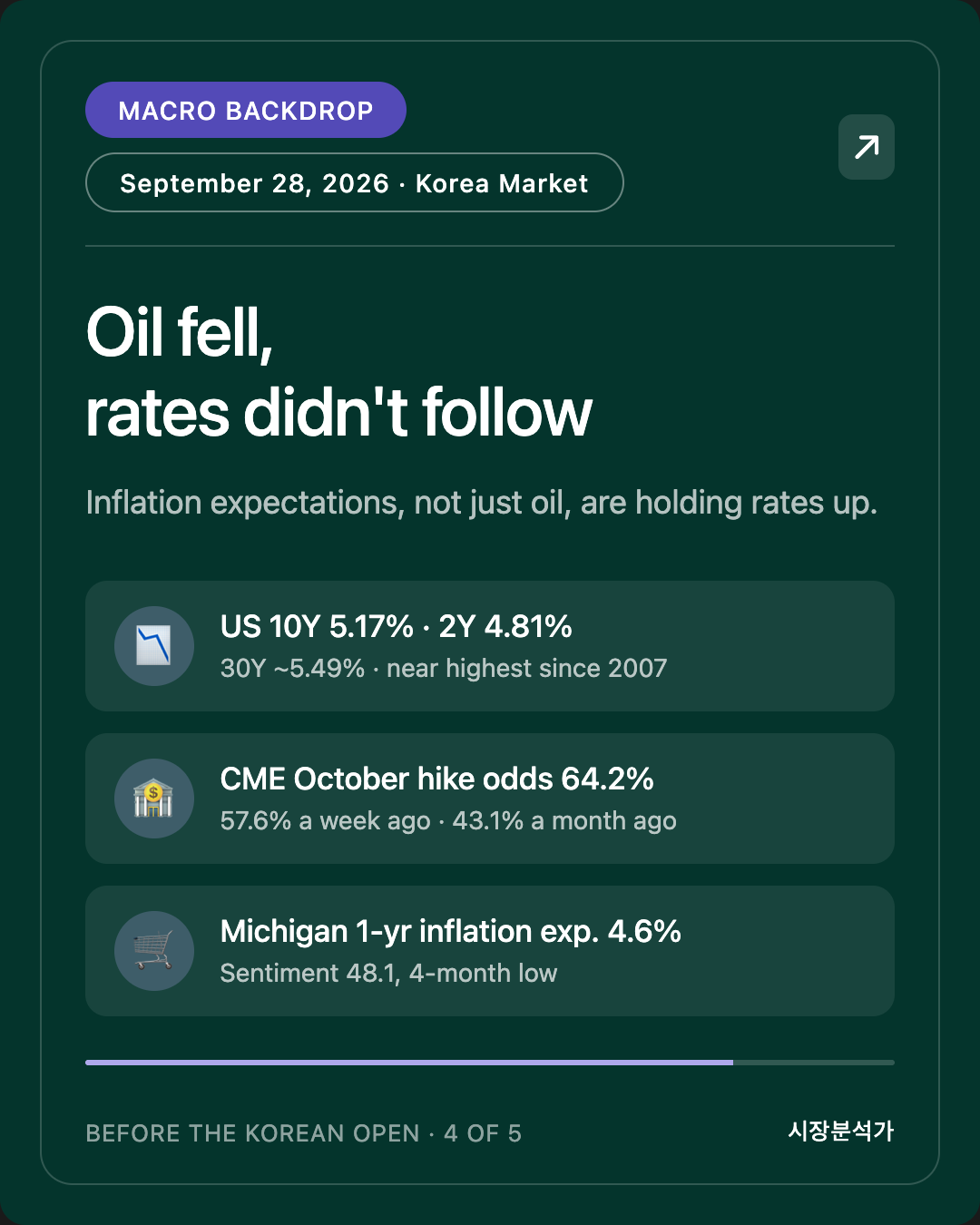
- ★ Over four days, stocks abroad were flat while yields rose ~18bp. S&P 500 from 9/22 to 9/25: about −0.3%; SOX about −0.2% (12,689.82 → 12,668.93). Over the same span, the US 10-year went from about 4.99% to 5.17%, the 2-year sits at 4.81%, the 30-year at 5.49%. Most of the new information Seoul prices today is about rates, not stock prices.
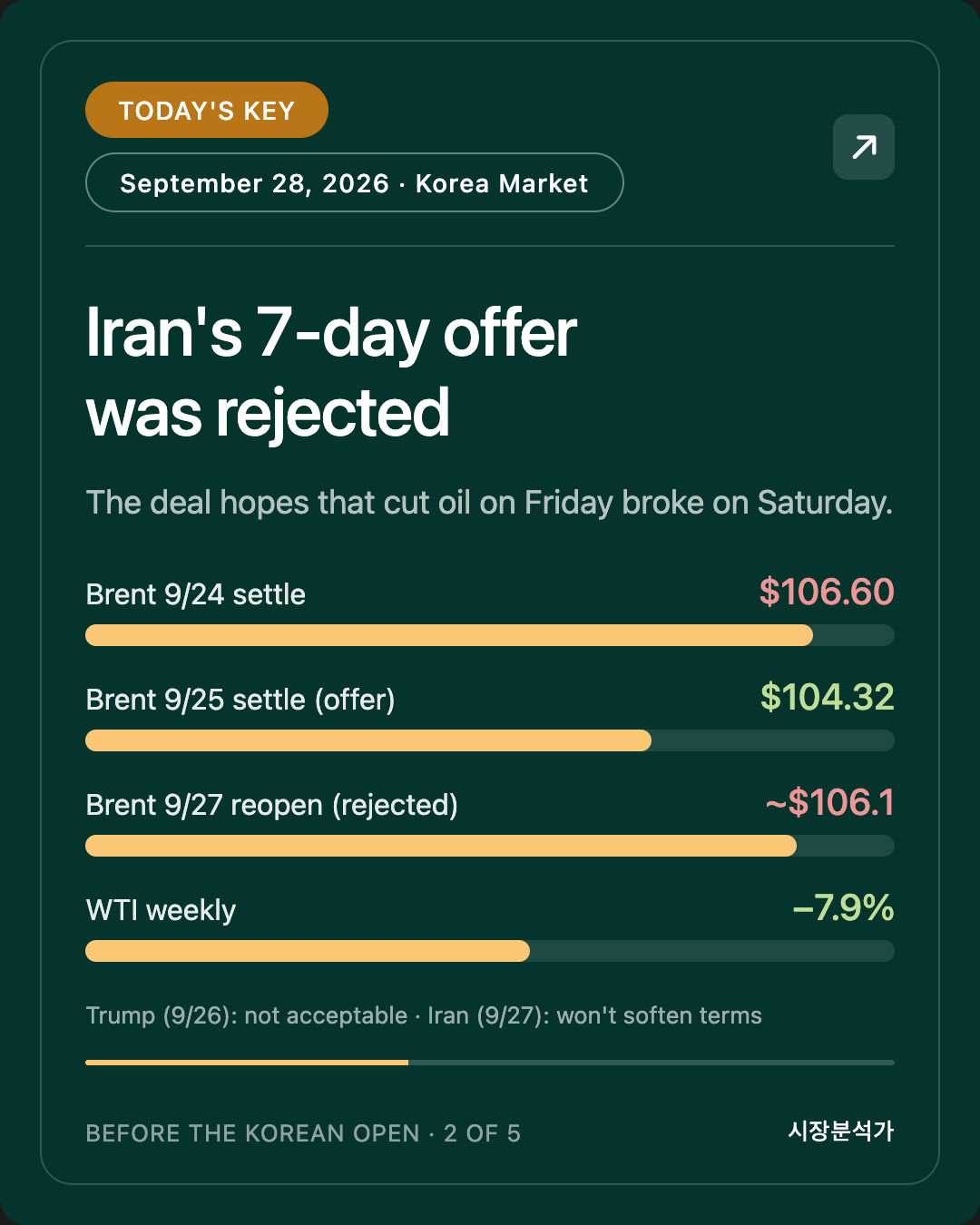
- ★ Iran's "seven-day plan" was rejected over the weekend. Trump (Sat 9/26): the proposal "would not be acceptable." Iran (Sun 9/27): it will not soften its conditions and is awaiting a formal answer through mediators Qatar and Pakistan. Oil futures on reopening: Brent ~$106.1 (+1.7%), WTI ~$93.6 (+1.2%).
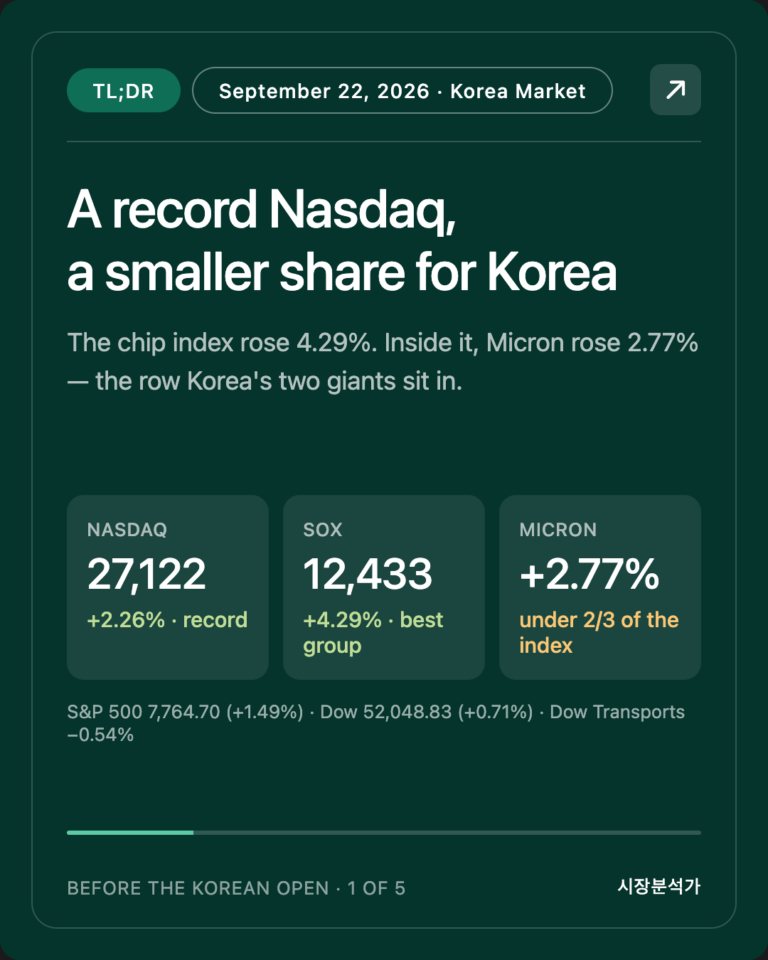
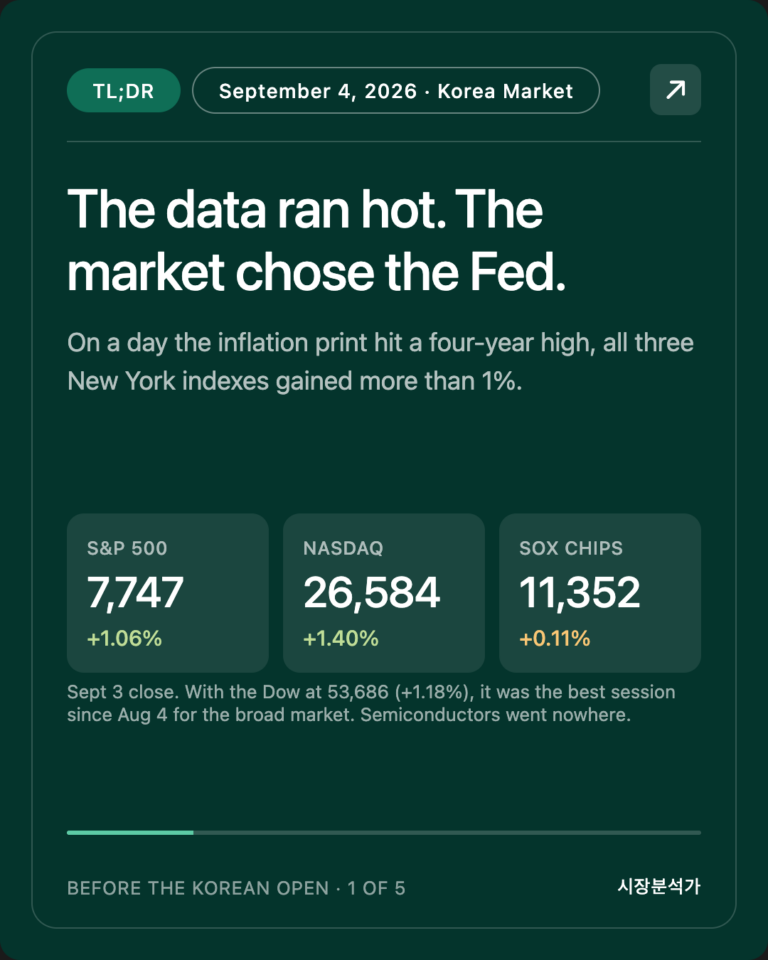
- Wall Street rallied on Friday. S&P 500 7,743.41 (+0.51%), Nasdaq 27,068.72 (+0.5%), Dow 51,828.62 (+0.93%, snapping a three-week losing streak), SOX +1.41%. EWY, the US-listed Korea ETF, rose +2.55%. But all of that came before the weekend rejection.
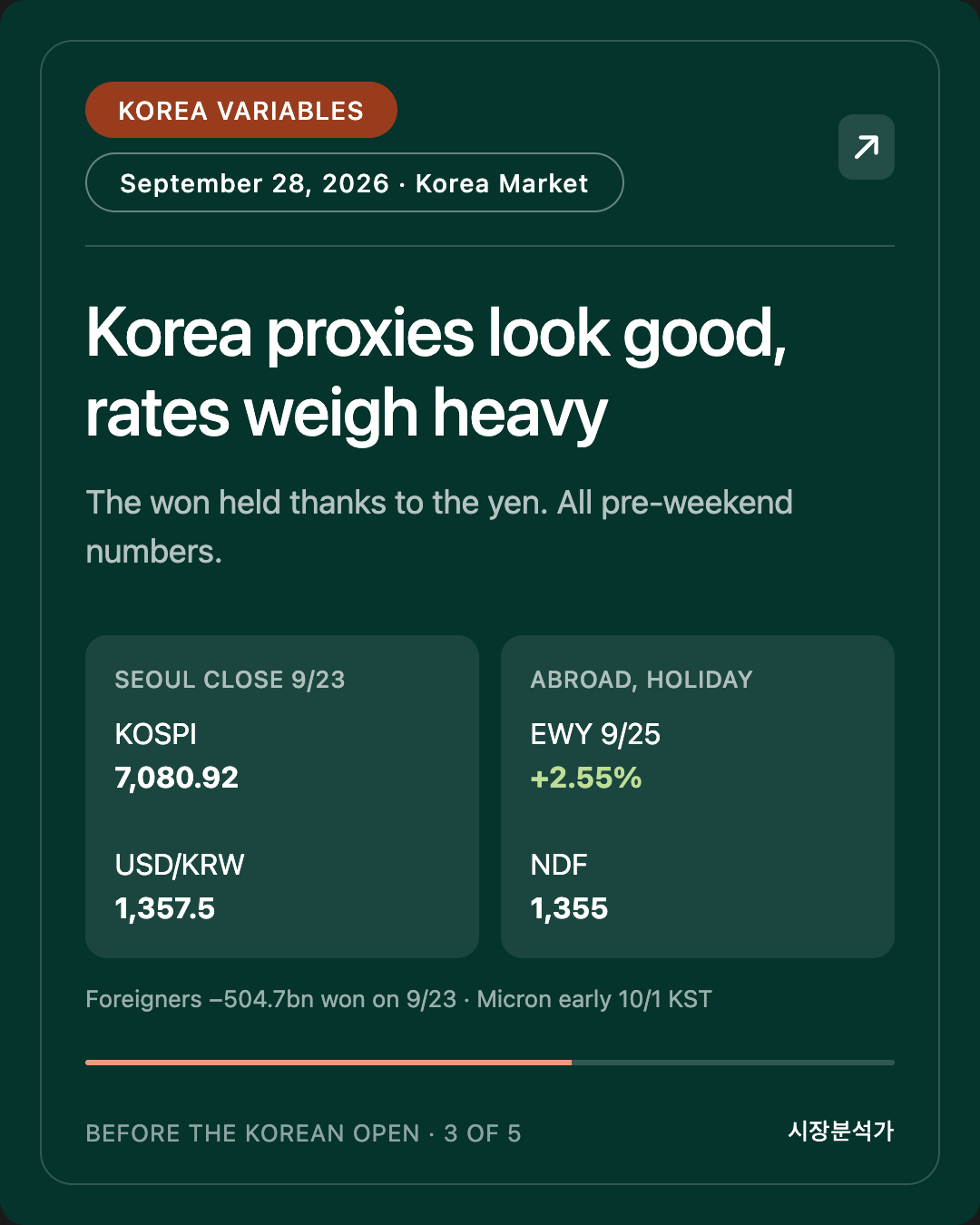
- The yen firmed; the won held steady. USD/JPY around 157.2 (−1.0% Friday). Offshore one-month USD/KRW non-deliverable forwards (NDFs) quoted 1,354.9–1,355.3, about 2 won below Seoul's 9/23 close of 1,357.5.
- Three things for Korea this week: US August PCE inflation on Wed 9/30, Micron earnings after the US close that day (early Thu 10/1 in Korea), and the US September jobs report on Fri 10/2. CME FedWatch odds of an October hike: 64.2% (9/26).
This is Mr. Can. Here is the September 28, 2026 brief ahead of the Korean market open.
Written: 2026-09-28 08:19 KST (Vancouver 9/27 16:19 PDT)
Basis: US closes 9/23–9/25 + Tokyo closes 9/24–25 + weekend (9/26–27) US–Iran news + oil futures reopening Sunday evening (US Eastern)
🟢 Korean stocks reopen today (Mon 9/28) at 09:00 KST after a four-day closure for Chuseok, Korea's harvest holiday (9/24–27). This edition sums up everything that piled up abroad while Seoul was shut.
✅ Scheduled 16:00 PDT, started 16:02 PDT. On time.
SEO Intro
Since the KOSPI last traded on the afternoon of September 23, Wall Street has had three more sessions. Over those three sessions, US stocks went essentially nowhere: the S&P 500 is about −0.3% from its September 22 close, and the Philadelphia Semiconductor Index (SOX) about −0.2%.
What moved was rates and oil. The US 10-year Treasury yield rose from roughly 4.99% to 5.17%, ending the week near its highest level since 2007. Brent crude climbed from about $99 to $104.
Then the weekend added one more thing. On Saturday, President Trump called Iran's offer to reopen the Strait of Hormuz within seven days "not acceptable." When oil futures reopened Sunday evening, Brent traded around $106 (+1.7%).
So here is the report card Seoul receives this morning: stocks stood still, rates and oil went up, and the deal that might have brought oil down was rejected over the weekend.
1. Checkpoint Scorecard
The four set in the 9/24 PM edition (through the 9/28 reopening)
The question was: Will Seoul's reopening gap be driven by "reality" (rates and oil) or by "possibility" (a Hormuz deal)?
| # | Criterion | Result | Verdict |
|---|---|---|---|
| 1 | US 10-year closes 9/25 above 5.10% | 5.17% | ✅ Reality side |
| 2 | Official Hormuz announcement · Brent below $100 / above $105 | Iran offer → Trump rejects · Brent Friday $104.32, Sunday reopen ~$106 | 🟡 → Leaning reality |
| 3 | USD/JPY hits 160 or Japan intervenes | 157.2, yen stronger | ❌ Opposite direction |
| 4 | Tokyo TOPIX falls two days in a row | TOPIX 9/25 +1.31% (4,128.59) | ❌ Opposite direction |
The four set in the 9/25 AM edition (through the 9/25 US close)
| # | Criterion | Result | Verdict |
|---|---|---|---|
| 1 | 10-year closes below 5.15% / above 5.20% | 5.17% | 🟡 In between |
| 2 | Brent closes above $105 / below $100 | $104.32 (−2.14%) | 🟡 In between |
| 3 | Michigan 1-year inflation expectations final ≥ 4.6% | 4.6% (prior 4.0%) · 5-year 3.4% | ✅ |
| 4 | Chips outperform the Nasdaq | SOX +1.41% vs Nasdaq +0.5% | ✅ Chips led |
[Interpretation] Eight checkpoints, one sentence
The rate line was crossed. The oil line looked like it would go to "possibility" on Friday, then swung back to "reality" with the weekend rejection. Meanwhile Tokyo, the yen and chips all came in better than the direction we had flagged. [Interpretation] So Seoul's open today can't be summed up as "one bad thing." Rates and oil are a headwind; chips and neighboring markets are a tailwind. Both hit on the same day.
2. The Big Picture: While Seoul Was Closed, Rates Moved — Not Stocks
[Fact] Abroad since the KOSPI's last trade (9/23, 15:30 KST) — calculated
| Item | US close 9/22 | US close 9/25 | Change |
|---|---|---|---|
| S&P 500 | ~7,764 | 7,743.41 | ~−0.3% |
| Nasdaq | ~27,244 | 27,068.72 | ~−0.6% |
| SOX (chips) | 12,689.82 | 12,668.93 | ~−0.2% |
| US 10-year | ~4.99% | 5.17% | ~+18bp |
| Brent | ~$99 | $104.32 → ~$106 Sunday | ~+5–7% |
| Nikkei | — | 9/24 +0.97% · 9/25 +1.30% (66,364.20) | +2.3% over two days |
9/22 closes are back-calculated from 9/23 percentage moves.
★ [Interpretation] Measured in stock prices, the four-day gap is near zero. Measured in rates, it's large.
After a long holiday, the first instinct is to ask "how much did US stocks move in the meantime?" This time the answer is almost nothing. US stocks fell hard on 9/23 (S&P −0.75%) and clawed it back by Friday. Chips were flat across the three sessions too.
What changed was the discount rate. The 10-year pushed through 5% and finished the week at 5.17%. [Interpretation] The KOSPI's +2.71% three-day run last week, which took it back above 7,000 (to 7,080.92), happened while the 10-year was below 5%. Today Seoul reprices the same stocks at a higher rate. The first signal of which way that repricing goes: whether foreign investors keep selling, as they started to on 9/23 (about −504.7 billion won).
[Observation] But the prices that track Korea directly looked good
- EWY (US-listed Korea ETF; SK hynix and Samsung Electronics are more than half of it): +2.55% ($187.18) on Friday. We could not confirm its 9/24 move.
- Tokyo: Tokyo Electron +4.82% on 9/25; the broad TOPIX rose too.
- SOX +1.41% Friday, about 0.9 points ahead of the Nasdaq.
[Interpretation] On Friday alone, then, there is a chip-friendly setup for Seoul. The problem is the weekend rejection that came after. One source shows US stock index futures opening around −0.3% on Sunday evening (observation, single source).
3. Korea Variables: Rates, the Won, Chips — and Micron This Week
[Fact] Seoul's last numbers (9/23)
| Item | 9/23 | Note |
|---|---|---|
| KOSPI | 7,080.92 (+0.90%) | Fourth straight gain; +2.71% over last week's three sessions |
| Foreign investors | ~−504.7bn won | Turned net sellers · corporate buybacks (+1.63tn won) absorbed it |
| Advancers / decliners | 311 / 548 | Narrow rally |
| Korea 10-year bond | 4.405% | Set before the US 10-year broke 5% |
| USD/KRW | 1,357.5 (15:30) |
[Fact] Korea-relevant moves during the holiday
| Item | Value |
|---|---|
| Offshore 1M USD/KRW NDF | 1,354.9–1,355.3 (~−2.1 won vs 9/23 Seoul) |
| USD/JPY | ~157.2 (9/25 −1.0%, stronger yen) |
| EWY | 9/25 +2.55% |
| Micron | Reports Wed 9/30 after the close · revenue consensus ~$50.8–50.9bn (vs $11.3bn a year ago) · EPS ~$31.5 (vs $3.03) |
[Interpretation] The won didn't weaken, despite the rate spike
While the US 10-year rose 18bp, the NDF actually slipped 2 won lower. The reason is the yen. After Japan's finance minister said publicly that the US president had raised concerns about yen weakness (see our 9/25 AM edition), the yen firmed and other Asian currencies followed. [Interpretation] A steady won means foreign investors face less currency-loss worry at the open, so the exchange rate offsets part of the rate headwind. But that NDF quote, too, predates the weekend rejection.
[Observation] The real test for chips comes Wednesday night
Korean brokerages' weekly previews all put Micron first. What the market wants isn't just the headline numbers but HBM4 demand, DRAM and NAND pricing, and long-term contract terms. Micron is up about 279% this year, and options imply a move of roughly 9% after earnings. [Interpretation] Stocks carrying that much expectation often "beat and still disappoint" — Applied Materials on 8/14 and Broadcom on 9/3 followed that script. Worth watching from today until Wednesday: do Korean chip stocks run up ahead of the report, or wait?
4. Macro Backdrop: 5% Yields, a Rejected Offer, 64% Hike Odds
[Fact]
| Item | Value | Note |
|---|---|---|
| US 10-year | 5.17% (9/25 close) | Near 5.2% intraday Friday, around the highest since 2007 |
| US 30-year | ~5.49% | Around the highest since 2004 |
| US 2-year | 4.81% | |
| CME October hike odds | 64.2% (9/26) | 57.6% a week ago, 43.1% a month ago |
| Michigan sentiment (final) | 48.1 | Four-month low (51.7 in August) |
| 1-year / 5-year inflation expectations | 4.6% / 3.4% | 1-year highest since June |
| Brent / WTI (9/25 settle) | $104.32 / $92.41 | WTI −7.9% on the week, Brent +0.4% |
| Brent / WTI (9/27 evening reopen) | ~$106.1 / $93.6 | Reflects Trump's rejection |
| Gold | ~$4,294 | |
| VIX | 14.87 (−5.1%) | |
| Bitcoin | ~$84,300 |
[Fact] Hormuz: from offer to rejection
- Fri 9/25: Iran formally delivers a "seven-day roadmap" via Qatar. If the US releases frozen funds, lifts oil sanctions and ends its naval blockade (which Iran estimates would take four to five days), the strait reopens, and talks on a final deal start on day seven.
- Sat 9/26: Trump at the White House: the proposal "would not be acceptable"; Iran wants a deal "because they are losing so badly." Reports say he left room for talks to resume this week.
- Sun 9/27: Foreign Minister Araghchi: Iran won't soften its conditions and will wait for a formal reply through mediators. President Pezeshkian: "We have no trust in the American side."
★ [Interpretation] Brent and WTI are telling different stories
This week WTI fell 7.9% while Brent rose 0.4%, widening the gap between the two to about $12. WTI is oil traded inside the US; Brent is closer to the price of crude that has to move through or around Hormuz to reach the Middle East, Europe and Asia. [Interpretation] Korea buys Brent-linked oil. "Oil fell sharply this week" is a US headline about WTI. The price that hits Korea's import bill and trade balance is still around $105.
[Interpretation] Rates didn't come down even when oil did
WTI dropped more than 2% on Friday, yet the 10-year closed almost unchanged at 5.17% (which is why the 9/25 AM checkpoint #1 ended "in between"). [Interpretation] The 9/25 AM edition asked: was the rate spike about oil, or about something else? This week's answer leans toward "not only oil." Michigan's 4.6% 1-year inflation expectations and a +1.6% jump in core capital-goods orders point to growth and inflation expectations holding rates up.
5. Today's Korean Session (Mon 9/28 KST) Preview
[Observation] Today and this week (KST)
- 09:00 KOSPI and KOSDAQ reopen (first session in four days)
- Intraday: oil and US index futures during Asian hours; further US or Iranian statements
- Mon 9/28 23:30 Dallas Fed manufacturing index
- Tue 9/29 23:00 US August JOLTS · Conference Board consumer confidence
- Wed 9/30 21:30 US August PCE inflation
- Early Thu 10/1 Micron earnings (after the US close on 9/30) · Korea September exports
- Fri 10/2 21:30 US September jobs report
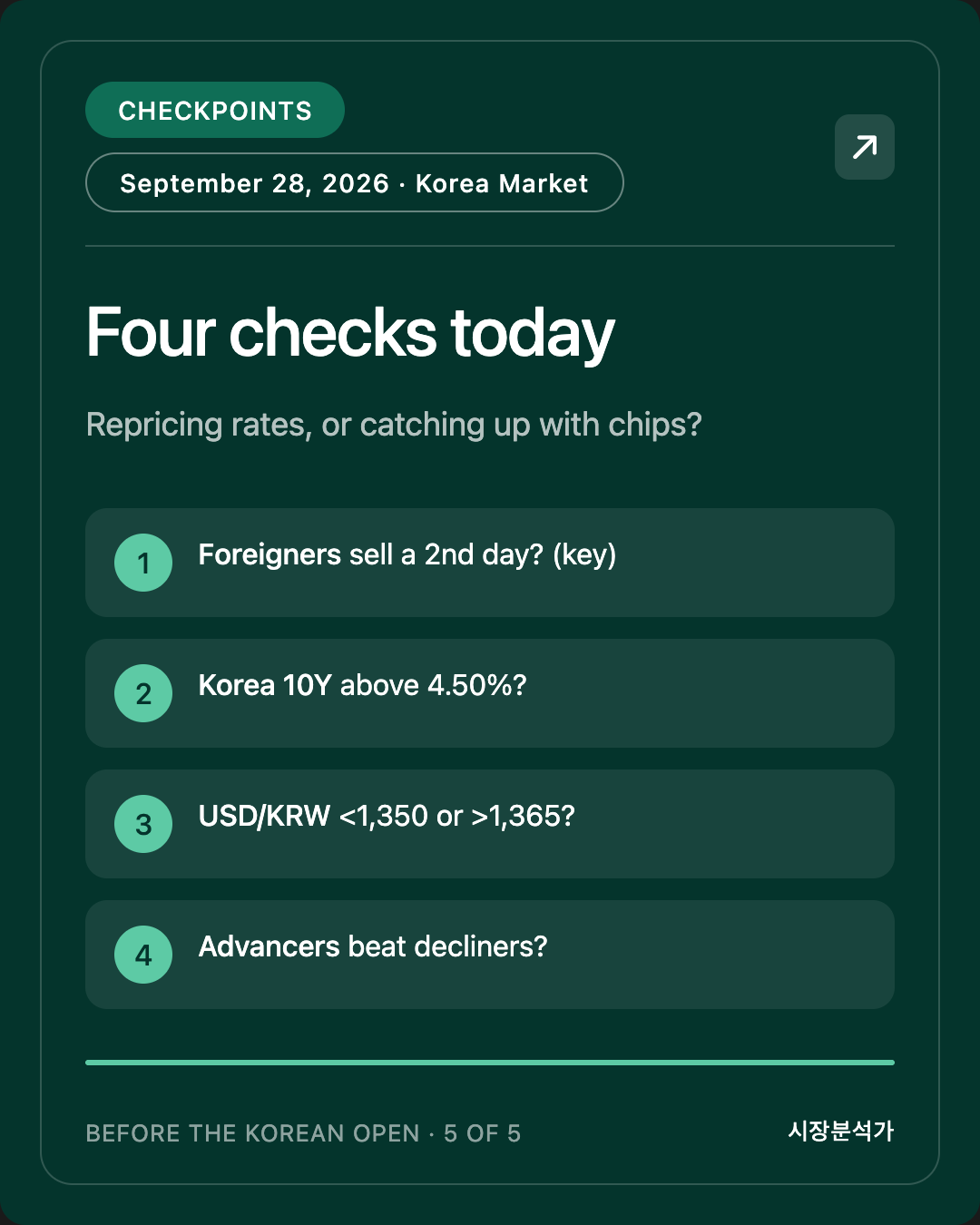
✅ Four Checkpoints (through today's Korean close)
The axis first: these four tell us whether Seoul uses today to "reprice at higher rates" or to "catch up with Friday's chip rally."
- Do foreign investors net-sell for a second straight session? Following about −504.7bn won on 9/23, another day of selling means repricing; a switch to net buying means catch-up. (Most important.)
- Does Korea's 10-year bond yield close above 4.50%? From 4.405% on 9/23, that would mean Korea absorbs more than half the US +18bp today. Below 4.45% means Korean bonds followed the US only partly.
- Does USD/KRW end below 1,350 or above 1,365? NDF reference: 1,355. Below 1,350 despite the weekend news means the yen's strength won; above 1,365 means oil and safe-haven demand won.
- Do advancers outnumber decliners? On 9/23 it was 311 vs 548, a narrow rally. A broad rally today looks like Tokyo's 9/25 "oil-relief" pattern; chips up while everything else falls points to rate pressure.
[Interpretation] The most informative is #1. The last two days of last week's KOSPI gain were carried by corporate buybacks, not foreign investors. If foreigners don't come back today, even a higher index would mean the same structure as 9/23, one more time.
6. Study Note: How to Measure the Post-Holiday "Gap"
Concept
A gap is when today's opening price starts away from the previous session's close. New information accumulates while trading is halted and gets priced in all at once the moment the market reopens.
Analogy
It's like opening your work inbox after four days of vacation. A lot of emails doesn't mean a lot of importance. What matters is how many decisions changed while you were away.
How to actually count it (applied to this holiday)
- Write down when the market closed. The KOSPI's last trade was 9/23 at 15:30 KST, the early hours of 9/23 in New York. So all three US sessions (9/23, 9/24, 9/25) are new information.
- Find proxy prices. Even with Seoul closed, EWY (a US-listed Korea ETF), Tokyo chip stocks, and the USD/KRW NDF keep trading. They hint at where Seoul would have gone if it had been open.
- Separate price from discount rate. This time, US stock prices were flat over three sessions, but rates (the discount rate) rose 18bp. "US stocks didn't fall, so we're fine" counts only half the story.
- Count the news that came after the last proxy price. EWY's +2.55% Friday predates Trump's Saturday rejection. If there's news the proxies haven't seen, discount them accordingly.
One-line summary
The first-day gap after a holiday isn't measured by "how much did markets rise?" but by "what changed?" This time, what changed wasn't stock prices; it was rates, and a deal that got rejected over the weekend.
7. Corrections & Open Items
🔴 US 10-year close on 9/24, corrected again
Our 9/24 PM edition put the 9/24 close at ~5.11–5.12%; the 9/25 AM edition revised it to ~5.20%. Friday's final data show the 9/25 close of 5.17–5.18% was up about +0.02 points, which makes a 9/24 close of ~5.15–5.16% the most consistent figure. Both editions were slightly off. The ✅ verdict on 9/24 AM checkpoint #2 (above 5.10%) stands.
🟡 CME October hike odds
The 9/25 AM edition said "about 70%." CME FedWatch on 9/26 shows 64.2%. Per our rule, we cite CME only (another aggregator's 69% is not used).
Source discrepancies (values adopted)
| Item | Discrepancy | Adopted |
|---|---|---|
| Brent 9/25 | Settle $104.32 / one outlet "$97.44 (−2.8%)" | $104.32 (consistent with the prior $106.60 settle; the $97 figure is not used) |
| US 10-year 9/25 | 5.17% / 5.18% | 5.17% (timing difference) |
| Nasdaq 9/25 | +0.5% / +0.48% | +0.5% |
| Brent Sunday evening | ~$106.1 (+1.74%) / "above $103, +2%" | ~$106, subject to Asian-hours trading |
🔲 Unconfirmed
| Item | Status |
|---|---|
| EWY moves on 9/23 and 9/24 | 🔲 Friday only |
| Dollar index 9/25 | 🔲 |
| Oracle 9/25 close | 🔲 (second half of 9/25 AM checkpoint #4) |
| US index futures Sunday evening | 🟡 ~−0.3% (single source) |
8. Event Calendar (KST)
| Date/time (KST) | Event | Note |
|---|---|---|
| Mon 9/28 09:00 | Korea reopens | First session in four days |
| Mon 9/28 23:30 | Dallas Fed manufacturing index | |
| Tue 9/29 | Trump–Big Tech CEO AI meeting · Reserve Bank of Australia decision | |
| Tue 9/29 23:00 | US JOLTS · Conference Board confidence | |
| Wed 9/30 21:30 | US August PCE · Q2 GDP final | |
| Early Thu 10/1 | Micron earnings | Directly relevant to Korean chips |
| Thu 10/1 09:00 | Korea September exports | |
| Fri 10/2 21:30 | US September jobs report | After Korea's close |
| Wed 10/28 (US) | FOMC decision | Early 10/29 in Korea |
Sources
- Stock market today: Dow, S&P 500, Nasdaq notch weekly wins as market shrugs off bond sell-off | Yahoo Finance
- Stock market news for Sept. 25, 2026 | CNBC
- 10-year Treasury yield is little changed to end a volatile week | CNBC
- Week ended September 25, 2026: bond yields continue to increase | eMorningCoffee
- Oil Ends Week Lower as U.S.-Iran Truce Hopes Hit WTI, While Middle East Supply Risks Keep Brent Above $100 | EnergyNow
- Oil rebounds after Trump rejects Iran peace deal | Reuters via Investing.com
- Trump rejects Iran's seven-day roadmap to end war and reopen Hormuz | Al Jazeera
- Iran Says Won't Soften Demands After Trump Rejects Hormuz Offer | Bloomberg
- Oil Up, Stock Futures Slip as Iran Offer Rejected: Markets Wrap | Bloomberg
- US Michigan Inflation Expectations Final (Sep) 4.6% | Newsquawk
- 6 Words From Kevin Warsh Changed the Question | 24/7 Wall St.
- Philadelphia Semiconductor Index Historical Data | Investing.com
- Japan stocks higher at close of trade; Nikkei 225 | Investing.com
- USD/JPY Moved Sharply on Sep 25 | TradingKey
- iShares MSCI South Korea ETF (EWY) | Pluang
- KRW NDF falls 2.1 won on yen strength and Hormuz optimism | Etoday (Korean)
- KOSPI after Chuseok: rates and oil in focus | Financial Post Korea (Korean)
- Micron's 279% Rally Is Heading Into a Big Earnings Test | Yahoo Finance
- The Week Ahead: US PCE, jobs report, Micron earnings | CMC Markets
Market Analyst · We do not recommend buying or selling individual stocks. This report offers macro context and interpretation.
📌 More market briefs
※ This post is market observation and organization intended to support your own judgment. It is not a recommendation to buy or sell any security. Figures are as of the time of writing and may differ between sources.
If this was useful, bookmark it or pass it along. It genuinely helps me write the next one.
I can survive. We can survive.