September 22, 2026 KOSPI Market Brief — What to Watch Before the Korean Open
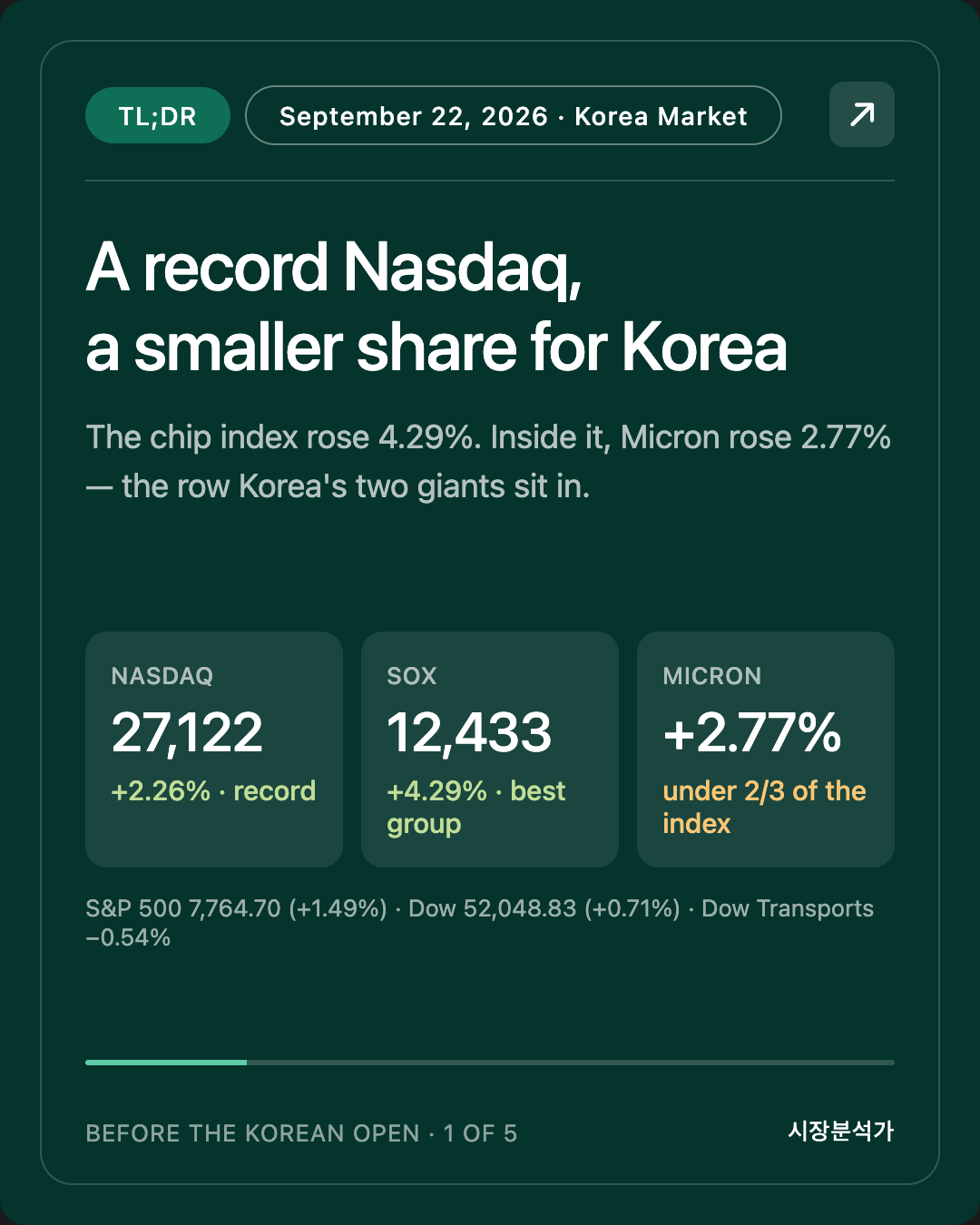
- The Nasdaq Composite closed at a record 27,122.09, up 2.26% — its first record close since June. S&P 500 7,764.70 (+1.49%), Dow 52,048.83 (+0.71%). Best session since early August.
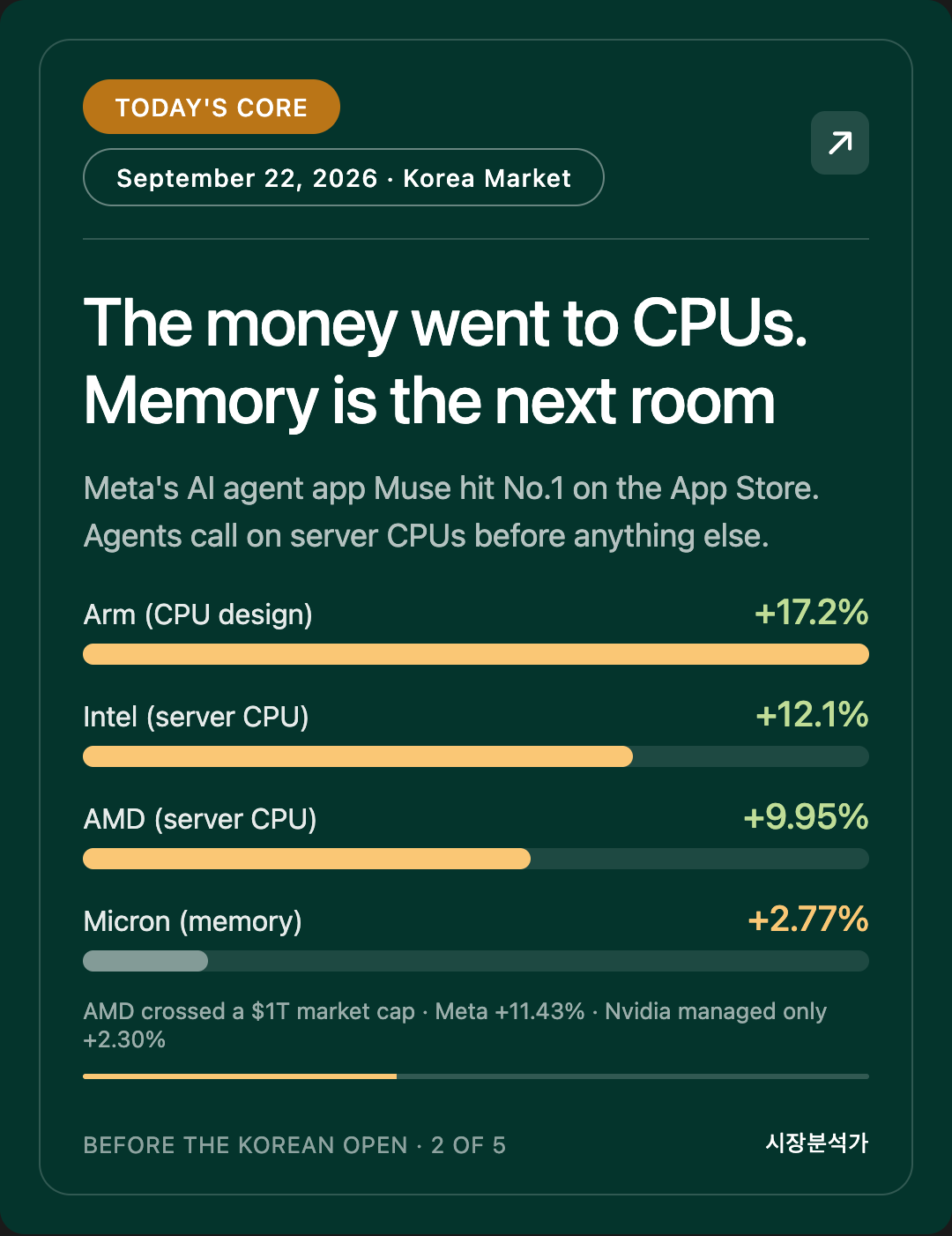
- ★ SOX rose 4.29%, but the internals split. Intel +12.14% · AMD +9.95% · Arm +17.2% versus Micron +2.77% and Nvidia +2.30%. CPUs led; memory only followed. Korea's two giants are memory companies.
- The spark was Meta's AI agent app, Muse. Launched September 8, it logged 730,000 downloads in five days (Sensor Tower) and overtook ChatGPT for the #1 free spot on the US App Store on September 18. Meta stock +11.43%.
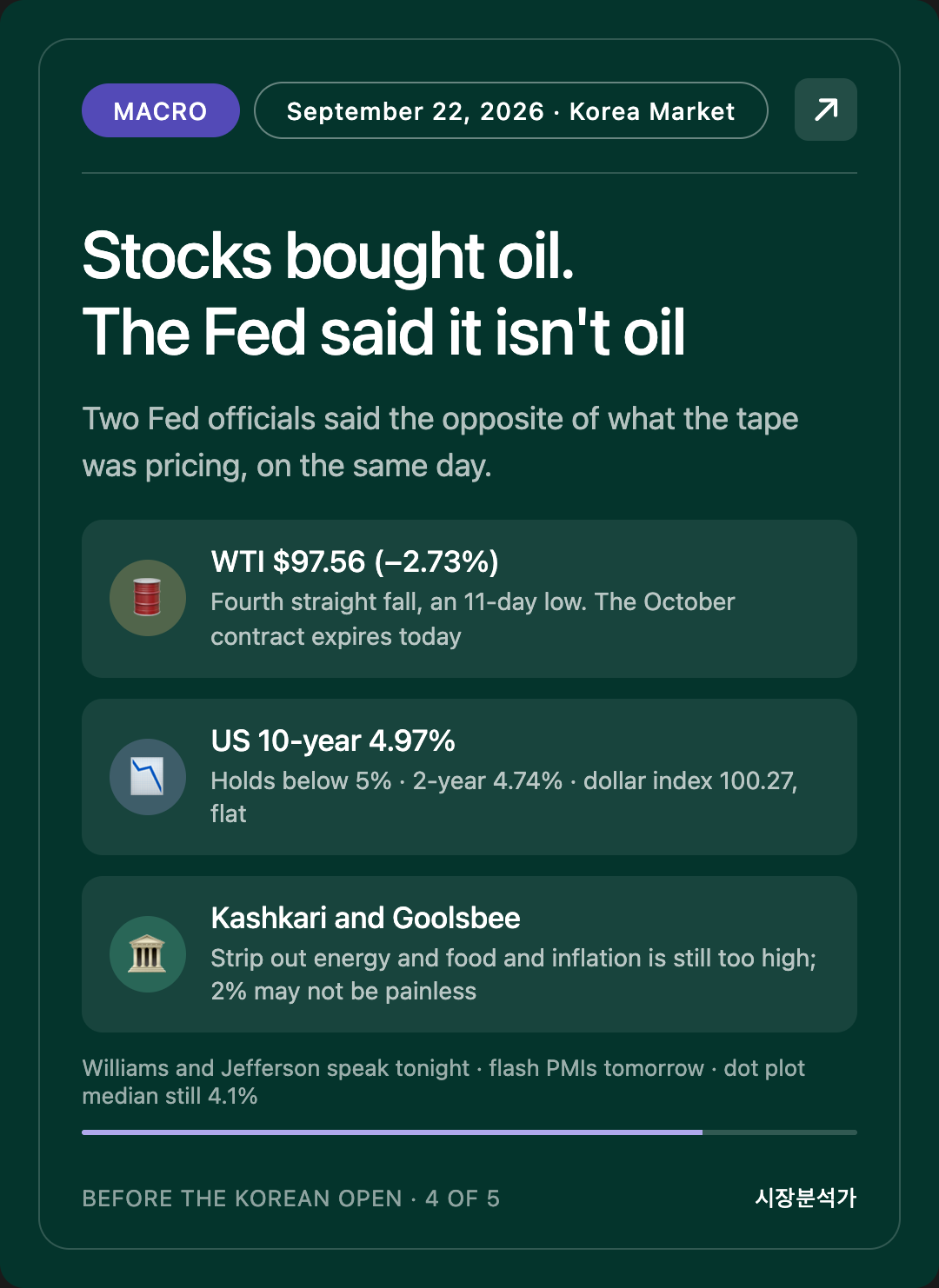
- ★ The same day, two Fed officials said the opposite. Kashkari: "even if we strip out energy and strip out food, inflation is still too high." Goolsbee, in London: supply shocks "have come more frequently, hit harder and lasted longer," and the road to 2% may not be painless.
- Oil fell for a fourth straight session. WTI October $97.56 (−2.73%), Brent $100.06 (−3.67%) — an 11-day low. The US 10-year held below 5% at 4.97%. ⚠️ The WTI October contract expires today.
This is Mr. Can. Here is the September 22, 2026 brief ahead of the Korean market open.
Written: September 22, 2026, 08:15 KST (Vancouver, Sept 21, 16:15 PDT)
Basis: Confirmed US close for Sept 21 + European close + Korean close for Sept 21
🟢 On schedule again. Scheduled 16:00 PDT, written 16:15 PDT. Wall Street closed three hours ago and Seoul opens in 52 minutes. Second consecutive on-time edition.
SEO Intro
The Nasdaq closed at a record high last night, its first since June. The Philadelphia Semiconductor Index rose 4.29% in a single session.
On the headline, that is a good night for Korea. Open it up and the story changes.
AMD rose 9.95% and crossed a $1 trillion market cap. Intel gained 12.14%. Arm gained 17.2%. Micron gained 2.77%. Same industry, but one group jumped double digits and the group Korea's two giants belong to captured barely a quarter of that.
There is a reason. What moved New York was Meta's new AI agent app, Muse. Agents run far more inference than chatbots, and they run it in steps that have to be sequenced. That sends money to server CPUs first. Memory is the next room over.
And on the very same day, two Federal Reserve officials said the opposite of what the market was pricing: strip out energy and food, and inflation is still too high. Equities bought a story about falling oil. The Fed replied that oil is not the problem.
Today is the first of only two Korean sessions before the Chuseok holiday. Below, those three threads, separated.
1. Scoring Yesterday's Four Checkpoints
Yesterday morning's question was: is this rally about falling oil, or about Thursday's Trump-Xi summit? Wall Street has closed, so all four can be graded.
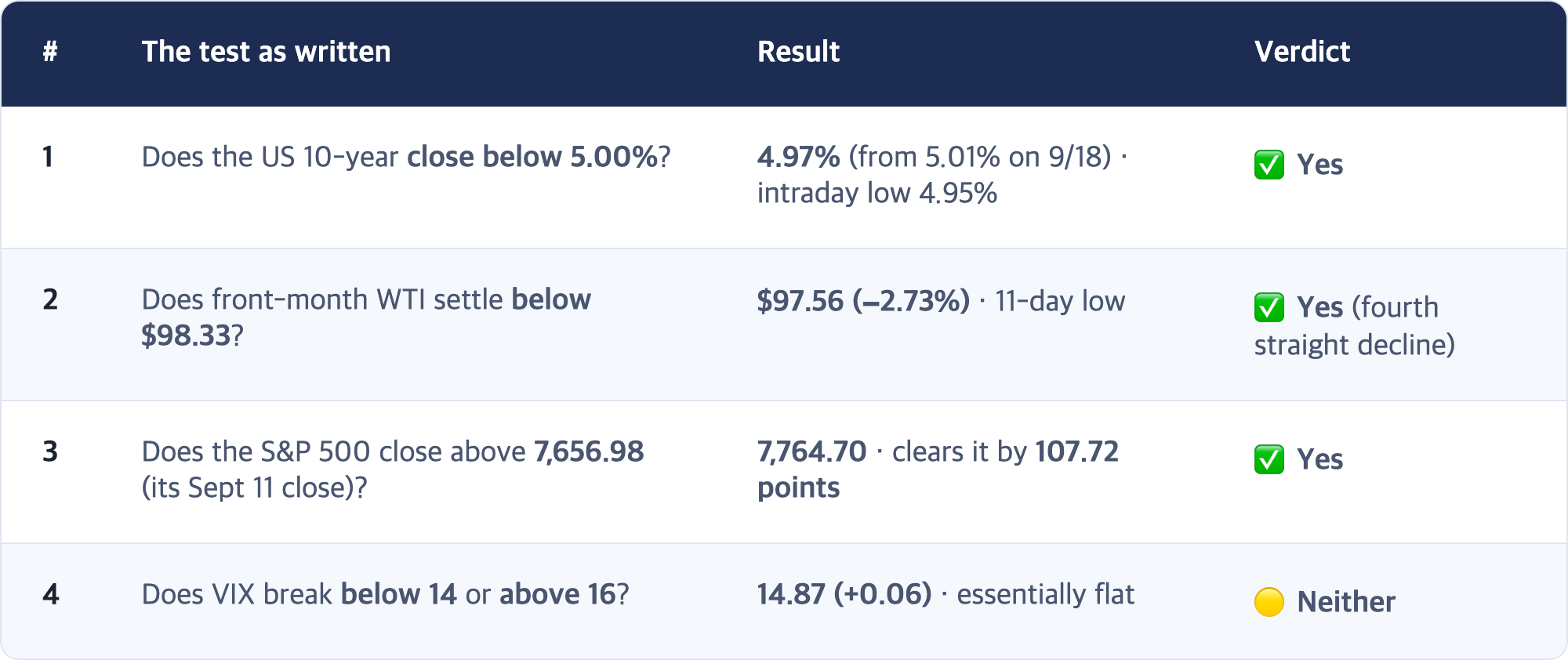
[Interpretation] Three hits, but the third one happened for a different reason than I wrote
Numbers 1, 2 and 3 all passed. Yesterday I said I would treat that as evidence for a chain: oil down → inflation expectations down → yields down → equities up.
Look at the close, and that is not what actually lifted stocks.
- If the oil channel had been the driver, the energy-cost-sensitive parts of the market should have moved first: transports, small caps, consumer discretionary.
- Instead the Dow Transports fell 0.54% and the Russell 2000 rose just 0.52% — both far behind the index. The Dow itself added only 0.71%.
- What rose was the Nasdaq 100 (+2.83%) and the SOX (+4.29%). The money went into one theme.
[Interpretation] Oil and yields opened the door; the money walked into AI. The checkpoints passed, but the explanation behind them was only half right. And checkpoint 4 matters here: a flat VIX means the market has not yet priced Thursday's summit in either direction. Yesterday's rally was neither the summit nor oil. It was a third thing.
2. Today's Core: SOX Gained 4.29%, but Korea's Share of It Is Smaller
[Fact] The US close (Sept 21, ET)
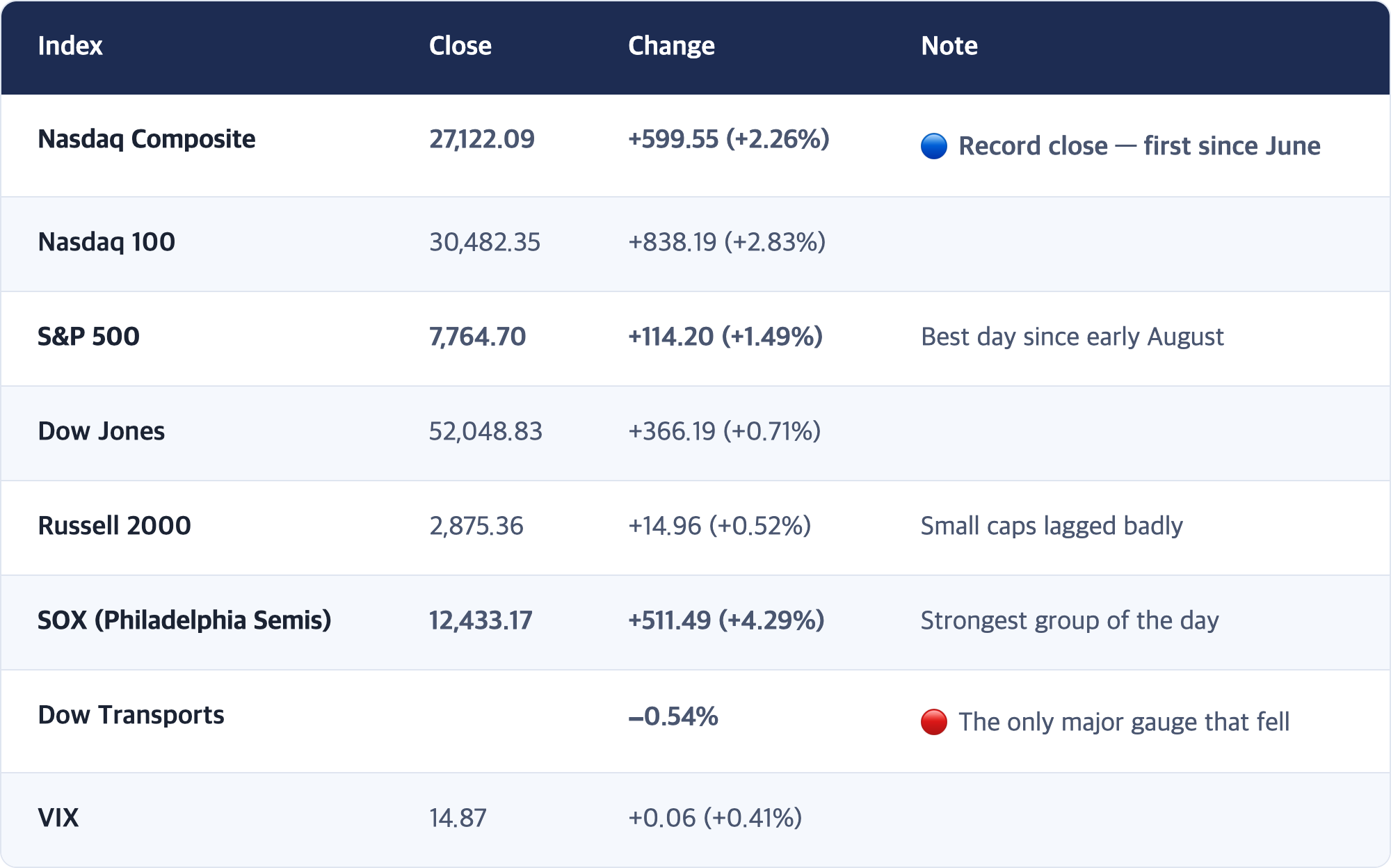
🔴 [Fact] Inside the chip rally, the ranking looked like this
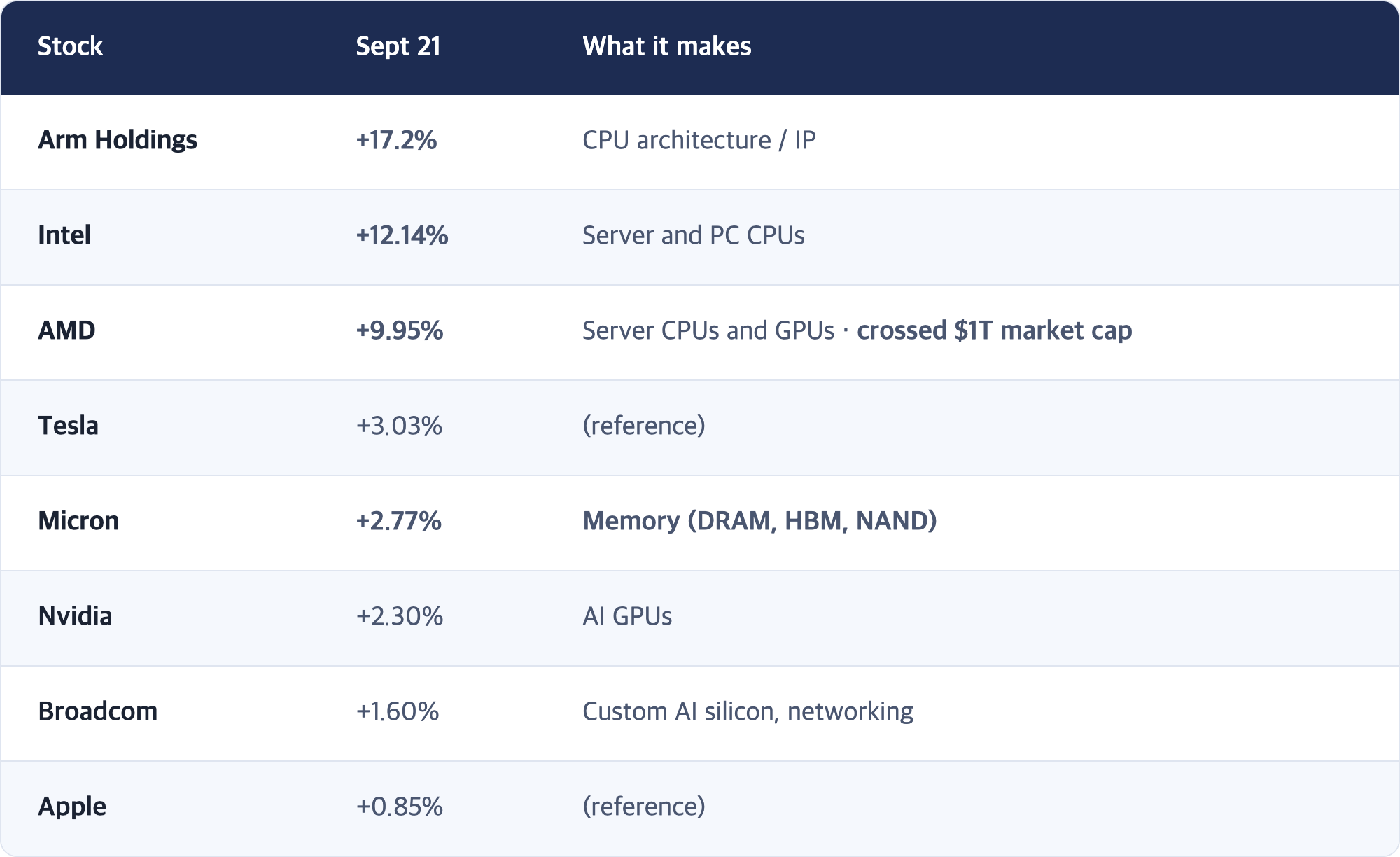
The top three are all CPU names. Samsung Electronics and SK Hynix sit in Micron's row.
[Fact] The spark: Meta's Muse
- Meta launched the AI agent app on September 8. Sensor Tower counted 730,000 downloads in five days, and on September 18 it passed ChatGPT to become the #1 free app on the US App Store.
- Meta shares rose 11.43% on Monday.
- The logic the market applied: an agent chains multiple tasks on its own, so it generates far more inference than a chatbot — and the sequencing and orchestration load lands on server CPUs, not only GPUs.
- Layered on top: Nvidia's Jensen Huang, OpenAI's Sam Altman, Microsoft's Satya Nadella and Tim Cook are all reported to be attending Thursday's Trump-Xi summit.
✅ [Interpretation] For Korea, the question is not how much chips rose but which chips rose
Three reasons not to read SOX +4.29% as "Korean semis open up 4% today."
First, this story pays CPUs first. Memory is second in line. Micron's +2.77% is the distance, measured. The company in Korea's own category captured less than two-thirds of the index move.
Second, Seoul already split the same way yesterday. Samsung Electronics +4.98%, SK Hynix +0.59%. My checkpoint from Sunday — does SK Hynix catch up to Samsung? — failed, and the gap widened from 3.3 points at midday to 4.4 at the close. Last night in New York did nothing to narrow it.
Third, this is not a story without memory in it. More server CPUs means more low-power DRAM (LPDRAM) sitting beside them, which is exactly why all three memory makers have been pushing data-center LPDRAM this year. But that is a multi-quarter story, and what got priced yesterday was the CPU.
[Interpretation] So the single most useful thing to watch in Seoul today is not the index level. It is whether SK Hynix outperforms Micron's +2.77%. If it does, the market is extending the agent story into memory. If it does not, Seoul is simply copying last night's league table.
3. The Korea Variable: Two Sessions to the Holiday
[Fact] Seoul's close (Sept 21, KST)
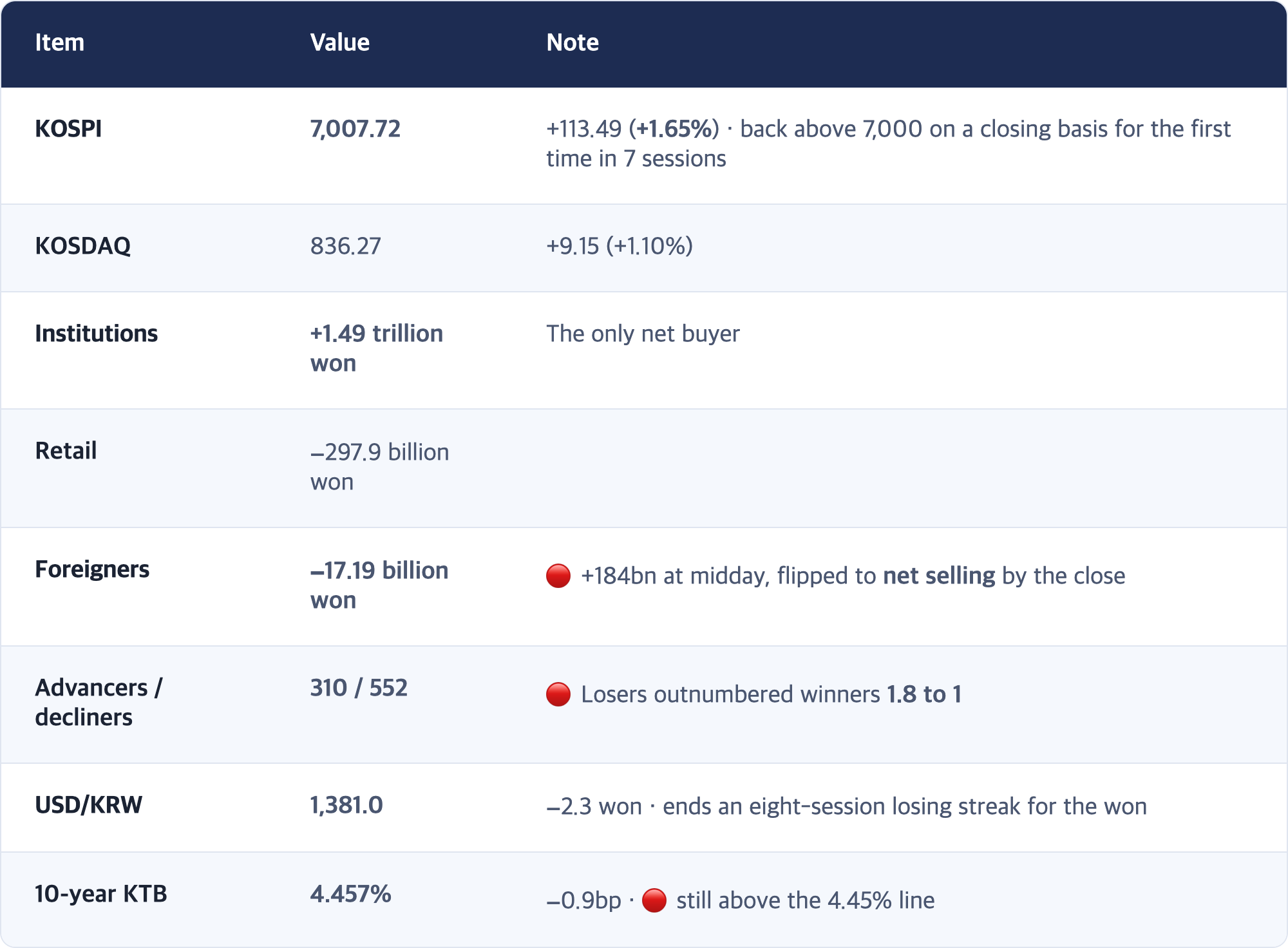
Single names — Samsung Electronics 274,000 won (+4.98%) · SK Hynix 1,868,000 won (+0.59%) · LG Energy Solution 352,000 won (−3.30%) · Hyundai Motor 359,000 won (−1.64%)
[Fact] The fundamentals are still excellent
Korea Customs Service data for September 1–20, released Monday:
- Exports $71.4 billion, +78.3% year on year — a record for the period
- Semiconductor exports $34.1 billion, +259.4% — also a record for the period
- Semiconductors now make up 47.8% of total exports, up 24.1 percentage points in a year
- Imports $48.4 billion (+26.7%); trade surplus $23.0 billion
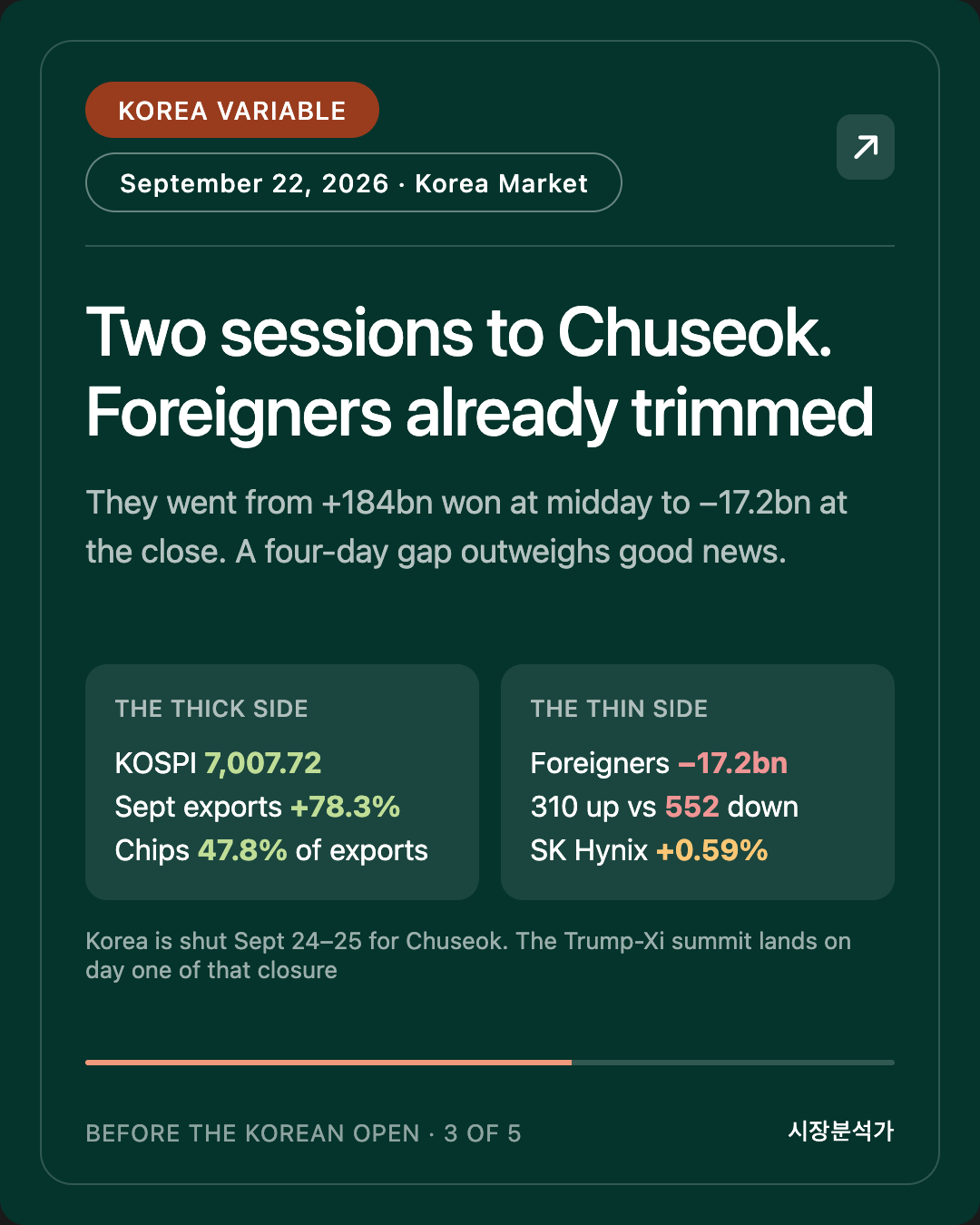
[Interpretation] Nearly half of everything Korea sells abroad is now a chip. That cuts both ways: the KOSPI is close to a single-axis index now. When chips work, one sector lifts the whole market; when they stop, nothing else is big enough to take over. Yesterday's 310 advancers against 552 decliners is that structure on display.
🔴 [Fact] Korea has only two trading days left this week
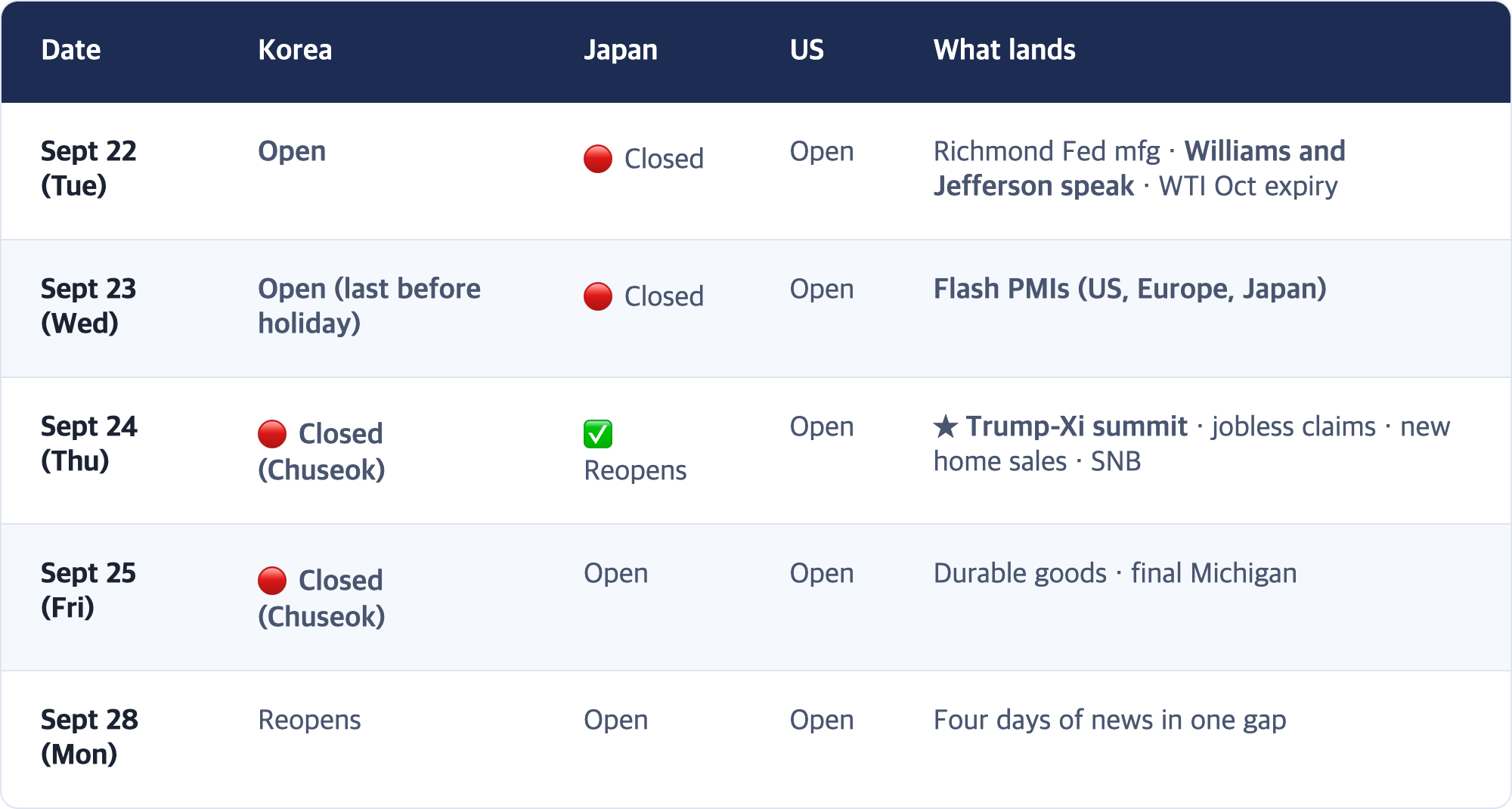
Chuseok is Korea's autumn harvest holiday, the closest equivalent to Thanksgiving. Japan is closed Monday through Wednesday for three separate national holidays.
[Observation] What Chuseok has historically done to the KOSPI
From a 25-year study published by the Korea Economic Daily:
- Over the last decade, the KOSPI averaged −0.42% in the five sessions before Chuseok
- and +0.68% in the five sessions after
- From 2000 to 2025, the five sessions after the holiday were cumulatively positive 61.5% of the time
NH Investment & Securities has a 6,400–7,500 KOSPI band for this week.
[Interpretation] The statistics say: compress into the holiday, expand out of it. But do not paste that average onto this year. In a normal Chuseok nothing much happens while Seoul is shut. This year the US and China meet on day one of the closure. That 61.5% comes from 25 years in which that was almost never true.
🔴 [Interpretation] So foreign flows today tell you more than usual
Yesterday foreigners went from +184 billion won at midday to −17.2 billion at the close.
Ahead of a four-day closure an investor has two choices: carry the position through a market you cannot exit, or trim it. Selling into the close is the second choice.
[Interpretation] If foreigners sell into the close again today, with SOX +4.29% sitting there as a reason to buy, that is not skepticism about the story — it is skepticism about the four-day gap. If instead they finish net buyers, they are treating Thursday's summit as an opportunity rather than a risk. That reads better than the index does.
4. The Macro Backdrop: The Market Watched Oil, the Fed Watched Everything Else
[Fact] Rates, oil, dollar
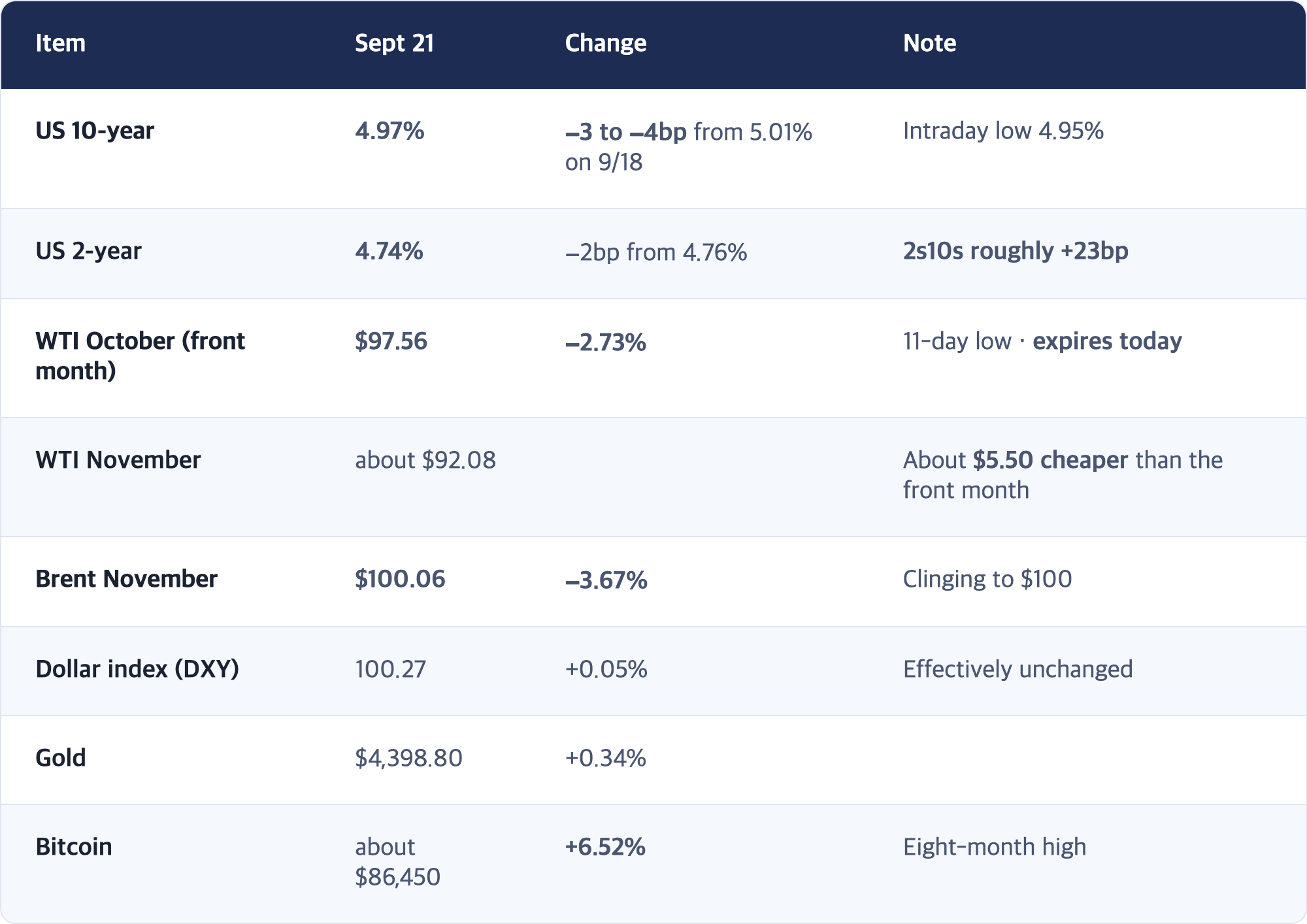
Two reasons were reported for the oil move: President Trump said he would be open to meeting Iran's President Pezeshkian at this week's UN General Assembly, and Saudi exports have recovered above 4 million barrels a day in September after falling to 2.4 million in August.
🔴 [Fact] What the Fed said on the same day
- Neel Kashkari (Minneapolis Fed) — inflation pressure is no longer confined to energy; it has spread across the economy, notably into services. "Even if we strip out energy and strip out food, inflation is still too high." He backed September's hike and signaled openness to more.
- Austan Goolsbee (Chicago Fed, speaking in London) — supply shocks "have come more frequently, hit harder and lasted longer." The Fed cannot ignore them, and responding may involve real economic pain.
✅ [Interpretation] Two readings of the same day
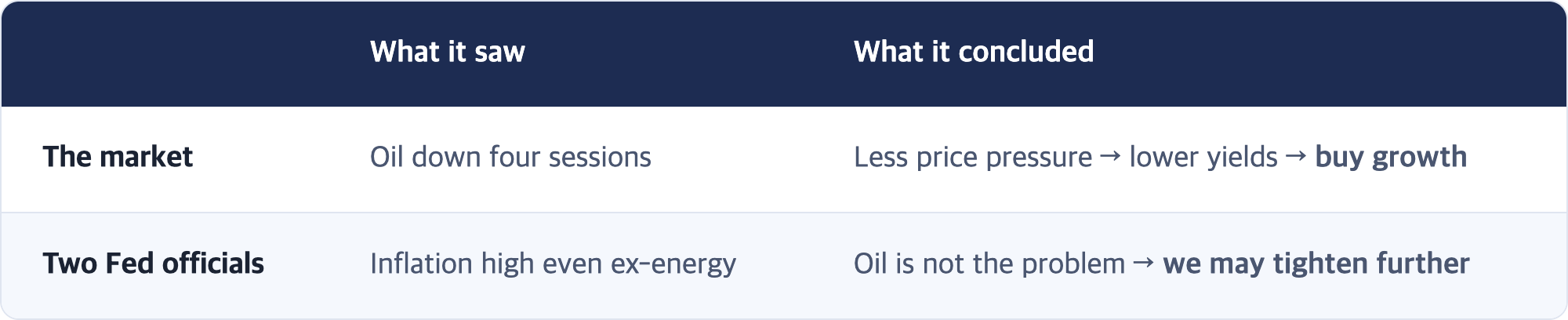
[Interpretation] These two have to meet. There are two meeting points this week.
- Tonight (Sept 22 US time): New York Fed President John Williams and Vice Chair Philip Jefferson both speak at a Treasury market conference. Kashkari and Goolsbee are individual voices; Williams and Jefferson sit closer to the leadership. If they sound the same way, that is the committee's tone, not a personal view.
- Wednesday's flash PMIs — the only major data release of the week, and the services prices component is the direct test of Kashkari's claim.
The September dot plot still puts the 2026 and 2027 medians both at 4.1%, implying at least one more hike this year (12 of 18 officials saw one more, four saw two). Until that changes, falling oil does not remove the Fed from the board.
[Interpretation] How this reaches Korea
- Rates — The US 10-year fell to 4.97%, but the Korean 10-year closed at 4.457%, still above the 4.45% line. Whether Korea follows the US lower gets tested today.
- Currency — The dollar was flat and the won still gained 2.3 won. That was not dollar weakness; it was something changing on the Korean side. Today shows whether an eight-day trend really turned or just paused.
- Oil — Korea imports every barrel it uses, so cheaper crude helps both the trade balance and inflation. ⚠️ But the WTI October contract expires today, and outlets will begin quoting November (about $92). If you see a "5% oil crash" headline, check the contract month first.
5. Preview: The Korean Session (Sept 22, KST)
[Observation] The setup
- The inputs are good. SOX +4.29%, a Nasdaq record, US yields lower, oil lower, the won stronger. All five point the same way.
- But the input is CPU-flavored. Korea's core product, memory, captured less than two-thirds of the index move.
- And this is the first of two sessions before a four-day close. Good news and holiday-risk aversion collide in the same tape.
- Japan is shut again today. For a second session, Asian prices are set only in Seoul, Hong Kong and Shanghai.
✅ Four checkpoints (Korean open to close)
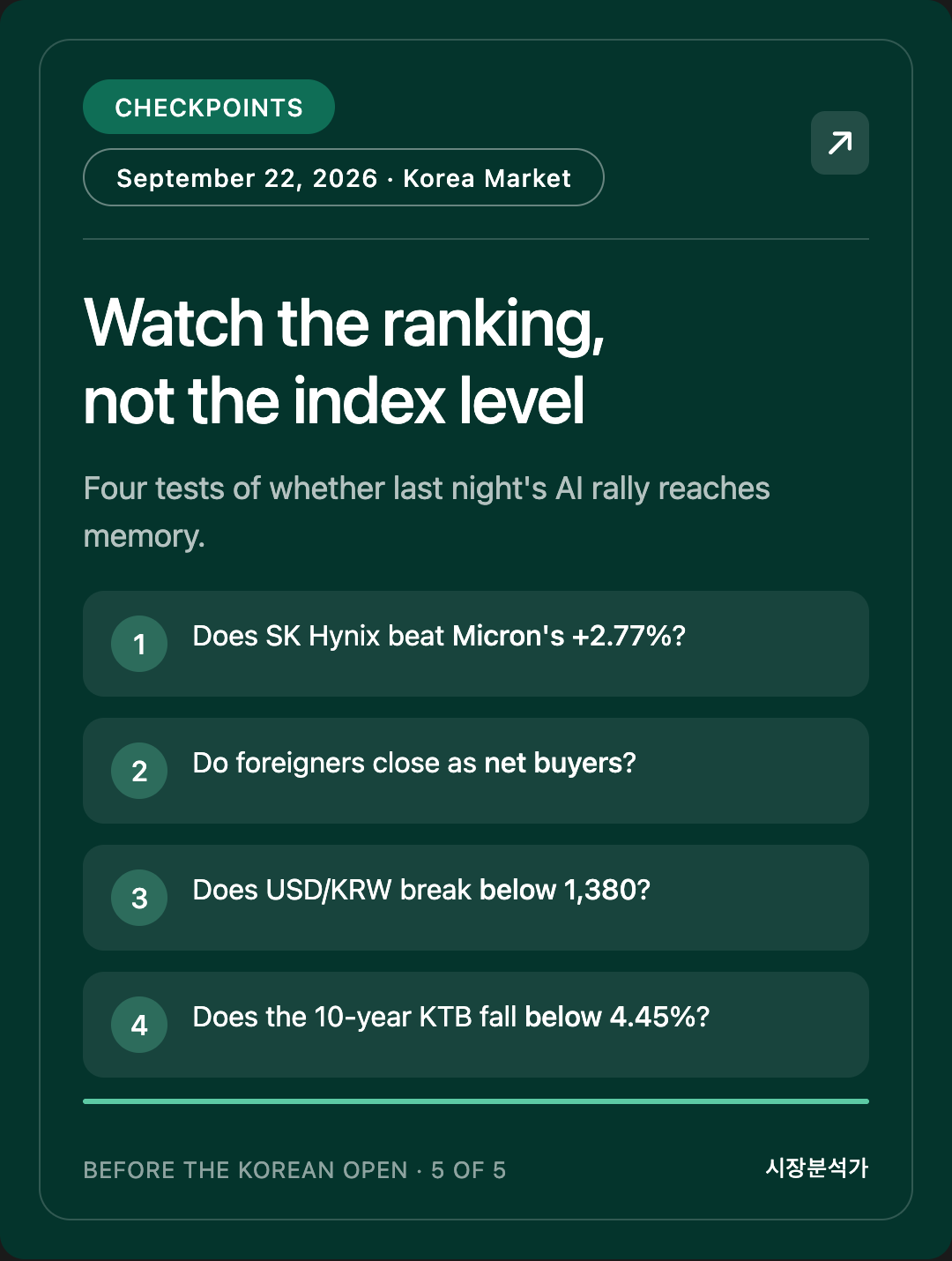
The axis, stated up front: does last night's AI rally extend into memory, or does Seoul simply copy New York's ranking?
- Does SK Hynix outperform Micron's +2.77%? If yes, the market is extending the agent story into memory. If no, Seoul copied the league table, and the two-day gap with Samsung does not close.
- Do foreigners finish as net buyers? Yesterday they went from +184 billion won at midday to −17.2 billion at the close. The same shape today means the four-day gap, not the news, is setting flows.
- Does USD/KRW break below 1,380? (Carried over from the Sept 20 report · deadline is Wednesday's close.) Yesterday's 1,381.0 leaves one won to go. The dollar was flat overnight, so failing here is a Korea problem, not a dollar problem.
- Does the 10-year KTB fall below 4.45%? (Carried over · failed yesterday by 0.7bp at 4.457%.) Failing again, after a night in which US 10s fell 4bp, would confirm a second day of Korean rates refusing to follow the US.
6. Study Note: Why AMD Rose 10% and Micron Only 2.8%
If you looked at a screen last night, this is the first question. It maps directly onto today's Korean session, so it is worth ten minutes.
The concept — "semiconductors" is not one thing
Three different jobs hide inside that one word.
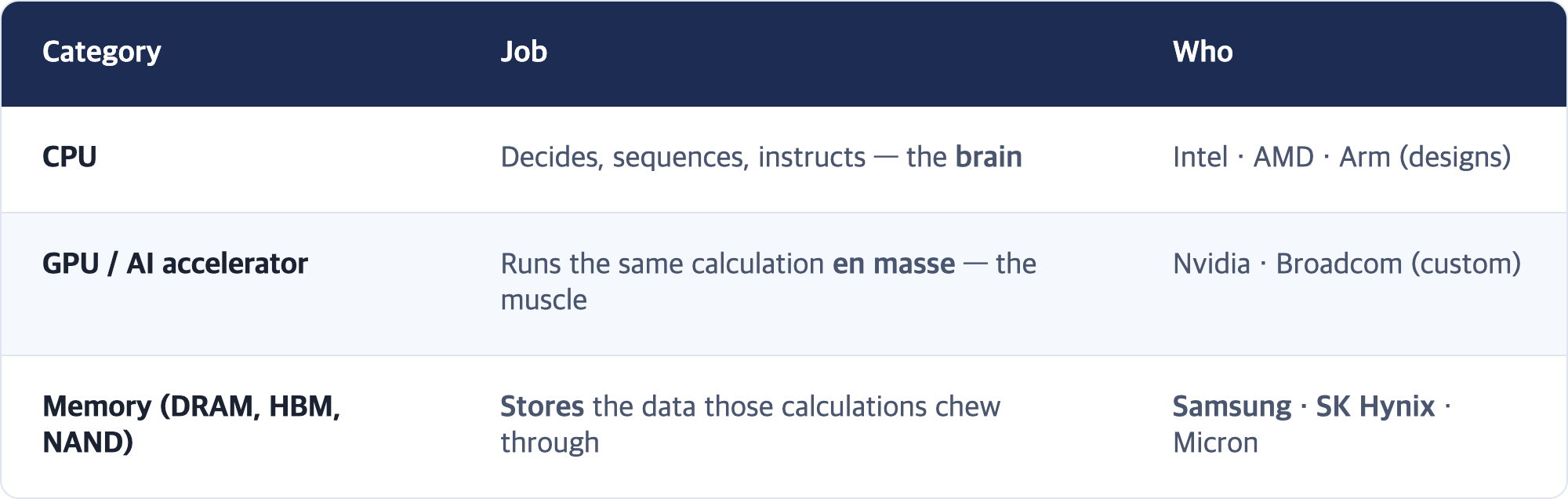
Korea's two giants live in the third row. So how far a "chips rallied" headline actually travels to Seoul depends entirely on which row rallied.
What happened last night
Meta's agent app hit #1 on the App Store. The market did this arithmetic:
An agent is not a chatbot. A chatbot answers once. An agent runs many steps by itself, in order. Deciding and sequencing is CPU work. More agents, more server CPUs.
So the money went to the CPU row first: Arm +17.2%, Intel +12.14%, AMD +9.95%.
Nvidia only rose 2.30% — different row. Micron only rose 2.77% — different row again.
An analogy — a restaurant that suddenly gets busy
Orders triple overnight.
- You hire chefs (CPUs) first, because someone has to take the orders and sequence them.
- You cannot easily add burners (GPUs) — that means rebuilding the kitchen.
- You enlarge the refrigerator (memory) only once the new chefs start saying they are running out of ingredients.
Money moves in that order. Yesterday was the first item getting repriced.
One step further — so is Korea left out?
No. This is a question of sequence, not direction.
More server CPUs means more low-power DRAM (LPDRAM) sitting next to them, which is precisely why the three memory makers have spent this year pushing data-center LPDRAM. HBM capacity, meanwhile, is already effectively sold out through 2026 across all three suppliers.
But CPUs are this quarter's order and memory is next quarter's. The lag shows up in the price.
A live example — Seoul split the same way yesterday
Samsung Electronics closed +4.98% and SK Hynix +0.59% — a gap of more than eight times between two memory companies.
CPU-versus-memory alone does not explain that; you need one more layer. Samsung runs a foundry business alongside memory, manufacturing other companies' chips. More CPU demand gives Samsung a second road in. SK Hynix does not have that road.
One-line summary
"Chips rallied" does not translate directly into Korean. Check whether it was CPUs, GPUs or memory, and read the memory number as Korea's share. Last night that number was +2.77%.
7. Corrections and Open Items
🔴 Self-audit of yesterday's report (not a correction)
Yesterday morning I said I would treat last night's move as evidence of an oil → inflation expectations → yields → equities chain, and three checkpoints passed in that direction. But the actual composition of the close was concentration into AI, not a broad cost-relief rally — Dow Transports −0.54% and Russell 2000 +0.52% are the evidence. → Revised framing: oil and yields opened the door; the money went into AI. I will not use passing checkpoints as proof of the story attached to them.
Source discrepancies (value adopted here)
![Item · Competing values · Adopted / WTI Sept 21 · $97.56 (−2.73%) [Trading Economics] · $97.61 (−2.7%, 12:54 GMT) [Reuters] · $95.78 (−4.5%) [some outlets] · $92.08 [Yahoo, November contract] · $97.56 (October, front month) — within $0.05 of the Reuters intraday print. The $92.08 quote is a different contract month / Brent Sept 21 · $100.06 (−3.67%) [Trading Economics] · $101.18 (−2.6%, 12:54 GMT) [Reuters] · $100.06 (later timestamp) / US 10-year Sept ...](https://wecansurvive.ca/wp-content/uploads/2026/09/tbl_9-33.png)
Unresolved
- US 30-year yield for Sept 21 — only the 9/18 level (5.34%) confirmed, so the long end of the curve cannot be checked
- Updated CME odds for an October hike — 59.7% as of Sept 20 remains the latest. After two hawkish Fed speeches, this is the number I most want and did not get
- Overnight USD/KRW — Korea moved to 24-hour weekday FX trading in July 2026, so an overnight quote exists, but the Sept 21–22 print was not obtained
- Foreign futures flow in Korea on Sept 21 — only the cash market's flip to net selling is confirmed
- KOSPI 200 night session futures
Operations
- 🟢 On time. Scheduled 16:00 PDT, written 16:15 PDT, 52 minutes before the Korean open. Second consecutive on-time edition; the mid-September streak of late and missing runs is fully broken.
Sources
- Stock market today: Nasdaq surges 2% to record high, Dow and S&P 500 gain as chip stocks rally, oil falls (Yahoo Finance)
- Stock Market Today (Sept. 21, 2026): Nasdaq, S&P 500 surge on best day since early August (TheStreet)
- Meta's Muse Hits No. 1 As AMD Tops $1 Trillion (Benzinga)
- US stocks close higher as tech and semiconductors lead (Seoul Shinmun)
- Meta's Muse drives AMD past a $1 trillion market cap (SBS)
- Oil prices slide to 11-day low on hopes of US-Iran diplomacy, Saudi exports (Reuters via Yahoo)
- U.S. crude oil tumbles back below $100 after Trump says he's open to talking to Iran at UN (CNBC)
- Crude Oil Price Chart and Historical Data (Trading Economics)
- Brent Crude Oil Price Chart (Trading Economics)
- US 10 Year Treasury Note Yield (Trading Economics)
- H.15 Selected Interest Rates — September 21, 2026 (Federal Reserve)
- Fed's Kashkari says inflation is still too high across the U.S. economy (CNBC)
- Fed's Goolsbee Says Road to 2% Inflation May Not Be Painless (Bloomberg)
- Kashkari Says Inflation Now Hits 'All Corners' of US (Vantage Markets)
- KOSPI closes at 7,007.72, back above 7,000 for the first time in seven sessions (Seoul Shinmun)
- Semiconductor exports up 259.4%; Sept 1–20 exports hit a record $71.4bn (Money Today)
- Sept 1–20 exports a record $71.4bn, semiconductors 47.8% of the total (Dailian)
- USD/KRW closes 2.3 won lower at 1,381.0 (Money Today)
- Korean government bond yields mixed; 3-year at 4.056% (Betanews)
- Does the KOSPI rise after Chuseok? A 25-year data study (Korea Economic Daily)
- KOSPI into Chuseok: the Trump-Xi summit, oil and rates in focus (Herald Business)
- HBM, DRAM & AI Demand: Memory Supply and Price Trends (IntuitionLabs)
This report interprets market flows and macro variables. It is not a recommendation to buy or sell any individual security.
📌 More market briefs
※ This post is market observation and organization intended to support your own judgment. It is not a recommendation to buy or sell any security. Figures are as of the time of writing and may differ between sources.
If this was useful, bookmark it or pass it along. It genuinely helps me write the next one.
I can survive. We can survive.