September 4, 2026 KOSPI Market Brief — What to Watch Before the Korean Open
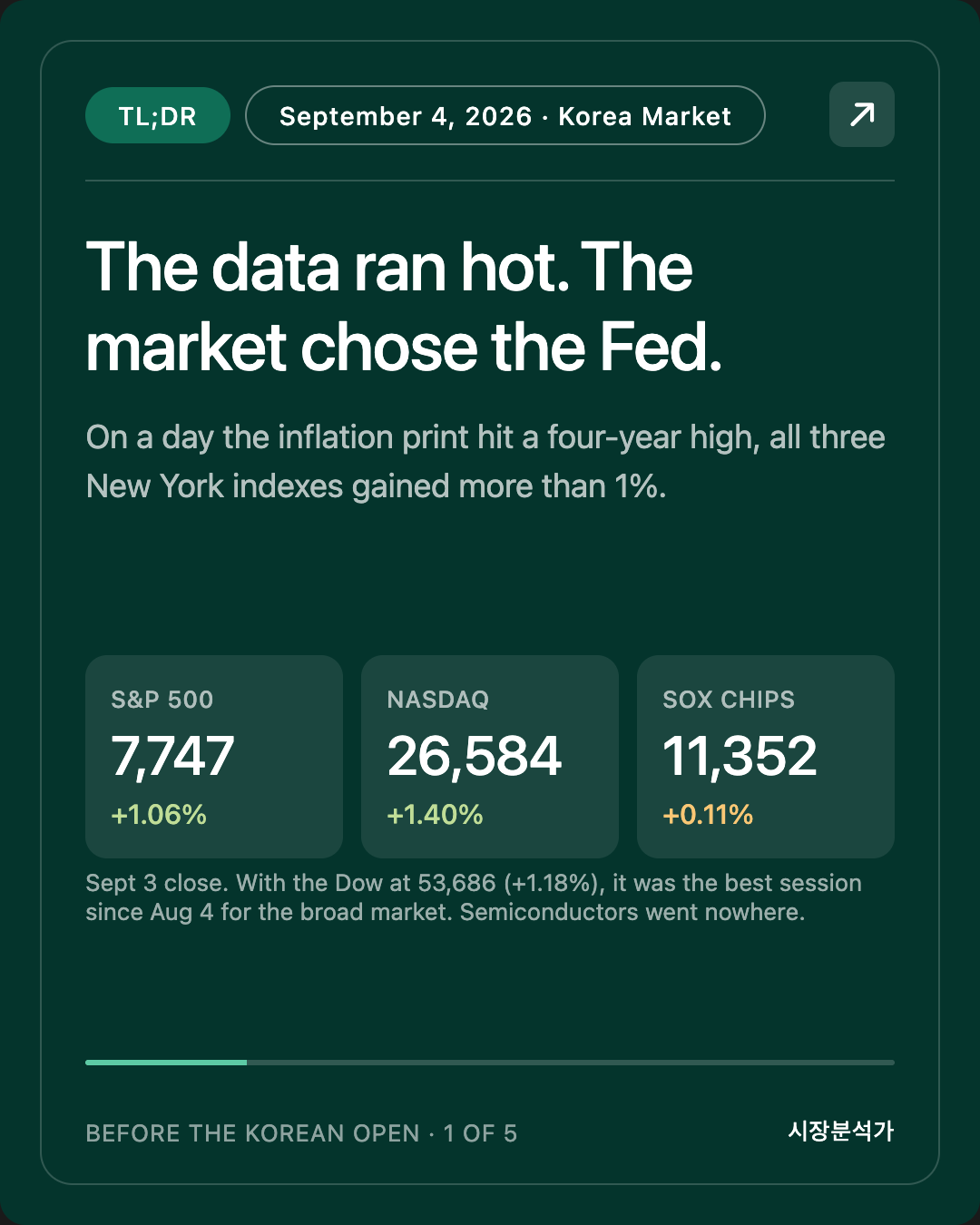
- All three major US indexes gained more than 1%. S&P 500 7,747.71 (+1.06%), Nasdaq Composite 26,584.06 (+1.40%), Dow 53,686.11 (+1.18%). For the Dow and the S&P, it was the best session since August 4.
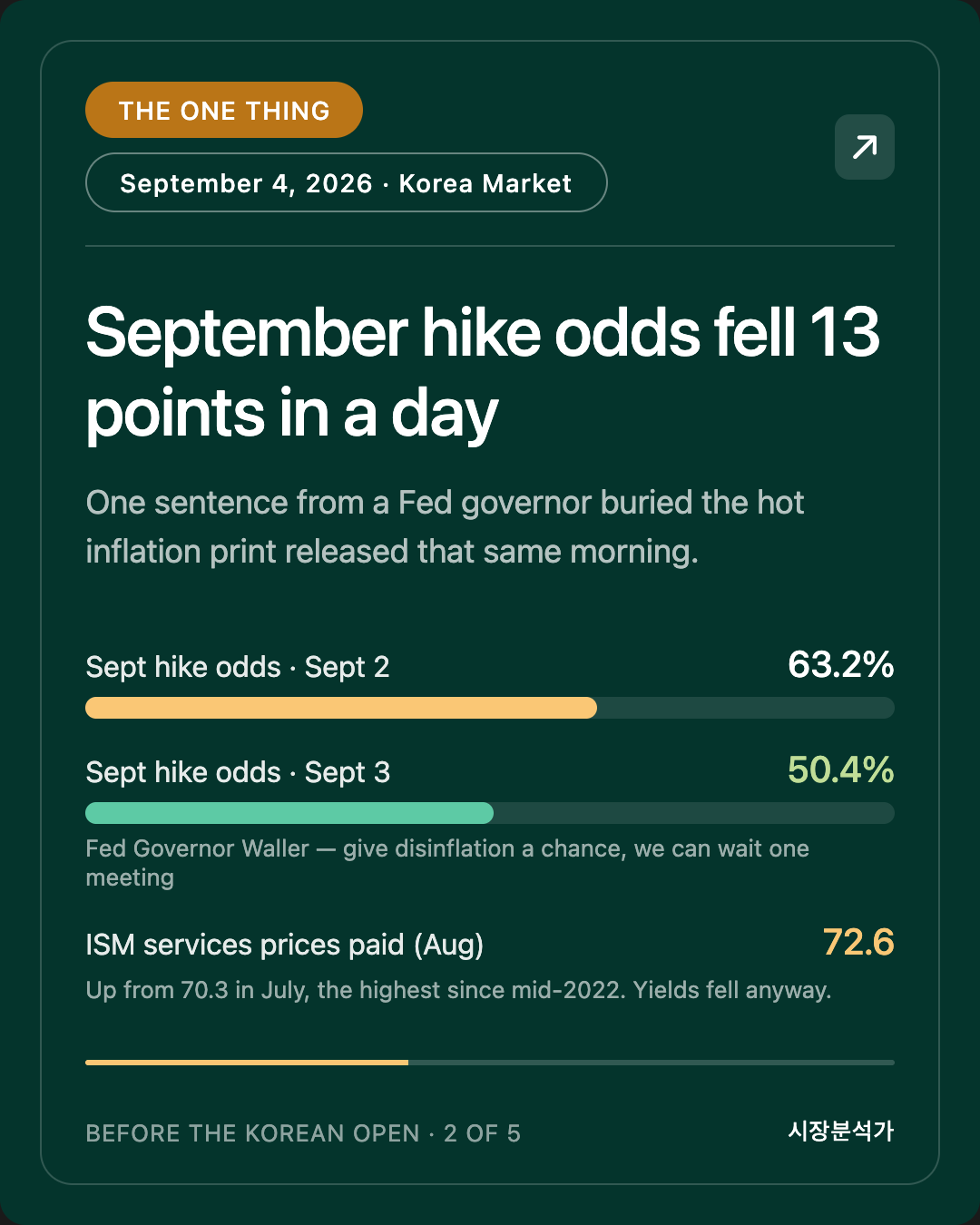
- The driver was a Fed governor, not the data. After Waller signaled he could vote to hold in September, CME FedWatch odds of a September hike fell from 63.2% to 50.4%. The 10-year Treasury yield eased to 4.74–4.75% and the VIX dropped to 14.32 (−5.79%).
- The morning's inflation print said the opposite. August ISM services PMI 55.4 (highest since February), new orders 60.9 (fastest since early 2023), and prices paid 72.6, the highest since mid-2022. The market saw the hot print and chose Waller's sentence anyway.
- Semiconductors sat the rally out. The SOX index closed at 11,352.1 (+0.11%), a 1.29 percentage-point gap behind the Nasdaq. Broadcom finished the regular session at $356.36 (−2.96%), trimming its after-hours loss but never turning green.
- Korea trades today without knowing the answer. The US August jobs report lands at 21:30 KST on Sept 4, after Seoul closes. Consensus is +53,000 to +60,000 nonfarm payrolls and a 4.1% unemployment rate.
This is Mr. Can. Here is the September 4, 2026 brief ahead of the Korean market open.
Written: September 4, 2026, 08:10 KST (Vancouver: Sept 3, 16:10 PDT)
Covers: US and European close of Sept 3 (05:00 KST on Sept 4)
Intro
September 3 in New York had two halves that pointed in opposite directions. In the morning, the August ISM services prices-paid index came in at 72.6, the highest since mid-2022. Inflation in the service economy is not cooling; it is heating up. Then in the afternoon, Fed Governor Christopher Waller said he could support holding rates steady in September, and the odds of a September hike collapsed from 63.2% to 50.4%. The Dow posted its best day since August 4. A single official's sentence beat a hot data print.
For anyone watching Korea, though, the more important number is elsewhere. While the Nasdaq rose 1.40%, the Philadelphia Semiconductor Index rose only 0.11%. Korea's index opens this morning holding three good cards and one bad one, and the bad one is the heaviest. Here is what to watch.
1. The September 3 Close (US session = 05:00 KST, Sept 4)
[Fact] — Major indexes
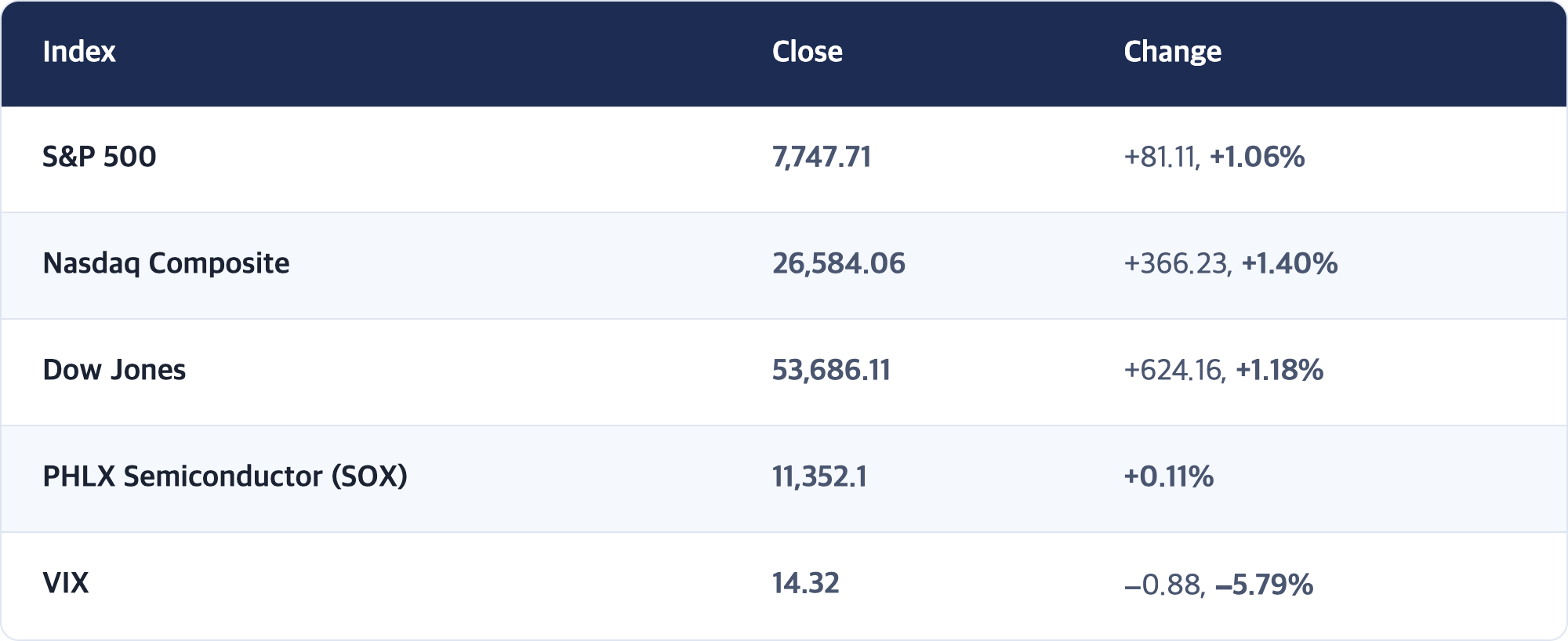
The Dow and the S&P 500 both posted their largest single-day gain since August 4.
[Fact] — Rates, currencies, commodities
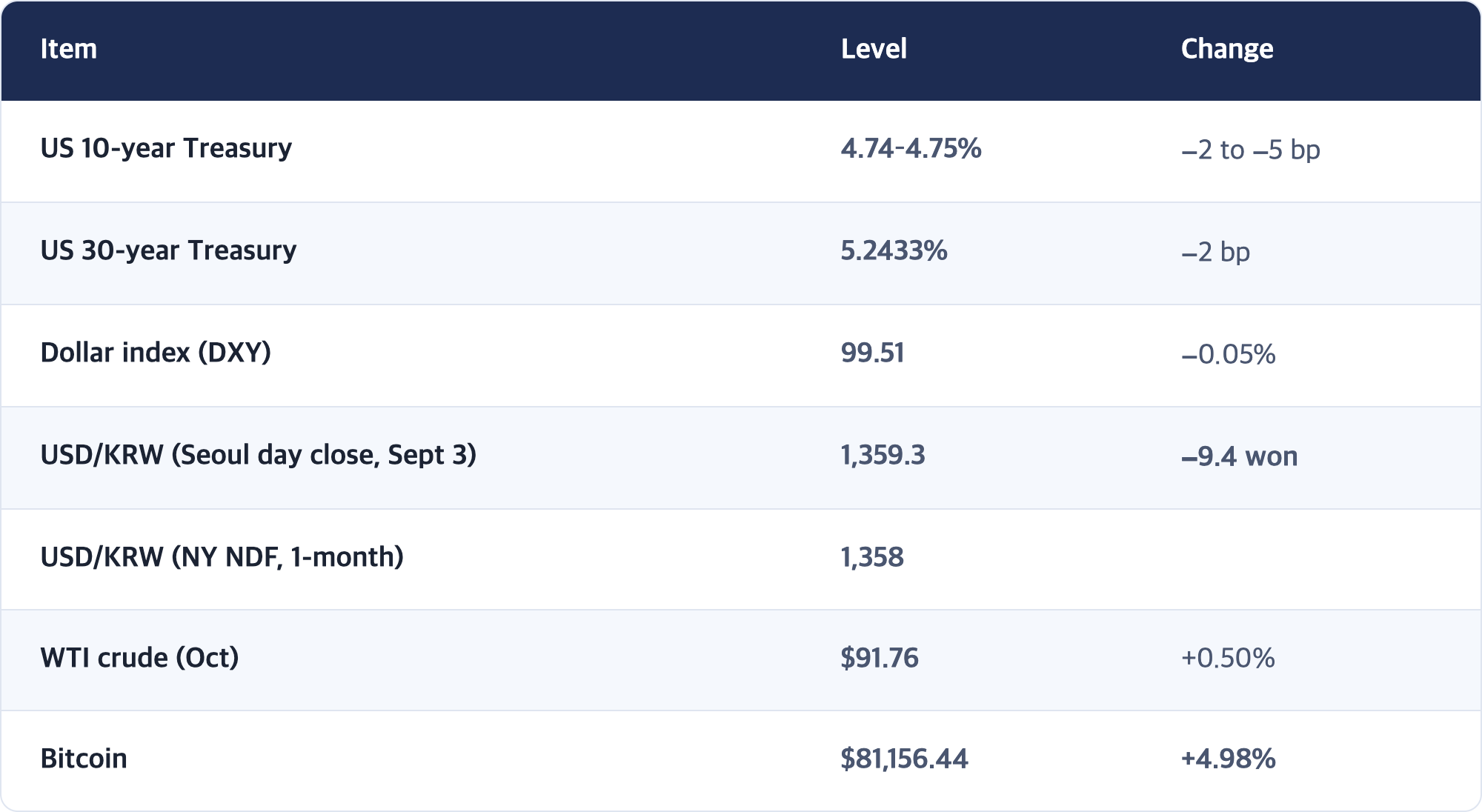
[Fact] — The data that landed that day
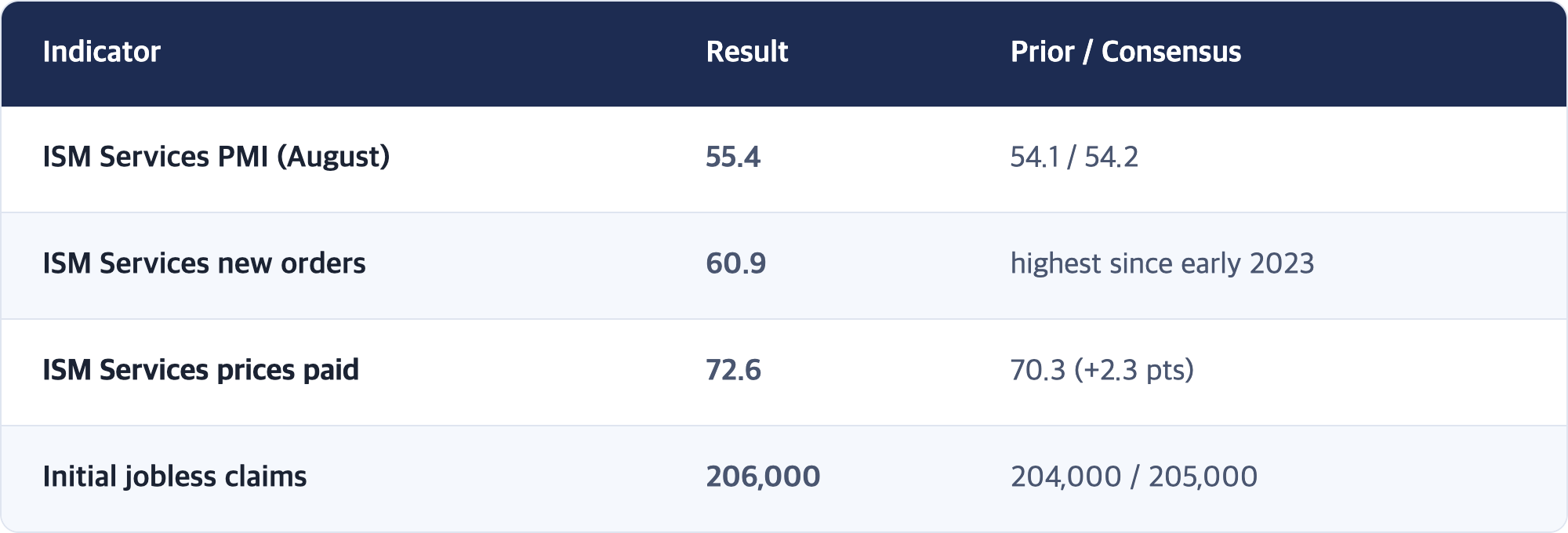
Prices paid has now been above 60 for 21 straight months, and its 12-month average rose to 68.5, the highest since April 2023. ISM specifically flagged gasoline, diesel and other petroleum-linked inputs as rising in price in August, and added GPUs and steel to its list of items in short supply.
2. The One Thing That Mattered — the data said one thing and the market heard another
[Fact] — What Waller actually said
Speaking on September 3, Waller acknowledged that inflation remains "meaningfully above" the Fed's 2% target, but said recent trends "suggest we are finally seeing some signs of disinflation." Then he added:
"I'm going to paraphrase John Lennon here: Give disinflation a chance. We can wait one meeting."
He attached conditions. His September vote will be "heavily influenced" by the August CPI print, and "if inflation comes in hot, I would consider a rate hike." He also noted that policy is "only slightly restricting aggregate demand," so "it may not take much acceleration in inflation to nudge me into supporting tighter policy."
[Fact] — How the market moved
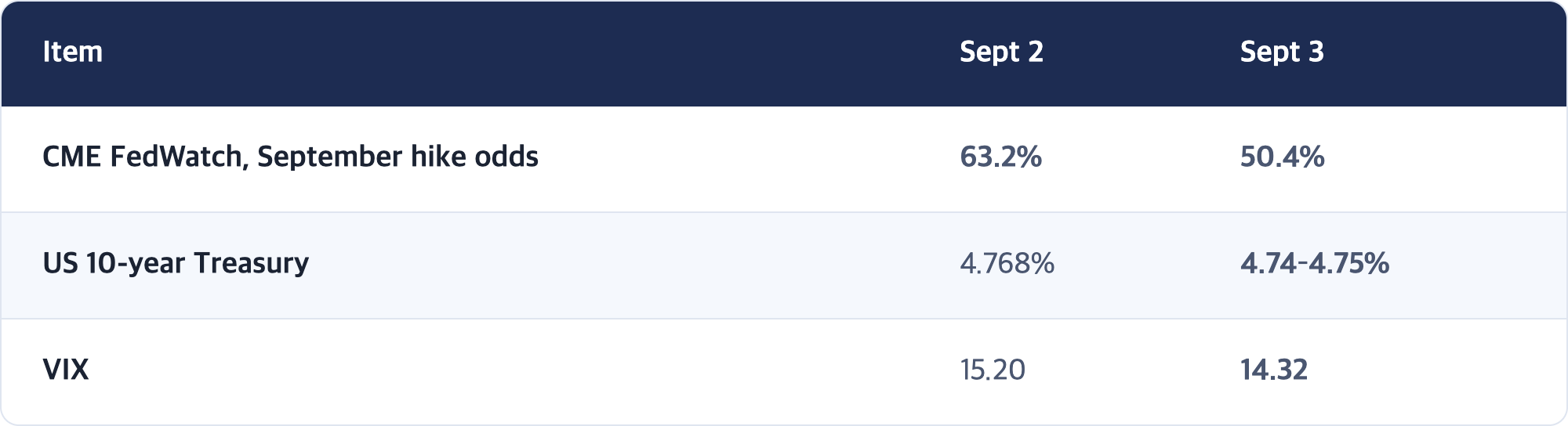
[Interpretation] — Why this matters
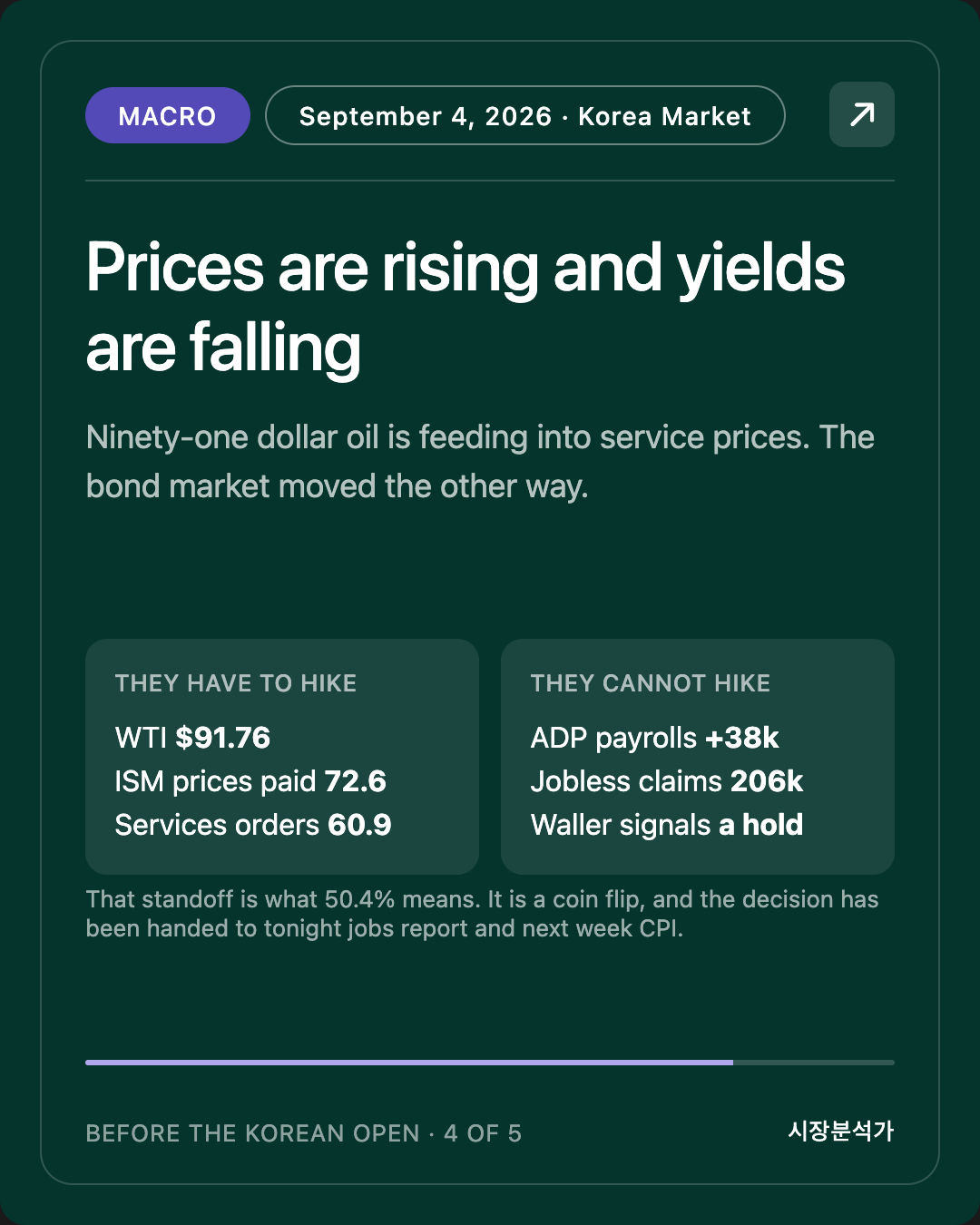
The morning's data pointed the other way. ISM services was strong across the board, and prices paid at 72.6 is a four-year high. That is closer to evidence that $91 oil is now feeding into service-sector prices than to evidence of disinflation. Yesterday morning's report set exactly this as its test, and by that test yields should have risen.
They fell instead, and the logic is simple. Data tells you what the Fed will be looking at. A governor's remarks tell you what the Fed will do about it. The second is closer to the decision and more specific. Waller in particular has long been treated by markets as a leading indicator of where the committee is heading.
But the relief comes with a condition attached. Waller himself named the August CPI print as the hinge. That release is next week; the FOMC meets September 15–16. What the market bought yesterday is not a hold, it is the probability of a hold. The odds went from 63% to 50%, not to zero. Miss that distinction and next week's CPI will feel like an ambush.
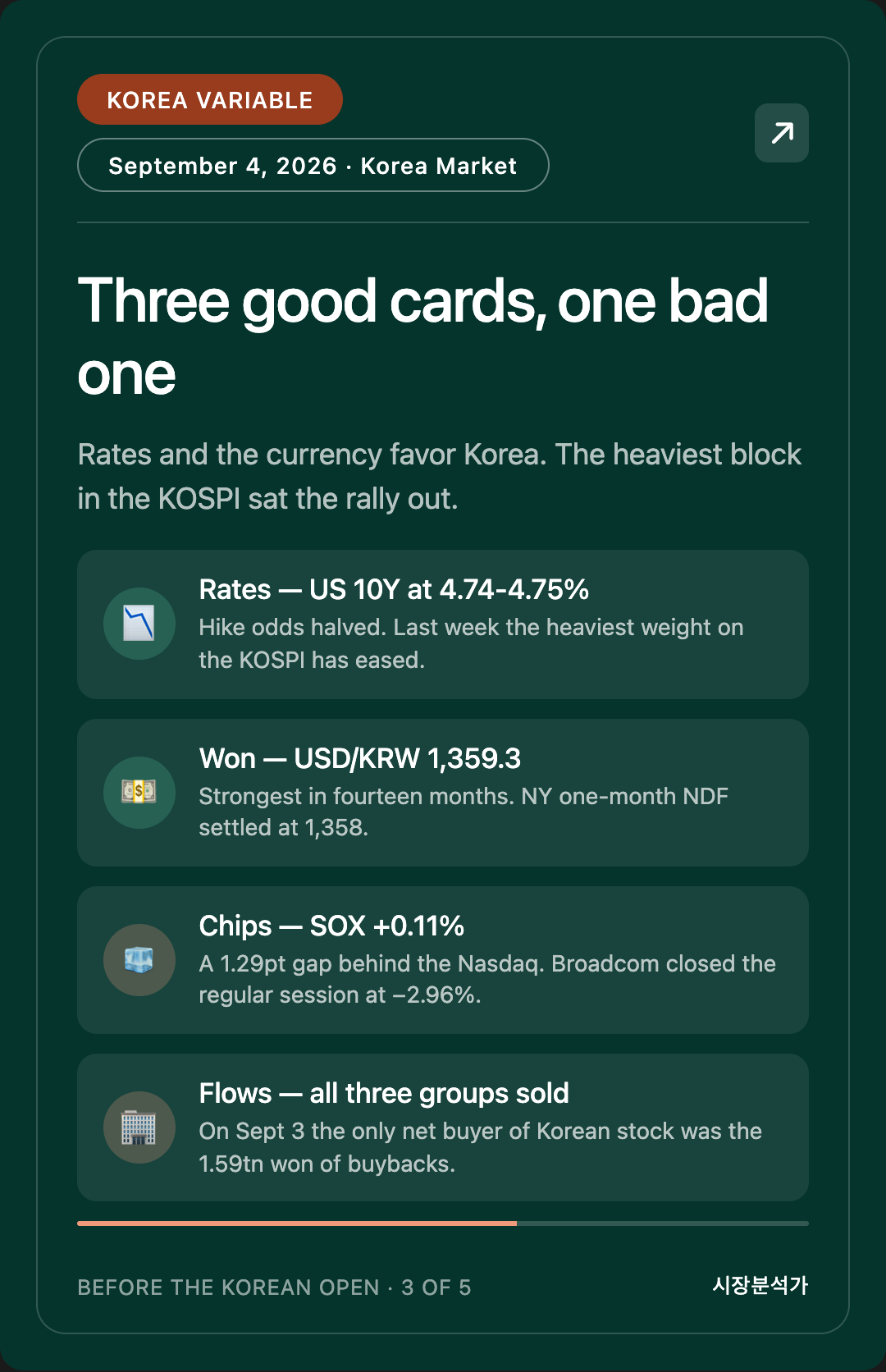
3. The Korea Variable — three good cards, one bad one
[Fact] — Where Korea closed on Sept 3
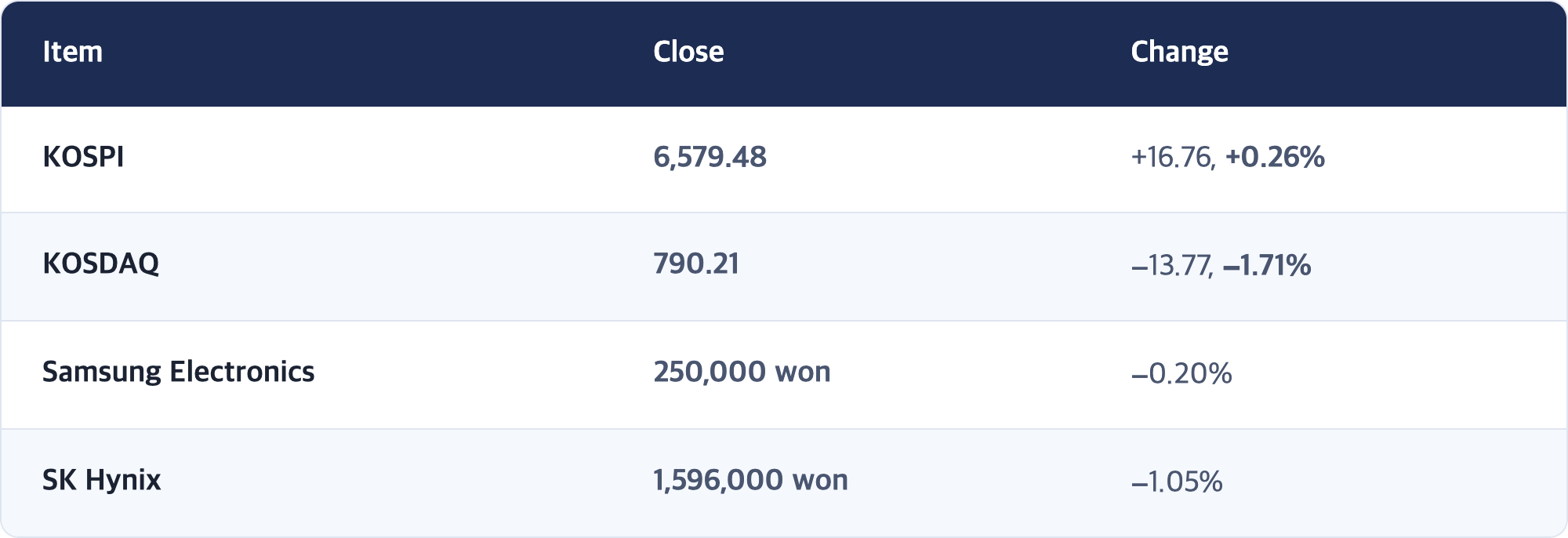
By investor type, retail (−955.1bn won), foreign (−419.3bn) and institutional (−215.2bn) investors all sold. The only net buyer was the "other corporations" category at +1.59tn won, which in Korea is overwhelmingly Samsung Electronics and SK Hynix buying back their own shares.
[Observation] — What Korea inherits this morning
Three things in Korea's favor.
- Rates. The US 10-year is back to 4.74–4.75% and September hike odds have halved. High global yields were the single biggest weight on the KOSPI last week.
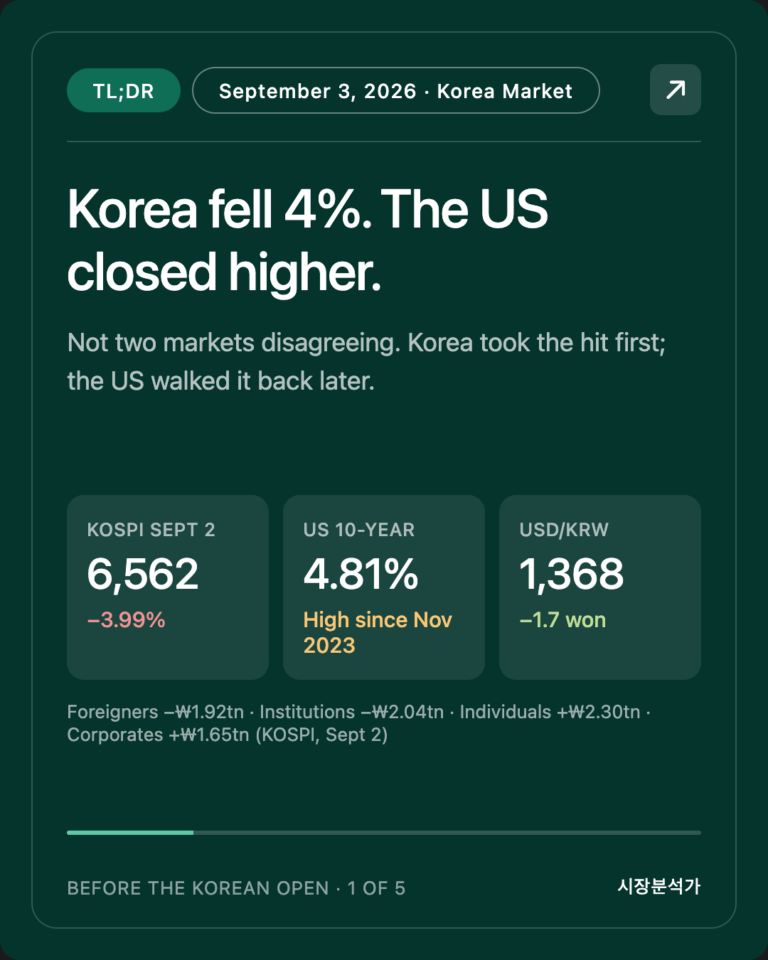
- The won. The Seoul day close of 1,359.3 is the strongest in fourteen months (intraday low 1,355.9), and the NY one-month NDF settled at 1,358. The dollar index also slipped to 99.51. For a foreign holder of Korean equities, currency losses are shrinking.
- Risk appetite. VIX at 14.32, bitcoin up 4.98%. A textbook risk-on signature.
One thing against Korea, and it is the one that weighs most.
The SOX rose just 0.11%. On a night the Nasdaq gained 1.40%, chips went nowhere, a gap of 1.29 percentage points. Broadcom closed the regular session down 2.96%, cutting its after-hours loss without erasing it.
Meanwhile Nvidia rose on news that it will acquire the open-source AI platform Hugging Face for $12.9 billion. The AI-infrastructure story and the semiconductor-earnings story are separating, and that split has repeated all week.
[Interpretation] — What this means for the KOSPI
Korea gets tailwinds for the index as a whole (rates, currency, risk appetite) and a headwind for the largest single block inside it. Semiconductors are a very large share of KOSPI market capitalization. When Wall Street rallies but chips do not, Korea structurally cannot match the US move.
Yesterday was exactly that case. The KOSPI opened up 1.33% on the US bounce, gave the entire gap back during the session, and closed +0.26%. This morning arrives with the same structure. Whether the opening gap survives is the first thing to watch today.
4. Macro Backdrop — prices are rising and yields are falling
[Fact] — Oil and geopolitics
WTI for October delivery sits at $91.76 (+0.50%). Tension around the Strait of Hormuz persists, but oil's rally has paused after the US indicated the latest strikes on Iran would be short-lived, while keeping the door open to further action.
[Interpretation] — The structural tension right now
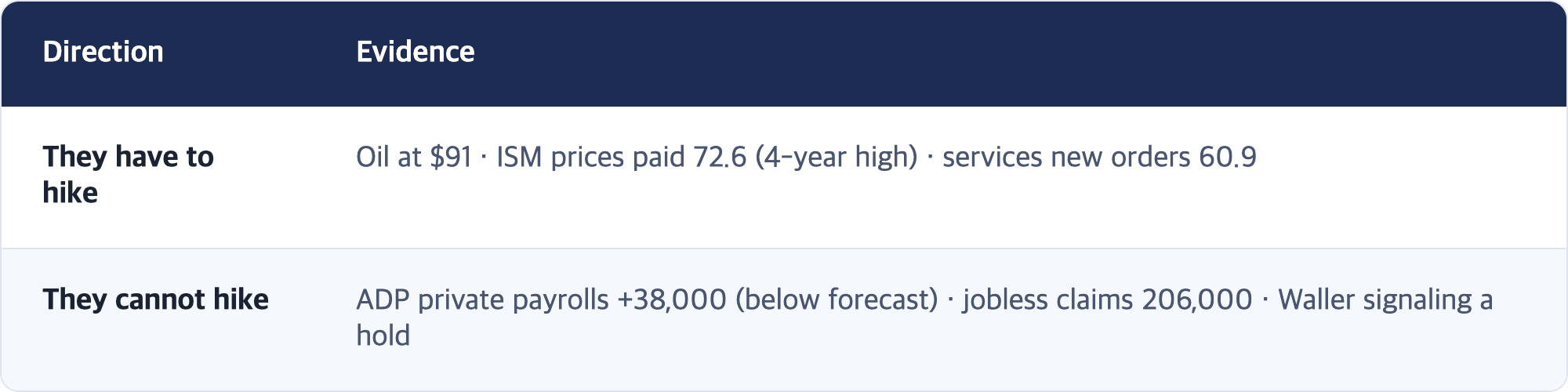
That standoff is what 50.4% means. It is a coin flip, and it is honest: the market has not decided, and it has handed the decision to tonight's jobs report and next week's CPI.
[Fact] — Gold quotes still disagree
Futures show $4,520.70 (−0.42%) while spot shows $4,427.99 (+0.92%). The two sources disagree on direction, not just level. Neither is used here as a settled figure; both are shown. This discrepancy has recurred since August 31.
5. Preview — the Korean session of Friday, September 4 (KST)
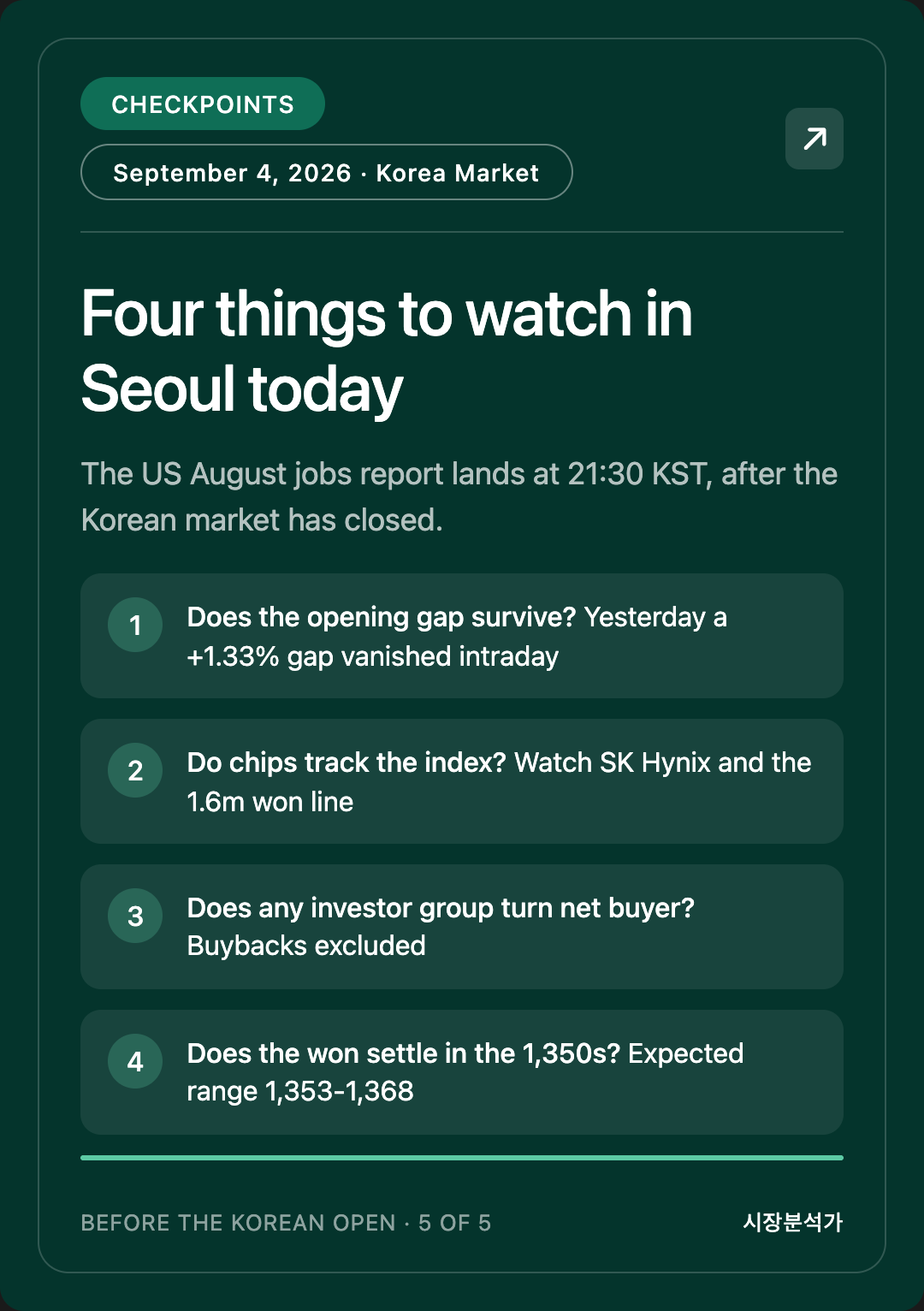
[Interpretation] — Four things to watch
- Does the opening gap survive the session? Yesterday a 1.33% gap vanished entirely intraday. If it happens again, "the index rises but nobody is buying" is a structure, not a one-day accident. Watch whether there is a give-back at all, not how large it is.
- Do Samsung and SK Hynix track the index or trade apart from it? After a flat night for the SOX, both may open weaker than the index. Yesterday's closes were 250,000 won and 1,596,000 won. SK Hynix has already lost the 1.6 million-won line, so whether it reclaims that level is the cleanest read on semiconductor sentiment.
- Does any of the three main investor groups turn net buyer? Buybacks excluded. Retail, foreign or institutional, any one of them turning would make today different from yesterday. If none does, the demand vacuum is unchanged regardless of where the index closes.
- Does the won settle into the 1,350s? Seoul's expected range is 1,353–1,368. Foreign investors have sold more than 2 trillion won over two sessions and the won still strengthened. A third day of that would firm up the reading that this is portfolio rebalancing inside Korea, not capital leaving it.
[Observation] — Event calendar (D-N)
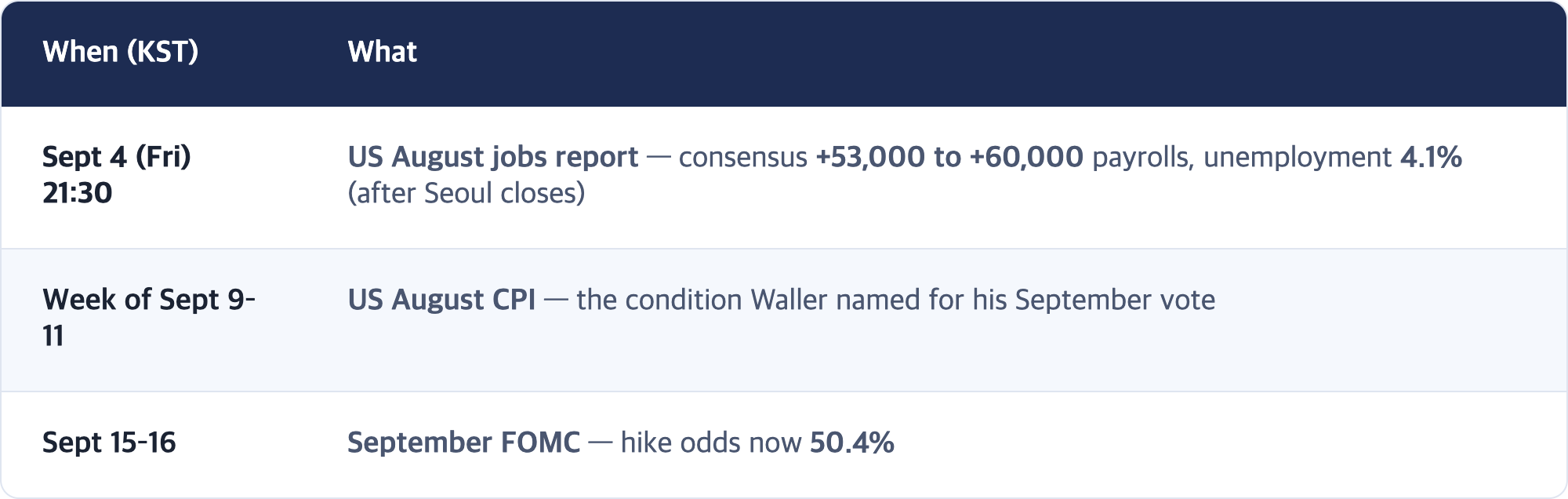
[Interpretation] Today is a waiting session. The US jobs report arrives after Seoul closes, so anyone holding a position at 15:30 KST carries it into the weekend without knowing the answer. Expect volume to thin and conviction to fade through the afternoon. If the index finishes ambiguously, that ambiguity is not itself a signal.
[Interpretation] One more thing. What has held Korea's floor all week is Samsung and SK Hynix buying their own shares. A large share of the 55 trillion-won buyback program is still unspent, so the floor should keep holding. But holding a floor and lifting an index are different jobs. A buyback absorbs sellers; it does not manufacture buyers. That is why checkpoint 3 above matters most.
📖 Study Note — why an official's sentence outweighed a hot data print: forward guidance
The concept. When a central bank tells you in advance what it intends to do, that is forward guidance. It is a tool for moving market interest rates using words alone, without touching the policy rate at all.
Why words work. The yields you see traded in the market are not today's policy rate. They are an average of what the market expects the policy rate to be over the coming years. So any new information about the future path shows up in today's yields immediately.
An analogy. High humidity this morning is data. It is a hint that it might rain. But if the head of the weather service goes on television and says "we will not be issuing a rain forecast for tomorrow," people leave their umbrellas at home without checking the humidity again. Data nudges the odds; the decision-maker's words change the conclusion.
Keep the case in mind.
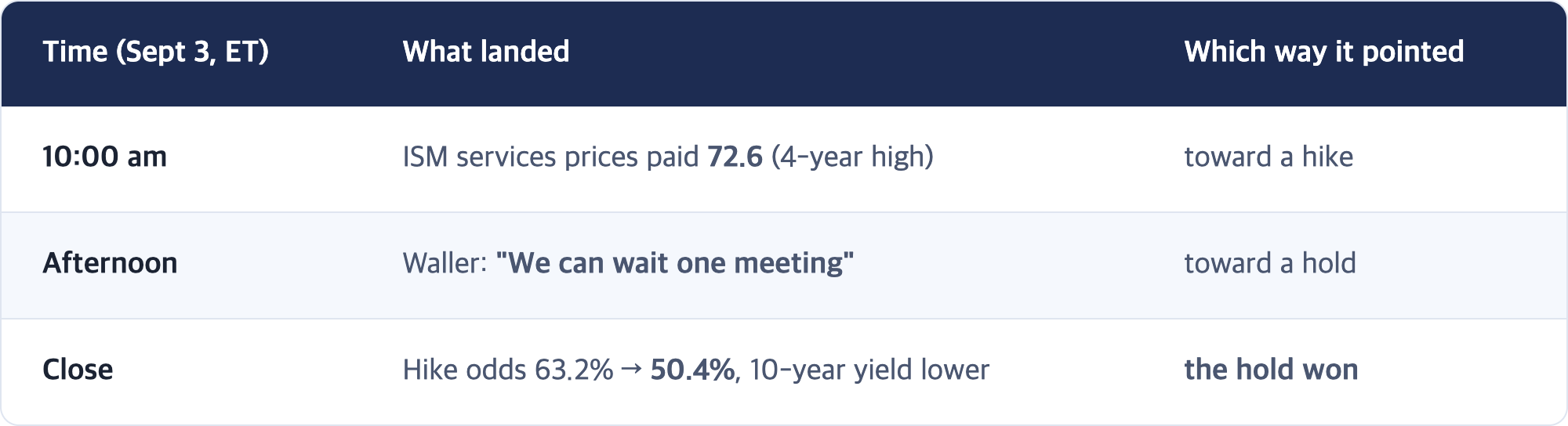
One caution. Forward guidance is conditional. Waller explicitly tied his vote to the August CPI. If you remember the conclusion and forget the condition, you will not understand why markets lurch when the condition breaks. When reading Fed commentary, look for "what would make me act" before "what I will do."
📌 Corrections and Follow-ups
1) Checkpoint 1 from the Sept 3 morning report was wrong. That report said of ISM services prices paid: "if this rises, the case for a September hike strengthens and the calm in bonds turns out to have been a single day." Prices paid rose sharply, from 70.3 to 72.6, and yields fell further while hike odds dropped 12.8 percentage points. Hanging a path on one indicator was the error. When a Fed official is scheduled to speak the same day, that speech outranks the print, and future checkpoints will say so.
2) Checkpoint 2 was right. Broadcom closed the regular session at $356.36 (−2.96%), failing to turn positive. That is the third instance of the same pattern, after Applied Materials on August 14 and Broadcom's own after-hours move on September 2. The diagnosis that strong results are no longer a reason to buy stands.
3) Checkpoint 3 is unresolved. The 10-year closed at 4.74–4.75%, sitting precisely on the line the report drew. It neither settled below nor bounced back above. Tonight's jobs report decides it.
4) Checkpoint 4 asked the wrong question. It framed the test as "the gap between the Dow and the Nasdaq," and the Nasdaq (+1.40%) in fact overtook the Dow (+1.18%), reversing the gap. So Wednesday's weakness was not a broad tech problem. But the real gap was not Dow-versus-Nasdaq. It was Nasdaq (+1.40%) versus SOX (+0.11%). For a Korean investor the meaningful axis is not "tech versus old economy" but "AI infrastructure versus semiconductor earnings." Future reports will use that axis instead.
5) SOX figures diverged sharply between sources. Some aggregators reported the September 3 SOX at 11,167.19 (−1.52%). Investing.com historical data and Korean coverage (Asia Economy) both show 11,352.1 (+0.11%), which is also the only figure consistent with the September 2 close of 11,339.3. The latter is used here.
6) US closing levels differ between wire flashes and settled prints. Reuters-sourced flashes gave Dow 53,707.66 (+1.22%), S&P 7,755.14 (+1.15%) and Nasdaq 26,628.14 (+1.57%). This report uses the settled closes: 53,686.11 · 7,747.71 · 26,584.06.
7) Jobs-report consensus varies by house. Nonfarm payrolls estimates run +53,000 (CNBC), +58,000 and +60,000; most expect unemployment to hold at 4.1%, though some see 4.2%. A range is quoted rather than a single figure.
8) This edition ran on schedule. Scheduled for 16:00 PDT, started 16:04 PDT. No drift.
🔗 Sources
- Yahoo Finance — Sept 3 US market close · Wall Street rallies as Waller eases hike fears · Waller's "if" is doing heavy lifting
- CNBC — Waller indicates support for holding rates in September · August jobs report: payrolls projected up 53,000 · ADP private payrolls +38,000 · Treasury yields move lower
- PR Newswire / ISM — August 2026 ISM Services PMI report, 55.4%
- Investing.com — Waller open to a September hold if disinflation holds up · PHLX Semiconductor historical data
- Motley Fool — Sept 3 midday: stocks rally as yields fall, Broadcom falls despite beat
- Benzinga — Why Broadcom stock fell Thursday
- Asia Economy (Korean) — NY stocks rise across the board on Waller's remarks
- Money Today (Korean) — Won closes 9.4 lower at 1,359.3 · Tech smiled at the "support a hold" remark
- Edaily (Korean) — Won trades around 1,360 on a softer dollar
- NewsSpace (Korean) — Nvidia to acquire Hugging Face for $12.9bn
- Trading Economics — US 10-year yield · Gold · Dollar index
This report summarizes market flows and macro variables. It is not a recommendation to buy or sell any individual security.
📌 More market briefs
※ This post is market observation and organization intended to support your own judgment. It is not a recommendation to buy or sell any security. Figures are as of the time of writing and may differ between sources.
If this was useful, bookmark it or pass it along. It genuinely helps me write the next one.
I can survive. We can survive.