September 1, 2026 KOSPI Market Brief — What to Watch Before the Korean Open
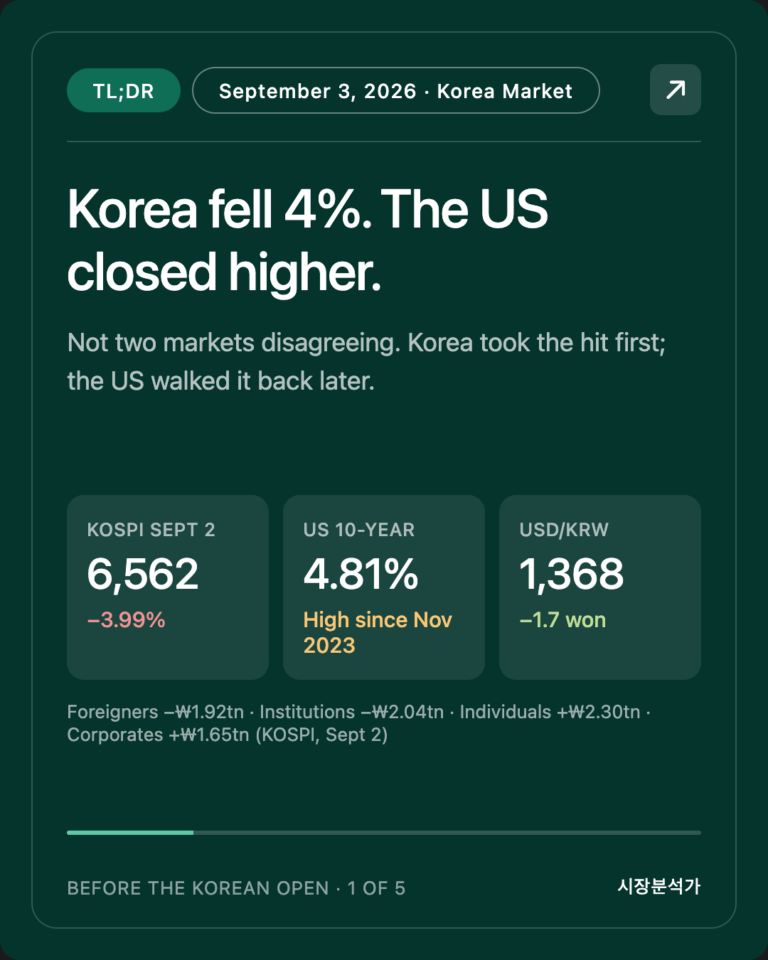
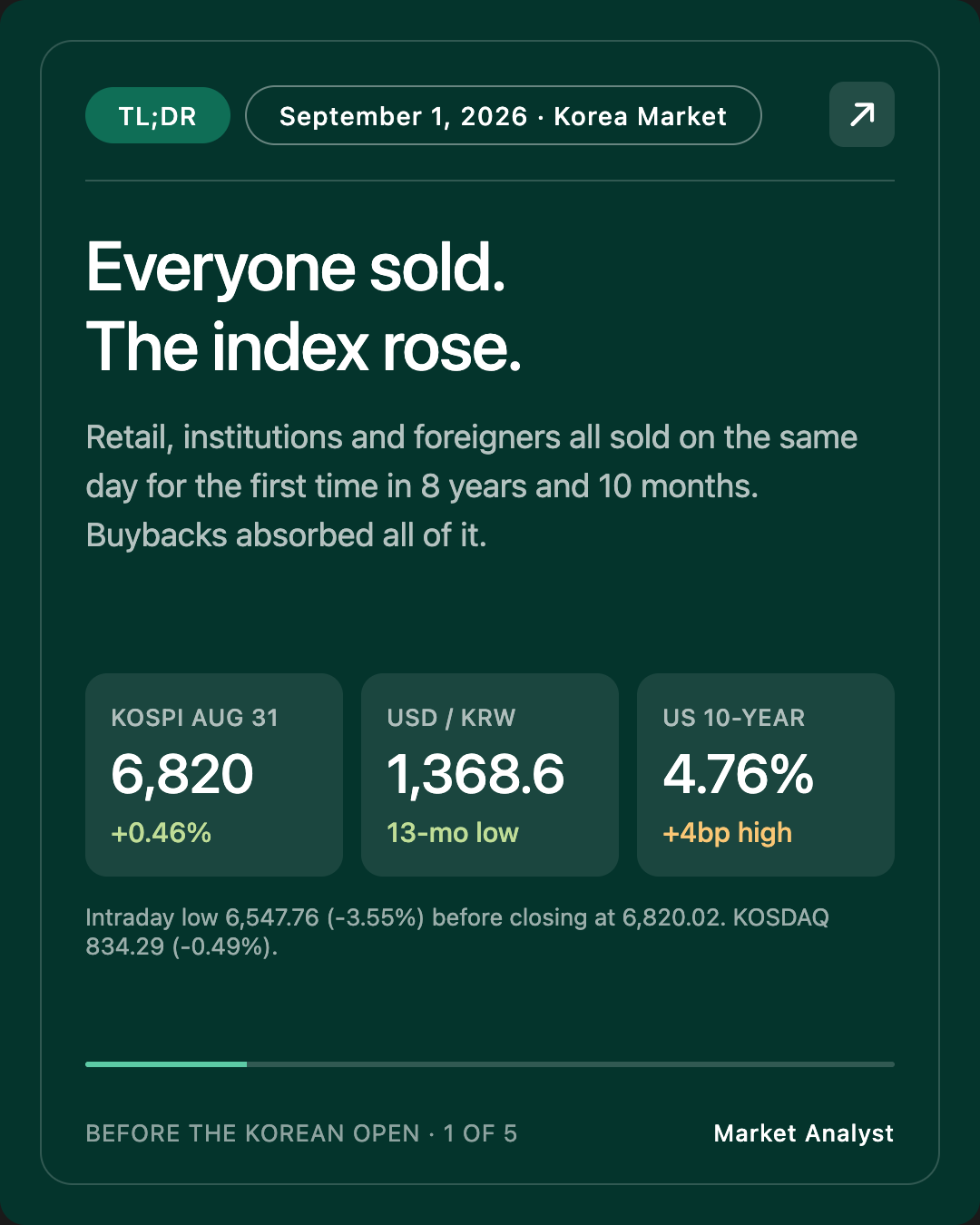
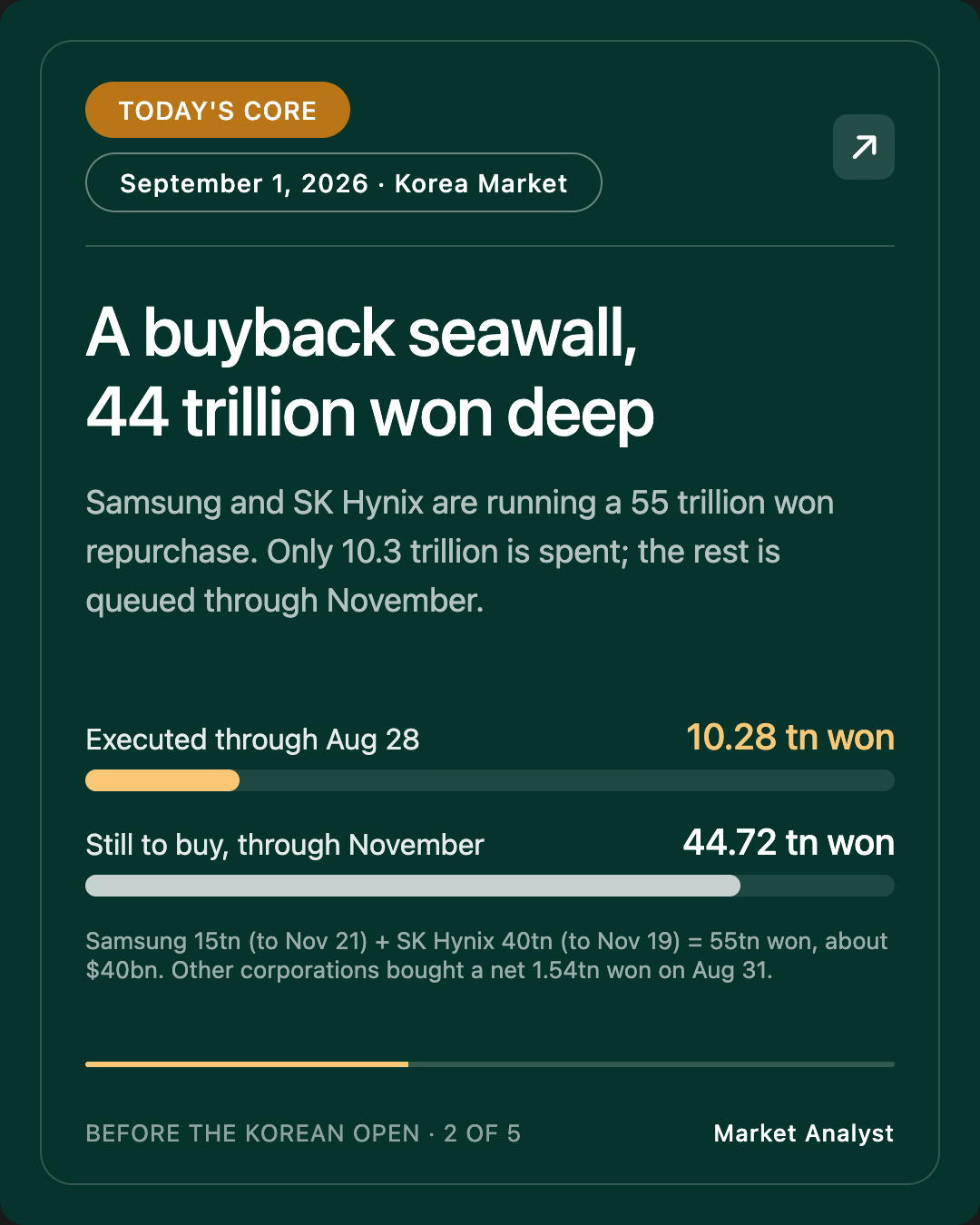
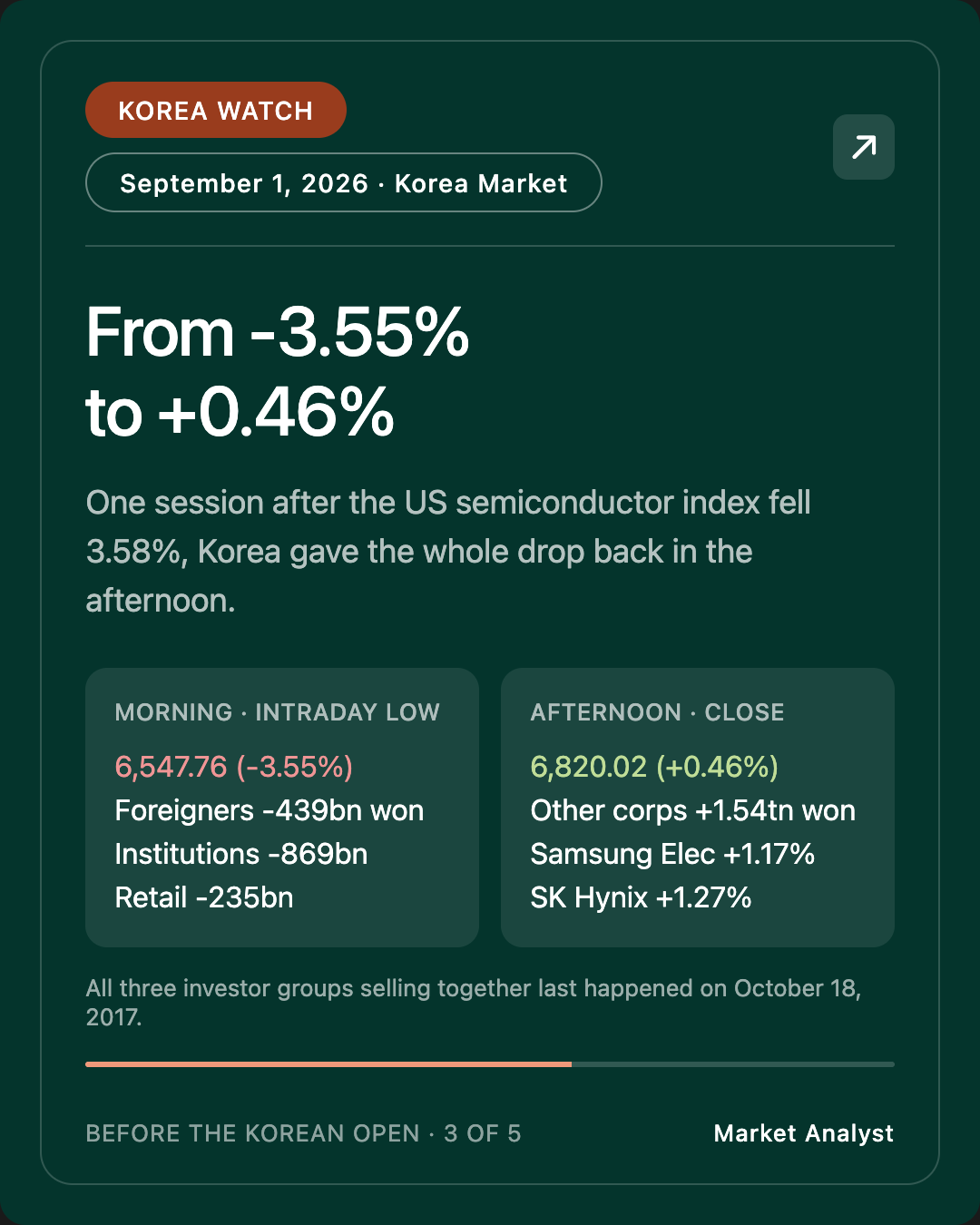
Korea's KOSPI fell as much as 3.55% intraday on the last trading day of August, touching 6,547.76, and then closed at 6,820.02, up 0.46%. Two shocks were stacked against it. At Jackson Hole on August 28, Federal Reserve Chair Kevin Warsh said inflation is running above the 2% target and that prices should be the Fed's predominant focus; the Philadelphia Semiconductor Index fell 3.58% that day. Over the weekend, US forces struck Iranian rocket launchers that were being readied to lay mines in the Strait of Hormuz, and oil jumped again. Yet Korea held. The reason sits in the flow data. On August 31, retail investors, domestic institutions and foreigners were all net sellers of KOSPI on the same day — the first time that has happened since October 18, 2017. A fourth bucket, "other corporations," absorbed all of it with 1.54 trillion won of net buying, and that bucket is where corporate share buybacks land. Samsung Electronics and SK Hynix are running a combined 55 trillion won repurchase program, of which 10.28 trillion had been executed through August 28, leaving roughly 44.72 trillion won still to be spent by November. The won, meanwhile, strengthened to 1,368.6 per dollar, its strongest in 13 months. Here is what to watch as Korea opens the first trading day of September.
This is Mr. Can. Here is the September 1, 2026 brief ahead of the Korean market open.
Written: September 1, 2026, 03:20 KST (Vancouver, Aug 31, 11:20 PDT)
Covers: Korea's Sep 1 session · Korea's Aug 31 close and the US session of Aug 31 (still open at writing)
⚠️ Two notes before you start
① This brief resumes after a publishing gap since August 14 (a break in the publishing pipeline, now fixed).
② It was written before the US cash session closed on August 31 (about 03:00 KST on Sep 1). The August 31 US figures below are intraday; the confirmed close will be reconciled in the next brief. August 28 figures are final closes.
⚡ TL;DR
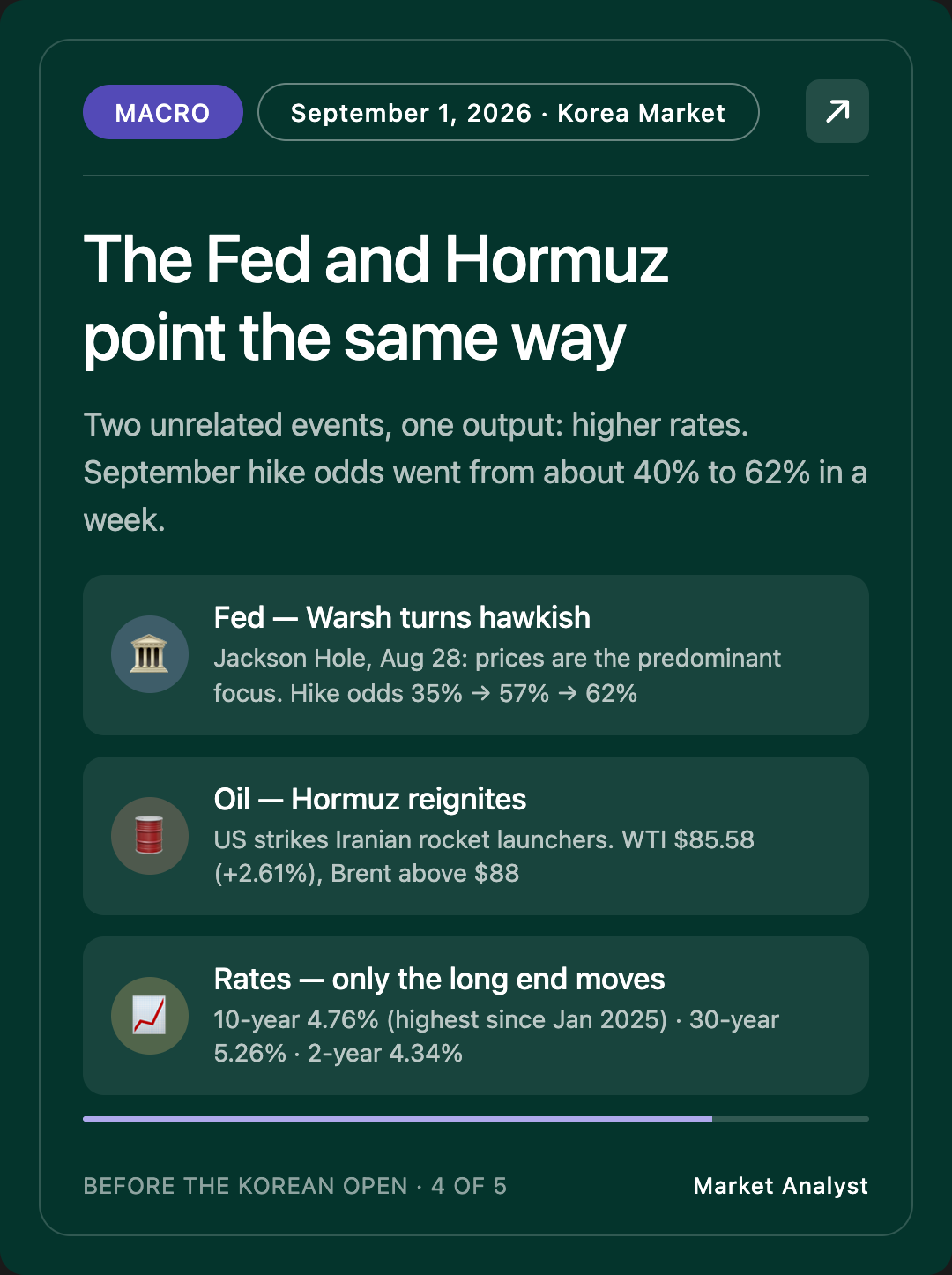
- The Fed turned hawkish. At Jackson Hole on August 28, Chair Kevin Warsh said inflation "is running above our 2% target" and that "the Fed's predominant focus right now should be on prices." Odds of a 25bp hike in September went from 35% the day before, to 57% after the speech, to 62% on August 31 — roughly 40% a week earlier.
- Hormuz reopened as a risk. US forces struck Iranian rocket launchers preparing to mine the Strait of Hormuz; Iran retaliated against Jordan, a US ally. WTI $85.58 (+2.61%), Brent above $88, November futures above $90. The Fed and the oil price are now pushing in the same direction: higher rates.
- Korea held anyway. KOSPI intraday low 6,547.76 (-3.55%), close 6,820.02 (+0.46%). KOSDAQ 834.29 (-0.49%). That is an unusual recovery on the session right after the SOX fell 3.58%.
- Buybacks did it. Retail (-235bn won), institutions (-869bn) and foreigners (-439bn) were all net sellers — the first simultaneous sell by all three in eight years and ten months. "Other corporations" bought a net 1.54 trillion won, which is the Samsung and SK Hynix repurchase programs. Roughly 44.7 trillion won of that program is still unspent, running to November.
- The won went the other way. USD/KRW closed at 1,368.6 (-3.9), the lowest since July 8, 2025. A stronger won while the dollar is being repriced higher needs explaining — and it has an explanation.
1. US and global (Aug 28 final closes / Aug 31 intraday)
[Fact] August 28 (Fri), final US closes
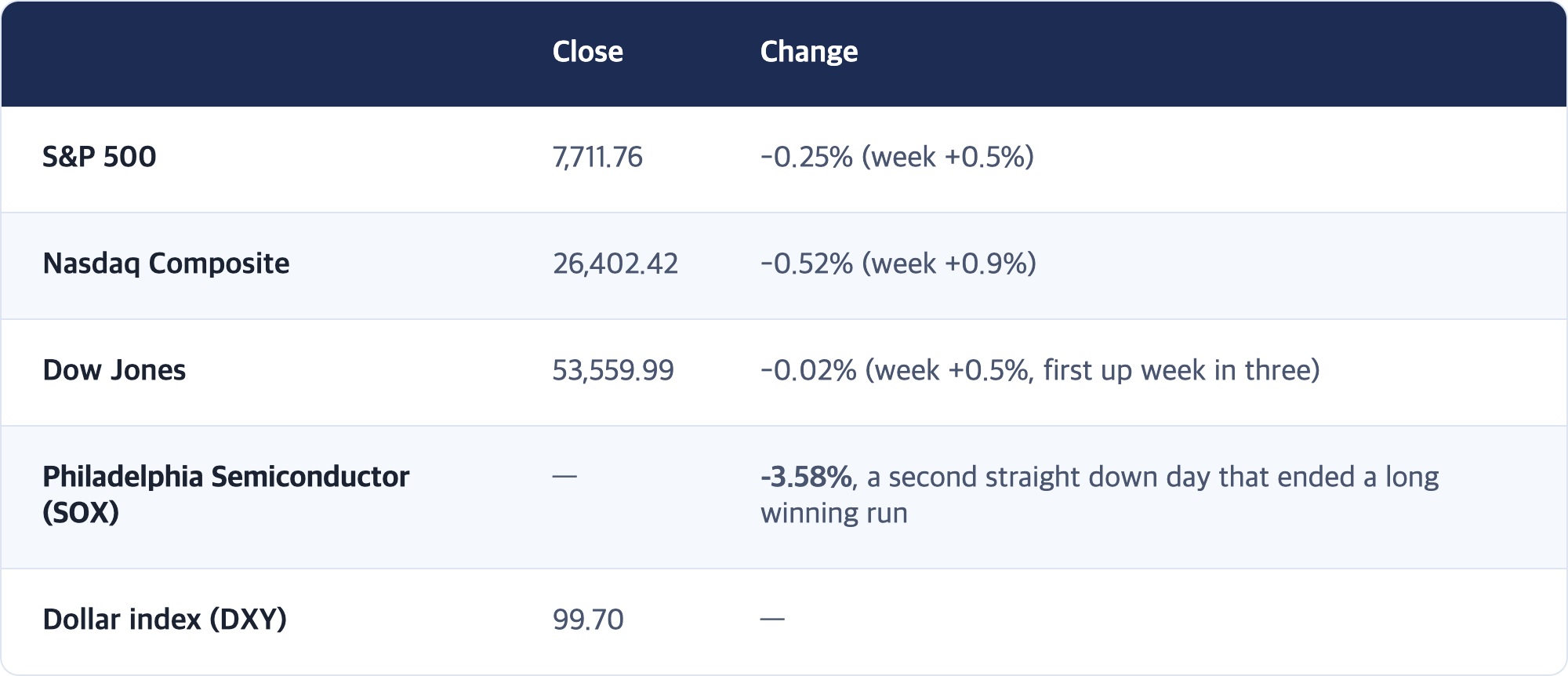
[Fact] August 31 (Mon), intraday — as of roughly 03:00 KST on Sep 1, before the US close
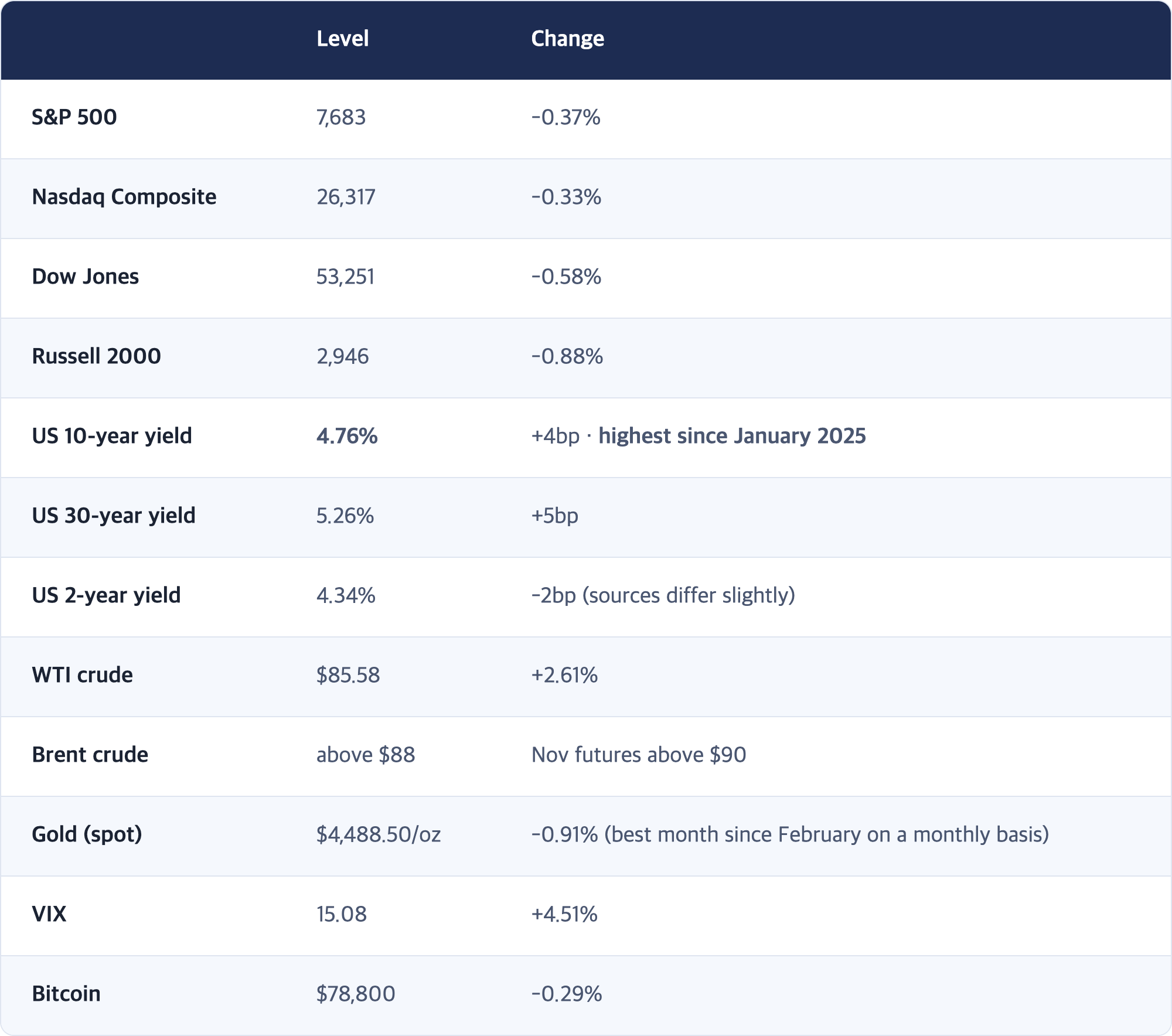
[Observation] The shape of the yield move matters more than the size of the equity drop. The 10-year rose 4bp and the 30-year 5bp, while the 2-year eased slightly. The long end is moving more than the policy-sensitive short end.
[Observation] Single names: PayPal -12.7% after Bloomberg reported that an Advent–Stripe consortium walked away from a deal; Nvidia +1% on a $3.5bn investment in MediaTek; GameStop +3%.
2. The one thing that matters — Korea now has a buyback seawall
[Fact] KOSPI flows, August 31
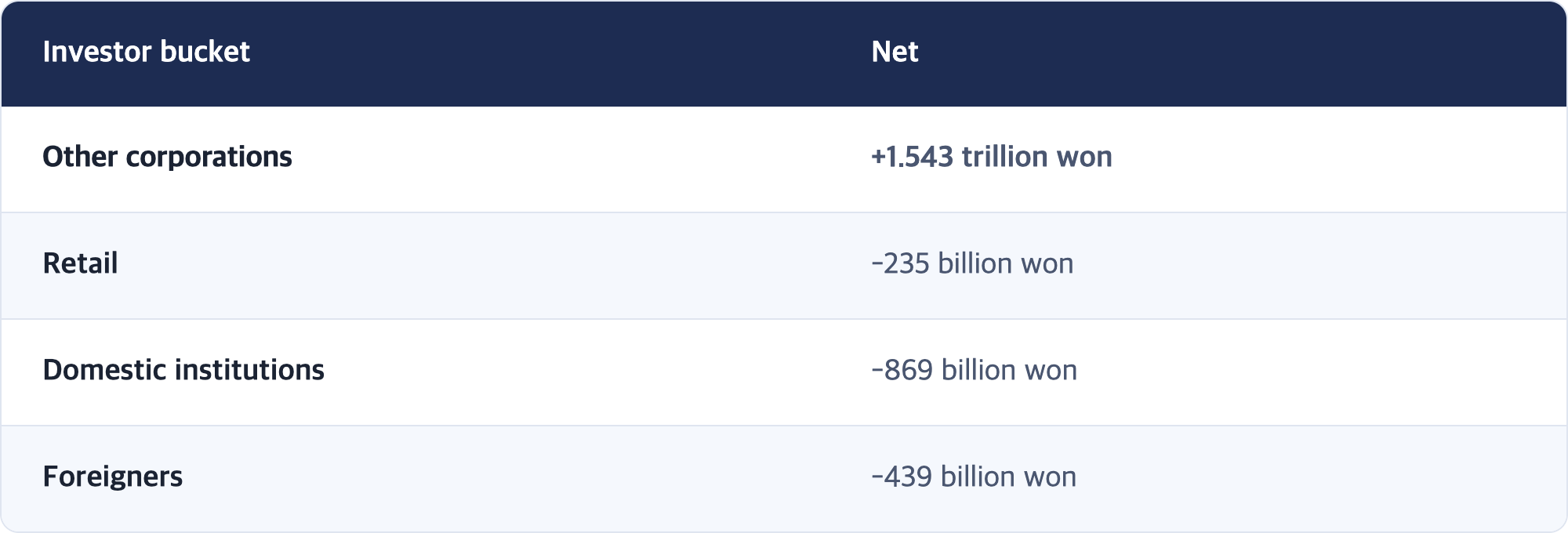
- All three of the usual buckets selling on the same day is the first such session since October 18, 2017 — about eight years and ten months.
- Korea publishes daily net flows by investor type, and a company buying its own shares is booked under "other corporations." So that +1.54 trillion won is, in substance, Samsung Electronics and SK Hynix buying themselves.
- Program size: Samsung Electronics 15 trillion won (through Nov 21) plus SK Hynix 40 trillion won (through Nov 19) = 55 trillion won, roughly $40bn. Executed through August 28: 10.28 trillion won. Remaining: about 44.72 trillion won.
- Result: Samsung Electronics closed at 260,000 won (+1.17%), SK Hynix at 1,674,000 won (+1.27%).
- The closing auction also had to absorb passive selling from the MSCI August index review. The buyback bid took that too.
[Interpretation] Three things worth keeping separate.
- The floor is genuinely thicker. Roughly 44.7 trillion won will enter the market on a fixed schedule through November. That is not sentiment, it is a commitment. Someone is contractually obliged to bid, and August 31 was the demonstration.
- But this is a bid that supports price, not one that sets it. Buyback programs do not shop for valuation; they buy an agreed amount over an agreed window. They do not change direction, they cushion it.
- Reading the index alone will mislead you. Every real participant category sold on August 31, and the index still rose. If you read "+0.46%" as investors turning optimistic, you get the opposite of what happened. What lifted the index was accounting flow, not conviction.
Study note — why Korea's flow data looks like this
Korean exchanges publish daily net buying and selling split into four buckets: retail, domestic institutions, foreigners, and "other corporations" (non-financial companies). Most markets do not publish this. The result is that a Korean investor can see, every evening, exactly who bought and who sold.
The analogy: a shopkeeper buying back a stake in their own shop. If every customer walks out but the owner keeps standing at the counter, the shop does not look empty. That does not mean the customers came back.
On August 31: the customers left, the owner bought 1.54 trillion won of shelf space, and the index printed +0.46%. What it looked like and what happened were different things.
3. The second variable — the Fed and Hormuz point the same way
[Fact] Jackson Hole, August 28
- Fed Chair Kevin Warsh: inflation "is running above our 2% target"; "the Fed's predominant focus right now should be on prices." He also said he was "impressed by the overall performance of the economy."
- The broader message was that the underlying inflation trend has not meaningfully improved and that policy is not restrictive enough to bring it down.
- September 25bp hike odds: 35% on Aug 27 → 57% on Aug 28 → 62% on Aug 31.
- The next FOMC is September 15–16, and it comes with a Summary of Economic Projections and a dot plot.
[Fact] The Middle East, Aug 30–31
- US forces struck Iranian rocket launchers being prepared to lay mines in the Strait of Hormuz — the first military exchange in roughly a month.
- Iran retaliated against Jordan, a US ally.
- Oil: WTI $85.58 (+2.61%), Brent above $88, November futures above $90.
[Interpretation] These are two unrelated events with the same output.
- Warsh is hawkish because of prices. Higher oil raises prices. The Hormuz strike strengthens his argument.
- The mid-August rally ran on the opposite engine: energy fell, so headline inflation cooled (July PPI printed 0.0% month-over-month on August 13). That engine has started turning the other way.
- So the pressure point is the same as it was two weeks ago — oil — with the sign flipped. Then, falling crude produced a rally. Now, rising crude produces tightening expectations.
- The bond market agrees. The short end is quiet while the 10s and 30s rise, which reads less like "how much will the Fed hike" and more like "inflation may not be tamed for a while."
4. Macro backdrop — a triangle that does not line up
[Fact]
- Rates: 10-year 4.76% (highest since January 2025), 30-year 5.26%, 2-year 4.34%. The 10s-2s spread is about +42bp.
- Oil: WTI $85.58 (+2.61%), a second straight gain after +2.64% on August 28.
- Gold: $4,488.50/oz. Down 0.91% on the day but heading for its best month since February.
- Dollar and won: DXY 99.70 as of August 28 — and yet USD/KRW fell to 1,368.6 (-3.9), a 13-month low, from a previous Seoul close of 1,372.5.
- Volatility: VIX 15.08 (+4.51%), still low in absolute terms.
[Interpretation] The won is the thing that needs explaining. The textbook path is hawkish Fed → stronger dollar → weaker won, and the won did the opposite. Two things appear to be layered on top of each other.
- Export dollars are actually arriving. In the first ten days of August, Korean exports hit $21.3bn, a record for that period, with semiconductors at $10bn (+155.4% year-over-year, 46.8% of total exports).
- Foreign selling eased into the close. Once buybacks turned the index around, pressure to sell won faded with it.
[Observation] Gold is strong on a monthly view while the VIX sits at 15. Bonds and commodities are pricing inflation and geopolitics; equity volatility is not. Which way that gap closes is the question for September.
5. Preview — Korea's September 1 session (KST)
[Fact] Today's calendar
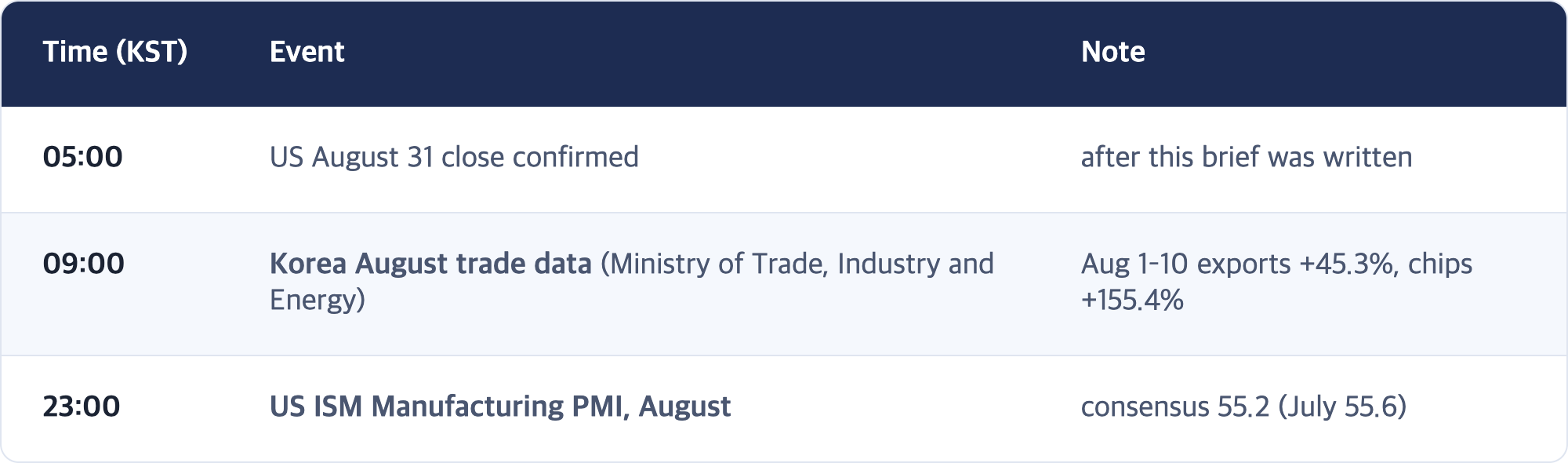
[Interpretation] The forces actually meeting today
- Pushing up: 44.7 trillion won of buyback demand still queued, a semiconductor export boom, a stronger won, and a demonstrated floor from yesterday.
- Pulling down: 62% odds of a September hike, a 4.76% 10-year, oil turning back up, a weak SOX, and foreign net selling.
- The swing factor is foreigners. Buybacks stop the index breaking down, but the side that is selling sets the direction. Whether foreign net selling grows beyond August 31's -439 billion won or shrinks will define the session.
- September 1 is also the first trading day of the month, when institutional allocations are refreshed. The texture of the flow can differ from late August.
6. Checklist for the open
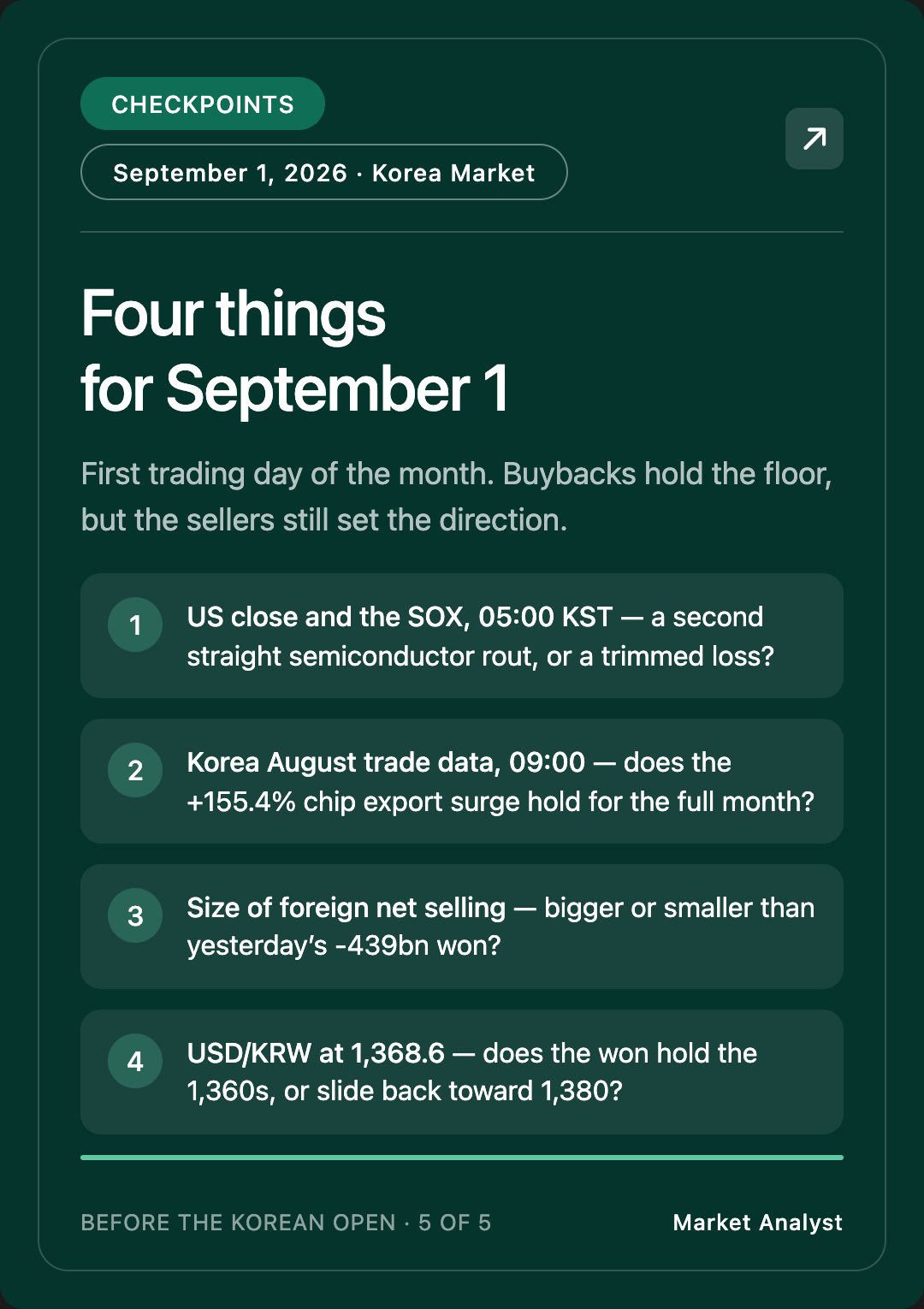
- The confirmed US close and the SOX, out at 05:00 KST. A second straight semiconductor rout deepens the opening gap; a trimmed loss leaves room for yesterday's recovery to continue.
- Korea's August trade data at 09:00. Whether the +155.4% semiconductor number from the first ten days holds for the full month. It moves the won and the two big chip names at once.
- The size of foreign net selling. Buybacks can absorb, but they do not steer. Larger or smaller than -439 billion won?
- USD/KRW at 1,368.6. Holding the 1,360s keeps the conditions for foreign inflows intact. Sliding back toward 1,380 would mark yesterday's won strength as a one-day event.
Corrections and notes
- Publishing gap: regular briefs stopped after the August 14 morning edition because of a path problem in the publishing pipeline and a schedule that had to be re-registered. Nothing was published between August 16 and August 30. Publication resumes today.
- The August 31 US figures in this brief are intraday (about 03:00 KST on September 1, before the cash close). The confirmed close will be reconciled at the top of the next brief.
Sources
- Stock market today: Dow, S&P 500, Nasdaq end week on down note — Yahoo Finance (Aug 28)
- Stock market today: Dow, S&P 500, Nasdaq fall as US strikes Iran — Yahoo Finance (Aug 31)
- Stock Market Today (Aug. 31, 2026) — TheStreet
- Jackson Hole Fed summit live: Kevin Warsh's keynote speech — Yahoo Finance
- Kevin Warsh signals forward guidance at Jackson Hole symposium — Marketplace
- All three investor groups net sellers on the same day — Hankyung (Korean)
- KOSPI's late rebound, carried by Samsung and SK Hynix shareholder returns — Hankyung (Korean)
- KOSPI reverses to reclaim 6,820 — BusinessKorea (Korean)
- MSCI rebalancing versus buybacks — EBN (Korean)
- Another 46 trillion won to buy: the buyback floor under Korean stocks — EBN (Korean)
- USD/KRW down 3.9 won to 1,368.6 — Asiae (Korean)
- Won at a 13-month high against the dollar — Asiae (Korean)
- Record early-August exports, chips near half the total — Financial News (Korean)
- ISM Manufacturing Report On Business — release calendar
- The Fed — Meeting calendars and information
Market Analyst · a macro brief. It contains no buy or sell recommendation on any individual security.
📌 More market briefs
※ This post is market observation and organization intended to support your own judgment. It is not a recommendation to buy or sell any security. Figures are as of the time of writing and may differ between sources.
If this was useful, bookmark it or pass it along. It genuinely helps me write the next one.
I can survive. We can survive.