October 9, 2026 KOSPI Market Brief — What to Watch Before the Korean Open
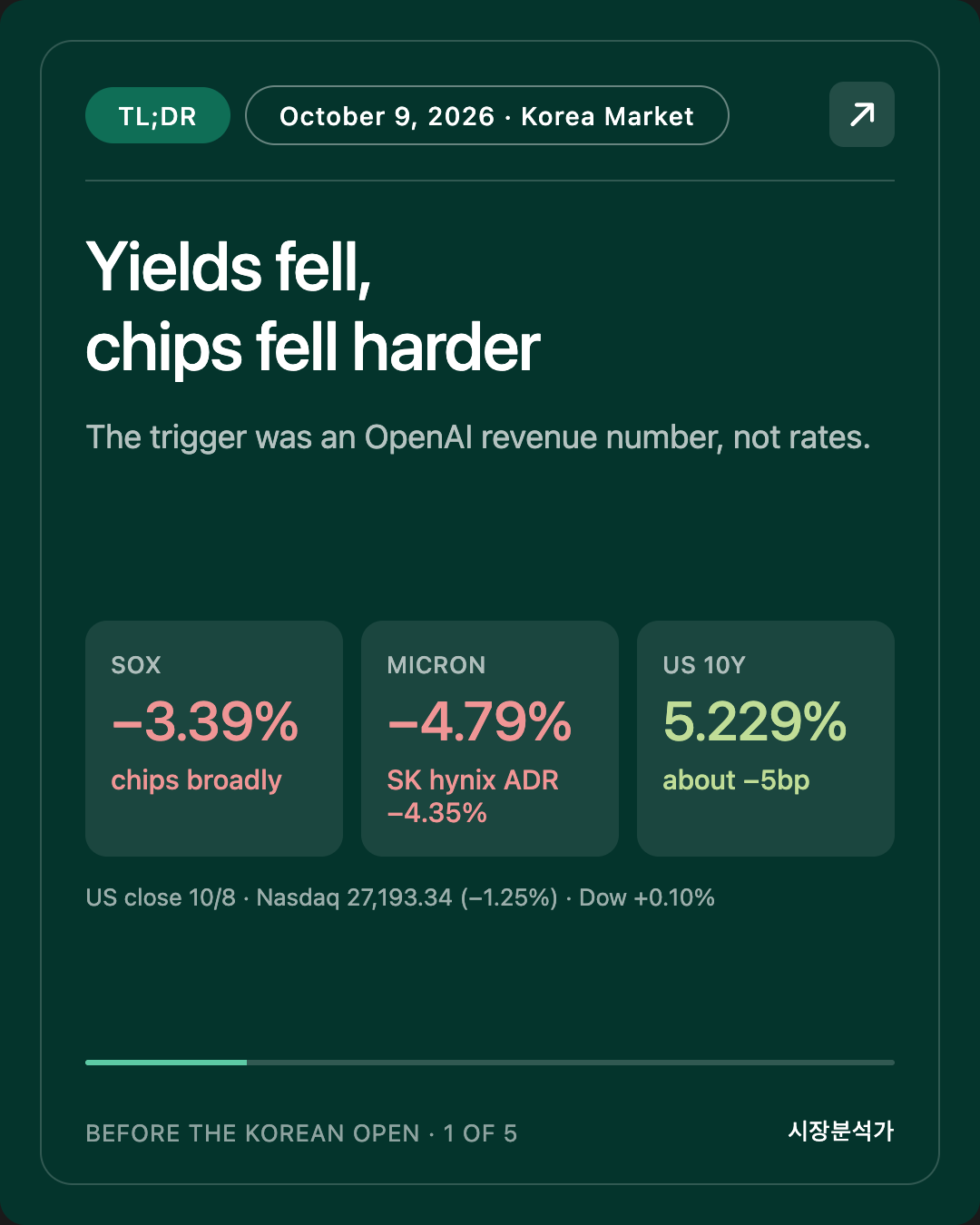
- ★ This chip selloff was about an AI revenue number, not rates. FT: OpenAI's annualized revenue was about $50 billion (vs. a market estimate of $68–70 billion). SOX −3.39%, Micron −4.79%, Broadcom −4.35%, AMD −3.90%, Nvidia −2.24% to −2.94% (sources differ).
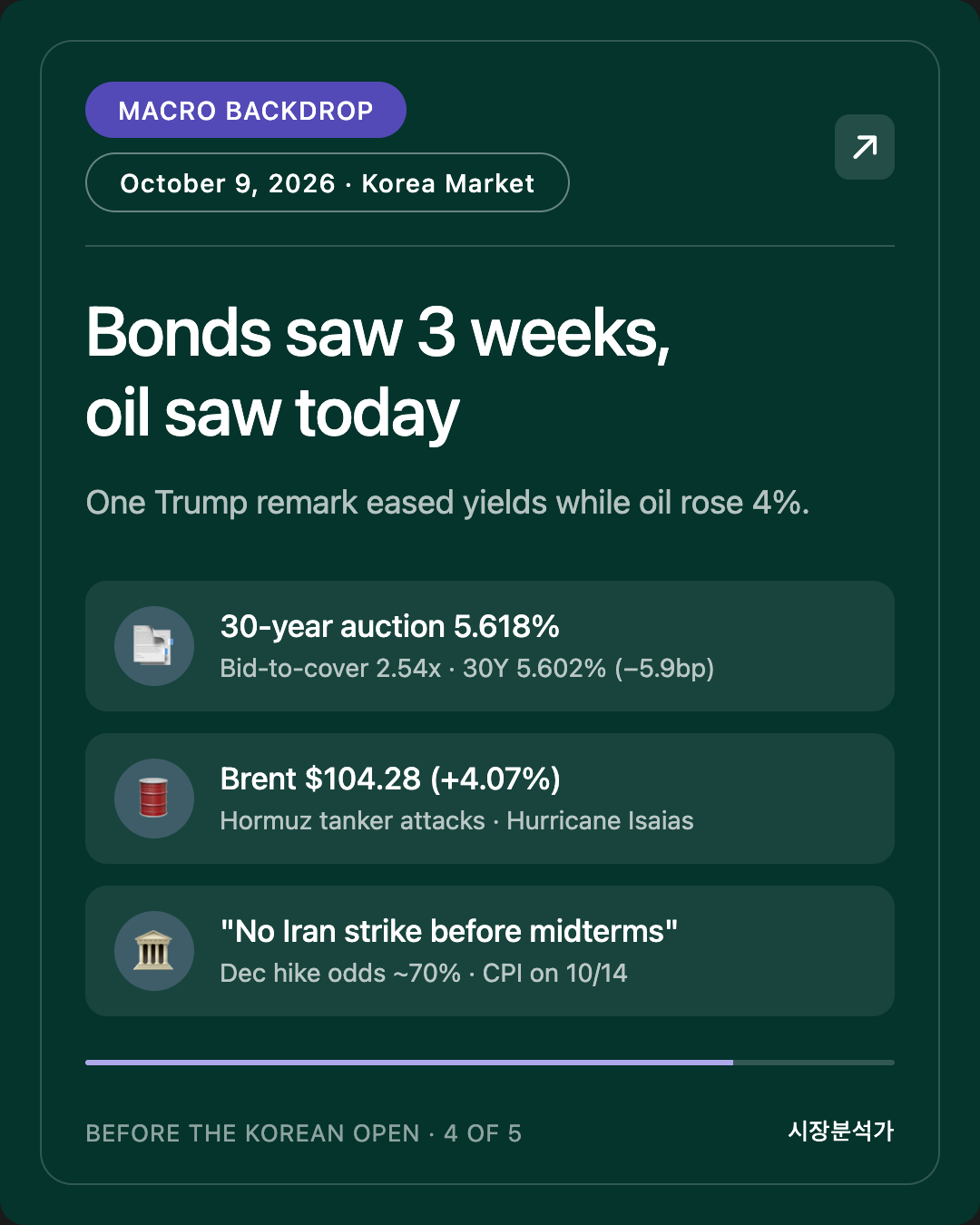
- ★ Yields moved the other way. The 10-year traded above 5.34% intraday and closed at 5.229%. The 30-year auction cleared at 5.618% (highest since around 2000) with a 2.54x bid-to-cover (average 2.41x); the 30-year closed at 5.602% (−5.9bp). Yields gave back their gains after President Trump said the US would not attack Iran before the 11/3 midterm elections.
- Oil jumped 4%. Brent $104.28 (+4.07%), WTI $91.49 (+3.64%), on tanker attacks in the Strait of Hormuz and Hurricane Isaias, which shut in about 25% of Gulf of Mexico output (CNBC). A report (Axios, cited by Seoul Economic Daily) said the Pentagon told Central Command to prepare to resume large-scale operations against Iran.
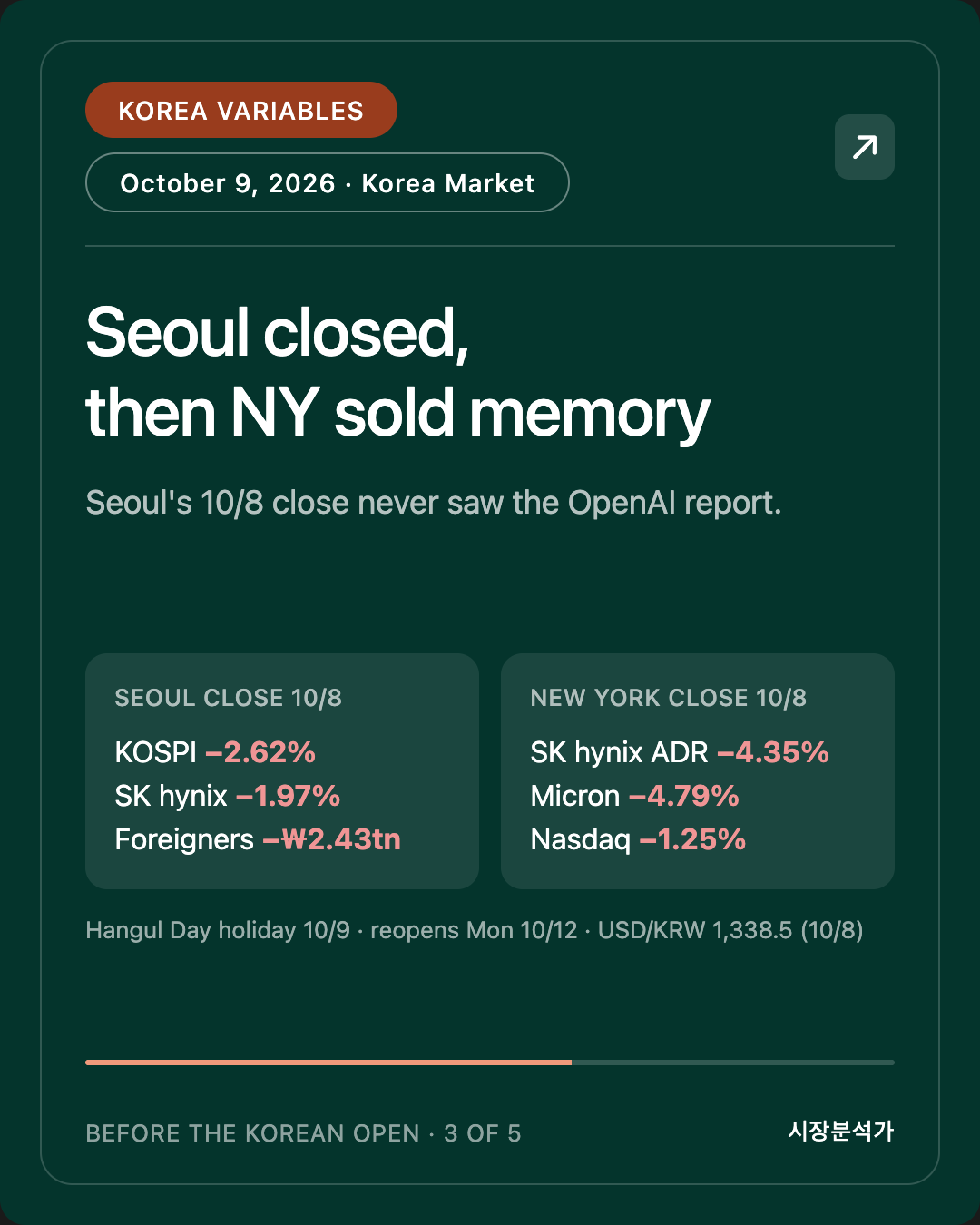
- Seoul got a "proxy report card" while closed. SK hynix ADR −4.35%. In Seoul on 10/8, SK hynix fell only 1.97%, less than the index, but New York then sold memory hard after Seoul's close.
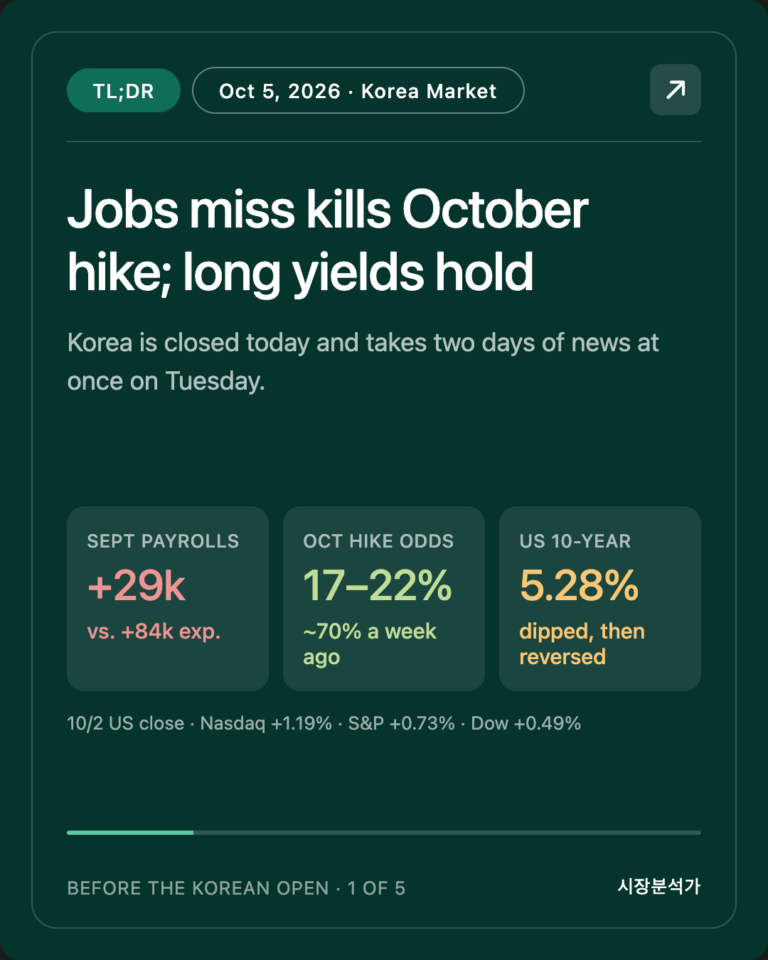
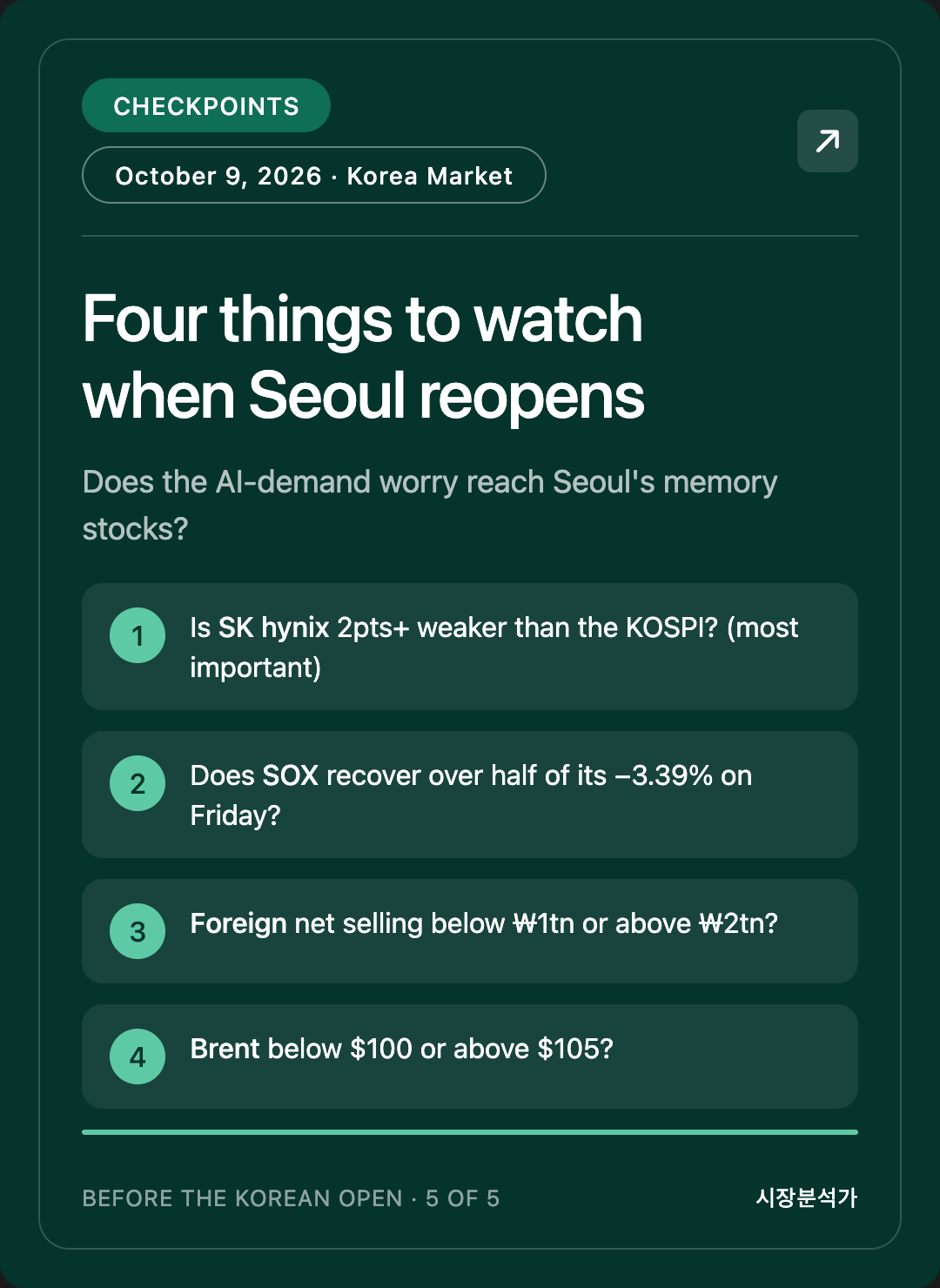
- The question for Monday's reopening: does the AI-demand worry cross over to Seoul's memory stocks? New York still has one more session on Friday 10/9.
This is Mr. Can. Here is the October 9, 2026 brief ahead of the Korean market open.
Written: 2026-10-09 08:15 KST (Vancouver 10/8 16:15 PDT)
Basis: US regular-session close for Thu 10/8 (05:00 KST 10/9) + US 30-year bond auction results + crude futures settlement 10/8 + Seoul close for Thu 10/8
🟢 Scheduled 16:00 PDT, started 16:02 PDT. On time.
🟡 Korea's stock market is closed today (Fri 10/9) for Hangul Day, the national holiday celebrating the Korean alphabet. With the weekend, the next Seoul session is Monday 10/12. As with our 10/5 holiday edition, this issue tracks what piles up while Seoul is shut. New York trades one more session on Friday before Seoul reopens.
SEO Intro
Wall Street sold chip stocks on a day when bond yields actually fell. On 10/8 the Nasdaq Composite closed at 27,193.34 (−1.25%) and the S&P 500 at 7,765.36 (−0.47%), both down for a second day, while the Dow held at 51,231.64 (+0.10%). The Philadelphia Semiconductor Index (SOX) dropped 3.39%, Micron 4.79%, and SK hynix's US-listed ADR 4.35%.
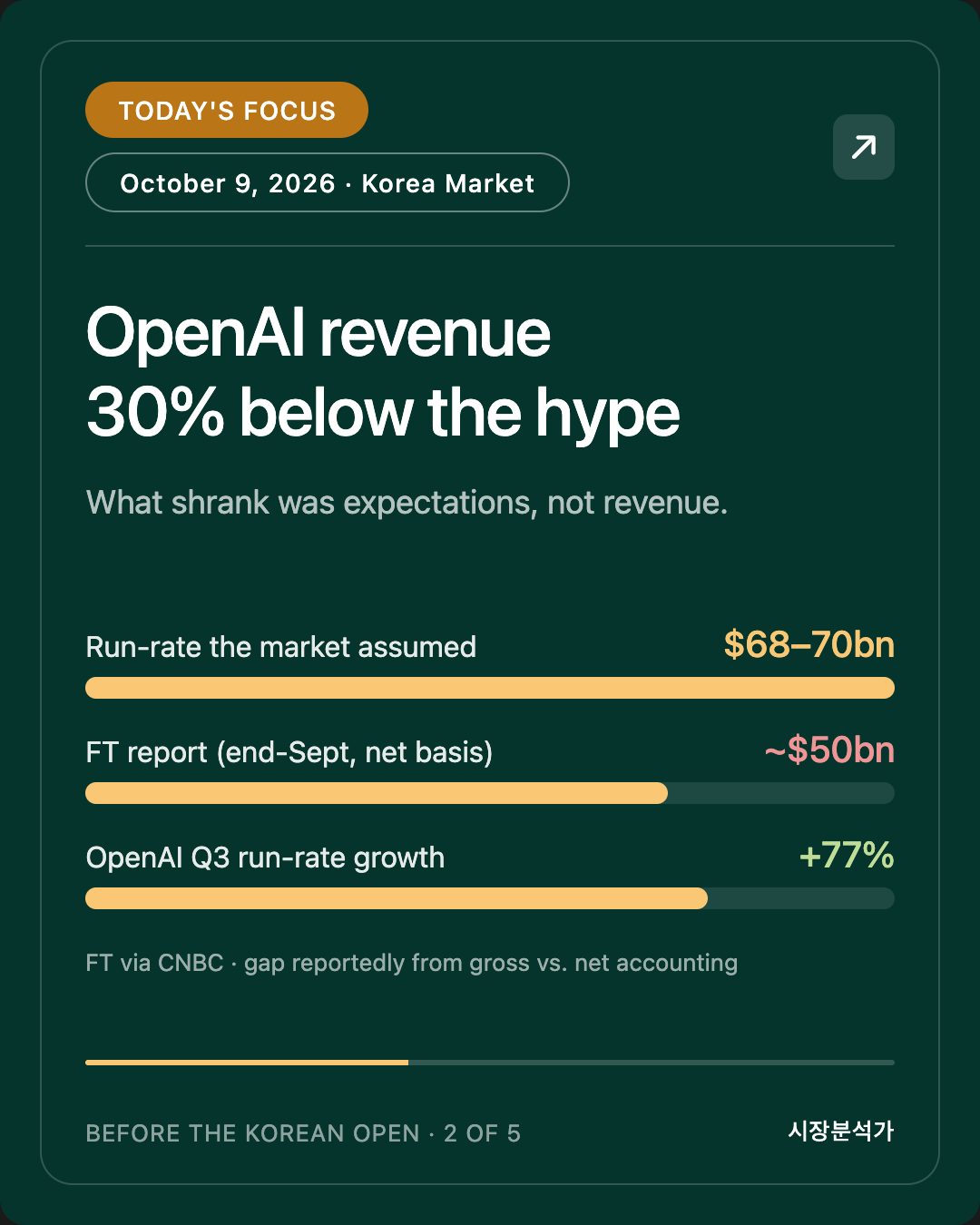
The trigger was not interest rates. The 10-year Treasury yield fell to 5.229% (about −5bp), and a $22 billion 30-year auction was absorbed without trouble. What hit semiconductors was a Financial Times report: OpenAI told investors its annualized revenue at the end of September was about $50 billion, some $18–20 billion below the roughly $68–70 billion figure the market had been carrying around.
Seoul went into its long weekend with the KOSPI at 6,625.93 (−2.62%) on 10/8. It closed before that OpenAI headline hit New York, and it will absorb everything at once on Monday 10/12.
1. Checkpoint Scorecard
The four set by the 10/8 US pre-open brief (scored at the 10/8 US close)
The axis was "does the yield push from Fed Governor Waller break this week's intraday high, or does the 30-year auction absorb it?"
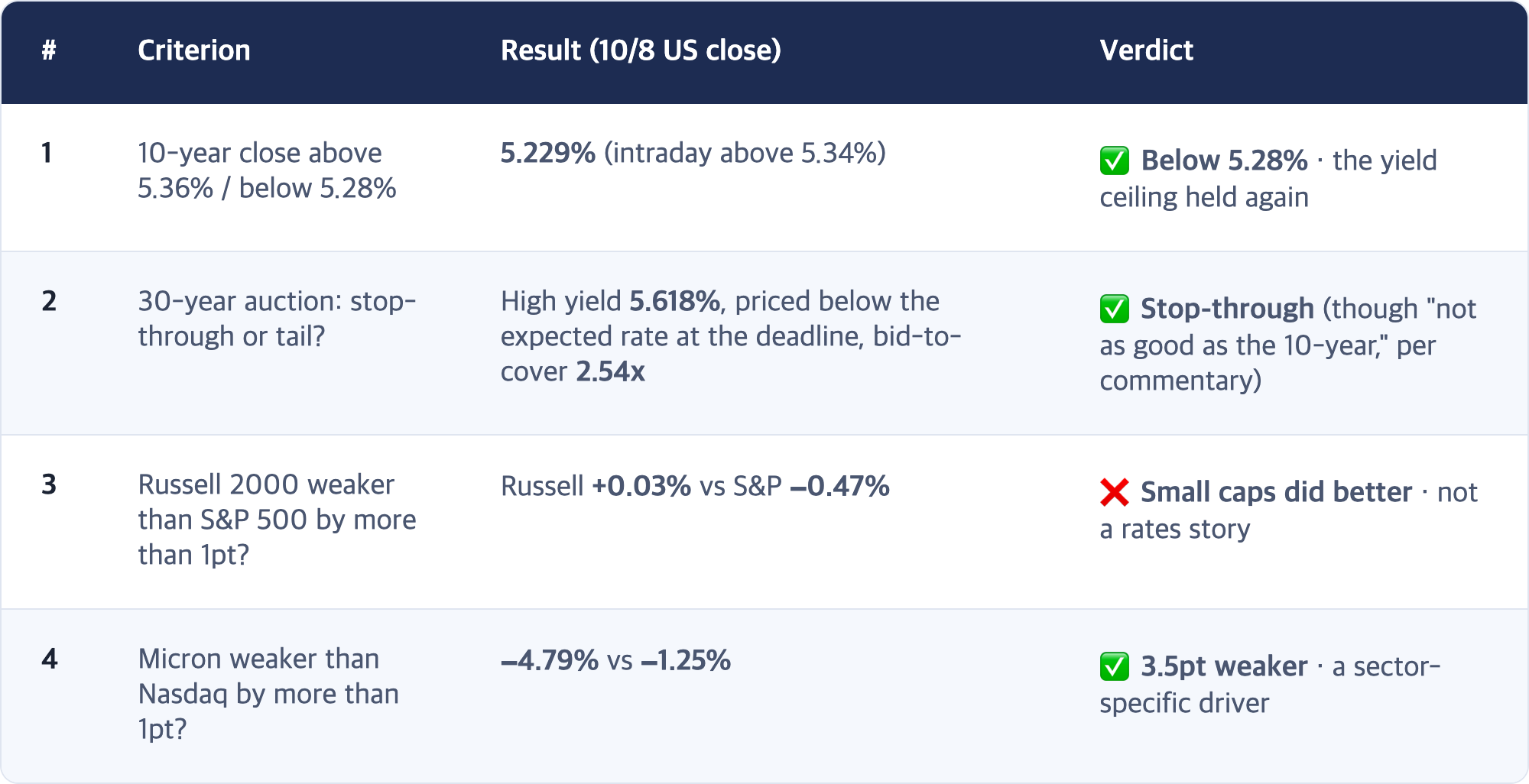
★ [Interpretation] Checkpoint 4 hit, but for a different reason
The 10/8 pre-open brief said that if #4 hit, the likely reason would be a Taiwan strike risk stacked on top of rates. #4 did hit, but the afternoon slide came from the OpenAI revenue report, not Taiwan. Nvidia, Broadcom, AMD and Oracle fell together, so it wasn't memory-only either. The question was sector-wide: are the companies spending on AI earning as much as assumed?
Read alongside #1–3, all of which said "rates were not the problem," the picture is clear. If rates were the hand pressing on chips for most of this week, the hand changed on Thursday afternoon.
2. Today's Focus: Yields Fell, but an AI Revenue Number Pulled Chips Down
[Fact] US close, Thu 10/8 (05:00 KST 10/9)
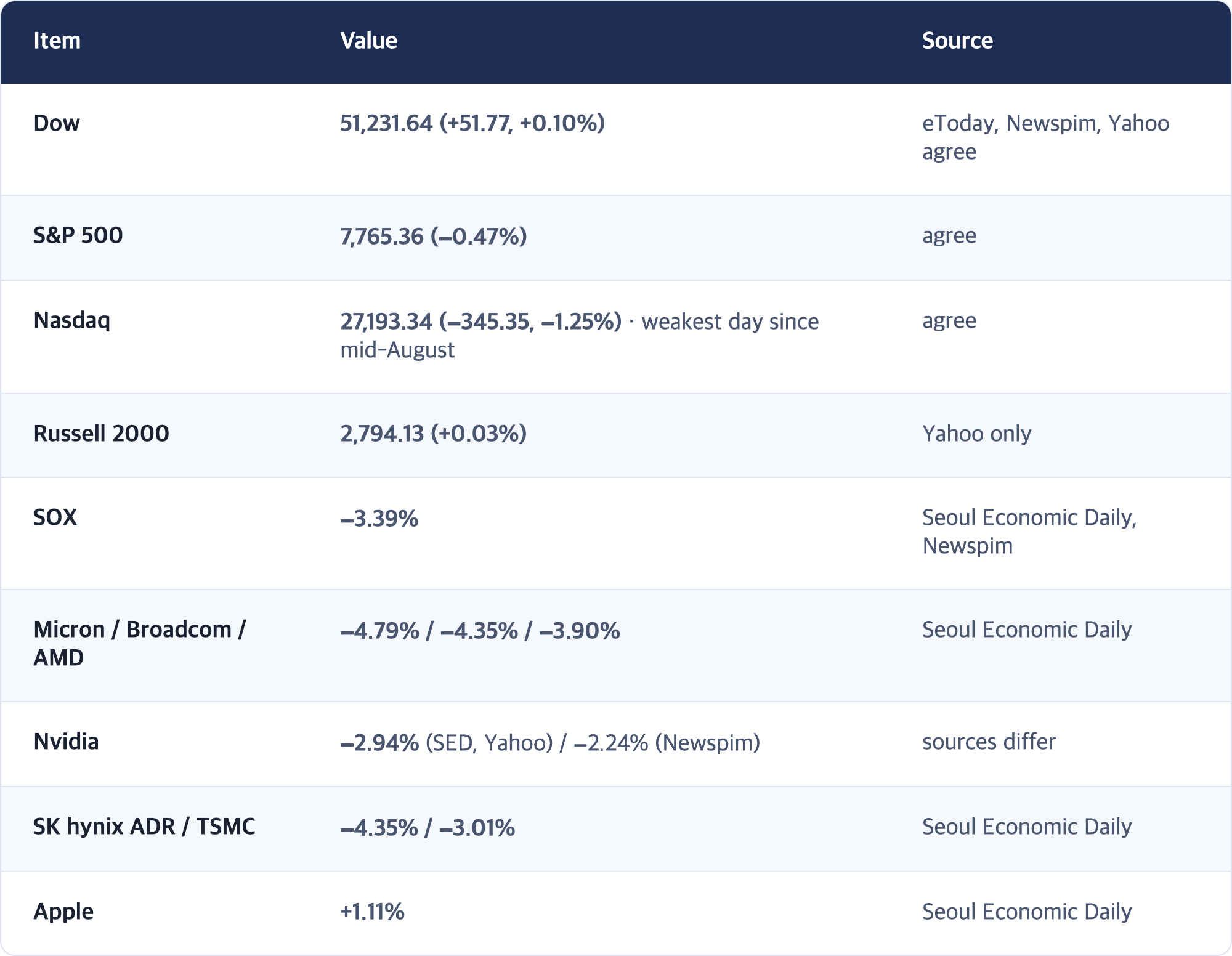
[Fact] What the FT reported
- OpenAI told investors its annualized revenue at the end of September was about $50 billion (FT, as cited by CNBC).
- The figure widely circulated last month was about $68–70 billion (varies by outlet), a gap of $18–20 billion.
- Several reports attribute the gap to accounting basis: the earlier figure was an estimate built to compare with a rival that books gross revenue including cloud partners, while OpenAI's number is net revenue.
- OpenAI cited Q3 run-rate growth of 77%, and 107% for its enterprise business (per a person familiar with the matter).
★ [Interpretation] Not "less revenue," but "lower expectations"
First, separate the facts. The report does not say OpenAI's revenue shrank. It is still growing more than 70% a year. What shrank was the number the market had in its head.
But that number is baked into chip prices. Spending on AI data centers (hyperscaler capex) ultimately rests on the expectation that AI services will earn enough to justify it. If the headline number behind that expectation was nearly 30% smaller, investors start asking whether the capex plans stacked on top of it are equally less solid. Companies with large direct contracts with OpenAI, such as Broadcom and Oracle, fell more, which points the same way.
[Observation] Combined with yields, this week splits into two phases:
- 10/5 through the morning of 10/8: the pressure on chips was rates (the 10-year near its highest since 2002).
- Afternoon of 10/8: yields fell, yet chips fell harder. The pressure shifted to AI-demand expectations.
[Interpretation] For Korea this distinction matters for one reason. Rate worries weigh on all growth stocks together, but AI-demand worries hit memory head-on, and memory is exactly where the Korean market's center of gravity sits.
3. Korea Variables: Seoul Sold "the Index," Then New York Sold "Memory"
[Fact] Seoul close, Thu 10/8 (last session of the week)
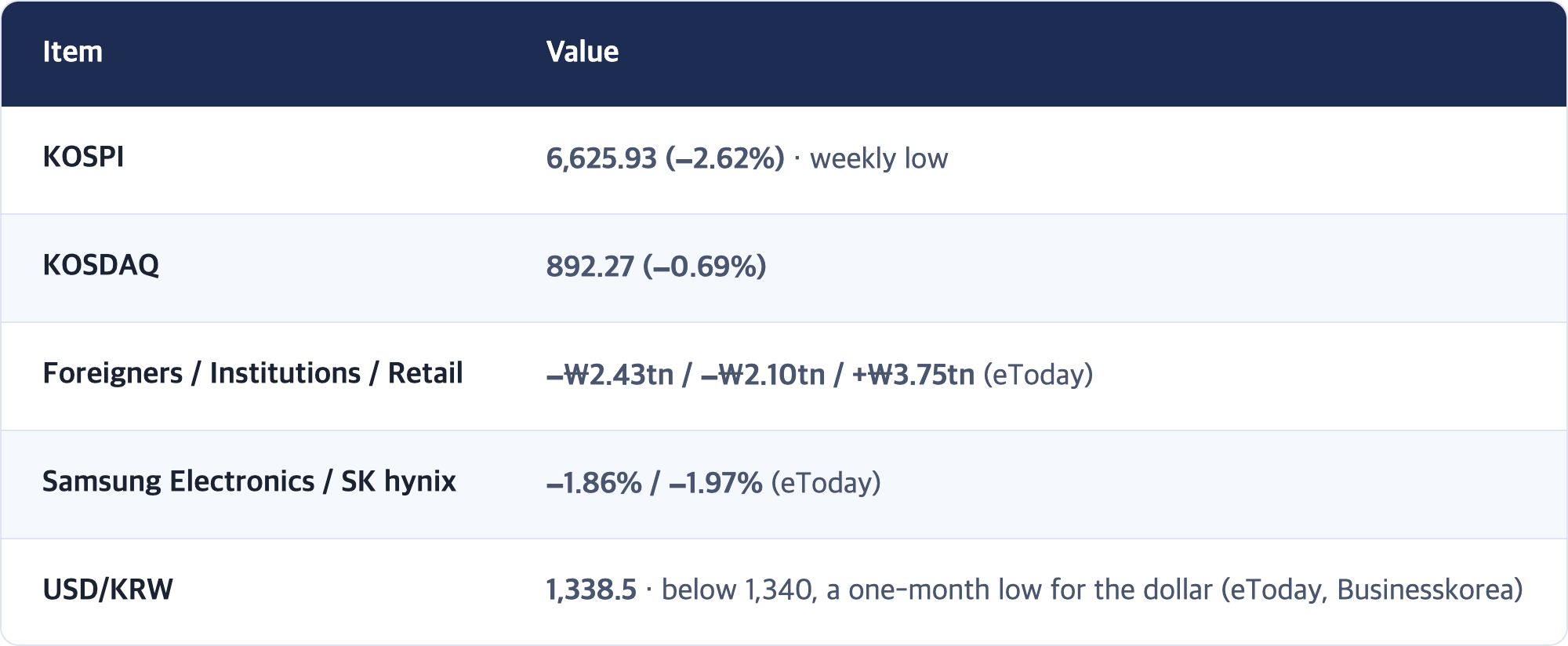
(₩1 trillion ≈ US$747 million at the 10/8 rate.)
[Observation] The order flipped
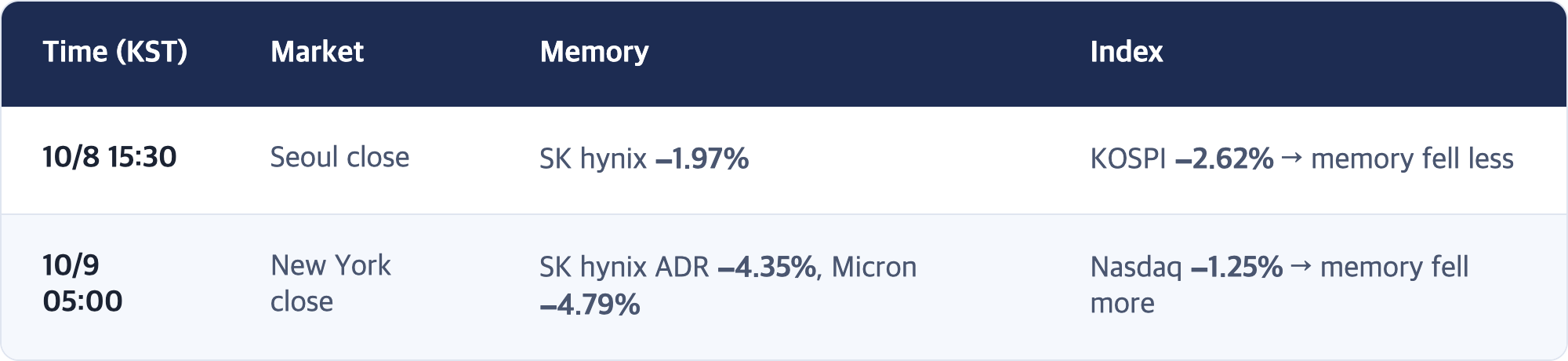
[Interpretation] The 10/8 pre-open brief read Seoul's drop as broad de-risking across large caps, not a targeted sale of memory. That was right as of Seoul's close. But after Seoul shut, a memory-specific headline arrived in New York. In other words, Seoul's 10/8 closing prices never saw the OpenAI report. This is exactly the "time zones are information" principle we noted in September.
[Observation] Korea's won market reportedly moved to 24-hour weekday trading in July (unofficial source; 🔲 needs official confirmation), so the currency may move even while stocks are closed. We record 1,338.5 only as the last daytime close before the holiday.
4. Macro Backdrop: Oil Back at $104; Yields Eased on an Auction and One Trump Remark
[Fact] (10/8 closes and settlements)
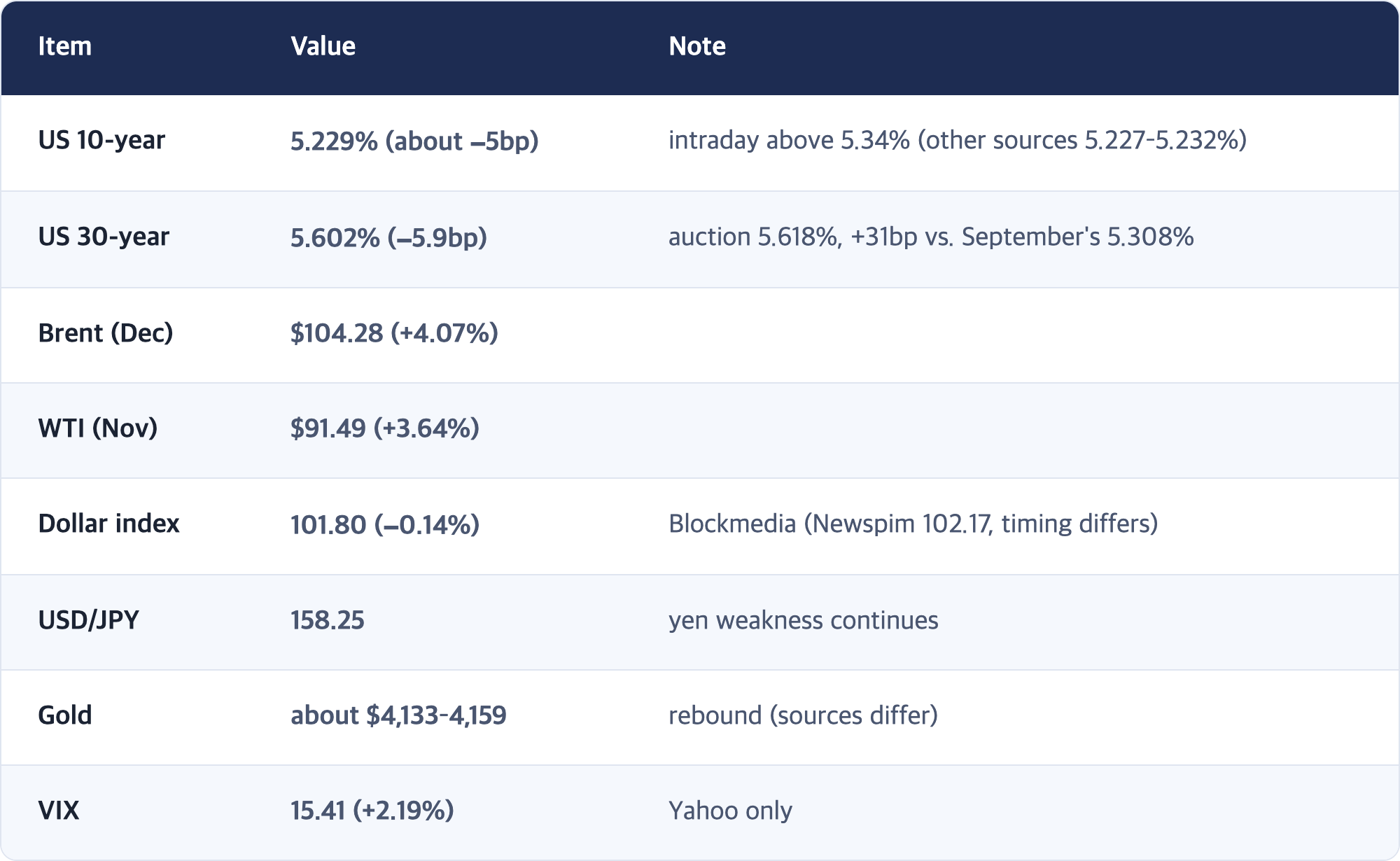
[Fact] The Fed and the Middle East
- Fed Governor Waller: more hikes may be needed, but "they don't need to be at consecutive meetings." St. Louis Fed President Musalem: rates should rise over the next 6–9 months, but he did not back an October hike (Newspim). CME odds of a December hike: about 70% (Newspim).
- President Trump: no attack on Iran before the 11/3 midterms; the blockade stays fully in place (Seoul Economic Daily, investingLive).
- Pentagon: Axios reported that Central Command was told to prepare to resume large-scale operations against Iran (cited secondhand; original not verified). No date was reportedly set.
- Hurricane Isaias: about 500,000 barrels a day (about 25%) of Gulf of Mexico production shut in (CNBC).
★ [Interpretation] Two opposite signals on the same day
Trump's "no attack before the midterms" pulled yields down (the war → oil → inflation channel looks weaker for now), while oil still rose 4% (tanker attacks and the hurricane already happened). Bonds looked at the next three weeks; crude looked at supply lost today. That gap is hard to sustain. If Brent stays at $104, October inflation becomes fuel for higher yields again, and the first test is the US September CPI on Wednesday 10/14.
5. Until Seoul Reopens on Monday 10/12: Checkpoints
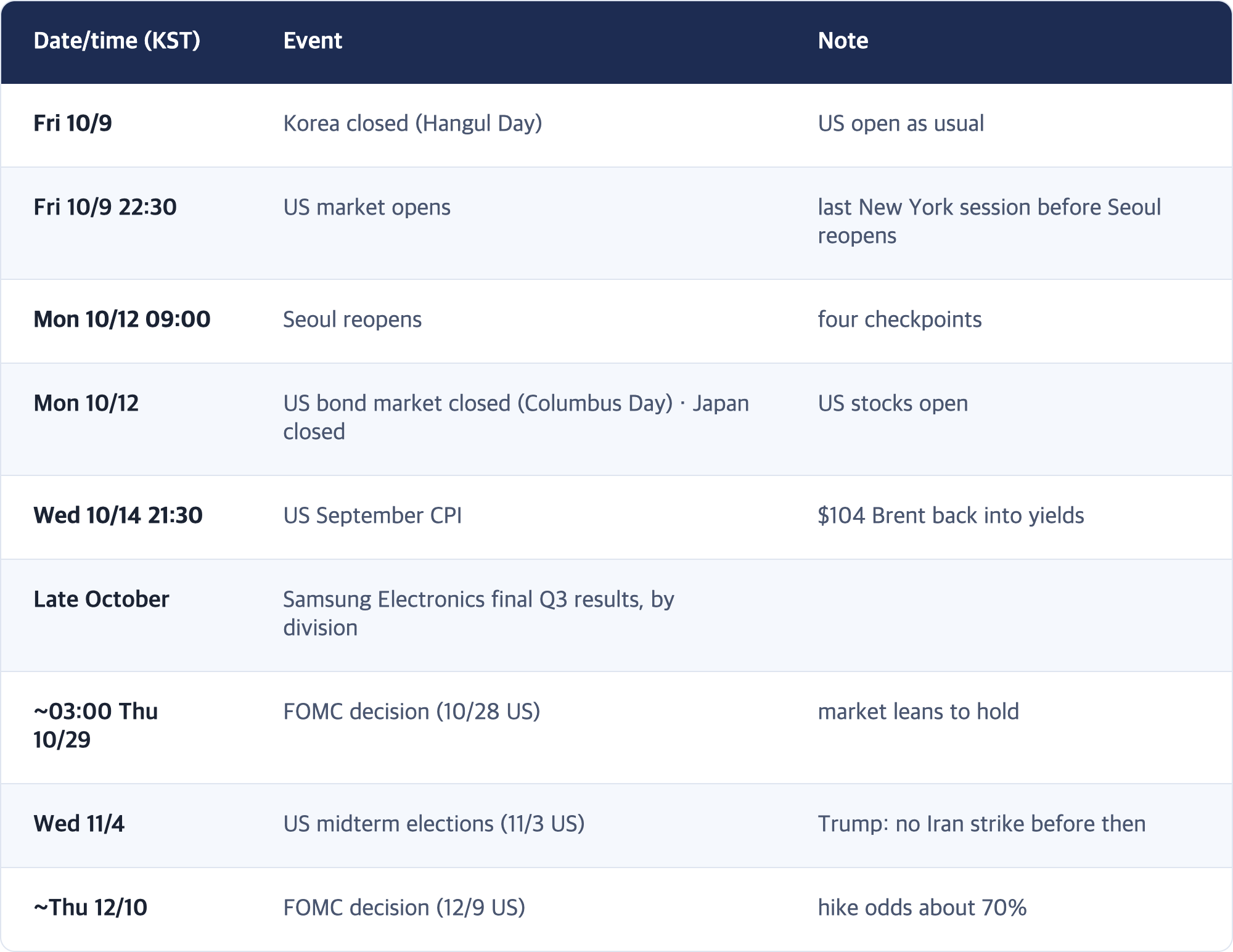
[Observation] Schedule before the reopening (KST)
- Fri 10/9 22:30 US market opens (Korea closed; the last New York session Seoul sees)
- Mon 10/12 09:00 Seoul reopens · US bond market closed (Columbus Day), US stocks open · Japan closed (Sports Day)
- Wed 10/14 21:30 US September CPI
- Around 03:00 Thu 10/29 FOMC decision (10/28 US time) · market leans to a hold
✅ Four checkpoints (through the Seoul close on 10/12)
The axis first: these four sort out whether the "AI-demand worry" New York sold on 10/8 crosses over to Seoul's memory stocks, or gets digested in a single Friday session. The answer decides whether next week's Korean chip story is a "rates phase" or a "re-pricing AI-demand expectations" phase.
- Is SK hynix weaker than the KOSPI by more than 2pts on 10/12? If so, the memory selling seen in the ADR crossed over to Seoul; if it's in line or better, New York already digested it on Friday. (Most important)
- Does SOX recover more than half of its −3.39% on Friday 10/9? If yes, the "it's just an accounting basis" reading won; if it falls further, the market is re-pricing AI capex expectations as a whole.
- Foreign net selling below ₩1 trillion / above ₩2 trillion? Continuation or pause of the two pre-holiday days (−₩2.60tn, −₩2.43tn).
- Brent's Friday close below $100 / above $105? Above means the yields that eased on Trump's remark have fresh fuel to rise again before next week's CPI.
[Interpretation] The most informative signal is #1 and #2 together. If SOX bounces Friday but SK hynix still badly lags the index on Monday, that is Seoul's own memory concentration at work, not New York. If chips fall further Friday and Seoul follows Monday, the force pressing on chips this week has clearly shifted from rates to AI demand.
6. Study Note: What Is "Annualized Revenue," and How Can It Be Off by $20 Billion?
Concept
Annualized revenue (run-rate) asks: "If we keep earning at the current pace, what would a full year look like?" Usually it's the latest month's revenue times 12. It is not money actually earned over a year; it is a snapshot of current speed.
So run-rate figures can differ sharply for two reasons:
- Which month you use: multiply your best month by 12 and the number is big; an ordinary month gives a smaller one.
- What counts as revenue: the full amount sold through cloud partners (gross) versus the share OpenAI actually keeps (net).
Analogy
A friend who runs a restaurant says, "I made $10,000 this month, so that's $120,000 a year." But if that $10,000 includes the cut the delivery app takes, the amount that actually lands in the friend's bank account is smaller. Business isn't bad; the math was done differently.
Real-world case (10/8)
- The number the market knew: about $68–70 billion, reportedly an estimate built to compare side by side with a rival using gross accounting.
- The number OpenAI gave investors: about $50 billion (net basis).
- Market reaction: SOX −3.39%. Investors reacted not to "business is bad" but to "it isn't as big as we thought."
One-line takeaway
A run-rate is a speed snapshot, so it swings with its definition. This selloff was less about growth stalling and more about one layer of froth peeling off expectations, which shows how much of those expectations was priced into chip stocks.
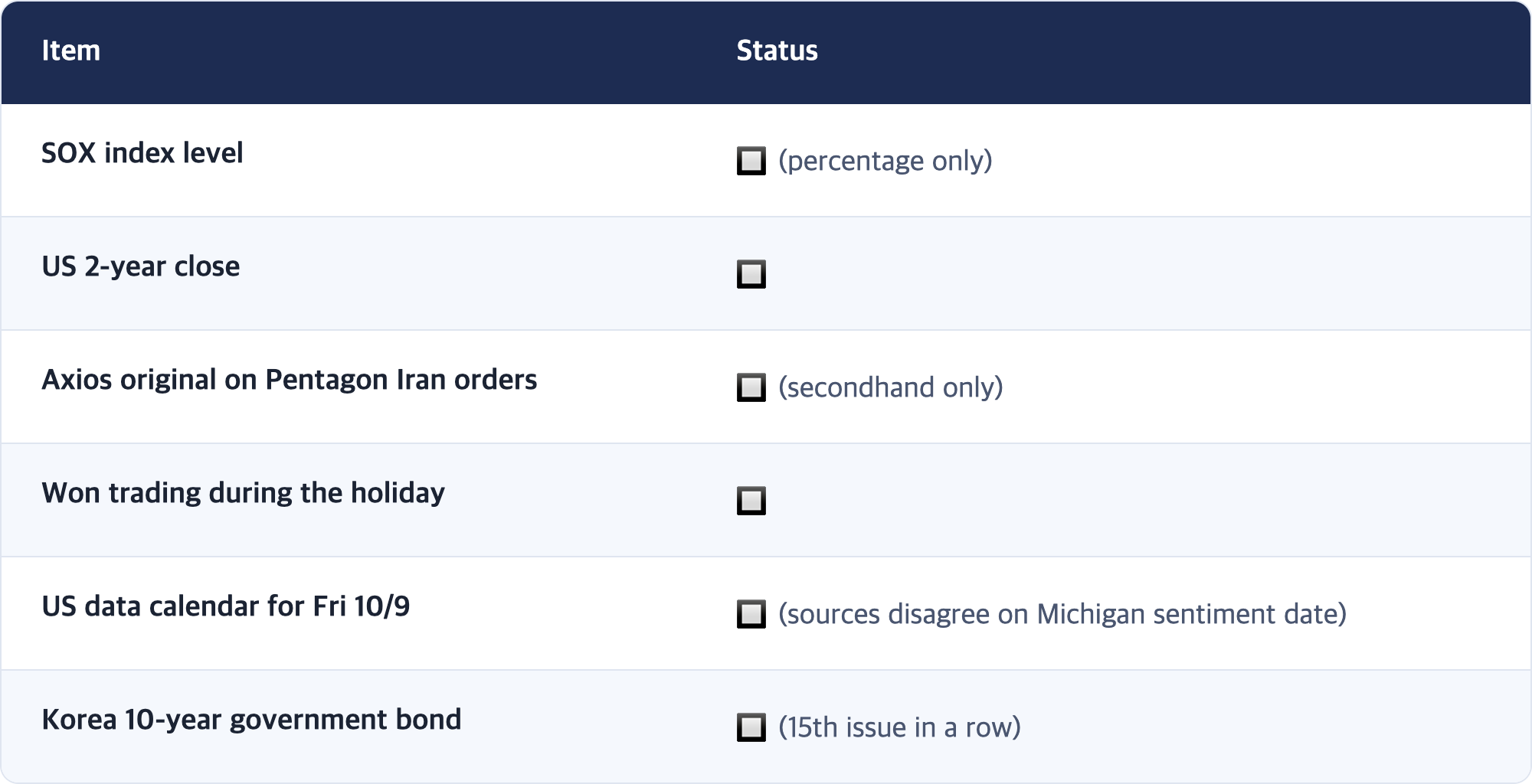
7. Corrections & Open Items
Corrections
- Updating one interpretation from the 10/8 pre-open brief. That brief read Micron's premarket weakness as driven by rates and Taiwan strike risk. Most of the regular-session drop (−4.79%) came from the OpenAI revenue report in the afternoon, on a day when yields fell. The reading wasn't wrong as of premarket, but it does not explain the close.
Source differences (value used in the text)
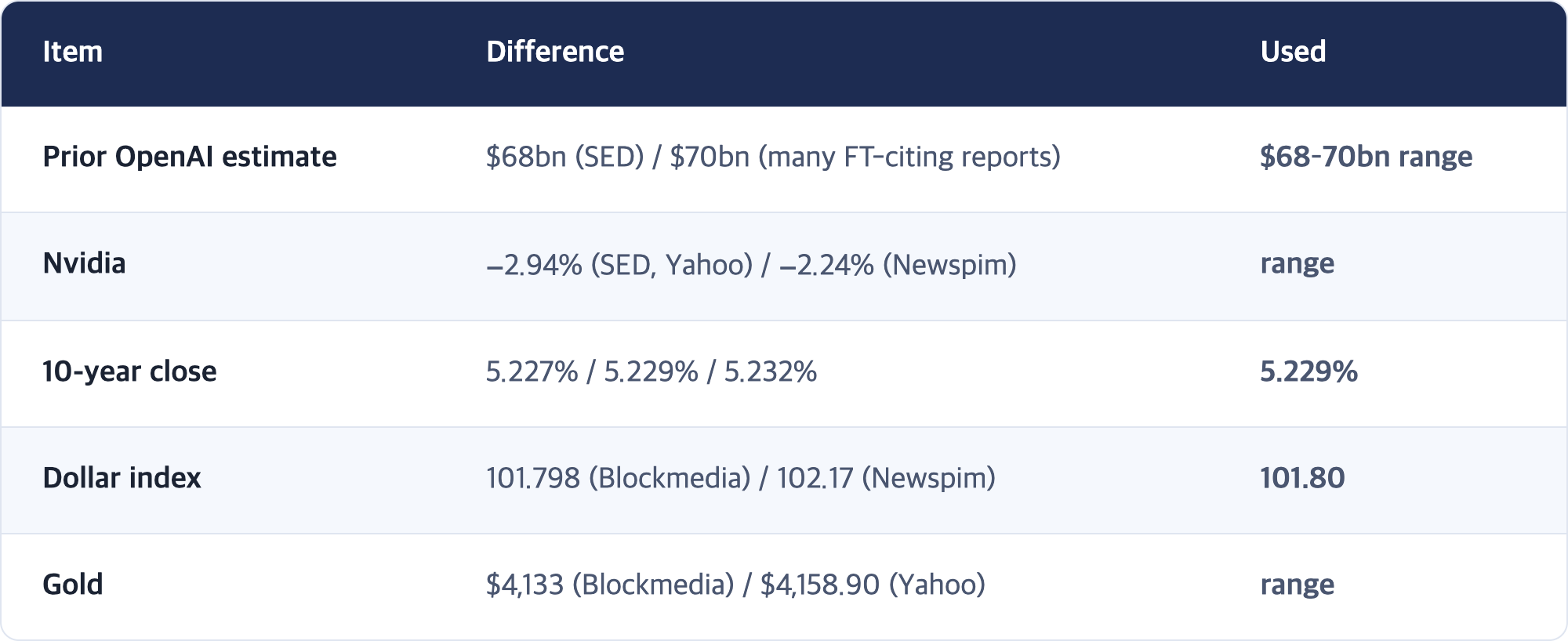
🔲 Unconfirmed
8. Event Calendar (KST)
Sources
- NY stocks close mixed; Nasdaq −1.25% | eToday
- NY stocks mixed as OpenAI revenue report hits chips | Newspim
- Chip stocks tumble on OpenAI revenue miss; oil up 4% on Iran strike fears | Seoul Economic Daily
- US yields fall on solid 30-year auction; dollar weaker | Newspim
- NY gold, bonds, dollar: solid auction lowers yields | Blockmedia
- 10-year at 5.229% on 30-year auction demand | TokenPost
- Stock Market Today, Oct. 8: Tech Stocks Slide as Treasury Yields and Oil Prices Surge | Yahoo Finance
- Stock market today: S&P 500, Nasdaq fall for second day in a row as AI trade takes a hit | Yahoo Finance
- Nasdaq Sinks 345 Points as OpenAI Revenue Woes Weigh on Tech Stocks | Kiplinger
- Micron, Nvidia shares fall after OpenAI revenue report raises concerns | Crypto Briefing
- US treasury sells $22 billion of 30 year bonds at a high yield of 5.618% | investingLive
- U.S. Treasury yields: investors await 30-year bond auction | CNBC
- Oil prices today: Brent, WTI gain on Middle East tensions | CNBC
- Oil settles circa 4% higher as two supply threats collide | investingLive
- Won below 1,340, one-month low | eToday
- KOSPI closes at weekly low of 6,625 ahead of holiday | eToday
Market Analyst · We do not make buy or sell recommendations on individual stocks. This brief offers macro context and interpretation.
📌 More market briefs
※ This post is market observation and organization intended to support your own judgment. It is not a recommendation to buy or sell any security. Figures are as of the time of writing and may differ between sources.
If this was useful, bookmark it or pass it along. It genuinely helps me write the next one.
I can survive. We can survive.