October 8, 2026 US Market Brief — Nasdaq and S&P 500 Before the Open
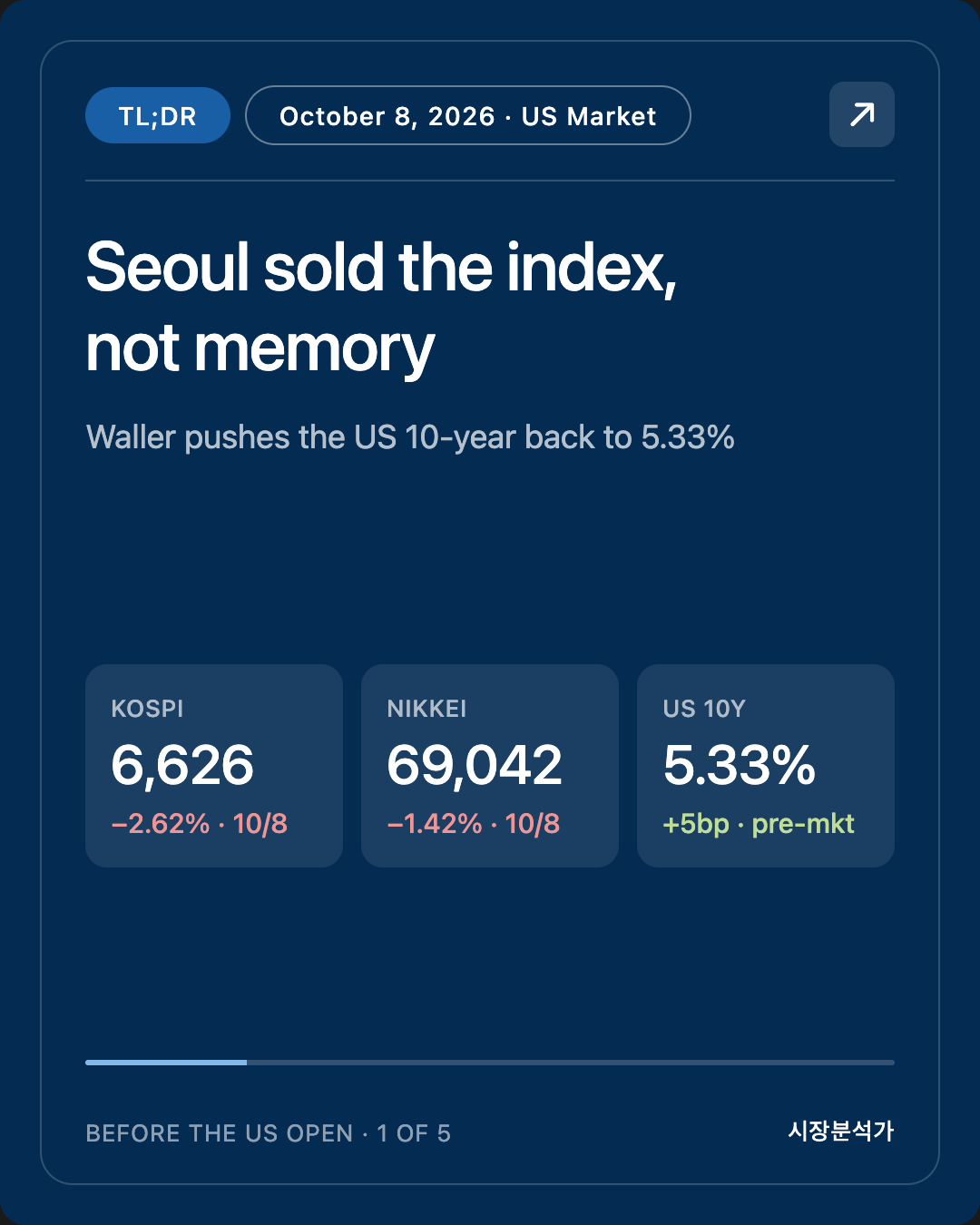
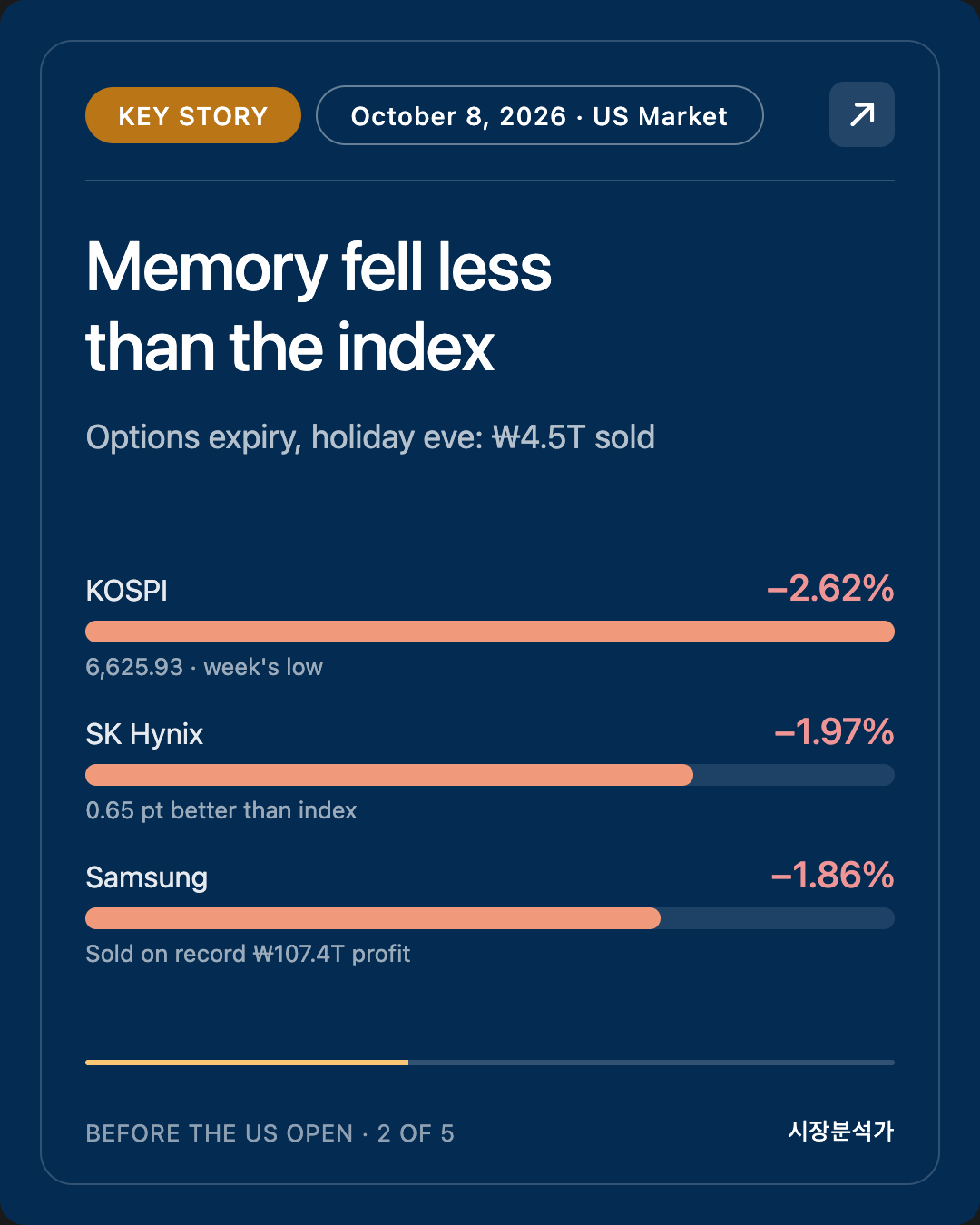
- ★ Seoul sold the index, not memory. KOSPI 6,625.93 (−2.62%) vs SK Hynix −1.97% and Samsung −1.86% (Etoday). Foreigners −₩2.43T, institutions −₩2.10T, retail +₩3.75T. The tech-heavy KOSDAQ fell only 0.69% to 892.27.
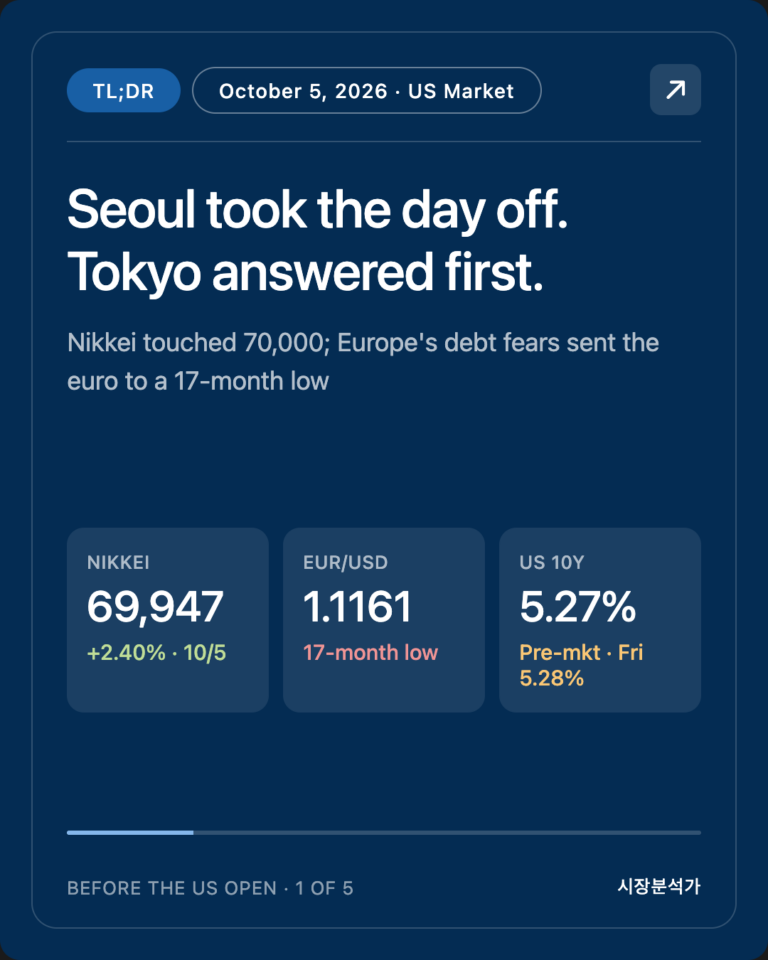
- ★ Tokyo fell for a second day. Nikkei 225 69,042.11 (−1.42%), Topix 4,091.46 (−1.51%) (CNBC), back below 70,000.
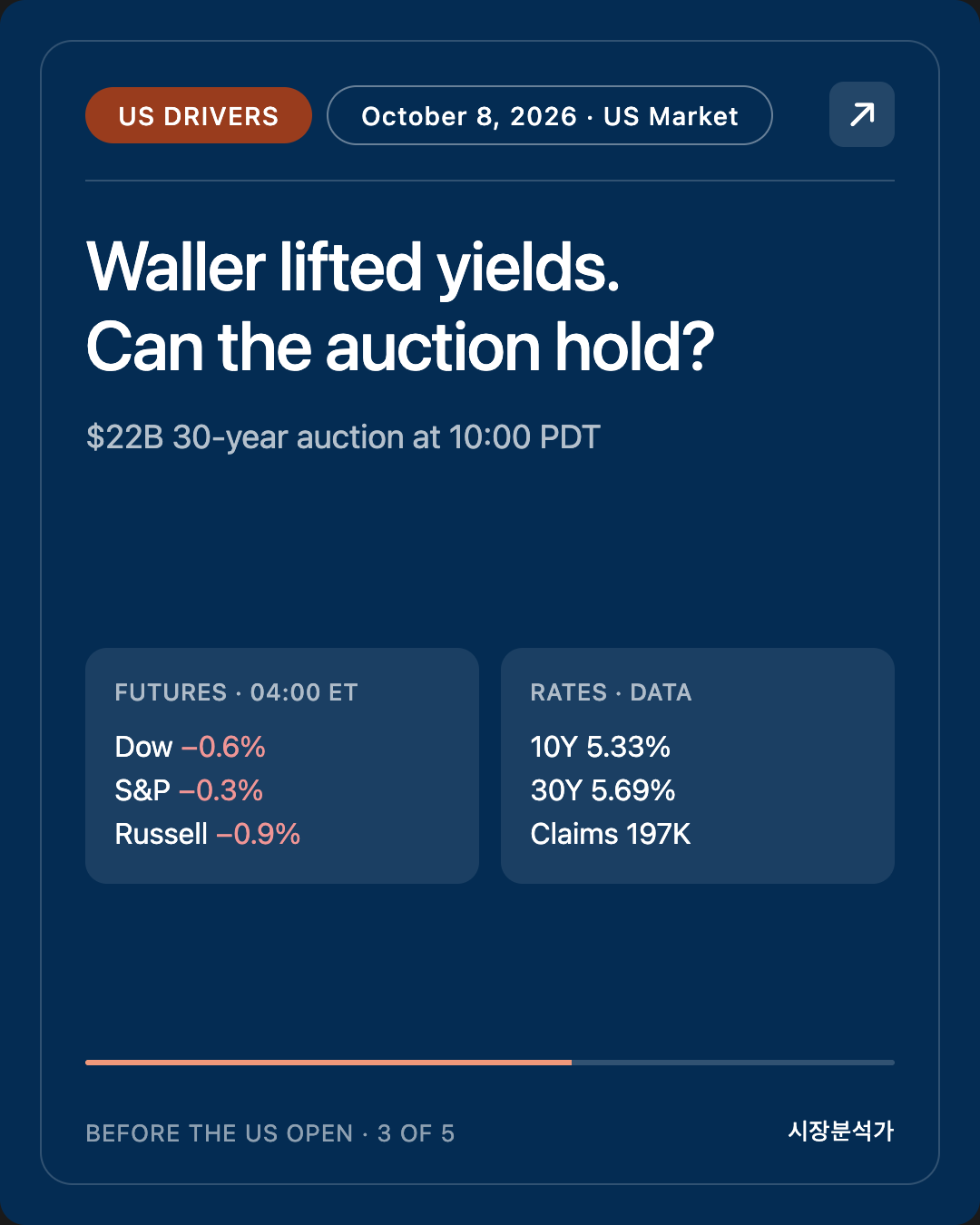
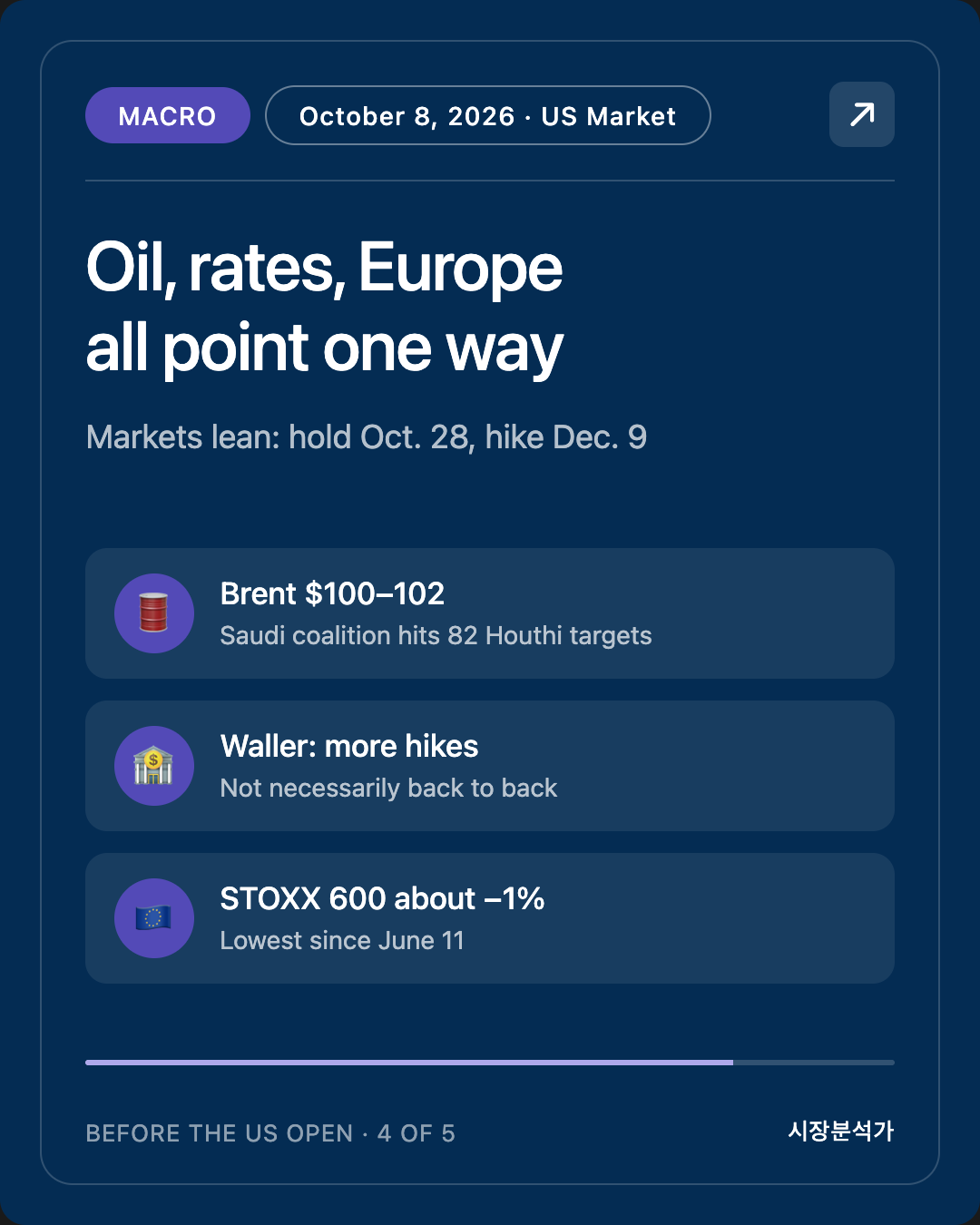
- ★ Waller pushed yields back up. "The hikes do not need to come at consecutive meetings, but they should be in place in an acceptable period of time." 10-year 5.33% (+5 bp), 30-year 5.69% (+3 bp). Markets price a hold on Oct. 28 and a hike on Dec. 9 (CNBC).
- Europe hit a four-month low. STOXX 600 about −1% (lowest since June 11), DAX −0.9% to −1%. Brent is trading between $100 and $102.
- Layoffs stay low. Initial jobless claims 197,000 (est. 200,000); continuing claims 1.716 million (est. 1.708 million). Few layoffs, but that is not the same as strong hiring.
This is Mr. Can. Here is the October 8, 2026 brief ahead of the US market open.
Written: 2026-10-08 05:50 PDT (Seoul 10/8 21:50 KST)
Basis: Seoul 10/8 close + Tokyo 10/8 close + Europe 10/8 intraday + US futures (around 04:00 ET) + US weekly jobless claims (08:30 ET)
🟢 Scheduled 05:30 PDT, started 05:43 PDT. US figures are pre-market futures readings.
🟡 Today the US Treasury sells $22 billion of 30-year bonds at 10:00 PDT. Seoul is closed tomorrow (Fri 10/9, Hangul Day), so today was Korea's last session of the week; it reopens Monday 10/12.
SEO Intro
Korea sold off hard ahead of a three-day weekend. The KOSPI closed at 6,625.93 (−2.62%), its lowest level of the week. Foreign investors and domestic institutions sold together (foreigners −₩2.43 trillion, institutions −₩2.10 trillion, per Etoday), while retail investors absorbed ₩3.75 trillion. This came on the same morning Samsung Electronics reported Korea's first-ever ₩100-trillion quarterly operating profit (₩107.4 trillion).
But this sell-off looked different from the two days before it. SK Hynix (−1.97%) and Samsung (−1.86%) fell less than the index. The concentrated selling of memory-chip stocks that dominated Monday and Tuesday broadened into a sell-off of large caps in general, on a day that combined monthly options expiry with pre-holiday de-risking.
Overnight, Fed Governor Christopher Waller said more rate hikes are needed, pushing the US 10-year yield back to 5.33% and the 30-year to 5.69%. As of 04:00 ET, Dow futures were −0.6%, S&P 500 −0.3%, Nasdaq −0.5%, and Russell 2000 −0.9%. Today's question for Wall Street: can this afternoon's 30-year auction absorb the yield spike Waller set off, the way yesterday's 10-year auction did?
1. Checkpoint scorecard
The four Korea checkpoints set in Wednesday's Korea-open brief (scored at the 10/8 Seoul close)
The question was: after New York bought memory stocks overnight, would Seoul stop selling them, or would Korea-specific selling continue?
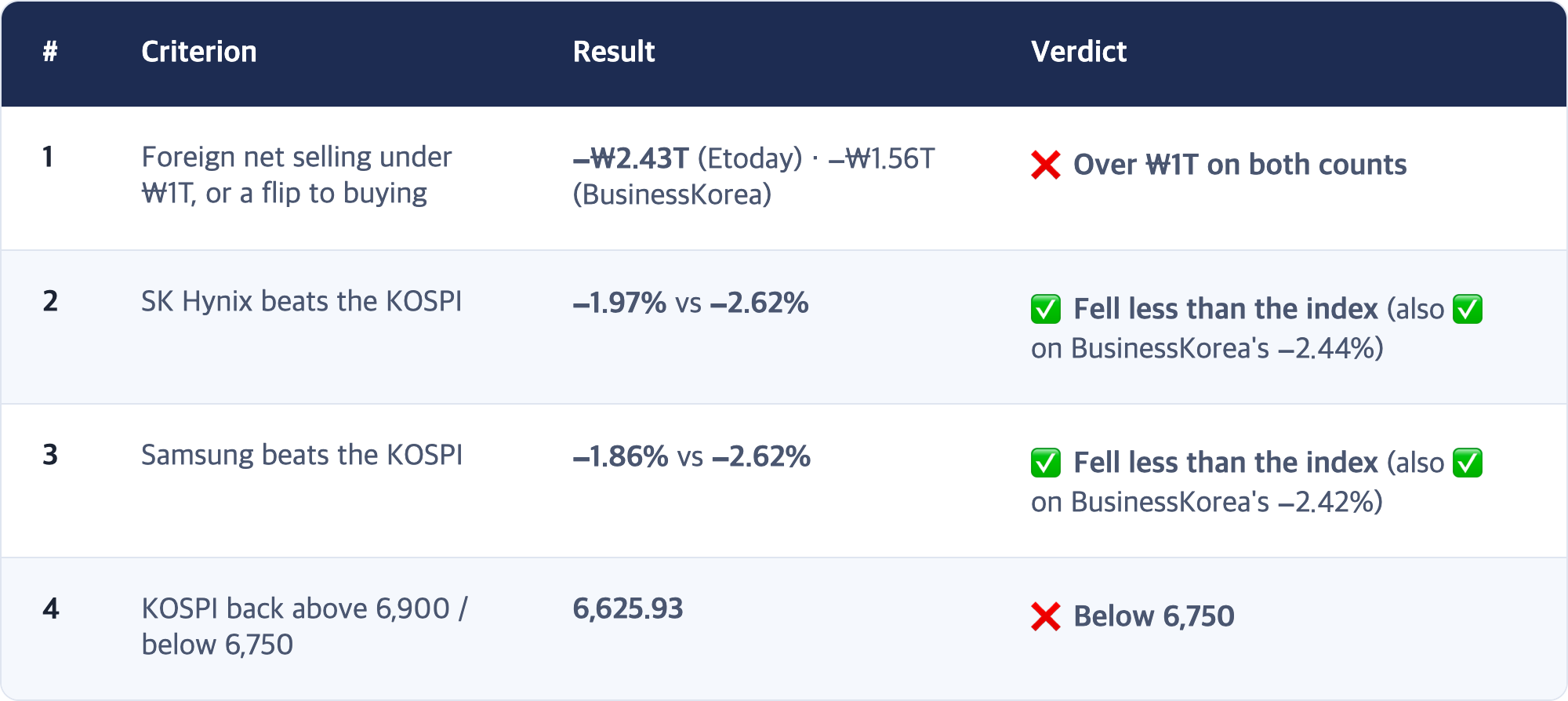
★ [Interpretation] The result landed between the two scenarios we laid out
We wrote that if foreign selling shrank and SK Hynix beat the index, Seoul had simply been "waiting for New York"; if foreigners kept selling ₩2T+ and Hynix lagged again, it was a Korea-only repricing of memory. What actually happened: foreigners kept selling heavily (❌), but SK Hynix beat the index (✅). Neither picture fits.
The better reading is that today's selling targeted large caps broadly, not memory specifically. Three pieces of evidence: (1) both memory names outperformed the index; (2) domestic institutions also sold more than ₩2 trillion; (3) it was monthly options expiry, and BusinessKorea reported heavy afternoon program selling. On top of that, some investors likely cut risk they could not manage during a three-day market closure. Investors do not disclose their reasons, so we cannot say which factor mattered most.
2. Today's key story: Seoul traded the calendar, not the earnings
[Fact] Seoul close, Thursday 10/8 (around 00:30 PDT)
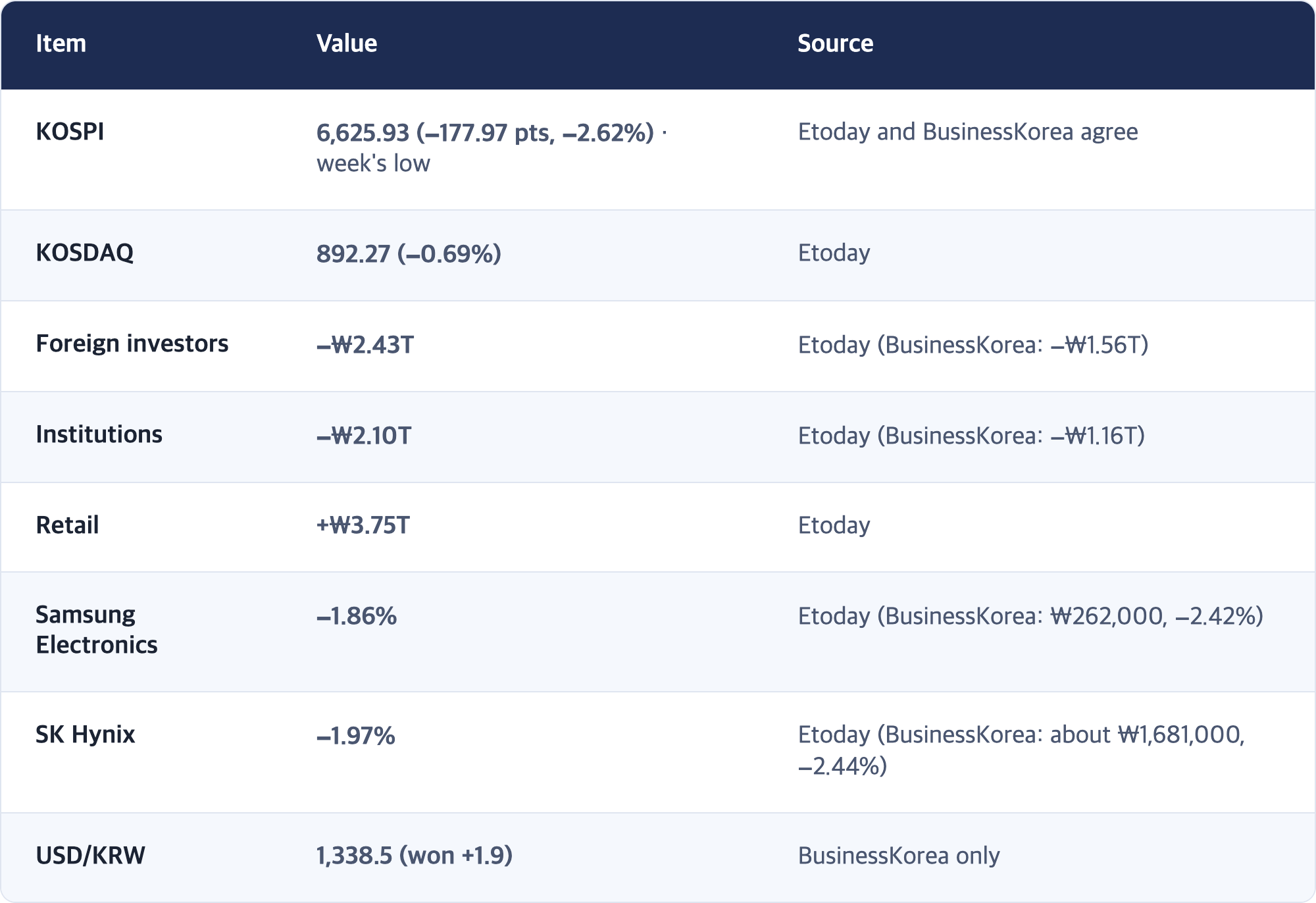
[Fact] Reasons cited by Korean media
- Foreign and institutional selling grew through the session amid pre-holiday caution (Daishin Securities analyst Lee Kyung-min, via Etoday).
- Samsung's preliminary results beat expectations but triggered "sell-on-the-news" selling (same article).
- Monthly options expiry brought heavy afternoon program selling, and profit-taking followed the end of Samsung's share buyback program (BusinessKorea). SK Hynix's buyback window runs to mid-November.
★ [Interpretation] For US investors, what matters is what Seoul did not sell
Micron jumped about 4% on Wednesday (single source: TheStreet). Seoul picked up a little of that signal: memory stocks beat the index by 0.6–0.8 percentage points. But with the index itself down 2.6%, this was "sold less," not "bought."
From Wall Street's point of view: Seoul's two-day, memory-focused selling stopped today, replaced by broad de-risking. That matters for Micron. The "Korea is worried about memory" story that might have spread to New York got weaker today. Micron's pre-market dip (Section 3) looks more tied to yields and a possible strike in Taiwan than to Seoul.
3. US drivers: Waller lifted yields, now the 30-year auction has to absorb them
[Fact] US futures (10/8, 04:00 ET, via Stocktwits)
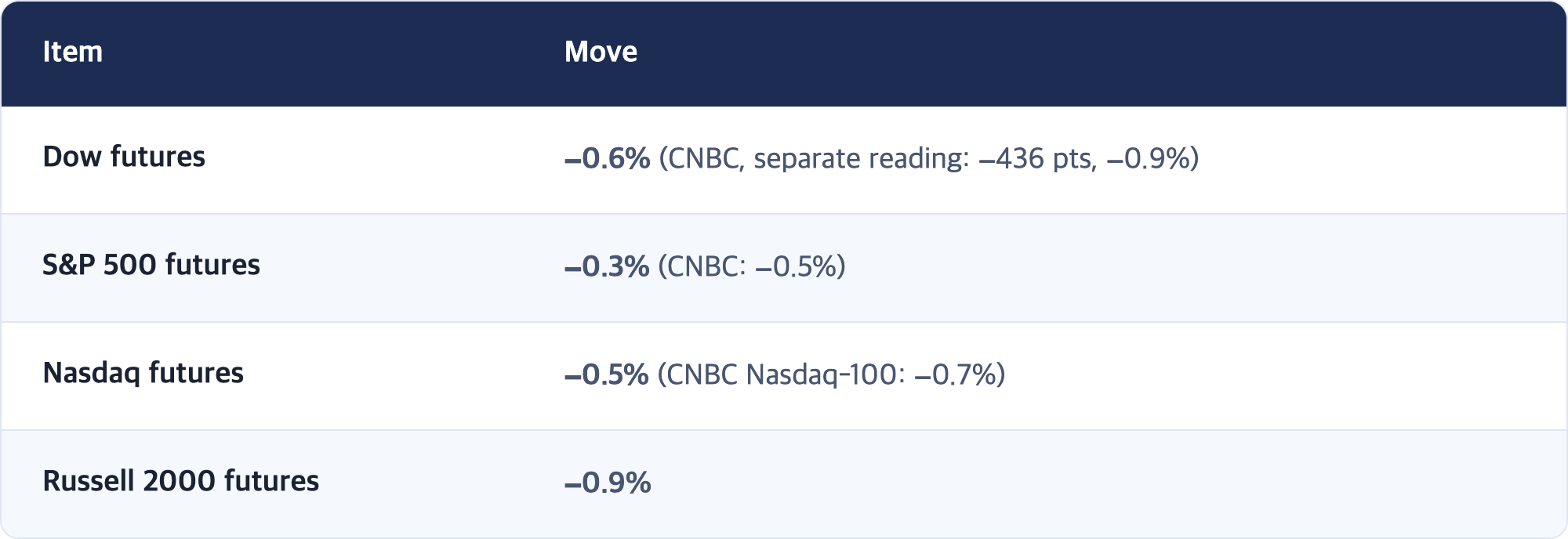
[Fact] Rates and the Fed
- Waller (Central Bank of Turkey forum, Istanbul): more hikes are needed. "The hikes do not need to come at consecutive meetings, but they should be in place in an acceptable period of time."
- 10-year at 5.328% (up 5+ bp), near its highest since 2002. 30-year at 5.694% (up 3+ bp), just below Wednesday's 24-year high (CNBC).
- Market pricing: hold at the Oct. 28 meeting, hike at the Dec. 9 meeting (CNBC).
- $22 billion 30-year bond auction at 10:00 PDT, the last of this week's coupon auctions.
[Fact] Data and stock-specific news
- Initial jobless claims 197,000 (est. 200,000; down 2,000). Continuing claims 1.716 million (est. 1.708 million).
- Micron down roughly 1.4% to 1.9% pre-market (StockAnalysis, TipRanks; timing differs). SanDisk and SK Hynix's US-listed shares also lower. Reported drivers: higher yields and oil, profit-taking after the AI rally, and a strike authorization vote at Micron's Taoyuan, Taiwan plant (about 99% of 1,994 voting workers in favor). No strike date has been set.
★ [Interpretation] The question isn't the level of yields, it's who will buy at that level
Wednesday's story was "the hawkish Fed minutes pushed yields up, and a strong 10-year auction pulled them back down." Today could rhyme: Waller has pushed yields up, and the 30-year auction comes this afternoon.
The 30-year is a harder test. The longer the maturity, the longer a buyer is exposed to inflation and fiscal risk. This week's 3-year and 10-year auctions both "stopped through" (sold at a lower yield than the market expected). If the 30-year does too, the week's theme holds: there is plenty of demand at 5%-plus yields. If it "tails" (sells at a higher yield than expected), long yields have fuel to break Wednesday's intraday high of 5.36% on the 10-year.
Russell 2000 futures being the weakest at −0.9% points the same way. Debt-heavy small caps are the most rate-sensitive part of the market. This morning, futures are watching rates more than memory chips.
4. Macro backdrop: oil, rates and Europe all point the same way
[Fact] Commodities and global markets (morning of 10/8)
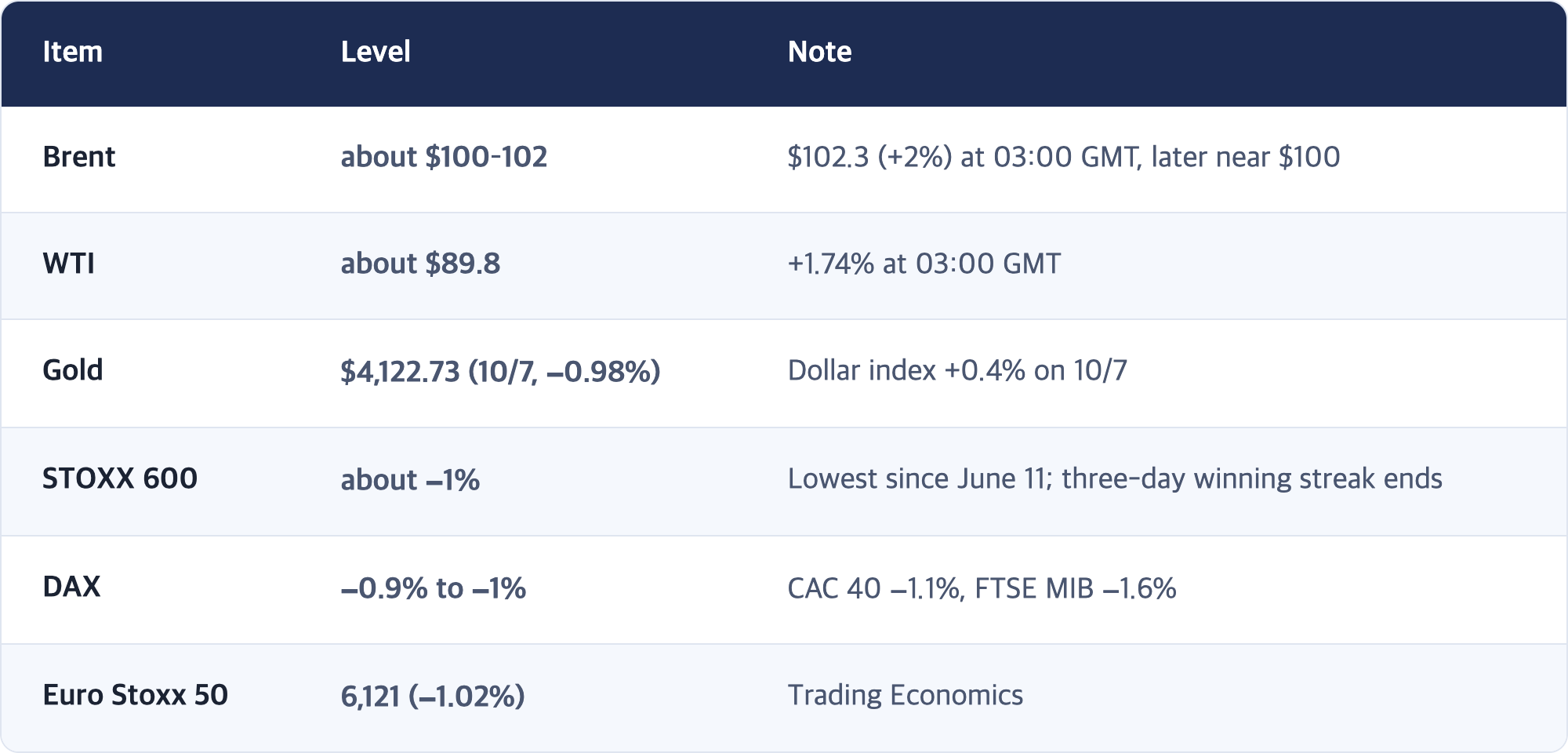
[Fact] Middle East
- Houthi attacks on Riyadh's King Khalid and Abha airports on Oct. 6–7 killed three people and injured 36 (Saudi aviation authority).
- The Saudi-led coalition said it struck 82 Houthi military targets across four Yemeni provinces.
- A tanker off Qatar's northern coast reported being hit by projectiles. The same day, Iran and Oman agreed on coordinates for safe transit routes through the Strait of Hormuz.
★ [Interpretation] Oil drives rates, rates weigh on stocks
The Fed minutes (10/7) named energy prices as an upside inflation risk. With Brent holding above $100, comments like Waller's push markets to put more weight on a December hike. Europe's slide to a four-month low was also attributed to oil, yields and fiscal worries. This morning Seoul, Tokyo, Europe and US futures are all moving the same direction. When everything lines up like this, a single number, the 10-year yield, tends to decide the whole session.
5. US session preview (Thursday 10/8, PDT)
The question
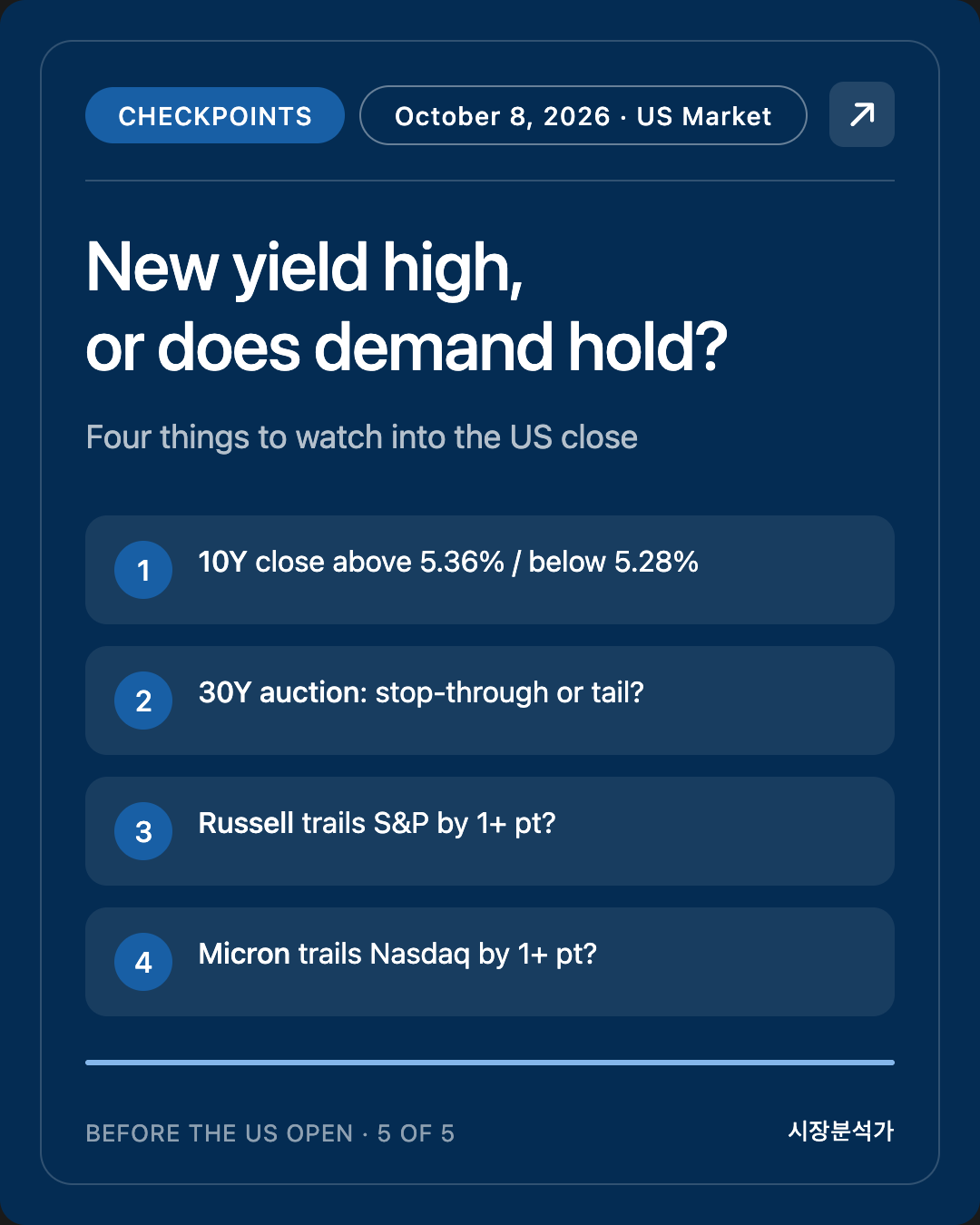
The four checkpoints test: does the yield spike Waller set off break Wednesday's intraday high, or does the 30-year auction absorb it the way the 10-year did?
✅ Four checkpoints (scored at today's US close)
- 10-year closes above 5.36% / below 5.28%. Above = a new high since 2002; below = back to Wednesday's close. (Most important)
- Does the 30-year auction (10:00 PDT) stop through or tail? The week's third test.
- Does the Russell 2000 trail the S&P 500 by more than 1 point? If so, today's drop is a rates story.
- Does Micron trail the Nasdaq by more than 1 point? If so, the Taiwan strike risk is adding a memory-specific factor on top of rates.
[Interpretation] The most informative combination is 1 and 2. A strong auction and a 10-year close below 5.28% would say "auctions capped this week's yield peak." A tail and a close above 5.36% would say "long bonds are starting to price the December hike Waller described." Seoul will then absorb all of this at once when it reopens Monday 10/12.
6. Study note: why does options expiry move an index so much?
Concept
Korea's KOSPI 200 options expire on the second Thursday of each month. Large institutions often pair options and futures with baskets of actual stocks to hedge or to capture small price gaps (arbitrage). At expiry, those pairs have to be unwound, which sends large basket orders to buy or sell many stocks at once. This is called program trading.
Analogy
Think of an apartment complex where everyone's lease ends on the same day. Moving trucks pile up, not because the apartments changed in value, but because the date arrived. Expiry-day orders are similar: they often come from contract dates, not from a change in what companies are worth.
Real example
Today (10/8) was the second Thursday of October, monthly options expiry. BusinessKorea reported heavy afternoon program selling. So part of the KOSPI's −2.62% may have had nothing to do with Samsung's results or the memory outlook. That fits with memory stocks falling less than the index. How many points expiry actually cost will only be clear once the breakdown is published.
One-line summary
Expiry-day orders tend to arrive "because the date came," not "because the value changed," which is why they are sometimes reversed the next session.
7. Corrections and open items
Correction
- October FOMC date. Wednesday's Korea-open brief listed the October FOMC date as unconfirmed. CNBC reports markets are pricing a hold at the Oct. 28 meeting and a hike at Dec. 9. We now list the October decision as Oct. 28.
Source differences (adopted values stated)
- Seoul flows: foreigners −₩2.43T, institutions −₩2.10T (Etoday) vs −₩1.56T and −₩1.16T (BusinessKorea), likely different cut-off times. Etoday adopted; checkpoint verdicts are the same either way.
- Samsung / SK Hynix moves: −1.86% / −1.97% (Etoday) vs −2.42% / −2.44% (BusinessKorea). Etoday adopted. Both still beat the KOSPI's −2.62%.
- US futures: Stocktwits (04:00 ET) vs CNBC (time unclear, larger declines). Stocktwits adopted, CNBC shown alongside.
- Nikkei: −1.42% at 69,042.11 (CNBC) vs about −1% (investingLive, likely intraday). CNBC adopted.
- Micron pre-market: −1.43% (StockAnalysis) to −1.9% (TipRanks). Range shown.
🔲 Unconfirmed
- Hang Seng and Shanghai closes for 10/8 not found. Mainland China was due to reopen today after the National Day holiday.
- USD/KRW 1,338.5 from a single source (third day running).
- SOX close, dollar index level, 2-year level, and Korea 10-year government bond yield (14th straight brief) not obtained.
- Micron's +4.1% on 10/7 is still from a single source (TheStreet).
8. Event calendar (PDT)
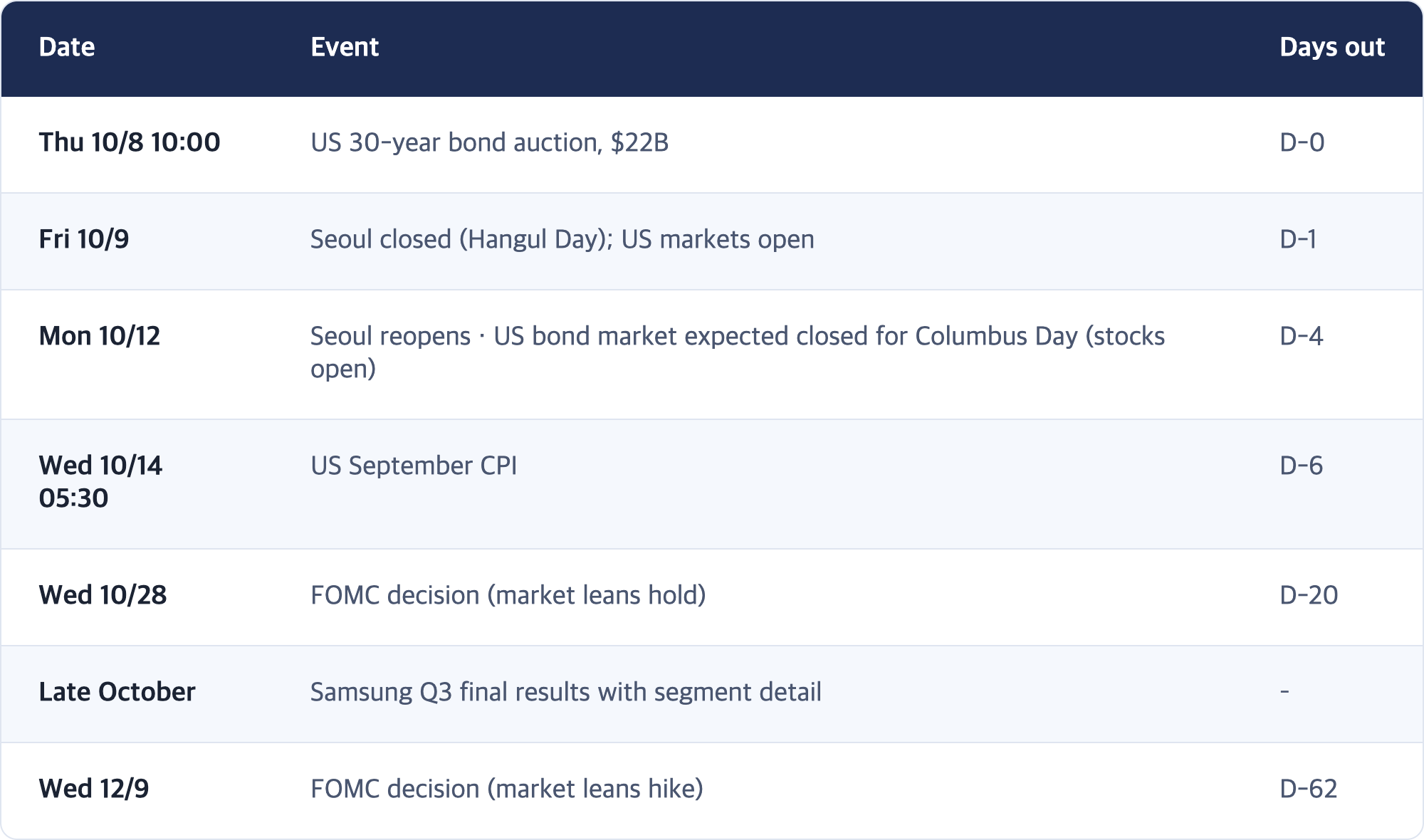
Sources
- Etoday: KOSPI closes at weekly low of 6,625 ahead of holiday (10/8, Korean)
- BusinessKorea: KOSPI retreats to 6,600s despite Samsung's record results (10/8, Korean)
- CNBC: Treasury yields rise as Fed's Waller says more hikes needed, investors await 30-year auction (10/8)
- CNBC: Stock market today live updates (10/7–8)
- Stocktwits: Why Are Nasdaq, Dow Futures Falling Premarket?
- Yahoo Finance: Fed's Waller sees additional rate hikes to get inflation down faster
- Investing.com (Reuters): Fed's Waller: More hikes needed, but there is 'flexibility' about the pace
- FXStreet: US Initial Jobless Claims dropped to 197K last week
- investingLive: US initial jobless claims 197K vs 200K est.
- TipRanks: Micron, SanDisk, and SK Hynix Stocks Extend Losses in Premarket
- TipRanks: Why AMD, Micron, SanDisk, and Nvidia Stocks Are Falling in Premarket Today
- Gulf News: Saudi-led coalition strikes 82 Houthi targets; Iran-Oman agree Hormuz routes
- AGBI: Saudi warns Houthi attacks on airports will not go unpunished
- Trading Economics: Euro Area stock market (EU50)
- Investing.com: European stocks retreat as yields gain again and energy costs weigh
- CNBC: Gold down 1% as dollar gains; Fed minutes in focus (10/7)
- Trading Economics: Japan stock market (JP225)
- investingLive: China markets reopen after Golden Week
📌 More market briefs
※ This post is market observation and organization intended to support your own judgment. It is not a recommendation to buy or sell any security. Figures are as of the time of writing and may differ between sources.
If this was useful, bookmark it or pass it along. It genuinely helps me write the next one.
I can survive. We can survive.