September 3, 2026 KOSPI Market Brief — What to Watch Before the Korean Open
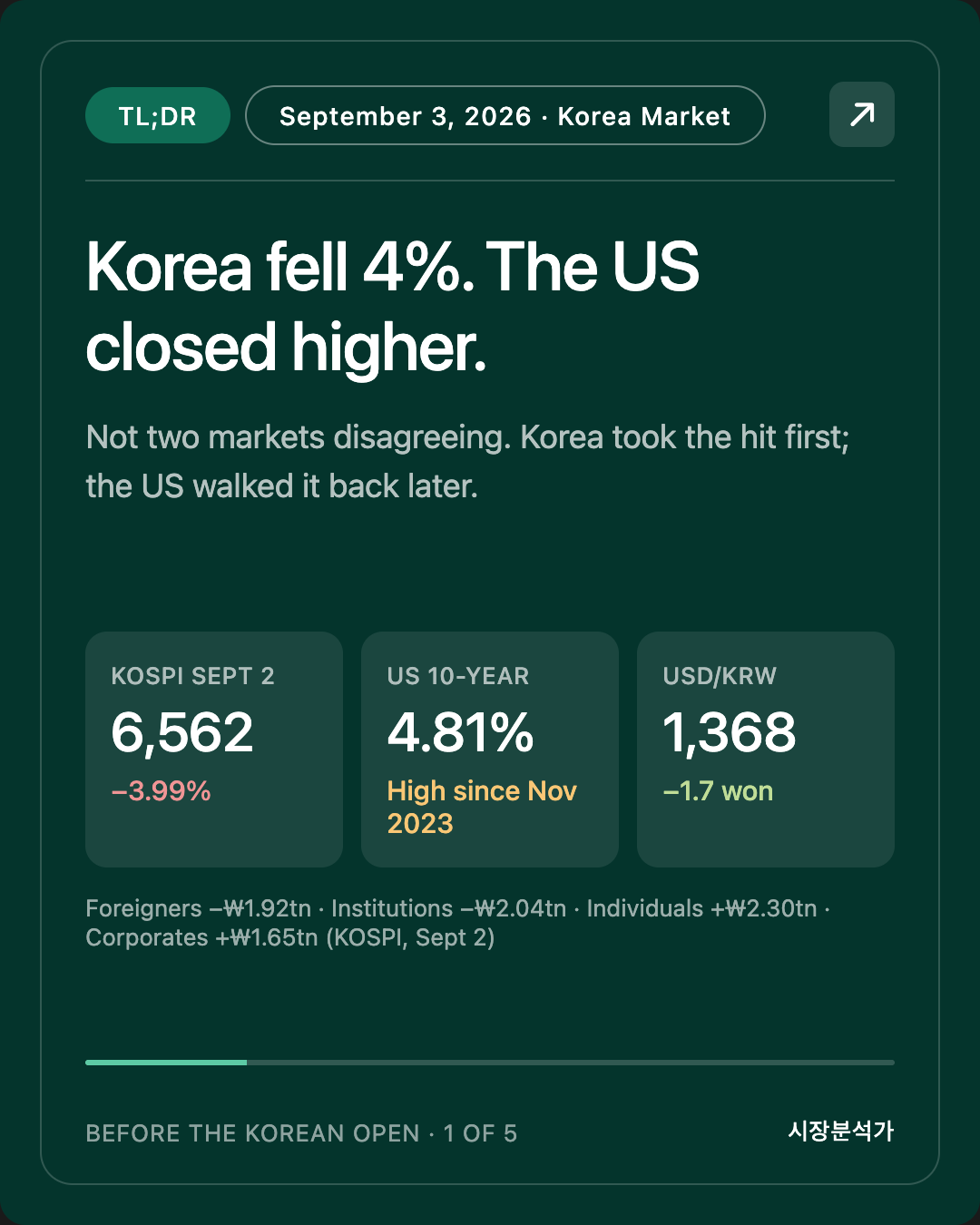
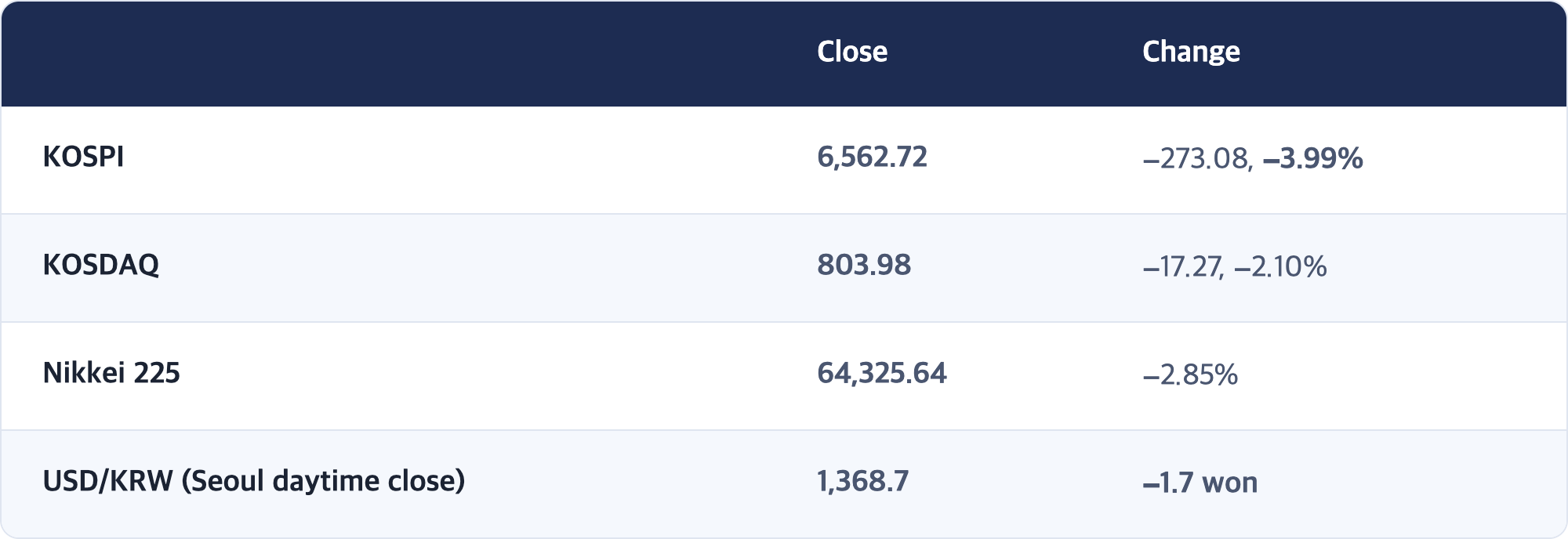
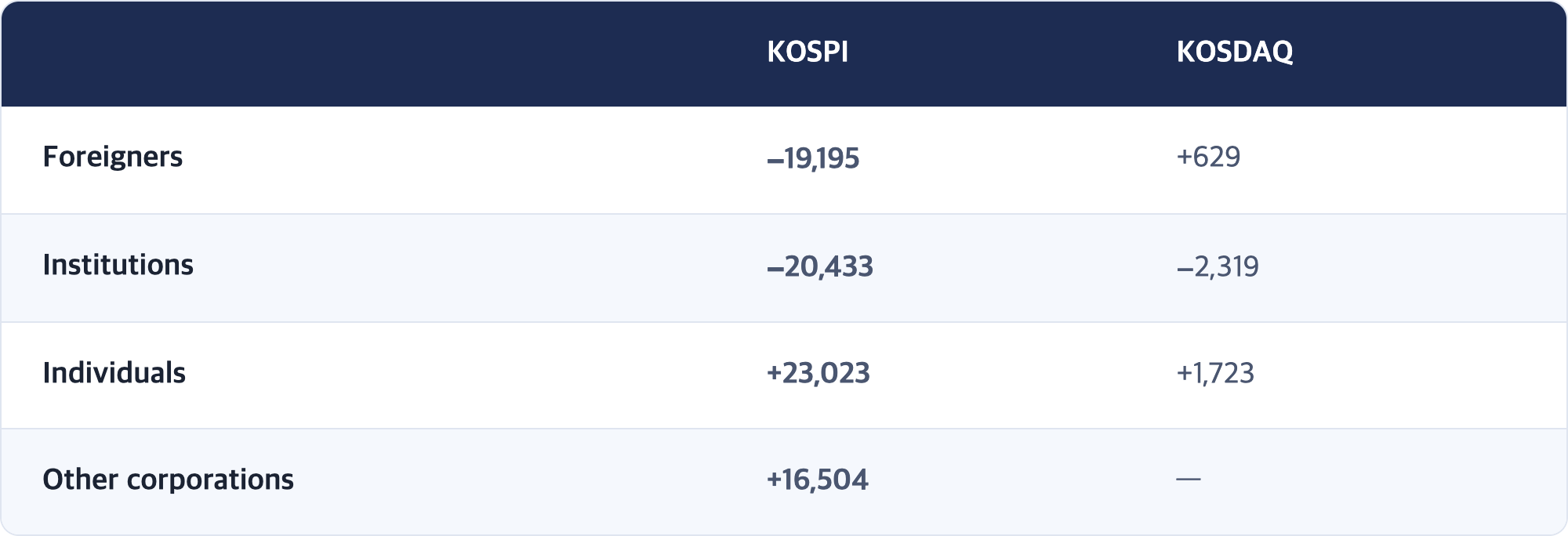
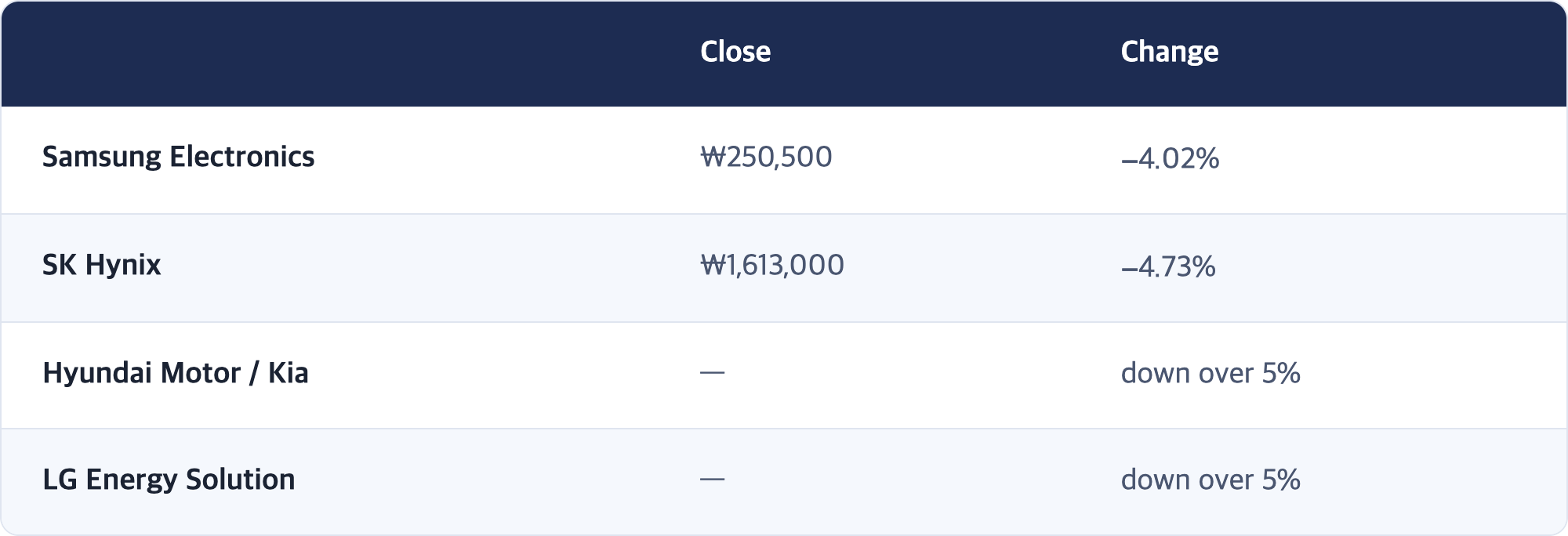
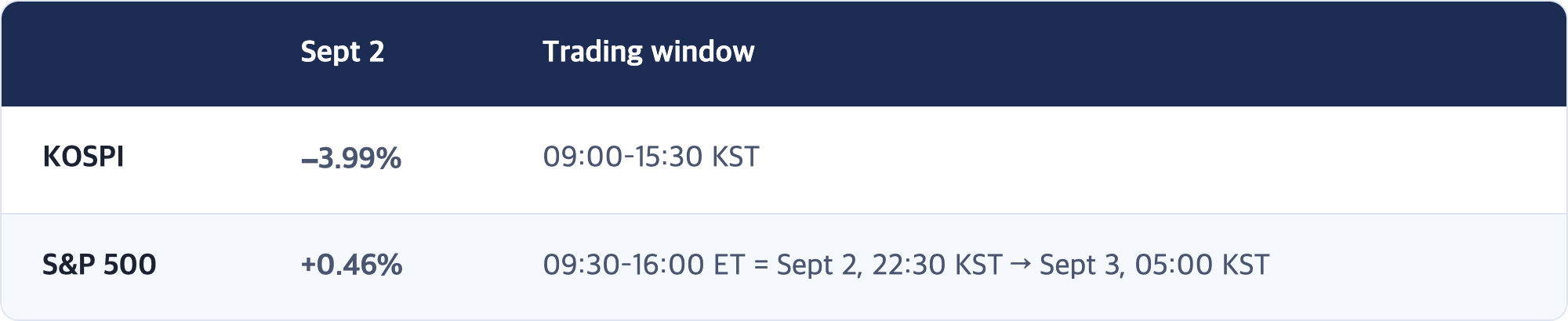
- Korea fell 4%. KOSPI closed at 6,562.72 (−273.08, −3.99%), KOSDAQ at 803.98 (−17.27, −2.10%). Foreigners sold a net ₩1.92 trillion and institutions ₩2.04 trillion — about ₩4 trillion combined. Selling concentrated in semiconductors, autos and battery makers.
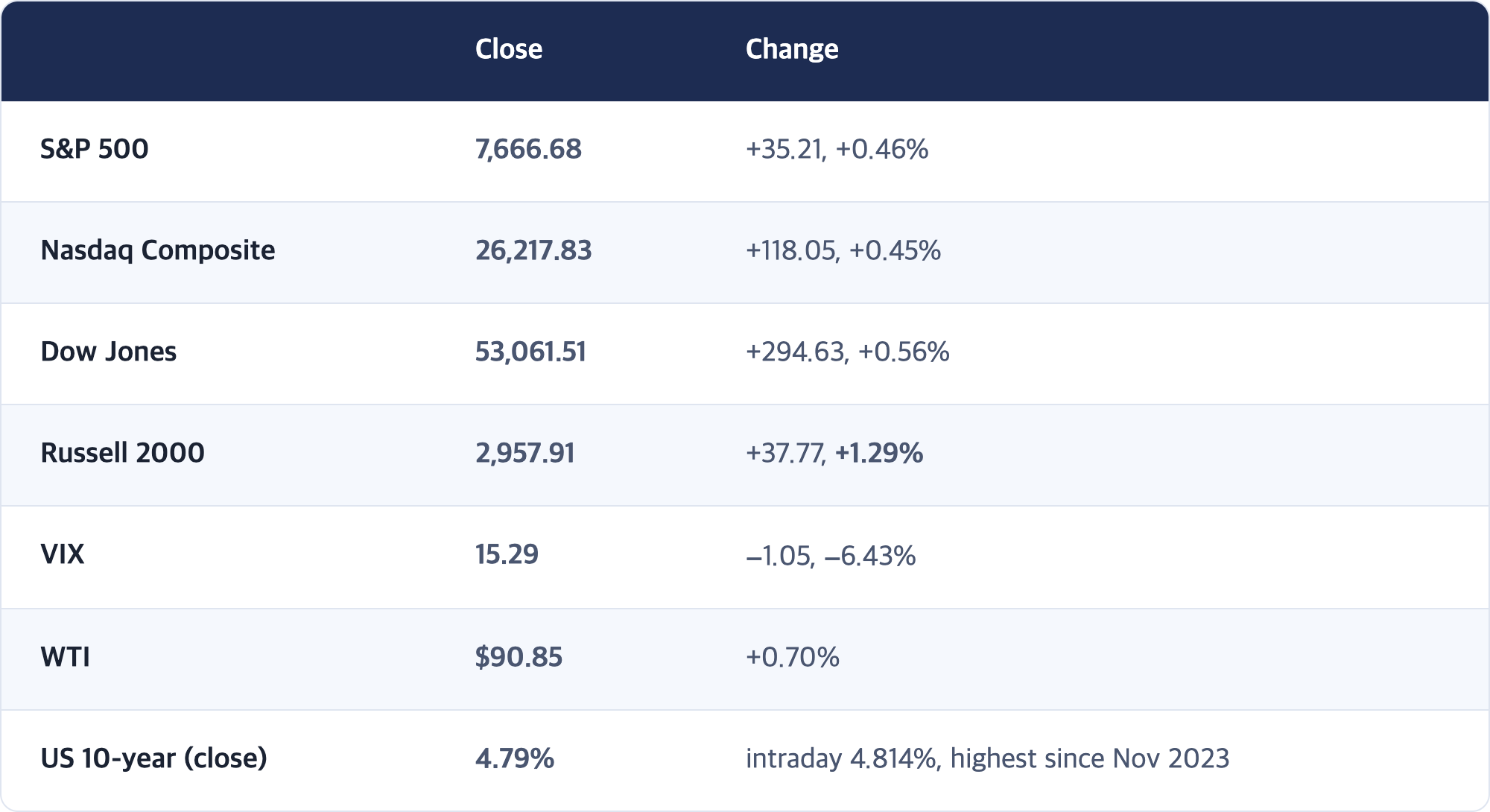
- The US rose the same day. The S&P 500 closed at 7,666.68 (+0.46%), the Nasdaq Composite at 26,217.83 (+0.45%) and the Dow at 53,061.51 (+0.56%), snapping a two-day losing streak. The Russell 2000 led with +1.29% and the VIX fell to 15.29 (−6.43%). Korea shut its doors having priced in only the bad half of the day.
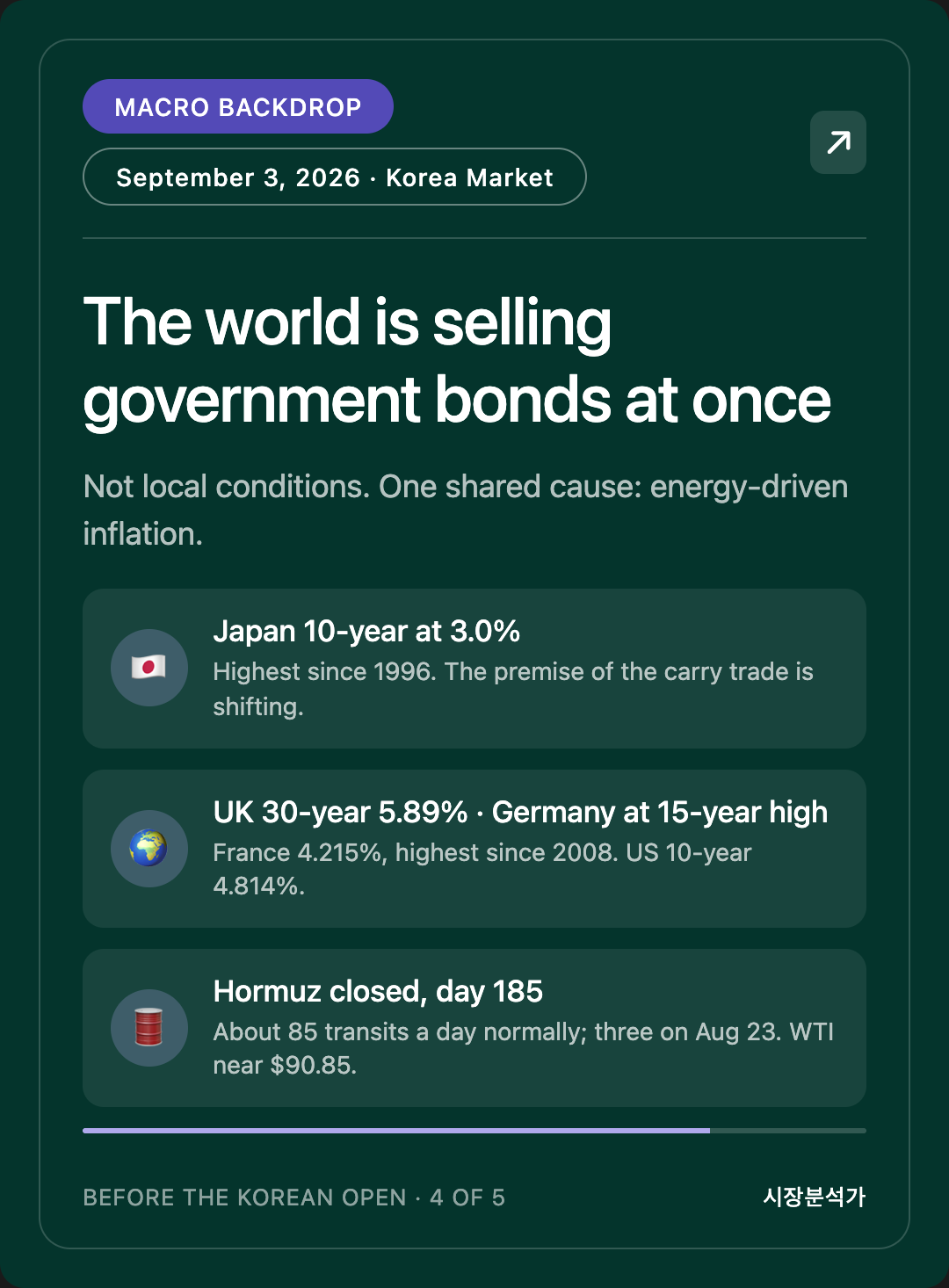
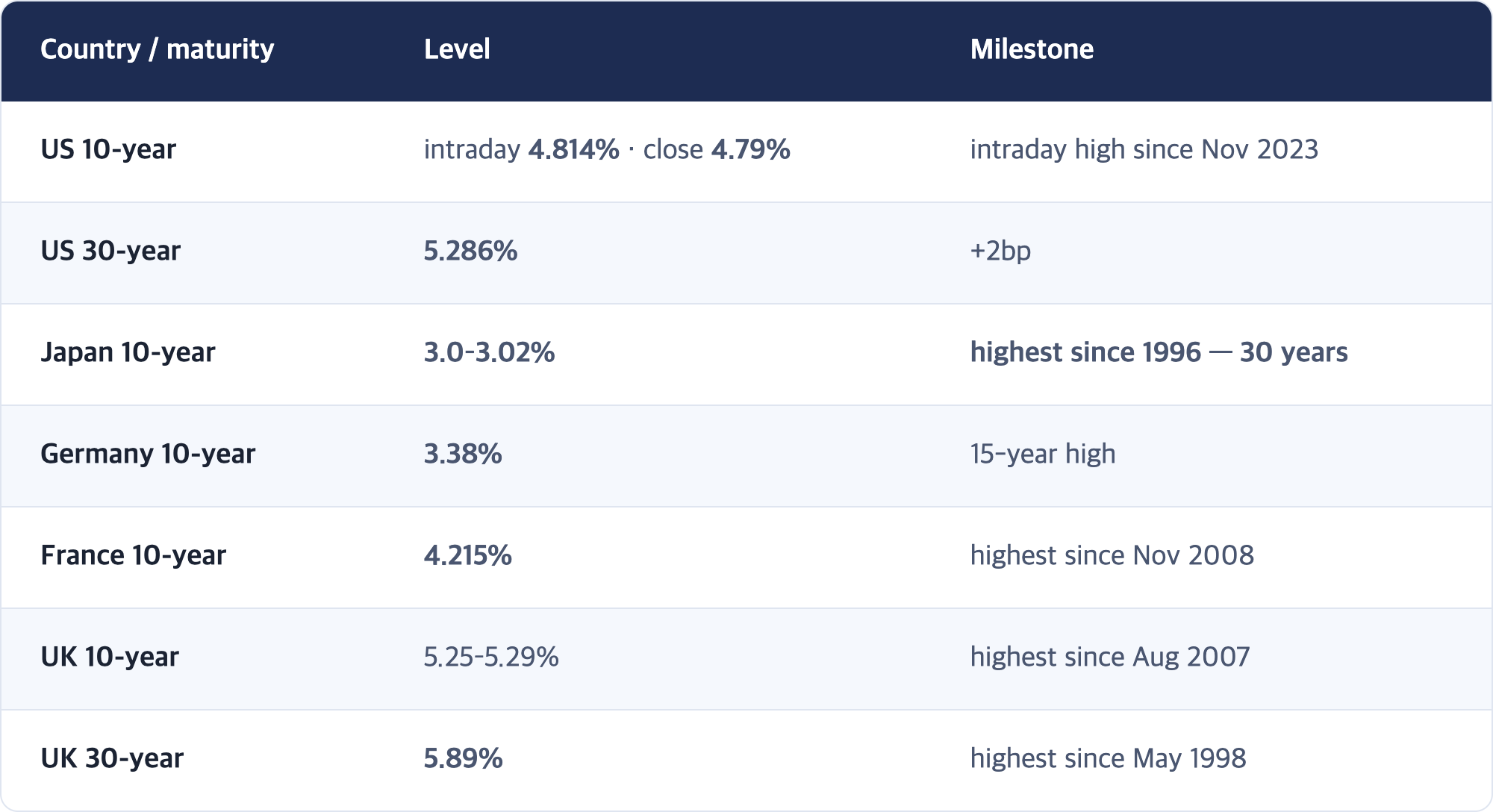
- Bonds remain the story. The US 10-year hit 4.814%, its highest since November 2023. Japan's 10-year reached 3.0% — a 30-year high, the first since 1996. The UK 30-year gilt hit 5.89% (highest since May 1998) and Germany a 15-year high. This is a synchronized global selloff in government debt.
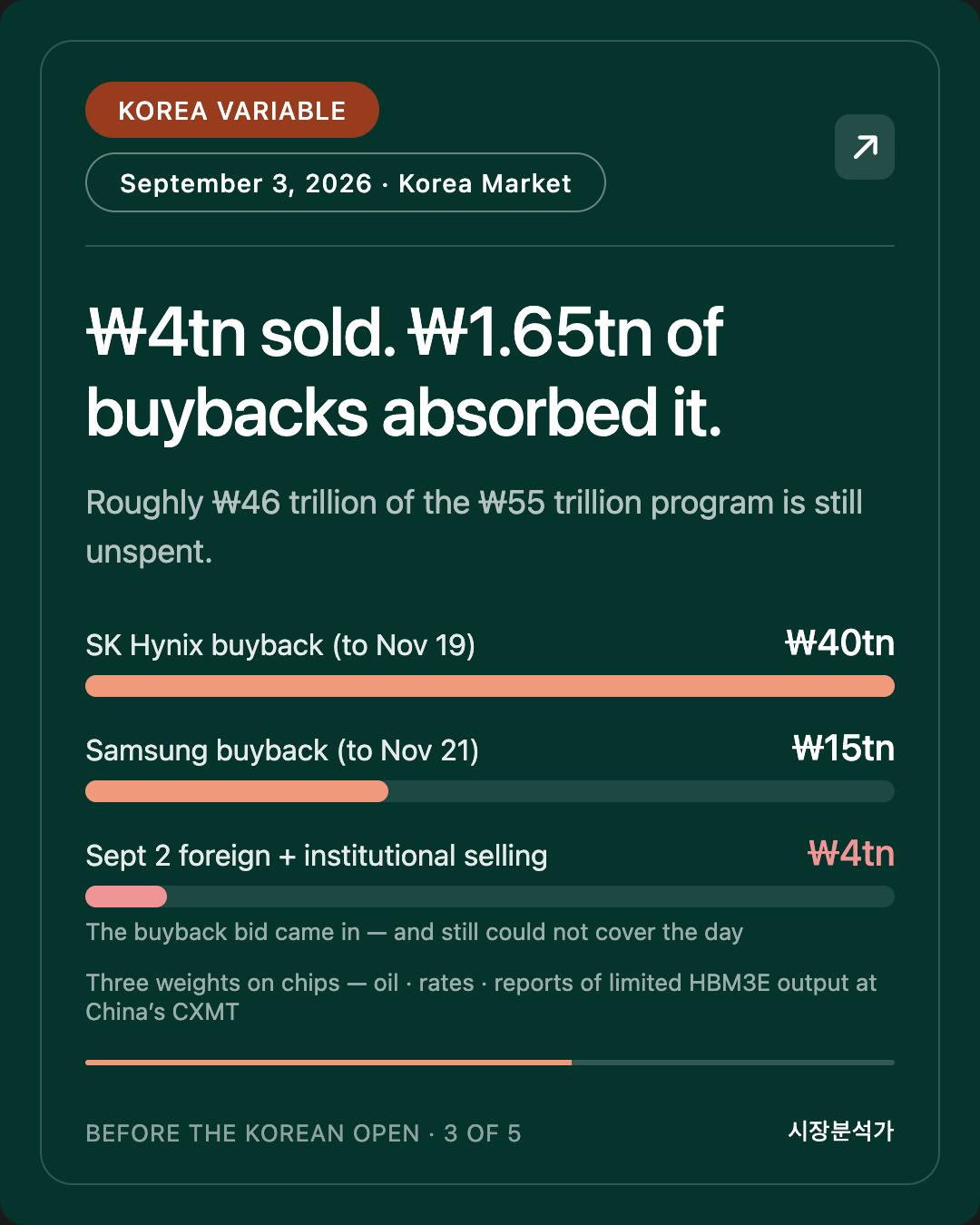
- Korea's floor is being held by buybacks. On a day of ₩4 trillion in selling, the "other corporations" category — which captures corporate share repurchases — absorbed ₩1.65 trillion. Samsung Electronics (₩15tn, through Nov 21) and SK Hynix (₩40tn, through Nov 19) have roughly ₩46 trillion still to spend.
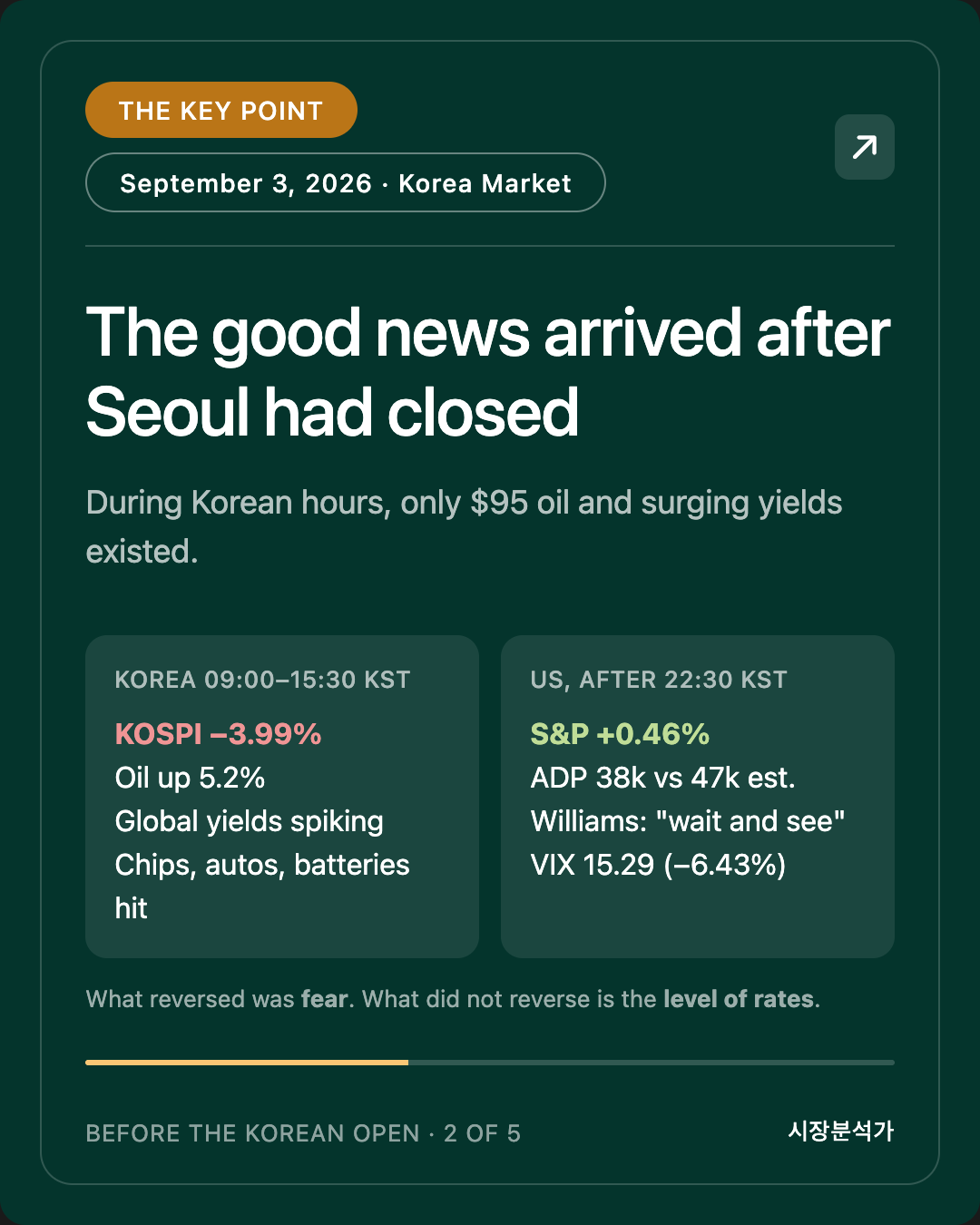
- Friday's US jobs report is the hinge. August ADP private payrolls came in at 38,000 against a 47,000 consensus, and NY Fed President John Williams said he is taking a wait-and-see approach. Odds of a September rate hike eased from 68% to the mid-66% range.
This is Mr. Can. Here is the September 3, 2026 brief ahead of the Korean market open.
Written: September 3, 2026, 05:05 KST (Vancouver Sept 2, 13:05 PDT)
Covers: Korea Sept 2 close + Europe Sept 2 close + US Sept 2 close
📌 Two housekeeping notes
1) Two editions did not go out. The Sept 1 evening brief (previewing Korea's Sept 2 session) and the Sept 2 morning brief (previewing the US Sept 2 session) were never produced. The last published edition was the morning of Sept 1. Korea fell 4% inside that gap, so this brief covers two days at once.
2) This edition started early. It was scheduled for 16:00 Vancouver time but began at 12:24 PDT, before the US closing bell at 13:00 PDT. The US figures below were held until the close and reflect confirmed closing levels, not intraday quotes.
SEO Intro
On September 2, Korea's KOSPI fell 273.08 points — 3.99%. Foreign investors and domestic institutions dumped roughly 4 trillion won between them in a single session. Yet that same night, US stocks rose. This was not two markets reading the same news in opposite ways. Korea took the hit first, and the US walked part of it back afterward. While Korean markets were open, the only news available was oil at $95 and a global surge in bond yields. The New York Fed president's "wait-and-see" remarks and a soft private payrolls print arrived after Seoul had already closed. The real driver right now is not equities but bonds: Japan's 10-year yield touched 3% for the first time in thirty years, Britain's 30-year gilt hit its highest since 1998, and Germany's benchmark reached a 15-year high. Here is what Korea's September 3 session can plausibly reverse, what it cannot, and what to watch through Friday's US jobs report.
1. Korea's September 2 Close
[Fact] — Indices
[Fact] — KOSPI net buying by investor type (₩100 million)
[Fact] — Large caps at the close
[Observation] The sell-side sidecar — Korea's automatic trading curb on program selling — did not trigger. That makes nine consecutive sessions without one, the longest stretch since April. A 4% drop, but not a disorderly one.
[Interpretation] Two details change how you read this session. First, the selling concentrated in the large caps that build the index — chips, autos, batteries — which makes the headline number look worse than the breadth. Second, the won actually strengthened, closing 1.7 won firmer at 1,368.7. When foreigners sell ₩4 trillion of stock and the currency does not weaken, that points to position-trimming inside the equity market rather than capital leaving the country. The same combination showed up on August 6.
2. The One Thing That Matters — Korea Took the Hit First
[Fact] — Same calendar day, opposite directions
[Fact] — Confirmed US closing levels, Sept 2
[Fact] — What arrived only after Seoul closed
- ADP August private payrolls: 38,000 — below the 47,000 consensus and below July's 46,000. The weakest month since January, with manufacturing, professional services and information all cutting jobs.
- NY Fed President John Williams described the yield surge as a product of a strong economy and said he is in wait-and-see mode on whether a hike is needed, adding there is "no clear sign right now" that September action is required to control inflation.
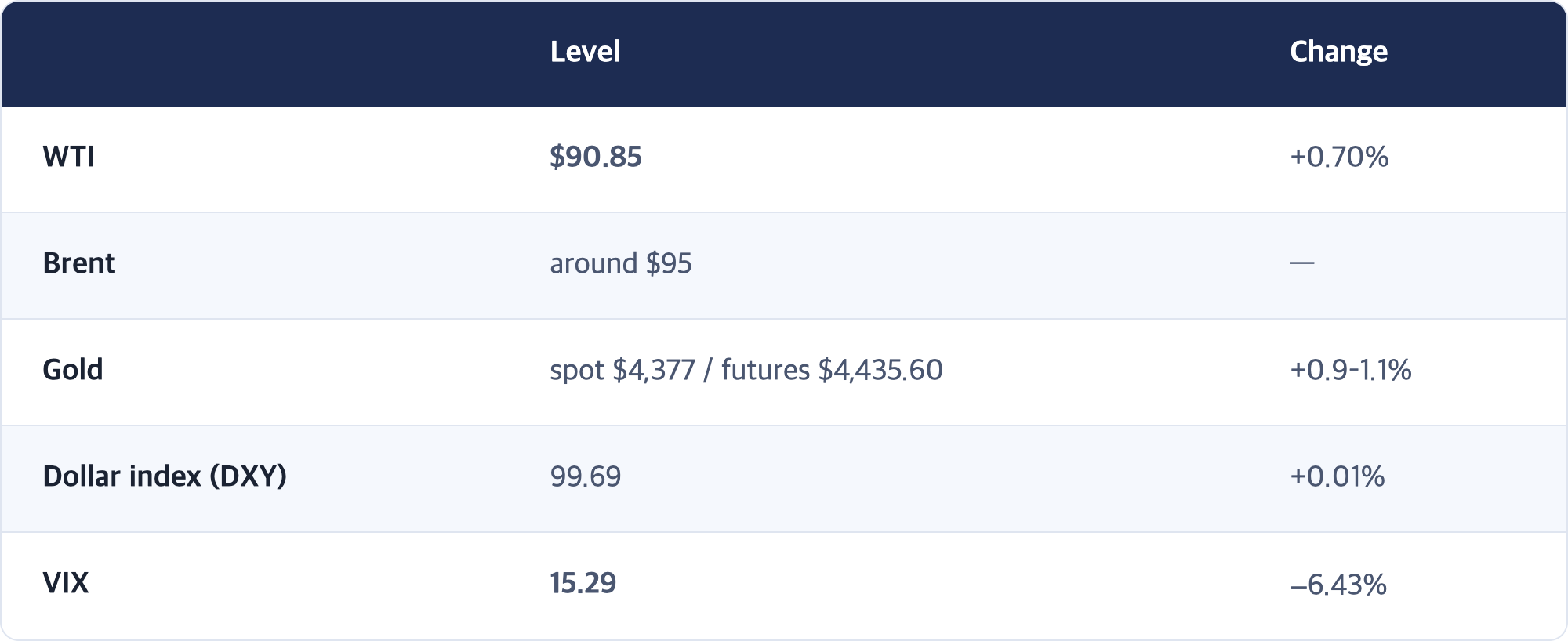
- Oil retraced. WTI, up 5.2% the previous session, steadied around $90.
- Consequently the VIX fell over 7% to roughly 15, and September hike odds slipped from 68.2% to the mid-66% range.
[Interpretation] This is the single most important read today. The KOSPI's 4% drop was not caused by something specific to Korea. It happened because during Korean trading hours, only the bad news existed. On the night of September 1, US crude jumped 5.2% to $90.22 (Brent $94.65), the S&P fell 0.71% and the Nasdaq 1.03%. Korea opened on September 2 looking at exactly that picture — and closed before the picture improved.
One more detail is worth reading: what led the rebound. It was not big tech (Nasdaq +0.45%) but small caps (Russell 2000 +1.29%). The Russell is the most rate-sensitive of the major indices because its constituents carry more debt, so it reacts first when the market senses rates may stop climbing. In other words, this was a relief rally about rates, not a bid for AI and technology.
So Korea's September 3 session starts from "however much the US took back." But be precise about what was taken back. Yield levels were not. The 10-year sits at 4.79–4.81%, near its highest since November 2023; what changed was the speed of the rise, not the level. Fear can be reversed overnight. A rate regime cannot.
3. Korea's Variable — ₩55 Trillion of Buybacks Against ₩4 Trillion of Selling
[Fact] — The buyback programs
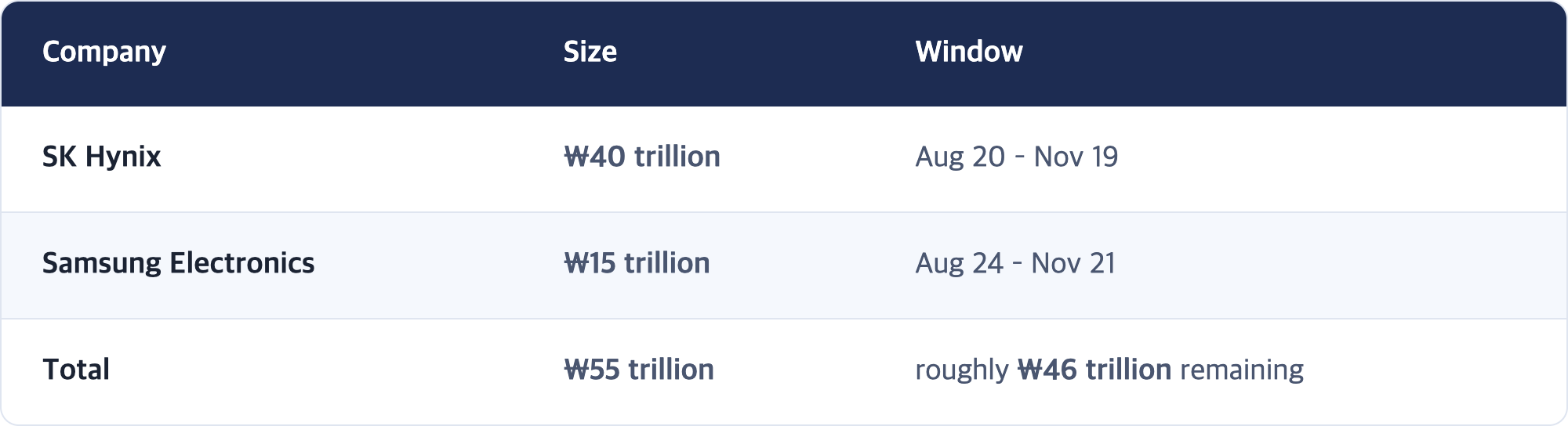
[Fact] The "other corporations" bucket bought over ₩1 trillion a day for six straight sessions from August 20–27, absorbed roughly ₩1.54 trillion on August 31, and took in ₩1.65 trillion on September 2. At the current pace this support runs about 30 more trading days — a month and a half.
[Observation] — Three weights on Korean chipmakers
- Oil — Brent at $94.65 (Sept 1 close), pressuring input costs broadly
- Rates — the US 10-year at a 19-month high, raising the discount rate applied to growth stocks
- Chinese HBM — reports that China's CXMT is producing HBM3E in limited volumes, having made progress despite the 2024 US export restrictions on advanced HBM to China. Chinese fabless firms including Alibaba's T-Head are said to be testing compatibility, with products possibly launching as early as next year. (Unverified: yields and actual supply capacity have not been disclosed.)
[Interpretation] The third item is the new one. The first two are macro forces every equity market absorbs together, but CXMT's HBM3E aims directly at the moat of Korea's two memory makers. That said, "limited-volume production" and "compatibility testing" are still a long way from share loss. The more accurate reading of a same-day price reaction is that the market is already primed for a memory-cycle peak, and is therefore reacting hard to small provocations.
[Interpretation] — How to read the flow structure. This continues the pattern flagged on August 31. When buybacks hold the floor, the index can look stronger than actual investor conviction. September 2 was the mirror image: ₩1.65 trillion of buying came in and the market still fell 4%, meaning the day's selling pressure exceeded what the buyback bid could absorb. In this regime, asking who bought and who sold before reading the index level is the more reliable habit.
4. The Macro Backdrop — A Synchronized Bond Selloff and a Strait Closed for Six Months
[Fact] — Government bond yields, Sept 2
[Fact] — Commodities and sentiment, Sept 2
[Fact] — Hormuz
The Strait of Hormuz has been effectively closed to commercial shipping since March 2026, and September 2 marked day 185. Against a normal flow of roughly 85 vessels a day, three transited on August 23. Two supertankers were struck by projectiles between August 31 and September 1; US forces hit IRGC air-defense, radar, mine-laying and anti-ship missile sites, and Iran retaliated against a US base in Jordan and targets in the UAE.
[Interpretation] When US, European and Japanese yields rise at the same time, the cause is not domestic to any of them. The chain runs energy-driven inflation → expectations of tighter policy → fiscal strain. Japan's 3% deserves particular attention. For thirty years Japanese government debt was the world's cheapest funding source, and that money financed asset purchases everywhere. Once you can earn 3% at home, the reason to send it abroad shrinks. For Korean and other Asian assets, this may prove a heavier long-run variable than the oil price itself.
5. Previewing Korea's September 3 Session
[Interpretation] — Four things to watch
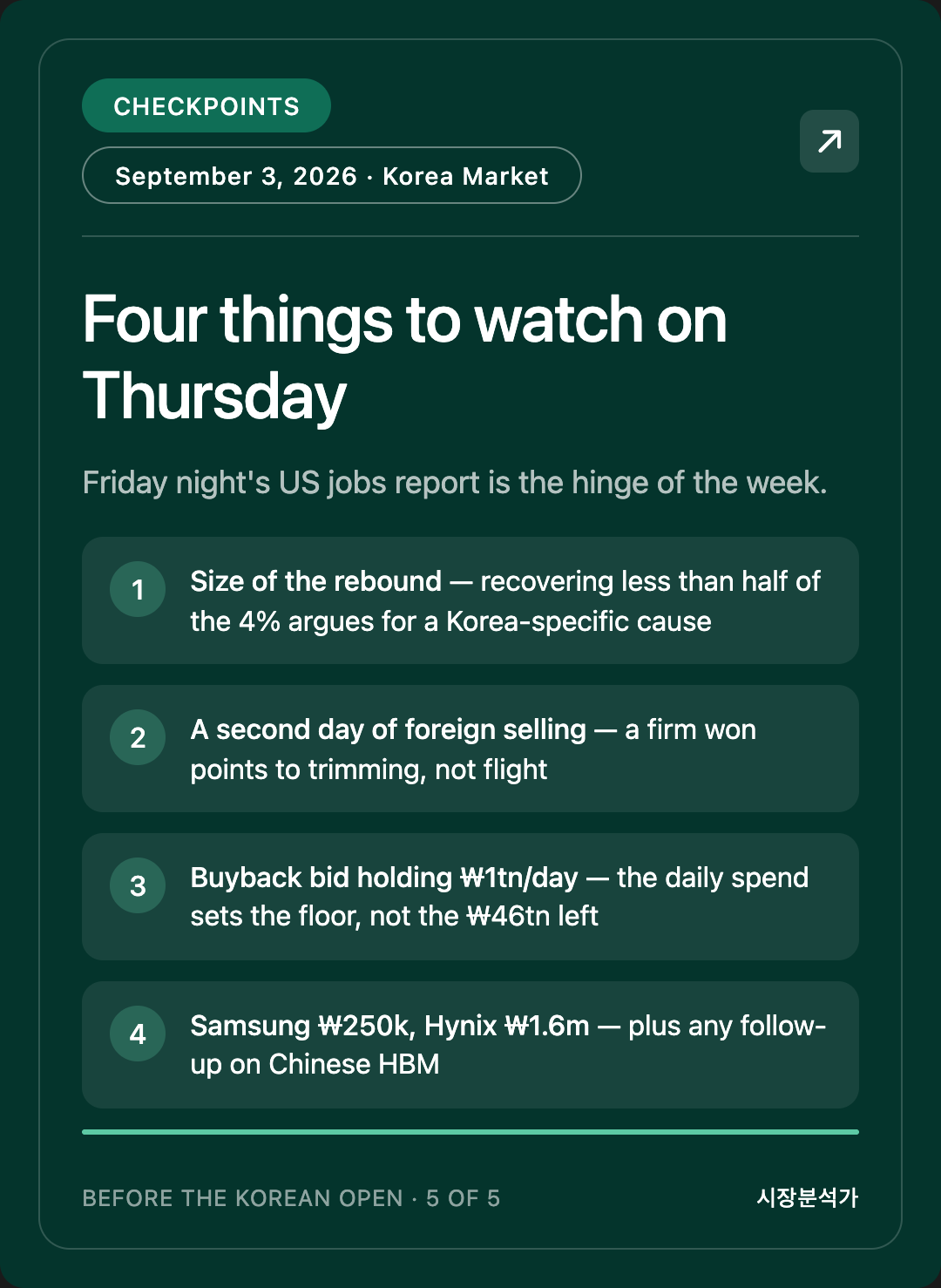
- The size of the rebound. Does the KOSPI follow what the US took back? How much of the 4% it recovers is the test of the "this was a timing gap" reading. Recovering less than half would argue that something Korea-specific is also at work.
- Whether foreigners turn. They sold ₩1.92 trillion on September 2. Given the firm won, that looks like position adjustment rather than flight — but a second consecutive session of heavy selling would force a different reading.
- The size of the buyback bid. Whether "other corporations" stay above ₩1 trillion. Having ₩46 trillion left matters less than how much of it gets spent per day — that is what sets the height of the floor.
- The two chipmakers and any CXMT follow-up. Whether Samsung holds ₩250,000 and SK Hynix ₩1.6 million. Further reporting on Chinese HBM could move them independently of the macro.
[Observation] — Event calendar
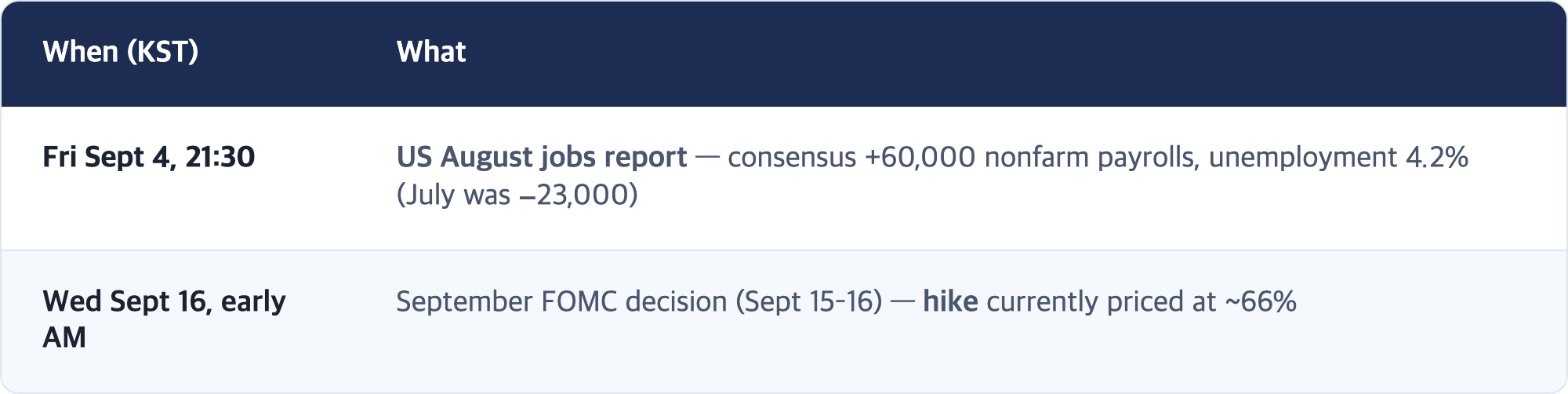
[Interpretation] Friday's payrolls report is the whole week. The market is standing between two propositions: "inflation forces the Fed to hike" and "the labor market is cooling too fast to allow it." A 38,000 ADP print and a cautious Williams tilted Wednesday toward the second. A payrolls number well below 60,000 would pull hike odds down quickly, settle yields, and land most directly as relief for Korean chip and growth names. A number well above it would make a September hike close to settled — and would argue that September 2 was a beginning rather than an overshoot.
📖 Study Note — Why a Synchronized Bond Selloff Moves Stocks
The concept. Government bond yields in different countries rising in the same direction at the same time. Normally each country's yields follow its own growth, inflation and fiscal position. Right now the US, Japan, Germany, France and the UK are all climbing together.
An analogy. Banks in different towns naturally charge different rates. If every bank in the country raises rates on the same day, the cause is not local — something national has changed. Here, that something is the belief that energy prices will push inflation back up.
Why equities care. A stock is worth its future earnings discounted into today's money, and the discount rate is the interest rate. When rates rise, earnings further in the future get marked down the most. So companies whose profits sit far out — growth and technology names — get hit first. That is precisely why the Nasdaq (−1.03%) fell more than the Dow (−0.79%) in the US on September 1, and why Korean chip and battery stocks fell more than the index on September 2.
The case to remember. Japan's 10-year at 3% is a 30-year first. For decades investors borrowed in Japan at near zero and bought assets elsewhere — the carry trade. When borrowing costs 3%, that trade stops paying, and the foreign assets bought with borrowed yen get sold to repay it. This is the quiet, long-duration force acting on Korean and emerging-market equities.
📌 Corrections
- The Sept 1 evening and Sept 2 morning editions were not published. This brief covers that gap.
- Confirmed US closing levels for Tuesday Sept 1, for the record: S&P 500 7,631.47 (−0.71%), Nasdaq Composite 26,099.77 (−1.03%), Dow 52,766.88 (−419.02, −0.79%), WTI $90.22 (+5.2%), Brent $94.65 (+4.6%).
- Sources disagreed on Samsung and SK Hynix prices for Sept 2. Intraday reporting had ₩253,250 (−3.07%) and ₩1,643,000 (−2.54%); closing reports had ₩250,500 (−4.02%) and ₩1,613,000 (−4.73%). This brief uses the closing figures.
- Sources differ on the S&P 500 close by about 0.6 points (7,666.06 vs 7,666.68). This brief uses 7,666.68 (+0.46%); neither direction nor interpretation changes.
- Gold continues to differ across sources. Spot at $4,377 versus futures at $4,435.60; both are given above. The August 31 close remains unconfirmed.
🔗 Sources
- Money Today — KOSPI closes down 4% · USD/KRW at 1,368.7
- Hankyung — Three weights on Korean chip stocks: oil, rates, Chinese HBM
- Etoday — Weekly flow report on corporate buyback demand
- Yahoo Finance — US markets live, Sept 2 · Sept 1
- Nikkei Asia — Japan's benchmark yield hits a 30-year high of 3%
- Euronews — European government bond yields at 15-year highs
- Axios — US strikes Iranian oil tankers
- UPI — ADP: private payrolls grew 38,000 in August
- CNBC — Williams says yield surge reflects strong economic prospects
- Morningstar — August jobs report preview
This brief summarizes market flows and macro variables. It is not a recommendation to buy or sell any individual security.
📌 More market briefs
※ This post is market observation and organization intended to support your own judgment. It is not a recommendation to buy or sell any security. Figures are as of the time of writing and may differ between sources.
If this was useful, bookmark it or pass it along. It genuinely helps me write the next one.
I can survive. We can survive.