Sept 30, 2026 KOSPI Market Brief — What to Watch Before the Korean Open
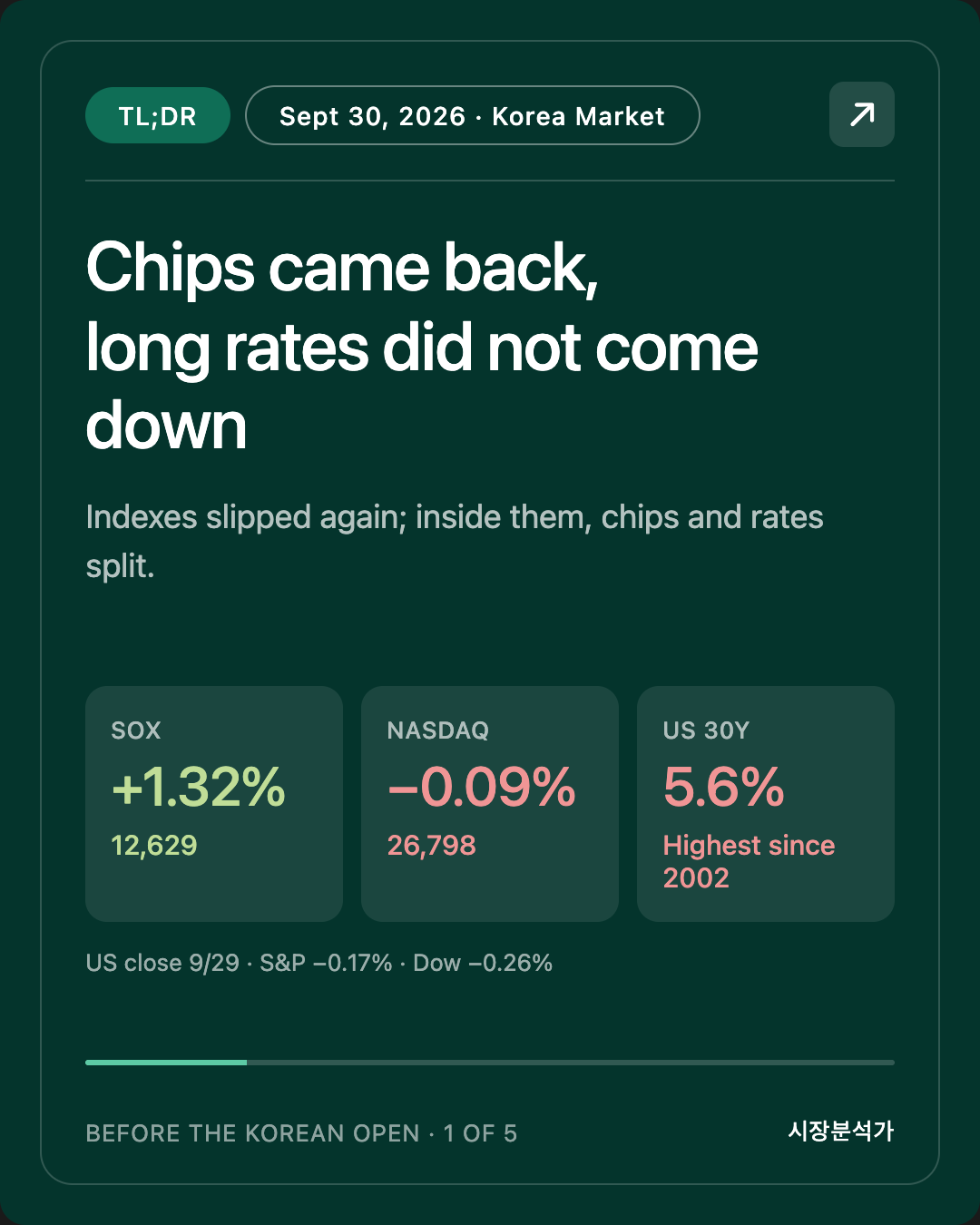
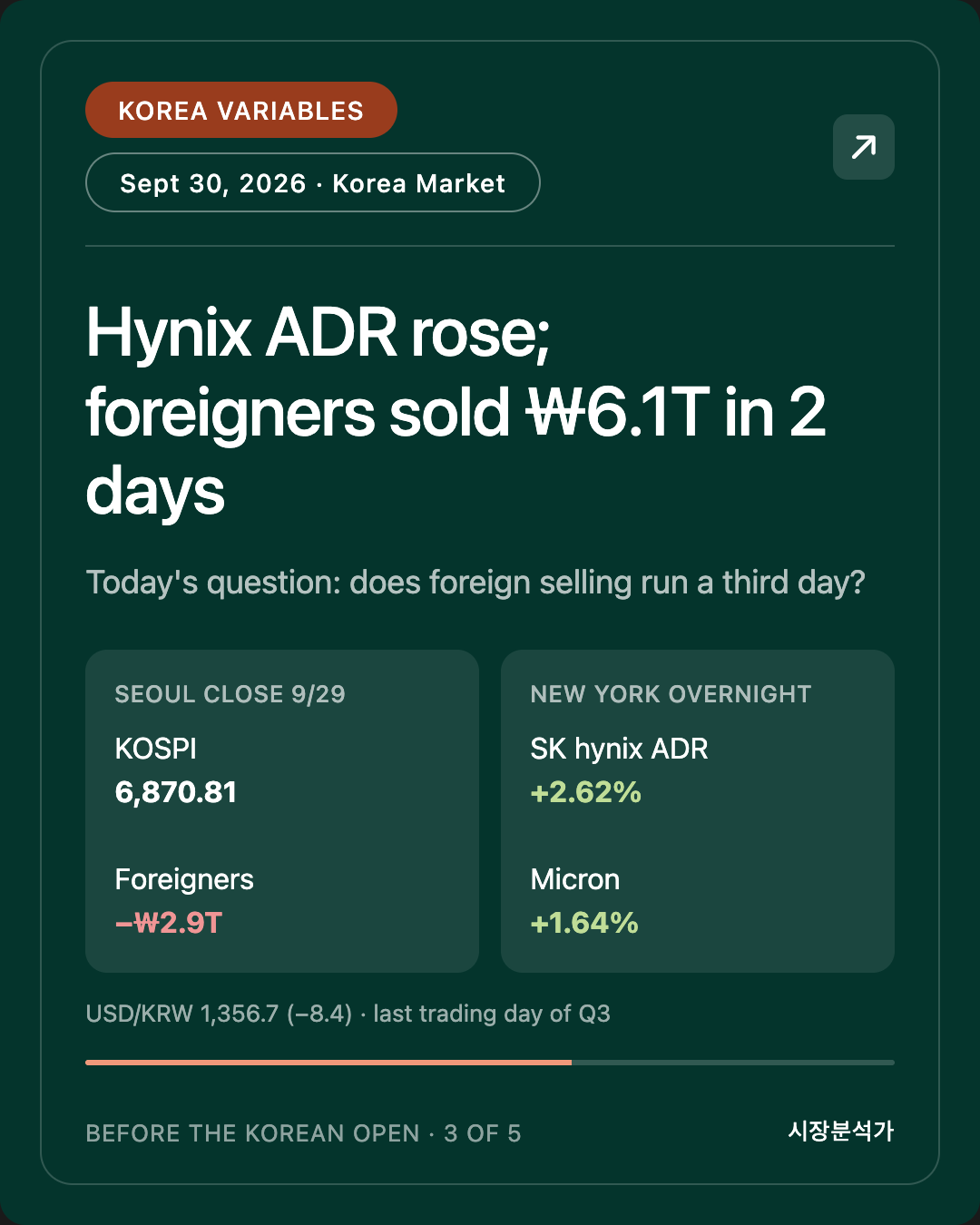
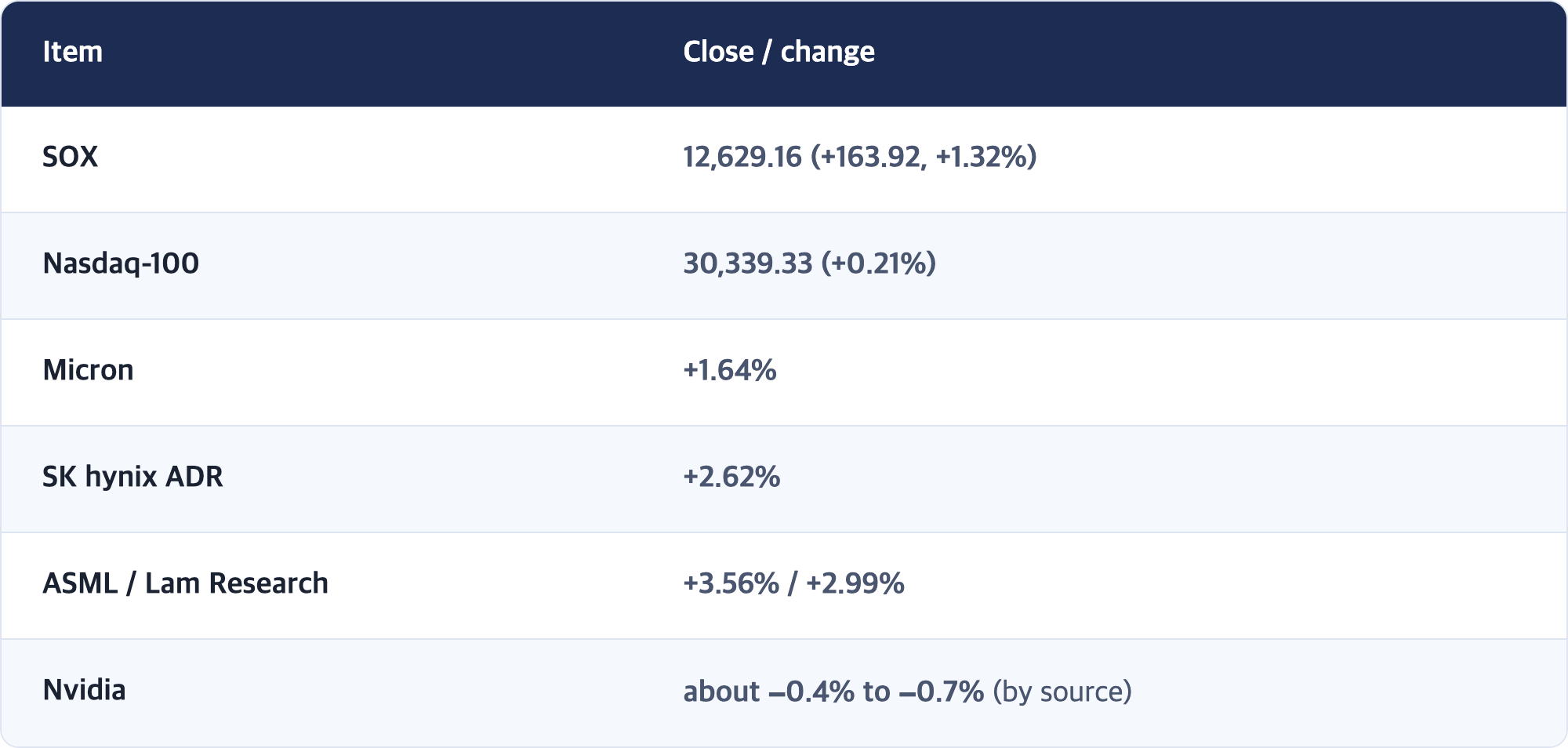
- ★ Chips came back first. SOX +1.32% vs Nasdaq −0.09%, a 1.41-point gap. Micron +1.64%, ASML +3.56%, Lam Research +2.99%, SK hynix's US-listed ADR +2.62%. Nvidia slipped slightly.
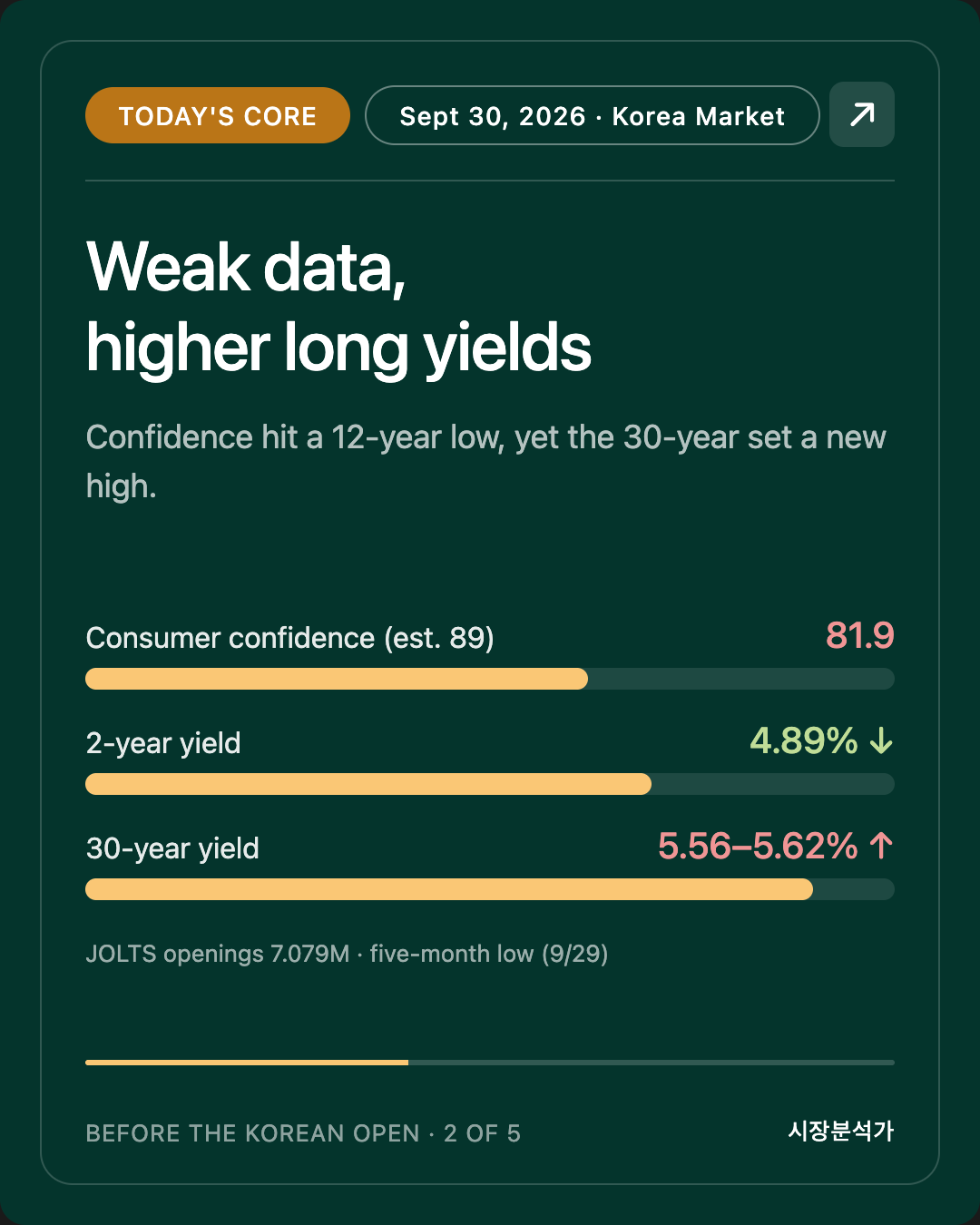
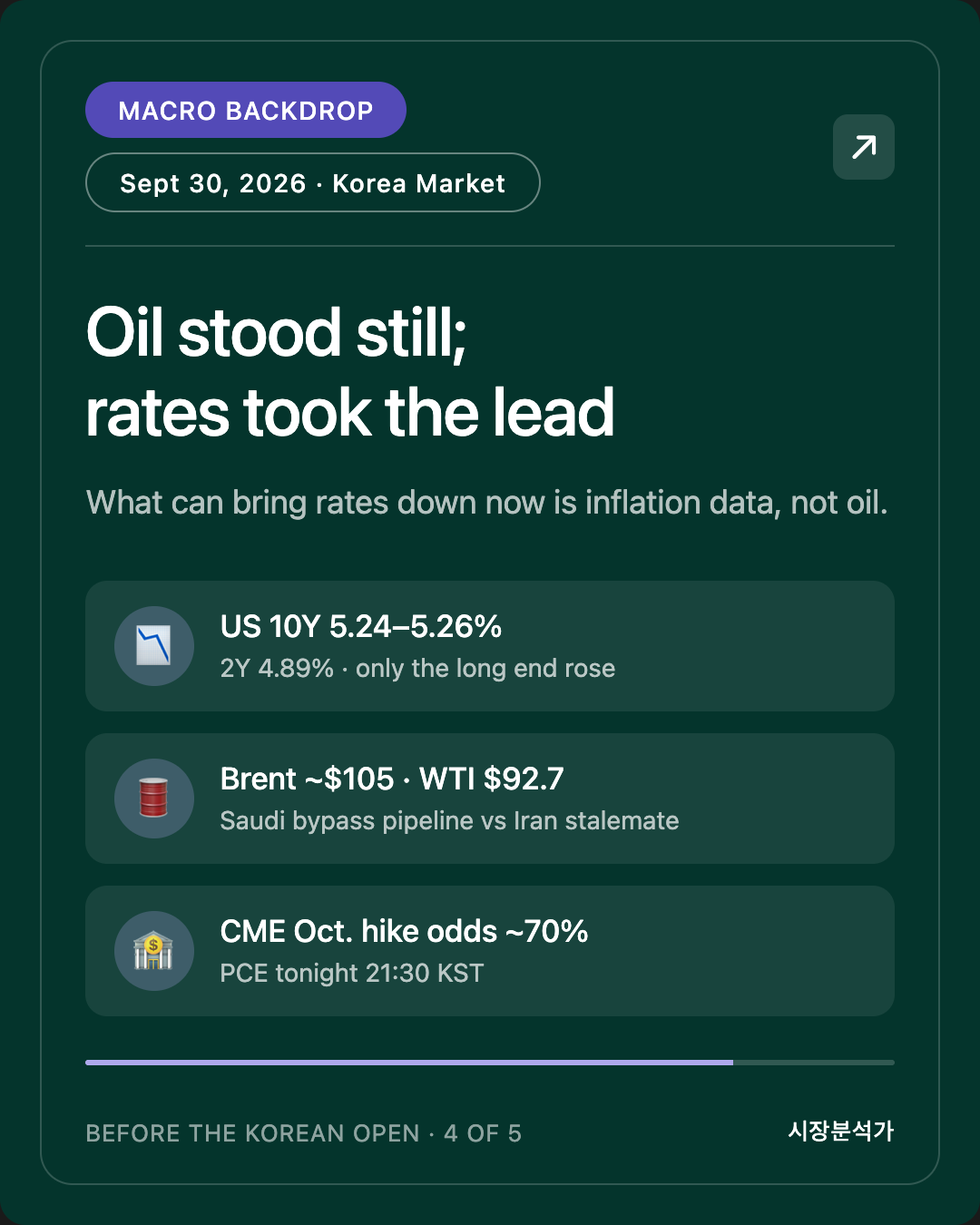
- ★ Weak data, higher long yields. Consumer confidence 81.9 (consensus ~89, lowest since 2014), expectations index 63.6; JOLTS openings 7.079M (consensus ~7.22M, five-month low). Yet the 10-year held at 5.24–5.26% and the 30-year hit 5.56–5.62%, a 24-year high. The 2-year eased to 4.89%.
- The indexes split. Nasdaq-100 +0.21%, Russell 2000 −0.35%, Dow −0.26%, Apple −2.66%. Rate-sensitive names lost; chips and chip equipment won.
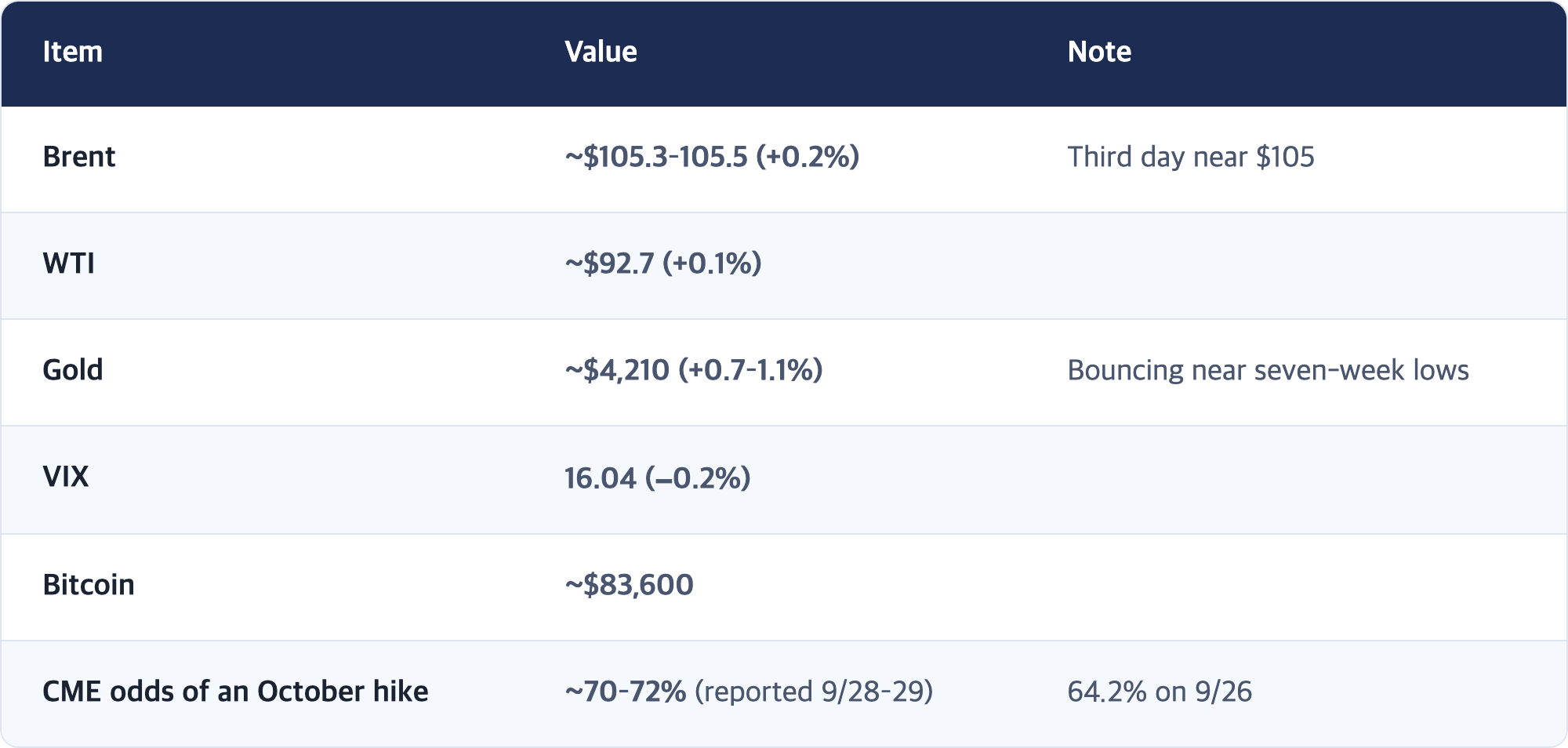
- Oil went nowhere. Brent ~$105.3–105.5 (+0.2%), WTI ~$92.7. Saudi Arabia's Hormuz-bypass pipeline and the stalled US–Iran talks cancelled each other out. Gold ~$4,210 (+0.7–1.1%).
- Today's Seoul question: after selling about ₩6.1 trillion (~$4.5 billion) in two days, do foreign investors sell for a third? US PCE inflation (21:30 KST tonight) and Micron's earnings (early 10/1 KST) both land after Seoul closes.
This is Mr. Can. Here is the Sept 30, 2026 brief ahead of the Korean market open.
Written: 2026-09-30 08:10 KST (Vancouver 9/29 16:10 PDT)
Basis: US closing prices for Tuesday 9/29 (05:00 KST 9/30) + oil futures settlement 9/29 + Seoul close 9/29
✅ Scheduled 16:00 PDT, started 16:02 PDT. On time.
🔴 The 9/28 PM edition (preview of Seoul's 9/29 session) was not produced. The 9/29 AM edition covered the gap. This edition grades the four checkpoints the 9/29 AM edition set, using final US closes.
SEO Intro
US stocks slipped for a second day on Tuesday, September 29. The Dow closed at 51,349.92 (−0.26%), the S&P 500 at 7,670.84 (−0.17%) and the Nasdaq Composite at 26,797.54 (−0.09%). Chips told a different story: the Philadelphia Semiconductor Index (SOX) rebounded 1.32% to 12,629.16, recovering most of Monday's 1.61% drop.
The economic data were weak. The Conference Board's consumer confidence index fell to 81.9, its lowest since 2014, and August job openings (JOLTS) came in at 7.079 million, below forecasts. Days like that usually pull yields down. Instead, the 30-year Treasury yield climbed to roughly 5.6%, its highest since 2002.
For Korea, which opens a few hours later, the message is two-sided: semiconductors bounced back, but the bond market refused to lower long-term rates even on bad economic news.
1. Checkpoint Scorecard
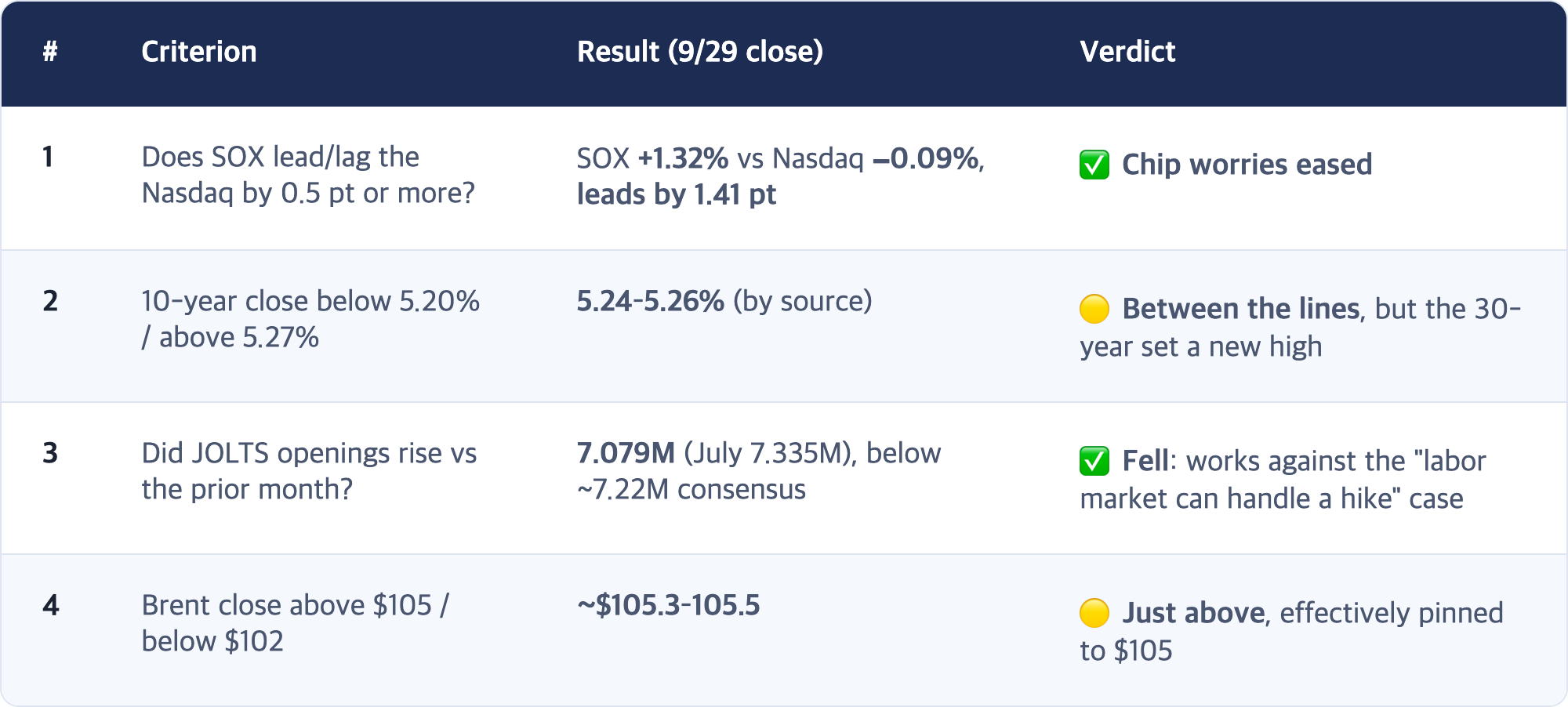
The four set by the 9/29 AM edition (through the US close)
The axis was: "Which door does the AI story enter through today — chip prices (spending pace) or interest rates (inflation)?"
[Interpretation] One door closed; the other opened wider
Checkpoint 1 is clear. If Monday's chip slump was the start of an "AI spending is slowing" scare, it did not carry into a second day. Equipment makers (ASML, Lam) and memory (Micron, SK hynix ADR) rose together, the same pattern Seoul showed on 9/29, when chip-equipment stocks jumped.
Put checkpoints 2 and 3 side by side, though, and the combination is odd. Job openings fell and consumer confidence hit a 12-year low, yet the 10-year did not come down and the 30-year set a new high. [Interpretation] The bond market is not only worried about an economy strong enough to require hikes. Even as growth cools, it is demanding more to hold long-dated debt because of inflation and fiscal worries. The study note in section 6 unpacks this.
2. Today's Core: Chips Came Back; Rates Ignored the Bad News
[Fact] Semiconductors (US close, 9/29)
[Fact] Economic data (released 07:00 PDT, 9/29)
- September Conference Board consumer confidence: 81.9 (consensus ~89; August revised to 88.6). Lowest since 2014. Present situation 109.3 (from 117.2); expectations 63.6 (consensus 68.5).
- August JOLTS job openings: 7.079M (July 7.335M; consensus ~7.22M). Quits 3.066M, layoffs 1.641M. One outlet reported 7.097M.
[Fact] Treasury yields (around the 9/29 close)
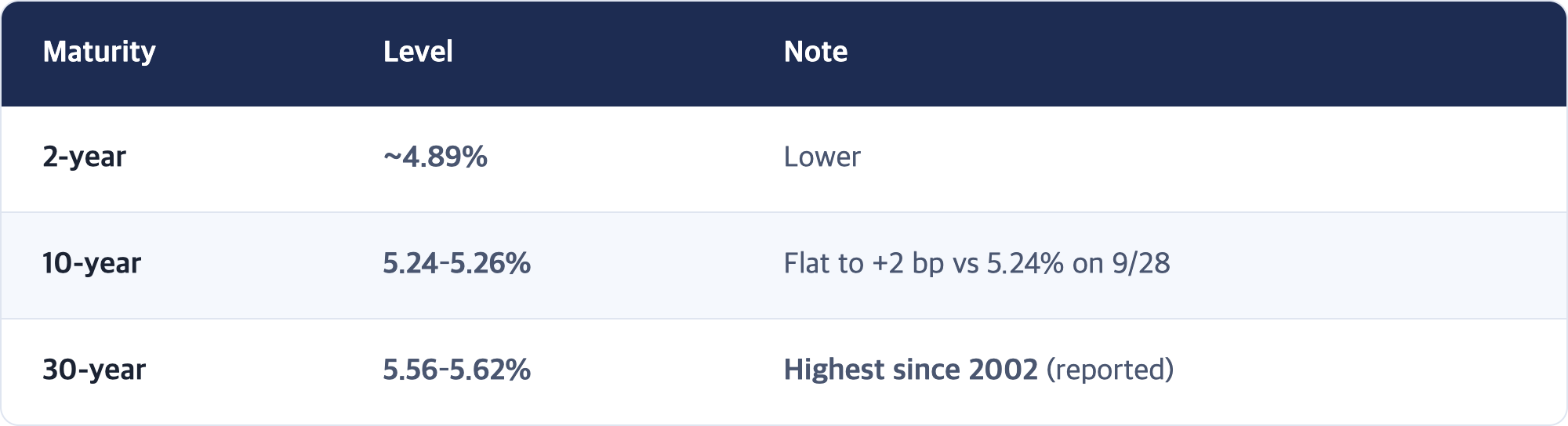
★ [Interpretation] They moved in opposite directions, and Seoul gets both
The chip rebound is a friendly signal for Korea's semiconductor sector. SK hynix's ADR gain of 2.62% is the closest overnight proxy that someone in New York was buying Korean chips again.
The 30-year at a 24-year high, on the other hand, weighs on rate-sensitive sectors. Remember that Seoul's worst sectors on 9/29 were construction (−4.95%), metals and chemicals. [Interpretation] That makes today a day when the headline index can mislead. Chips and rate-sensitive sectors may move in opposite directions, and the KOSPI is just their sum.
[Observation] Of the "two doors" the 9/29 AM edition described, the chip-price door closed within a day, while the interest-rate door opened wider. Whether AI-driven inflation or fiscal/term-premium worries pushed rates up cannot be settled with one day of data.
3. Korea Variables: Foreign Flows, the Won, and Quarter-End
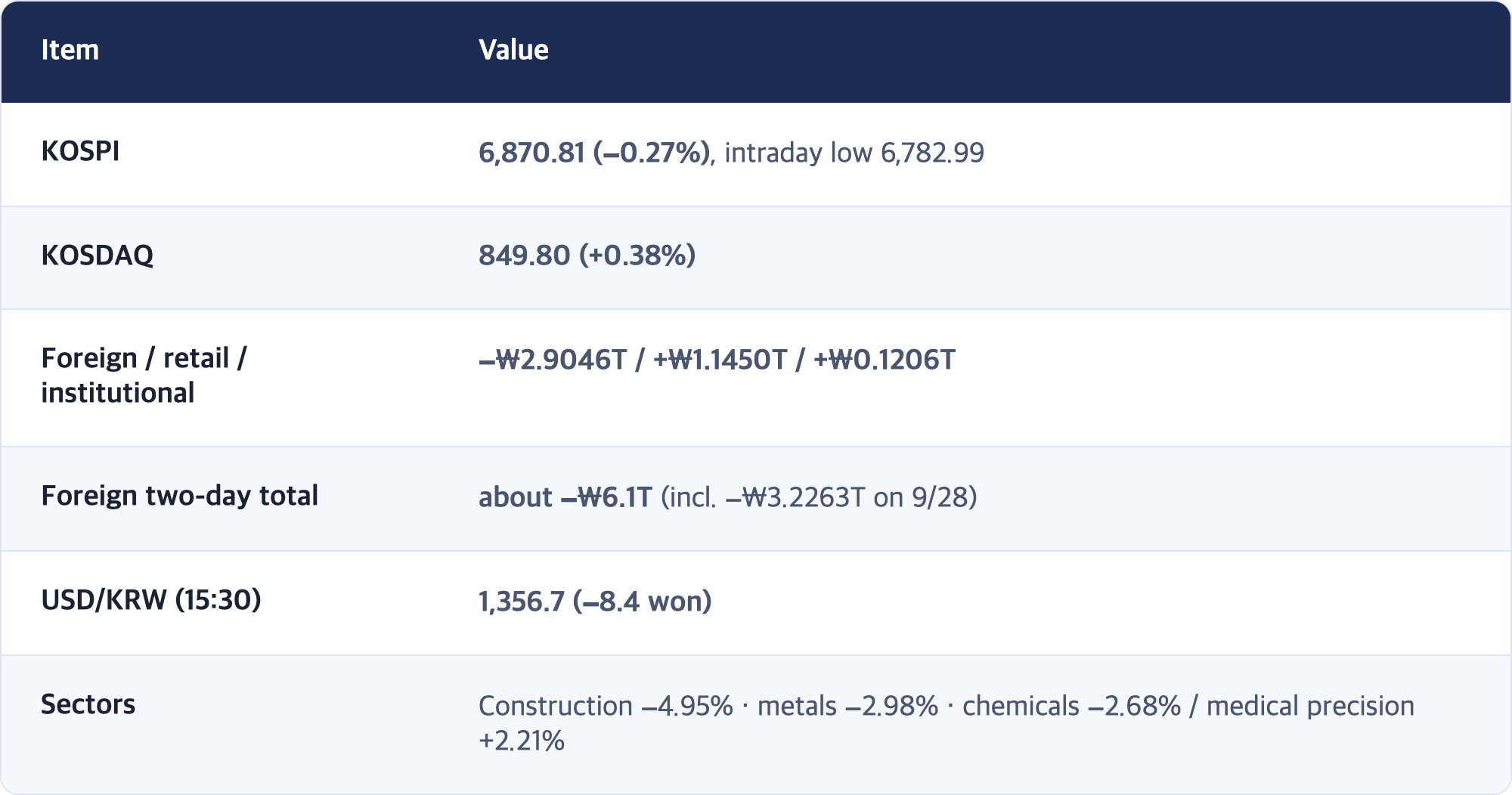
[Fact] Seoul close, 9/29 (reconfirmed)
[Observation] Overnight proxies for Korea
- SK hynix ADR +2.62%, SOX +1.32%: supportive for chips.
- US 30-year at a 24-year high: unfriendly for rate-sensitive sectors.
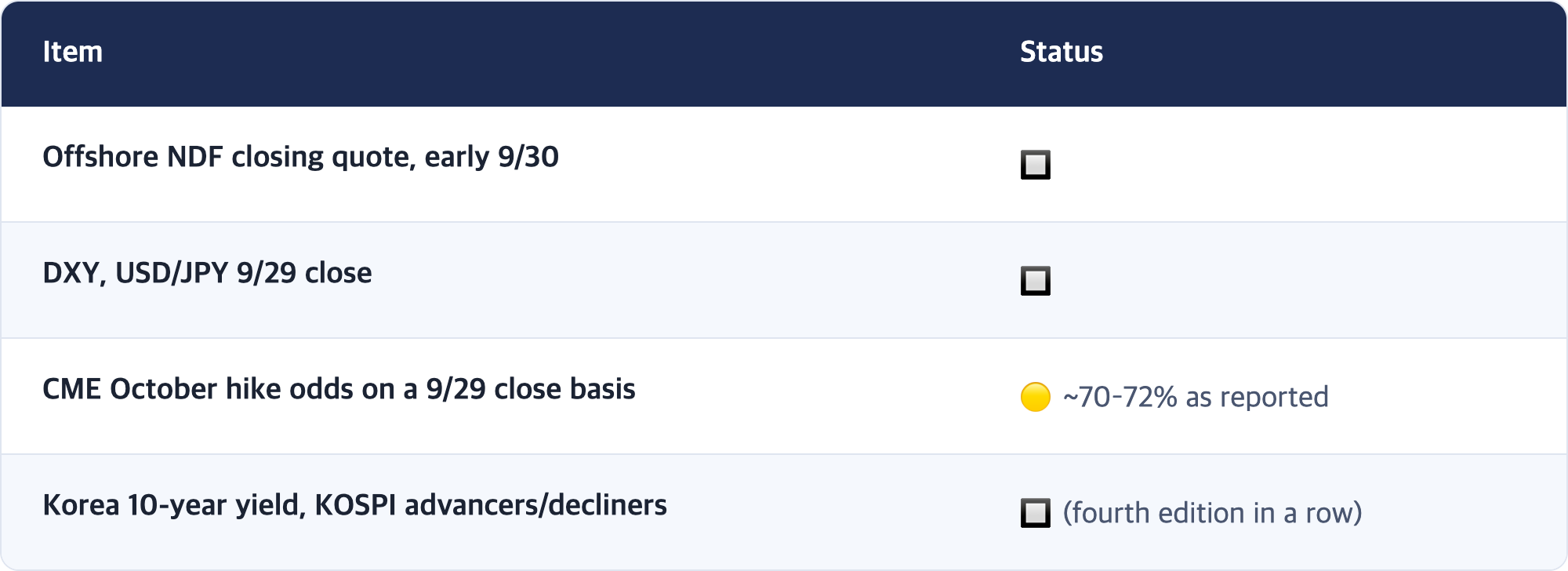
- The offshore NDF (won forward traded outside Korea) closing quote for early 9/30 was not secured for this edition. The early 9/29 quote was 1,358.8.
[Interpretation] Today should reveal what kind of foreign selling this is
Most of the ₩6.1 trillion foreigners sold over two days was in chips (reported). Yet the won strengthened by 8.4 on 9/29. [Interpretation] The proceeds do not appear to have been converted straight into dollars and sent out. Today's USD/KRW will test again whether "a firm won means the money is staying" still holds.
Today is also the last trading day of the quarter. Quarter-end window dressing by institutions can make flow numbers noisier than usual. [Interpretation] So when judging whether foreign selling has "stopped," look at direction (net selling turning to net buying) before size.
4. Macro Backdrop: $105 Oil, a 5.6% 30-Year, ~70% Odds of an October Hike
[Fact]
[Fact] Middle East
- Saudi Arabia's East-West pipeline (bypassing Hormuz) is moving about 3.5 million barrels a day, and September Middle East crude exports hit 12.8 million b/d, the most since February (Kpler, reported).
- US–Iran talks are stalled. Hormuz remains closed, and Iranian crude is blocked by the US naval presence (reported).
[Interpretation] Rates rose on a day oil stood still
For the second straight day, oil was flat while long-term yields rose. [Interpretation] That supports the 9/29 AM view that the forces pushing rates up have broadened beyond oil. The thing most able to bring rates down now is inflation data itself, which means tonight's PCE.
5. Korean Session Preview (Wednesday 9/30 KST)
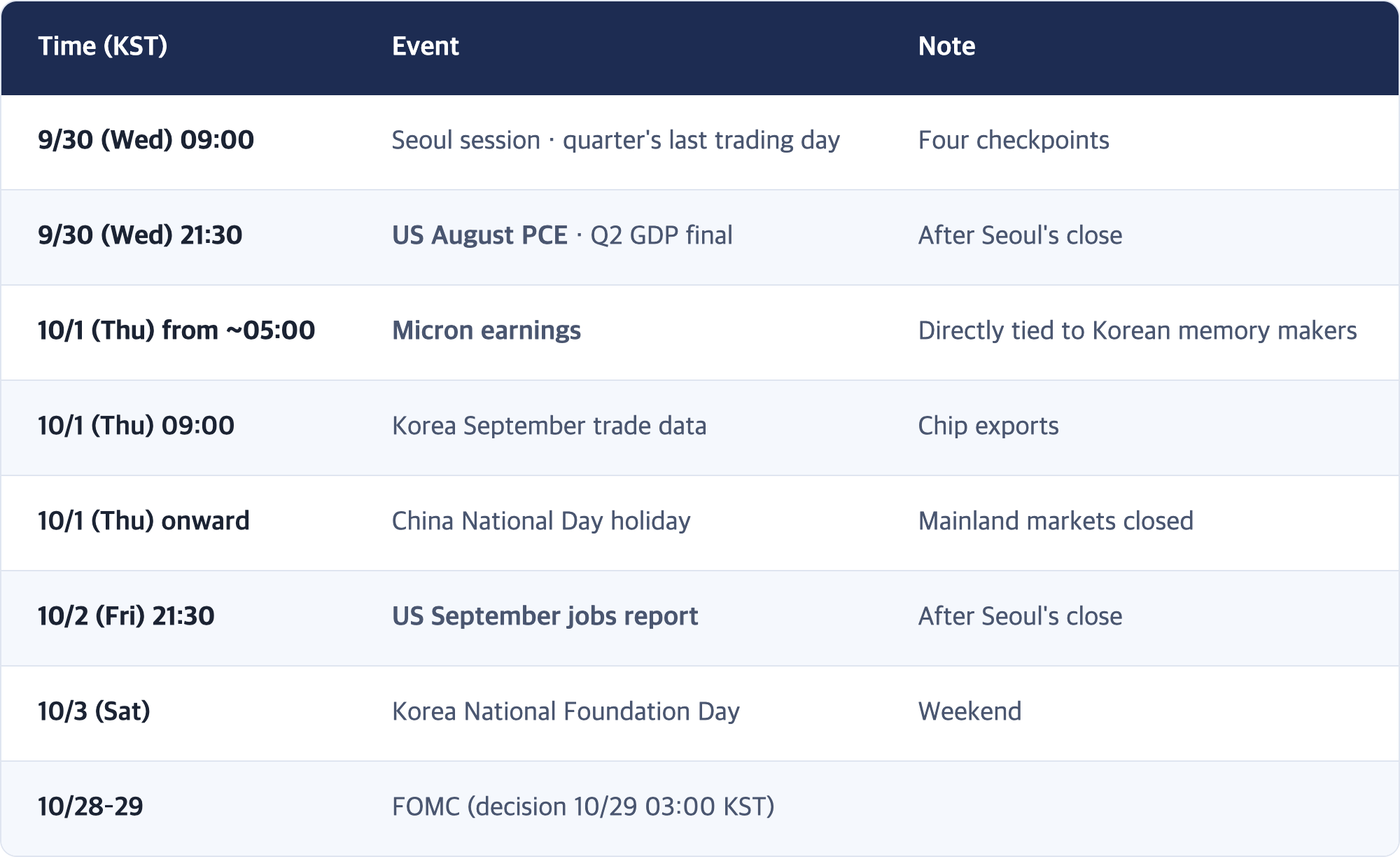
[Observation] Schedule (KST)
- 09:00 Seoul opens · last trading day of the quarter
- 21:30 US August PCE inflation · Q2 GDP final (after Seoul closes)
- 10/1 (Thu) from ~05:00 Micron earnings (after the US close on 9/30)
- 10/1 (Thu) 09:00 Korea September trade data · China's National Day holiday begins (mainland markets closed)
- 10/2 (Fri) 21:30 US September jobs report
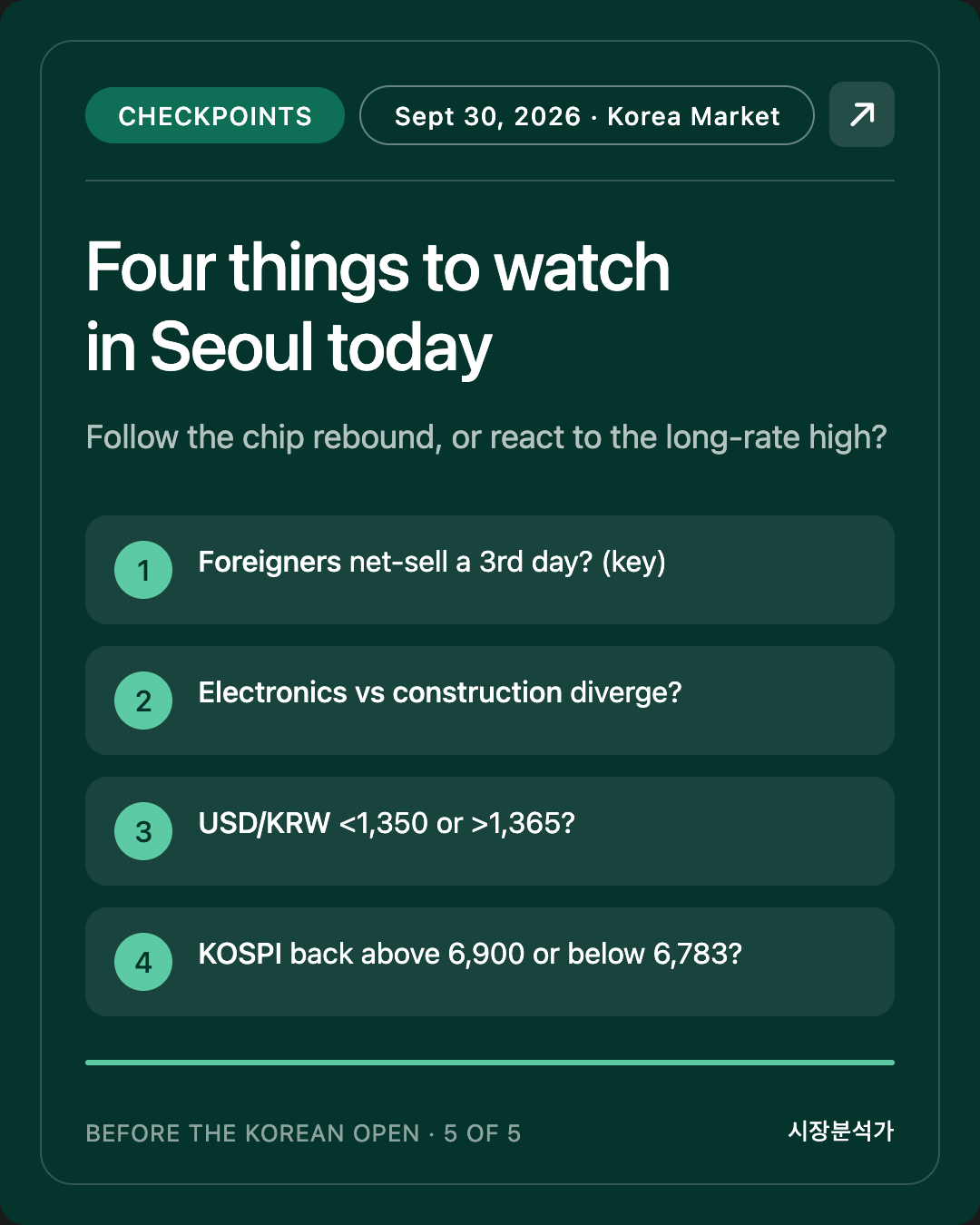
✅ Four Checkpoints (through Seoul's close)
The axis first: all four ask "Does Seoul follow last night's chip rebound, or react more to the new high in long-term yields?" The answer tells us whether tonight's PCE or tomorrow morning's Micron report deserves more weight.
- Do foreigners net-sell for a third day? Turning to net buying means chips won the day; net selling of ₩1 trillion or more means the selling is unrelated to the chip rebound. (Most important)
- Do chips and construction diverge? Electronics up and construction down again = "the two doors split"; both down = rates weighing on everything.
- USD/KRW below 1,350 / above 1,365. Below: money keeps staying despite foreign selling. Above: sale proceeds starting to leave as dollars.
- KOSPI closes back above 6,900 / below 6,783. Above: the two-day low may have been 9/29 intraday. Below: confirming a bottom waits until after PCE and Micron.
[Interpretation] Checkpoint 1 carries the most information. If foreigners keep selling Korean chips even after SK hynix's ADR rose 2.6% overnight, the selling is more likely position trimming for other reasons (rates, quarter-end) than a verdict on the chip outlook.
6. Study Note: Why Did Long Yields Rise on Bad Economic News?
Concept
Weak data usually pull yields down, because investors expect the Fed to tighten less. That is exactly what the 2-year (the maturity most sensitive to Fed expectations) did on Tuesday, easing to 4.89%.
The 30-year, however, rose. When short yields fall and long yields rise, the gap widens. This is called curve steepening. What pushes long yields up in this case is not the Fed's next move but the term premium: the extra compensation investors demand for tying up money for decades. It grows when inflation looks likely to stay high for years or when heavy government borrowing is expected to flood the market with bonds.
Analogy
Think of a one-year CD versus a 30-year CD. News that next year's economy is weak lowers the one-year rate. But if people worry that inflation will be erratic and government debt will keep piling up for the next 30 years, anyone locking money away that long asks for more interest to cover that uncertainty.
Real-world case (Tuesday)
- Consumer confidence 81.9 (lowest since 2014), JOLTS five-month low → 2-year yield fell
- Same day: 30-year hit its highest since 2002
- The day before, Fed Governor Lisa Cook said AI infrastructure buildout adds near-term inflation pressure, a reason to fear inflation will linger
One-line summary
Short yields watch "next month's Fed"; long yields watch "decades of inflation and national debt." On Tuesday they told different stories, and Korea's rate-sensitive sectors listen to the long end.
7. Corrections & Open Items
🔴 9/28 PM edition missing (re-recorded)
The Korean-session preview scheduled for 9/28 16:00 PDT was not produced. The 9/29 AM edition recorded this and graded the 9/28 AM checkpoints. The cause was not identified in this edition either.
Source discrepancies (adopted values noted)
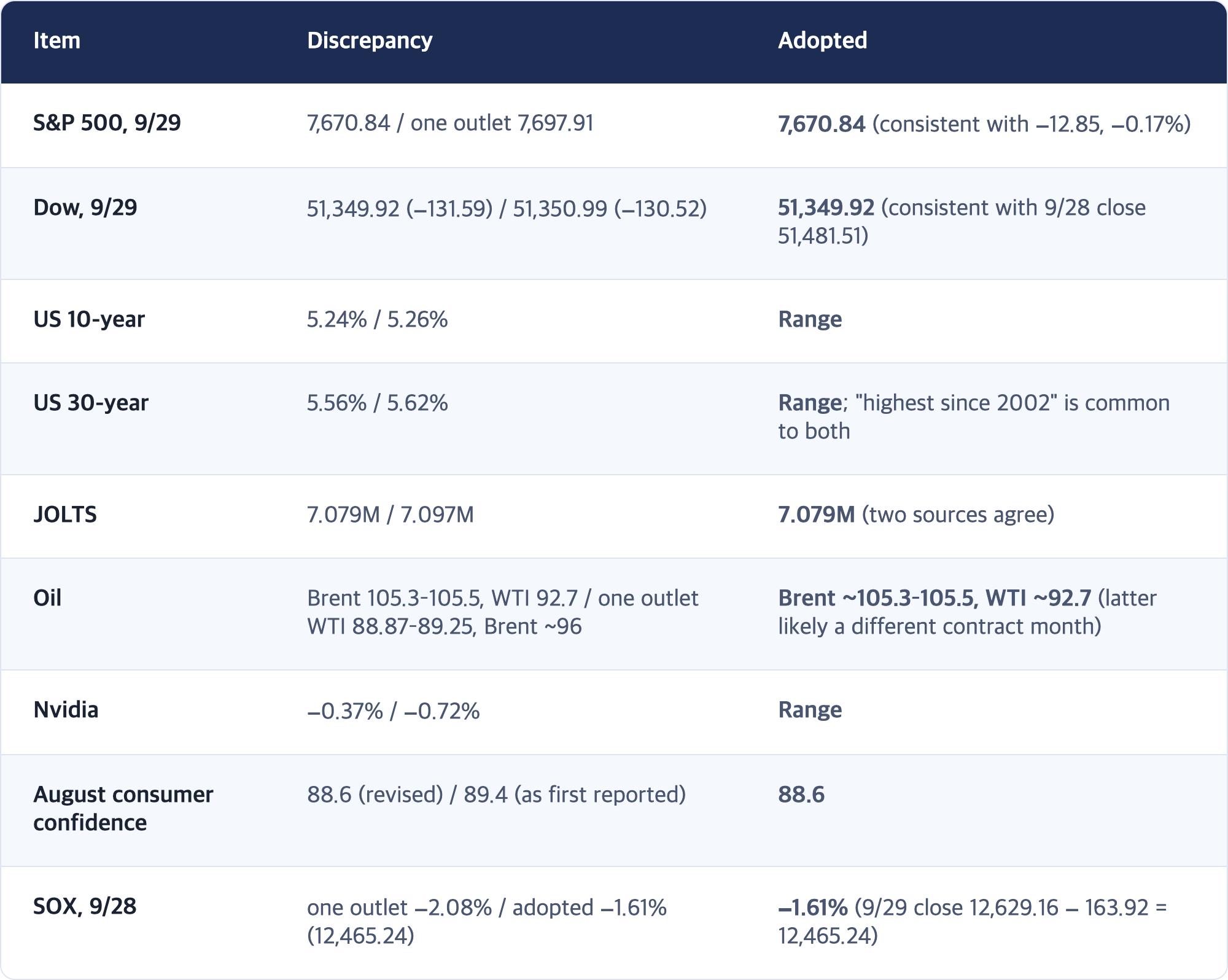
🔲 Not yet confirmed
8. Event Calendar (KST)
Sources
- US stocks fall for a second day on high Treasury yields; chips strong | Financial News (Korean)
- US stocks mixed; chips strong while Dow, S&P 500 slip | Seoul Shinmun (Korean)
- Stock market today: 30-year Treasury yield climbs to 24-year high | Yahoo Finance
- Stock Market Today (Sept. 29, 2026): S&P 500 falls as consumer confidence falls to 12-year low | TheStreet
- 30-year Treasury bond yield scales to highest level since 2002 | CNBC
- JOLTS job openings 7.079M vs 7.225M estimate | investingLive
- Financial & Forex Market Recap – Sept. 29, 2026 | Babypips
- Morgan Downey's Commodity News · Tuesday, September 29, 2026
- Brent crude oil | Trading Economics
- Daily Stock Market Summary, September 29, 2026 | Vista Partners
- New York Fed's Williams says it's 'reasonable' to expect another rate hike by year-end | CNBC
- USD/KRW 1-month NDF (9/29 06:45 KST) | Stockplus (Korean)
- Foreigners sell ₩2.9T; KOSPI ends slightly lower at 6,870 | Asia Economy (Korean)
- Won strengthens 8.4 to 1,356.7 per dollar | Money Today (Korean)
Market Analyst · This report does not recommend buying or selling individual securities. It provides macro context and interpretation.
📌 More market briefs
※ This post is market observation and organization intended to support your own judgment. It is not a recommendation to buy or sell any security. Figures are as of the time of writing and may differ between sources.
If this was useful, bookmark it or pass it along. It genuinely helps me write the next one.
I can survive. We can survive.