September 9, 2026 KOSPI Market Brief — What to Watch Before the Korean Open
The headline out of New York last night was "Dow drops 628 points." Oil pushed toward $100, Saudi refining capacity was hit in a drone and missile attack, and Canada's retaliatory tariffs on US goods took effect. Read the headlines alone and it looks like an unbroken run of bad news.
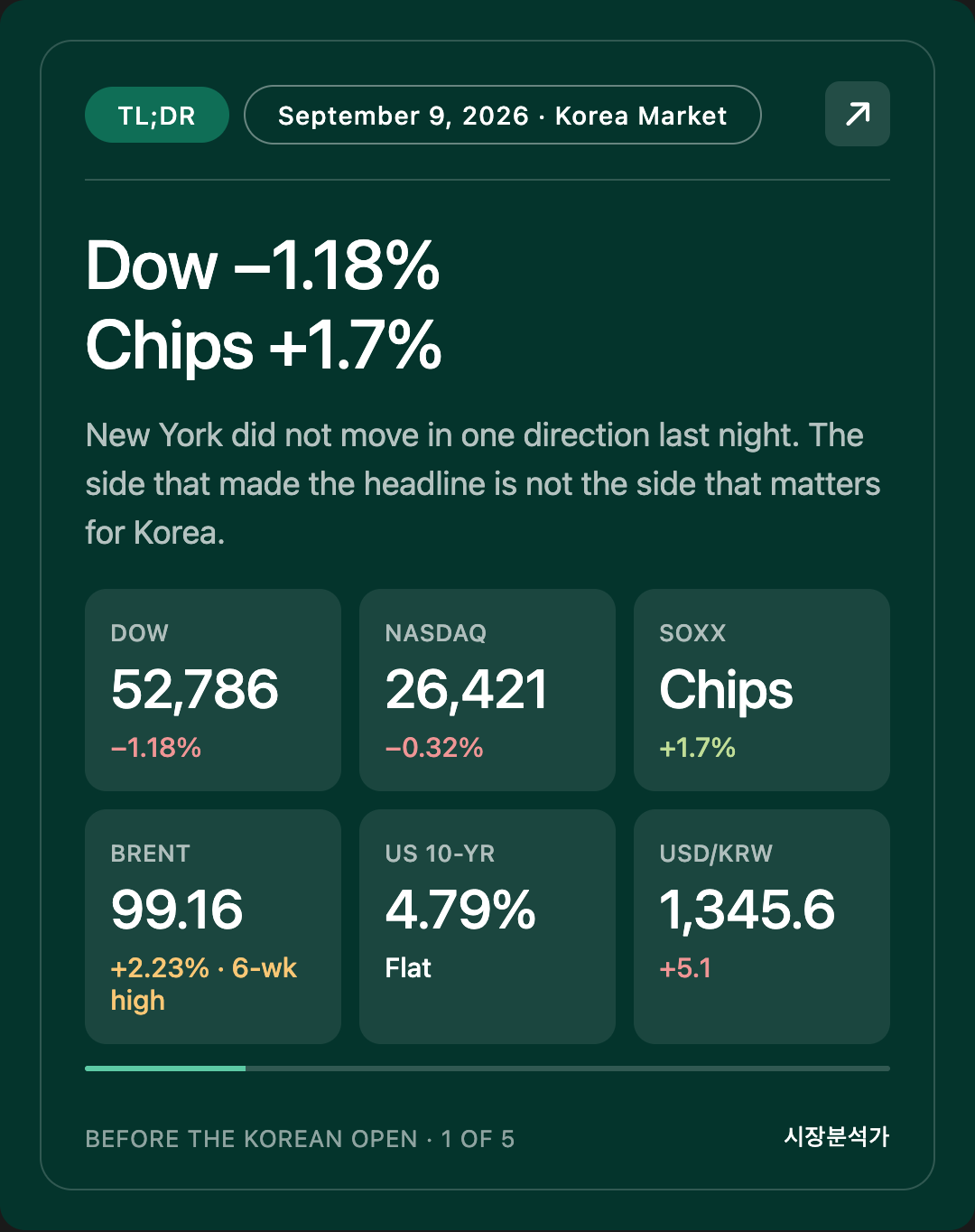
And yet, on that same night, Intel rose 9%. AMD gained 6%, HPE 8%, Qualcomm 4%, and the semiconductor ETF closed up 1.7%. On a day when all three major indexes finished red, chips were the one place that stayed green.
Last night was not a market moving in one direction. It split cleanly between what oil hurts and what AI capital spending helps. For anyone watching Korea, the side that generated the headline is not the side that matters.
This morning the Korean market has to decide which of those two signals it is reading. Here is what to watch.
This is Mr. Can. Here is the September 9, 2026 brief ahead of the Korean market open.
Written: 2026-09-09 08:05 KST (Vancouver Sep 8, 16:05 PDT)
Covers: US close Sep 8 (Tue) · Europe close Sep 8 · Korea close Sep 8
⚡ TL;DR
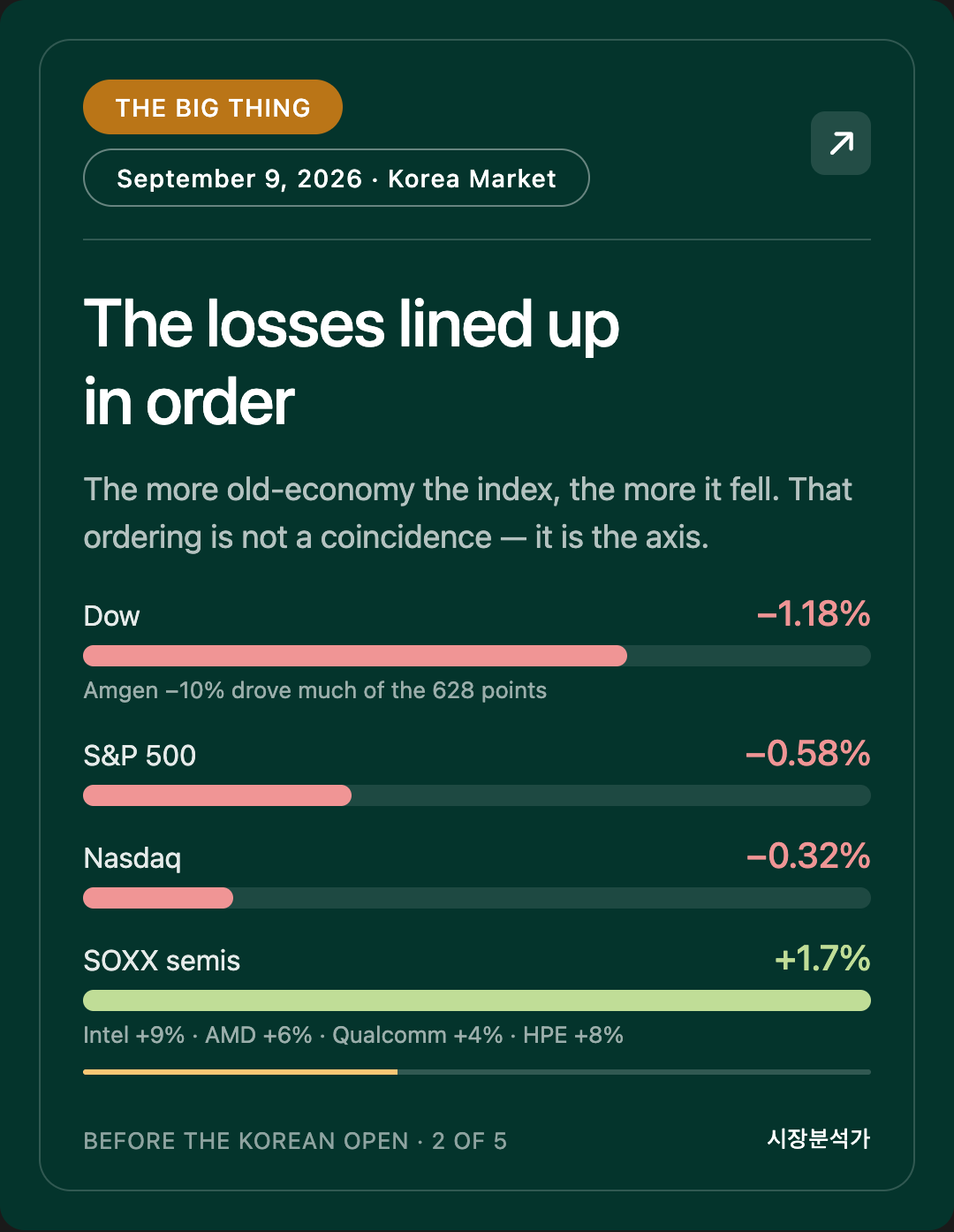
- US closes on Sep 8: Dow 52,786.07 (−1.18%), S&P 500 7,673.52 (−0.58%), Nasdaq 26,421.41 (−0.32%). All three fell, but the losses line up in a very specific order. The more old-economy the index, the more it lost.
- Semiconductors went the other way. Intel +9%, AMD +6%, HPE +8%, Qualcomm +4%, and the iShares Semiconductor ETF (SOXX) +1.7%. The catalysts were a Qualcomm-Amazon AI data-center partnership and a Corning infrastructure deal.
- Three of the four tests set out in yesterday's report returned the same answer. The oil, tariff and pharma shocks stayed contained inside their own sectors, they failed to spill into rates (10-year stuck at 4.79–4.80%), and yen strength has not yet crossed into US assets.
- One stock dragged the Dow down. Novartis's Lp(a) drug pelacarsen missed its Phase 3 cardiovascular endpoint, and the doubt spread to Amgen, which is running a similar candidate: Amgen −10%, Novartis −14%. Because the Dow is price-weighted, a single high-priced name can move the whole index.
- This week still turns on Friday's US August CPI. Consensus is +0.3% m/m and 2.9% y/y headline, +0.3% and 3.1% core. Before that, the ECB is expected to hike on Thursday.
1. The Big Thing — a night when the headline and the content pointed opposite ways
[FACT] — US closes, September 8
These printed at 05:00 Wednesday Korean time.
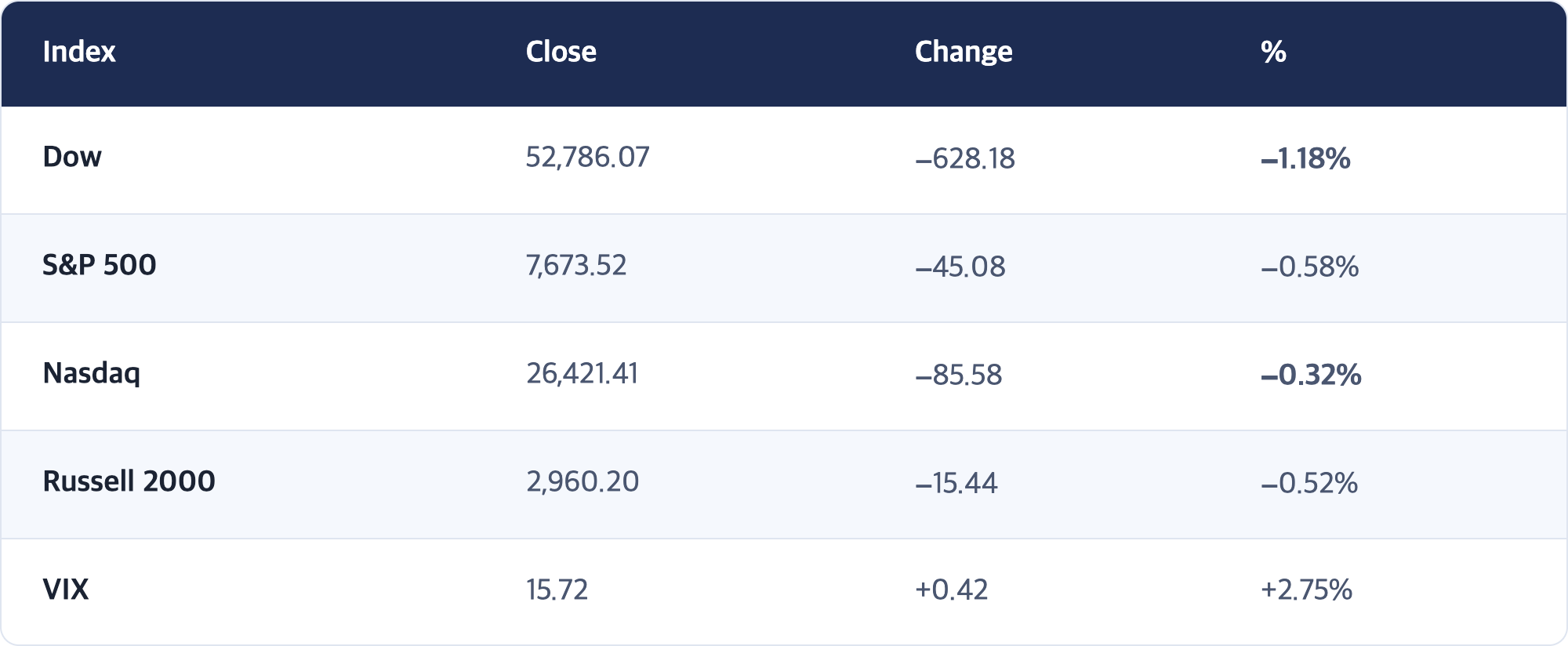
The three losses read −1.18% / −0.58% / −0.32%. That ordering is the story. The more an index is weighted toward older, cyclical industry, the more it fell. The more it is weighted toward technology, the less.
The VIX finished at 15.72, up 2.75%. It is called the fear gauge, but the mid-teens is still a calm reading. For a day when the Dow lost more than 1%, the market was not especially rattled.
[FACT] — Meanwhile, chips rallied
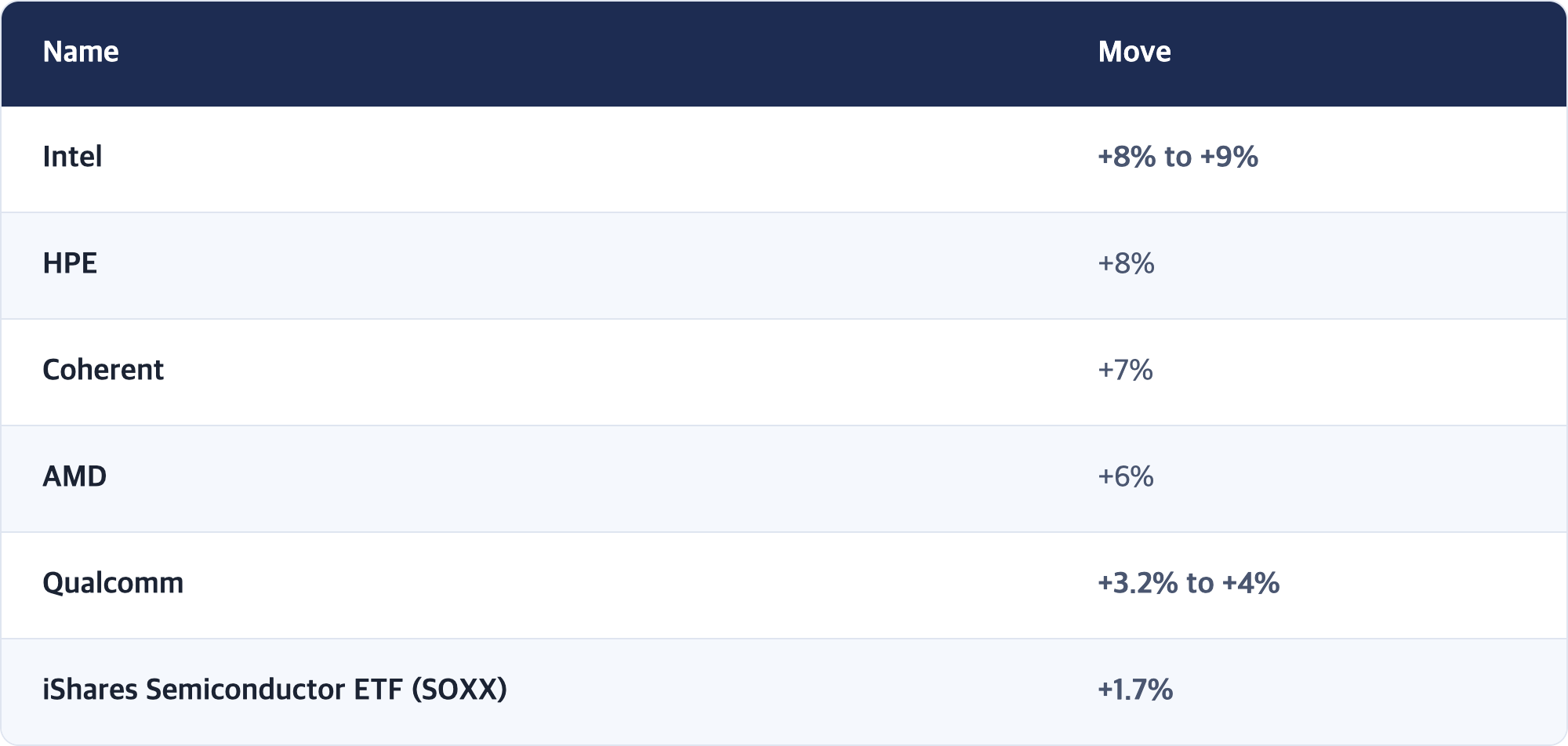
Two deals did it. Qualcomm agreed to work with Amazon on next-generation AI data-center infrastructure, and Corning announced an infrastructure contract of its own. Together they read as confirmation that data-center capital spending is not slowing.
Intel had two additional catalysts: Northland Securities upgraded it to Outperform with a $120 target, citing a shortage of server processors and Intel's semiconductor work with Tesla.
[ANALYSIS] Scoring the four tests from yesterday's report
Yesterday's before-the-US-open edition set out four things to watch, each paired with the question it would settle. Here is the scorecard.
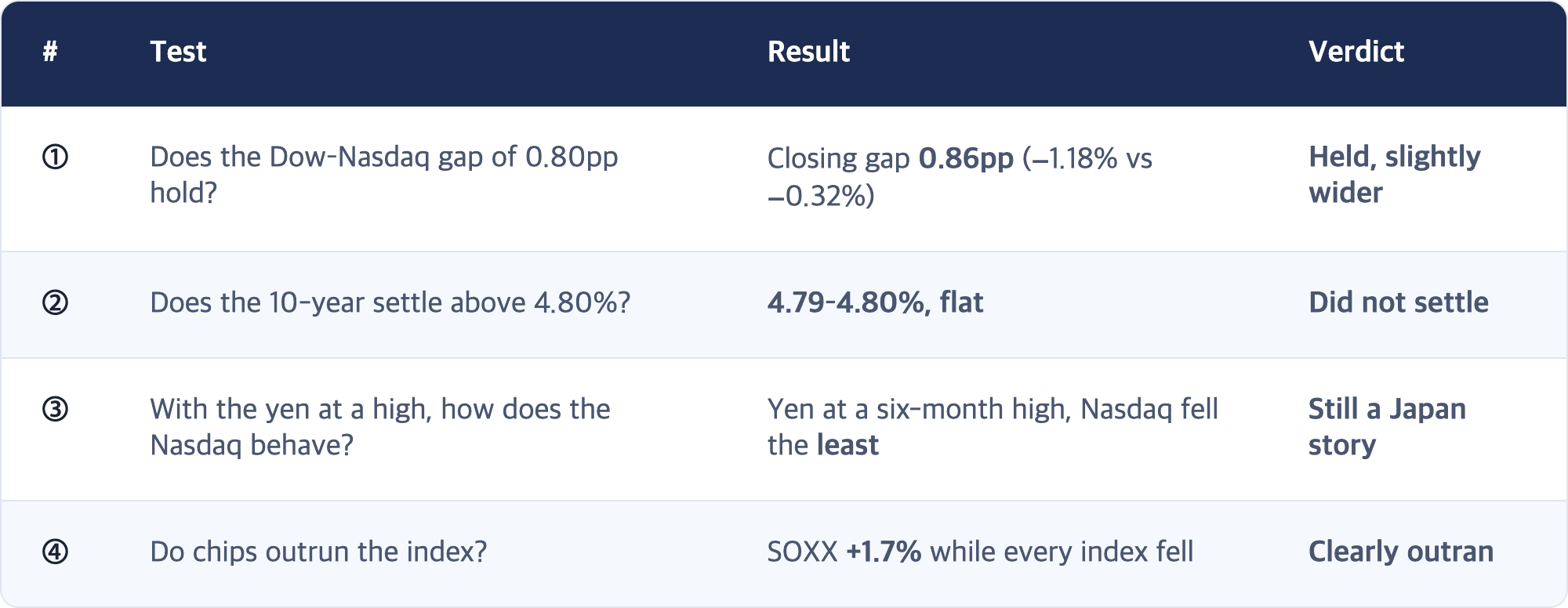
🔴 [ANALYSIS] All four answers point the same way
Taken one at a time these are separate line items. Put together they form a single sentence.
① The gap holding means the market processed oil, tariffs and the pharma news as sector-specific problems. It did not promote them to macro risk.
② The 10-year failing to settle above 4.80% means that even with Brent touching $99, the bond market declined to convert that into inflation expectations. Yesterday's report noted that a drop back below 4.75% would be much better for Korea. What actually happened was neither: it stopped in between.
③ The yen at a six-month high with the Nasdaq down only 0.32% means carry-trade unwinding has not yet crossed into US assets. This variable appeared only yesterday, and it did not spread in a day.
④ Chips outrunning the index means the story that started with a 3.37% jump in the SOX index last Friday is still alive.
Put the four together and you get this. The headline from last night reads "Dow falls 628 points," but what that night actually transmits to Korea is close to the opposite. The damage stayed inside specific sectors, it did not reach rates, and the part of the market Korea depends on went up.
Do not read this as "the KOSPI will rise today." Yesterday in Seoul was exactly that trap. The index opened at 7,045.79, ran to an intraday 7,171.52, and closed at 6,954.52. It opened on good material and closed badly. The character of the material and the outcome of the session are two different things.
2. US and European Close (Sep 8, ET)
[FACT] — The single stock that took the Dow down
Amgen fell about 10%, the worst performer in the Dow. One source described it as the stock's steepest one-day decline in roughly 26 years (other outlets reported the drop without that framing).
The cause was not Amgen's own news.
- On Friday Sep 4, Novartis reported Phase 3 cardiovascular outcomes for pelacarsen, an Lp(a)-lowering drug. It lowered Lp(a) levels but failed to reduce cardiovascular death, heart attack or stroke versus placebo.
- Amgen is running olpasiran, a drug in the same class, through its Phase 3 OCEAN(a)-Outcomes study.
- So the doubt that spread was categorical: lowering Lp(a) may not reduce cardiovascular risk at all. Novartis fell 14%, Amgen 10%, with a BMO downgrade layered on top.
The Dow is price-weighted. It adds up the share prices of 30 companies and divides. Because the input is price per share rather than market value, an expensive stock moves the index more, regardless of company size. Amgen trades in the $400s, so its influence is large. A meaningful share of last night's 628 points came from one name.
📖 Why this matters for reading headlines — the S&P 500 and the KOSPI are market-cap weighted, which avoids this distortion. When you see a big Dow drop, the first question is always how many stocks made that number.
[FACT] — The other side of the same session
Software moved the opposite way from chips.
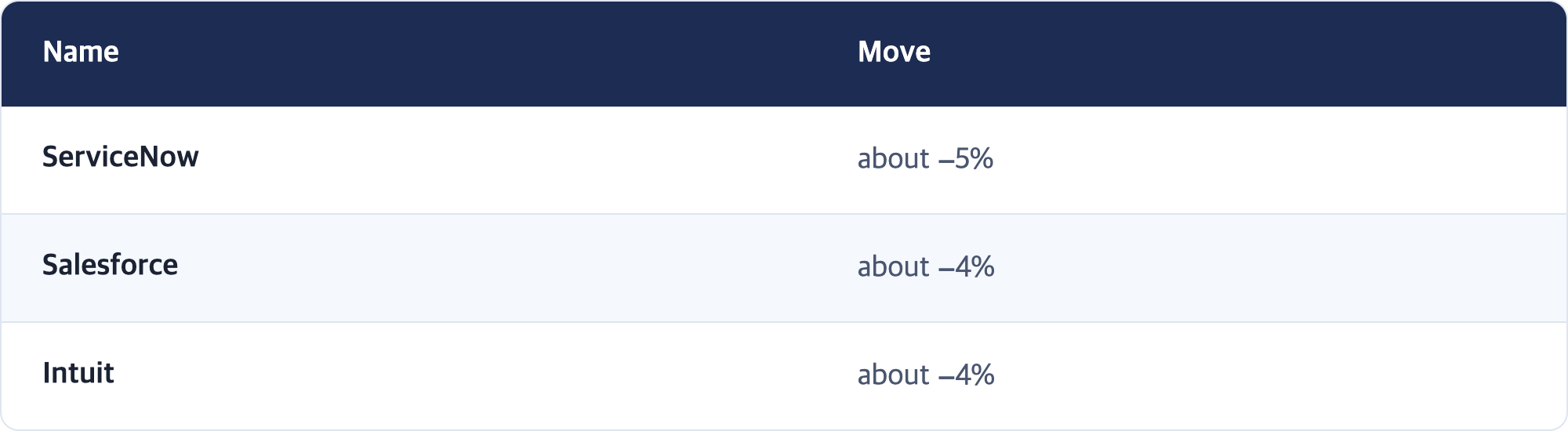
The cited concern was that AI may displace the software companies themselves. The shape of the day looked like this:
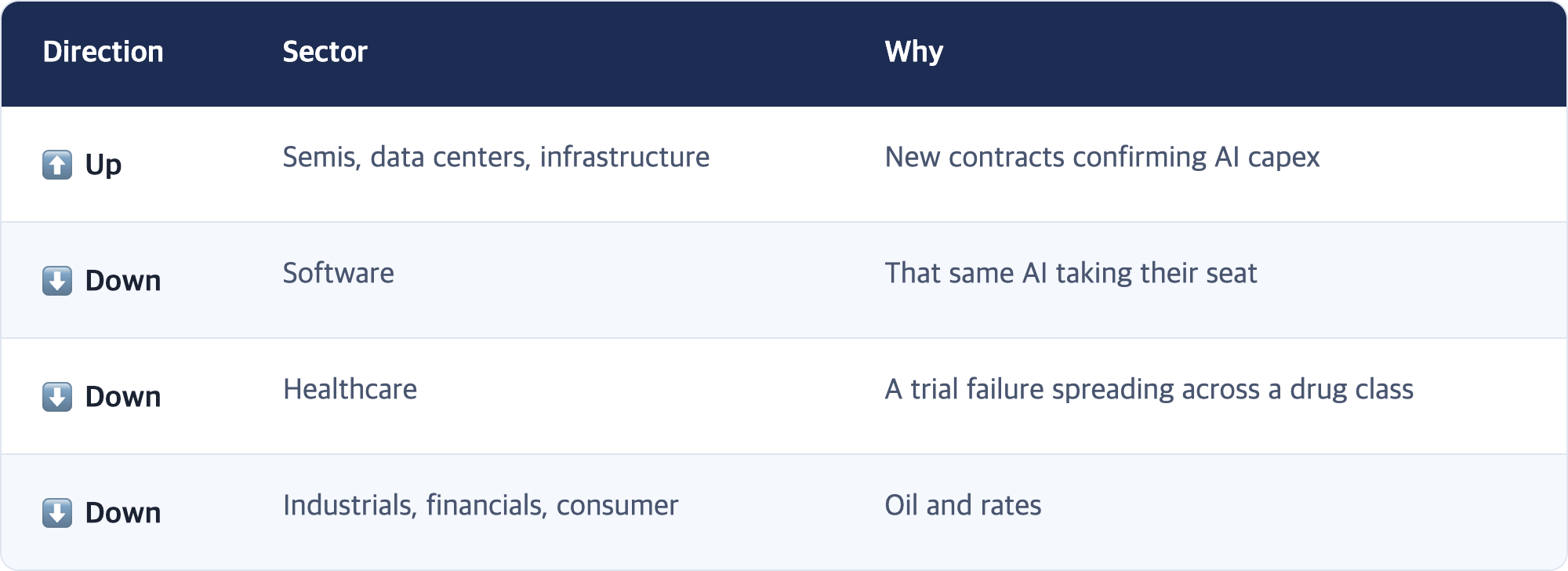
The same AI story was a reason to buy on one side of the market and a reason to sell on the other. That is the character of the session.
[FACT] — Commodities, currencies, rates
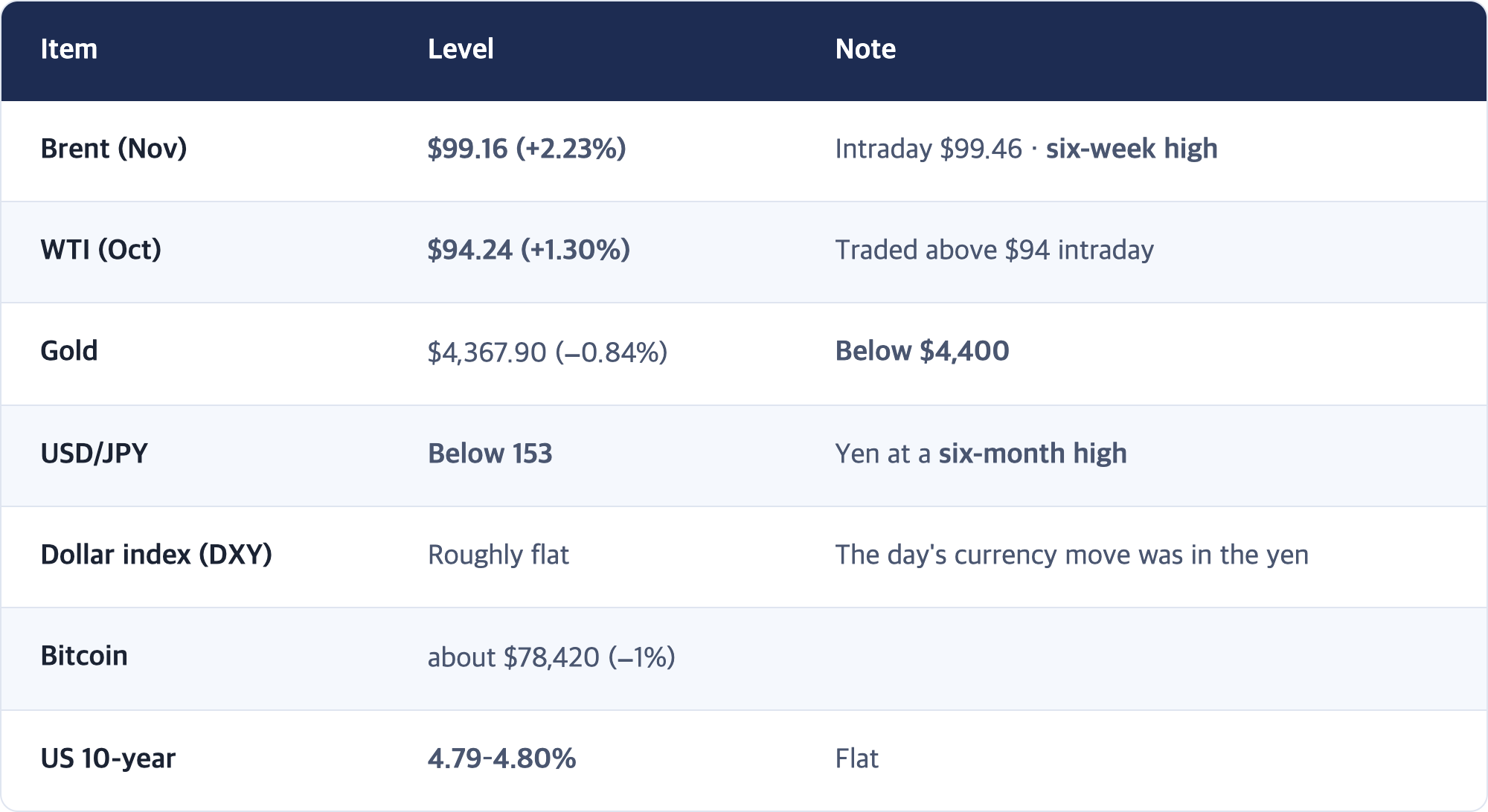
Oil rose on a continuation of the previous day's news. Iran-backed Houthi forces struck Aramco facilities in southern Saudi Arabia with drones and ballistic missiles, including the Jazan refinery, which processes about 400,000 barrels a day. Seventy-three people were injured and some operations were temporarily halted.
The Strait of Hormuz cuts both ways right now. Iran signalled that a temporary safe-passage arrangement with Oman could be close, while simultaneously warning that ships remain at risk.
Goldman Sachs raised its Brent and WTI forecasts by $5 on Monday, to $85 and $80 for December 2026, and warned that Brent could exceed $120 in 2027 if Gulf output stays 4 million barrels a day below prewar levels.
Gold falling is the detail worth noticing. Geopolitical risk rose and gold still gave up $4,400. The reason is rates: expectations that major central banks will hike this month weigh on an asset that pays no interest.
3. The Korea Variable — two forces meeting this morning
[FACT] — Korea's Sep 8 close, for reference
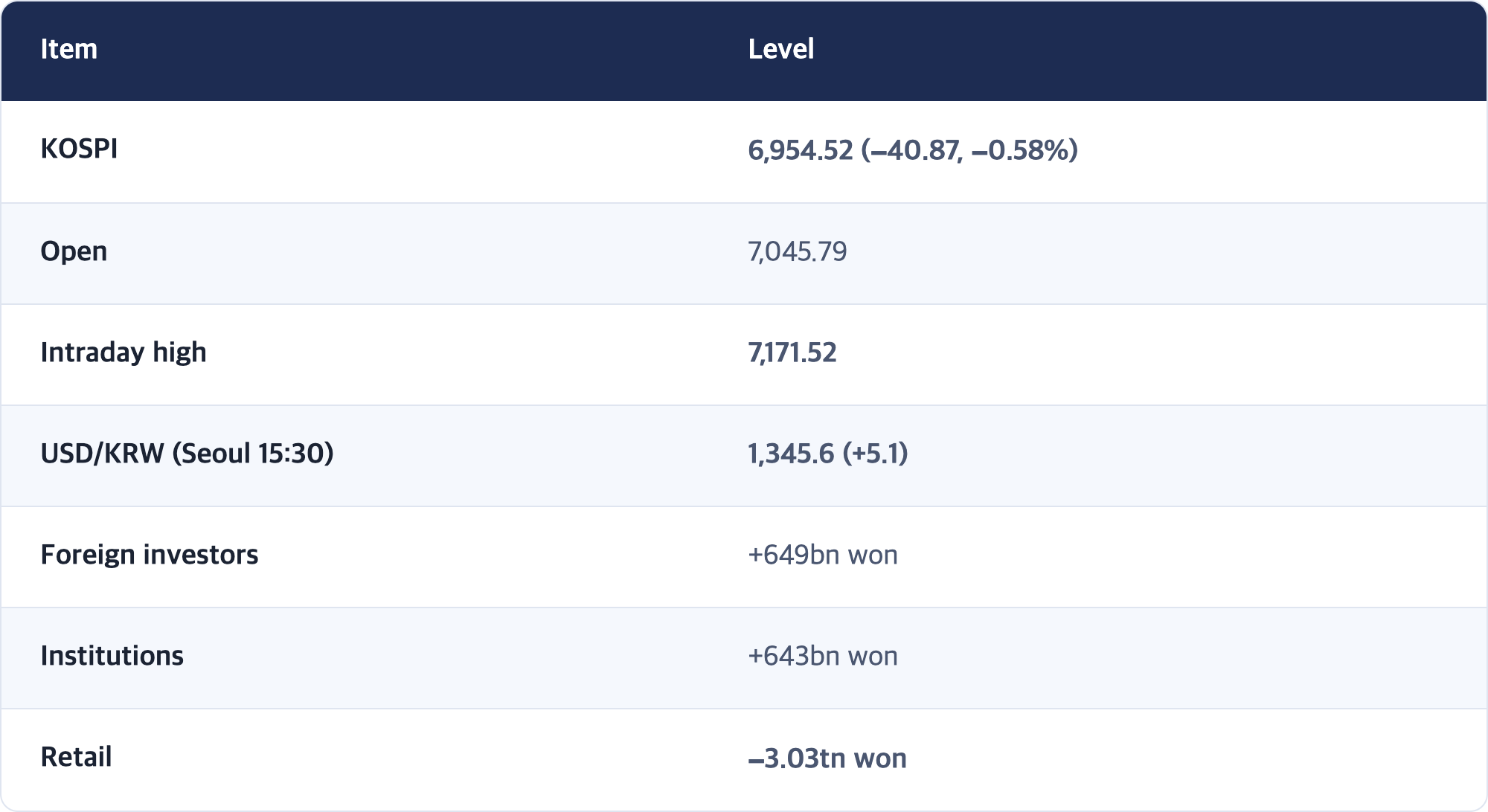
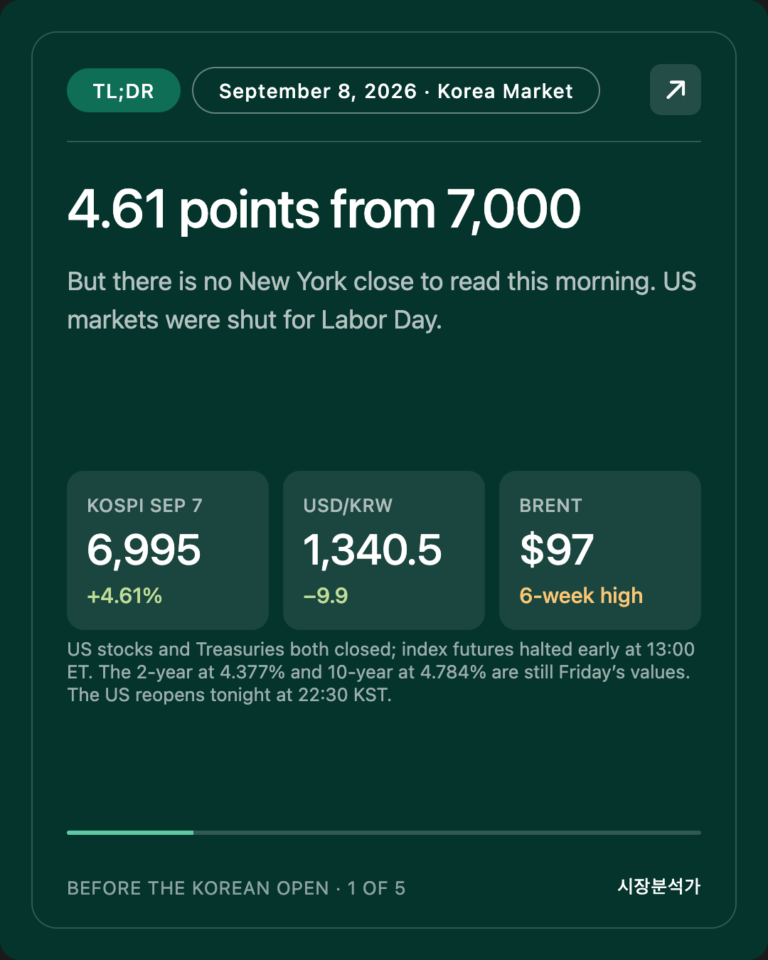
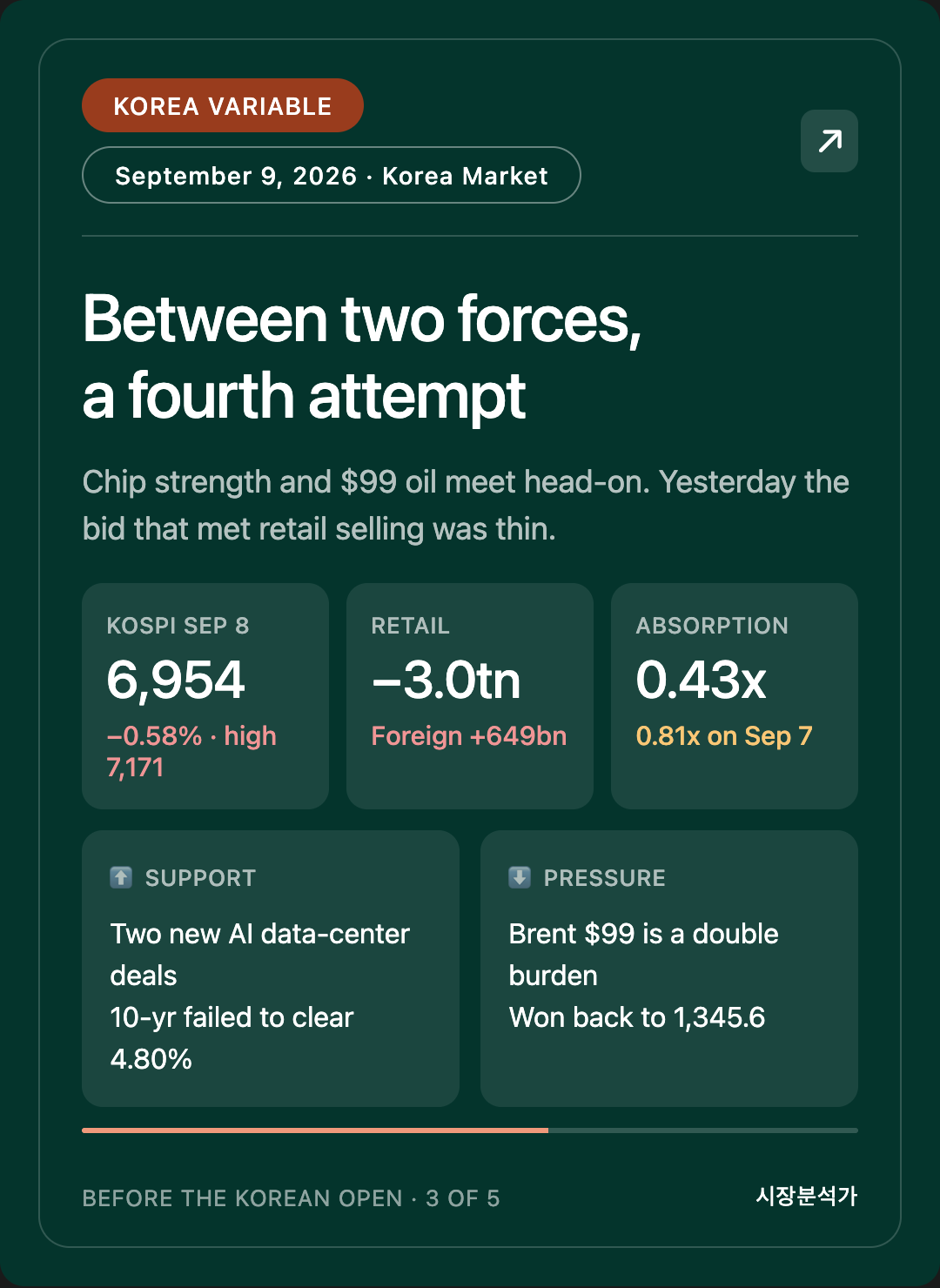
That was the third failure at 7,000. It follows August 14 (intraday 7,010.86, close 6,977.94) and August 18 (intraday 7,216.62, close 6,869.83). All three cleared the level intraday and gave it back by the close.
[ANALYSIS] Today the KOSPI stands between two forces
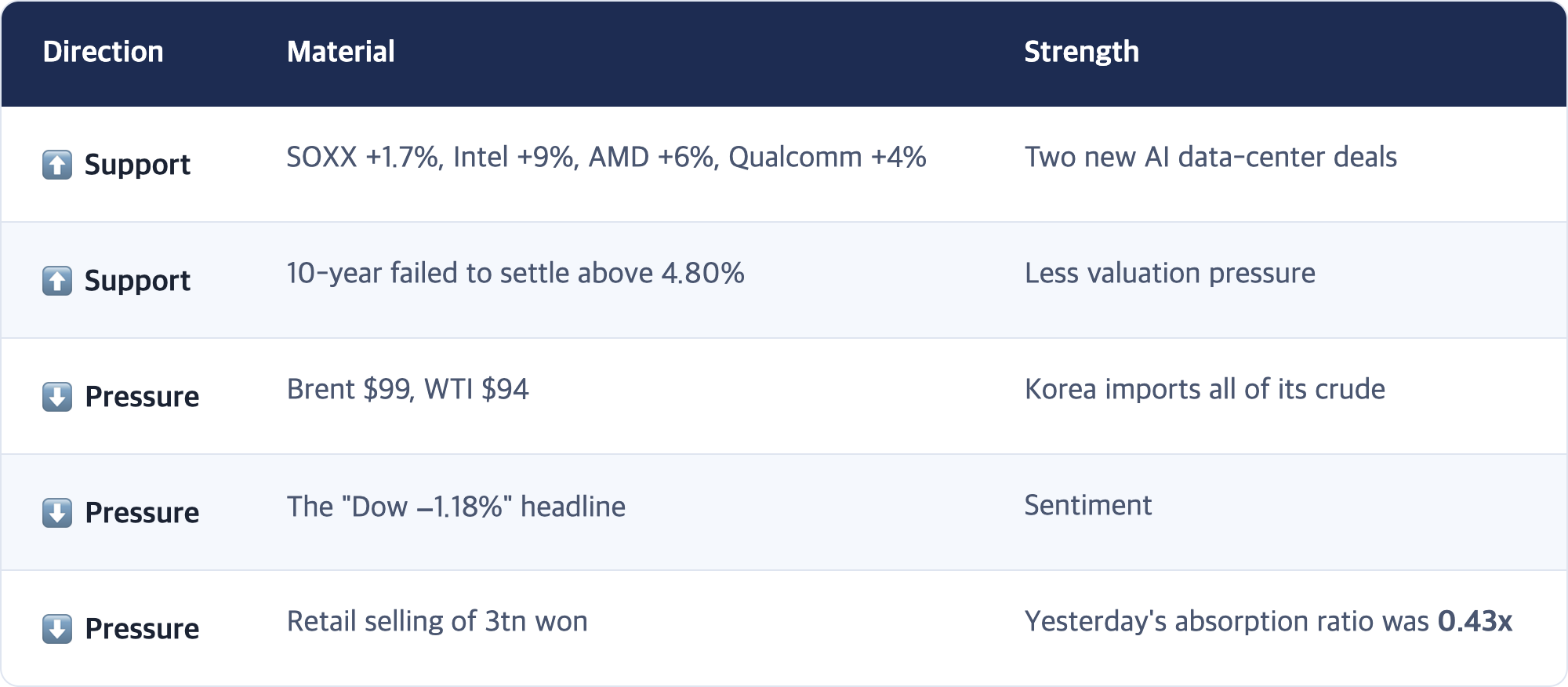
One condition differs from yesterday. Yesterday the US was closed for Labor Day, so Seoul had no overnight reference price. It opened on chip optimism alone and only priced in oil, the yen and tariffs in the afternoon. Today all three are already embedded in a US close. There is less reason for the session to reverse direction twice inside one day.
[ANALYSIS] The won — why $99 oil is a double burden
The won weakened yesterday to 1,345.6 per dollar, up 5.1, giving back Monday's strength in a single session.
Oil pressures Korea through two channels at once:
- Import prices. Korea imports all of its crude, so a higher oil price feeds straight into domestic inflation.
- The exchange rate. Oil is settled in dollars. A higher price means more dollars are needed to buy the same volume, which is downward pressure on the won.
Both channels push the same way, which is why it is called a double burden. And a weaker won cuts the dollar-denominated return on Korean equities, so it feeds back into foreign flows too.
Worth noting, though: foreigners still bought 649bn won on a day the won weakened. They did not sell.
[ANALYSIS] What the flow data says
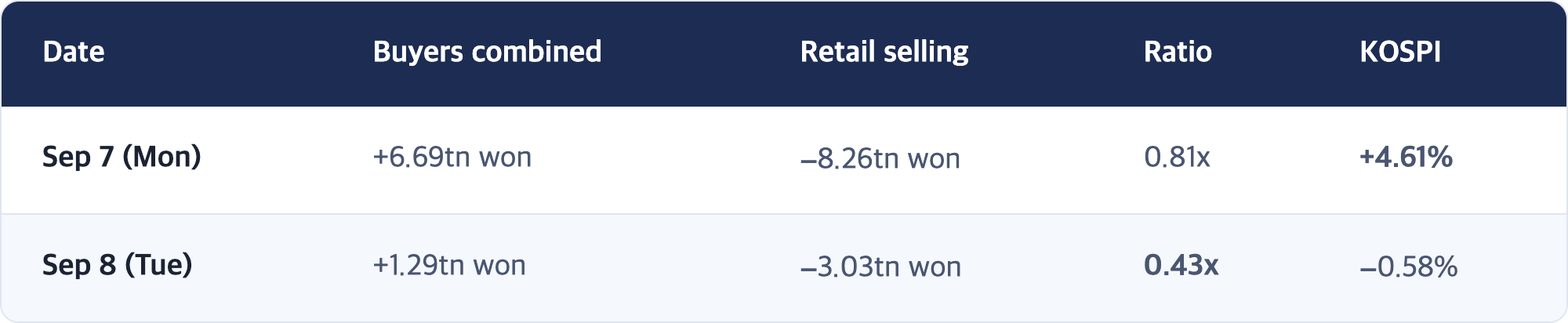
Comparing Monday and Tuesday, the ratio inverted.
📖 A note for readers outside Korea. Korean exchanges publish daily net buying and selling broken out by foreign, institutional and retail investors, which is unusually granular disclosure. Watching the ratio between what retail sells and what the other two absorb often explains a session better than the index number does.
Foreign net buying fell to a fifth of the previous day's. Retail selling shrank too, but the side absorbing it shrank more. Yesterday afternoon's reversal looks less like fresh bad news and more like a thinner bid.
4. Macro Backdrop — three central banks in nine days
[FACT] — Where policy stands
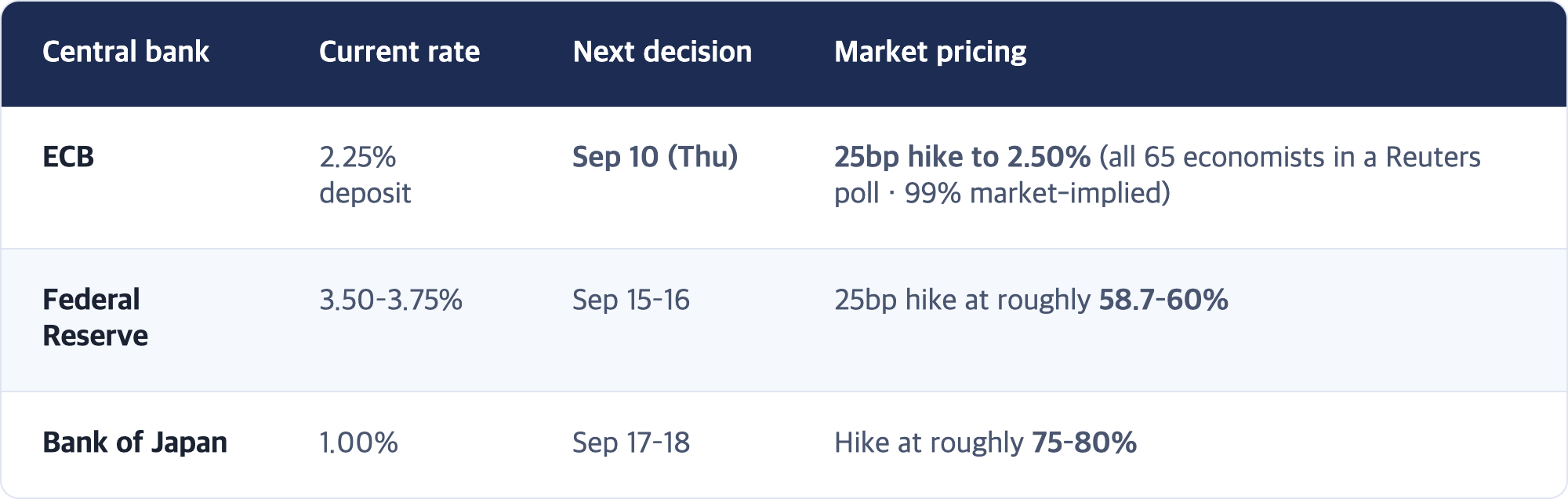
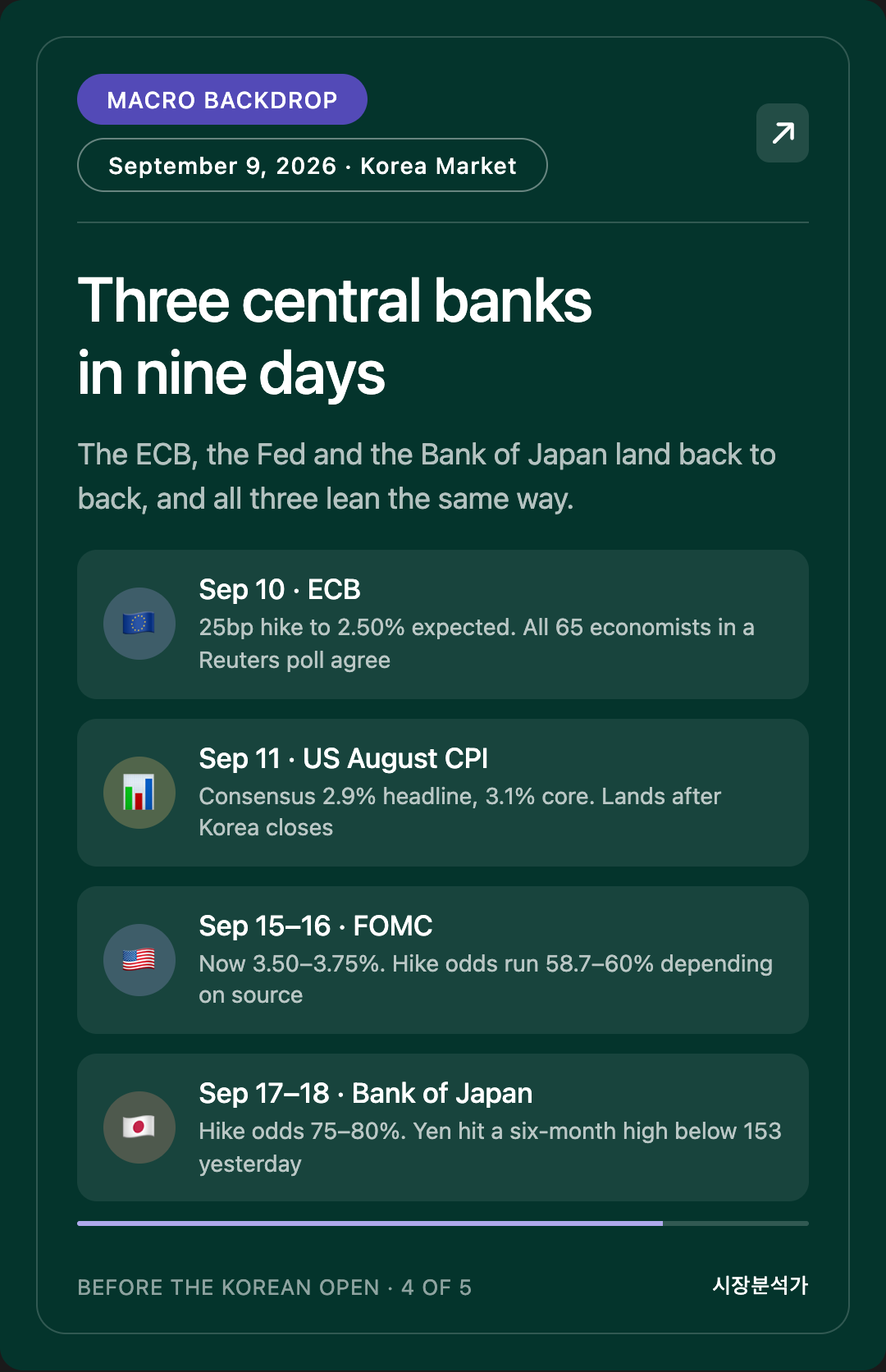
Three central banks inside nine days, and all three are leaning the same way. For the ECB, every one of the 65 economists Reuters surveyed expects a hike, and markets price it at 99%. Most of those economists also expect this to be the last hike, with 2.50% held well into 2027.
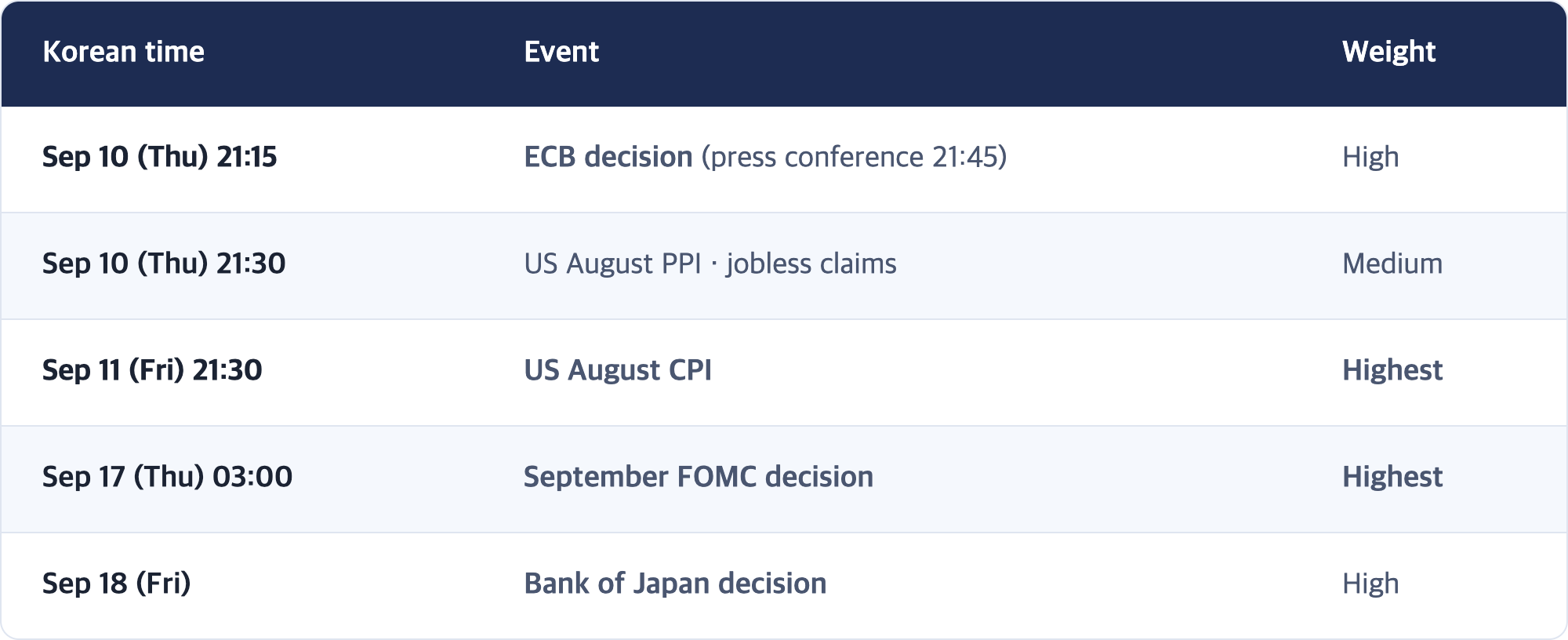
[OBSERVATION] — Event calendar (Korean time)
CPI consensus for Friday
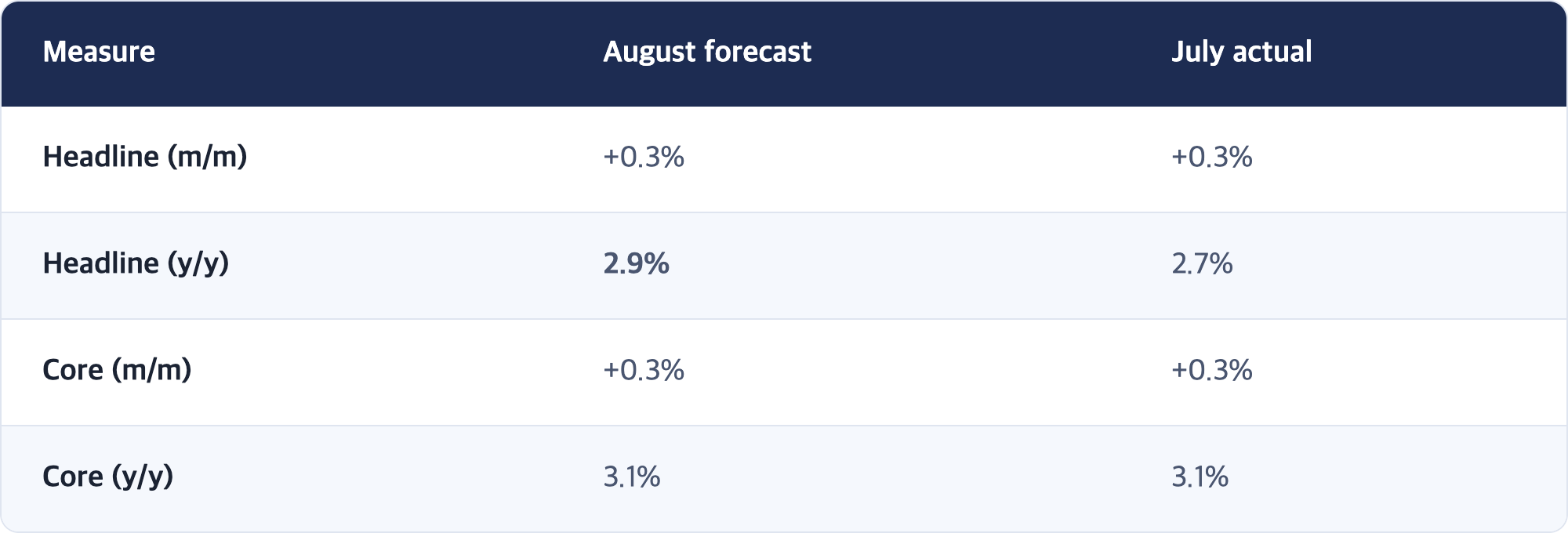
Russell Price, chief economist at Ameriprise, expects a hotter +0.4%, citing tariff costs passing through and rising food prices, particularly beef.
[ANALYSIS] Oil enters all three decisions at once
Yesterday's failure to convert oil into rates is good news, but it is one day's judgment.
There is a lag before $99 Brent shows up in the data. Friday's CPI is August data, and Brent averaged around $90 in August. Today's $99 is not in this report. It lands in the September figure, published in October.
So this week's CPI shows you the price level of a world before oil moved. If that number already runs hot, the market will immediately add the next sentence: and then oil gets layered on top. This is a release where the follow-on sentence may matter more than the print.
5. Previewing the Korean session (Sep 9, KST) — what to watch
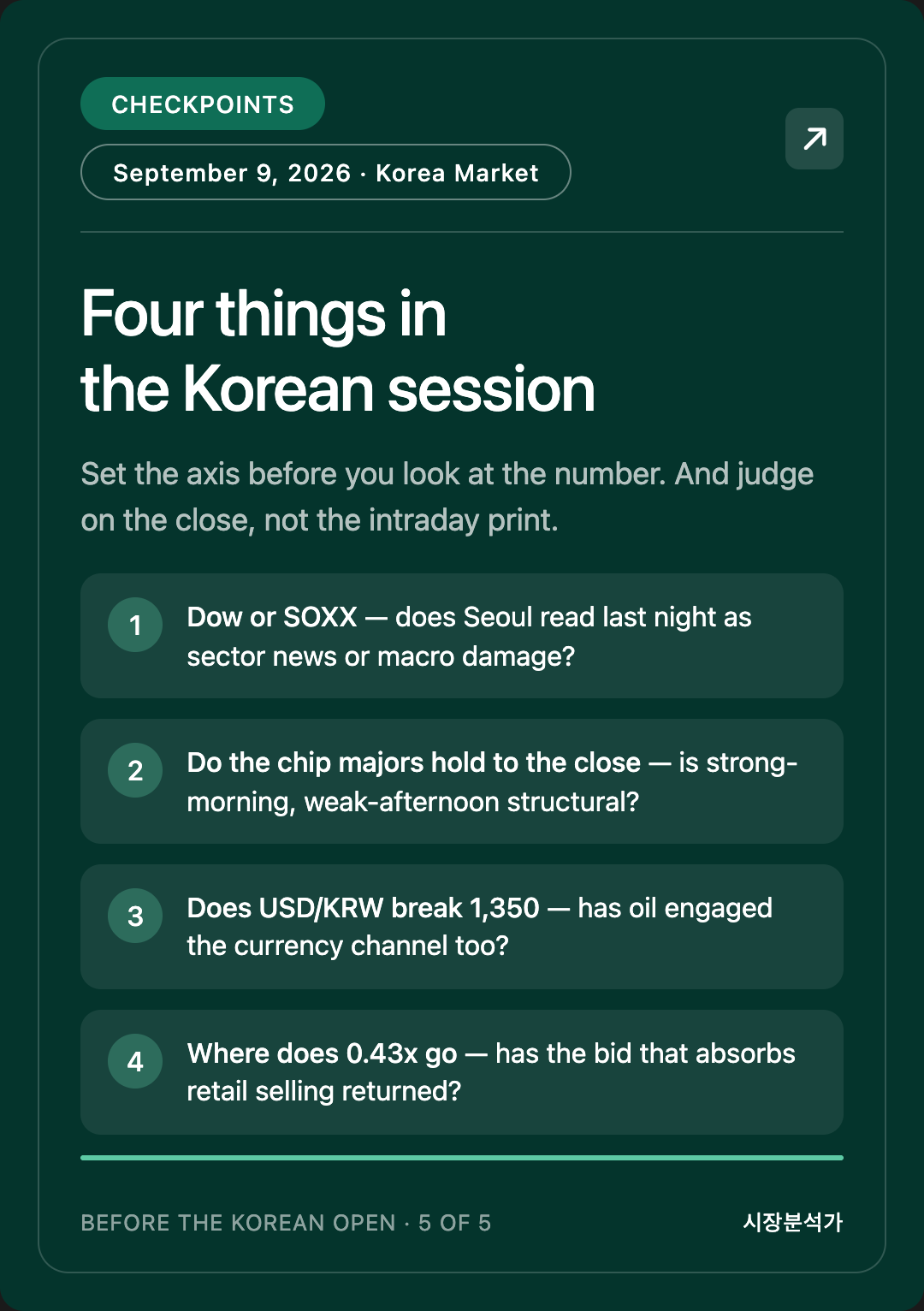
[ANALYSIS] — Four things. The axis first, then the number.
-
Which reference price does the KOSPI choose?
Axis — does Seoul read last night as sector news or as macro damage?
Last night offers two different reference prices: Dow −1.18% and SOXX +1.7%. If Korea takes its cue from chips, it has parsed the session correctly. If it opens weak on the Dow headline, it has read the index number and stopped there. This choice sets the character of the day. -
Do Samsung Electronics and SK Hynix hold their opening strength into the close?
Axis — is the "strong morning, weak afternoon" pattern structural or was it a one-off?
Yesterday both opened sharply higher and surrendered most of it in the afternoon. All three failed runs at 7,000 had the same shape. Judge on the close. Do not read anything into an intraday breakout headline. That rule was exactly right yesterday. -
Does USD/KRW break 1,350?
Axis — is oil now working through the currency channel too?
It closed at 1,345.6 yesterday. Above 1,350 means the second channel of the double burden has engaged. Holding in the 1,340s means only the import-price channel is being counted. The latter is better for foreign flows. -
Does retail selling ease, and how thick is the bid that meets it?
Axis — where does the 0.43x absorption ratio go?
Monday was 0.81x and +4.61%; Tuesday was 0.43x and −0.58%. Above roughly 0.6x and the bid has returned. Below 0.4x and yesterday's thinness persists. This ratio comes before the index direction.
[ANALYSIS] How the rest of the week is shaped
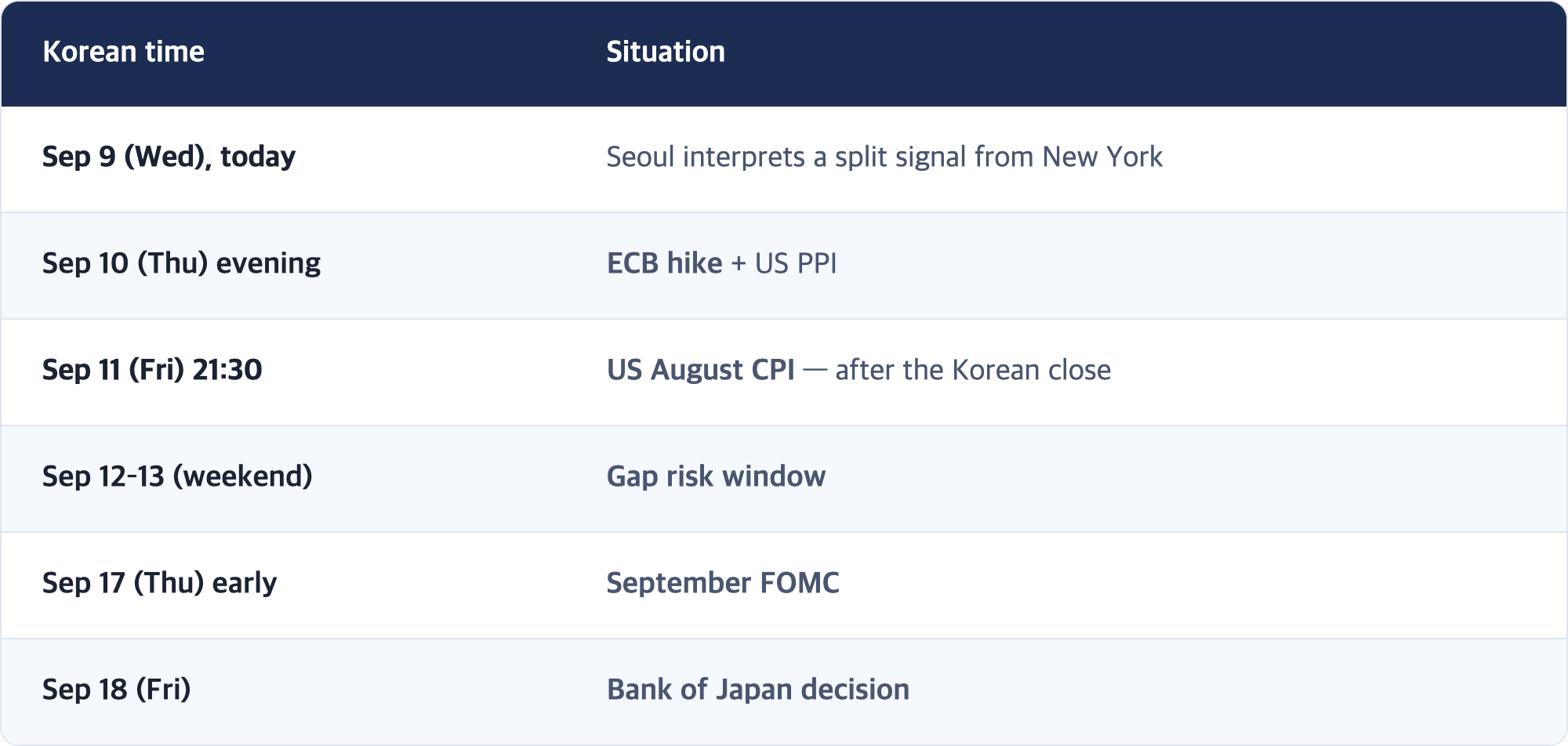
Note in advance that Friday's CPI lands after Korea has closed — the same structure as last week's jobs report. The reaction arrives all at once on Monday morning.
None of this is a directional forecast. It describes where the events sit on the calendar, not which way prices go.
📖 Study Note — headline versus core inflation, and which one oil enters
Friday's CPI release produces four numbers: headline monthly and annual, core monthly and annual. Here is why there are two versions, and which one oil goes into.
The concept
Headline CPI is the price of everything consumers buy, food and energy included.
Core CPI strips food and energy out.
They are stripped out because they swing too violently. One facility hit in the Middle East moves oil 2% in a day. A central bank that raised and cut in response to that would zigzag its way through a cycle. So core exists to show the underlying trend in prices.
An analogy
Think of measuring a river.
- Headline is the reading on the gauge this morning. If it rained last night, it is high.
- Core is the water table underneath. One storm barely moves it.
Whoever decides when to open the dam watches the water table. Open it because it rained today and you are short of water tomorrow.
But oil seeps into core eventually
This is the part that matters. Oil is an energy item, so it is excluded from core. Given time, it works its way in anyway. Economists call this the second-round effect.
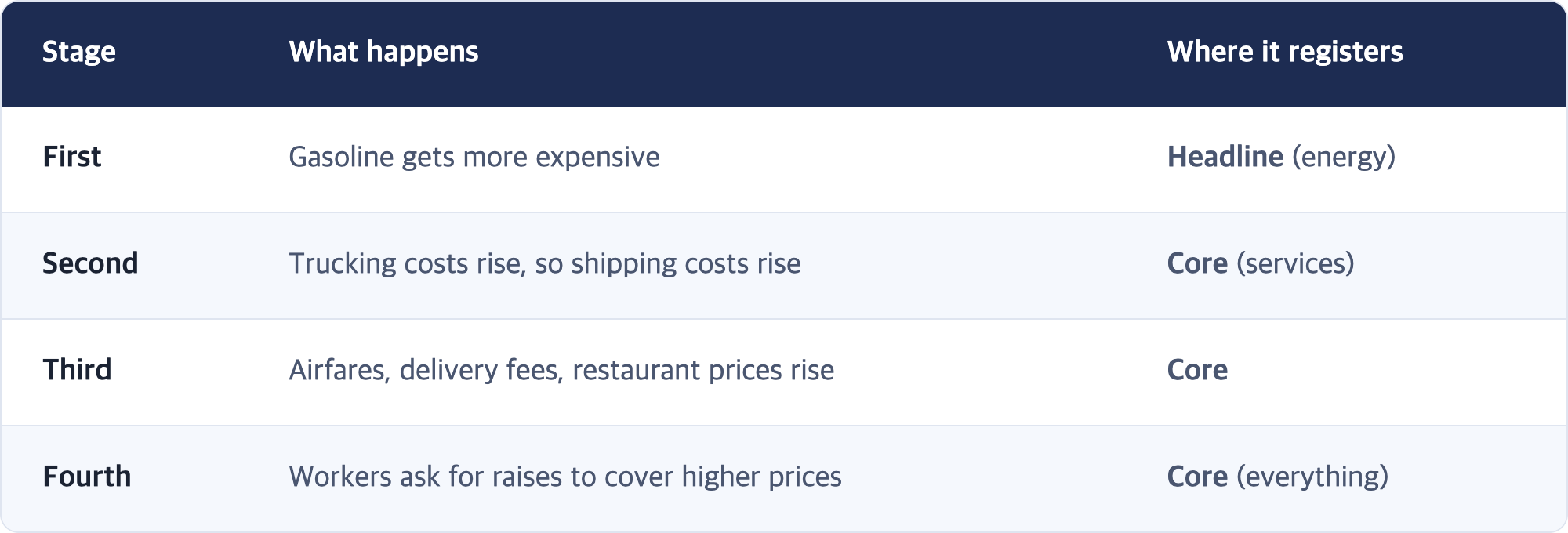
The first stage takes weeks, the second and third take months, the fourth can take more than a year.
A real example
On September 3, 2026, the US August ISM services survey printed a prices-paid reading of 72.6, up from 70.3 in July and the highest since mid-2022. Prices paid measures what businesses are paying for the goods and services they buy.
Oil was already in the $90s at the time. That number is a reasonable early signal of energy working its way into service-sector costs — and it shows up in core CPI several months later.
So how to read Friday
- If core comes in above the 3.1% annual consensus, oil and tariffs are already seeping through, and the Fed's case for hiking strengthens.
- If headline is hot but core stays calm, the pressure is still confined to energy, and the Fed has room to wait.
- And either way, today's $99 Brent is not in this August data. That is next month's release.
Why this matters for Korean investors — if the Fed hikes, US Treasury yields rise, and every risk asset including the KOSPI sees its valuation compressed. That is what it meant, above, to say the 10-year's failure to settle above 4.80% was not a bad outcome for Korea.
📌 Corrections and Source Conflicts
1) The S&P 500 close differs by source. Most outlets give 7,673.52 (−45.08, −0.58%); one summary put it near 7,685 (−0.2%). We adopted 7,673.52, on the strength of the matching point change and agreement across three or more sources.
2) The 10-year is described in two different directions. One data provider records 4.79%, unchanged; another reports a rise to about 4.80%. We state the range 4.79–4.80%. The scorecard verdict is unaffected, since neither value clears "settling above 4.80%," so the test is marked not met.
3) WTI varies by source. October futures at $94.24 (+1.30%), another tally at $93.90 (+1%), and a third describing "above $94 before easing to $92.75." These appear to be different contract months and snapshot times. We adopted the October contract at $94.24 and noted the intraday give-back.
4) 🔴 The SOX index close for Sep 8 could not be sourced. The only Sep 8 chip readings we secured were the SOXX ETF at +1.7% and individual stock moves. The report therefore cites no SOX index level, using the ETF and single names instead. This item was resolved for Sep 4 (11,735.26) after three attempts and is now unresolved again.
5) USD/JPY levels conflict. Most sources report below 153, a six-month high for the yen; one mentioned 155. We did not adopt the latter, judging it a different snapshot or an error. Yesterday's report cited an intraday 152.89 described as a seven-month high, versus today's "six-month high" framing, so we state only the level, not the record framing.
6) Bank of Japan hike odds differ. This cycle's confirmed figure is 75% (swaps basis); yesterday's citation was about 80%. We state 75–80%.
7) 🔴 We again failed to consolidate the September FOMC probability. Yesterday's report promised to narrow this with a direct CME FedWatch reading. The values secured this time are 58.7% (as of Sep 7) and about 60%, both still indirect. The range narrowed, but the promised direct verification was not done.
8) The "worst day in 26 years" framing for Amgen is single-sourced. The roughly 10% drop is confirmed widely; the 26-year record appears in one source only, and is attributed as such in the text.
9) Intel and Qualcomm percentages differ slightly by source — Intel +8% to +9%, Qualcomm +3.2% to +4%. Stated as ranges; no effect on the analysis.
10) Brent's Sep 7 settlement remains unsourced, now for the fourth consecutive edition. Only the Sep 8 figure ($99.16) is used; the Sep 7 value is not re-cited.
11) This edition ran on schedule. Scheduled 16:00 PDT, started 16:04 PDT. No drift.
🔗 Sources
- WTOP / AP, "How major US stock indexes fared Tuesday 9/8/2026"
- Yahoo Finance, "Stock Market Today (Sept. 8, 2026)"
- Kiplinger, "Dow Falls 628 Points as Rate Pressures Rise"
- CNBC, "Dow closes 600 points lower in back-to-back losses as oil prices gain"
- CNBC, "AI infrastructure stocks rally on deal announcements from Qualcomm, Corning"
- CNBC, "Brent crude oil hits $98 after Iran's Houthi allies attack multiple Saudi energy facilities"
- CNBC, "Novartis trial failure raises stakes for Amgen and Eli Lilly in Lp(a) drug race"
- Babypips, "Financial & Forex Market Recap – September 8, 2026"
- Alain Guillot, "Stock Market Recap — September 8, 2026"
- Trading Economics — US 10-year, gold, Brent
- Yahoo Finance / 24-7 Wall St., "Amgen Falls 10% as Novartis Trial Failure Clouds a Cholesterol Drug Class"
- Seeking Alpha, "Intel leads chip stocks higher as broader market dips"
- FXStreet, "Economists agree: ECB to hike rates on September 10 – Reuters poll"
- RTE, "ECB set to raise rates in September, but then done"
- Morningstar, "August CPI Report Forecasts Point to Sticky Inflation and Tariff Pressures"
- CNBC, "U.S. payrolls rose 162,000 in August" · BLS Employment Situation (2026 M08)
- Asiae / Money Today — USD/KRW closing quote
- Businesskorea, "KOSPI fails to hold 7,000 after intraday run to 7,170"
- Rio Times, "Global Economy Briefing — September 8, 2026" — central bank policy rates
Market Analyst · a sub-project of Fund Manager Cherry · We do not make individual buy or sell recommendations.
📌 More market briefs
※ This post is market observation and organization intended to support your own judgment. It is not a recommendation to buy or sell any security. Figures are as of the time of writing and may differ between sources.
If this was useful, bookmark it or pass it along. It genuinely helps me write the next one.
I can survive. We can survive.