Sept 14, 2026 KOSPI Market Brief — What to Watch Before the Korean Open
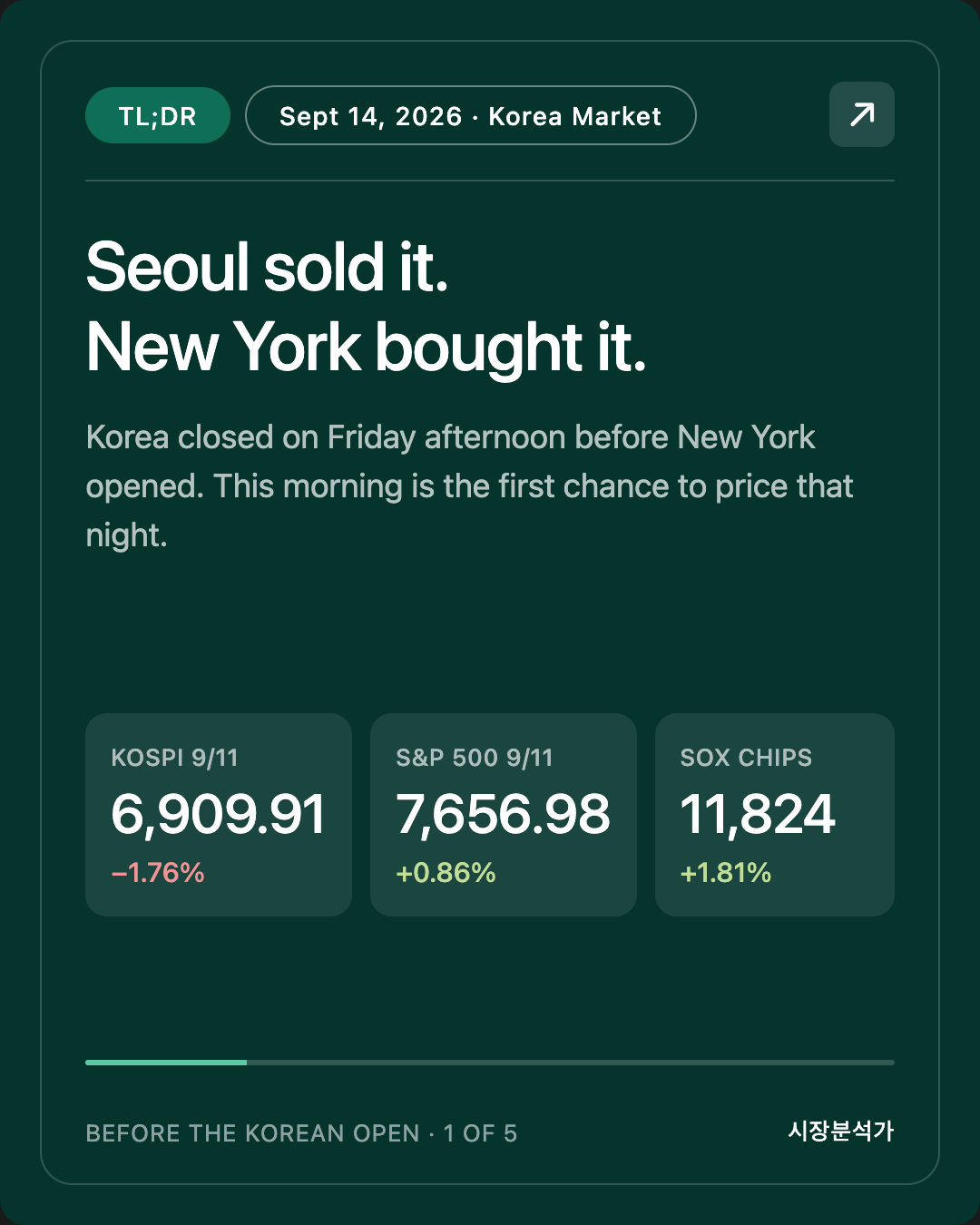
At 3:30 p.m. Seoul time on Friday, the KOSPI closed at 6,909.91. It had lost the 7,000 line. Samsung Electronics fell 3.35% and SK Hynix 2.21%. What got sold was semiconductors.
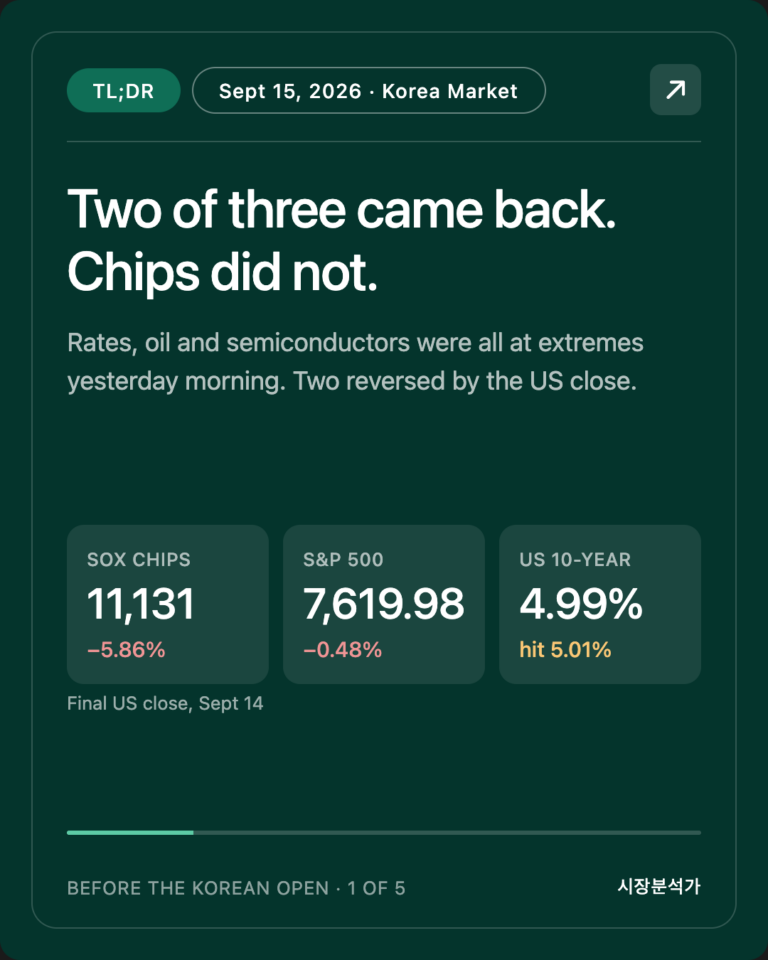
Nine hours later, in New York, the Philadelphia Semiconductor Index rose 1.81% — the best-performing major US index of the day.
Seoul sold the sector New York bought. But on that same night the US 10-year Treasury yield printed 4.96%, its highest since October 2023. The thing Seoul was actually afraid of on Friday got worse, not better.
The Korean market opens this morning holding both of those facts at once. Here is which one is heavier, and what to watch today to find out.
This is Mr. Can. Here is the Sept 14, 2026 brief ahead of the Korean market open.
Written 2026-09-14 08:05 KST (Vancouver 9/13 16:05 PDT)
Covers: US close of Friday 9/11 · the weekend in the Gulf · Korea's Friday 9/11 session
⚡ TL;DR
- Korea has not yet seen America's Friday. The KOSPI closed on Friday afternoon Seoul time before the New York regular session opened. Wall Street then snapped a five-day slide — Dow +0.98%, S&P 500 +0.86%, Nasdaq +0.96% — and this morning is the first chance Korea has to price it.
- Semiconductors led that rebound. The Philadelphia Semiconductor Index (SOX) closed at 11,824.00, up 1.81% — nearly double the Nasdaq's gain, and the exact sector Seoul dumped hours earlier.
- Rates went the other way. The US 10-year yield finished at 4.96–4.98%, the highest since October 2023; the 30-year at 5.36%. Stocks rose and yields rose with them. Of those two, the one Korea reacted to last week was rates.
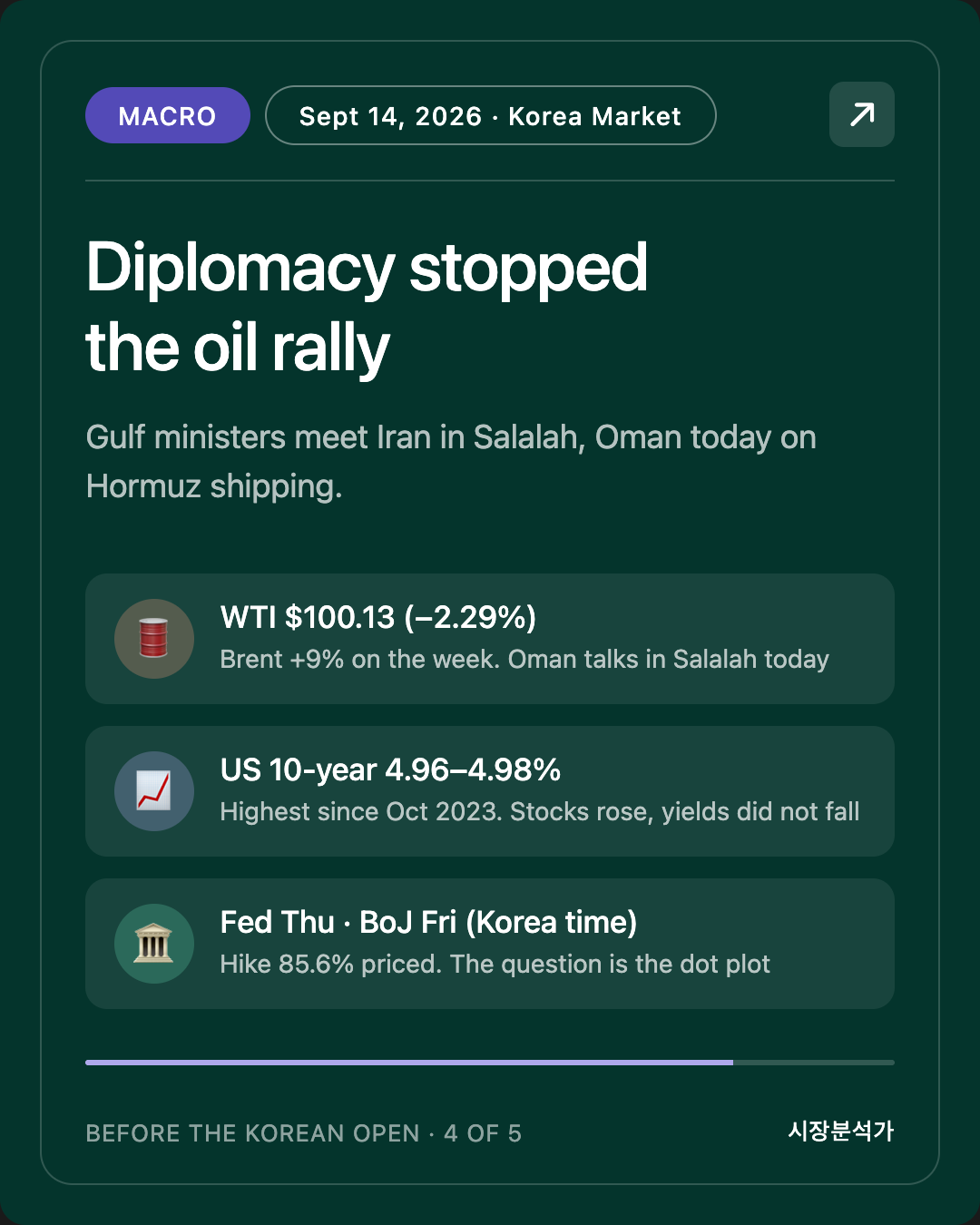
- Oil stalled at the $100 line — because of diplomacy, not supply. WTI settled at $100.13 (−2.29%), Brent near $104 after a +9% week. Today, Gulf Cooperation Council foreign ministers are due to meet their Iranian counterpart in Salalah, Oman, to discuss a temporary arrangement for shipping through the Strait of Hormuz.
- Three central banks decide this week. The Fed early Thursday Korea time (9/17, 03:00 KST), the Bank of England Thursday evening, the Bank of Japan Friday. A Fed hike is 85.6% priced on CME FedWatch — which means the market has stopped asking whether and started asking about the dot plot.
1. The Core of Today — Seoul Sold It, New York Bought It
[Fact] Start with the clock
The timing is the whole story, so let us lay it out in order.
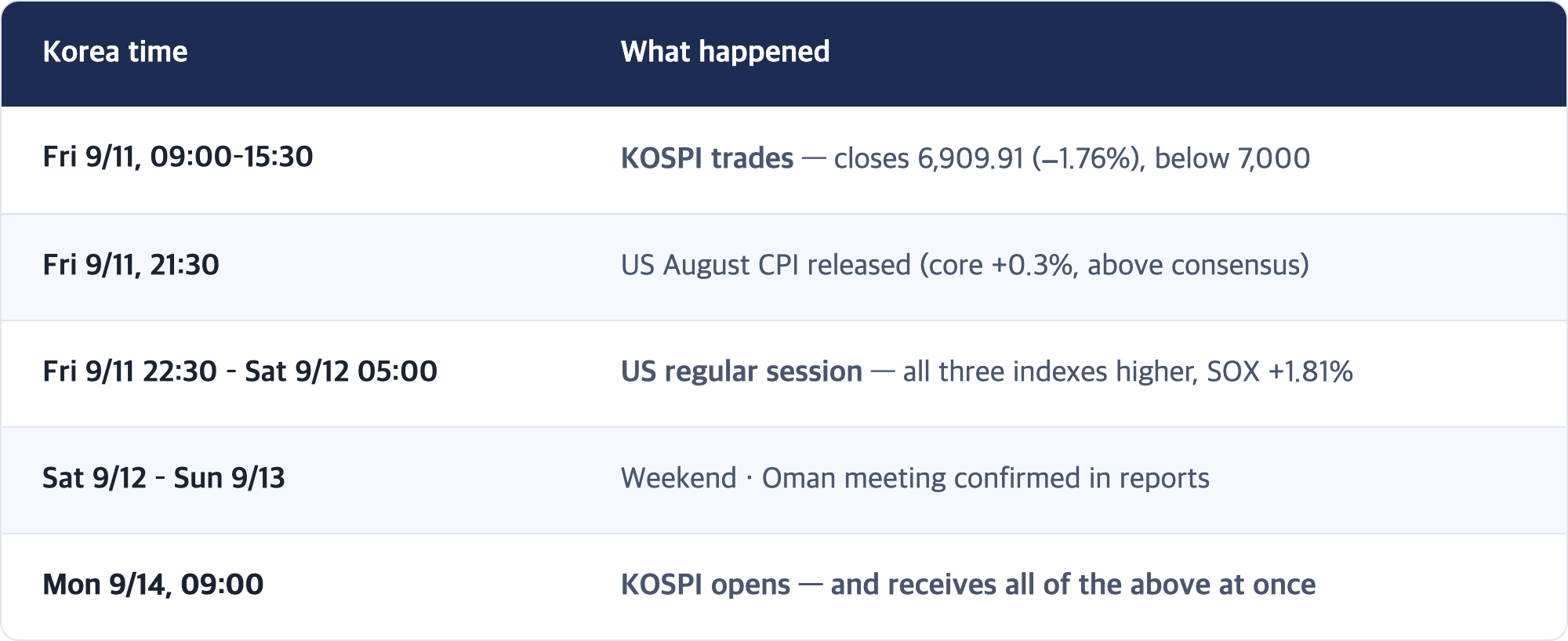
When Korea closed on Friday, New York had not opened yet. Korea's Friday selling was a reaction to Thursday night's America. What changed on Friday night is where today begins.
[Fact] US close, Friday 9/11
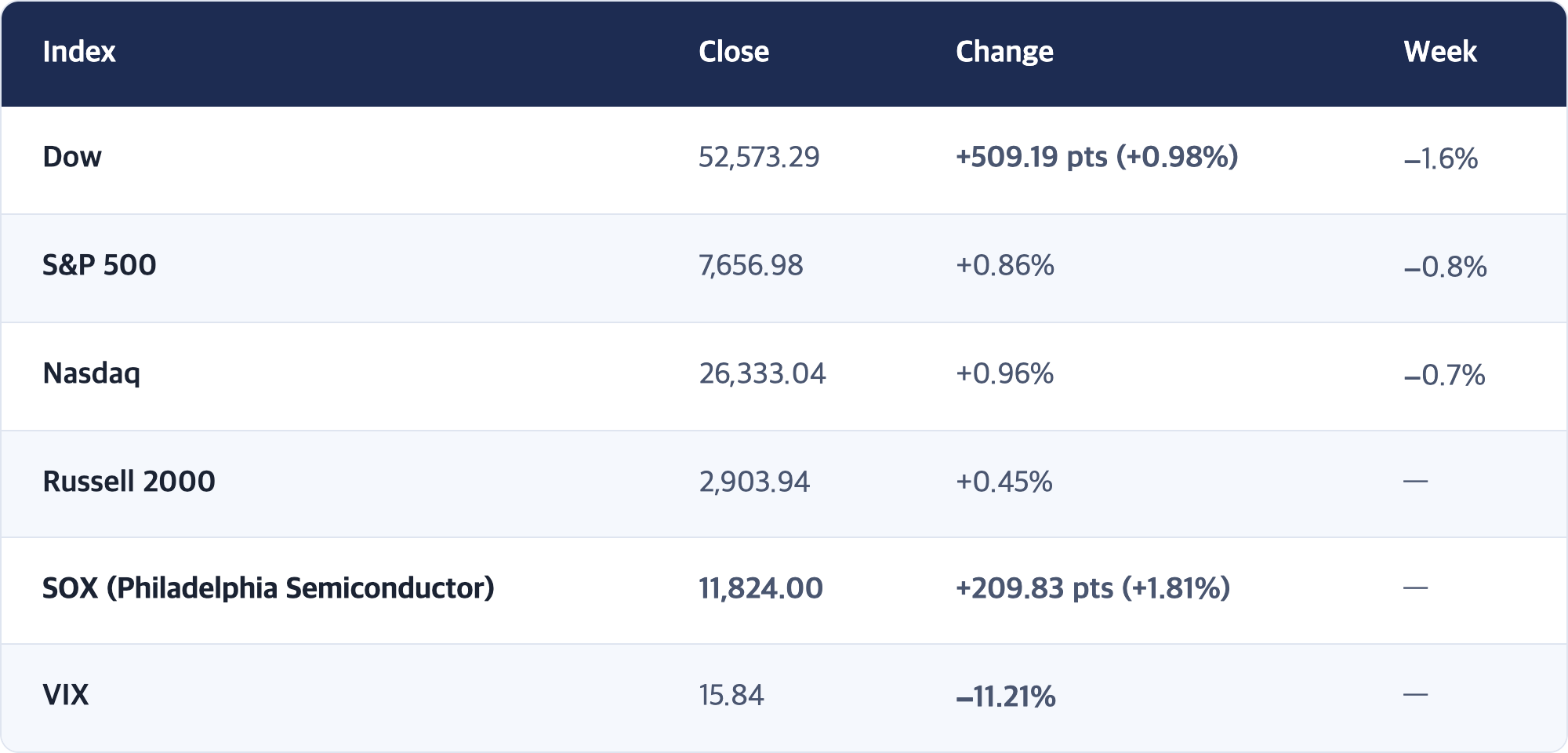
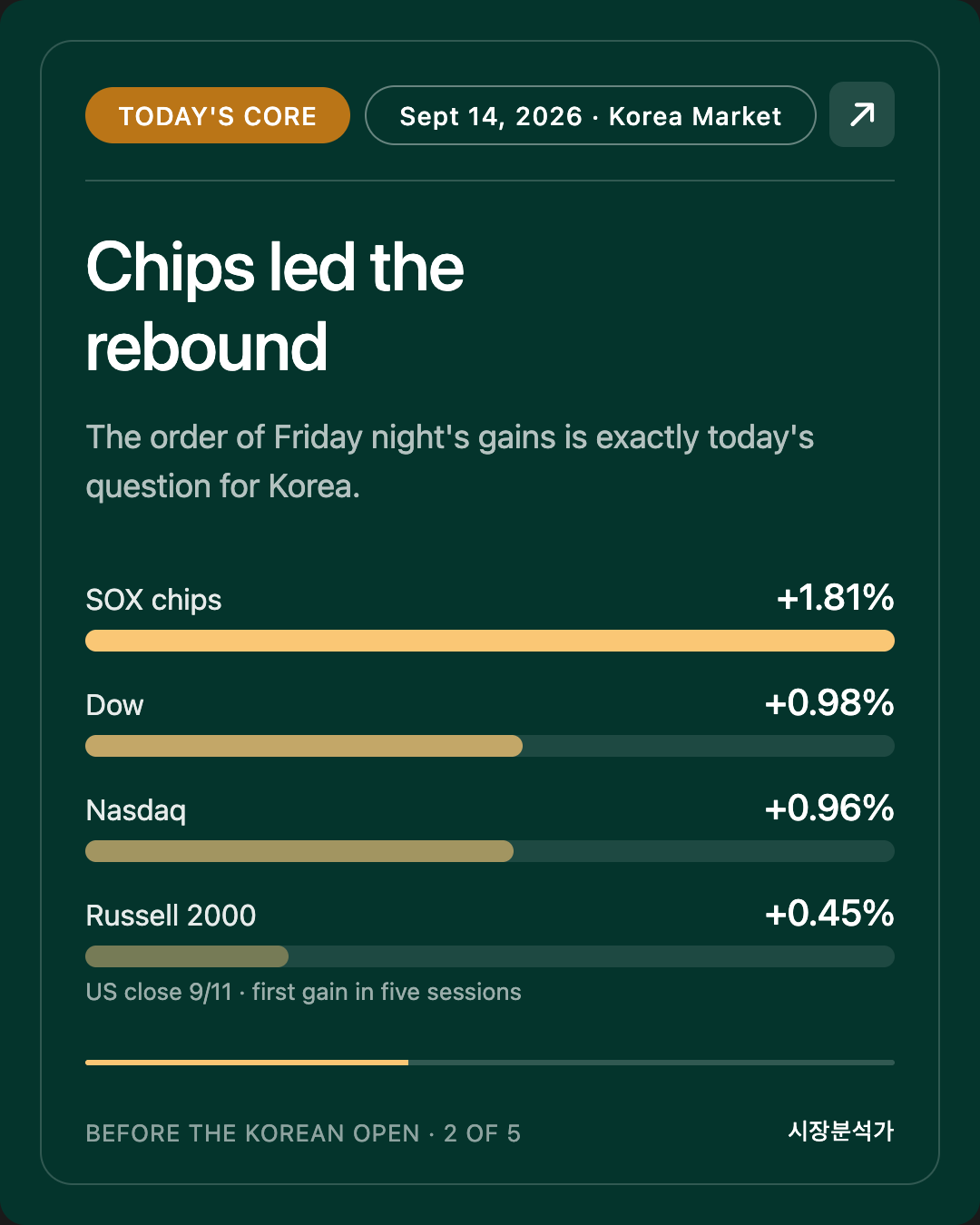
A five-day losing streak ended. The order of the gains matters: semis (+1.81%) > Dow (+0.98%) > Nasdaq (+0.96%) > S&P 500 (+0.86%) > Russell 2000 (+0.45%).
Note the VIX too — down more than 11% in a day. A week's worth of accumulated anxiety came out on Friday.
[Fact] Seoul's numbers at that same moment
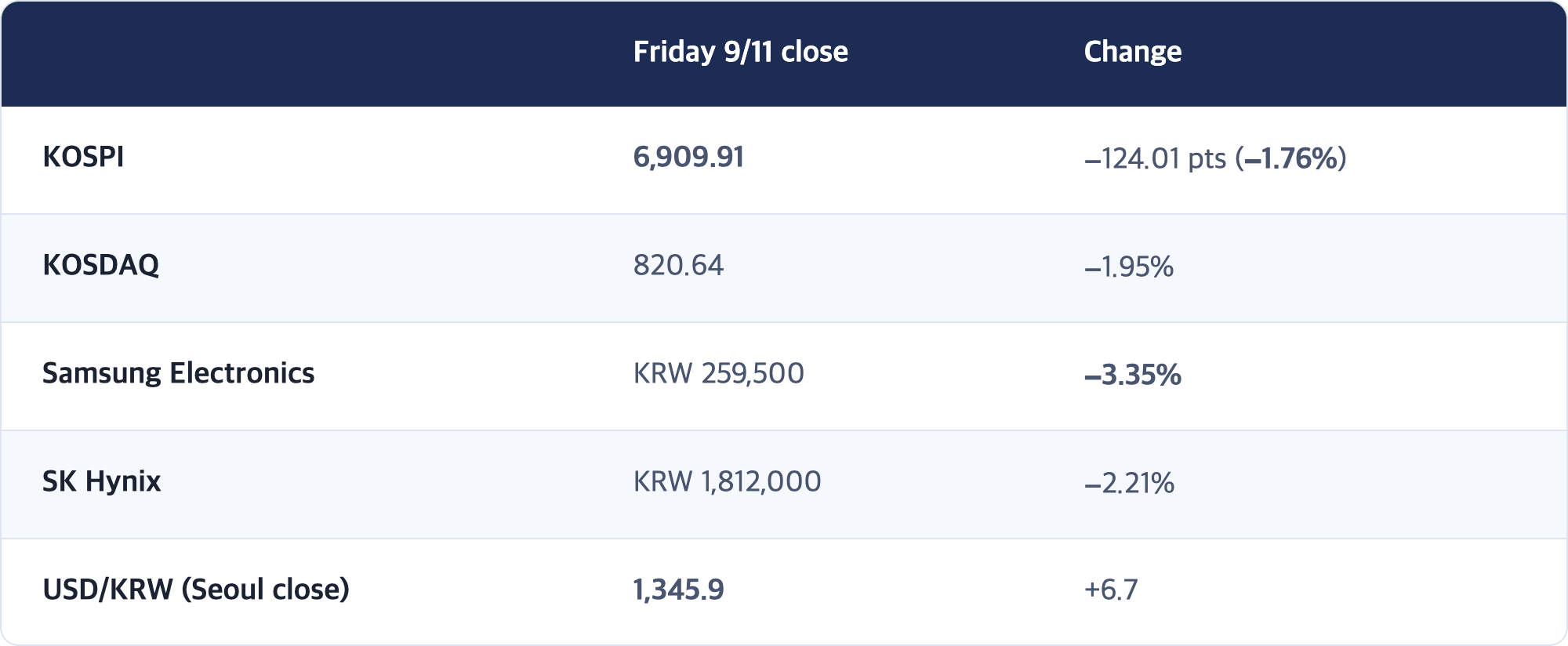
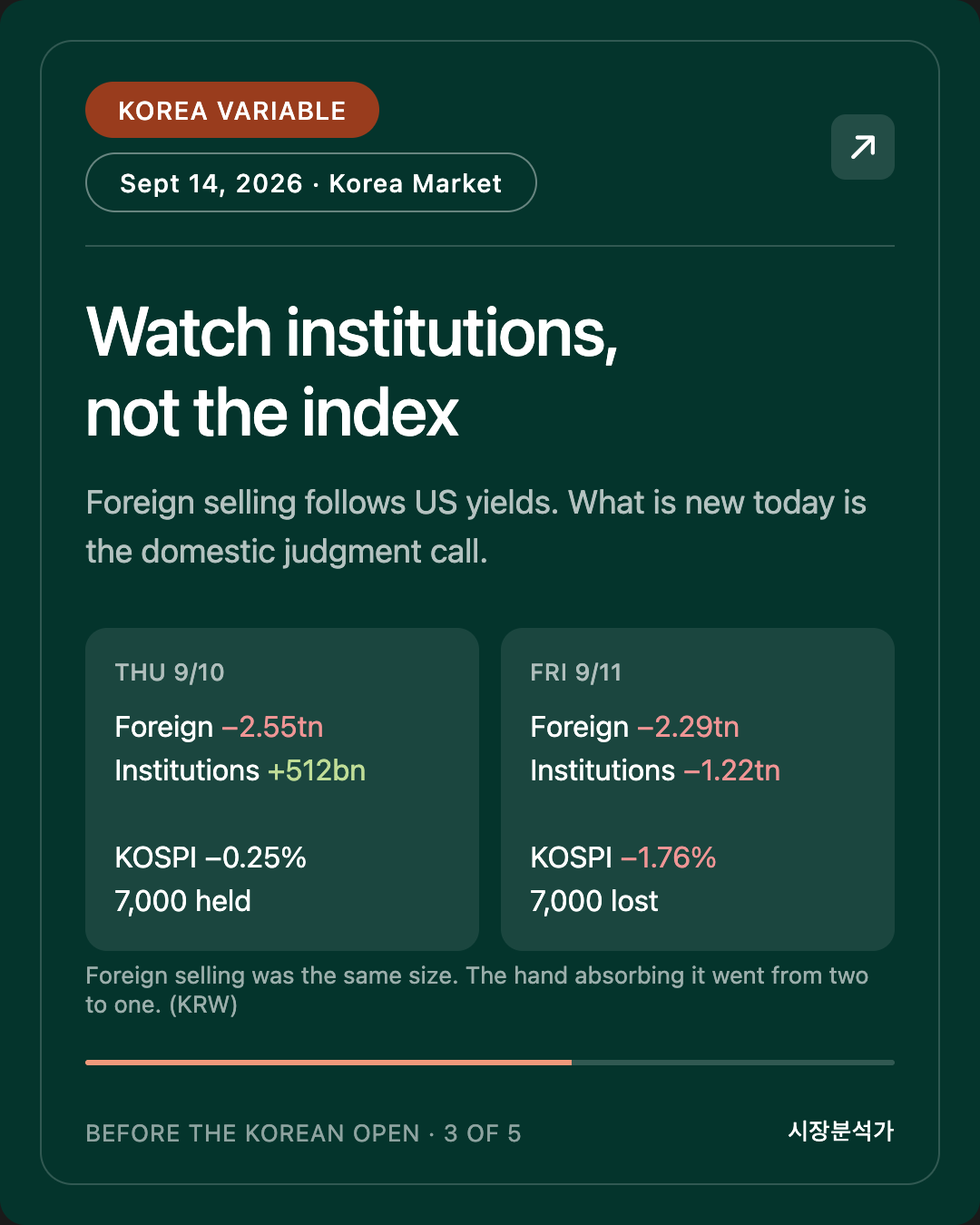
Foreigners sold a net KRW 2.29 trillion; institutions sold KRW 1.22 trillion; retail investors bought KRW 1.87 trillion. Over Thursday and Friday, foreigners sold roughly KRW 4.8 trillion — and the institutions that had been absorbing that flow on Thursday flipped to selling on Friday.
🔴 [Interpretation] And yet the KOSPI rose 3.33% last week
Look only at Friday and it reads as a collapse. Look at the week and the KOSPI gained 222.70 points, or 3.33%. Over the same week, the S&P 500 fell 0.8%, the Dow 1.6%, the Nasdaq 0.7%.
Korea beat the US by more than four percentage points in a single week. Put that first, and Friday looks less like a breakdown and more like one day of giving back a run that had already happened.
And the two reasons for that giveback — oil and rates — did not move together on Friday night. One loosened. One tightened further.
[Interpretation] Today's inputs point in opposite directions
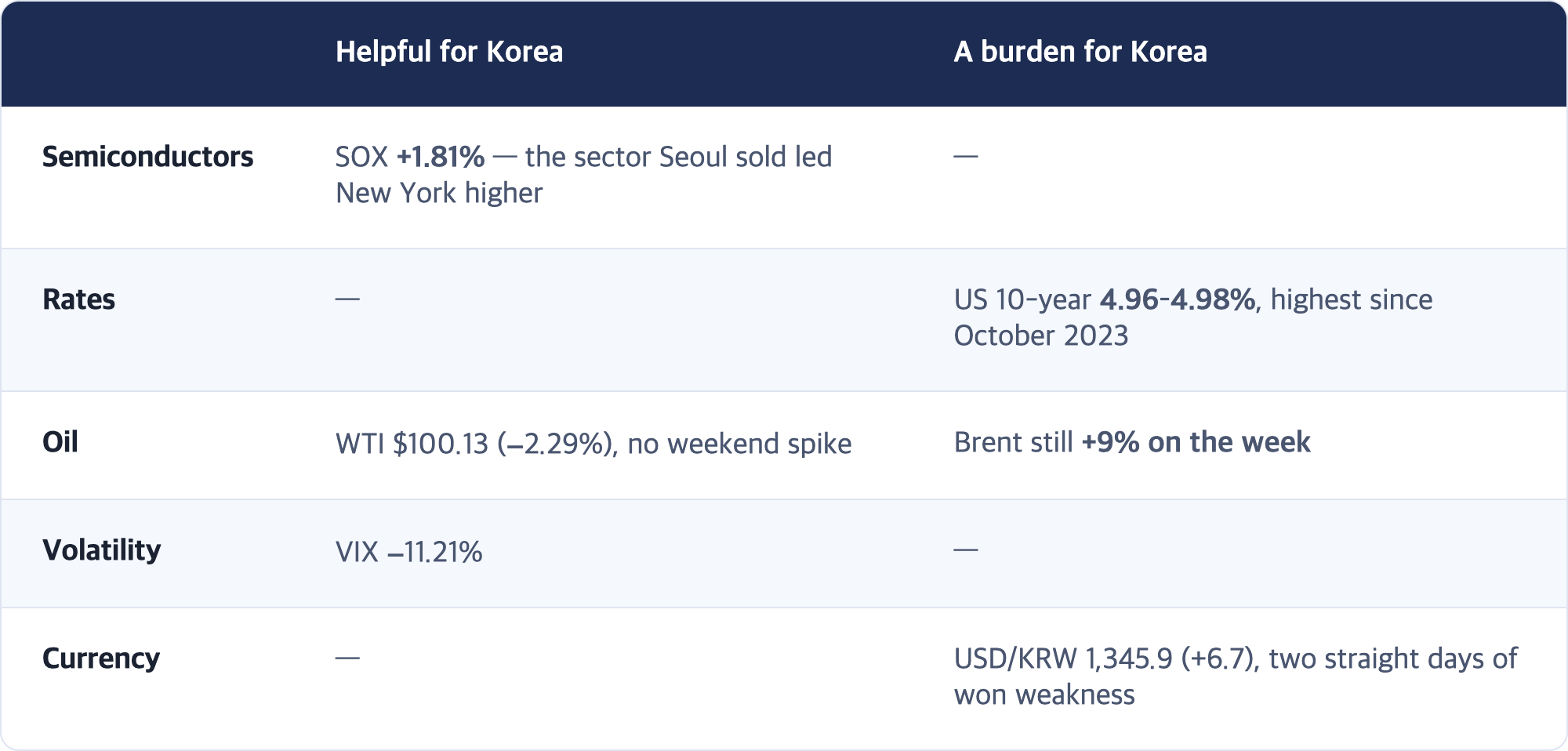
Equities improved; bonds got worse. That is the sentence for today.
Last week Korea reacted to the bond side. The proof is inside Friday's tape: KB Financial rose while Samsung Electronics fell, and the electrical & electronics sector alone dropped 2.66%. If the KOSPI follows New York's semiconductors today, last week's reaction pattern has changed. If it keeps watching rates, the pattern holds.
This is not a forecast. It is a question today's session answers by itself — which is why it is checkpoint number one.
2. Grading Friday's Checkpoints
These are the four the 9/11 pre-US-open report wrote down in advance.
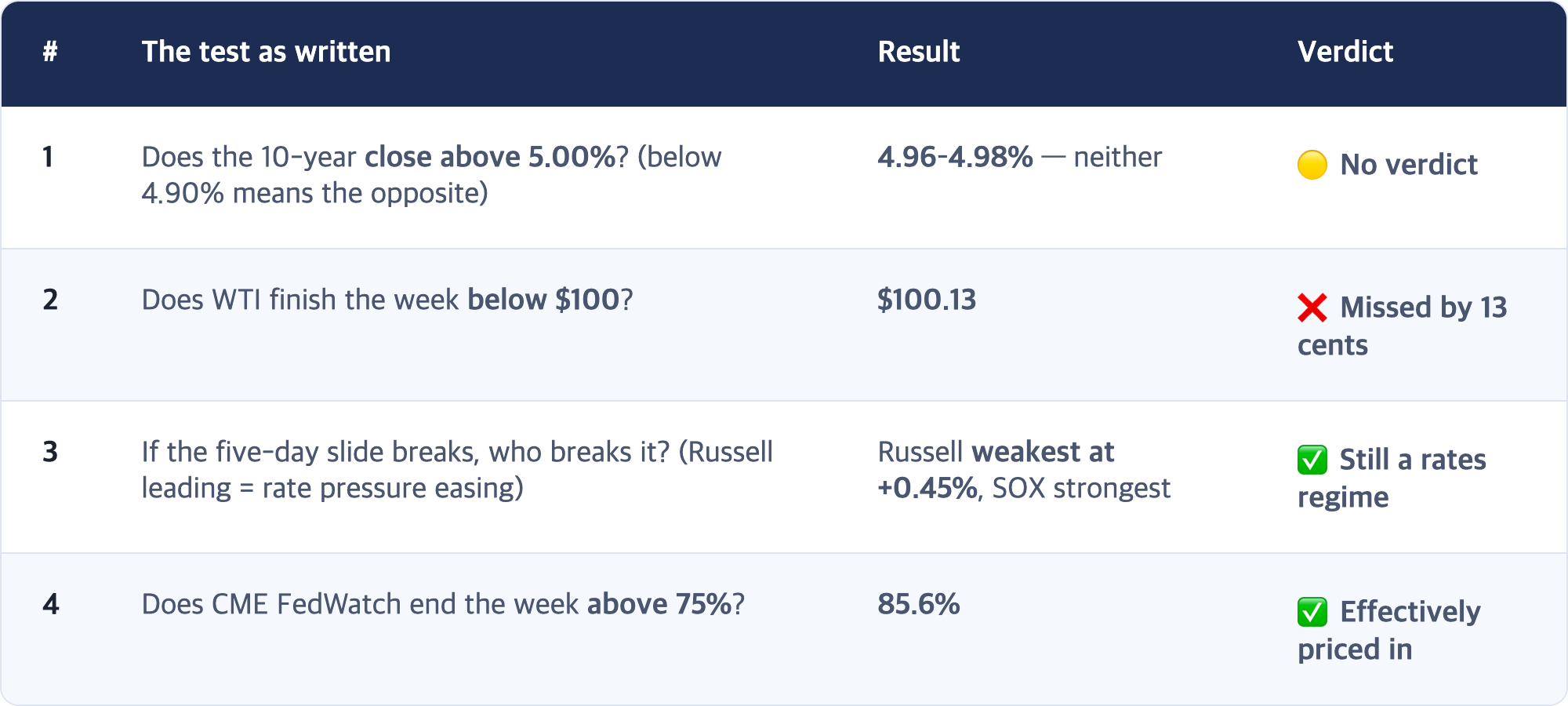
Two clearly right, one narrowly wrong, one unresolved.
[Interpretation] The unresolved one is itself information
The report drew two lines: above 5.00% would mean hot core inflation had been newly added to yields; below 4.90% would mean CPI merely confirmed what was already priced. It finished between them.
But 4.96% is the highest since October 2023. Landing between the lines does not mean nothing happened. It means yields are grinding higher without drama — no breakout, no relief, just a slow slide upward.
Stocks rose on Friday and yields did not fall. The equity market has filed the hike under "known." The bond market has not. That is the posture heading into this week's Fed.
🔴 [Interpretation] Thirteen cents still counts as a miss
WTI settled at $100.13. The report said a close below $100 would make Monday's start lighter. It did not get there — by 13 cents.
Practically that is $100. But a test written in advance gets graded as written. What matters more this time is why oil stopped: the reason was not in the market. See section 4.
3. The Korea Variable — Watch the Institutions, Not the Index
[Fact] The shape of last week's flows
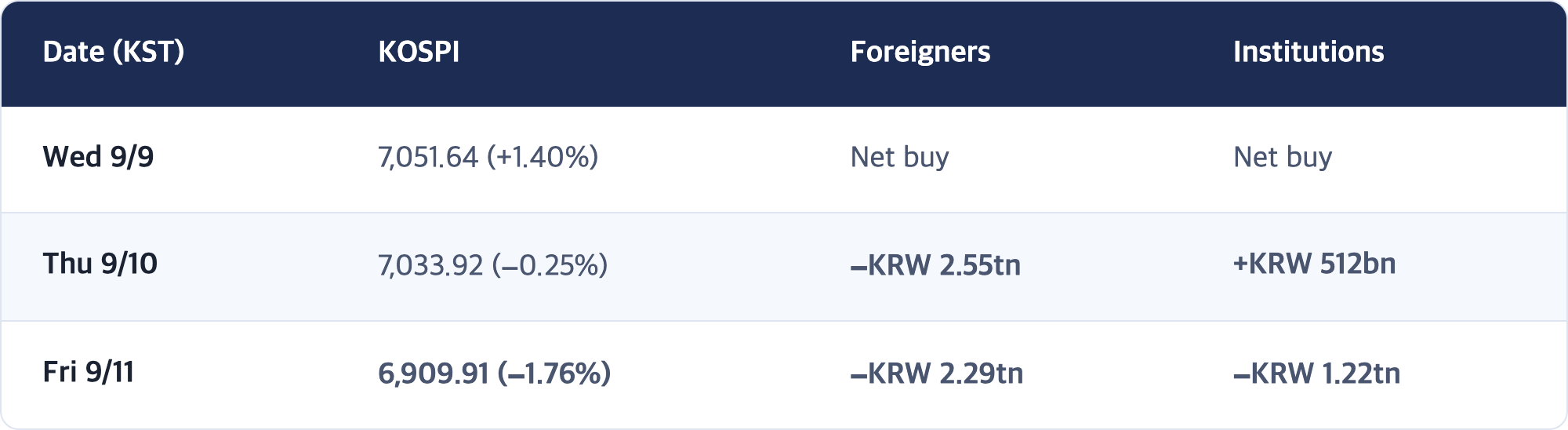
Foreign selling was roughly the same size on both days. What changed was the institutions. The hand that absorbed the flow on Thursday joined the selling on Friday, and the index went through 7,000.
[Interpretation] So this is the first thing to watch today
Not how far the index moves, but whether institutions come back to the buy side — for a simple reason:
- Foreign selling follows US yields. That driver does not change before Thursday's Fed.
- Institutional buying is a domestic judgment call. How Korean institutions read Friday night's semiconductor rally shows up immediately, today.
Foreigners are the predictable side this week. Institutions are the variable.
[Fact] Two straight days of won weakness
- Wed 9/9 — 1,336.1, the strongest won in one year and eleven months
- Thu 9/10 — 1,339.2 (+3.1)
- Fri 9/11 — 1,345.9 (+6.7)
Roughly 10 won given back in two sessions. Through 9/9, won strength was the evidence that foreign selling was position-trimming rather than capital flight. That evidence is now weaker — it becomes possible to argue that more of the proceeds are being converted to dollars and leaving [Interpretation].
That said, the dollar index also held above 99 through the same stretch. Whether this is won weakness or broad dollar strength should become clearer today by watching the yen and the yuan alongside it.
4. The Macro Backdrop — Diplomacy Stopped the Oil Rally, Not Supply
[Fact] There is a meeting in Oman today
- Iranian state media reported that Tehran would meet Gulf states in Oman.
- Oman is working to bring GCC foreign ministers and Iran's foreign minister together today (9/14) in the southern city of Salalah.
- The agenda is a temporary arrangement for managing shipping through the Strait of Hormuz.
On that report, Brent dropped back below $105 to settle near $104 on Friday, and WTI ended 2.29% lower at $100.13.
Brent rose 9% last week. What stopped it was not an inventory number. It was one line on a diplomatic calendar.
🔴 [Interpretation] Korea trades through that meeting today
Salalah is five hours behind Seoul. Headlines from the meeting will most likely land late in the Korean session or after the close.
Which gives two branches:
- If the talks progress: oil slides under $100, US yield pressure eases through that channel, and the denominator under Korean semiconductor valuations gets lighter.
- If the talks collapse: last week's oil path resumes. In that case, even if the KOSPI rises today on New York's semiconductors, the basis for that rise can be gone by tomorrow morning.
It is a variable today's session cannot resolve — and tonight can. So whether today closes green or red, the durability of the reason will not be visible in today's close.
[Fact] Three central banks this week (Korea time)
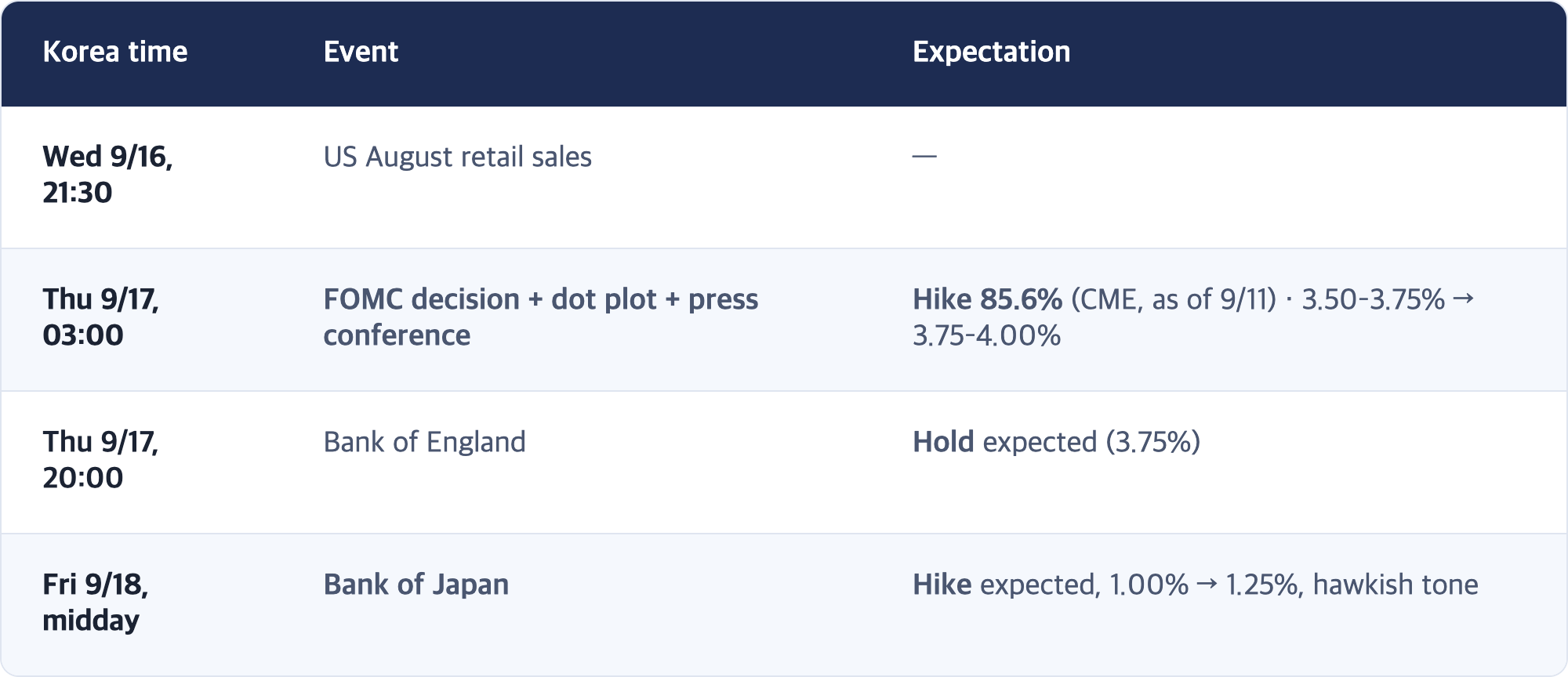
Two of the three tighten and one waits. The stretch in which major central banks all face the same direction continues.
🔴 [Interpretation] The dot plot, not the hike
An 85.6% probability means the hike is already in the price. What is left to move markets on the day is not the decision but what comes after it.
Lee Sang-jun of NH Investment & Securities made the same point: the direction of the US 30-year yield will depend more on the dot plot and the chair's remarks than on the policy rate itself.
A quick primer for readers outside Korea: the dot plot is a chart published four times a year in which each Fed official anonymously marks where they think the policy rate should be at the end of each coming year. The median dot is what markets read.
June's median for end-2026 was 3.8%. With the rate at 3.50–3.75%, that implied one more hike this year. A 25bp move this week fills in exactly that picture. So this dot plot answers one question: is there another one after this, or does it stop here?
- If the dots show another hike: long US yields go higher again, and that pressure lands directly on Korean semiconductor multiples.
- If the dots stop here: the rationale behind two weeks of foreign selling in Seoul gets weaker.
For a Korean investor, the number that matters this week is not the fed funds rate. It is where the dots sit.
[Fact] Elsewhere in prices (as of 9/11)
- Gold $4,389.70 (−0.40%) — still pressured despite Middle East escalation
- Bitcoin ~$77,240 (9/13, 01:22 ET) — US spot ETFs saw a fourth straight day of net outflows
- Dollar index above 99 (exact close not confirmed)
Gold's behavior follows from the same logic as everything else here. Higher yields raise the opportunity cost of holding an asset that pays no interest, and a firm dollar presses the dollar price on top of that. Rates are still beating geopolitics.
5. Checkpoints — Four Things to Watch in Today's Korean Session
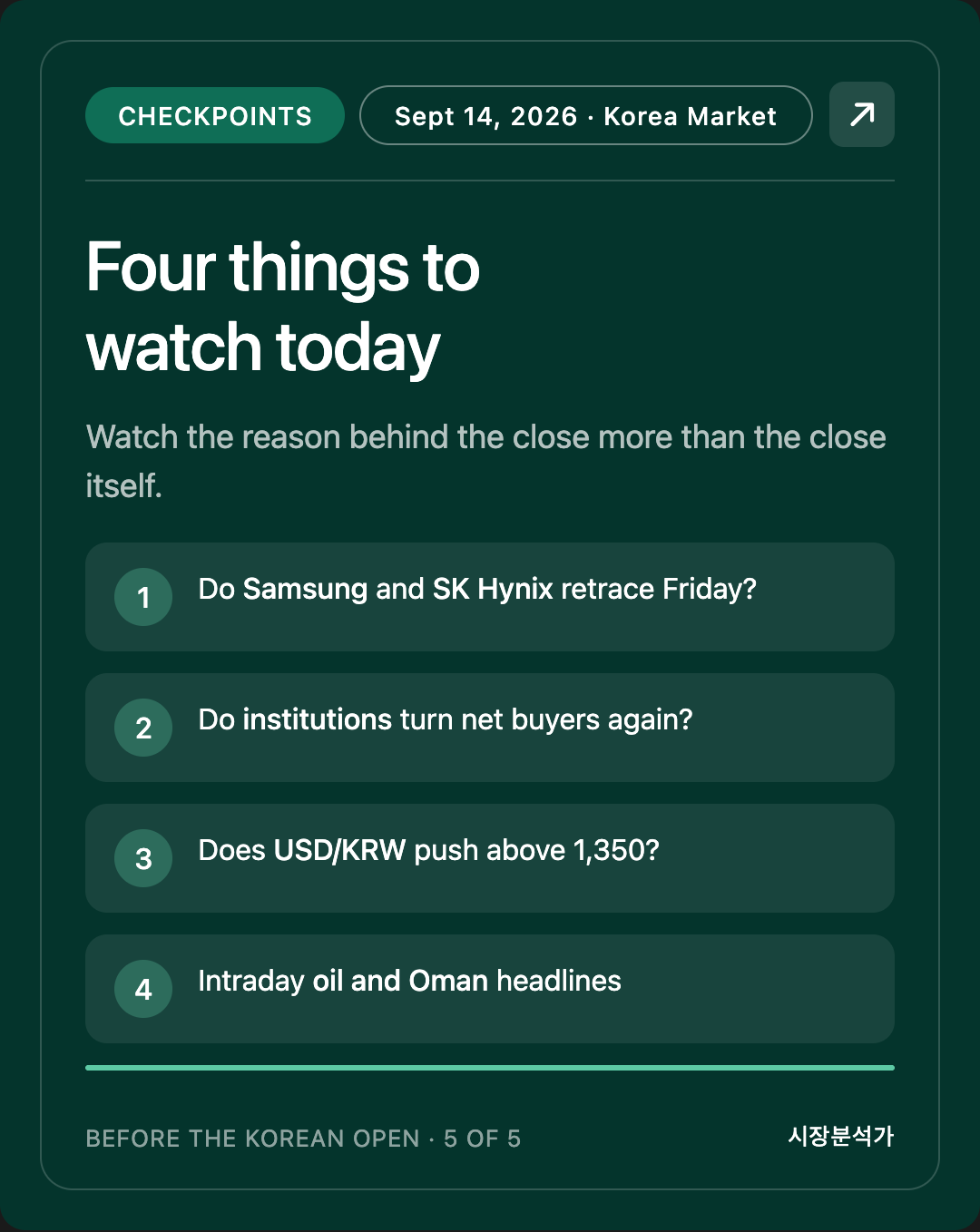
1. Do Samsung Electronics and SK Hynix retrace Friday's drop?
Axis: is the KOSPI watching New York's equities or New York's yields today?
Friday: Samsung −3.35%, SK Hynix −2.21%. That night: SOX +1.81%. If the two follow New York's chips, last week's rates-first reaction has changed. If the index rises but these two lag, the rates regime is intact. Watch these two before the index.
2. Do institutions turn net buyers again?
Axis: one hand absorbing foreign supply, or two?
On 9/10 institutions bought KRW 512bn; on 9/11 they sold KRW 1.22tn. If they buy again, there is a base for another attempt at 7,000. If only retail and corporate buybacks absorb the flow, last week's structure continues.
3. Does USD/KRW push further above 1,345?
Axis: is foreign selling position-trimming or capital flight?
From 1,336.1 on 9/9 to 1,345.9 in two sessions. Through 1,350 tilts toward FX conversion accompanying the equity selling. Back below 1,340 says last week's move was temporary oil-driven dollar strength.
4. Intraday oil and Oman headlines.
Axis: will today's move still have a reason tomorrow?
WTI $100.13 is the starting point. Brent under $100 intraday means today's basis survives the night. A breakdown in talks or a fresh strike makes tomorrow's open heavy regardless of today's close. Today is a day to watch the reason behind the close, more than the close.
⚠️ Corrections and Open Items
1. ✅ The PM slot ran on schedule. This edition started at 16:03 PDT against a 16:00 schedule — the first PM report after three consecutive missed slots (Sun 9/6, Wed 9/9, Thu 9/10). That was the test of the "only PM fails" hypothesis, and it passed. One clean run is not a root cause, so monitoring continues.
2. ✅ The SOX close, unconfirmed for four editions, is now confirmed. Per Nasdaq's official index page: 9/11 close 11,824.00 (+209.83, +1.81%), intraday high 11,910.20, low 11,711.33. It reconciles with the 9/4 close of 11,735.26.
3. ✅ Fed probability is now single-sourced. From this edition, CME FedWatch only — 85.6% as of 9/11. Figures of 87%, 88% and 90% appeared elsewhere the same day and were not cited.
4. Three source discrepancies.
- US 10-year, 9/11 close: 4.96%, 4.97% and 4.98% all appear. The report uses the 4.96–4.98% range. Every version supports "highest since October 2023."
- Korean flows, 9/11: one Korean outlet reports foreigners −KRW 1.64tn and institutions −KRW 660bn. This report keeps the figures adopted on 9/11 (foreigners −KRW 2.29tn, institutions −KRW 1.22tn); the gap looks like different cut-off times.
- Friday's long-yield narrative: one summary said long-dated yields eased from multi-year highs, but the levels show the 10-year rising from roughly 4.94% on 9/10. The levels were adopted.
5. Two open items. ① The exact 9/11 dollar index close (confirmed only as "above 99"). ② Weekend offshore (NDF) won quotes. Both carried to the next edition.
6. 🟡 Two card-template fixes remain pending (raised on 9/11): Korean text lacks word-break: keep-all, so words break mid-syllable; and slide 5 of the English card exceeds the 4:5 ratio because the date pill wraps. Awaiting Jinkyu's go-ahead.
Sources
- Market Digest — Friday, September 11, 2026 (StockMarketWatch)
- How major US stock indexes fared Friday 9/11/2026 (Washington Post)
- SOX Index History (Nasdaq OMX)
- Treasury Yields Snapshot: September 11, 2026 (ETF Trends)
- With Just 5 Days to Next FOMC Meeting, Odds of Fed Rate Hike Surge to Over 85% (Yahoo Finance)
- Gulf states, Iran weigh talks on reopening Strait of Hormuz (World Oil)
- Gulf States Mull Hormuz Talks with Iran (Rigzone)
- Week ahead – Fed, BoJ and BoE decide amid inflation dilemma (FXStreet)
- Newsquawk Week Ahead in Focus 14-18th September 2026
- KOSPI weekly outlook (Financial News, Korea)
- USD/KRW closes at 1,345.9 (Financial News, Korea)
- KOSPI Falls 1.76% to Close at 6,909.91 (Seoul Economic Daily)
- Bitcoin Price Analysis September 13, 2026 (UseTheBitcoin)
- Fed 'dot plot': Almost half of FOMC members project at least one interest rate hike this year (Yahoo Finance)
📌 More market briefs
※ This post is market observation and organization intended to support your own judgment. It is not a recommendation to buy or sell any security. Figures are as of the time of writing and may differ between sources.
If this was useful, bookmark it or pass it along. It genuinely helps me write the next one.
I can survive. We can survive.