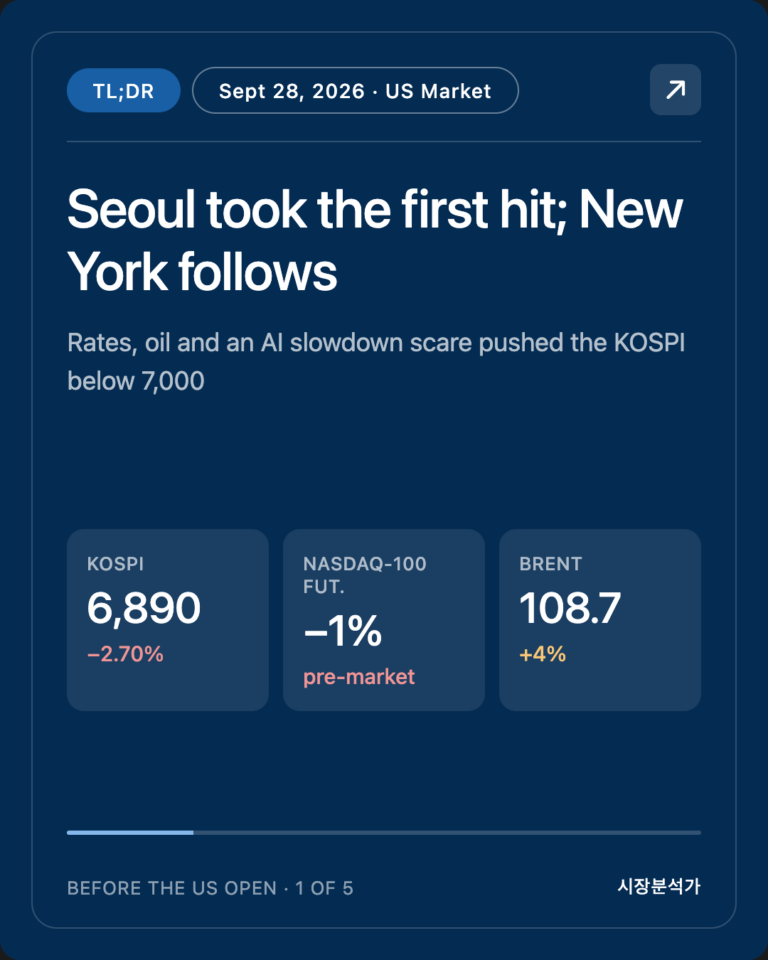
September 29, 2026 US Market Brief — Nasdaq and S&P 500 Before the Open
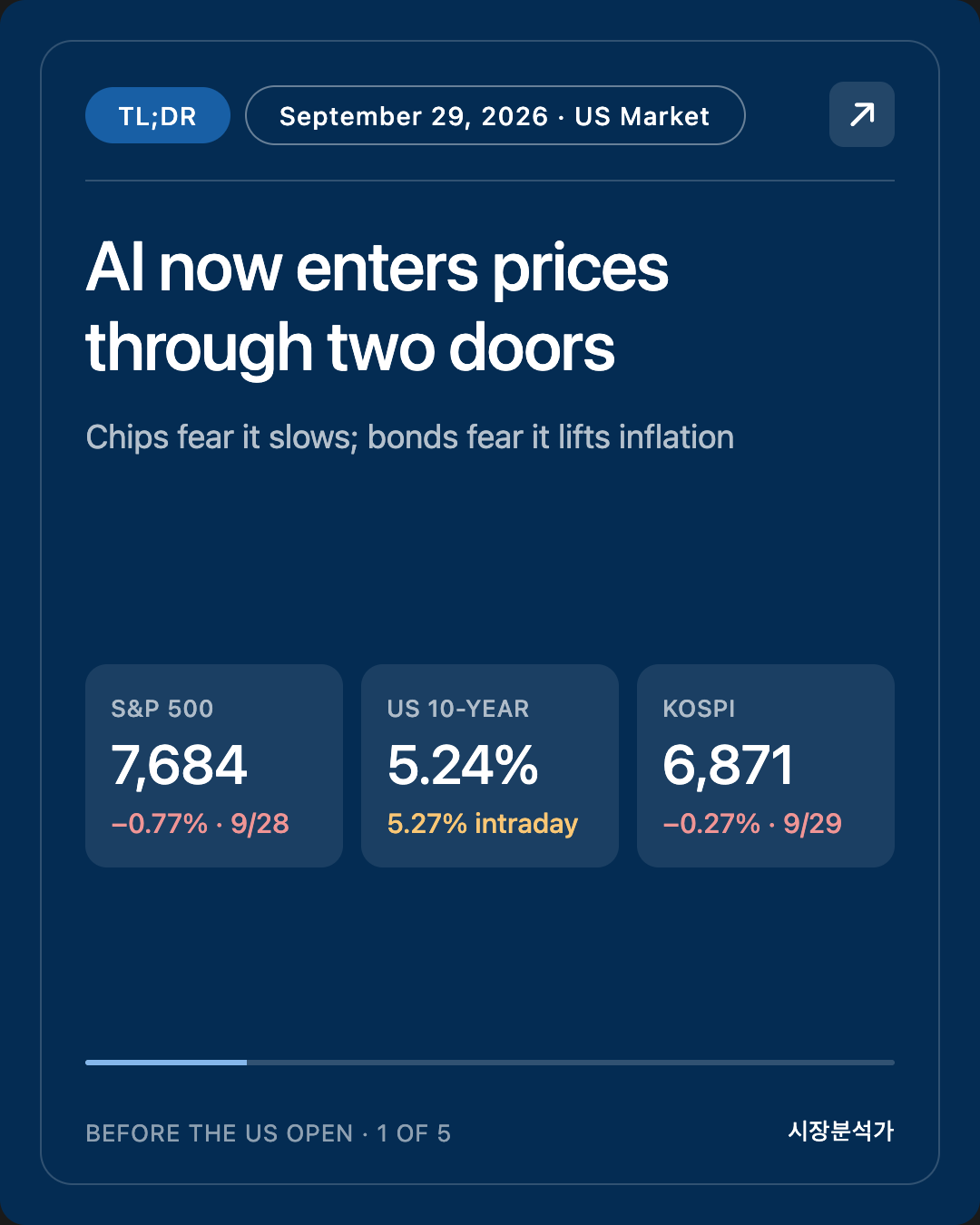
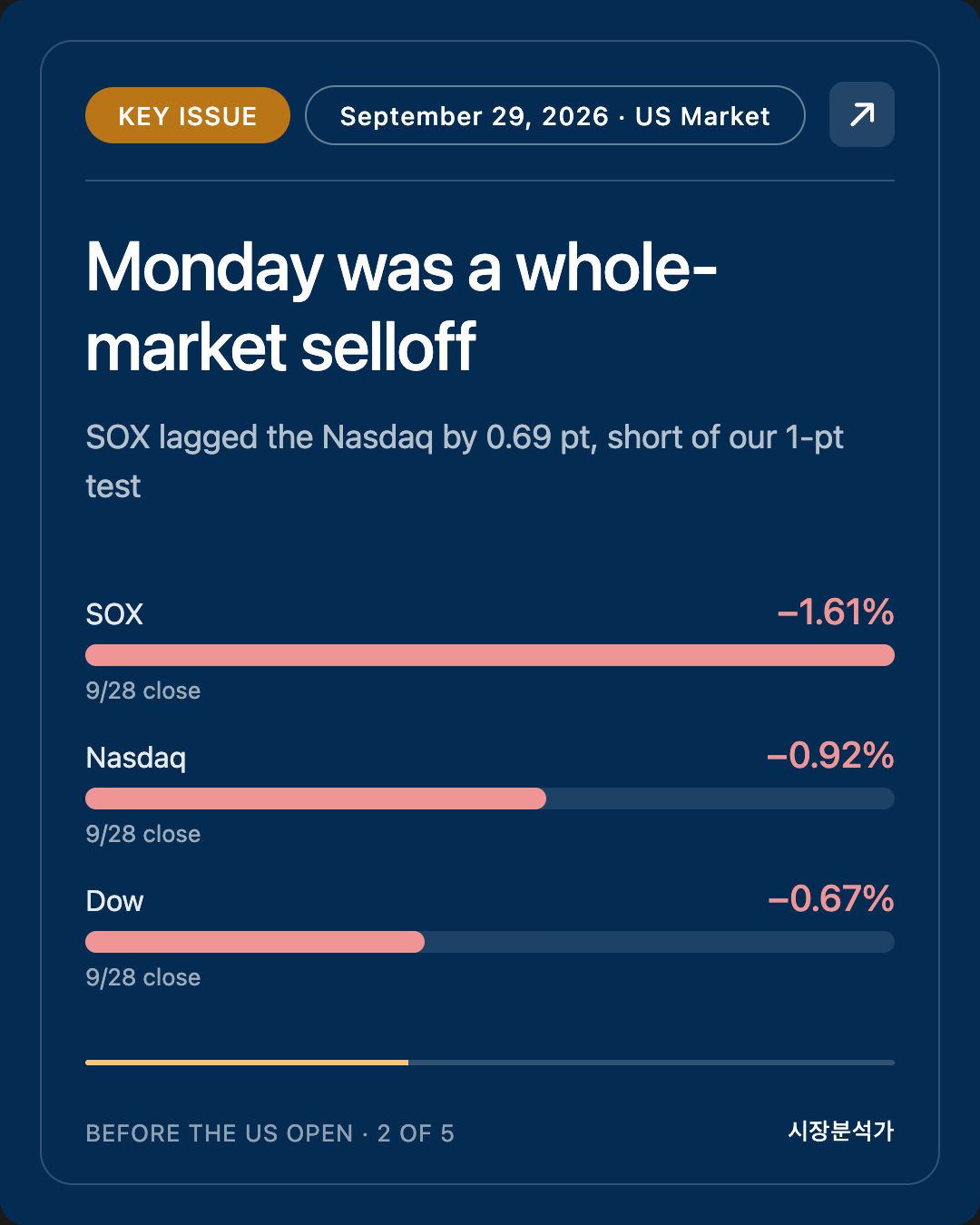
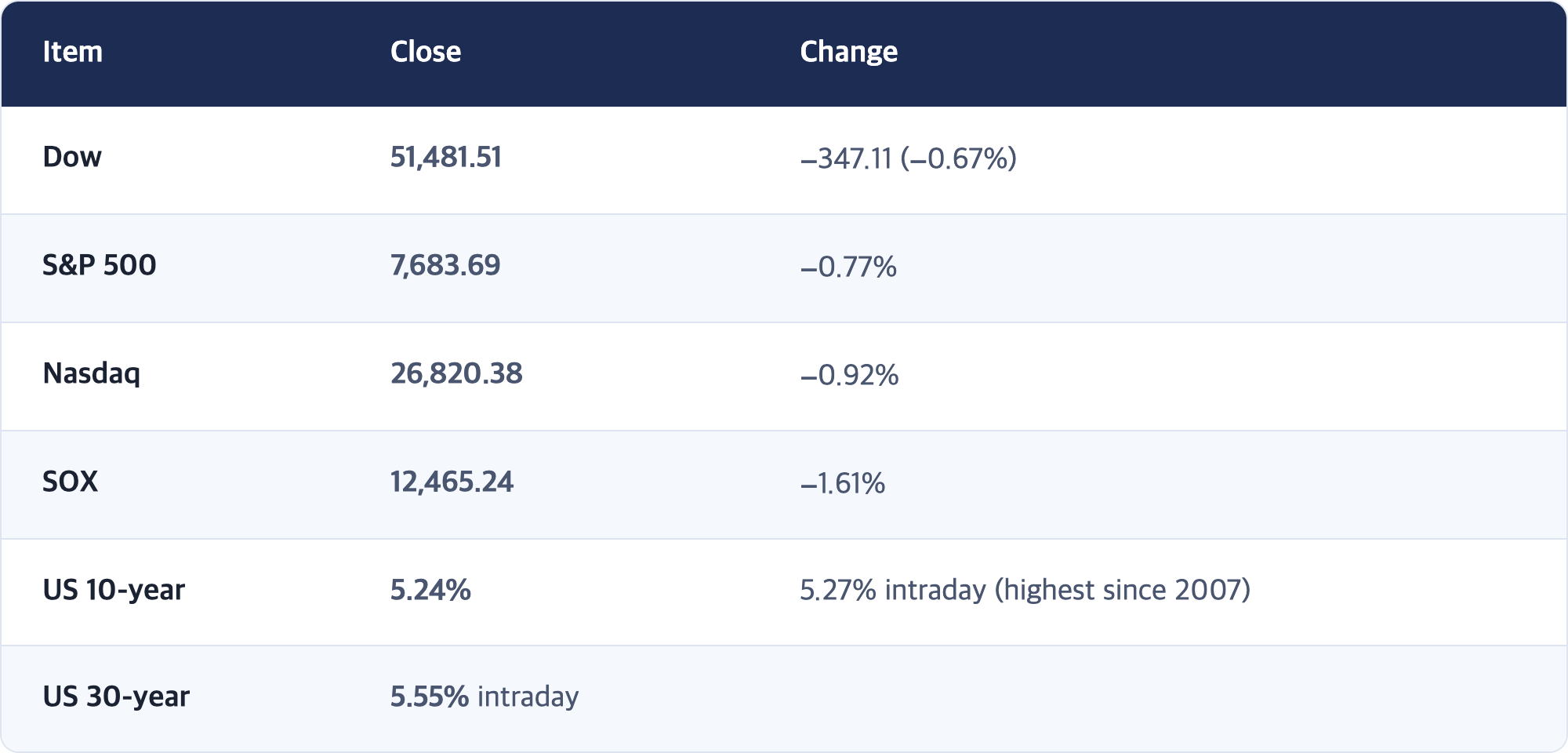
- ★ Monday was not a chip-only selloff. SOX −1.61% vs Nasdaq −0.92%: a 0.69-point gap, short of our 1-point threshold. Instead, the 10-year closed at 5.24% (5.27% intraday, highest since 2007) and weighed on the whole market.
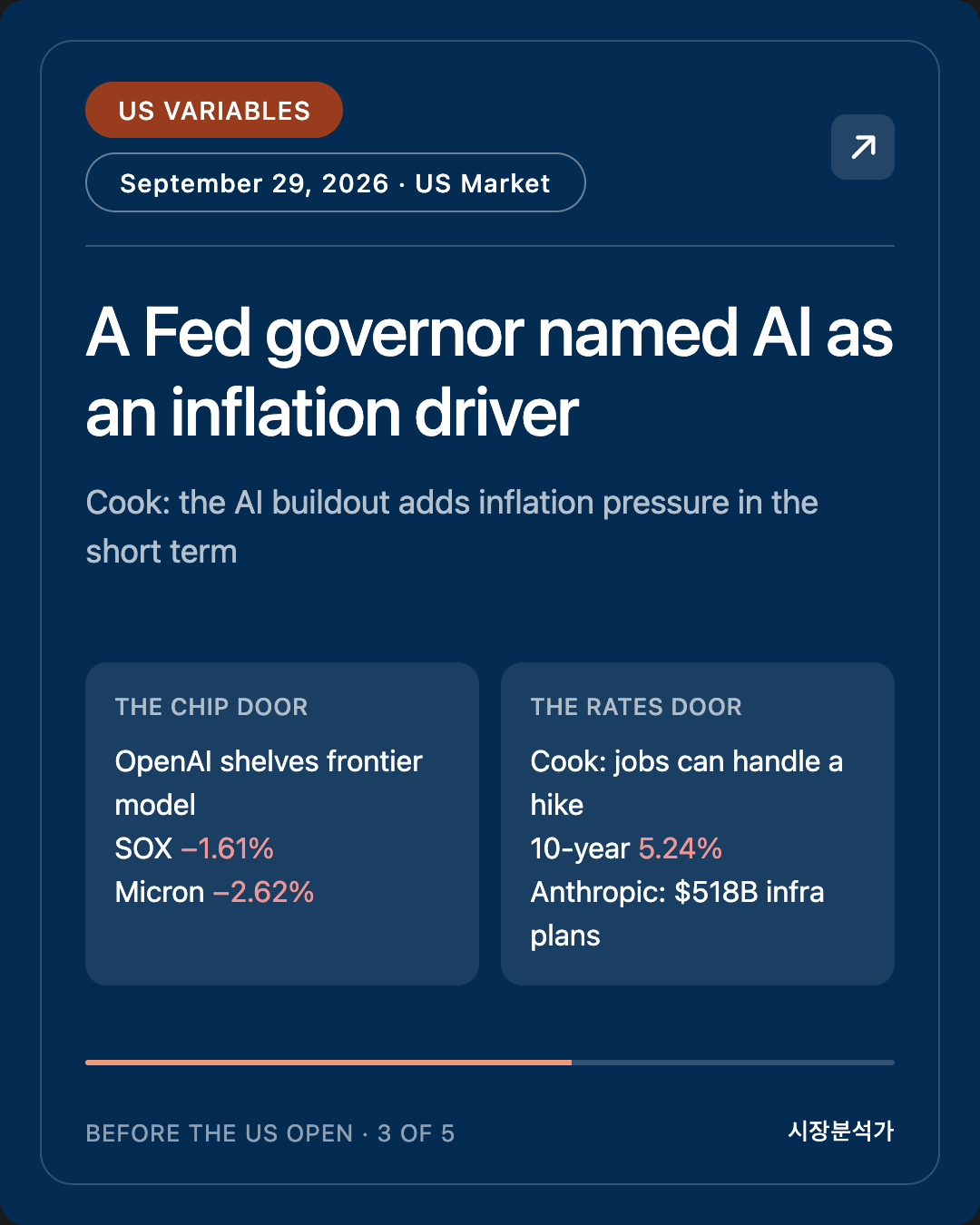
- ★ AI has entered the rates story. In a Sept. 28 speech, Governor Cook said the AI buildout is adding to inflation pressure in the short term and that the labor market can handle higher rates. The same day, Reuters reported on Anthropic's IPO prospectus, which lists $518 billion in future infrastructure commitments.
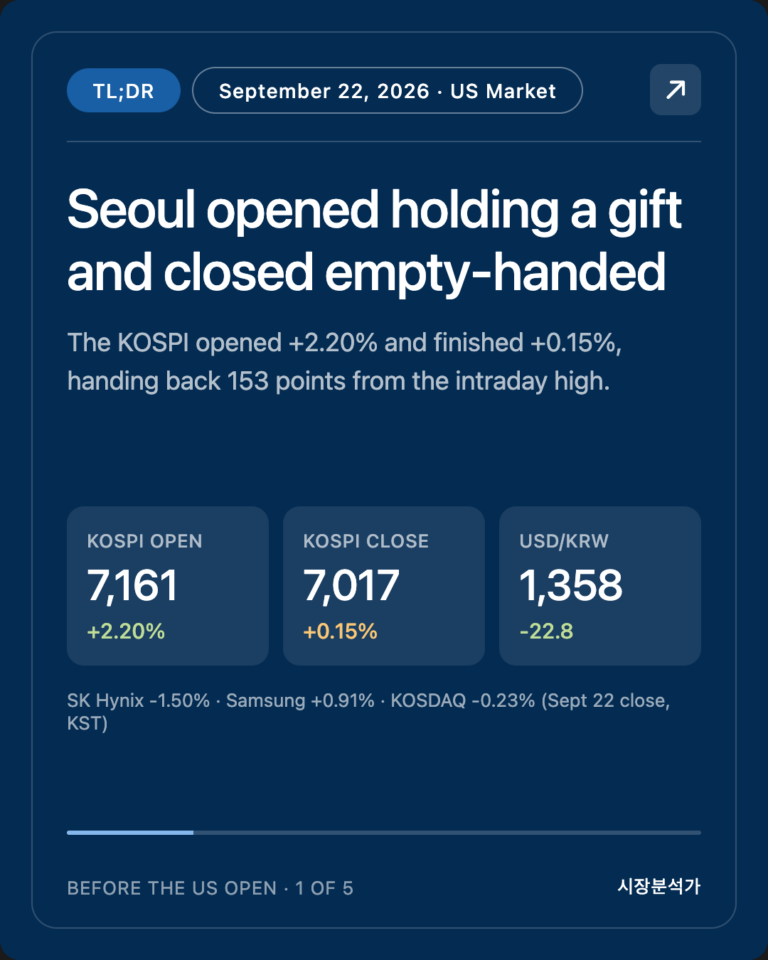
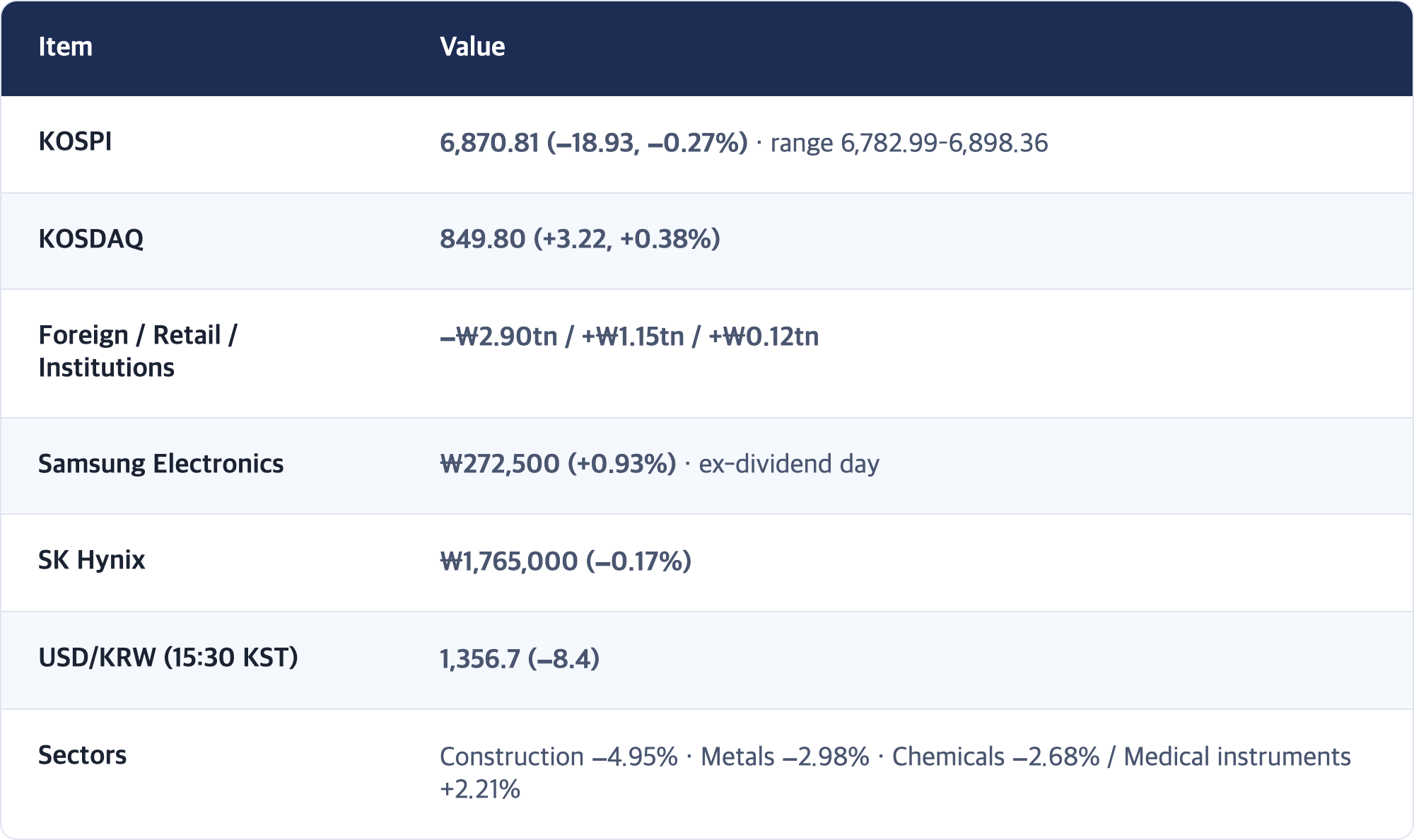
- Seoul held up despite roughly ₩6.1 trillion of foreign selling over two days. KOSPI 6,870.81 (−0.27%), intraday low 6,782.99. Foreigners −₩2.90tn (mostly semiconductors), retail +₩1.15tn, institutions +₩0.12tn. Samsung Electronics rose 0.93% to ₩272,500 on its ex-dividend day; SK Hynix ₩1,765,000 (−0.17%). KOSDAQ 849.80 (+0.38%).
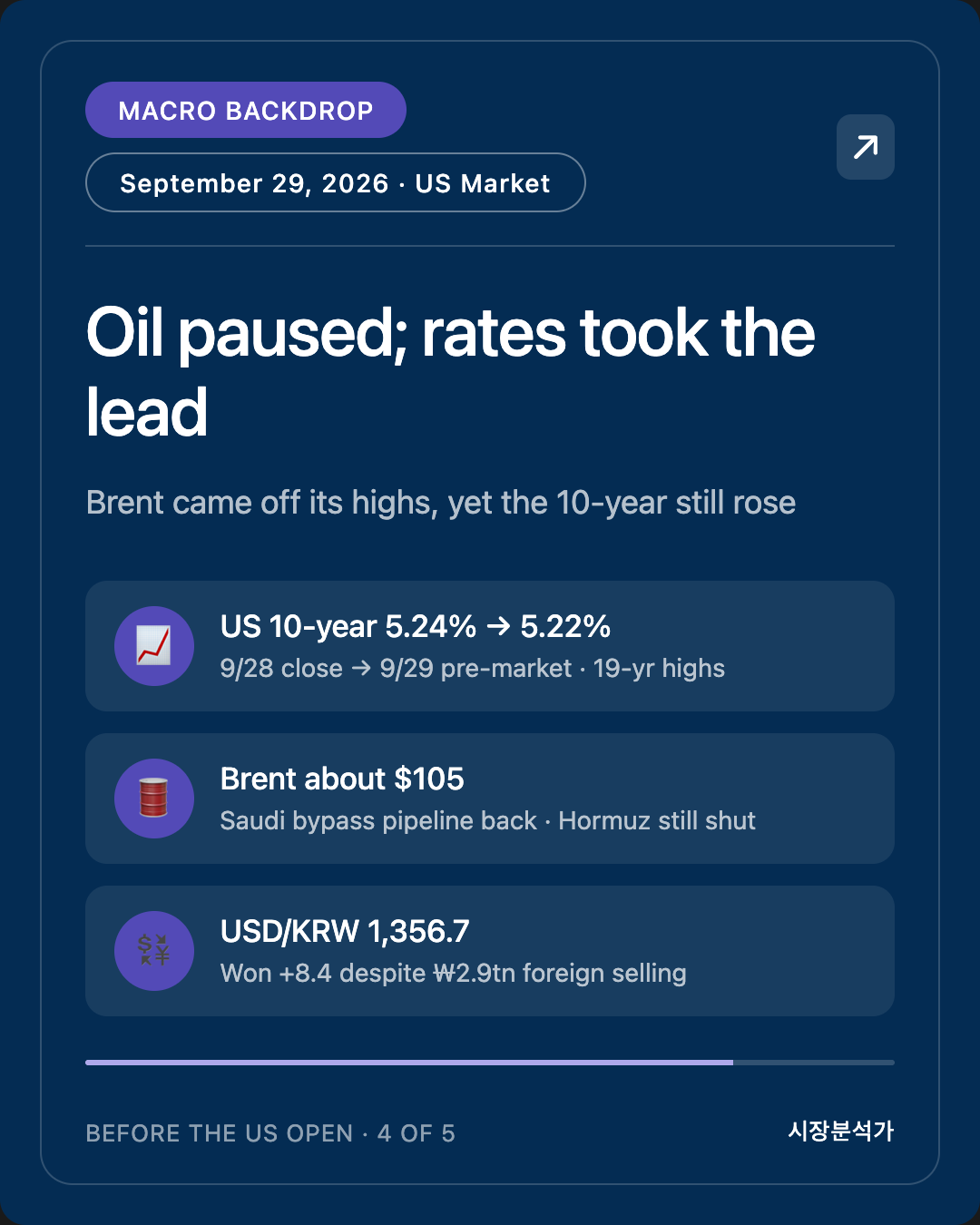
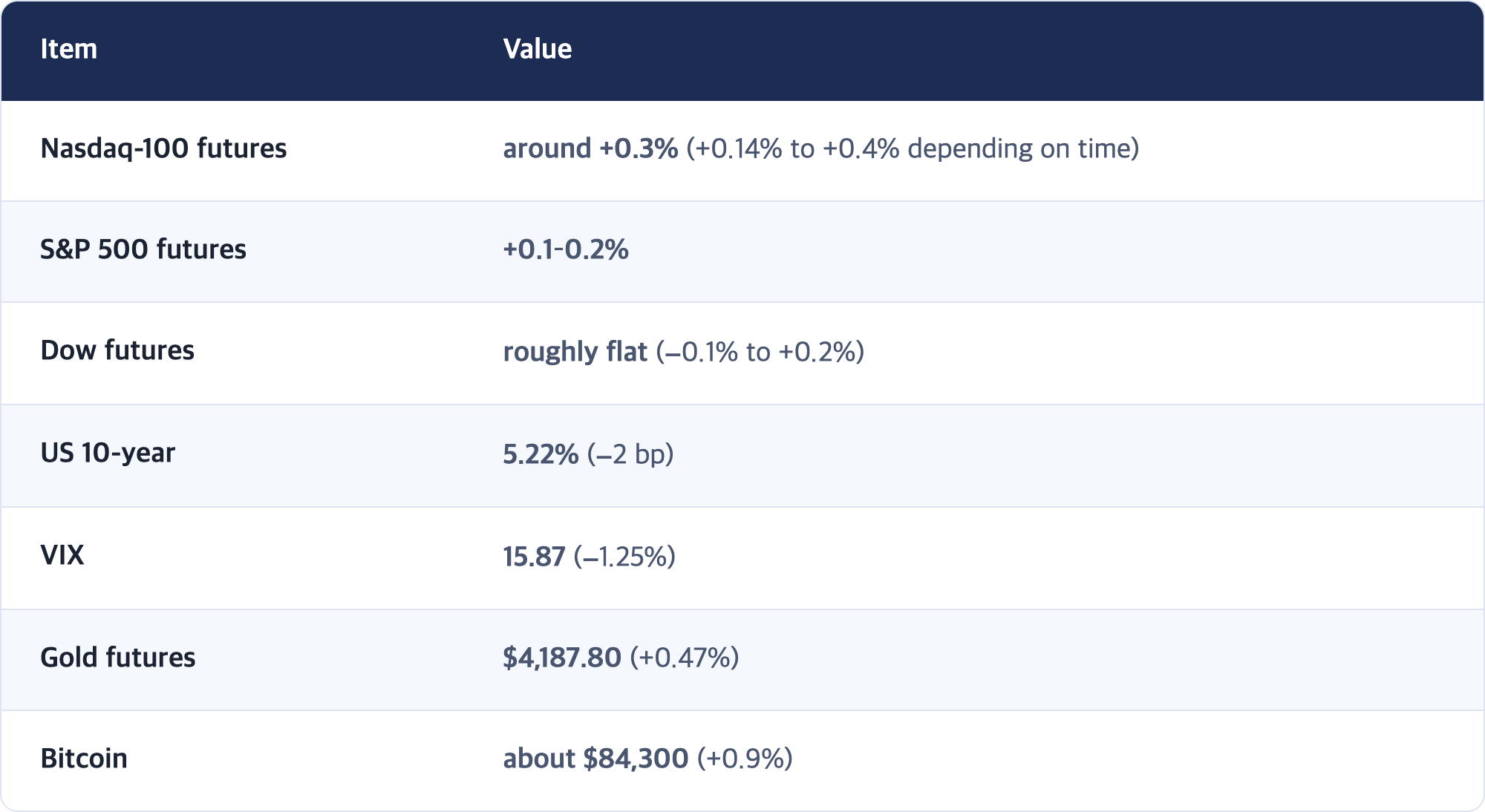
- US futures point to a modest bounce. Nasdaq-100 futures around +0.3%, S&P +0.1–0.2%, Dow roughly flat. 10-year 5.22% (−2 bp), WTI around $92, Brent around $105 (Saudi bypass pipeline restarting vs. gloom on Iran talks).
- Asia lower, Europe led by tech. Nikkei 64,988 (−1.35%), Hang Seng 24,409 (−0.95%), Shanghai flat near 3,823. STOXX 600 640.28 (+0.3%), with chipmakers leading.
This is Mr. Can. Here is the September 29, 2026 brief ahead of the US market open.
Written: 2026-09-29 05:50 PDT (Korea 9/29 21:50 KST)
Basis: US 9/28 official close + Seoul, Tokyo, Hong Kong and Shanghai 9/29 close + Europe 9/29 intraday + US 9/29 pre-market
🟢 Scheduled for 05:30 PDT, work began at 05:43 PDT. US figures are pre-market.
🔴 The 9/28 PM edition (Korea 9/29 preview) was not produced. Section 1 therefore grades yesterday morning's checkpoints against the official US close, and Korea's 9/29 session is covered in Sections 2 and 3.
SEO Intro
US stocks closed lower on Monday, Sept. 28: the Dow −0.67%, the S&P 500 −0.77% and the Nasdaq −0.92%. The Philadelphia Semiconductor Index (SOX) fell 1.61%, and the 10-year Treasury yield touched 5.27% intraday, a fresh 19-year high.
A day later in Seoul, foreign investors sold another ₩2.90 trillion (about $2.1 billion) of Korean stocks, yet the KOSPI slipped only 0.27% to 6,870.81. The won strengthened 8.4 won to 1,356.7 per dollar.
The bigger story is not a number. AI is now entering prices through two doors. For chip stocks, the worry is that AI spending slows down. For bond yields, the worry is that AI spending is so large it keeps inflation high. Fed Governor Lisa Cook said the second part out loud yesterday.
1. Grading Yesterday's Checkpoints (US 9/28 close)
The question was: is New York's decline an AI-sector problem, or a whole-market problem driven by rates and oil?
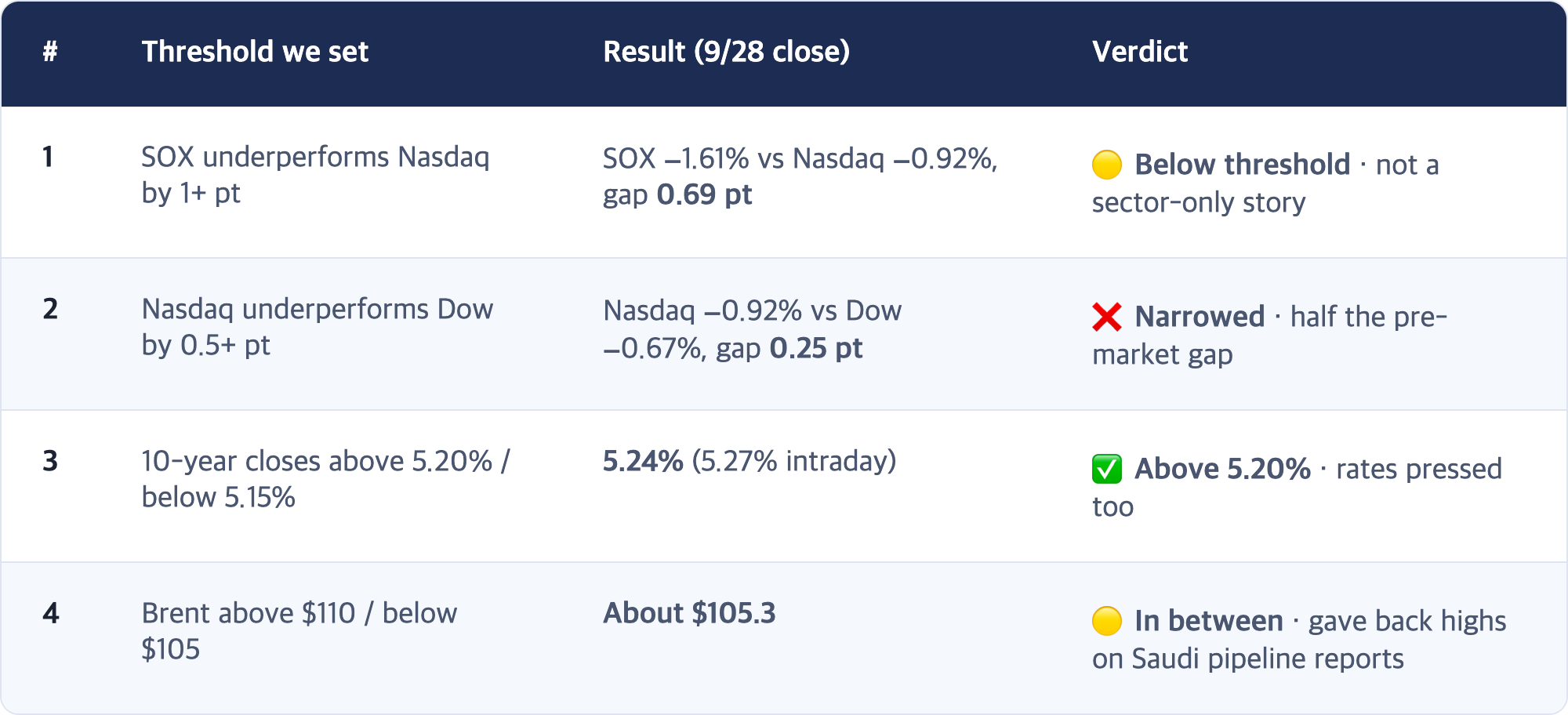
[Interpretation] The answer was "whole market," with AI mixed in
The clearest signal was line 3. The 10-year closed at 5.24%, and the three major indexes fell a fairly even 0.7–0.9%. That is not what a chip-only selloff looks like.
Inside AI, though, the moves split. Nvidia rose 2.1% after adding $150 billion to its buyback authorization, while Micron fell 2.62% and SanDisk and Marvell were weak. Yesterday's study note said volatility grows as you move down the supply chain; that played out inside the US too, with the front of the chain (Nvidia) up and memory at the back down.
A note on our own framing: we split the question into "sector vs. whole market" but did not count the path by which the same AI story reaches the whole market through interest rates. Governor Cook opened that path publicly yesterday (Section 2).
2. Today's Key Issue: AI Enters Prices Through Two Doors
[Fact] Door one, chip stocks: "Will AI spending slow?"
- OpenAI paused training and evaluation of its most capable models, and The Wall Street Journal reported that OpenAI shelved its next frontier model over safety concerns.
- SOX closed at 12,465.24 (−1.61%) on 9/28 after trading as low as 12,277.41. Micron −2.62%.
- Seoul 9/29: foreign selling concentrated in semiconductors (per local reports), about ₩6.1 trillion over two sessions.
[Fact] Door two, interest rates: "AI spending pushes inflation up"
- Fed Governor Lisa Cook (Sept. 28, AI conference in Oakland): in the short term, the AI buildout is adding inflation pressure and delaying the return to 2%. Pass-through from higher oil and Middle East supply disruptions continues. Inflation ran about 3.8% over the 12 months through August, "too high for too long." The labor market is well positioned to handle an increase in rates. She stopped short of saying more hikes are needed.
- Same day, Reuters reported on Anthropic's IPO prospectus: 2025 revenue of about $4.6 billion (12-fold growth), a net loss of $42 billion, and $518 billion in future infrastructure commitments. Target valuation up to $2 trillion; the listing may slip past the November midterms (reported).
★ [Interpretation] Two doors that look opposite, opened on the same day
Door one says AI spending might shrink. Door two says AI spending is so large it lifts inflation. That sounds contradictory, but for markets both read as negatives:
- If spending slows, chip orders slow.
- If spending continues, demand for power, equipment and labor pushes prices up, giving the Fed a reason to hike. Higher rates cut the value of AI stocks whose profits sit far in the future.
So AI chips now sit where news from either direction can shake them. Only one combination relieves the tension: spending stays on plan and inflation cools. This week two numbers each measure half of that. Tomorrow's (9/30) 05:30 PDT August PCE inflation covers the inflation side; Micron's earnings after tomorrow's close cover the spending side.
[Observation] Anthropic's $518 billion runs against the "AI spending is shrinking" worry, which may be part of why Nasdaq futures are bouncing this morning. But the same document's $42 billion loss and its warning of "existential risks to humanity" also fed AI-safety jitters (reported). One filing supplied both sides of the argument.
3. US Variables: Yesterday's Close and This Morning
[Fact] US official close, Mon 9/28
[Fact] US pre-market, 9/29 (around 05:30–06:00 PDT)
[Fact] Seoul close, 9/29
[Interpretation] Seoul sold chips, then bought chip equipment
Foreign selling targeted semiconductors, yet Samsung rose on its ex-dividend day (when a stock typically drops by the dividend it no longer carries), and chip-equipment names HPSP (+9.29%) and PSK Holdings (+8.33%) jumped. The biggest losers were rate- and cycle-sensitive sectors: construction, metals, chemicals and batteries. On day two, the center of Seoul's weakness shifted from chips to rate-sensitive sectors, matching the "whole market" verdict in Section 1.
The won strengthening 8.4 won on a day of ₩2.9 trillion in foreign selling is unusual. The sale proceeds may not have been converted straight into dollars, or oil's retreat from its highs may have mattered more. One day is not enough to tell.
4. Macro Backdrop: 5.2% Yields, $105 Oil, October FOMC
[Fact]
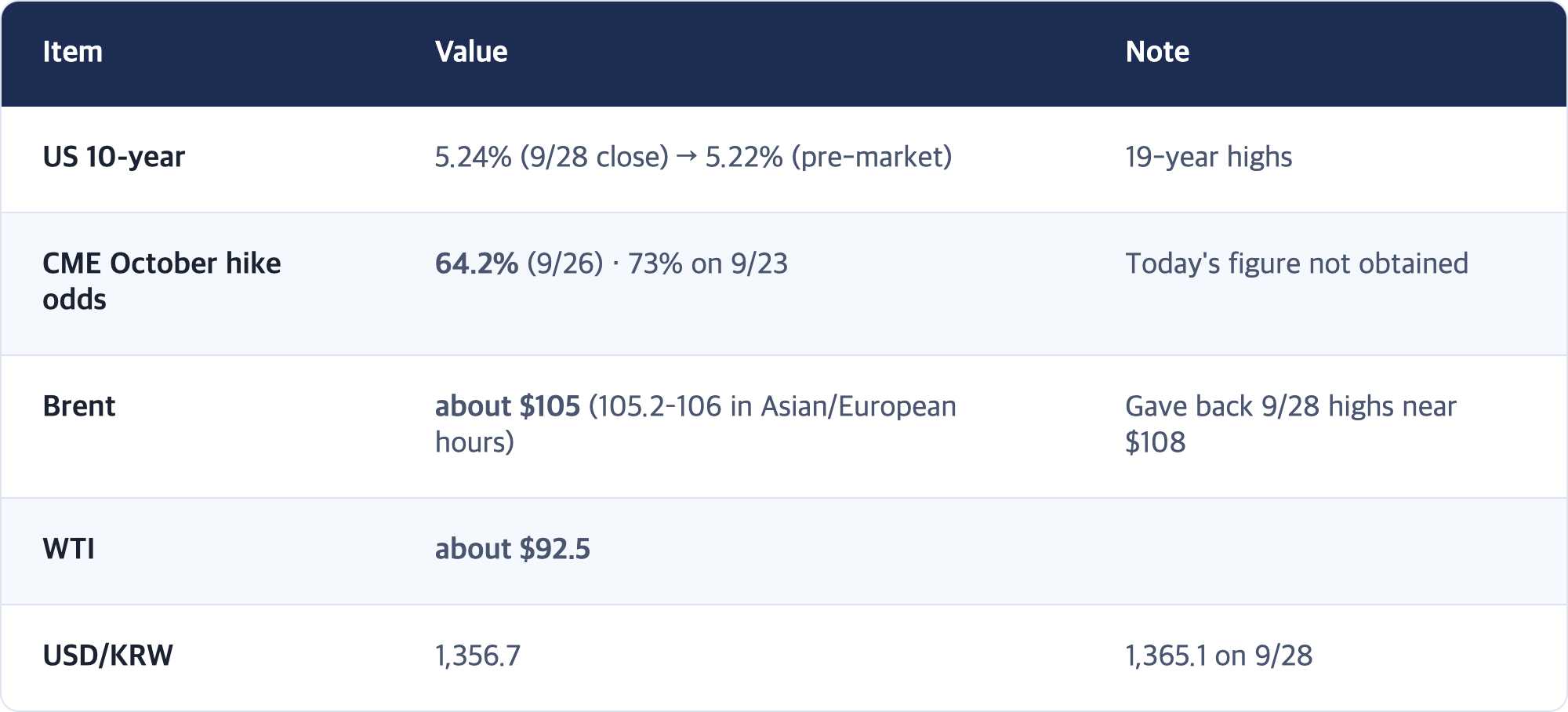
[Fact] Iran and Saudi Arabia
- Reports that Saudi Arabia's East-West pipeline (the route around Hormuz) was repaired and back to about 3.5 million barrels a day knocked oil off its 9/28 highs.
- Iranian officials have signaled that a deal to reopen Hormuz before the November US midterms is unlikely (reported), and the US and Iran are talking separately with mediators. The strait remains closed.
[Interpretation] Oil paused; rates took the lead
Until a few days ago, oil was pulling yields higher. Yesterday Brent came off its highs and the 10-year still climbed to 5.24%. The forces pushing rates have widened from oil alone to oil + Fed speakers + AI-driven inflation. From here, lower oil alone may not bring yields down with it.
5. Today's US Session (9/29 PDT) Preview
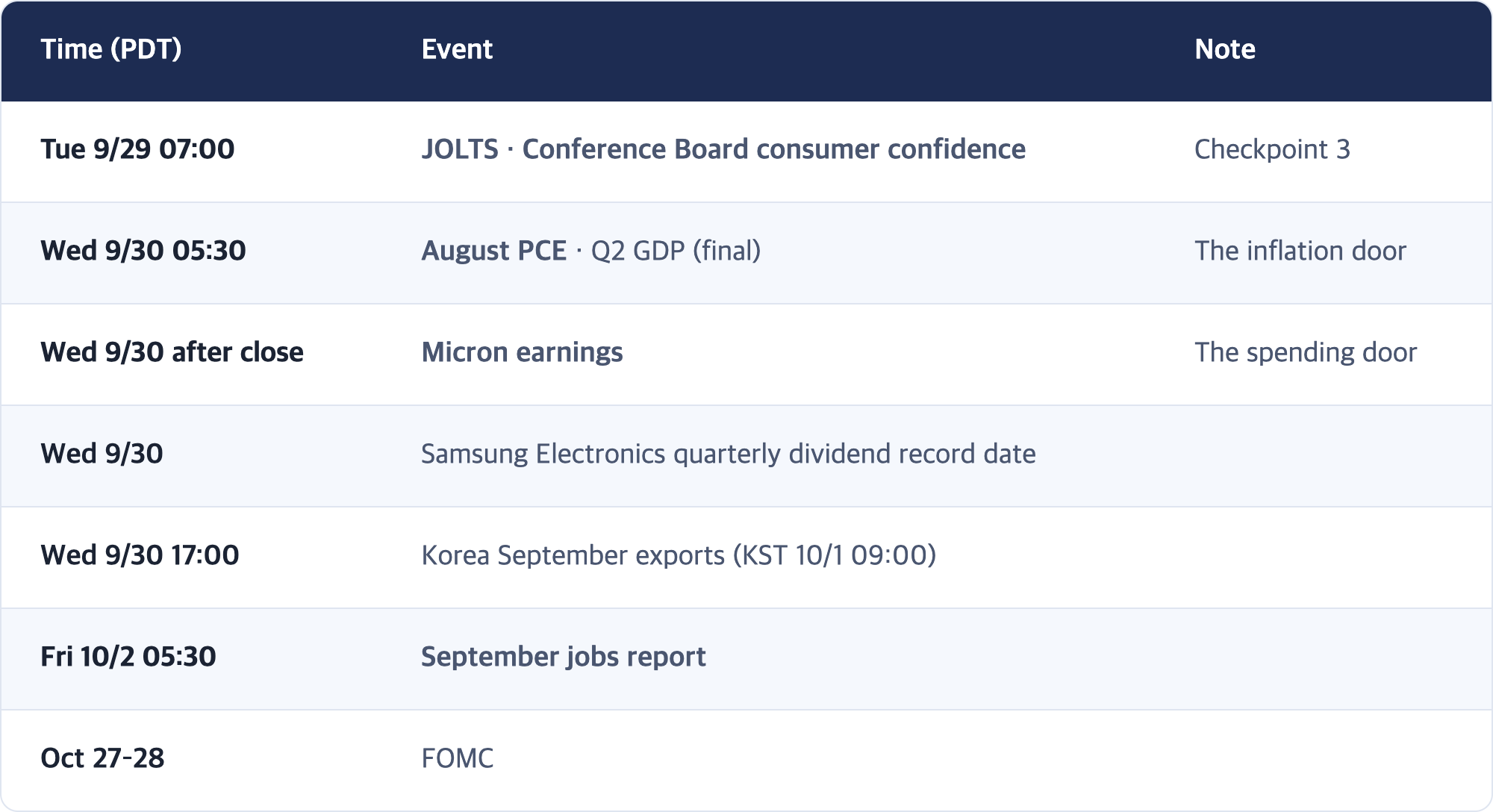
[Observation] Schedule (PDT)
- 06:30 US regular session opens
- 07:00 August JOLTS (job openings) · September Conference Board consumer confidence
- Wed 9/30 05:30 August PCE inflation · Q2 GDP (final)
- Wed 9/30 after the close Micron earnings
- Fri 10/2 05:30 September jobs report
- Oct 27–28 FOMC
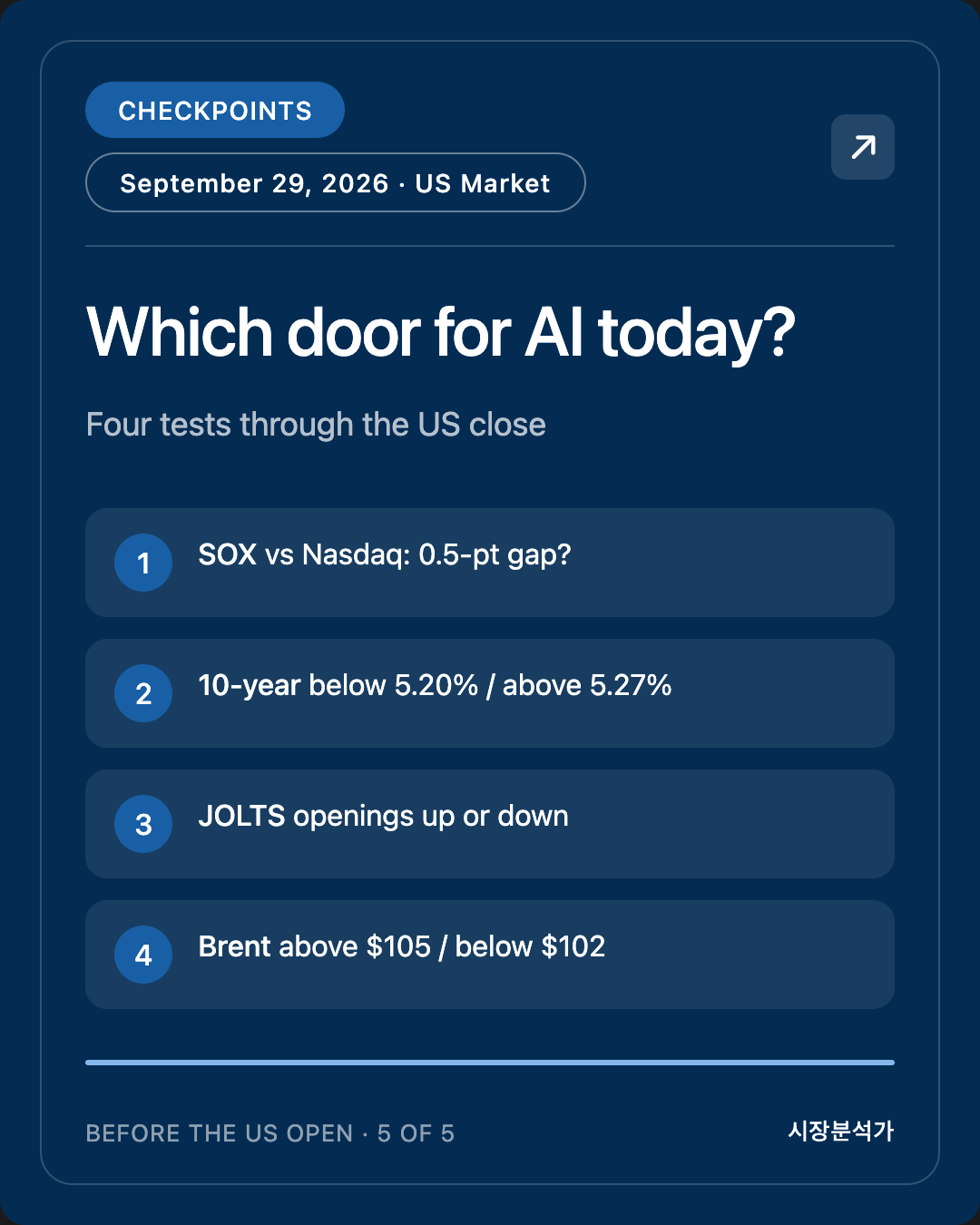
✅ Four Checkpoints (through today's US close)
The axis first: these four decide which door AI comes through harder today: chip stocks (spending pace) or rates (inflation). The answer tells Korean investors whether to watch only chips tomorrow or rate-sensitive sectors as well.
- Does SOX beat the Nasdaq? Outperforming by 0.5+ pt means chip worries are easing; lagging by 0.5+ pt means spending-pace fears persist. (Most important)
- 10-year close below 5.20% / above 5.27%. Below means the rates door closed for a day; above means a new high and rates stay in charge.
- Did JOLTS job openings rise or fall from the prior month? The first data test of Cook's "labor market can handle a hike." A rise leans toward an October hike; a fall leans the other way.
- Brent close above $105 / below $102. Above means Iran pessimism beats the Saudi pipeline restart; below means the pipeline is pushing oil a step lower.
Line 1 carries the most information. If chips rebound and the 10-year drops under 5.20%, the two-day slide looks like a temporary wobble inside a rate spike. If chips lag again while the 10-year breaks 5.27%, far more rides on tomorrow's PCE and Micron numbers.
6. Study Note: Why an Investment Boom Raises Inflation
Concept
Total demand in an economy is roughly consumption + investment + government spending + net exports. When companies build lots of factories and data centers at once, investment demand rises. During construction they draw on resources first (electricity, copper, construction workers, chip-making tools), but the finished facilities only start producing goods and services years later. So during the build phase, demand runs ahead of supply and pushes prices up.
Analogy
Picture a big shopping mall going up in your neighborhood. For two years of construction, local labor rates and concrete prices rise first. Any savings from the mall's competition come only after it opens.
Today's example
- Governor Cook: the AI buildout adds inflation pressure "in the short term." That phrase matters. She leaves room for AI to raise productivity and lower inflation later, but says we are in the build phase now.
- Anthropic's $518 billion in infrastructure commitments (reported): a sense of how big that build phase is.
- US 10-year at 5.24%: the bond market pricing that pressure.
One-line summary
AI investment raises inflation while it is being built and can lower it only after it is finished. The Fed is looking at the build phase, which is why an AI boom can become a reason to raise rates.
7. Corrections and Open Items
🔴 Missing 9/28 PM edition
The Korea 9/29 preview scheduled for 16:00 PDT on 9/28 was not produced (no file in the reports folder). The cause was not identified in this run. Grading of the 9/28 AM checkpoints appears in Section 1 here.
Source discrepancies (adopted values stated)
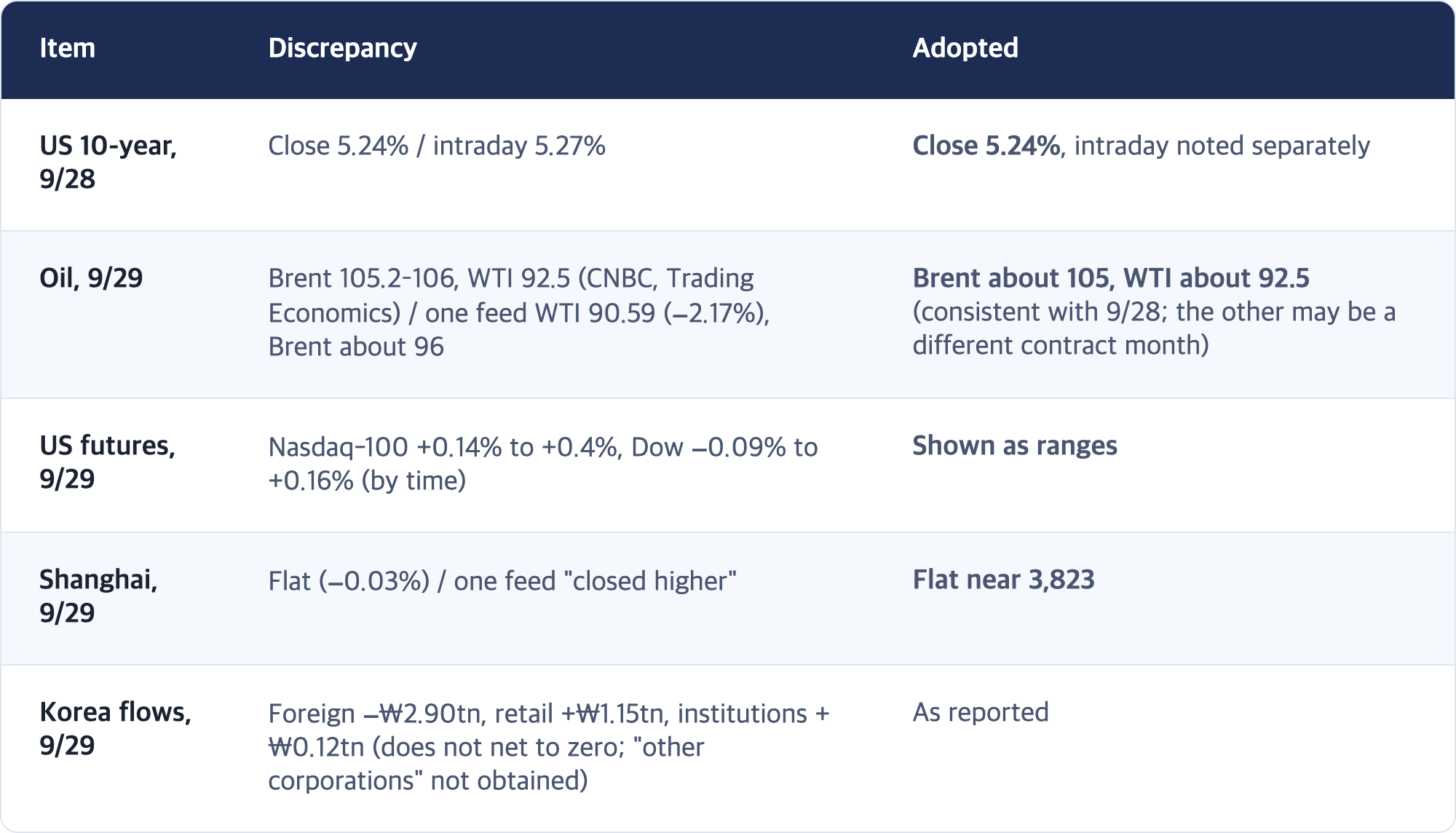
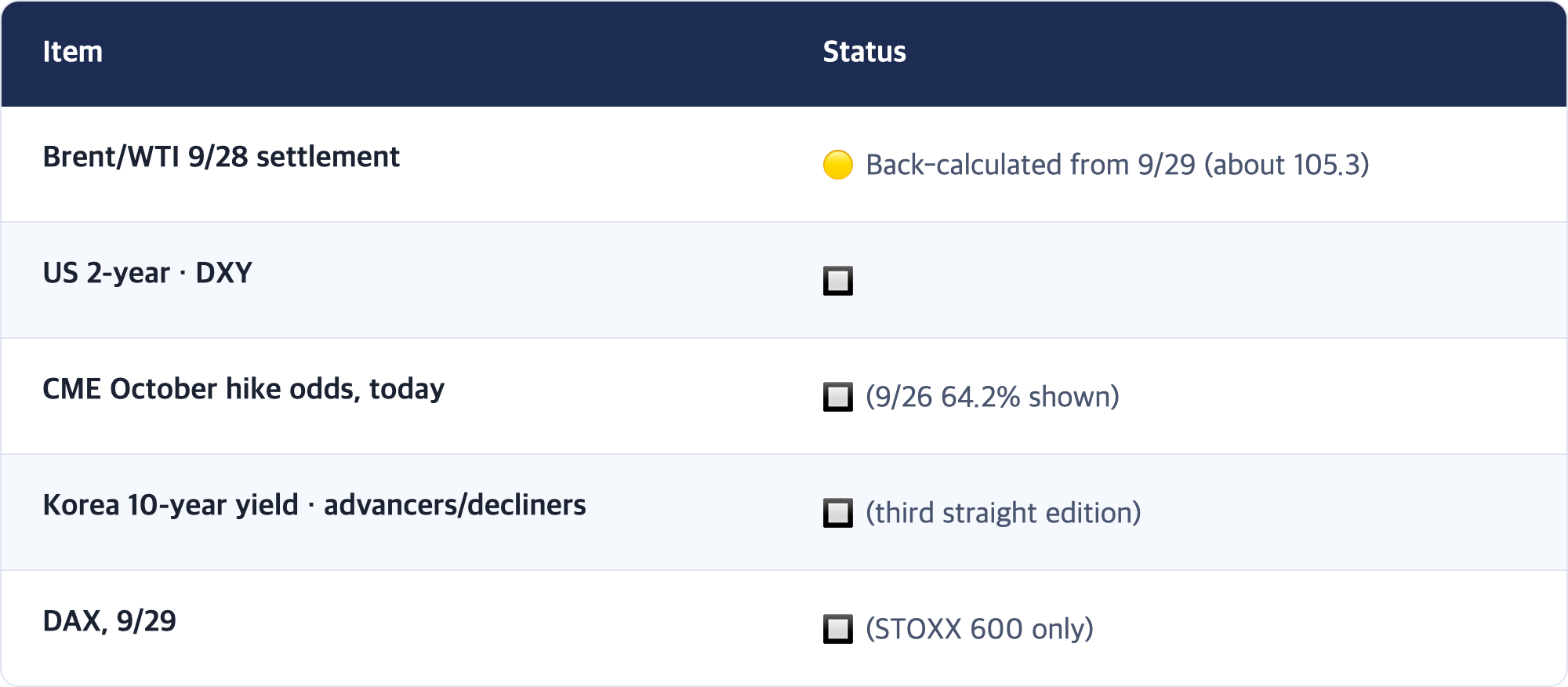
🔲 Not yet confirmed
8. Event Calendar (PDT)
Sources
- Foreigners sell ₩2.9tn; KOSPI ends slightly lower near 6,870 | Asia Economy
- KOSPI retreats to 6,870 on ₩3tn foreign selling | Newspim
- Samsung Electronics closes at ₩272,500 | Seoul Shinmun
- Samsung rises 0.9% despite ex-dividend | Segye Ilbo
- Won-dollar falls 8.4 won to 1,356.7 | Money Today
- Stock Market News for Sep 28, 2026 | Yahoo Finance
- Stock market today, Sept. 29: futures edge higher as oil retreats, Anthropic and OpenAI fuel AI jitters | Yahoo Finance
- Stock Market Today (Sept. 29, 2026) | TheStreet
- US Stock Futures Rise as Traders Await Key Economic Data | Bloomberg
- Philadelphia Semiconductor Index drops as OpenAI training pause sparks AI hardware sell-off | TradingKey
- Nvidia share buyback plan gets $150 billion boost | CNBC
- Fed's Cook sees further inflationary pressures ahead | Reuters via Investing.com
- Lisa Cook says AI surge risks wider inflation through energy and labor | The Hill
- Anthropic's IPO prospectus shows sweeping AI vision, surging costs: Reuters | CNBC
- Oil prices flat as Middle East supply concerns persist | CNBC
- Brent crude oil | Trading Economics
- European shares edge higher as tech stocks offset oil pressure | Reuters via Investing.com
- Market Pulse – September 29, 2026 | NordFX
Market Analyst · This report does not recommend buying or selling individual securities. It offers macro context and interpretation.
📌 More market briefs
※ This post is market observation and organization intended to support your own judgment. It is not a recommendation to buy or sell any security. Figures are as of the time of writing and may differ between sources.
If this was useful, bookmark it or pass it along. It genuinely helps me write the next one.
I can survive. We can survive.