Oct 14, 2026 KOSPI Market Brief — What to Watch Before the Korean Open
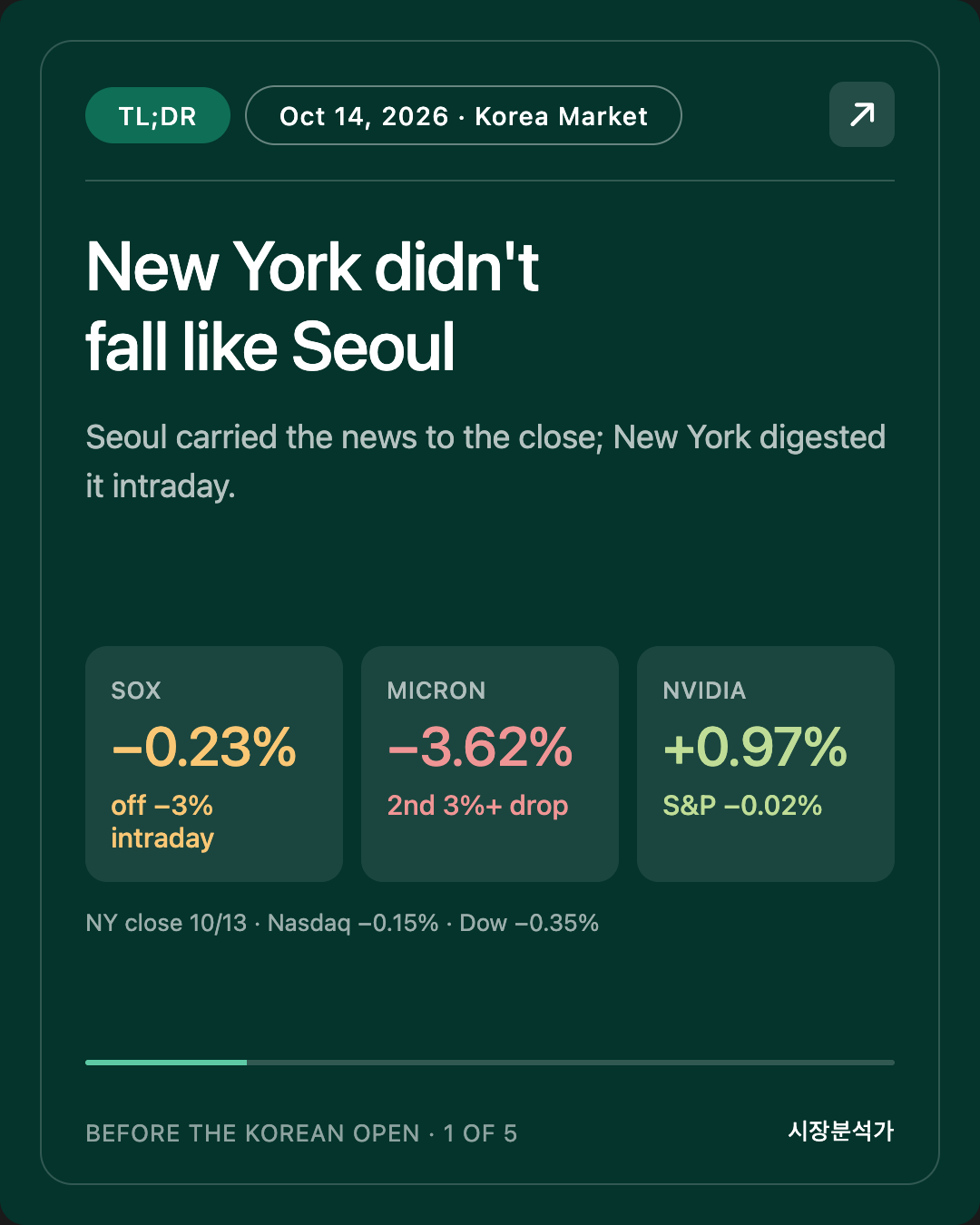
New York did not fall as hard as Seoul. On Tuesday, October 13, the S&P 500 closed at 7,805.45 (−0.02%), the Nasdaq at 27,204.38 (−0.15%) and the Dow at 51,670.10 (−0.35%). The Philadelphia Semiconductor Index (SOX) fell more than 3% intraday but recovered almost all of it to finish −0.23%, and Nvidia rose 0.97%. Micron lost 3.62%, its second straight 3%-plus drop.
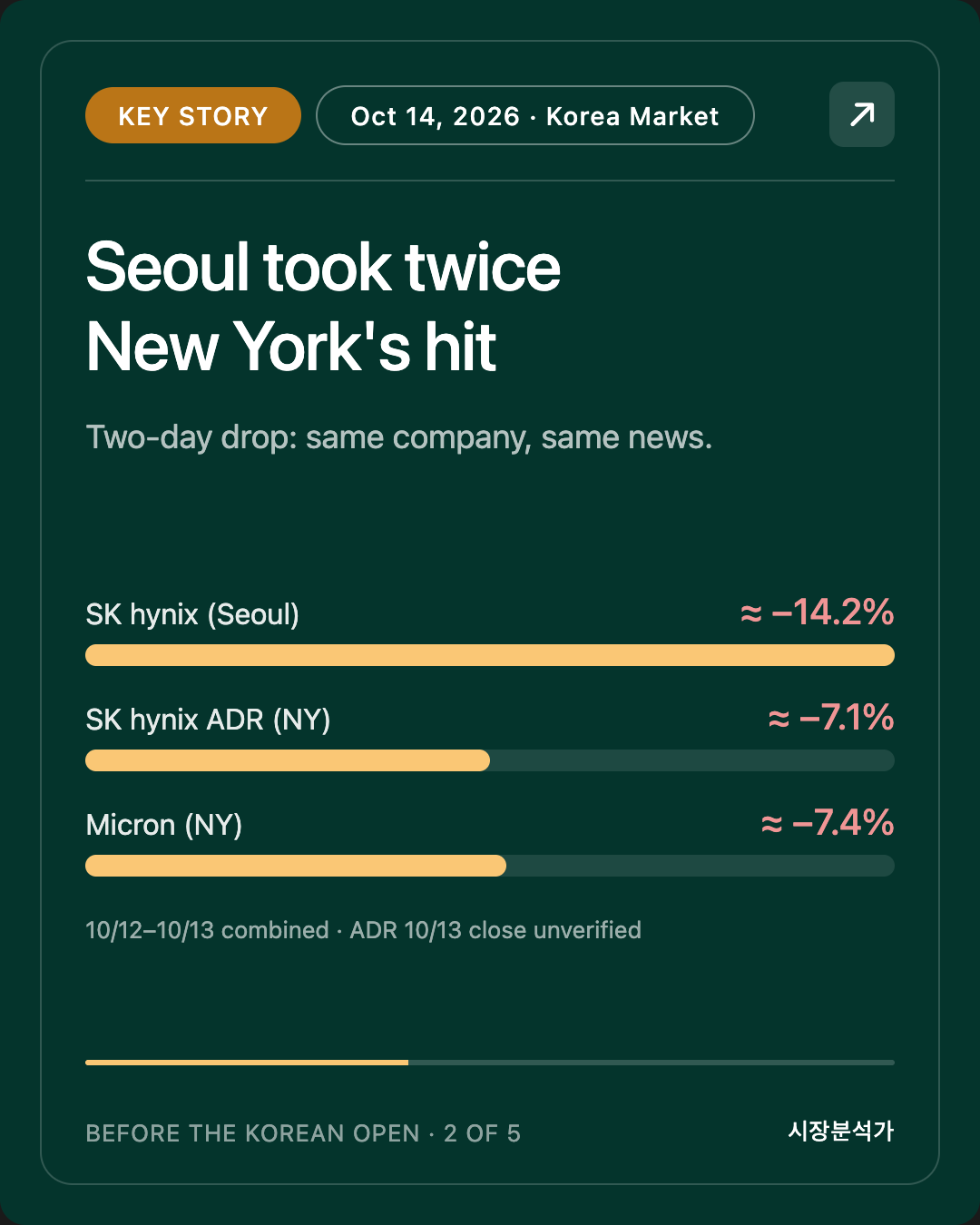
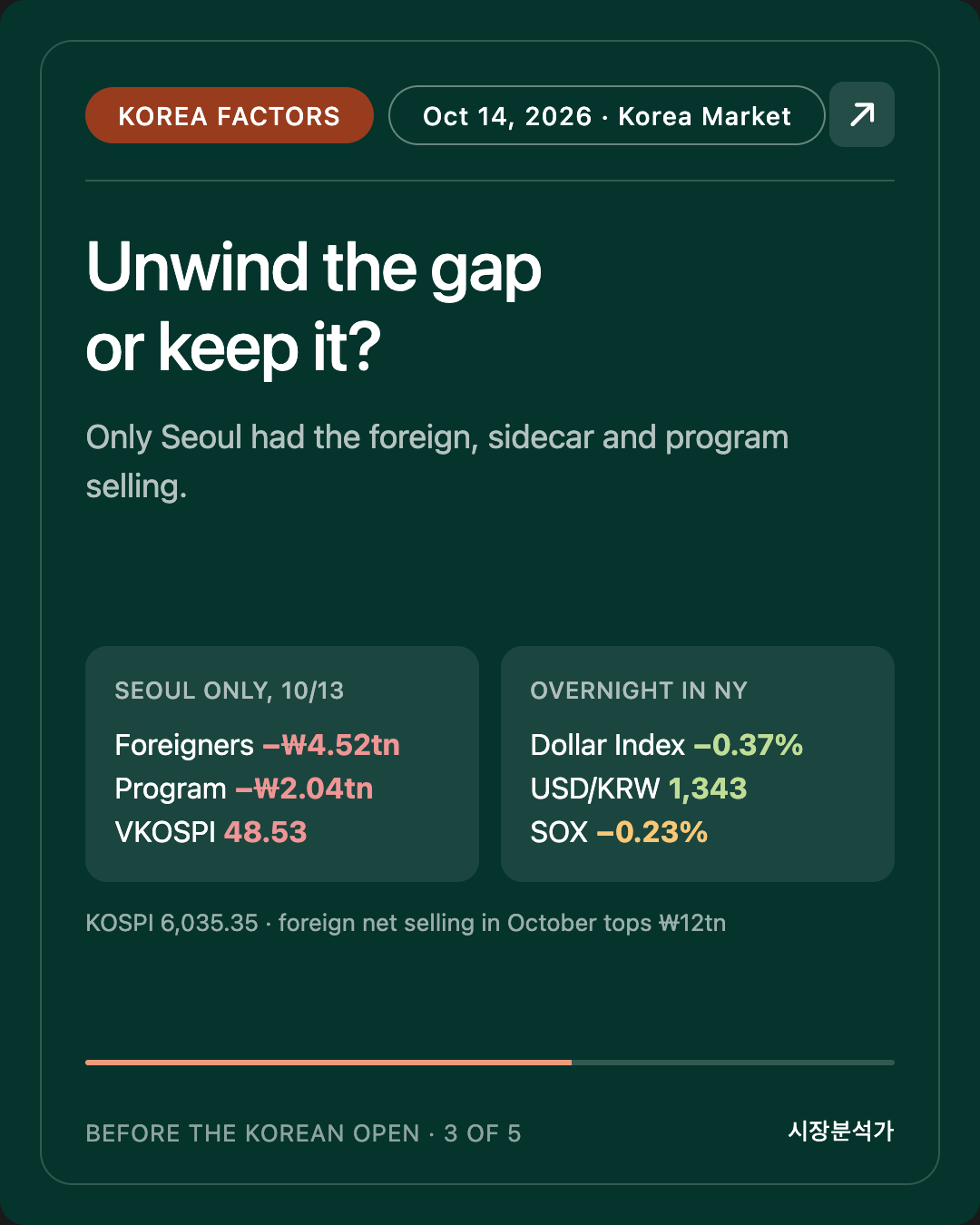
Line up the same two days and the gap is striking. In Seoul, SK hynix fell about 14% across October 12–13. Over the same stretch Micron fell about 7%, and SK hynix's own US-listed ADR also fell about 7%. Same news, same company, and Seoul took twice the hit.
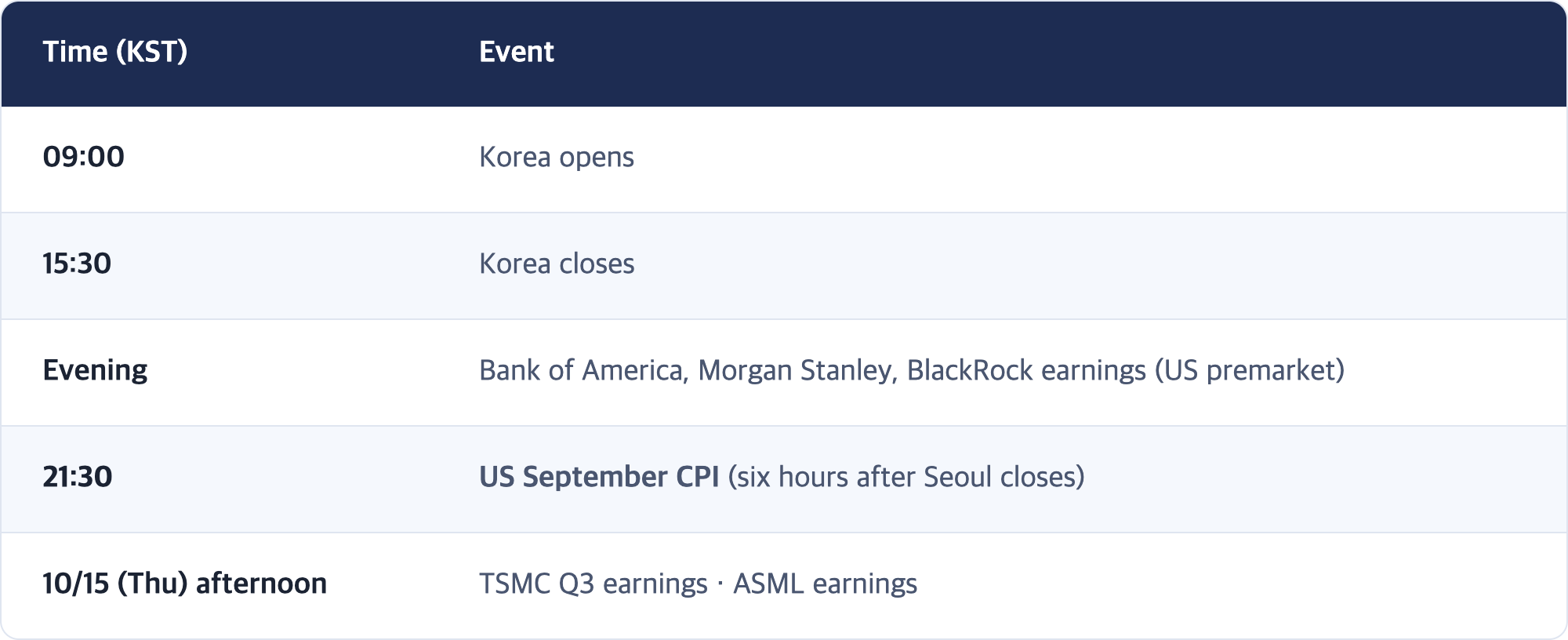
That sets up the question for Korea on Wednesday, October 14: if the gap came from selling pressure unique to Seoul (foreign outflows, a circuit-breaker-style "sidecar," program trading), part of it should unwind today. If the gap holds, it points to foreign investors cutting their Korea allocation itself. And US September CPI lands at 21:30 KST tonight, six hours after Seoul closes.
This is Mr. Can. Here is the Oct 14, 2026 brief ahead of the Korean market open.
Written: 2026-10-14 08:10 KST (Vancouver 10/13 16:10 PDT)
Basis: US 10/13 (Tue) regular-session closes (05:00 KST 10/14) + 10/13 oil settlements + 10/13 New York Treasury close + Seoul 10/13 close
🟢 Scheduled 16:00 PDT, started 16:01 PDT. On time.
🟢 No missed editions. The previous edition was the 10/13 pre-US-open brief.
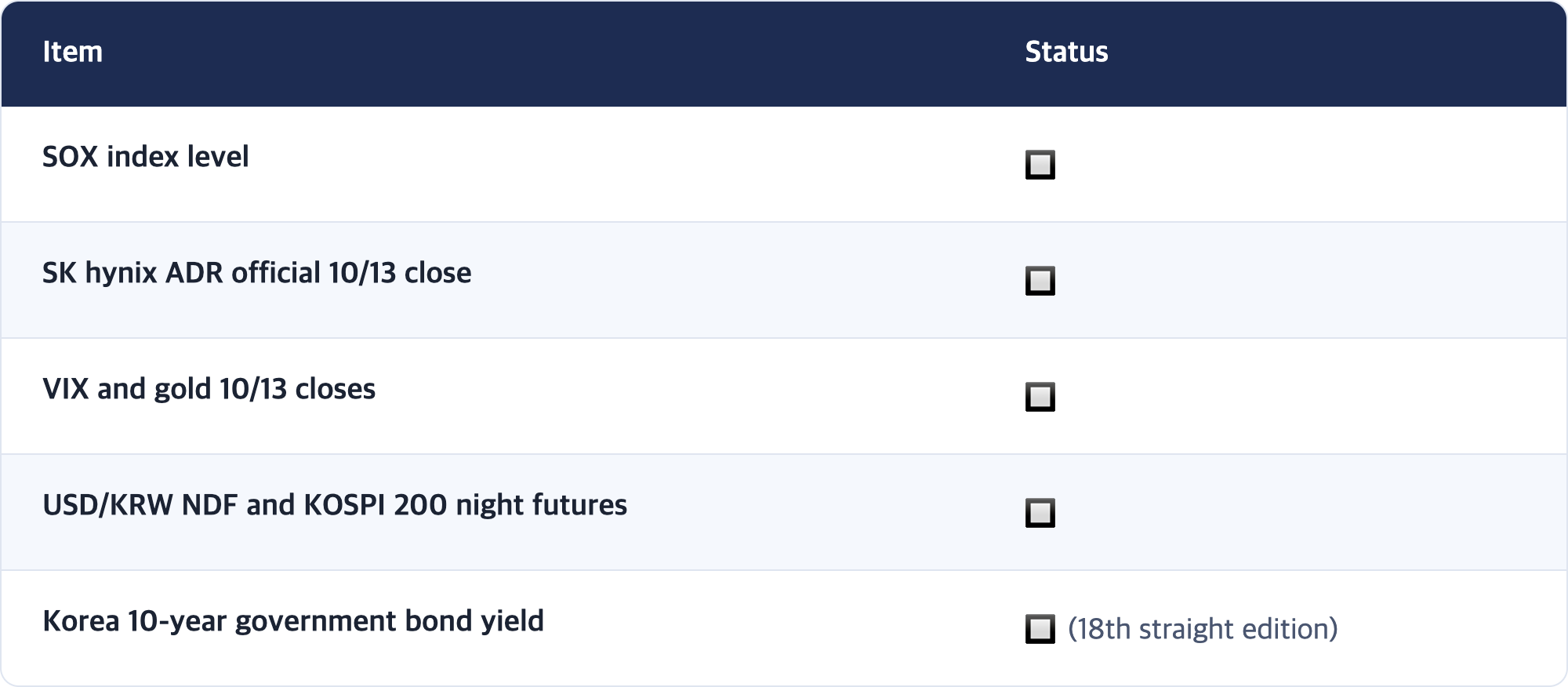
🟡 VIX, gold and the SOX index level were not available. For the SOX we use the percentage change only (see section 7).
⚡ TL;DR
- ★ New York didn't take a second hit. SOX −0.23% (after being down 3%+ intraday), Nvidia +0.97%, Nasdaq −0.15%. Only Micron (−3.62%) and chip-equipment maker Applied Materials (−6.69%) fell hard.
- ★ Over two days, Seoul fell twice as much as New York. SK hynix in Seoul ≈ −14.2% vs Micron ≈ −7.4% and the SK hynix ADR ≈ −7%. Much of the gap looks like Seoul-specific selling pressure (interpretation).
- Banks beat and still got sold. Citi −5.6% (earnings beat), Wells Fargo −3.1%, JPMorgan −0.8 to −0.9%, Goldman −0.2%. The premarket "rotation from tech into banks" was gone by the close.
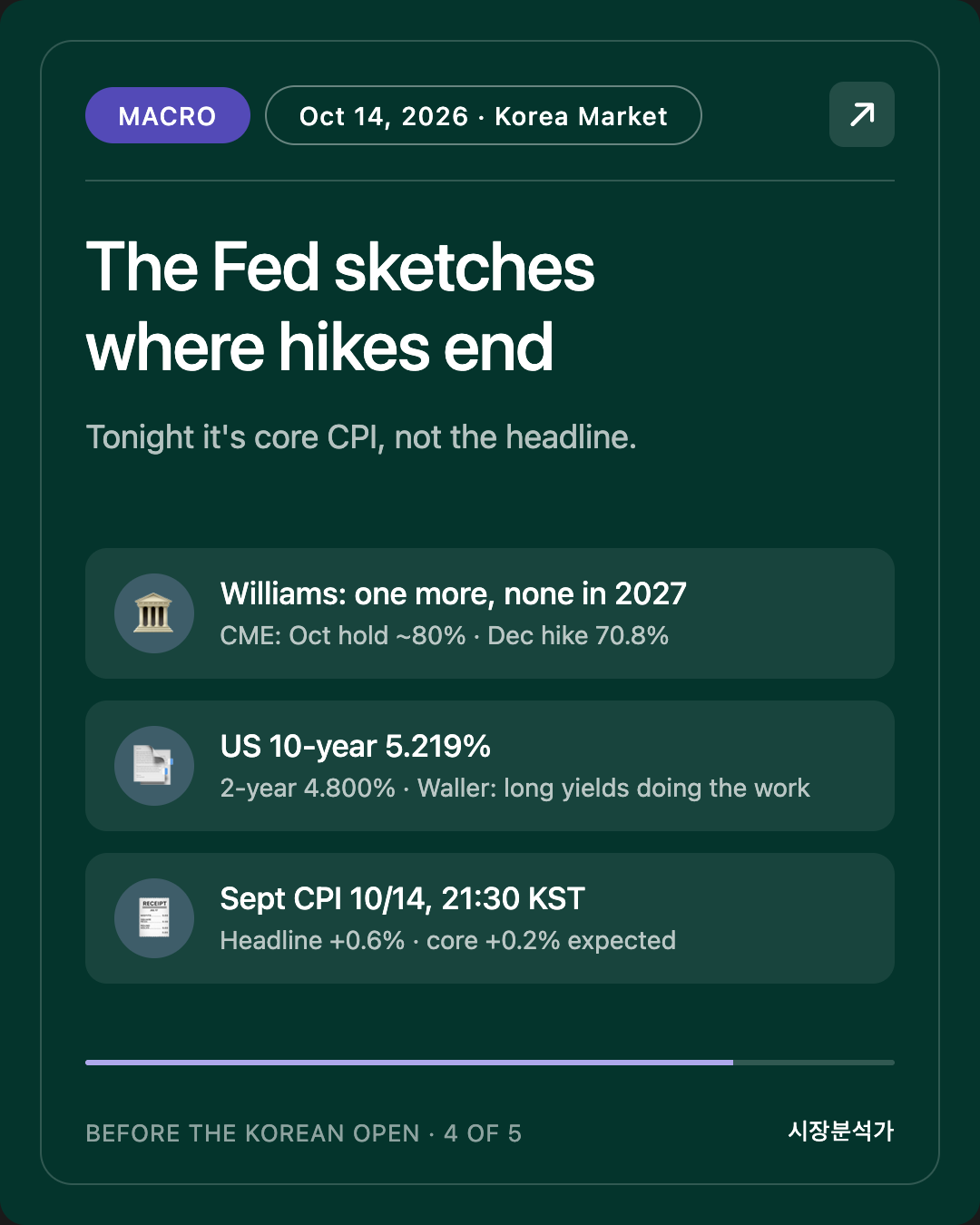
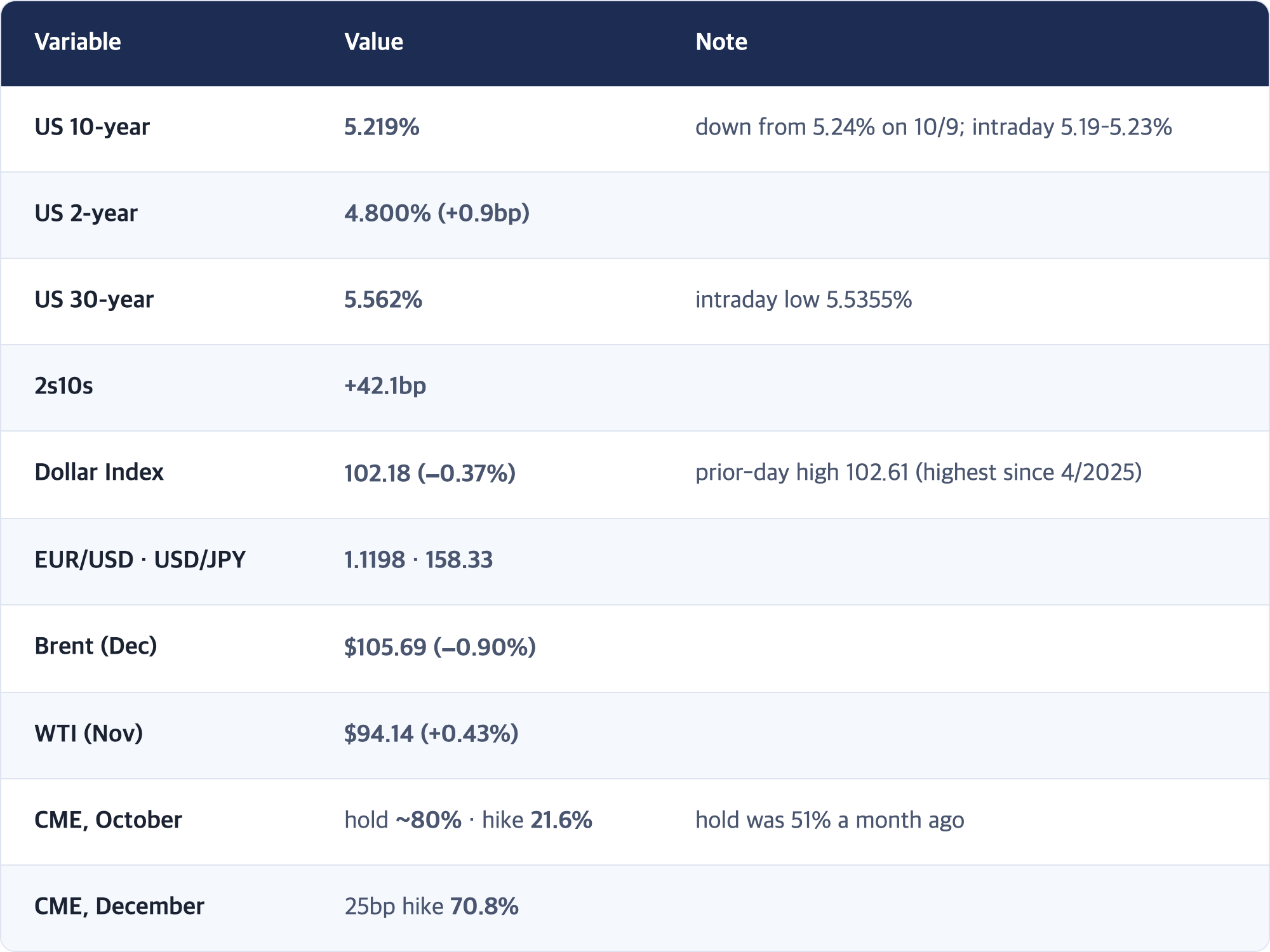
- Yields go into CPI lower. US 10-year 5.219%, 2-year 4.800%, Dollar Index 102.18 (−0.37%). New York Fed President Williams: one more hike this year, none needed in 2027. CME: ~80% odds of an October hold, 70.8% odds of a December hike.
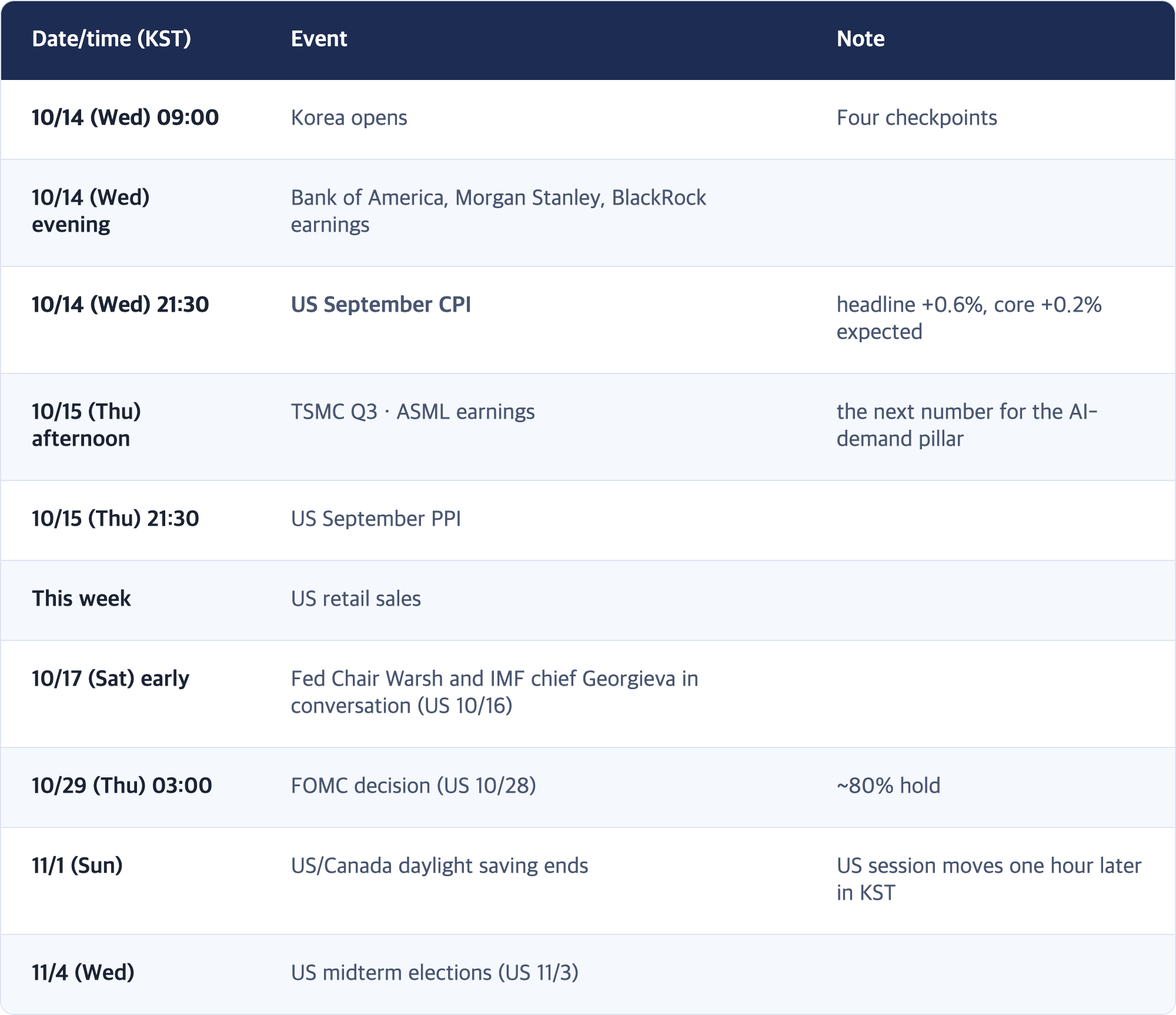
- US September CPI tonight, 21:30 KST. Headline seen at +0.6% m/m (gasoline), core +0.2%. TSMC reports tomorrow (10/15).
1. Checkpoint scorecard
The four set by the 10/13 pre-US-open brief (US close 10/13)
The question was: is money leaving memory being rotated within the US, or leaving altogether?
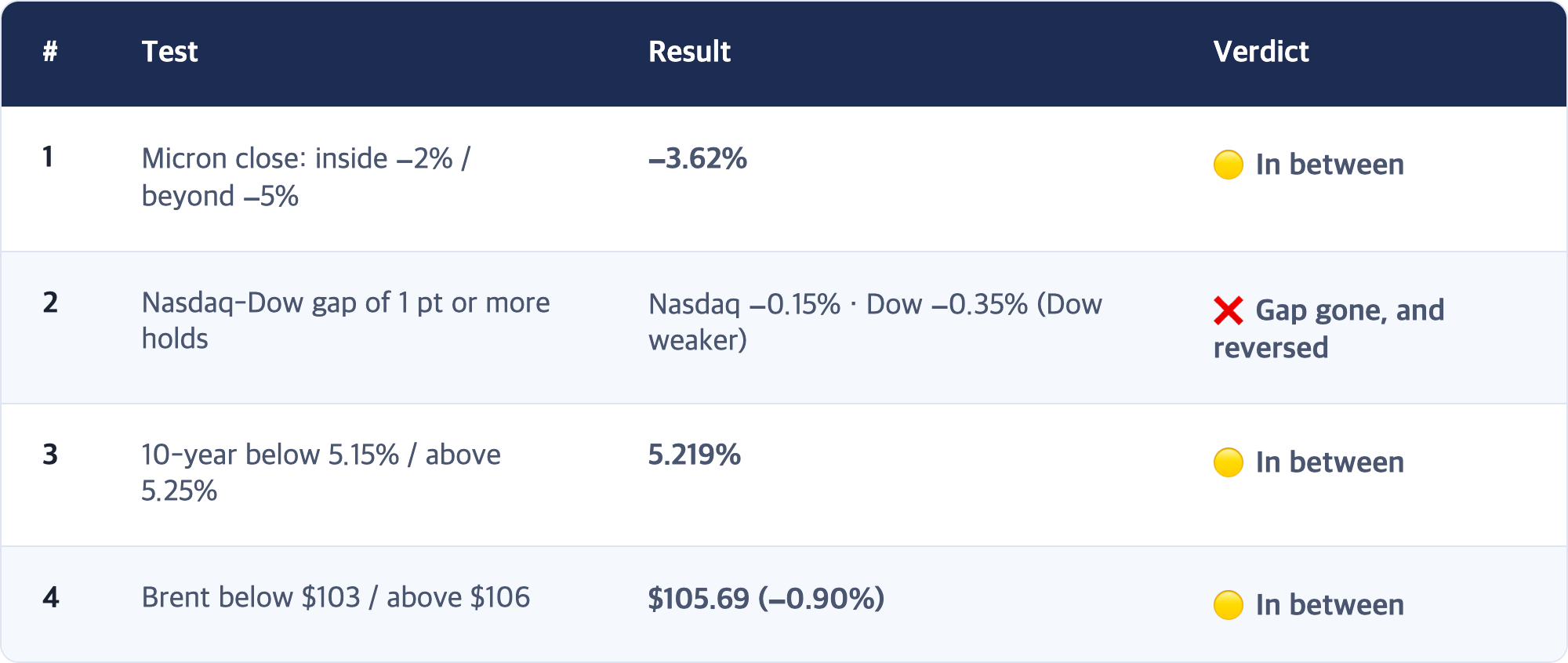
★ [Interpretation] Three stalled in the middle, one was wrong, and both say the same thing
Premarket, it looked like rotation: Nasdaq futures −0.7%, Dow futures +0.9%. By the close both had slipped, and the Dow was actually weaker, because the banks that were supposed to absorb the money sold off despite good results.
It wasn't an exodus either: the S&P 500 was flat at −0.02%. A lesson we wrote down on September 28 applied again: build a test around only two outcomes, and a third outcome (nothing much happens) muddies the verdict. October 13 in New York was neither a rotation day nor an exit day. It was a digestion day.
2. Today's key story: Seoul took twice New York's hit
[Fact] US close, Tuesday 10/13 (05:00 KST 10/14)
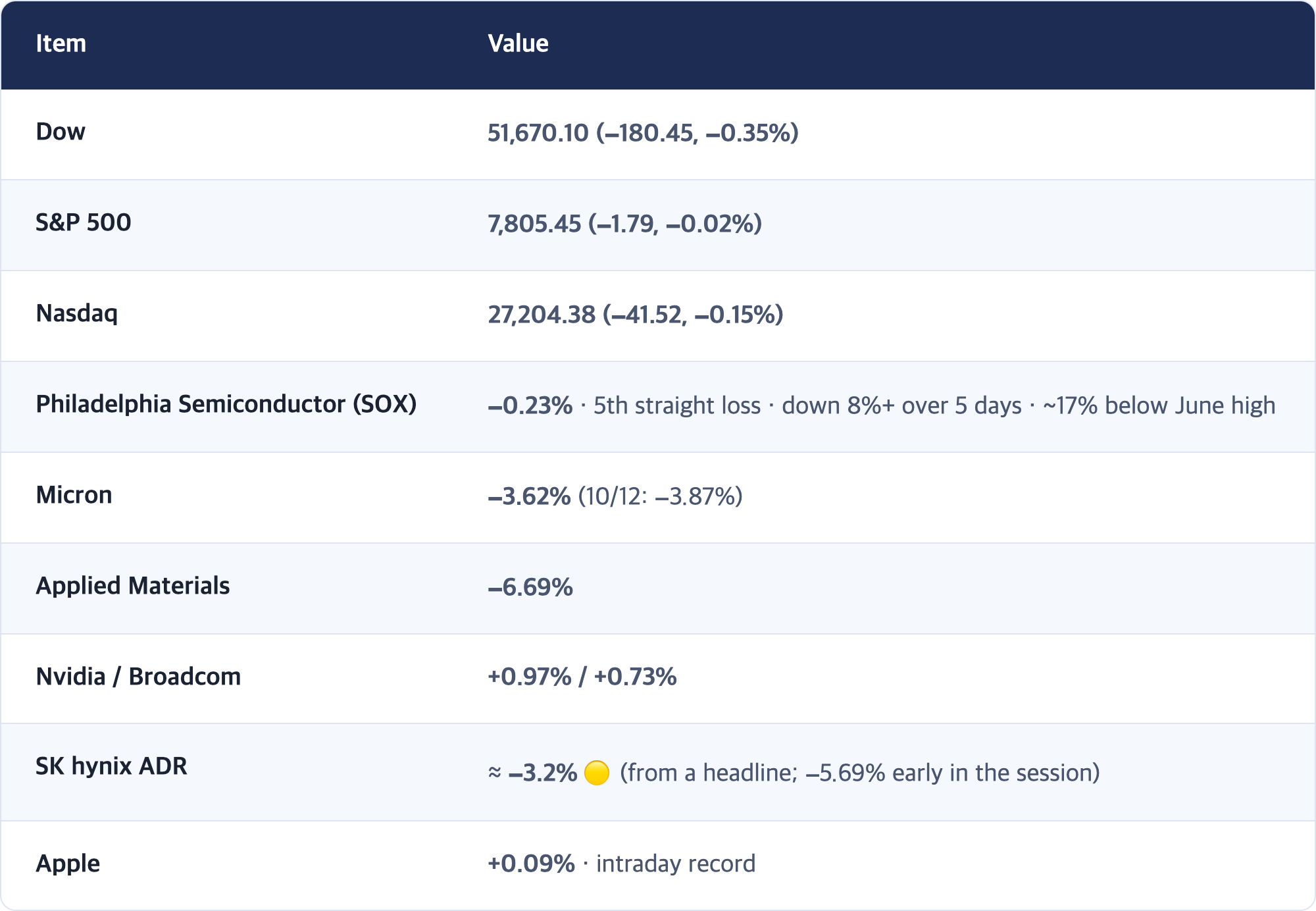
[Fact] Two-day comparison (10/12–10/13)
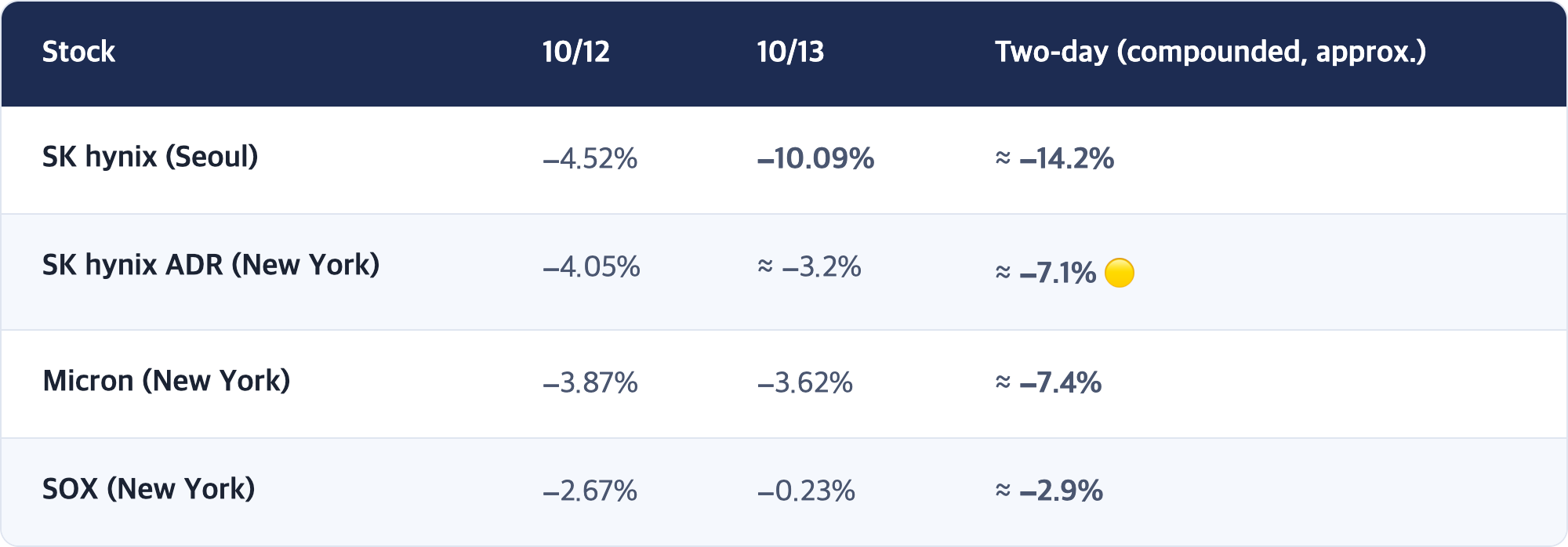
★ [Interpretation] Same company, same news, double the damage
SK hynix shares in Seoul and its ADR in New York are claims on the same company. Over these two days they absorbed the same news: China's CXMT unveiling a denser server DRAM design, and Broadcom CEO Hock Tan suggesting today's memory shortage may look different a year from now. Yet Seoul fell 14% and New York 7%. The won's move (about 0.7% weaker) explains only a sliver of that.
The most natural explanation for the rest is what happened only in Seoul:
- Foreign investors sold a net ₩4.52 trillion (about $3.4 billion) of KOSPI shares, the fourth straight day above ₩2 trillion
- A "sell sidecar" (a five-minute pause on program trading, triggered at 09:47 KST) and ₩2.04 trillion of net program selling
- Mechanical selling from leveraged products (the 3x Korea ETF KORU was down 10%+ premarket in the US)
[Observation] In New York, the SOX dropped 3%+ intraday and then recovered almost fully. New York digested the news inside the session; Seoul carried it all the way to the close.
[Interpretation / scenarios] How Seoul handles that gap today is the whole story.
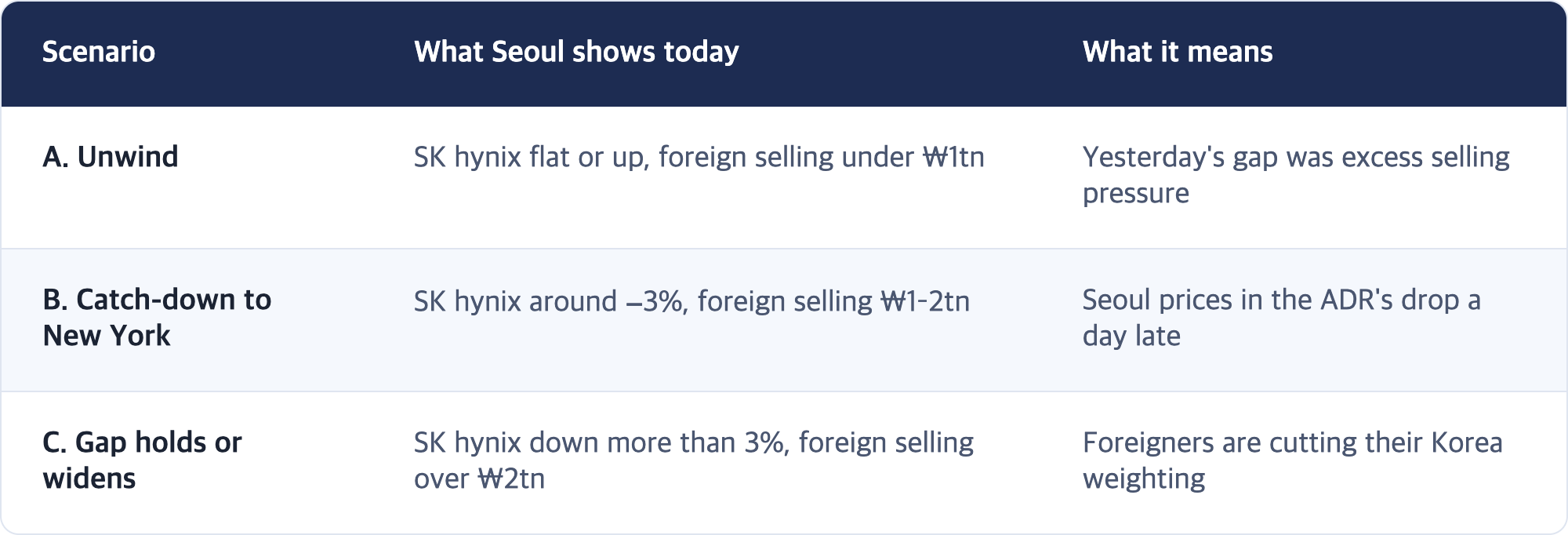
🟡 Caveat: the ADR figure (−3.2%) comes from a news headline; we could not verify the official close. ADRs and local shares trade at different hours, with currency and flow differences, so they never match exactly day to day. "Twice as much" is a directional signal, not a precise measurement.
3. Korea factors: three days, every number pointing the same way
[Fact] Seoul close, Tuesday 10/13 (confirmed in the previous edition)
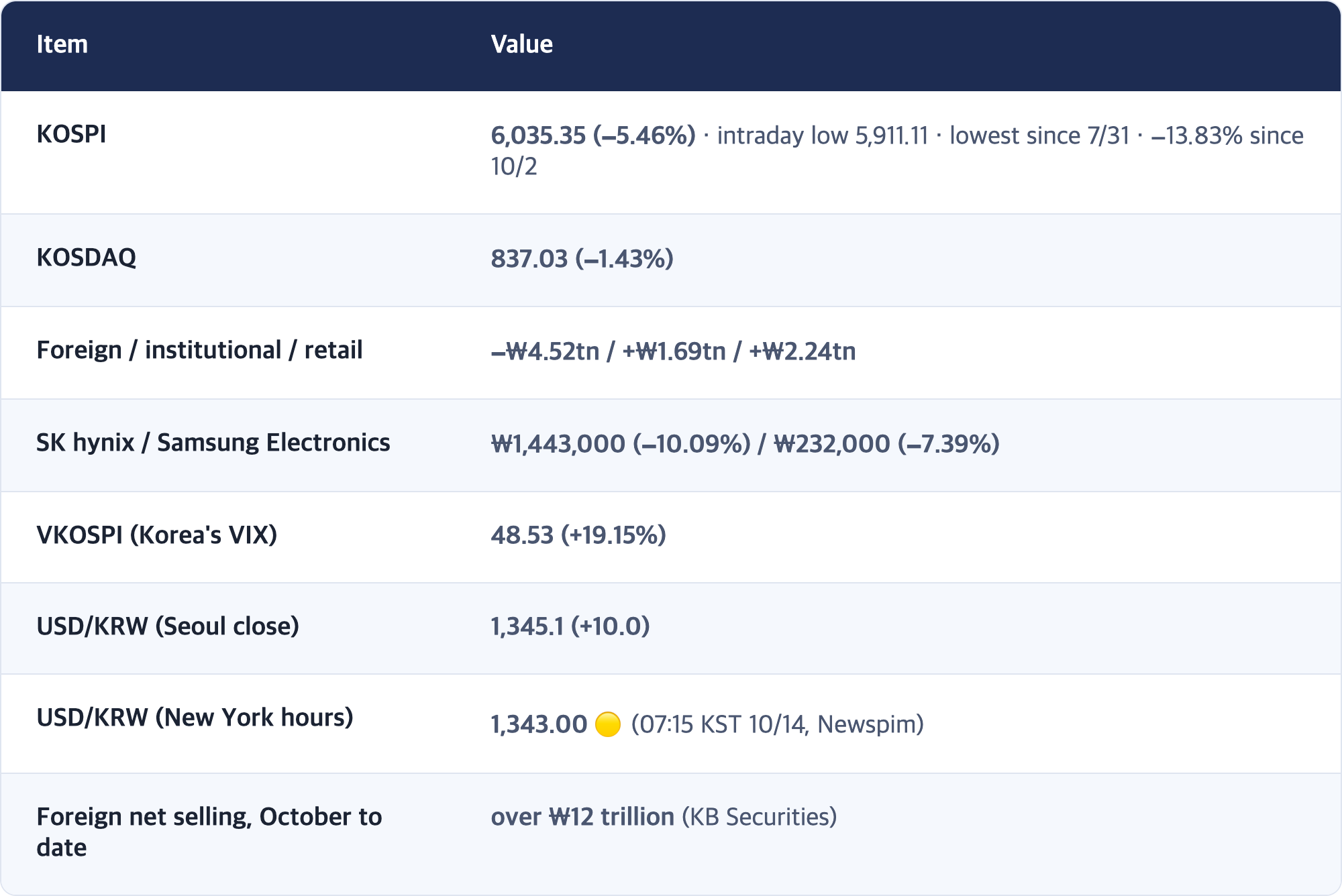
[Observation] The won clawed back a little overnight
The Dollar Index fell to 102.18 (−0.37%), off the previous day's 102.61, the highest since April 2025. USD/KRW eased from 1,345.1 at the Seoul close to around 1,343 by early morning. On Tuesday the won weakened even as the dollar fell; overnight it followed the dollar lower. That suggests the "money leaving Korean stocks" that had been pressing on the won paused overnight (observation).
[Observation] Korean brokers are starting to talk about a floor
KB Securities flagged the mid-5,000s to low-6,000s on the KOSPI as a buying zone and named this week's US inflation data as the main uncertainty. Yuanta Securities called support at 6,000 solid (its long-run scenario is 12,000 in 2027). 🟡 These are broker views; there is no data yet showing that foreign selling has stopped.
[Interpretation] The four Korean market commentators we track (Kwak Sang-jun, Park Si-dong, Lee Kwang-soo, Lee Sun-yeop) share a long-term bullish view on Korea centered on semiconductors. Lee Sun-yeop has long argued that flows and leverage, not war risk, drive sharp sell-offs, and this week fits that diagnosis (sidecar, program trading, leveraged ETFs). But "the cause is flows" and "so a rebound is near" are two different claims. If flows caused the drop, flows have to stop before prices recover. Today we're looking for the first sign of that stop.
4. Macro backdrop: yields eased, and the Fed sketched where hikes end
[Fact] Rates, FX and commodities (New York close 10/13)
[Fact] Fed speakers (10/13)
- Williams (New York Fed): one more hike this year may be appropriate, but he sees no need for more in 2027. That is more dovish than futures pricing (one hike in December plus two in 2027).
- Waller (Governor): higher long-term yields are restraining rate-sensitive sectors like housing and autos, doing part of the Fed's tightening for it. He attributes the rise in yields to solid growth and AI investment rather than inflation expectations, which he called "well anchored."
- Goolsbee (Chicago Fed): more progress is needed before returning to a path of cuts.
★ [Interpretation] The Fed is starting to draw the shape of "the end"
Williams is effectively the Fed's No. 3 and usually tracks the chair's thinking. "One more this year, none next year" is the first time the end of this hiking cycle has been put in concrete numbers. Waller's "long yields are doing the work" points the same way: as long as the 10-year sits around 5.2%, the Fed has less reason to keep hiking.
That's the frame for tonight's CPI. Everyone expects a hot headline (+0.6%) from gasoline. What matters is core at +0.2%. If core holds at 0.2%, Williams' "one last hike" picture gains strength; at 0.3% or above, yields could jump again, as they did in September (when a 0.3% core print pushed September hike odds above 90%).
5. Korea today (Wednesday 10/14): checkpoints
[Observation] Today's schedule (KST)
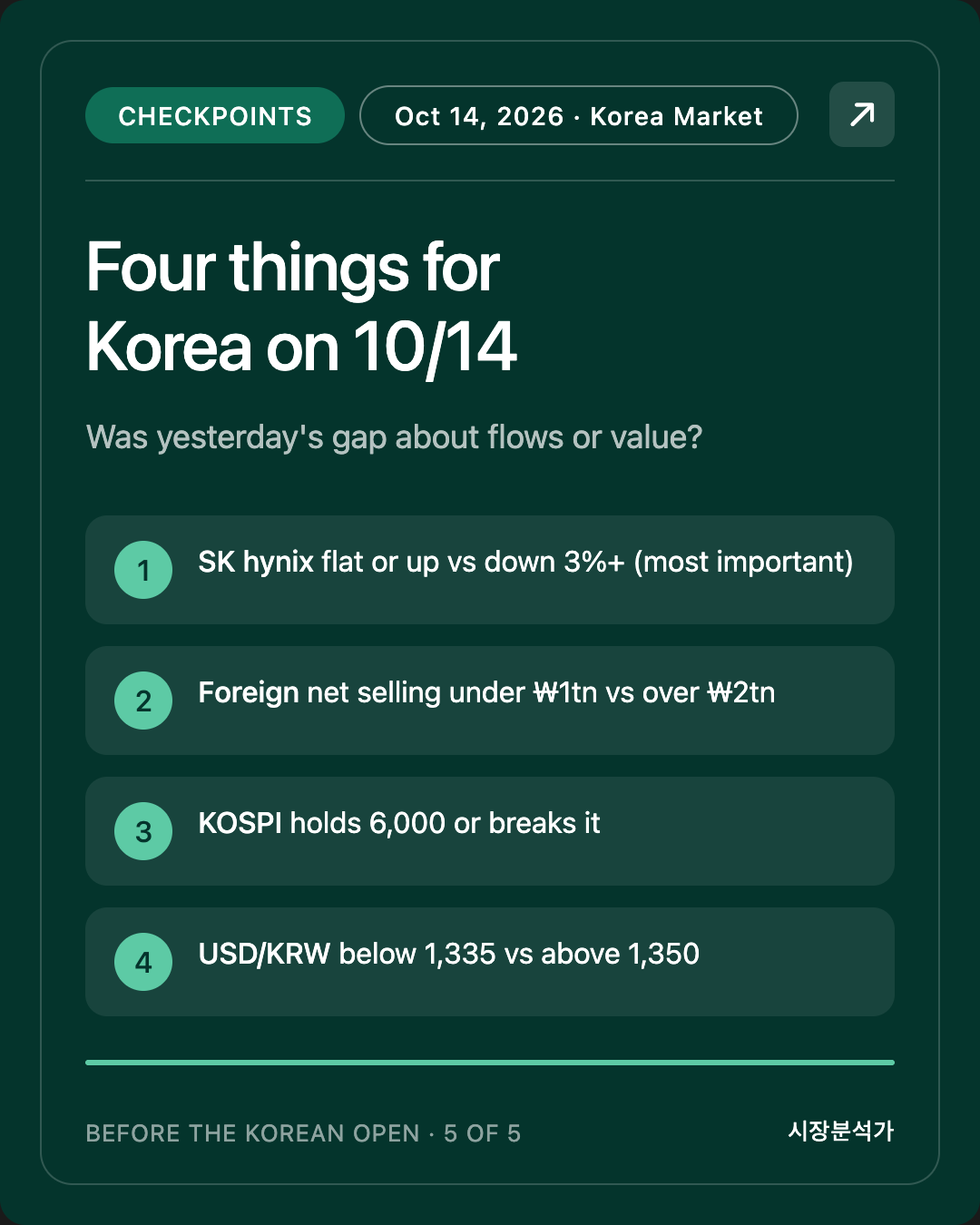
✅ Four checkpoints (through the Seoul close)
The question: does Seoul unwind the extra damage it took versus New York, or keep it? These pair with the A/B/C scenarios in section 2.
- SK hynix close: flat or higher / down more than 3%. Flat or up = A (unwind); down more than 3% = C (gap holds). In between = B. (Most important)
- Foreign net selling under ₩1tn / over ₩2tn. Over ₩2tn would make five straight days. A shrinking number is the first sign of a "stop."
- KOSPI close: holds 6,000 / breaks it. It hit 5,911 intraday Tuesday before closing at 6,035.
- USD/KRW below 1,335 / above 1,350. Starts around 1,343.
[Interpretation] If #1 is flat or up but #2 is over ₩2tn, that's a rebound being absorbed by local institutions and retail, not a return of foreign money. In that case how long it lasts will depend more on tonight's CPI and tomorrow's TSMC results.
6. Study note: same company, so why did Seoul and New York fall by different amounts? (ADRs)
The concept
An ADR (American Depositary Receipt) is a certificate issued by a US bank that holds shares of a foreign company, letting those shares trade in New York in dollars. Owning an SK hynix ADR is economically the same as owning a slice of SK hynix shares in Seoul. In theory, the ADR price should track "local price × ratio ÷ exchange rate."
An analogy
Picture the same apples sold at a market in Seoul and a market in New York at the same time. Prices should be similar. But if one big wholesaler dumps a truckload of apples only at the Seoul market one day, only the Seoul price drops. The apples didn't get worse; sellers crowded into that one market. If the Seoul price stays low for days, though, it may mean people actually think less of the apples.
This week's example (10/12–10/13)
- SK hynix in Seoul ≈ −14% over two days vs the ADR ≈ −7% (🟡 the ADR's 10/13 close is unverified).
- Only in Seoul: ₩4.5 trillion of foreign selling, a sell sidecar, ₩2 trillion of program selling.
- So a large part of the gap reads as sellers crowding into the Seoul market.
One-line takeaway
If the gap between local shares and the ADR closes within a day, it was a flow problem; if it stays open, it's a valuation problem. Today's Seoul session is the first test of which it is.
7. Corrections and open items
Corrections
- None.
- Note: the 10/13 pre-US-open brief cited Brent at about $104.90 intraday. The settlement was $105.69 (−0.90%) (a timing difference, not an error).
Source discrepancies (value used in this report)
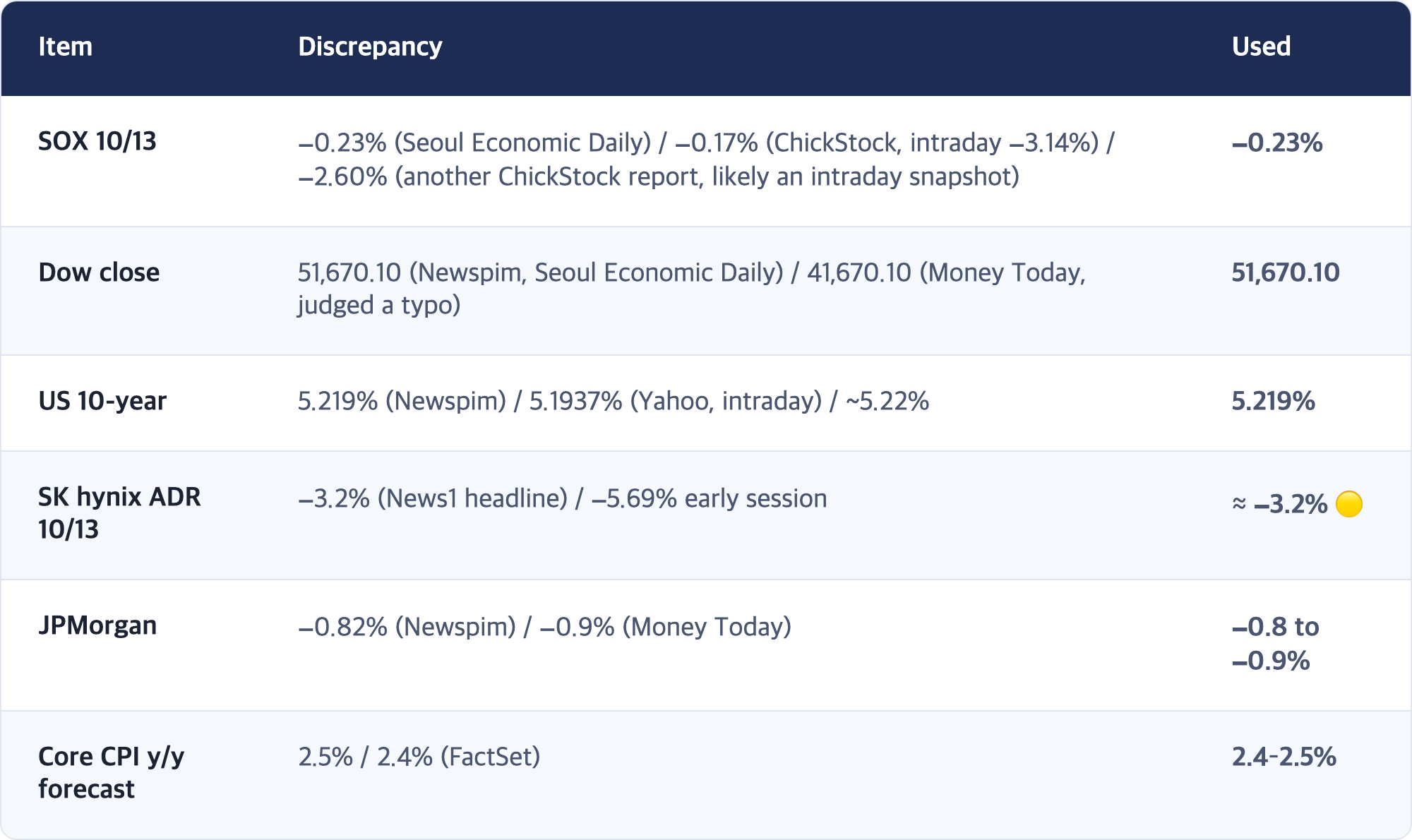
🔲 Unverified
8. Event calendar (KST)
Sources
- NY stocks fall as chips slide for a 5th day | Newspim
- Treasury yields fall, dollar retreats from 18-month high | Newspim
- China chip shock continues; banks wobble despite strong results | Money Today
- NY stocks weaken on China chip catch-up; SK hynix −3.2% | Seoul Economic Daily
- Nasdaq −0.15% on China chip push, bank disappointment | News1
- S&P 500 closes near flat after big banks post earnings and memory chip stocks decline | CNBC
- Stock Market Today, Oct. 13 | Motley Fool
- Fed's Waller Says Higher Treasury Yields Are 'Doing A Little Bit Of The Work' | Yahoo Finance
- US Treasury Yields Stabilize as Williams Signals Potential Rate Hike | GuruFocus
- US September CPI seen +0.6%, core 2.5% | TokenPost
- Foreigners net-sold ₩12tn in October | EBN via Investing.com
- KOSPI 12,000 scenario | Hankyung
- KOSPI closes at 6,035.35 | Wikitree
- Chip sector swung deep intraday | ChickStock
- TSMC Q3 revenue and earnings date | The Check
Market Analyst · This report does not recommend buying or selling any individual stock. It offers macro context and interpretation.
📌 More market briefs
※ This post is market observation and organization intended to support your own judgment. It is not a recommendation to buy or sell any security. Figures are as of the time of writing and may differ between sources.
If this was useful, bookmark it or pass it along. It genuinely helps me write the next one.
I can survive. We can survive.