Sept 15, 2026 KOSPI Market Brief — What to Watch Before the Korean Open
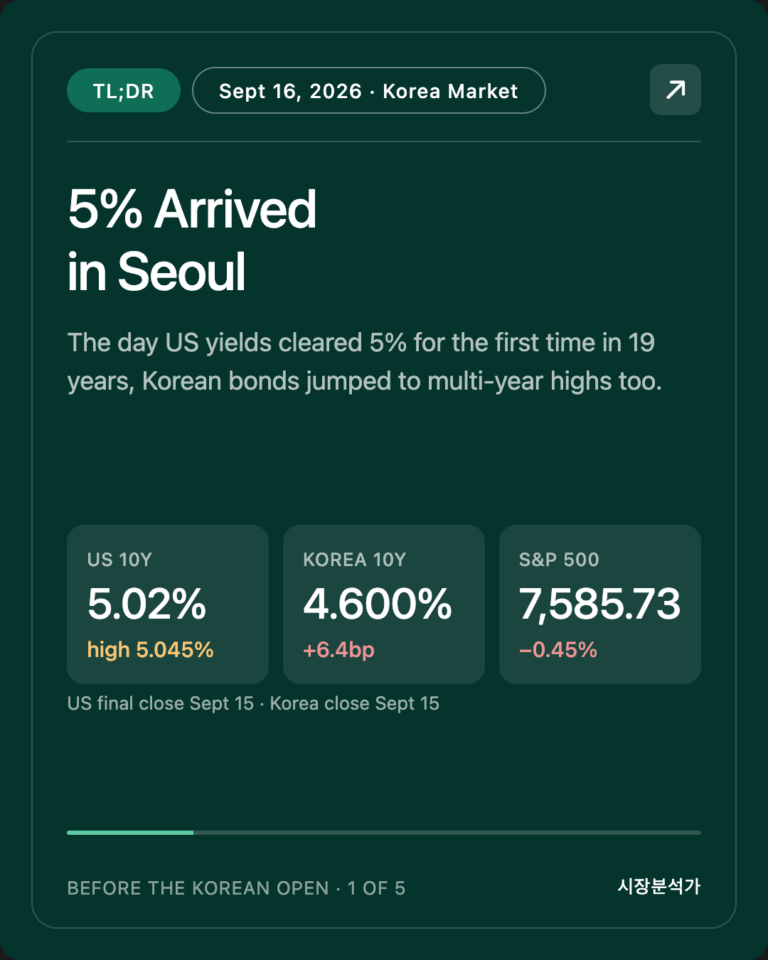
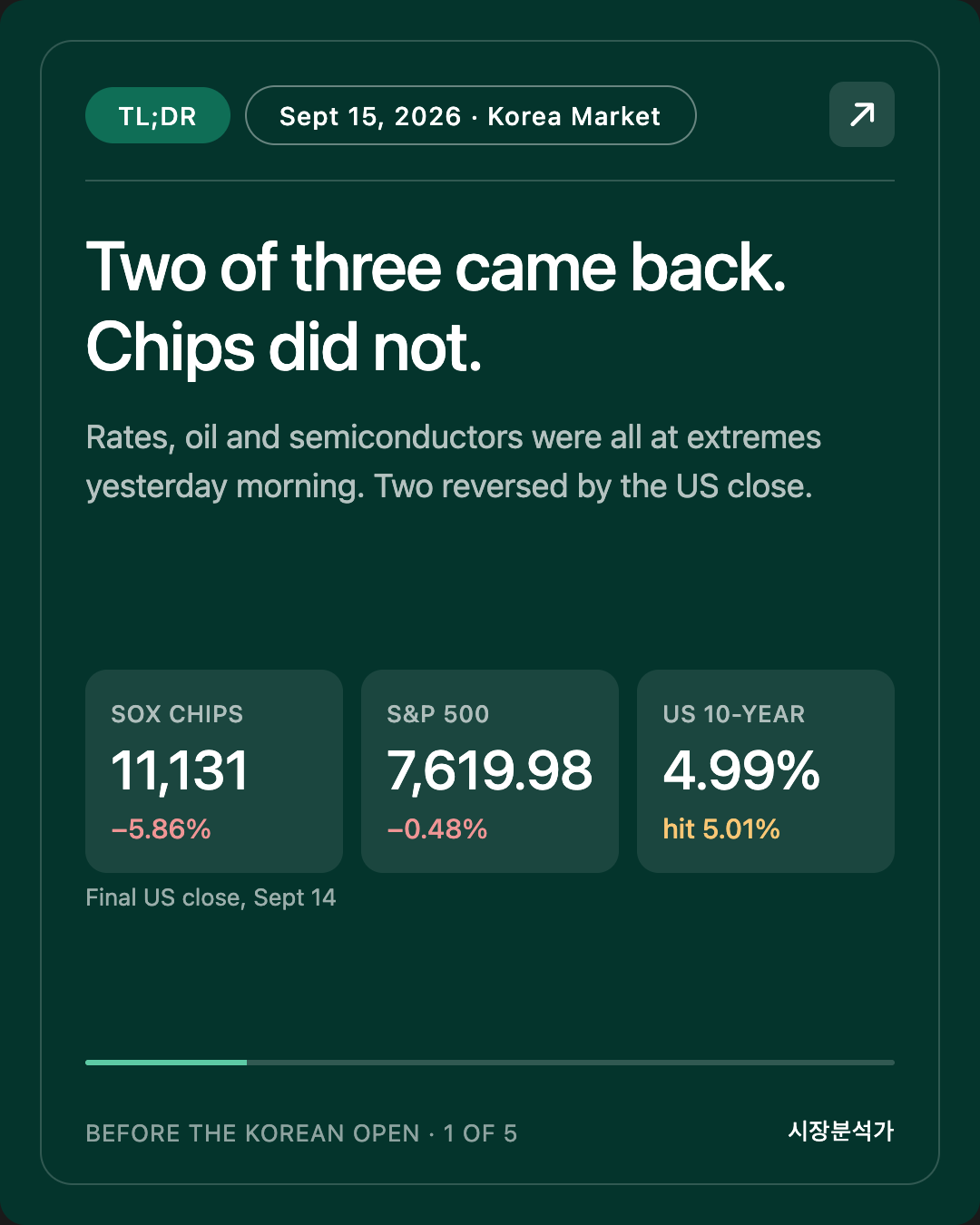
- Two of yesterday's three extremes reversed. The 10-year hit 5.01% and closed at 4.99%; Brent gave back more than $3 from its intraday high to settle at $105.68. The market absorbed both.
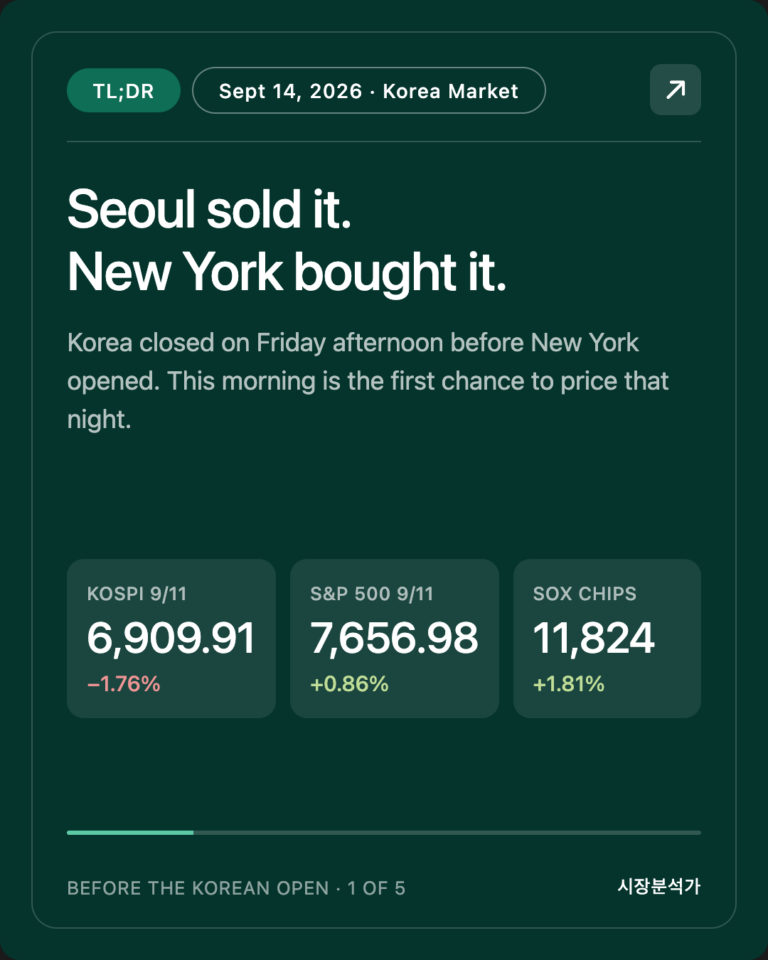
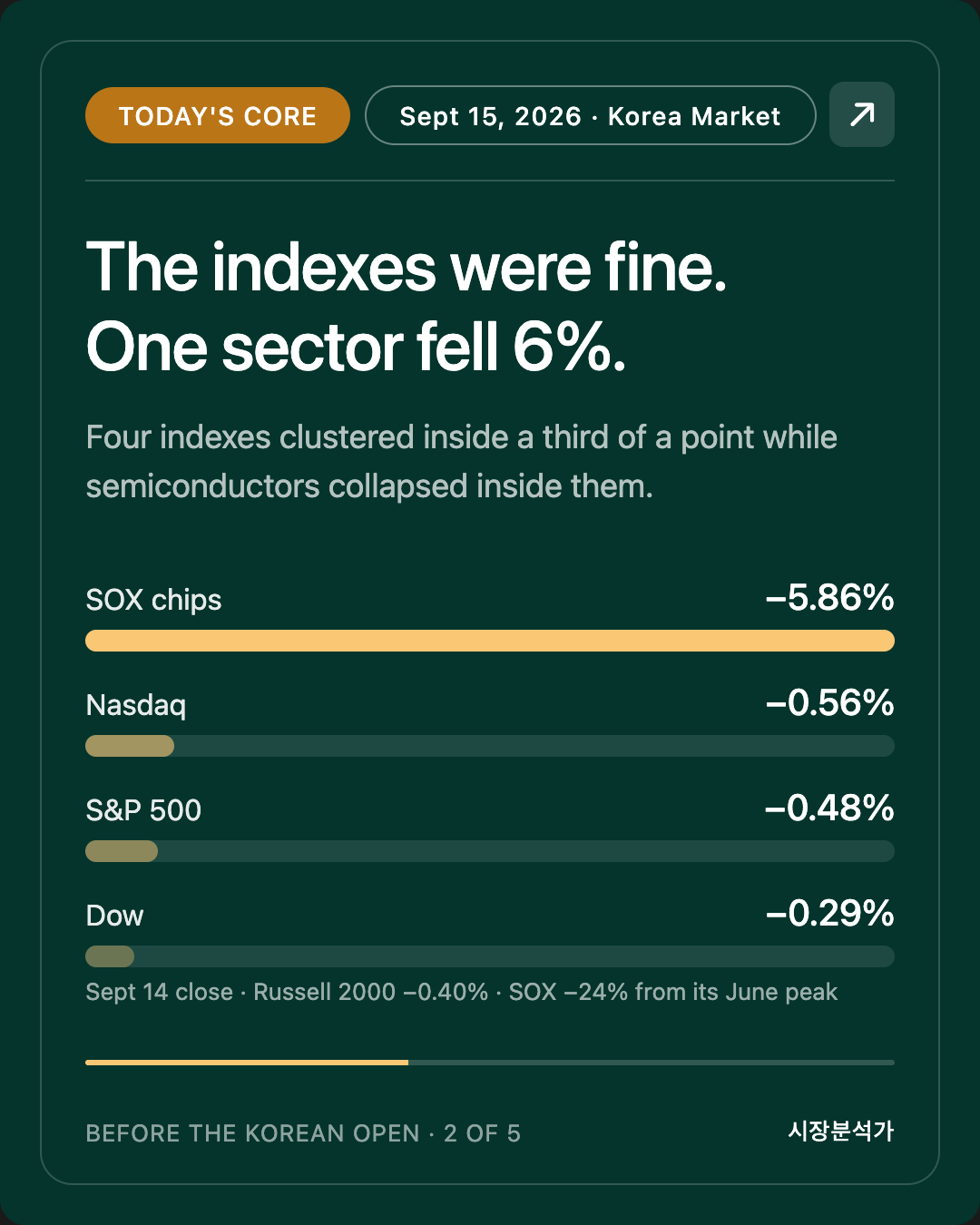
- Semiconductors did not reverse. SOX closed 11,131.3 (−5.86%, −692.7 points), now −24.0% from its June 22 peak of 14,655 and 593 points below the 11,724 bear-market line this brief flagged yesterday.
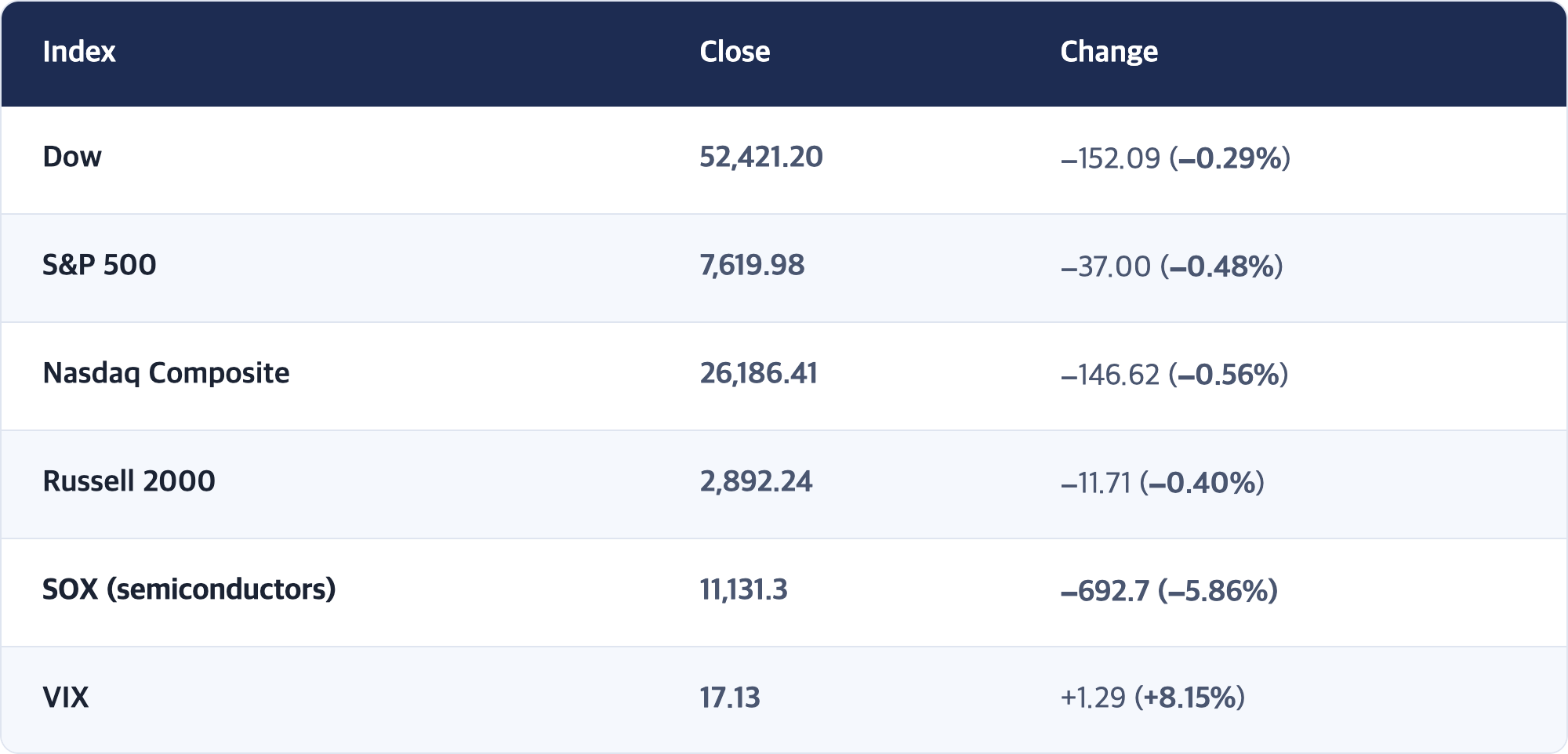
- The indexes themselves were fine. Dow 52,421.20 (−0.29%) · S&P 500 7,619.98 (−0.48%) · Nasdaq 26,186.41 (−0.56%) · Russell 2000 2,892.24 (−0.40%). Four indexes clustered inside a 0.3-point range while one sector inside them fell 6%.
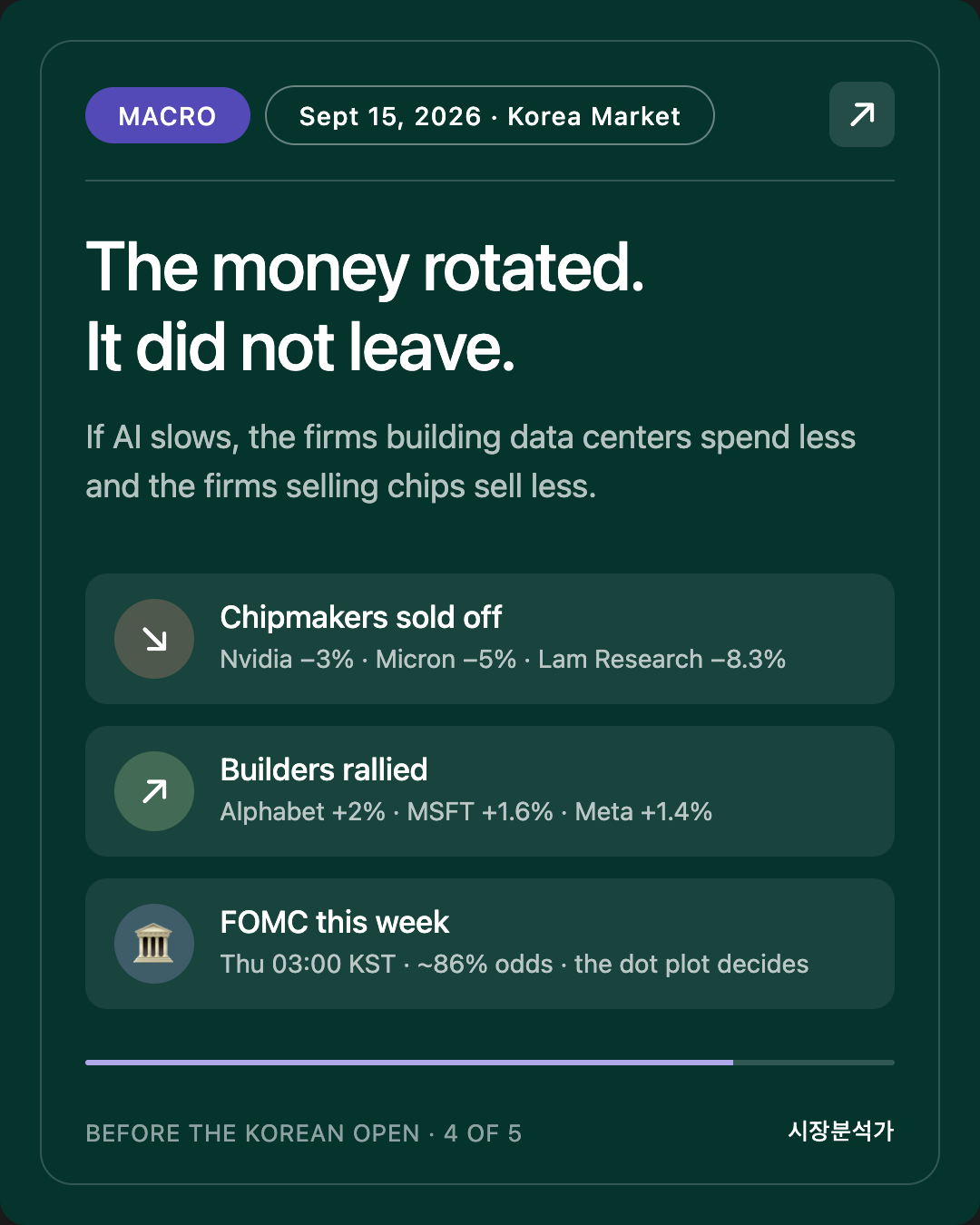
- 🔴 Money rotated rather than left. While chipmakers sold off, Alphabet rose about 2%, Microsoft 1.6%, Meta 1.4%, and ServiceNow, Adobe and Workday gained 4% to 7.4%. If AI development slows, the companies building data centers spend less; the companies selling them chips sell less.
- Korea has no other side of that trade. The KOSPI's center of gravity is Samsung Electronics and SK Hynix — both on the selling-chips side. What was a rotation in New York can be an outflow in Seoul. The 6,600 level is today's test.
This is Mr. Can. Here is the Sept 15, 2026 brief ahead of the Korean market open.
Written: 08:10 KST, Sept 15 (Vancouver: 16:10 PDT, Sept 14)
Basis: US close Sept 14 (final) + Korea close Sept 14 + US bond and commodity settlements Sept 14
✅ On schedule. Scheduled 16:00 PDT, started 16:03 PDT. Fourth consecutive on-time run.
Written after the US regular session closed at 13:00 PDT, so every US figure here is a final close, not an intraday quote.
SEO Intro
Yesterday morning's brief was written an hour before the US open. At that moment Nasdaq 100 futures were down 1.56%, the 10-year Treasury yield was closing in on 5%, and Brent crude was pushing toward $109. Three things were at extremes.
Now that the US session has closed, two of the three have come back.
The 10-year touched 5.01% and finished at 4.99%. At the first sight of 5% since 2023, buyers showed up. Brent reached the $109 area intraday and settled at $105.68. The Nasdaq's 1.56% pre-market decline shrank to 0.56% by the bell.
One thing did not come back. The Philadelphia Semiconductor Index closed at 11,131.3, down 5.86% — 24% below its June peak.
What Korea opens into this morning is not a market-wide selloff. It is one sector being repriced. And that sector is roughly half of the KOSPI.
1. Today's core: two of three came back, semiconductors did not
[Fact] Yesterday morning versus last night
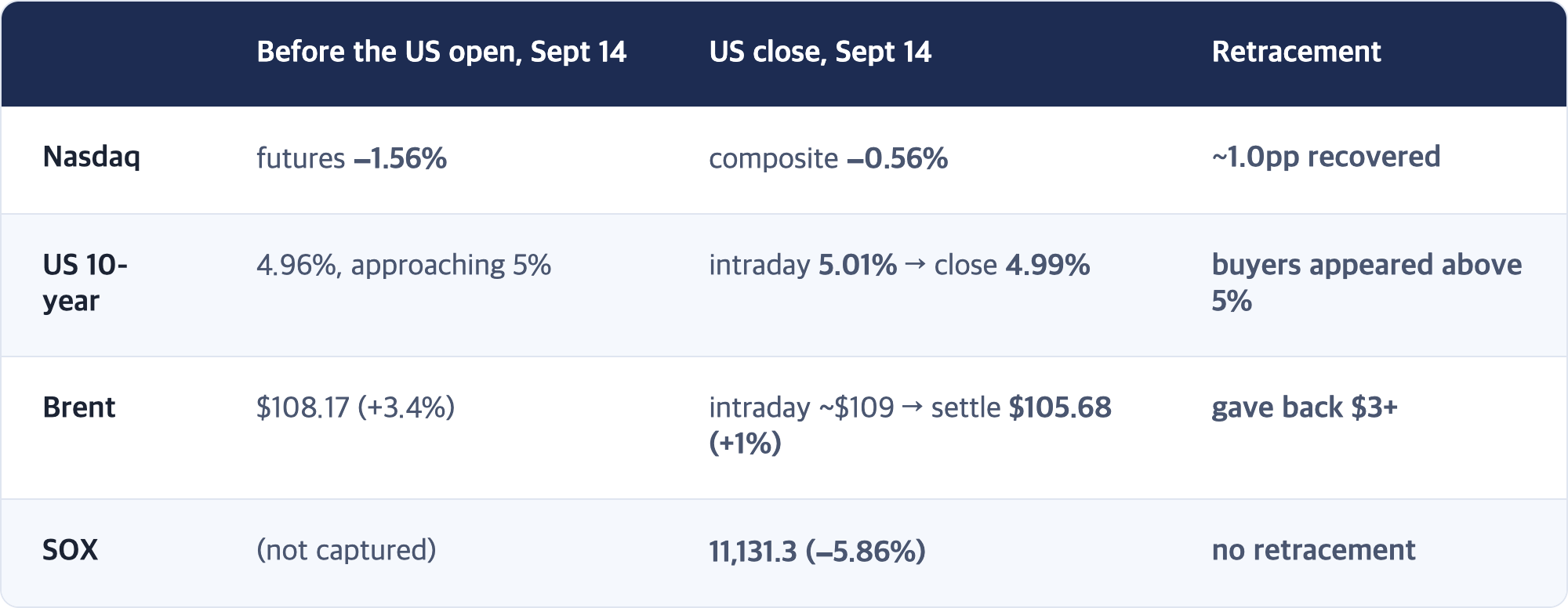
The pre-market numbers are futures and the closing numbers are cash indexes, so they are not the same instrument. The direction and magnitude still compare cleanly.
🔴 [Interpretation] What this table says
The market digested two of the three things that looked frightening yesterday morning.
- Rates. A 5% 10-year is territory not seen since October 2023. Buyers stepped in there anyway — Bloomberg described the advance being erased as bids emerged. The 2-year rose barely a basis point to 4.658% and the 30-year actually eased slightly to 5.353%. This was not a day when the whole curve shifted up.
- Oil. Two live catalysts remain in place — the shut Saudi East-West pipeline and the postponed Oman talks — and crude still failed to hold its intraday high. The market is pricing a supply disruption, just not a $109 one.
That leaves semiconductors, and semiconductors got worse into the close.
[Fact] What fell and what rose
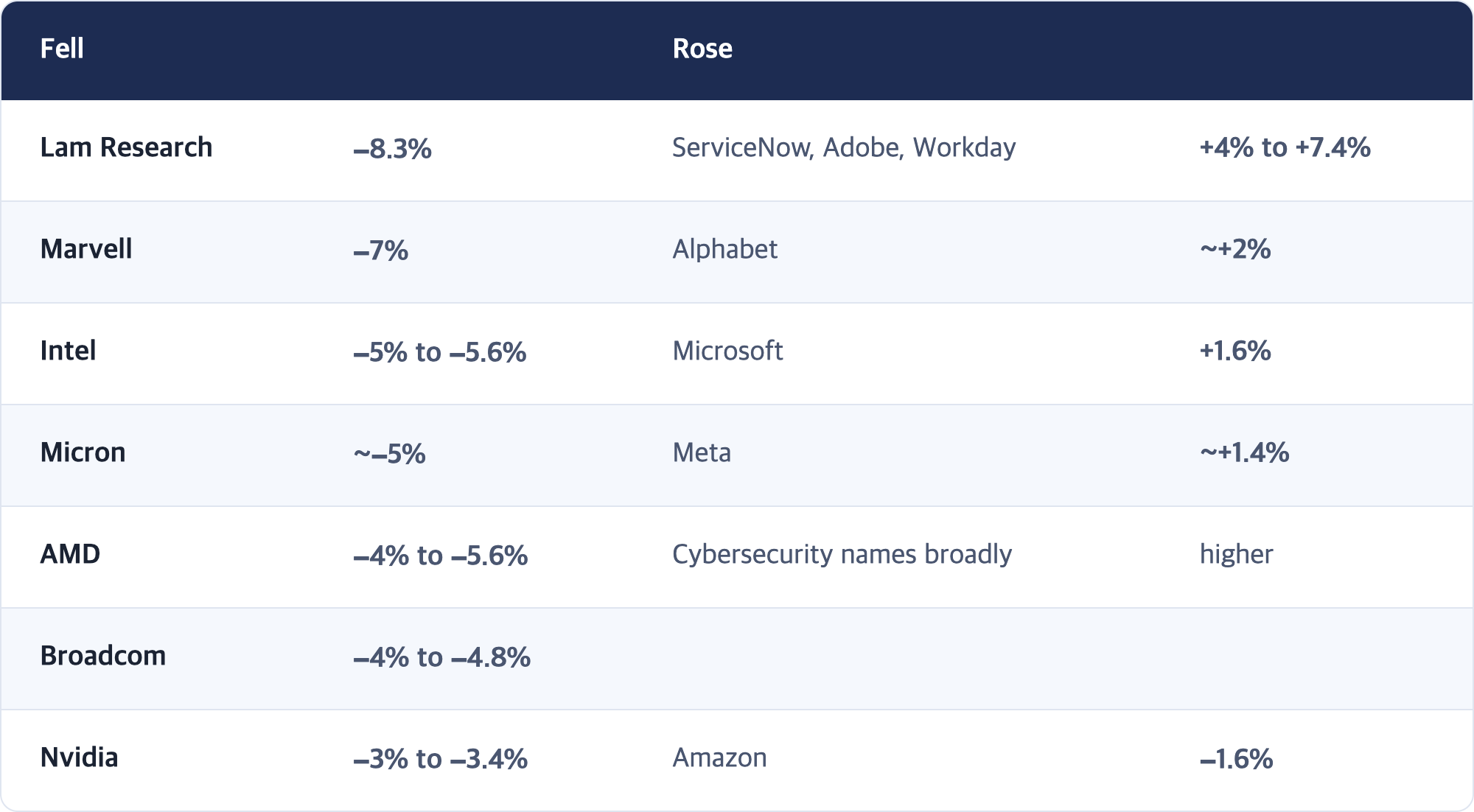
🔴 [Interpretation] Why the same headline is good news for one side
Dario Amodei's weekend essay argued for slowing the pace at which frontier models gain capability. Two kinds of companies read that sentence in opposite directions.
For the companies building data centers — Alphabet, Microsoft, Meta — it is a cost story. If model development slows, they can stop building and run what they already have. Capital spending falls while revenue and profit keep arriving. Wedbush's Gil Luria put it as being able to stop building and digest existing capacity — the same move Amazon made when it halted warehouse expansion after the pandemic.
For the companies selling the silicon — Nvidia, Broadcom, Micron, SK Hynix — the identical sentence is a revenue story. One company's capital expenditure is another company's sales. If the buyers decide to economize, the sellers sell less.
The same news is a cost saving on one side of the ledger and a revenue cut on the other. That is precisely the line along which money moved in New York yesterday, and it is why the indexes finished within half a percent. What left one pocket arrived in another inside the same market.
🔴 [Interpretation] Which puts Korea in the harder seat
Korea does not have a builder side.
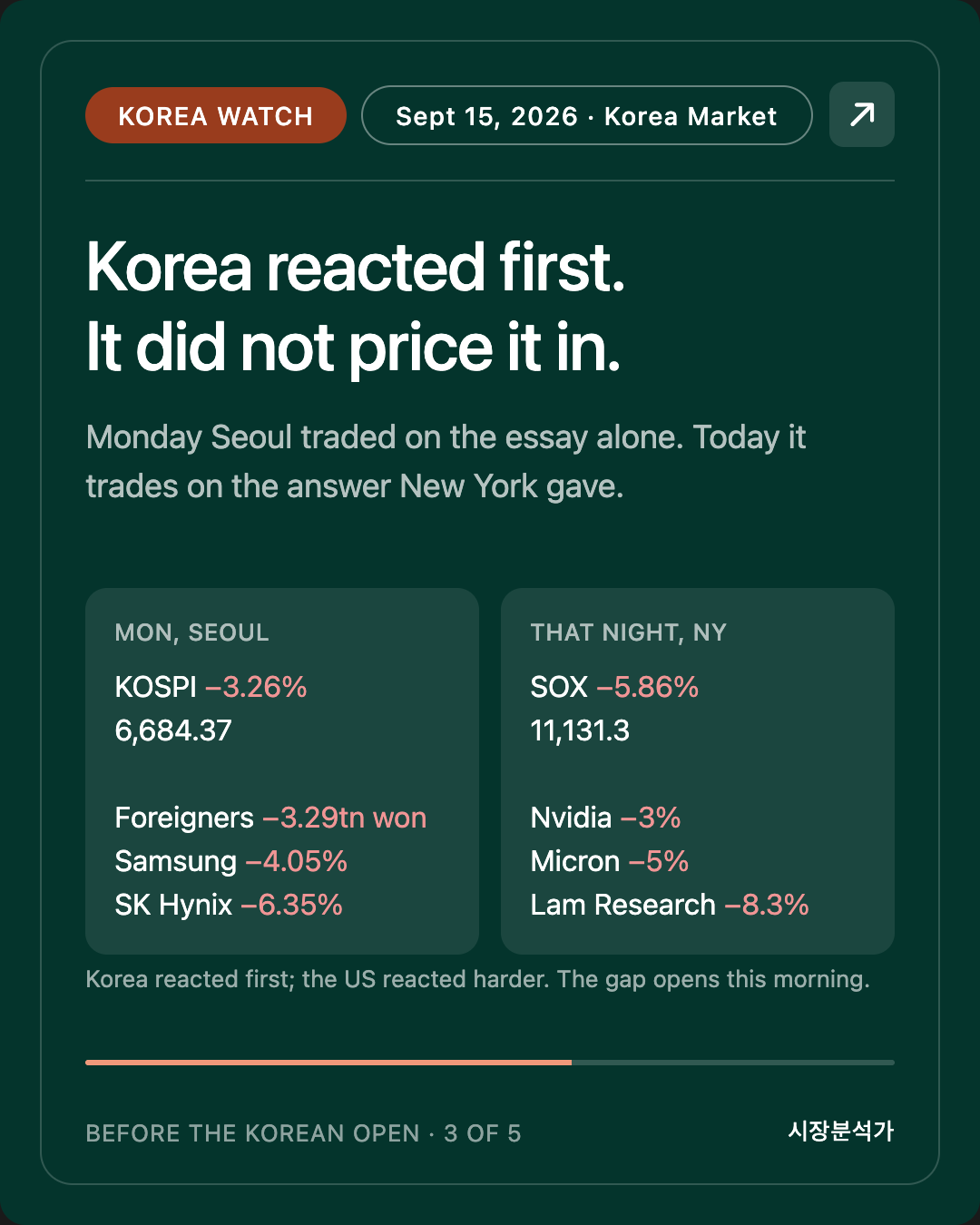
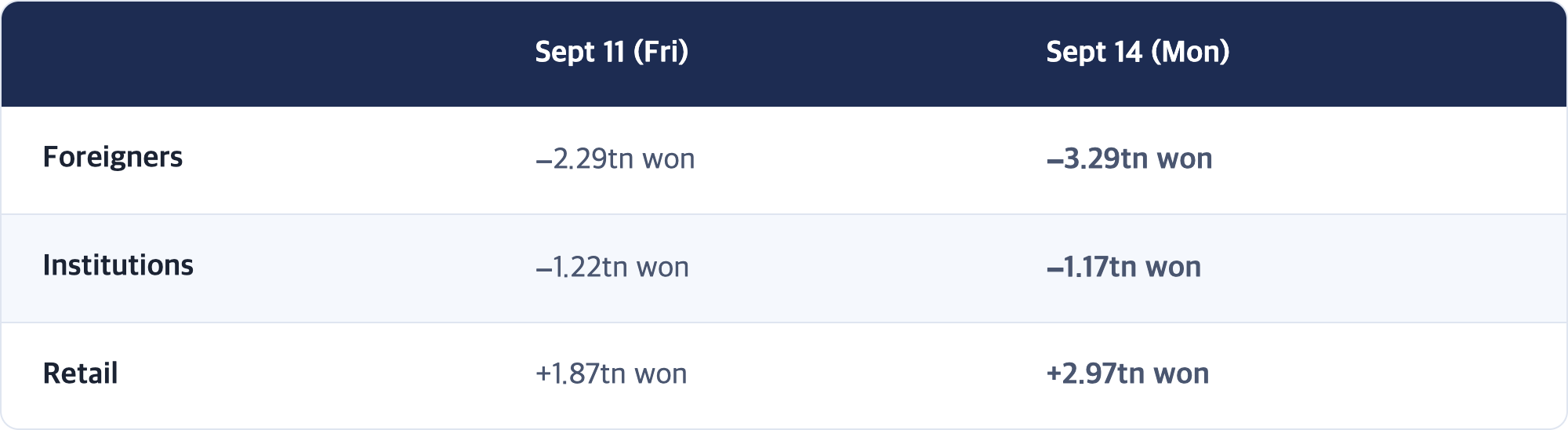
The KOSPI's weight sits in Samsung Electronics and SK Hynix, both sellers. On Monday, foreign and institutional investors' net selling in those two names alone came to 3.82 trillion won, about 86% of the day's total net selling.
For a US investor this story is a reweighting: sell some semis, buy Alphabet, stay in the market. Inside the Korean market there is no comparable seat to move to. The same decision becomes a decision to leave.
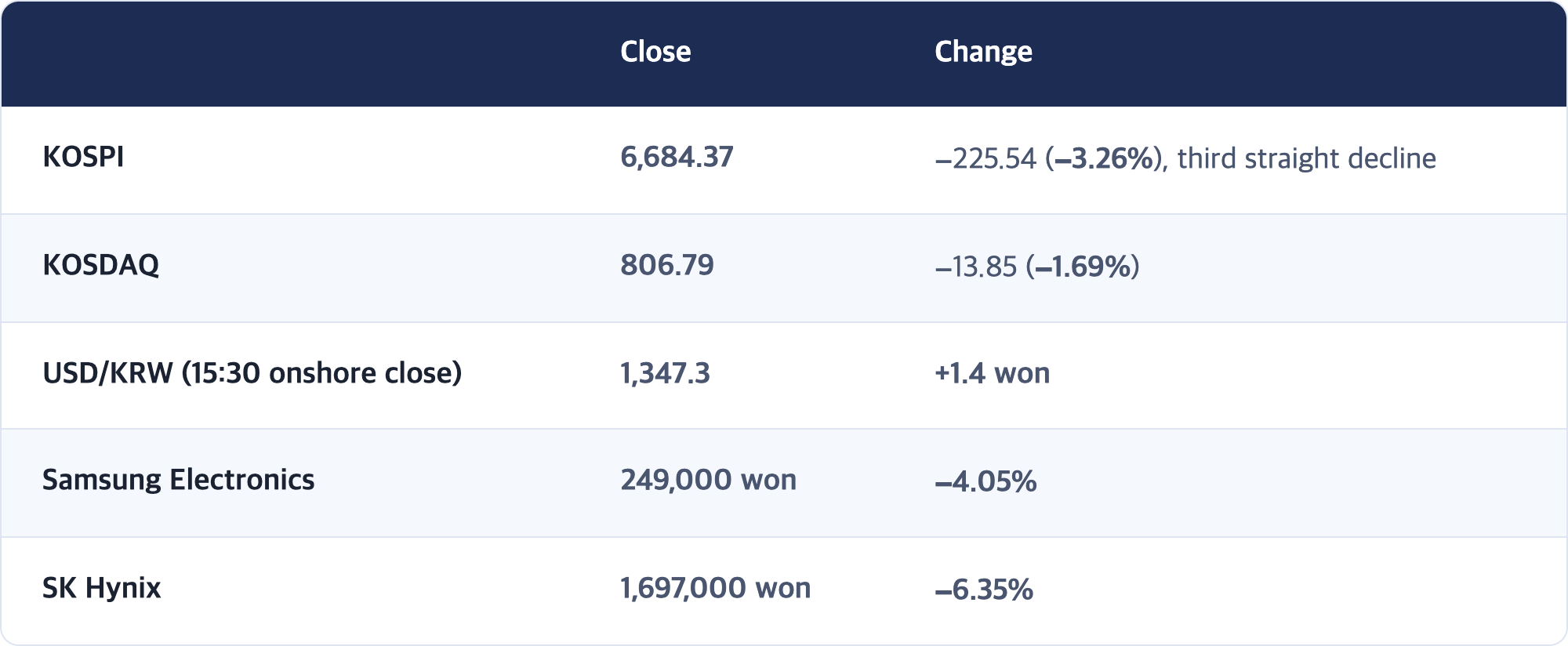
KB Financial's +2.08% and Samsung Biologics' +0.35% on Monday were the narrow shelter available. The KOSDAQ falling 1.69% against the KOSPI's 3.26% is the same fact from another angle.
[Interpretation] But separate the story from the numbers
To be fair about what actually changed: the forecast moved, not the earnings.
On memory specifically, DRAM and NAND contract prices are still rising and HBM is booked out into next year. There is no confirmation yet that any hyperscaler has cut an order. What moved yesterday was not the order book. It was the growth slope priced into the stock.
So the first real test of this narrative is Micron's earnings on September 30, which will deliver contracts and guidance rather than opinions. Everything between now and then is the price of an argument.
2. Scoring yesterday's checkpoints (US session, Sept 14)
The four lines the Sept 14 morning brief drew for the US session:
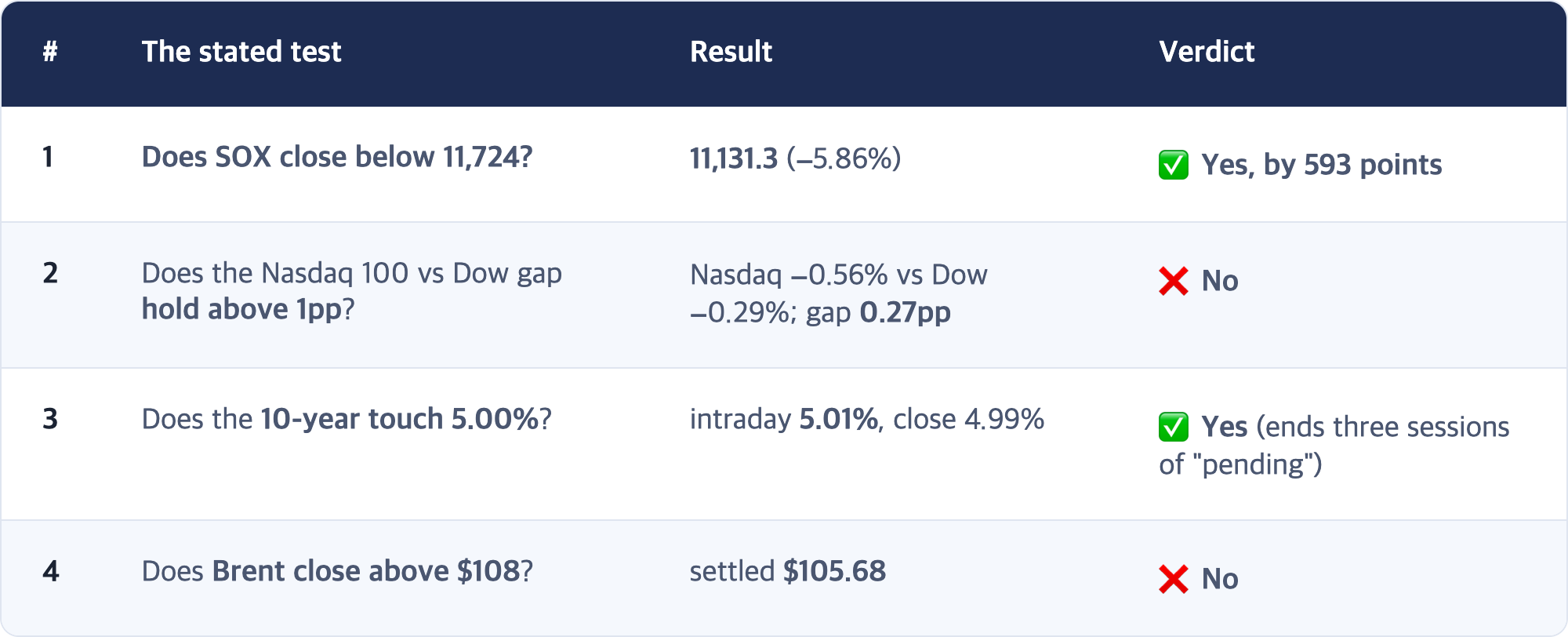
🔴 [Interpretation] How #2 was wrong matters more than that it was wrong
The gap did narrow. By yesterday's own rule that should read as a return to last week's macro regime. But SOX fell 5.86% on the same day. A macro day does not take one sector down 6% on its own.
The axis of the question was wrong. The line that split the market yesterday did not run between the Nasdaq and the Dow. It ran between semiconductors and everything else. Alphabet, Microsoft and Meta sit inside the Nasdaq, so measuring at the index level let the winners erase the losers.
This is a repeat of a mistake already written down on September 3, when the same brief asked about Dow versus Nasdaq, found the real gap was Nasdaq versus SOX, and promised to reframe the axis as AI infrastructure versus semiconductor earnings. Yesterday's checkpoint did not keep that promise. Today's five checkpoints do not ask index-against-index.
[Interpretation] Reading #1 and #4 together
Yesterday's brief drew the SOX line at 11,724 and the Brent line at $108 as though they were the same kind of test. They resolved in opposite directions. Semiconductors blew through their line; oil could not hold its own.
That contains the market's answer for the day: the Middle East is already in the price, and the AI capex story is not yet fully in it.
3. US and global close (Sept 14, ET)
[Fact] US indexes
[Fact] Rates, dollar, commodities
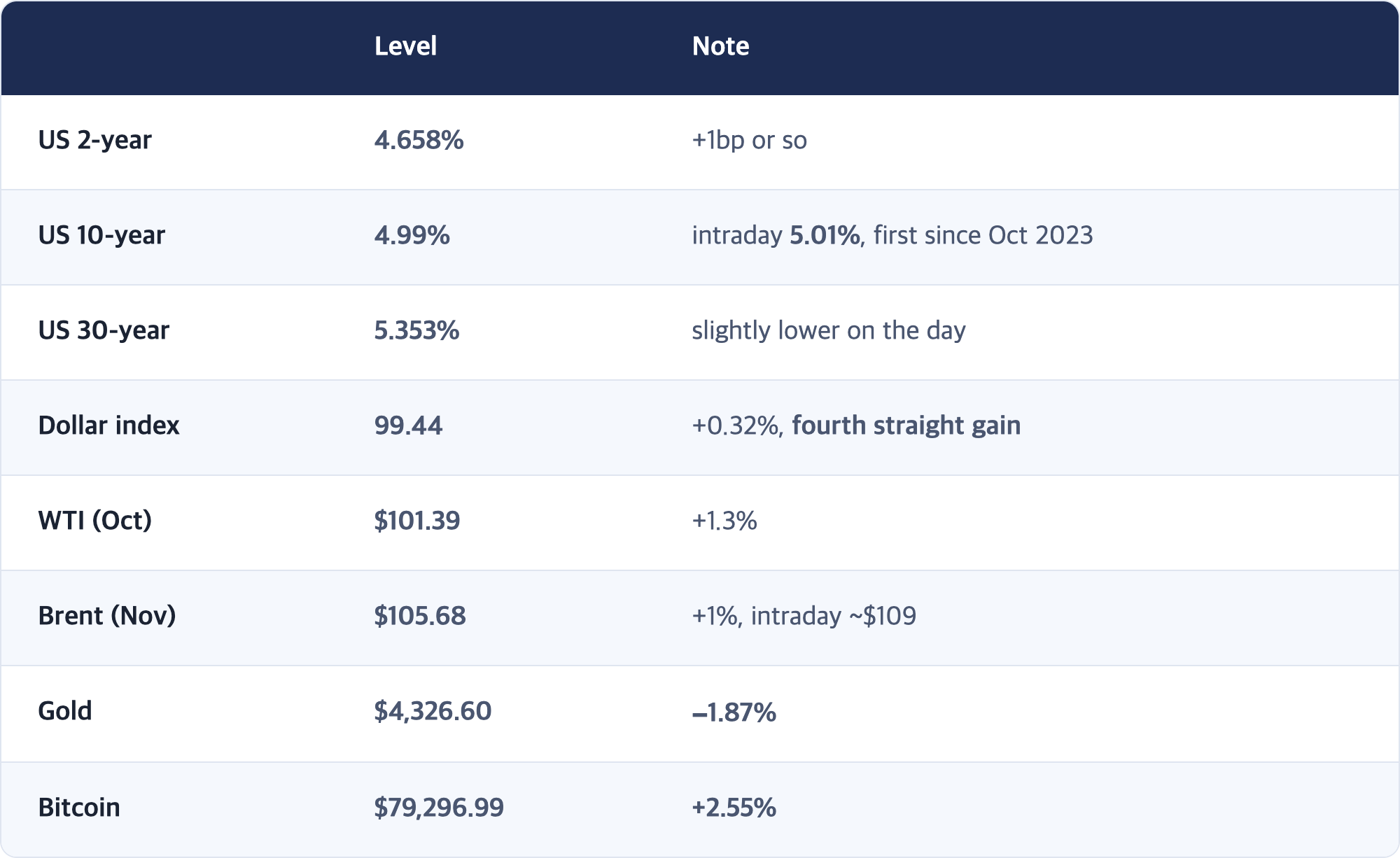
US retail diesel pushed above $6.23 a gallon, a fresh record. Crude futures retraced; refined product pressure did not.
🔴 [Interpretation] Gold fell again
Gold dropped 1.87%, a third straight decline, on a day when equities fell and the VIX rose 8%.
The structure flagged in yesterday's brief held for another session. In a market pricing better than an 85% chance of a rate hike two days from now, gold is not a shelter — it pays no interest, so it is expensive to hold while rates rise. Set that beside Bitcoin's +2.55% and yesterday's flow looks less like a move into safety and more like a move away from anything priced on an AI growth slope.
4. Korea: Monday was Korea reacting first, not Korea pricing it in
[Fact] Korea close, Sept 14 (KST)
[Fact] KOSPI flows
🔴 [Interpretation] Be careful with the phrase "already priced in"
The KOSPI fell 3.26% on Monday. That night, SOX fell 5.86%.
It is tempting to put those two numbers together and conclude Korea front-ran the damage and should fall less today. There is a reason not to read it that way.
Monday's Korean session traded on the essay alone, before anyone knew how far US chip stocks would actually go. Today's Korean session trades on the answer. And the answer came in worse than Monday's guess.
So the accurate sentence is not "Korea priced it in." It is "Korea reacted first, and the US reacted harder." The difference opens this morning.
[Observation] Three things are nevertheless better than yesterday
For balance, the other side of the ledger:
- Rates retreated from 5%. Rates were the variable Korea was reacting to all last week, and that pressure did not increase yesterday.
- Oil surrendered its high. Had Brent held $109, this morning would be considerably heavier.
- The won is holding. On a day the KOSPI fell 3.26%, the currency moved only 1.4 won. That is a second piece of evidence for the reading that foreign selling in semis is closer to sector reweighting than to capital flight. The caveat: the dollar index has now risen four sessions in a row, so today brings more pressure.
5. Macro backdrop: three central banks this week
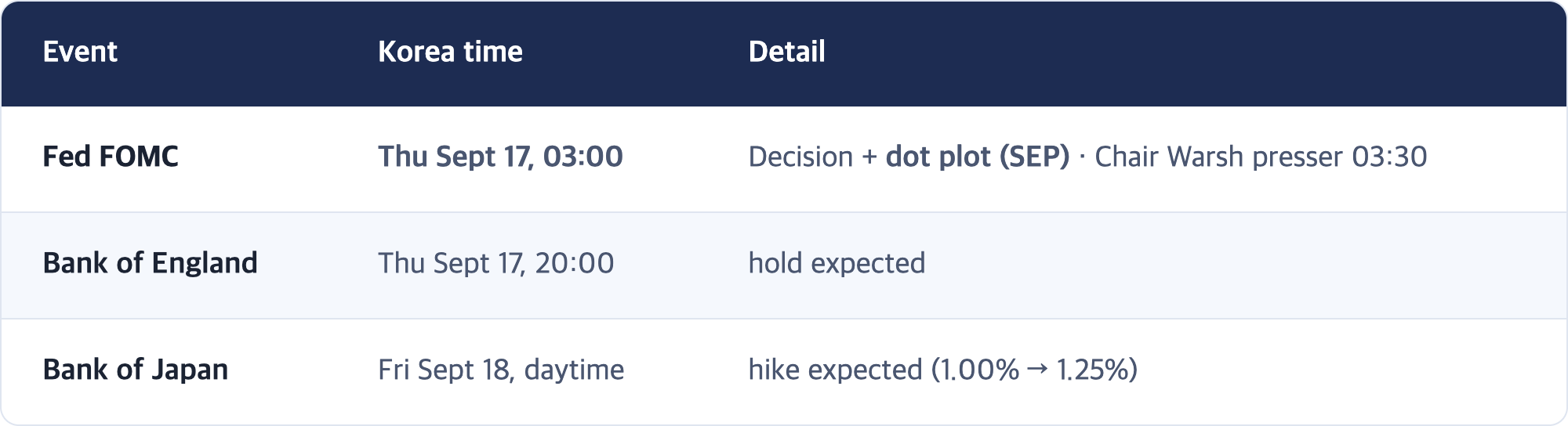
[Fact] Calendar (KST)
[Fact] Hike odds
CME FedWatch puts a 25bp September hike at roughly 86% as of Sept 14, little changed from 85.5% on Sept 12.
🔴 [Interpretation] The hike is settled; the dot plot is not
The increase itself is in the price. What the market is actually waiting for is the dot plot — each policymaker's projection for where rates go next.
June's median for end-2026 was 3.8%. This week's hike fills that number. So this dot plot answers exactly one question: one more this year, or stop here?
And a new input arrived yesterday: oil. Brent is up more than 20% in a month and diesel is at a record. How much of that made it into the projections decides the direction of rates for the rest of the week.
[Interpretation] Why this week is awkward for a Korean investor
On Korean time the FOMC lands at 3 a.m. Thursday. Today and tomorrow, Seoul has to trade two full sessions without knowing the answer, then receive it all at once on Thursday morning.
Layered on top is the AI capex story. This week contains one problem the Fed can fix (rates) and one it cannot (the growth slope). Even a friendly dot plot on Thursday does not resolve the semiconductor question. Holding that distinction makes the second half of this week much easier to read.
6. Previewing the Korean session (Sept 15, KST)
[Observation] The starting line
The KOSPI opens from 6,684.37, a third session below 7,000. The level Korean brokerages name as the next support is 6,600, which sits 84 points, or 1.26%, below Monday's close.
Samsung Electronics starts at 249,000 won, below the 250,000 mark, and SK Hynix at 1,697,000 won, below 1.7 million. Both are already under their psychological lines, which is what differs from yesterday. Today is not about defending those levels. It is about recovering them.
[Interpretation] The fork
The worse path. The US semiconductor decline transmits directly, both names fall further, foreign net selling stays in the 3 trillion won range, and 6,600 gets tested. In that case the won likely breaks above 1,350 as well.
The better path. The market counts the two retracements first — rates off 5%, oil off its high — along with memory contract prices still rising, both names limit early losses, and the index tries to stabilize in the upper 6,600s.
The fork turns on one number: the size of foreign selling. Monday's −3.29 trillion won is large even by recent standards. Whether it shrinks is the first thing to check this morning.
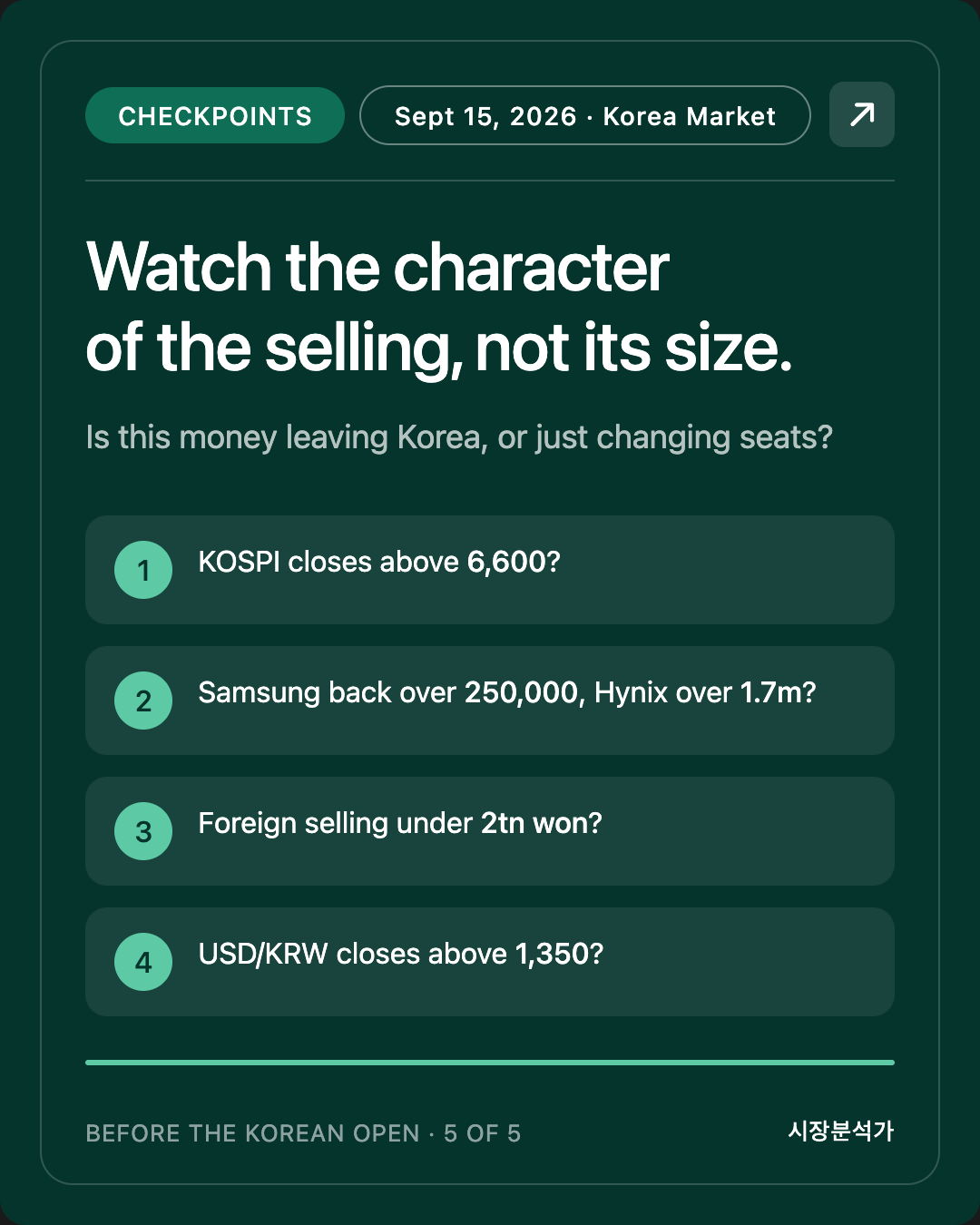
✅ Four checkpoints for today's Korean session
- Does the KOSPI hold 6,600 on a closing basis? 1.26% below Monday's close; measures how strongly the US semiconductor move transmits.
- Do Samsung Electronics and SK Hynix close back above 250,000 and 1,700,000 won? Both recovering means Monday overshot; neither recovering means the repricing is still running.
- Does foreign net selling fall below 2 trillion won? Monday was −3.29tn. Smaller means sector reweighting; unchanged means capital leaving.
- Does USD/KRW close above 1,350? The dollar index has risen four straight sessions. A break tilts #3 toward the worse reading.
Stating the axis explicitly: all four ask the same question — is this selling money leaving Korea, or money changing seats inside Korea? The first two measure intensity; the last two measure character.
7. Study note: capital expenditure is one firm's cost and another firm's revenue
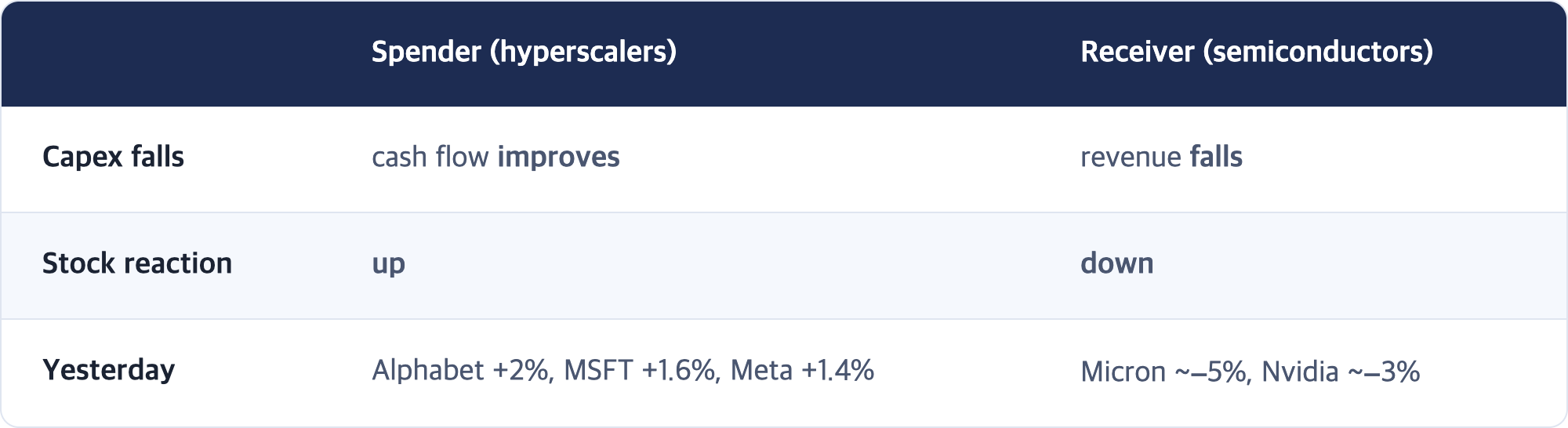
Yesterday the same headline lifted Alphabet 2% and cut Micron 5%. Understanding why makes every future AI headline faster to read.
The concept
Capital expenditure (capex) is money a company spends on long-lived assets — plants, equipment, buildings. It has one accounting property that matters enormously here: one company's capex is another company's revenue.
When Microsoft spends $10 billion on data centers, that $10 billion lands as revenue at Nvidia, Broadcom and SK Hynix. The same dollar is an outflow on one ledger and an inflow on the other.
Which is why "we will spend less on capex" hits two companies in opposite directions.
An analogy
Think of a landlord and a contractor.
The landlord announces: "We are pausing renovations and just renting out the building as it stands." For the landlord this is good news — money stops going out, rent keeps coming in.
The identical sentence tells the contractor the work has dried up.
The landlord has not gone bankrupt. The landlord is healthier. And for the contractor it is the worst news of the year. Same sentence, opposite outcomes.
Applying it to Korea
The Korean market stands almost entirely on the contractor's side of this picture.
A large share of Samsung's and SK Hynix's memory revenue traces back to global hyperscaler capex. Korea has essentially no large listed company on the landlord side.
So when a US investor decides to sell chips and buy hyperscalers, the money stays inside the US market — while in Korea, only the selling half is visible. That is part of why the KOSPI fell hardest in Asia on Monday.
When does this story end
When numbers replace words. Whether capex actually fell shows up in two places:
- Memory contract prices. Still rising today. If orders thin, this bends first.
- Capex guidance on earnings calls. The nearest is Micron on September 30, followed by hyperscaler Q3 reports in October.
Until then, the moves are the price of an opinion. Keeping that straight makes the headlines much less unsettling.
8. Corrections and open items
Source discrepancies (adopted values stated)
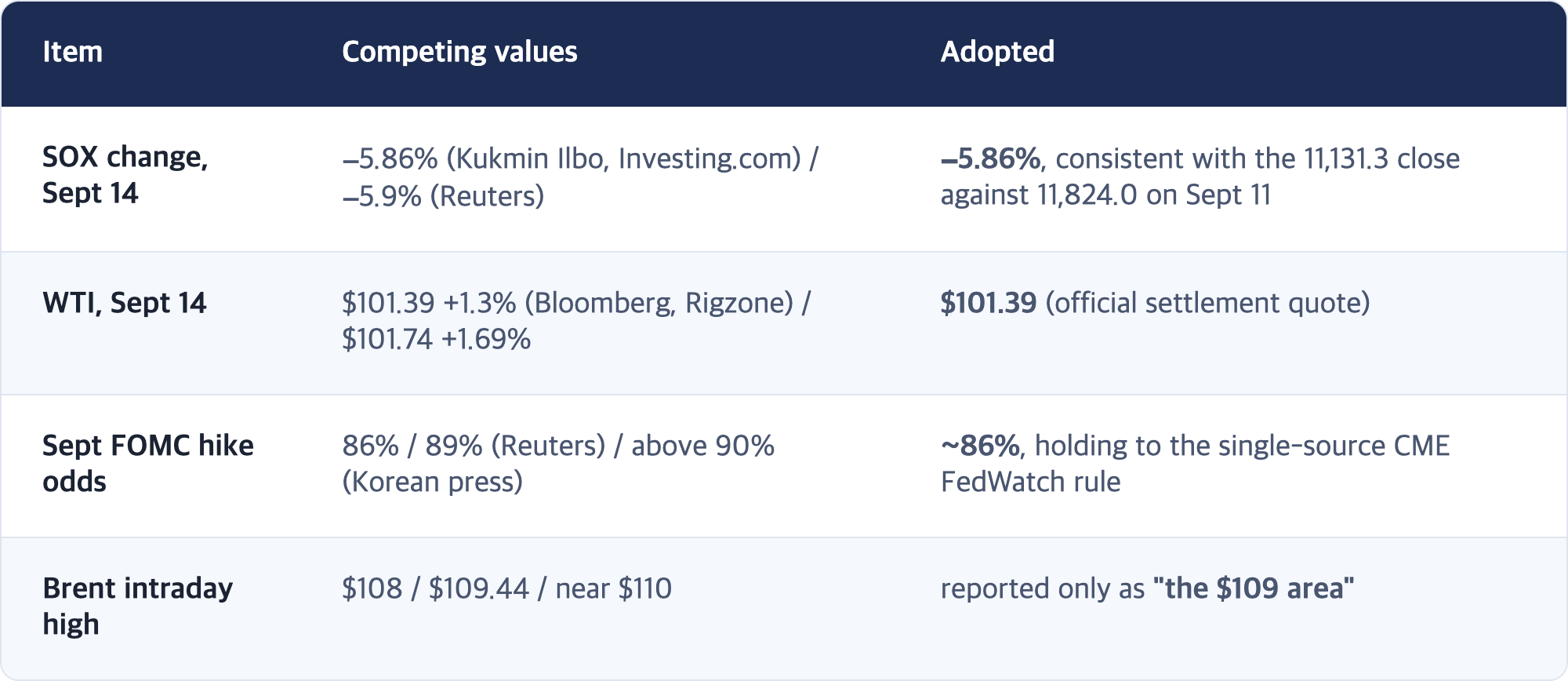
🔴 One reporting error at another outlet
A Businesskorea opening-session piece on Sept 14 put USD/KRW at "1,382, up 8.5 won." The onshore 15:30 close that day was 1,347.3, up 1.4 won (Money Today), which is the figure used here. The gap is too large to be an open-versus-close difference, so that number was not cited.
Open items
- Sept 11 dollar index close still not captured — carried from the Sept 11 morning brief, now a fourth session. The Sept 14 close of 99.44 is confirmed.
- Korean night futures and offshore NDF for Sept 14 not captured — no usable source found for estimating this morning's open.
✅ One item closed
The 10-year 5.00% test resolved after three sessions. Left "pending" on Sept 11, Sept 13 and Sept 14, it settled yesterday with an intraday print of 5.01%.
Sources
- Wall Street ends down, calls for AI slowdown pummel chipmakers — Reuters / Yahoo Finance
- Wall Street's AI doomsday trade: chipmakers sink while hyperscalers gain — Fortune
- AI stocks sink while cybersecurity shares rally on slowdown fears — CNBC
- Philadelphia semiconductor index plunges 5.86% — Kukmin Ilbo
- Is the AI rally stalling? The 10-year reached 5% — Edaily
- S&P 500, Nasdaq Close Lower as AI Euphoria Encounters a 5% Reality Check — VistaP Global
- PHLX Semiconductor Index Historical Data — Investing.com
- 10-year Treasury yield hits 5% before reversing as traders await Fed meeting — CNBC
- US 10-Year Yield Tops 5% as Inflation and Supply Concerns Intensify — Bloomberg
- Oil Climbs Amid Saudi Pipeline Halt — Rigzone
- United States Dollar — Trading Economics
- KOSPI closes down 3.26% at 6,684.37 — Businesskorea
- Won/dollar closes 1.4 won higher at 1,347.3 — Money Today
- KOSPI faces the double burden of rates and oil after US chip selloff — EBN
- Semiconductor sentiment is the biggest variable for the Sept 15 KOSPI session — CBC News
- Samsung and SK Hynix fall 3-5% on FOMC caution and AI slowdown talk — Segye Ilbo
- Slowdown calls deflate AI stocks — Taipei Times
- Prediction: This AI Chip Stock Will Soar After Sept. 30 — The Motley Fool
- Diesel prices push to new all-time high as key Saudi pipeline shut — NBC News
This brief interprets market flows and macro variables. It is not a buy or sell recommendation on any individual security.
📌 More market briefs
※ This post is market observation and organization intended to support your own judgment. It is not a recommendation to buy or sell any security. Figures are as of the time of writing and may differ between sources.
If this was useful, bookmark it or pass it along. It genuinely helps me write the next one.
I can survive. We can survive.