Oct 16, 2026 KOSPI Market Brief — What to Watch Before the Korean Open
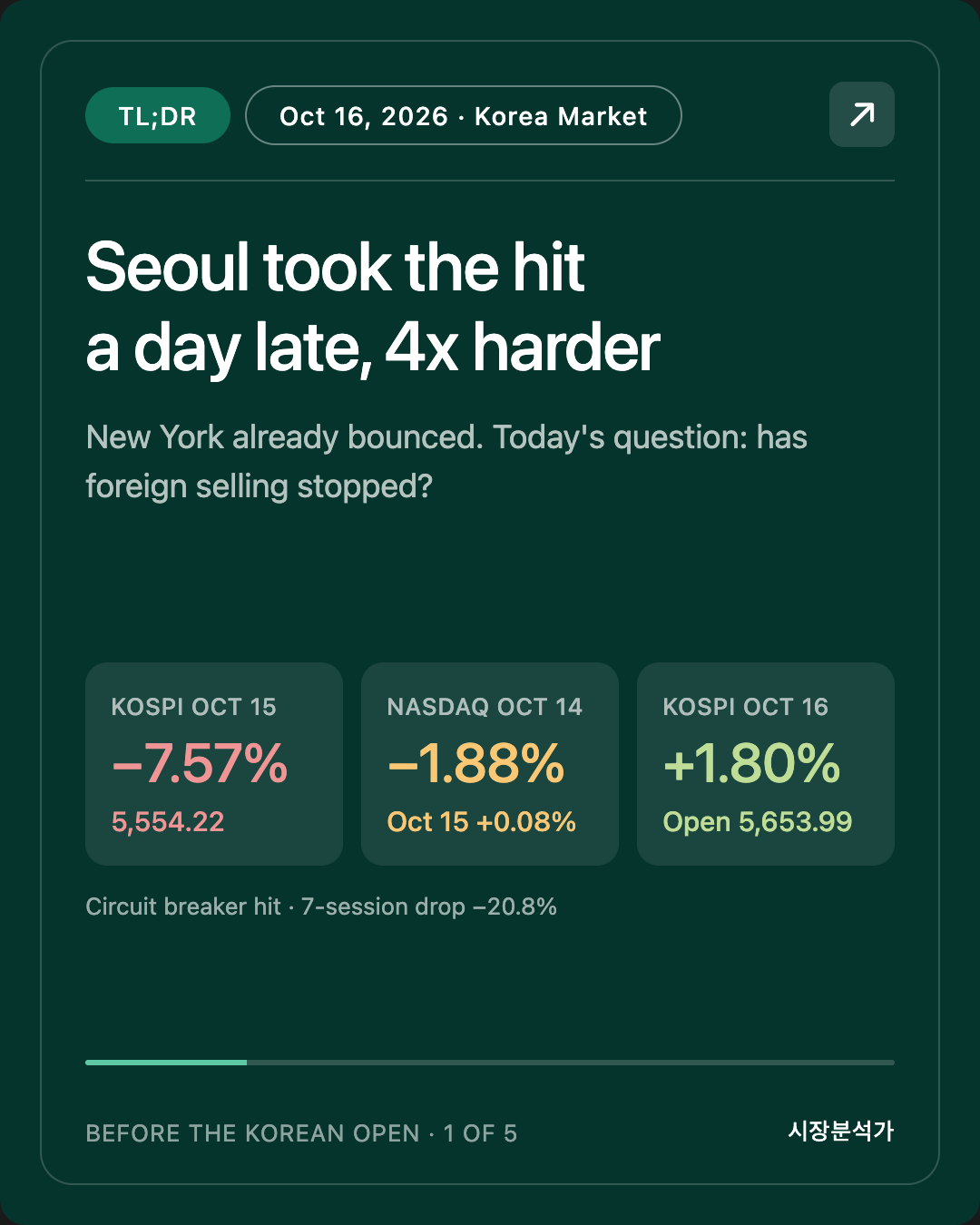
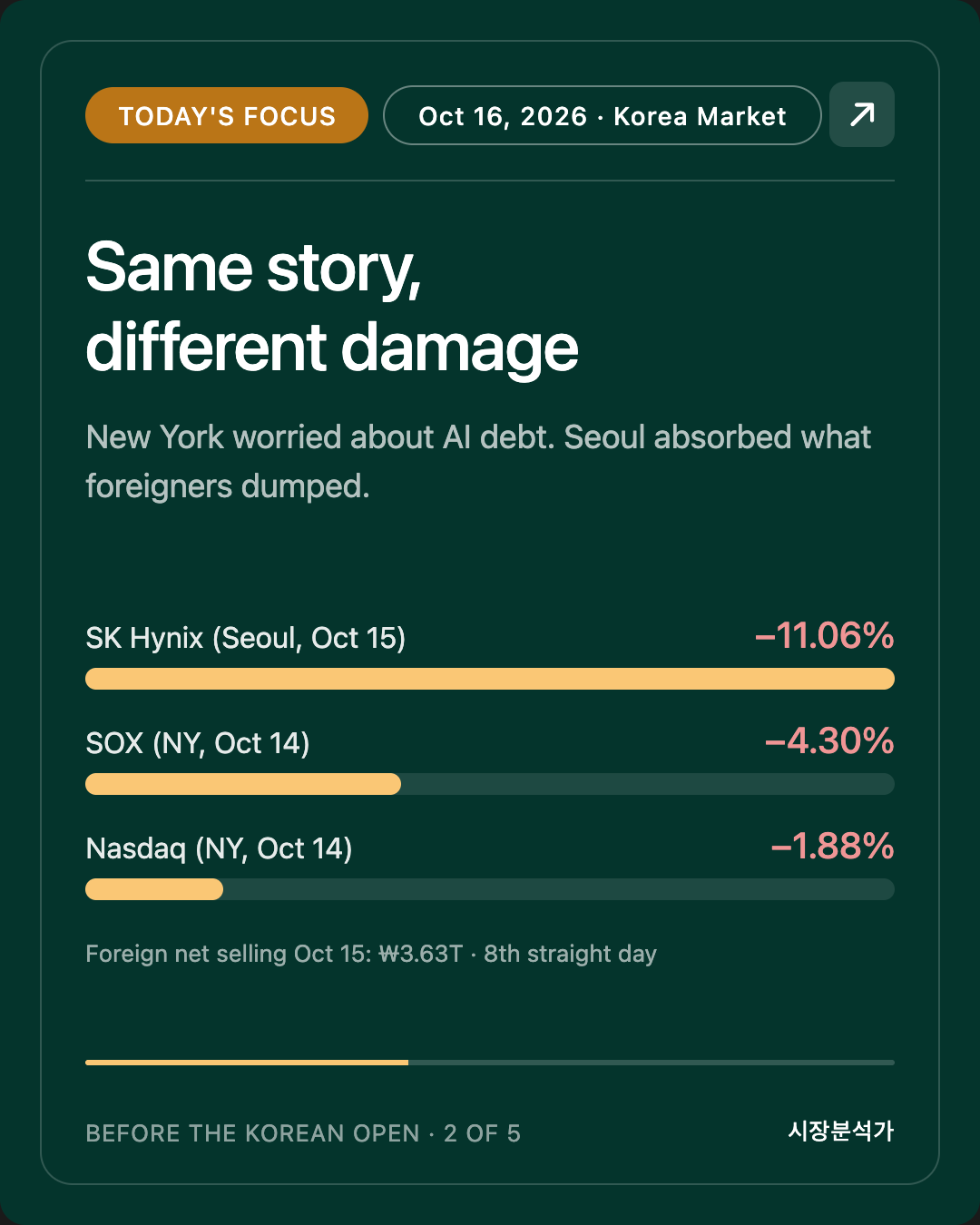
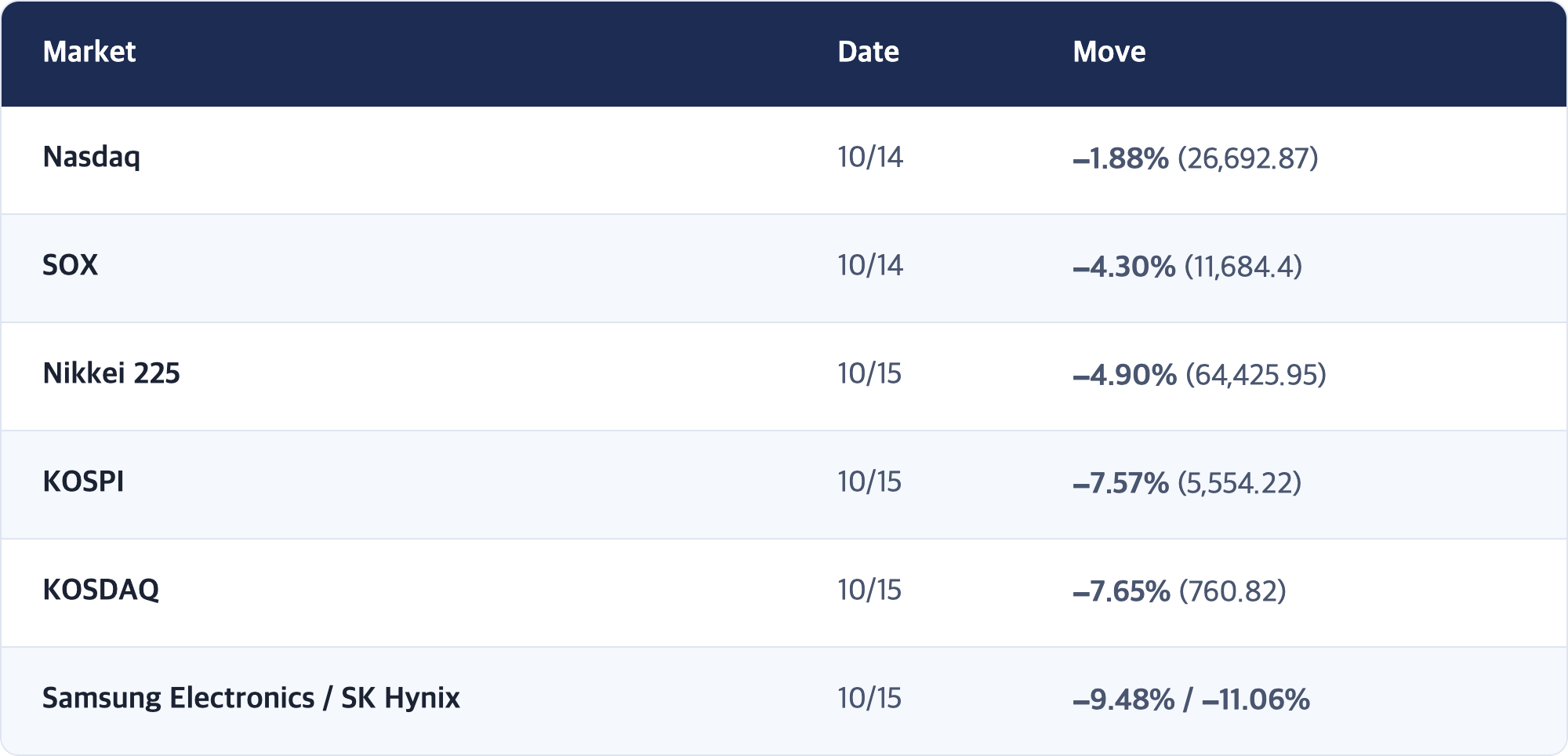
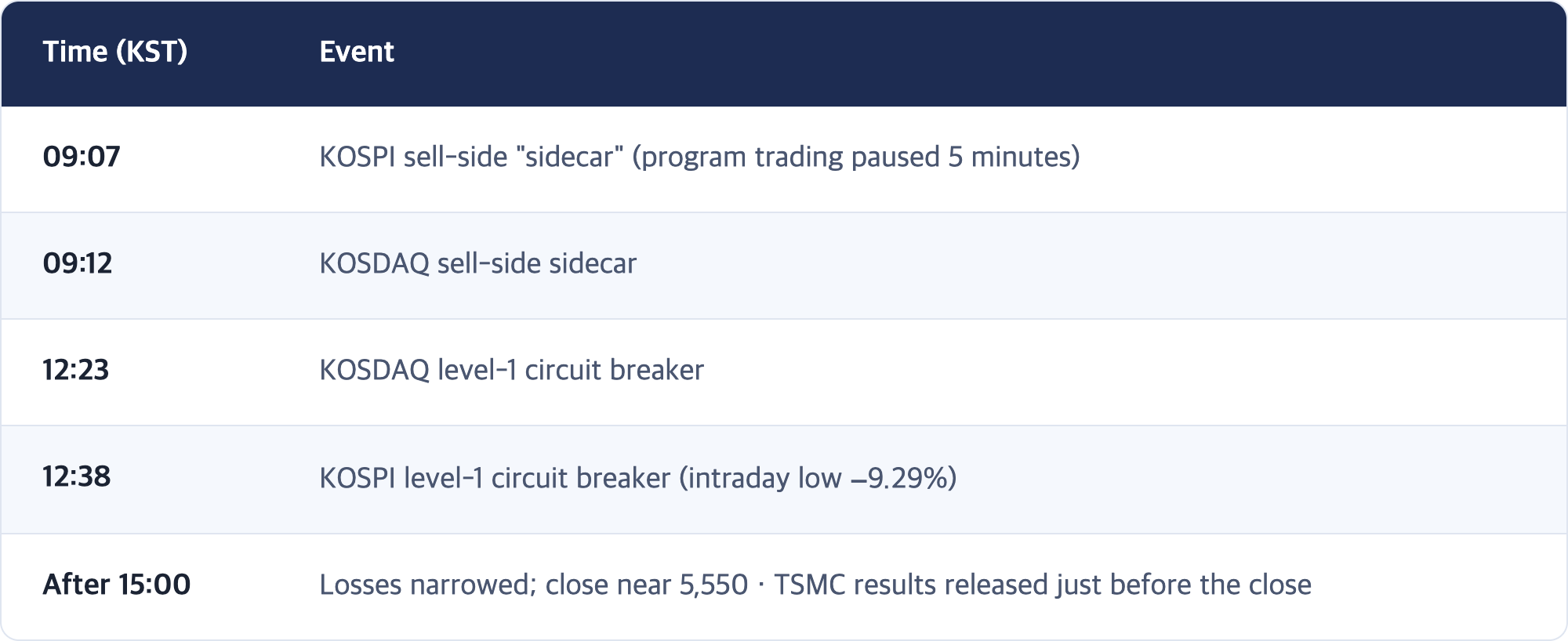
Seoul took the hit a day late, and much harder. On Wednesday 10/14, a hotter-than-expected US September consumer price index (CPI) sent the Nasdaq down 1.88% and the Philadelphia Semiconductor Index (SOX) down 4.30%. A few hours later, Korea's KOSPI collapsed 7.57% to 5,554.22. It fell more than 9% intraday, triggering a circuit breaker (a 20-minute halt on all trading). Foreign investors sold a net ₩3.63 trillion (about $2.7 billion). Over seven sessions, the KOSPI has now fallen 20.8%.
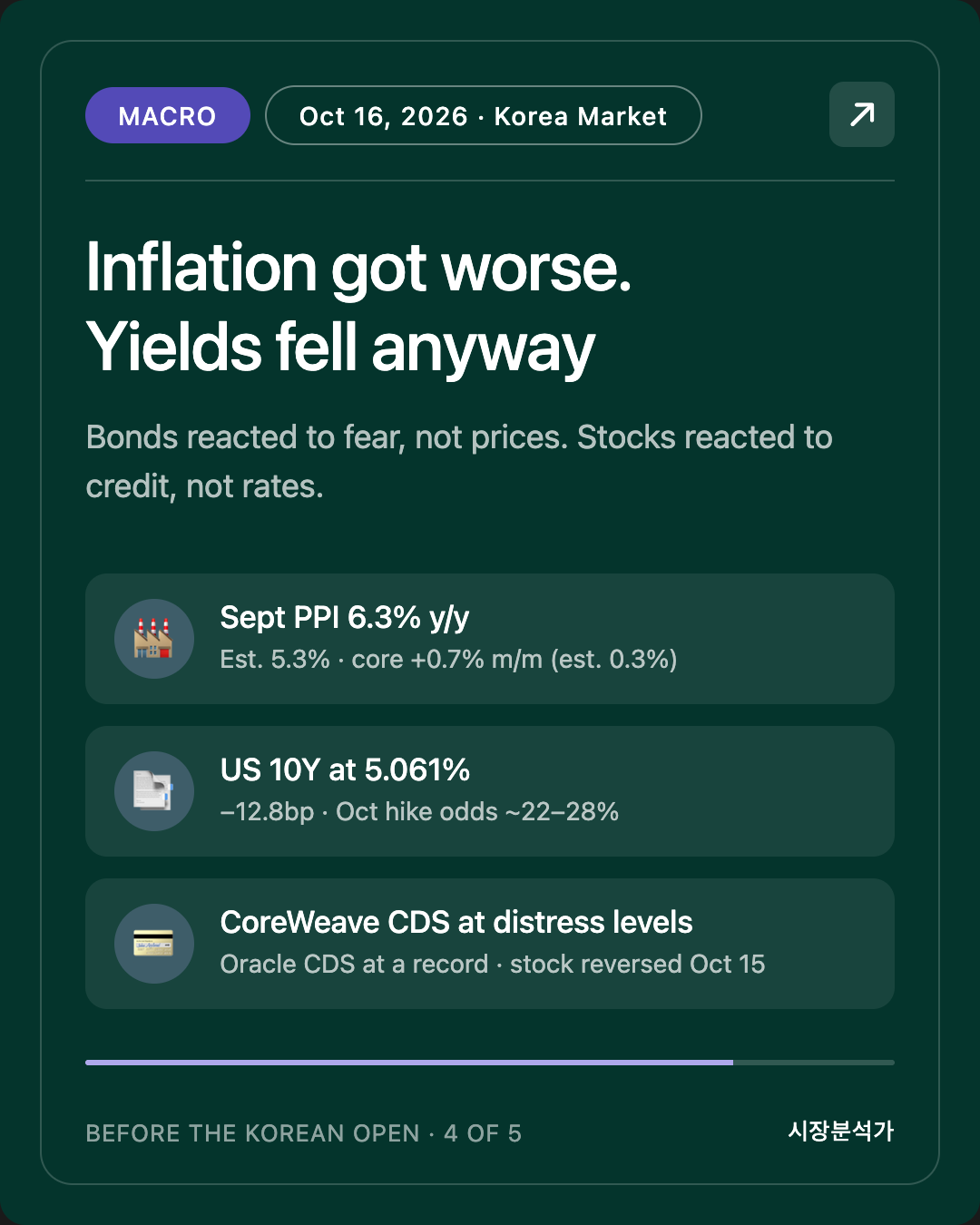
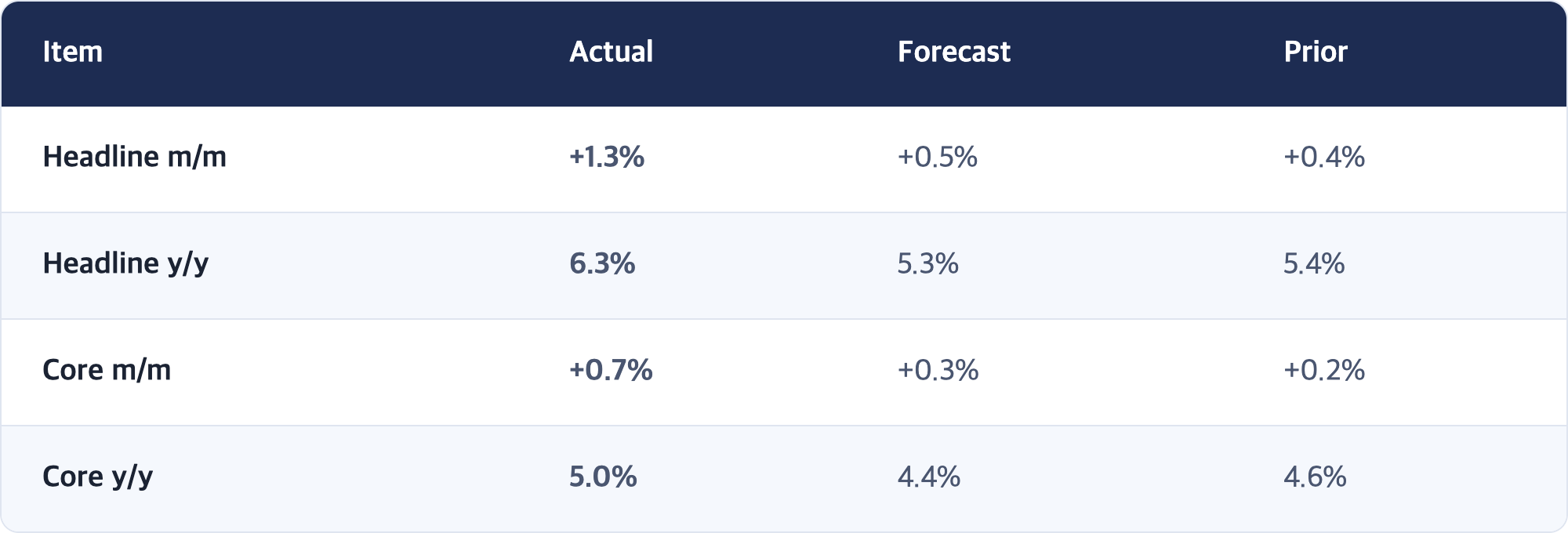
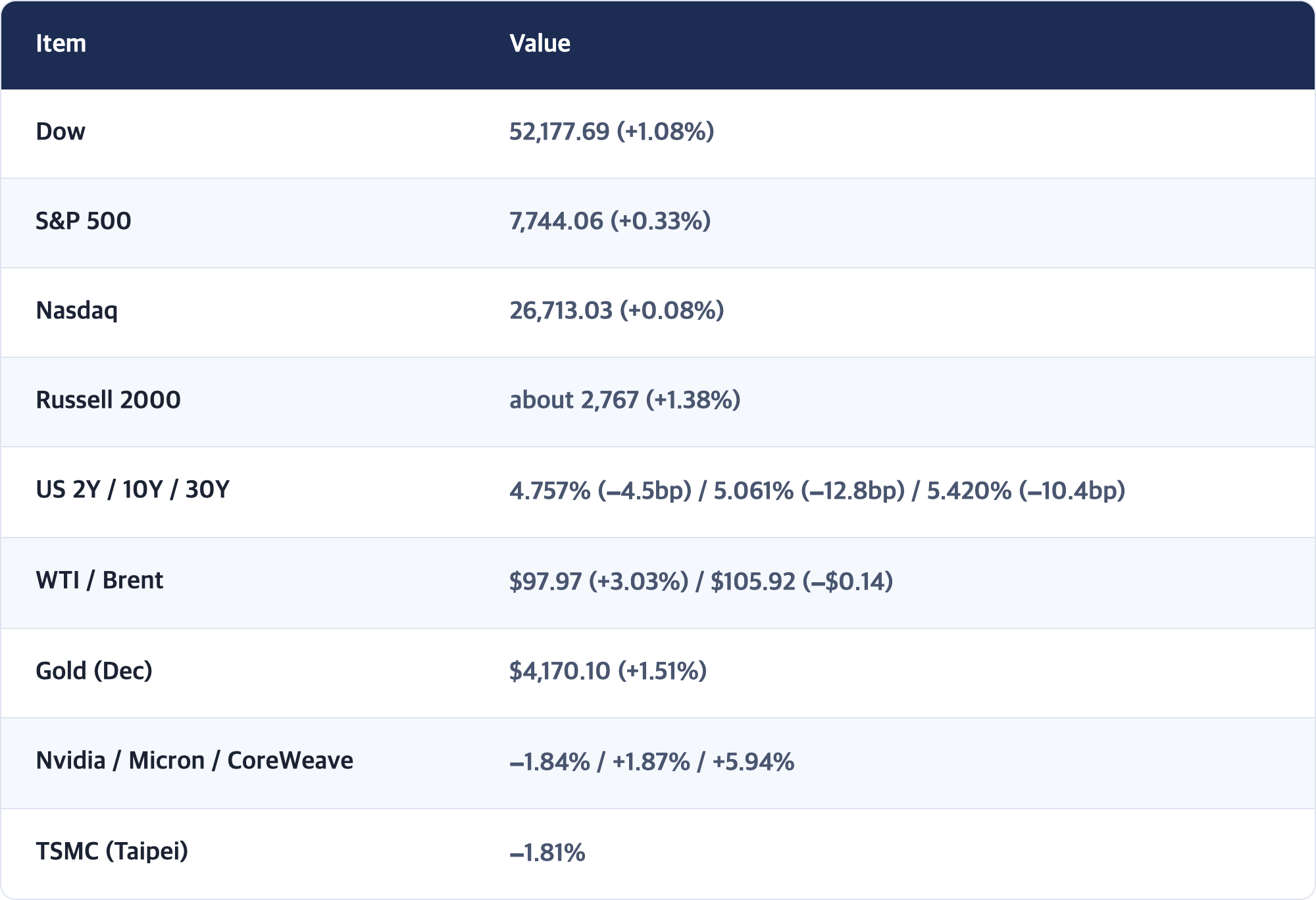
Then New York did the opposite. On Thursday 10/15, September producer prices (PPI) came in far hotter, at 6.3% year on year (forecast 5.3%). Yet the Dow rose 1.08%, the S&P 500 rose 0.33%, and the US 10-year Treasury yield fell about 13 basis points. Inflation got worse and yields fell.
That split tells us what really moved markets this week. It was not only interest rates. It was a credit scare: is the money lent to AI infrastructure companies safe? This morning (10/16) the KOSPI opened 1.80% higher at 5,653.99. Today's question for Seoul: is this bounce a sign that foreign selling has stopped, or just a one-day breather after a crash?
This is Mr. Can. Here is the Oct 16, 2026 brief ahead of the Korean market open.
Written: 2026-10-16 12:55 KST (Vancouver 10/15 20:55 PDT) · work started 09:08 KST
Basis: US 10/14 (Wed) and 10/15 (Thu) regular-session closes (05:00 KST 10/16) + New York Treasury close 10/15 + Seoul close 10/15 + Seoul open 10/16
🔴 Scheduled 16:00 PDT, started 17:08 PDT, finished 20:55 PDT. Work started 1 hour 8 minutes late and finished about 5 hours late (tools stalled for long stretches). Seoul is already past its morning session. The analysis is based on the open; the morning's trading is added separately below.
🟢 As of publication (11:23 KST, Newspim/News1): KOSPI 5,723.72 (+3.05%), intraday high 5,745.36. Foreign investors were net sellers of about ₩242.5 billion, a ninth straight day of selling. Bargain buying by retail and institutions drove the bounce. The index has moved beyond its +1.80% open toward the +3.90% night-futures level, but checkpoint 1 (foreign flows) still reads "selling."
🔴 Two editions were missed: the 10/14 pre-Korean-open brief and the 10/15 pre-US-open brief. This edition covers two days at once: the US close after CPI on 10/14, Seoul's crash on 10/15, and the US close after PPI on 10/15.
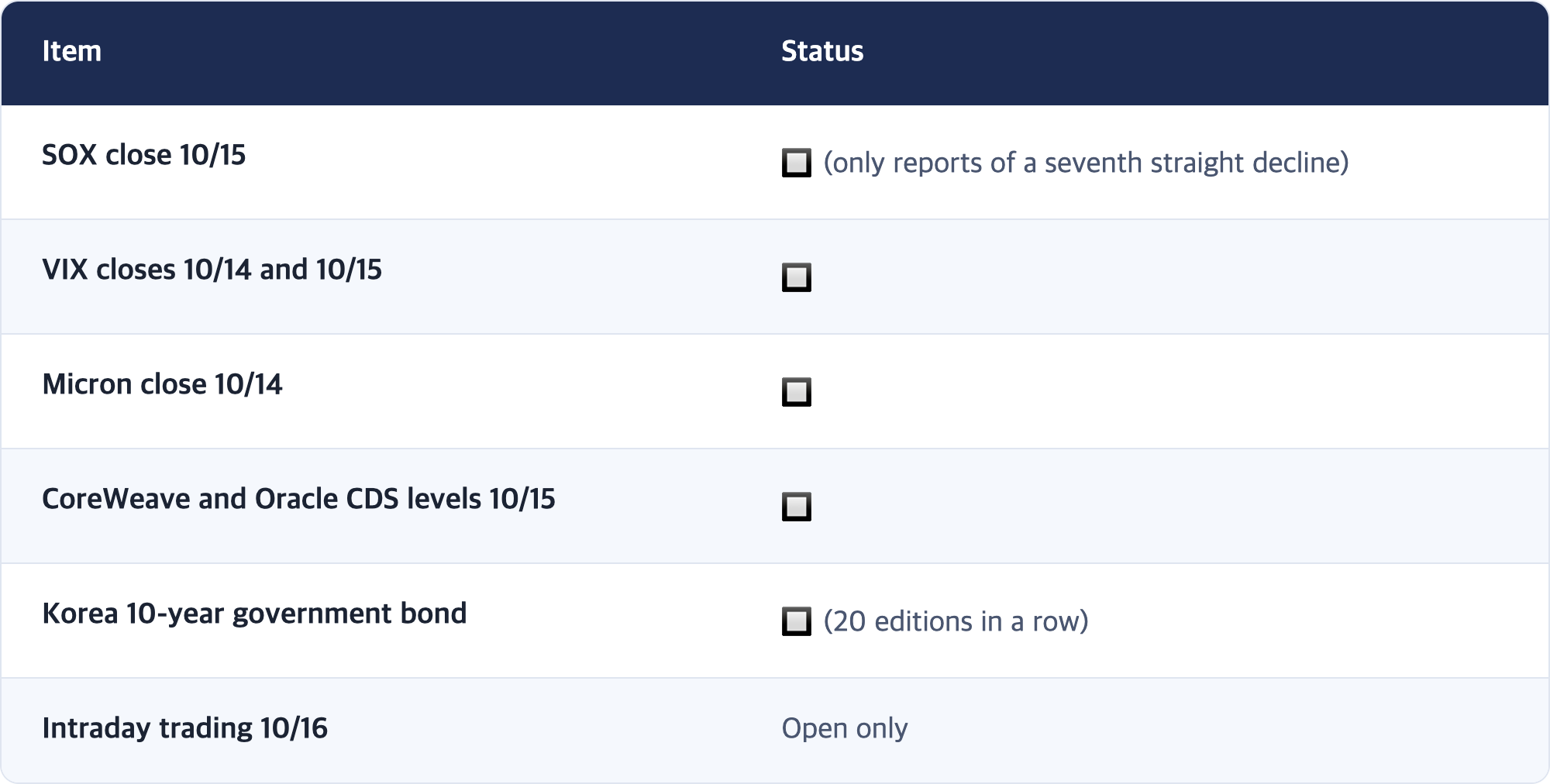
🟡 The 10/15 SOX close, VIX closes and the TSMC ADR close were not available (see section 7).
⚡ TL;DR
- ★ Seoul absorbed New York's worst day a day later, at four times the size. KOSPI 10/15 5,554.22 (−7.57%), KOSDAQ 760.82 (−7.65%), with circuit breakers on both. Samsung Electronics −9.48%, SK Hynix −11.06%. Japan's Nikkei fell 4.90% the same day.
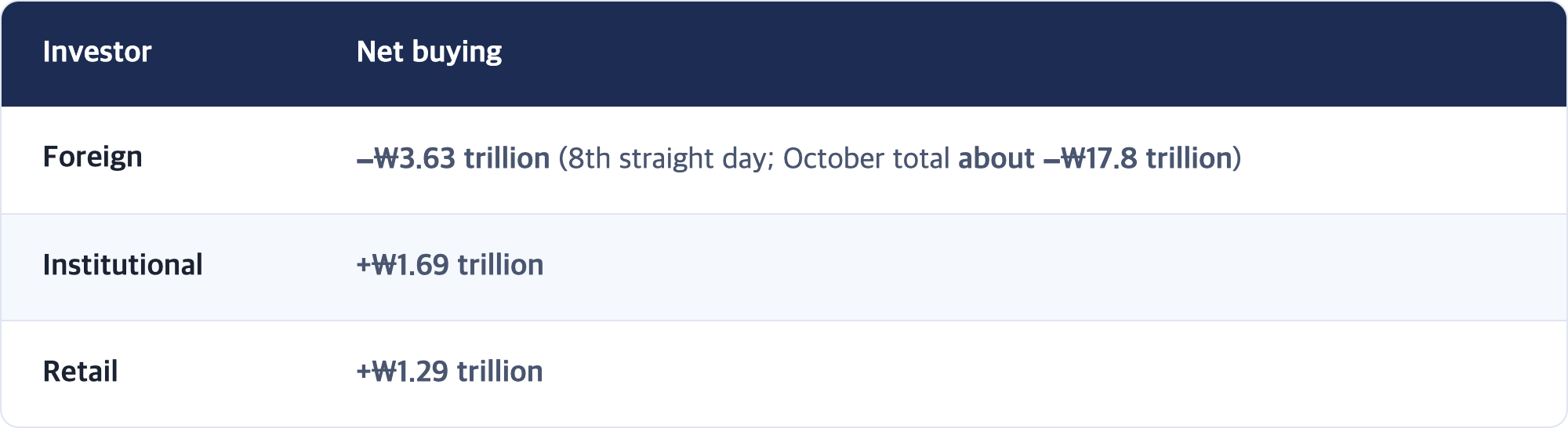
- ★ Eight straight days of foreign selling, about ₩17.8 trillion in October. 10/15 alone: −₩3.63 trillion, of which ₩3.17 trillion came out of electronics. Korean institutions (+₩1.69T) and retail investors (+₩1.29T) were the buyers.
- ★ PPI was hotter, yet yields fell. September PPI +1.3% m/m (est. 0.5%), core +0.7% (est. 0.3%). But the US 10-year ended at 5.061% (−12.8bp), the 2-year at 4.757% (−4.5bp), and the dollar index near 102.00 (−0.5%). Odds of an October Fed hike fell back from around 50% (10/14) to about 22–28% (10/15).
- The real variable was AI debt. CoreWeave's credit default swaps (CDS) reached "distress" levels and Oracle's CDS hit a record, sending CoreWeave down 15.46% on 10/14. On 10/15, after Nvidia CEO Jensen Huang said CoreWeave's "cost of capital is actually decreasing," the stock reversed to +5.94%.
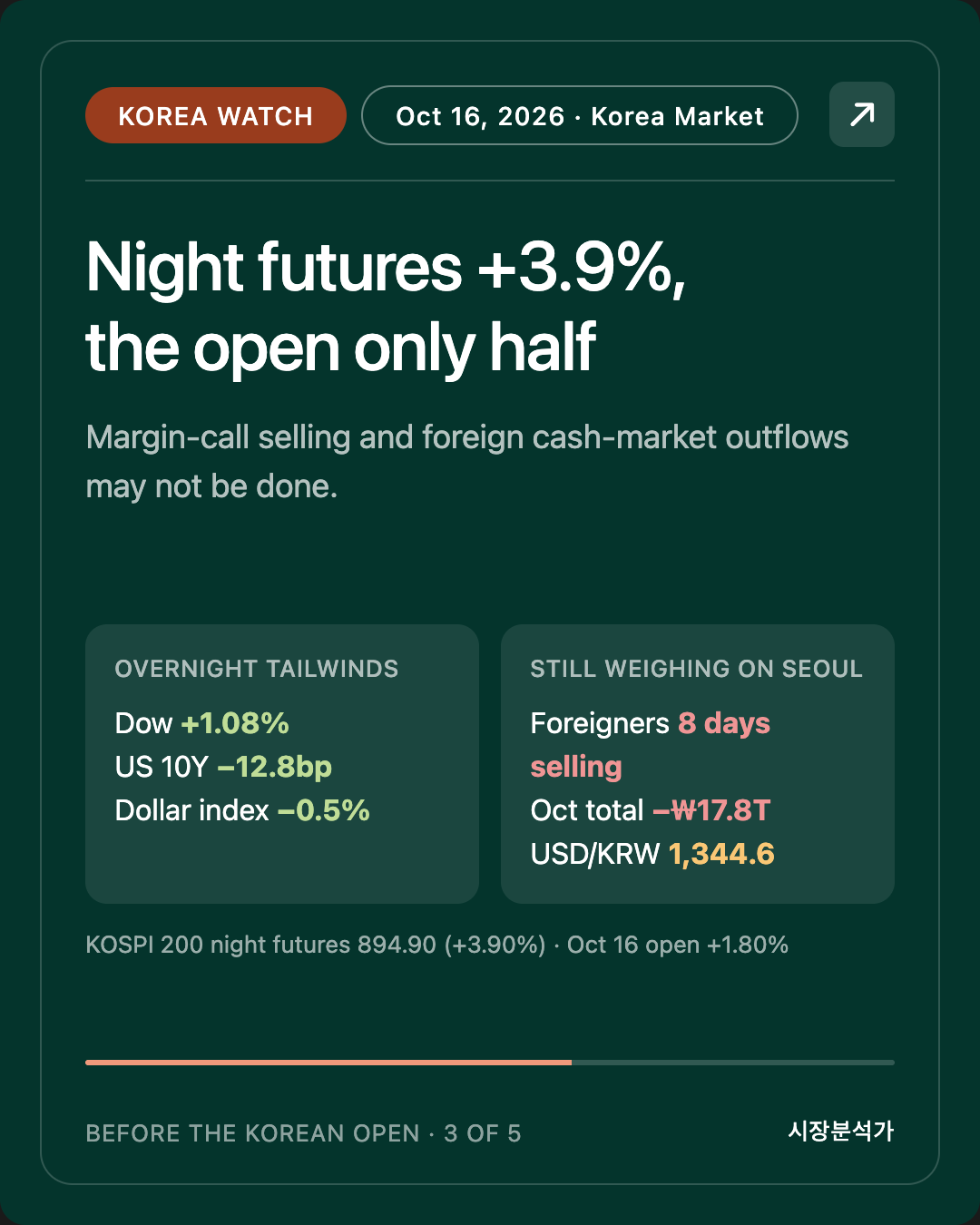
- Seoul opened 1.80% higher. KOSPI 200 night futures ended +3.90% (894.90); the won closed 10/15 at 1,344.6 per dollar (+6.3). Note that the cash market opened with only half the move in night futures.
1. Checkpoint scorecard
The four set by the 10/14 pre-US-open brief (US close 10/14)
The question was: does the CPI shock stay priced in as "the next meeting" by the close, or does it fade as a first-hour overreaction?
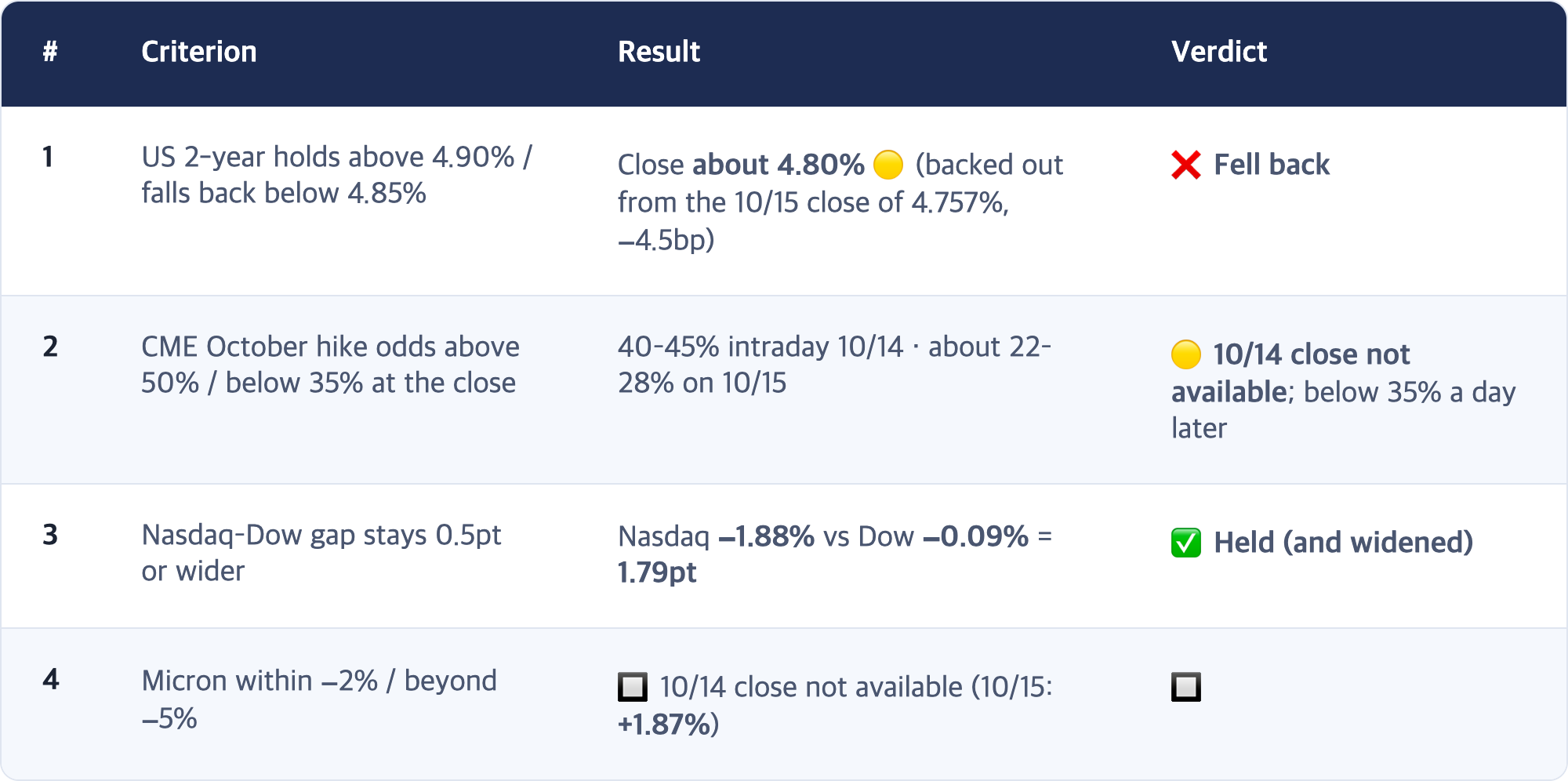
★ [Interpretation] The verdicts were right. The explanation was wrong
Read checkpoints 1 and 3 together and something looks off. The 2-year yield came back down (the rate story weakened), yet the Nasdaq–Dow gap widened to 1.79 points. The 10/14 brief said a lasting gap would mean a rate-driven selloff. The gap lasted, but rates were not the cause.
A third variable arrived on the afternoon of 10/14: the debt of AI data-center companies. CoreWeave fell more than 15% in a day and Oracle's CDS hit a record. A line written in the 9/28 edition proved right again: "If you frame a market with only two options, on the day a third variable shows up your verdict will be right and your explanation wrong." This is the second time.
2. Today's key story: why Seoul fell four times as hard as New York
[Fact] Same news, different damage
[Fact] How 10/15 unfolded in Seoul (Alpha Economy)
[Fact] Flows by investor type (KOSPI, 10/15)
★ [Interpretation] New York worried about AI debt. Seoul absorbed what the worriers sold
In New York on 10/14, the biggest losers were companies like CoreWeave that borrow to build data centers. Companies that sell the chips, like Nvidia (−1.84% on 10/15) and Micron (+1.87% on 10/15), held up relatively well. In Seoul, though, the chip sellers, Samsung and SK Hynix, fell 9–11%.
The most natural explanation is flows (interpretation). In October alone, foreign investors sold ₩9.29 trillion of SK Hynix and ₩4.82 trillion of Samsung. When a global fund wants to cut its AI exposure quickly, these two stocks are the easiest and biggest things to sell: they are liquid and heavily weighted. Daishin Securities' Lee Kyung-min also said foreign selling and an imbalance in domestic supply and demand deepened the fall.
[Observation] One thing is clearly different. When the 10/13 pre-Korean-open brief pointed out that Seoul fell twice as much as New York, it was a sidecar-level day. This time it was a circuit breaker. It was the KOSPI's first circuit breaker since 7/28 (−10.84%).
3. Korea factors: this morning's numbers point to a bounce, but only halfway
[Fact] Around the 10/16 open
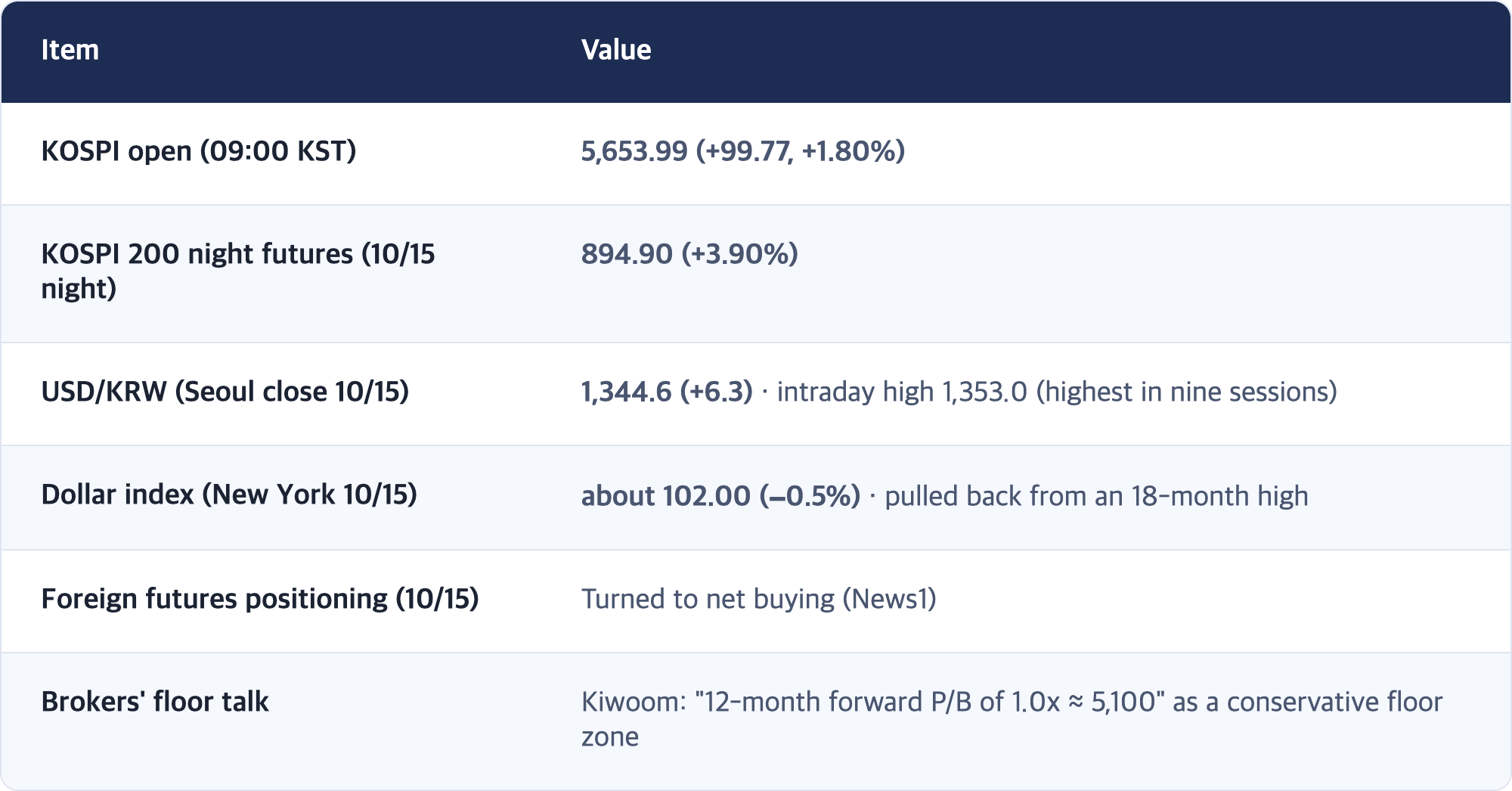
★ [Interpretation] Night futures +3.9%, the open +1.8%. That gap is today's first clue
Overnight, New York erased its intraday losses and closed higher, the dollar weakened, and yields fell. All three favor Korea. Night futures priced that in at +3.9%. The regular session opened at only +1.8%.
Two likely reasons for the half-strength open (interpretation). First, forced selling of margin accounts. After a 21% drop in seven sessions, many investors who bought with borrowed money face margin calls, and that stock tends to hit the market on the first morning of a bounce. Second, there is no evidence yet that foreign selling in the cash market has stopped. Foreigners turned buyers in futures, but they sold stocks for an eighth straight day.
Among the Korean market commentators this report tracks, AFW Partners' Lee Sun-yeop has long argued that flows and leverage, not headlines, drive sharp selloffs. This week fits that view best. The shared view among all four commentators, a long-term uptrend centered on semiconductors, is supported by TSMC's numbers (section 4). But strong long-term fundamentals and a price floor this week are different questions.
4. Macro backdrop: inflation got worse, and yields fell
[Fact] US September PPI (released 21:30 KST 10/15)
[Fact] US close 10/15 (05:00 KST 10/16)
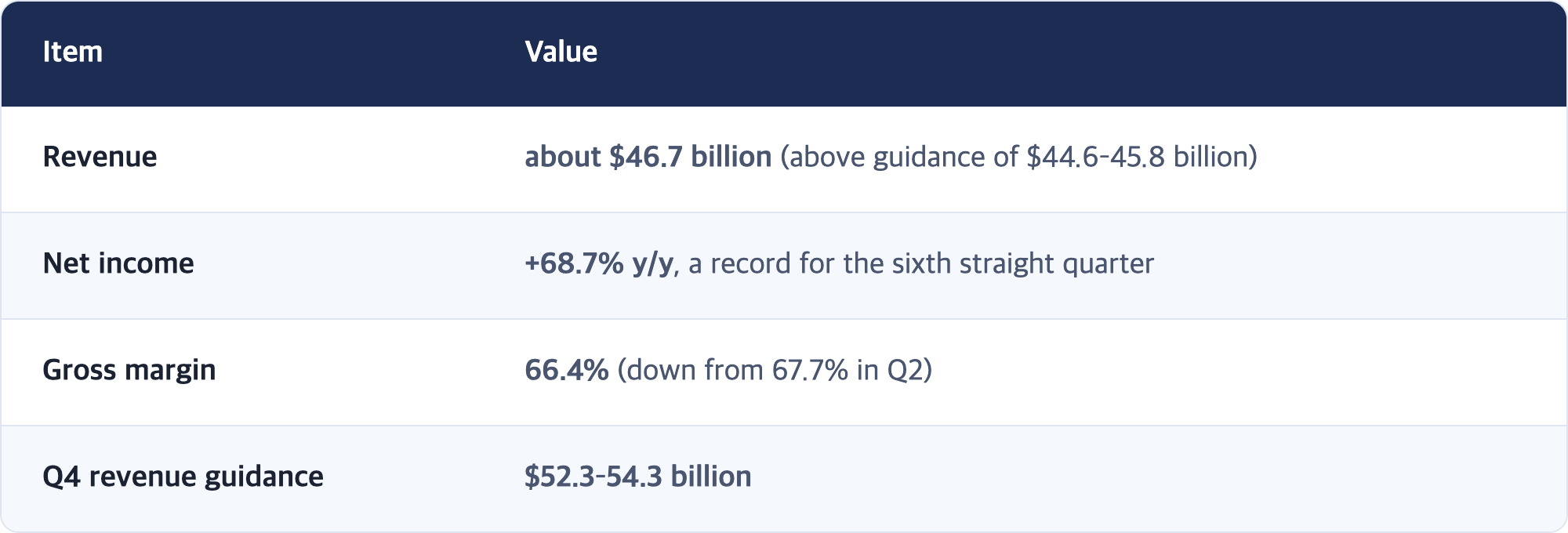
[Fact] TSMC third quarter (released 10/15)
★ [Interpretation] Why did yields fall on a 6.3% PPI?
By the textbook, producer prices a full point above forecast should push yields up. Futures did slip right after the release. But by the end of the day the 10-year was down 12.8 basis points.
Three things overlapped (interpretation). First, a flight to safety. Money leaving AI stocks went into Treasuries and healthcare, which hit a record high (CNN). Second, dovish signals from Fed officials. Expectations of an October hike faded after comments from Governors Bowman and Daly. Third, much of the PPI jump was energy. Markets may be starting to read that less as inflation the Fed must fight with rates and more as a cost that eats into growth.
As the 9/18 edition put it, score stocks and bonds separately. This week bonds reacted to fear more than to inflation, and stocks reacted to credit more than to rates. Both point the same way: risk-off.
[Observation] TSMC's numbers show there is no doubt about AI demand itself. Fourth-quarter guidance is about 15% above the third quarter. What the market questioned was not demand, but whether the companies building for that demand with borrowed money can carry the debt. Mixing those two up leads to the wrong reading.
5. Korea today (Friday 10/16): checkpoints
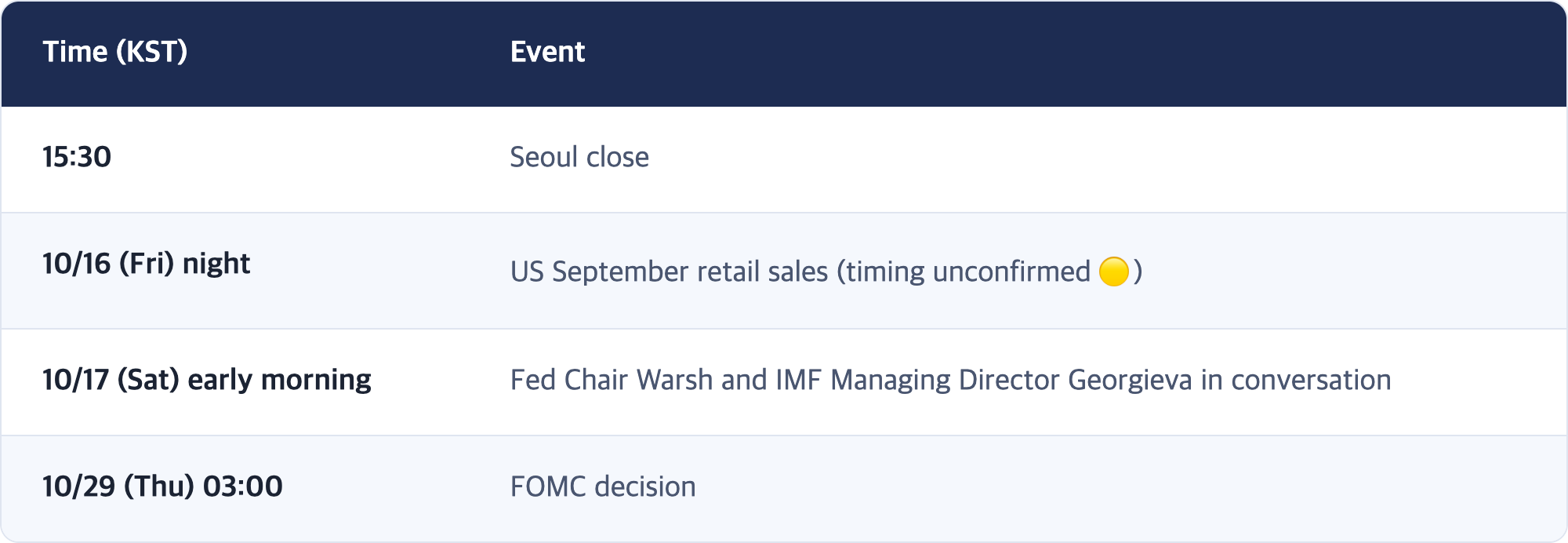
[Observation] Today's schedule (KST)
✅ Four checkpoints (through the Seoul close)
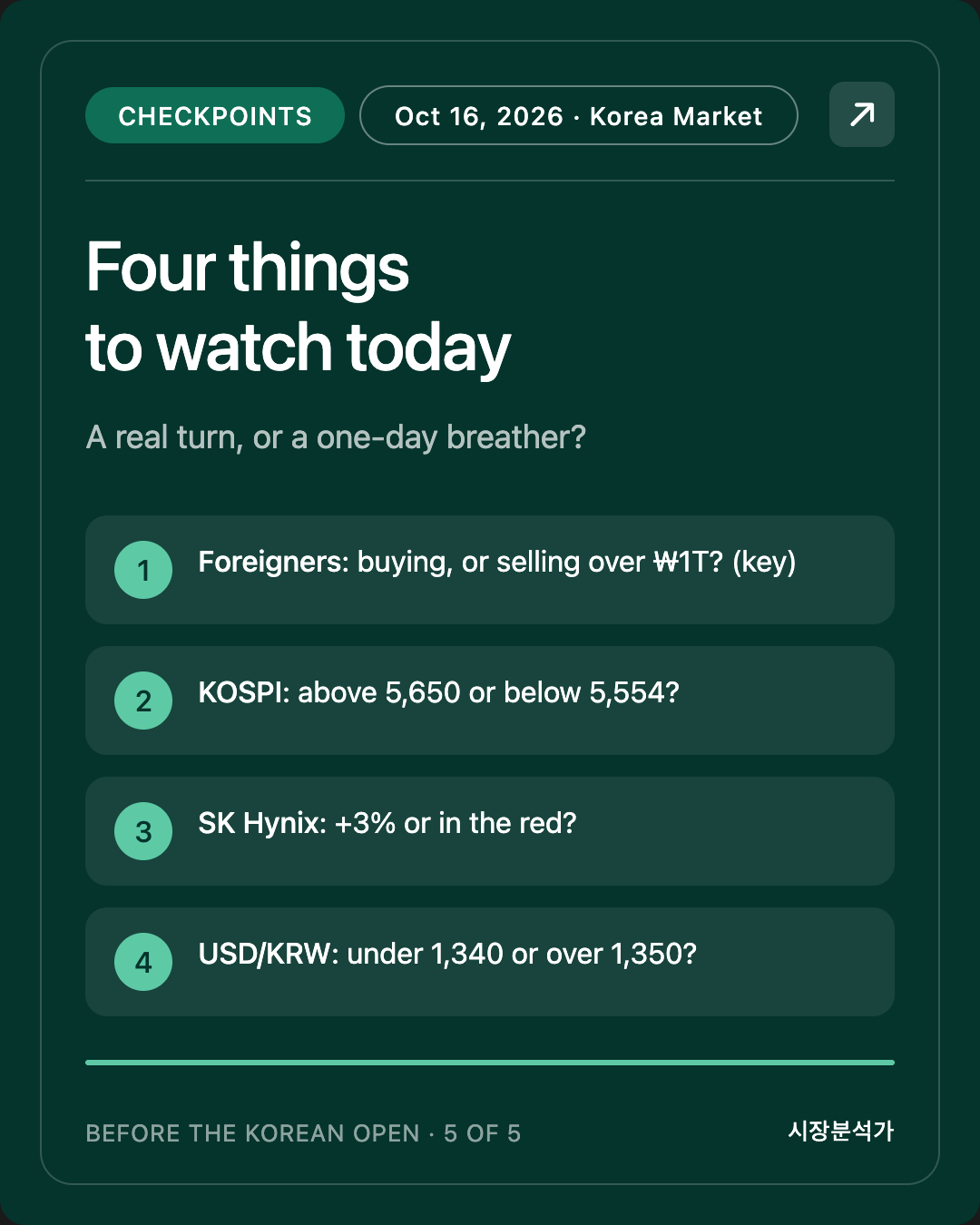
The question: is today's bounce the result of selling stopping, or a one-day breather after a crash?
- Foreign investors turn net buyers in stocks / sell more than ₩1 trillion. Whether this becomes a ninth straight day of selling is the key. (Most important)
- KOSPI closes above 5,650 / below 5,554 (yesterday's close). Holding the open means a bounce; slipping below yesterday's close means margin-call selling is not done.
- SK Hynix up 3% or more / closes in the red. The stock foreigners sold most will answer first.
- USD/KRW below 1,340 / above 1,350. Does the won pick up the overnight dollar weakness (−0.5%)?
[Interpretation] If foreigners turn buyers and the KOSPI holds above 5,650, the case grows that this crash was a flow accident. If foreigners sell more than ₩1 trillion but the index holds, it only means institutions and retail absorbed the selling for one more day. In that case Monday's open matters more than today's.
6. Study note: credit default swaps (CDS), the market that gets scared before stocks do
The concept
A CDS is an insurance contract: "If this company can't repay its debt, I'll pay instead." The buyer pays an annual premium, called the CDS spread. The riskier a company looks, the more expensive the insurance. So the CDS spread is the market's price tag on default risk.
An analogy
Picture a neighborhood where fires seem likely. House prices (stock prices) bounce around every day. But if fire insurance premiums suddenly double, the insurers probably know something. They calculate risk more coldly than homeowners do.
This week's example
- CoreWeave buys Nvidia chips, builds data centers and rents them out. That business runs on debt.
- This week CoreWeave's CDS rose to "distress" levels (CNBC), and Oracle's CDS hit a record. The insurance price moved before the stock.
- Investors who saw that signal sold CoreWeave down more than 15% on 10/14, and the fear spread to chips broadly, then to Seoul a day later.
- On 10/15, after Jensen Huang said CoreWeave's cost of capital is falling, the stock reversed. But we have not confirmed that its CDS came down. A falling insurance price is a more reliable signal than a stock bounce.
One-line takeaway
Stock prices are people's mood; CDS is an insurer's calculation with money on the line. When the two disagree, look at the CDS first.
7. Corrections and open items
Corrections
- None.
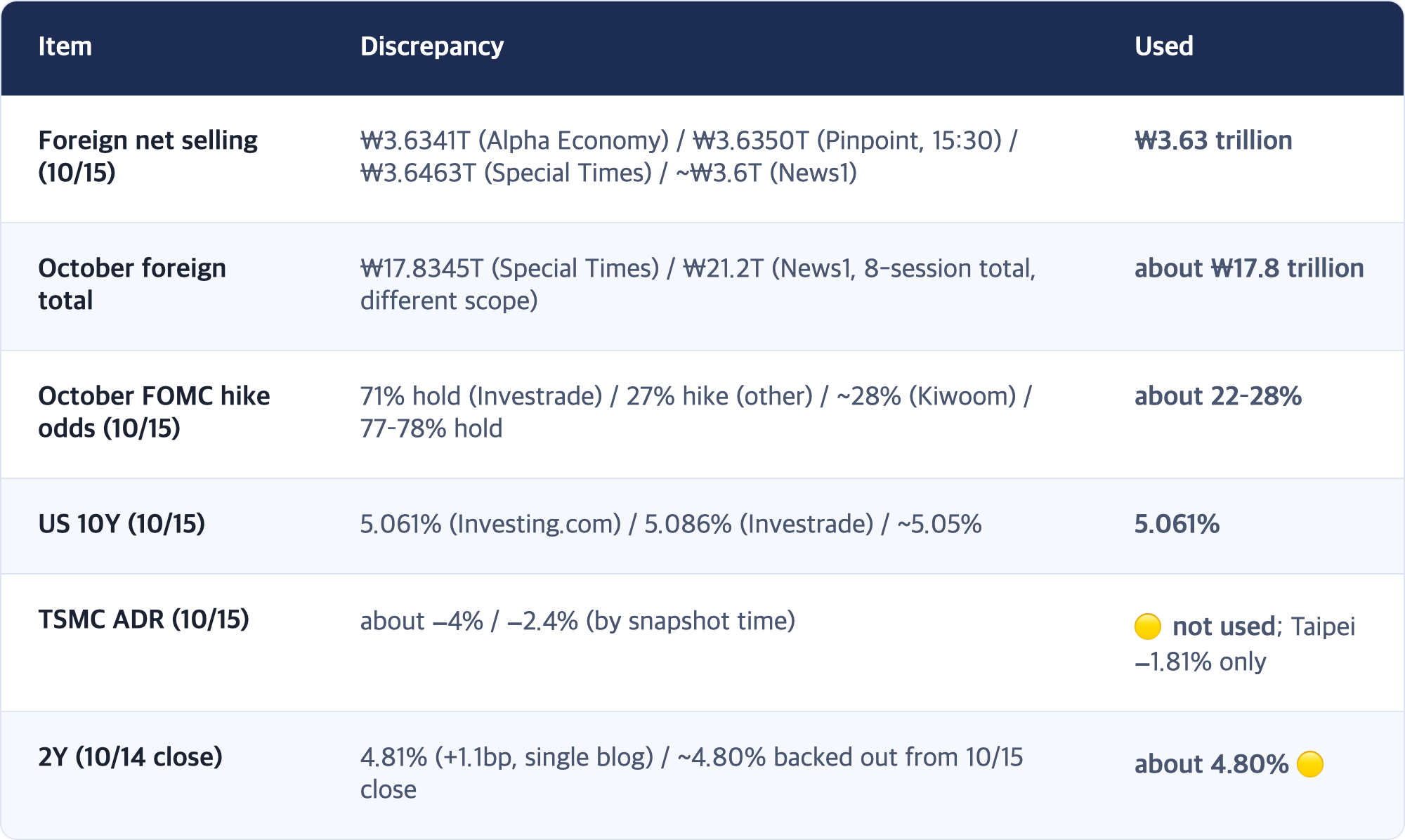
Source discrepancies (value used in this report)
🔲 Unverified
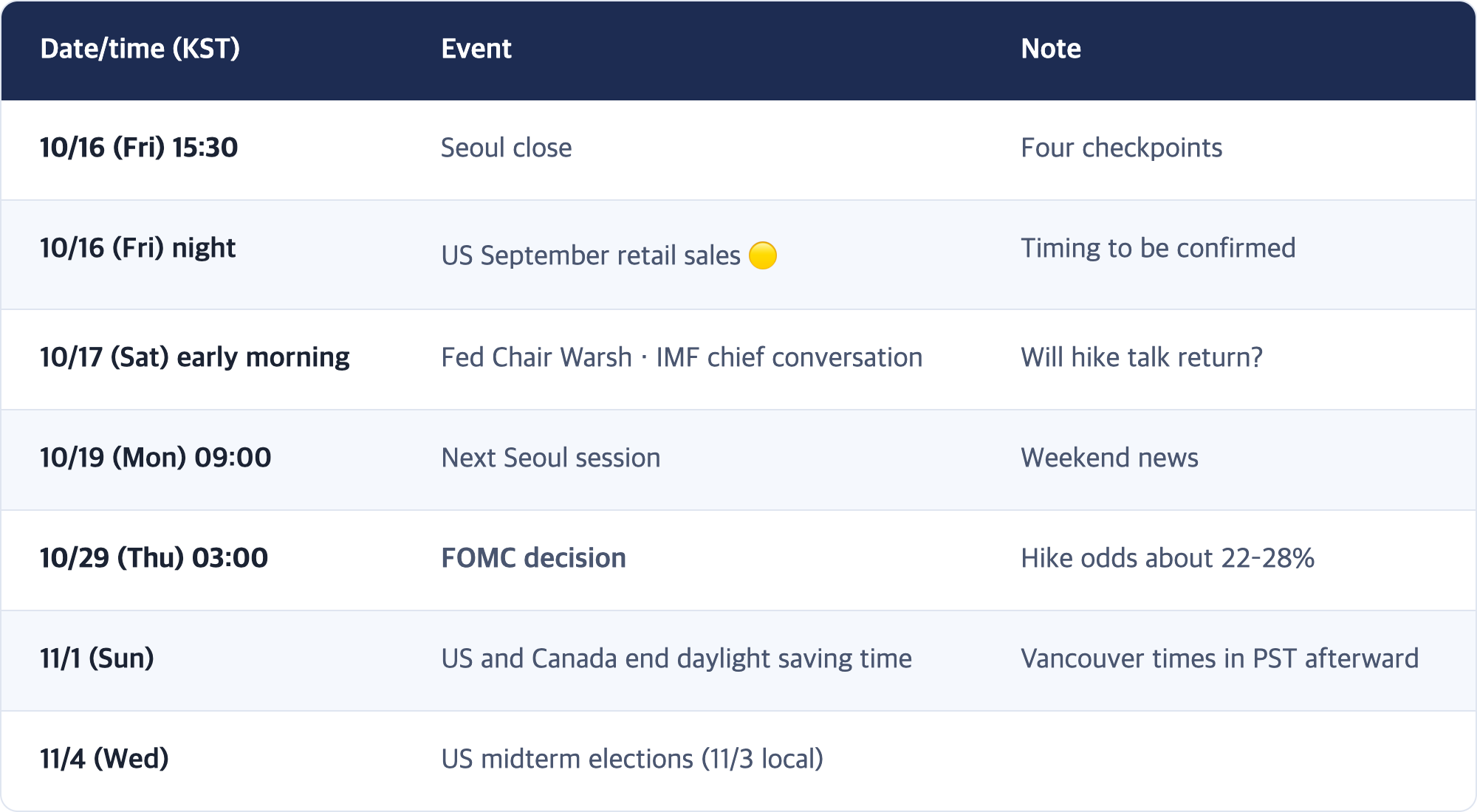
8. Event calendar (KST)
Sources
- KOSPI plunges 7.57% on US inflation shock and AI profitability worries | Alpha Economy via Investing.com Korea
- KOSPI closes at 5,554; foreigners sell ₩3.6T | News1
- October 15 trading by investor type | Pinpoint News
- Foreigners net-sell ₩17.83T of KOSPI in October | Special Times
- KOSPI down 21% in seven sessions | Special Times
- Won hits 1,353 intraday as KOSPI drops 7.57% | EBN via Investing.com Korea
- Won closes at 1,344.6 | BetaNews
- Nikkei drops nearly 5% on tech selling | Financial News
- Today's strategy: KOSPI attempts a rebound | eToday
- KOSPI rebounds 3% despite foreign selling, retakes 5,700 | Newspim
- KOSPI battles around 5,700 on persistent foreign selling | News1
- KOSPI opens at 5,653.99 (+1.80%) | eToday
- KOSPI night futures jump 3.9% | Financial Post Korea
- How major US stock indexes fared Wednesday 10/14/2026 | The Washington Post
- U.S. stocks close down as hot CPI revives Fed rate-hike bets | Xinhua
- Market Review: October 15, 2026 | Investrade
- Stock Market Today (Oct. 15, 2026) | TheStreet
- U.S. Treasury yields slide after CPI-driven spike | Investing.com
- Stocks Slip Early after Wholesale Inflation Surges | Schwab
- TSMC Form 6-K 3Q26 | SEC
- CoreWeave credit default swaps hit distress levels | CNBC
- Oracle's default insurance hits a record as AI debt fears spread | Yahoo Finance
- Nvidia CEO Jensen Huang addresses CoreWeave stock plunge | Yahoo Finance
- Chipmaker sell-off sends investors to other stocks and bonds for safety | CNN
- Nvidia, AMD, Dell sink in global tech rout on AI funding worries | CNBC
Market Analyst · This report does not recommend buying or selling any individual stock. It offers macro context and interpretation.
📌 More market briefs
※ This post is market observation and organization intended to support your own judgment. It is not a recommendation to buy or sell any security. Figures are as of the time of writing and may differ between sources.
If this was useful, bookmark it or pass it along. It genuinely helps me write the next one.
I can survive. We can survive.