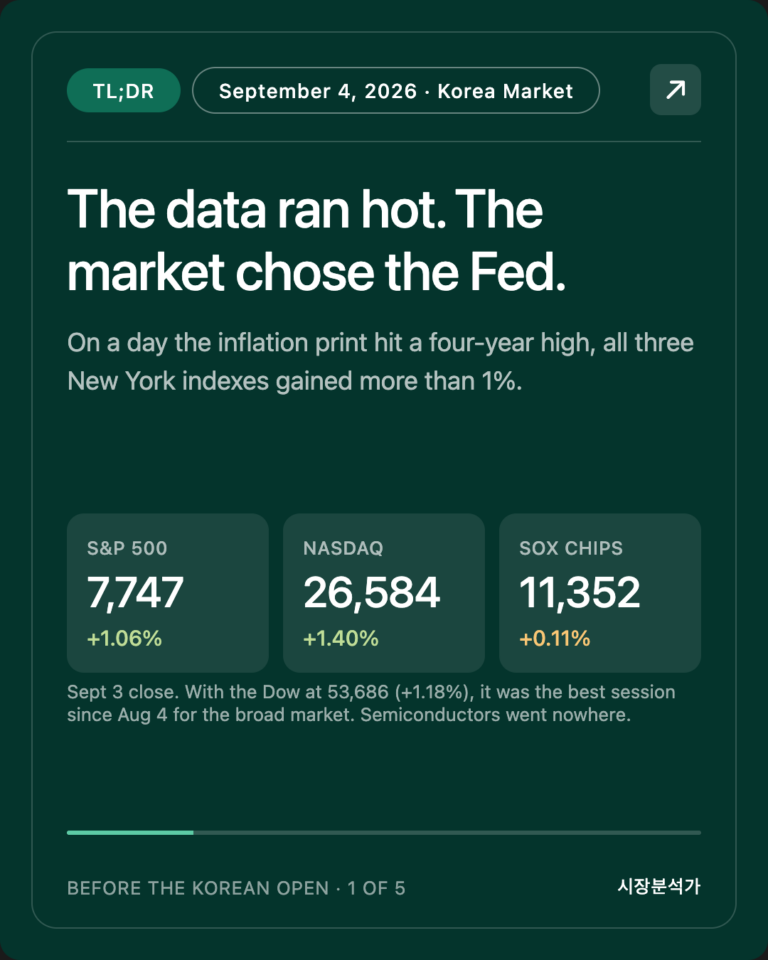
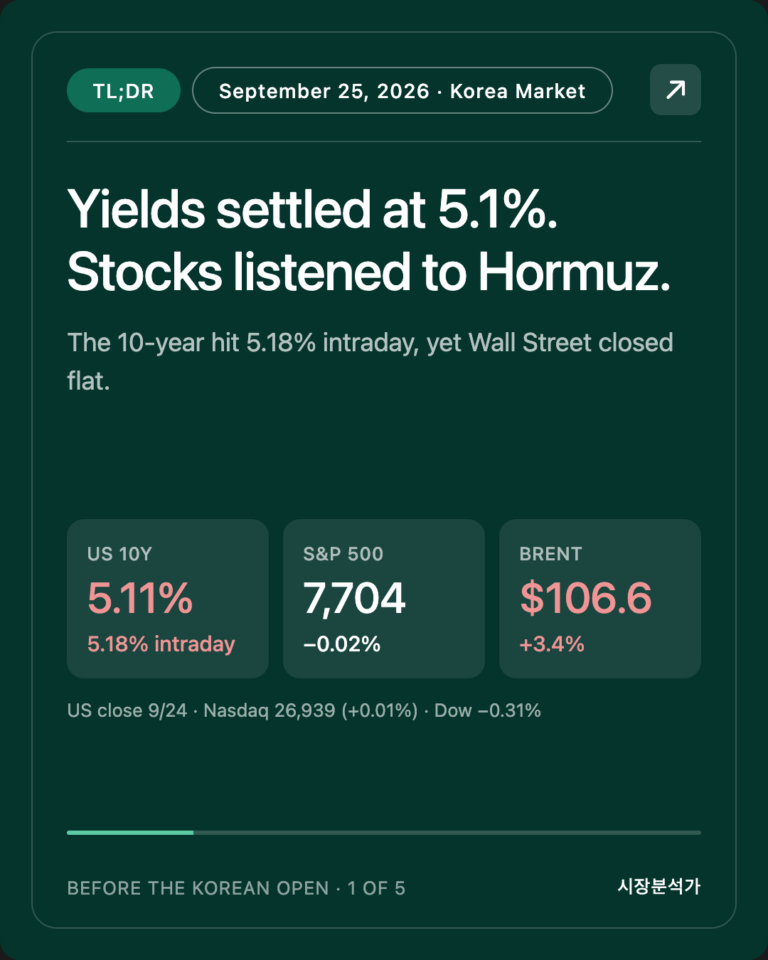
Oct 1, 2026 KOSPI Market Brief — What to Watch Before the Korean Open
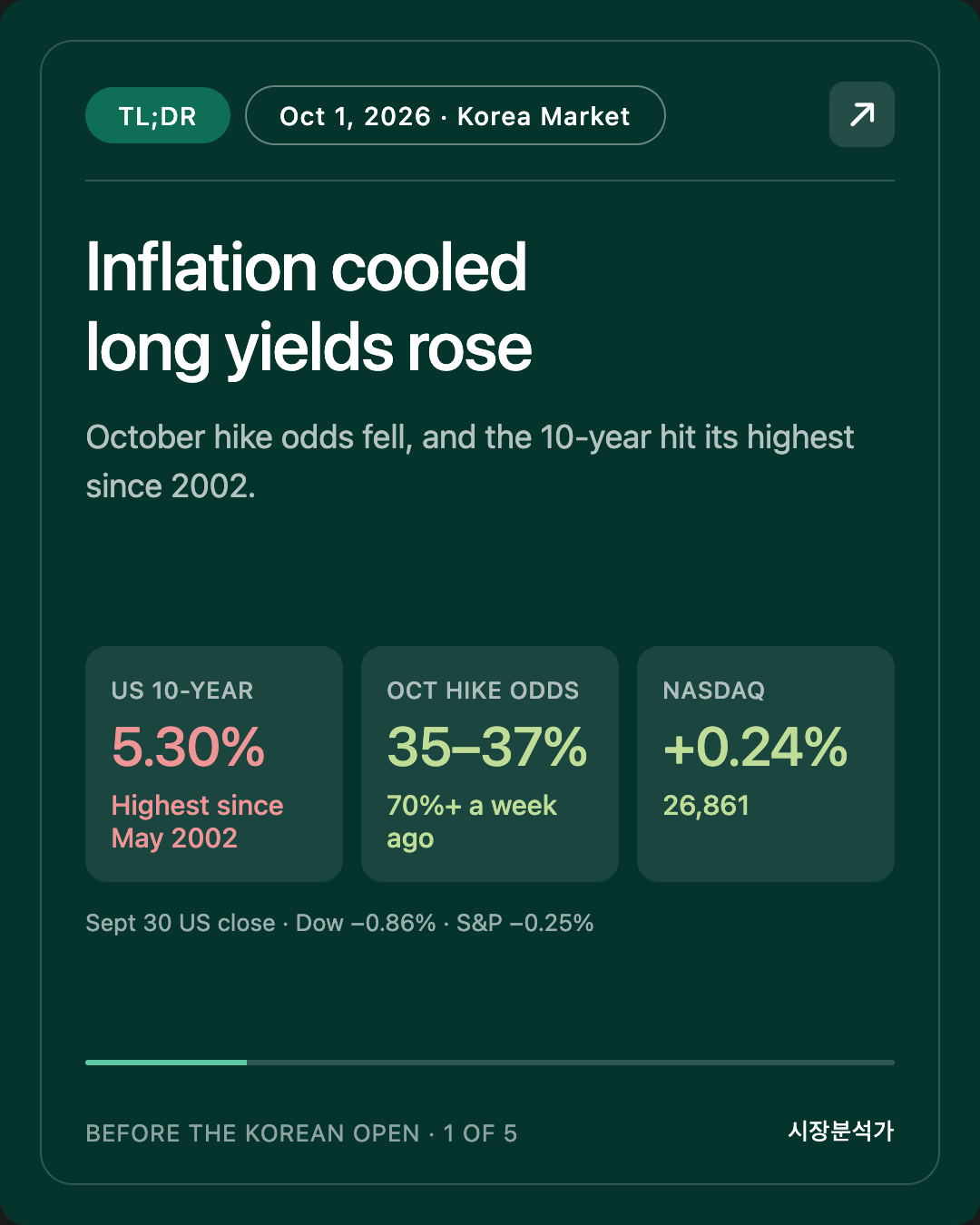
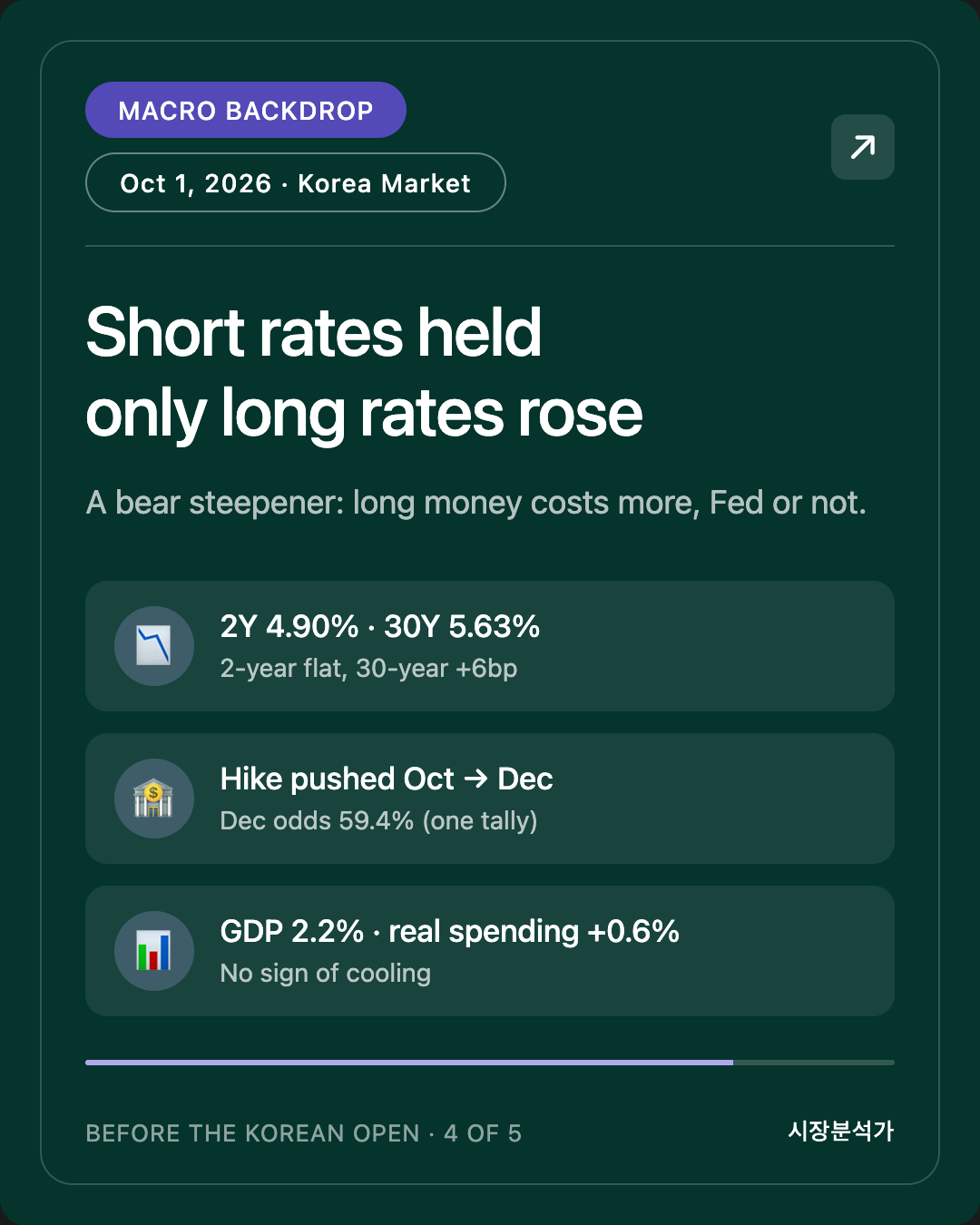
- ★ Short rates believed the PCE report; long rates did not. CME odds of an October hike: 35–37% (about 51% on Sept 29, 70%+ a week earlier). Yet the 10-year rose to 5.29–5.30% (+4bp) and the 30-year to 5.63% (+6bp), while the 2-year sat near 4.90%. December hike odds actually rose to 59.4% (one tally).
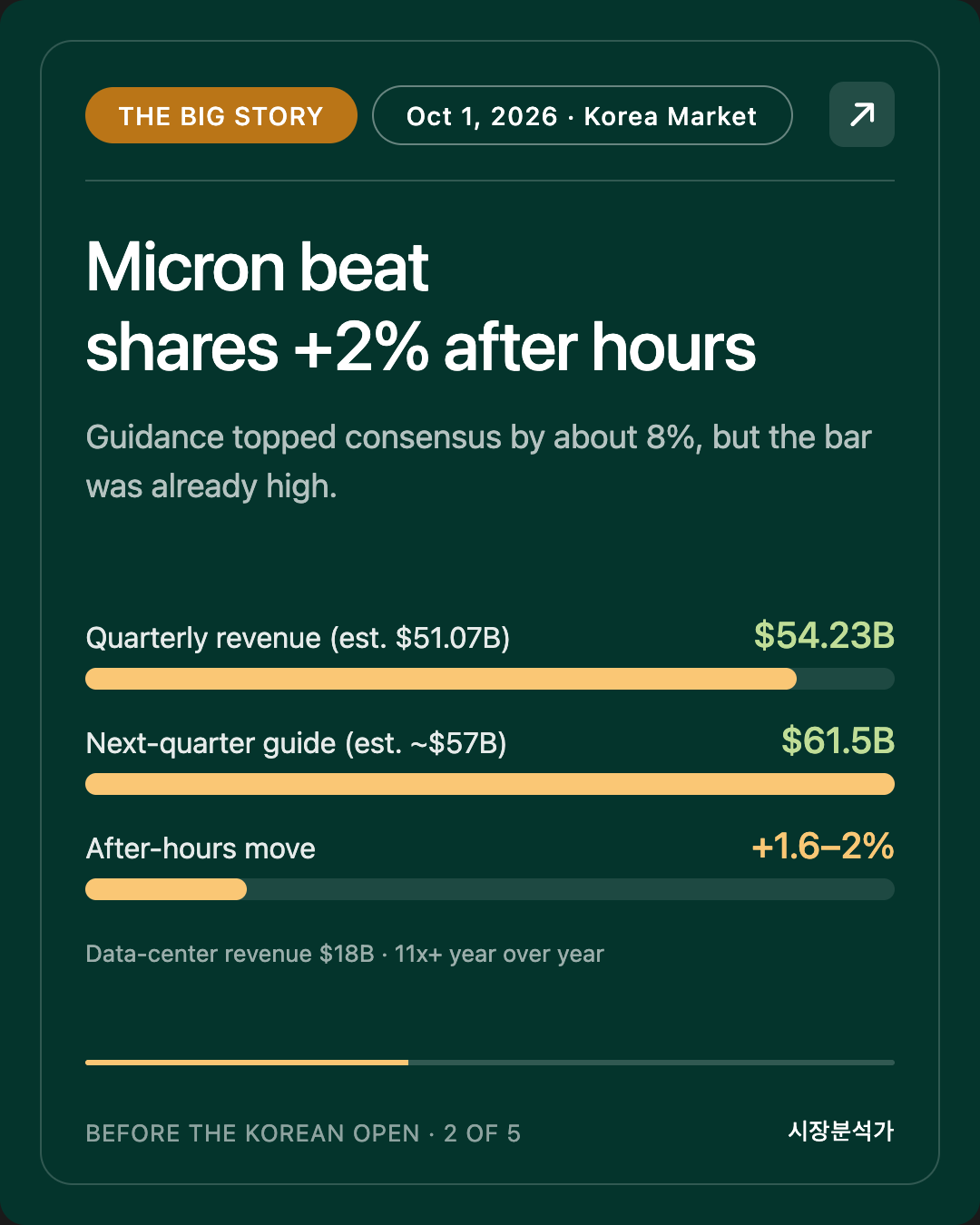
- ★ Micron won on the numbers, only modestly on the price. Revenue $54.23B (est. $51.07B), adjusted EPS $33.42 (est. $31.61), data-center revenue $18B, more than 11x a year ago. Next-quarter guidance: revenue $61.5B, EPS $38.15 (est. ~$57B and $35.40). After hours: +1.6–2%.
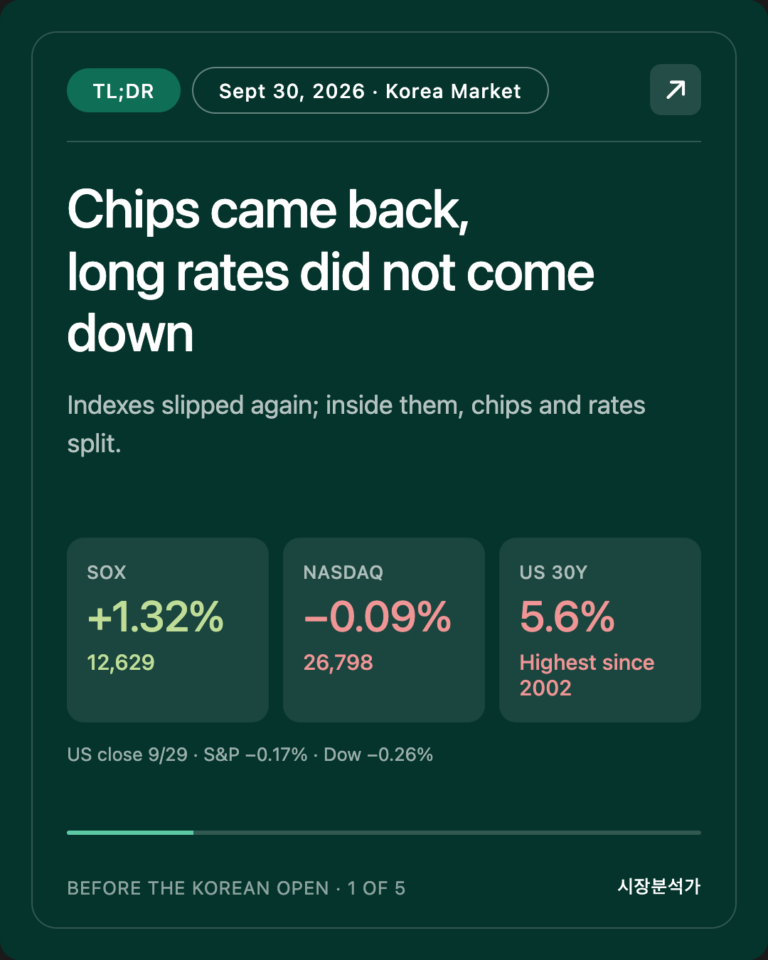
- Indexes split by rate sensitivity. Dow −0.86%, S&P −0.25%, Nasdaq +0.24%. The Philadelphia Semiconductor Index (SOX) was flat at 12,616.00 (−0.10%). Intel +3.71%.
- September and Q3 report cards. September: Dow −4.9%, S&P −0.7%, Nasdaq +1.7%. Q3: S&P +2%, Nasdaq +2.5%, Dow −2.7%.
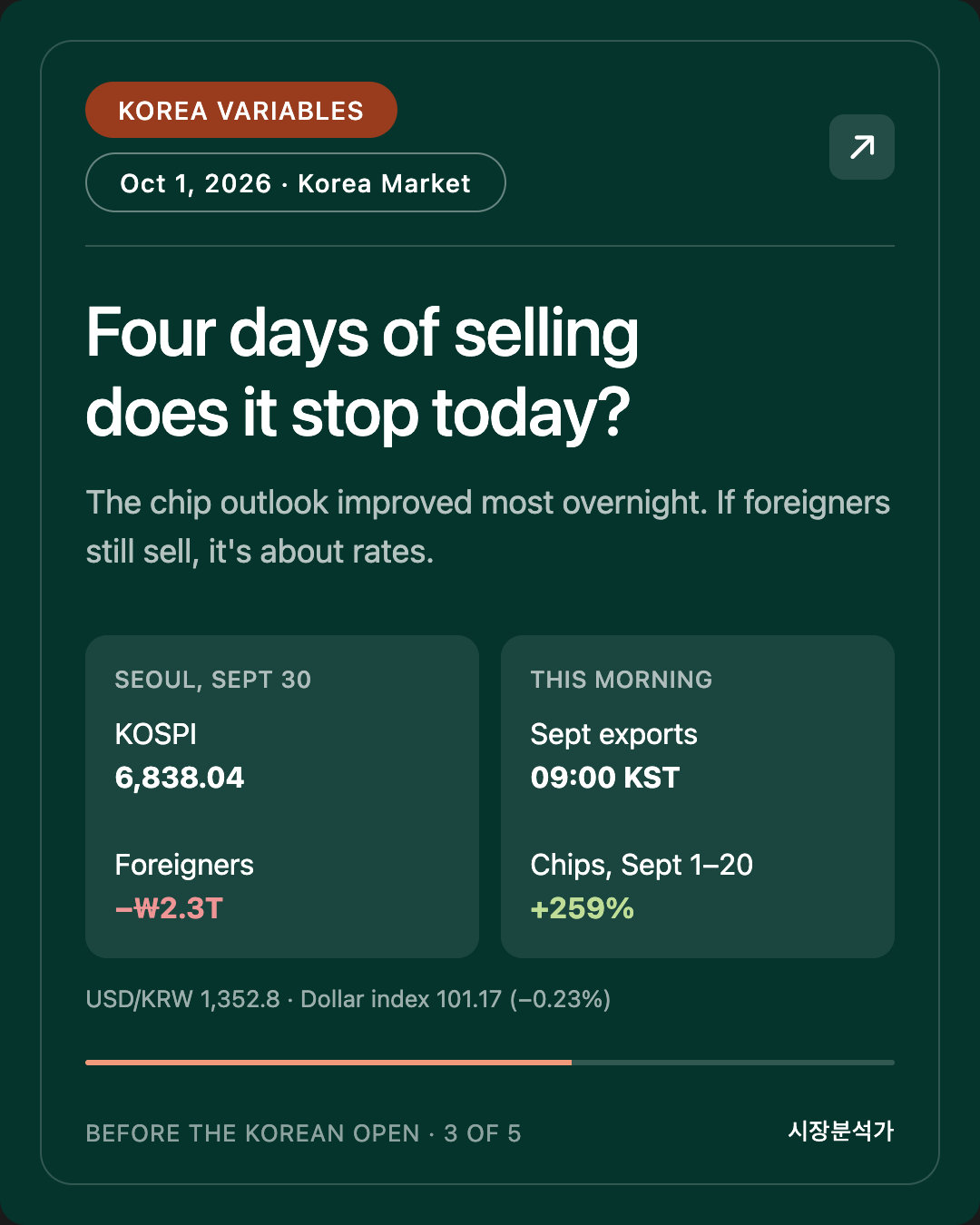
- Today's question for Seoul: do foreign investors, who have sold more than ₩8 trillion over four days, stop on Micron's beat, or keep selling into a 5.3% 10-year? Korea's September trade data lands at 09:00, right at the open.
This is Mr. Can. Here is the Oct 1, 2026 brief ahead of the Korean market open.
Written: 2026-10-01 08:25 KST (Vancouver Sept 30, 16:25 PDT)
Basis: US Sept 30 (Wed) regular-session closes (05:00 KST Oct 1) + Sept 30 crude settlements + Micron earnings (released after the US close) + Seoul Sept 30 close
✅ Scheduled 16:00 PDT, started 16:02 PDT. On time.
This edition grades the four checkpoints set in the Sept 30 US pre-open brief against confirmed US closes. No corrections; three source discrepancies are listed in Section 7.
SEO Intro
US August PCE inflation, the Federal Reserve's preferred price gauge, cooled far more than expected: headline 3.4% year over year (forecast 3.7%), core 3.0% (forecast 3.3%). The odds of an October rate hike fell to 35–37%, from above 70% a week ago.
Long-term Treasury yields did not buy it. The 10-year closed around 5.29–5.30%, touching 5.306% intraday, its highest since May 2002, and the 30-year hit 5.65% intraday. Wall Street split accordingly: Dow 50,906.05 (−0.86%), S&P 500 7,651.54 (−0.25%), Nasdaq 26,861.06 (+0.24%).
After the bell, Micron posted record results: quarterly revenue of $54.23 billion (vs. $51.07 billion expected) and next-quarter revenue guidance of $61.5 billion (vs. roughly $57 billion). Shares rose only 1.6–2% after hours. Seoul opens today facing two upside surprises at once: memory earnings above expectations, and long-term yields above expectations too.
1. Checkpoint Scorecard
The four set by the Sept 30 US pre-open brief (through the Sept 30 US close)
The axis was: does softer PCE lower only short rates (hike expectations), or long rates (the term premium) as well?
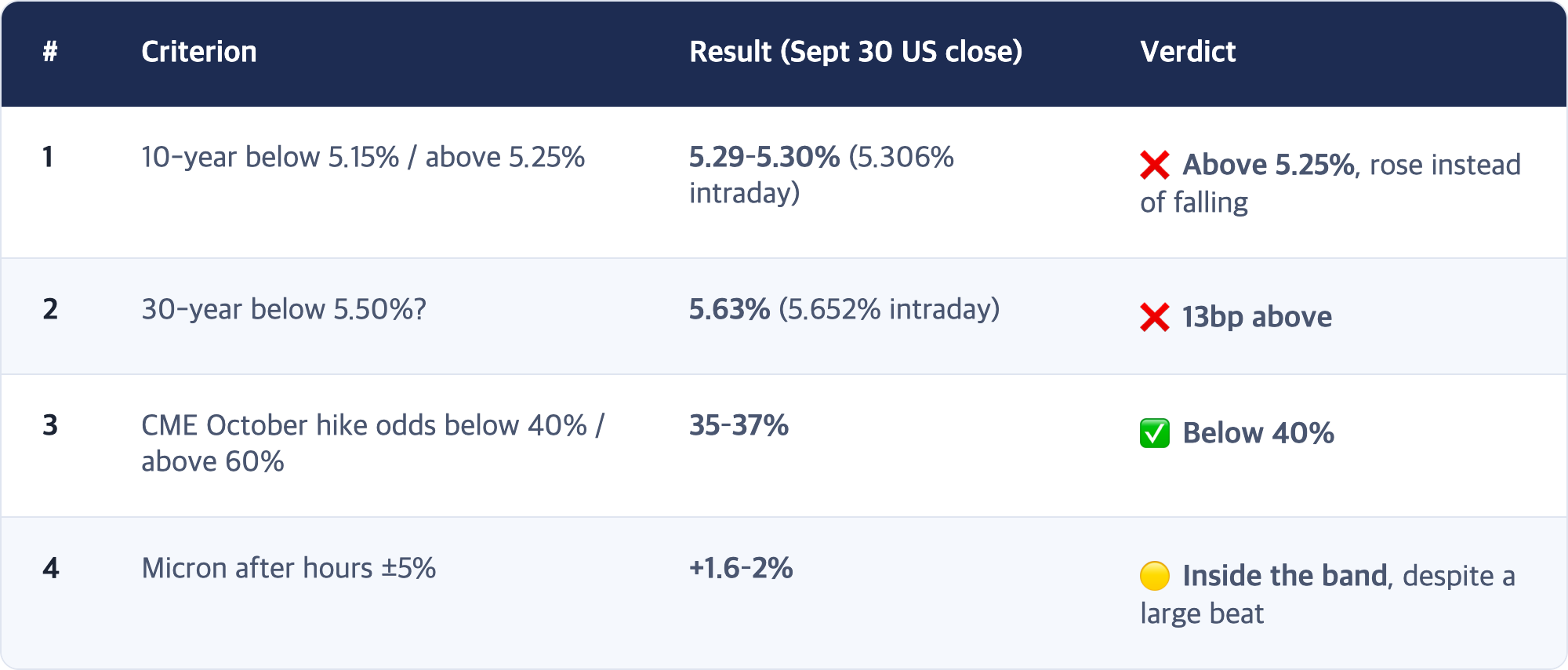
[Interpretation] The two ends of one axis came out exactly opposite
Read as written, the verdict is clear. Checkpoint 3 says the short-rate door opened; checkpoints 1 and 2 say the long-rate door shut even tighter. This was not a day when long rates believed PCE. In the brief's own words, it was a day that "only unwound the hike odds," and long yields climbed another 4–6bp on top.
[Observation] Yields dipped for a few minutes after the release, then rose for the rest of the session (reported). Same-day data added evidence that the economy is not cooling: Q2 GDP revised up to 2.2% (from 1.5%), September ADP private payrolls +90,000 (above forecast), and August real consumer spending +0.6%, the strongest in more than a year.
[Interpretation] The bond market saw cooling inflation, a strong economy, and growing government debt, all at once. For short rates, "the Fed will hike less" is good news. For long rates, the open question is whether hiking less is enough to keep inflation down. Rising December hike odds point the same way: the hike was pushed from October to December, not cancelled.
2. The Big Story: Memory Beat Expectations, and So Did Long Yields
[Fact] Micron fiscal Q4 (June–August, released after the US close)
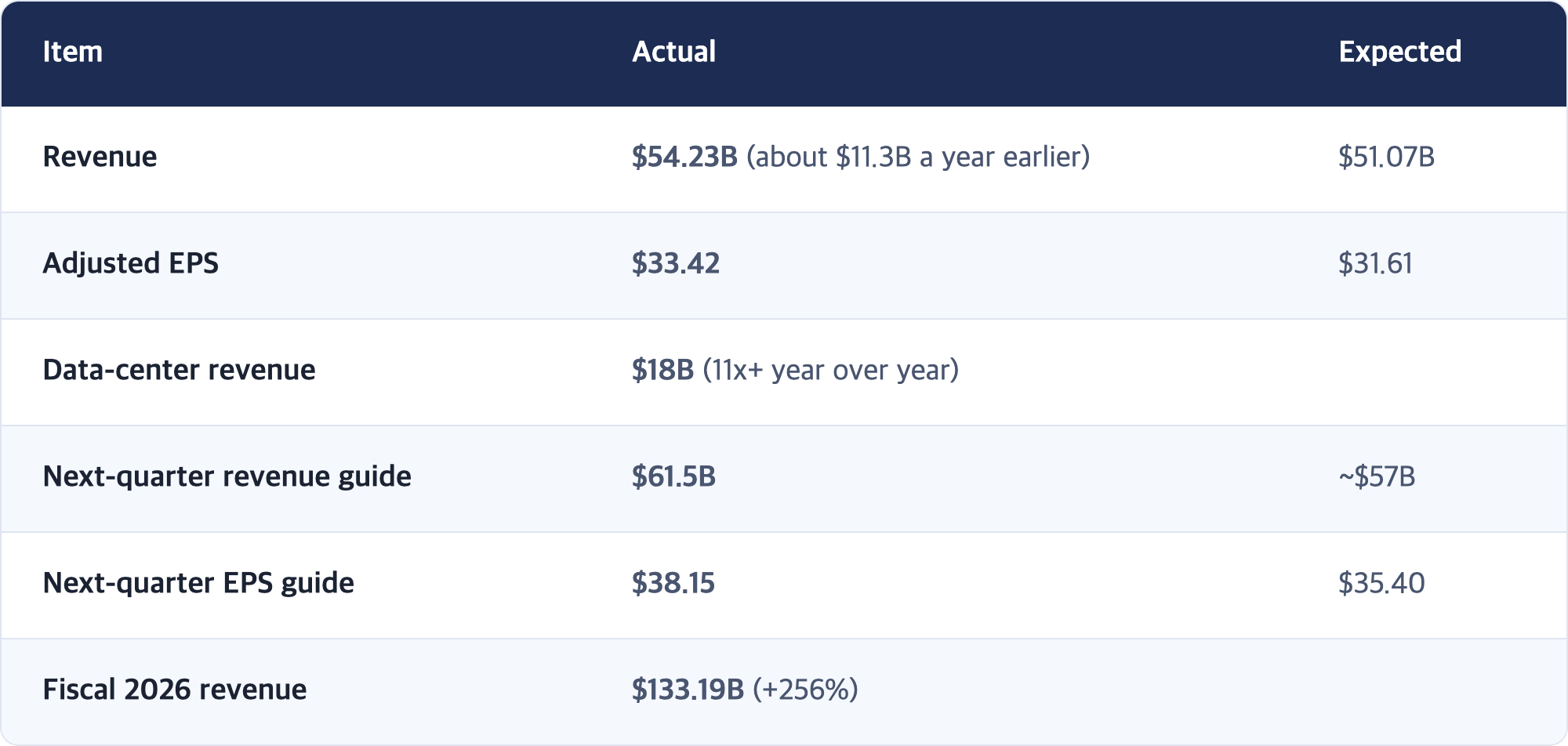
- Stock: flat in the regular session → +1.6–2% after hours. One report said shares rose more than 1% and then gave the gain back.
- Management (reported): strategic customer agreements support confidence in sustained results.
[Observation] The bar was already high
Pre-release consensus was about $52B in revenue and roughly $56.9B for next-quarter guidance, and Micron shares had rallied more than 50% since early September (reported). A 2x leveraged semiconductor ETF gained 31% in September alone. [Interpretation] Good numbers were largely priced in. A 2% after-hours move reads more like "expectations confirmed" than "expectations beaten."
★ [Interpretation] Seoul receives both surprises at once
The good surprise is memory. Micron competes with Samsung Electronics and SK hynix in DRAM and HBM (high-bandwidth memory used in AI accelerators). Guidance roughly 8% above consensus is a first-hand industry signal that memory pricing and AI demand hold at least through year-end.
The bad surprise is long yields. A 5.3% 10-year raises the discount rate applied to every growth stock. The question this brief has been asking since Sept 29, is foreign selling in Korea about the chip outlook, or about rates and positioning?, gets its cleanest test today. The chip outlook clearly improved overnight. If foreigners still sell, the answer is rates.
3. Korea Variables: Four Days of Foreign Selling, September Exports at 09:00
[Fact] Seoul Sept 30 close (reconfirmed)
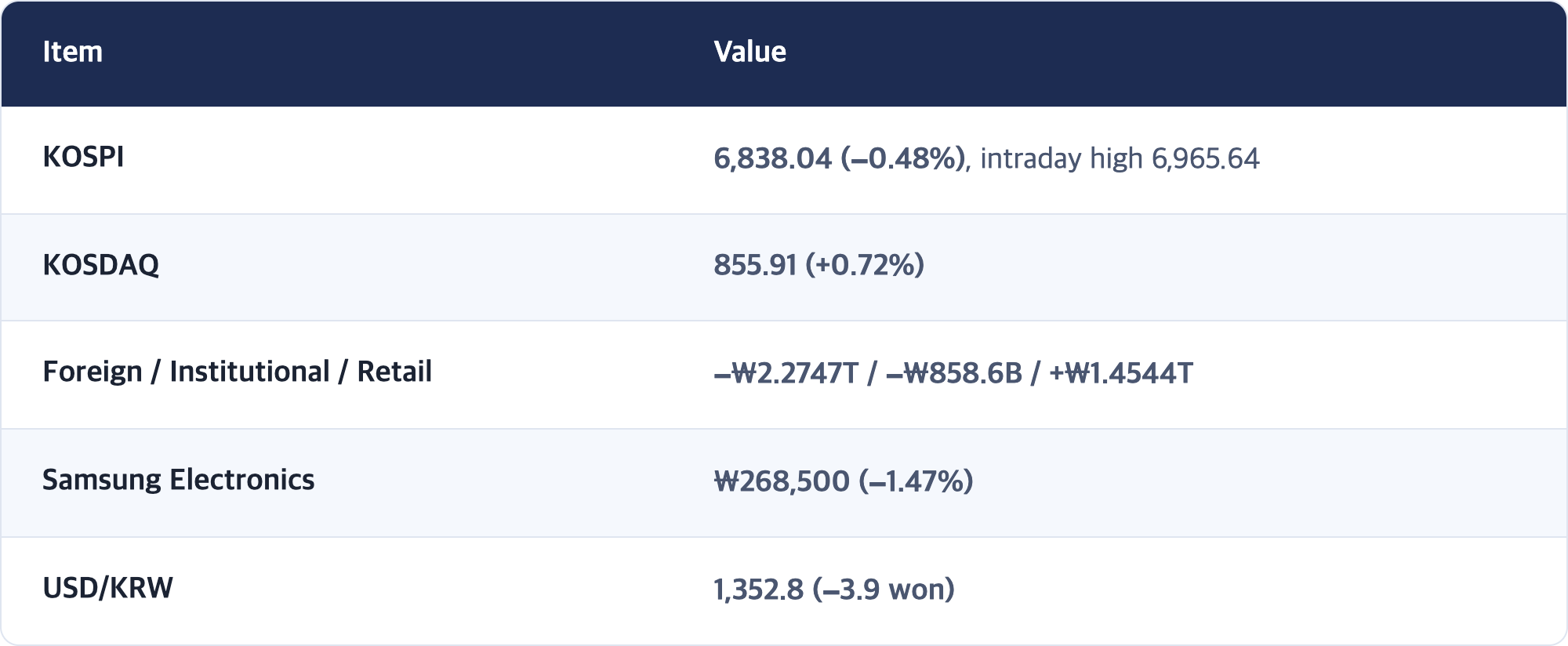
[Observation] Overnight proxies for Korea
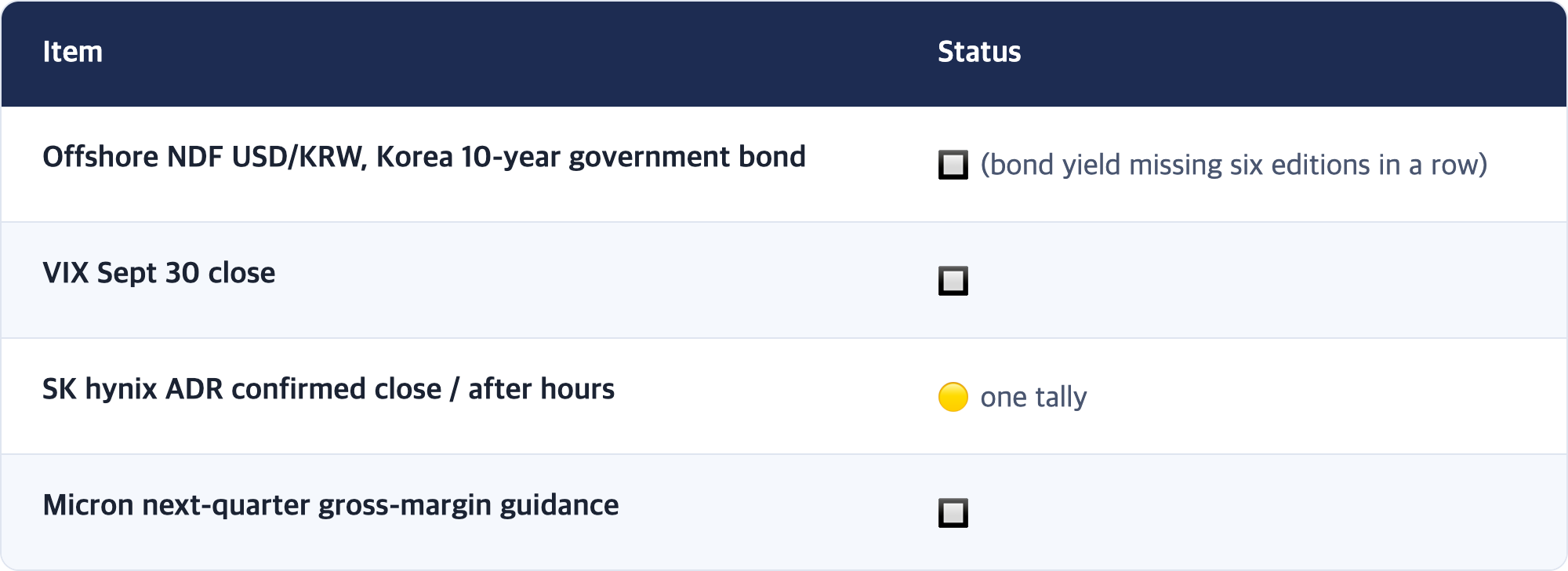
- SK hynix ADR (US-listed depositary receipt): about $186.19, slightly below the prior $186.68 (one tally, likely regular session before Micron's release).
- Dollar index 101.17 (−0.23%). A weak-dollar night is friendly to the won.
- Offshore one-month NDF (non-deliverable forward on USD/KRW): not captured in this edition.
[Fact] Korea September trade, 09:00 KST today
- Sept 1–20 preliminary: exports $71.4B (+78.3%, a record for the period), semiconductors $34.12B (+259.4%), chips' share 47.8%.
[Interpretation] The strong won now trims earnings
One brokerage analysis (reported) estimates the won is about 11% stronger than at end-Q2, which would cut Q3 operating-profit estimates for Samsung and SK hynix by roughly ₩7T and ₩8T respectively: dollar revenue shrinks when converted to won. [Interpretation] A stronger won is a good sign for foreign capital, but a discount on exporters' won-denominated earnings. However strong today's dollar export figures look, that discount comes attached in Q3 earnings season (Samsung's preliminary results are due in early October).
4. Macro Backdrop: A 5.3% 10-Year, and a Hike Pushed to December
[Fact] (Sept 30 closes / settlements)
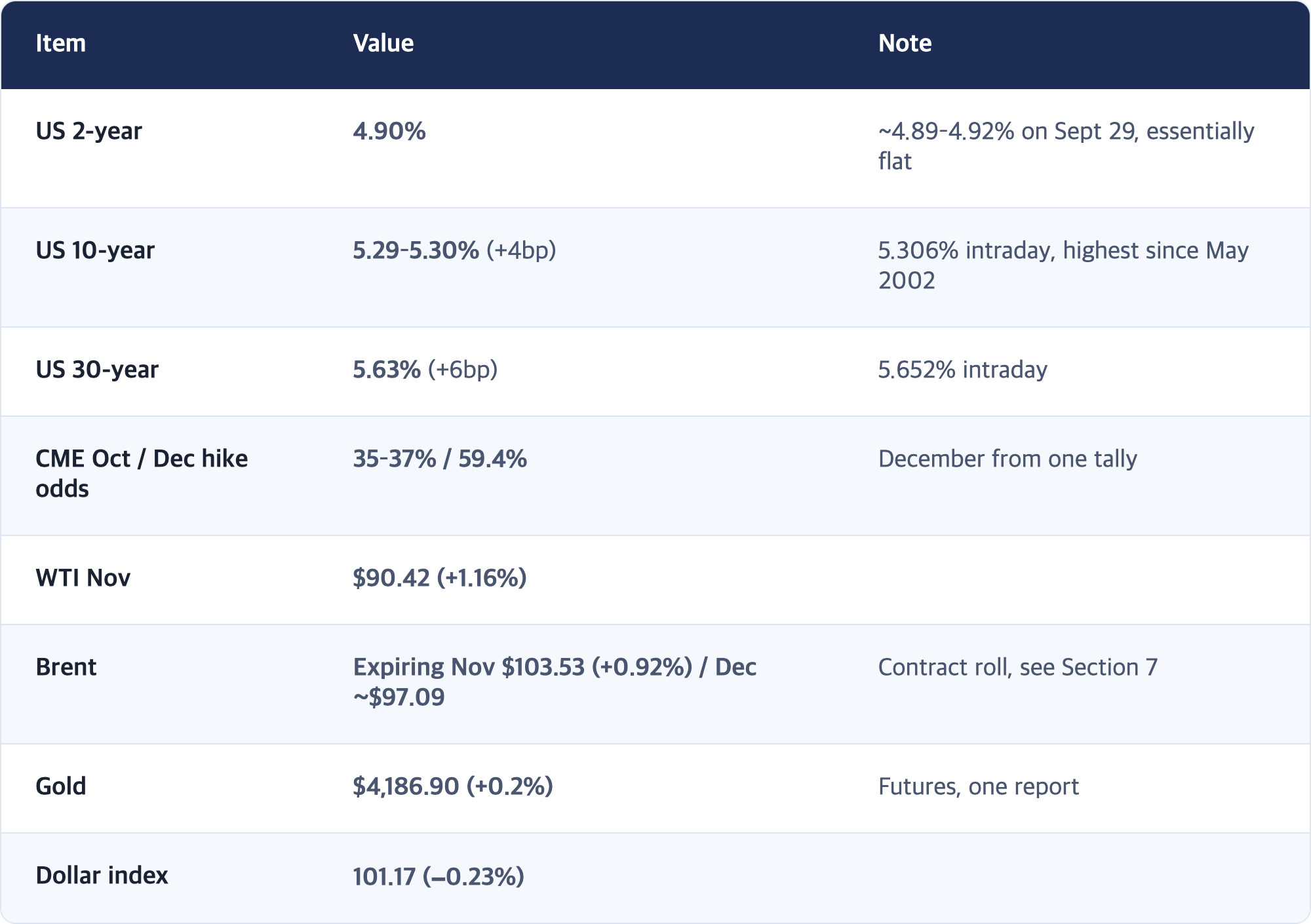
[Interpretation] The curve is steepening the wrong way
The 2-year held still while the 10- and 30-year rose. In bond-market terms, that is a bear steepener (see the study note). Long yields are not rising because the Fed will hike; the price of lending long is rising regardless of the Fed. On Sept 29 long yields rose on bad economic data; on Sept 30 they rose on good inflation data. [Interpretation] Two straight days of refusing to fall, "for good reasons and bad," is the strongest sign yet that this move will not be undone by any single data point.
Oil is not the lead character this week. WTI at $90 and December Brent in the high $90s are below early-September levels.
5. Korea Market Preview (Oct 1, Thu KST)
[Observation] Schedule (KST)
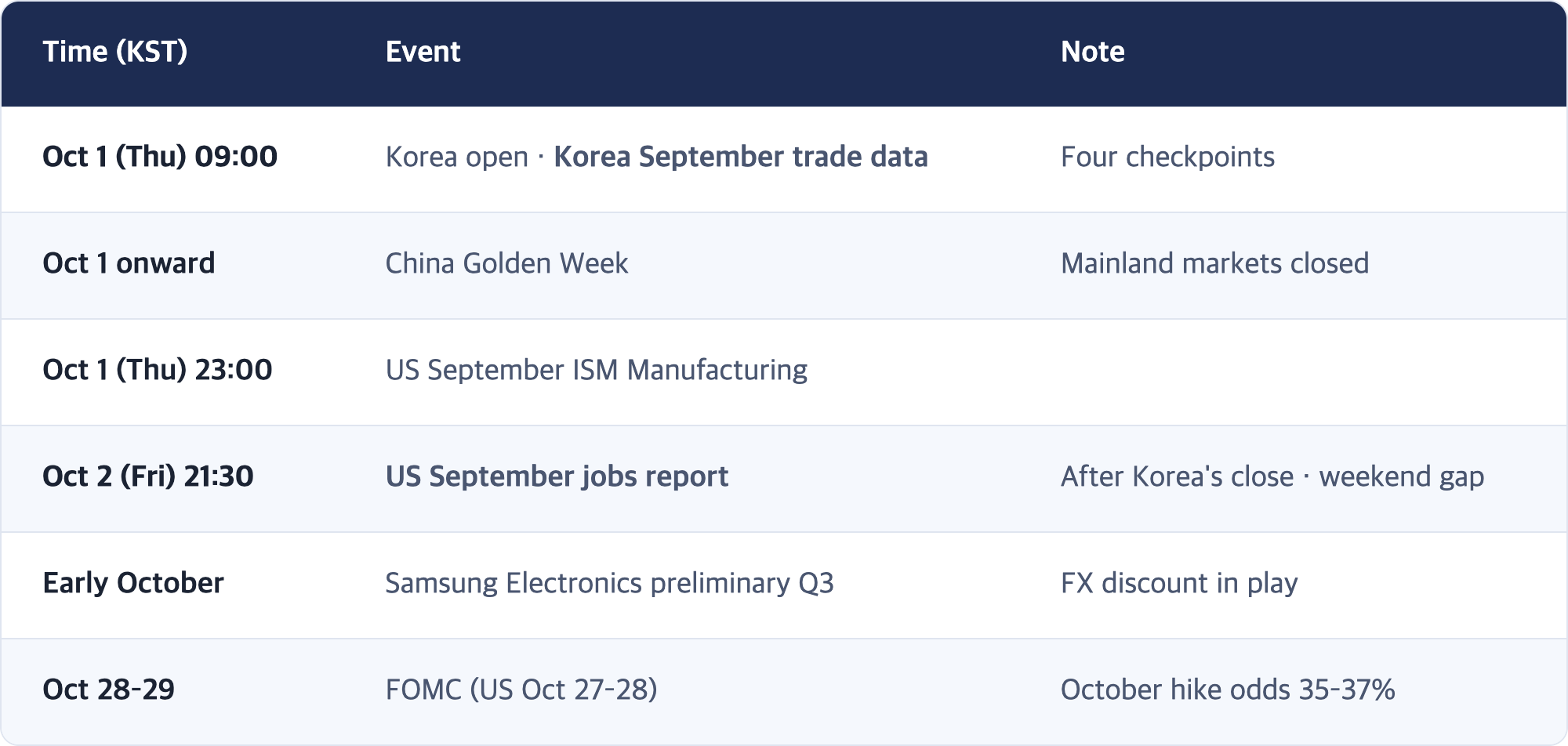
- 09:00 Korean open · Korea September trade data (Ministry of Trade, Industry and Energy)
- Oct 1 onward China Golden Week holiday (mainland markets closed)
- 23:00 US September ISM Manufacturing (after Korea's close)
- Oct 2 (Fri) 21:30 US September jobs report (after Korea's close, weekend gap risk)
- Early October Samsung Electronics preliminary Q3 results
✅ Four Checkpoints (through today's Korea close)
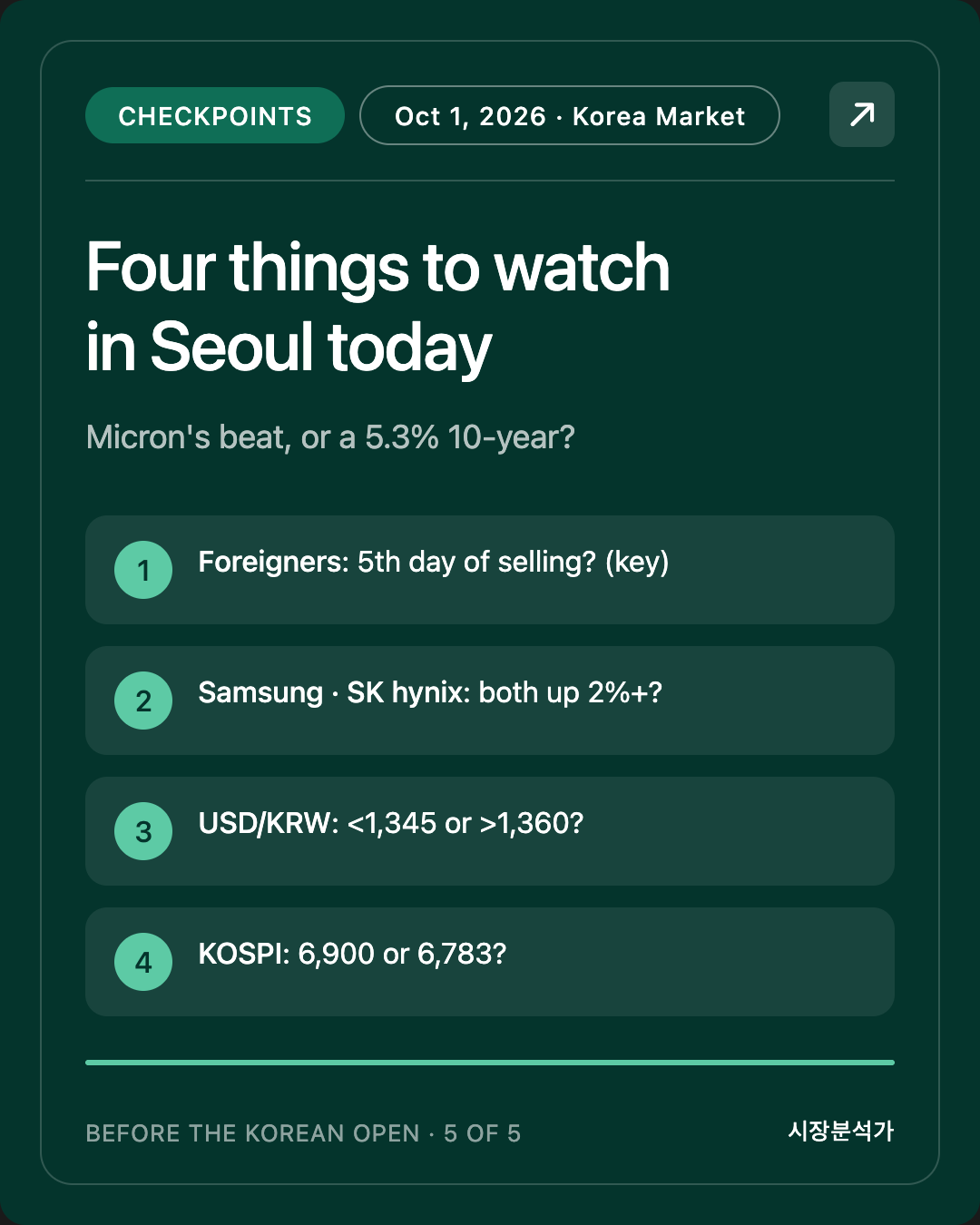
The axis first: these four separate whether Seoul follows Micron's memory beat or reacts more to a 5.3% US 10-year. The answer decides whether this week's foreign selling is about the chip outlook or about rates and positioning.
- Is this a fifth straight day of foreign net selling? A flip to net buying means the memory beat won. Another ₩1T+ of net selling all but confirms the selling is not about the chip outlook. (Most important)
- Do Samsung Electronics and SK hynix both rise 2% or more? Both above means Seoul accepted Micron's signal. Both weak means rates and flows beat earnings.
- USD/KRW below 1,345 / above 1,360. Below: foreign money stays in won assets even while selling stocks. Above: sale proceeds are starting to leave in dollars.
- KOSPI close: reclaim 6,900 / break 6,783. Yesterday reached 6,965 intraday and gave it back, so judge on the close only.
[Interpretation] Checkpoint 1 carries the most information. This brief has asked the same question for three sessions, and last night delivered the biggest chip-outlook upgrade of the week. If foreigners sell more than ₩1T again today, it is fair to conclude the chip outlook was never the reason for the selling.
6. Study Note: The Bear Steepener, When Only Long Yields Rise
Concept
Plot Treasury yields by maturity and you get a line: the yield curve. The ways it moves have names.
- Bear: yields rise (bond prices fall). The opposite is bull.
- Steepening: the gap between long and short yields widens. The opposite is flattening.
A bear steepener is when yields rise and the long end rises more. That is exactly what happened yesterday: 2-year roughly flat, 10-year +4bp, 30-year +6bp.
Analogy
Think of lending money to a friend. For a two-year loan, you set the interest based on where bank rates will likely be over the next two years. For a 30-year loan, you add something extra: nobody knows what inflation will do over 30 years or how much more debt your friend will pile up, so you charge for that uncertainty. That extra charge is the term premium. A bear steepener is a day when that uncertainty charge grows.
Real example (yesterday)
- What the short end watches: next month's Fed. Cooler PCE cut October hike odds to 37%, so the 2-year had no reason to rise.
- What the long end watches: decades of inflation and fiscal policy. An upward GDP revision (2.2%), strong spending, and heavy Treasury issuance pushed the 10-year to 5.3% and the 30-year to 5.63%.
One-line summary
A bear flattener says "the Fed might hike"; a bear steepener says "long money is getting expensive regardless of the Fed." The first can be talked down by the Fed; the second rarely can. Growth stocks, chipmakers included, discount future profits at long rates, which is one reason Korean chip stocks have felt heavy this week despite good earnings news.
7. Corrections & Open Items
Corrections
- None. From the Sept 30 pre-open brief's open items, Q2 GDP (third estimate) is now confirmed at 2.2% (from 1.5%).
Source discrepancies (adopted values stated)
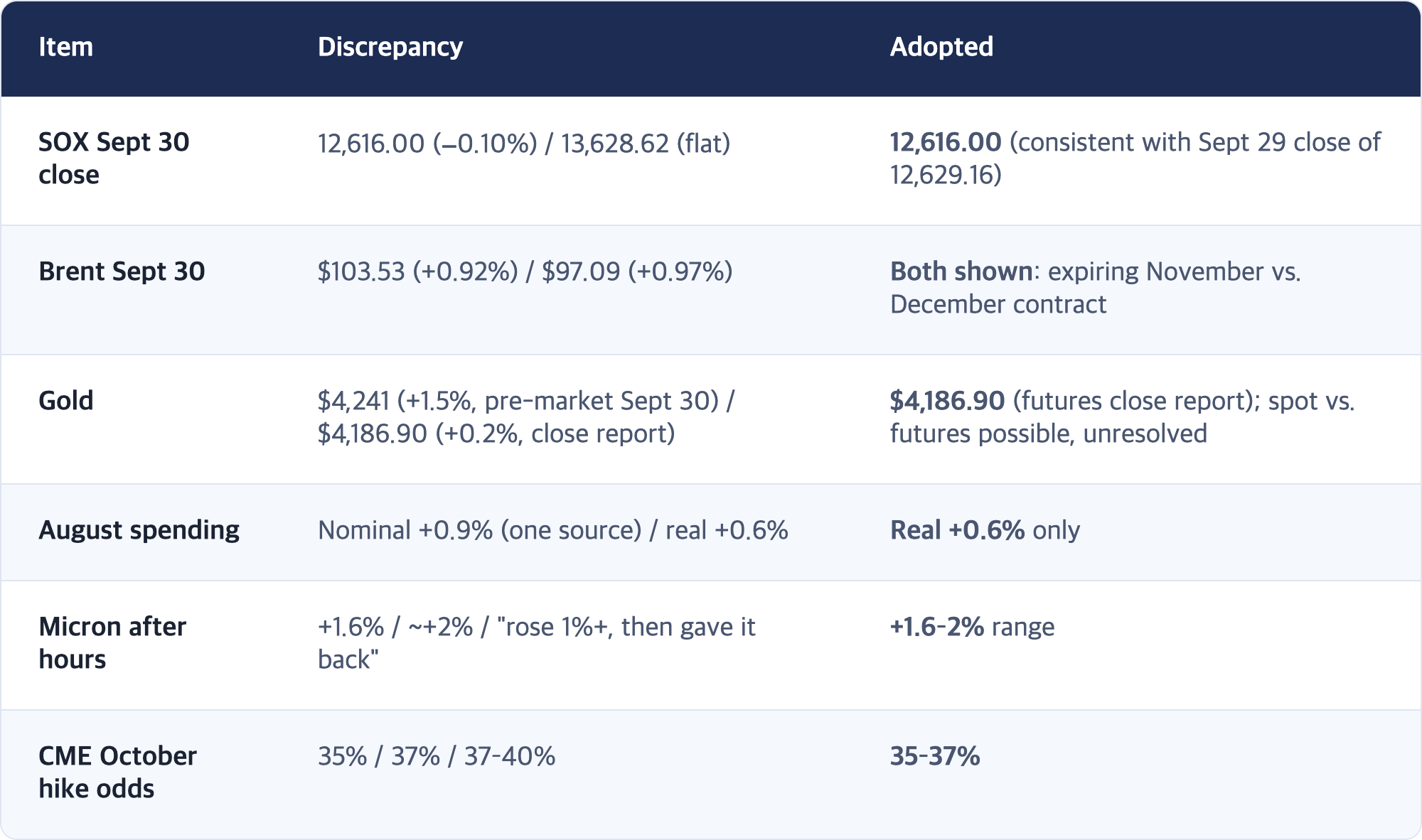
🔲 Not yet confirmed
8. Event Calendar (KST)
Sources
- Stock market today: Dow, S&P 500 post monthly losses in September as Treasury yields climb | Yahoo Finance
- S&P 500 falls Wednesday despite softer-than-expected inflation data | CNBC
- 10-year Treasury yield is higher as traders look past inflation data | CNBC
- Micron beats on earnings and issues strong guidance as data center revenue jumps 11-fold | CNBC
- Micron Technology, Inc. Reports Record Fiscal Fourth-Quarter and Full-Year 2026 Results | Yahoo Finance
- US Stocks Diverge as Dow Falls Over 400 Points; Tech Stocks Lead | TradingKey
- Stock Market Today (Sept. 30, 2026) | TheStreet
- US 10 Year Treasury Note Yield | Trading Economics
- Brent oil | Trading Economics
- New York stocks mixed; Micron up after hours | Seoul Finance (Korean)
- New York close: mixed as Treasury yields jump despite soft PCE | Aju News (Korean)
- Micron posts record quarterly revenue | Herald Business (Korean)
- Micron Earnings Due Sept. 30 With 2027 Outlook Seen as Key to South Korea Stocks | Bloomingbit
- Korea Sept 1–20 exports hit record $71.4B | Dailian (Korean)
- KOSPI falls 0.48% on ₩2.3T foreign selling | Newspim (Korean)
Market Analyst · This brief does not recommend buying or selling any individual security. It provides macro context and interpretation.
📌 More market briefs
※ This post is market observation and organization intended to support your own judgment. It is not a recommendation to buy or sell any security. Figures are as of the time of writing and may differ between sources.
If this was useful, bookmark it or pass it along. It genuinely helps me write the next one.
I can survive. We can survive.