October 21, 2026 KOSPI Market Brief — What to Watch Before the Korean Open
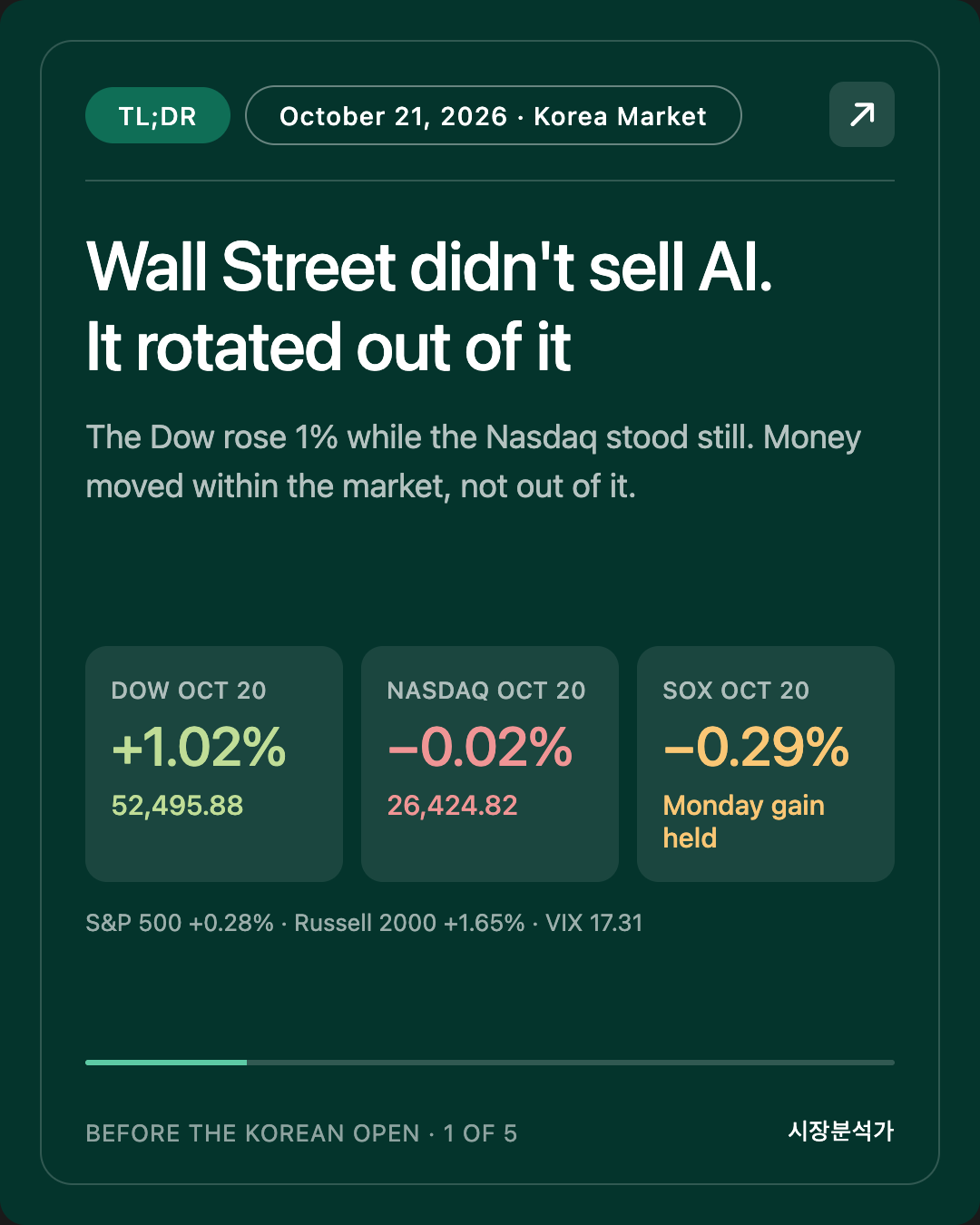
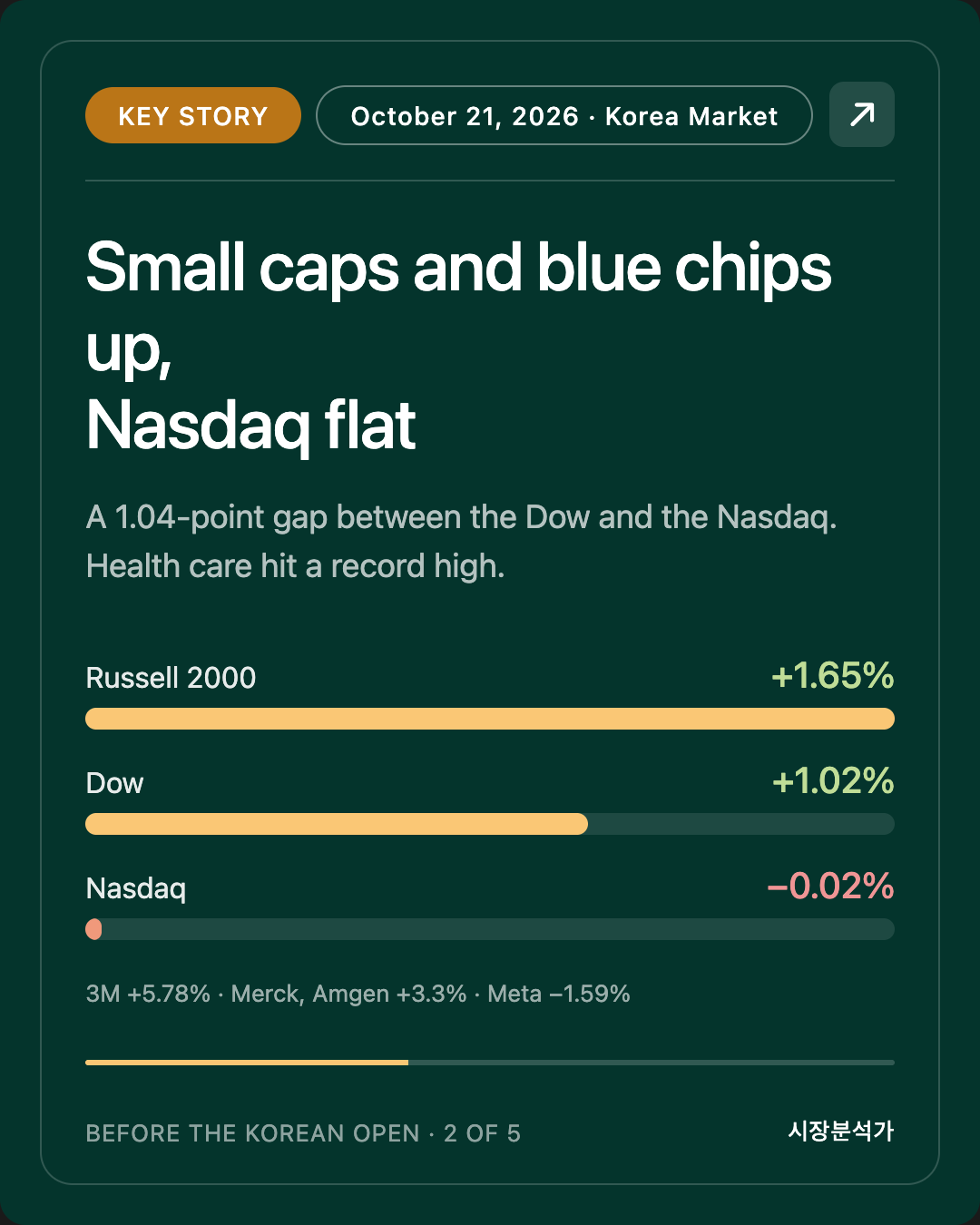
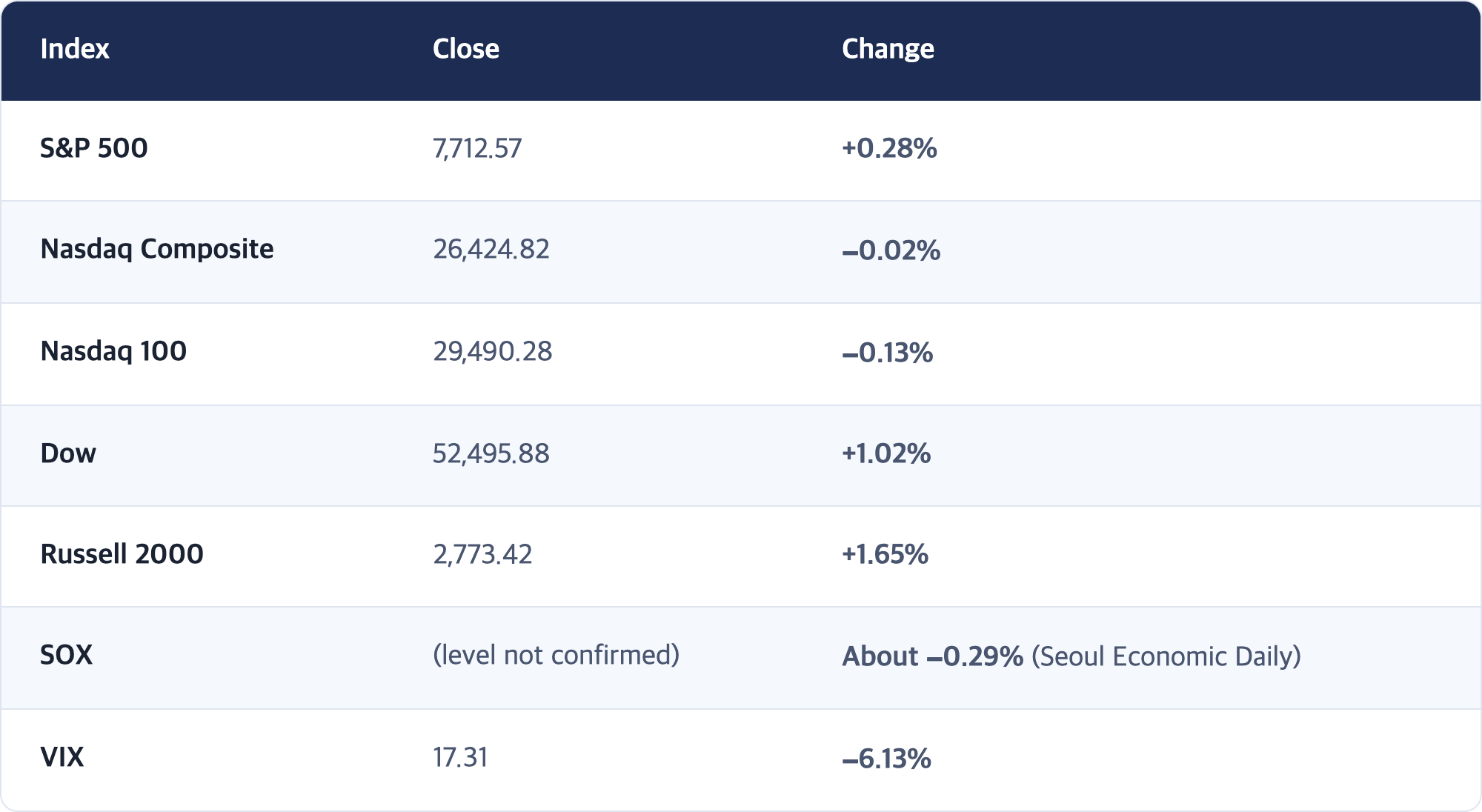
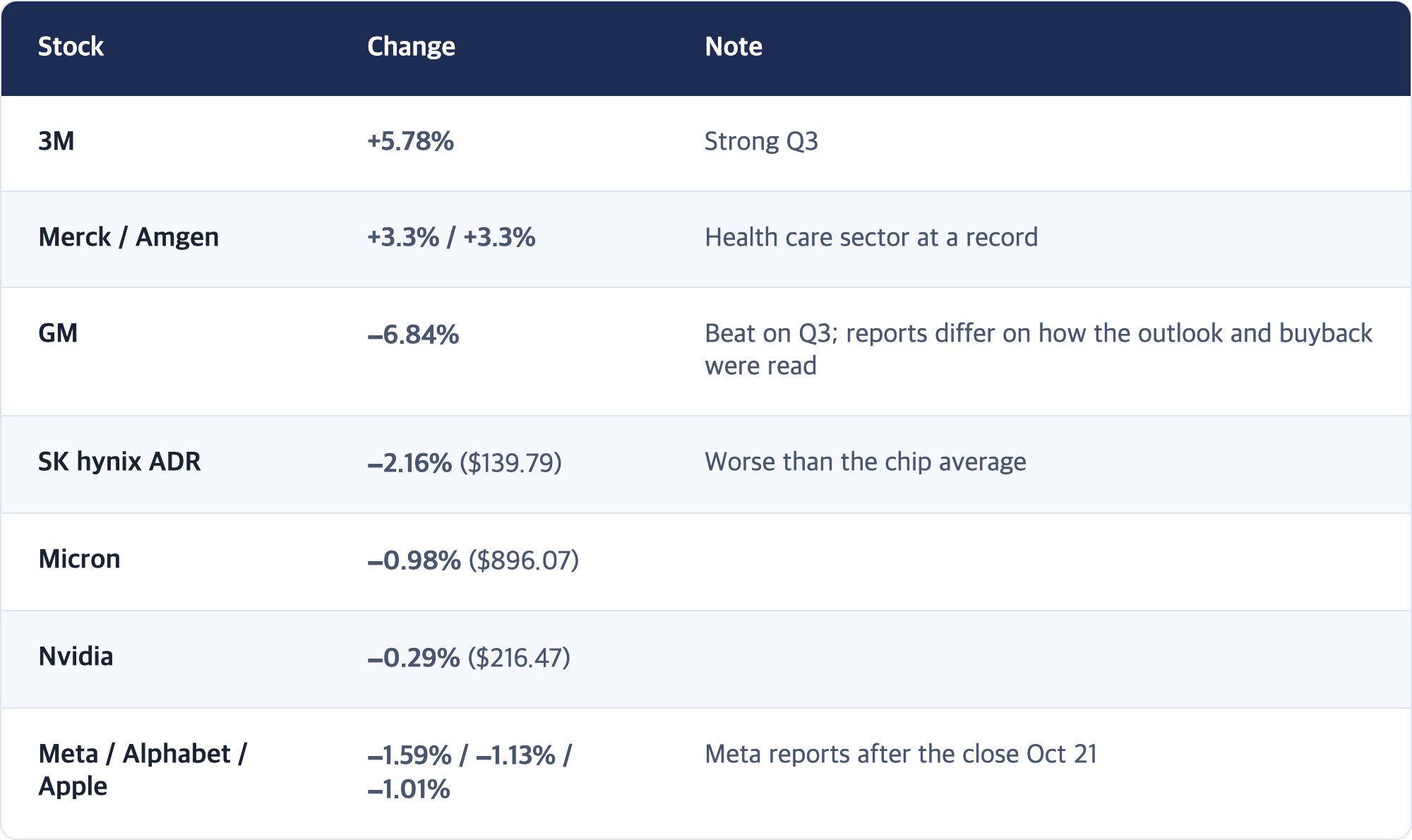
- ★ New York rotated out of AI instead of dumping it. Dow +1.02%, Russell 2000 +1.65%, S&P 500 +0.28% (7,712.57), Nasdaq −0.02%, Nasdaq 100 −0.13%. Health care (Merck and Amgen each +3.3%) and old-economy names with strong earnings (3M +5.78%) did the lifting.
- ★ Chips held up, but memory was weak. SOX about −0.29%, Nvidia −0.29%, Micron −0.98%, SK hynix ADR −2.16% ($139.79). Meta −1.59%.
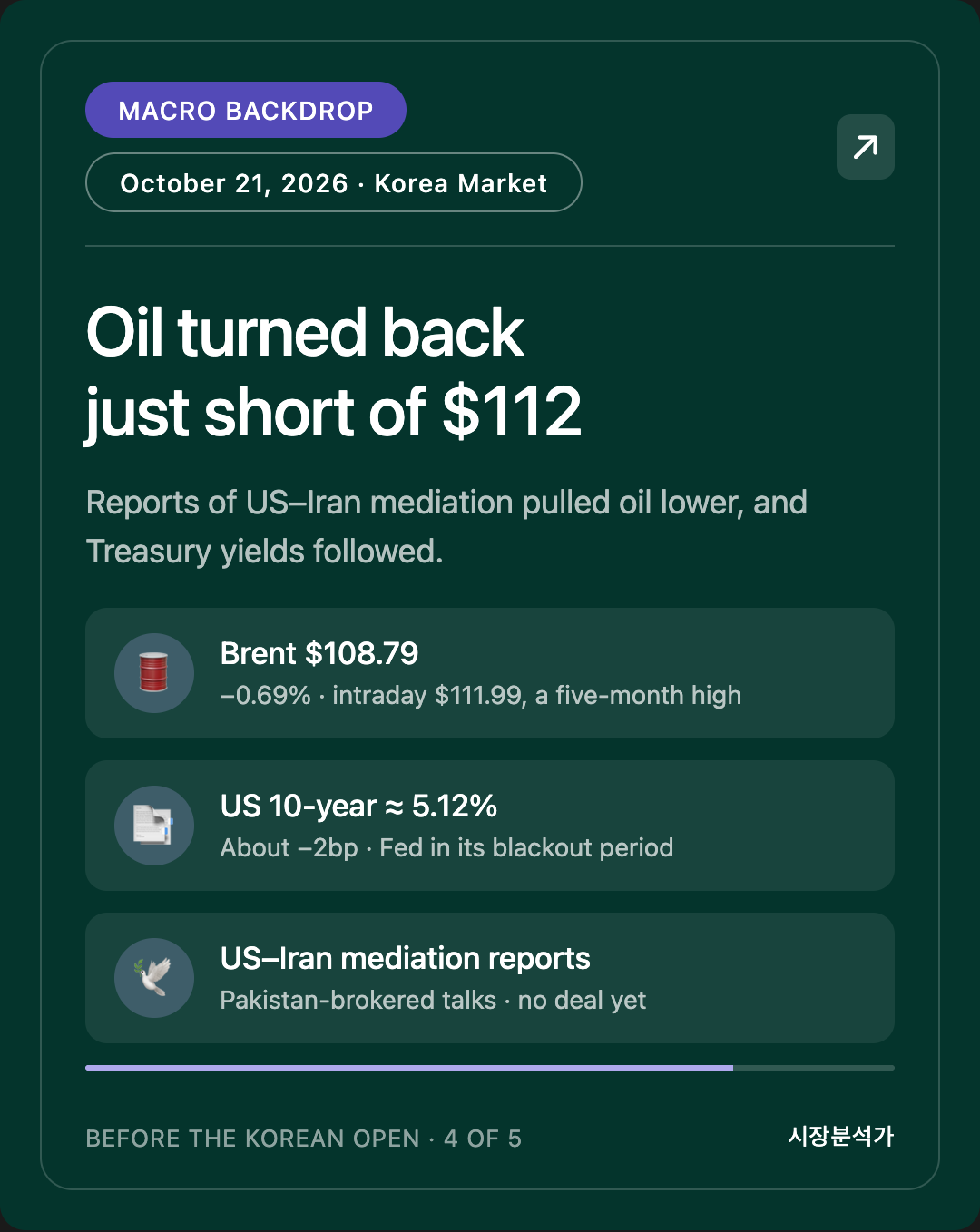
- ★ Oil hit a five-month high, then turned. December Brent settled at $108.79 (−0.69%) after touching $111.99. November WTI $101.79 (−1.80%), December WTI $98.28. Reports of US–Iran mediation (talks involving Pakistan's army chief) reversed the move.
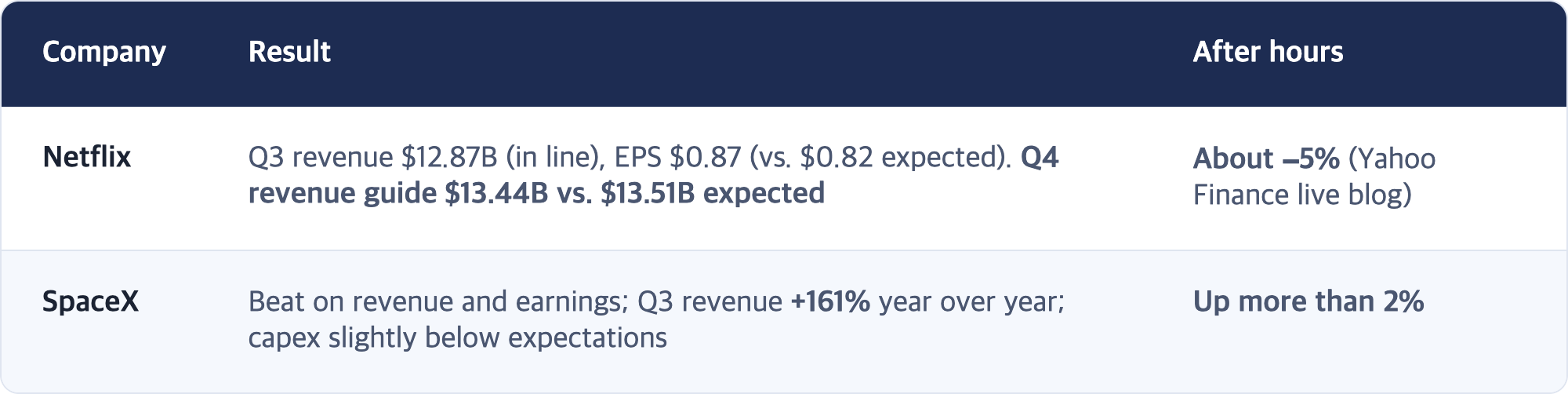
- After-hours earnings were mixed. Netflix's Q4 revenue forecast ($13.44B) fell short of estimates ($13.51B), sending shares about −5% after hours. SpaceX beat on revenue and earnings and rose more than 2% after hours (mostly single-source).
- Rates and volatility took a breather. US 10-year about 5.12% (around −2bp), VIX 17.31 (−6.1%), gold $4,139.90 (−0.07%). Korea's Oct 1–20 export data comes out at 09:00 today, and the Bank of Korea decides rates at 10:00 tomorrow.
This is Mr. Can. Here is the October 21, 2026 brief ahead of the Korean market open.
Written: 2026-10-21 08:30 KST (Vancouver Oct 20, 16:30 PDT) · Work started 08:01 KST
Basis: US regular session close on Tue Oct 20 (05:00 KST Oct 21) + Treasury moves + oil settlement + after-hours earnings (Netflix, SpaceX)
🟢 Scheduled for 16:00 PDT, started 16:01 PDT. Written before Seoul opens (09:00 KST).
🟢 No missed editions. The previous brief was the Oct 20 AM (US preview).
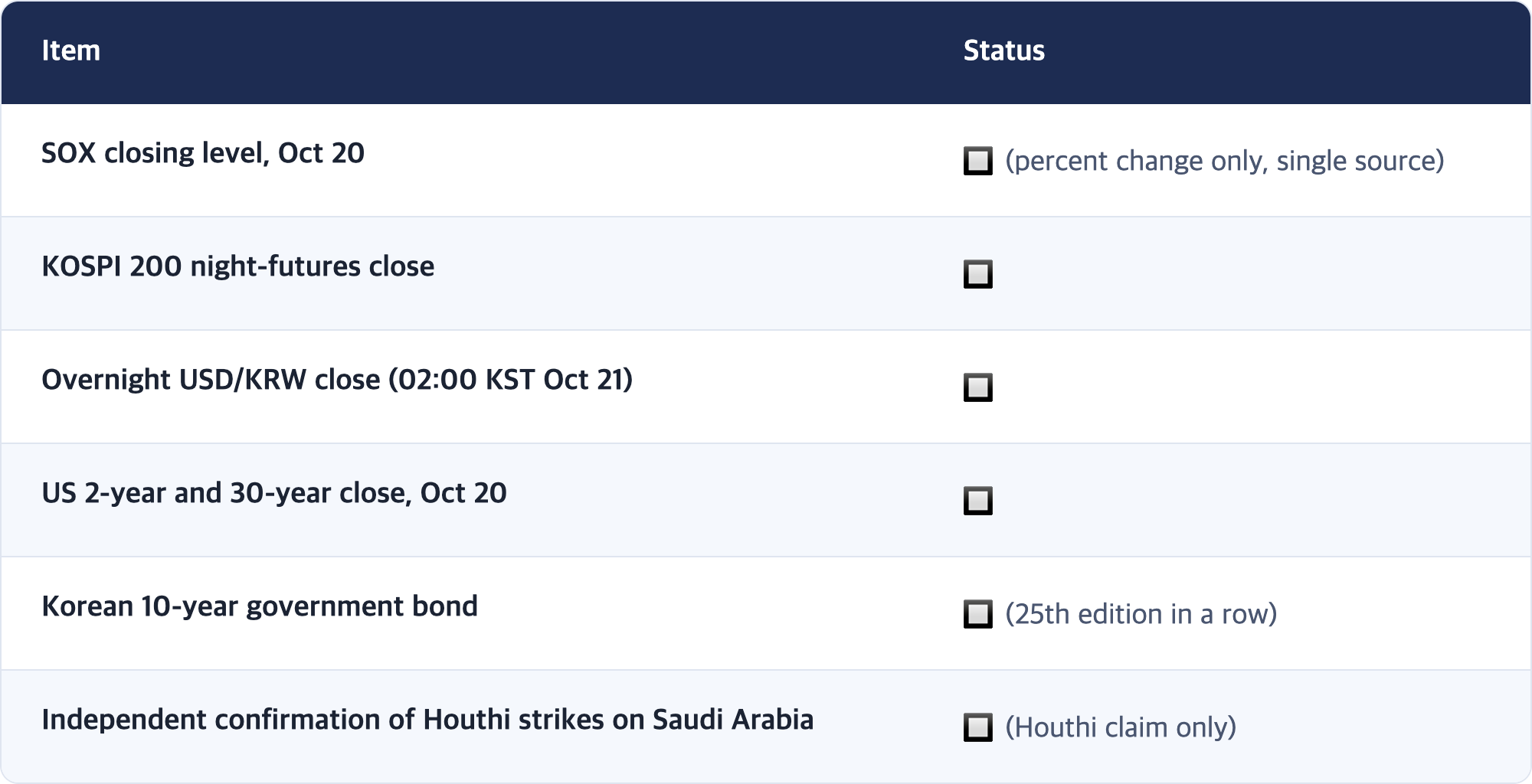
🟡 We could not confirm the closing level of the Philadelphia Semiconductor Index (SOX), the KOSPI 200 night-futures close, the overnight USD/KRW close, or the Korean 10-year government bond yield (see Section 7).
SEO Intro
On Tuesday, Wall Street didn't sell AI. It moved money out of AI and into everything else. The Dow climbed 1.02% to 52,495.88, the small-cap Russell 2000 gained 1.65%, and health care hit a record high. The Nasdaq, meanwhile, finished flat at 26,424.82 (−0.02%). The gap between the Dow and the Nasdaq was 1.04 percentage points.
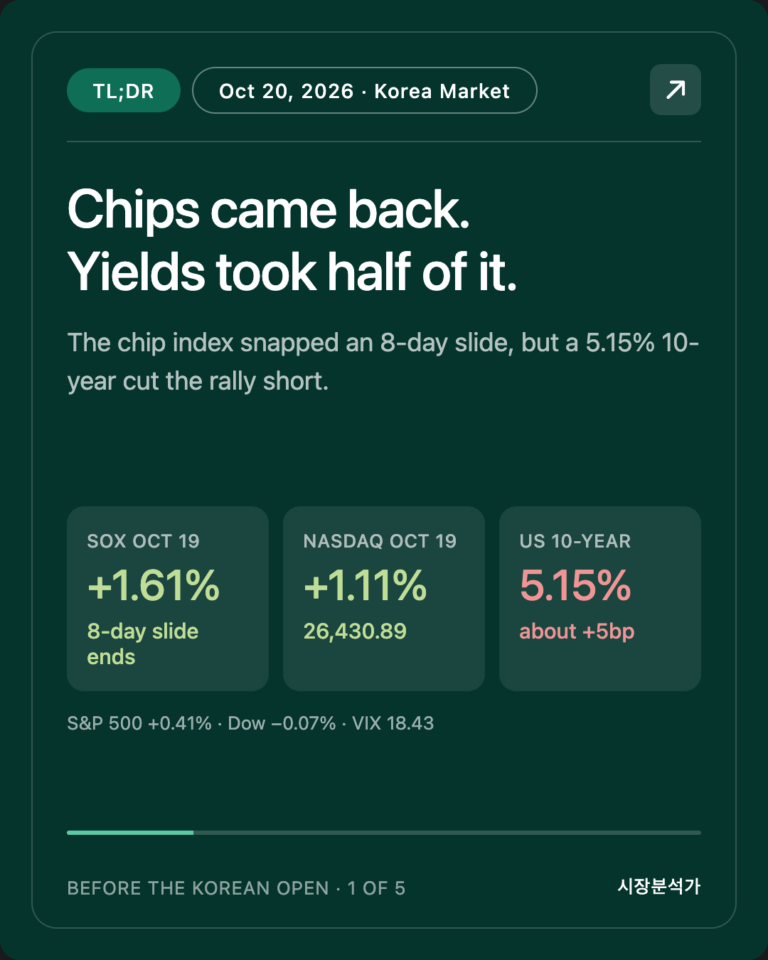
Chip stocks didn't break. The SOX slipped about 0.29% (single source), keeping most of Monday's 1.61% rebound. SK hynix's US-listed depositary receipt (ADR), however, fell 2.16%, more than the chip average. Brent crude touched $111.99 intraday, a five-month high, before reports of US–Iran mediation pulled it back to $108.79 (−0.69%). The US 10-year yield eased to about 5.12%.
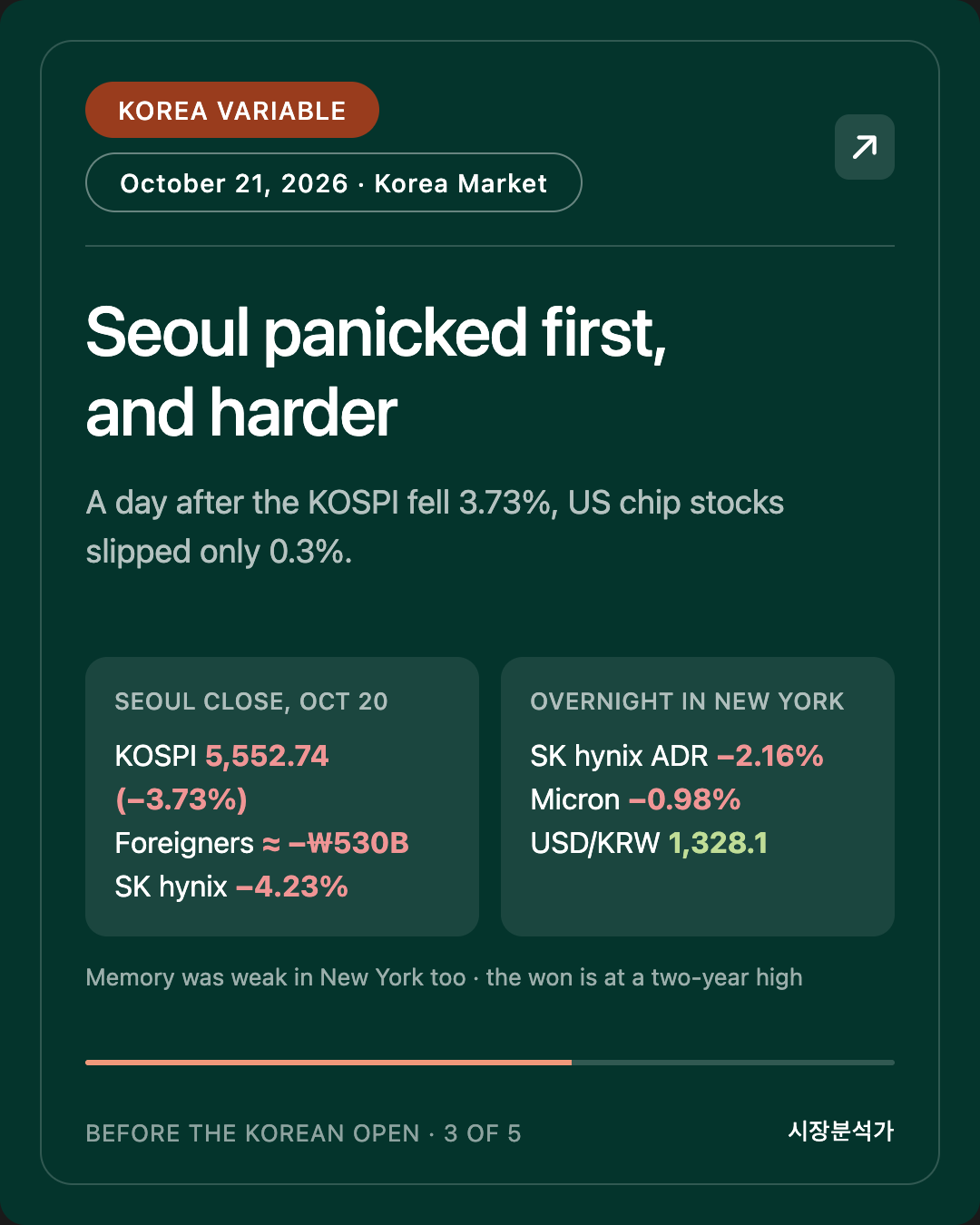
Seoul got scared first, and harder: the KOSPI fell 3.73% on Tuesday. New York didn't follow with the same fear overnight. The question for Seoul today: does Korea rotate out of chips and hold steady like New York, or does the whole index fall for a second day?
1. Scoring Last Session's Checkpoints
The four set by the Oct 20 AM brief (US close, Oct 20)
The question was: "Does Seoul's 'who's funding AI?' doubt spread to New York, or does New York just rotate out of chips?" Oil was left as the wild card.
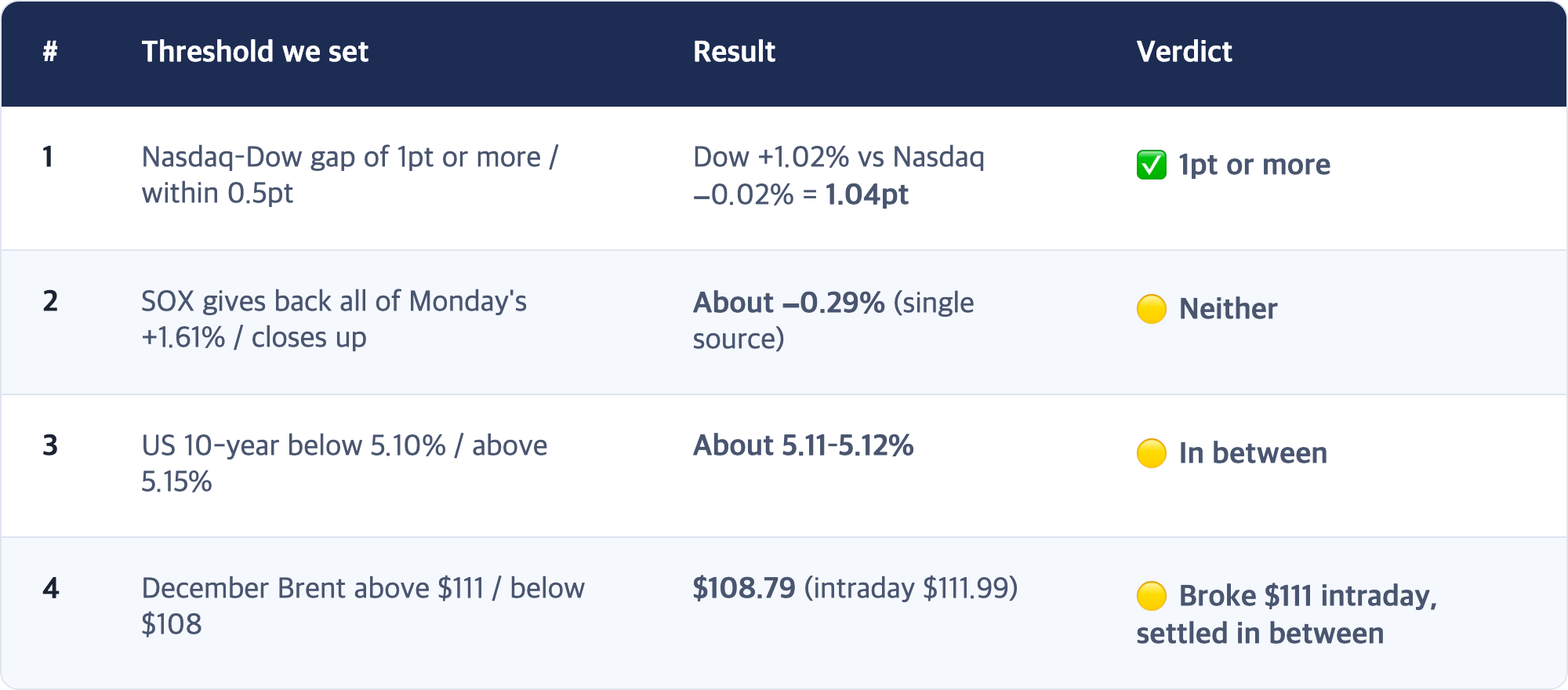
★ [Interpretation] It didn't spread. It shifted.
The morning brief said that a 1pt+ gap combined with a full SOX give-back would mean Seoul's selloff was simply an early warning. Only the first half happened. The Dow and Nasdaq split by more than a point, but the chip index held nearly all of Monday's gain.
[Observation] That combination doesn't say "AI is collapsing." It says "let's own something besides AI too." Small caps led the day and health care set a record. Money didn't leave the market; it changed seats inside it.
[Interpretation] That makes Seoul's 3.73% drop look like a step further than New York went. In New York, investors could trim AI and add elsewhere. In Seoul, there's much less "elsewhere" — chipmakers make up a very large share of the KOSPI. That difference is the starting point for reading Seoul today.
2. Today's Key Story: New York Rotated Out of AI Instead of Selling It
[Fact] US close, Tue Oct 20
[Fact] Sectors and stocks
[Fact] After-hours earnings
★ [Interpretation] Tuesday measured how big the AI doubt really is
If the doubt were severe, the chip index would have given back all of Monday's rebound. It didn't. What we saw was a milder worry — "holding only AI feels risky" — that sent money into the Dow, small caps and health care.
[Observation] Memory stocks were the soft spot. SK hynix's ADR (−2.16%) and Micron (−0.98%) lagged Nvidia (−0.29%). Recent reports of China's ChangXin Memory (CXMT) catching up technologically, plus debt worries at AI cloud providers like CoreWeave, appear to be feeding doubts about memory demand (interpretation).
[Interpretation] SpaceX's after-hours gain is a small piece of evidence that companies spending heavily on infrastructure can still make money. The real test comes tonight (early Oct 22 in Korea): Meta's AI capital-spending guidance.
3. The Korea Variable: Seoul Panicked a Day Early, and Harder
[Fact] Seoul close, Tue Oct 20 (figures adopted in the Oct 20 AM brief)
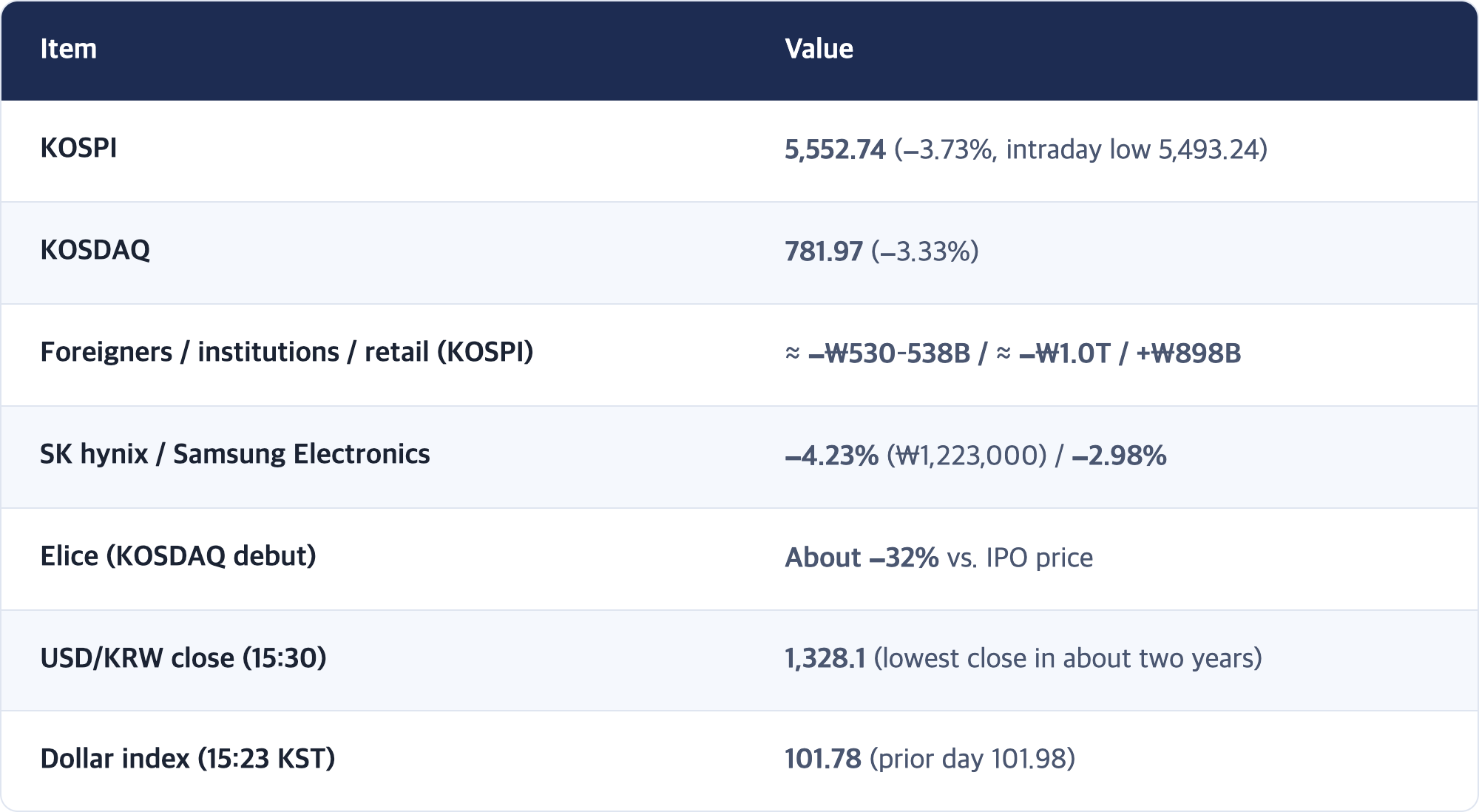
[Fact] Overnight signals for Korea
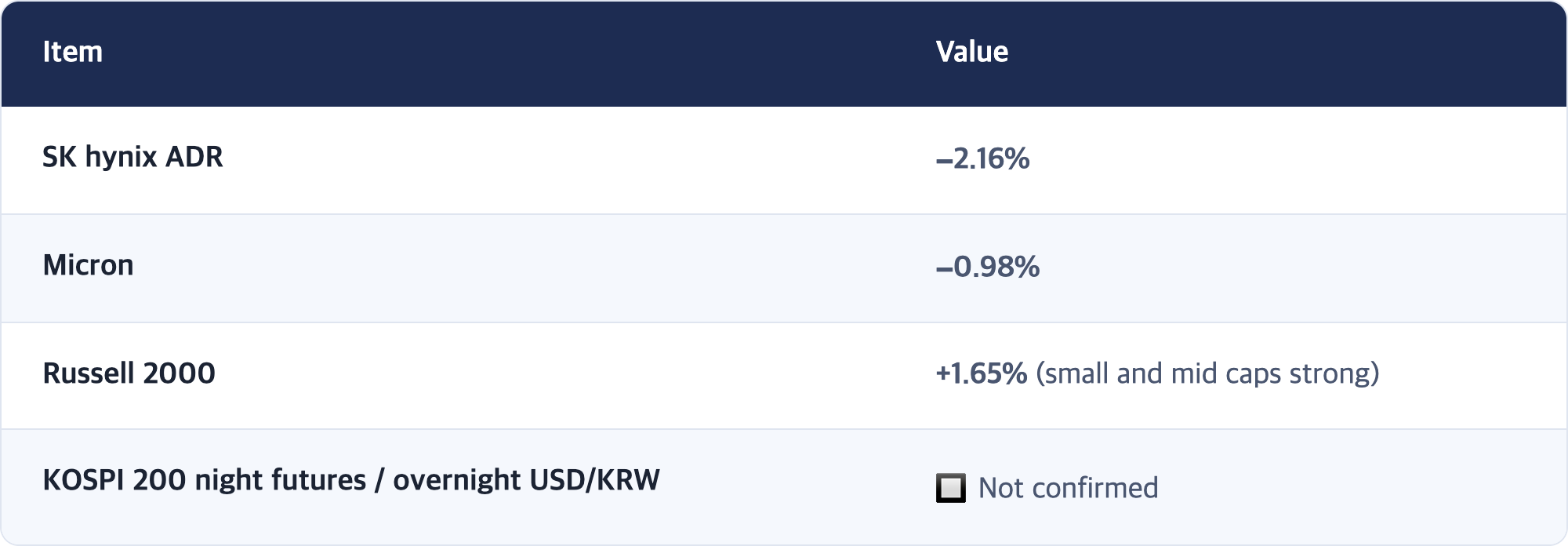
★ [Interpretation] Korean chipmakers have reasons to hold and reasons to slip
- Reasons to hold. The US chip index kept almost all of Monday's rebound. The level of fear behind Seoul's 4%+ chip selloff wasn't confirmed in New York.
- Reasons for weakness. Memory was soft in New York too. SK hynix's ADR fell 2.16% after Seoul's drop. SK hynix also faces a separate issue: a shareholder-value debate over the planned US listing of its subsidiary Solidigm (Invest Chosun, single source).
- Reasons to rotate. If money switches sectors the way it did in New York, the signal in Seoul will be whether non-chip sectors — financials, health care, defense — hold up.
[Observation] The won keeps moving opposite to stocks. Even on a day when foreigners sold more than ₩500 billion, USD/KRW fell to 1,328.1. The idea from yesterday still holds: this looks less like money leaving Korea and more like money trimming chips inside Korea.
4. Macro Backdrop: Oil Turned at a Five-Month High, Yields Rested
[Fact] Rates, currencies, commodities (around the New York close, Oct 20)
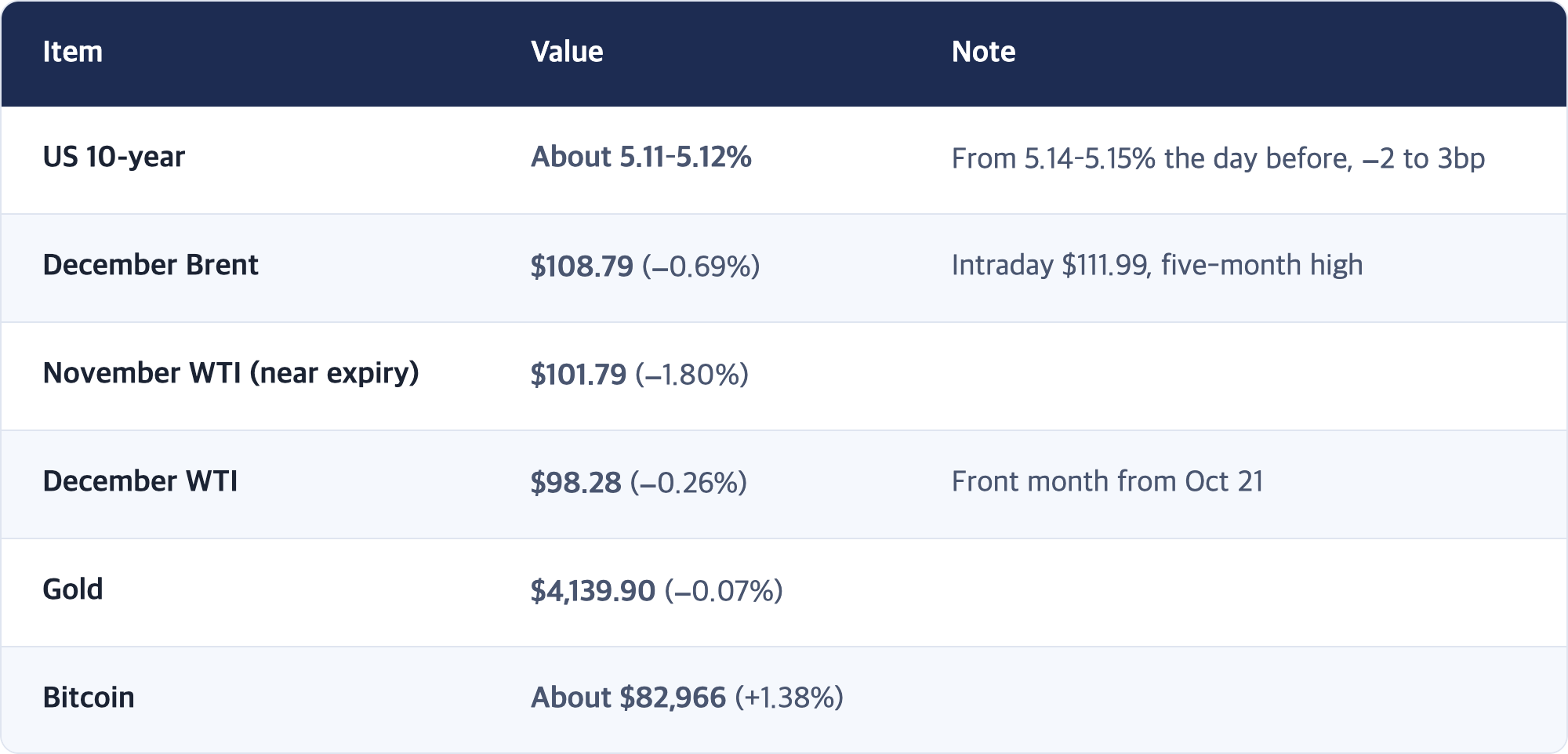
[Fact] What turned oil
- Pushing up: Yemen's Houthi rebels claimed strikes on Saudi energy facilities, airports and military sites (not confirmed by Saudi authorities). Ship-tracking firm Kpler counts at least 18 merchant vessels attacked over two weeks.
- Pushing down: Reports of diplomatic mediation between the US and Iran, including talks between Iran's president and Pakistan's army chief. Other reports stressed that no deal is done.
★ [Interpretation] When oil eased, yields eased with it
Yesterday morning's brief described a pattern where oil rises but yields fall — bonds buying safety rather than pricing inflation. Tuesday was simpler: oil fell on mediation headlines, and Treasury yields fell with it. This week, oil, not the Fed, is steering long-term rates (the Fed is in its pre-meeting blackout, and a hold is expected at the Oct 28 FOMC).
5. Today's Seoul Session (Wed Oct 21): Checkpoints
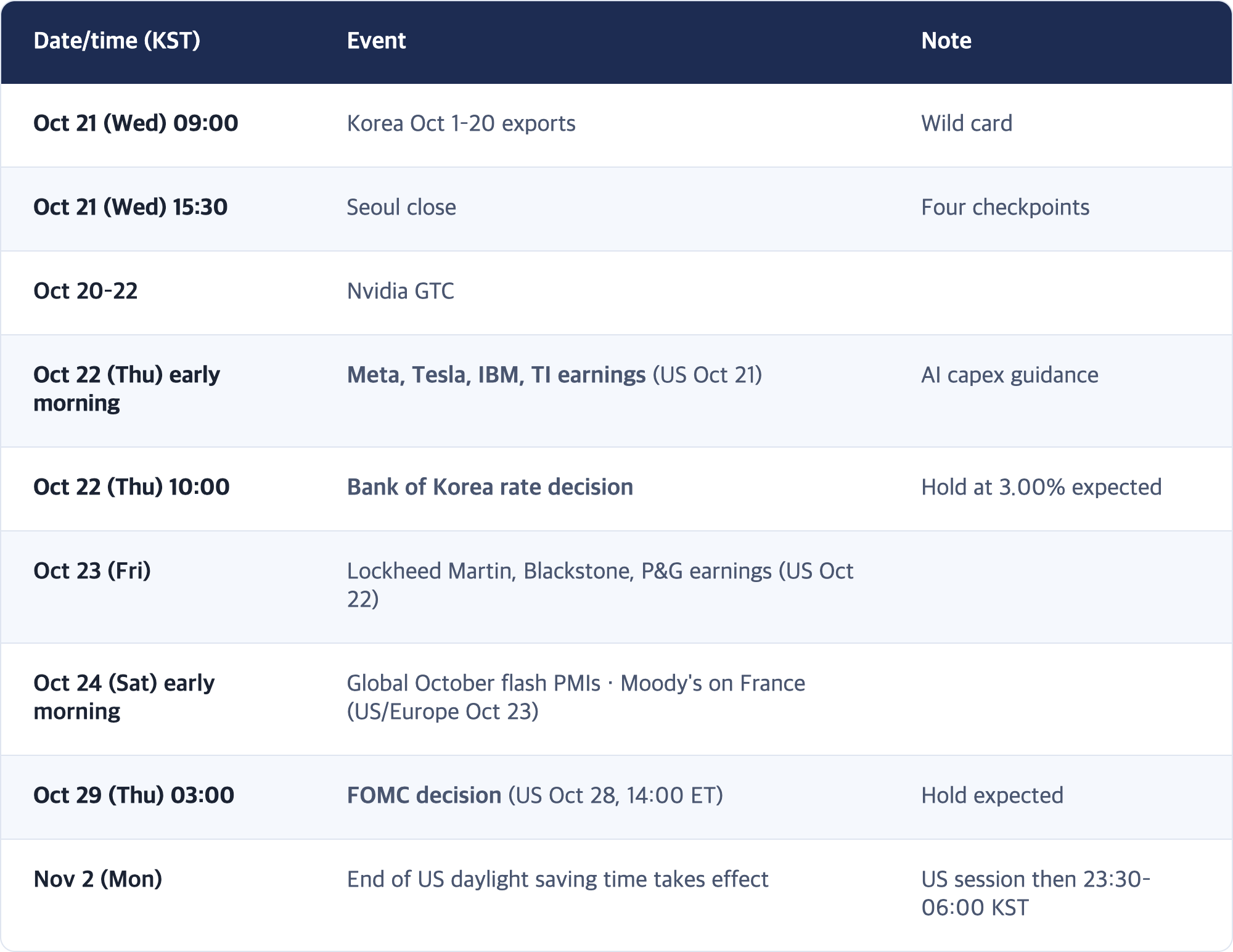
[Observation] Remaining schedule (KST)
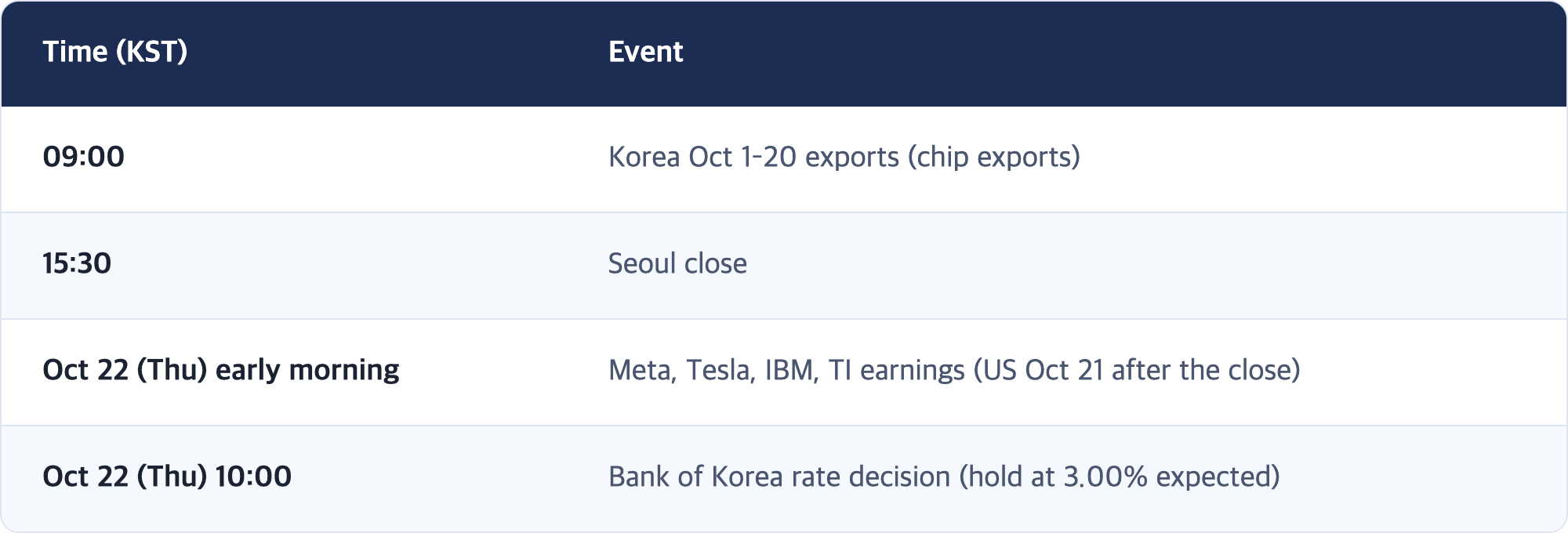
✅ Four checkpoints (through today's Seoul close)
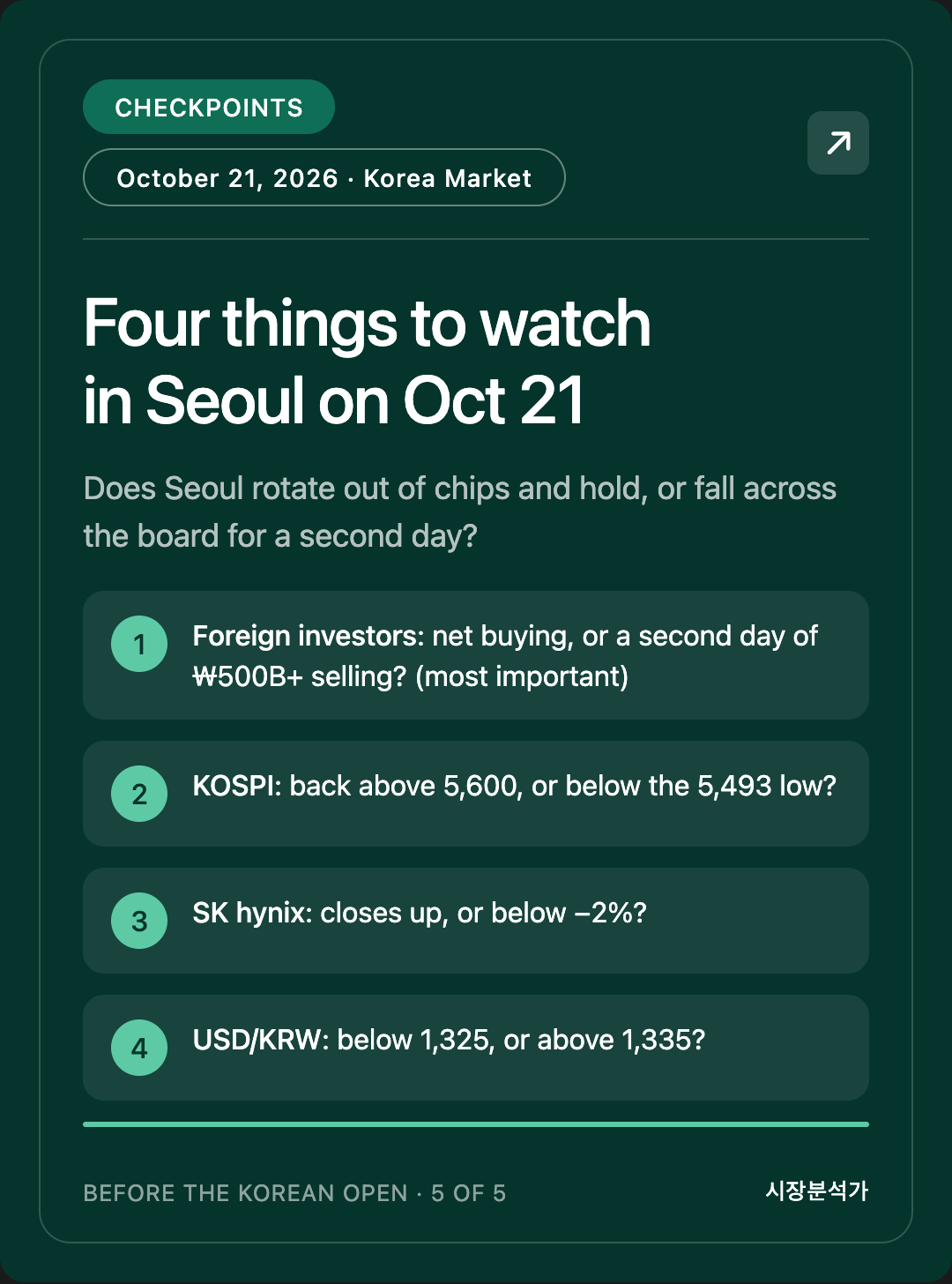
The question: "Does Seoul rotate out of chips and hold like New York, or does the whole index fall for a second day?" The wild card is the 09:00 export data.
- Foreigners turn net buyers / a second day of ₩500B+ net selling. (Most important)
- KOSPI back above 5,600 / below 5,493 (yesterday's intraday low). Holding the low is the test of whether Tuesday's fear was a one-day event.
- SK hynix closes up / closes below −2%. Does it fall less, or more, than the ADR's −2.16%?
- USD/KRW below 1,325 / above 1,335. Does the won keep holding even while foreigners sell?
[Interpretation] Foreign net buying (1) plus a KOSPI recovery above 5,600 (2) would mean Seoul's 3.73% drop was an overreaction a day ahead of New York. A second day of ₩500B+ selling with the won strengthening below 1,325 (4) would mean another day of money trimming chips inside Korea. A break below 5,493 with USD/KRW above 1,335 would be the first sign worth taking seriously that money is leaving Korea itself. Strong chip numbers in the 09:00 export data would push checkpoints 2 and 3 in the better direction.
6. Study Note: "Sector Rotation" (When Money Changes Seats Inside the Market)
The idea
Sector rotation is when money doesn't leave the stock market as a whole but moves from one sector to another. On these days the headline index can look calm while large moves happen underneath.
An analogy
Picture a building where the number of people inside doesn't change, but the crowd at the third-floor restaurant suddenly heads down to the first-floor café. The building's headcount (the overall index) is the same, but the restaurant owner (AI chips) and the café owner (health care and old-economy stocks) are having very different days.
Today's example
On Oct 20 the S&P 500 rose a quiet 0.28%. But the Dow gained 1.02%, the Russell 2000 1.65%, and the Nasdaq slipped 0.02%. Within one market, sector results split by more than 1.5 points. Days like this are better read as "the seats changed" than "the market rested."
Why it matters
Rotation and a broad exit call for different responses. Rotation doesn't mean much risk for the index as a whole, but a portfolio concentrated in one sector can still hurt. In a market like Korea's, where chips carry a huge weight, there are fewer sectors to rotate into, so the same rotation can shake the index more.
One-line summary
When the index is calm but sectors split sharply, suspect sector rotation first.
7. Corrections and Open Items
Corrections
- None. (The Oct 20 AM brief's Brent figure of "$110–111" was an intraday level; the settlement was $108.79.)
Where sources differ (figure used in this brief)
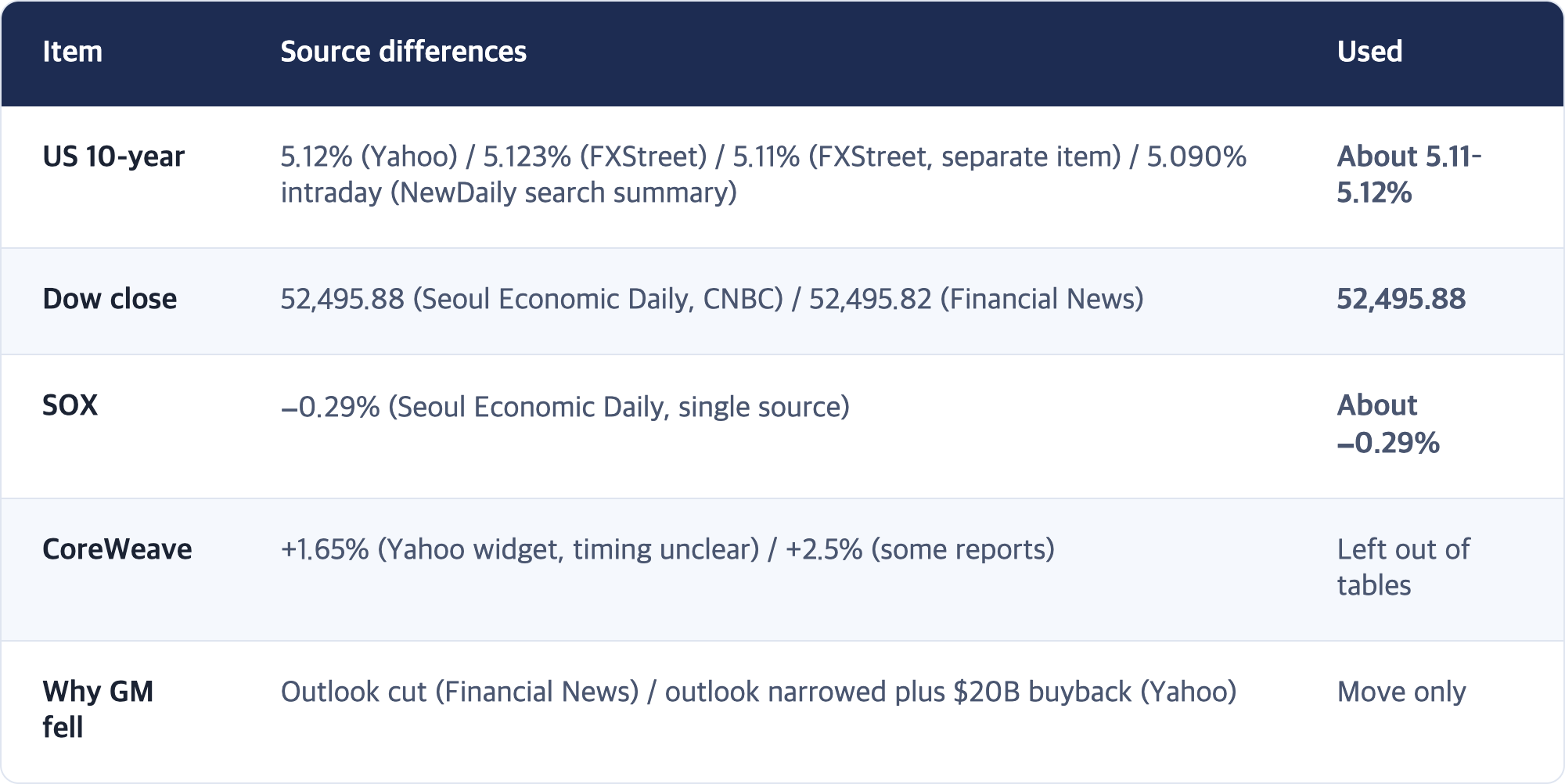
🔲 Not confirmed
8. Event Calendar (KST)
Sources
- [NY Stocks] Dow, S&P 500 close higher; Tesla +1.5% | Financial News (Korean)
- Blue chips up, chips down; Brent hits $112 intraday | Seoul Economic Daily (Korean)
- Stock market today: Dow, S&P 500 rise, Nasdaq slips as investors await SpaceX, Netflix earnings | Yahoo Finance
- Oil falls on hopes for US–Iran diplomatic solution; WTI −1.8% | News1 (Korean)
- [Oil] Closes lower after intraday spike | Financial News (Korean)
- US Treasury yields retreat as Iran deal hopes pull WTI lower | FXStreet
- US stocks: Nasdaq lower on AI and oil worries; SK hynix down 3% | Topstar News (Korean)
- Chip sentiment freezes: Samsung −2.98%, SK hynix −4.23% | Segye Ilbo (Korean)
- Won closes at year's strongest, 1,328.1 per dollar | Seoul Economic Daily (Korean)
- SK hynix slides despite US chip rebound on Solidigm concerns | Invest Chosun (Korean)
- Dow jumps 500 points as earnings optimism steadies market: Live updates | CNBC
Market Analyst · This brief does not recommend buying or selling individual stocks. It offers macro context and interpretation.
📌 More market briefs
※ This post is market observation and organization intended to support your own judgment. It is not a recommendation to buy or sell any security. Figures are as of the time of writing and may differ between sources.
If this was useful, bookmark it or pass it along. It genuinely helps me write the next one.
I can survive. We can survive.