September 24, 2026 KOSPI Market Brief — What to Watch Before the Korean Open
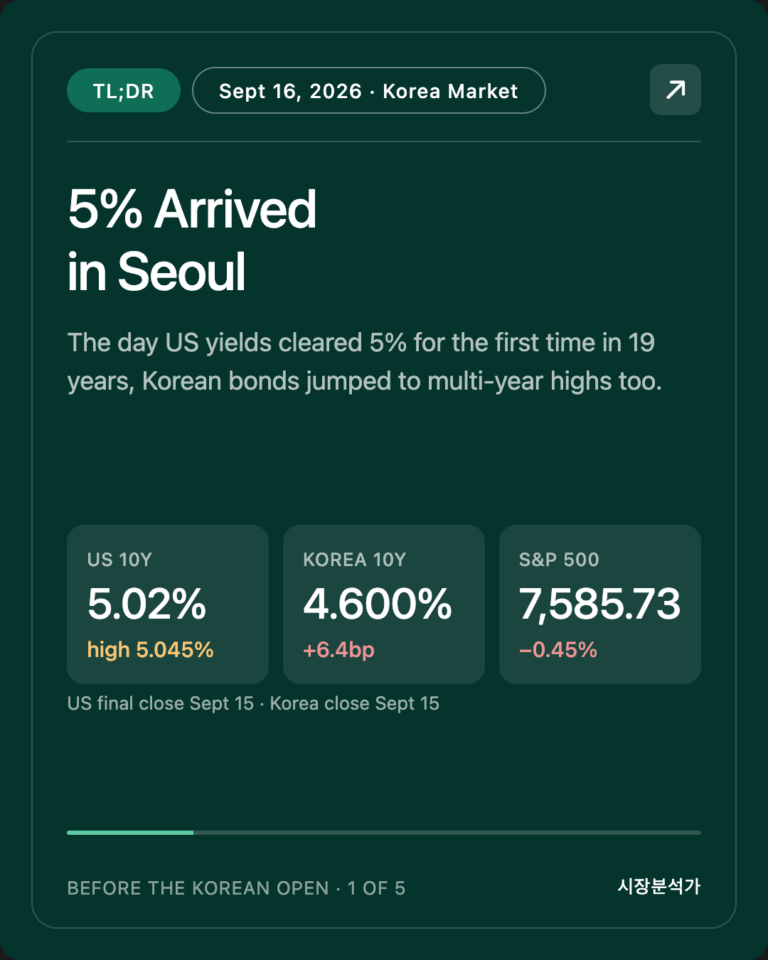
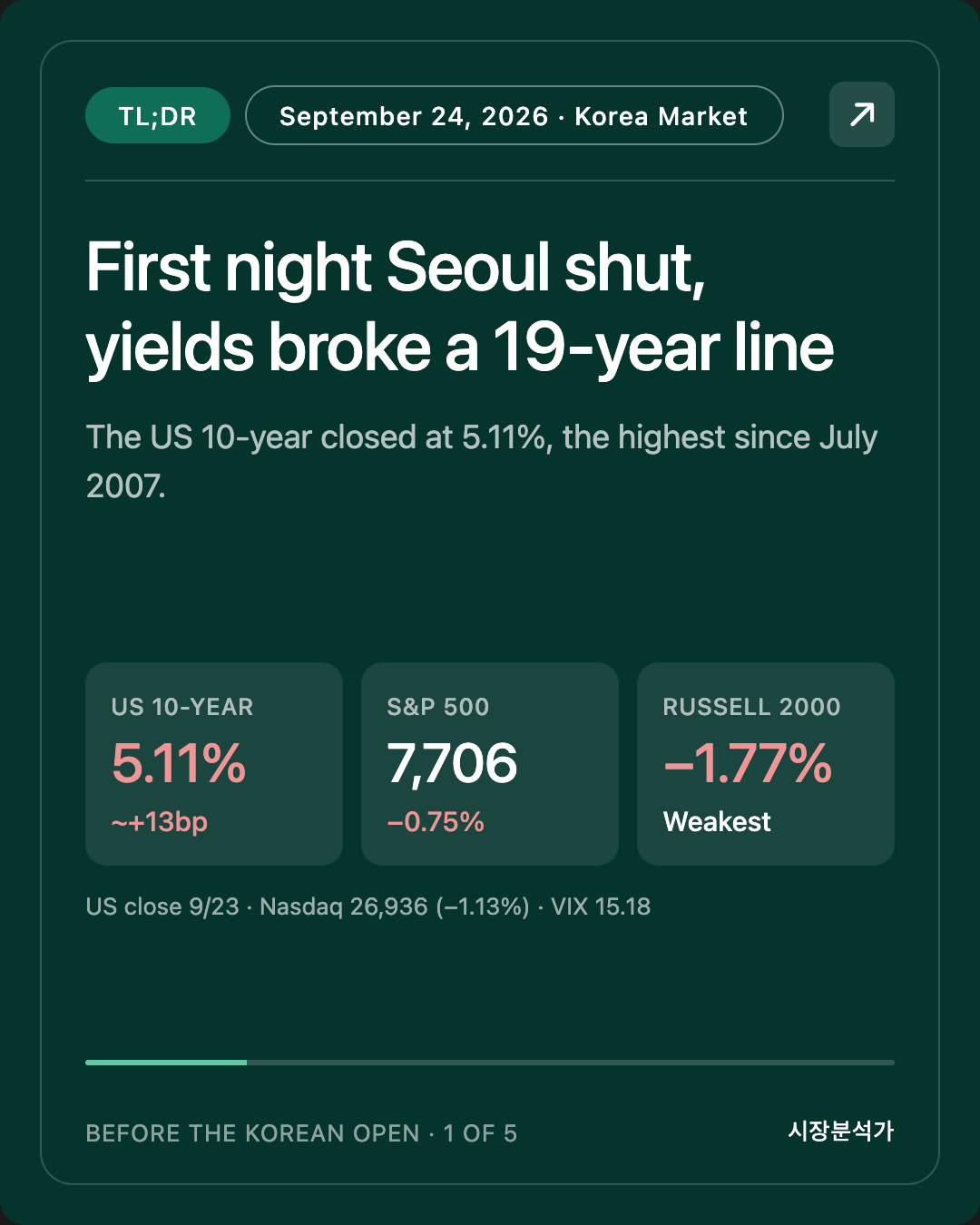
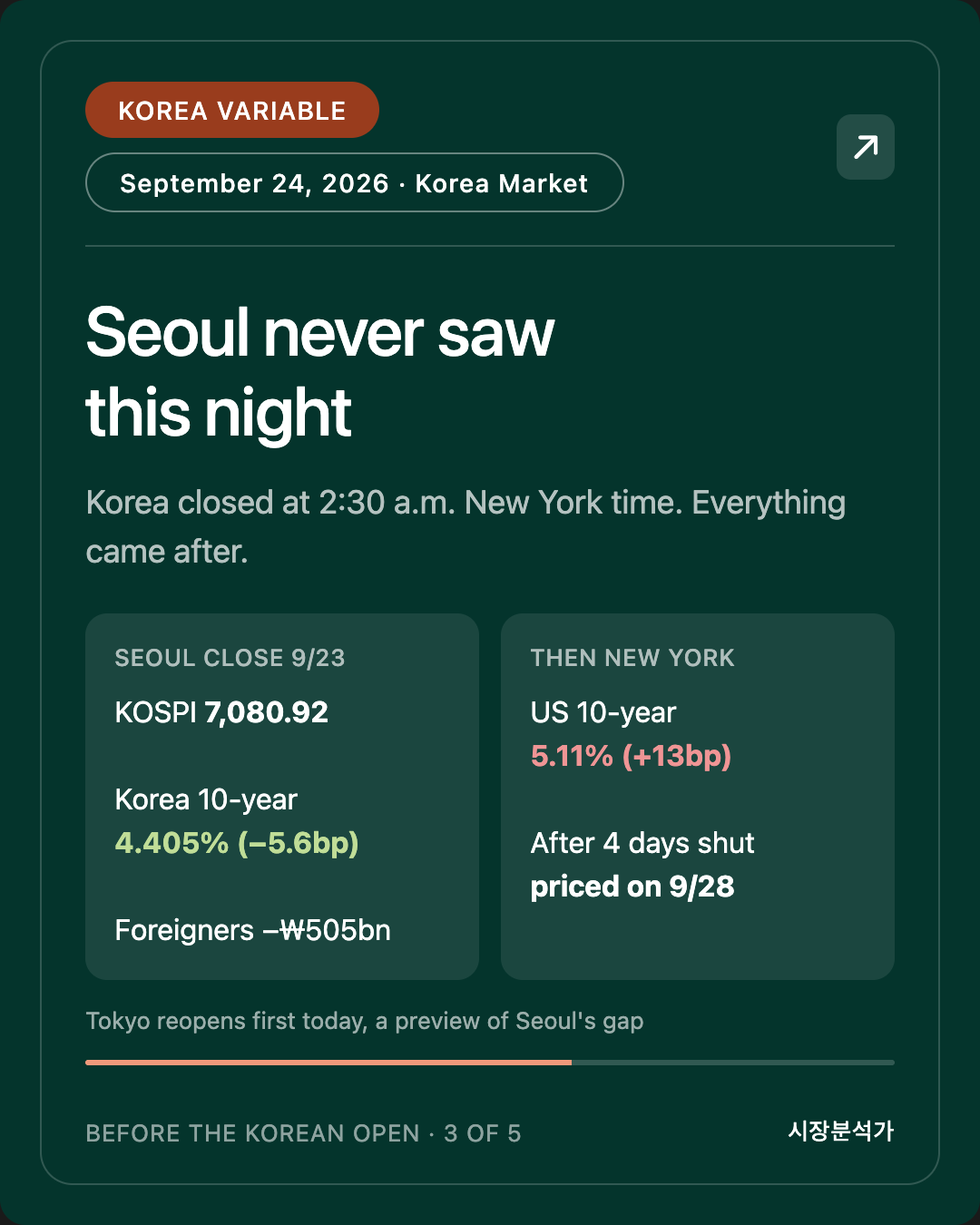
On the first night Seoul was closed, the US 10-year Treasury yield crossed a line it had not crossed in 19 years.
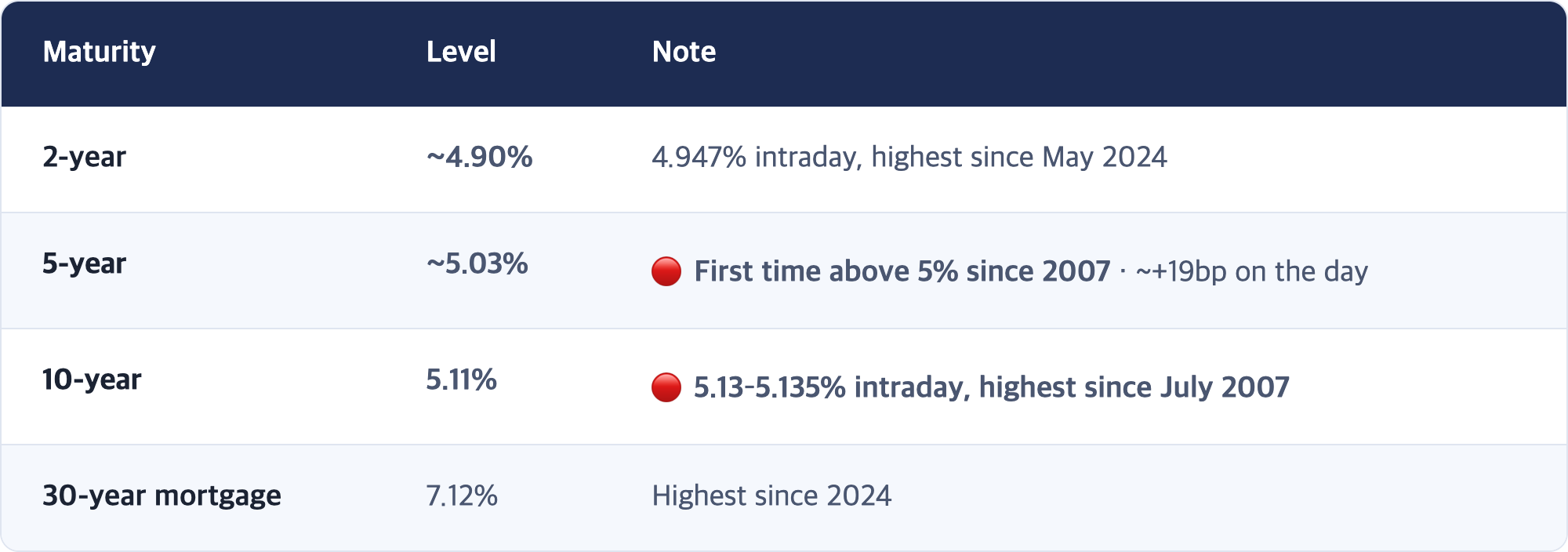
The 10-year closed at 5.11%. Intraday it touched 5.13%, the highest since July 2007, a jump of more than 13 basis points in a single session.
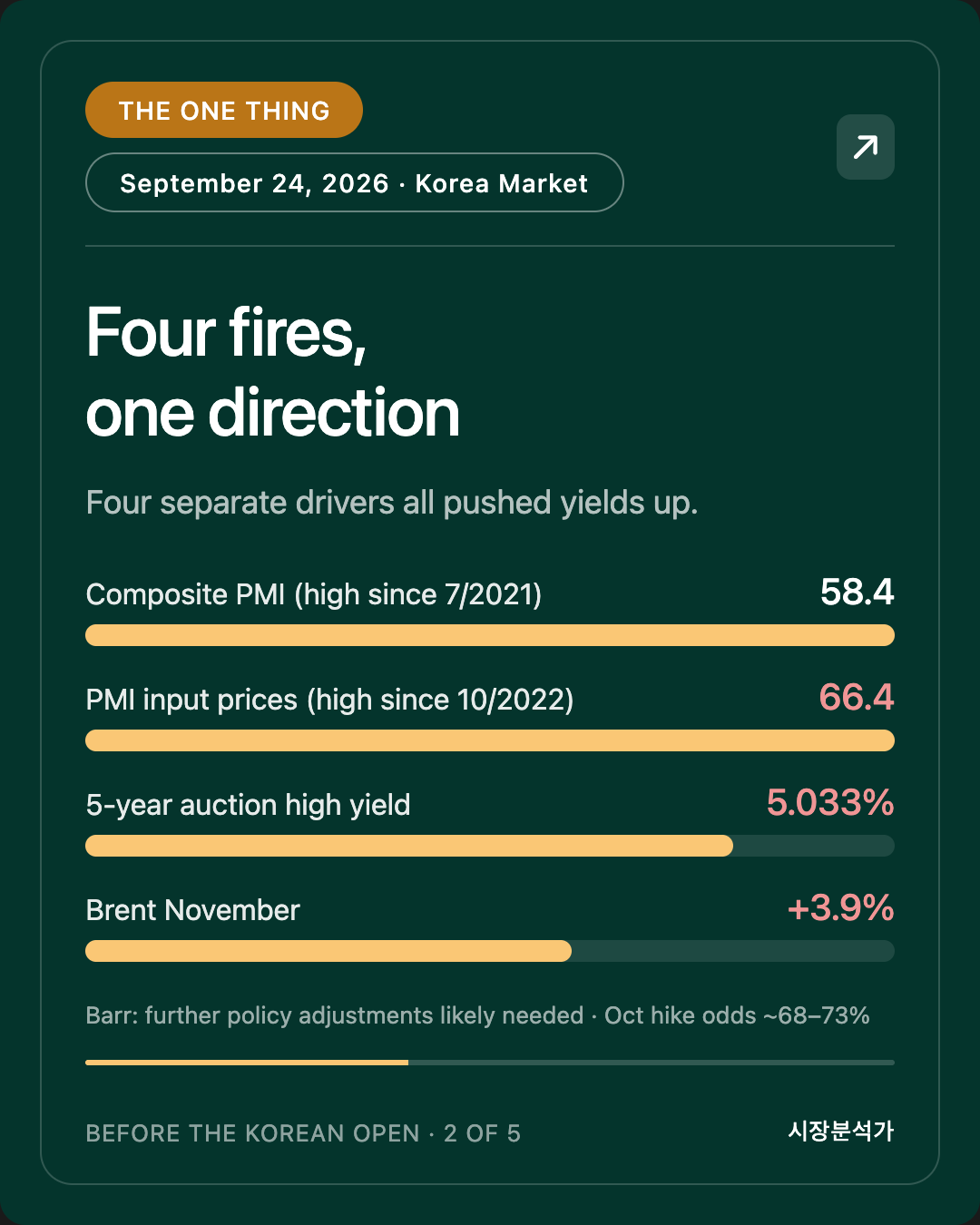
Four things hit at once: the hottest business-activity survey in five years, a Fed governor saying "further policy adjustments are likely to be needed," a weak 5-year Treasury auction, and a rebound in oil.
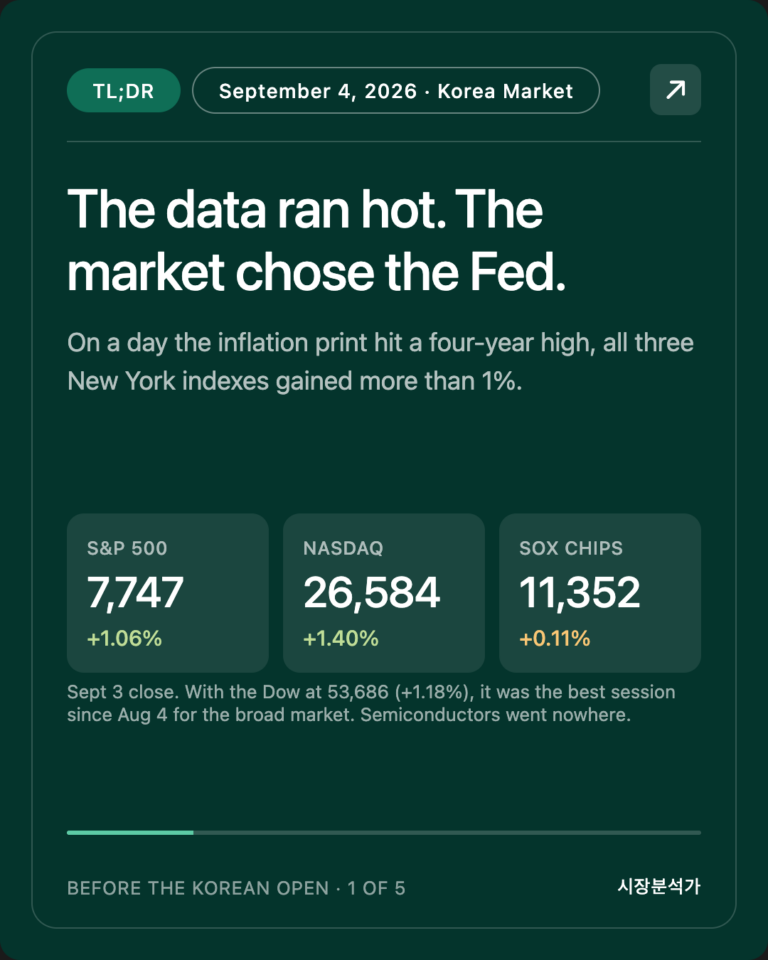
Stocks took it on the chin. The S&P 500 fell 0.75%, the Nasdaq 1.13%, and the small-cap Russell 2000 1.77%.
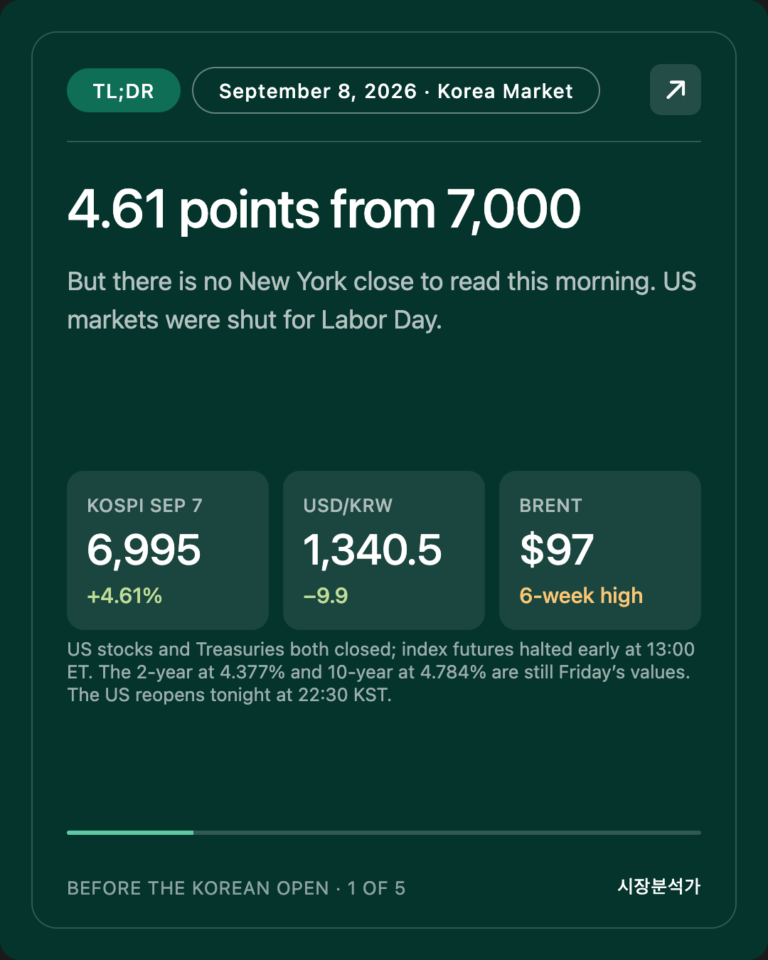
The KOSPI is frozen at 7,080.92, a price set before any of this happened. By the time it reopens on September 28, three more US sessions will have stacked up.
This is Mr. Can. Here is the September 24, 2026 brief ahead of the Korean market open.
Written: 2026-09-24 08:20 KST (Vancouver 9/23 16:20 PDT)
Basis: US 9/23 regular-session close + Europe 9/23 close + Korea 9/23 close (last session before the holiday)
🟡 Korean stocks do not open today. The Chuseok (Korean harvest festival) holiday closes the market for four days, 9/24–9/27, and trading resumes Monday 9/28. So this edition is not a preview of today's session. It tracks what piles up while Seoul is shut.
⚡ TL;DR
- ★ US 10-year closed at 5.11% (5.13% intraday), the highest since July 2007. The 5-year hit about 5.03%, above 5% for the first time since 2007. The 2-year sits near 4.90% (4.947% intraday). The whole curve moved up a notch in one day.
- Four forces pointed the same way: ① September flash composite PMI 58.4 (highest since July 2021) with input prices at 66.4 (highest since October 2022) ② Fed Governor Barr: "further policy adjustments are likely to be needed" ③ a soft $70B 5-year auction at 5.033%, bid-to-cover 2.21 ④ Brent at $103.08 (+3.9%).
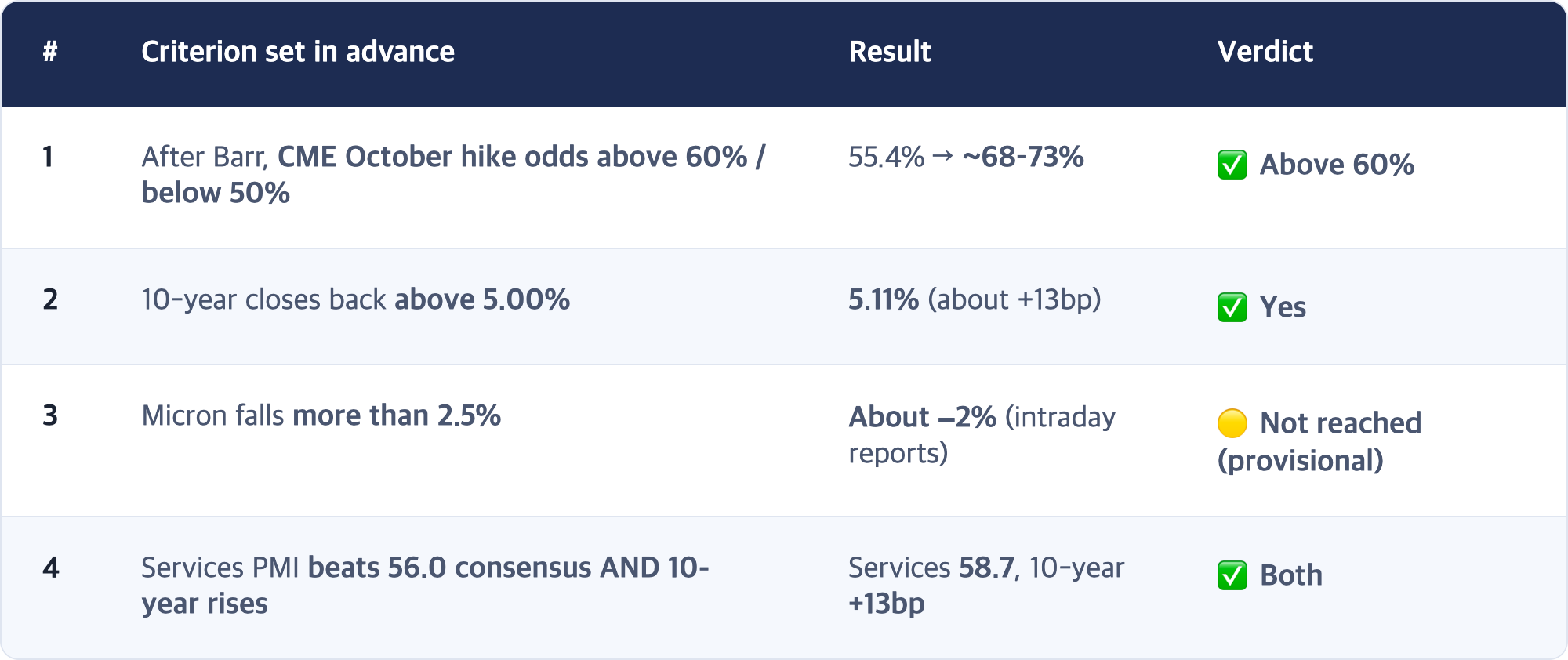
- CME odds of an October hike jumped from 55.4% to roughly 68–73%. Yesterday's checkpoint ("above 60% or below 50%?") resolved above 60%.
- Equities priced the yield shock directly: S&P 500 7,706.03 (−0.75%) · Dow 51,511.59 (−0.68%) · Nasdaq 26,936.04 (−1.13%) · Russell 2000 −1.77% · VIX 15.18 (+6.83%). The most rate-sensitive stocks fell the most.
- Seoul stays shut until 9/28, but Tokyo reopens today after its own three-day break. The Nikkei will absorb three days of news at once, a preview of the gap Seoul faces on Monday. The US–China summit is at the White House later today (US time).
1. Scoring the 9/23 AM Checkpoints (Last Night's US Session)
Yesterday morning's axis: "Does the memory-chip rally hold ahead of the summit, and does the Fed lean toward an October hike?"
[Interpretation] This time the key checkpoint gave a real answer
Two days ago, Fed speakers Williams and Jefferson spoke at a Treasury-market plumbing conference, so there was nothing to score. Yesterday we picked Barr's speech precisely because its title was "Economic Outlook." The venue matters more than the speaker.
Barr was direct: growth is strong and the labor market solid, but inflation is above 2% and "not clearly trending toward target in a timely way." Even after last week's 25bp hike, the Fed sees more work to do. Hike odds jumped 13–18 points in a day.
Checkpoints 2 and 4 point the same way. By the rules written in advance: the 10-year's slide after 9/18 was temporary, and "strong data = hike pressure" is still the market's operating rule.
Checkpoint 3 needs care. Micron fell roughly 2%, giving back less than half of Tuesday's +5.02% gain. That figure is from intraday coverage, so we will reconfirm the close. [Interpretation] If memory stocks held up this well on a day yields spiked this hard, there is no basis yet to call the memory rally a one-day event.
2. The Big Story: Four Fires, One Direction
[Fact] US Treasury Yields (9/23 ET Close)
[Fact] What Pushed Yields Up
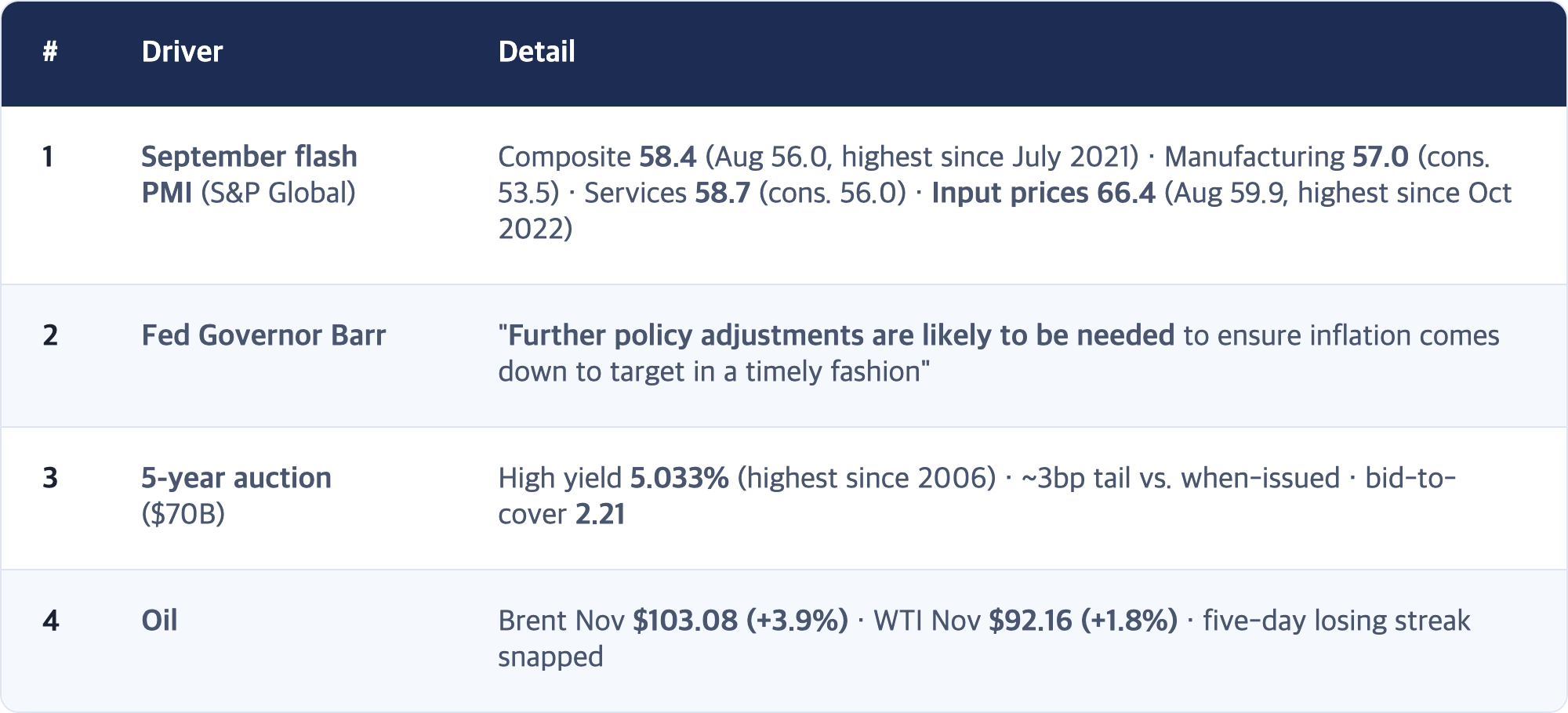
★ [Interpretation] Any one of these alone would not have done this
The four came from four different places: growth (PMI), policy (Barr), supply and demand for bonds (the auction), and geopolitics (oil). Usually one offsets another. Last night all four lined up.
The number to watch is input prices at 66.4. Businesses are paying up for materials and labor at the fastest pace since October 2022. Yields did not rise because the economy is strong. They rose because the economy is strong and inflation is re-accelerating inside it. That is the combination the Fed likes least.
[Observation] Refining yesterday morning's call
Yesterday's AM brief said "oil, more than Fed talk, is moving yields this week." Oil did move last night, but yields really took off after the PMI and Barr. [Interpretation] This week's yield driver is not oil alone but oil + inflation data + Fed talk, and the biggest move came on the day all three agreed.
3. The Korea Angle: Seoul Never Saw This Night
[Fact] Korea 9/23 Close (Last Session Before the Holiday)
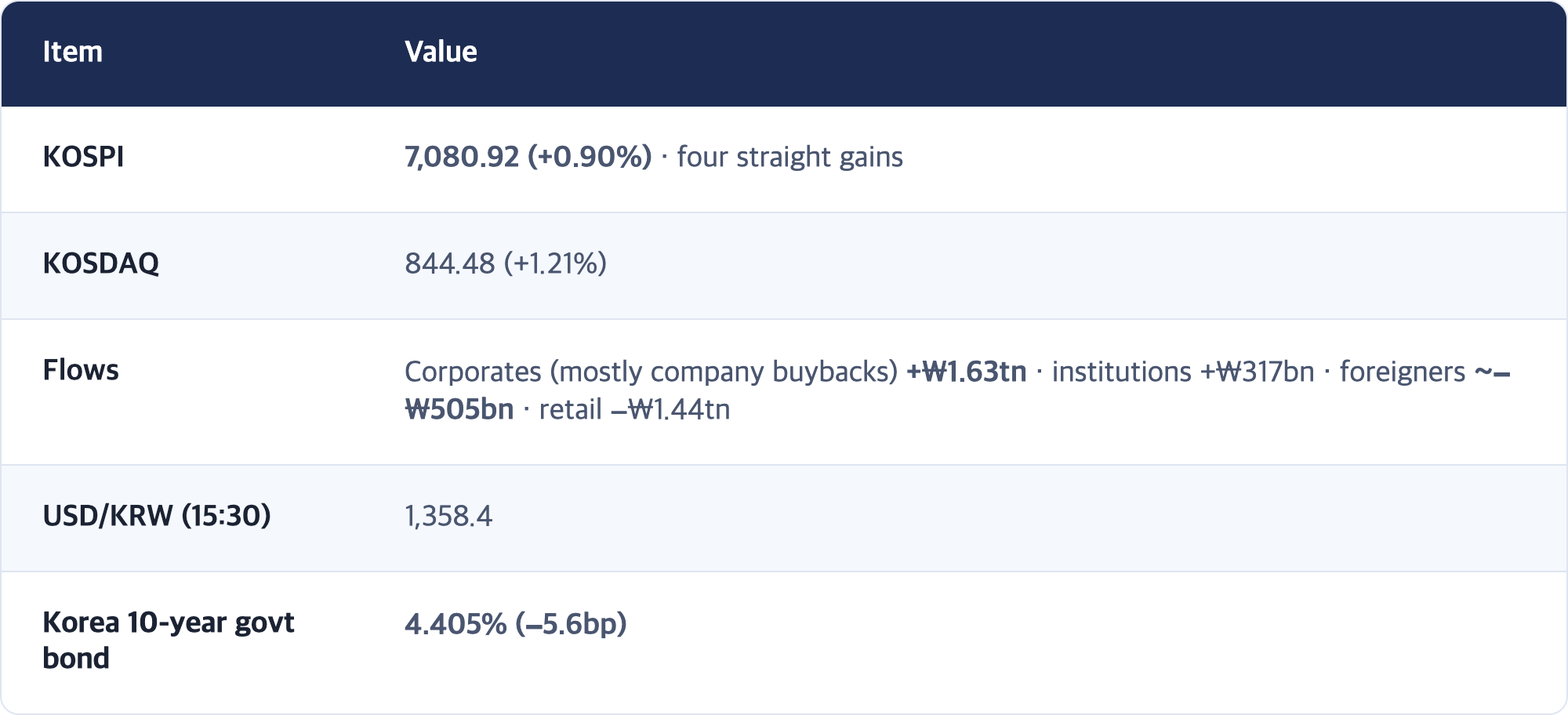
★ [Interpretation] Every Korean number predates the shock
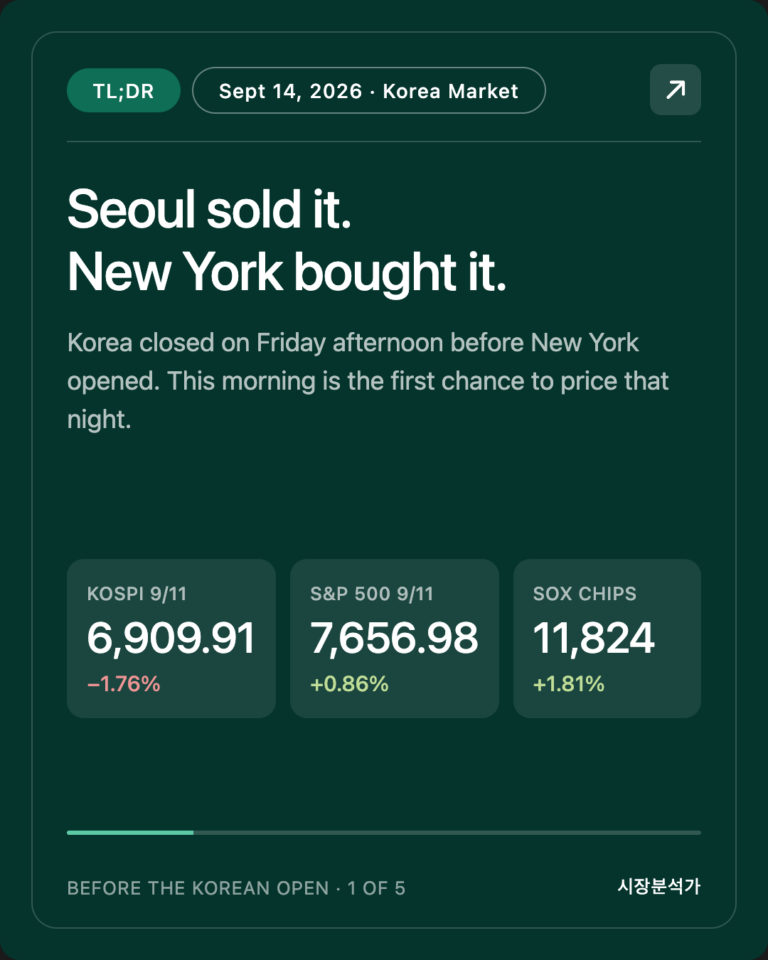
A habit this brief adopted on 9/13: time zones are information — before asking what the US did, ask where the US day was when Korea closed.
When Seoul closed at 15:30 on 9/23, it was 2:30 a.m. in New York. The PMI, Barr, the 5-year auction, and Brent's 3.9% jump all came after Seoul had closed.
That makes the Korean 10-year at 4.405% (−5.6bp) look odd now. Korean yields fell just before US 10-year yields jumped 13bp. [Interpretation] When Korea reopens on September 28, the bond market is where that gap closes first.
[Observation] Foreign investors stepped aside
Foreign investors sold about ₩505bn before the break, choosing not to hold positions they could not manage for four days. [Interpretation] Night one vindicated that choice. But it is only night one of four. Tonight's summit could deliver news in the other direction.
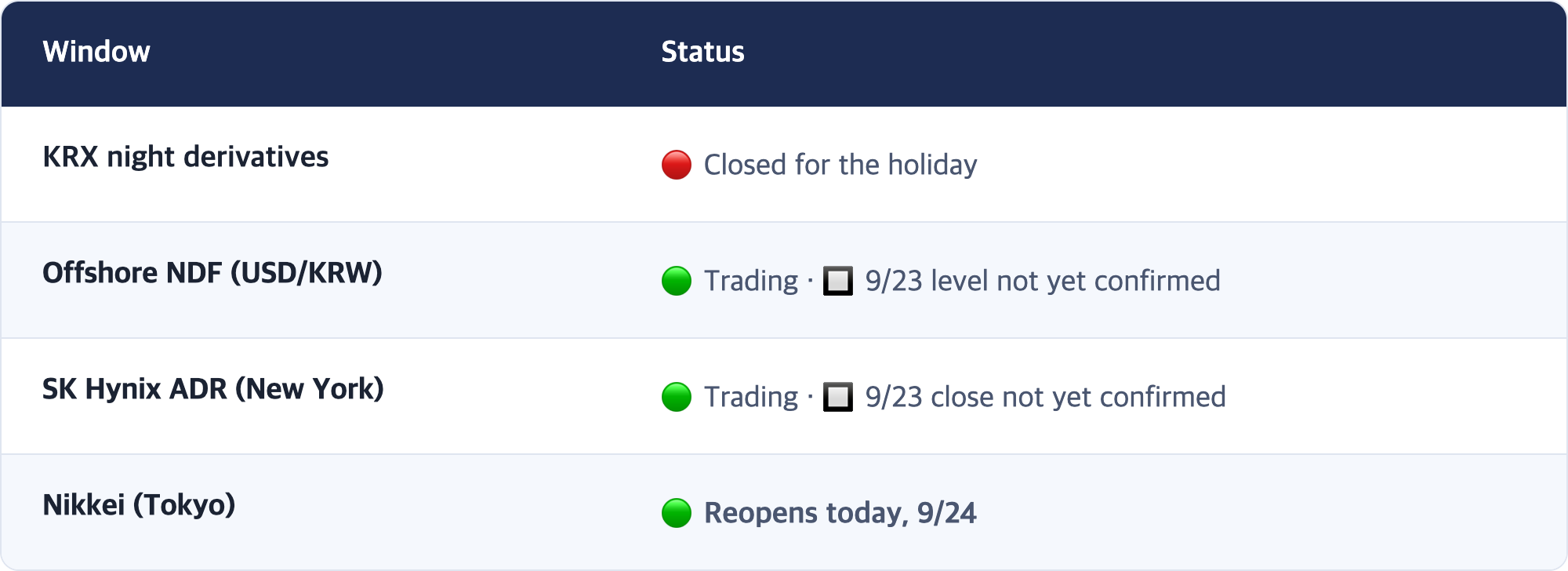
[Observation] Windows onto the won while Seoul is shut
4. Macro Backdrop: Oil, Dollar, Gold, and Washington
[Fact] Commodities and FX
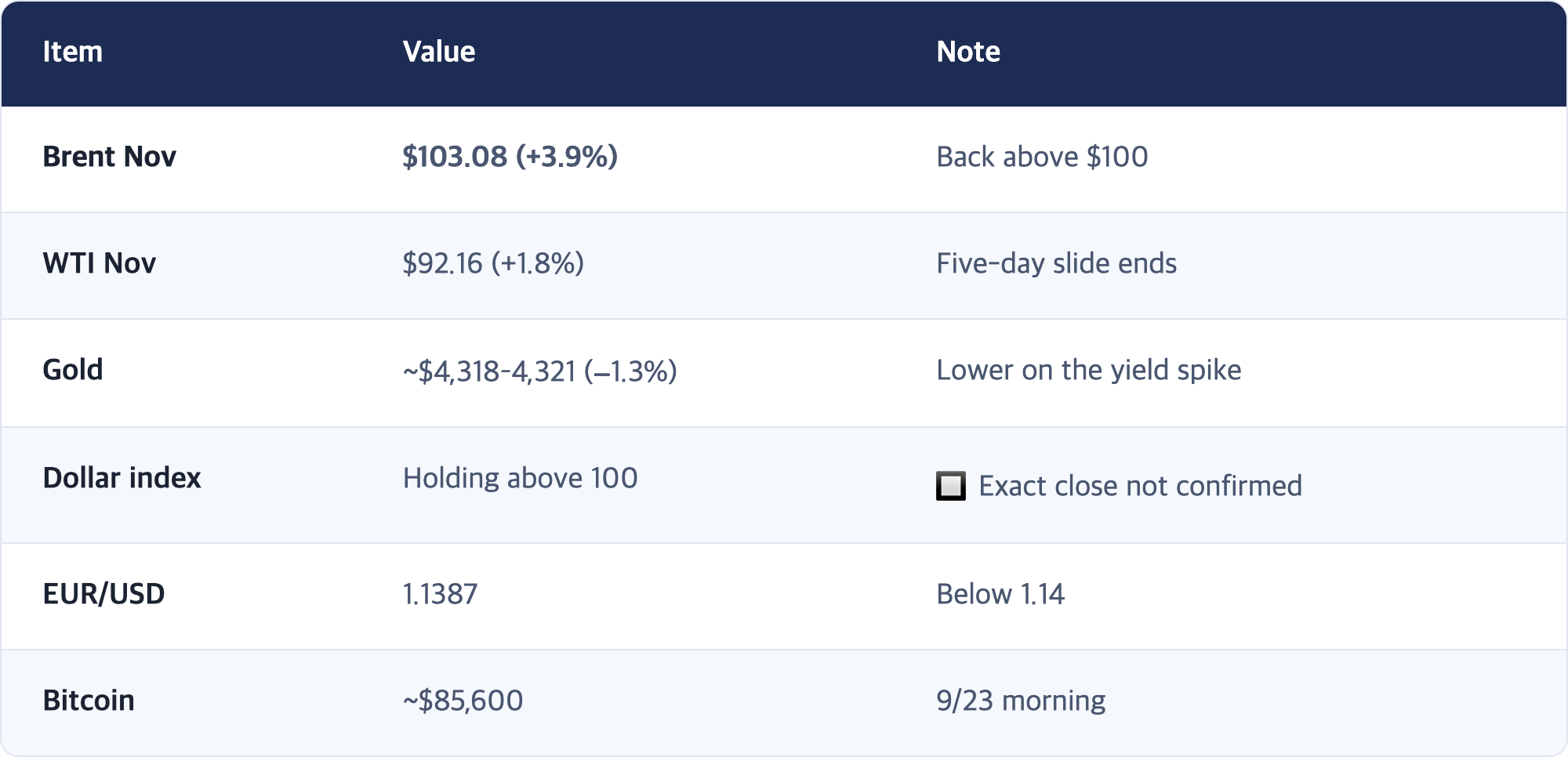
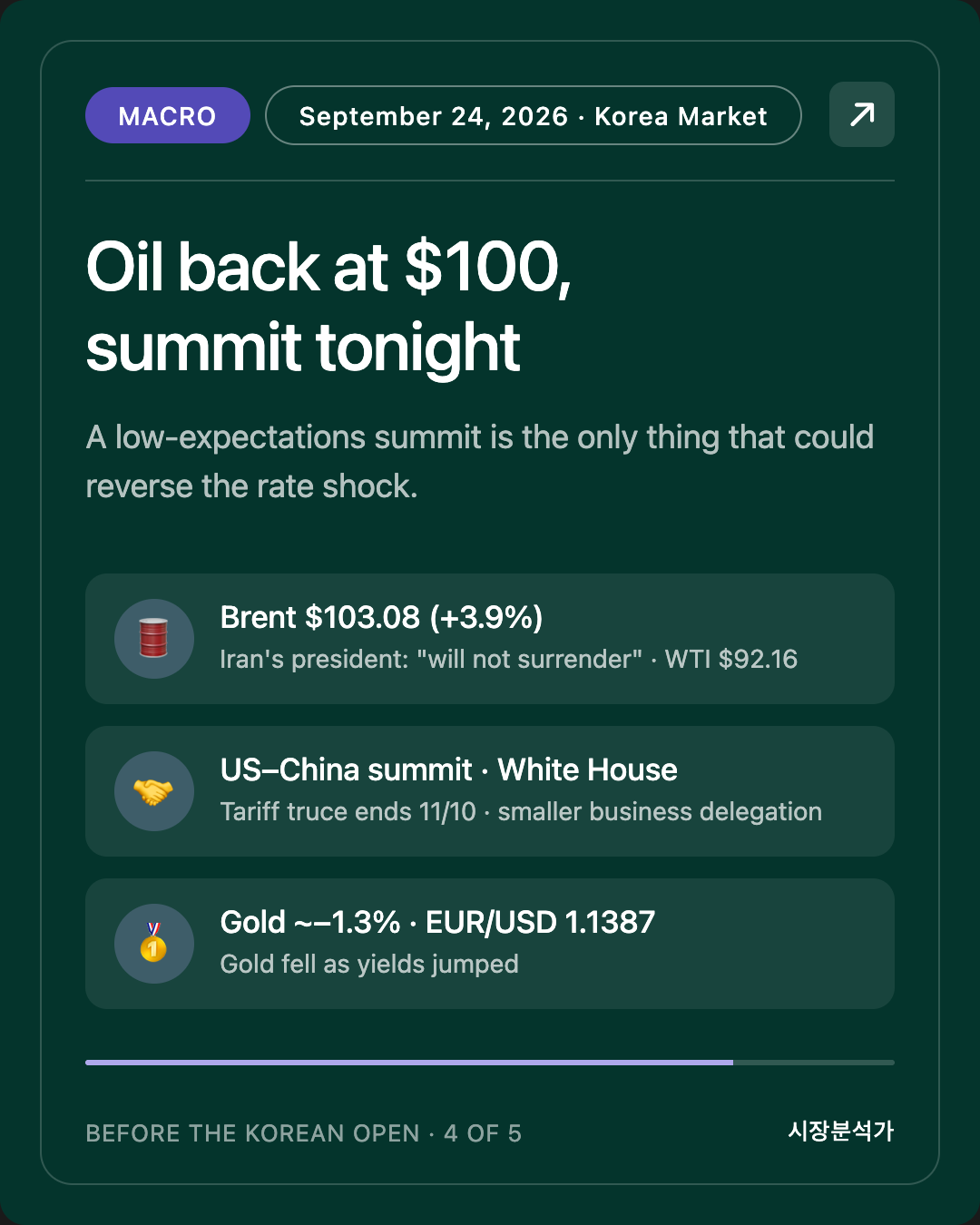
[Fact] Oil rebounded after Iranian President Pezeshkian vowed Iran "will not surrender." On the same day President Trump called a US–Iran meeting "very productive" with more talks planned. Diplomacy and defiance arrived together, and the market listened harder to defiance.
[Fact] The US–China Summit (9/24 ET)
- President Xi has arrived in Washington, with a much smaller business delegation than expected, reportedly because deals are not progressing.
- Jensen Huang (Nvidia) and Sam Altman (OpenAI) are expected at Thursday's leaders' dinner.
- Agenda: whether to extend the tariff truce that expires November 10, critical minerals, an AI safety channel, Taiwan, Iran.
[Interpretation] A smaller delegation lowers expectations in advance. With the bar low, a single line on "truce extended" could bring relief; without it, disappointment could be sharp. This is the single biggest swing factor for Seoul's open on 9/28.
5. Next Korean Session (Mon 9/28 KST) Preview
[Observation] What has piled up so far (night one of four)
- 🔴 Rates: US 10-year from ~4.93–4.95% to 5.11%. Korean yields closed lower.
- 🔴 Small caps and growth: Russell −1.77%, Nasdaq −1.13%. Rate-sensitive stocks were hit first.
- 🟡 Memory: Micron down about 2%, holding up relatively well.
- 🔴 Oil: Brent back above $100.
- 🟡 Still to come: tonight's summit, two more US sessions (9/24, 9/25), and Tokyo's reopening today.
✅ Four Checkpoints (Before Seoul Reopens on 9/28)
The axis: will Seoul's Monday gap lean toward the rate shock or toward the summit?
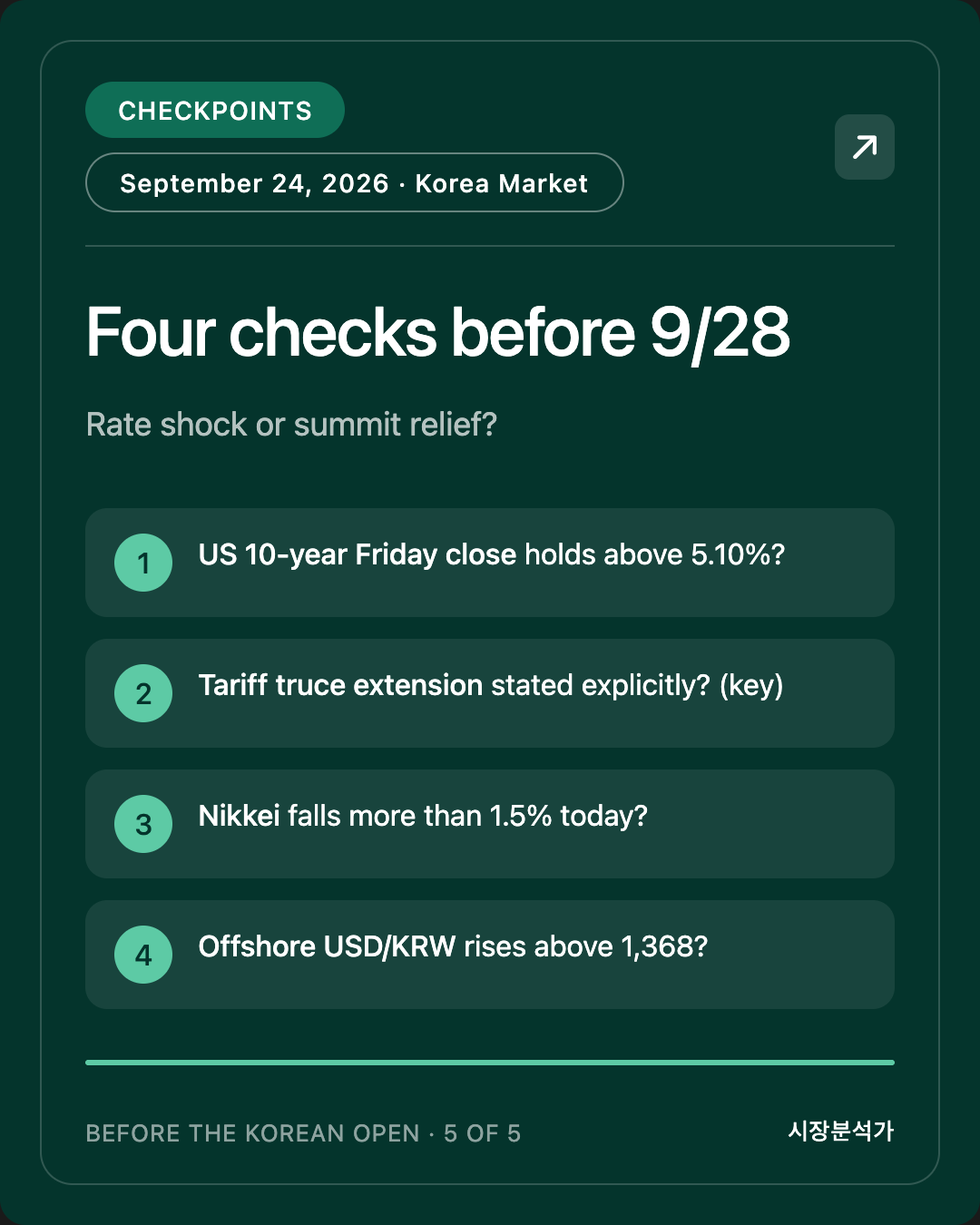
- Does the US 10-year hold above 5.10% at Friday's (9/25) close? If so, last night set a new level. Back below 5.00%, and it was a one-day overheating from four drivers lining up.
- Does the summit explicitly extend the tariff truce? An extension in writing or in a joint statement is a positive for 9/28. "Talks will continue" means nothing offsets the rate shock.
- Does the Nikkei fall more than 1.5% today as it absorbs three days of news? Tokyo is solving Seoul's problem four days early. A big drop raises the odds that Seoul gaps lower on 9/28 too.
- Does offshore NDF USD/KRW rise 10 won or more above the 9/23 close of 1,358.4 (above 1,368)? It is the only window, during the holiday, into whether the US yield spike is spilling into a weaker won.
[Interpretation] The most informative is #2. Checkpoints 1, 3 and 4 all track the aftershocks of last night's rate spike. The summit is the only event that could reverse it.
6. Study Note: What It Means When a Treasury Auction "Tails"
Of last night's four drivers, the 5-year auction is the least familiar.
Concept: Governments borrow by auction
The US Treasury sells new bonds at scheduled auctions. Bidders state the yield they will accept, and the Treasury fills the order starting from the lowest yields. The yield at which the full $70B is filled is the high yield.
Just before the auction, the 5-year was trading around 5.00% ("when-issued"). The auction cleared at 5.033%. That gap of about 3bp is called the tail. A longer tail means weaker demand.
Analogy: A used-car auction
Say a car's market value is $10,000, but few buyers show up and it only sells at $9,700. The seller effectively paid a price to get the deal done. For bonds, "selling cheaper" means "paying a higher yield."
Why one auction moves the whole market
- An auction is where fresh money shows up. Everyday yields reflect trading in existing bonds. An auction tests whether new money is actually willing to come in at that yield.
- A 2.21 bid-to-cover means about $154.7B of bids for $70B of bonds, on the low side of normal.
- A weak auction signals "this yield isn't enough," pulling up yields on other maturities too.
Last night in practice
Yields were already rising on the PMI and Barr. When the 5-year results came out at 1 p.m. ET, they jumped again. The 5-year's first close above 5% since 2007 is tied to that auction.
One-line summary
An auction tail measures how much extra the government had to pay to borrow. A long tail and a low bid-to-cover mean the market is saying yields need to go higher. With Washington borrowing heavily, auction days now matter as much as data days.
7. Corrections & Open Items
🔴 Correction to the 9/22 PM brief: SOX (1 item)
The 9/22 PM brief put the Philadelphia Semiconductor Index's 9/22 gain at +0.69%, and the 9/23 AM brief left it unresolved. We have now found a second source showing +2.06% (12,689.82), consistent with the SK Hynix ADR close of $195.37 (+3.45%). → Corrected to +2.06%. The 9/22 PM line "the index was quiet while only memory jumped" should be softened to: the S&P was quiet, chips broadly rallied, and memory led.
🟡 Refinement of the 9/23 AM call
"Oil, more than Fed talk, is moving yields this week" → last night was oil + inflation data + Fed talk + auction demand. Not withdrawn, but narrowed.
Source discrepancies (adopted values)
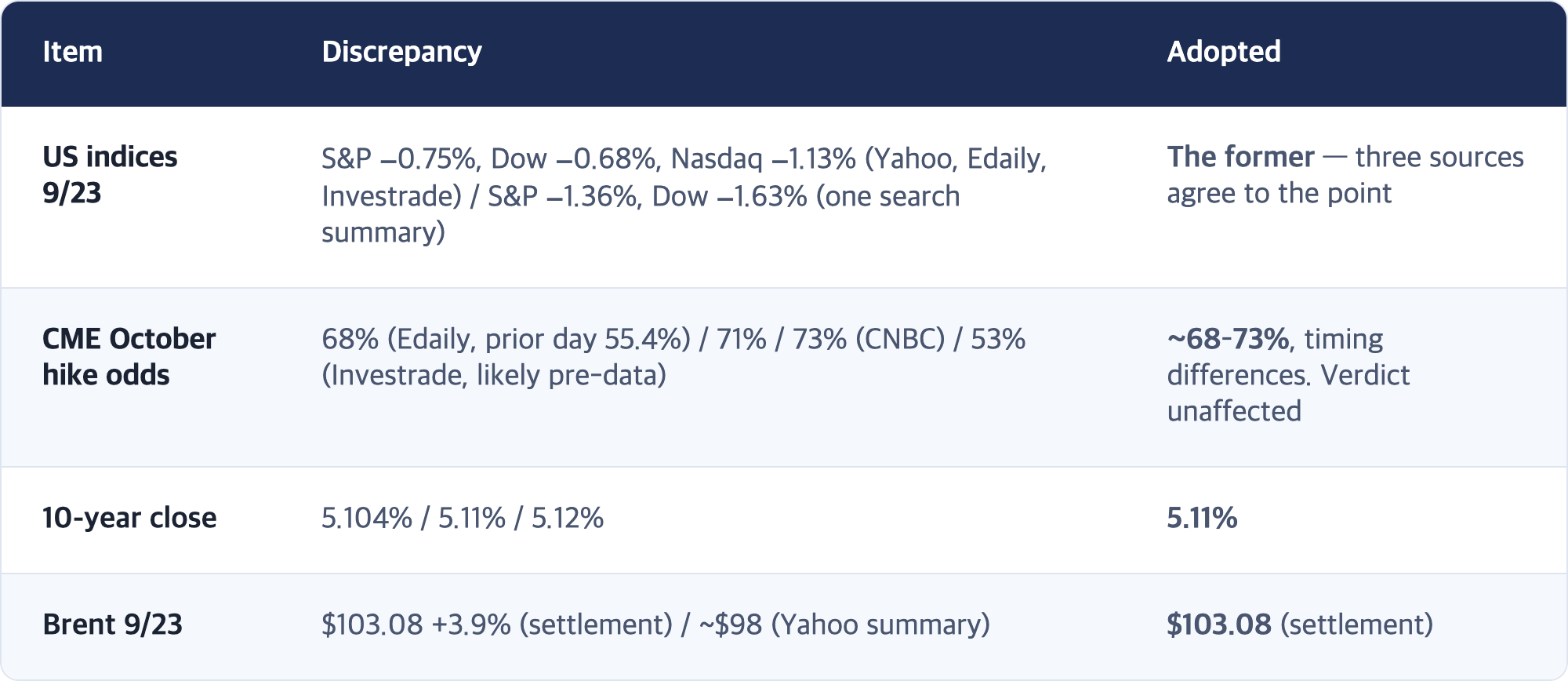
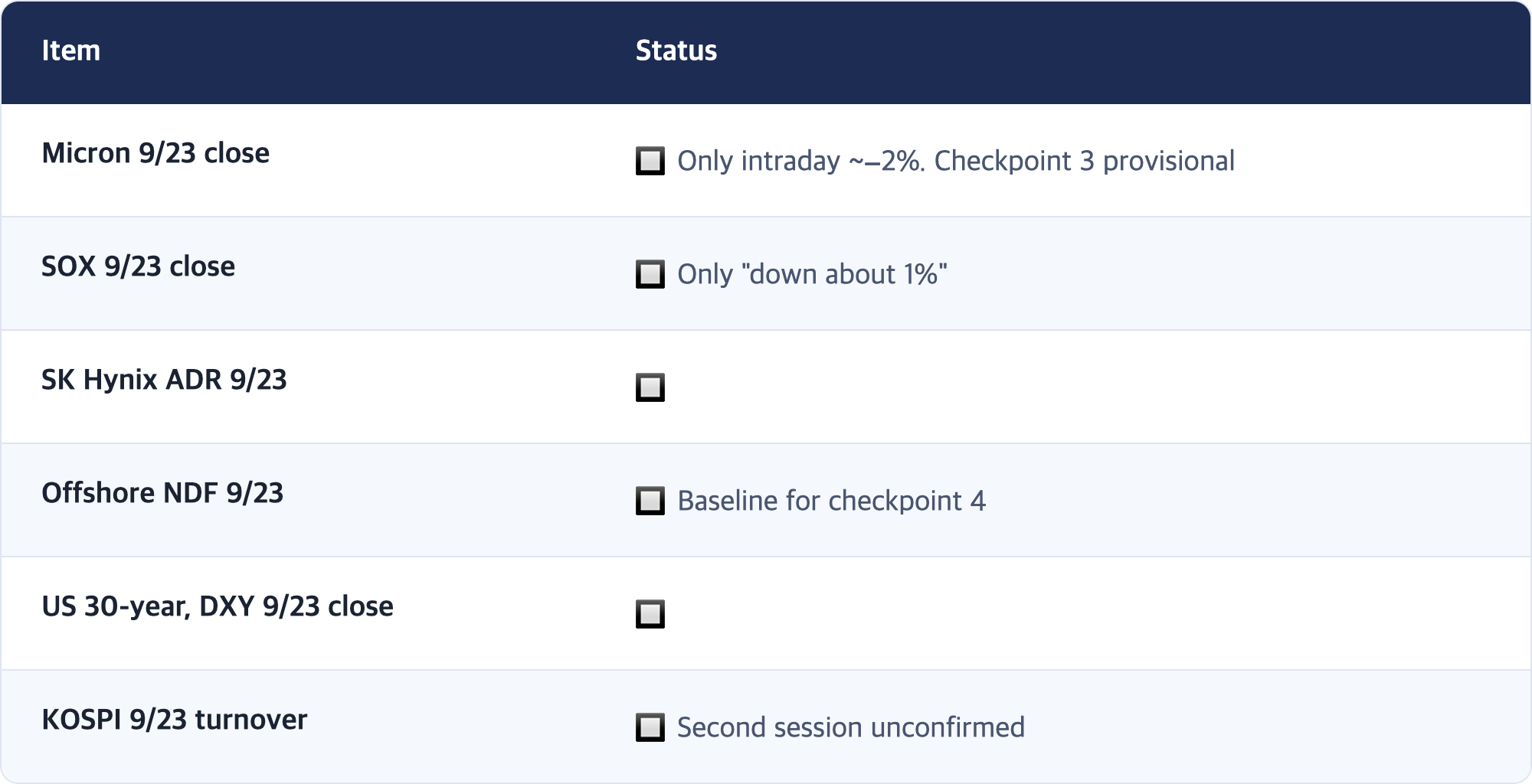
🔲 Not yet confirmed
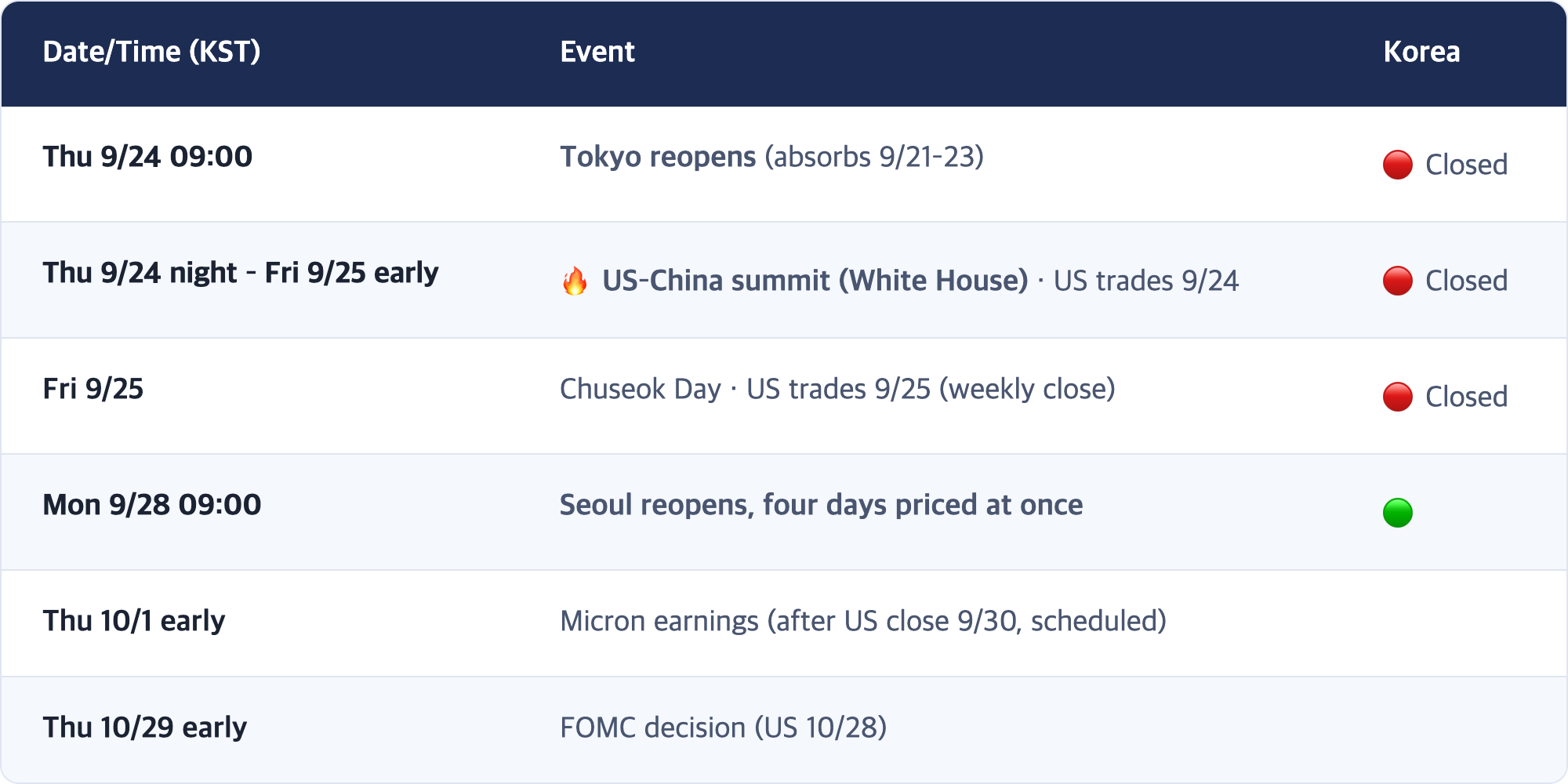
8. Event Calendar (KST)
Sources
- Stock market today: 10-year Treasury yield surges to 2007 high | Yahoo Finance
- US 10-year breaks 5.1%, Nasdaq −1.1% | Edaily
- Market Review: September 23, 2026 | Investrade
- 10-year Treasury yield rockets to 19-year high | CNBC
- Market sees next Fed hike in October, following Barr comments | CNBC
- Speech by Governor Barr on housing | Federal Reserve Board
- US Composite PMI 58.4 in September | FXStreet
- Oil prices rise, snap five day losing streak | CNBC
- Micron stock falls 2% on Wednesday | Invezz
- Trump hosts Xi for two-day Washington summit | Crypto Briefing
- Xi Jinping's Return to Washington | CSIS
- Japan stock market reopens Sept 24 | Sunday Guardian
- KOSPI closes at 7,080.92 | Seoul Shinmun
Market Analyst · This brief does not recommend buying or selling any individual security. It offers macro context and interpretation.
📌 More market briefs
※ This post is market observation and organization intended to support your own judgment. It is not a recommendation to buy or sell any security. Figures are as of the time of writing and may differ between sources.
If this was useful, bookmark it or pass it along. It genuinely helps me write the next one.
I can survive. We can survive.