September 8, 2026 US Market Brief — Nasdaq and S&P 500 Before the Open
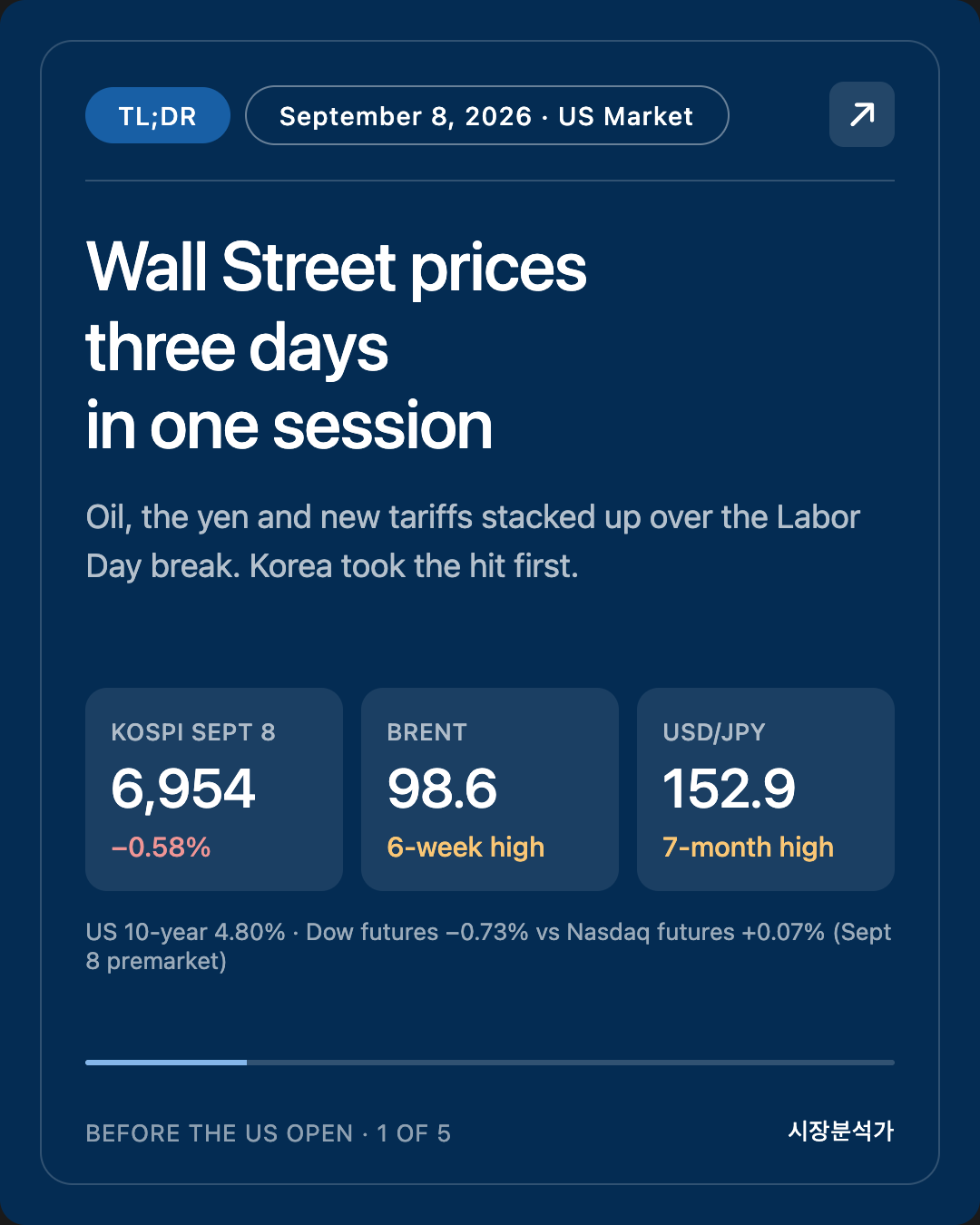
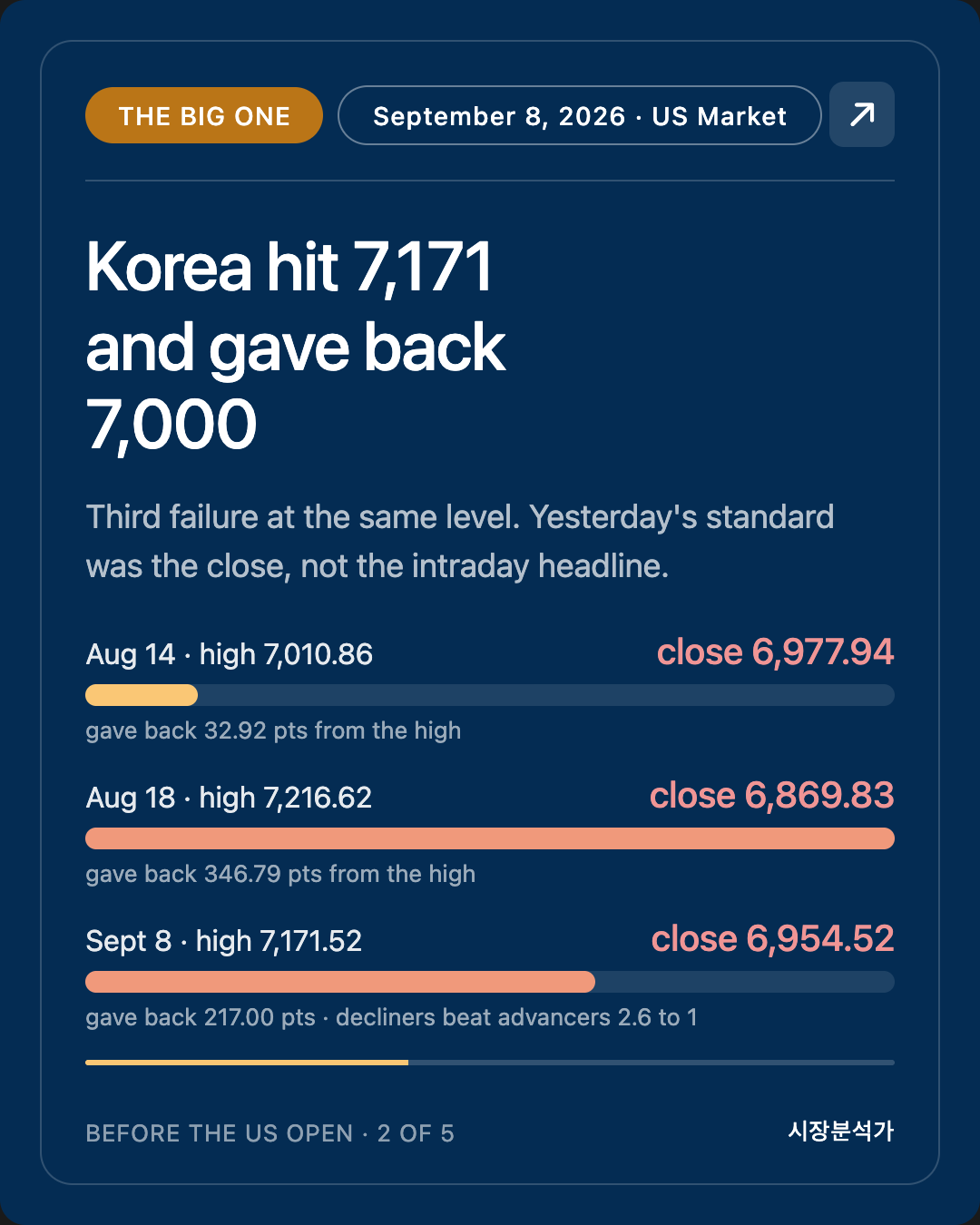
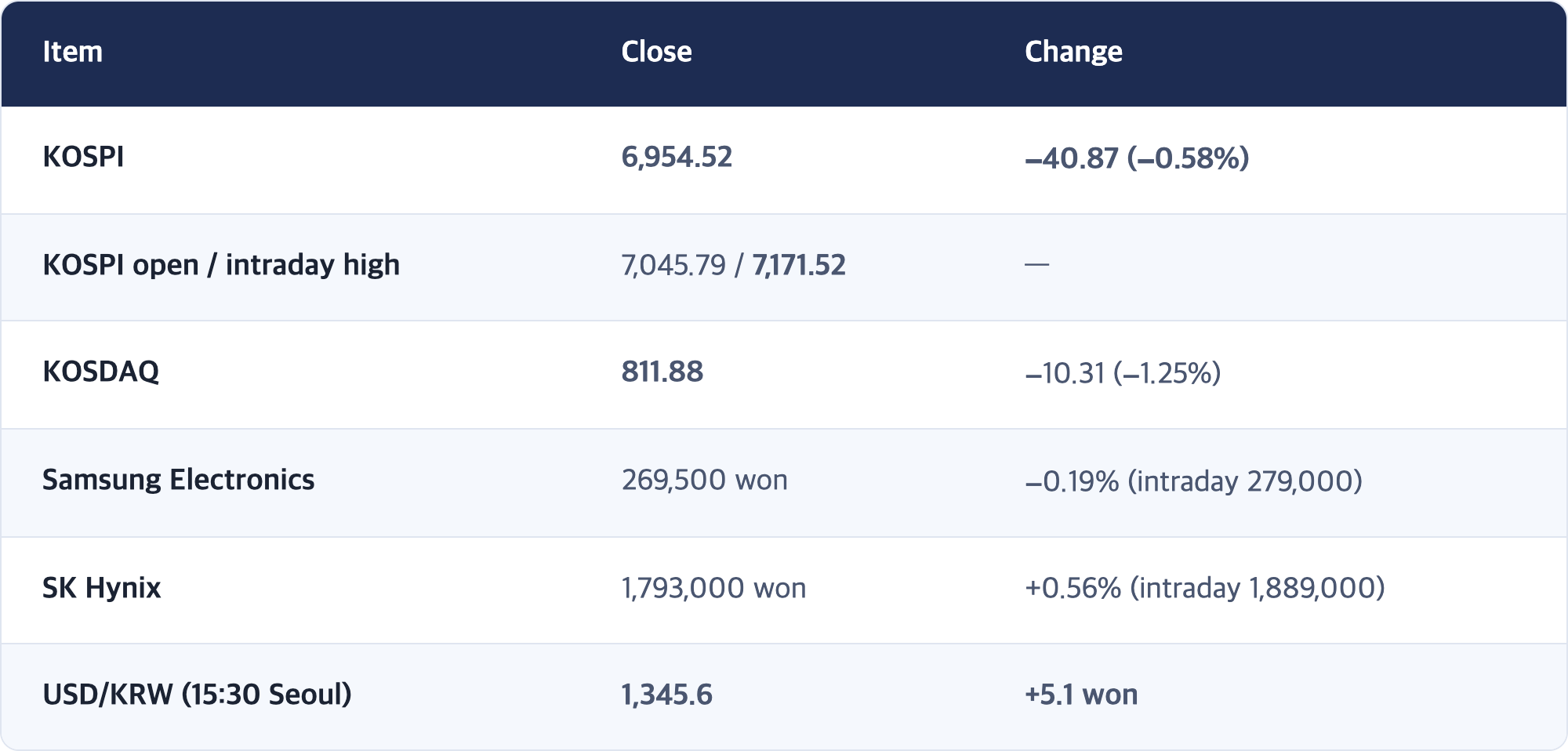
- KOSPI closed 6,954.52, down 0.58% (−40.87 points). It opened at 7,045.79, reclaimed 7,000 for the first time in 15 sessions, ran to 7,171.52, and surrendered the entire move. Decliners outnumbered advancers 2.6 to 1. KOSDAQ 811.88 (−1.25%).
- The three-stage test this briefing set yesterday has its answer. ① intraday break of 7,000 — passed. ② close above 7,000 — failed. ③ progress toward the Aug 18 high — came within 45.10 points, then reversed. The instruction written yesterday was to judge on the close, not the intraday headline. That held.
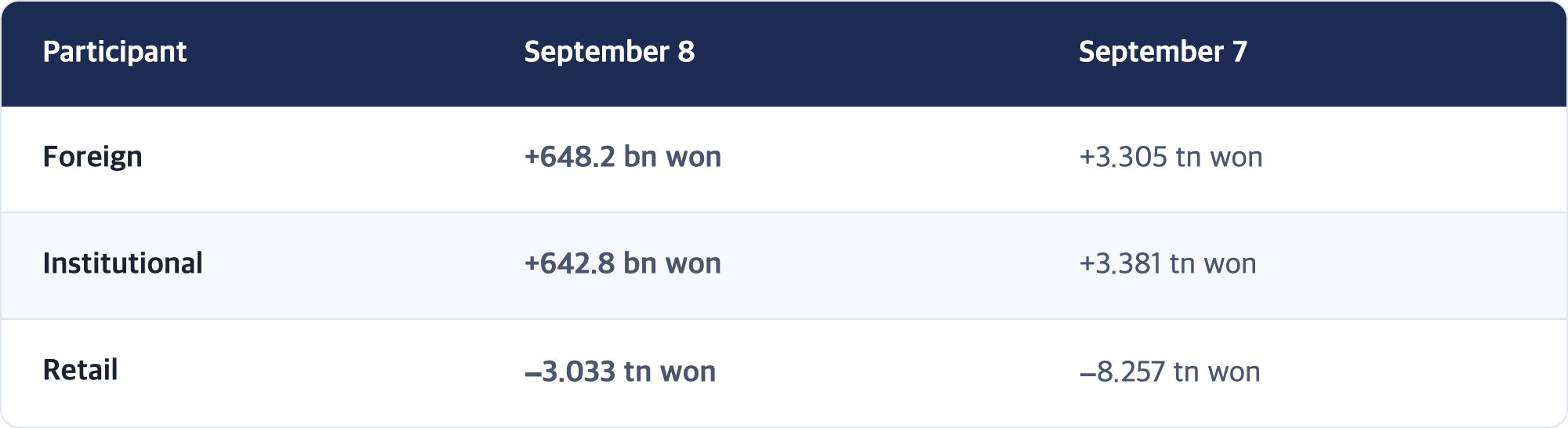
- USD/KRW backed up to 1,345.6 (+5.1 won) while foreign net buying shrank to 648.2 billion won — about one-fifth of Monday's 3.31 trillion. Both happening together confirms the reading that Monday's won strength was equity inflows, not a dollar story.
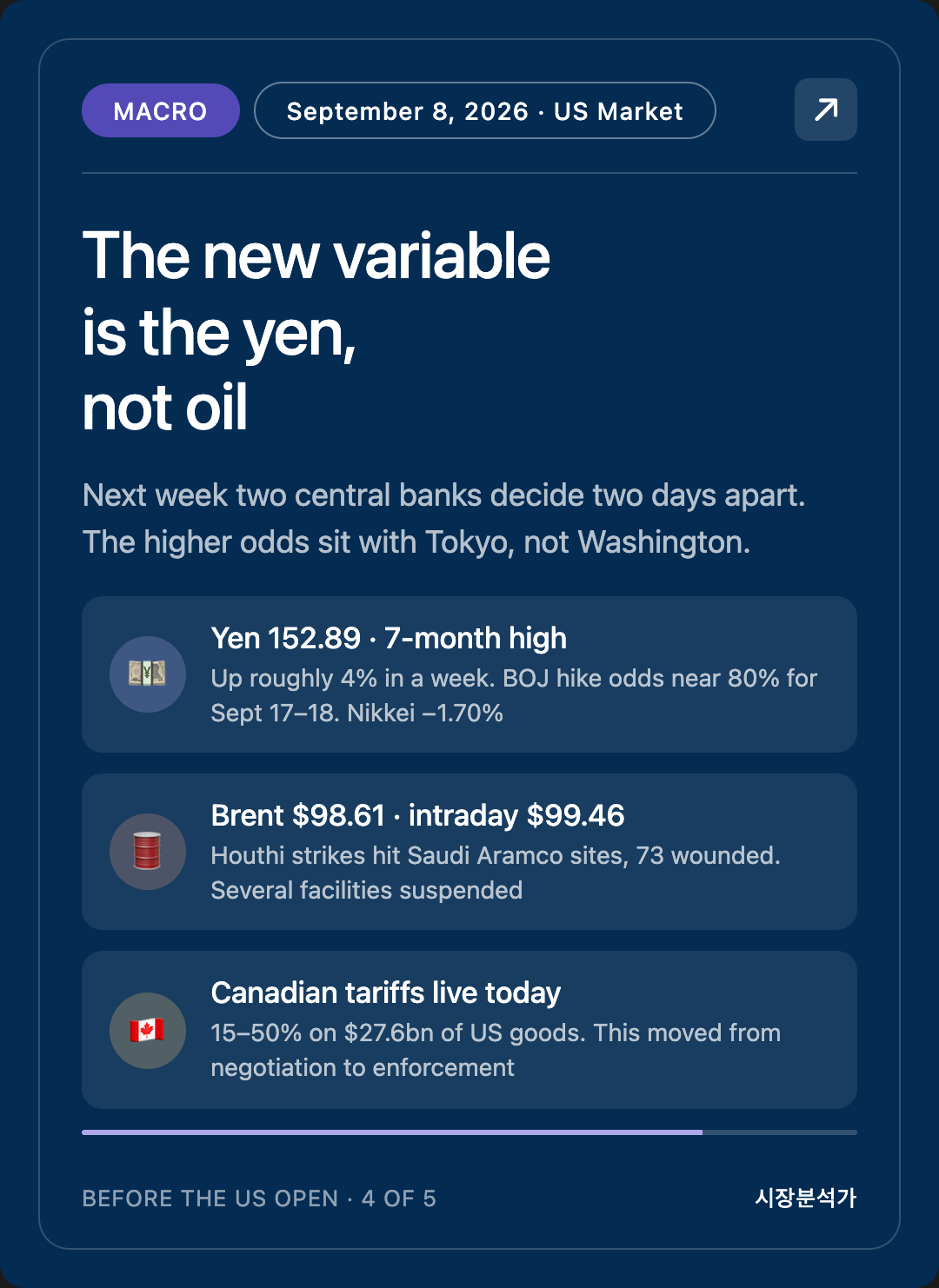
- The genuinely new variable today is not oil. It is the yen. USD/JPY touched 152.89, its strongest in seven months, after firming roughly 4% from around 160 a week ago. Swaps price roughly 80% odds of a Bank of Japan hike on September 17–18. The Nikkei fell 1.70% to 65,269.
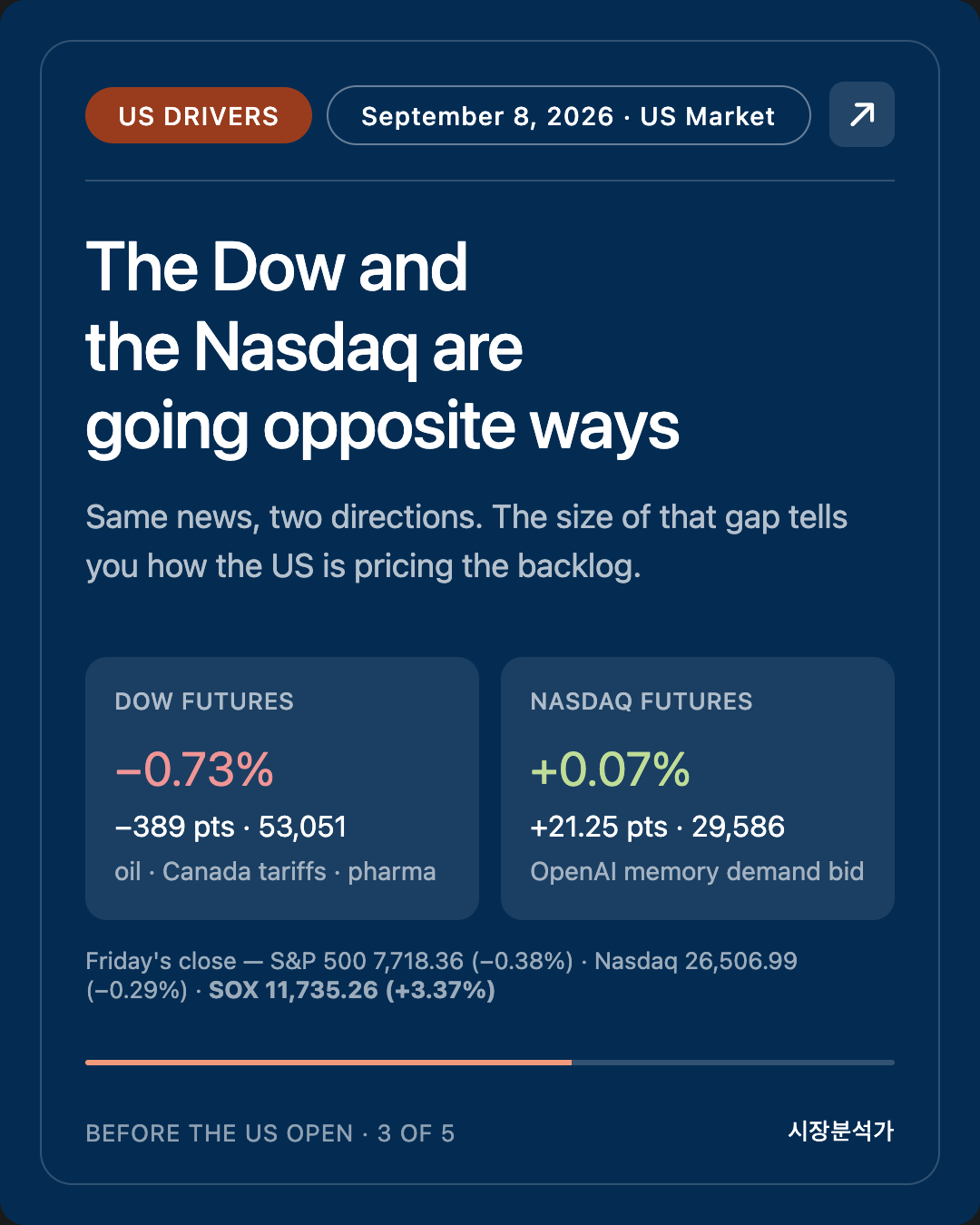
- US futures are split. Dow futures −389 points (−0.73%) against Nasdaq futures +21.25 (+0.07%). Brent $98.61 (intraday $99.46, highest since July 24), US 10-year at 4.80%. The split itself is today's message.
This is Mr. Can. Here is the September 8, 2026 brief ahead of the US market open.
Written: September 8, 2026, 05:35 PDT (Korea: Sept 8, 21:35 KST)
Basis: Asian closes Sept 8 · European morning Sept 8 · US premarket · confirmed US closes from Friday Sept 4
SEO Intro
Korea's KOSPI opened this morning at 7,045.79 and ran to 7,171.52 intraday — within 45.10 points of the 7,216.62 high it set on August 18.
Then it gave all of it back. The close was 6,954.52, down 0.58%. That is the third time the index has touched 7,000 and failed to hold it into the bell.
Yesterday's edition of this briefing wrote that with the US shut for Labor Day, Korea's session would carry little external reference and would be driven mostly by domestic flows. Half of that was right and half was wrong. What turned the KOSPI over in the afternoon was not domestic positioning. It was three foreign markets that stayed open while New York was closed: crude, the yen, and Canada's retaliatory tariffs, which took effect today.
Wall Street reopens this morning and has to price three days at once. Here is what to watch.
1. The Big One — Korea Reached 7,171 and Gave Back 7,000
[Fact] — Three attempts at 7,000
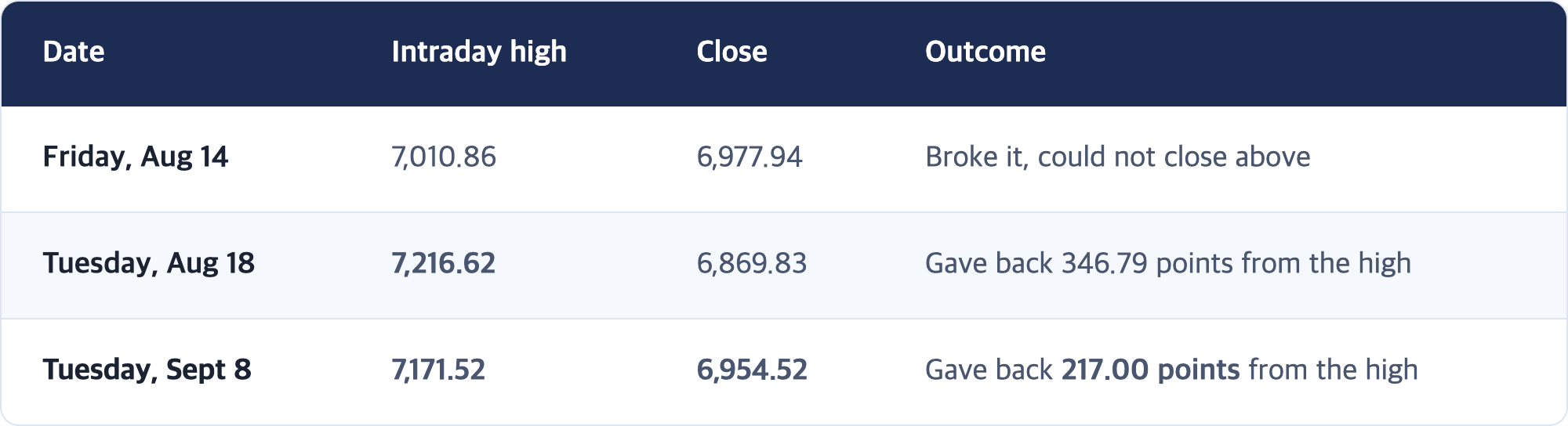
Three attempts, three failures, all in the same band.
[Interpretation] Scoring yesterday's test
Yesterday's Korea-open edition wrote the test down in advance. Here is the scoring.
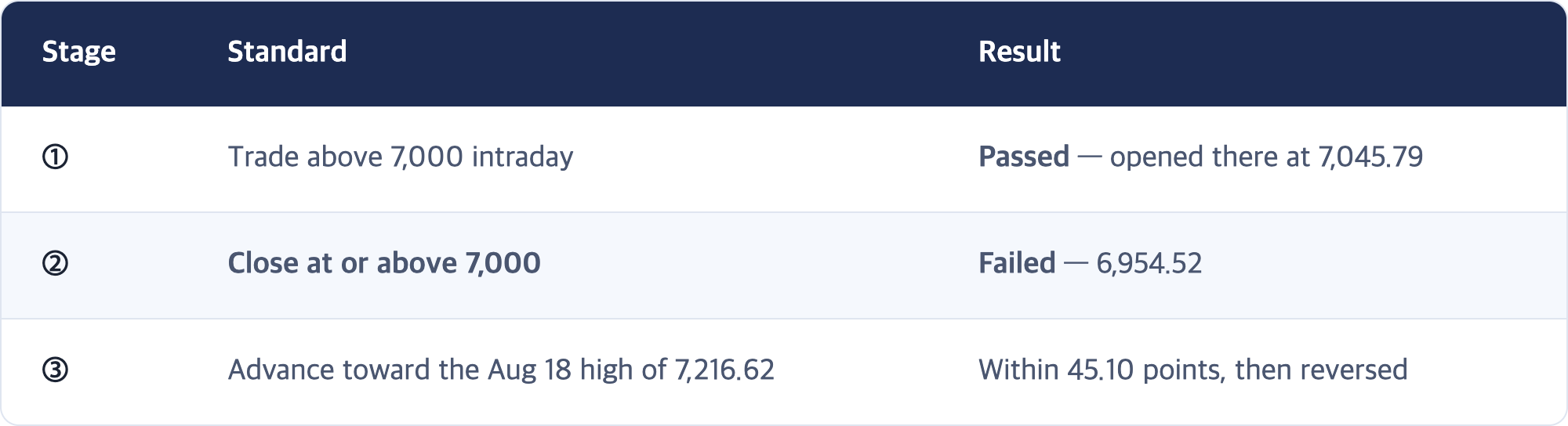
The same report said the close is the standard and not to attach meaning to intraday-breakout headlines, because August 18 was exactly that trap. Every headline out of Seoul this morning was an intraday-breakout headline.
🔴 [Interpretation] But another line in that same report was wrong
Yesterday's briefing argued that with the US closed, whichever way the KOSPI moved would contain little external reference, and domestic flows would carry more weight than usual.
Equating a New York holiday with an absence of external variables was the error. Three things turned the afternoon, and all three came from outside Korea.
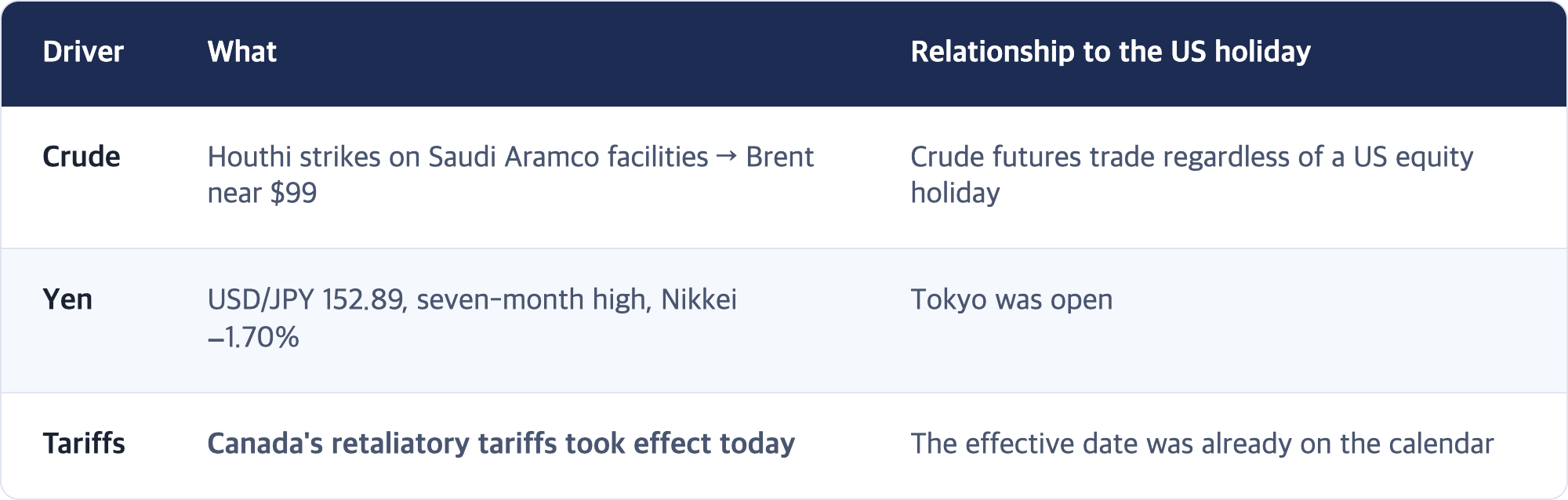
New York being shut is not the same as the world being shut. Yesterday's report welded those two ideas together, and today's session pulled them apart. That framing is withdrawn.
[Interpretation] The morning and the afternoon were built by different things
Semiconductors built the morning. Memory-demand expectations following OpenAI's new model release last week carried over, and Samsung Electronics traded as high as 269,000 won → intraday 279,000 won, SK Hynix as high as 1,889,000 won.
By the close, those two had drifted back to roughly 270,000 and the 1.79 million area, and the index had turned negative. Decliners beat advancers 2.6 to 1.
Compressed to one sentence: one sector's expectation lifted the index, and market-wide risk pushed it back down. US premarket is showing the identical shape — Dow −0.73%, Nasdaq +0.07%.
2. Asia's Close (Sept 8)
[Fact] — Korea, September 8
[Fact] — KOSPI flows
[Interpretation] The ratio says more than the absolute numbers
In absolute terms everything shrank. The ratio, though, flipped.
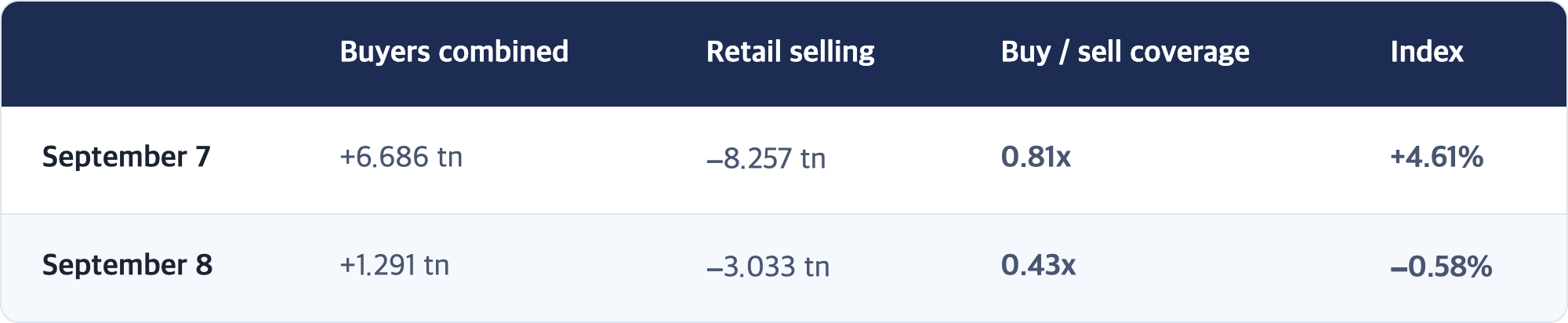
Monday, foreigners and institutions absorbed roughly 80% of what retail sold. Today they absorbed 43%. Yesterday's observation that retail supply comes out above 7,000 was confirmed, and the money to absorb it did not show up in the same size.
That answers the axis set on Monday: was the 3-trillion-won inflow an index-level allocation or a genuine re-rating? Foreign buying fell to one-fifth in a single session. The weight sits with the index-allocation reading. Money that arrives on one trigger leaves when the trigger changes.
[Interpretation] The won was the litmus test, and it answered
Monday's US-open briefing read the won's strength as equity inflows rather than dollar weakness, since the dollar index was essentially flat. Yesterday's Korea-open briefing wrote the test explicitly: if foreign buying fades and the won retraces at the same time, that reading was correct.
That is exactly what happened. Foreign net buying fell to one-fifth and USD/KRW moved from 1,340.5 to 1,345.6.
One consequence follows. If equity money is setting the won's direction, the won stops when that money stops. Won strength should not be read as an improvement in Korea's underlying economy — particularly not while crude is rising and Korea imports every barrel it uses.
[Fact] — Asian closes
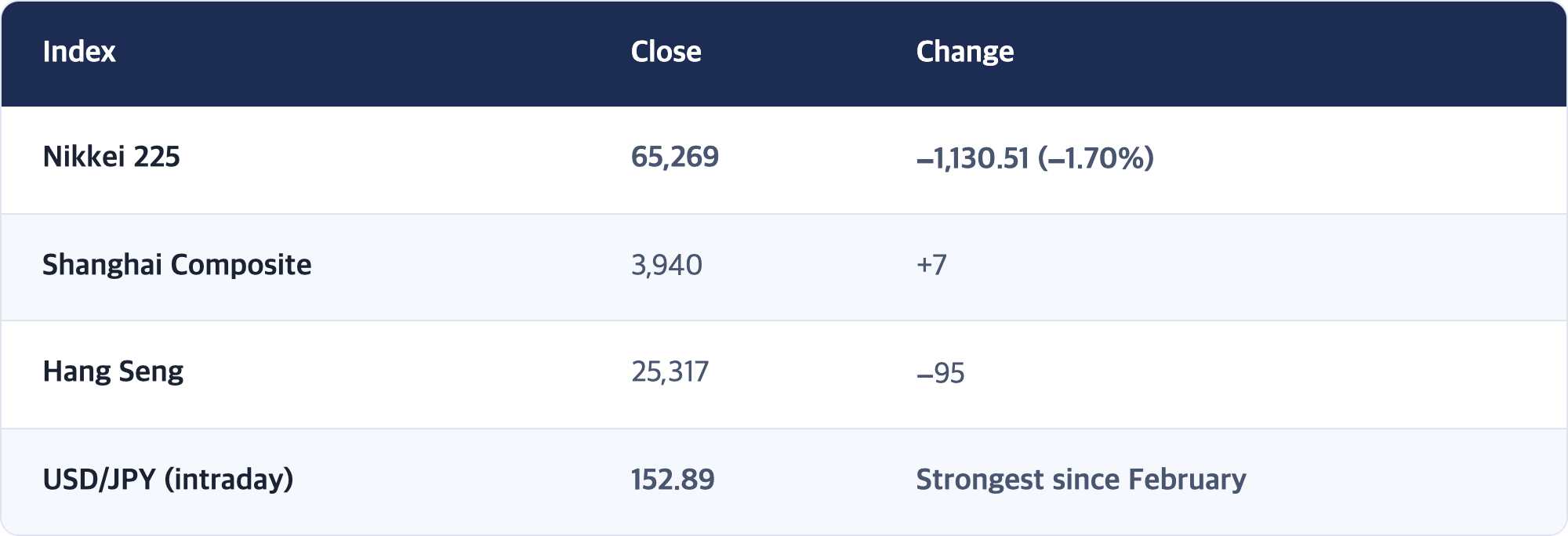
Japan's decline was not confined to expensive tech. It spread into exporters, financials, machinery and precision instruments — everything sensitive to currency and rates.
[Fact] — European morning (Sept 8)
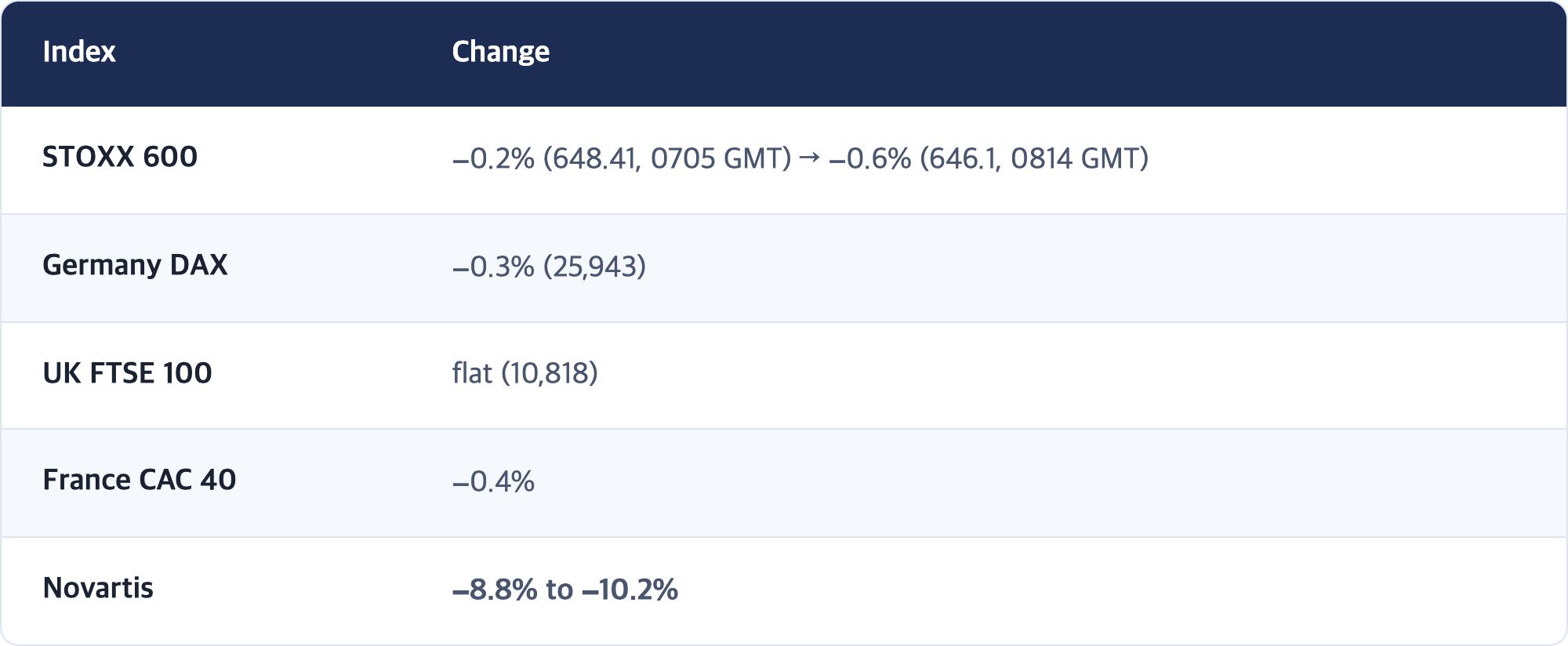
Novartis has now failed two late-stage readouts on consecutive days: pelacarsen for cholesterol on Monday, del-desiran for myotonic dystrophy on Tuesday, both missing their primary endpoints. It dragged the whole European pharma complex and carried straight into US premarket pharma.
3. The US Side — Three Days Priced in One Session
[Fact] — Confirmed US closes, Friday September 4
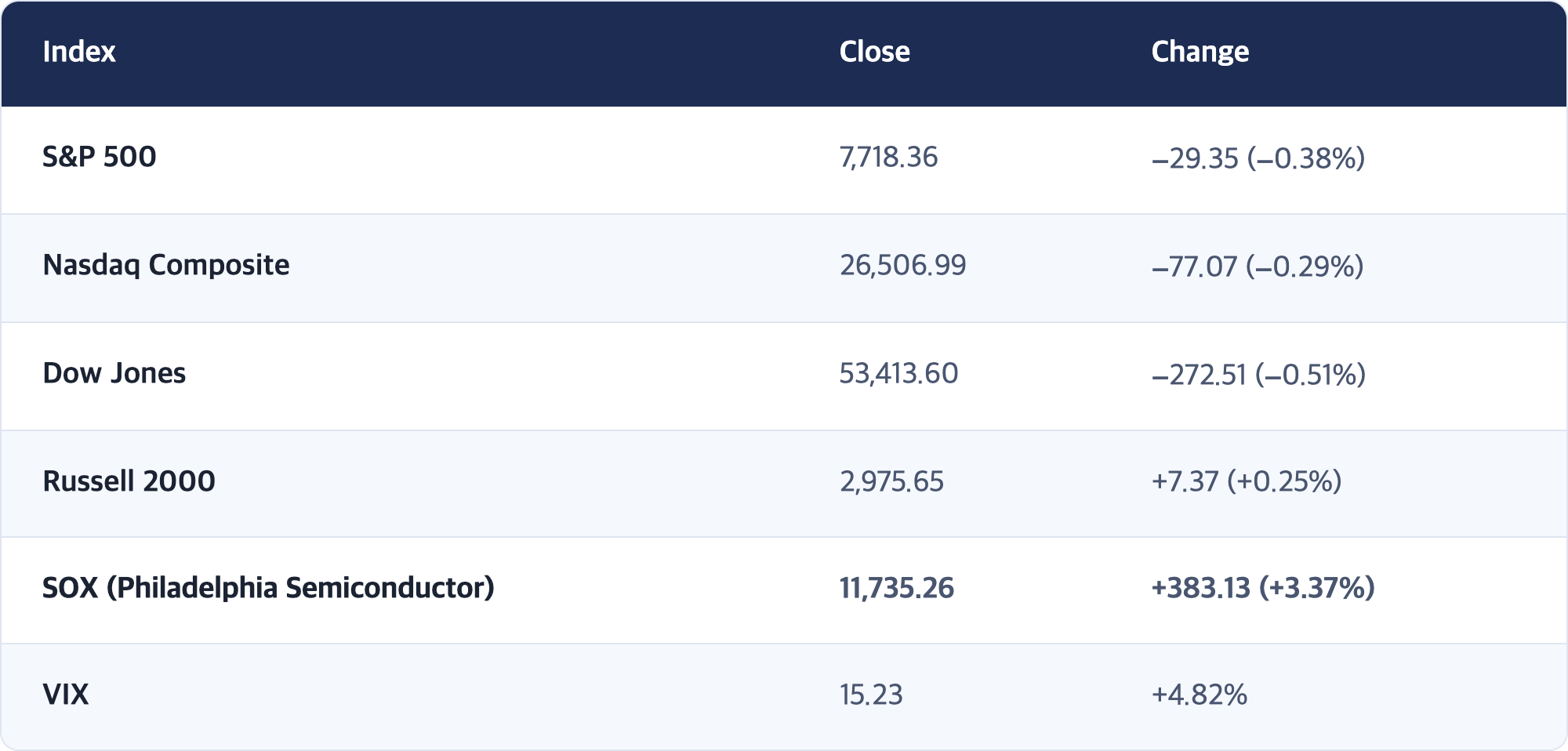
The SOX level for September 4 is finally pinned down. Three consecutive editions carried the percentage without the index level. It is 11,735.26, up 383.13 points from the September 3 close of 11,352.1.
[Fact] — US premarket (around 05:30 PDT)
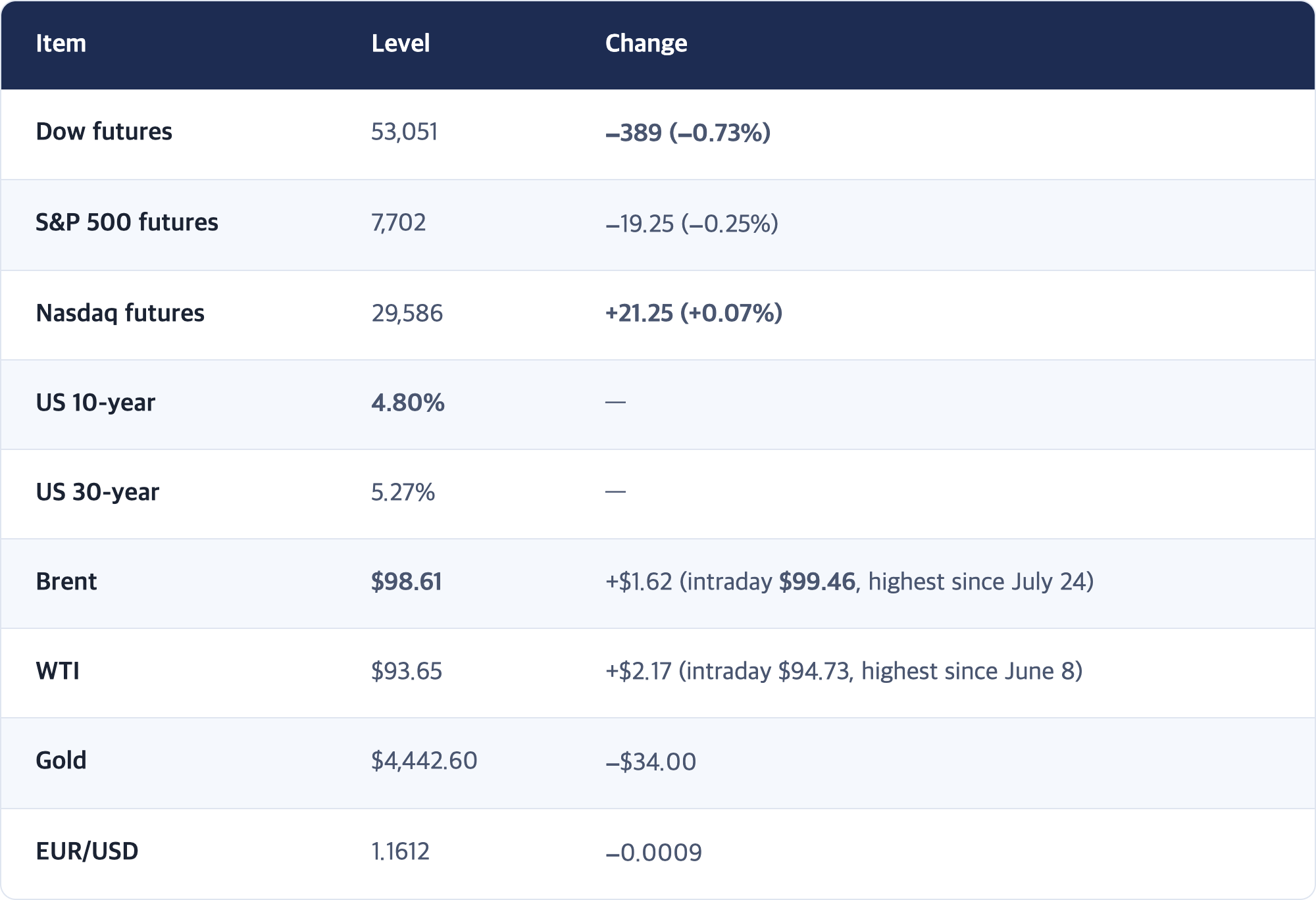
[Interpretation] The divergence is the message
Dow futures are down 389 points while Nasdaq futures are green. Same market, same news, opposite directions. The gap exists because today's three drivers hit different places.
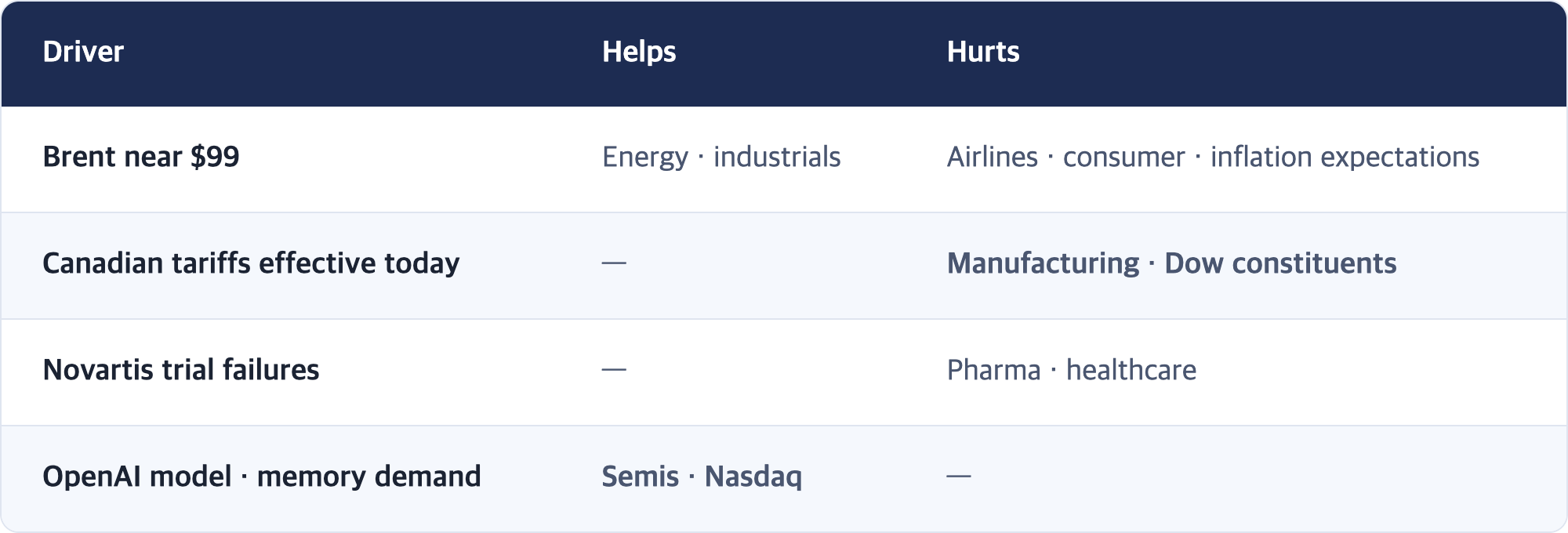
Single names show the same shape. Apple −2.55%, Alphabet −2.10% and Microsoft −2.05% sit at the bottom; Caterpillar +1.65%, Honeywell +0.95% and Home Depot +0.88% at the top. This is not a market moving in one direction.
[Fact] — Canada's retaliatory tariffs take effect today
This answers the 50% US tariff imposed on August 22 on a list of Canadian goods including hockey equipment, cement, liquor and dairy. Canada's Department of Finance is applying 15%, 25% and 50% rates to $27.6 billion of American imports starting today, September 8. Ottawa has pledged an additional $7.5 billion to support affected workers and businesses.
[Interpretation] Why this matters even where it does not apply
Korean companies are not the target. Today it still cannot be ignored, for three reasons.
- A tariff fight with one of America's largest trading partners has moved from negotiation to enforcement. Markets treat those two states differently.
- Today is day one. How US equities handle it today becomes the price tag on this story for the next several weeks.
- Part of the Dow-Nasdaq gap is coming from here. Tariffs hit manufacturing, logistics and consumer goods, and the Dow is heavier in those.
Do not over-extend it, though. Dow futures are down because oil, pharma and tariffs stacked, not because of any one of them. The regular session has to open before the weights can be separated.
4. Macro Backdrop — The New Variable Is the Yen, Not Oil
[Fact] — Houthi strikes on Saudi energy infrastructure
Iran-aligned Houthi forces hit Saudi Aramco installations and other energy infrastructure across southern Saudi Arabia with drones and ballistic missiles, wounding at least 73 people. Saudi Arabia's Energy Ministry said operations at several facilities were suspended, with crews still fighting fires. The Jizan refinery was struck again.
Brent traded at $98.61 (+1.67%) Tuesday morning and reached $99.46 intraday, the highest since July 24. WTI touched $94.73, its highest since June 8.
Goldman Sachs raised its Brent and WTI forecasts by $5 each, to $85 and $80 for December 2026, on a new assumption that Middle East shipping disruption persists into 2027.
[Interpretation] Oil is no longer new news
Yesterday's briefing noted that oil headlines had become two-directional — escalation on one side, an Iran–Oman Hormuz transit deal on the other. Today's Saudi strikes tilted it back toward escalation.
And yet the price reaction was modest. Actual Saudi facilities actually stopped, and Brent added 1.67%. Comparable headlines last week were worth 3–4% in a day. The market is desensitizing to this category of news.
Desensitization is not good news. It also means the geopolitical premium is already in the price. That is precisely the basis for Goldman's upgrade — it has stopped treating this as an episode and started treating it as a structure that runs into 2027.
🔴 [Fact] — What is actually new today: the yen
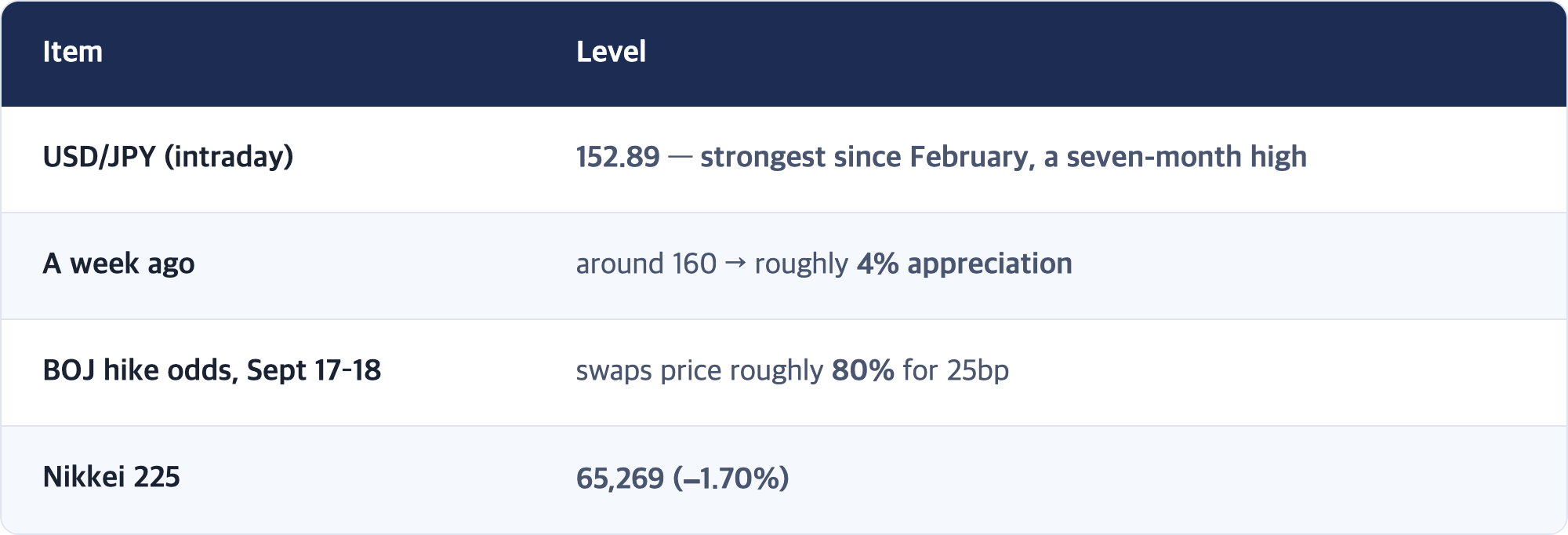
This is stronger than the levels Japan's July intervention produced.
[Interpretation] Why this may matter more than crude
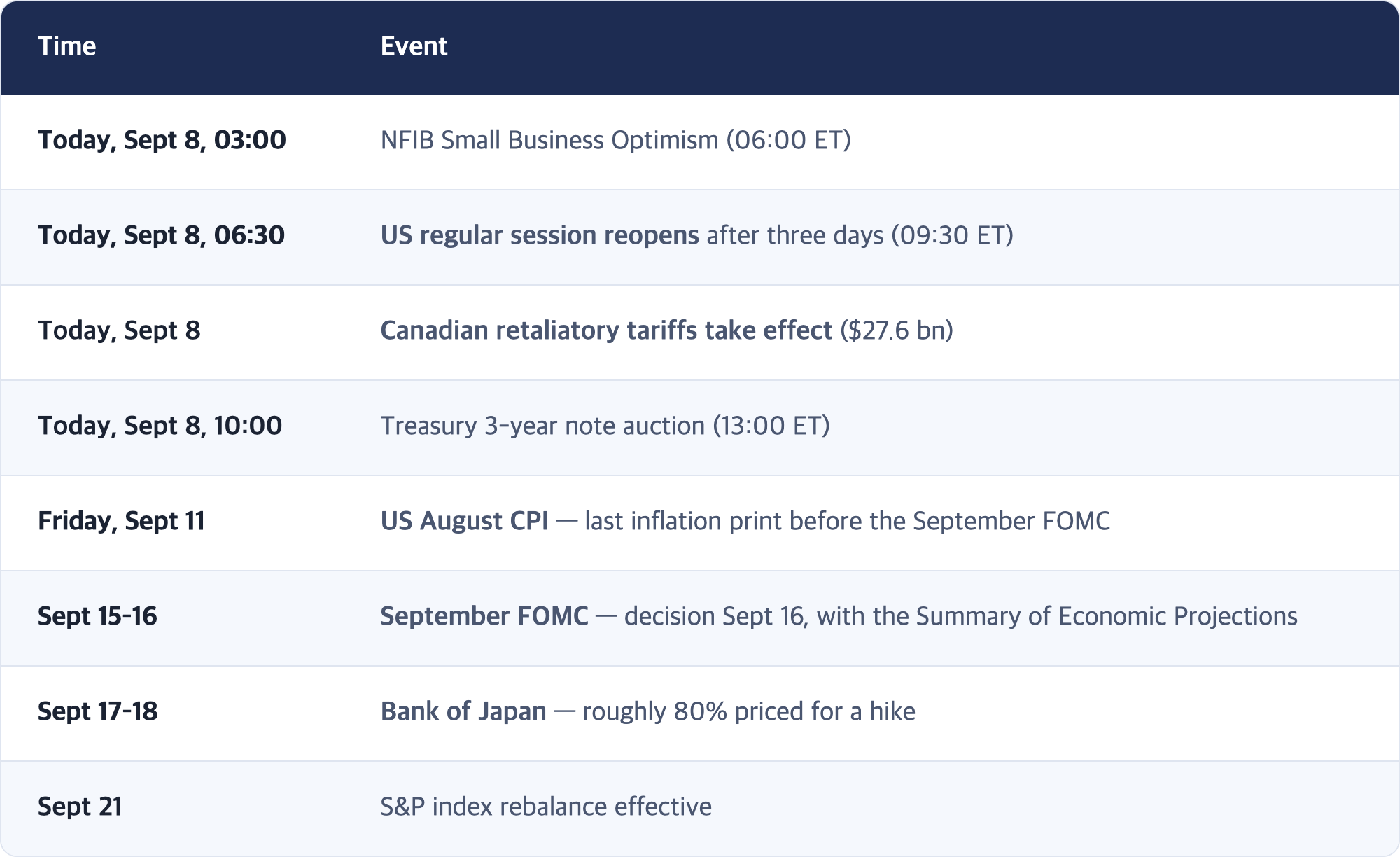
The reason is next week's calendar.
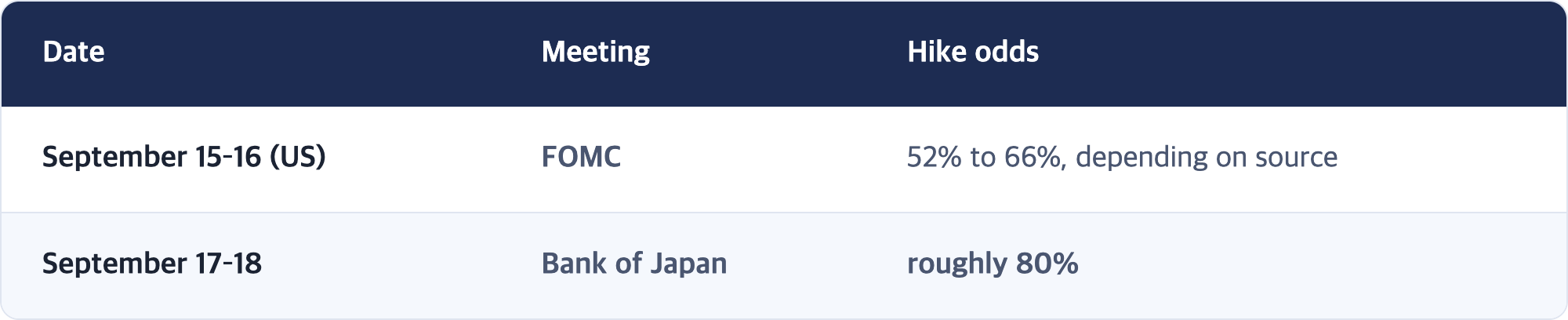
Two central banks decide two days apart. And the one the market currently rates as more likely to hike is not the Fed.
Why that is a problem: Japan has been the cheapest place in the world to borrow. For decades investors have borrowed yen to buy assets elsewhere. A weak yen makes that trade work. When the yen strengthens abruptly, the trade turns into a loss, and the borrowed money has to be repaid by selling what was bought.
Today's Nikkei decline spreading beyond tech into exporters, financials and machinery is the tell. This may not stay inside Japan.
It is still an observation, not a conclusion. US markets have not reacted — Nasdaq futures are green. Whether today's regular session treats the yen as a tradeable input is the first real check. The study note below unpacks the mechanism.
[Observation] — Event calendar (PDT)
5. Preview — Four Things to Watch at the US Open
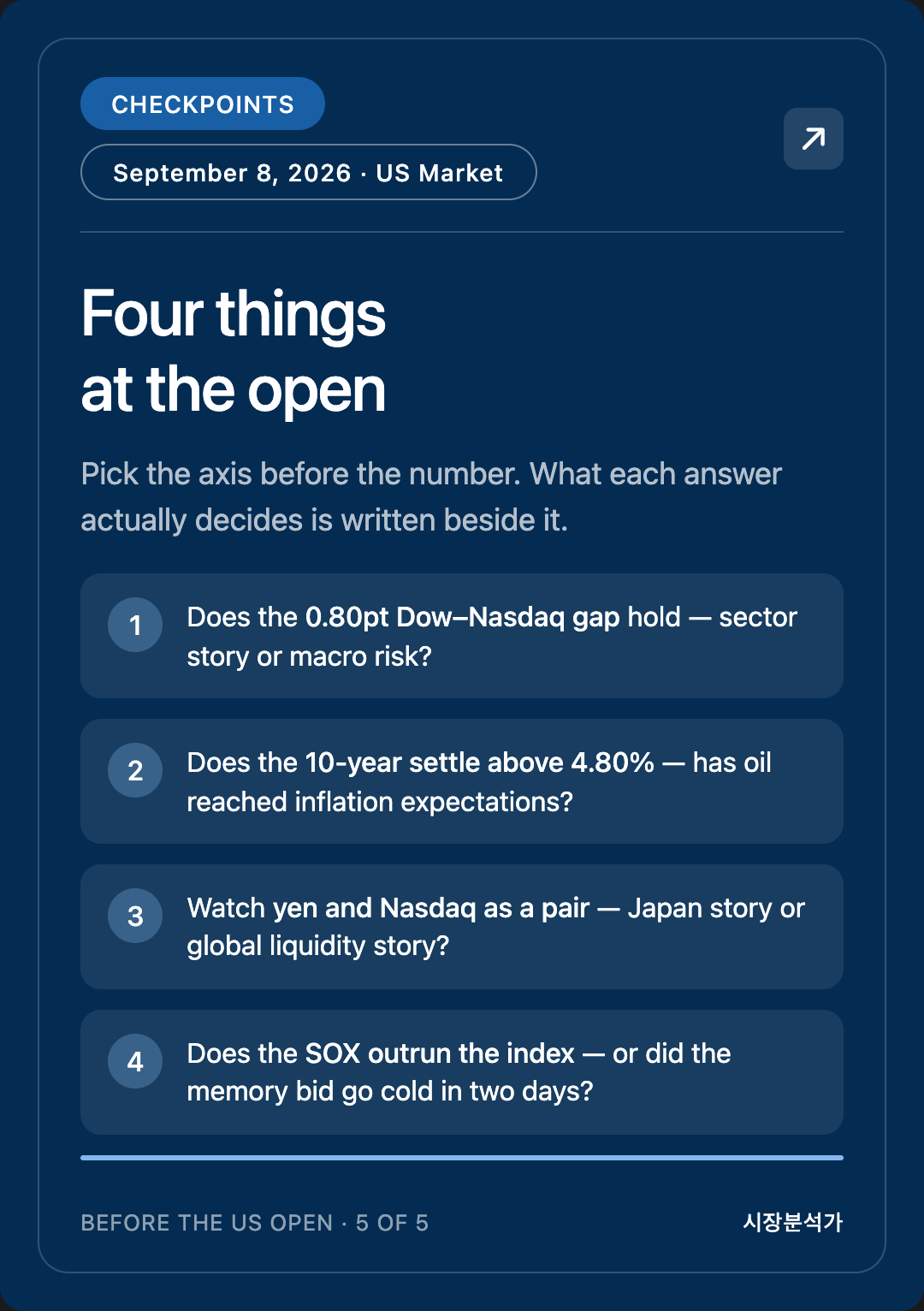
[Interpretation] — The axis first, then the number.
-
Does the Dow–Nasdaq gap hold after the open?
Axis — is the US pricing three days of news as sector stories or as market-wide risk?
The premarket gap is 0.80 percentage points (Dow −0.73% vs Nasdaq +0.07%). If it holds or widens, oil, tariffs and pharma are being handled as sector problems. If the Nasdaq gives way and the gap closes, it has been promoted to macro risk. Korea showed both shapes in a single session today — morning and afternoon. -
Does the US 10-year settle above 4.80%?
Axis — has oil transmitted into inflation expectations and therefore into rates?
Premarket 4.80% sits slightly above Friday's 4.784% close. With Brent at $99, a 10-year that settles in the 4.80s means the market has answered ahead of Friday's CPI. Back below 4.75% means it is not connecting oil to inflation. The second is materially better for Korea — rising yields compress KOSPI valuations. -
Does USD/JPY push below 152, and how does the Nasdaq respond?
Axis — is the yen a Japan story or a global liquidity story?
These have to be watched as a pair. A stronger yen with a resilient Nasdaq keeps it domestic. A stronger yen alongside a falling Nasdaq means carry unwinding has started reaching US assets. In that case next week's BOJ meeting becomes as important as this week's US CPI. -
Does the SOX outrun the index again?
Axis — does the OpenAI-driven memory bid go cold in two sessions?
Friday's SOX +3.37% built Monday's Korean rally and this morning's Korean opening surge. If the SOX leads again, the story is still alive. If it falls with the index, this morning's 7,171 was the story's last reaction. What Korea has to reference tomorrow morning is decided here.
[Interpretation] The shape of this week, for a Korea-based investor
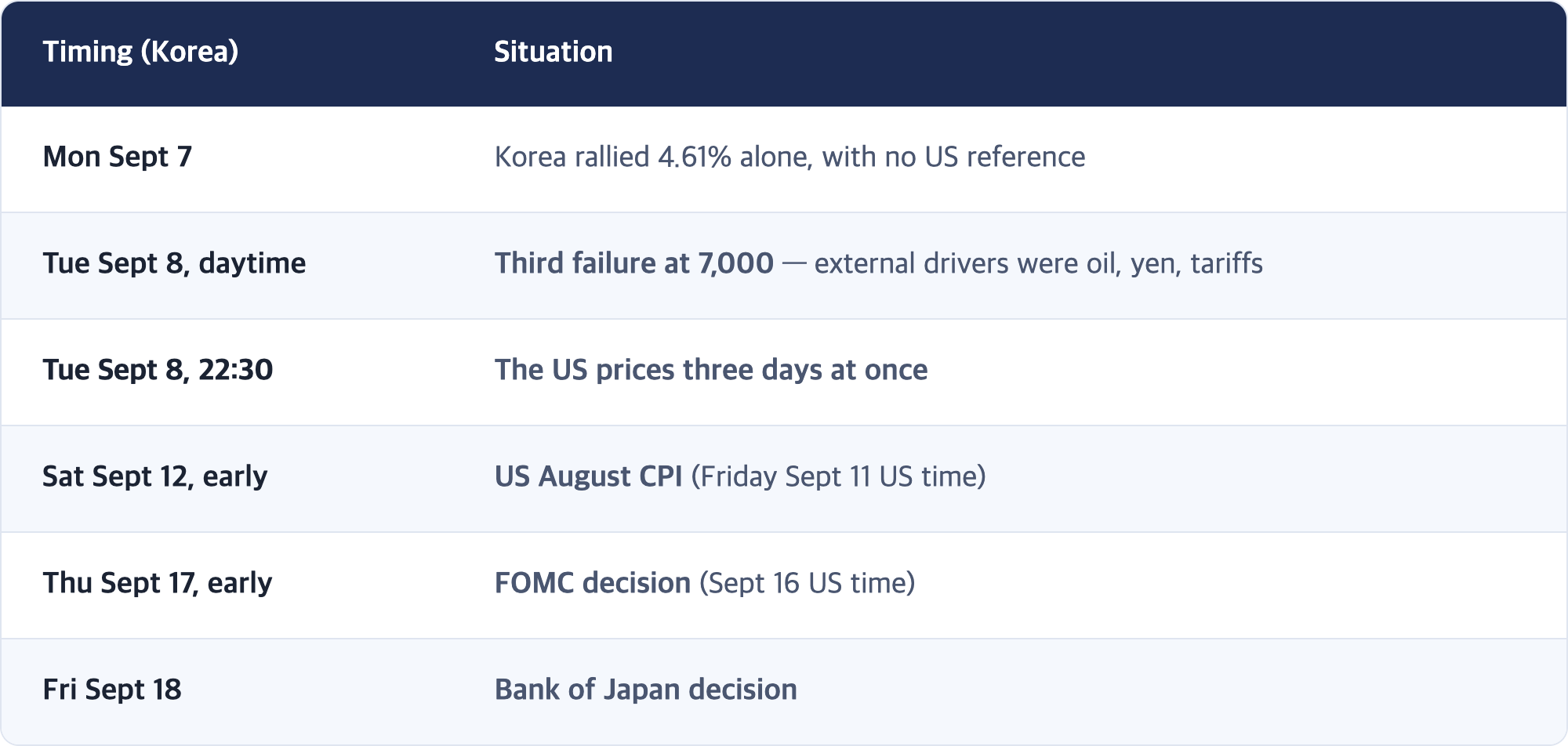
Next week is two central banks deciding two days apart, and this week is the inflation print that sets up both. They are better read as one block than as two.
None of this is a directional call. It describes where the calendar is dense, not whether prices go up or down.
📖 Study Note — The Yen Carry Trade, and Why a Rising Yen Sinks Other Countries' Stocks
The concept. Borrowing where money is cheap and buying assets where returns are higher is called a carry trade. Carry means the cost of holding. If borrowing costs 1% and the asset yields 5%, the 4% gap is the return.
The yen carry trade is that trade with Japanese yen as the borrowed currency. For nearly three decades Japan has been the cheapest place on earth to borrow, so investors worldwide have borrowed yen to buy US equities and bonds and emerging-market assets.
An analogy. Borrow at 1% from one bank, deposit at 5% at another. You earn 4% doing nothing. With one condition: the loan has to be repaid in yen.
A weaker yen (160 per dollar) makes repayment easier. A stronger yen (152 per dollar) means more dollars are needed to buy back the same yen. Earn 4% and lose 5% on the currency and the trade is negative.
What happens next. As losses build, the trade has to be closed. Closing it means selling the assets, converting to dollars, buying yen, repaying the loan. When everyone does this at once, two things happen together.
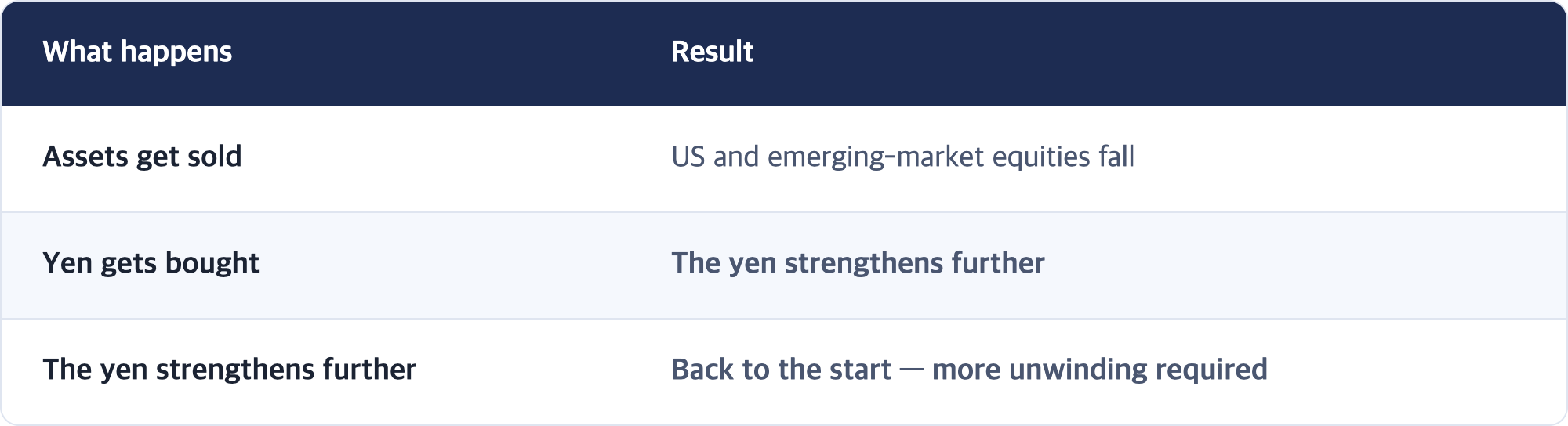
This is why carry unwinds are dangerous. The loop reinforces itself. Selling lifts the yen, and a higher yen forces more selling.
A real case. This happened precisely on August 5, 2024. The Bank of Japan hiked in late July, the yen surged, and on August 5 the Nikkei fell more than 12% in a single day. Korea's KOSPI fell more than 8% the same day; the Nasdaq lost more than 3%. That day was the textbook illustration of why a Japanese rate decision moves Seoul and New York.
Where things stand today.
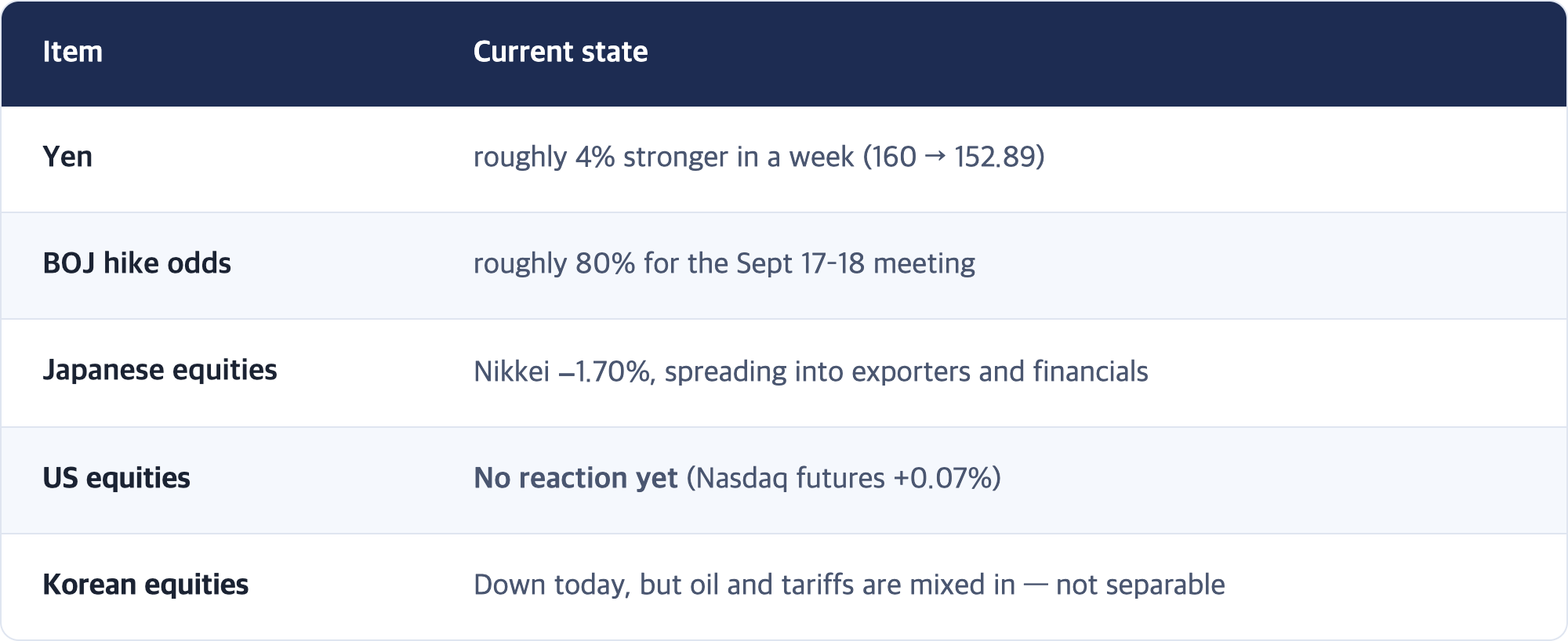
The front half of the loop has started turning. The back half has not.
How to hold this. Three habits.
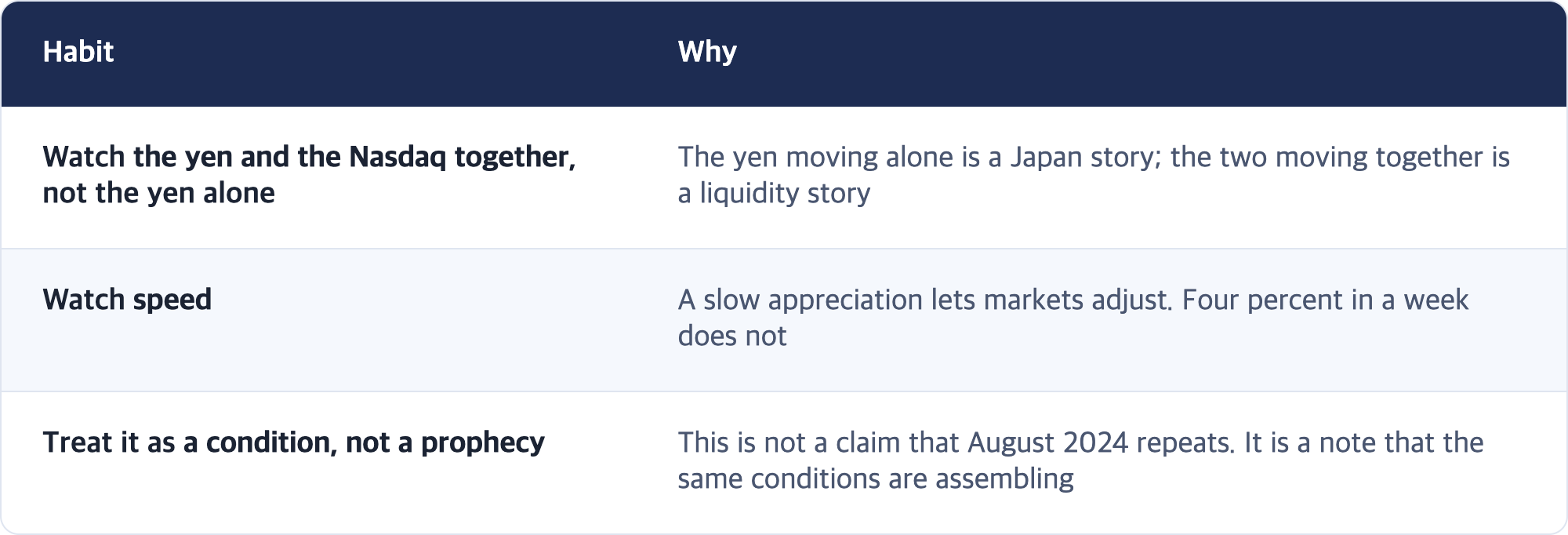
One caution. Nobody knows the true size of the yen carry trade. Institutions publish estimates and they vary enormously. When an article quotes a figure, treat it as indicative only. This report has deliberately quoted none.
📌 Corrections and Open Items
1) One framing line from the September 7 Korea-open report is withdrawn. It argued that with the US closed, today's KOSPI move would carry little external reference and would be driven by domestic flows. The afternoon reversal was driven by oil, the yen and Canadian tariffs — all from outside Korea. Equating a New York holiday with an absence of external variables was the error. Reflected in section 1. That same report's checkpoint 1 (judge on the close) and checkpoint 3 (the won as litmus test) were both correct.
2) The SOX close for September 4 has been obtained. Three editions carried only the percentage. It is 11,735.26 (+383.13). The percentage differs slightly by source: this source says +3.37%, prior citations said +3.38%. The report uses +3.37%.
3) KOSPI flow figures differ by collection time. Pre-close tallies showed foreign +452.8 bn, institutional +848.8 bn, retail −3.060 tn won; final tallies show foreign +648.2 bn, institutional +642.8 bn, retail −3.033 tn. The report uses the final tallies. The interpretation — foreign buying at one-fifth of Monday's — holds either way.
4) The KOSPI intraday high differs by source. Most Korean outlets report 7,171.52; some English-language coverage reports roughly 7,100. The report uses 7,171.52.
5) USD/JPY quotes differ by timestamp. The strongest intraday print is 152.89; a US premarket snapshot shows 153.92. Both are accurate at their respective times. The report cites the intraday high as the seven-month record and does not quote the premarket figure separately.
6) September FOMC hike odds are unusually dispersed. Values confirmed this session: 52% (immediately post-payrolls), 57% (Sept 3), 60%, and 66% (late August). Rather than adopt one, the report uses a 52–66% range. The next edition will narrow this to a single directly verified source.
7) Friday's US closes vary in the decimals. The S&P 500 appears as 7,718.36 and 7,718.60; the Dow as 53,413.60 and 53,414.25. The gap is under 0.01% and changes nothing, so the first values were used.
8) The confirmed Brent close for September 7 was again not obtained. This remains open from the September 7 Korea-open report (Bloomberg $96.15 vs other tallies of $97–97.5). Only September 8 live prices are used here; the September 7 figure is not re-cited.
9) Corporate treasury (other-corporate) net buying remains unverified. The roughly 1.57 trillion won arithmetic estimate from the September 7 US-open report is still not a sourced figure and is not used in any interpretation here.
10) This edition ran on schedule. Scheduled 05:30 PDT, actual start 05:35 PDT. No drift.
🔗 Sources
- KOSPI Slips Again Near 7,000, Ends at 6,954 — Seoul Economic Daily
- KOSPI Tops 7,000 Intraday for First Time in 15 Sessions — Seoul Economic Daily
- KOSPI fails to hold 7,000 after intraday 7,171 — Businesskorea
- KOSPI intraday 7,171.52, retail selling continues — Financial Post Korea
- Morning Preview: September 08, 2026 — Investrade
- Stock Market Today (Sept. 8, 2026): Dow futures edge lower as oil prices climb, Mideast tensions rise — TheStreet
- Brent crude nears $100 after strikes on Saudi energy sites amid renewed Mideast hostilities — CNBC
- Oil hits multi-week highs after Houthi attacks on Saudi energy facilities — Business Recorder
- Oil rises after Houthi attacks on Saudi energy facilities — RTÉ
- Saudi Aramco's Jizan Refinery Hit Again as Houthi Attacks Escalate — OilPrice.com
- Nikkei Drops 1,130 Points as Yen Surge Hits Exporters — News On Japan
- Japan stocks lower at close of trade; Nikkei 225 down 1.69% — Investing.com
- Yen Hits 7-Month High at 152 per Dollar on Rate Hike Bets — Seoul Economic Daily
- Japanese Yen rises to seven-month high on BoJ rate hike bets — FXStreet
- European shares dip as higher crude revives inflation worries; Novartis drags — Reuters via Investing.com
- Oil Inflation Fears Hit European Stocks; Novartis Tumbles — Tradingpedia
- As U.S.-Canada trade talks collapse, Carney says retaliatory tariffs will start Sept. 8 — CNBC
- Canada to hit US with retaliatory tariffs as trade war escalates — Al Jazeera
- US-Canada tariffs trade war September 2026 — Money.ca
- Philadelphia Semiconductor Index Historical Data (SOX) — Investing.com
- OpenAI announces rollout of GPT-6 Astra model — CNBC
- CME FedWatch Provides A 66% Chance Fed Will Hike Rates In September — Forbes
- US 10 Year Treasury Note Yield — Trading Economics
- Stock market news for Sept. 4, 2026 — CNBC
📌 More market briefs
※ This post is market observation and organization intended to support your own judgment. It is not a recommendation to buy or sell any security. Figures are as of the time of writing and may differ between sources.
If this was useful, bookmark it or pass it along. It genuinely helps me write the next one.
I can survive. We can survive.