September 9, 2026 US Market Brief — Nasdaq and S&P 500 Before the Open
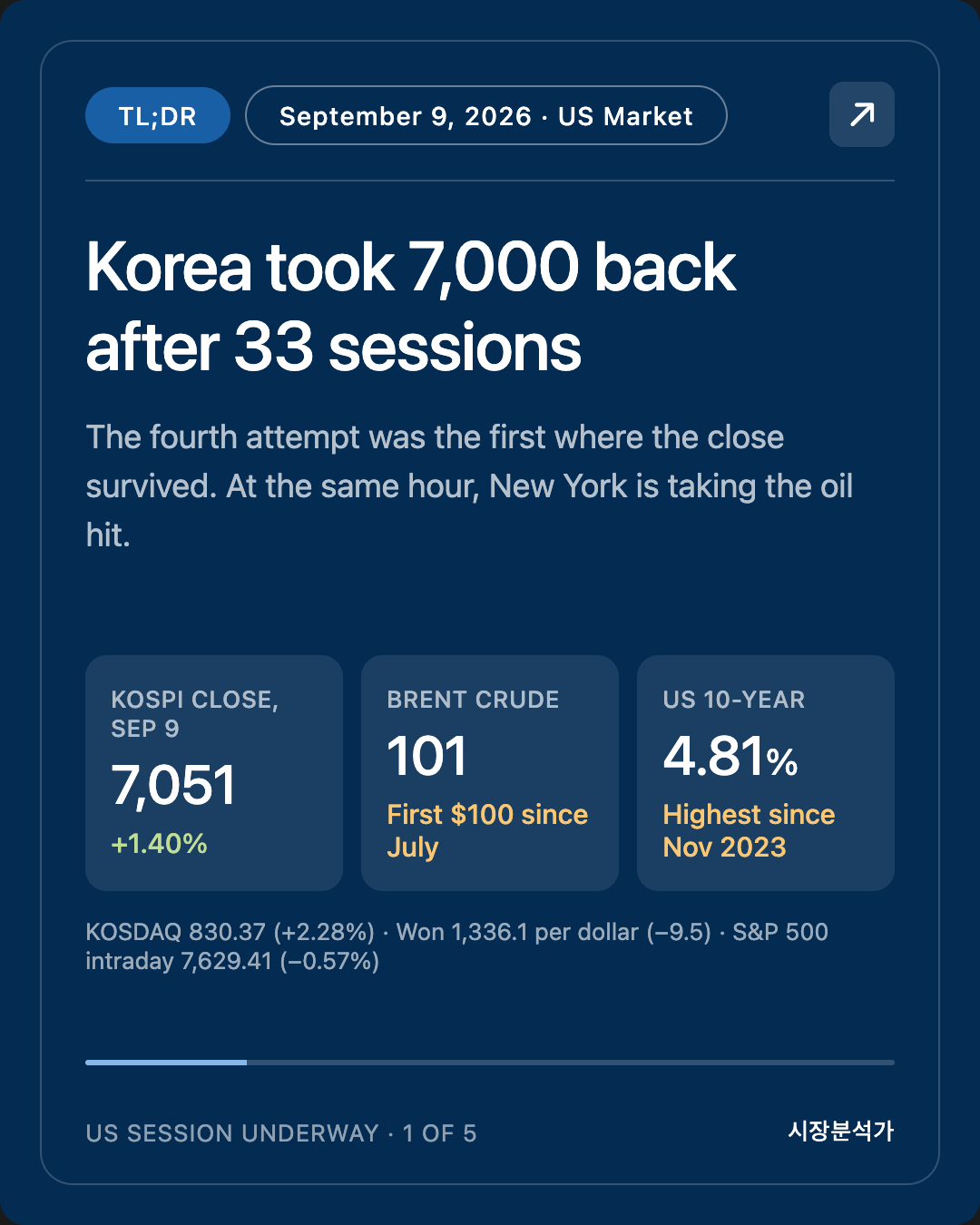
- KOSPI 7,051.64 (+1.40%, +97.12 pts) — back above 7,000 for the first time in 33 sessions. Intraday high 7,112.48; the KOSDAQ small-cap index rose 2.28% to 830.37. Three prior failures (Aug 14, Aug 18, Sep 8) gave way on the fourth try.
- All four checkpoints this brief set yesterday resolved the same way. Korea followed the chip tape, not the Dow headline (−1.18%); the two memory giants held their gains into the close; the won strengthened rather than breaking 1,350 (1,336.1 per dollar, −9.5); and the buy-side ratio recovered from 0.43x to roughly 0.99x.
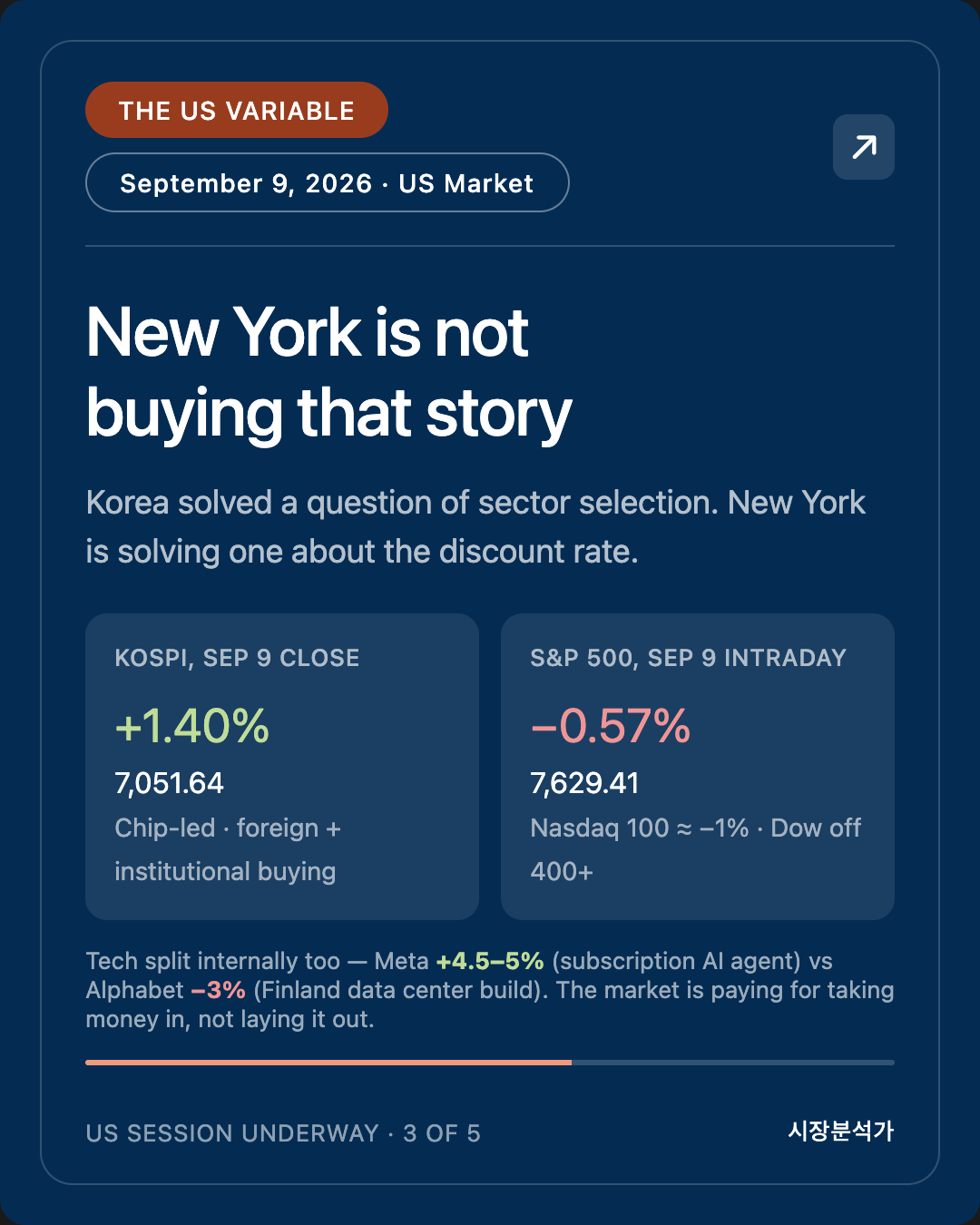
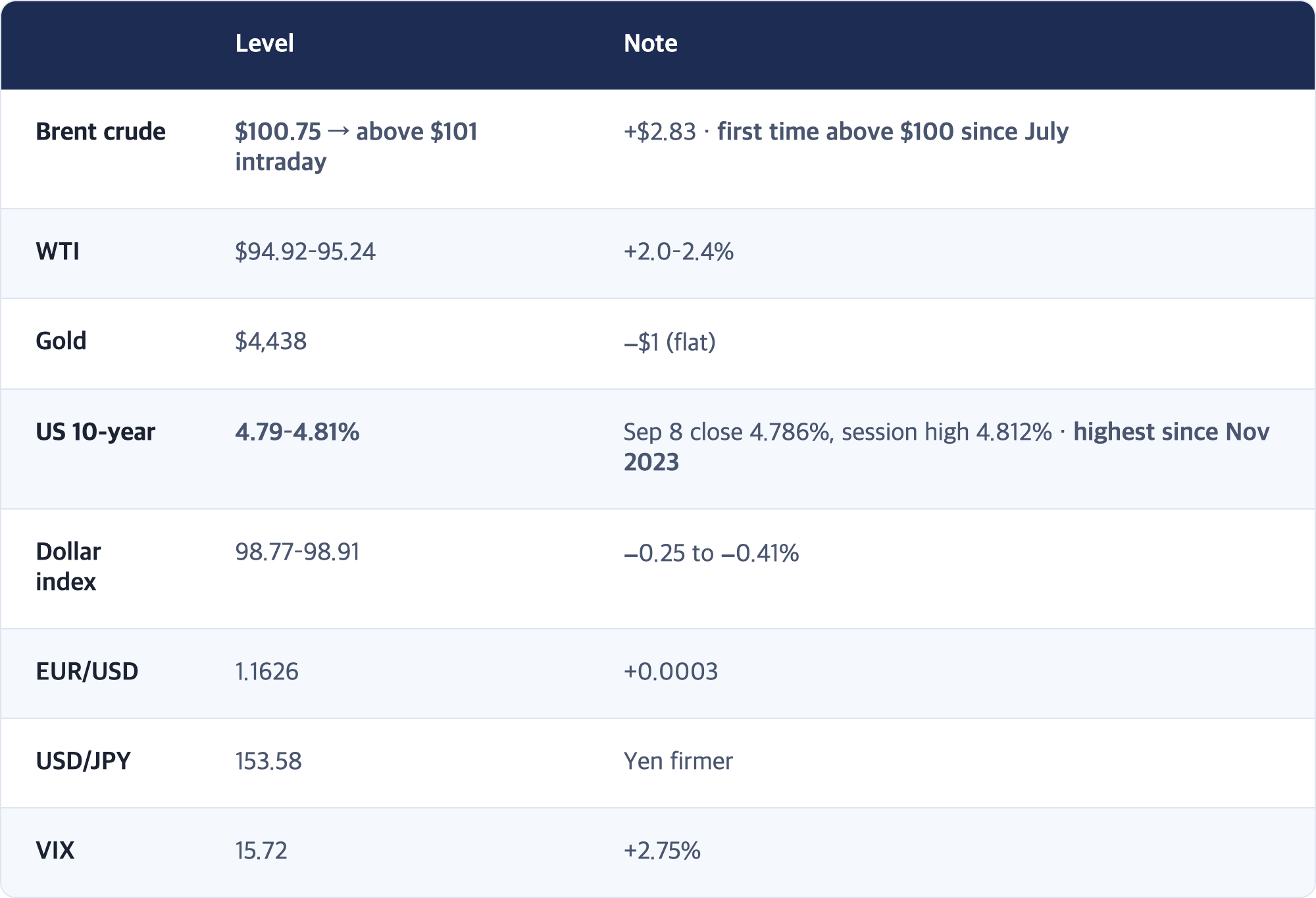
- The US is standing on the other side. Brent broke $101 (first time above $100 since July), the S&P 500 traded at 7,629.41 (−0.57%), the Nasdaq 100 was off roughly 1%, and the Dow shed 400-plus points intraday.
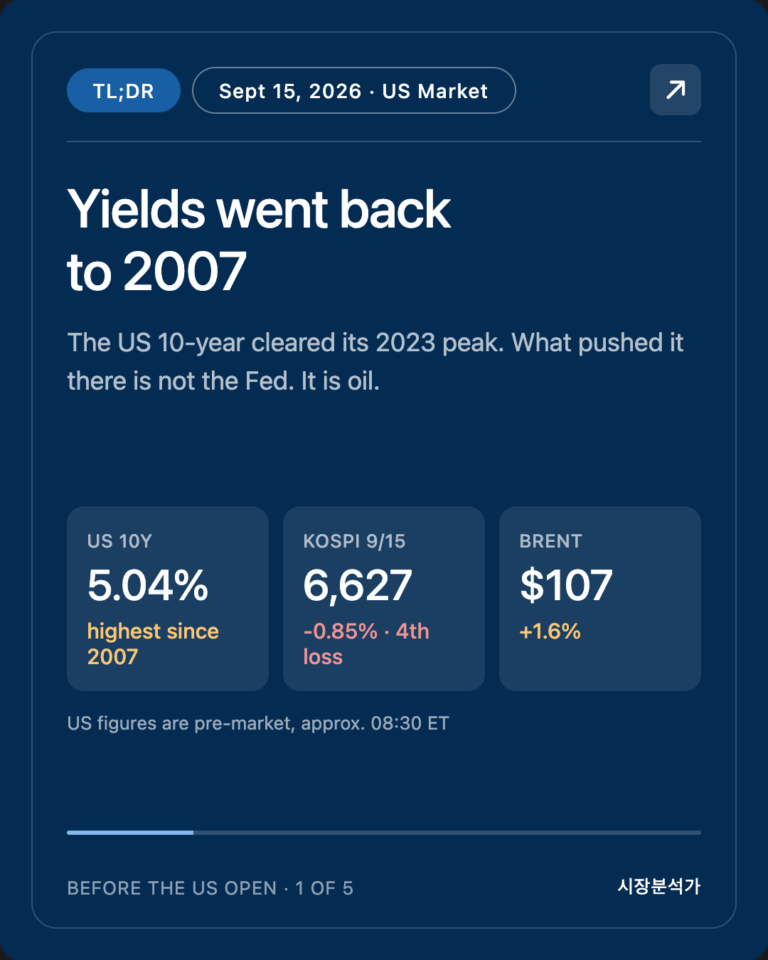
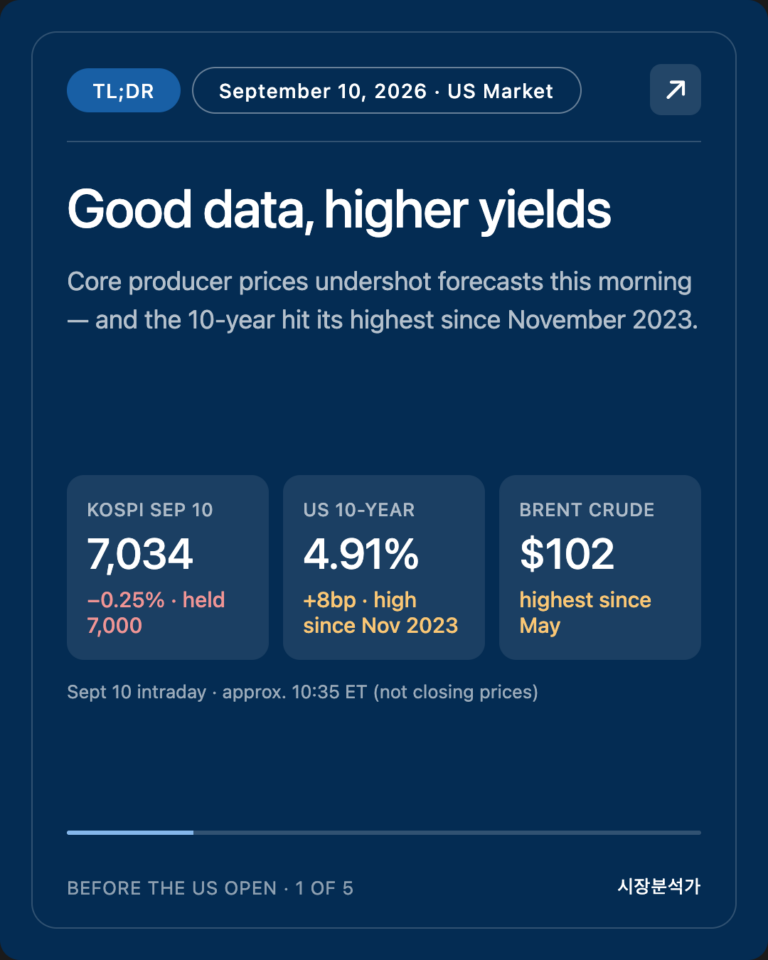
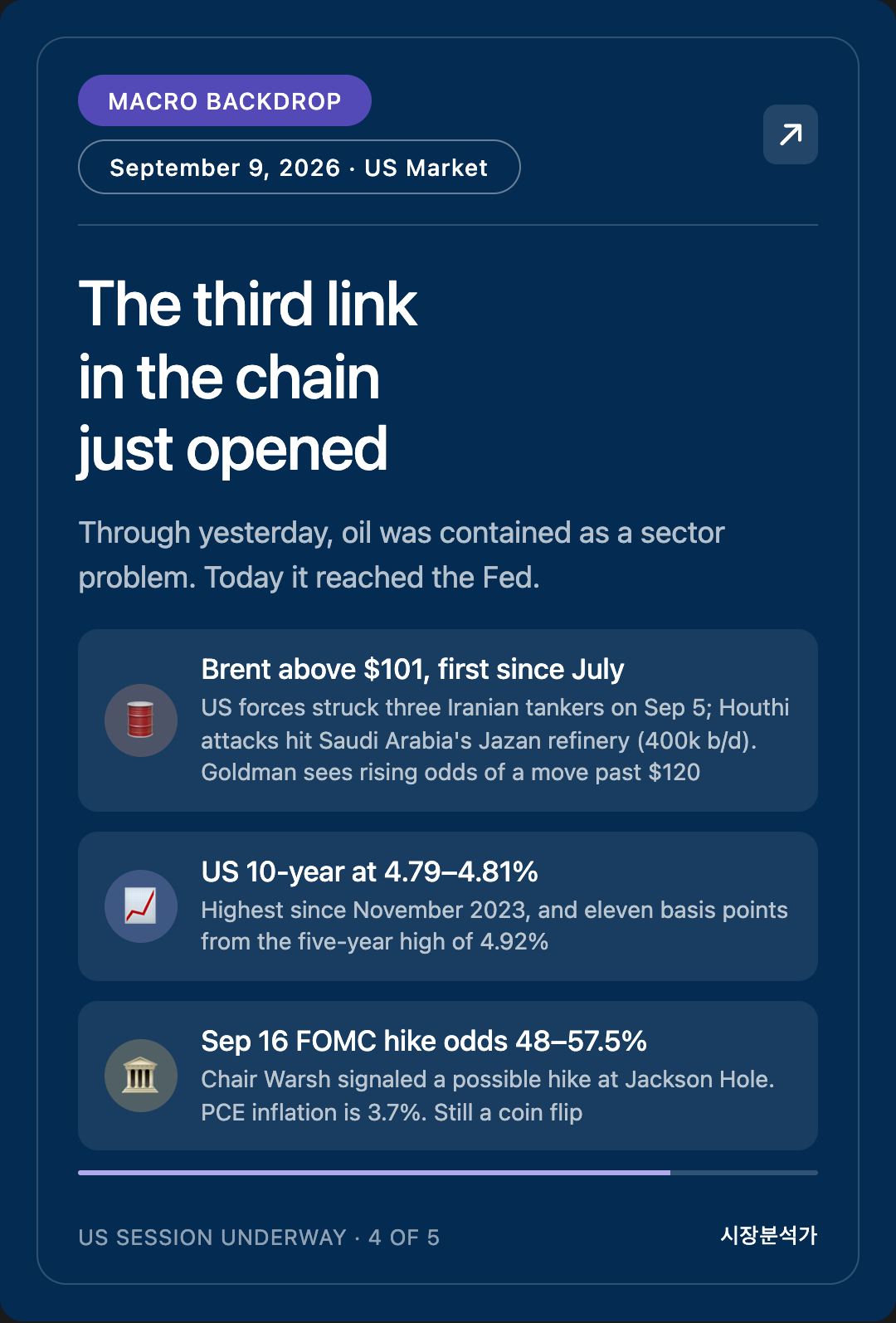
- The real variable today is not oil — it is the third link in the chain from oil to the Fed. The US 10-year yield sits at 4.79–4.81%, its highest since November 2023 and within striking distance of the five-year high at 4.92%. Odds of a hike at the September 16 FOMC run 48–57.5% — still a coin flip.
- The week's center of gravity is Friday's August CPI at 8:30 ET. Thursday brings the ECB decision and US PPI. How oil prints in that data decides next week's Fed meeting.
This is Mr. Can. Here is the September 9, 2026 brief ahead of the US market open.
Written: 2026-09-09 09:25 PDT (12:25 ET)
Basis: Asian closes 9/9 · European morning 9/9 · US intraday 9/9 (~12:25 ET)
⚠️ This edition ran 3 hours 55 minutes behind schedule. It was set for 05:30 PDT (08:30 ET, an hour before the bell); it actually started at 09:25 PDT (12:25 ET). New York had already been open for roughly three hours.
So the US figures below are not pre-open estimates — they are live intraday prints. That is better data than futures, with one caveat: none of it is a closing price. Final US closes will be settled in tonight's Korea-open edition.
The delay is logged in the Corrections section at the bottom.
SEO Intro
Korea's KOSPI closed at 7,051.64 today, up 1.40% — its first close above 7,000 in 33 trading sessions, and the first since July 23.
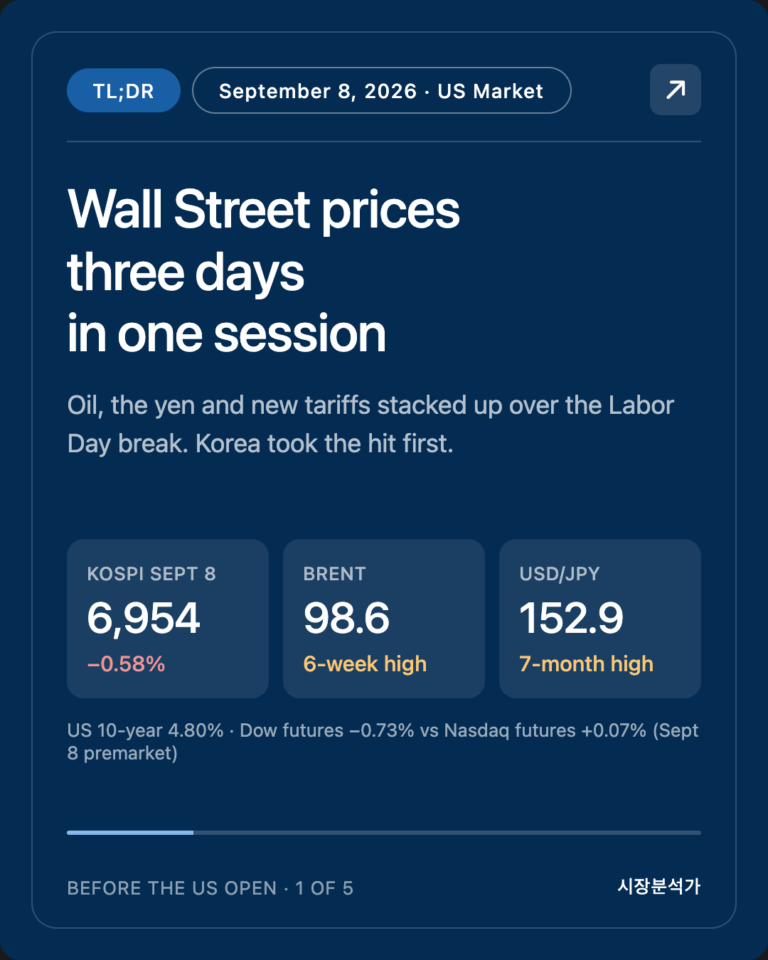
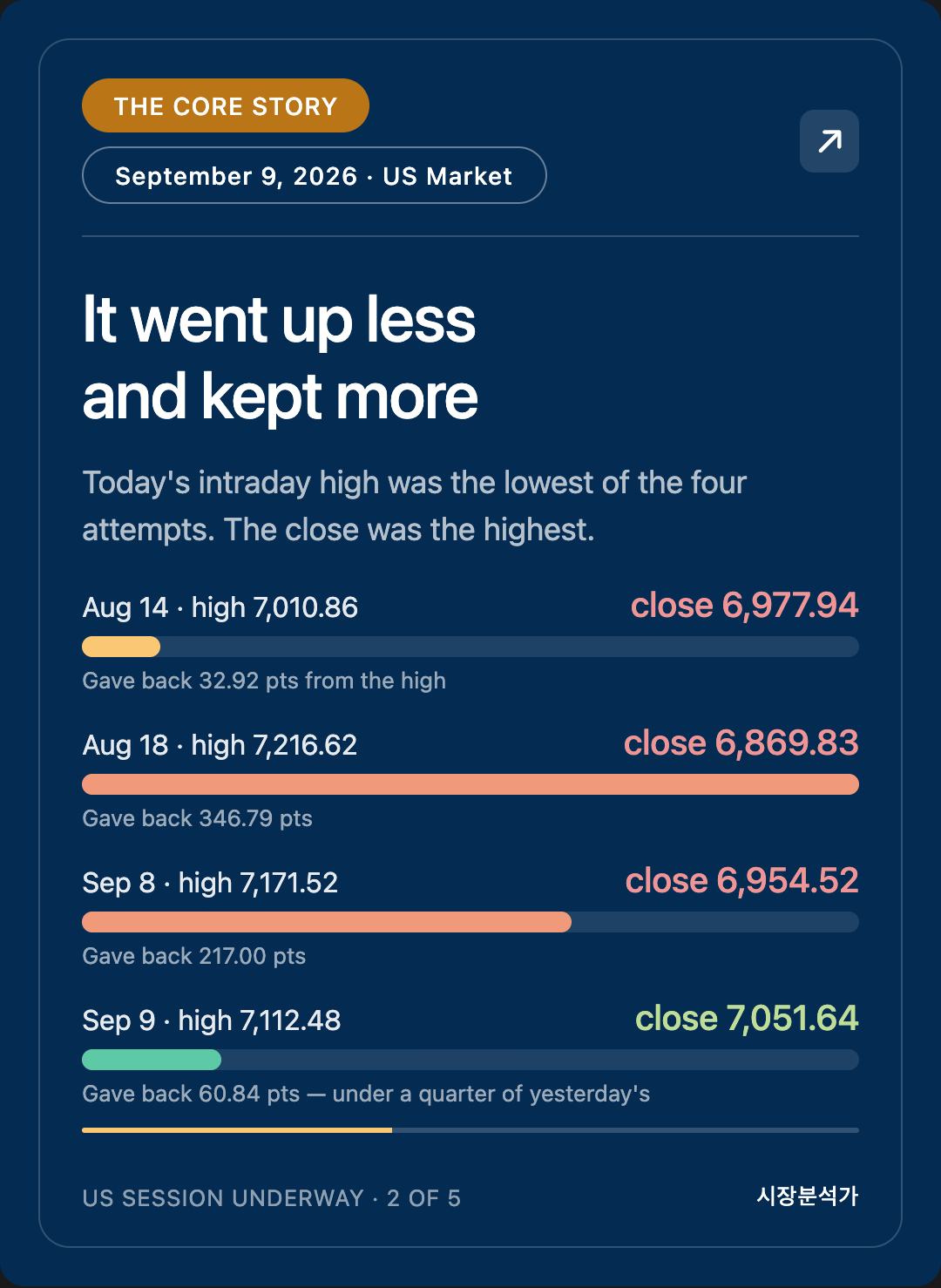
This brief has said the same thing for two weeks running: the close is what counts, and an intraday break above a round number is not news. On August 14, August 18 and September 8, the index crossed 7,000 during the day and gave it all back by the bell. Today was the fourth attempt, and the first one where the close survived.
At the same hour, New York is not buying that story. Brent crude pushed past $101, and the Dow has been down more than 400 points intraday.
Korea and the US are solving two different problems today. Here is the difference.
1. The Core Story — Korea Took 7,000 Back; New York Isn't Buying It
[FACT] — Four runs at 7,000
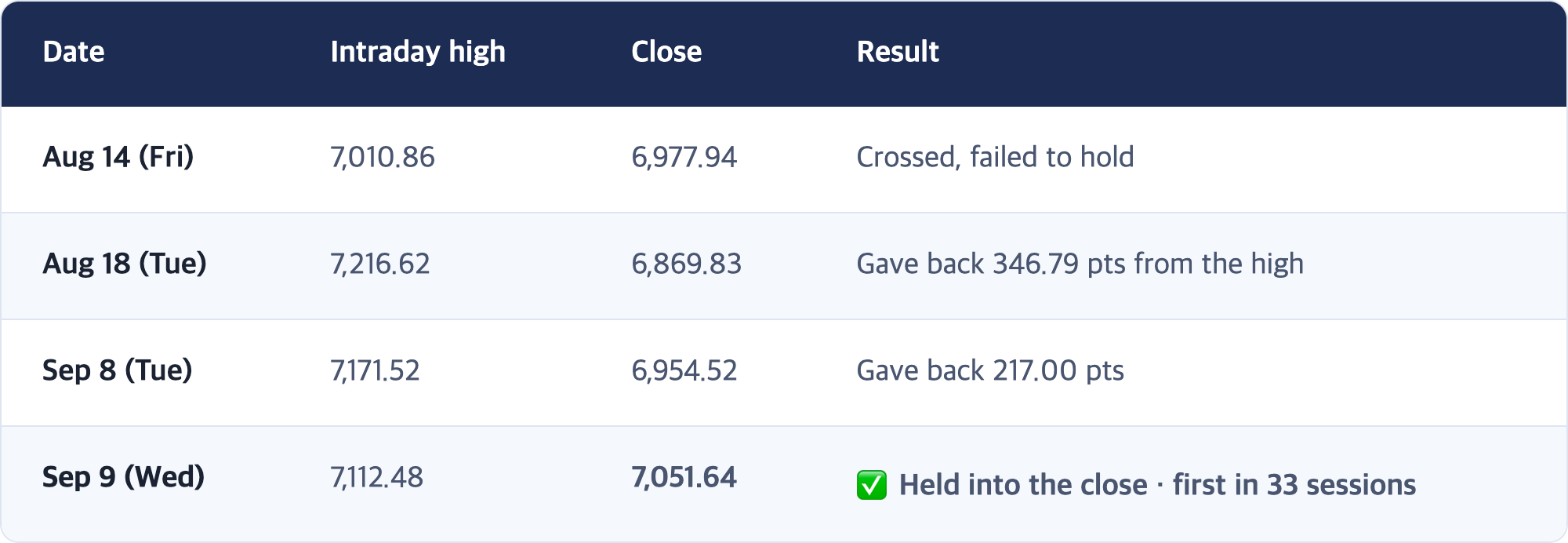
Today's intraday high was the lowest of the four. It fell short of August 18's 7,216.62 and of yesterday's 7,171.52. Yet the close was the highest of the four.
That contrast is the whole character of the session. It went up less and kept more. The three earlier attempts all shared one shape — a strong morning push, an afternoon surrender. Today there was no surrender: the give-back from high to close was 60.84 points, against 217.00 yesterday and 346.79 on August 18. Less than a quarter of yesterday's.
[INTERPRETATION] Grading yesterday's checkpoints
Yesterday's Korea-open edition set four tests in advance. The results:
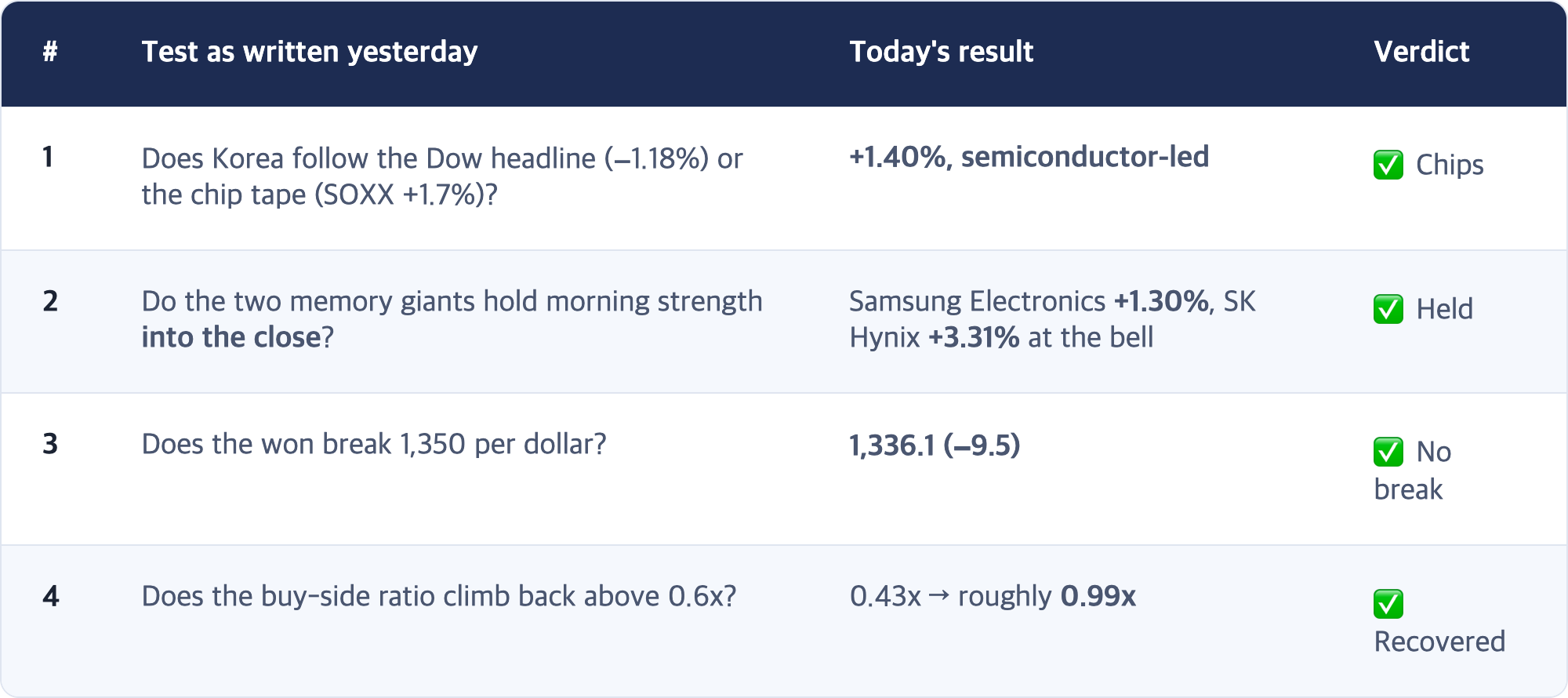
This is the first session since this brief began where all four tests answered the same way. And the index went with them.
One honest footnote belongs here. Four correct calls means the tests were well built for this particular day — not that they will keep working. Today the four variables were all telling the same story, which made grading easy. The hard days are the ones where they disagree, and those are far more common.
🔴 [INTERPRETATION] But the US is not working the same problem
The question Korea answered today was a question of sector selection: of the two contradictory signals New York sent overnight, which one is ours? The answer was semiconductors.
The question New York is working right now is different: how does $101 oil feed into Friday's inflation print and next week's Fed decision?
These sit at different levels. Sector selection decides who wins and who loses inside an index. The discount rate moves the whole index up or down.
So today's Korean success does not automatically carry into tomorrow. That Korea picked the right tape to follow is one question. Whether that tape is thick enough to withstand a US repricing of interest rates is another. The second question is still open.
2. Asia Close (Sep 9, Seoul time)
[FACT] — Korea
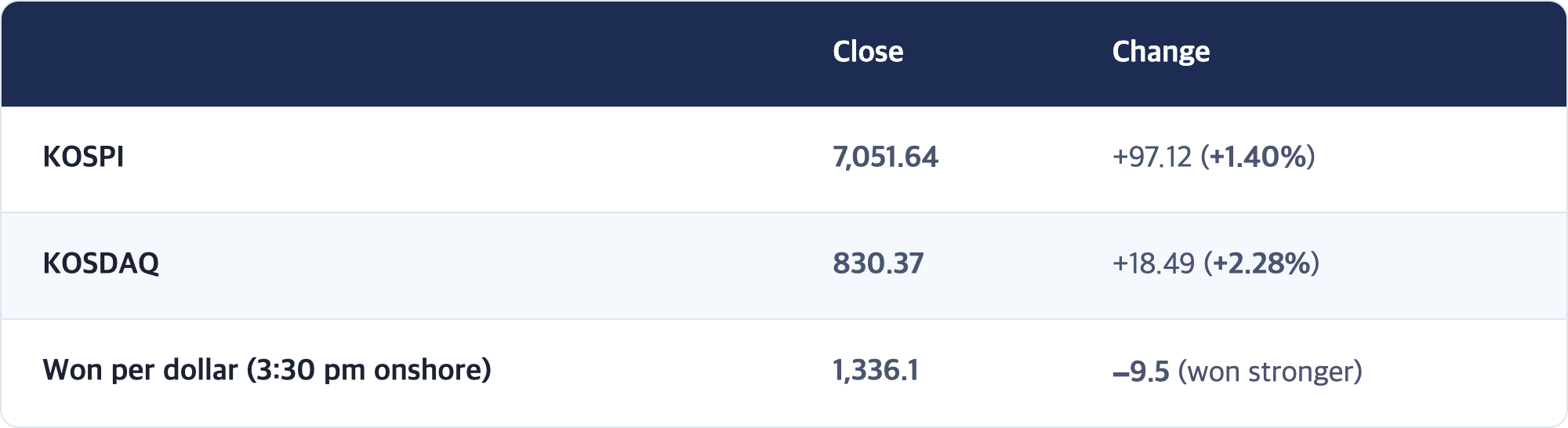
KOSPI intraday high 7,112.48; the won opened at 1,339.5.
[FACT] — Who bought
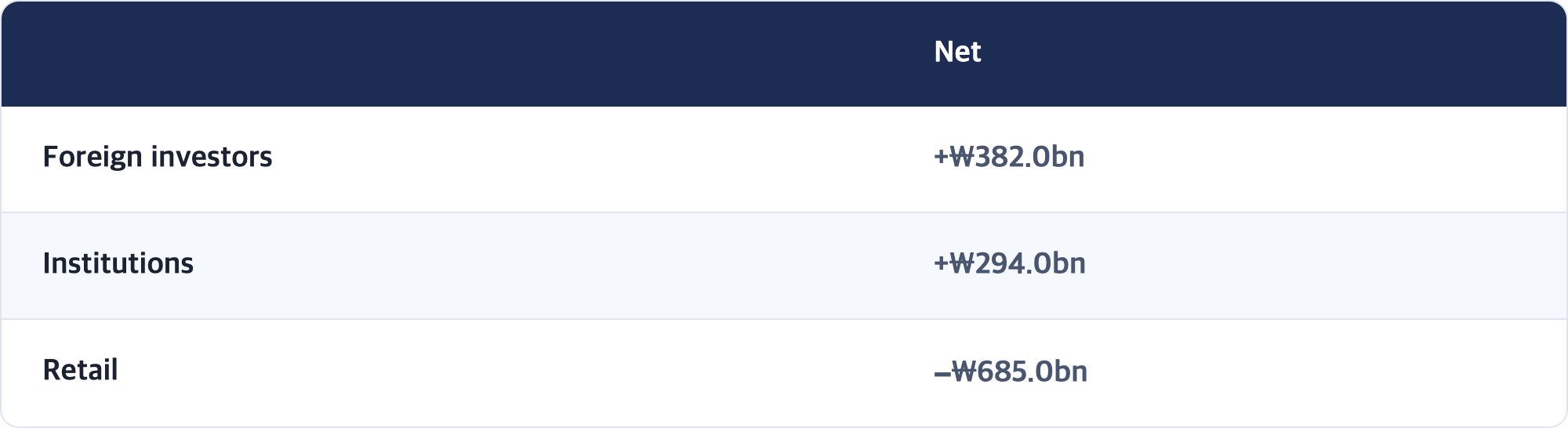
Foreigners and institutions together bought ₩676.0bn against ₩685.0bn of retail selling — a ratio of roughly 0.99x.
⚠️ Prior readings for this ratio (0.81x on Sep 7, 0.43x on Sep 8) came from a different source reporting in trillions. A ratio is unit-free, but there is no guarantee the two sources cover the same universe (KOSPI alone vs KOSPI plus KOSDAQ). Today's figure is used only directionally — above 0.6x — with no decimal-level comparison. Logged below.
[FACT] — Single names
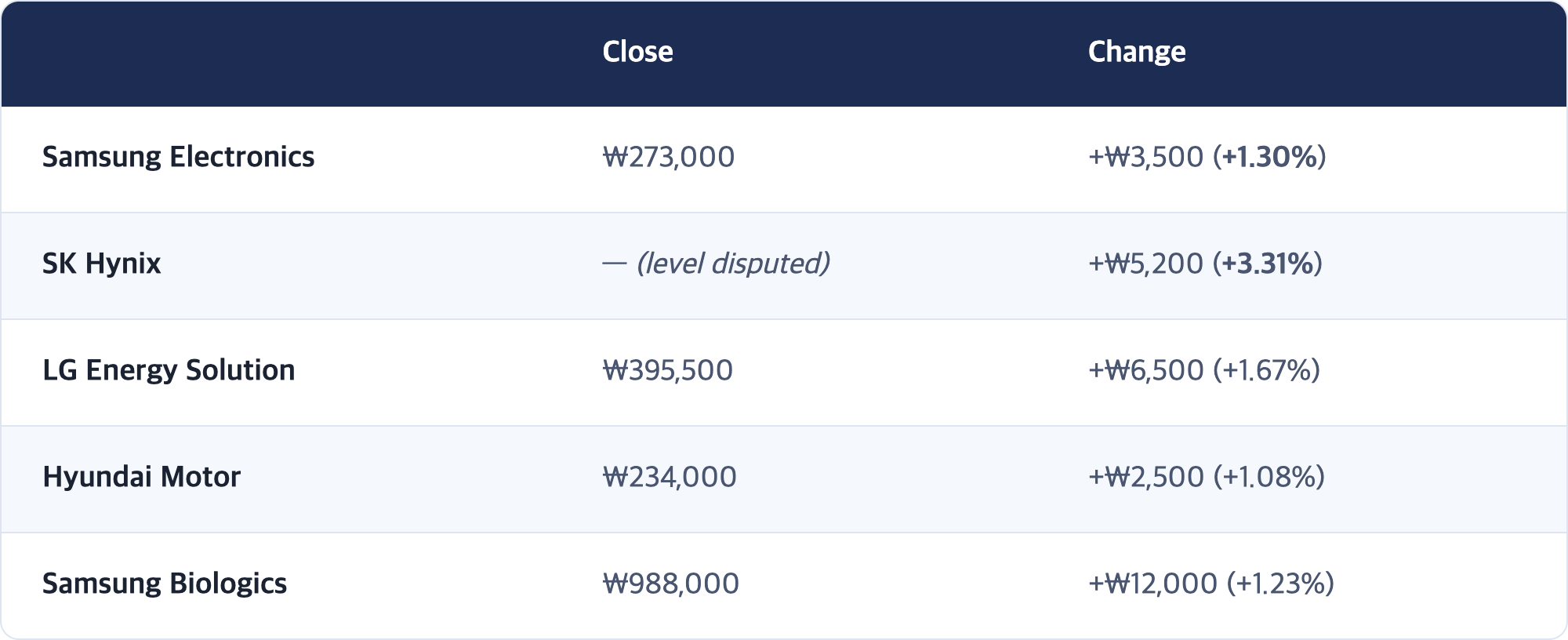
SK Hynix was reported as rising on continued dominance in high-bandwidth memory and improving supply-demand conditions.
🔴 SK Hynix's share price level could not be confirmed. Today's source prints ₩162,200; yesterday this brief cited roughly ₩1.79 million. That is a factor-of-ten gap, too large to be a normal quotation difference. Only the percentage move is used here; the level is left blank.
[FACT] — Rest of Asia
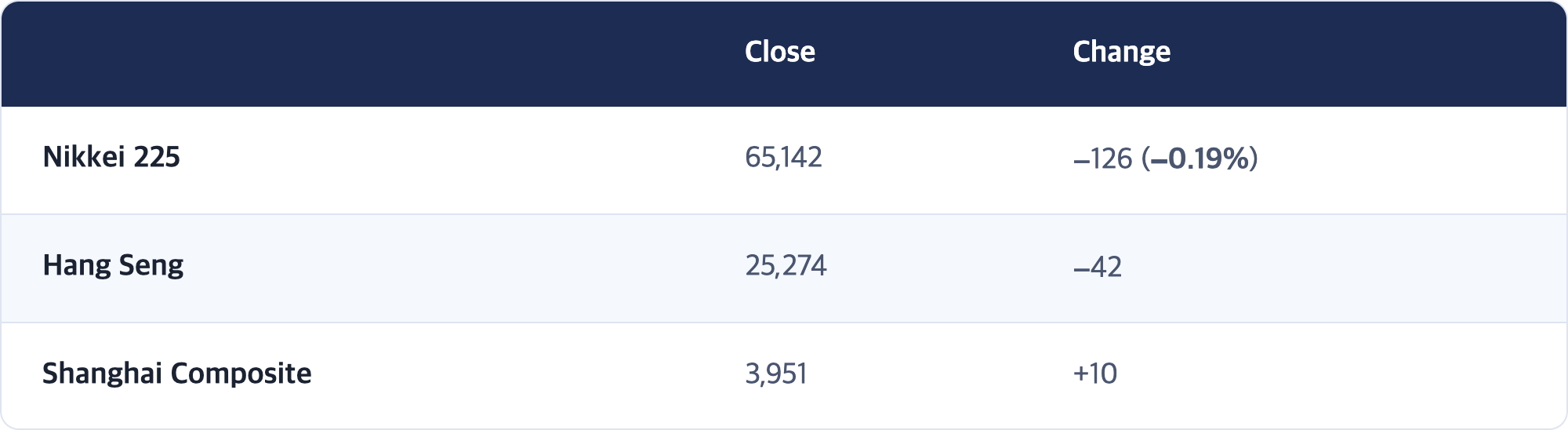
Korea was effectively the only Asian market that rose today. Tokyo and Hong Kong slipped, Shanghai was flat. The KOSPI's 1.40% and the KOSDAQ's 2.28% were a Korean move, not a regional one.
[INTERPRETATION] A quiet yen helped
The variable this brief flagged yesterday as the genuinely new one — the yen, not oil — went quiet today. Dollar-yen sits near 153.58, and the Nikkei's −0.19% is a long way from yesterday's −1.70%.
When the yen is quiet, the won can breathe. Today's 9.5-won move owes something to broad dollar softness (the dollar index eased to 98.77–98.91, down 0.25–0.41%), but also to reduced pressure on Asian currencies generally. And a firmer won is precisely the condition under which foreigners buy Korean equities — which is what the ₩382bn of net foreign buying reflects.
3. The US Variable (Sep 9 ET, intraday ~12:25)
[FACT] — Tuesday's confirmed closes (Sep 8)
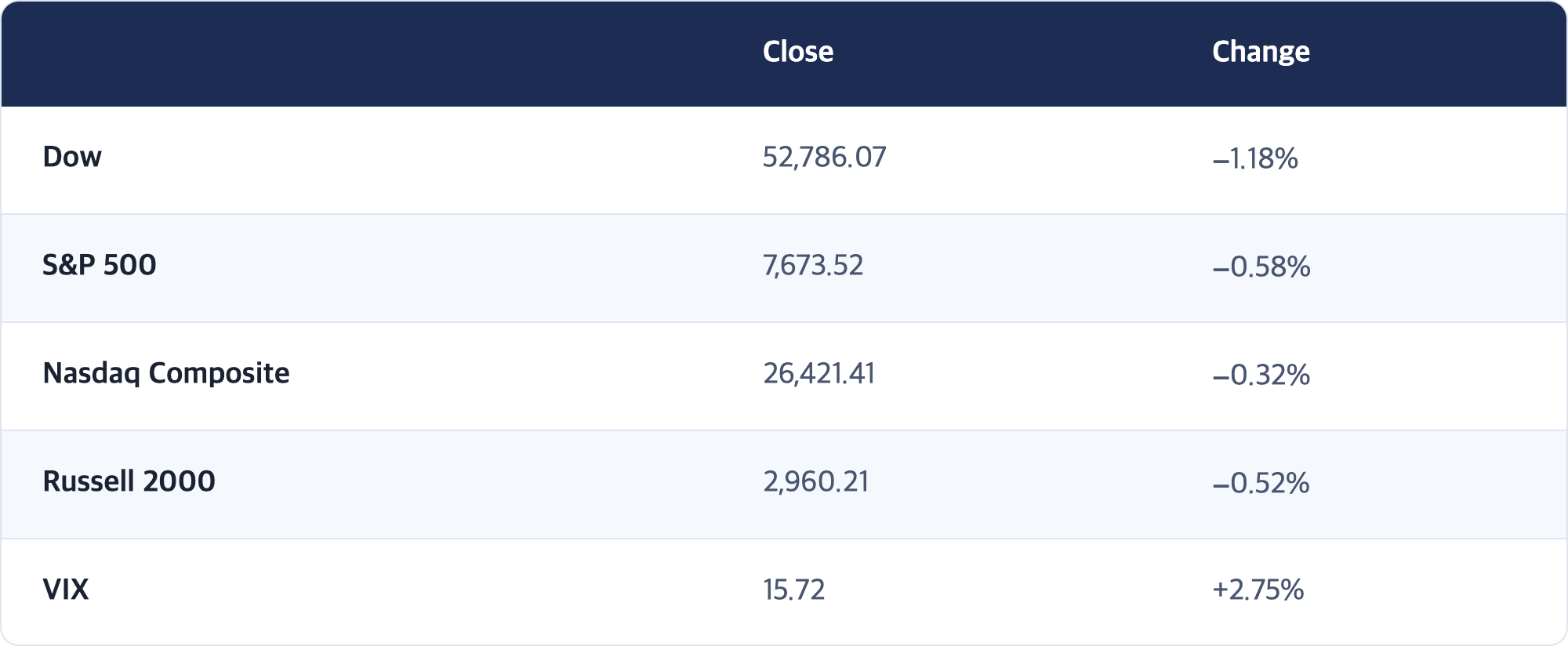
[FACT] — Today, pre-open into the session
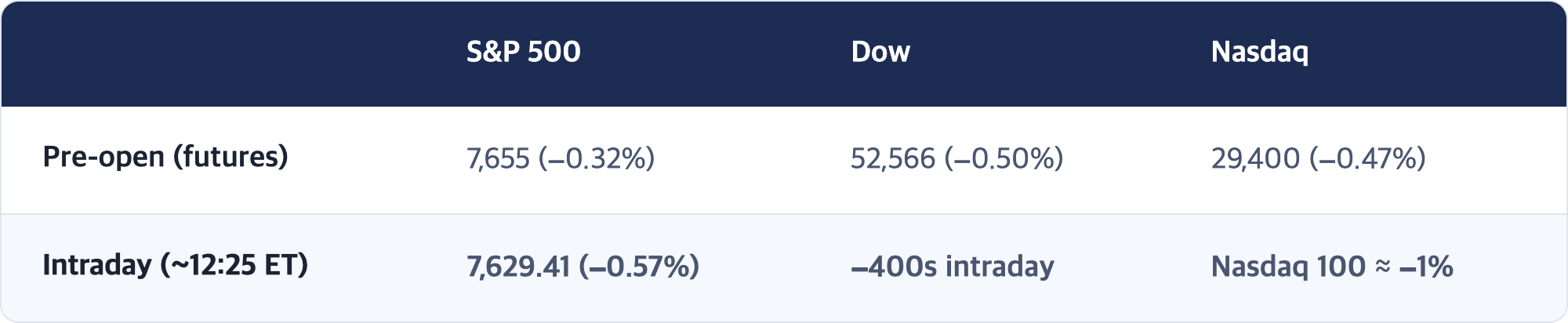
The session has been worse than the futures suggested. The S&P went from −0.32% pre-open to −0.57%, and the Nasdaq widened from −0.47% to about −1%. This is a tape that has deteriorated as the day has gone on.
[FACT] — Today's movers
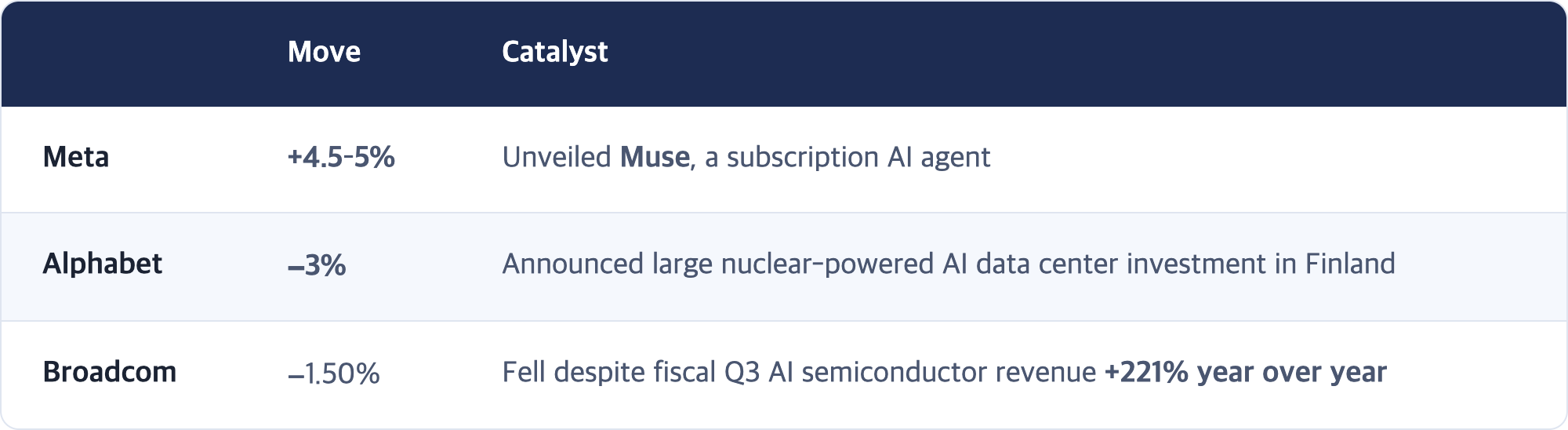
🟠 [INTERPRETATION] The line running through tech moved
Last night, chips rallied on a simple thesis: AI capital spending continues. Qualcomm's and Corning's data center deals were the catalyst, and Intel rose 9%.
Today the same thesis is being read in reverse. Alphabet announced a Finnish data center build and fell 3%. Broadcom grew AI chip revenue 221% year over year and fell anyway. Meta, meanwhile, announced something different — not spending money but collecting it, via a subscription AI agent — and rose close to 5%.
The name of that dividing line is capex versus monetization. When the discount rate climbs toward 4.8%, cash you expect to collect years from now is worth less today. So the market starts paying more for companies taking money in now than for companies laying money out now. Until yesterday, "we are investing in AI" was straightforwardly good news. Today it passes through an interest-rate filter first.
Why this matters for Korean chipmakers — Samsung Electronics and SK Hynix sit on the receiving end of that capex, not the spending end. When a hyperscaler builds a data center, it buys memory. So Alphabet's Finland announcement can be a negative for Alphabet's own stock and a positive for memory demand at the same time. That said, this is an observation, not an established causal link — one session is not enough to call it.
4. Macro Backdrop — The Oil / Rates / Fed Triangle
[FACT] — Commodities, rates, currencies
[FACT] — The geopolitics, in sequence
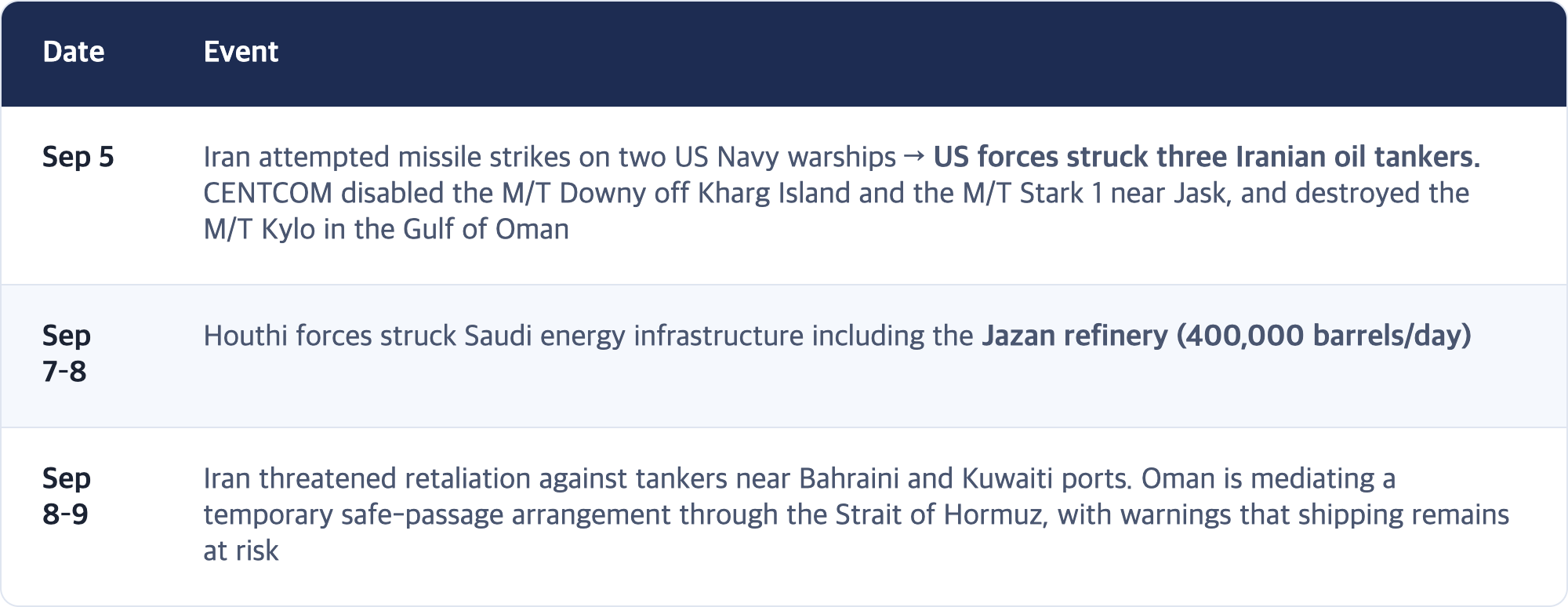
US Central Command described the tankers as part of a shadow fleet financing the Islamic Revolutionary Guard Corps and its regional proxies. Goldman Sachs has said intensifying attacks on shipping raise the probability of Brent exceeding $120.
🔴 [INTERPRETATION] Watch the third link, not the oil price
The $100 headline is the headline. What the market is actually pricing is the chain behind it.
Oil at $101  →  inflation pressure  →  Fed can't cut (or must hike)  →  10-yr at 4.8%  →  equity discount rate up
  [link 1]        [link 2]                   [link 3]                     [link 4]              [link 5]
Through yesterday, this chain stopped at links 1 and 2. That is what this brief meant in writing that the oil and tariff shocks had stayed "contained as sector problems and had not crossed into rates." The 10-year sat still at 4.79–4.80%.
Today link 3 is open. Hike odds for next week's FOMC are stuck near half, and the 10-year printed 4.812%. The five-year high is 4.92% — eleven basis points away.
So the reason US equities are falling today is not oil; it is rates. Oil is the cause and rates are the transmission channel — and it is the channel, not the cause, that actually touches equity prices.
[FACT] — Fed and event calendar
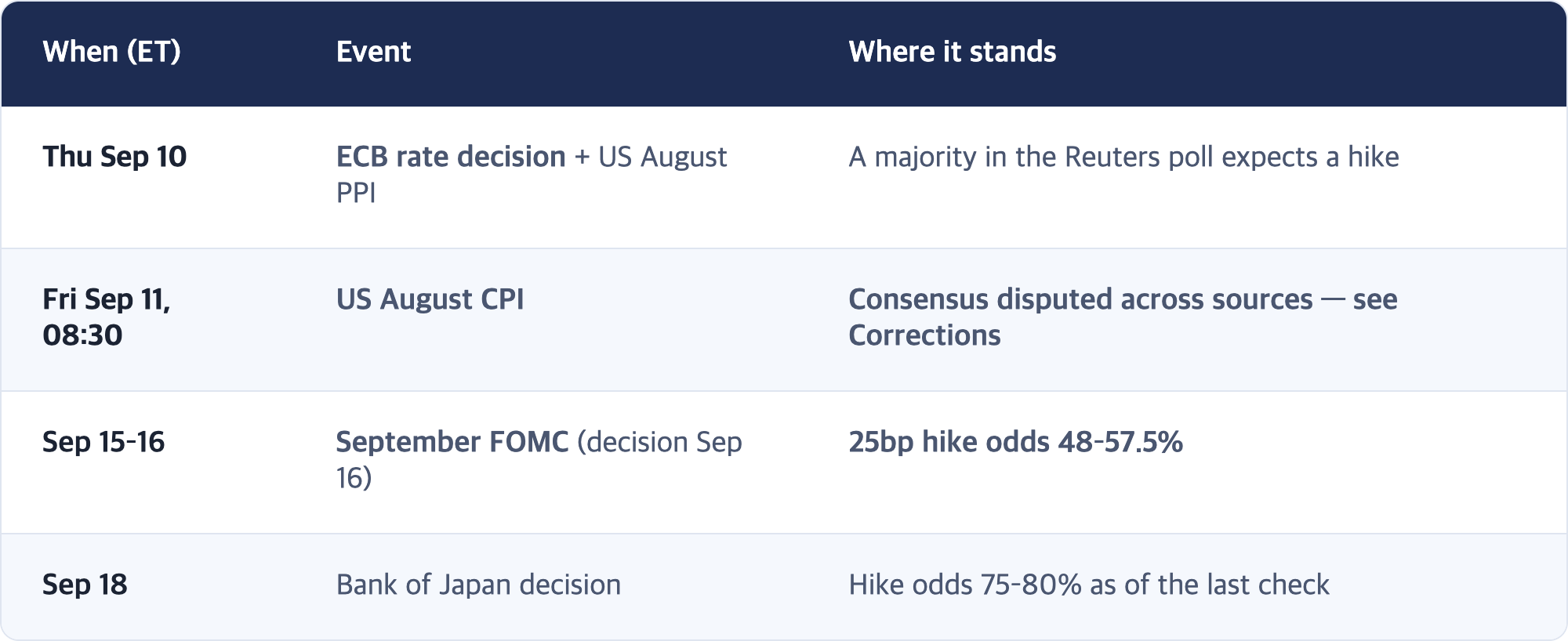
Fed Chair Kevin Warsh told Jackson Hole on August 28 that inflation remains above the 2% goal and signaled the Fed may need to raise rates. PCE inflation stands at 3.7%. Odds of a September hike were about one in three before that speech and moved above even afterward, where they have hovered since.
5. Checkpoints — The Rest of Today, and the Rest of the Week
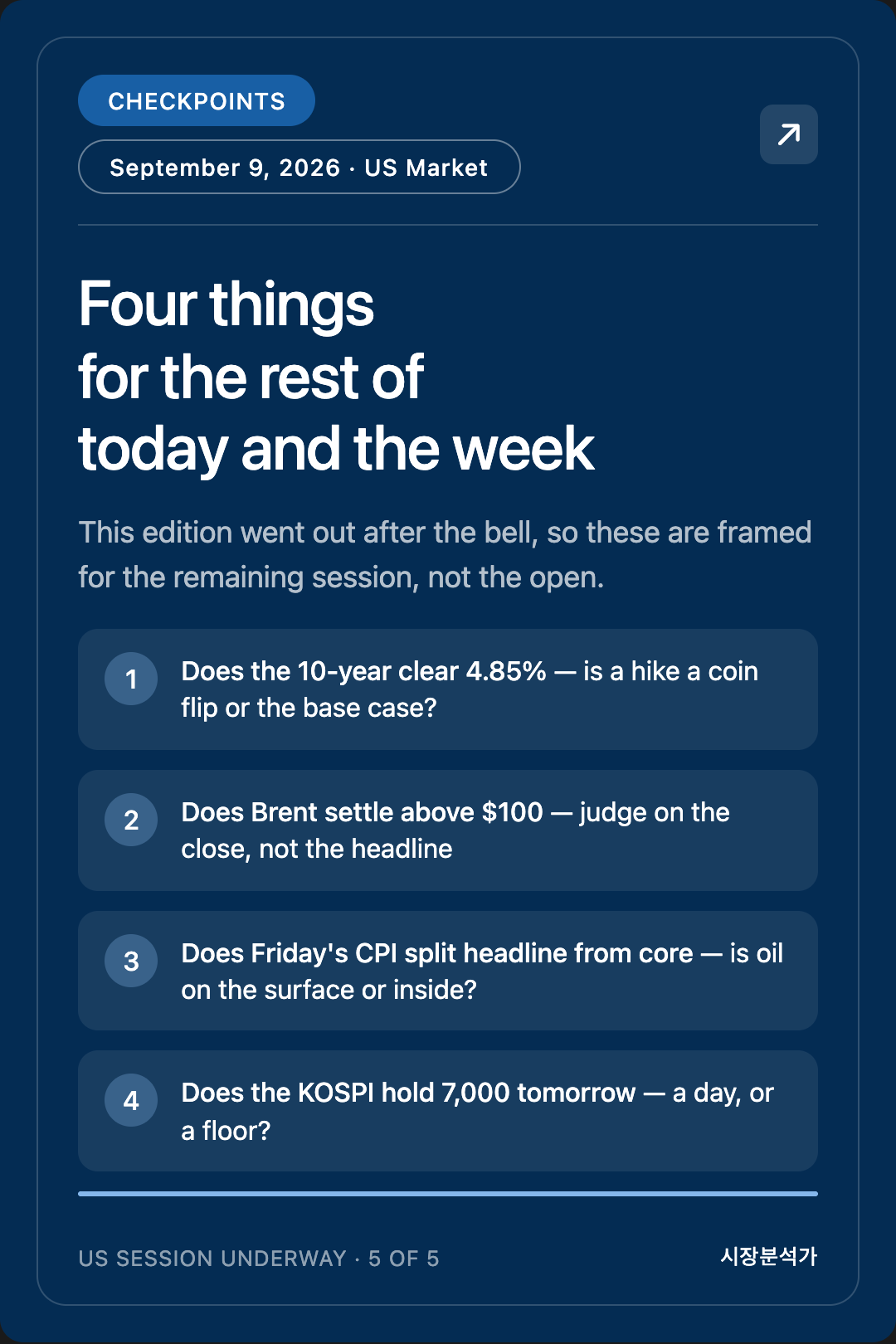
Because this edition went out after the bell rather than before it, these are framed as what to watch for the remainder of the session and the week, not what to watch at the open.
1. Does the US 10-year clear 4.85%?
Axis — does oil move past link 3 (the Fed) and settle into link 4 (rates)?
It sits at 4.79–4.81%. Above 4.85% would say the market has moved a September hike from a coin flip to the base case; back under 4.75% would say it is treating the oil shock as temporary. The five-year high at 4.92% is the gate above that.
2. Does Brent settle above $100?
Axis — is $100 a break or a base?
The principle this brief has applied to the KOSPI's 7,000 line for two weeks applies to oil unchanged. Judge on the close. The number that enters next week's FOMC arithmetic is not the "Brent tops $100" headline — it is whether it finishes there.
3. Does Friday's CPI split headline from core?
Axis — which layer of inflation does oil land in?
Oil hits headline inflation immediately and core inflation only with a lag. Headline up with core quiet leaves the Fed room to call it a transitory supply shock; both up together hardens the case for a hike. That split is the real determinant of the September 16 decision. (Unpacked in the study note below.)
4. Does the KOSPI hold 7,000 tomorrow?
Axis — was today's recapture a day or a floor?
Today closed at 7,051.64, back above 7,000 for the first time in 33 sessions. Another close above it tomorrow means the level has been claimed; giving it back makes this a fourth failure. And this time how New York finishes tonight feeds directly into that — Korea closed today before the US even opened.
[INTERPRETATION] What is left this week
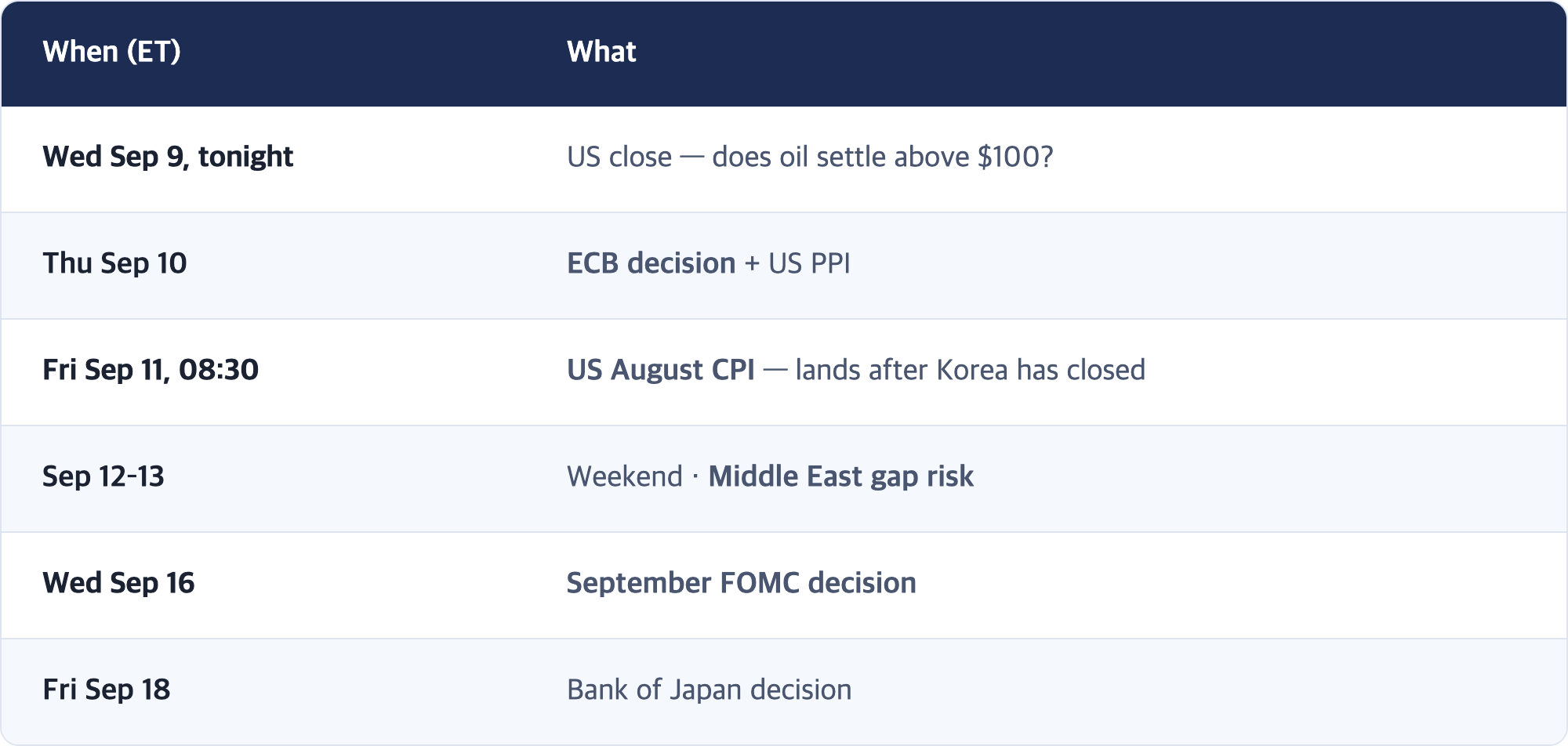
This weekend carries more gap risk than the last two. What is underway in the Gulf is a tit-for-tat campaign against shipping, and that kind of event does not pause for the weekend. Friday's CPI and a weekend of geopolitics sit back to back.
Do not read this as a directional call. It says where the calendar sits, not which way anything goes.
📖 Study Note — Why an Oil Shock Translates Straight into "Rate Hike"
Knowing this structure changes how Friday's numbers read.
The concept — supply shocks and demand shocks hand a central bank opposite problems
Prices rise for broadly two reasons.
Demand shock — people are spending more, so prices rise. The central bank's answer is easy: raise rates, and both the inflation and the overheating cool. One remedy, two problems solved.
Supply shock — it costs more to make or move things, so prices rise. Today's oil is this. Here the answer is hard: raise rates and inflation expectations settle, but growth weakens further. One remedy, one problem solved and one made worse.
That second case is what gets called a stagflationary shock: prices up, growth down, at the same time.
The analogy — two reasons for a fever
If a fever comes from an infection, antibiotics are the answer. Cause and cure line up.
If the fever comes from the room being too hot, antibiotics do nothing for the temperature and something bad to the patient. The answer is to open a window — and that is not a thing a doctor can do.
To a central bank, oil is the hot room. No amount of tightening reopens the Strait of Hormuz. And yet they tighten anyway. The reason is that if the heat lasts, people start believing the room is simply a hot room.
That belief is inflation expectations. More dangerous than oil rising is people concluding that prices will keep rising and setting wages and prices accordingly. When a central bank raises rates into a supply shock, it is not trying to move the oil price. It is trying to break that belief.
In practice — which is why headline and core are read separately
Headline inflation includes energy and food. When oil rises, it rises immediately.
Core inflation strips both out. Oil does not enter it directly. Over time it seeps in indirectly and with a lag, through freight, electricity, plastics feedstock and the like.
So here is what to look for on Friday.
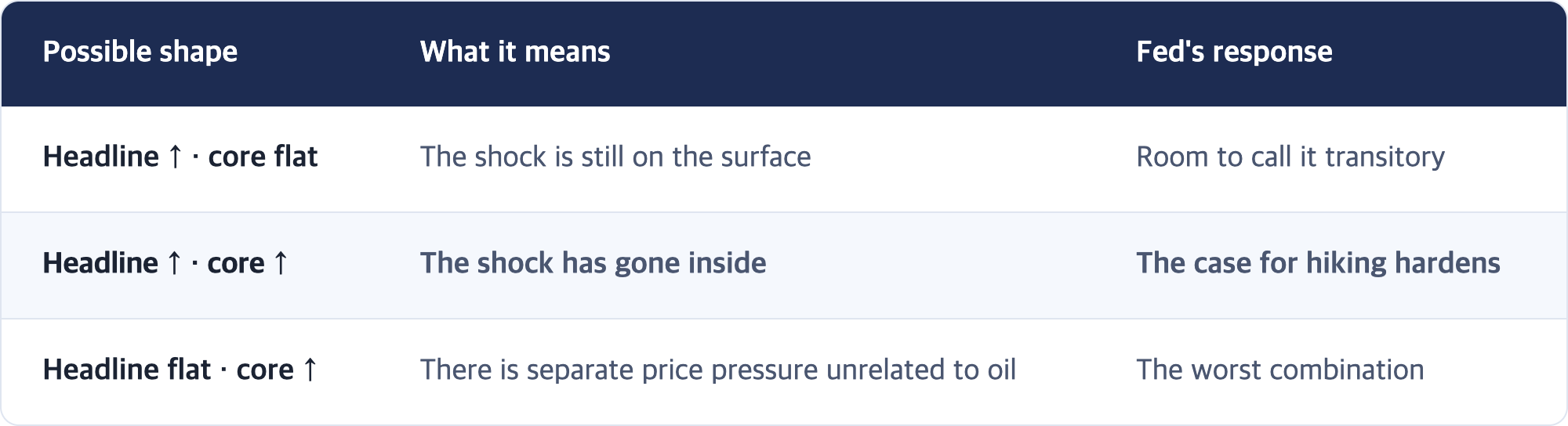
When Warsh cited PCE at 3.7% at Jackson Hole and added that comparable CPI measures are elevated too, he was already looking at the second row. Friday's numbers confirm that read or overturn it.
⚠️ Corrections and Open Items
1. 🔴 This edition ran 3 hours 55 minutes late. Scheduled 05:30 PDT, actually started 09:25 PDT — after the US open (06:30 PDT / 09:30 ET). The "before the US open" framing and the actual publication time do not match. US figures were replaced with live intraday prints rather than futures, and the checkpoints were rewritten for "the rest of the session and the week" instead of "at the open." Yesterday's PM edition ran on time, so this looks specific to the AM schedule — next edition will check the run time to see whether it repeats.
2. 🔴 SK Hynix's share price differs by a factor of ten across sources. Today's source prints ₩162,200 (+₩5,200, +3.31%); yesterday this brief cited roughly ₩1.79 million (intraday ₩1,889,000). Whether that is a typo, a different security or a different unit could not be determined. Only the percentage move was used; the level was left blank. To be resolved next edition.
3. 🔴 September FOMC hike odds still could not be reduced to a single number. This edition found CME FedWatch at roughly 56–57.5%, Kalshi at 48%, Polymarket at 49% — a spread of up to 9.5 points. The text uses the 48–57.5% range. Third consecutive edition unresolved. The interpretation ("coin flip") is the same under all three, so the reading is unaffected.
4. 🔴 The August CPI consensus conflicts across sources. Yesterday this brief carried headline +2.9% year over year (+0.3% monthly) with core at +3.1%. This edition found another compilation at 3.4% headline (with its own estimate at 3.34%). A half-point gap is large enough to change the interpretation, so neither was adopted alone. The checkpoint was rewritten to key off the headline-versus-core split rather than an absolute level. To be pinned to the pre-release BLS consensus next edition.
5. The buy-side ratio uses a different reporting unit than prior editions. September 7 (0.81x) and September 8 (0.43x) came from a source reporting in trillions of won; today's figure (≈0.99x) comes from one reporting in hundreds of millions. Ratios are unit-free, but there is no guarantee both cover the same universe, so only the direction (above 0.6x) was used.
6. All September 9 US figures are intraday, not closes. The S&P 500 at 7,629.41, the Dow's 400-point decline and the Nasdaq 100's roughly 1% drop are as of about 12:25 ET. Confirmed closes will appear in tonight's Korea-open edition.
7. VIX intraday change for Sep 9 differs across sources — one shows +2.75% (15.72), another +5.47%. Only the confirmed September 8 close (15.72) is cited; no September 9 intraday value was used.
8. Brent's exact session high is unconfirmed — sources give $100.44, $100.75 and "above $101." The text uses $100.75 (+$2.83) as the reference and treats the $101 break as a factual statement only.
9. European closes were not obtained. The DAX at 25,662 (−1.3%) and FTSE 100 at 10,746 (−65) are intraday European levels as of the US pre-open.
10. The SOX index close remains unobtained for a second consecutive edition.
🔗 Sources
- Seoul Economic Daily, "KOSPI Closes Up 1.40% at 7,051.64"
- Businesskorea, "KOSPI reclaims 7,000 on combined foreign and institutional buying" — flows, single names, FX
- The Korea Times, "KOSPI reclaims 7,000 as chip gains offset oil price worries"
- SBS News — KOSDAQ 830.37 (+2.28%)
- Money Today — won at 1,336.1, down 9.5
- Investrade, "Morning Preview: September 09, 2026" — futures, Asia, Europe, commodities, rates
- Trading Economics, US Stock Market — S&P 500 intraday 7,629.41 (−0.57%) and session commentary
- CNBC, "Dow slides 400 points as rates jump, international crude price tops $101"
- CNBC, "Oil prices today: WTI, Brent, U.S.-Iran" — Brent above $100, Goldman's $120 scenario
- CNBC, "Brent crude oil hits $98 after Iran's Houthi allies attack multiple Saudi energy facilities" — Jazan refinery
- CNBC, "10-year Treasury yield briefly ticks back above 4.8% as oil prices rise"
- CNBC, "10-year U.S. Treasury yield hits highest level since November 2023"
- CNN, "US military strikes three Iranian tankers in retaliation for missile attacks"
- CNN Politics, "Tehran threatens vessels in Bahrain, Kuwait after US strikes Iranian tankers near Kharg Island"
- Washington Post, "U.S. says it hit 3 Iranian oil tankers, including one near Kharg Island"
- Washington Post / AP, "How major US stock indexes fared Tuesday 9/8/2026"
- NPR, "Fed's Kevin Warsh warns inflation is too high, sparking bets rate hikes are coming"
- CNBC, "September Fed decision is now a coin flip as rate hike odds increase" · Yahoo Finance, "FOMC September 2026 Odds for a Rate Hike Surpass 50%"
- ATFX, "September FOMC Meeting 2026" — meeting dates
- Nowflation, CPI Release Dates — September 11 release and consensus
- Tech Startups, "Top Tech News Today, September 9, 2026" — Meta Muse, Alphabet Finland
- FXStreet, "Economists agree: ECB to hike rates on September 10 – Reuters poll"
※ This brief is market observation and interpretation, not a recommendation to buy or sell any security. Figures are as of the time of writing, and all September 9 US values are unconfirmed intraday prints.
📌 More market briefs
※ This post is market observation and organization intended to support your own judgment. It is not a recommendation to buy or sell any security. Figures are as of the time of writing and may differ between sources.
If this was useful, bookmark it or pass it along. It genuinely helps me write the next one.
I can survive. We can survive.