Sept 30, 2026 US Market Brief — Nasdaq and S&P 500 Before the Open
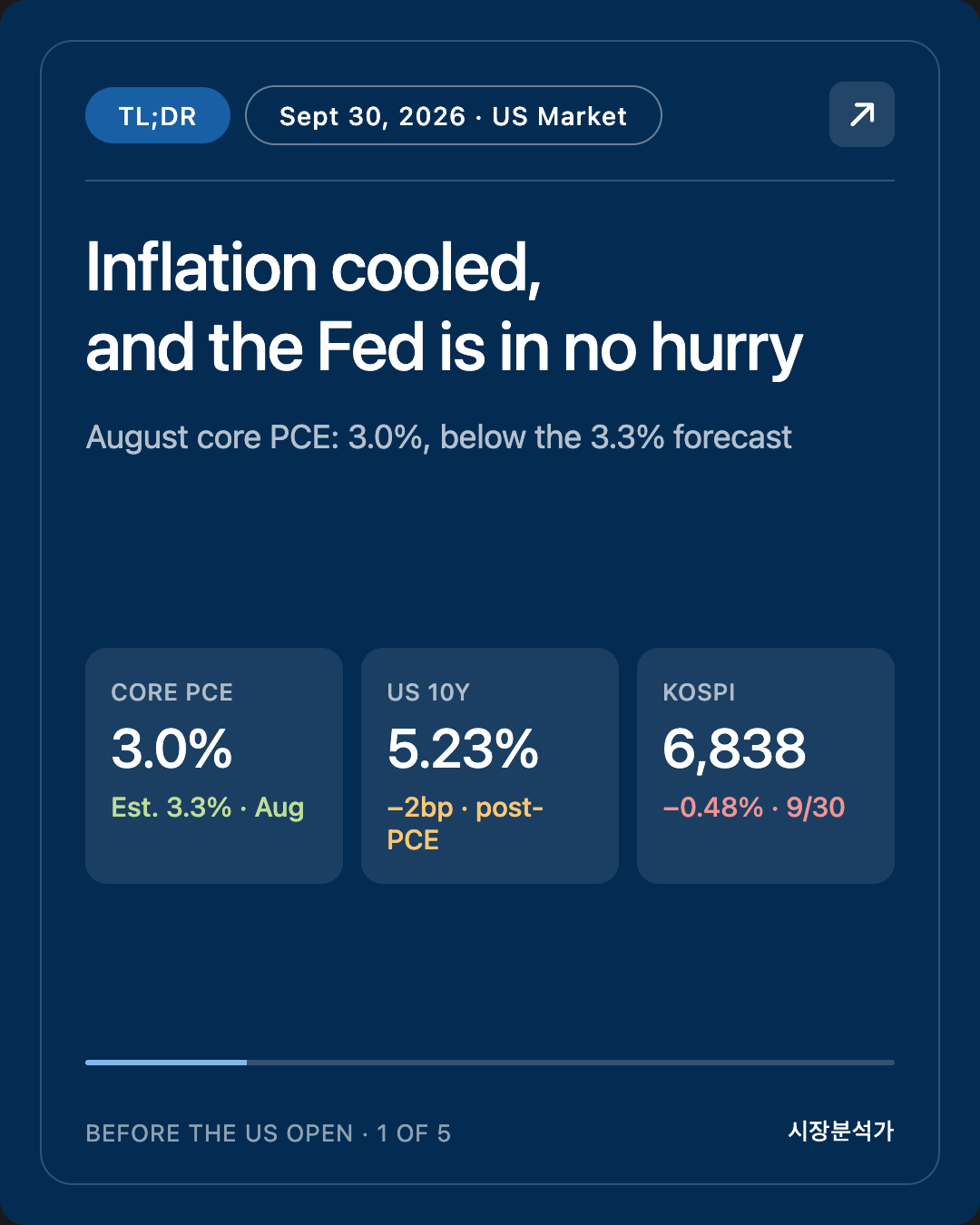
- ★ August PCE cooled sharply. Headline +0.3% m/m, 3.4% y/y; core +0.2% m/m, 3.0% y/y. Forecasts were +0.4%/3.7% and +0.3%/3.3%. All four came in below expectations.
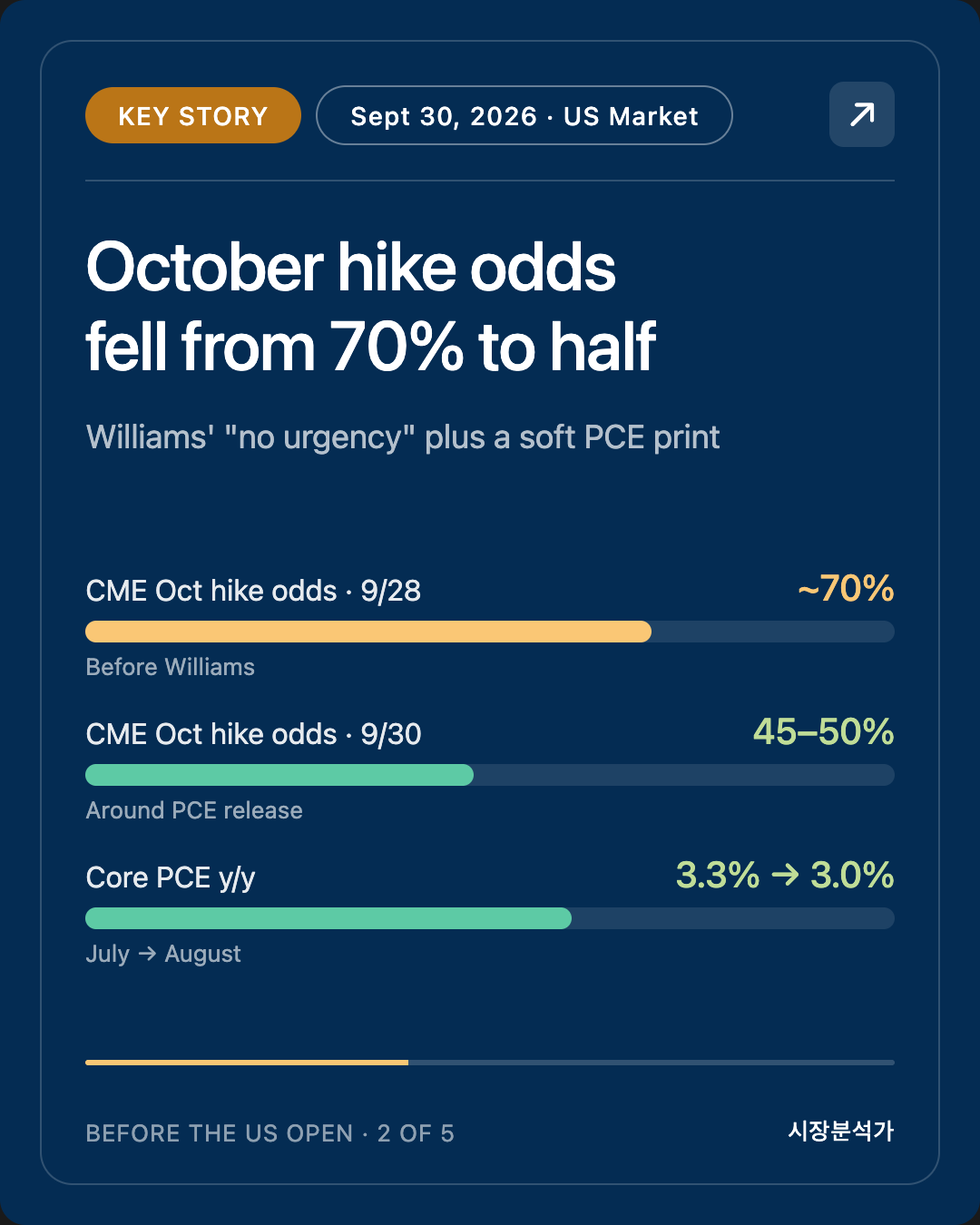
- ★ The Fed had already eased its tone. Williams (9/29): "With the policy action we took at our September meeting, there is no need for urgency." One more hike this year remains his base case. CME October hike odds around 45–50% (about 70% on 9/28).
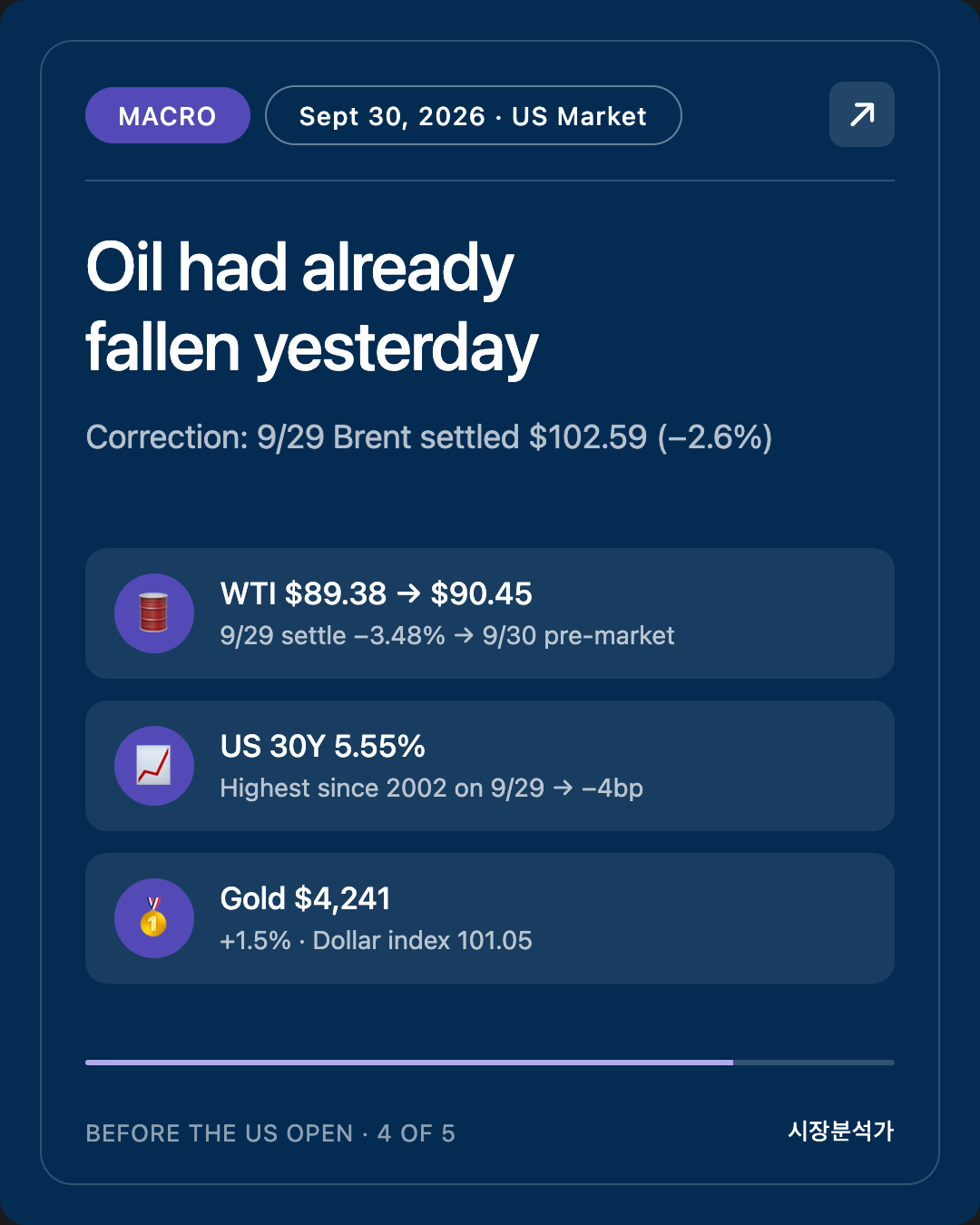
- Bonds moved a little; stocks moved more. 10-year 5.22–5.23% (−2 to −3 bp), 2-year 4.88% (−1 bp), 30-year 5.55% (−4 bp). Futures: Dow about +180 points (+0.3%), S&P about +0.4%, Nasdaq-100 about +0.4%. Gold $4,241 (+1.5%).
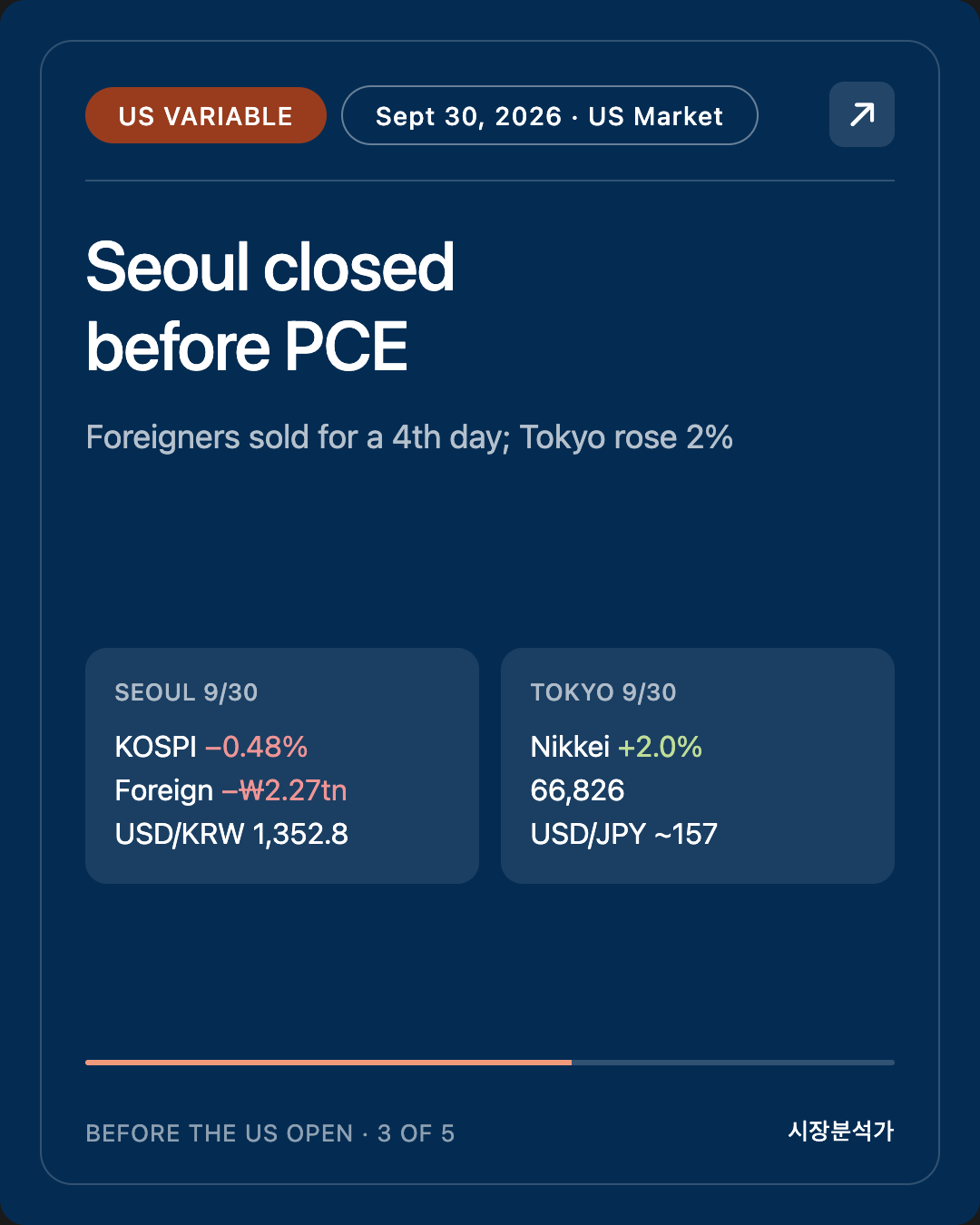
- Seoul closed before PCE. KOSPI 6,838.04 (−0.48%) after touching 6,965.64 intraday. Foreigners −₩2.27tn (fourth day), institutions −₩0.86tn, retail +₩1.45tn. Samsung Electronics −1.47%, SK Hynix +0.6–1.1% (sources differ). The won firmed to 1,352.8 per dollar (−3.9).
- Tokyo went the other way, +2.0%. Nikkei 66,826 with the yen weaker near 157. Hang Seng 24,472 (−0.2%), Shanghai 3,840 (+0.3%). Europe: STOXX 600 +0.7%, DAX +0.7%. Micron reports after today's close.
This is Mr. Can. Here is the Sept 30, 2026 brief ahead of the US market open.
Written: 2026-09-30 05:51 PDT (Korea 9/30 21:51 KST)
Basis: US 9/29 official close and oil settlements + Seoul, Tokyo, Hong Kong and Shanghai 9/30 close + Europe 9/30 intraday + US 9/30 pre-market (just after the PCE release)
🟢 Scheduled for 05:30 PDT, work began at 05:45 PDT. US figures are pre-market and include the August PCE report released at 05:30 PDT.
🔴 One correction. Our 9/29 evening (Korea-open) edition put Brent at about $105.3–105.5 (+0.2%) and said oil was "flat." That was wrong. The 9/29 settlements were Brent November $102.59 (−2.6%) and WTI November $89.38 (−3.48%). Details in Section 7.
SEO Intro
The Fed's preferred inflation gauge cooled more than expected in August. Headline PCE inflation came in at 3.4% year over year (forecast 3.7%), and core PCE, which strips out food and energy, at 3.0% (forecast 3.3%). Both fell 0.3 percentage points from July.
The day before, New York Fed President John Williams said there was "no need for urgency" to raise rates again. Together, the two pieces of news pulled the odds of an October hike from roughly 70% down to 45–50%. The 10-year Treasury yield eased to 5.22–5.23%, and S&P 500 futures rose about 0.4%.
Seoul closed before any of this. The KOSPI fell 0.48% to 6,838.04 as foreign investors sold for a fourth straight day (₩2.27 trillion, about $1.7 billion). The question for today's US session is simple: will long-term yields believe the cooler inflation data, or only short-term rate expectations?
1. Checkpoint Scorecard
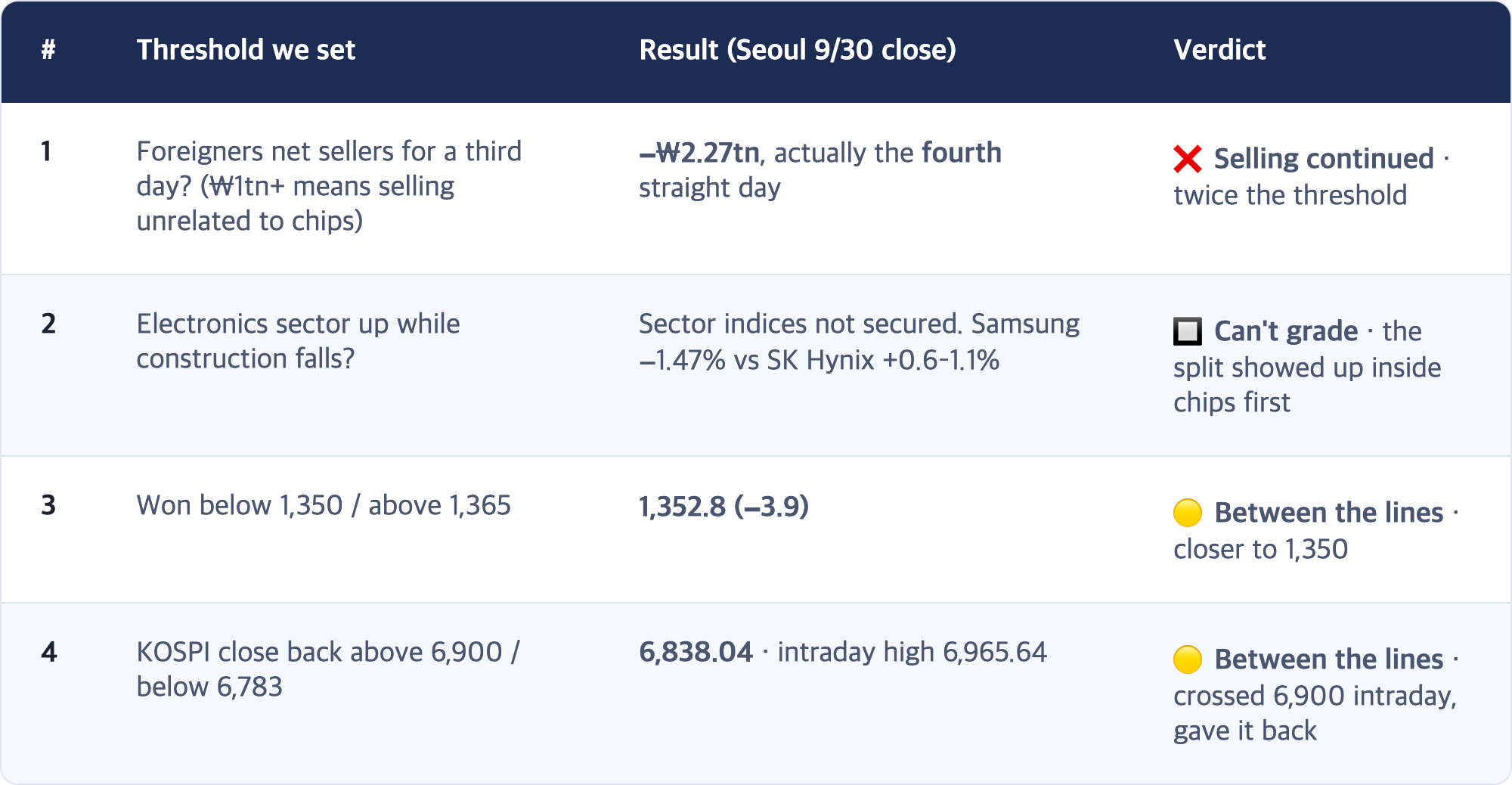
Four checkpoints from the 9/29 evening edition (Korea 9/30 close)
The question was: would Seoul follow the overnight chip rebound, or react more to record long-term yields?
[Interpretation] The chip rebound didn't last a full day in Seoul
Checkpoint 1 is the clearest. SK Hynix's US-listed shares rose 2.6% overnight and the SOX gained 1.3%, yet foreigners still sold more than ₩2 trillion in Seoul. By the rule we wrote down, the foreign selling now looks more like position cutting for other reasons (rates, quarter-end) than a verdict on chips.
Checkpoint 3 adds a caveat. Foreigners have sold over ₩8 trillion in four days, yet the won has strengthened two days in a row (1,365.1 → 1,356.7 → 1,352.8). The money doesn't appear to be leaving Korea yet. It looks more like trimming stocks while staying in won assets.
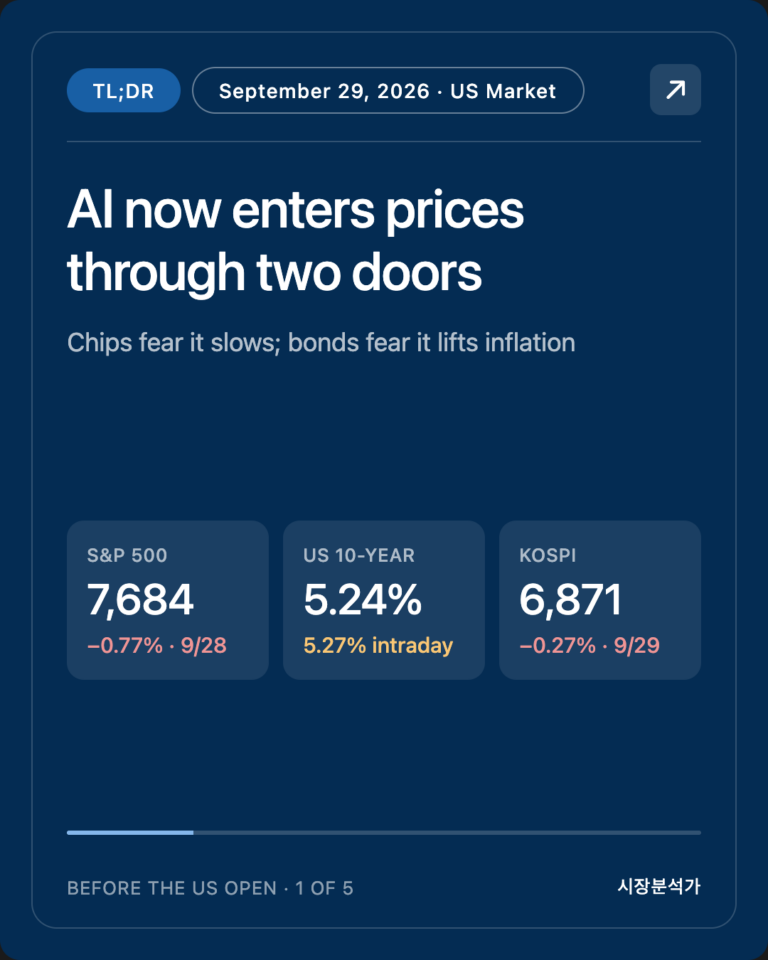
Checkpoint 4 is about the shape of the day. The index rallied to 6,965 in the morning with chips, then fell back in the afternoon on "global rate pressure and foreign selling" (local reports). The "two doors" we described yesterday, chips and rates, opened in Seoul in the same session: one in the morning, one in the afternoon.
2. Today's Key Story: Inflation Cooled. Will Long-Term Yields Believe It?
[Fact] August PCE (released 9/30, 05:30 PDT)
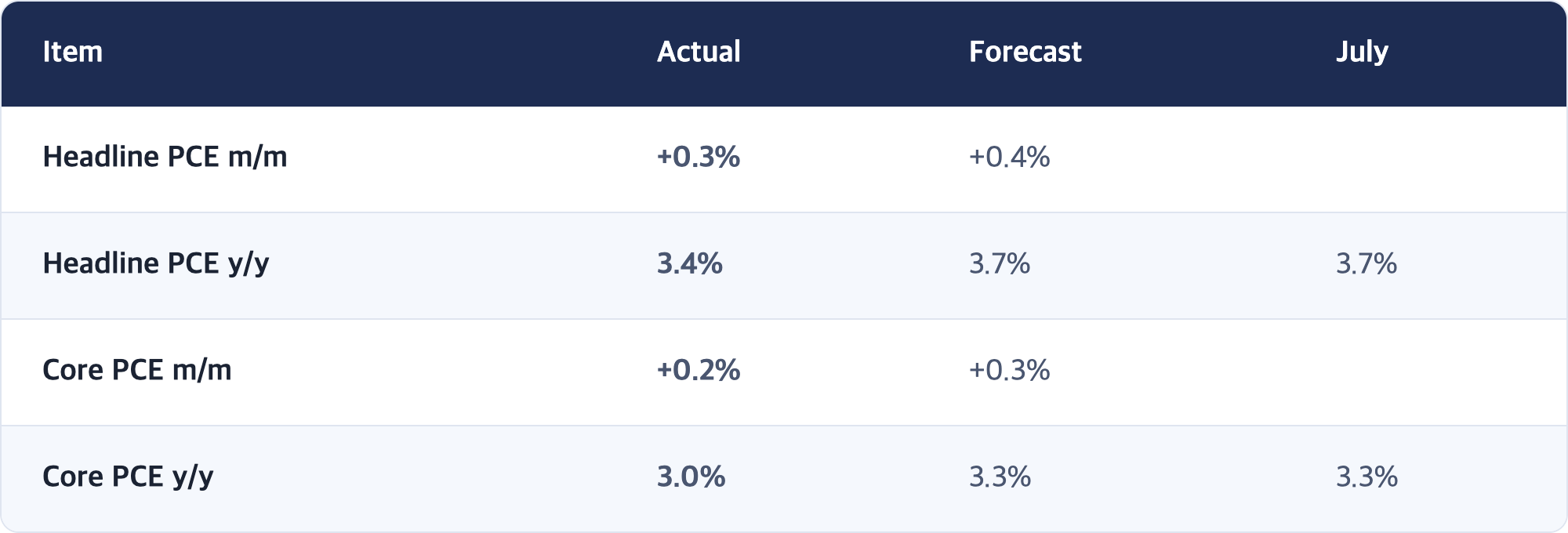
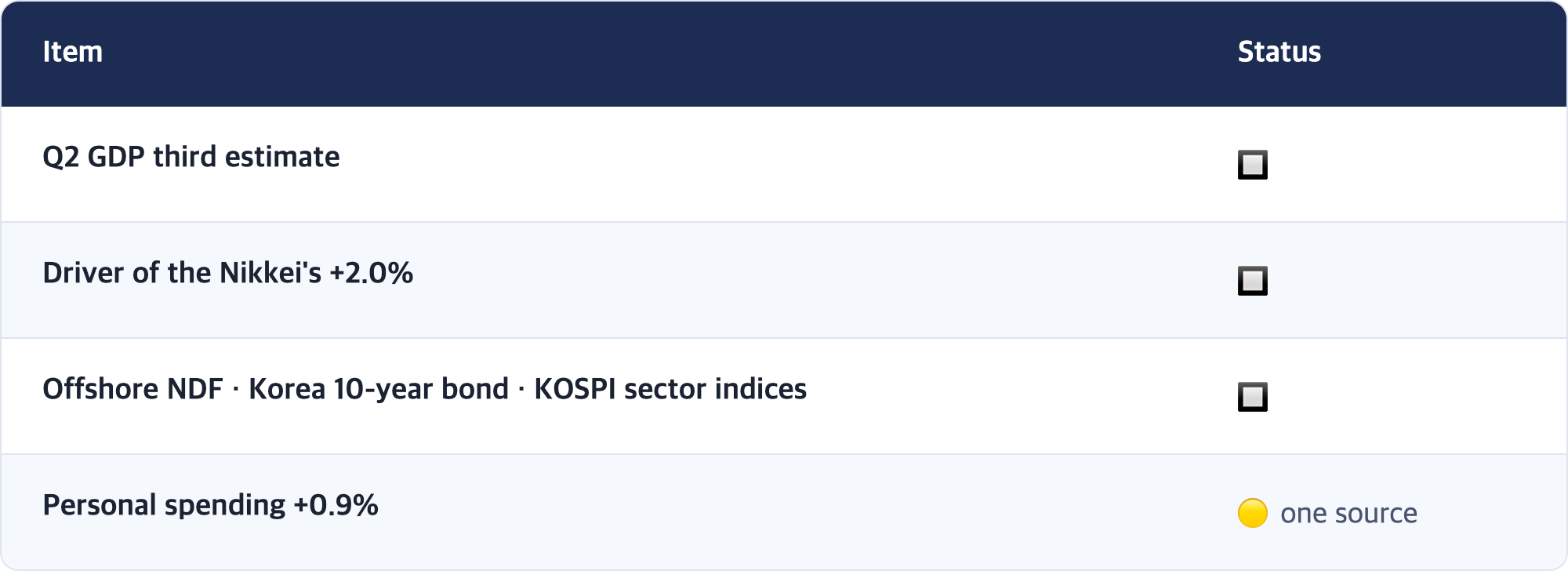
- Personal income +0.2%, personal spending +0.9% (one source; needs confirmation).
- The third estimate of Q2 GDP was released at the same time, but we could not secure the figure for this edition (the second estimate was 1.5%).
[Fact] Before and after the release
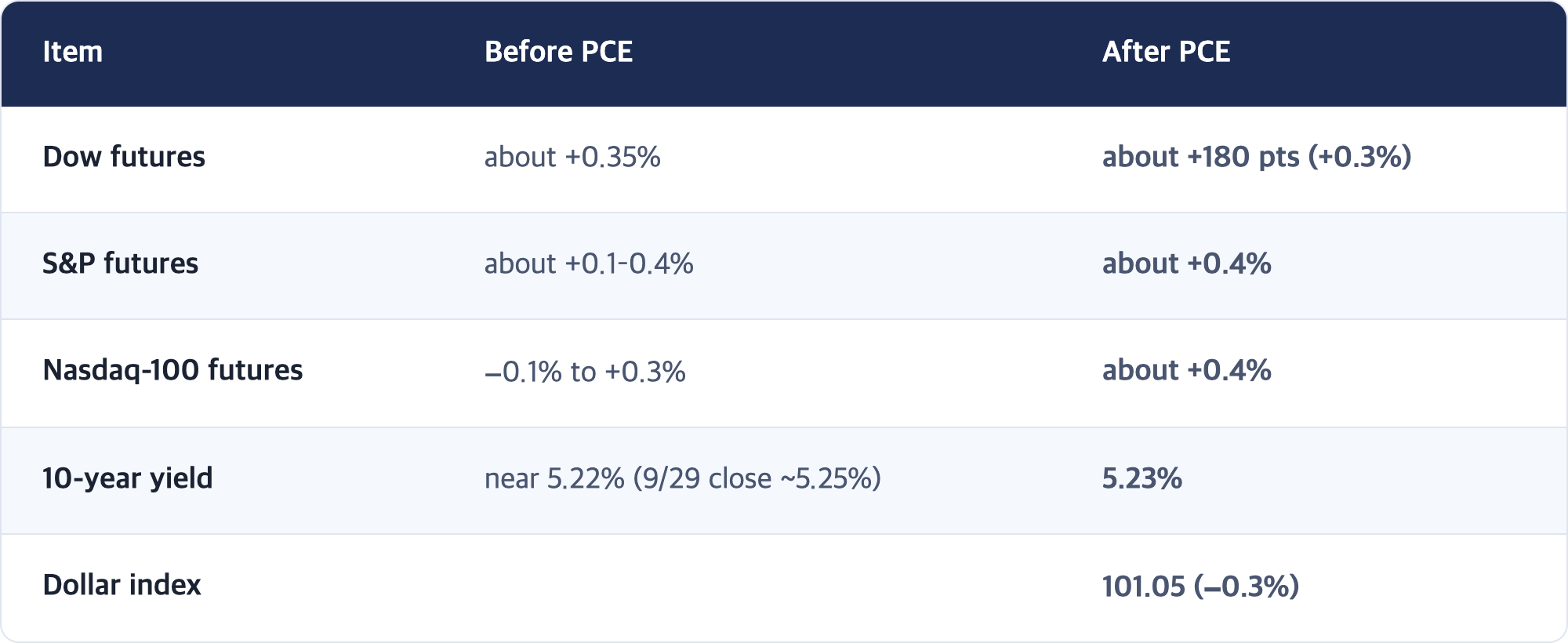
★ [Interpretation] Both pieces of news hit the short end first
Williams' "no urgency" and the soft PCE are both about what the Fed does next month. That's why the biggest move was in October hike odds (70% → 45–50%).
Bonds have barely moved. The 10-year is down only 2–3 bp and still sits in the 5.2% range, near its highest since 2007. As yesterday's study note explained, long-term yields care less about "the Fed next month" and more about "inflation and government debt over the coming decades." One month of cooler inflation doesn't remove that term premium overnight.
[Observation] That's where today's real test lies. Stock indices respond to short-term rates (hike odds), while rate-sensitive sectors and Korean growth stocks respond to long-term yields. If both ease together, we may have seen this week's peak in rate pressure. If the 30-year holds in the 5.5% range, today's bounce will have only unwound hike odds.
3. The US Variable: Foreign Selling in Seoul, a Different Story in Tokyo
[Fact] Korea and Asia, 9/30 close (15:30 KST = 23:30 PDT 9/29)
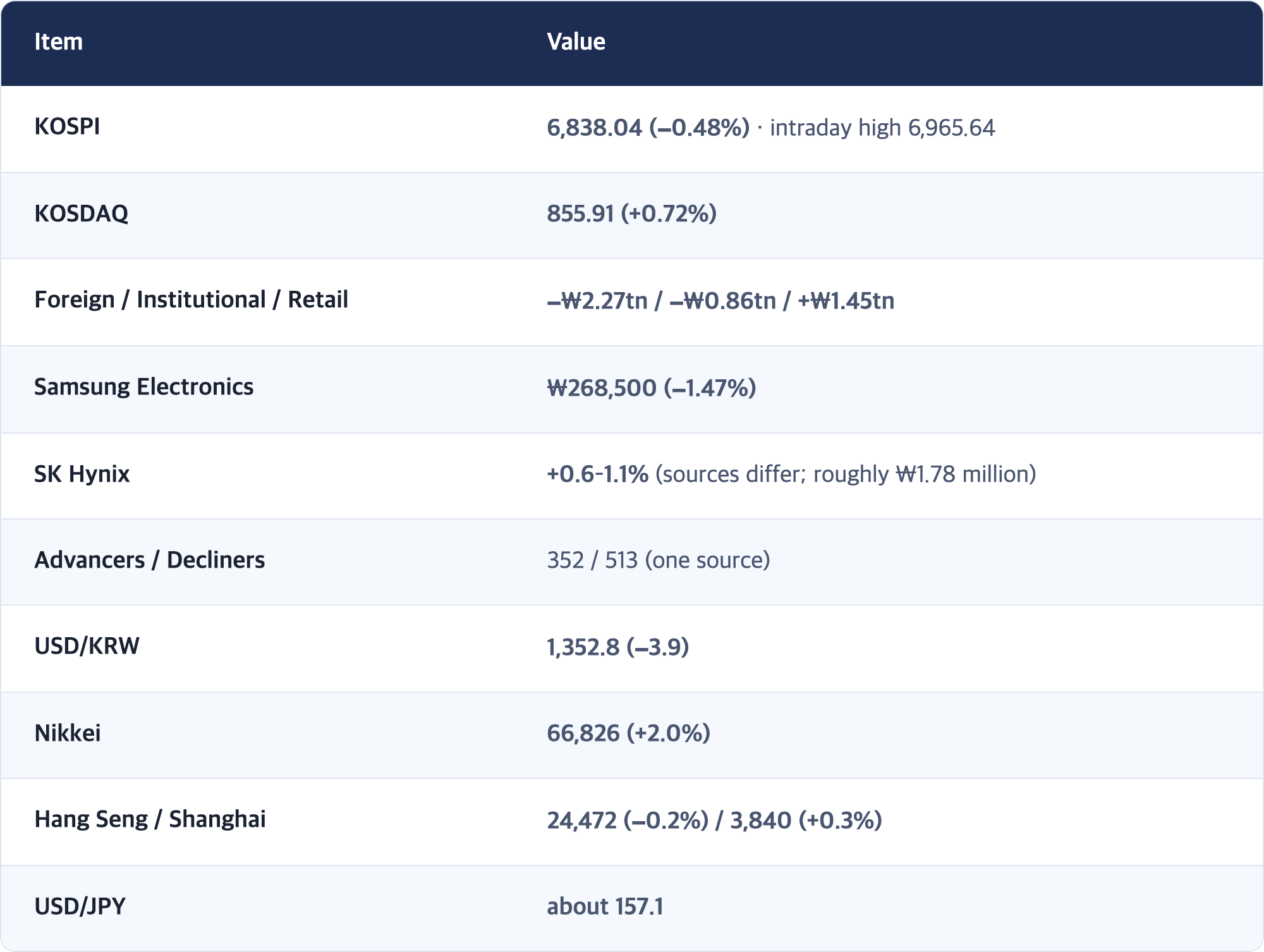
[Observation] Tokyo and Seoul moved in opposite directions
The Nikkei rose 2% while the KOSPI fell 0.5%. A weaker yen near 157 may have helped Japanese exporters, but we could not confirm the specific driver of Tokyo's rally for this edition. What's clear is that "Asia was crushed by rates" doesn't describe the day. Seoul's weakness owes a lot to Korea-specific foreign selling.
[Interpretation] What Seoul missed, and what it gets tonight
Seoul closed six hours before PCE. Applying our 9/13 rule, "time zones are information," Seoul's 9/30 close knew about Williams but not about PCE. Tomorrow (10/1) Seoul will absorb PCE and Micron's results at the same time.
4. Macro Backdrop: Oil Had Already Fallen Yesterday
[Fact]
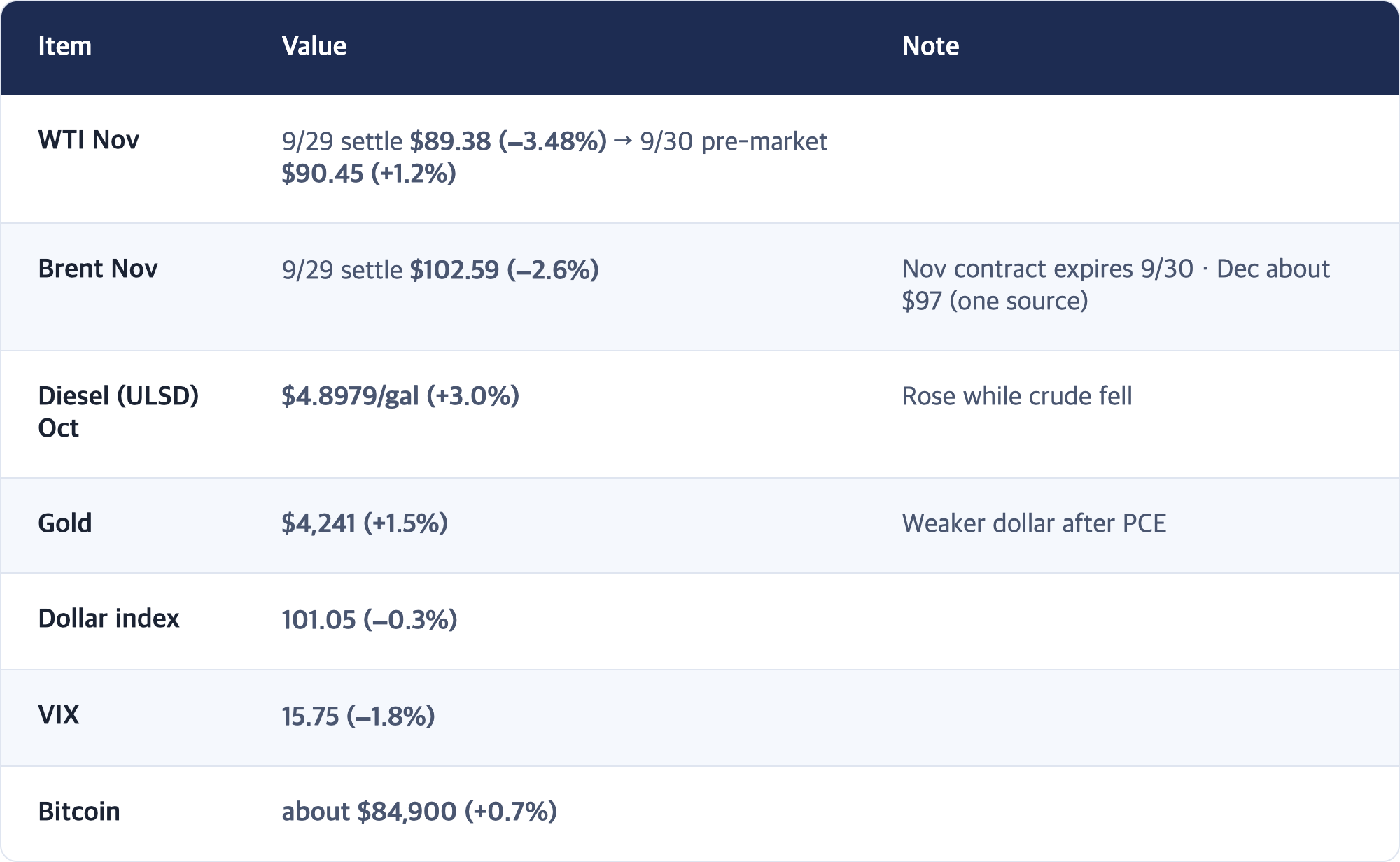
- Why crude fell (reports): Saudi Arabia partly restored its East-West pipeline, resuming Red Sea exports after a two-week pause; ship-to-ship transfers in the Gulf of Oman expanded; the 10-day average of Middle East crude exports recovered to 17.5 million barrels a day, 98% of pre-war levels.
- Diesel rose on worries about a global shortage of transport fuels.
[Interpretation] Yesterday, yields rose on a day oil fell
The correction makes the picture sharper. On 9/29, crude fell about 3% while the 30-year yield hit its highest since 2002. Our 9/29 view that "the force pushing yields higher has broadened beyond oil" was built on the wrong oil price, but with the right one it holds even more strongly. We note that separately from the correction.
Still, keep an eye on diesel. Even if crude eases, the path into inflation through transport costs remains open.
5. US Session Preview (Wed 9/30, PDT)
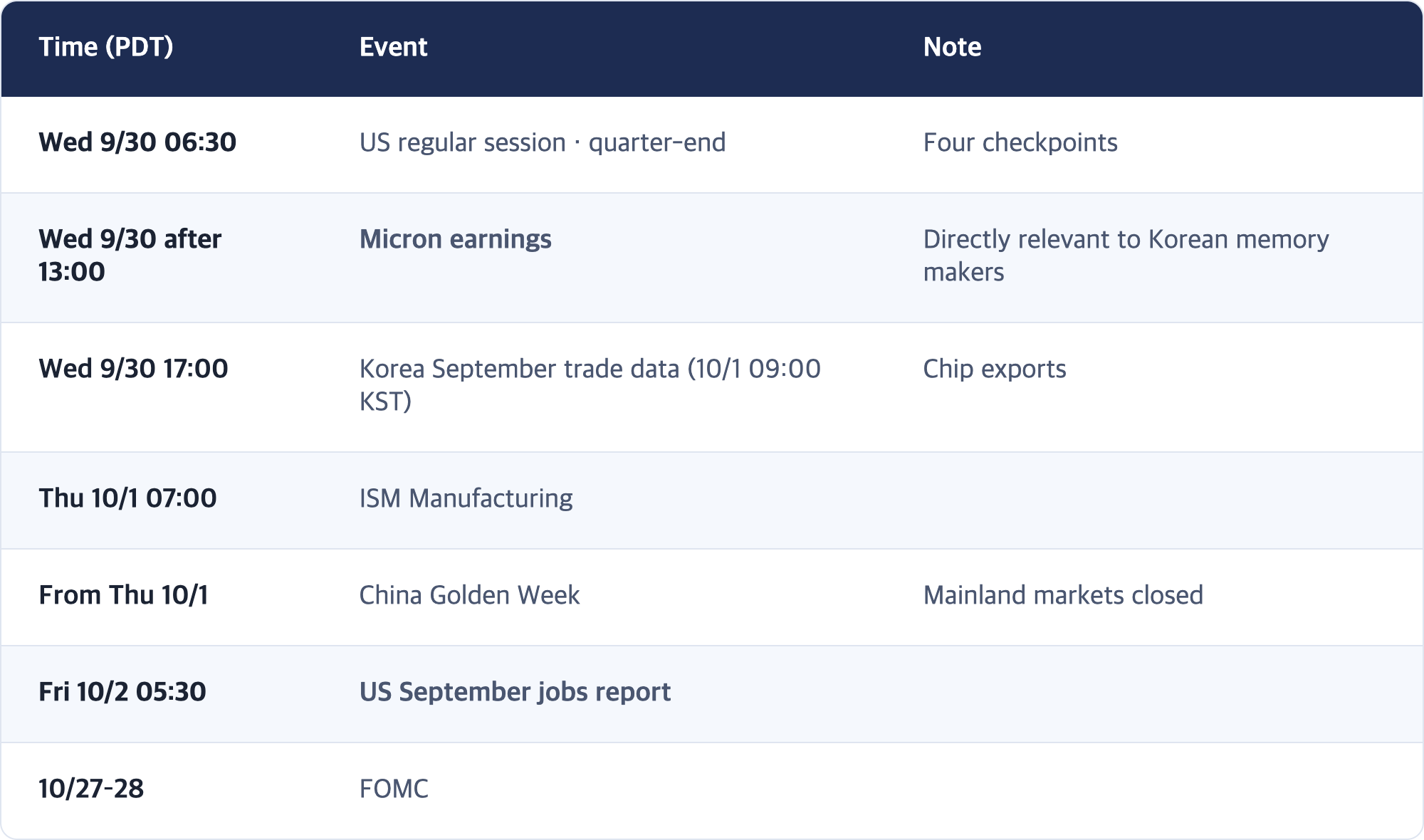
[Observation] Today and this week (PDT)
- 06:30 US regular session opens · last trading day of the month and quarter
- After 13:00 Micron fiscal Q4 results (guidance: revenue $49–51B, EPS $30–32; consensus about $50.9B and $31.49, per reports)
- 17:00 Korea September trade data (10/1 09:00 KST)
- Thu 10/1, 07:00 ISM Manufacturing
- From 10/1 China's Golden Week holiday (mainland markets closed)
- Fri 10/2, 05:30 US September jobs report
✅ Four Checkpoints (through today's US close)
The axis first. These four ask: does the PCE slowdown only lower short-term rates (hike expectations), or long-term yields (term premium) too? The answer tells us how much weight to give Korean rate-sensitive sectors and foreign flows tomorrow.
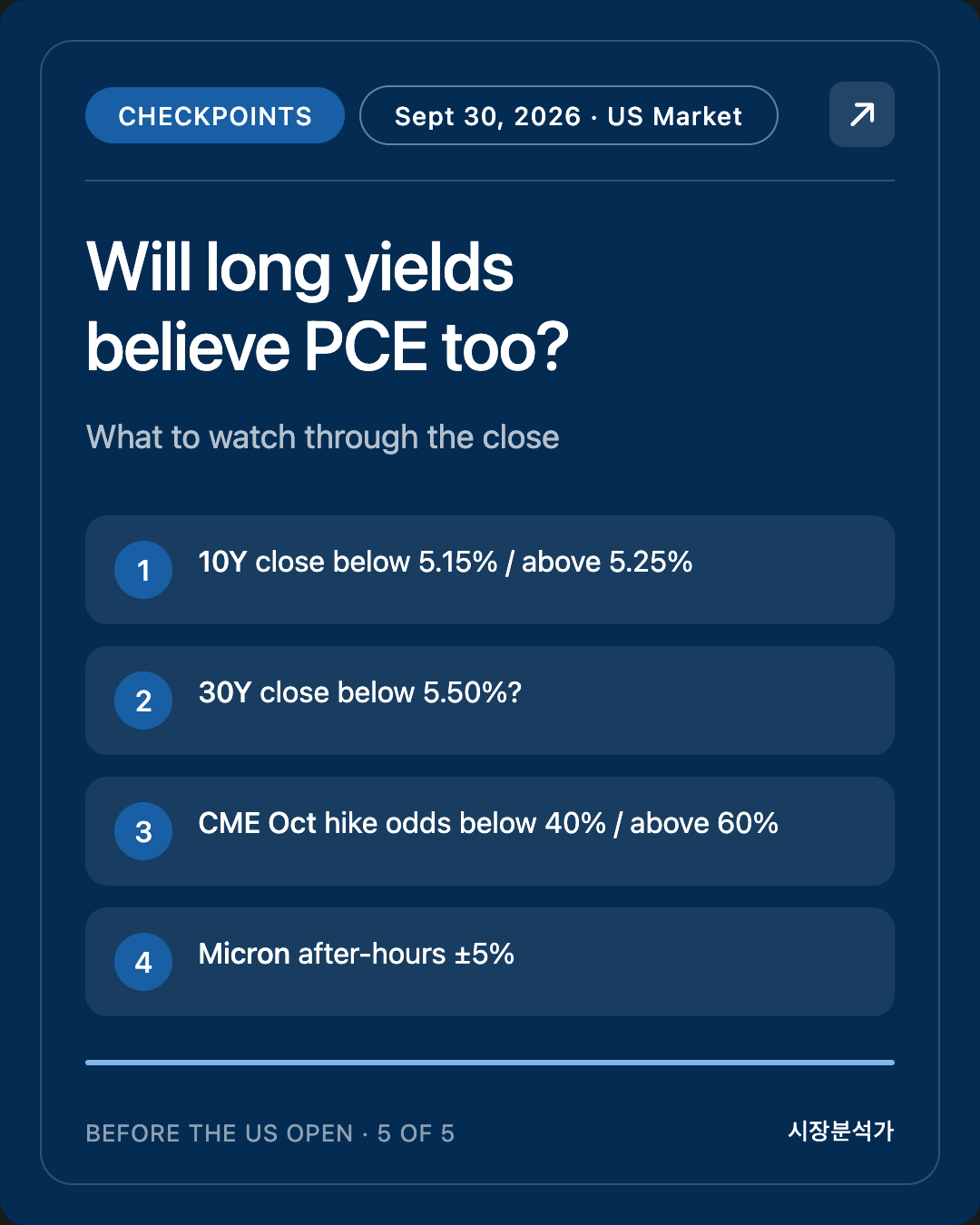
- 10-year close below 5.15% / above 5.25%. Below: long rates believed PCE too. Above: today's bounce only unwound hike odds. (Most important)
- 30-year close below 5.50%? If the 30-year falls less than the 10-year, the term premium is intact.
- CME October hike odds below 40% / above 60%. Below: PCE cemented Williams' message. Above: markets worry about "one more" again.
- Micron after-hours ±5%. Guidance already sits above consensus, so next-quarter outlook and comments on the pace of AI spending will decide the direction more than the headline numbers.
[Interpretation] Checkpoint 1 carries the most information. If long yields rose on 9/29 despite weak data because of inflation worries, today's PCE should ease them. If the driver was fiscal and term premium, it shouldn't. Today is the first day the 10-year can separate the two.
6. Study Note: Monthly Inflation Was 0.3%. Why Did the Annual Rate Drop 0.3 Points?
Concept
A year-over-year inflation rate is roughly the sum of the last 12 monthly increases. When a new month comes in, the same month from a year ago drops out. August's headline PCE rose 0.3% on the month, which is not a low number, yet the annual rate fell sharply from 3.7% to 3.4%. [Interpretation] That most likely means last August's monthly increase was bigger than this August's, and that large number fell out of the calculation. This is called a base effect.
Analogy
Suppose you weigh yourself every month and track "how much heavier than a year ago." If you gained 3 kg on vacation last August, gaining just 1 kg this August makes your "vs. a year ago" figure drop by 2 kg. Your eating habits didn't necessarily improve this August. Last August was simply unusual.
Today's example
- Year over year: 3.7% → 3.4% (a big drop)
- Month over month: +0.3% (roughly mid-3% annualized, still above the Fed's 2% target)
- Core, similar: +0.2% m/m, 3.3% → 3.0% y/y
One-line summary
Annual inflation compares "this year" with "last year." Whether inflation is truly cooling shows up in several consecutive low monthly readings. Today's core +0.2% is a good start, but it's one month.
7. Corrections and Open Items
🔴 Correction: oil prices in the 9/29 evening edition
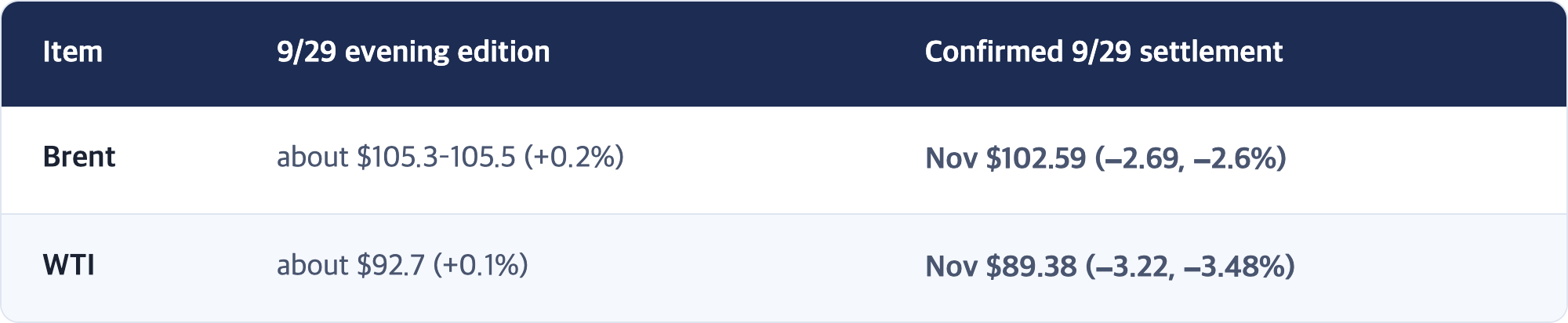
- The 9/29 edition saw a data set showing "WTI 88.87–89.25, Brent about 96" but set it aside as a possible different contract month. Checking the settlement source (DTN) shows that set was closer to right.
- We withdraw the "oil was flat" statement. As Section 4 explains, the view that yields are being pushed by more than oil stands, and is stronger.
- Re-grading the 9/29 morning checkpoint 4 (Brent above 105 / below 102): still 🟡 between the lines, but just above 102 (by $0.59), not just above 105.
Source discrepancies (values used in this report)
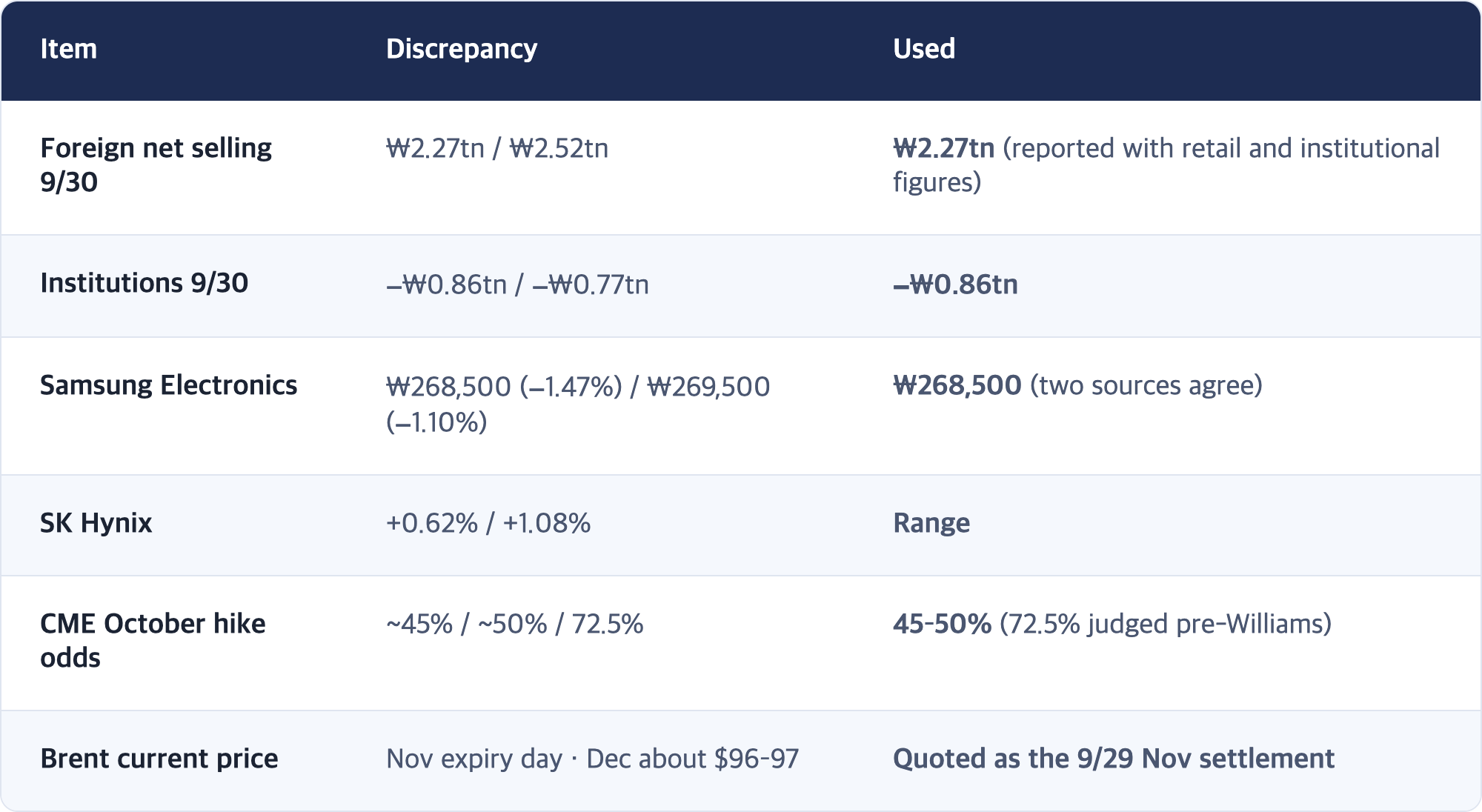
🔲 Unconfirmed
8. Event Calendar (PDT)
Sources
- August PCE: Fed's favored inflation gauge rose less than expected | Fox Business
- US core PCE inflation softens to 3% in August vs. 3.3% expected | FXStreet
- Dow futures jump 200 points after data shows a big inflation slowdown last month | CNBC
- Stock market today: futures little changed ahead of PCE inflation data | Yahoo Finance
- Pressure on U.S. Treasurys eases after 30-year yield hits highest level since 2002 | CNBC
- 'No need for urgency': New York Fed's Williams squashes notion of an October rate hike | Yahoo Finance
- Fed's Williams Sees No Urgency for Next Fed Rate Hike | US News/Reuters
- Oil Tumbles on Red Sea Flows; Diesel Reverses Higher | DTN
- Brent crude oil | Trading Economics
- Market Pulse – September 30, 2026 | NordFX
- Micron (MU) Stock: Wall Street's Outlook for Sept 30 Q4 Earnings | parameter.io
- KOSPI close, Sept. 30 | Newspim (Korean)
- KOSPI market close | BusinessKorea
Market Analyst · We do not make buy or sell recommendations on individual stocks. This report offers macro context and interpretation.
📌 More market briefs
※ This post is market observation and organization intended to support your own judgment. It is not a recommendation to buy or sell any security. Figures are as of the time of writing and may differ between sources.
If this was useful, bookmark it or pass it along. It genuinely helps me write the next one.
I can survive. We can survive.