September 7, 2026 US Market Brief — Nasdaq and S&P 500 Before the Open
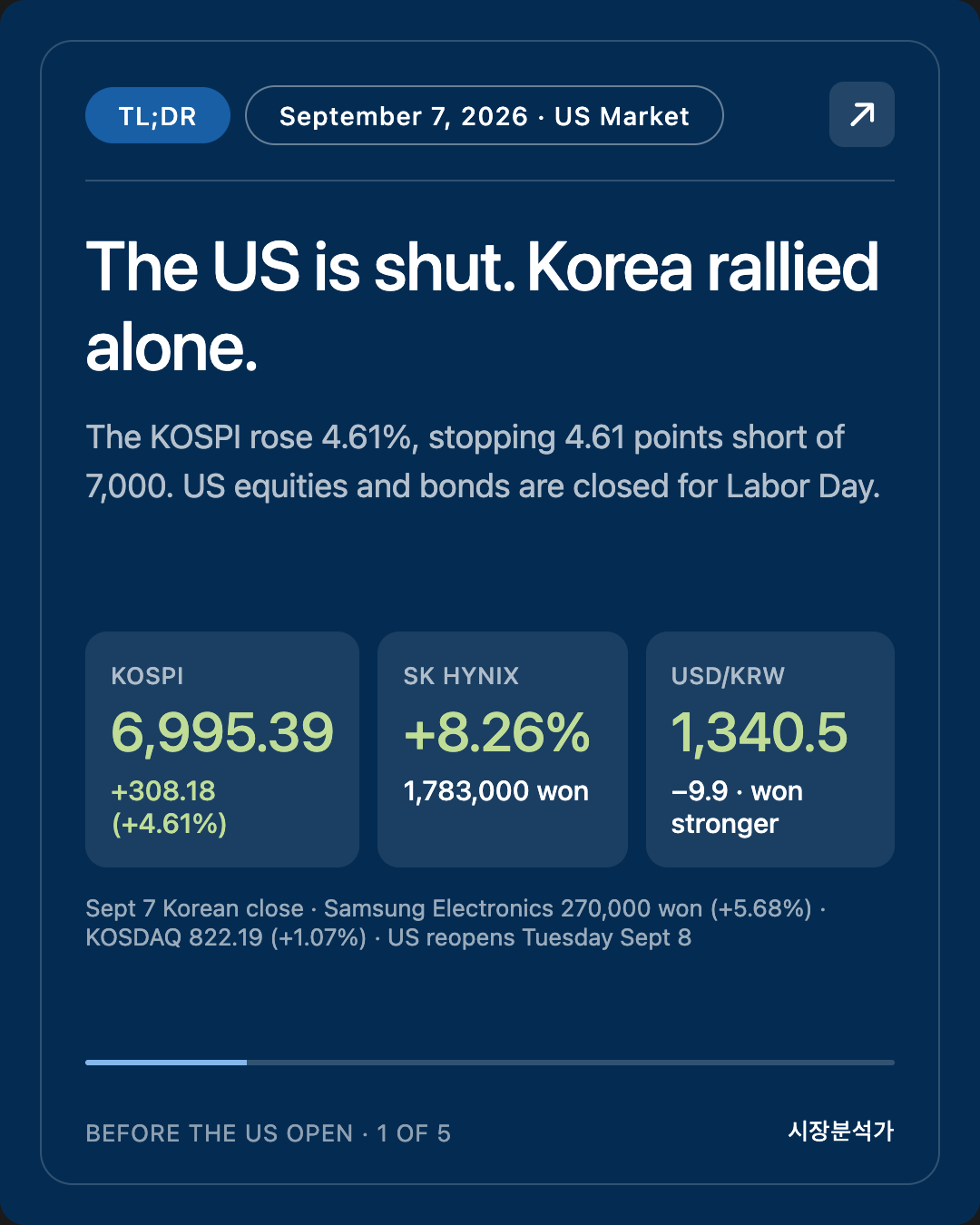
- KOSPI 6,995.39 (+4.61%, +308.18 points). KOSDAQ 822.19 (+1.07%). Samsung Electronics 270,000 won (+5.68%), SK Hynix 1,783,000 won (+8.26%). The won strengthened to 1,340.5 per dollar (−9.9).
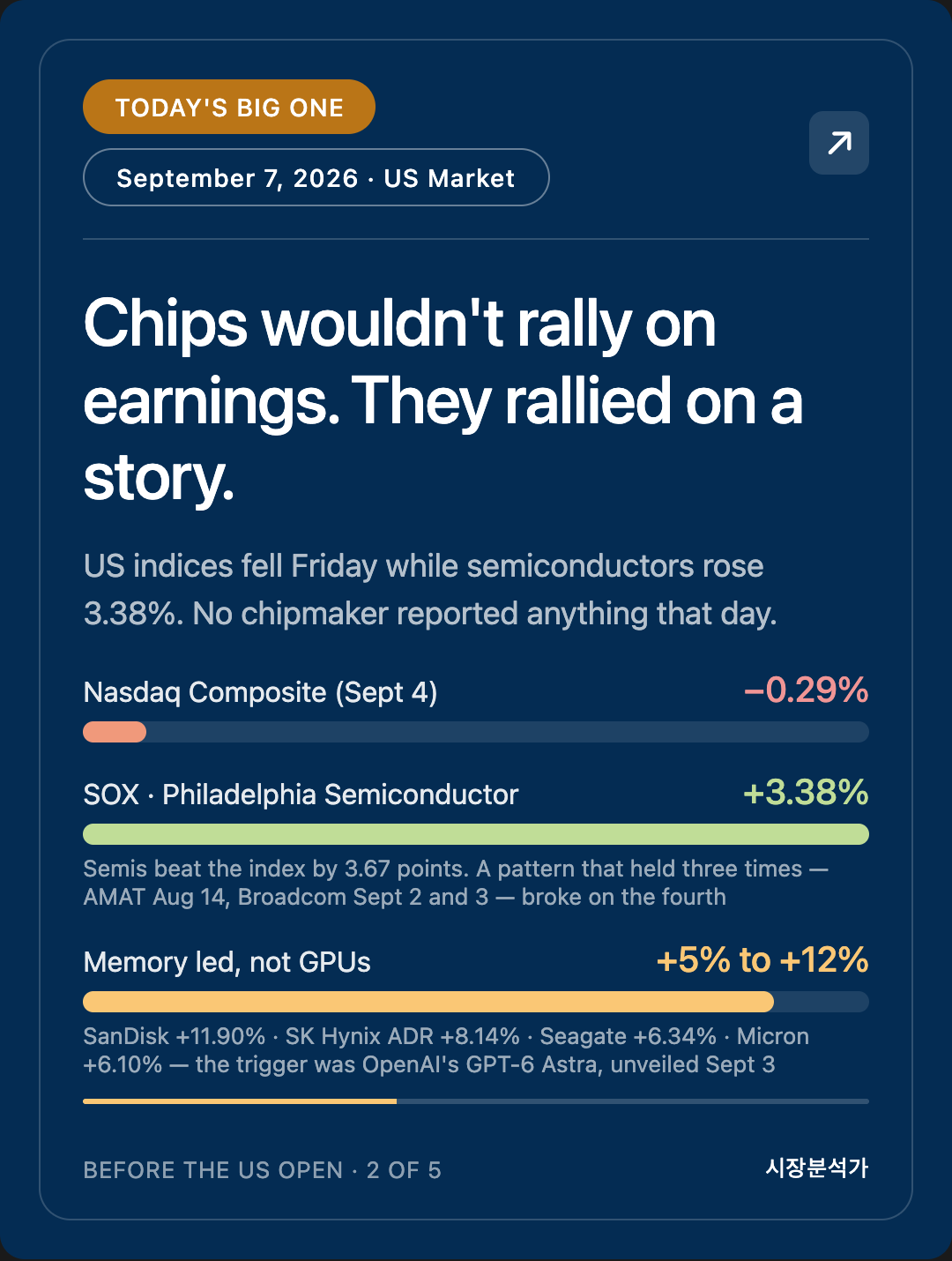
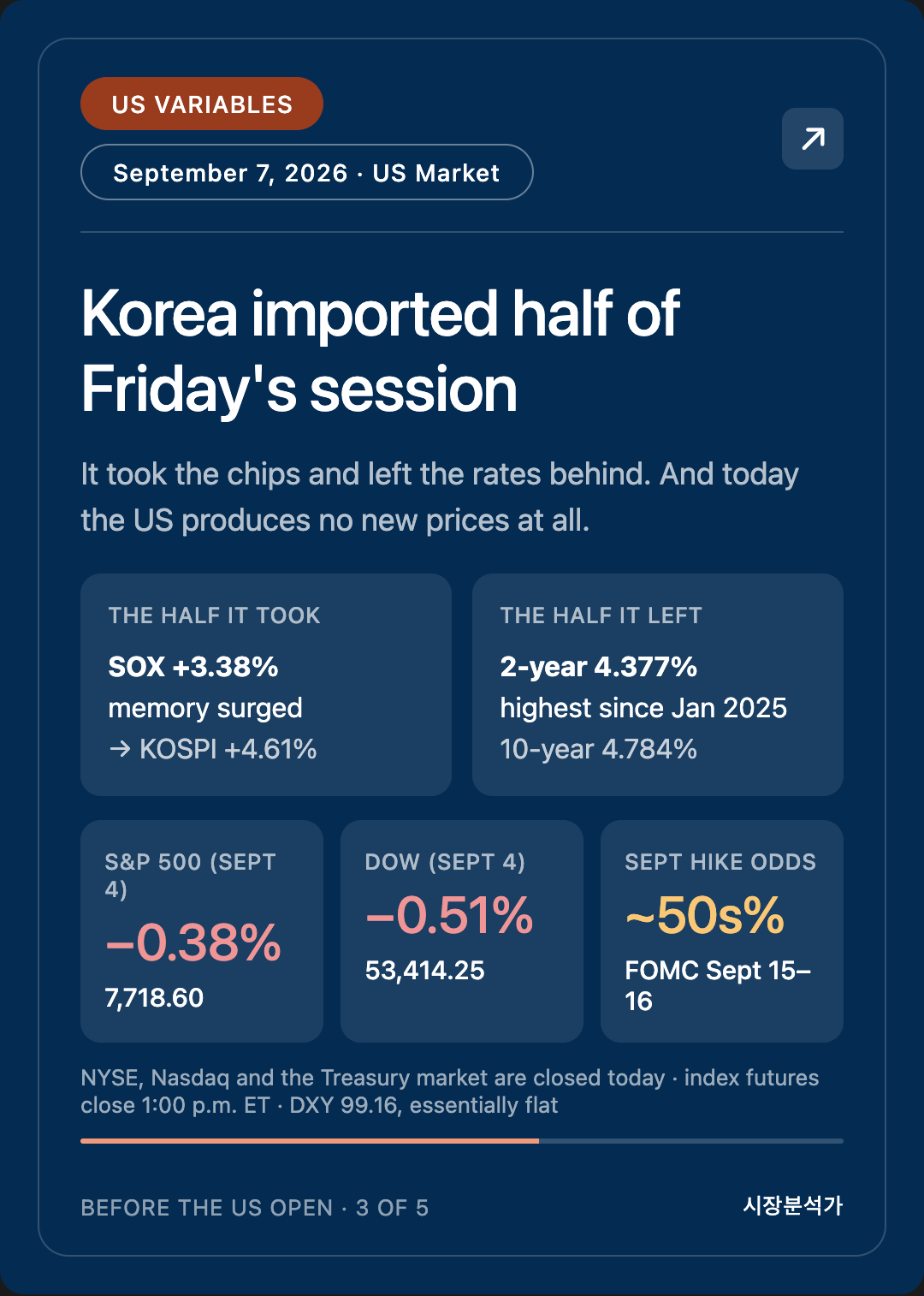
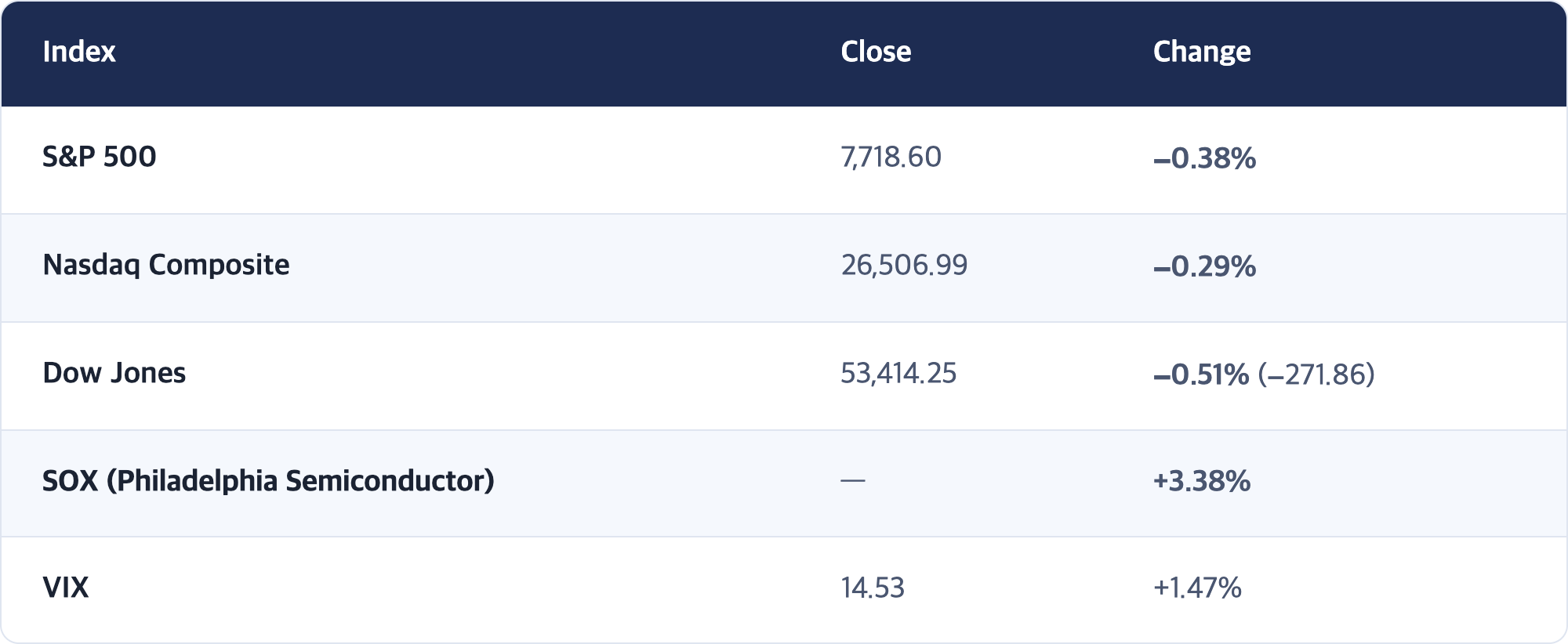
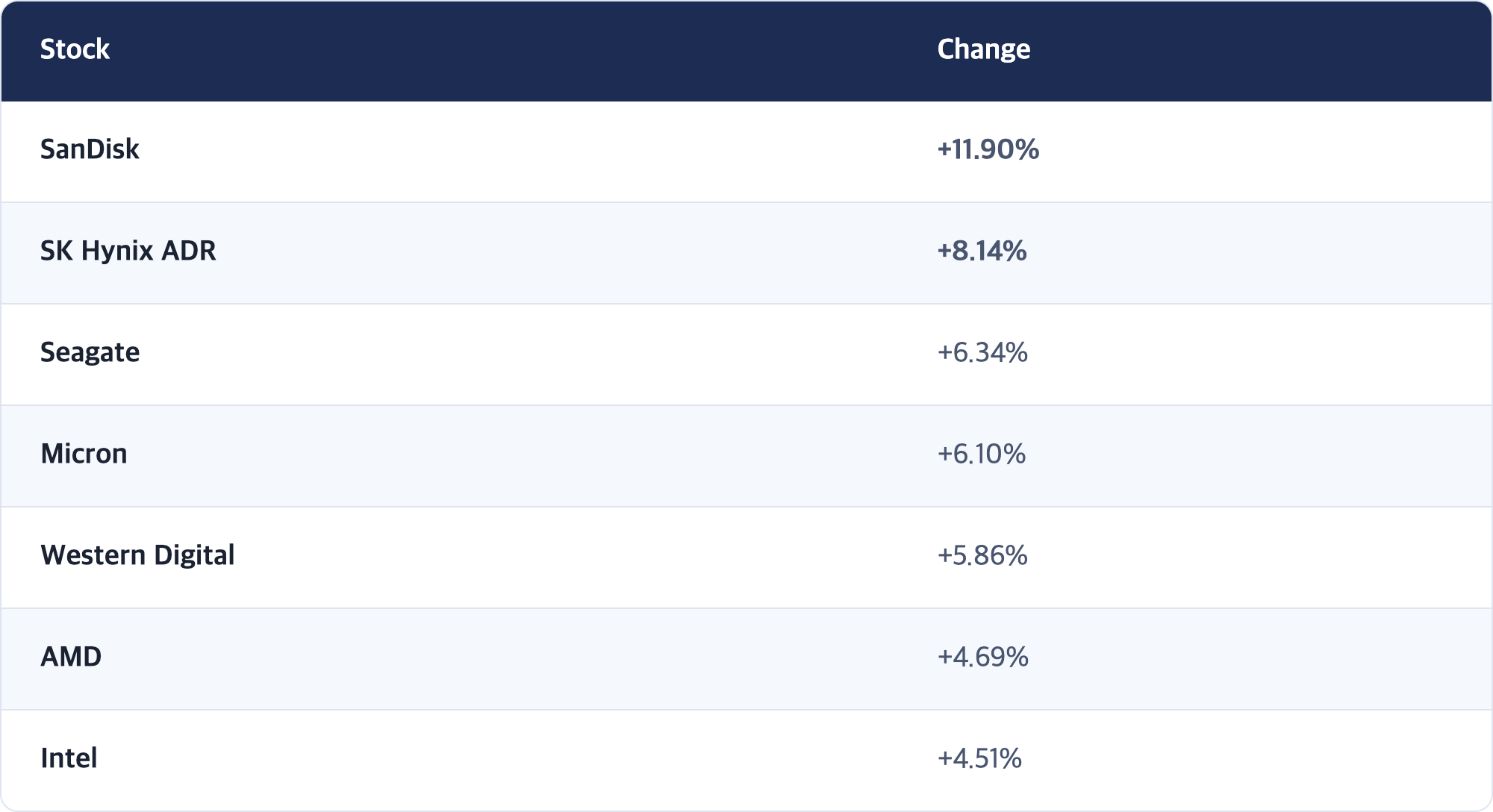
- The fuel came from Friday's US session — but only part of it. On Sept 4: S&P 500 −0.38% (7,718.60), Nasdaq −0.29% (26,506.99), Dow −0.51% (53,414.25), while the SOX rose 3.38%. And it was memory, not GPUs, that led — SK Hynix ADR +8.14%, Micron +6.10%, SanDisk +11.90%.
- A pattern that held three times broke on the fourth. Applied Materials on Aug 14, Broadcom on Sept 2–3: each beat on earnings and each sold off. On Friday semis surged — and no semiconductor company reported anything. The trigger was OpenAI's GPT-6 Astra, unveiled Sept 3.
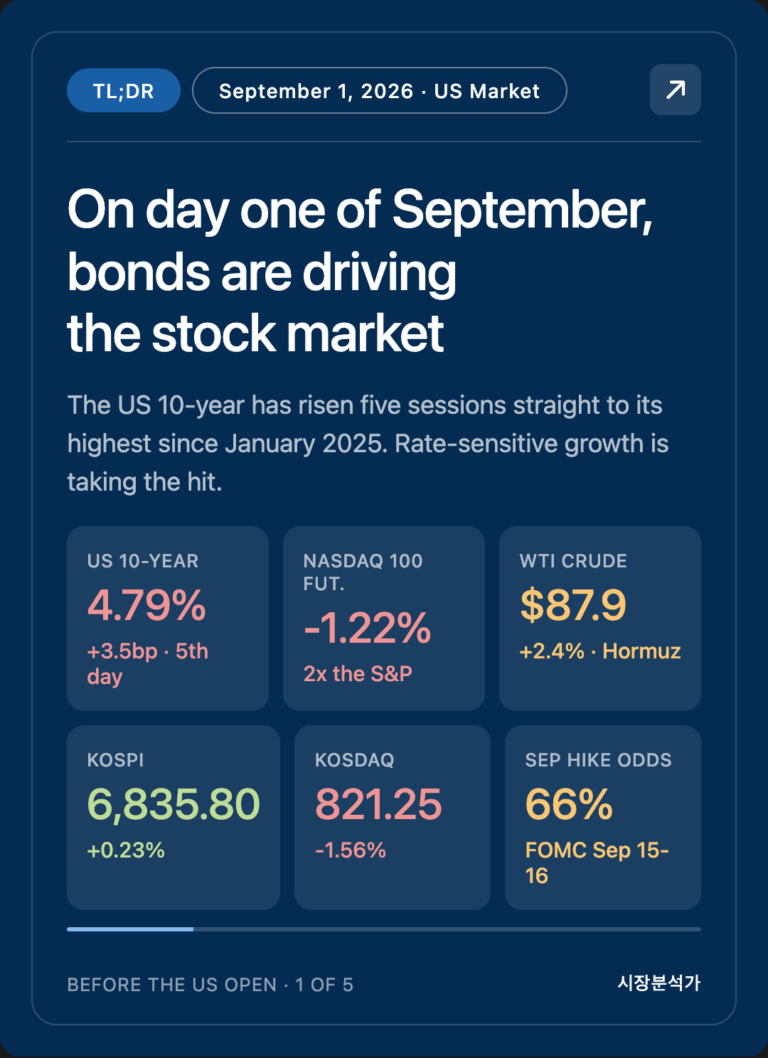
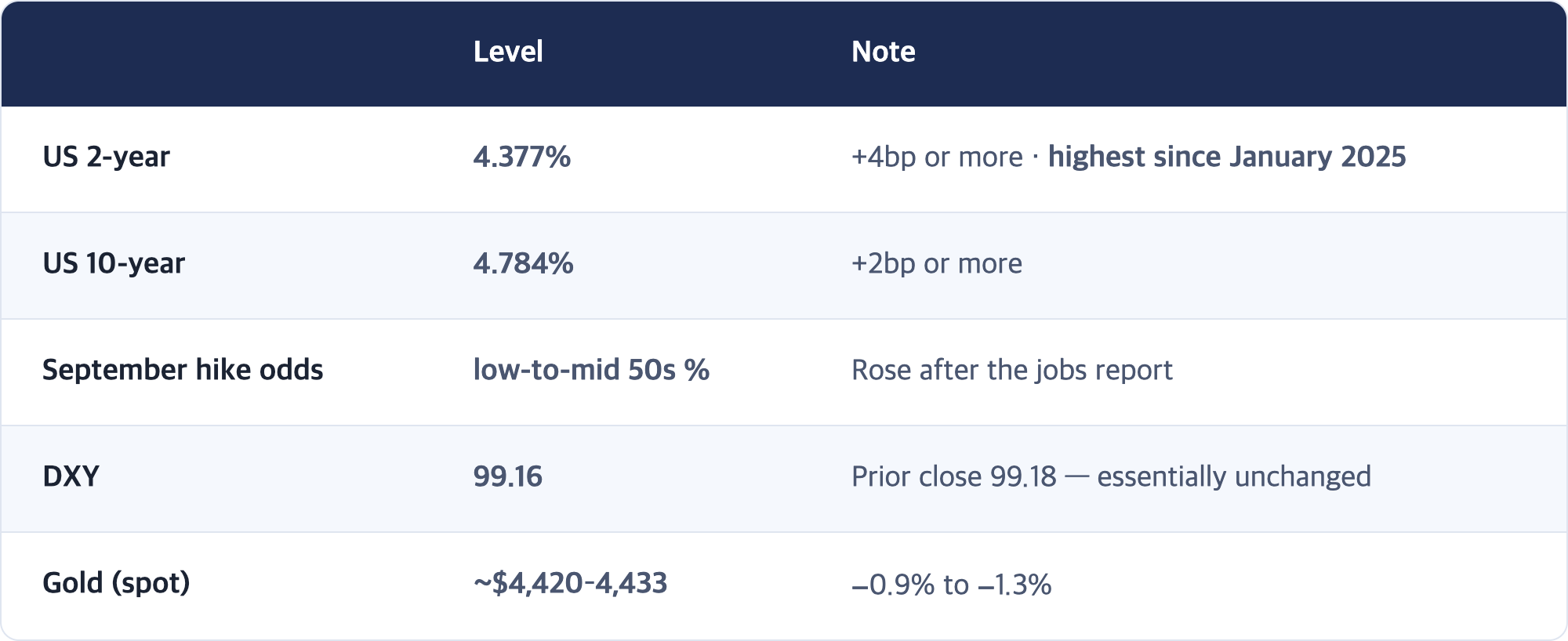
- The half Korea left behind. US 2-year yield 4.377% (highest since January 2025), 10-year 4.784%, September hike odds in the low-to-mid 50s. None of that rate pressure is in today's Korean prices.
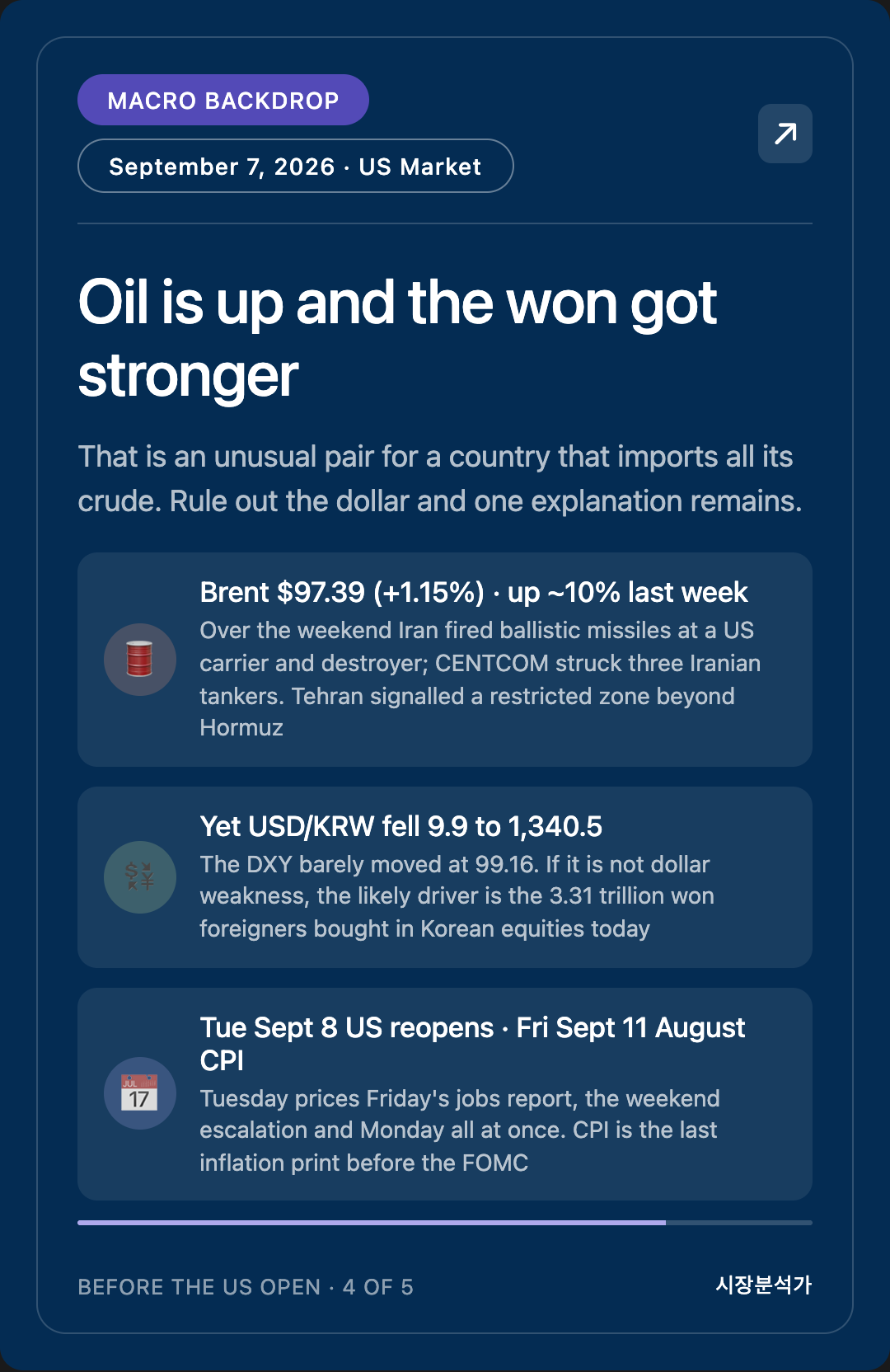
- The weekend added a variable. The US struck three Iranian tankers after Iran fired ballistic missiles at a US carrier and destroyer. Brent $97.39 (+1.15%), up roughly 10% last week. With the US closed, none of these three things gets priced today.
This is Mr. Can. Here is the September 7, 2026 brief ahead of the US market open.
Written: 2026-09-07, 05:35 PDT (Seoul: Sept 7, 21:35 KST)
Covers: US close Friday Sept 4 + weekend geopolitics + Asian close Sept 7 + European morning
⚠️ US equity and bond markets are fully closed today for Labor Day. Equity index futures close early at 1:00 p.m. ET. The next regular US session is Tuesday, September 8.
SEO Intro
South Korea's KOSPI closed at 6,995.39 today, up 308.18 points, or 4.61% — leaving it just 4.61 points short of 7,000. Foreign investors bought a net 3.31 trillion won and domestic institutions bought 3.38 trillion won. Since late August this briefing has been asking one question about the Korean market: who is buying, other than the companies themselves? Today produced an answer.
But the rally was built on half of Friday's US session. On September 4 the S&P 500 fell 0.38% and the Nasdaq fell 0.29%, while the Philadelphia Semiconductor Index rose 3.38%. Korea imported the half that went up. It did not import the half where the 2-year Treasury yield hit its highest level since January 2025. And over the weekend, the US and Iran traded strikes on tankers and warships, pushing Brent crude to $97.
And today the US is shut. The bill arrives all at once on Tuesday. Here is what to watch.
1. The Big One — A Thesis This Briefing Set Four Days Ago Got Its Answer
[Fact] — US close, Friday September 4
[Fact] — Semiconductor movers the same day
[Interpretation] The axis was chosen deliberately — and the answer inverted it
On September 3 this briefing wrote that it would stop framing the market as Dow versus Nasdaq and start framing it as AI infrastructure versus semiconductor earnings. The September 4 edition then set the test: does the SOX close the gap with the Nasdaq, or does the gap widen?
Neither. It inverted. Semis beat the index by 3.67 percentage points.
Now go one layer down: what did the inverting?
Applied Materials on August 14. Broadcom on September 2 after hours and again in the September 3 regular session. All three cleared their numbers. All three fell. The market was refusing to pay for semiconductor earnings. Then on Friday semis exploded — and not a single semiconductor company reported anything that day.
What moved them was OpenAI's GPT-6 Astra, announced September 3: roughly a 1.05-million-token context window and stronger agentic capability. The chain the market drew is straightforward — if a model handles far more context and runs longer autonomous tasks, demand grows not just for GPUs but for HBM, DRAM and NAND.
Which is why the order of the rally matters. This was not an Nvidia day. It was a memory day. SanDisk, SK Hynix, Micron, Western Digital and Seagate all rose between 5% and 12%.
[Interpretation] But this is an expectation with no price tag attached yet
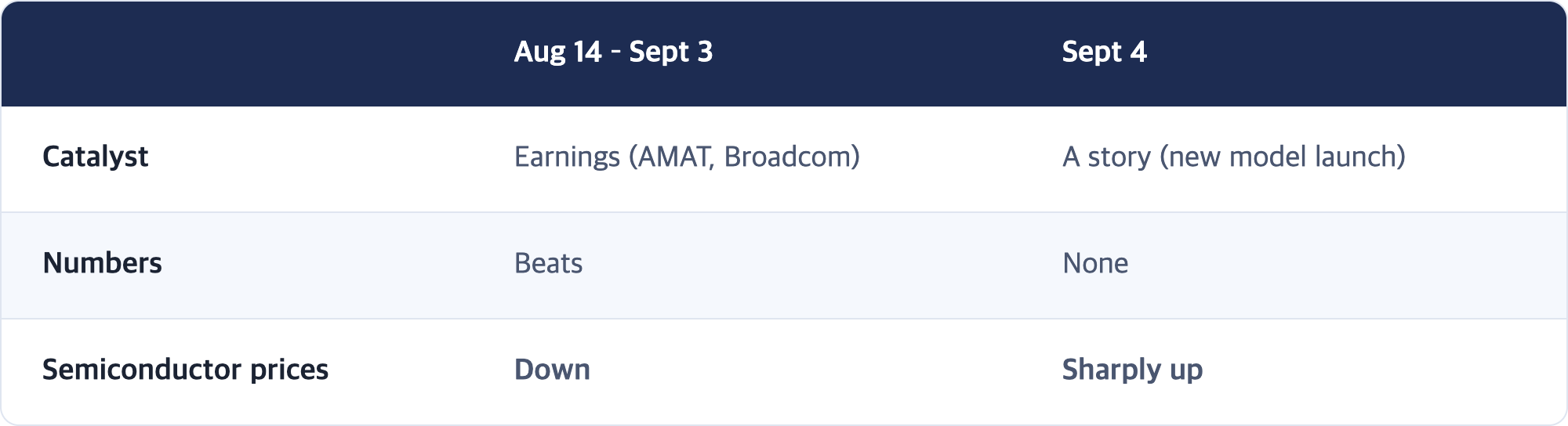
The same sector refused to rally on results and rallied on a narrative. That is not good or bad in itself, but it does tell you exactly where to look next.
There are only two channels through which this story becomes earnings: (1) contract prices for DRAM, HBM and NAND, and (2) next-quarter guidance from the three big memory makers. Until one of those moves, Friday's 8% is anticipation, not confirmation.
This distinction is worth holding onto. If you read today's 4.61% in Korea as "semiconductor earnings are improving," you will have no explanation when the next set of earnings lands and the stocks do not move. What rallied was a demand story. Earnings have not answered yet.
2. Korea and Asia (Sept 7 KST) — A Buyer Other Than the Companies Themselves Finally Showed Up
[Fact] — Korean close, September 7
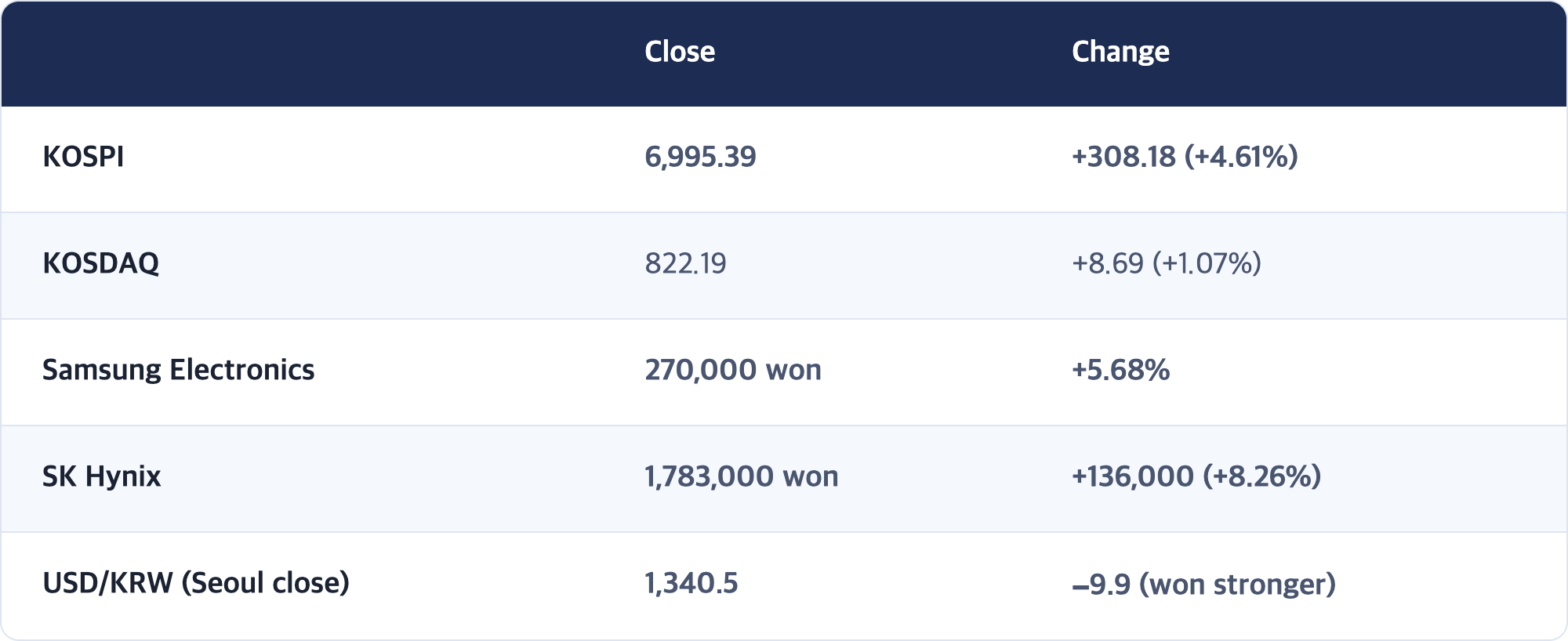
The index opened at 6,910.78 (+3.34%), touched a high of 6,995.40, and closed there. It did not fade into the bell — which is itself notable after two prior sessions this month where Korean gap-ups melted during the day.
[Fact] — Flows (KOSPI)
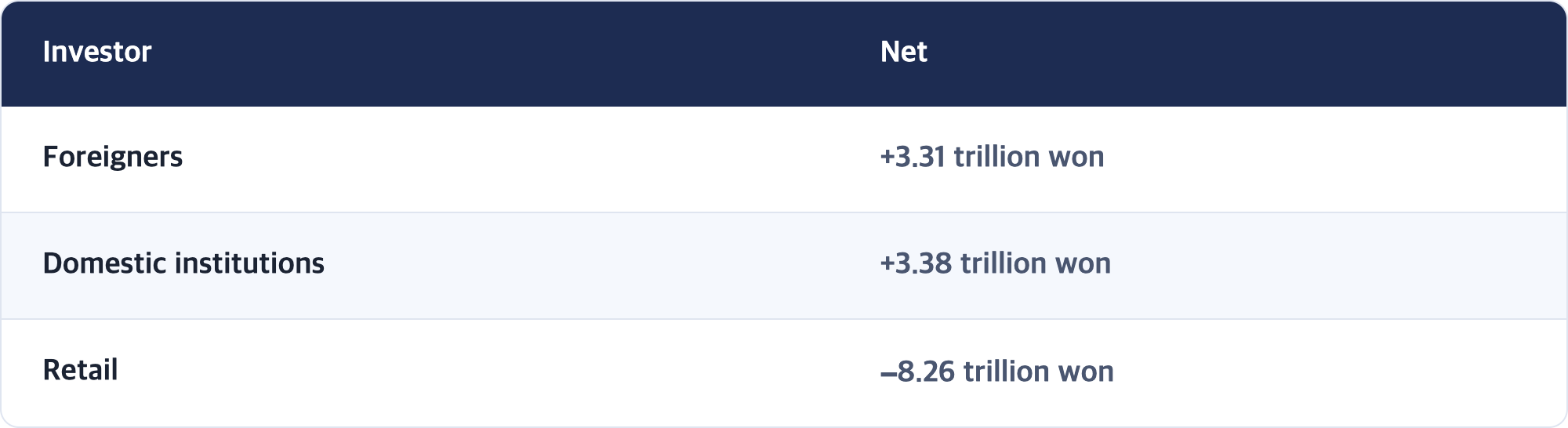
The KOSDAQ ran the other way: retail +187 billion won, foreigners −68 billion, institutions −131 billion.
[Observation] The 1.57 trillion won that does not add up
Add those three and you get −1.57 trillion won. Buys and sells must net to zero, so a fourth category bought roughly 1.57 trillion won. In Korean market data that fourth bucket is "other corporations" — and in practice, right now, it is companies buying back their own shares. Note that this is arithmetic, not a sourced figure.
Why it matters: since August 31 this briefing has recorded the same uncomfortable fact — corporate buybacks were holding the index up alone, on days when foreigners, institutions and retail were all selling at once. Buybacks bought again today. What changed is that foreigners and institutions turned up beside them with 6.69 trillion won.
[Interpretation] The answer arrived — now look at what kind of answer it is
On September 3 this briefing diagnosed Korea's weakness as "not new bad news, but the absence of a buyer." That absence was filled today.
But look at how. Foreigners and institutions each bought over 3 trillion won on the same day, in the same direction. Buying that arrives in that shape is usually index- and sector-level money — passive and basket flows — rather than a thousand separate stock decisions. Money that arrives all at once on one trigger leaves all at once when the trigger changes.
And the retail figure deserves a word. A net 8.26 trillion won of selling is enormous. Do not read it as "retail got it wrong." Heavy retail selling into a 5% melt-up is textbook profit-taking. What it does tell you is that there is a thick layer of domestic investors who find this index level uncomfortable.
[Fact] Today's 6,995 is not a record high
Headlines built around "just below 7,000" invite the wrong inference. The KOSPI has already traded above 7,000 this year — this briefing's own August 14 entry records an intraday 7,010.86. Today was a recovery session, not a new high. Getting the label right matters for the next judgment.
[Fact] — Asia and Europe
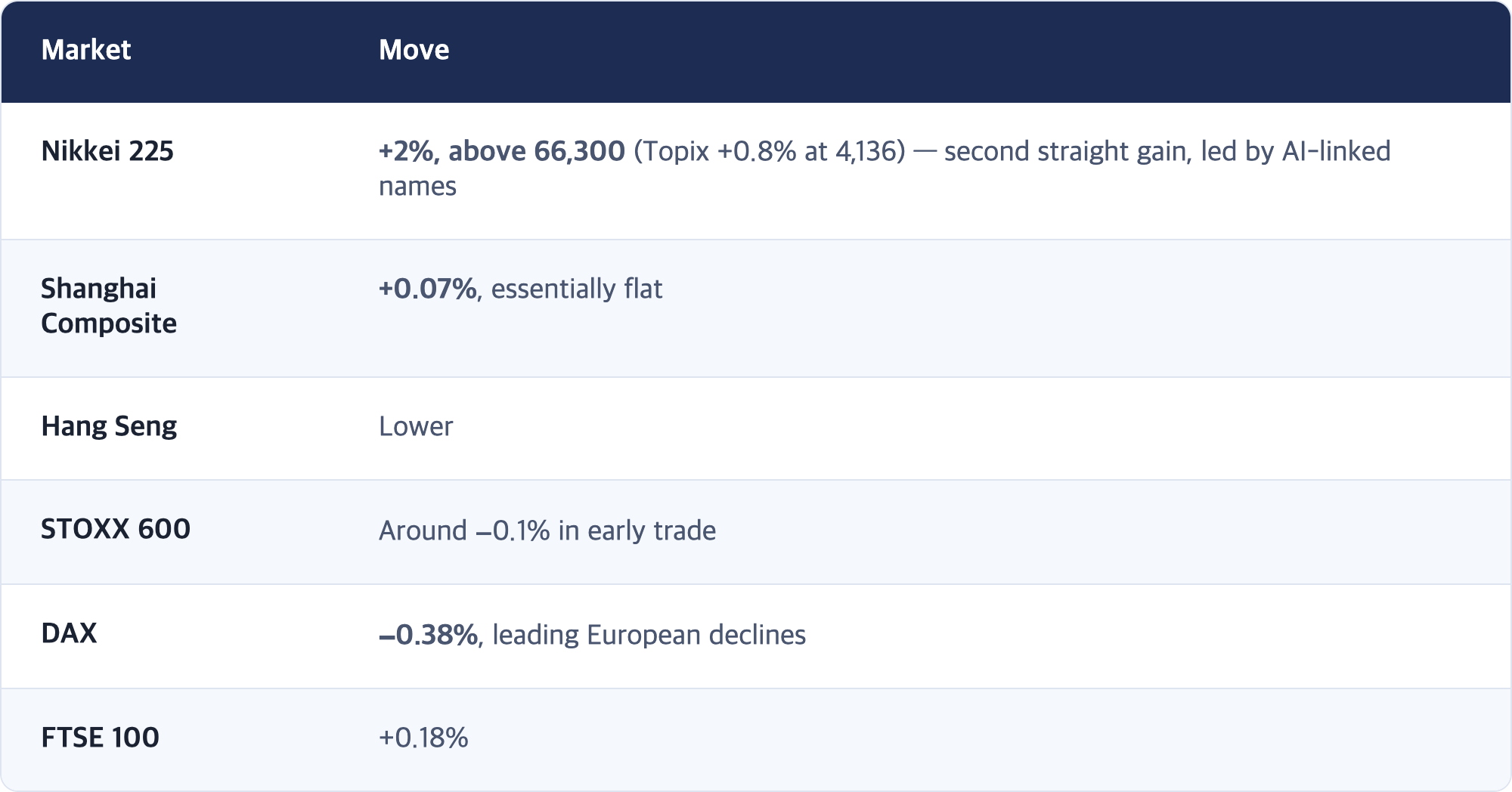
European sectors split along the oil line: oil and gas +1.14% led gains, tech +0.55%, utilities +0.53%, while healthcare fell more than 1% and food and beverage dropped about 0.8%.
3. The US Side — No New Prices Today
[Fact] — Rates, dollar and metals, Friday September 4
[Fact] — What is actually open today
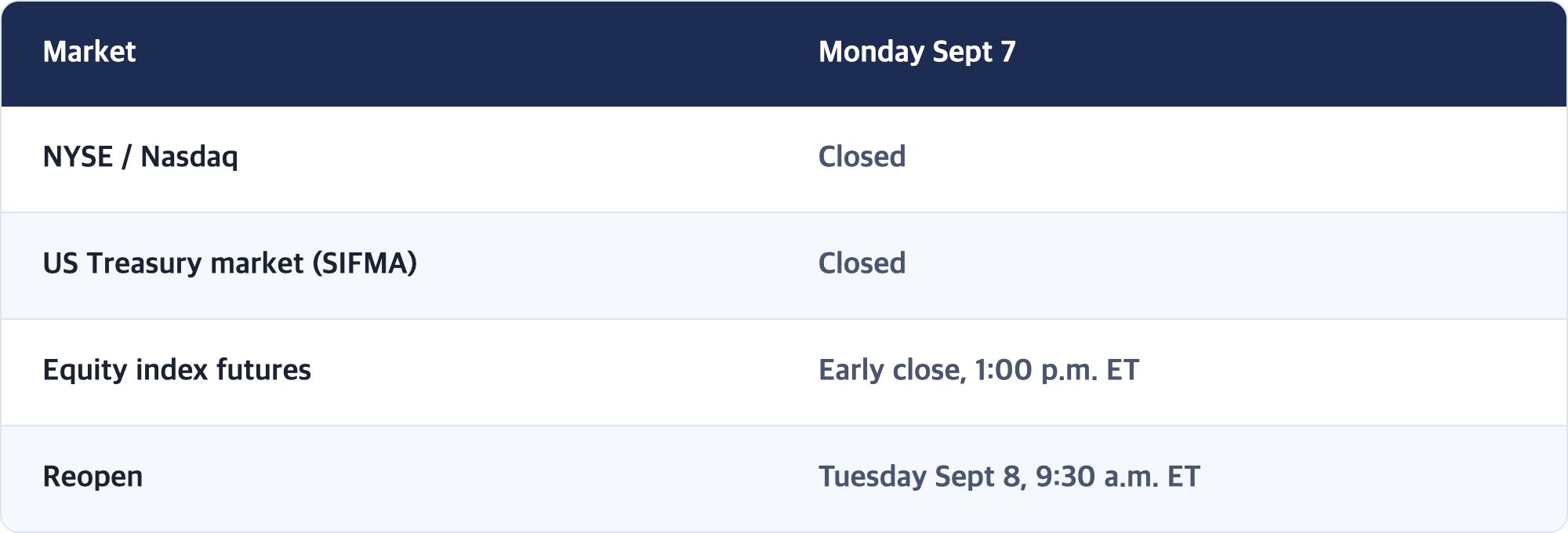
[Interpretation] Today you cannot write the sentence "the US market reacted this way"
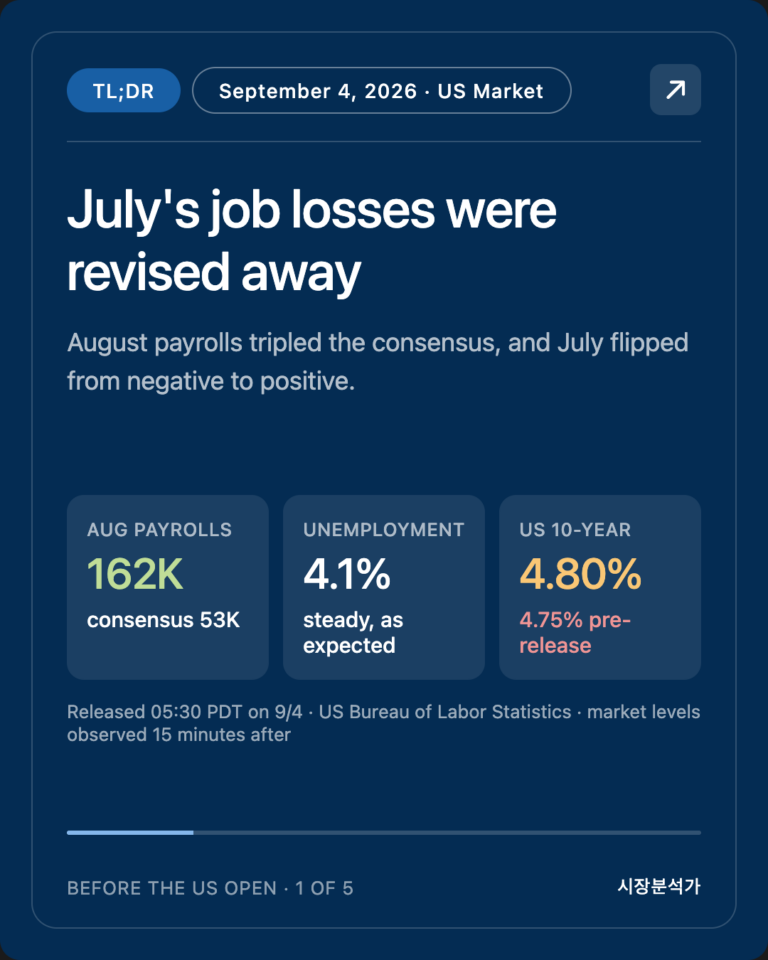
Friday's August payrolls came in at +162,000 against a consensus near 53,000 — roughly triple. The market's answer was unambiguous: stocks down, yields up. Classic good news is bad news.
That answer does not get updated today. Neither US equities nor Treasuries will produce a price. Meanwhile information keeps accumulating — the weekend escalation with Iran, today's European and Asian sessions, whatever US news breaks during the day.
So a word of caution about today's commentary generally: no analysis published today can cite what the US market thinks, because the US market is not speaking. Everything written today, this briefing included, is inference layered on Friday's closing prices.
4. Macro Backdrop — What Grew Over the Weekend Was Oil
[Fact] — US–Iran tanker war escalates (Sept 5–6)
- Saturday Sept 5: Iran's Revolutionary Guard fired ballistic missiles at a US aircraft carrier and a guided-missile destroyer patrolling regional waters — the first ballistic missile launch at a US carrier in this war. No US personnel were injured.
- Same day: CENTCOM struck three Iranian tankers, permanently disabling the Downy off Kharg Island and the Stark 1 near Jask, and sinking the Kylo in the Gulf of Oman. CENTCOM described the vessels as part of a "multibillion-dollar shadow network" funding the IRGC and its regional proxies.
- Sunday Sept 6: Iran continued attacks on US-linked vessels and signalled it would declare a "restricted" maritime zone beyond the Strait of Hormuz.
[Fact] — Oil today
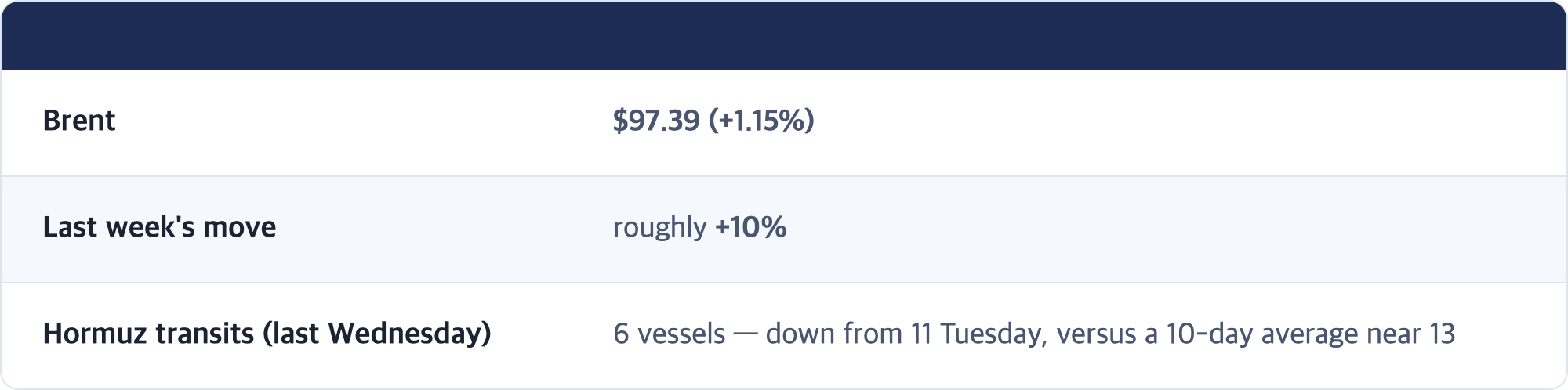
[Interpretation] The genuinely odd thing today is oil and the won moving in opposite directions
South Korea imports all of its crude. The textbook relationship is straightforward: oil up, trade balance worse, downward pressure on the won. Today Brent went to $97 and the won strengthened by 9.9 to 1,340.5.
Three explanations, and only one survives:
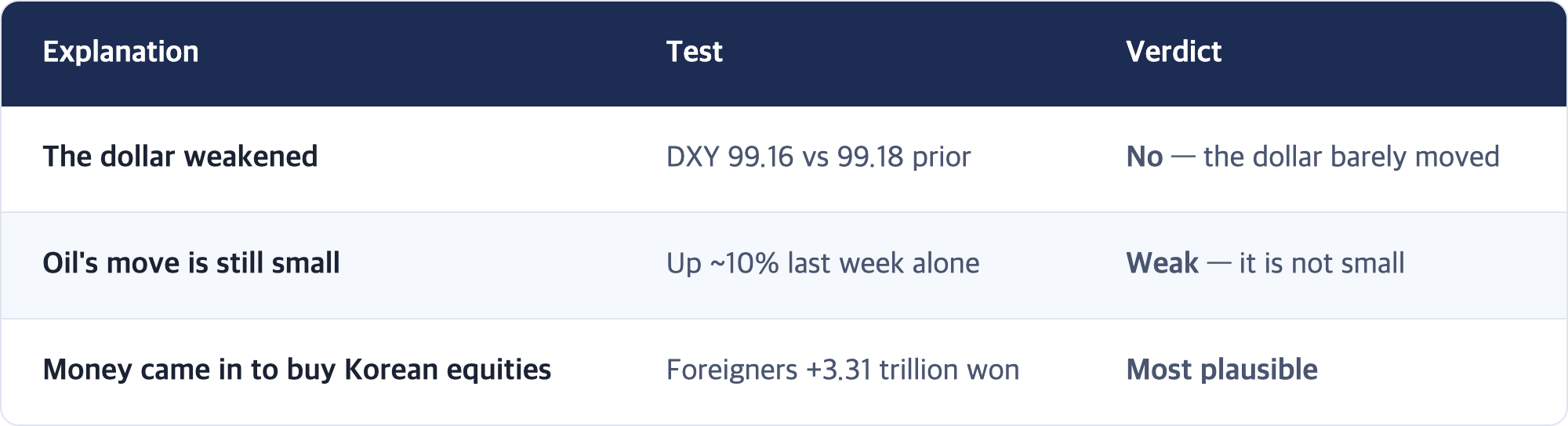
So today's won strength looks less like "the dollar is weak" and more like "someone needs won to buy Korean stocks."
The distinction matters because if equity flows are the cause, the currency turns when those flows turn. This is not a currency move to read as improving economic fundamentals. And since oil is still climbing, the moment equity inflows pause, the oil bill shows up in the exchange rate.
[Observation] — Event calendar
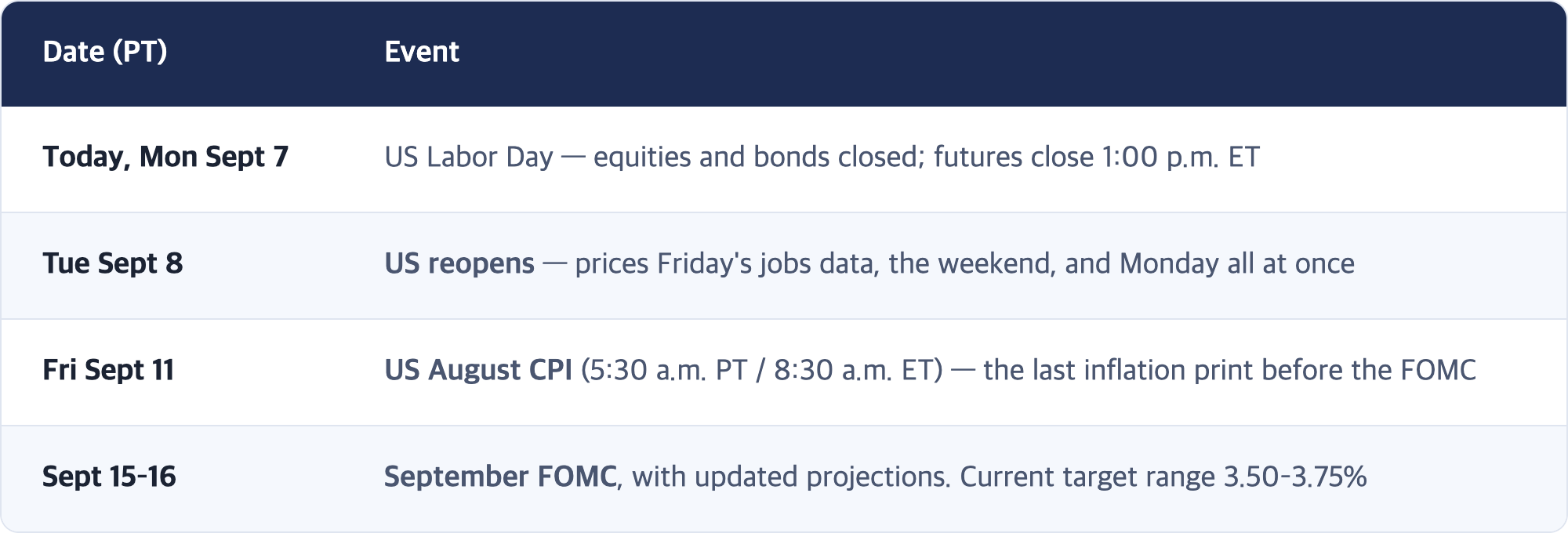
5. Preview — What to Watch When the US Reopens Tuesday
[Interpretation] — Four things. This time the axis is stated first.
-
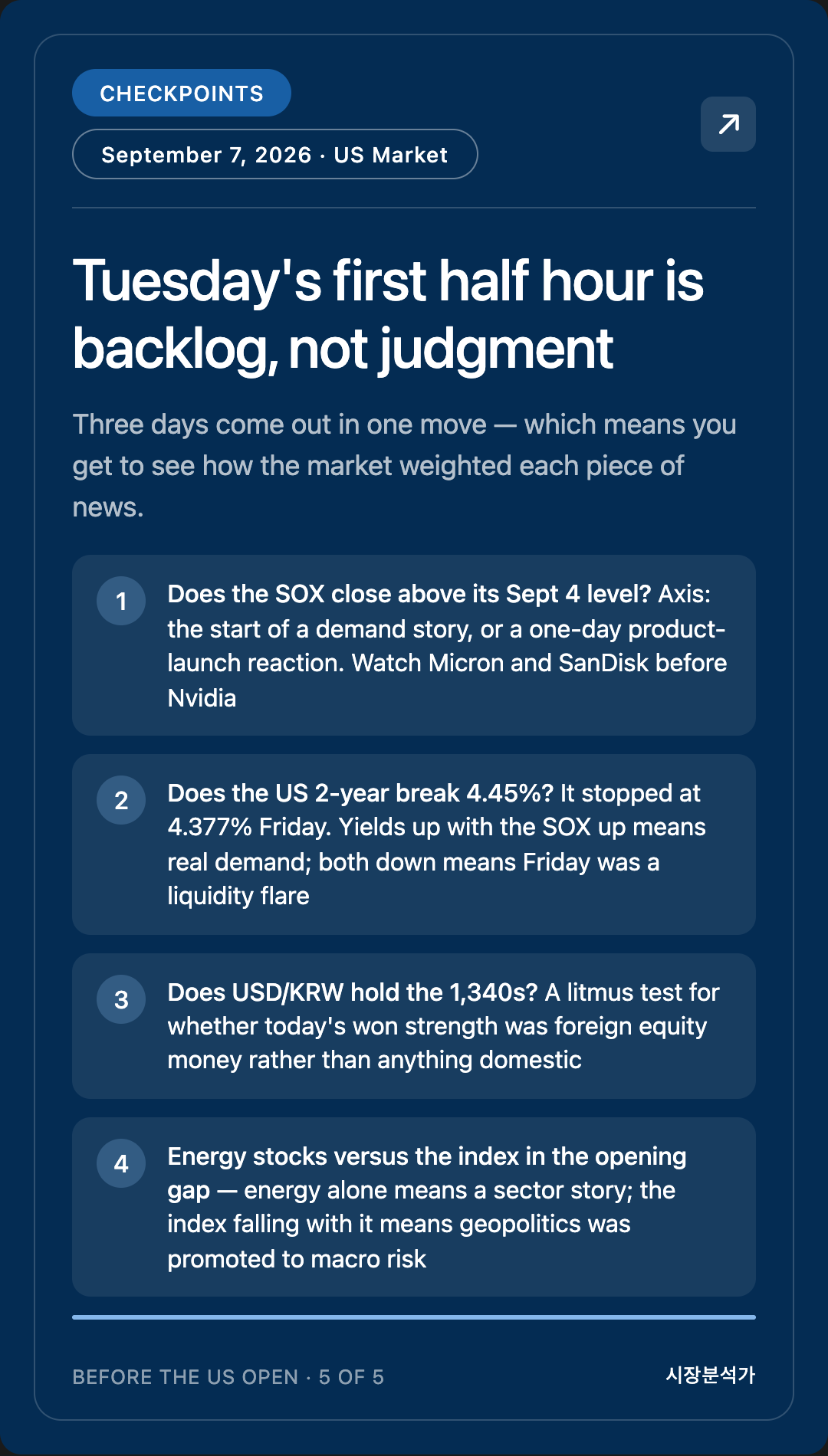
Does the SOX close above its September 4 level?
Axis — is Friday the start of a demand story, or a one-day reaction to a product launch?
The test is simple: a higher close means the former, a lower close the latter. Watch Micron and SanDisk before Nvidia — memory led on the way up, so it will lead on the way back down too. -
Does the US 2-year break 4.45%?
Axis — can the semiconductor rally carry rising rates?
This line was set in the September 4 edition and was not reached: 4.377%. Tuesday prices three days at once, so the line means more now. If yields rise and the SOX rises with them, this move is running on real demand expectations. If both fall together, Friday was the last flare of a liquidity rally. -
Does USD/KRW hold the 1,340s?
Axis — a litmus test for whether today's won strength was foreign equity money.
If semis sell off Tuesday and foreign flows stall, the won should give back ground. If it does, the reading above holds. If the won stays strong anyway, something else is driving it. -
In the reopening gap, what is the ratio between energy stocks and the index?
Axis — is the geopolitical risk a price or a backdrop?
The US has not yet expressed the Iran escalation in any price. If energy rises while the index holds, the market is treating this as a sector story. If the index falls with it, the risk has been promoted to macro.
[Interpretation] The shape of this week, for a Korea-based investor
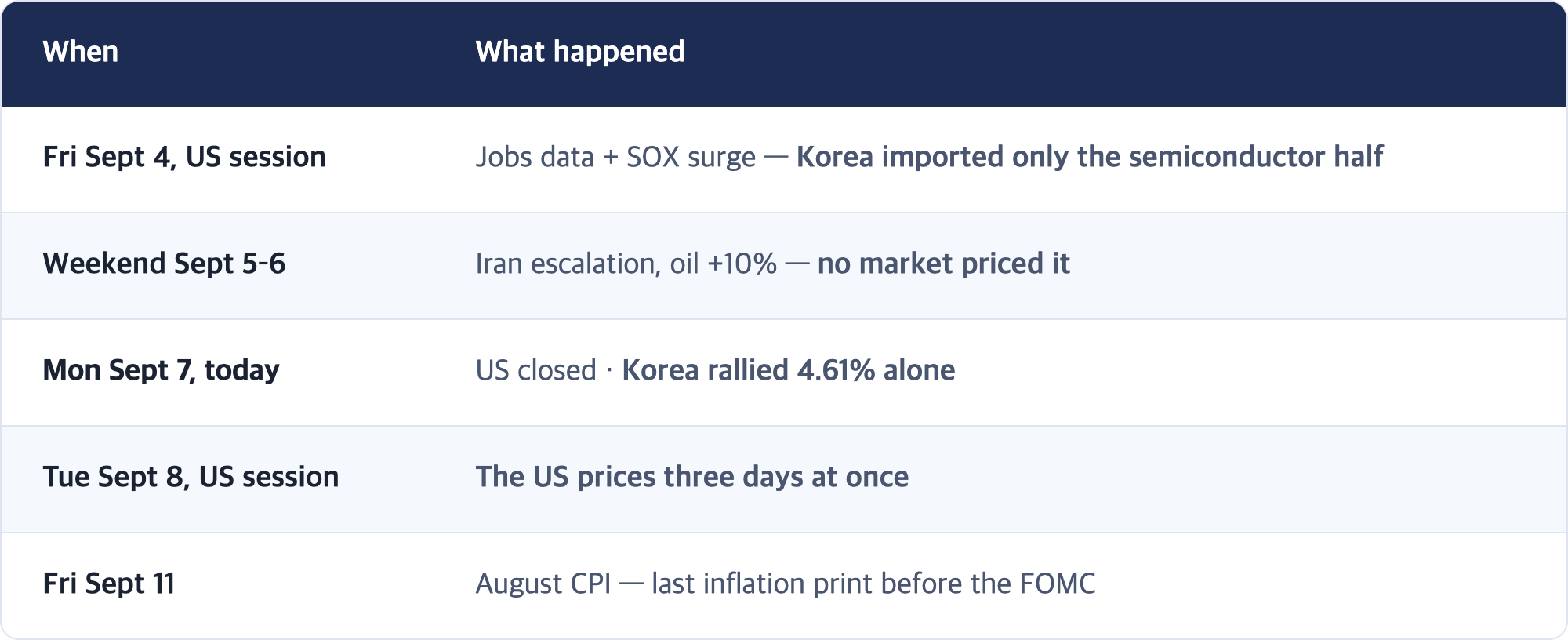
Korea started the week holding half the information. It was the good half. The other half — rates, oil, geopolitics — gets calculated by the US on Tuesday and handed over.
Do not read this as a bearish call. It is a statement about where information is concentrated, not about direction. The first thirty minutes of Tuesday's US session will be backlog, not judgment. Wait for that to clear before drawing a conclusion about direction.
📖 Study Note — Holiday Information Gaps, and Why Gaps Happen
The concept. A market is a machine that converts information into prices. News arrives, people buy and sell, prices adjust. On a holiday the machine stops — but the information does not. That state is an information gap.
When the market reopens, everything that piled up gets priced at once. The distance between the last close and the next open is what traders call a gap.
An analogy. Think of a dam. Normally water flows through steadily and the level changes gradually. Close the gates and water keeps arriving with nowhere to go. Open them three days later and the surge is far stronger than usual — not because the river changed character, but because three days of it are moving at the same time.
That is exactly this week. The US gates closed Friday afternoon and reopen Tuesday morning. Here is what has piled up behind them:
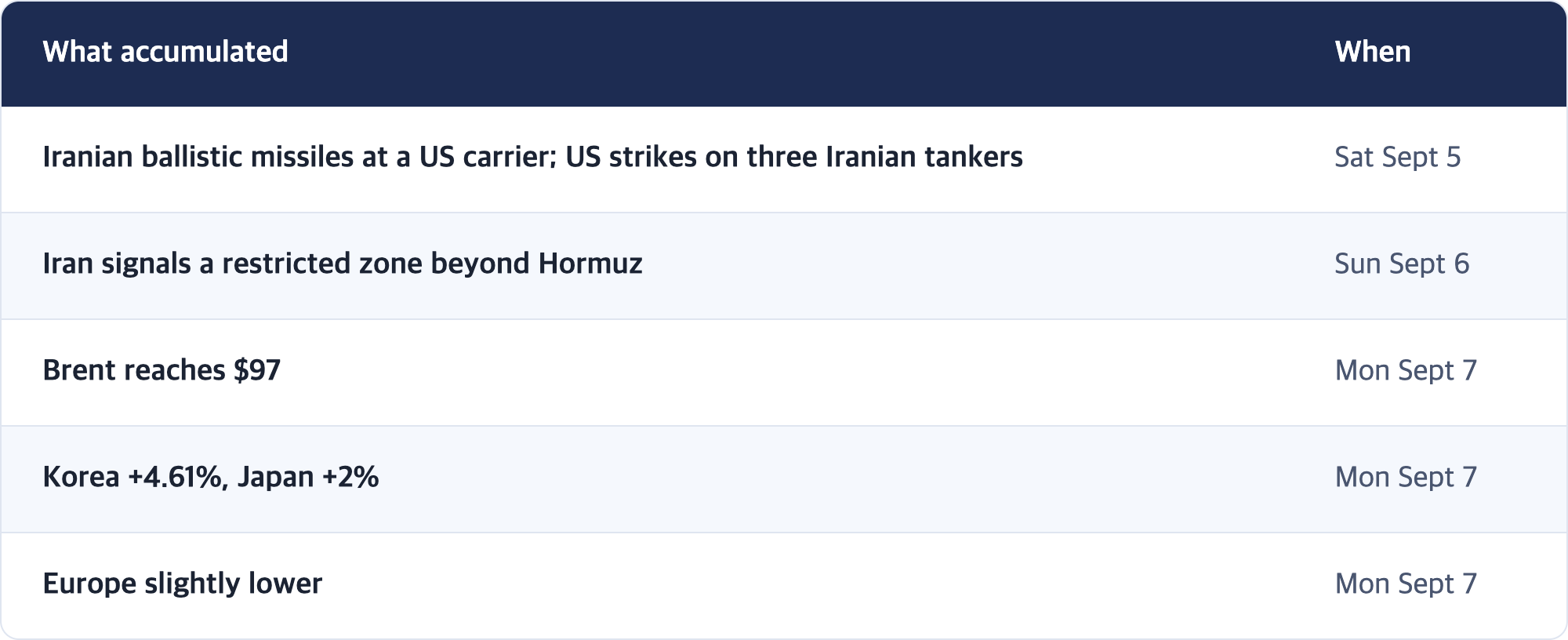
How to handle it. Three habits are worth keeping:
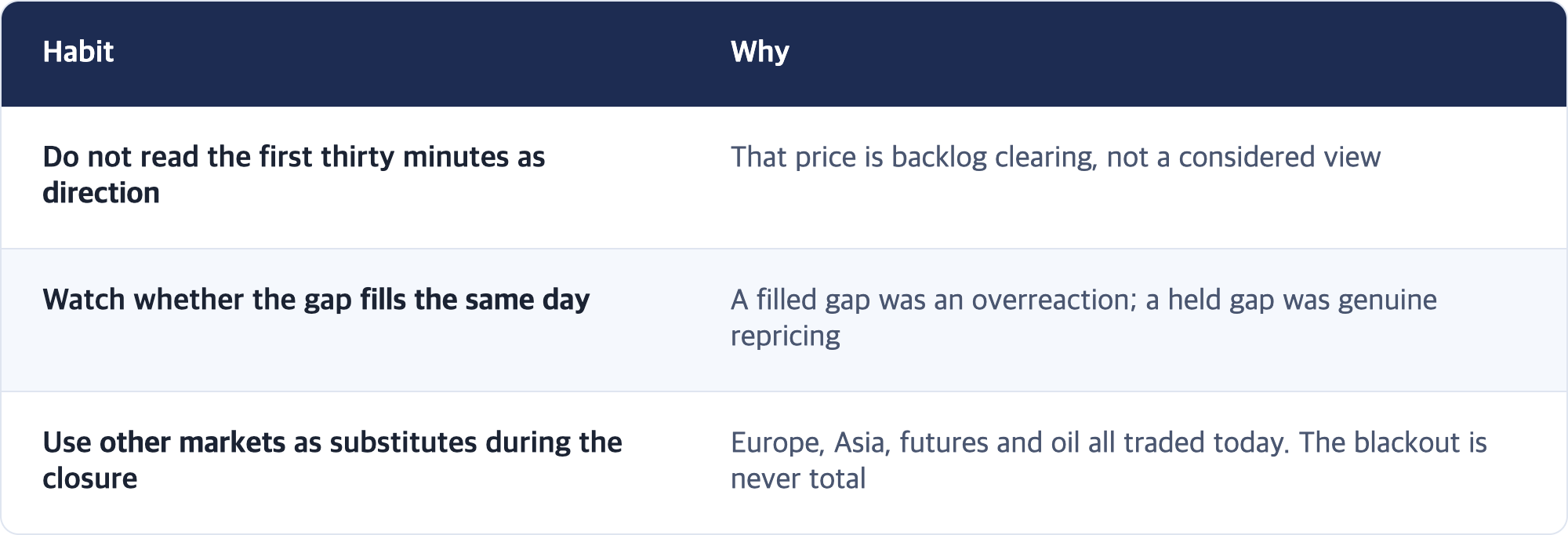
One more thing. A gap is a risk, but it is also information. Because three days come out in a single move, you get to see how the market weighted each piece of news relative to the others. That is why the fourth checkpoint above asks for the ratio between energy stocks and the index rather than the direction of either. Days when you can compare competing narratives on one screen are rare.
📌 Corrections and Open Items
1) September 4 checkpoint 1 — right direction, line not reached. The question was whether the US 2-year would break 4.45%. It closed at 4.377% — up, and the highest since January 2025, but short of the line. The same line is re-set for Tuesday.
2) Checkpoint 2 — the axis held; the answer was neither option offered. The question allowed two outcomes: the SOX–Nasdaq gap narrows (one-day event) or widens (structural separation). It inverted instead: SOX +3.38% versus Nasdaq −0.29%, a 3.67-point reversal. A pattern that had held three times broke on the fourth. The axis stays; from now on "inversion" is listed as an explicit third option.
3) Checkpoint 3 — correct, but only half the question was useful. The Dow and Nasdaq did converge, both lower (−0.51%, −0.29%), which by the stated rule means "a day governed by rates." But the SOX went its own way. Stated properly: rates governed the indices and a theme governed semiconductors. Comparing two indices could not capture that.
4) Checkpoint 4 — not adjudicated. No reliable source was found on Fed speakers on September 4. Left unresolved.
5) An open item on the dollar index is now closed. The September 4 edition declined to cite a DXY reading near 95 because it conflicted with 99.51 on September 3. The September 4 close of 99.16 (prior 99.18) has now been obtained and is consistent with September 3. The earlier 95-handle observation is judged an error and the item is closed.
6) The gold discrepancy has narrowed but is not resolved. Two September 4 spot readings appear: $4,420.00 (−1.28%) and $4,432.56 (−0.92%). This has been open since August 31; the gap is now about 0.3%. The text quotes a range.
7) Sources differ on the Nikkei's September 7 move. One set reports +2% above 66,300 (closing basis), another reports roughly +1% at the open. The closing-basis figure was used.
8) No confirmed closing levels for the Hang Seng or Shanghai on September 7. Only direction is quoted — Shanghai flat at +0.07%, Hong Kong lower. One source showed a Hang Seng value of 3,235.5, which is inconsistent with the index's actual order of magnitude and was not used.
9) September hike odds range from 51% to 65% depending on source. CNBC put it near 52% on September 4; market-implied 56%; Polymarket 51%; some aggregates 60–65%. The conclusion — close to a coin flip — is the same either way, so the text uses "low-to-mid 50s."
10) The SOX point level for September 4 was not obtained — only the +3.38% change. To be recovered next edition so Tuesday's close can be compared directly.
11) The ~1.57 trillion won of "other corporation" buying is arithmetic, not a sourced figure. The derivation is shown in section 2.
12) This edition ran on schedule. Scheduled 05:30 PDT, started 05:35 PDT. No drift.
🔗 Sources
- Stock Market Today (Sept. 4, 2026): Yields jump, stocks fall after jobs report surprises to upside — TheStreet
- Stock market news for Sept. 4, 2026 — CNBC
- 2-year yield rises to highest since January 2025 after hot jobs report — CNBC
- Semiconductor Stocks Surge on OpenAI's 'GPT-6 Astra' Unveiling — BigGo Finance
- OpenAI announces rollout of GPT-6 Astra model — CNBC
- KOSPI closes up 4.61% at 6,995.39 — Newspim
- KOSPI surges 4.61%, closing just short of 7,000 — Businesskorea
- Samsung Electronics +5.68%, SK Hynix +8.26% on OpenAI optimism — KDF News
- U.S. strikes 3 Iranian oil tankers after missile attacks on Navy ships — CNBC
- US, Iran engaged in tanker war: Where is the months-long conflict headed? — Al Jazeera
- Iran War 2026 — Day 191 Update, 6 September 2026 — GlobalSecurity.org
- Brent crude oil price — Trading Economics
- European stocks fall and Asia-Pacific markets rise as investors assess renewed Middle East hostilities — CNBC
- Monday 7th September 2026: Asia-Pacific Markets Rise as U.S.-Iran Tensions Escalate — IC
- Japan Stock Market Index (JP225) — Trading Economics
- Is the stock market open on Labor Day? 2026 holiday trading schedule — Yahoo Finance
- Labor Day 2026 Trading Schedule: Market Closures and Operating Hours — Blockonomi
- Gold price today, Friday, September 4, 2026 — Yahoo Finance
- US Dollar Index (DX-Y.NYB) — Yahoo Finance
- Consumer Price Index Release Schedule — US Inflation Calculator
- Fed decision in September? Odds & Predictions 2026 — Kalshi
📌 More market briefs
※ This post is market observation and organization intended to support your own judgment. It is not a recommendation to buy or sell any security. Figures are as of the time of writing and may differ between sources.
If this was useful, bookmark it or pass it along. It genuinely helps me write the next one.
I can survive. We can survive.