August 31, 2026 US Market Brief — Nasdaq and S&P 500 Before the Open
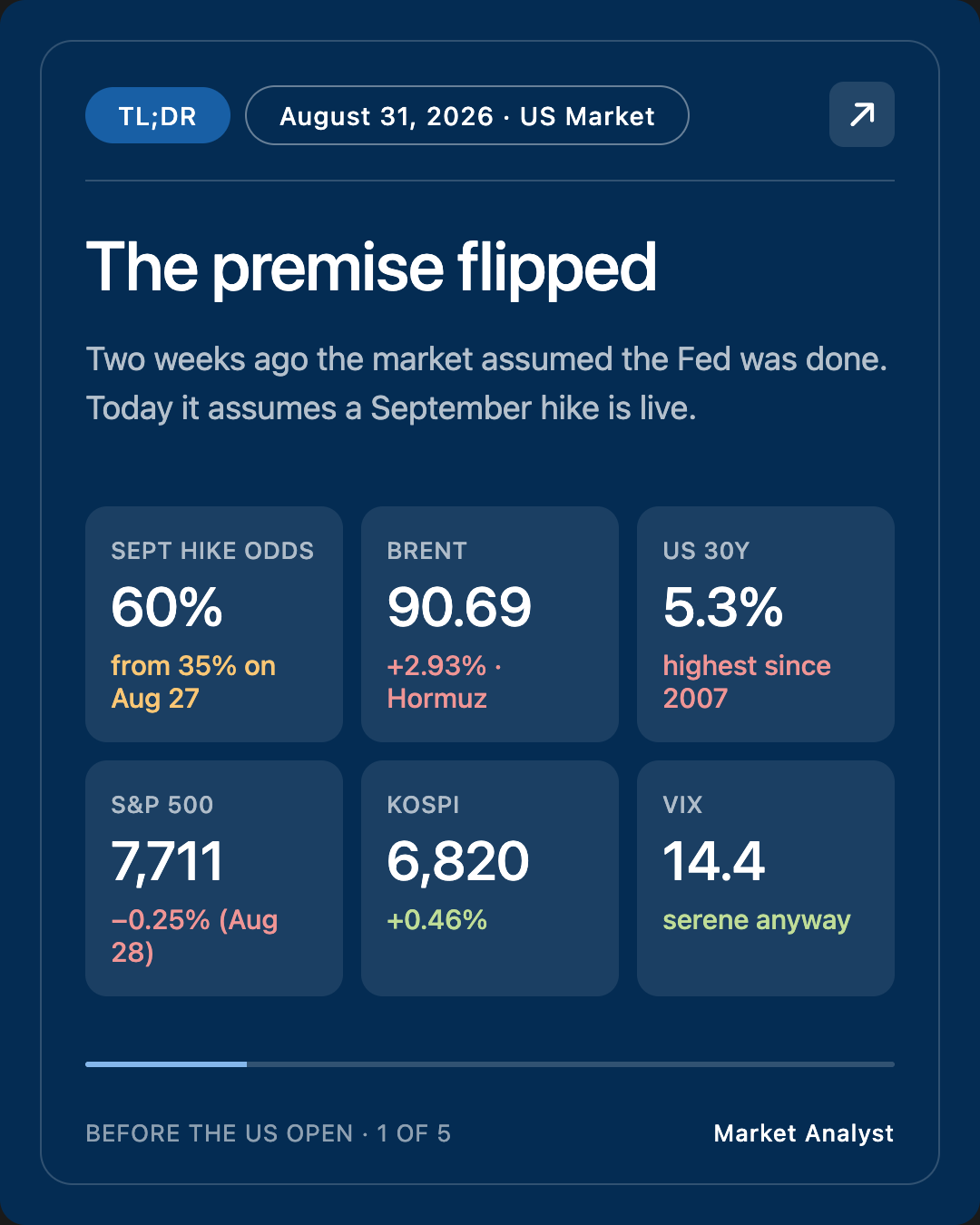
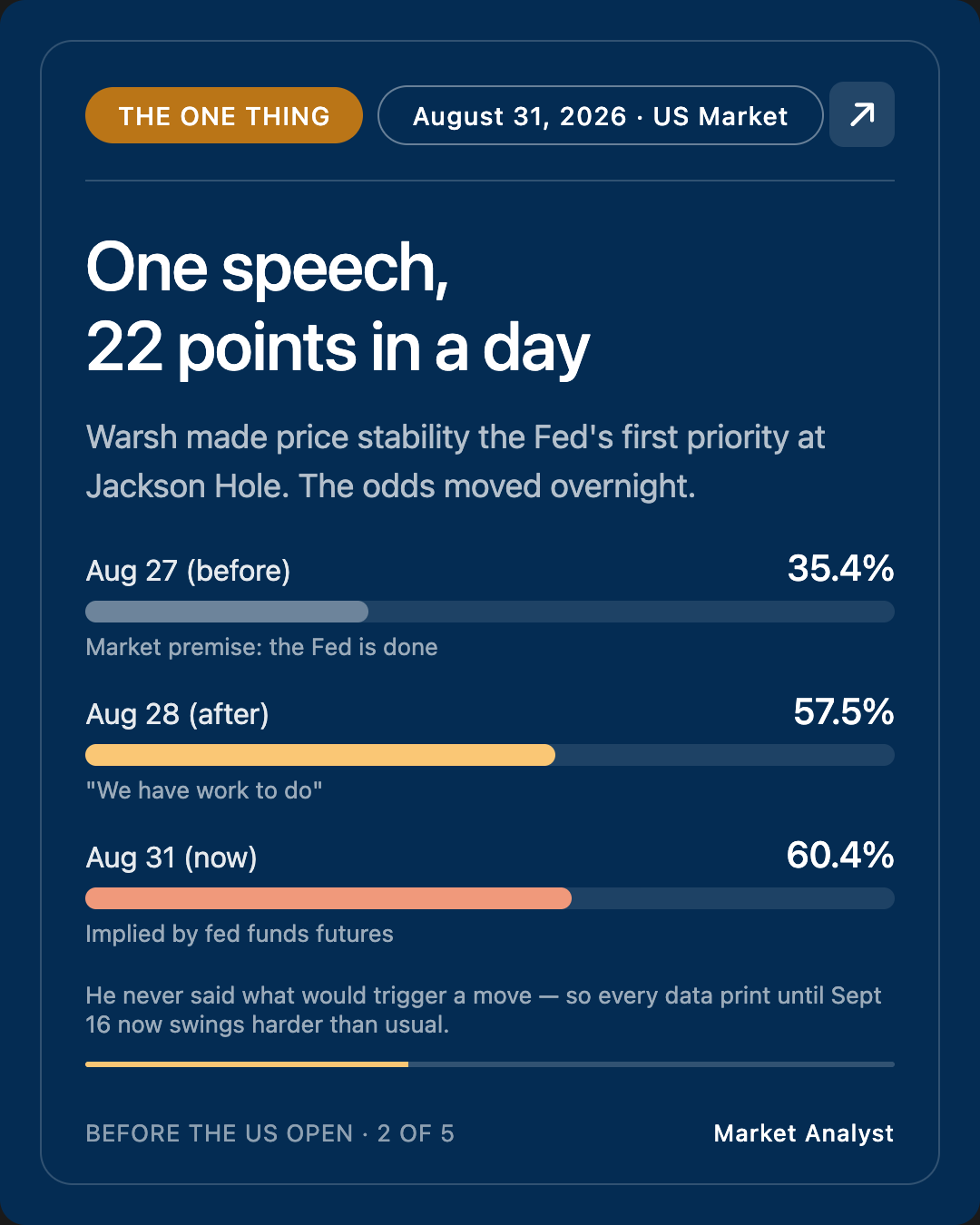
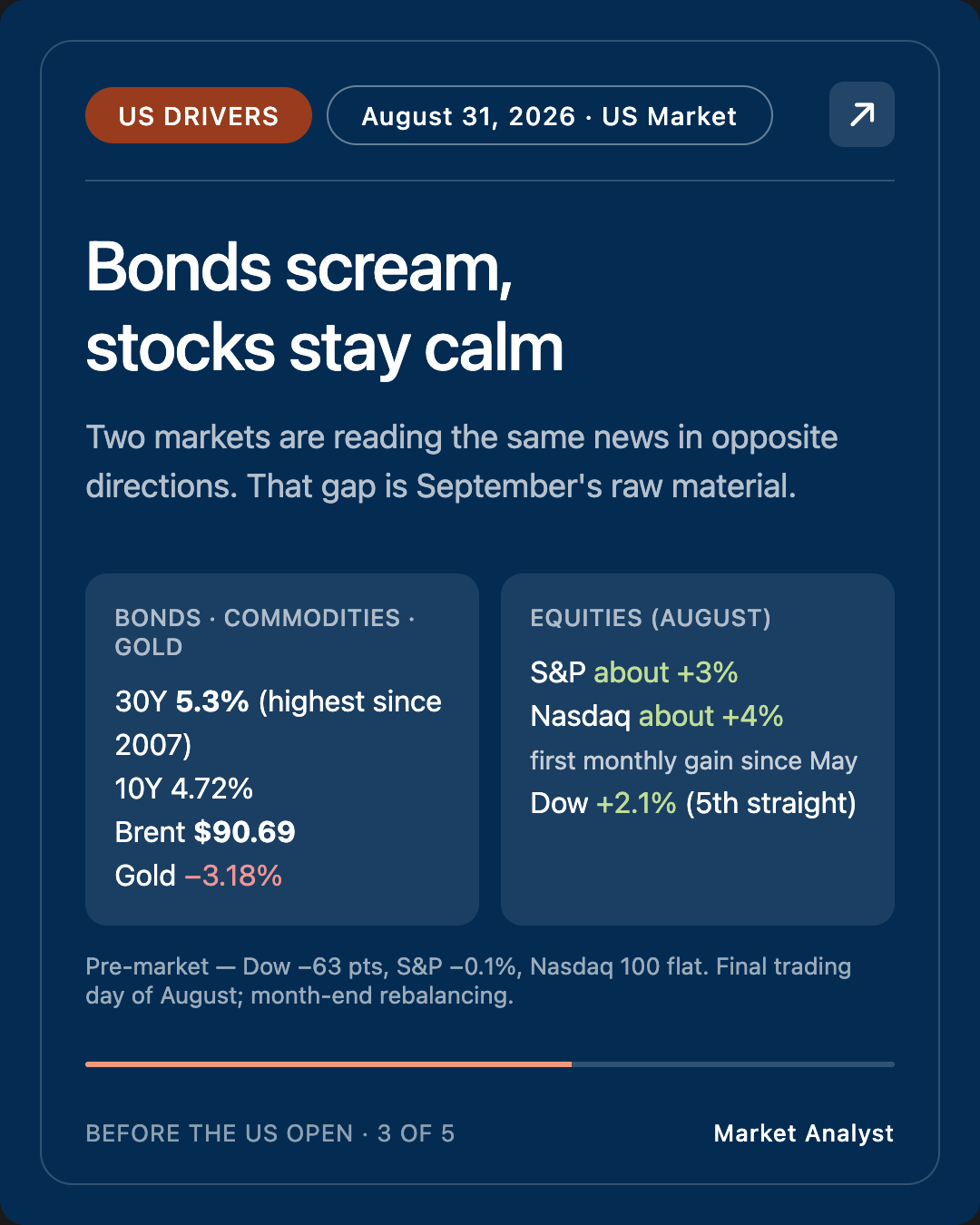
- The premise flipped. After Warsh's August 28 Jackson Hole speech, the probability of a September rate hike surged from 35.4% to 57.5%, and fed funds futures now put it near 60%. The September 15–16 FOMC also carries a fresh dot plot.
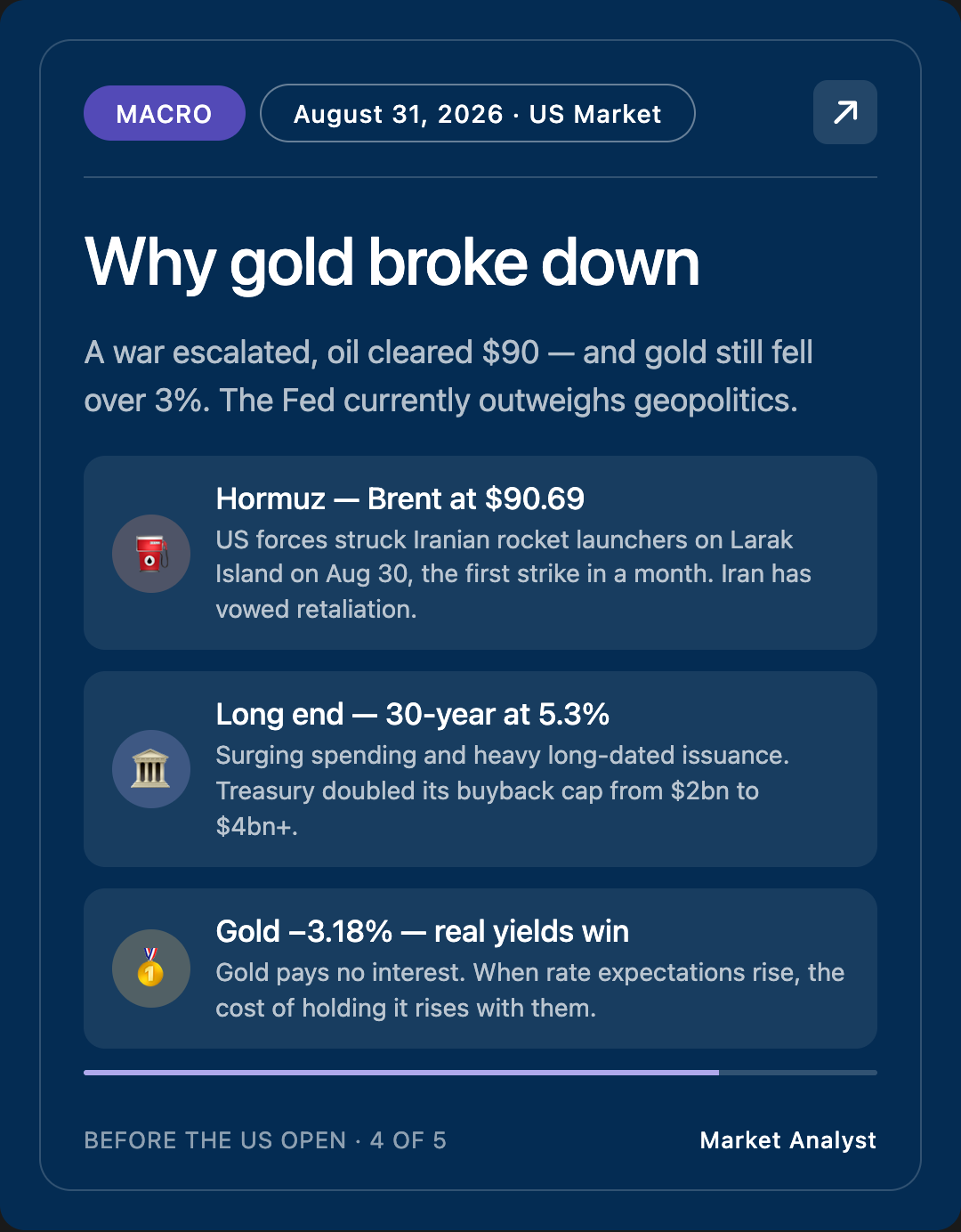
- Oil landed on top of it over the weekend. On August 30, US forces struck two Iranian rocket launchers on Larak Island near the Strait of Hormuz — the first such strike in over a month — after detecting preparations to lay mines. Iran has promised retaliation. Brent $90.69 (+2.93%), WTI in the $86 range.
- The bond market is already screaming. The 10-year sits at 4.72%; the 30-year cleared 5.3% during August, its highest since 2007. The Treasury has at least doubled its long-bond buyback cap, from $2bn to $4bn+, running September through November.
- Equities did not break. Friday's close: S&P 500 7,711.76 (−0.25%), Nasdaq 26,402.42 (−0.52%), Dow 53,559.99 (−0.02%). For August as a whole the S&P is up roughly 3% and the Nasdaq roughly 4% — their first monthly gain since May — with the Dow up 2.1% for a fifth straight monthly advance. Pre-market: Dow futures −63 pts, S&P −0.1%, Nasdaq 100 near flat.
- In Korea, corporate buybacks held the index up. The KOSPI fell to an intraday low of 6,547.76 before closing at 6,820.02 (+0.46%). Foreigners, institutions and retail investors were all net sellers on the same day — an unprecedented combination — yet the index rose, because Samsung Electronics and SK Hynix are executing roughly ₩55 trillion (about $40bn) of share buybacks that register as corporate buying.
This is Mr. Can. Here is the August 31, 2026 brief ahead of the US market open.
Written: 2026-08-31 05:55 PDT (Korea: Aug 31, 21:55 KST)
Covers: Asia's Aug 31 close + Europe's session + US pre-market. Last US close was Friday, Aug 28.
Note — This briefing was interrupted between Aug 17 and Aug 28 by a failure in the automated publishing routine (fixed Aug 28). Publication resumes today, and the assumptions that changed during the gap are summarized in "What Changed in Two Weeks" below.
SEO Intro
Two weeks ago this briefing was written on the premise that the Federal Reserve was about to stop. Today the premise is the opposite. At Jackson Hole on August 28, new Fed Chair Kevin Warsh made price stability his declared first priority, and the odds of a September rate hike jumped from 35% to 57% in a single day — they are now flirting with 60%. Over the weekend, US forces struck Iranian rocket launchers on Larak Island near the Strait of Hormuz, pushing Brent above $90. A central bank determined to crush inflation has run head-on into an oil price that creates it. And yet US equities are closing out August in the green, and Korea's KOSPI reversed a 3% opening plunge to finish higher. Bonds are screaming while stocks stay calm. Here is how to read that gap heading into the US open.
What Changed in Two Weeks (Aug 16 → Aug 31)
The market's skeleton changed during the publishing gap. Three things matter.
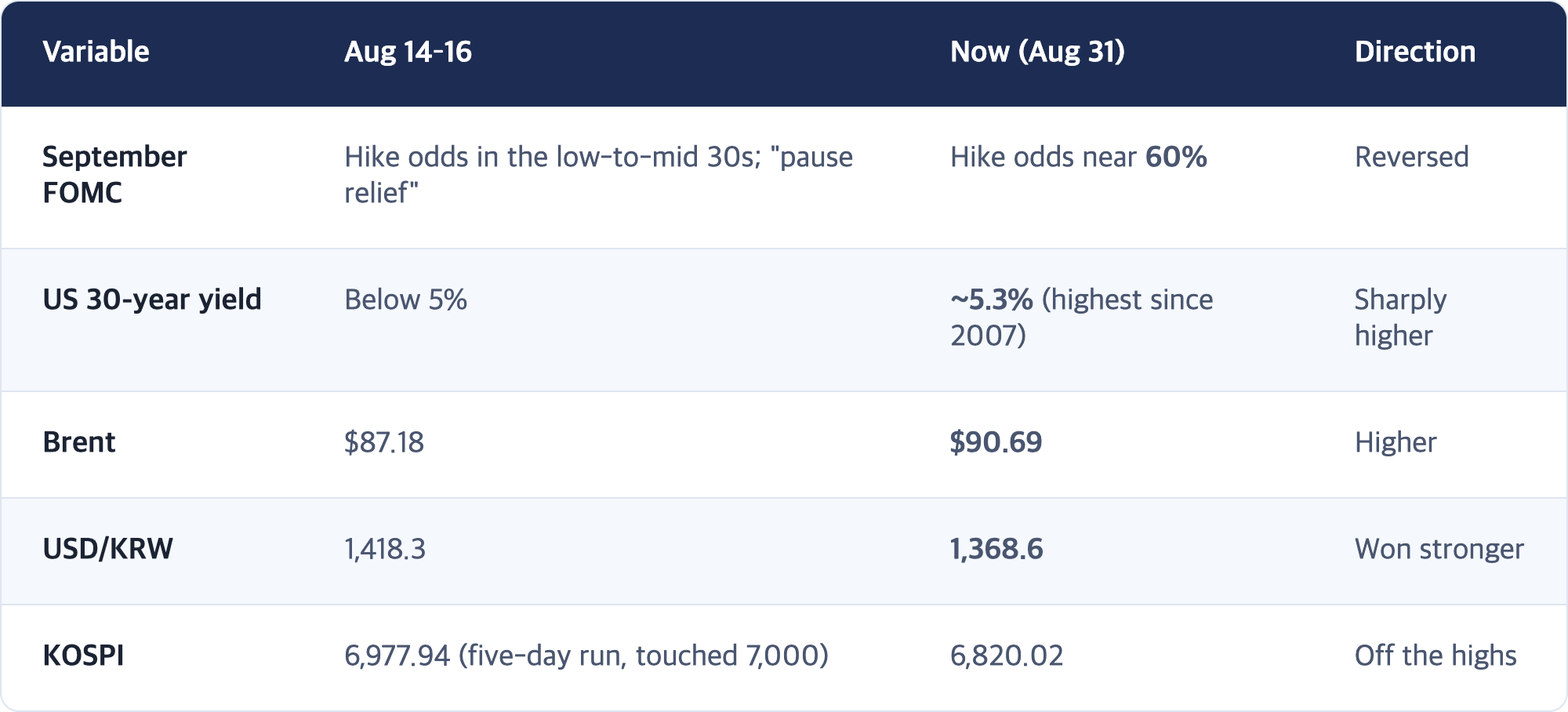
[Interpretation] The mid-August rally rested on a story: inflation had cooled, so the Fed would stop. That story died on August 28. Yet the index has not collapsed, and the Korean won has actually strengthened by roughly 50 points. In other words, the market is partly reading a hawkish Fed as a signal that growth can take it. Whether that reading survives is a question this week's data will answer.
1. Asia and Europe (Aug 31 local sessions)
[Fact] — Prices
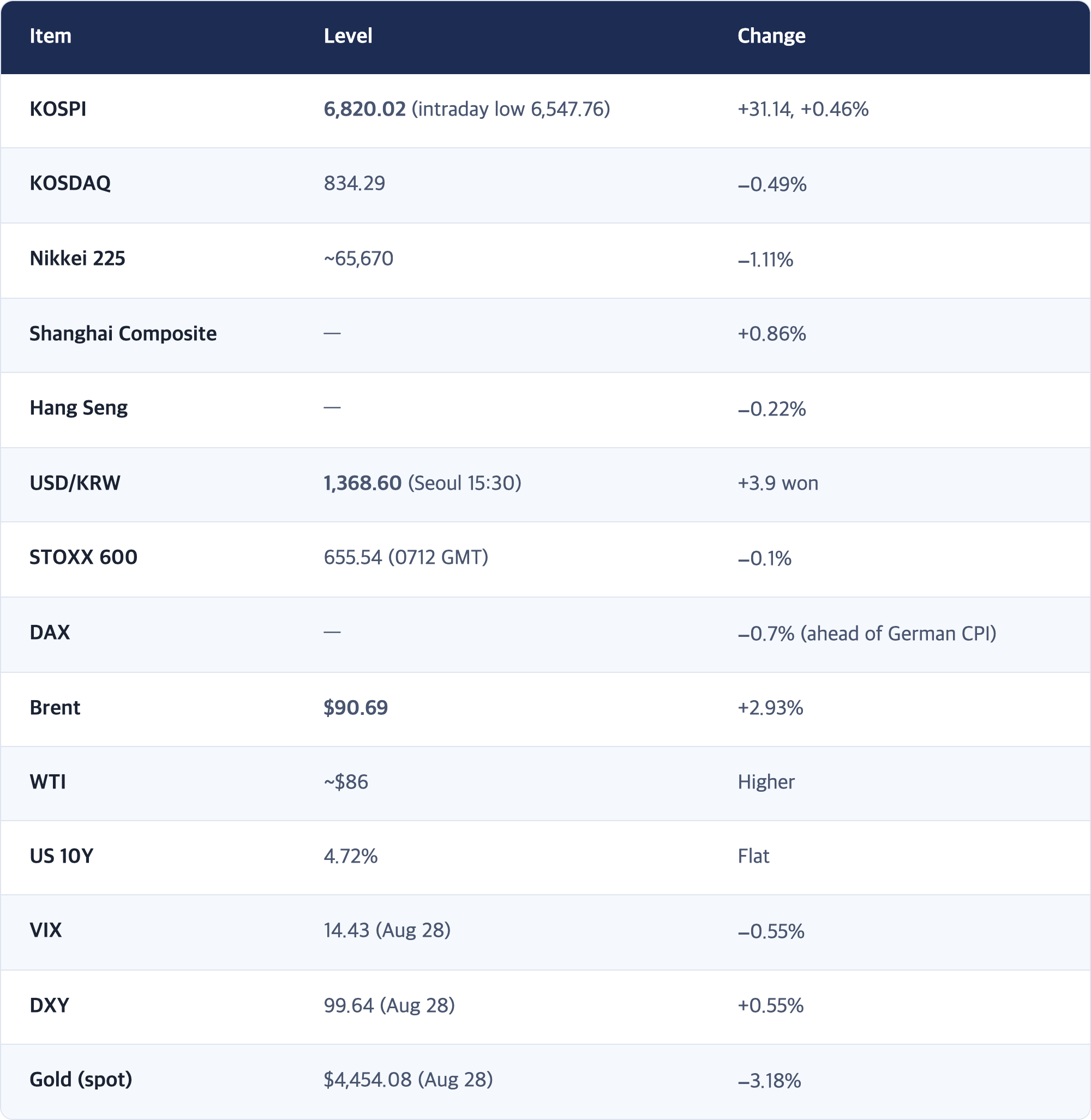
[Observation] Asia split. Korea plunged and reversed (+0.46%), Japan was pinned down 1.11%, and mainland China was the strongest at +0.86%. Europe traded thin with London closed for a bank holiday: energy was the only sector clearly bid, up 0.6% alongside crude, while Germany's DAX was the regional laggard at −0.7%. The STOXX 600 is on track for a fifth consecutive monthly gain, up about 0.9% in August.
[Interpretation] Today Asia and Europe are speaking one language: who gets hurt when rates and oil rise together. Japan — energy-importing and rate-sensitive — took the worst of it. Europe split internally by sector rather than by country. China, relatively insulated from the US rate story, went its own way. Markets are not lining up by nationality right now; they are lining up by exposure to energy and to duration.
2. The One Thing — Warsh at Jackson Hole: from "cuts" to "hikes"
[Fact] Jackson Hole symposium, August 28. Fed Chair Kevin Warsh:
- Said the Fed will "have work to do" if policymakers are not confident underlying inflation is returning to 2% — the closest he has come to acknowledging hikes may be needed.
- Declared price stability the Fed's predominant focus, and interest rates its predominant tool.
- Crucially, offered neither forward guidance nor a reaction function. He did not say what conditions would trigger a move.
- Market response: September hike odds went from 35.4% to 57.5% in a day, and fed funds futures now imply roughly 60.4%.
- Rates response: short-dated yields rose more than long-dated ones, since near-term Fed expectations map directly onto the front end of the curve.
- Equity response: S&P −0.25%, Nasdaq −0.52% (dragged by chipmakers including Nvidia and Intel), Dow −0.02%. All three still finished the week higher.
[Interpretation] Three points.
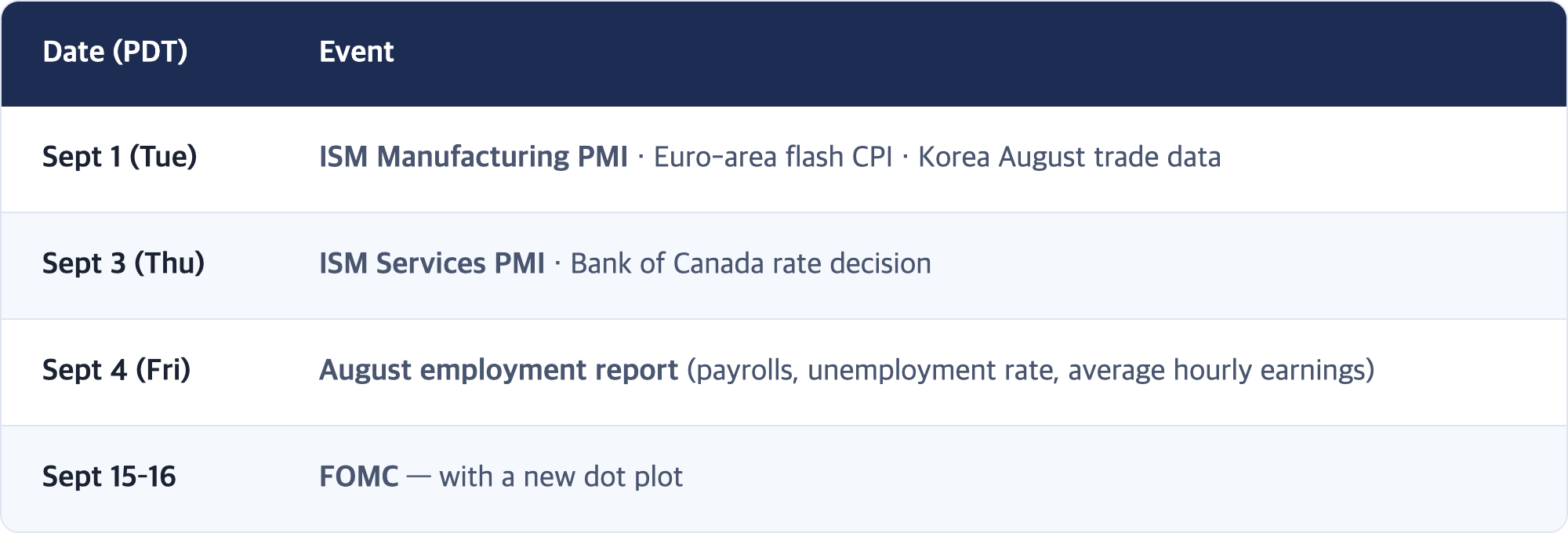
- What he did not say matters most. Warsh committed to fighting inflation but gave no conditions — no "if we see X, we move." Without a reaction function, the market has to re-price the odds itself after every single data release. That means every inflation and labor print between now and September 16 will move markets harder than usual. Treat this week's ISM surveys and Friday's jobs report as carrying roughly double their normal weight.
- 57% is closer to "nobody knows" than to "they're hiking." A 60% probability is a coin flip leaning slightly one way. In that regime, a single data point can swing the odds twenty points, and bonds and FX will react before equities do. The habit of reading rates before reading the index is unusually valuable this month.
- The shape of the curve is the message. On Friday the front end rose more, flattening the curve — but across August the 30-year pushed to 5.3%. The front end is pricing "the Fed hikes"; the long end is pricing deficits, heavy issuance and long-run inflation. Two different forces are lifting yields at the same time, which means the discount-rate pressure on equities is arriving from both directions.
Study note — stagflation, and why the word is back today
The concept: prices rising (inflation) while the economy stalls (stagnation). Normally a weak economy brings prices down, so the central bank can cut rates to help. Under stagflation it cannot — inflation blocks the cut. The genuine danger of this state is that the central bank cannot come to the rescue.
The analogy: a patient running a fever (prices) who is also exhausted (growth). The fever reducer makes the exhaustion worse; the stimulant makes the fever worse. The doctor has no clean move.
Today's example: oil is at $90 (upward price pressure), the August Chicago PMI came in at 47.1, the weakest reading of the year (below 50 means contraction — downward growth pressure), and the Fed chair has declared inflation his first priority. Having all three on one screen is why markets feel jumpy. That said, stagflation is not confirmed. Chicago PMI is one regional survey; the national ISM manufacturing print (Sept 1) and the jobs report (Sept 4) will either corroborate it or contradict it. Not diagnosing a regime from a single indicator is the basic discipline with this word.
3. The Second Variable — Korea: everyone sold, and the index still rose
[Fact] Korea, August 31
- Opened sharply lower on US rate fears and the Philadelphia Semiconductor Index's −3.47% drop on Aug 28, falling more than 3% to an intraday low of 6,547.76
- Reversed in the afternoon to close at 6,820.02 (+0.46%) — roughly +4.2% off the low
- Flows (KOSPI, net): "other corporations" +₩1.543tn · institutions −₩910bn · foreigners −₩444bn · retail −₩192bn
- Samsung Electronics closed at ₩260,000 (+1.17%); SK Hynix at ₩1,674,000 (+1.27%), after dipping to ₩1,626,000 intraday
- The catalyst for the reversal: reports that Samsung has secured mass-production readiness for next-generation HBM4 memory, plus bargain hunting
- USD/KRW 1,368.60 (+3.9 won)
Tallies differ slightly by outlet — Hankyung reported roughly −₩700bn for foreigners, −₩800bn for institutions and −₩100bn for retail. Every outlet agrees on the shape: all three traditional investor groups net sellers, with heavy net buying booked to corporations.
[Fact] The buyback programs behind that corporate bid
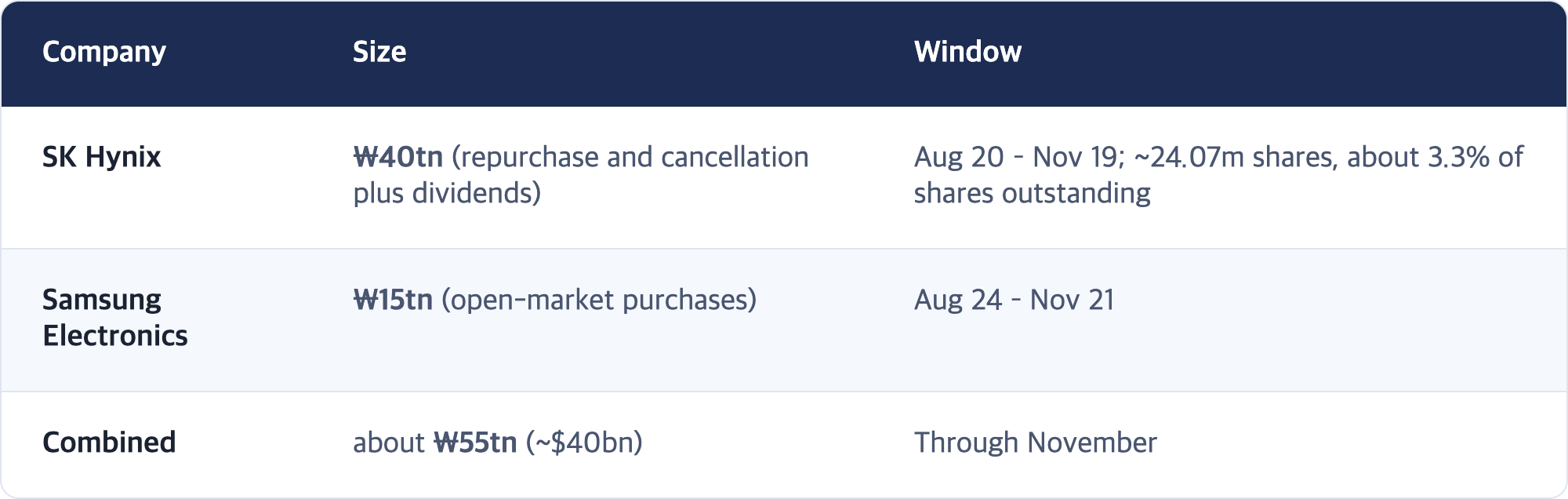
[Interpretation] This is a structural event in how Korea's market clears.
For years the Korean market has been explained as a tug-of-war between three players: foreign investors, domestic institutions, and retail. Today all three sold — and the index still rose, because a fourth player bought ₩1.5tn. That buyer is the companies themselves. Korean exchange data books corporate buybacks under "other corporations," and this flow behaves differently from the others in one decisive way: it is executed on a disclosed schedule, not on a view about price. Foreigners sell because of rates and currency. A buyback program simply buys.
What follows from that:
- There is a floor under the market until November. ₩55tn is being spread across the windows ending November 19 and 21. Days like today — heavy foreign selling, muted index damage — can repeat.
- But the signal gets noisier. The index holding up does not mean foreign investors came back. Today is exactly that case. For the next few months, watch the foreign flow number separately from the index level to get the market's true temperature.
- And the support expires. The floor now under the market is not permanent. That date belongs on the calendar.
The currency tells a related story. Despite a Fed turning hawkish, USD/KRW has fallen from 1,418 two weeks ago to the 1,368 area. [Observation] A won that strengthens while the dollar strengthens is unusual. [Interpretation] Expanded shareholder returns making Korean assets more attractive is a plausible explanation, but trade balances and energy import payments are also in the mix, so it is too early to be certain. Korea's August trade data, out September 1, is the first real clue.
4. Macro Backdrop — $90 oil, a 5.3% long bond, and gold breaking down
[Fact]
- Oil: On August 30 US forces struck two Iranian rocket launchers on Larak Island near the Strait of Hormuz, citing detected preparations for a mining operation. It was the first such strike in over a month, and Iran has vowed retaliation. Brent $90.69 (+2.93%), having touched $90.60 in Sunday evening trade.
- Bonds: 10-year at 4.72%. The 30-year reached 5.31–5.33% during August, the highest since 2007, driven by surging government spending, a flood of long-dated issuance, and inflation that has run above target for five years. Canada's 30-year hit its highest since 2010 and German yields their highest since 2011.
- Treasury response: long-bond buyback cap at least doubled from $2bn to $4bn+, running September through November.
- Dollar and gold: DXY 99.64 (+0.55%, Aug 28), a one-week high. Gold fell 3.18% on August 28 to $4,454.08.
- Volatility: VIX 14.43 — low, through all of the above.
[Interpretation] The key sentence in today's macro is this: gold broke down.
When a geopolitical conflict escalates and oil clears $90, gold normally rises. On August 28 it fell more than 3% instead. The reason is mechanical: gold pays no interest, so when real yields rise, the cost of holding it rises. Warsh's hawkishness lifted rate expectations, and gold was sold. Priced in gold, the market is telling us that right now the Fed variable outweighs the geopolitical one.
A VIX at 14.43 is the same story from the other side. Oil at $90, a 5.3% long bond and 60% hike odds — and the volatility index is serene. That leaves two possibilities: either the market genuinely believes it can absorb these risks, or it has not priced them yet. A low VIX is not evidence of safety; it is evidence of consensus — and moves get violent when consensus breaks. This week's data is that consensus's stress test.
5. US Session Preview (Monday, Aug 31 ET)
[Fact] Today (PDT)
[Fact] This week
[Fact] Pre-market
- Dow futures −63 pts (−0.1%), S&P 500 futures −0.1%, Nasdaq 100 futures near flat
- For August: Dow +2.1% (fifth straight monthly gain), S&P ~+3%, Nasdaq ~+4% — the first monthly gain since May for the latter two
- For context, Nvidia's FQ2 2027 report (Aug 26): revenue $96.22bn (+106% y/y, 4.5% above consensus), next-quarter guidance $108bn versus $104.2bn expected, and a forecast that top-five hyperscaler capex rises from $800bn in 2026 to $1.3tn in 2027
[Interpretation] Two forces meet today
- Lifting: month-end mechanics, the AI capex trajectory Nvidia just confirmed, and the pull of closing August green
- Pressing down: 60% hike odds, $90 Brent, a 5.3% long bond, and the aftershock of Friday's −3.47% in semiconductors
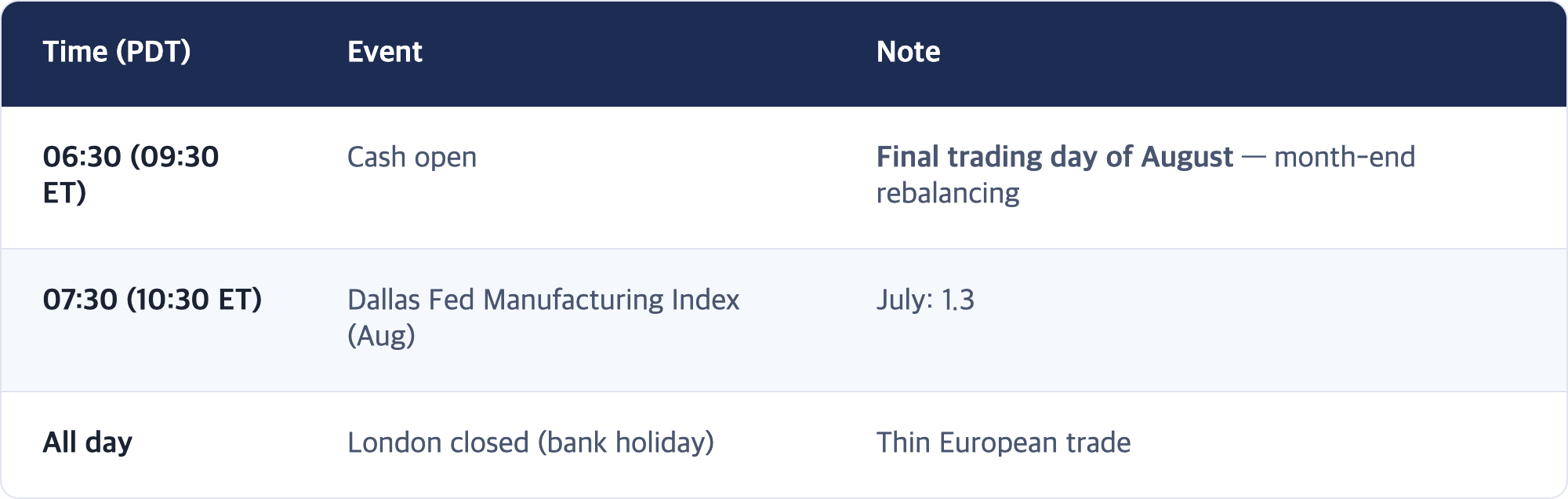
Today's close carries a weak signal. Month-end rebalancing — pension funds and index funds mechanically restoring target asset weights — is mixed into the tape, which makes directional reading unreliable. The real answer starts arriving tomorrow with ISM manufacturing. Today is better spent watching where rates and oil stop than where the index finishes.
6. Checkpoints for the US Open
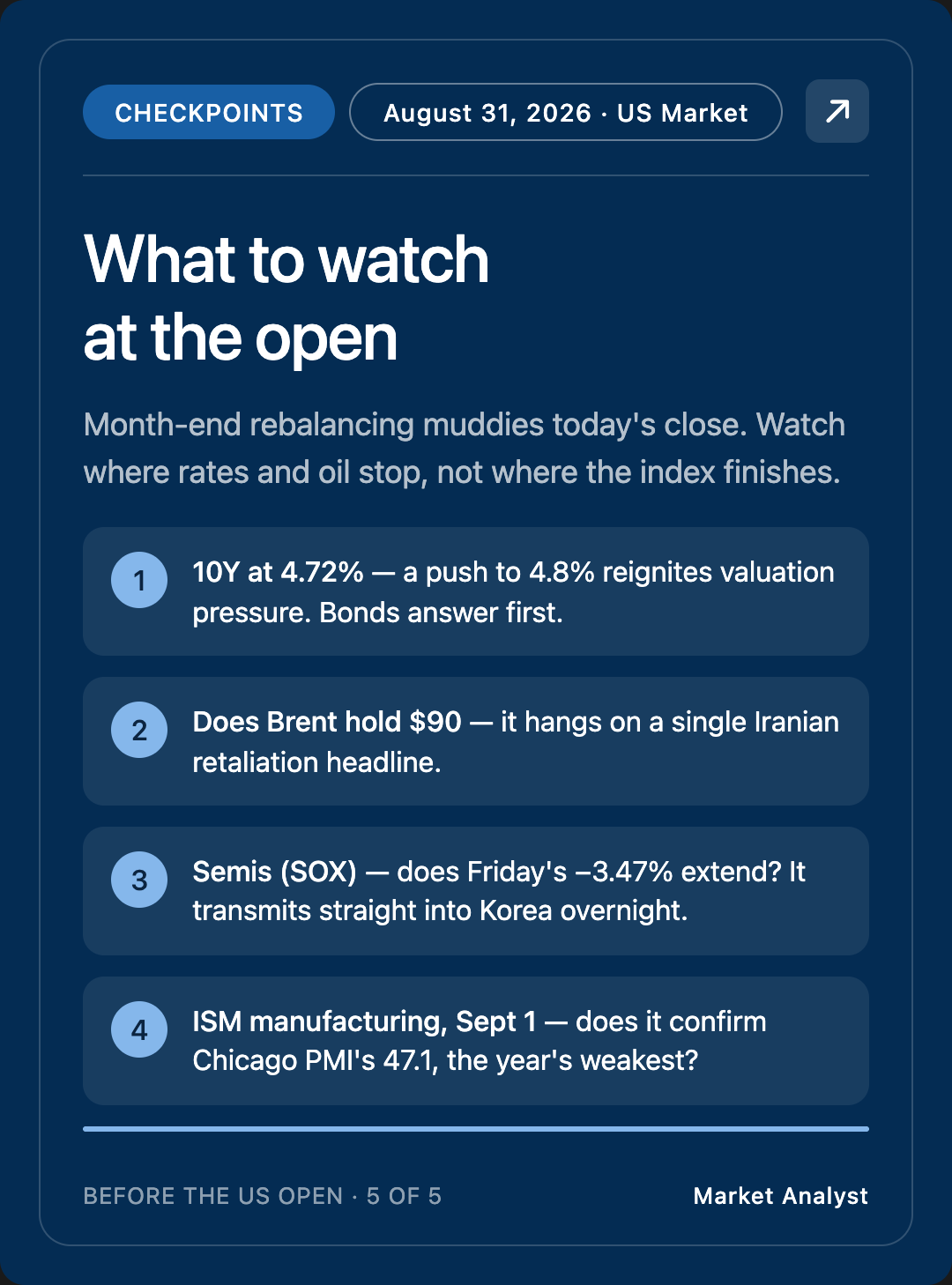
- The 10-year around 4.72% — a push toward 4.8% puts valuation pressure back on. Bonds answer before the index does.
- Whether Brent holds $90 — this hangs on a single Iranian retaliation headline. Staying above $90 carries the pressure into September's inflation prints.
- Semiconductors (SOX) — does Friday's −3.47% extend? This is the first full week after Nvidia's report, and it transmits straight into Korea's index overnight.
- Month-end distortion — do not read today's close at face value. Check it against volume.
- ISM manufacturing on Sept 1 — does the national survey confirm the Chicago PMI's 47.1, the weakest of the year? If it does, the market gets the least comfortable combination available: a hawkish Fed alongside contracting manufacturing.
Corrections
- None. The previous edition was the Aug 16 PM report; publication was interrupted in between.
Sources
- KOSPI closes up 31.14 points at 6,820.02 — Asiae
- KOSPI stages dramatic reversal to reclaim 6,820 — BusinessKorea
- Retail, institutions and foreigners all net sellers — yet the KOSPI rose — Hankyung
- KOSPI closes at 6,820.02, propped up by Samsung and SK Hynix buybacks — MoneyToday
- "₩46tn more to buy" — how Samsung and SK Hynix buybacks are supporting the market — EBN
- Fed Chairman Warsh warns on inflation at Jackson Hole — CNBC
- S&P 500 falls Friday after Fed's Warsh highlights inflation worries — CNBC
- Jackson Hole analyst roundup: Warsh's speech sends hike chances higher — CNBC
- Fed September Hike Odds Spike to 59% After Warsh's Jackson Hole Speech — Benzinga
- Stock futures fall after U.S. strikes Iran; Wall Street heads for winning month — CNBC
- US-Iran conflict escalates near Hormuz after Larak Island strikes — Benzinga
- Brent crude oil — Trading Economics
- Europe stocks edge lower as oil jumps; monthly gain in sight — Reuters via Yahoo
- US bond selloff drives 30-year yields to highest since 2007 — Bloomberg
- US 10 Year Treasury Note Yield — Trading Economics
- Gold — Trading Economics
- August Chicago PMI comes in at 47.1, the weakest number for the year — CNBC
- Nvidia earnings takeaways — CNBC
- 2026 FOMC Meeting Schedule: Sept 15–16 — FedRateCalc
- Economic Calendar for the Week of 8/31 Through 9/4 — Substack
Market Analyst · a macro interpretation briefing. It contains no buy or sell recommendations on individual securities.
📌 More market briefs
※ This post is market observation and organization intended to support your own judgment. It is not a recommendation to buy or sell any security. Figures are as of the time of writing and may differ between sources.
If this was useful, bookmark it or pass it along. It genuinely helps me write the next one.
I can survive. We can survive.