October 6, 2026 US Market Brief — Nasdaq and S&P 500 Before the Open
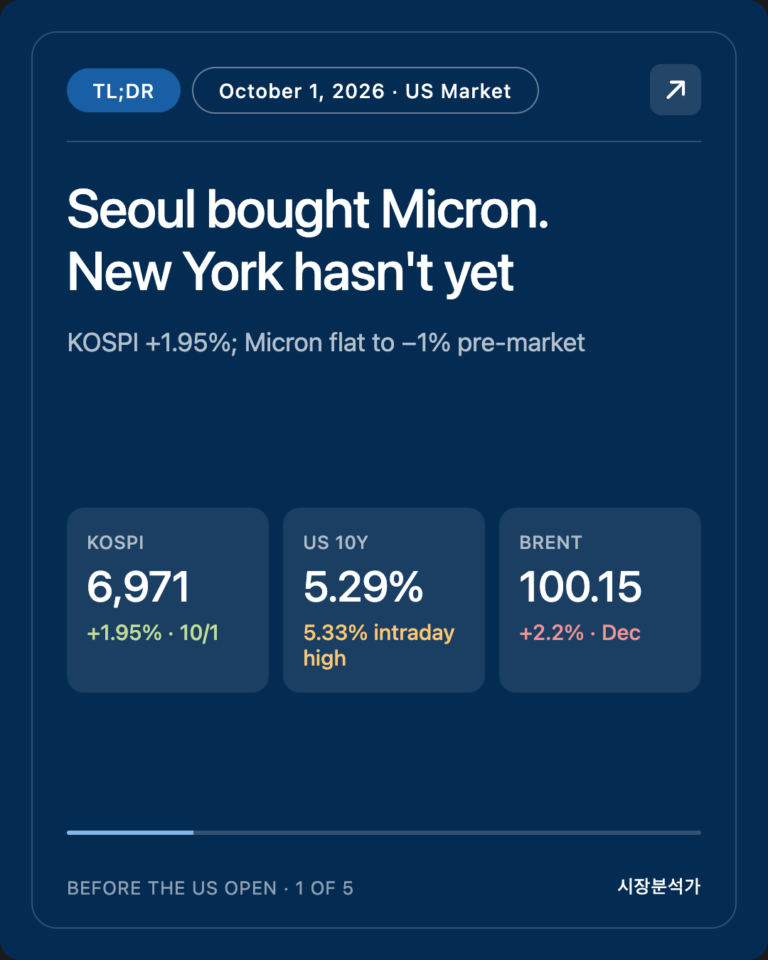
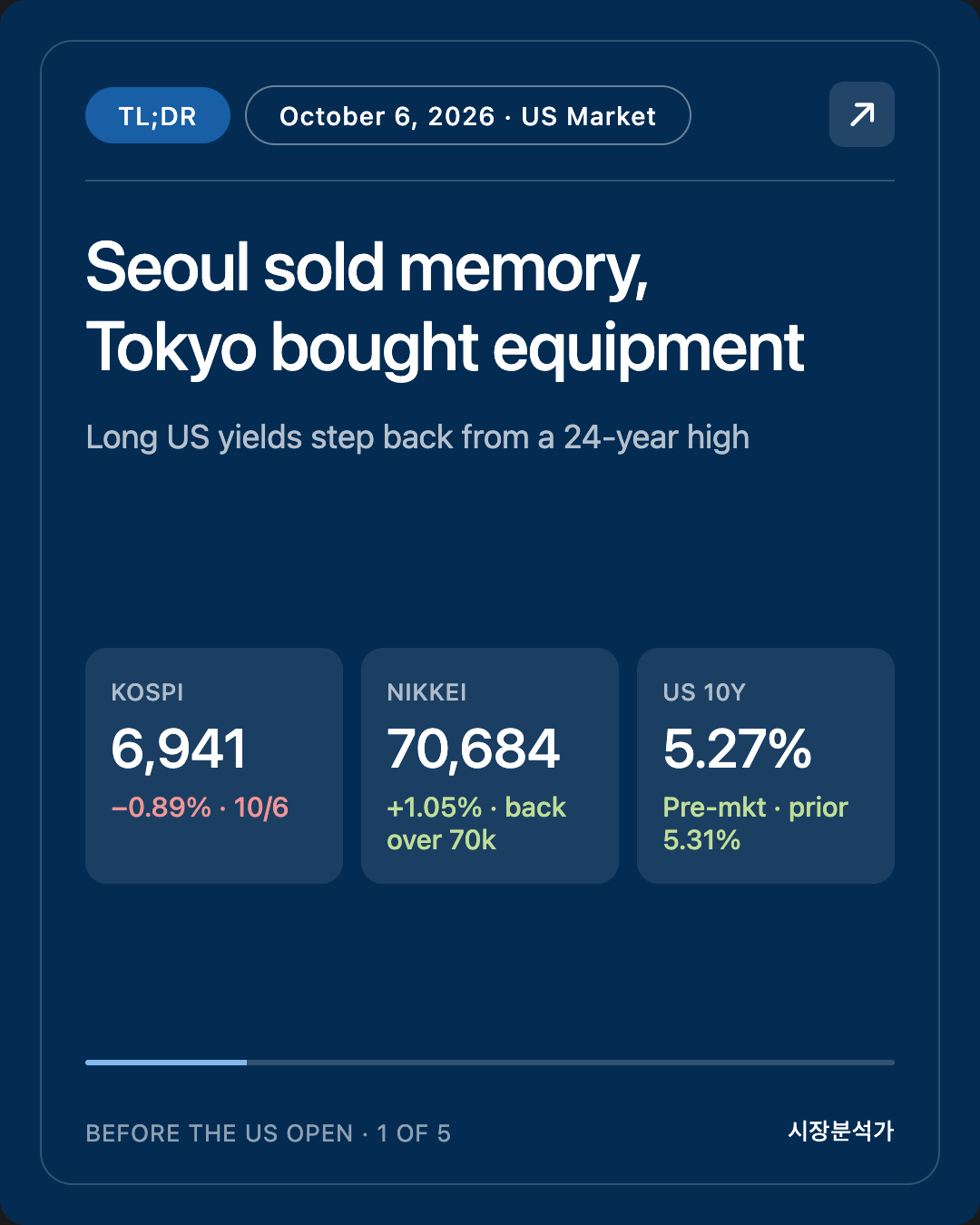
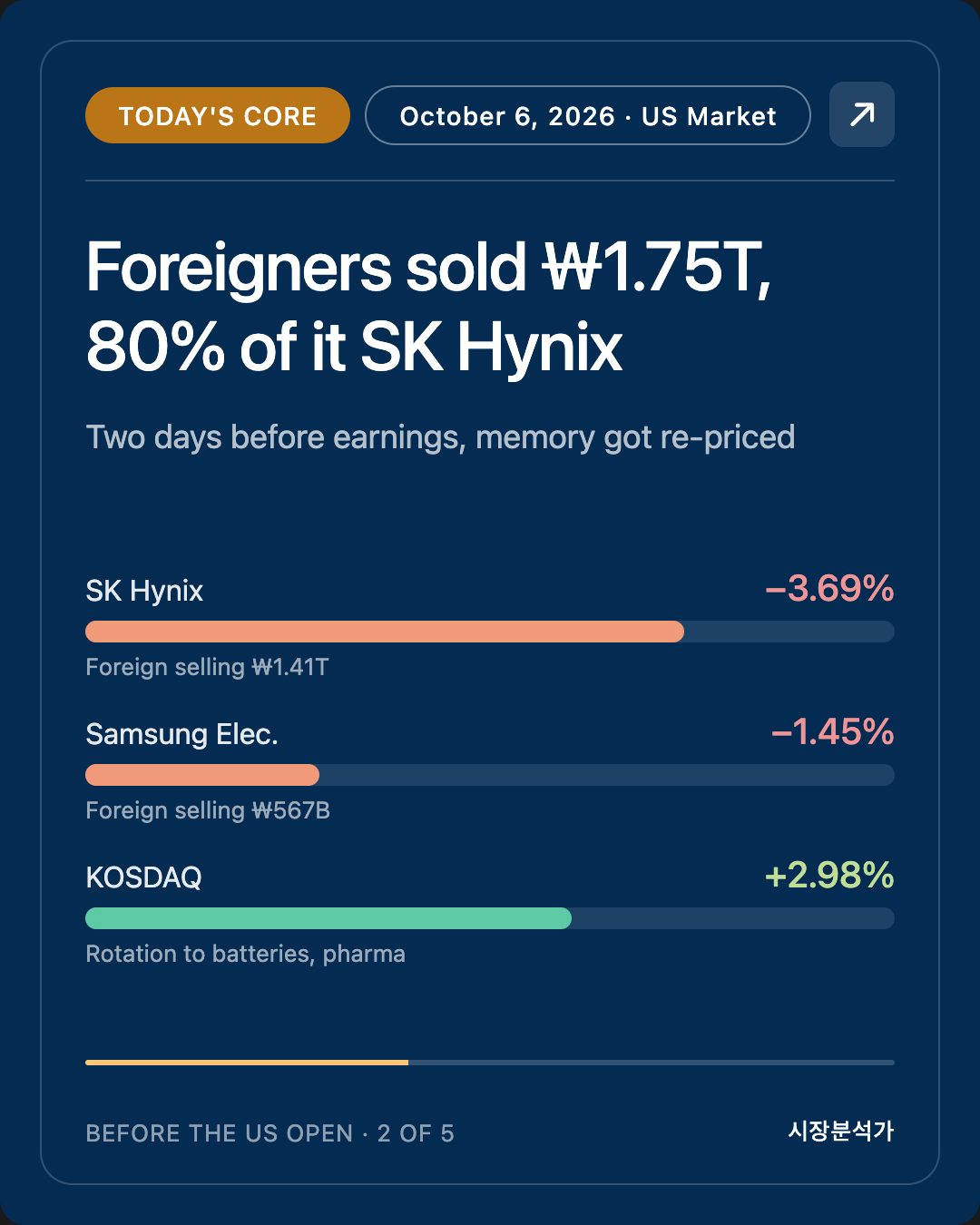
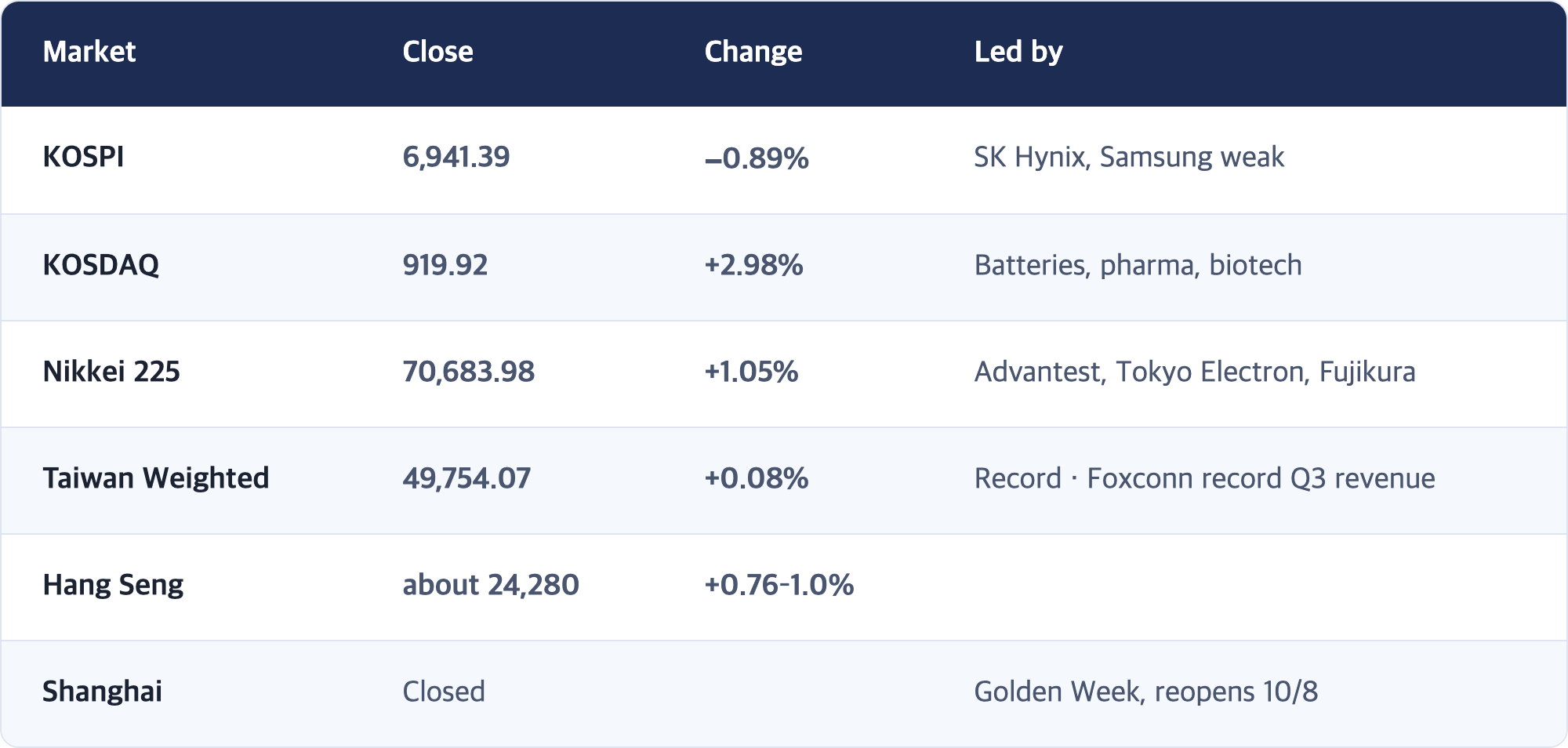
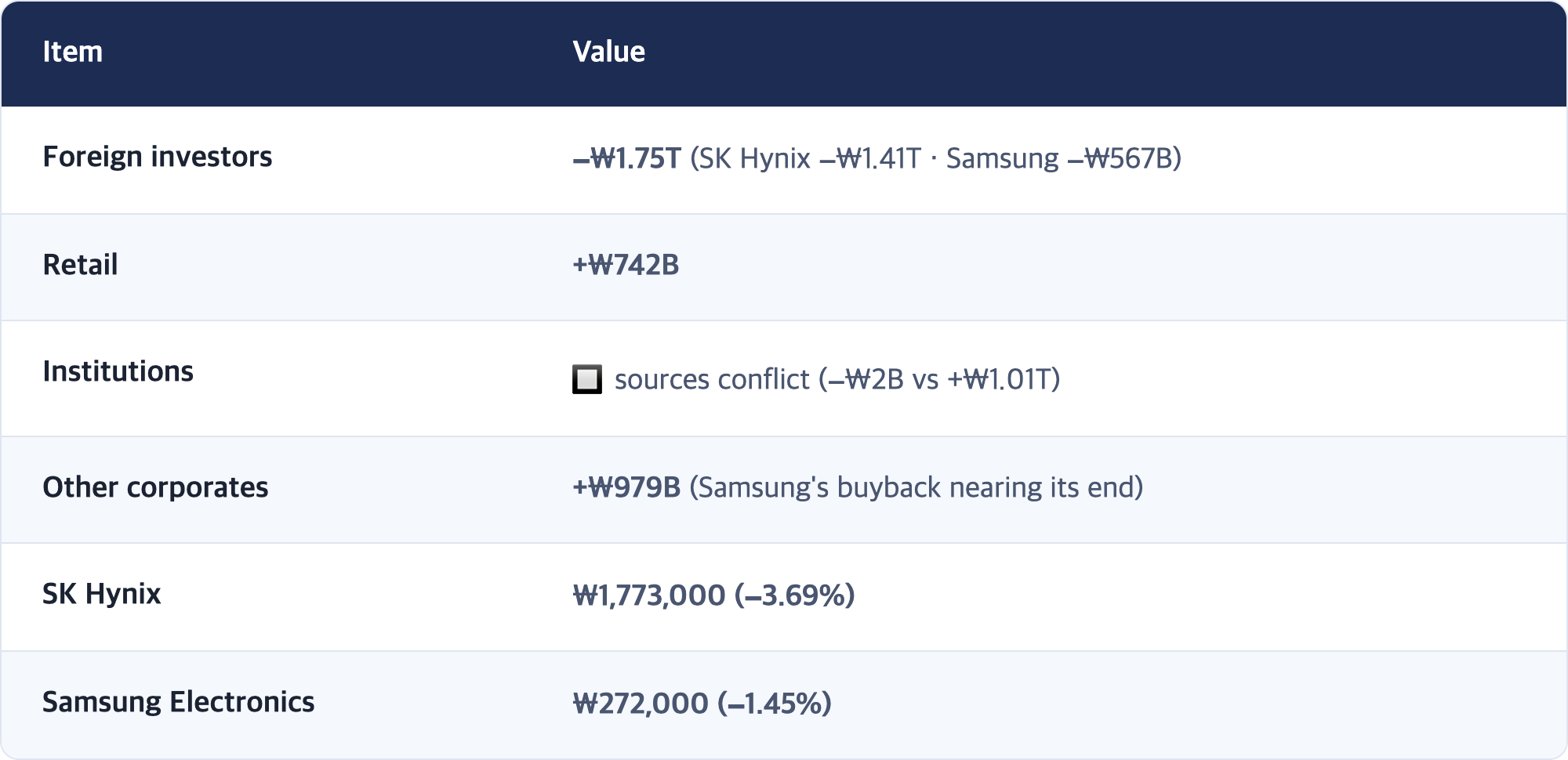
- ★ Seoul listened to Micron, not Nvidia. KOSPI 6,941.39 (−0.89%), losing 7,000 one day after reclaiming it. Foreigners sold ₩1.75T, including ₩1.41T of SK Hynix and ₩567B of Samsung Electronics. SK Hynix −3.69%, Samsung −1.45%. The small-cap KOSDAQ, by contrast, jumped +2.98%.
- ★ Asian chips split in two. Nikkei 70,683.98 (+1.05%), led by test-equipment maker Advantest (sixth straight gain, record high). Taiwan 49,754.07 (+0.08%), a record. Hang Seng +0.8–1.0%. Equipment and AI servers were bought; memory was sold.
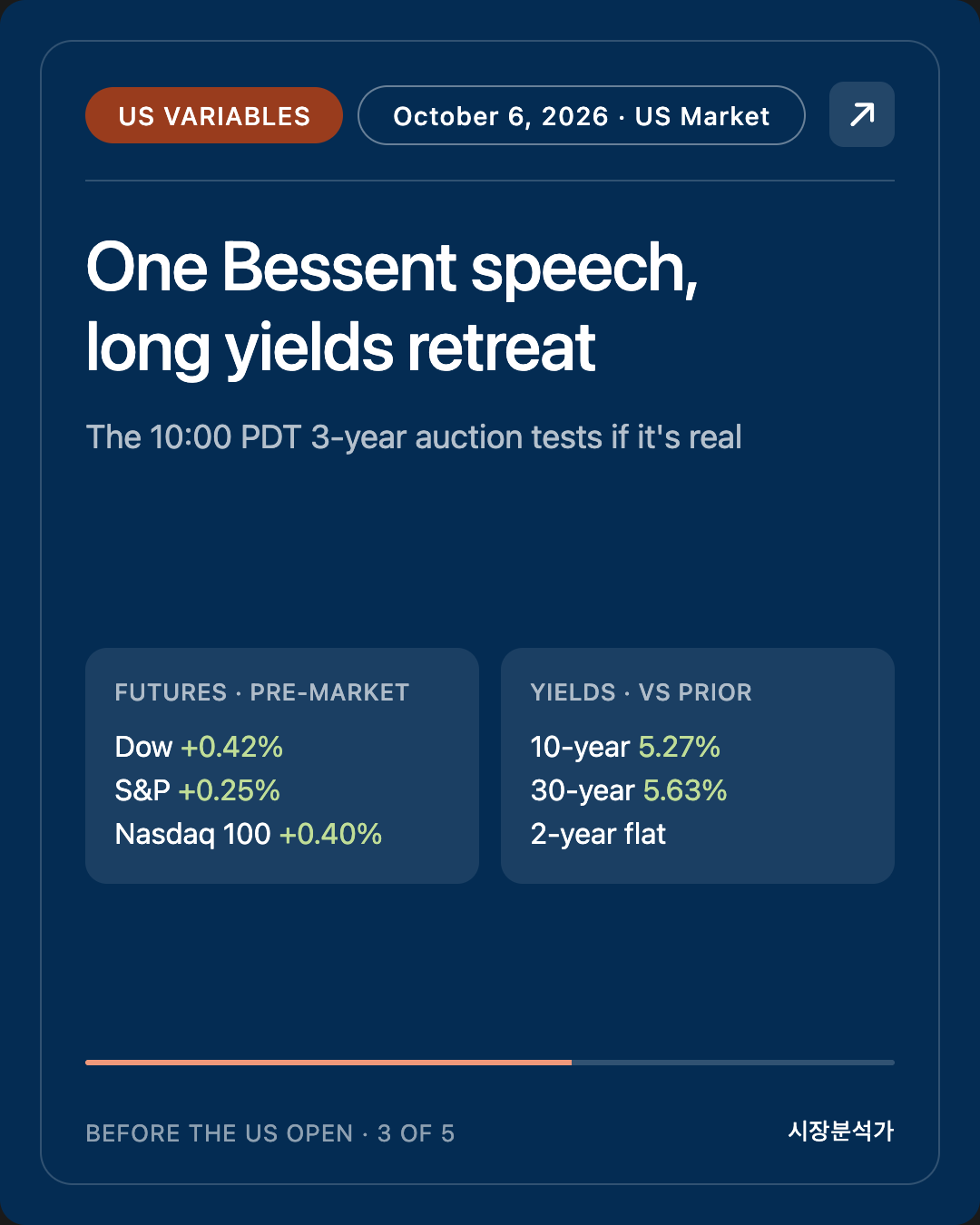
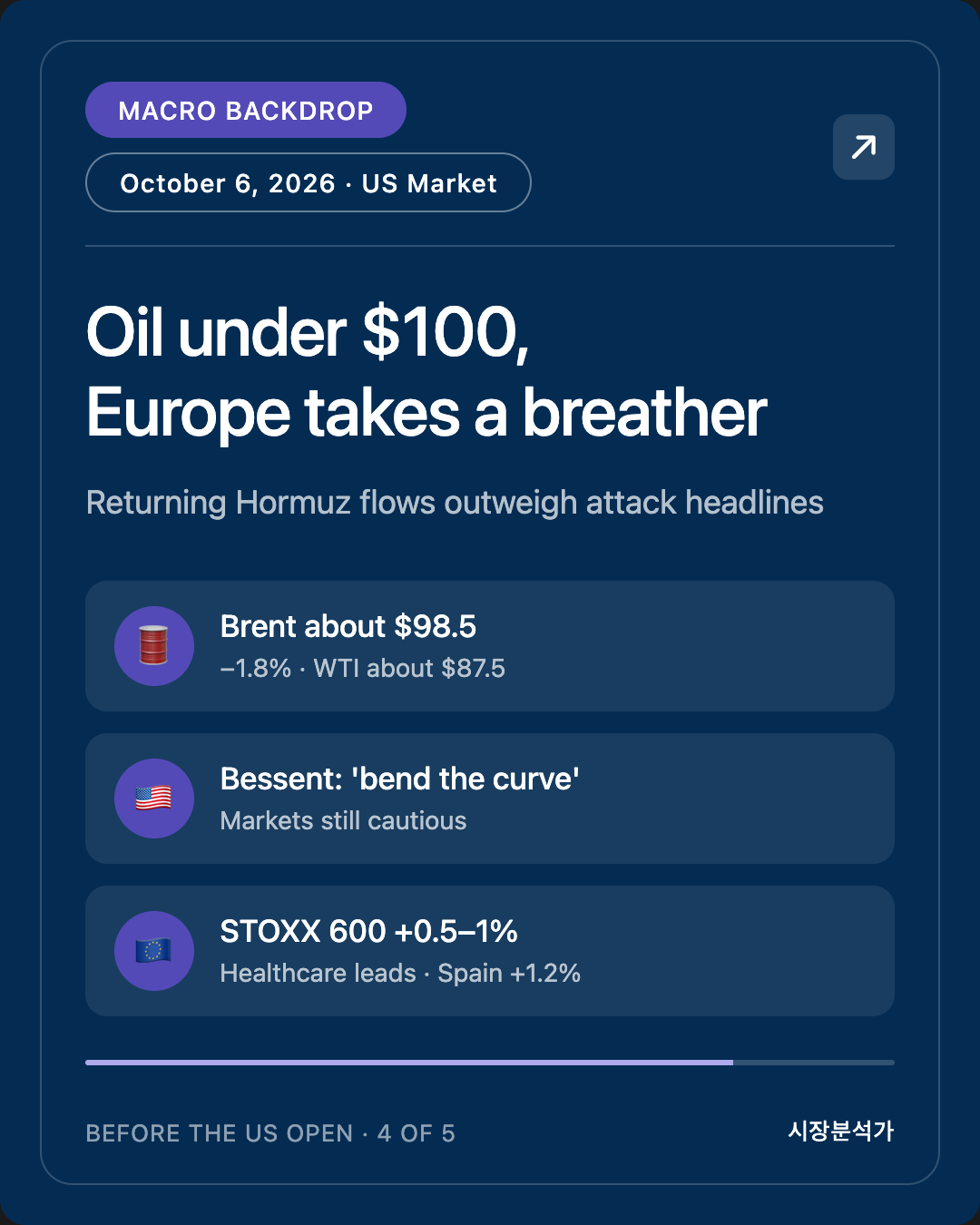
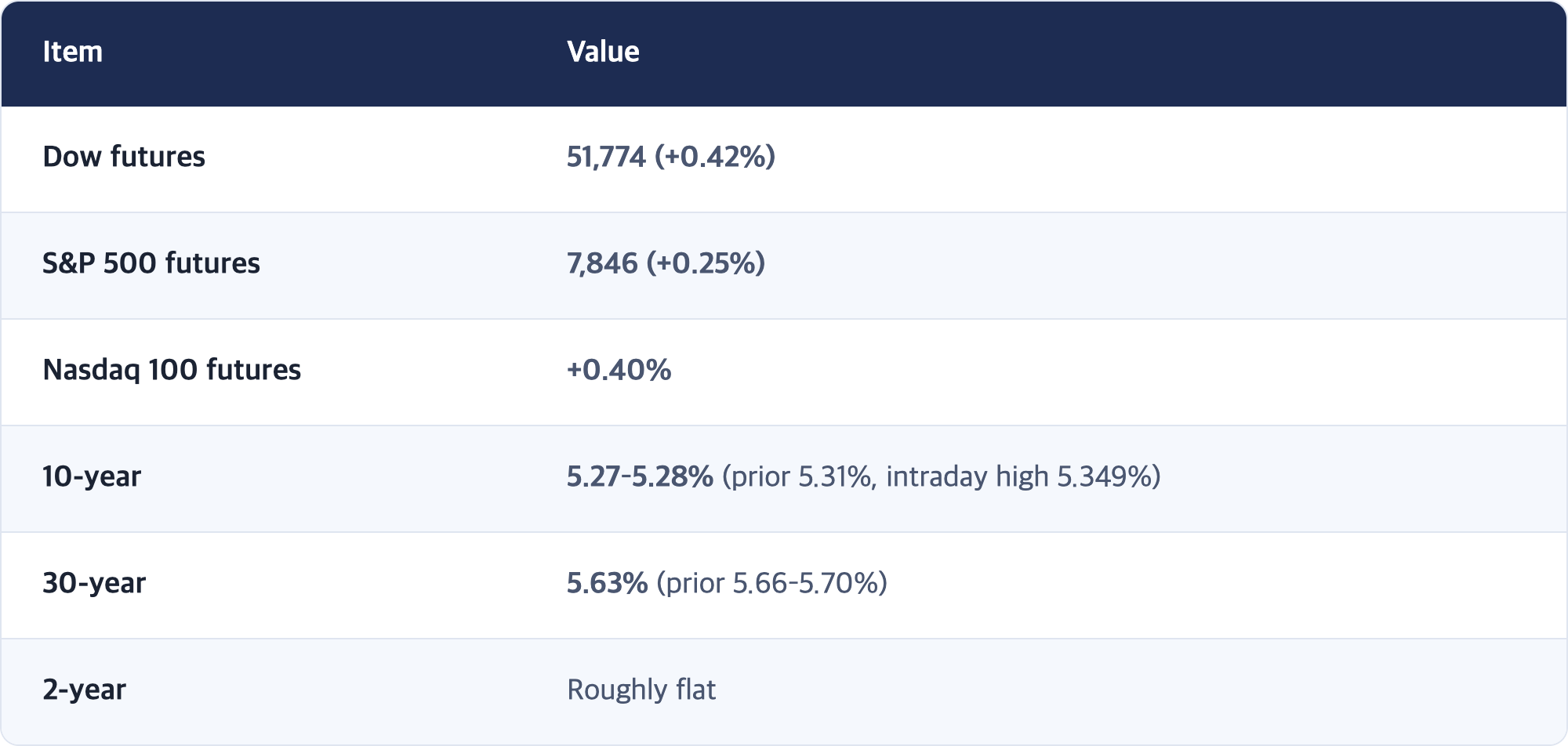
- ★ Long-dated US yields backed off. 10-year 5.27% (−3 to −5 bp), 30-year 5.63% (−4 bp), 2-year roughly flat. Treasury Secretary Bessent said growth and spending restraint would "bend the curve" on federal debt, and more oil moving through the Strait of Hormuz pulled crude lower.
- Oil below $100. Brent about $98.5 (−1.8%), WTI about $87.3–87.7 (around −2%). Futures: Dow +0.42%, S&P 500 +0.25%, Nasdaq 100 +0.40%. Europe's STOXX 600 +0.5% to +1%.
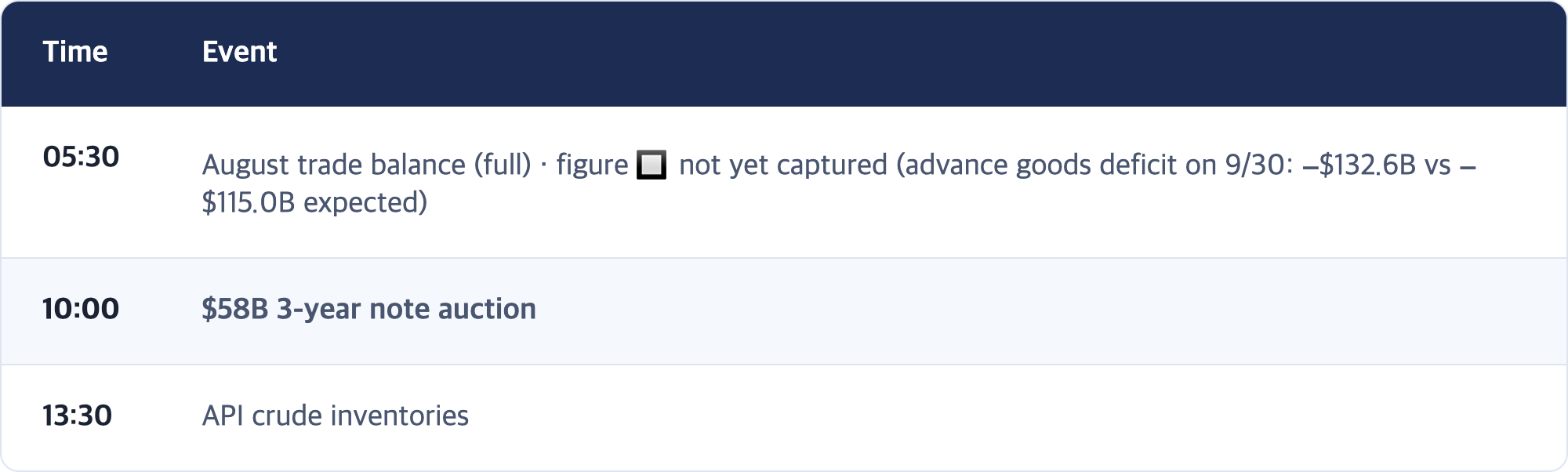
- Today at 10:00 PDT: a $58 billion 3-year Treasury auction — the first real-money test of whether yields have actually turned. FOMC minutes follow tomorrow at 11:00 PDT, then Samsung's preliminary Q3 results on Thursday morning Seoul time.
This is Mr. Can. Here is the October 6, 2026 brief ahead of the US market open.
Written: 2026-10-06 05:50 PDT (Korea 10/6 21:50 KST)
Basis: Seoul 10/6 close + Tokyo, Hong Kong and Taiwan 10/6 close (mainland China closed for Golden Week) + Europe 10/6 intraday + US 10/6 pre-market
🟢 Scheduled 05:30 PDT, started 05:43 PDT. US figures are pre-market.
🟡 Seoul reopened today after a four-day break, and this is a three-day week there (Tue–Thu; closed Friday 10/9 for Hangul Day). Today we score the four Seoul checkpoints set in yesterday's pre-Korea brief.
SEO Intro
Seoul reopened after four days and immediately gave back the 7,000 line. The KOSPI closed at 6,941.39 (−0.89%) as foreign investors sold a net ₩1.75 trillion (about $1.3 billion). Of that, ₩1.41 trillion came out of a single stock, SK Hynix. At the same hour Tokyo's Nikkei 225 closed at 70,683.98 (+1.05%), back above 70,000 for the first time in three months, and Taiwan's benchmark set a new all-time high.
Last night in New York, Nvidia rose while Micron fell. Today Asia copied that split almost line for line: it bought the AI equipment and server names (Tokyo, Taiwan) and sold the memory makers (Seoul). Meanwhile, US rates took a step back. The 10-year Treasury yield eased to 5.27% from its highest level since 2002, Brent crude slipped below $100, and US stock futures are up 0.25–0.4%. Today's question for Wall Street: on a day when rates catch their breath, do memory stocks get a breather too?
1. Checkpoint Scorecard
The four set in the 10/5 pre-Korea brief (Seoul close, 10/6)
The question was: "Does Seoul take the AI rally behind the Nasdaq's record, or the weak memory stocks and 24-year-high yields?"
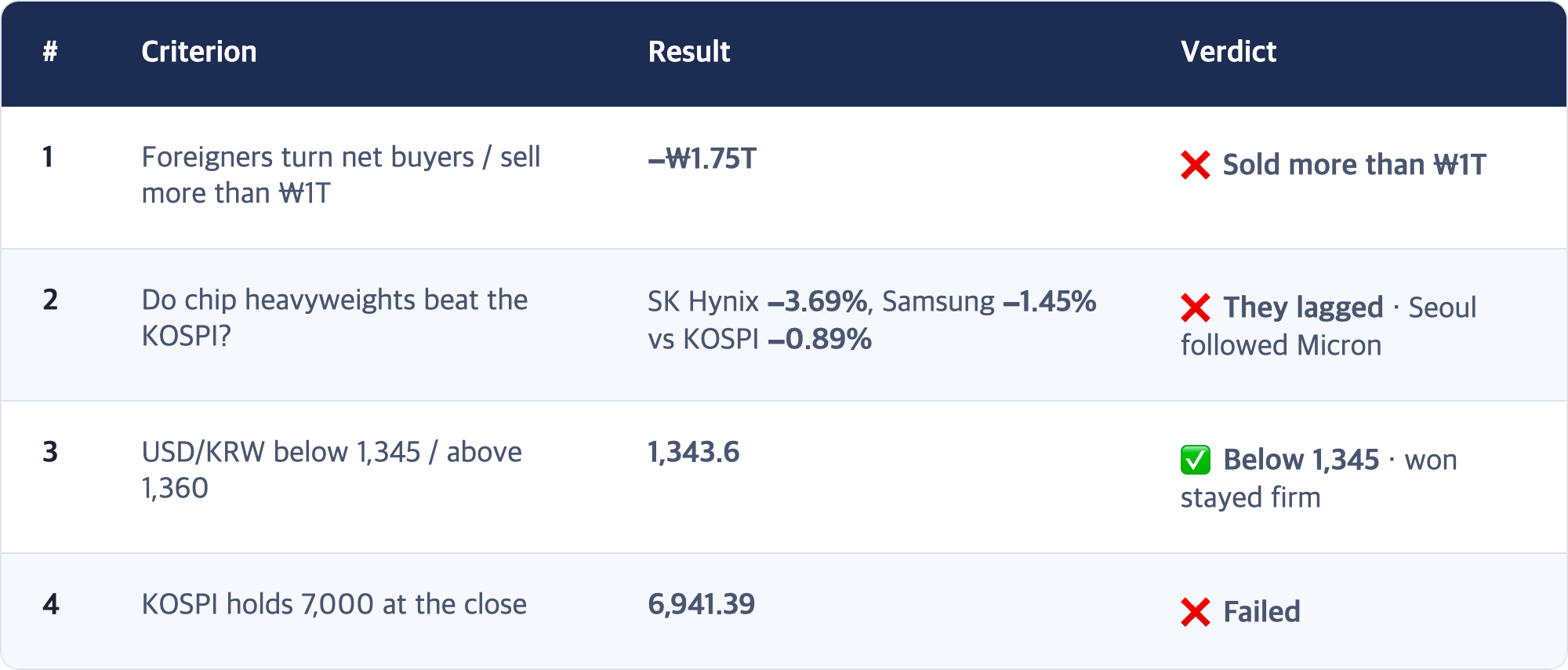
[Interpretation] It landed exactly in the box we drew in advance
Yesterday's brief said: if foreigners sell and chips lag, read it as profit-taking ahead of earnings. That is today. About 80% of foreign selling was concentrated in SK Hynix, and foreigners alone sold ₩1.54T in the electronics sector while retail (+₩445B) and institutions (+₩119B) absorbed it.
[Observation] One number doesn't fit. Foreigners sold ₩1.75T of stocks, yet the won strengthened (checkpoint 3 ✅). Normally foreign selling means converting won into dollars, which weakens the won. The proceeds may not have been converted right away, or the dollar itself may have been soft. Today's data can't tell us which, so we leave it as an observation.
2. Today's Core: Asia transcribed New York's chip split
[Fact] Asia close, 10/6 (Vancouver 00:00–01:00 PDT)
[Fact] Seoul flows (10/6)
★ [Interpretation] Same "AI chips," so why did Tokyo buy and Seoul sell?
What Tokyo and Taiwan bought: companies that test chips (Advantest), assemble AI servers (Foxconn), and make cables and components (Fujikura). If AI spending continues, their revenue grows with how much gets built.
What Seoul sold: memory chips (SK Hynix, Samsung). Memory has one more variable on top of AI demand — price. You can sell more units and still earn less if prices roll over. Micron (−1.26%) and SanDisk (−1.47%) moving opposite Nvidia (+2.12%) in New York last night was the same story.
[Interpretation] So the right read on Asia today is not "AI is cracking" but "within AI, the market is re-pricing memory on its own." With Samsung's Q3 results due Thursday (consensus operating profit about ₩108.1T, roughly $80B), the market is asking less "will the number be good?" and more "is the good number already in the price?" That is the principle we wrote down on 10/1: measure a surprise against the price path, not the consensus.
[Observation] Some Korean reports also cited a possible IPO of SK Hynix's US NAND subsidiary Solidigm (valuations up to $150B floated) as a factor. This is an unconfirmed report, and reports differ on why it would weigh on the parent. We don't treat it as a core driver.
[Observation] The KOSDAQ's +2.98% shows money didn't leave Korean equities — it rotated from big chips into batteries and pharma. LG Energy Solution rose about 5% on hopes for energy-storage demand from AI data centers.
3. US Variables: rates stepped back, and futures welcomed it
[Fact] US pre-market (early 10/6)
[Fact] Two things pulled yields lower (Bloomberg)
- Treasury Secretary Bessent said growth plus spending restraint would "very quickly" start to change the government's borrowing path — "bending that curve."
- Oil: signs of more supply getting through the Strait of Hormuz pushed Brent below $100.
- Bloomberg also noted investors greeted Bessent's comments with caution and were reluctant to call an end to the selloff.
★ [Interpretation] This time the long end fell
On the last four "should-be-rally" days (9/29, 9/30, 10/2, 10/5), the 10-year actually rose. Today, for the first time, the long end (10s and 30s) fell while the short end (2s) held. The reason matters: what had been pushing long yields up was worry about deficits and inflation (term premium), and today's relief came from exactly those two — the Treasury Secretary on debt, and oil.
[Interpretation] Whether this is a turn or just a reflex to one speech will first be answered by the 10:00 PDT 3-year auction. Talk is free; auctions need real money.
[Fact] Today's US calendar (PDT)
4. Macro Backdrop: oil under $100, Europe takes a day off from worry
[Fact] (before the US open, 10/6)
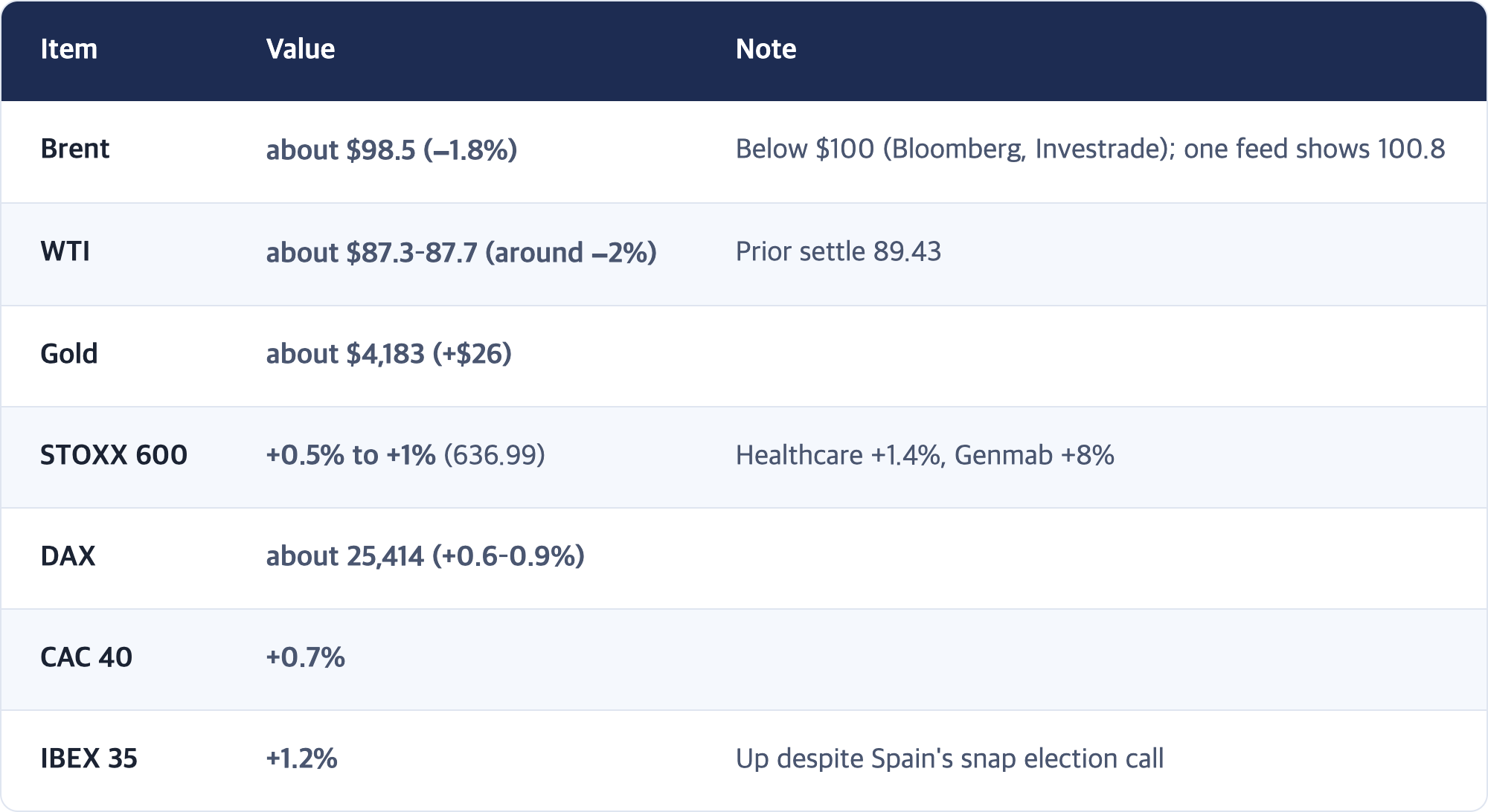
[Interpretation] Oil is now listening to "supply is coming back"
Despite the Houthis' claimed weekend attack on Aramco, oil fell yesterday (−1.8%) and again today (−1.8%). Aramco cutting its November price to Asia to $5 a barrel below benchmark (vs a $2 discount in October) reads as "we have plenty to sell." Through mid-September, attack headlines lifted oil; now recovering Hormuz flows and the G7 stock release weigh more.
[Interpretation] Europe set aside yesterday's fiscal worries (France, Spain) for a day. Spain's market rising 1.2% despite a snap-election announcement suggests "election = risk" is not yet the center of pricing. We still couldn't confirm EUR/USD or the French 10-year (🔲), so we don't draw firm conclusions.
5. Today's US Session (Tue 10/6, PDT) Preview
The question
These four test whether today's retreat in long yields is confirmed by real money, and whether memory stocks share in it. The answer flows straight into Seoul's chip names tomorrow.
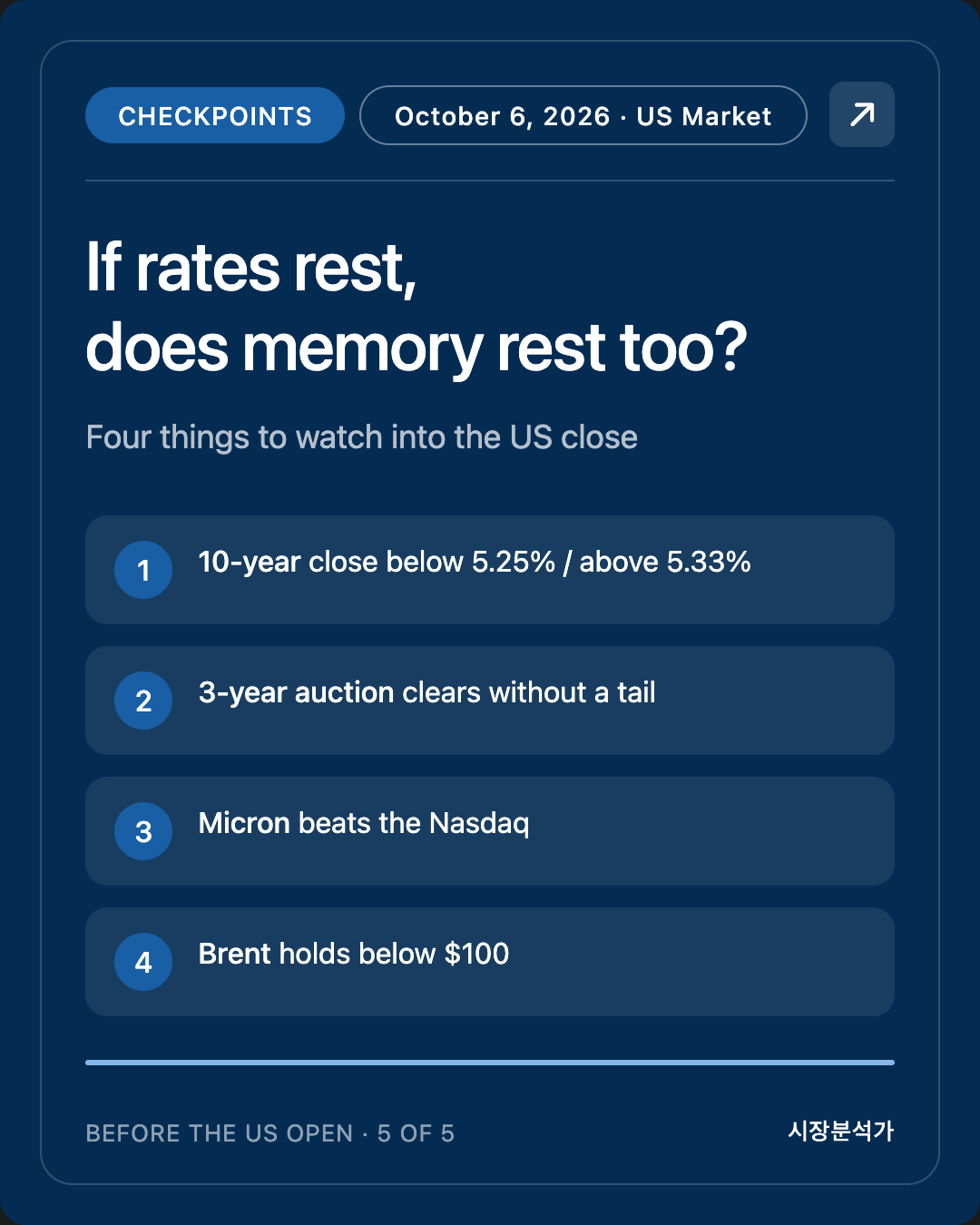
✅ Four checkpoints (US close)
- 10-year close below 5.25% / above 5.33%. Below: Bessent and oil held for more than a day. Above: it was a one-speech reflex. (Most important)
- Does the 3-year auction finish without a "tail"? If the awarded yield is above the pre-auction market yield (when-issued), that's a tail — weak demand.
- Does Micron outperform the Nasdaq? If yes, Seoul's memory selling has room to reverse tomorrow; if not, the memory re-pricing continues.
- Brent holds below $100 at the close. If it does, one weight on long yields is lighter.
[Interpretation] The most informative pair is 1 and 3. If yields fall and memory still can't rally, Seoul's memory weakness isn't about rates — it's memory being re-priced on its own. Then Samsung's guidance on Thursday matters more than its headline number.
6. Study Note: what is a Treasury "auction," and what is a "tail"?
Concept
The US government borrows by selling Treasuries at scheduled auctions. Investors bid "I'll buy at this yield," and the Treasury fills from the lowest yields (best for the government) upward. If the final awarded yield ends up higher than the yield the market was trading just before (the when-issued, or WI, yield), the gap is called the tail. A tail means the government had to offer more interest to sell everything — demand was soft.
Analogy
You list something on a resale app and everyone says "I'd pay $100." When you actually try to sell, you have to drop to $90 to close the deal. That $10 is the tail — the seller (here, the government) ends up borrowing more expensively.
Real examples
- 9/24 7-year auction: awarded at 5.085%, the highest since April 1993. The tail was small (0.7 bp), but the bid-to-cover ratio — how much was bid relative to what was sold — was a weak 2.42. The 10-year settled into the 5.1% range that week.
- Today's $58B 3-year: with the 10-year at a 24-year high as of yesterday, the question is whether higher yields lure in buyers. A clean auction would be evidence that "there are buyers at these levels."
One line
Yields don't fall on words; they fall on auctions. Whether the Treasury Secretary's message landed will show up first on the 10 a.m. auction results.
7. Corrections and Open Items
Correction
- USD/KRW on 10/2: yesterday's brief listed 10/2 as "1,350.6 (−7.8)." Back-calculating from today's report (1,343.6, −0.4 vs prior day-session close), the 10/2 day-session close was about 1,344.0. Yesterday's figure may have been the overnight-session close; not confirmed. Checkpoint 3 is scored on the 1,343.6 day-session close.
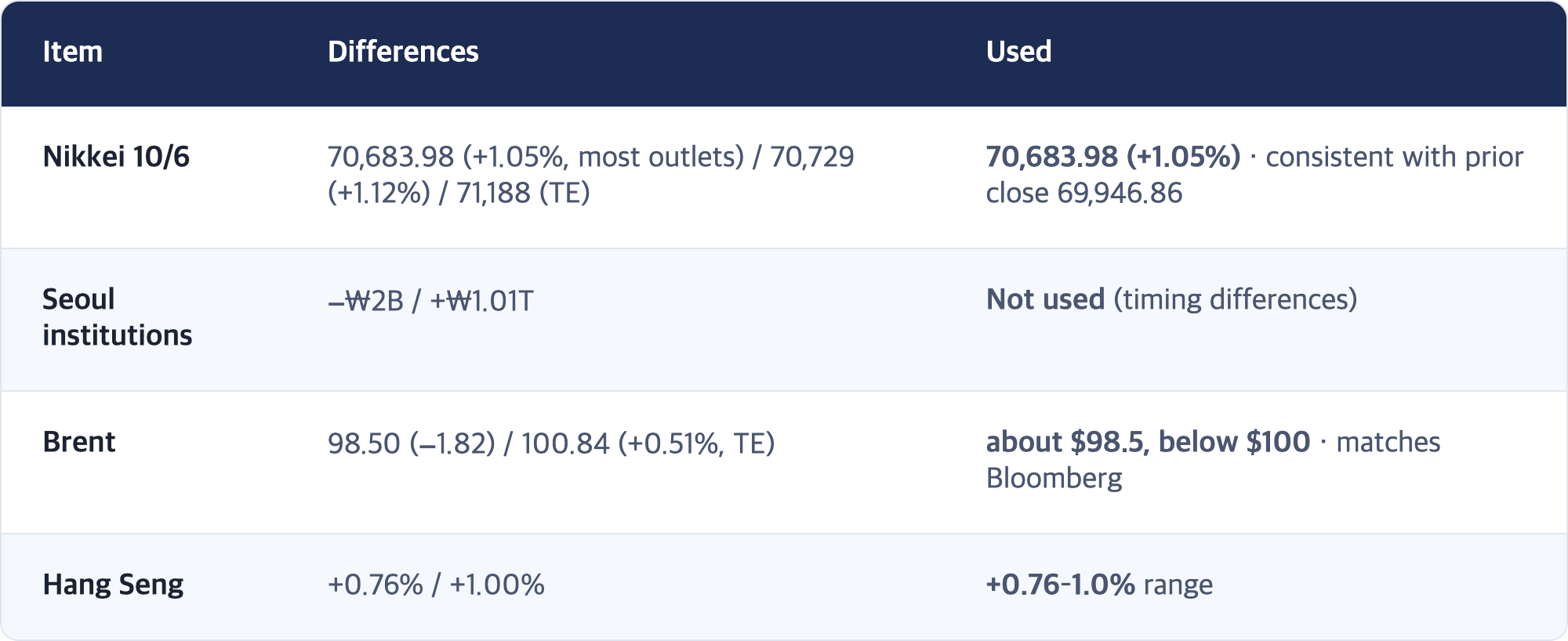
Source differences (value used)
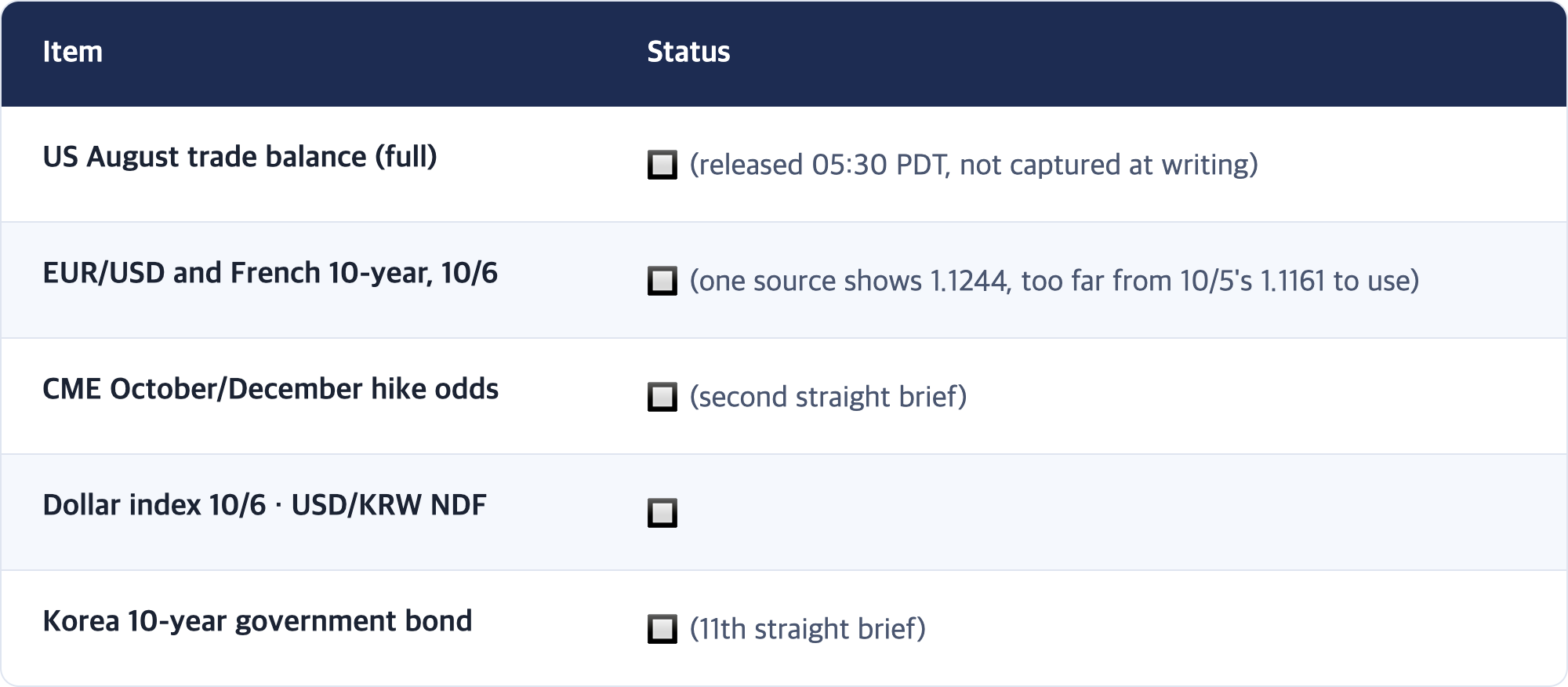
🔲 Unconfirmed
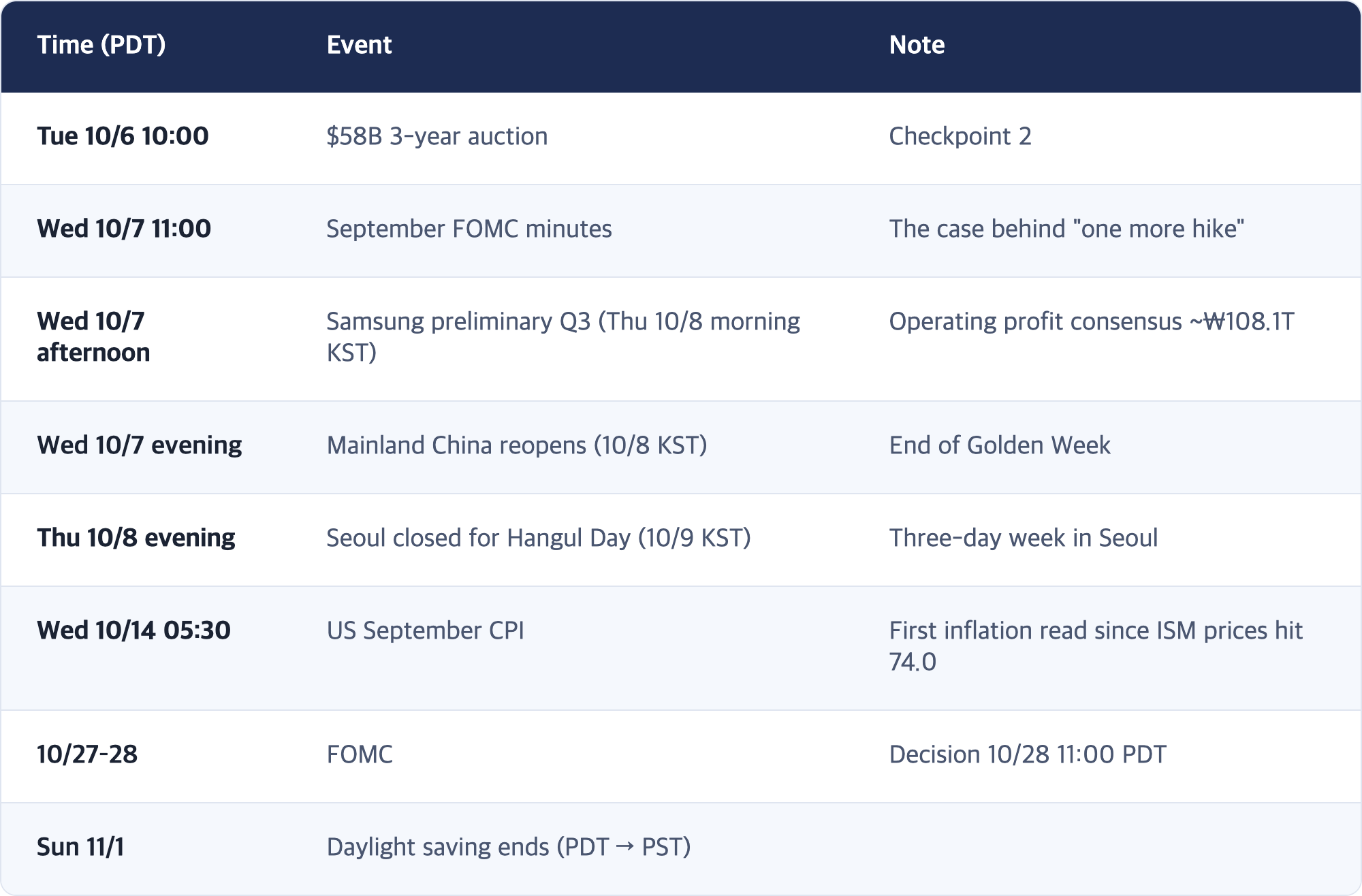
8. Event Calendar (PDT)
Sources
- KOSPI falls to 6,900 range on ₩1.7T foreign selling | EBN via Investing.com (Korean)
- Market close: KOSPI loses 7,000 on foreign selling, KOSDAQ +3% | BusinessKorea (Korean)
- Chip stocks fall as buyback winds down, Solidigm IPO talk | Special Times (Korean)
- KOSPI breaks below 7,000 | Shinailbo (Korean)
- Asia close: Nikkei reclaims 70,000, Taiwan record | Money Today (Korean)
- Nikkei tops 70,000 for first time in three months | Newspim (Korean)
- Japan Stock Market Index | Trading Economics
- US Yields Fall From 2002 High as Oil Dips, Bessent Vows On Debt | Bloomberg
- Morning Preview: October 06, 2026 | Investrade
- Brent oil | Trading Economics
- Healthcare Stocks Power STOXX 600 Higher Amid Easing French Debt Concerns | Blockonomi
- US goods trade deficit sees sharp increase in August | webindia123
- FOMC Meeting Schedule October 2026 | fedratecalc
Market Analyst · We do not recommend buying or selling individual stocks. This brief covers macro trends and interpretation.
📌 More market briefs
※ This post is market observation and organization intended to support your own judgment. It is not a recommendation to buy or sell any security. Figures are as of the time of writing and may differ between sources.
If this was useful, bookmark it or pass it along. It genuinely helps me write the next one.
I can survive. We can survive.