Oct 19, 2026 KOSPI Market Brief — What to Watch Before the Korean Open
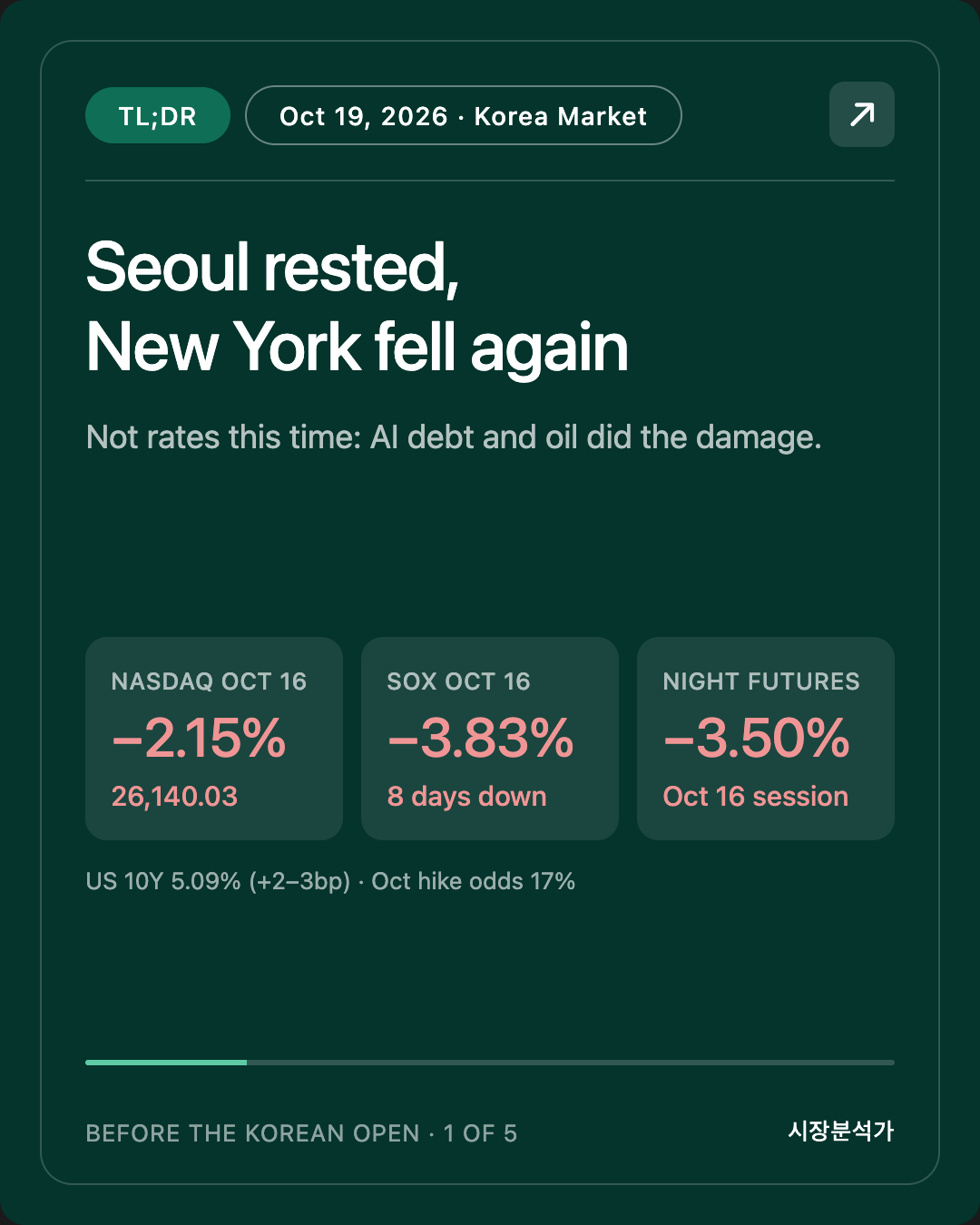
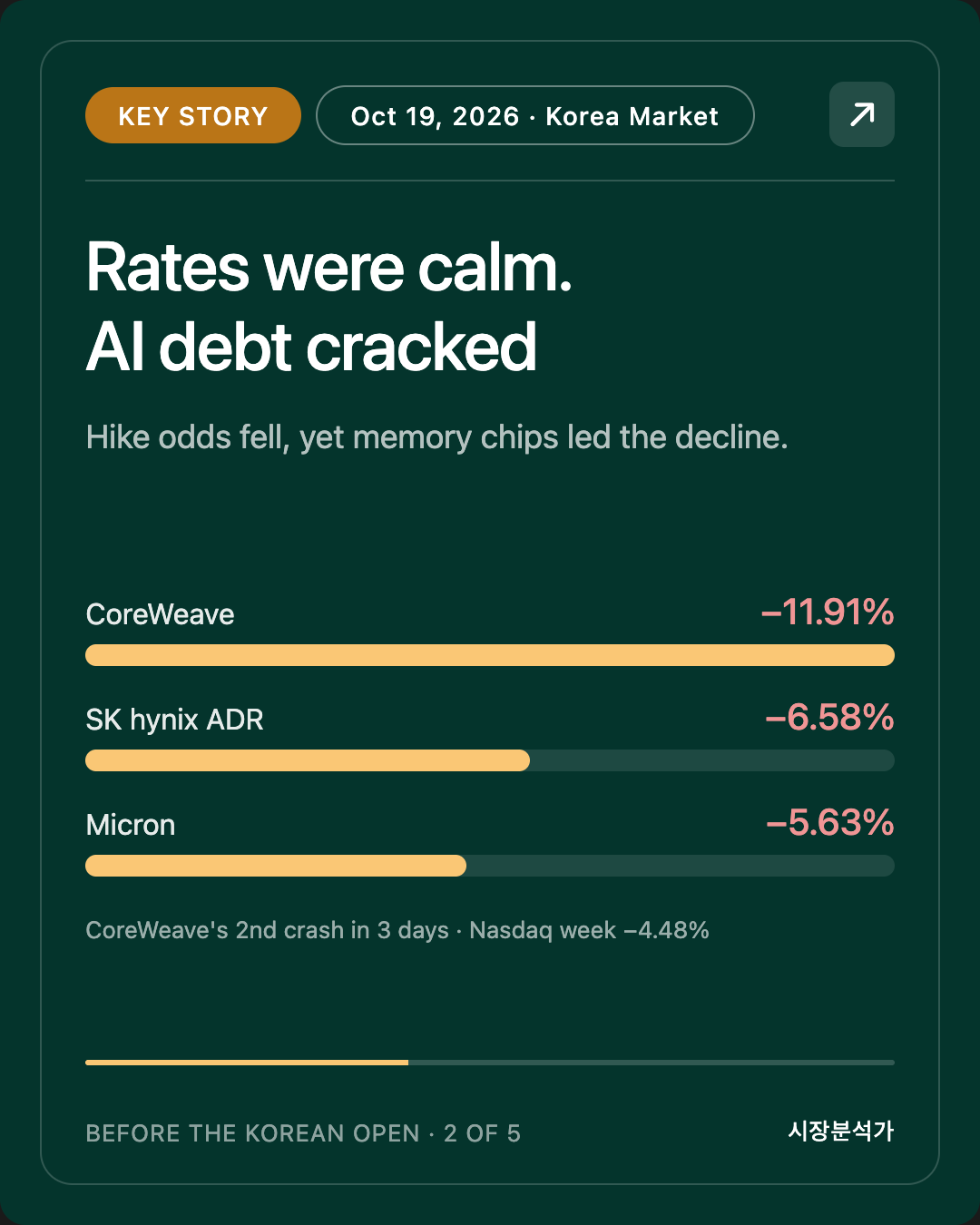
- ★ Friday in New York was about AI debt plus oil. Nasdaq −2.15%, SOX −3.83% (8 straight down days), CoreWeave −11.91%, Micron −5.63%, AMD −5.95%. S&P 500 7,659.44 (−1.09%), Dow −0.34%, Russell 2000 −1.66%.
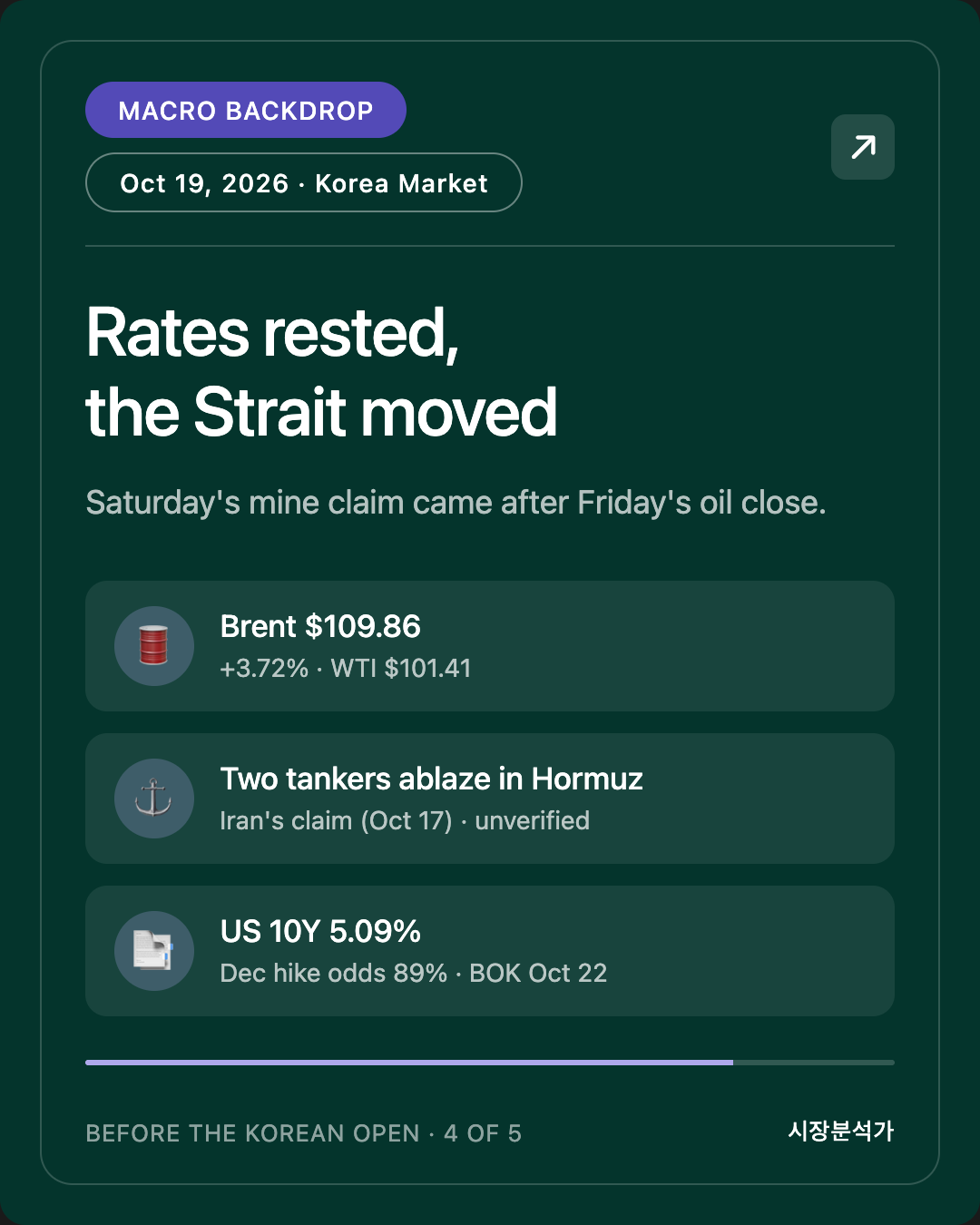
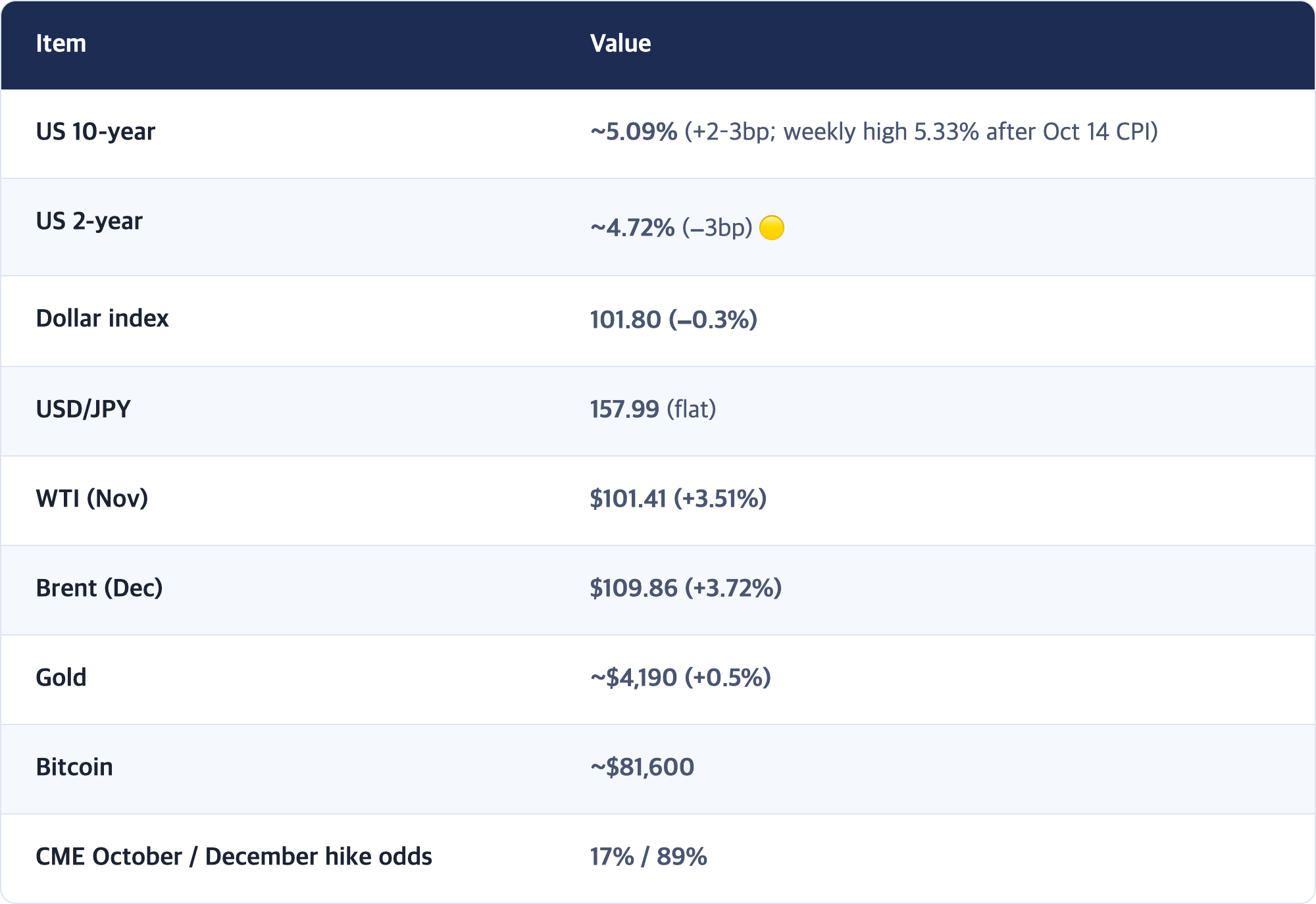
- ★ Rates stayed quiet. 10-year 5.09% (+2–3bp), 2-year about 4.72%, dollar index 101.80 (−0.3%). CME October hike odds 28% → 17%. Blaming Friday's drop on rates would be the wrong read.
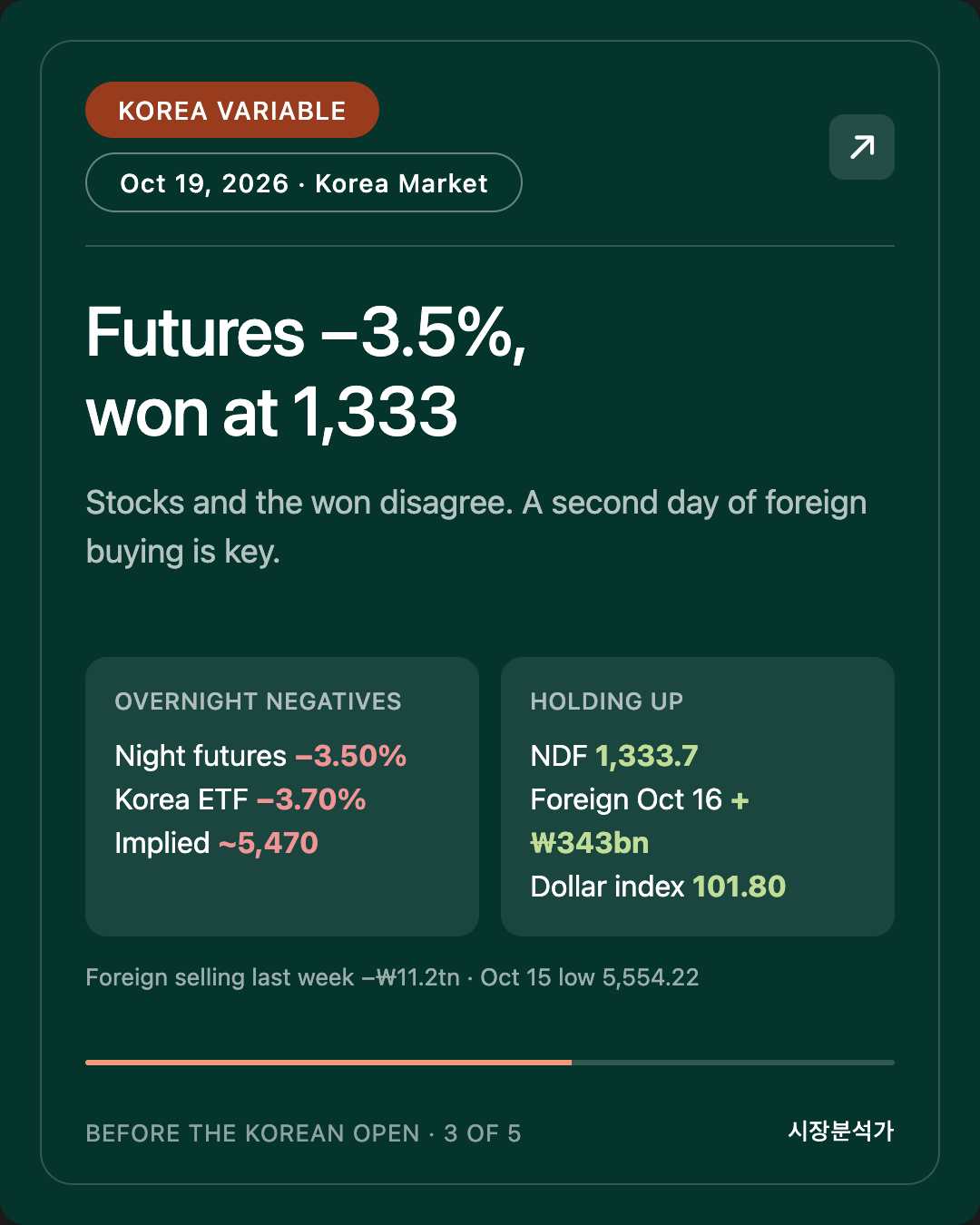
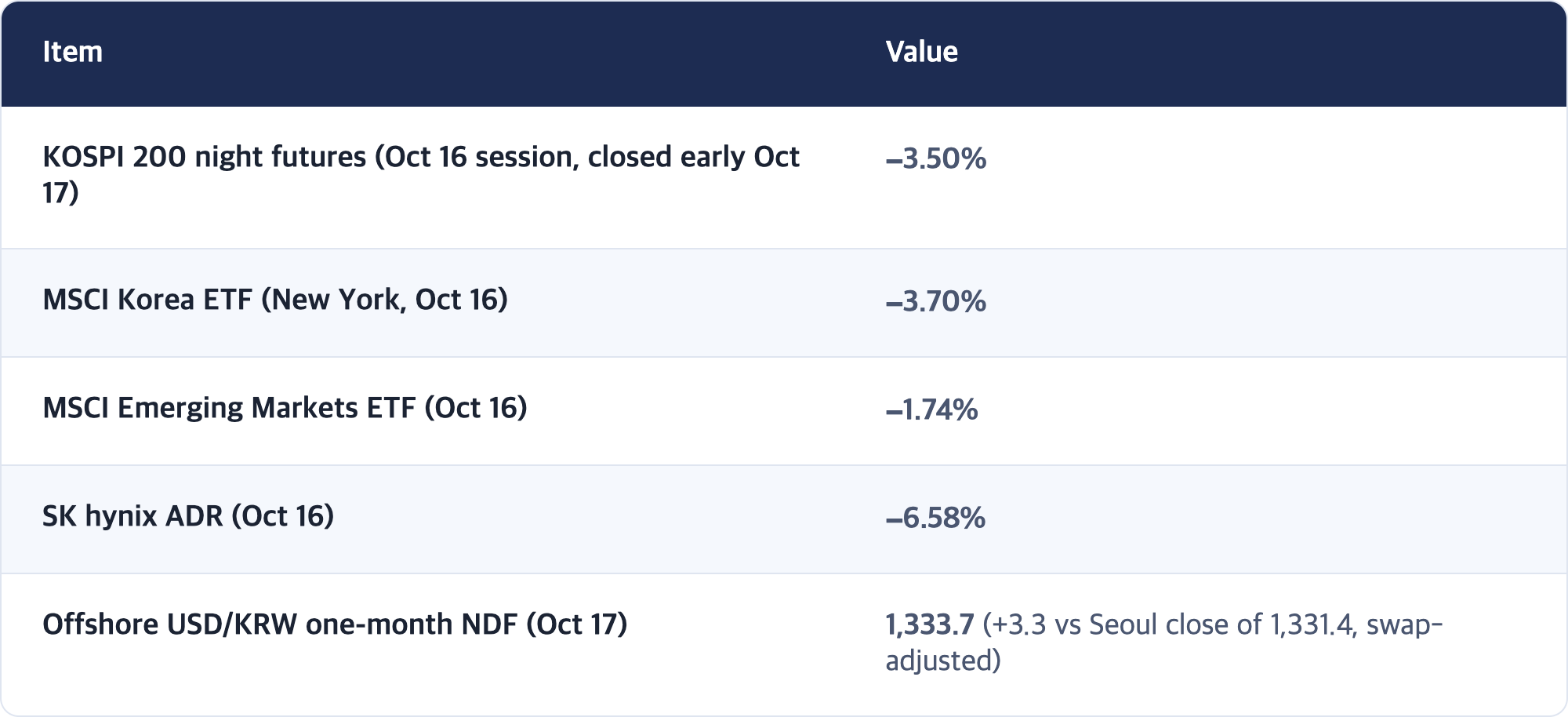
- ★ Seoul opens with a weak signal. Night futures −3.50%, MSCI Korea ETF −3.70%, SK hynix ADR −6.58%. Applied directly, that implies a KOSPI near 5,470, below the Oct 15 low of 5,554.22.
- The won is telling a different story than stocks. Offshore NDF 1,333.7 vs. Friday's Seoul close of 1,331.4. Despite the equity sell signal, the won is holding near its strongest level in two years.
- Oil got fresh news over the weekend. Brent $109.86 at Friday's close. Iran's claim of two mined tankers on Saturday has not been independently confirmed. Watch where crude opens in Asian trading today.
This is Mr. Can. Here is the Oct 19, 2026 brief ahead of the Korean market open.
Written: 2026-10-19 09:20 KST (Vancouver Oct 18, 17:20 PDT)
Based on: US close Fri Oct 16 (05:00 KST Oct 17) + Treasury close Oct 16 + KOSPI 200 night futures (Oct 16 session) + offshore won NDF Oct 17 + weekend (Oct 17–18) reports from the Strait of Hormuz
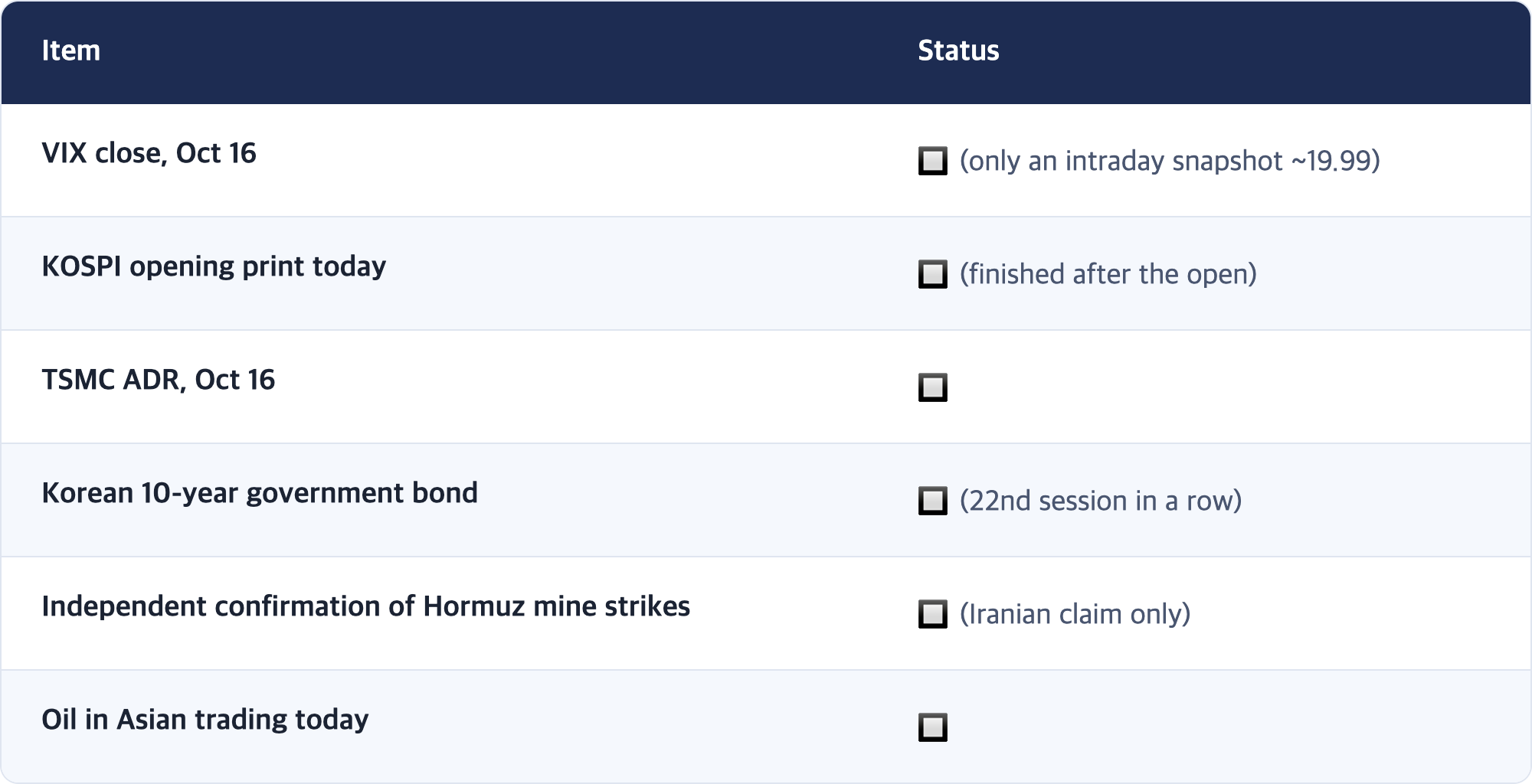
🔴 Scheduled for 16:00 PDT, started 16:54 PDT. 54 minutes late, finished after the Seoul open (09:00 KST). The analysis reflects the pre-open picture; today's opening print is not included.
🟡 VIX close, TSMC ADR and the Korean 10-year government bond yield were not available (see section 7).
SEO Intro
Seoul caught its breath on Friday, and New York fell over again. On October 16 the Nasdaq closed at 26,140.03 (−2.15%) and the Philadelphia Semiconductor Index (SOX) at 11,137.29 (−3.83%), its eighth straight losing session. The Nasdaq had its worst week since June (−4.48%). AI data-center operator CoreWeave fell 11.91%, its second crash in three days, and SK hynix's US depositary receipts dropped 6.58%.
Interest rates were not the culprit this time. The US 10-year yield barely moved (5.09%, +2–3bp), and the odds of an October Fed hike actually fell to 17%. Instead, two other things pushed down at once: worry about the debt behind the AI build-out, and oil. Brent settled at $109.86 (+3.72%). Over the weekend, Iran's Revolutionary Guard said two tankers caught fire after hitting mines in the Strait of Hormuz.
KOSPI 200 night futures ended −3.50% and the US-listed MSCI Korea ETF −3.70%. Yet the won stayed strong: the offshore one-month rate was 1,333.7 per dollar. Today's question for Seoul: was Friday's foreign buying the start of something, or a one-day event?
1. Scoring Last Session's Checkpoints
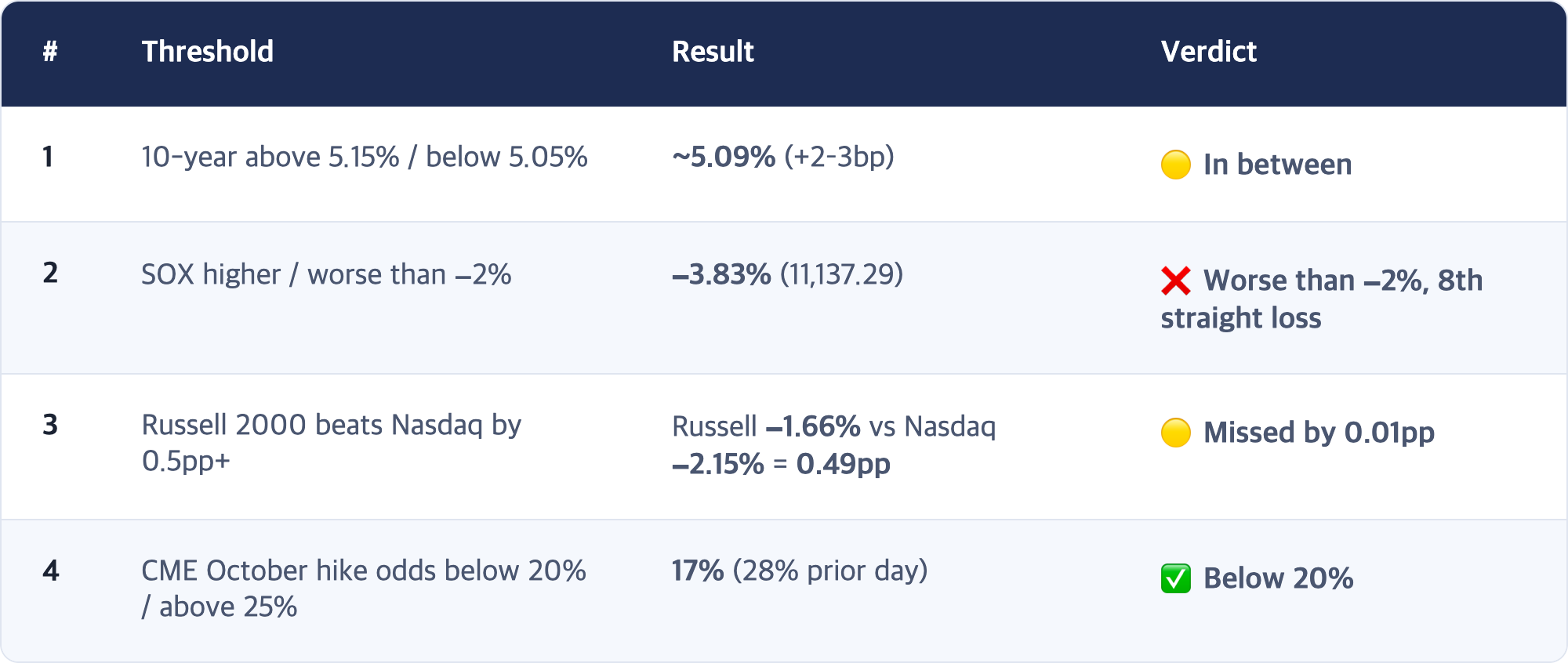
Four set by the Oct 16 AM brief (US close, Oct 16)
The question was: "Does New York pick up Asia's relief rally, or do long-term yields take it back?"
★ [Interpretation] Neither branch happened
The brief offered two outcomes: New York joins the relief, or long yields take it back. Neither happened. The 10-year was flat (#1), hike odds fell further (#4), and chips still collapsed (#2).
This is the third time a lesson from our Sept 28 brief has applied: when you frame a day as a choice between two variables, the day a third one shows up, your verdict can be right and your explanation wrong. This time the third variable was really two: AI credit (CoreWeave) and oil (Hormuz).
[Observation] #3 missed by a hair, but small caps also fell 1.66%. The "just rotate out of AI" trade weakened on Friday. So this session's checkpoints shift the focus from rates to foreign flows and oil.
2. Today's Key Story: Friday Wasn't About Rates. It Was AI Debt and Oil
[Fact] US close, Friday Oct 16
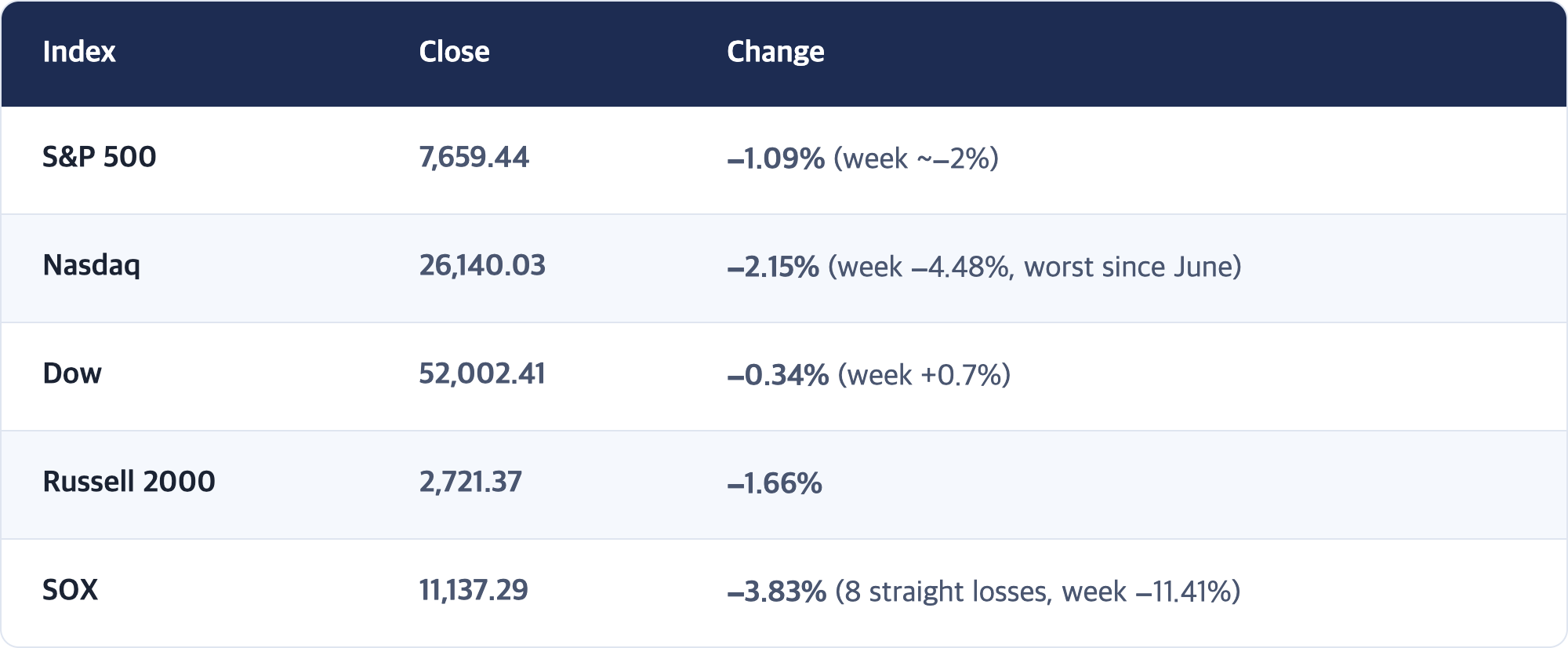
[Fact] Biggest movers (Oct 16)
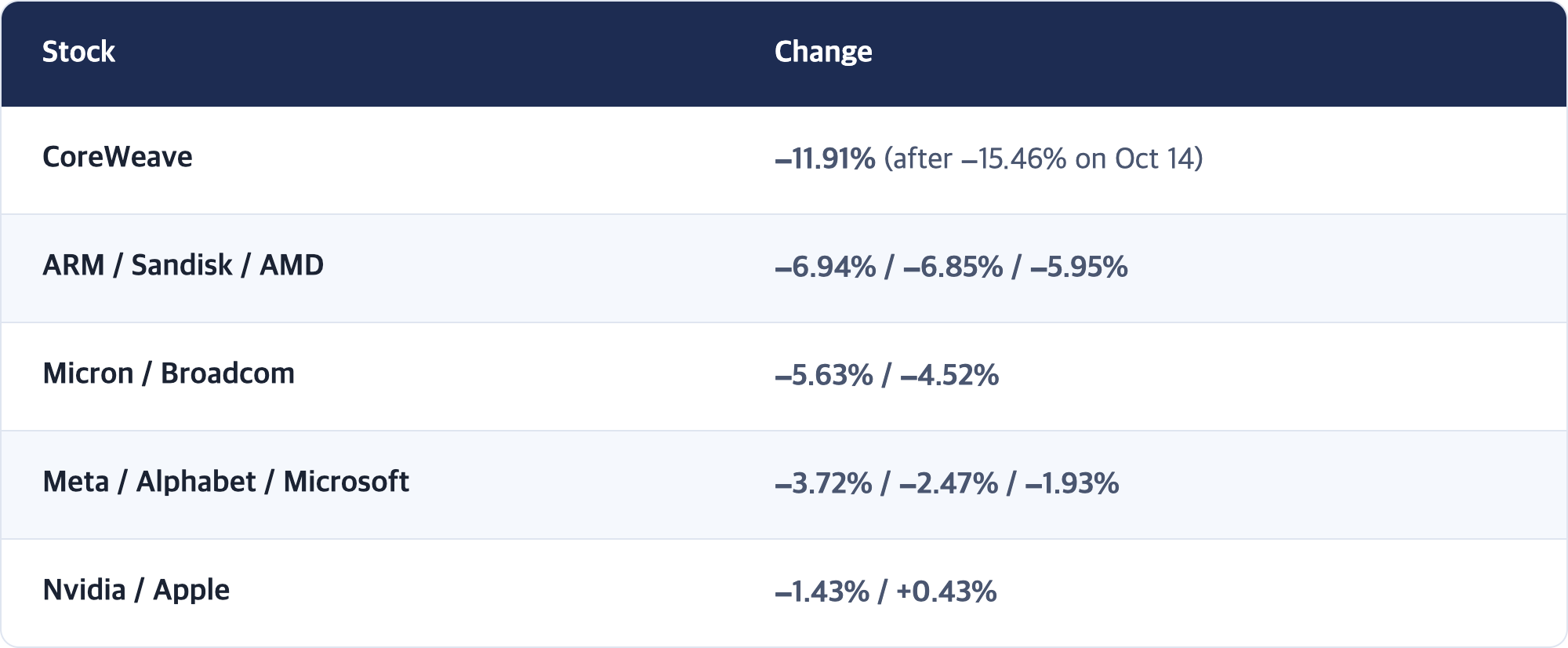
★ [Interpretation] Same size drop, different cause, different consequences for Seoul
The Nasdaq's −1.88% on Oct 14 was an inflation shock: the 2-year jumped on fears the Fed would hike soon. Friday's −2.15% was different. Hike odds fell and yields were calm, yet concern about AI infrastructure debt flared again and memory-chip stocks led the decline.
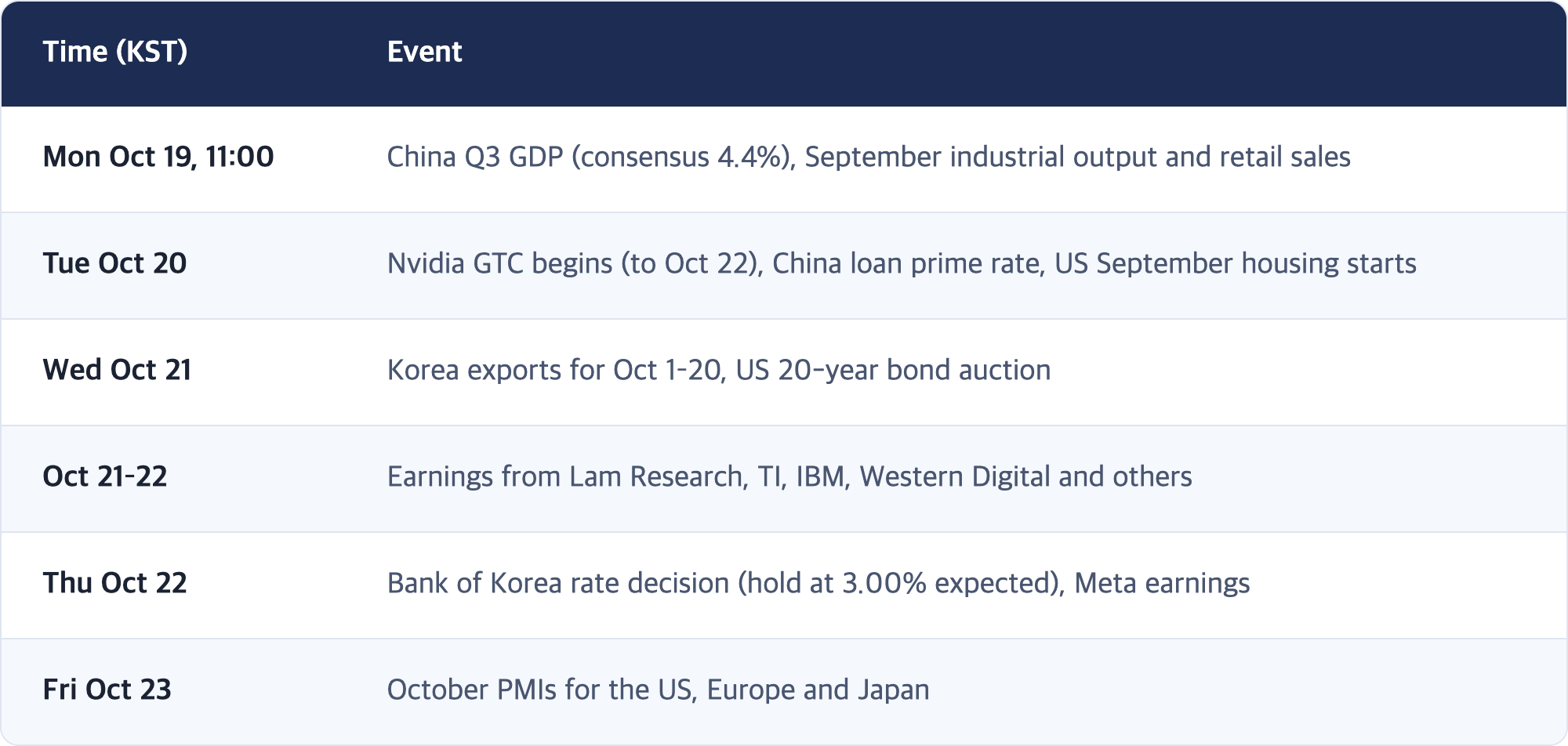
That matters for Korea. A rate scare can fade once a Fed meeting passes. But the question "will money keep flowing into AI investment?" has to be answered by earnings and credit markets, and Samsung Electronics and SK hynix sit right in the middle of it. This week's results from Lam Research, Texas Instruments, Western Digital and Meta, plus Nvidia's GTC conference (Oct 20–22), are the first pieces of that answer.
[Observation] Apple was the only Magnificent Seven stock to rise (+0.43%), consistent with money moving from the heaviest AI spenders to lighter ones. One day is not a trend.
3. The Korea Variable: Night Futures −3.5%, Won at 1,333
[Fact] Prices set while Seoul was closed
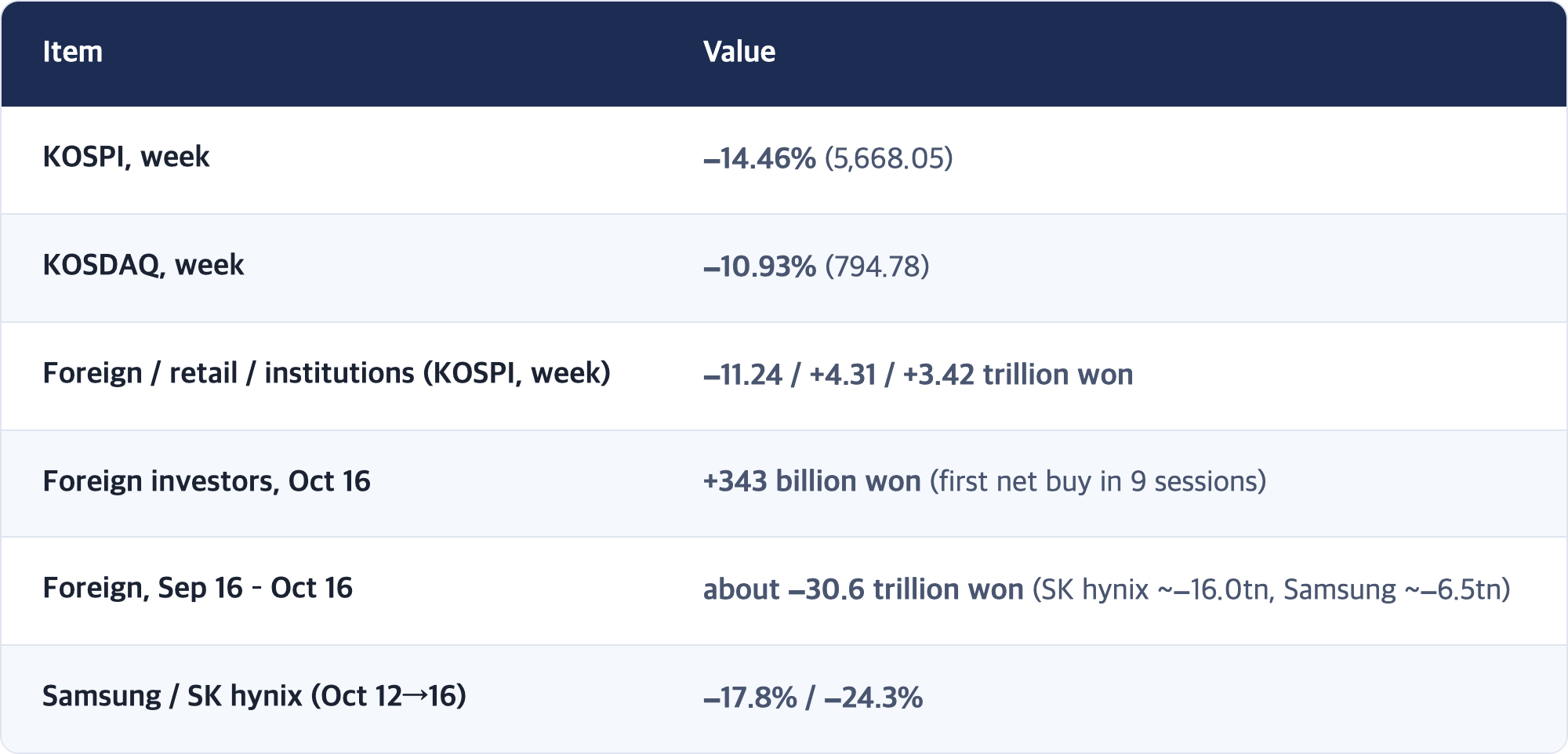
[Fact] Seoul last week (Oct 12–16)
[Fact] Brokers' KOSPI ranges for this week
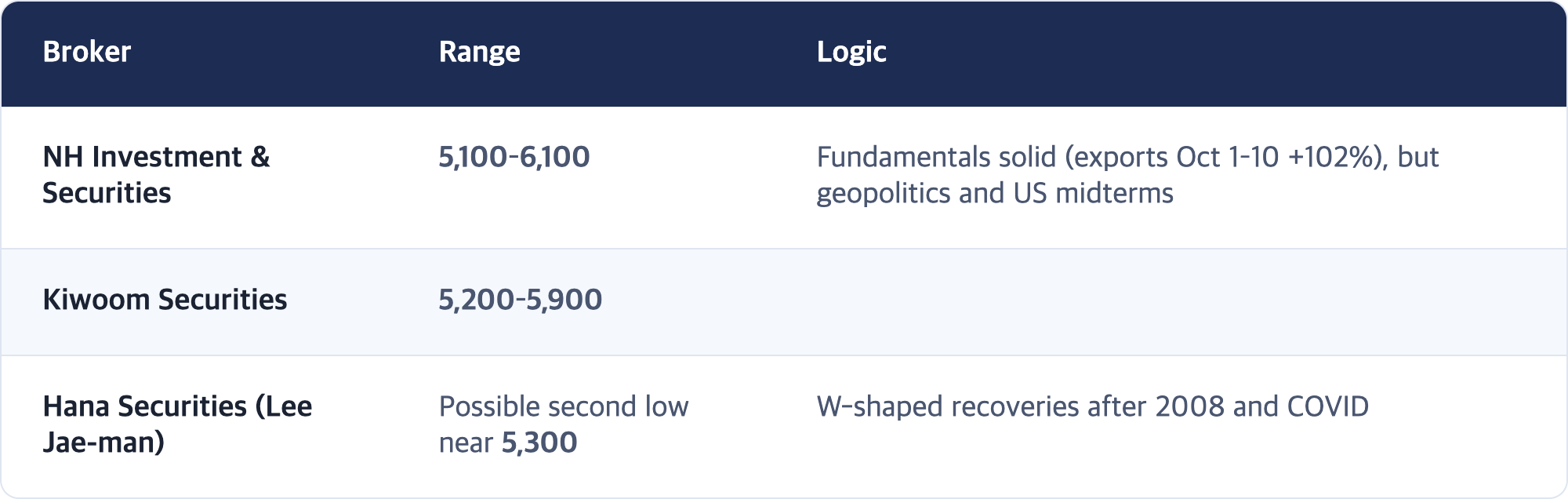
★ [Interpretation] Futures and the won point in different directions
A straight −3.50% implies a KOSPI open around 5,470, below the Oct 15 low. Yet the won hasn't weakened alongside stocks.
As our Oct 16 brief noted, the won's strength is more about a weaker dollar than about foreigners coming back. The dollar index slipped again Friday to 101.80. So a strong won today is not, by itself, a sign of foreign buying. What matters is whether foreign investors buy Korean stocks for a second straight day.
[Observation] Yuanta Securities' Lee Jae-won described last week's drop as "the absence of buyers showing up before any damage to fundamentals." Reports note the selloff coincided with the end of Samsung's and SK hynix's share buybacks. This week's variable is less about earnings and more about who steps in to buy.
4. Macro Backdrop: Rates Rested, Oil and the Strait Moved
[Fact] Rates, dollar, commodities (around the Oct 16 close)
[Fact] Strait of Hormuz (reports Oct 15–18)
- Iran's IRGC said on Saturday (Oct 17) that two tankers caught fire after hitting naval mines, each carrying about 2 million barrels of crude. The ships were not named and the claim has not been independently verified.
- On Friday, a tanker with 15 Indian crew was hit by an unidentified projectile (India's ports minister; no injuries).
- Strait traffic fell from about 20.8 million barrels on Oct 8 to about 2.9 million on Oct 11 (Kpler).
- President Trump said he expects a deal to end the war with Iran after the Nov 3 midterm elections. No ceasefire has been reported.
★ [Interpretation] Oil is this week's second axis
Brent near $110 hits Korea two ways. First, inflation: US price data is already hot (September PPI +6.3% year on year), and higher oil makes the 89% December hike odds stickier. Second, the trade balance and the won: Korea imports essentially all its crude, so higher oil means it needs more dollars.
Friday's oil jump is already priced in, but Saturday's mine claim came after the close. Whether crude trades above $110 in Asia today will show how much the weekend news is being priced.
[Observation] The Bank of Korea is expected to hold its policy rate at 3.00% on Oct 22. With a strong won and high oil, the question is whether its message leans toward the currency or toward inflation.
5. Today's Seoul Session (Mon Oct 19): Checkpoints
[Observation] Calendar (KST)
✅ Four checkpoints (by Seoul close today)
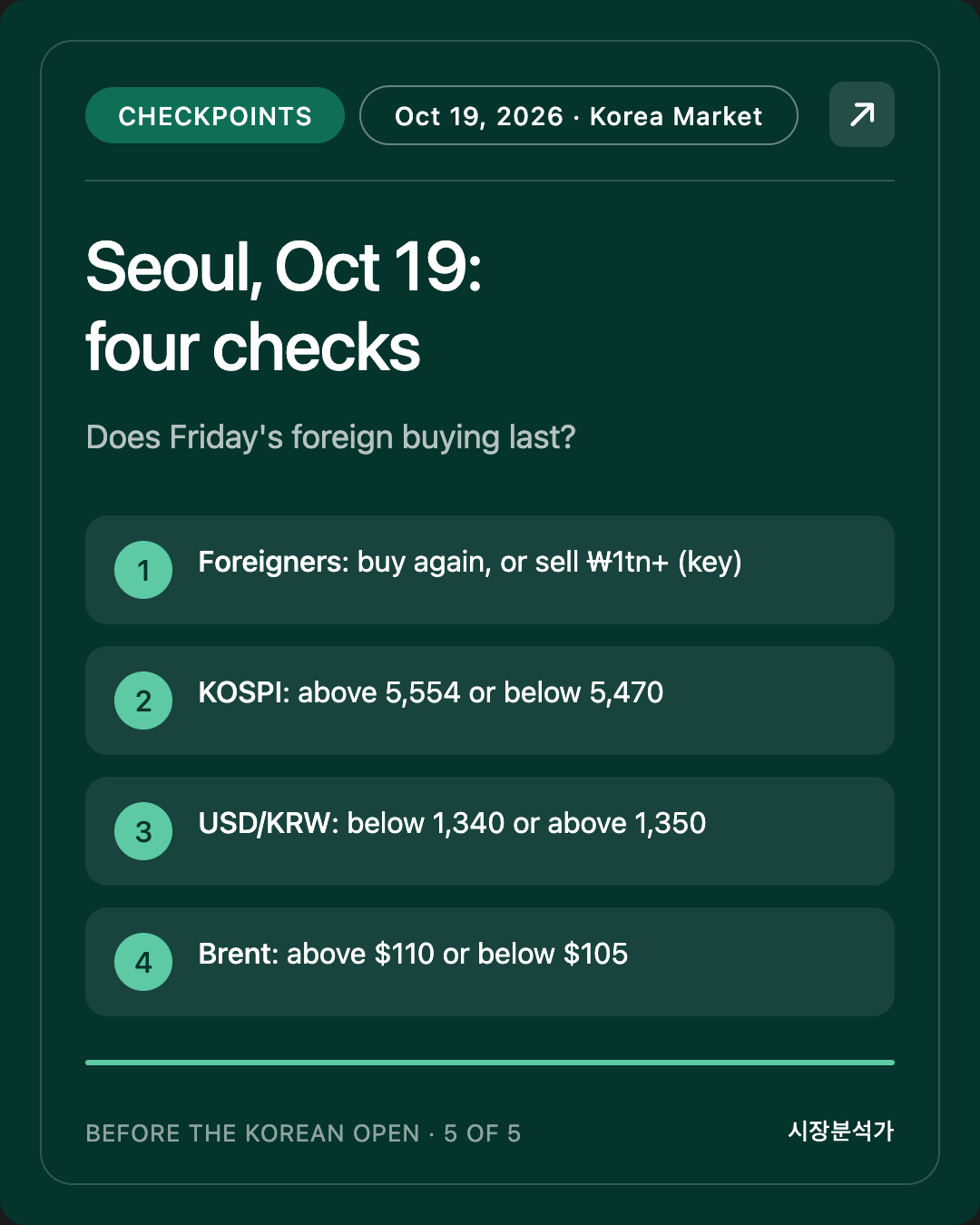
The question: "Does Friday's foreign buying continue for a second day, or was it a one-off?" This time we reserve a seat for the third variable in advance: oil.
- Foreign investors net buy for a second day / net sell more than 1 trillion won. (Most important)
- KOSPI closes above 5,554 / below 5,470. 5,554 is the Oct 15 low; 5,470 is the night-futures implied level.
- USD/KRW stays below 1,340 / rises above 1,350. Does the won keep diverging from stocks?
- Brent above $110 / below $105 in Asian trading. Is the weekend mine claim being priced in?
[Interpretation] If #1 is a net buy and #2 holds above 5,554, the "flow accident, not a fundamental break" reading of last week gets a second piece of evidence. If #1 is a sale of more than 1 trillion won and the won also weakens past 1,350, Hana's second-low near 5,300 scenario deserves serious attention. If #4 is above $110, even correct verdicts on #1–3 may have oil as the real explanation.
6. Study Note: Two Windows on Korean Stock Prices While Seoul Is Closed
The concept
Korea's stock market trades only 09:00–15:30 local time. When something happens in New York overnight, where does the "price" of Korean stocks show up before the next morning? In two places.
- KOSPI 200 night futures: Korea Exchange runs a futures session from evening into the early morning. A futures contract is an agreement to buy or sell the KOSPI 200 index later, so it records what traders think Korean stocks are worth overnight.
- MSCI Korea ETF: a fund holding large Korean stocks that trades in New York in dollars. Its price contains both stock moves and currency moves.
An analogy
If the market is a shop that has closed for the night, night futures are an order slip saying "I'll buy these goods at this price tomorrow morning." The Korea ETF is the same goods sold in a foreign store, priced in dollars. The foreign price changes when the goods change in value, and also when the exchange rate moves.
The real case (Friday night)
- Night futures −3.50%, Korea ETF −3.70%: a gap of just 0.2pp.
- The won barely moved (NDF 1,333.7, +3.3), so the currency added little, and the two windows showed nearly the same number.
- If the won had weakened sharply, the ETF would have fallen much more than the futures. The gap between the two windows is the currency effect.
Why it matters
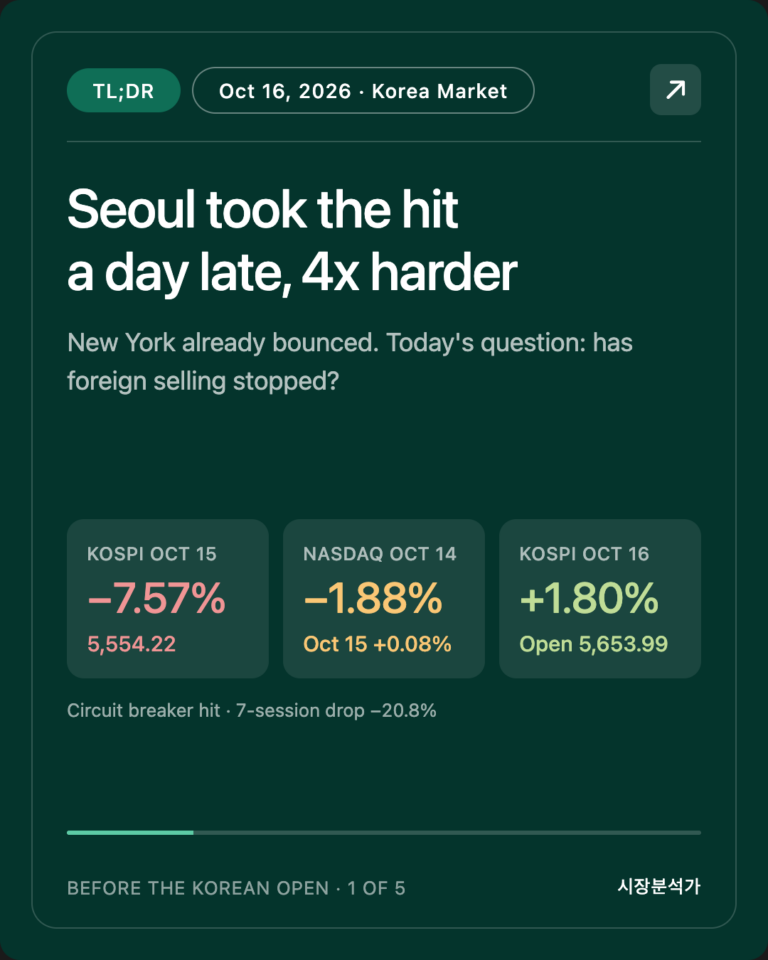
On Oct 16, night futures were +3.90% but the actual open was only +1.80%, about half. Night futures trade thinly and can exaggerate. Today's −3.50% is a hint about the starting point, not a guaranteed open.
One-line summary
Night futures are the overnight order price for Korean stocks; the Korea ETF is Korean stocks priced in dollars. The difference between them is the currency, and both can overstate the next open.
7. Corrections and Open Items
Correction
- The Oct 16 AM brief listed "15:00 PDT interview with Chicago Fed President Goolsbee." We could not confirm it: no Friday market wrap mentions Goolsbee remarks. The listing itself may have been wrong.
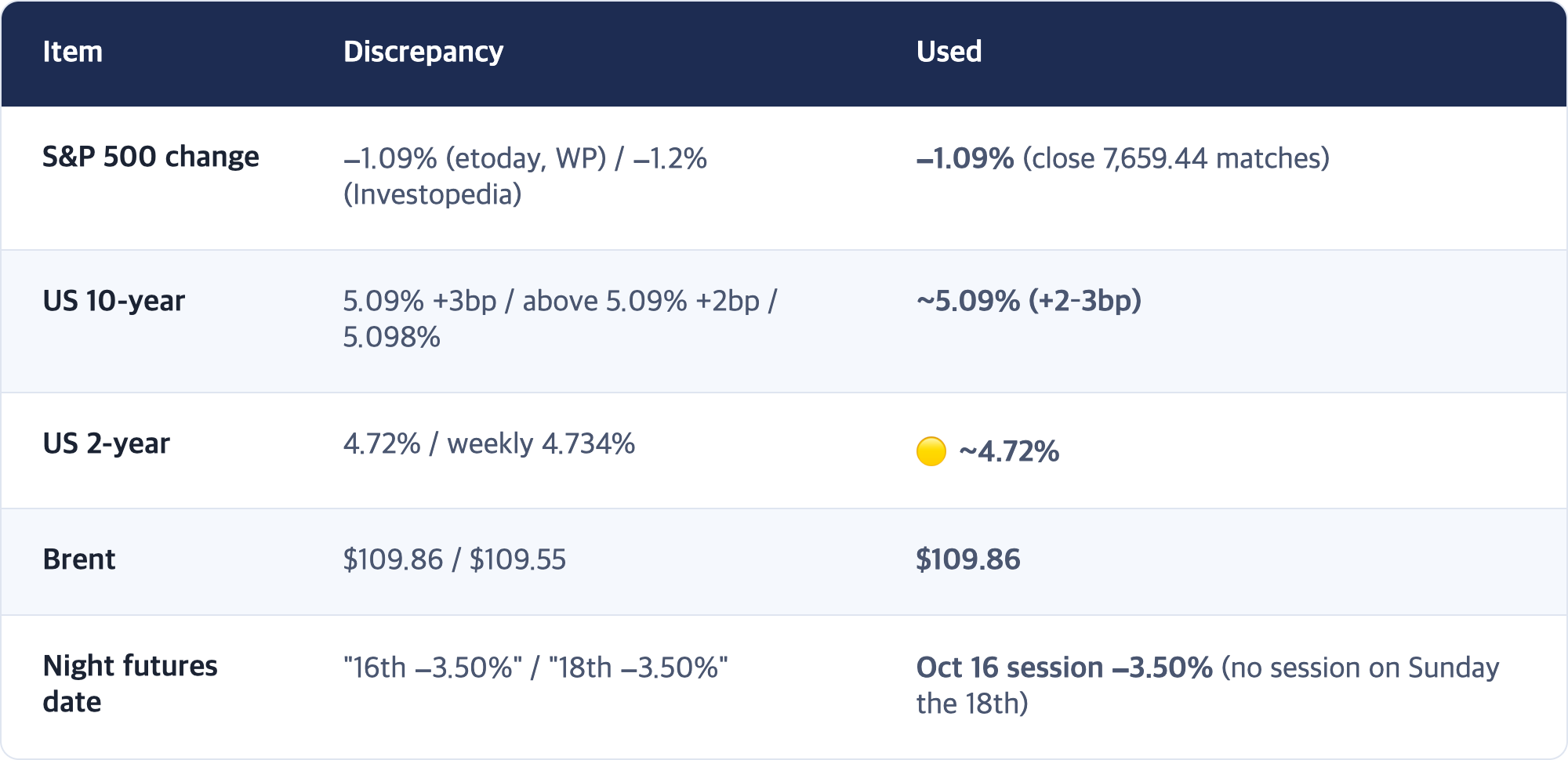
Source discrepancies (value used in the text)
🔲 Not confirmed
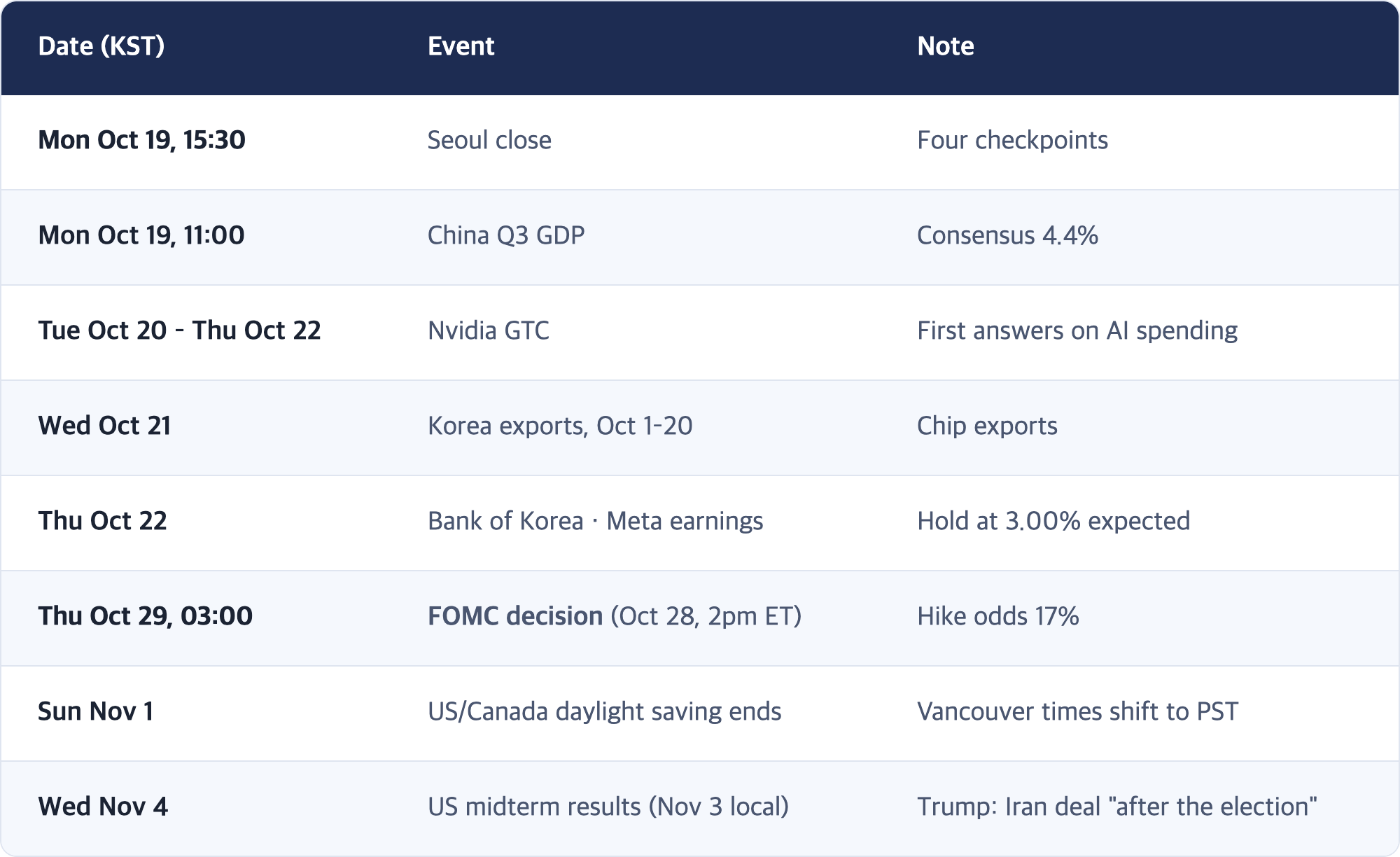
8. Event Calendar (KST)
Sources
- Nasdaq down 2%, worst week since June | etoday
- US AI and chip stocks slump; this week a 'W' rebound test | Financial News
- Weekly outlook: KOSPI 5,100–6,100 | etoday
- KOSPI outlook: foreign flows tested | Topstar News
- This week's KOSPI | CBC News
- KOSPI rebound clouded again | Sankyung Today
- Seoul Shinmun, Oct 18
- USD/KRW NDF one-month up 3.30 won | Stockplus
- Markets News, Oct. 16, 2026 | Investopedia via Yahoo Finance
- How major US stock indexes fared Friday 10/16/2026 | The Washington Post
- Iran says two tankers catch fire after hitting mines in Strait of Hormuz | Al Jazeera
- Oil tanker struck in Strait of Hormuz, says Indian ports minister | The National
- Market Review: October 16, 2026 | Investrade
Market Analyst · We do not recommend buying or selling individual stocks. This brief offers macro context and interpretation.
📌 More market briefs
※ This post is market observation and organization intended to support your own judgment. It is not a recommendation to buy or sell any security. Figures are as of the time of writing and may differ between sources.
If this was useful, bookmark it or pass it along. It genuinely helps me write the next one.
I can survive. We can survive.