October 26, 2026 KOSPI Market Brief — What to Watch Before the Korean Open
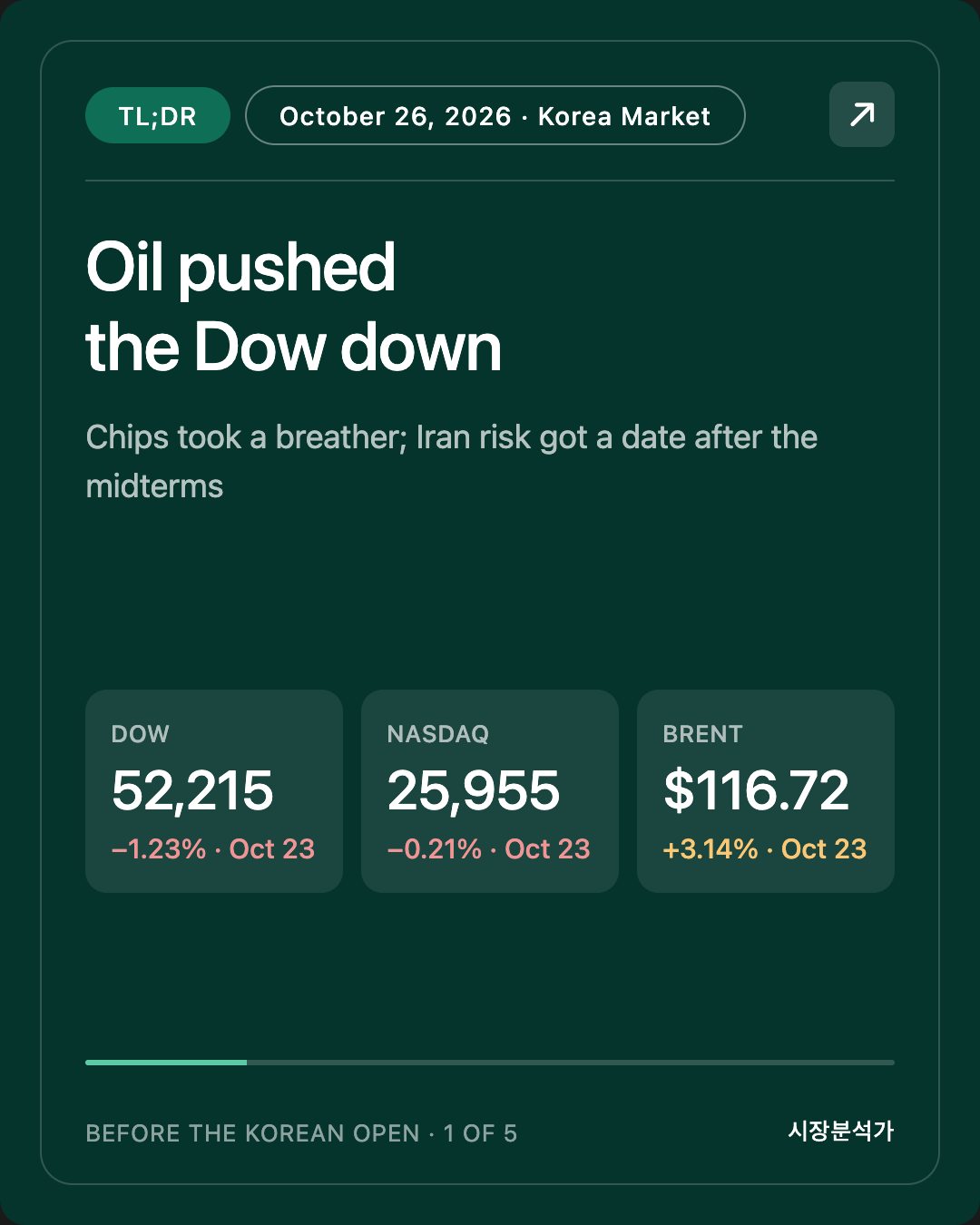
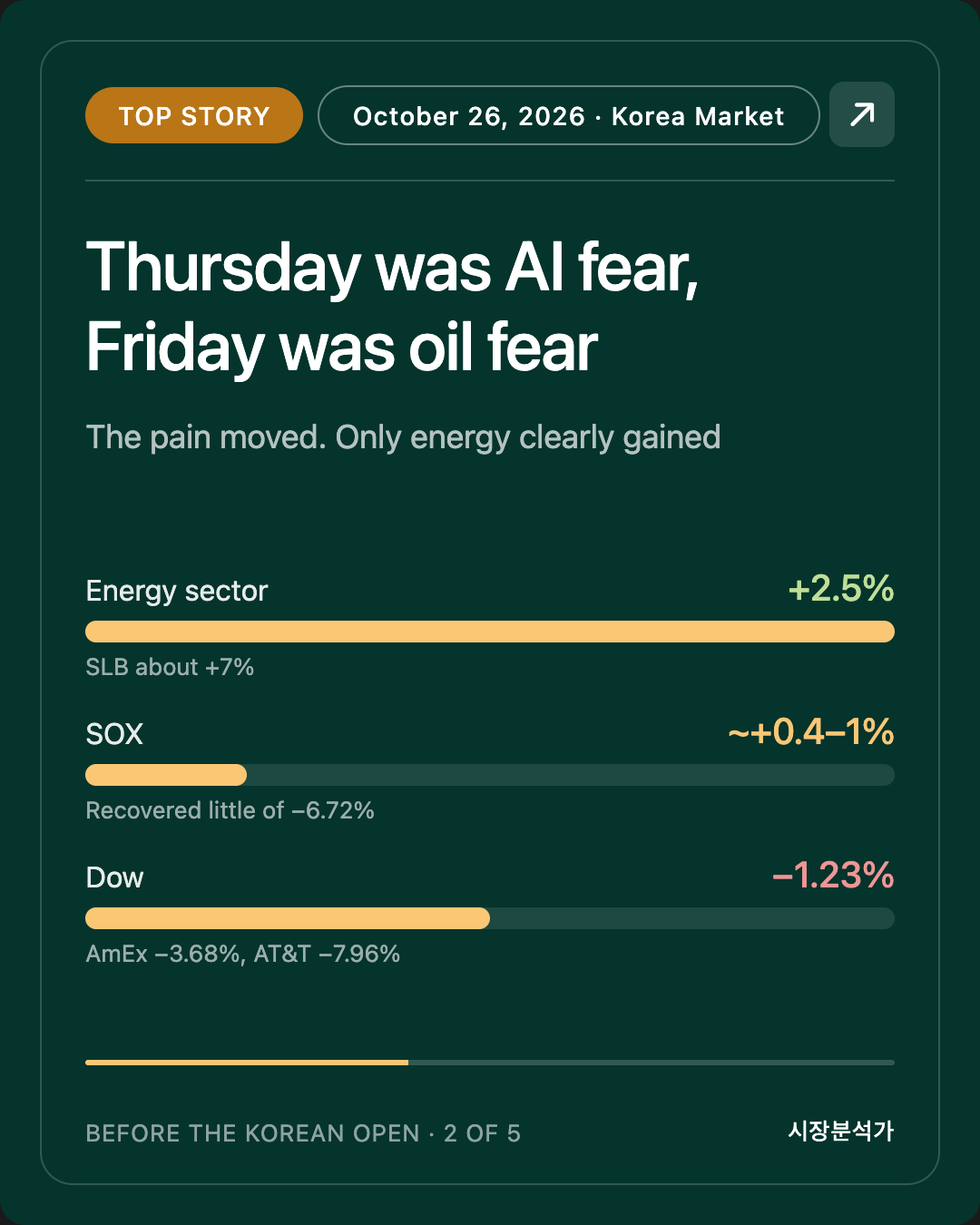
- ★ Friday on Wall Street wasn't an "AI comeback." Oil pushed the Dow down. Dow −1.23%, S&P 500 −0.52%, Nasdaq −0.21%. Only energy clearly rose (+2.5%); tech held up (+0.35%).
- ★ Chips took a breather. SOX about +0.4–1% (sources differ), Micron +2.4%, Nvidia −0.58%, SK hynix ADR +4.05% ($137.02), in line with SK hynix's Friday gain in Seoul.
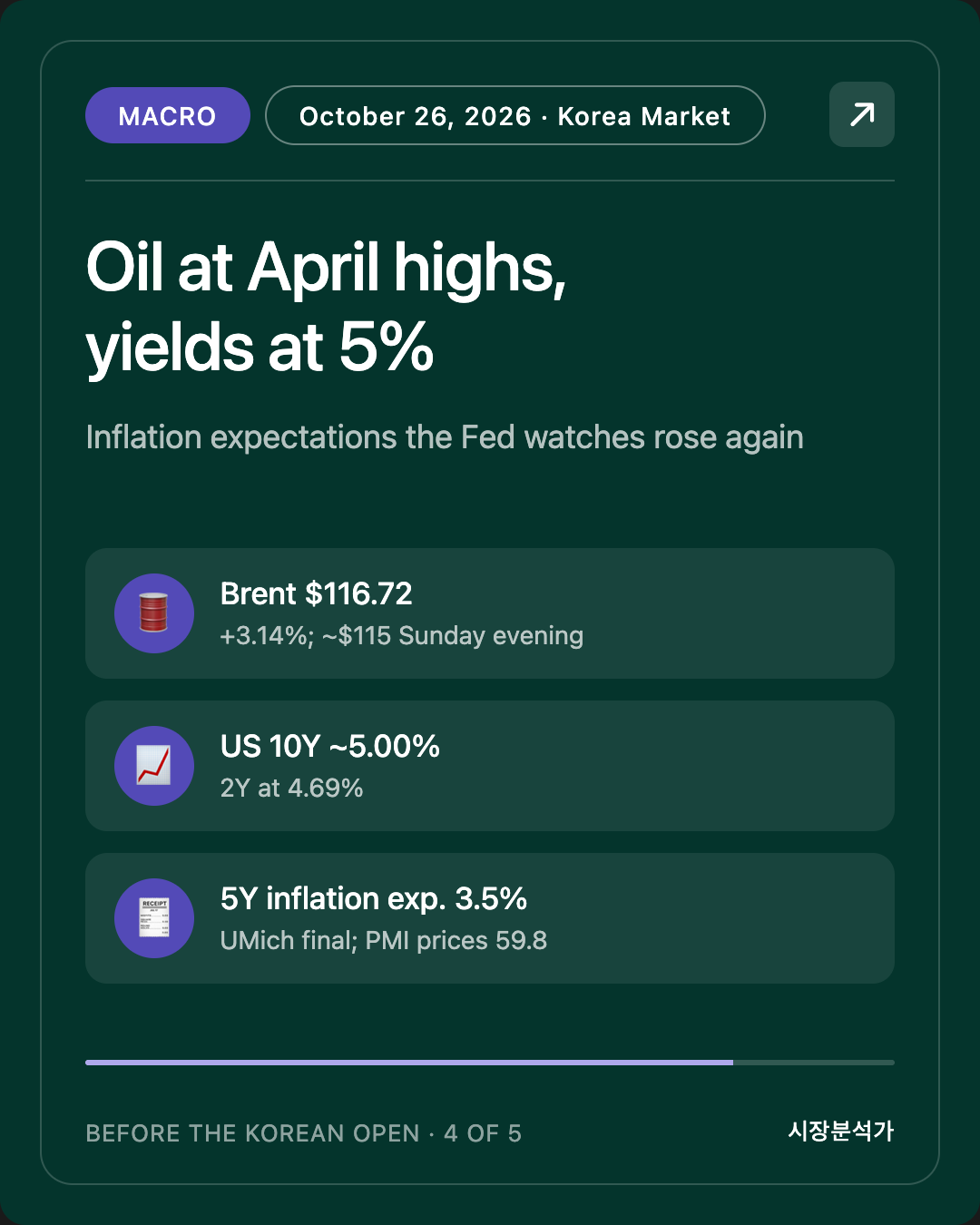
- ★ Oil at an April high, yields at the 5% line. Brent $116.72, WTI $103.27, US 10-year ~4.99–5.00%, 2-year 4.69%. VIX 19.45 (+2.2%), gold ~$4,024.
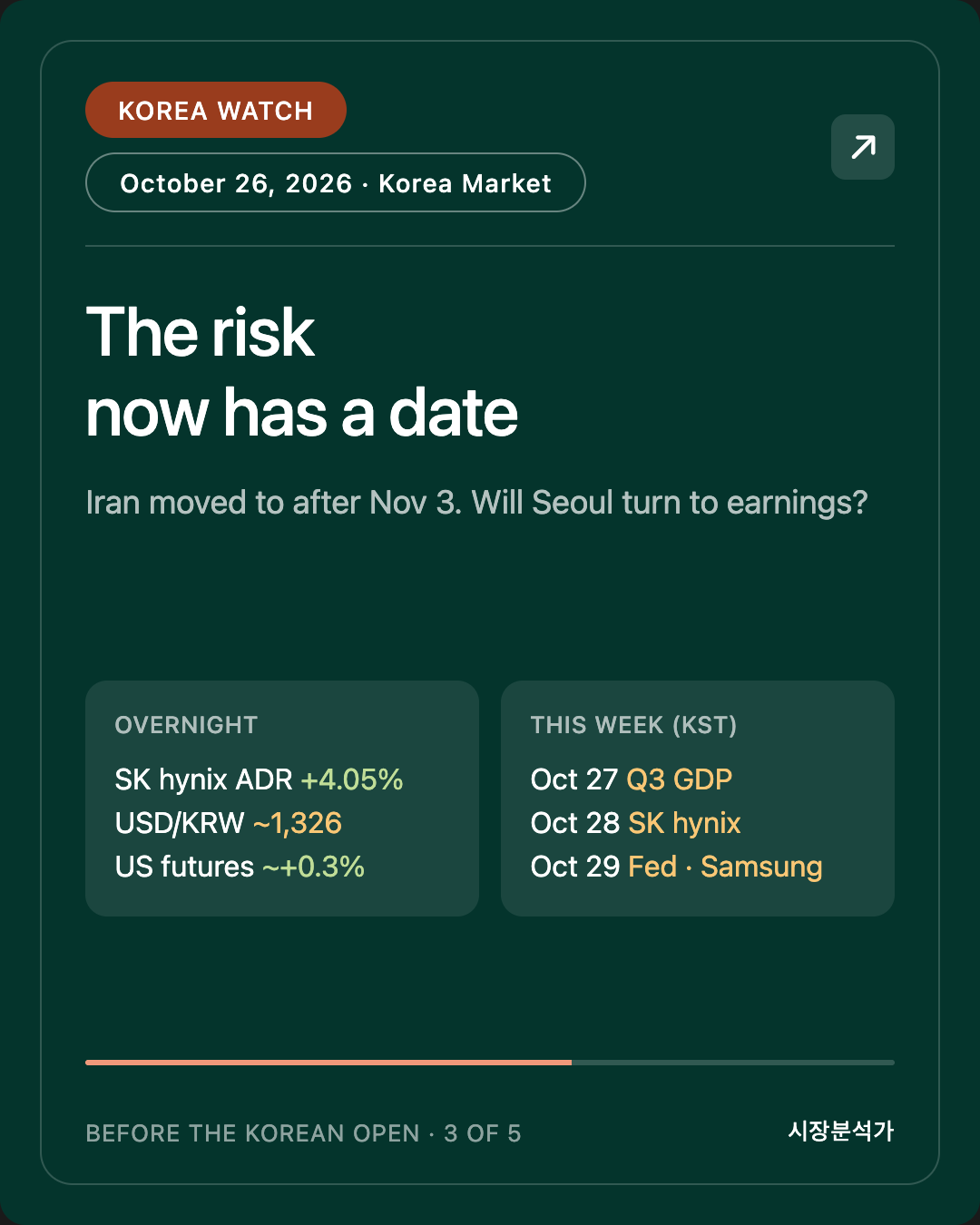
- Weekend: the risk was pushed past the election. Renewed US-Israeli strikes are reportedly being planned for after Nov 3; Trump mentioned talks via mediators. Sunday evening: Brent ~$115 (−1.1%), S&P 500 futures ~+0.3–0.4%, Nasdaq-100 futures ~+0.4–0.6%.
- Korea. Overnight USD/KRW about 1,325–1,326. It's a "super week" of GDP, chip earnings and the Fed, and foreign investors sold about ₩1 trillion of Korean stocks on Friday.
This is Mr. Can. Here is the October 26, 2026 brief ahead of the Korean market open.
Written: Oct 26, 2026 08:07 KST (Vancouver Oct 25, 16:07 PDT) · Work began 08:01 KST (16:01 PDT)
Basis: US close on Fri Oct 23 + weekend news + US futures (Sunday evening ET, early Oct 26 KST) + Seoul close on Oct 23
🟢 No missed editions. The previous brief was the Oct 23 pre-US-open edition; there is no weekend edition.
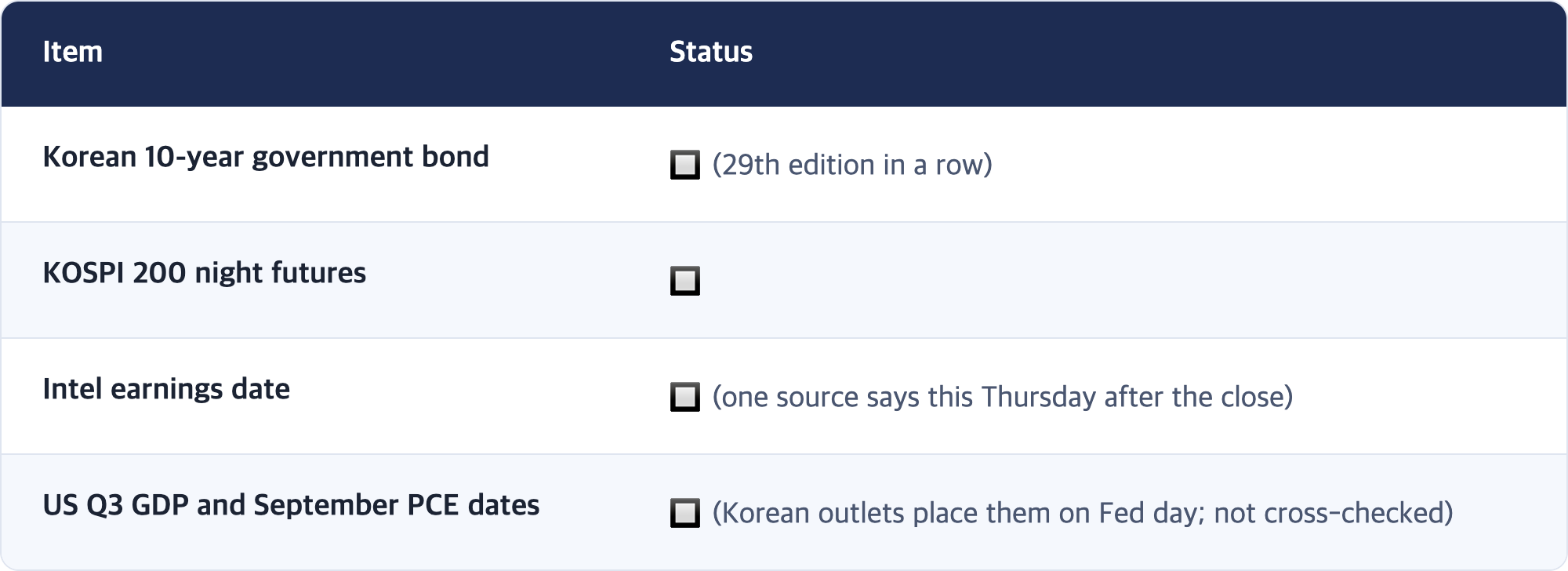
🟡 KOSPI 200 night futures (Friday night session) were not available. The overnight USD/KRW close differs by about one won between sources. Korean 10-year government bond yields were not available.
SEO Intro
The Dow took the biggest hit on Friday. It fell 1.23% to 52,215.16, while the S&P 500 slipped 0.52% to 7,623.68 and the Nasdaq dipped 0.21% to 25,955.34. Chip stocks steadied after Thursday's 6.7% rout (SOX roughly +0.4% to +1%), and SK hynix's US-listed shares rose 4.05%. What dragged the Dow wasn't AI. It was oil, plus company-specific hits at American Express (−3.68%) and AT&T (−7.96%).
Brent crude settled at $116.72 (+3.14%), its highest close since April, on reports that the US and Israel may resume strikes on Iran after the November 3 midterm elections. Over the weekend, President Trump said there would be no strike on Sunday and that negotiators are talking through mediators. Brent eased to about $115 on Sunday evening, and S&P 500 futures were up roughly 0.3–0.4%.
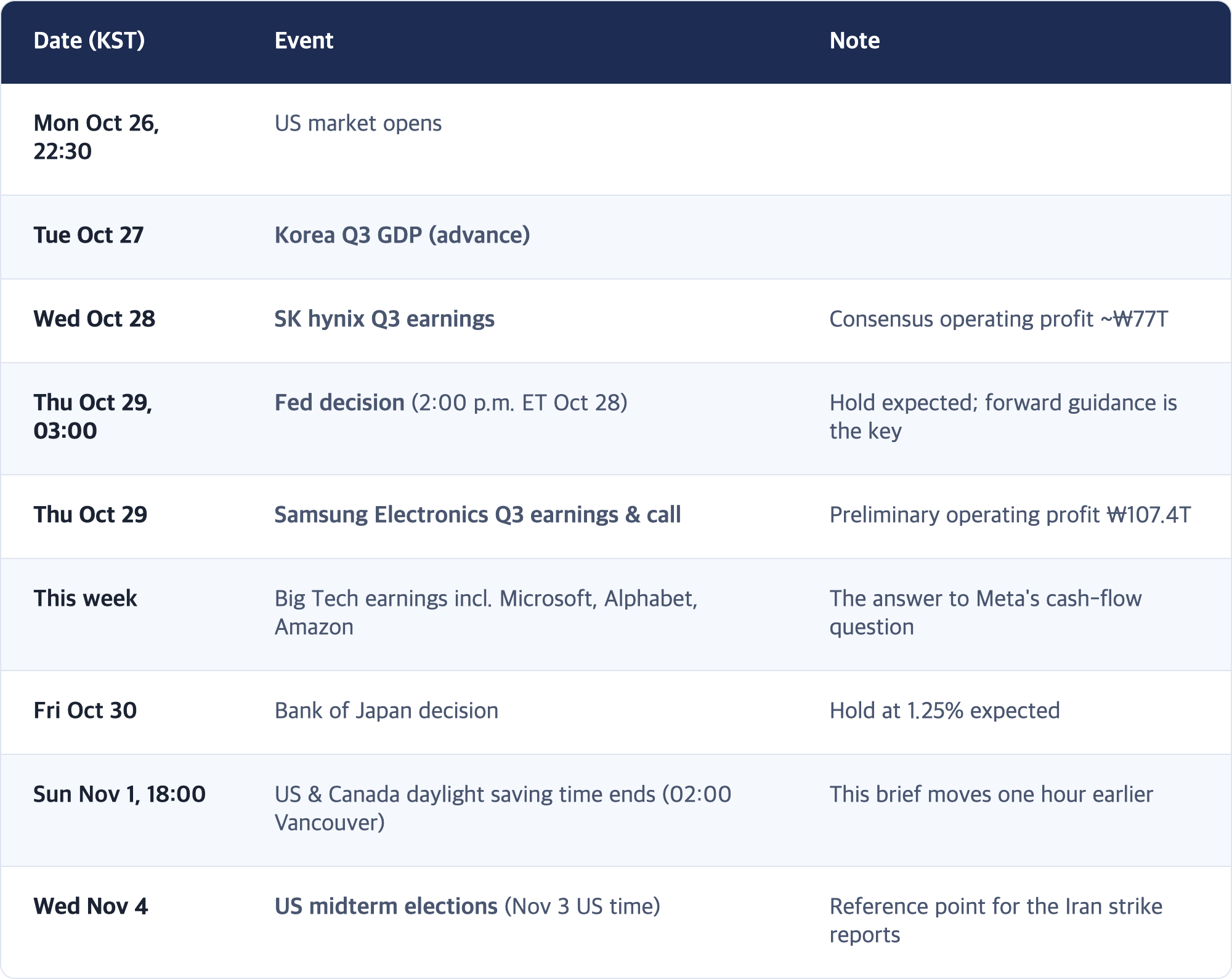
The question for Seoul today: now that the Middle East risk has a date pushed into November, will investors turn to this week's earnings and the Fed? This is a packed week for Korea: third-quarter GDP (Oct 27), SK hynix (Oct 28) and Samsung Electronics (Oct 29) earnings, and the Fed decision (early Oct 29, Korea time).
1. Scoring the Last Checkpoints
Set in the Oct 23 pre-US-open brief (US close, Oct 23)
The axis was "Does the money that rotated from AI into defensive stocks come back, or stay put?" with a third-variable slot left open for weekend Middle East risk (Iran's threat to hit regional airports).
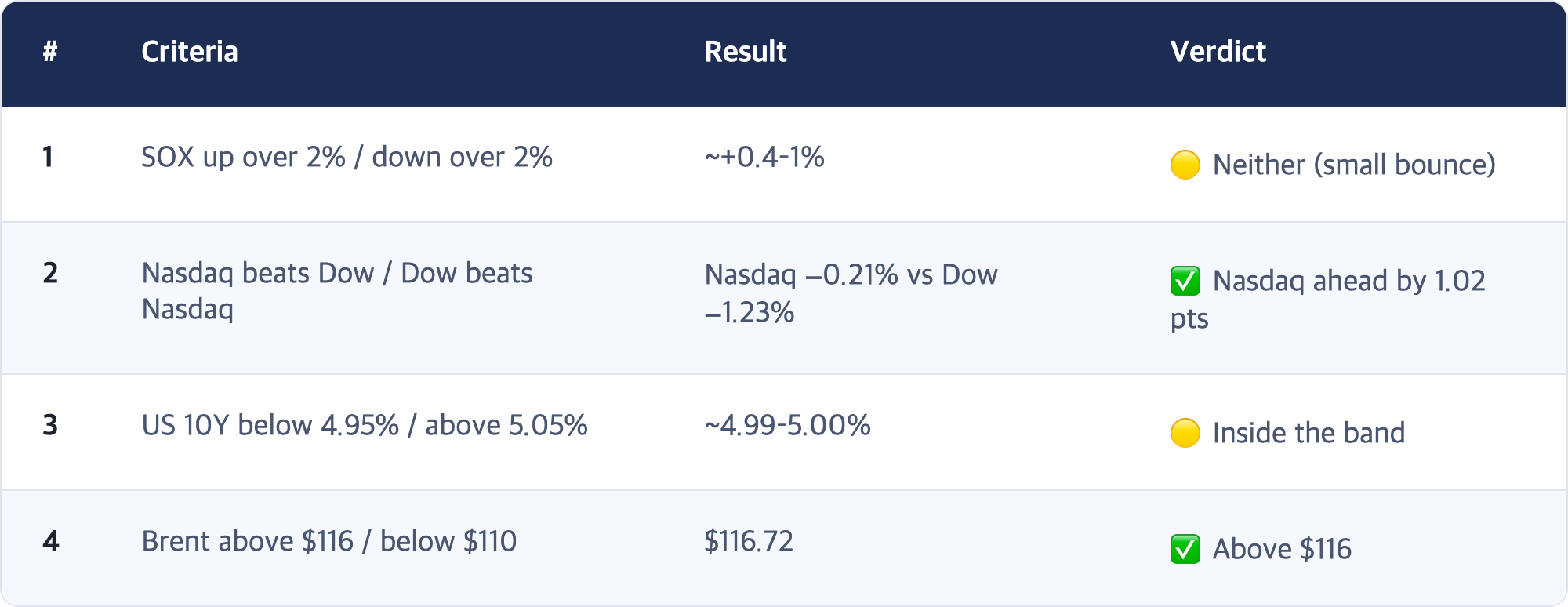
★ [Interpretation] #2 pointed to "money coming back," but for a different reason
On paper, #2 says the money came back. But the Nasdaq beat the Dow because the Dow fell on its own, not because tech was strong. The Dow was hit by oil and by company news (American Express announcing job cuts, a sharp drop in telecom stocks). SOX bounced but didn't reach +2%.
Friday's winner was #4: oil. The open third-variable slot did its job, but the risk arrived in a different form than expected. Instead of Iran's airport threat, it was reports of strikes resuming after the midterms.
2. The Big Story: Oil Weighed on the Dow; Chips Took a Day Off
[Fact] US close, Fri Oct 23
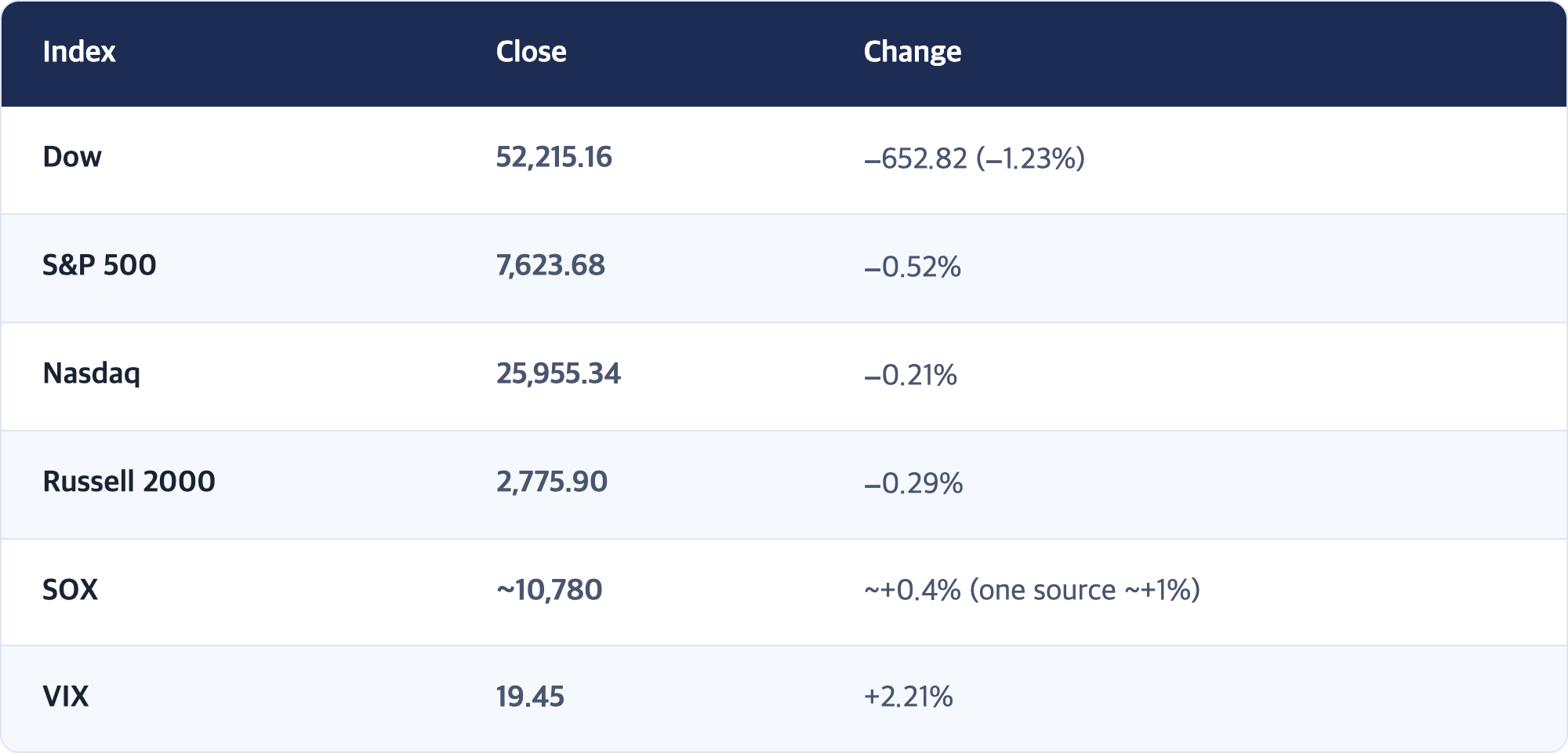
[Fact] For the week: S&P 500 −0.5%, Nasdaq ~−0.7%, both down for a second straight week. The Dow still notched a third straight weekly gain (CNBC).
[Fact] Notable movers (Oct 23)
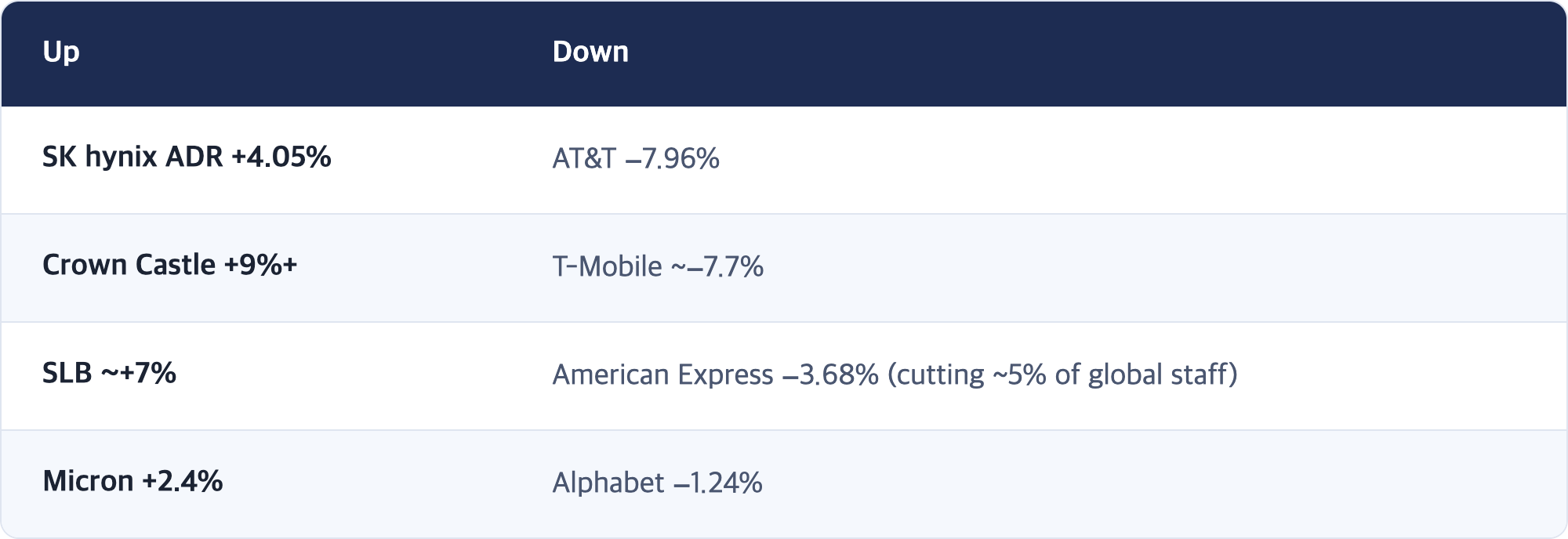
★ [Interpretation] Friday's drop was a different animal from Thursday's
- Thursday was about AI; Friday was about oil. On Thursday, SOX collapsed 6.72% while the Dow held. On Friday, the Dow was weakest and chips rested. The indexes fell two days in a row, but different parts of the market took the blow.
- Energy-only gains signal inflation worries. When oil rises and only energy stocks benefit, investors are worried that fuel costs will squeeze other industries and consumers. Still, the 10-year stopping at 5% shows the bond market is torn between "inflation" and "safety."
- The chip bounce was a pause, not a verdict. SOX recovered only a sliver of Thursday's loss. Investors seem unwilling to pick a direction until this week's Big Tech and Korean chip earnings land.
3. Korea Watch: The Risk Now Has a Date. Will Seoul Shift Its Focus to Earnings?
[Fact] Seoul close, Fri Oct 23 (from the previous brief)
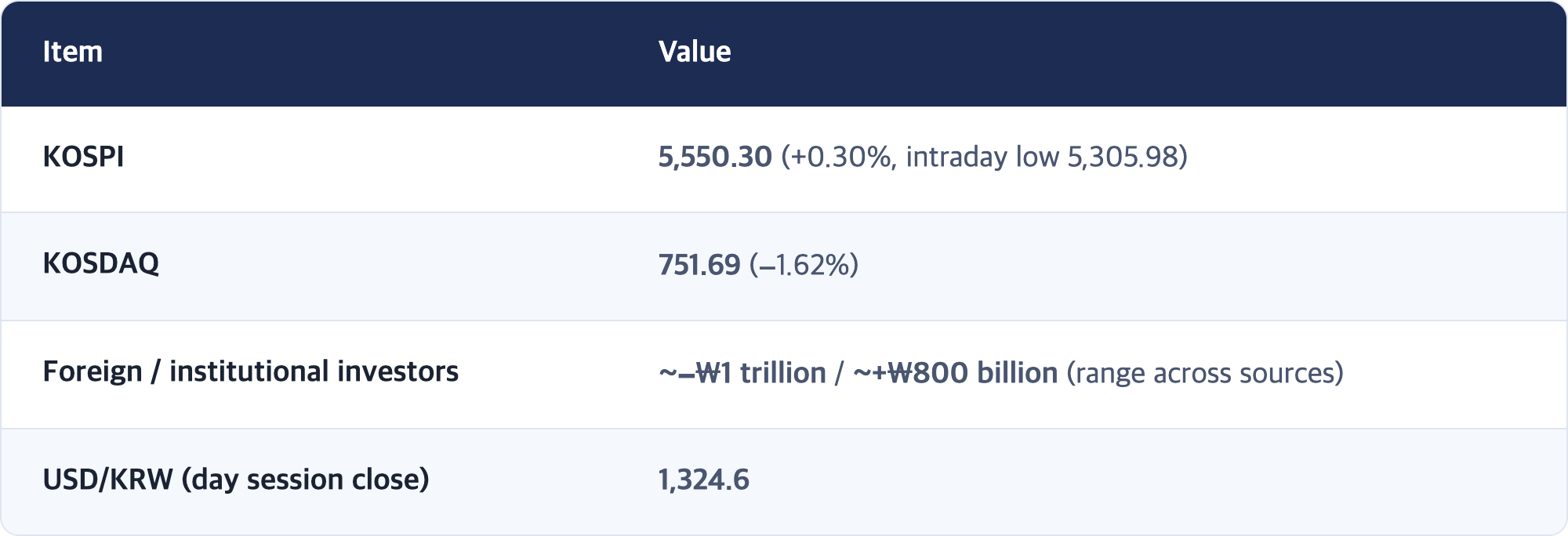
[Fact] Overnight and weekend signals
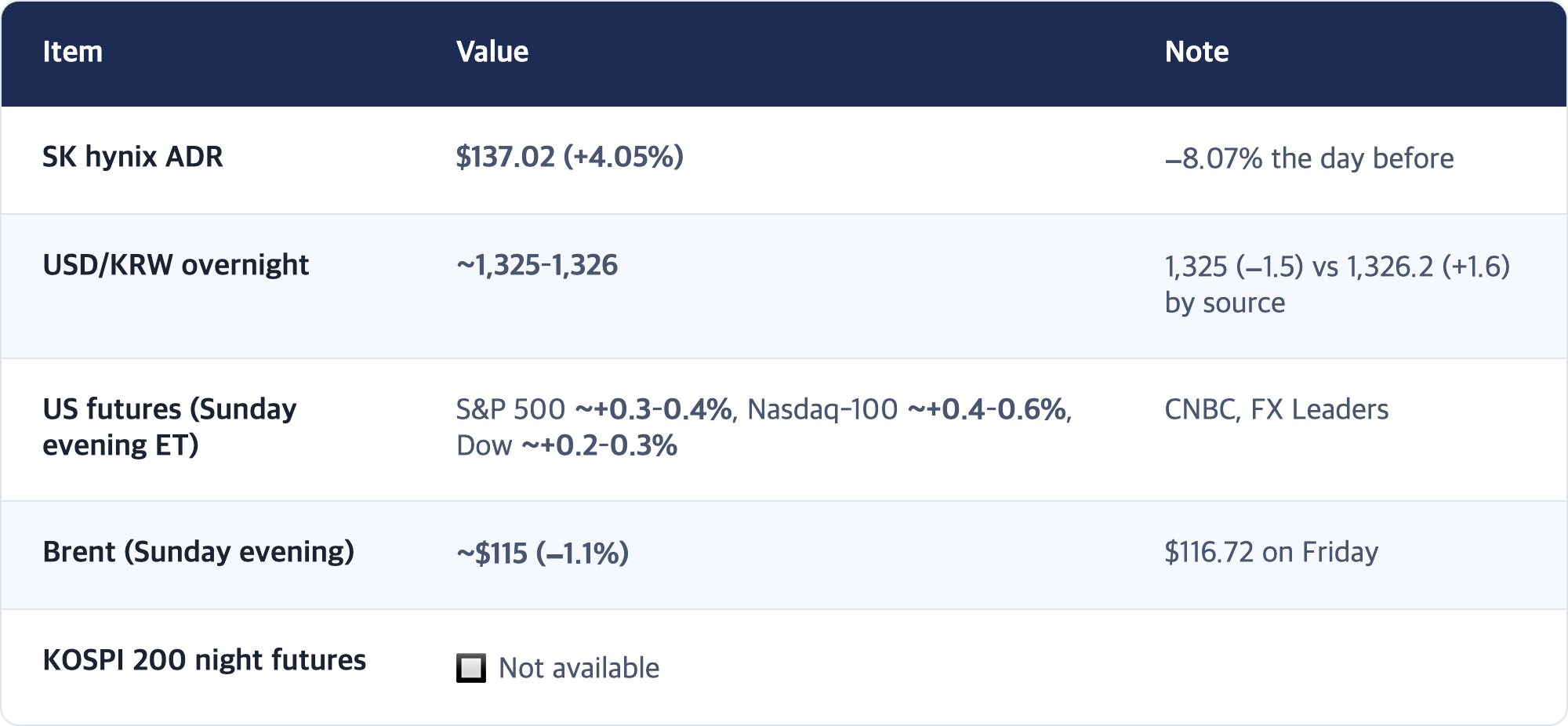
[Fact] Korea's week ahead (KST)
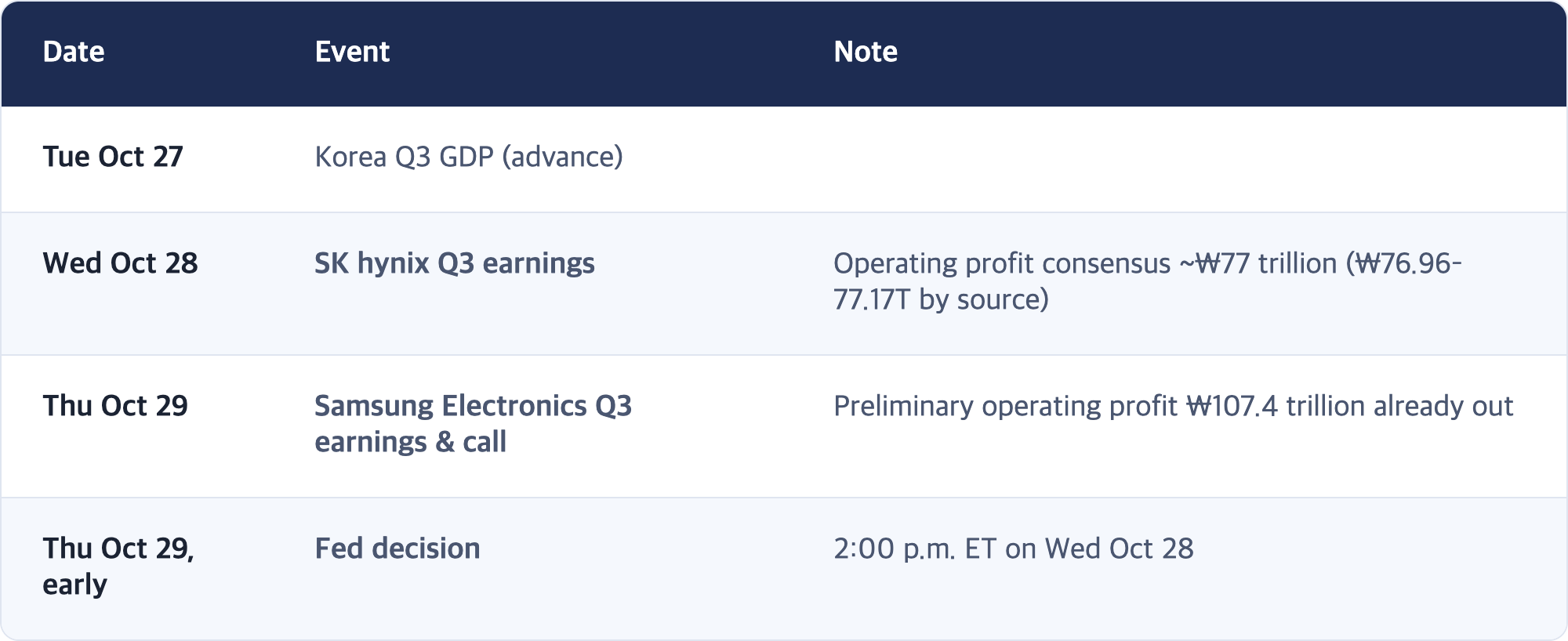
★ [Interpretation] Today Seoul is caught between a Middle East pause and pre-earnings caution
- The risk didn't go away; it got a date. With renewed strikes reportedly slated for after the election, the chance of something blowing up today or tomorrow fell, but a new calendar risk appeared for early November (see the Study Note). Rising US futures and a slight dip in oil reflect that near-term relief.
- The SK hynix ADR's +4% isn't new information. Seoul had already closed SK hynix up 4%+ on Friday afternoon, so New York simply confirmed that move. There isn't much extra for Seoul to add today.
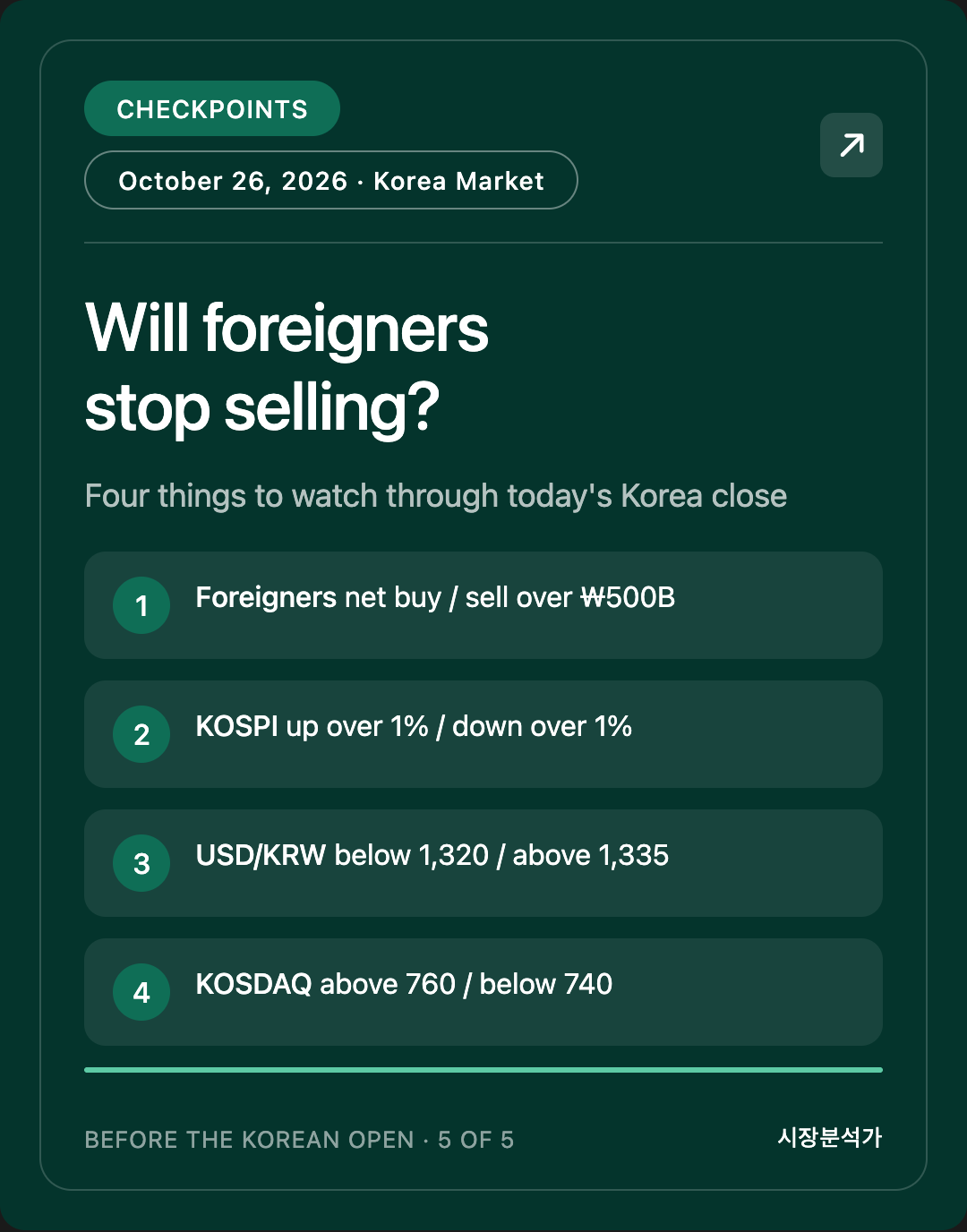
- The swing factor is foreign investors. Friday's rebound was propped up by domestic institutions while foreigners sold about ₩1 trillion. Whether foreigners stop selling ahead of the chip earnings, and whether the won holds in the 1,320s, is the first thing to watch.
- Korean brokers mostly expect "bottoming." NH Investment & Securities put this week's KOSPI range at 5,100–6,400. A 1,300-point range is itself a signal: the market could move sharply either way depending on this week's results.
[Observation] Four Korean market commentators that our readers follow closely (asset manager Kwak Sang-jun, economic commentator Park Si-dong, real-estate and equity analyst Lee Kwang-soo, and AFW Partners' Lee Sun-yeop) share a common view: chips will lead Korea's market higher over the medium term. This week's SK hynix and Samsung results put that view to a numbers test. But many reports say investors care less about the record Q3 figures, which are widely expected, and more about next-quarter guidance and shareholder returns. Good news that everyone already expects is likely priced in.
4. Macro Backdrop: Oil at an April High, Yields at 5%, the Fed on Wednesday
[Fact]
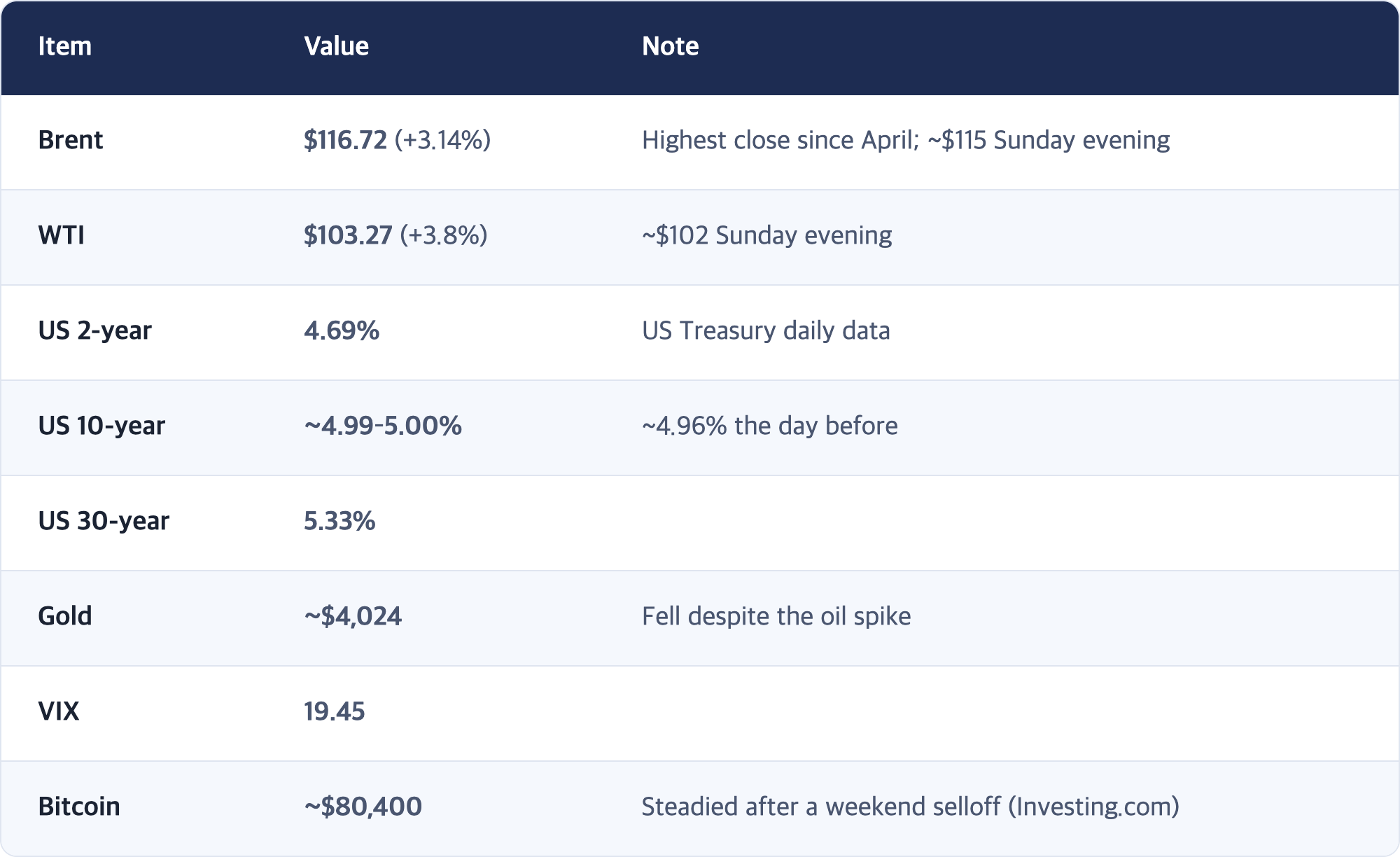
[Fact] Data (released Oct 23)
- S&P Global flash October PMI: composite 57.6 (from 58.4), manufacturing 56.0 (53-month high), services 57.9. The prices gauge rose to 59.8.
- University of Michigan final consumer sentiment: 48.0 (forecast 46.3). One-year inflation expectations 4.7%; five-year expectations rose to 3.5%.
[Fact] Geopolitics and policy
- Iran: According to The New York Times, the US and Israel are preparing to resume strikes on Iranian energy and nuclear sites after the Nov 3 midterms. Iran has threatened retaliation against regional data centers and undersea cables. President Trump said there would be no strike on Sunday and mentioned talks through mediators. Saudi Arabia said it intercepted Houthi drones and missiles on Sunday.
- The Fed: The FOMC meets Oct 27–28; a hold is widely expected (about 84–86% last week). The current policy rate is 3.75–4.00%.
★ [Interpretation] The numbers the Fed watches got worse
A hold this week is nearly certain. What matters is what the Fed says next. Friday's data showed a higher PMI prices gauge and five-year consumer inflation expectations rising to 3.5%, all with oil at $116. What the Fed fears most is people believing prices will keep rising. If the Fed's messaging leaves the door open to another hike, even strong chip earnings may not buy much of a rebound. Korean outlets are flagging the same risk.
5. Today's Korean Session (Mon Oct 26): Checkpoints
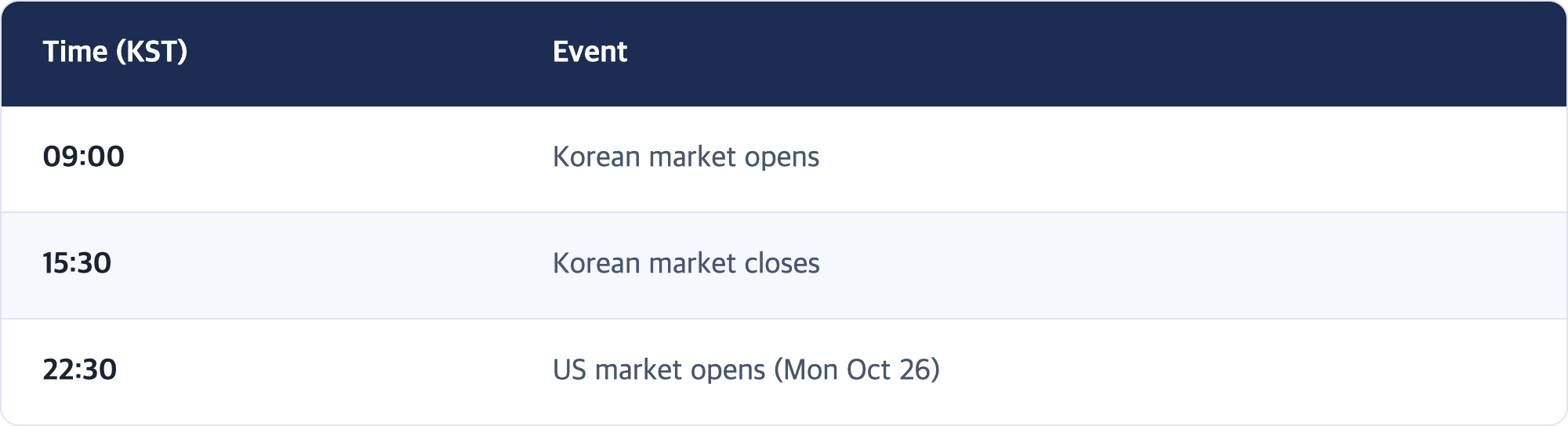
[Observation] Today's schedule (KST)
✅ Four checkpoints (through today's Korean close)
The axis: "With the Middle East risk pushed past the election, does Seoul shift its attention to this week's earnings and the Fed?" The third-variable slot is reserved for reports on US-Iran mediated talks.
- Foreign investors turn net buyers / sell more than ₩500 billion. Does Friday's ~₩1 trillion selling stop? (Most important)
- KOSPI up more than 1% / down more than 1%. Baseline: Friday's 5,550.30.
- USD/KRW below 1,320 / above 1,335. Where oil and foreign flows both show up.
- KOSDAQ above 760 / below 740. Baseline 751.69. Does the rebound spread beyond a single stock?
[Interpretation] If #1 and #4 land on the first side, Friday afternoon's reversal has widened from a single-stock story into a market-wide breather, and the "bottoming ahead of GDP and SK hynix earnings" view gains ground. If foreigners sell more than ₩500 billion and the won weakens past 1,335, foreign investors are still trimming chip exposure ahead of earnings.
6. Study Note: "Risk With a Date"
The concept
There are two kinds of risk: risk that could hit any time (a surprise attack, an accident) and risk that comes on a known date (an election, a central bank meeting, an earnings report). The second kind is often called event risk. Once a date is set, markets tend to relax until then and tense up again as the day approaches.
An analogy
Think of a typhoon forecast. If no one knows when it will hit, you carry an umbrella every day. If it's forecast to make landfall next Tuesday, you enjoy the weekend outdoors, and the grocery stores are packed Monday evening.
Today's example
When renewed strikes on Iran were tied to "after the Nov 3 midterms," Brent fell about 1% on Sunday evening and US futures rose. The risk didn't disappear; it was written on the calendar. Meanwhile, other dated events (the Fed on Oct 28, chip earnings) arrive first.
Why it matters
As a dated risk approaches, pre-positioning trades (buying oil, cutting stock exposure) tend to return. So it's worth watching whether oil and volatility (VIX) climb again as the first week of November nears. Conversely, if talks erase the date altogether, oil bought ahead of time could unwind quickly.
One-line summary
A risk with a date hasn't gone away; it has moved onto the calendar.
7. Corrections & Open Items
Corrections
- None.
Source discrepancies (value used in the text)
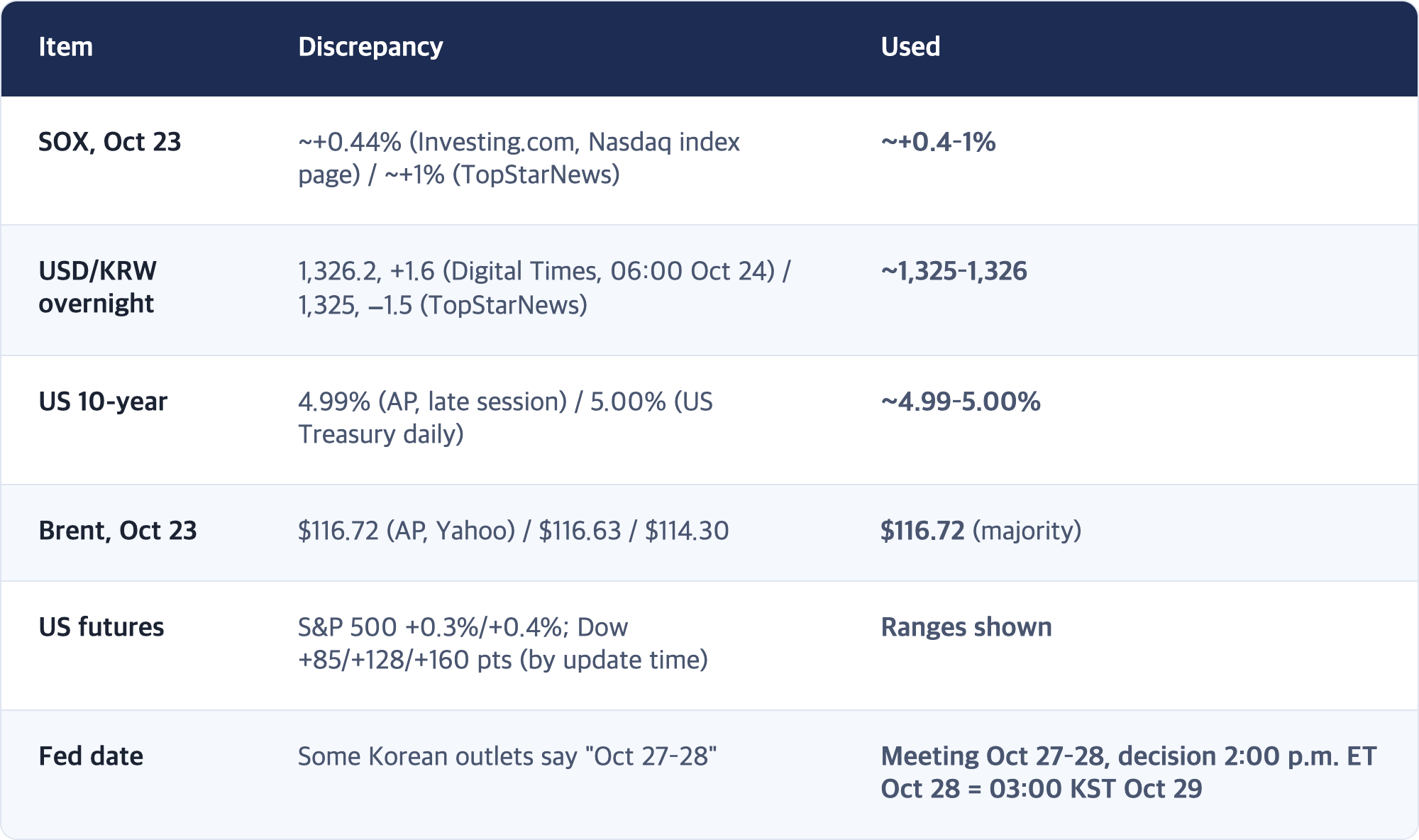
🔲 Unconfirmed
8. Event Calendar (KST)
Sources
- Stock market today: Dow sinks 600 points, S&P 500, Nasdaq drop to cap a volatile week, oil prices rise | Yahoo Finance
- Dow, S&P 500 fall, tech steadies to end rocky week | The Spokesman-Review (AP)
- Wall Street loses ground under pressure from rising oil prices | Times Leader (AP)
- Dow drops 652 points; chips rebound, SK hynix ADR up 4% | TopStarNews (Korean)
- Philadelphia Semiconductor Index Historical Data | Investing.com
- CBOE Volatility Index Historical Data | Yahoo Finance
- Stock futures climb as traders try to recover from the S&P 500's losing week | CNBC
- Dow Jones and Nasdaq Futures Rebound as Oil Prices Ease Ahead of Fed Decision | FX Leaders
- Markets tumble as concerns about Iran war and high AI spending collide | NBC News
- Netanyahu calls for US and Israel to overthrow Iran as Brent crude hits five-month high | Fox News
- Weekly Market Review: 2026-10-23 | The Glass Desk
- Bitcoin steadies near $80,400 after weekend selloff, Fed decision looms | Investing.com
- Foreigners sell ₩21T yet the won strengthens | Digital Times (Korean)
- KOSPI directionless ahead of SK hynix, Samsung earnings and FOMC "super week" | Gukje News (Korean)
- Will KOSPI find a floor? Eyes on the FOMC and Samsung/SK hynix earnings | Hankyung (Korean)
- FOMC and chip earnings "super week": can KOSPI find a rebound? | Seoul Economic Daily (Korean)
Market Analyst · This brief does not recommend buying or selling individual stocks. It provides macro context and interpretation.
📌 More market briefs
※ This post is market observation and organization intended to support your own judgment. It is not a recommendation to buy or sell any security. Figures are as of the time of writing and may differ between sources.
If this was useful, bookmark it or pass it along. It genuinely helps me write the next one.
I can survive. We can survive.