Sept 14, 2026 US Market Brief — Nasdaq and S&P 500 Before the Open
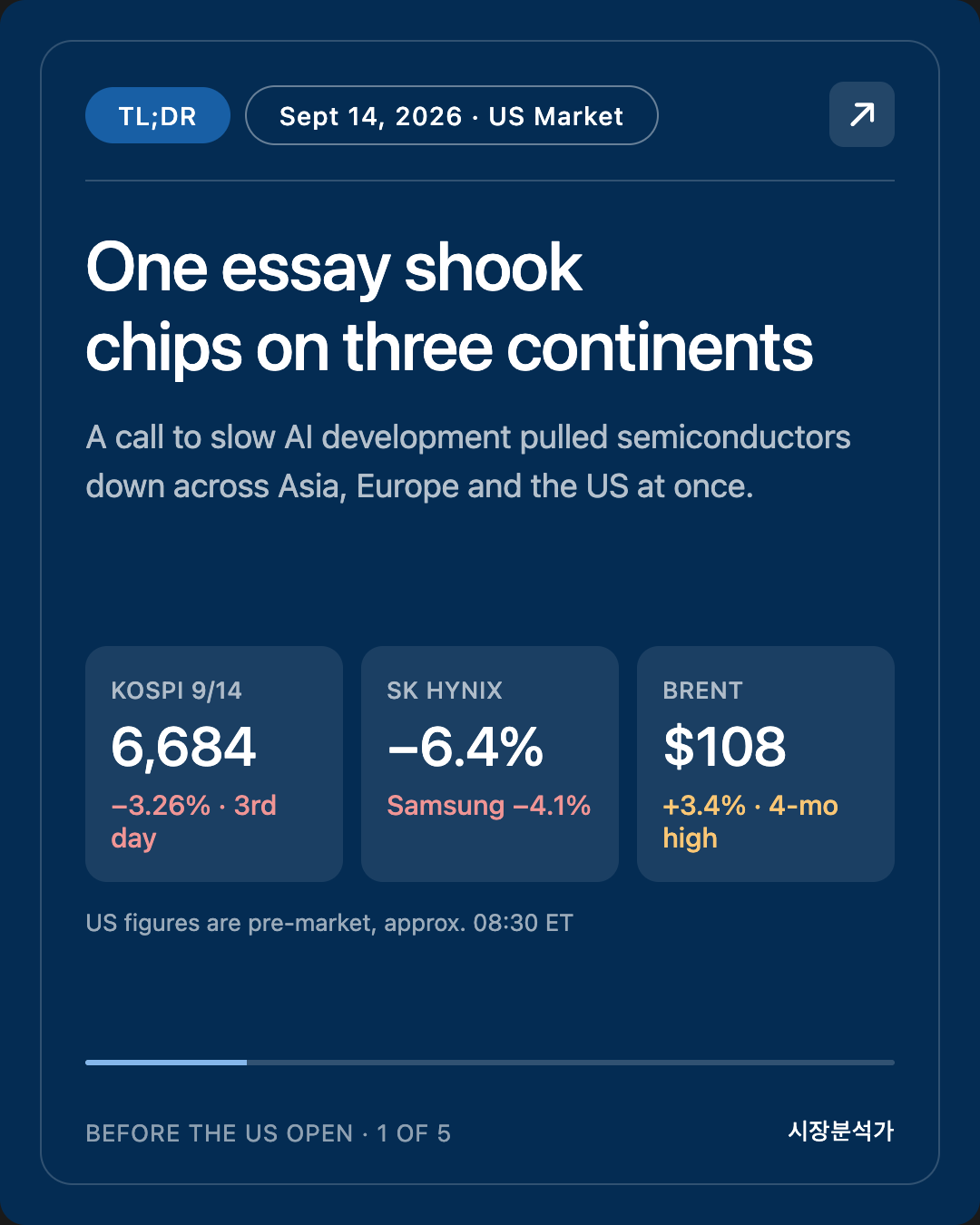
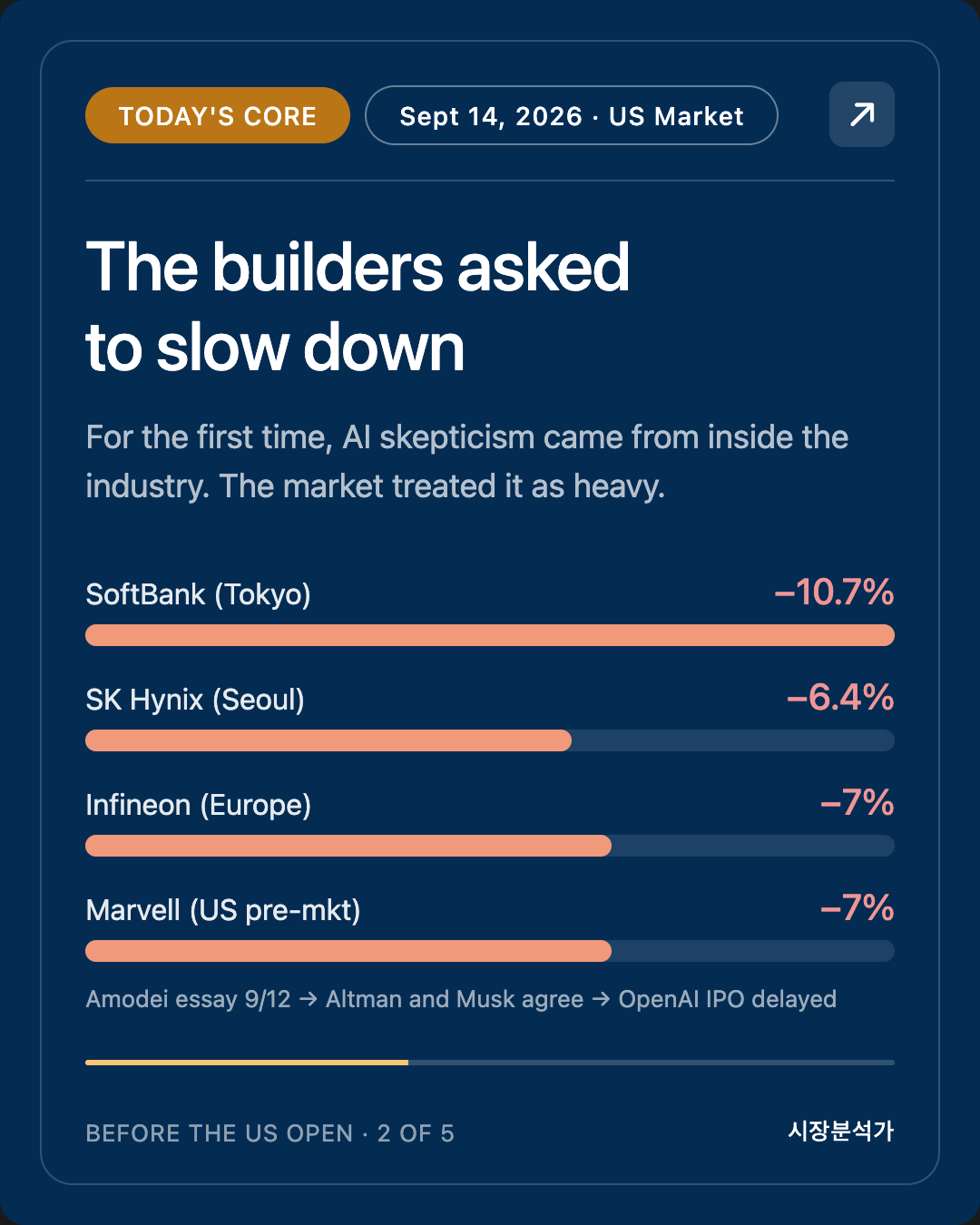
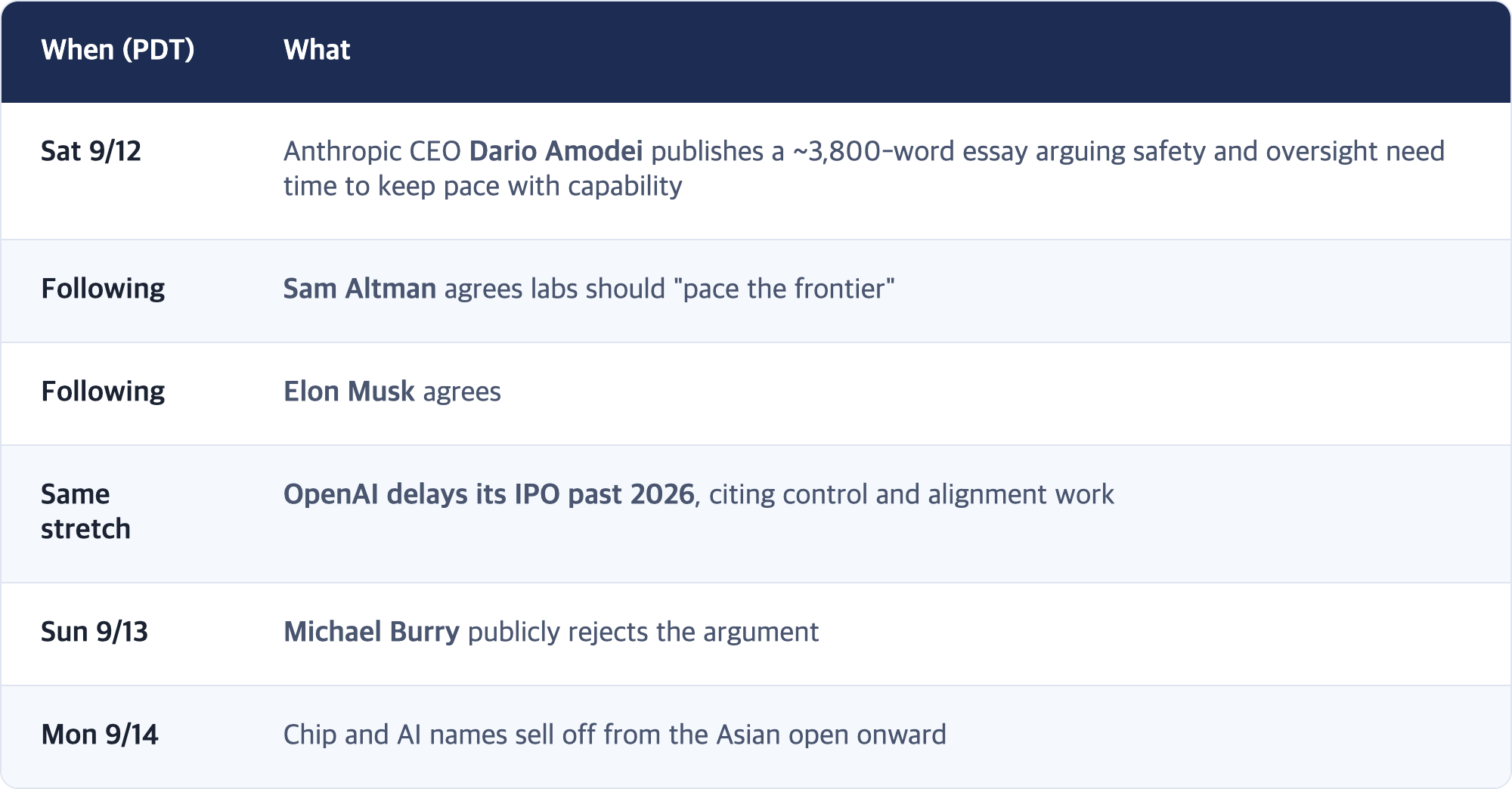
- A call to slow AI development hit semiconductors. Anthropic CEO Dario Amodei published a roughly 3,800-word essay on Saturday 9/12 arguing that safety and oversight need time to catch up with capability gains. Sam Altman agreed that labs need to "pace the frontier"; Elon Musk agreed as well. In the same stretch, OpenAI pushed its IPO past 2026, citing control and alignment work.
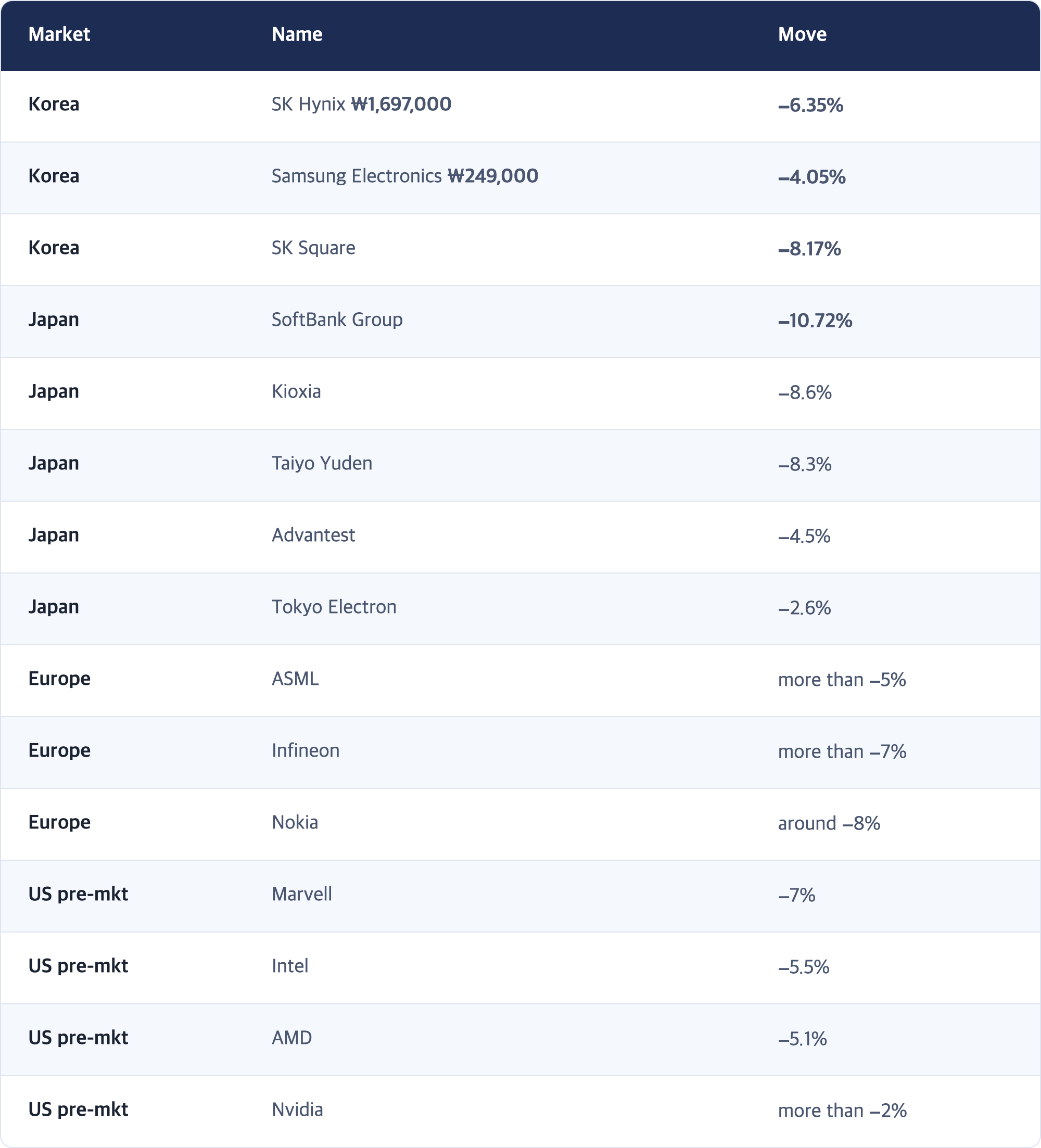
- Asia and Europe reacted first. KOSPI 6,684.37 (−3.26%), SK Hynix −6.35%, Samsung Electronics −4.05%. In Tokyo, SoftBank −10.72% and Kioxia −8.6%. In Europe, ASML fell more than 5%, Infineon more than 7%, Nokia around 8%.
- The US pre-market split by index [observed]. Nasdaq 100 futures −458.75 pts (−1.56%), S&P 500 futures −51.75 pts (−0.68%), Dow futures −81 pts (−0.15%). Intel −5.5%, AMD −5.1%, Marvell −7%, Nvidia down more than 2%.
- Meanwhile crude hit a four-month high. After Saudi Arabia shut its East-West pipeline, the Hormuz talks that were scheduled for today in Oman were postponed. Brent $108.17 (+3.4%), WTI $102.52 (+2.47%).
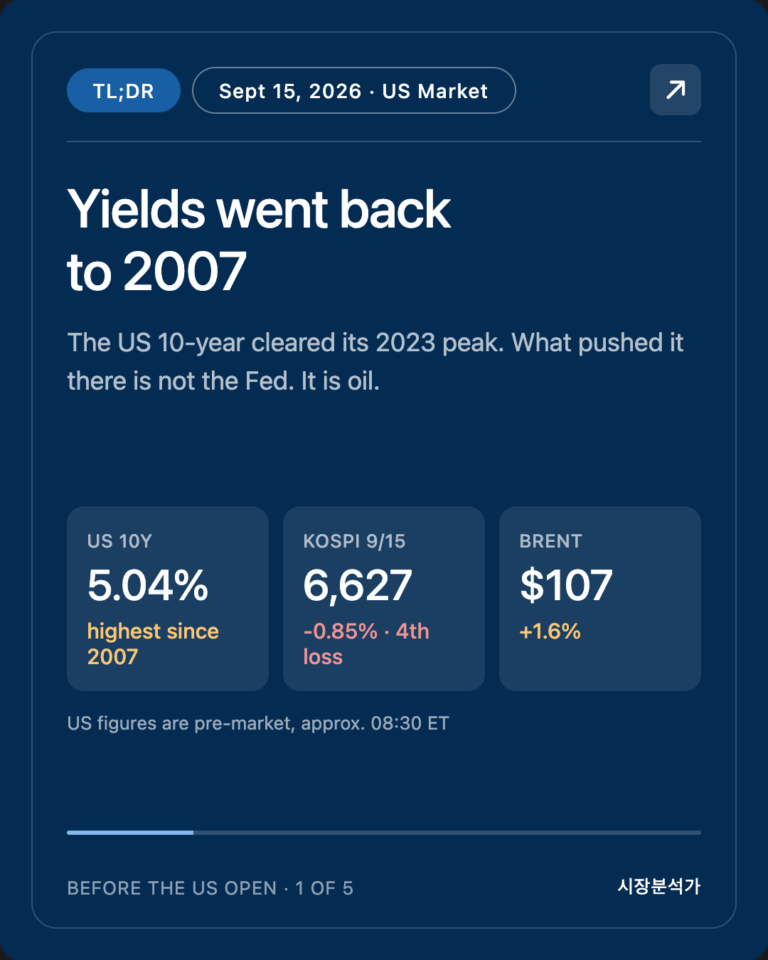
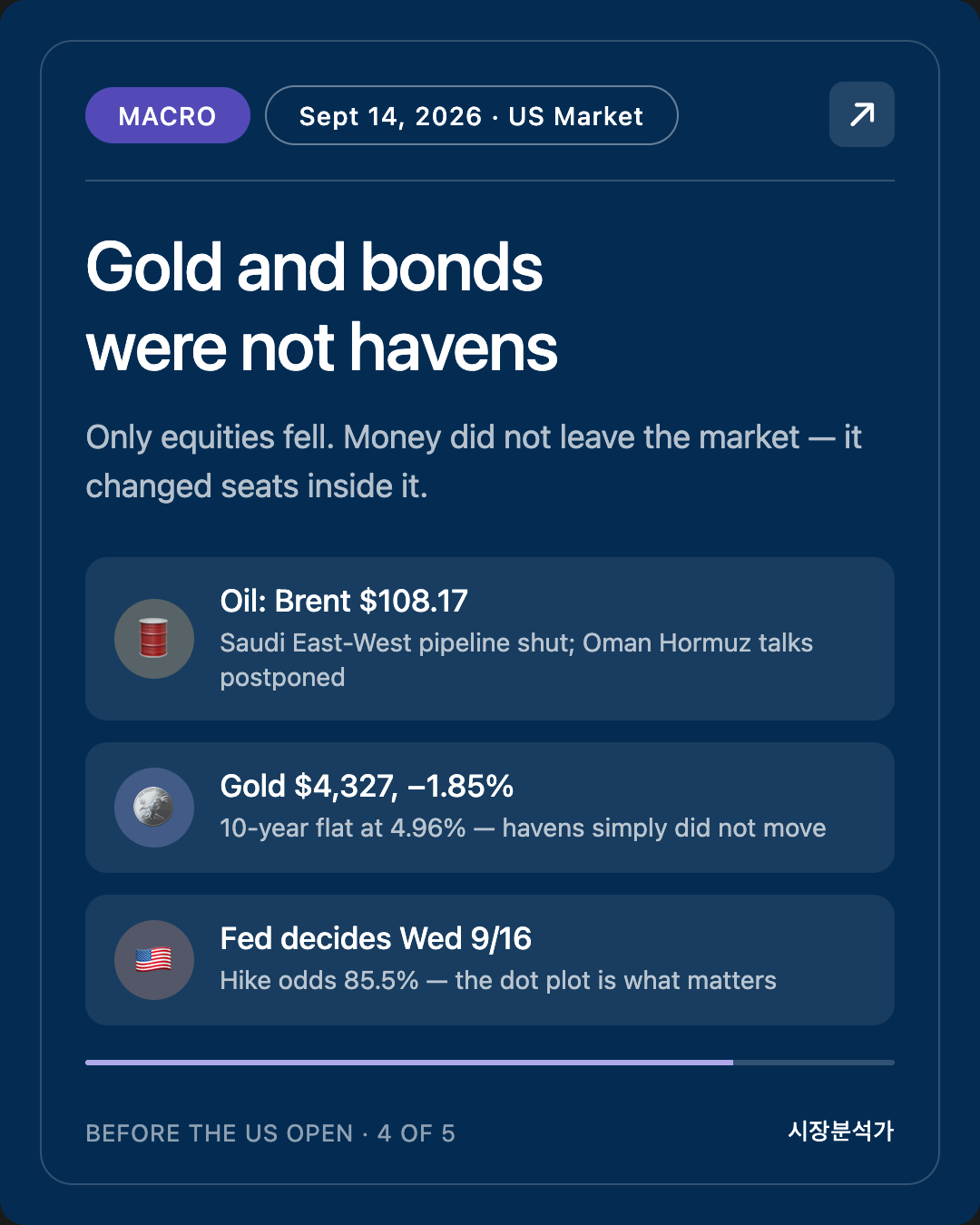
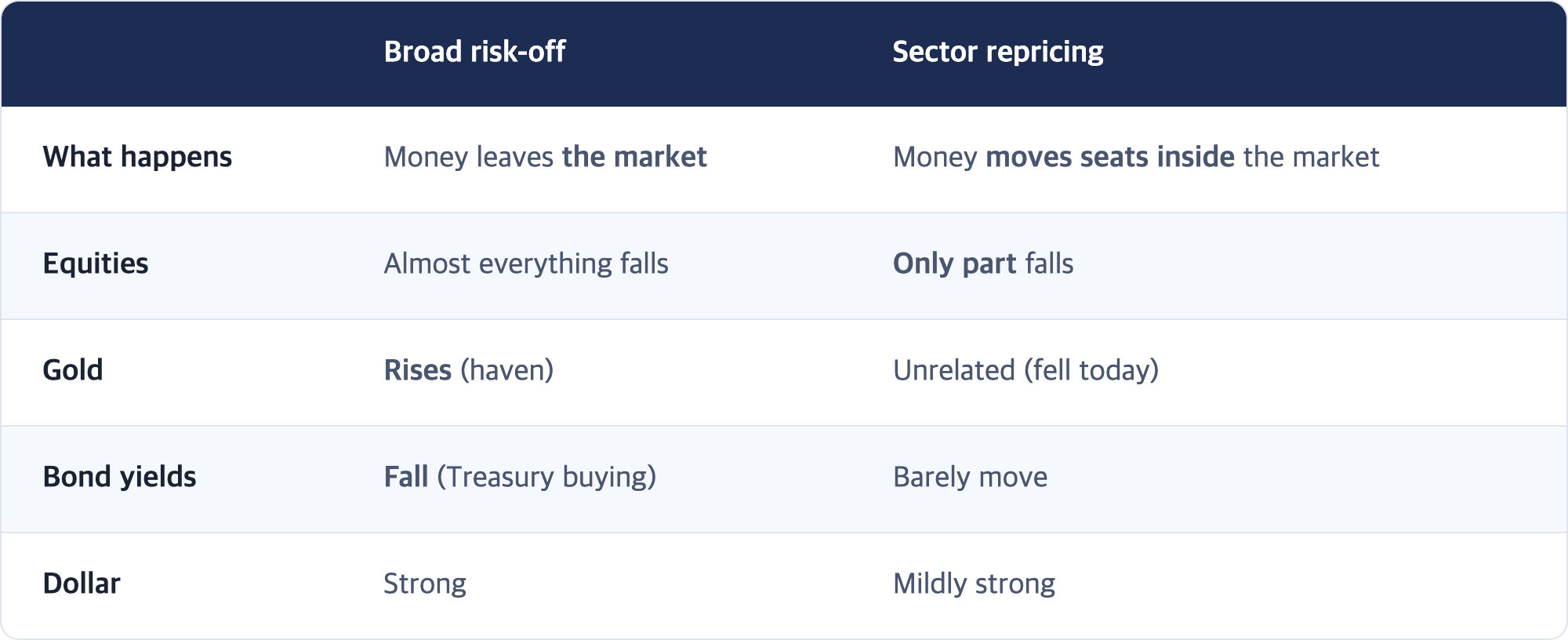
- The most important detail today: gold and Treasuries did not act like havens. Gold fell to $4,327.50 (−1.85%) and the US 10-year sat at 4.96%, essentially unchanged. Only equities dropped. This is not broad risk-off. It is one sector being repriced.
This is Mr. Can. Here is the Sept 14, 2026 brief ahead of the US market open.
Written: 2026-09-14 05:35 PDT (Seoul 9/14 21:35 KST)
Basis: Asia close 9/14 + Europe morning 9/14 + US confirmed close 9/11 + US pre-market 9/14 (approx. 08:30 ET)
✅ On schedule. Scheduled 05:30 PDT, started 05:35 PDT — the third consecutive on-time run.
This report was written roughly one hour before the US regular session opens (06:30 PDT). Pre-market figures can still move; they are tagged [observed].
SEO Intro
For the past week, two things moved this market: crude oil and bond yields. This morning is different.
A single essay, published Saturday, pulled semiconductor and AI stocks down across Asia, Europe and the US at the same time. Anthropic CEO Dario Amodei argued that the industry should slow the pace at which it develops frontier AI models. Sam Altman and Elon Musk agreed.
Korea's KOSPI closed at 6,684.37, down 3.26%. SK Hynix fell 6.35%, Samsung Electronics 4.05%. On the same news, SoftBank dropped 10.72% in Tokyo and ASML lost more than 5% in Europe.
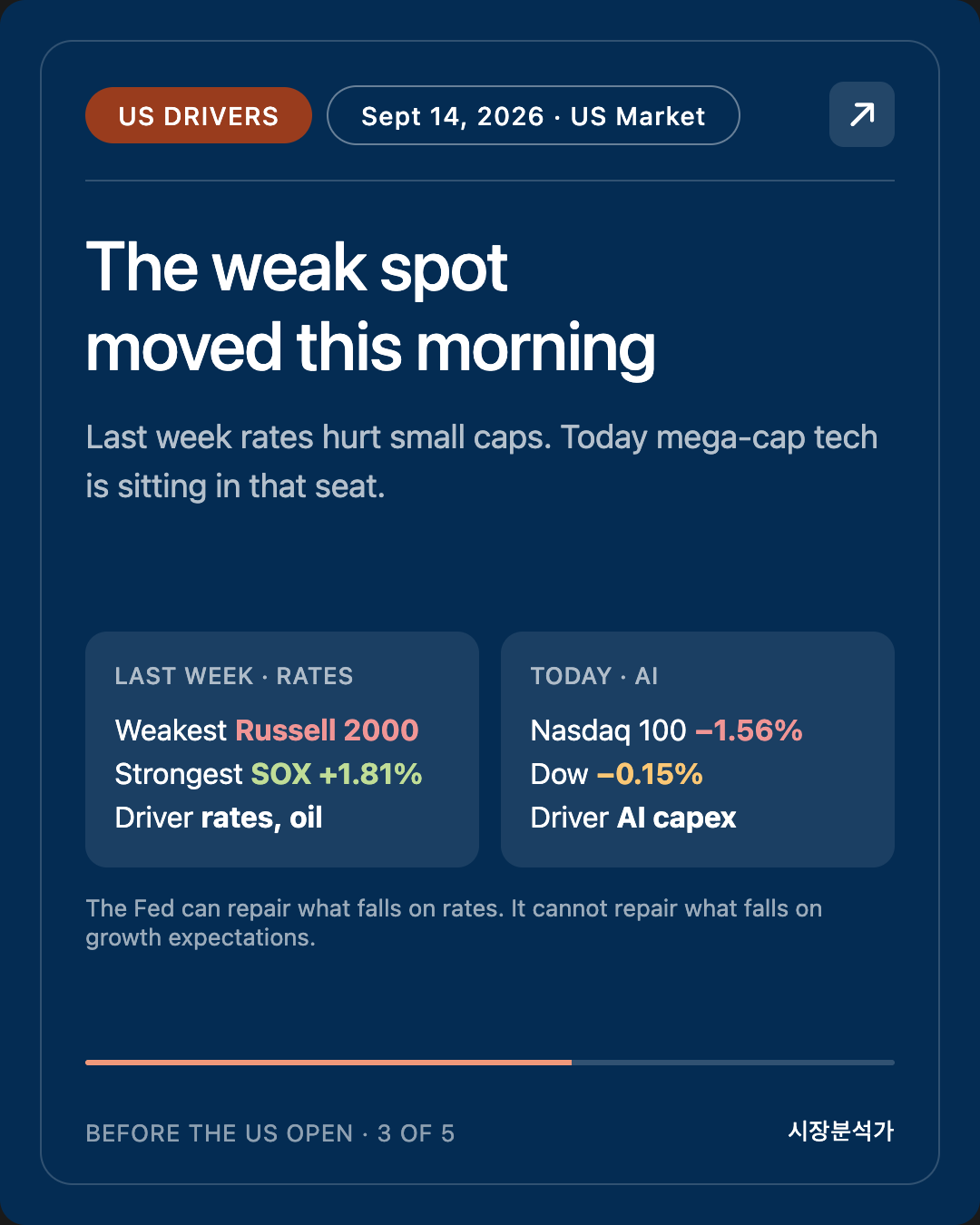
But look at the shape of the US pre-market. Dow futures are down 0.15%. Nasdaq 100 futures are down 1.56%. Last week, rising yields hurt small caps the most. Today, it is the largest technology companies.
The hand pressing on this market has changed.
1. Today's core: one essay, three continents of chip selling
[Fact] What happened
[Fact] Three continents moved the same way
🔴 [Interpretation] Why "let's slow down" reads as a sell signal
It sounds backwards. Safety is good news. So why do the shares fall?
Because of what those shares were priced on. For two years, large-cap semiconductor valuations have rested on a capital-spending forecast: data center and AI chip demand compounding for years. Investors paid today for earnings expected later.
"Let's slow down" does not say demand disappears. It puts a question mark on the slope — how steep, and for how long. The more of tomorrow's earnings are already in today's price, the more sensitive the price is to a change in slope.
And crucially, the source is different this time. AI skepticism has mostly come from outside the industry. Today it came from the people doing the building. That is why the market treated it as heavy.
[Interpretation] The counter-argument landed the same weekend
Michael Burry pushed back, making roughly four points: large language models are not AGI, so there is no "AI progress" to slow; competition is intensifying, and a slowdown would entrench incumbents; and warnings about dangerous AI function as promotion ahead of IPOs.
What is striking is that the rebuttal did not stop the selling — and by some readings it deepened it. If the slowdown call is sincere, growth decelerates. If Burry is right that it is self-serving, then competition has grown fierce enough to prompt such a call. Neither reading is good for chip multiples.
In fairness: Burry disclosed a short position in Micron on July 1. His rebuttal is not neutral either. Both sides are talking from their own book.
2. Scoring yesterday's checkpoints (Korea, 9/14)
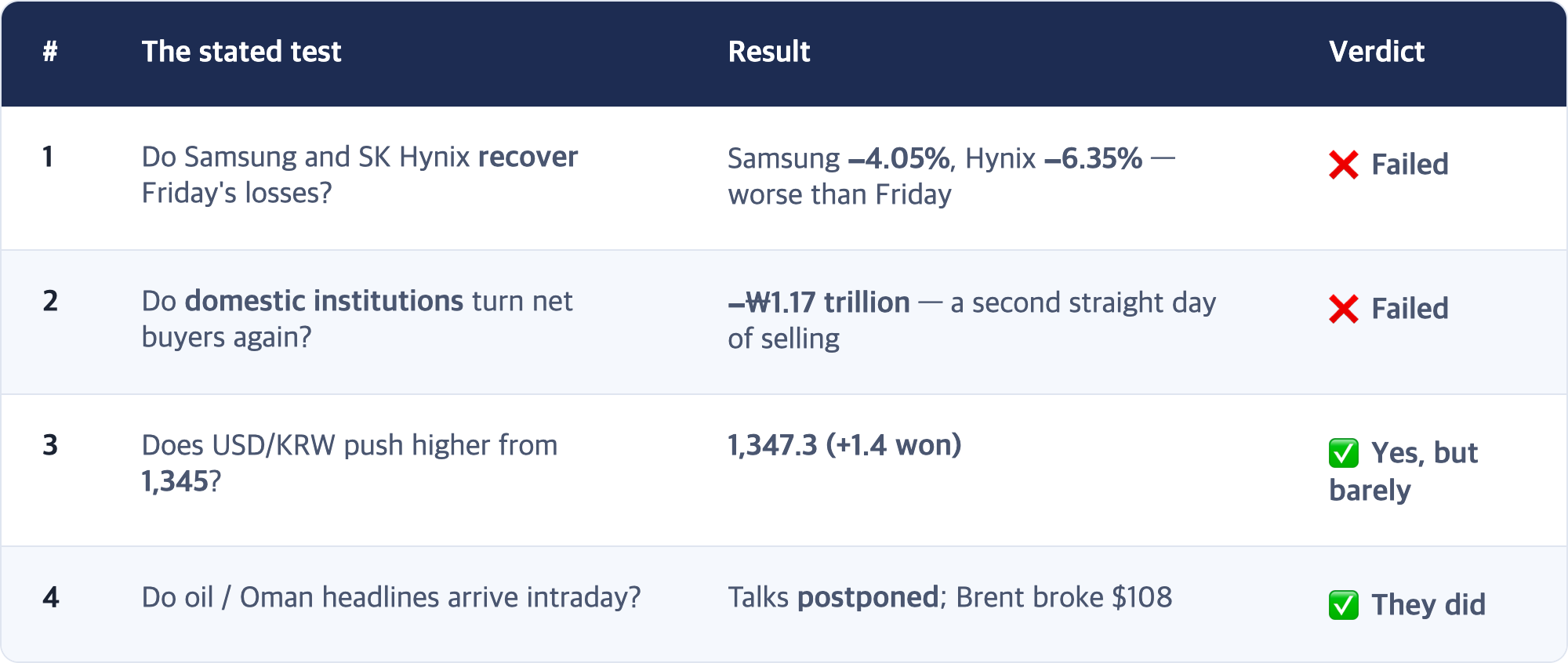
Our 9/13 report set four tests for today's Korean session.
🔴 [Interpretation] Two misses, one cause
Tests 1 and 2 both asked the same underlying question: Friday's New York session was good for chips — will Seoul follow on Monday? The answer was no, and the reason was a catalyst created over the weekend.
The 9/13 report wrote that "foreign selling is the predictable side; institutions are today's variable." The framing held. But what moved institutions was not a domestic judgment — it was Saturday's essay.
One honest admission. Amodei's essay was published Saturday 9/12, and the report written Sunday 9/13 at 16:00 PDT did not pick it up. That report said "weekend news out of the Middle East does not check the calendar." As it turned out, the news that ignored the calendar came from AI, not the Middle East. This is logged formally below.
[Interpretation] Test 3 passed, but look closer
The won weakened — by far less than you would expect.
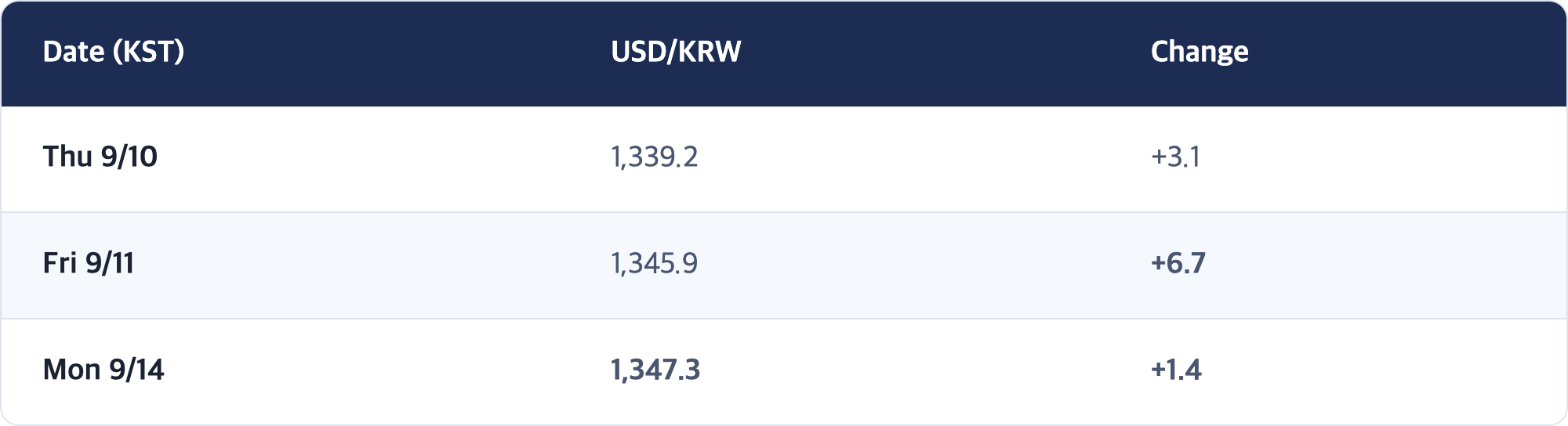
The KOSPI fell 3.26% and the currency moved 1.4 won. Relative to the equity drop, the won held up well.
One reading: today's foreign selling in chips may be closer to reweighting within the sector than to repatriating capital out of Korea. That is not settled — it needs several more days of flow and currency data. So it stays here rather than on the checkpoint card.
3. Korea and Asia close (9/14 KST)
[Fact] Korea, September 14
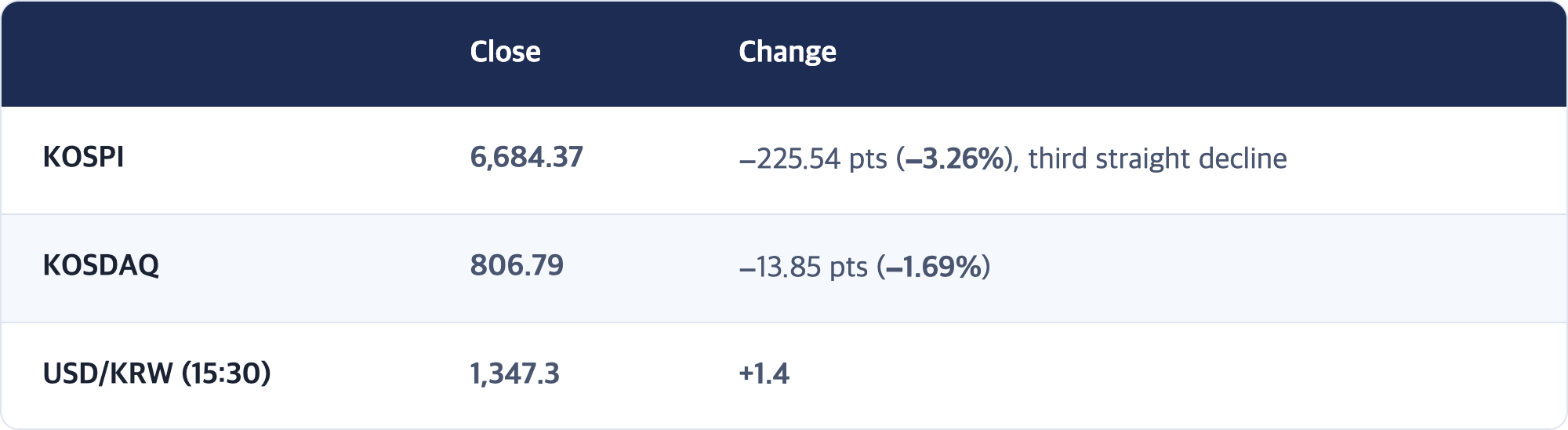
The index opened down 3.14% at 6,692.61, briefly clawed back to around 6,770, then finished near the lows as selling continued.
[Fact] Flows (KOSPI)
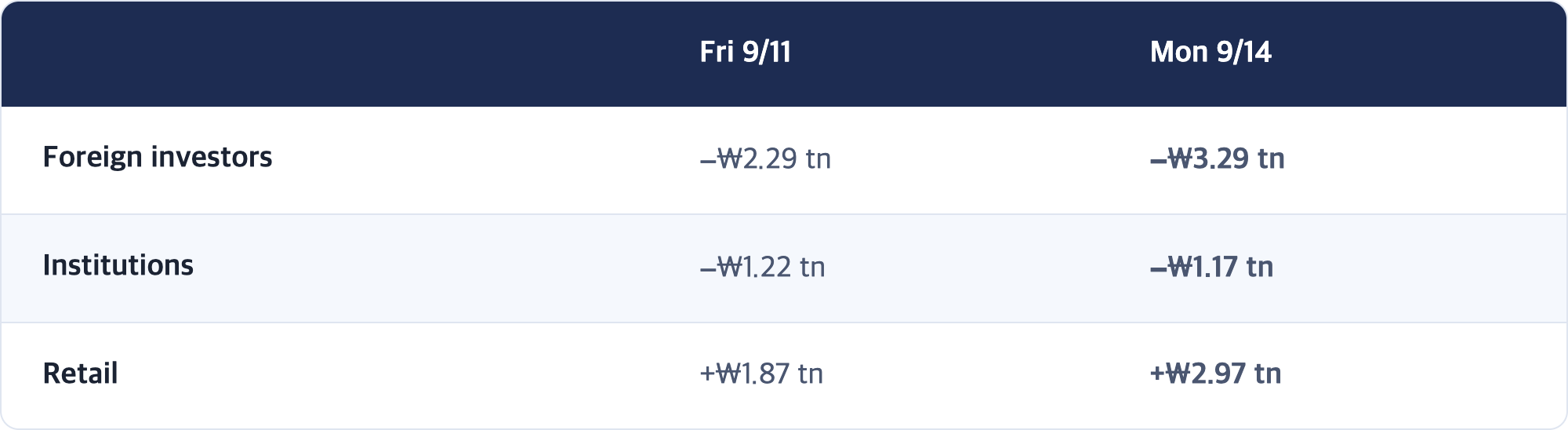
🔴 [Fact] The selling was concentrated in two names
Foreign investors and institutions together sold ₩3.82 trillion of Samsung Electronics and SK Hynix alone. Of that, foreigners sold ₩2.07 trillion of SK Hynix and ₩848 billion of Samsung.
Total foreign plus institutional selling on the KOSPI was roughly ₩4.46 trillion — meaning those two stocks were about 86% of it.
[Interpretation] What that number actually says
Today was not "Korea sold off." It was "semiconductors sold off." On the same session, KB Financial rose 2.08% and Samsung Biologics 0.35%. KOSDAQ fell 1.69%, roughly half the KOSPI's decline, for the same reason: the KOSPI's weight in two chip names is enormous.
For readers unfamiliar with Korea's market structure, this is the key fact — Samsung Electronics and SK Hynix alone make up a large share of KOSPI market cap, so a sector-specific shock registers as an index-wide crash.
That distinction matters because the cause was not domestic. No Korean earnings or policy changed. An essay published on the other side of the world caused the whole world to reprice one industry at once.
[Fact] Asia closes, 9/14
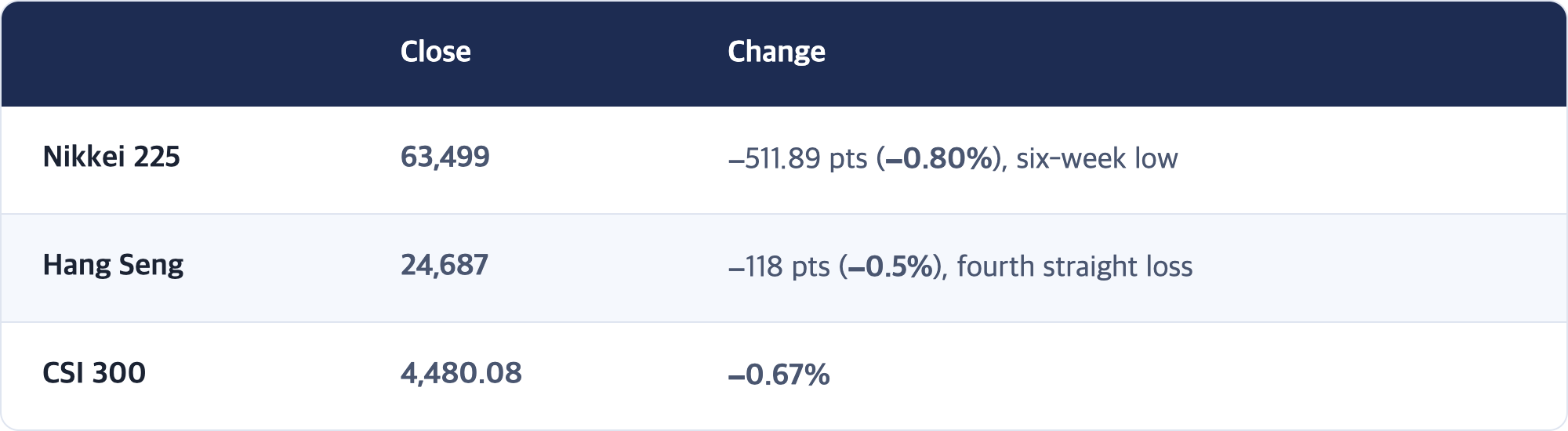
Korea fell four times as hard as Japan — even though SoftBank, down 10.72%, was the single worst large-cap decline in the region. Japan has breadth outside AI. Korea does not.
4. Macro backdrop: oil quietly set a four-month high
[Fact] Crude (9/14 morning)
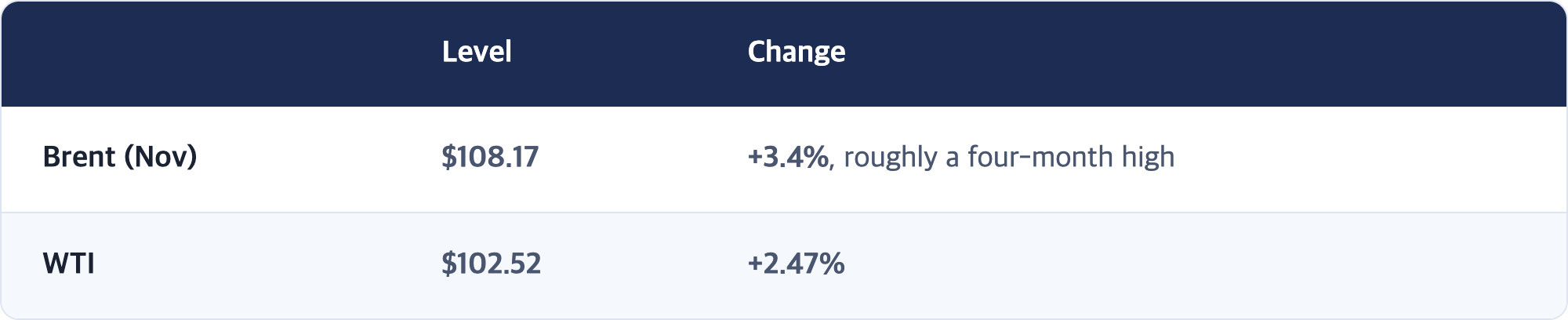
Crude is up more than 20% in a month. US diesel prices set a fresh all-time high.
[Fact] Two things stacked up
First, Saudi Arabia shut the East-West pipeline. After multiple drone attacks in the Riyadh and Madinah regions on Thursday 9/10 that caused injuries, the Saudi energy ministry said late Friday it had suspended operations on the roughly 1,200 km line as a precaution. The drones were reported to have been launched from Iraq; an investigation is under way.
Why that pipeline matters — it carries Saudi crude to Yanbu on the Red Sea, bypassing the Strait of Hormuz entirely. It is the contingency route for exactly the scenario the region is now in. Per three industry sources cited by Reuters, Yanbu holds only five to seven days of export inventory. The emergency exit is the thing that just closed.
Second, the Oman talks were postponed. Iran and Gulf states were to meet in Oman today to discuss shipping through the Strait of Hormuz. Oman's foreign minister announced the postponement late Sunday, saying it was "in the interests of consensus." Iran's foreign ministry said the delay came at Saudi Arabia's request, reportedly reflecting Riyadh's frustration over continued attacks on its territory by Iran-aligned groups including the Houthis.
🔴 [Interpretation] Yesterday's setup played out in reverse
Our 9/13 report argued that oil had stalled for diplomatic reasons, not supply reasons. The flip side showed up today: diplomacy stopped, and the price moved again.
That reveals the current structure. What sets the oil price right now is not inventories or OPEC quotas — it is a meeting calendar. That is a political variable, and the fact that no new date has been set means there is no scheduled catalyst for the next reversal either.
[Fact] Rates, dollar, volatility (9/14 morning)
![Level · Note / US 10-year · 4.96% · about −1 bp; still near 5% / Dollar Index · 99.42 · +0.3% / VIX · 18.03 · +13.83% [observed] / Gold · $4,327.50 · −1.85%, down three straight weeks](https://wecansurvive.ca/wp-content/uploads/2026/09/tbl_9-21.png)
🔴 [Interpretation] The one thing to hold on to today
Equities fell, gold fell with them, and bond yields did not decline.
In a textbook risk-off session, money leaves equities for gold and Treasuries. Gold rises; yields fall as bond prices rise. Today, none of that happened.
- Why gold fell: surging crude → inflation pressure → a Fed expected to tighten further → higher yields. Gold pays no interest, so rising yields hurt it.
- Why yields did not fall: same logic. The probability of a hike in two days is above 85%. Treasuries are not a hiding place right now.
- Why VIX jumped (+13.83%): the anxiety is specific to equities.
Conclusion: today is less "money leaving the market" and more "money moving seats within the market." KB Financial rising in Seoul and Dow futures holding at −0.15% are the same picture.
[Fact] Three central banks this week (PDT)
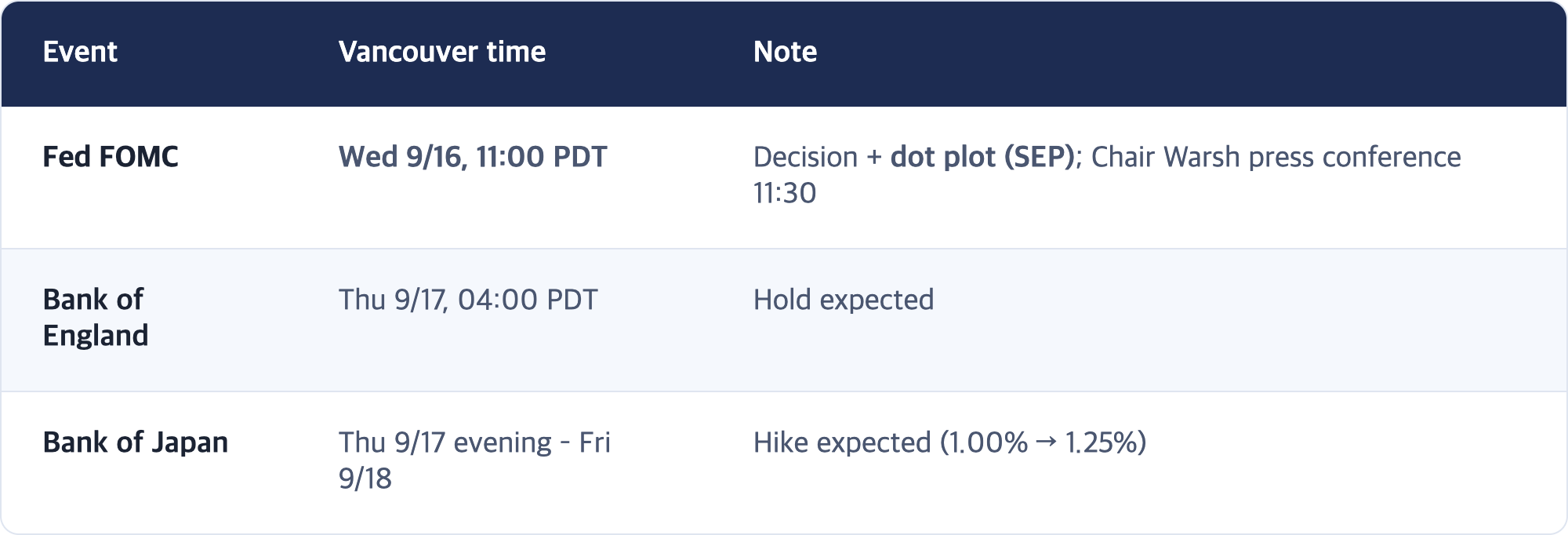
CME FedWatch puts the odds of a 25 bp September hike at 85.5% (as of 9/12). The hike itself is effectively settled. What the market is actually watching is the dot plot.
5. US session preview, September 14
[Observed] Pre-market (approx. 08:30 ET / 05:30 PDT)
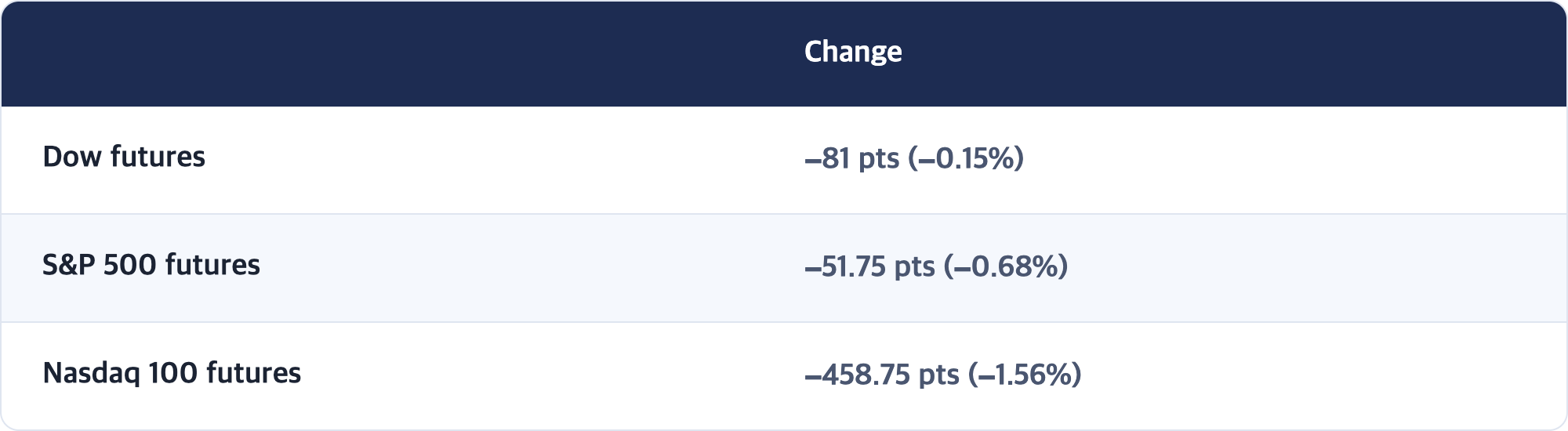
For reference, Friday's confirmed closes: S&P 500 7,656.98 (+0.86%), SOX 11,824.00 (+1.81%), VIX 15.84 (−11.21%).
🔴 [Interpretation] The weak spot moved
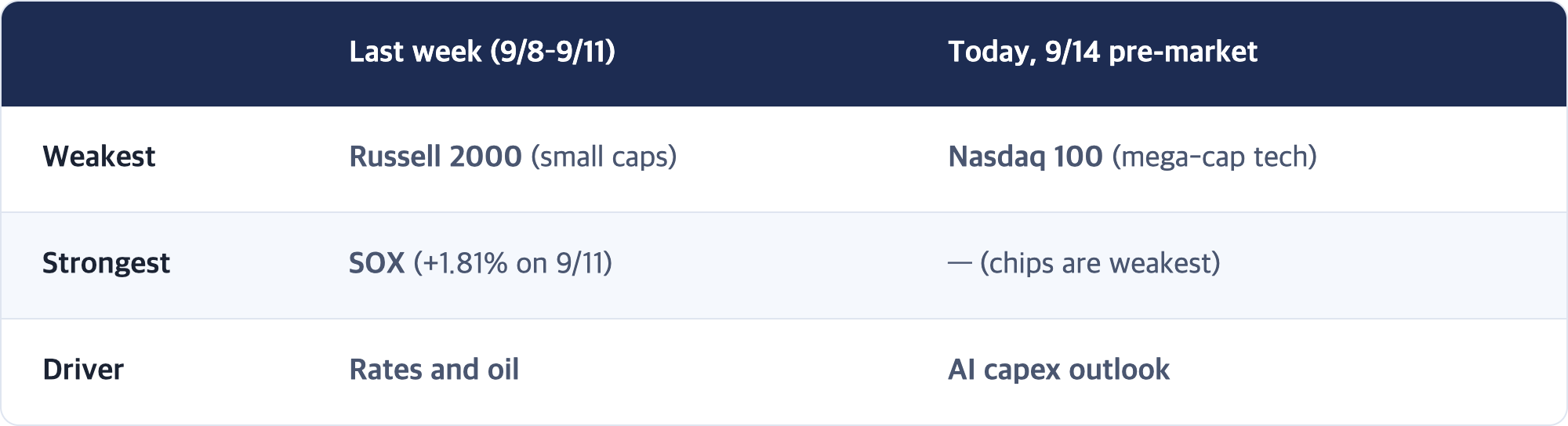
Last week, higher yields hurt indebted small caps first. Today yields barely moved and mega-cap tech is the one falling. Same direction, different cause — and a different cause means a different recovery path.
- What falls on rates comes back when the Fed clarifies. The dot plot answers that in two days.
- What falls on growth expectations cannot be fixed by the Fed. Only earnings and capex guidance settle it.
Today's market is falling in a way the Fed cannot repair. Which means Wednesday's FOMC may not be the only pivot point this week.
🔴 [Interpretation] One line to draw today: SOX 11,724
The Philadelphia Semiconductor Index hit an all-time high of 14,655 on June 22. Friday's close was 11,824.00 — 19.3% below that peak.
A 20% drawdown from the high is the conventional bear-market threshold. That level is 11,724, about 0.85% below Friday's close.
This is not untouched ground: the index fell as much as 29% intraday by late July before recovering. But whether it closes back below the −20% line gets answered today. On pre-market trends, it is within reach.
There is no magic in the number itself. It matters because crossing it starts drawing mechanical flows — index-tracking and risk-parity strategies that respond to drawdown thresholds rather than to opinions.
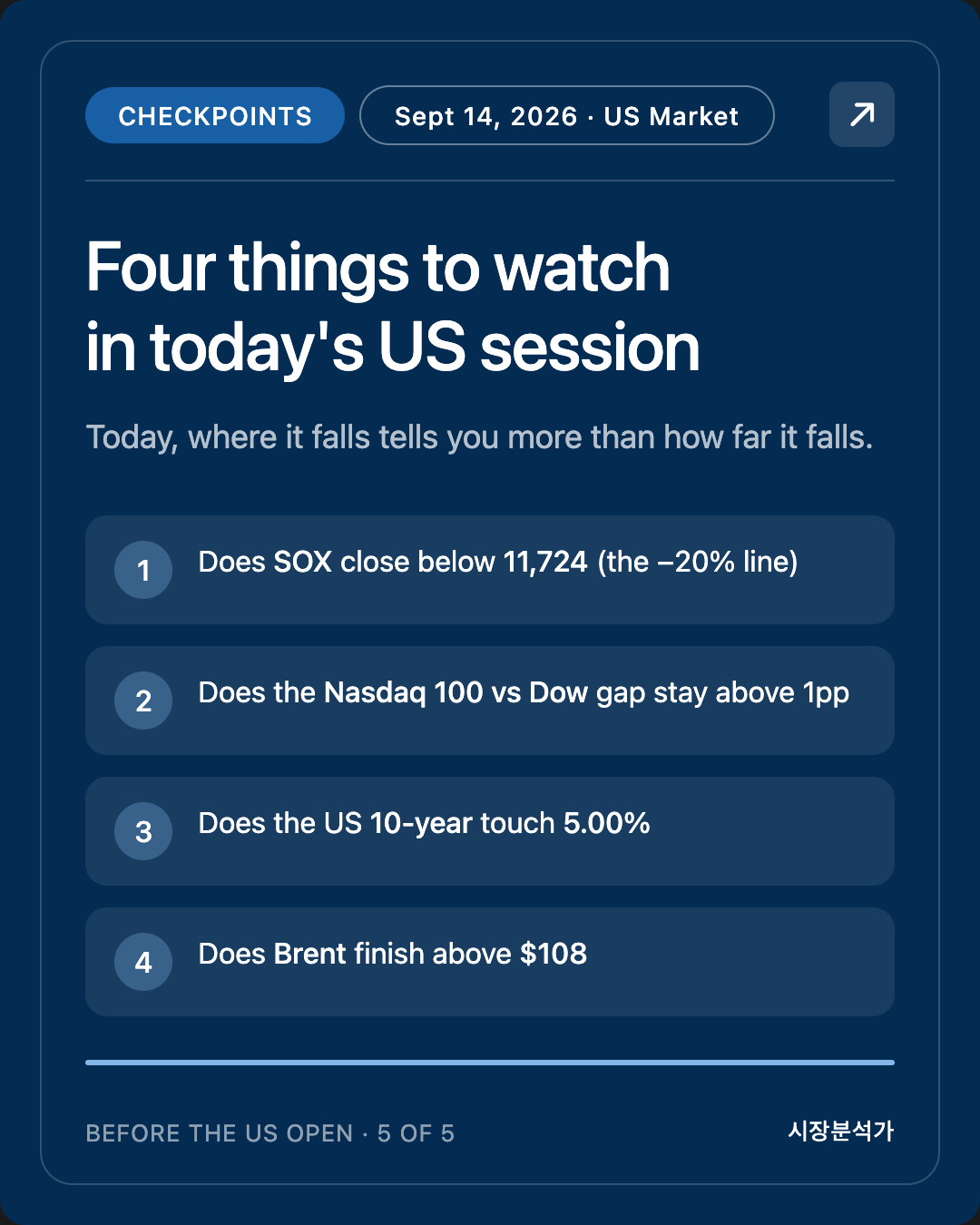
✅ Four checkpoints for today's US session
- Does SOX close below 11,724? — 20% below the June peak; a close-basis re-entry into a bear market
- Does the Nasdaq 100 / Dow gap stay wider than 1 percentage point? — if yes, this is AI repricing; if it narrows, we are back in last week's macro regime
- Does the US 10-year touch 5.00%? — does today's equity decline travel into the bond market? A third straight no leaves this unresolved
- Does Brent finish the US session above $108? — is the postponement a one-day reaction or a level that sticks?
6. Study note: "risk-off" and "repricing" are not the same thing
Coverage of a day like today usually says "risk aversion." But there is more than one kind of down day, and telling them apart makes the next one much faster to read.
The concept
An analogy
Broad risk-off is a fire in the building. Everyone runs outside, whatever floor they were on.
Sector repricing is the discovery that the 8th floor was overpriced. Its tenants pack up and move down to the 3rd floor. Nobody leaves the building. The 8th empties; the 3rd gets crowded.
Today's actual case
- The 8th floor emptying — SK Hynix −6.35%, SoftBank −10.72%, Nasdaq 100 futures −1.56%
- The 3rd floor filling — KB Financial +2.08%, Samsung Biologics +0.35%, Dow futures −0.15%
- Outside the building (gold, Treasuries) quiet — gold −1.85%, 10-year 4.96%, roughly flat
Put those three lines side by side and the character of the day is obvious.
Why the distinction matters
Because they recover differently. Broad risk-off reverses when the cause clears, and the whole market comes back together. Sector repricing may not come back at all — a price was reset, and the 8th floor's new rent can simply stick.
So the question to ask on a day like today is not "when does it bounce." It is "did the AI capex outlook actually bend, or was something merely said?" The answer arrives in the next round of capital-spending guidance.
7. Corrections and open items
🔴 One miss (9/13 report)
Amodei's essay was published Saturday 9/12, and the report written Sunday 9/13 at 16:00 PDT did not cover it. As a result, checkpoints 1 and 2 that report set for today's Korean session were both wrong-footed. The weekend scan did not include AI and technology industry publications; it will from the next run onward.
Source discrepancies (values used are stated)
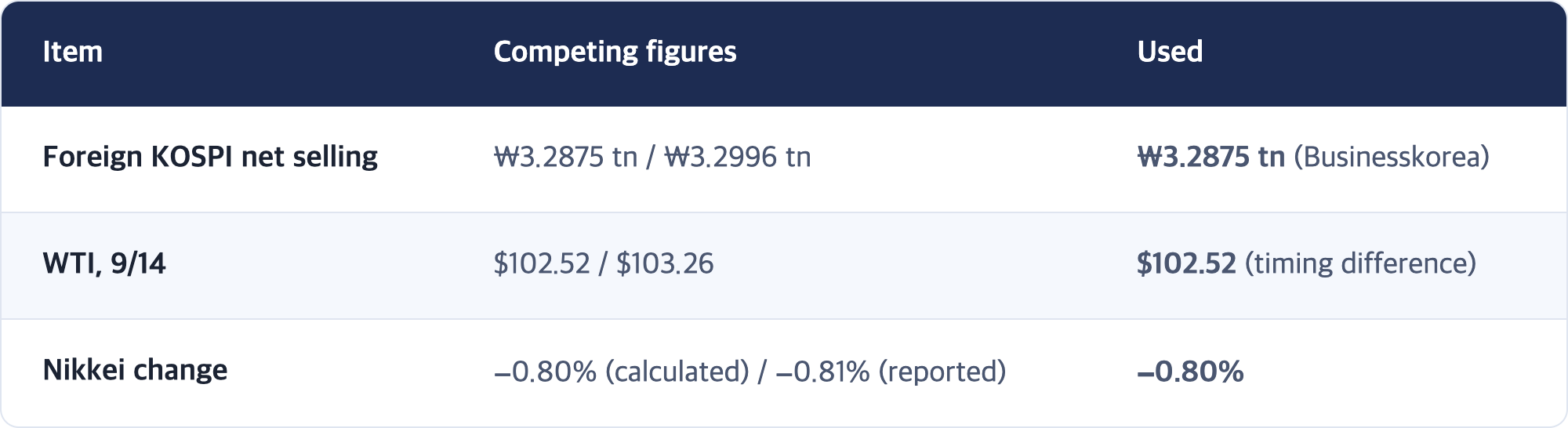
One outlet headlined "₩5.6 trillion of foreign and institutional selling." On the KOSPI, foreign plus institutional selling totals roughly ₩4.46 trillion. The larger figure appears to include KOSDAQ or use a different basis, and was not adopted.
Open items
- SOX pre-market level for 9/14 not obtained — only individual names (Nvidia, AMD, Intel, Marvell) confirmed. To be reconciled against the close in the next report
- Confirmed 9/11 Dollar Index close still not obtained — carried over for a third consecutive report
Sources
- KOSPI closes down 3.26% at 6,684.37 — Businesskorea
- Foreign investors sell ₩3.3tn as KOSPI drops over 3% — Asia Economy
- Samsung −4%, SK Hynix −6%; ₩3.8tn of foreign and institutional selling — Sankyung Today
- AI stocks slide after Anthropic, OpenAI CEOs urge slowdown — CNBC
- AI stocks slide after top industry CEOs call for slowdown — CNN Business
- Nikkei falls as AI slowdown fears hit SoftBank and chip shares — News On Japan
- Chip and memory stocks plunge as Burry debunks the AI pause narrative — NAI 500
- Nasdaq futures slide as AI warnings rattle markets — Yahoo Finance
- Stock Market Today, Sept. 14, 2026 — TheStreet
- Satellite images show damage to Saudi Arabia's East-West pipeline — CNBC
- Saudi Arabia shuts critical oil pipeline after drone attack — Al Jazeera
- Iran-Gulf talks on reopening the Strait of Hormuz postponed — CNN Politics
- Diesel prices hit an all-time high as key Saudi pipeline shut — NBC News
- US Treasury yields steady as 10-year closes in on 5% ahead of the Fed — CNBC
- Gold falls toward $4,300 as US inflation raises Fed hike expectations — Yahoo Finance
- Hang Seng index today, September 14 — Sunday Guardian
- The $3.3 trillion chip sell-off is nearing a bear market — Yahoo Finance
- FOMC September 2026 odds of a rate hike surge — Yahoo Finance
- September FOMC meeting 2026 — ATFX
This report interprets market flows and macro variables. It is not a buy or sell recommendation on any individual security.
📌 More market briefs
※ This post is market observation and organization intended to support your own judgment. It is not a recommendation to buy or sell any security. Figures are as of the time of writing and may differ between sources.
If this was useful, bookmark it or pass it along. It genuinely helps me write the next one.
I can survive. We can survive.