September 22, 2026 US Market Brief — Nasdaq and S&P 500 Before the Open
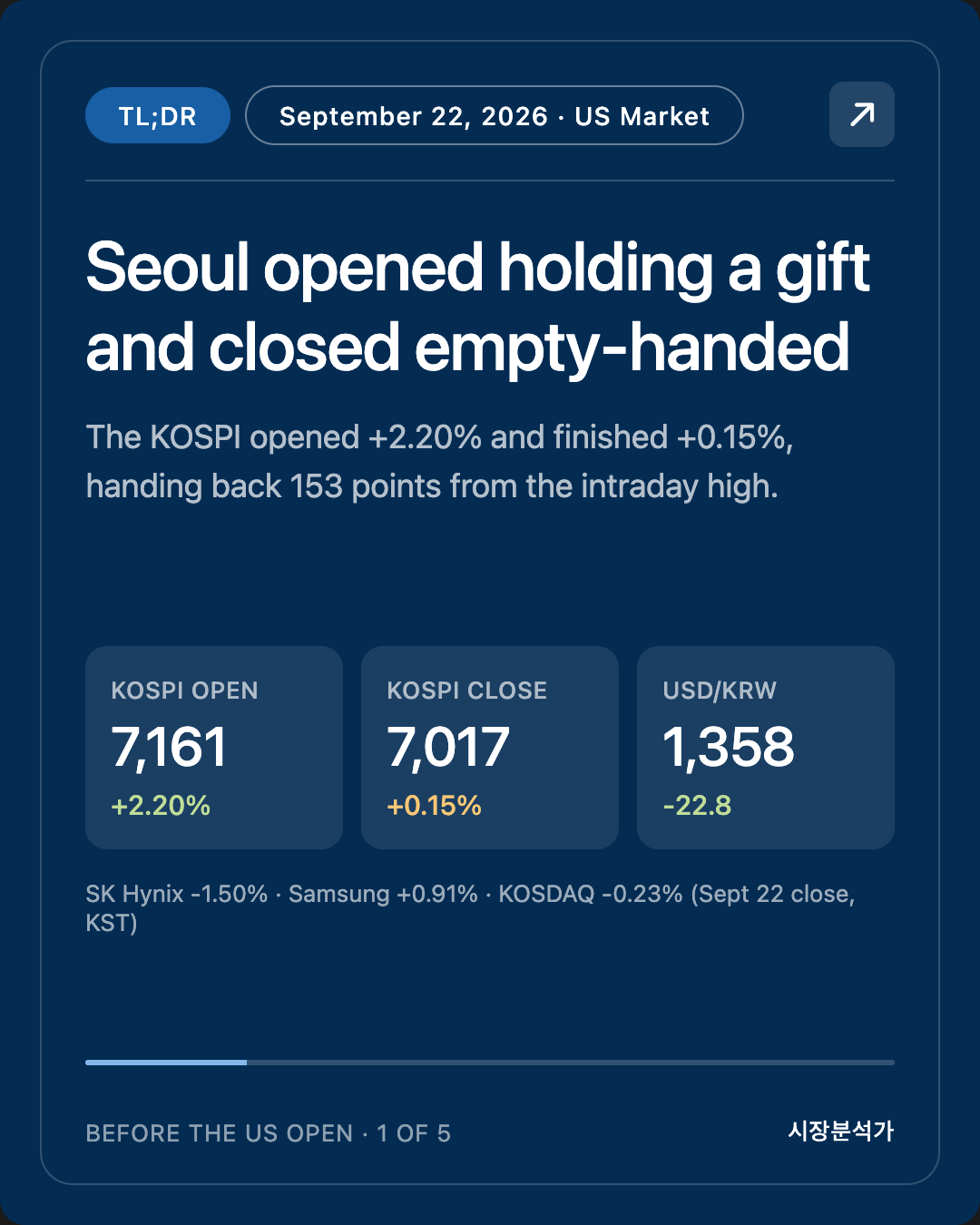
- The KOSPI opened +2.20% and closed +0.15%. Open 7,161.61, high 7,171.44, close 7,017.91 — 153.53 points given back from the high. The KOSDAQ actually fell, to 834.38 (−0.23%).
- ★ Yesterday's first checkpoint missed badly. I had asked whether SK Hynix would outperform Micron's +2.77%. SK Hynix fell 1.50% — a 4.27 percentage point gap. Last night's AI rally never reached memory. The call that this was a CPU story was right, and Korea did not get paid for it.
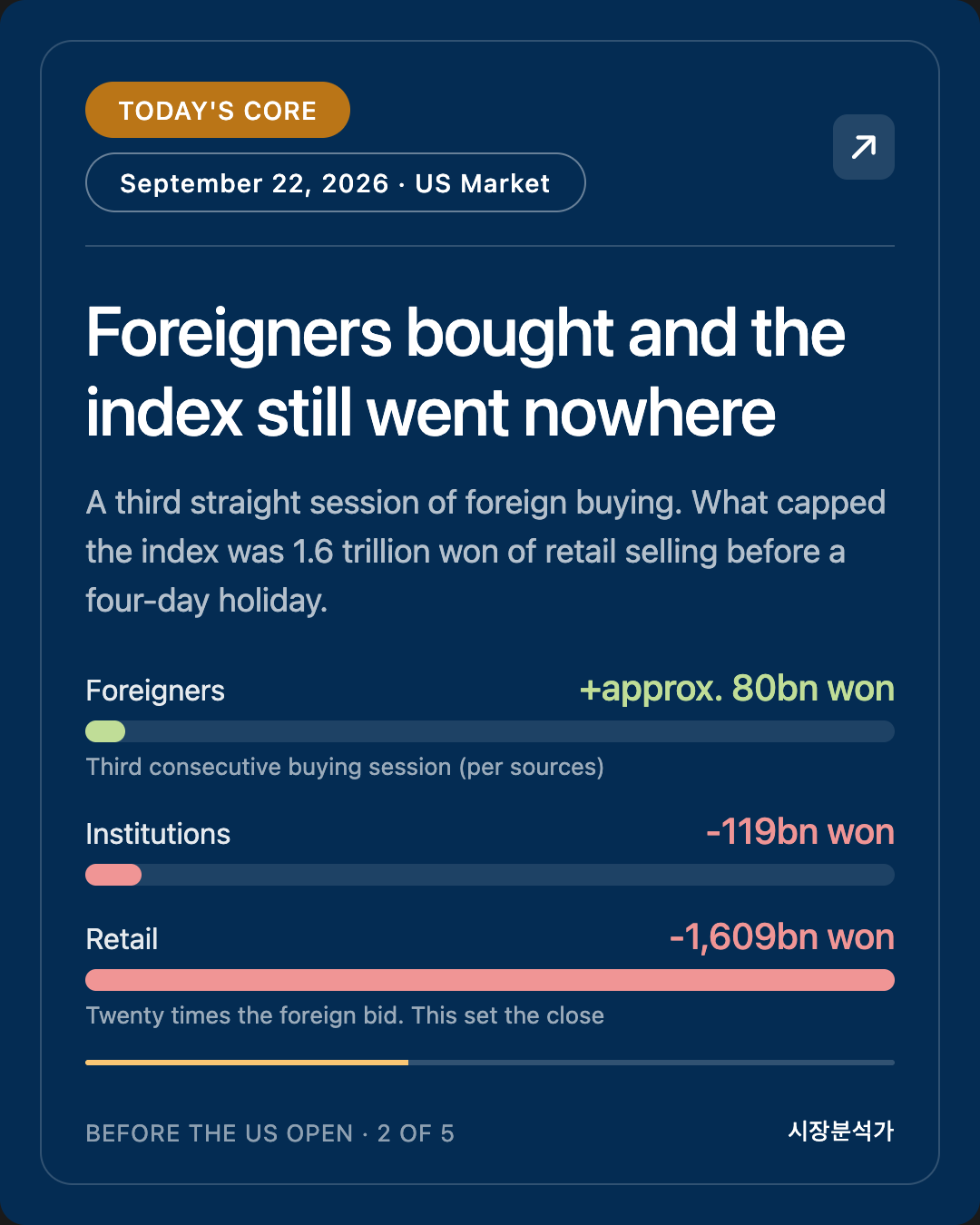
- ★ But foreigners bought. Net purchases of 75.6–85.0 billion won, a third consecutive session. Institutions sold 119 billion won; retail investors sold 1.609 trillion won. What capped the index was not foreign selling but Korean households raising cash before a four-day holiday.
- The won jumped to 1,358.2 per dollar, down 22.8 won (−1.65%) — the largest single-day move since July 8. Two drivers: exporters converting dollars before the Chuseok holiday, and hopes for US–Iran talks.
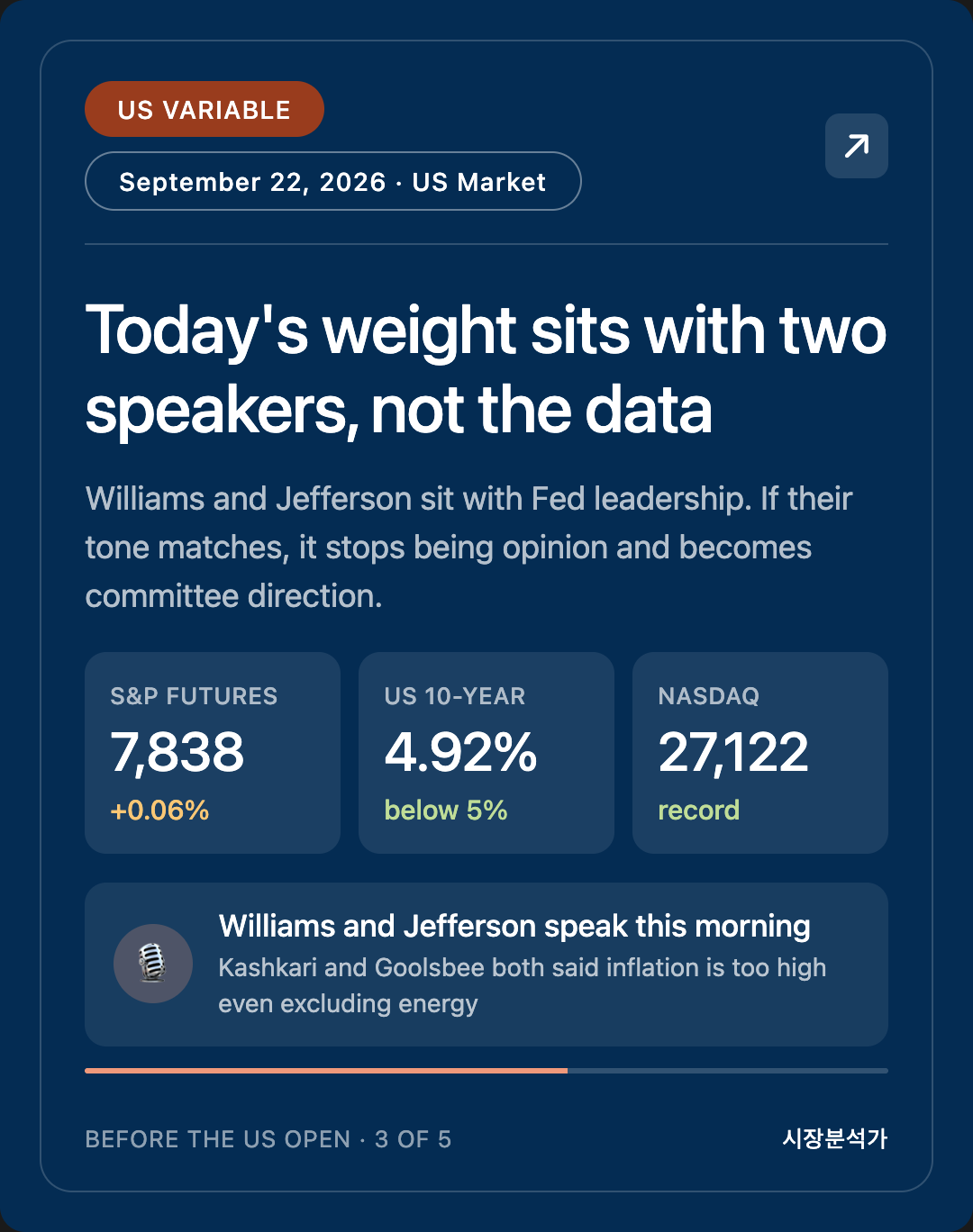
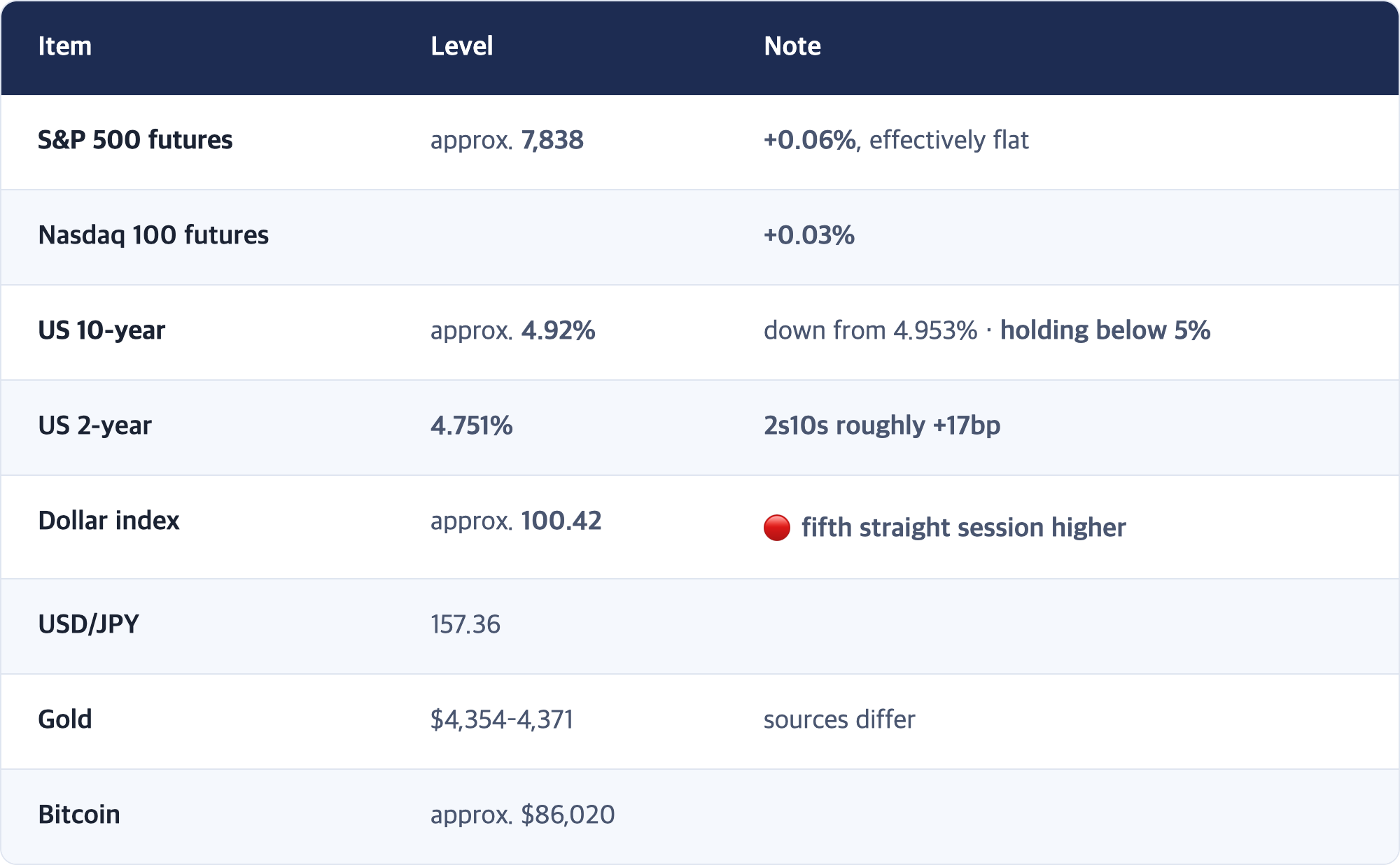
- The US opens quietly. S&P futures near 7,838 (+0.06%), Nasdaq 100 futures +0.03%. The 10-year Treasury is around 4.92%, holding below 5%; the 2-year is 4.751%. Today's real event is Williams and Jefferson.
A note for readers outside Korea: Chuseok is the Korean harvest holiday. Markets in Seoul close Thursday and Friday this week, reopening Monday, September 28. That four-day gap is doing a lot of work in the numbers below.
This is Mr. Can. Here is the September 22, 2026 brief ahead of the US market open.
Written: 2026-09-22 06:05 PDT (Seoul 9/22 22:05 KST)
Covers: Asia close 9/22 · Europe open 9/22 · US pre-market 9/22
🟢 Published on time. Scheduled 05:30 PDT, written 06:05 PDT. Three hours and twenty-five minutes to the US open. Third consecutive on-time edition.
SEO Intro
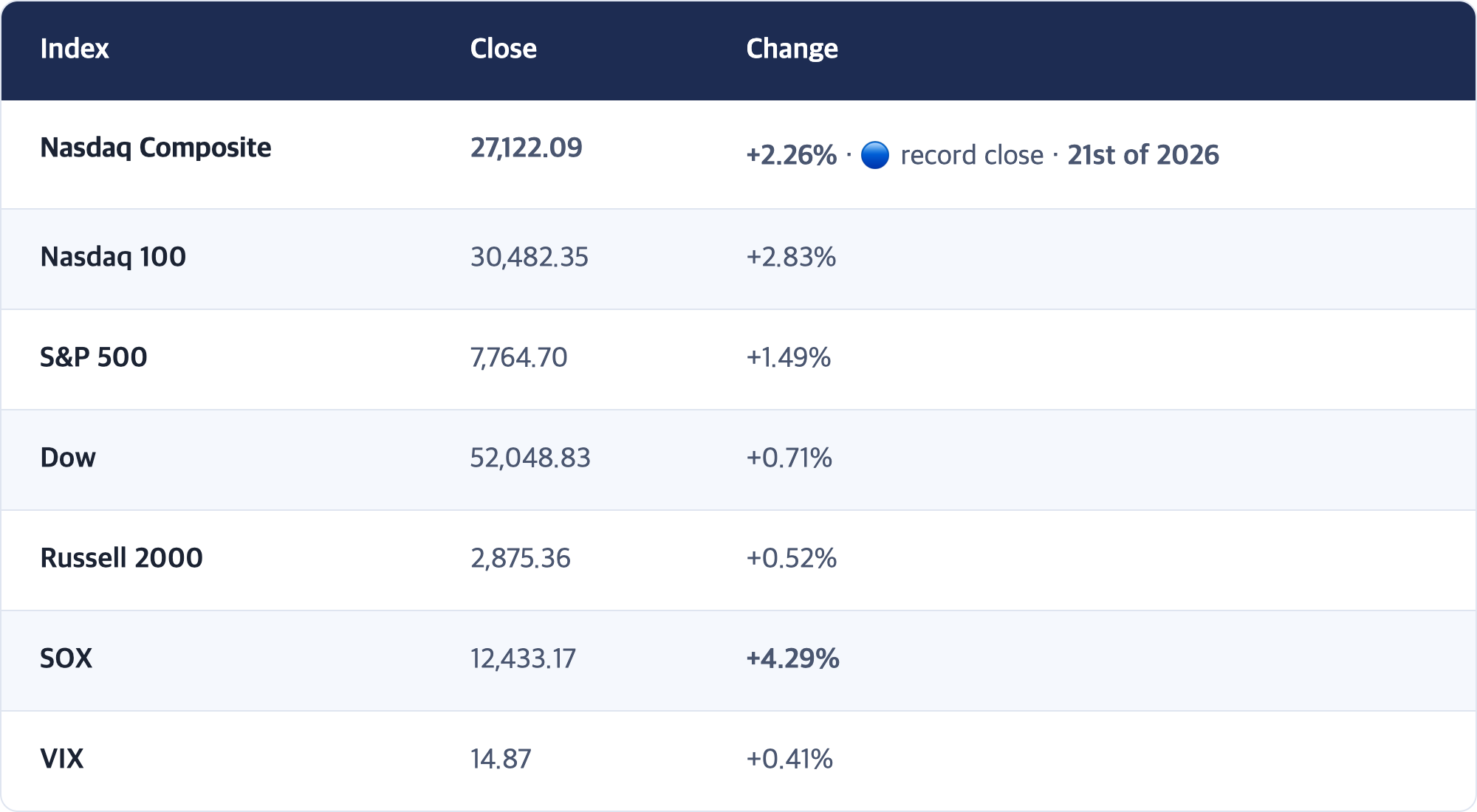
Last night in New York was good. The Nasdaq Composite closed at a record high, and the Philadelphia Semiconductor Index rose 4.29%.
Seoul took that handoff and opened 2.20% higher at 7,161.61. It reached 7,171.44 intraday.
It closed at 7,017.91, up exactly 0.15%.
The whole 153-point gain from the high went back. Korea opened holding a gift and closed empty-handed.
Look inside the session and it gets stranger. Foreigners were buyers today — a third straight session. The selling came from retail investors, and the size was 1.61 trillion won (about $1.2 billion).
A day when foreigners buy and the index does not move. That was today.
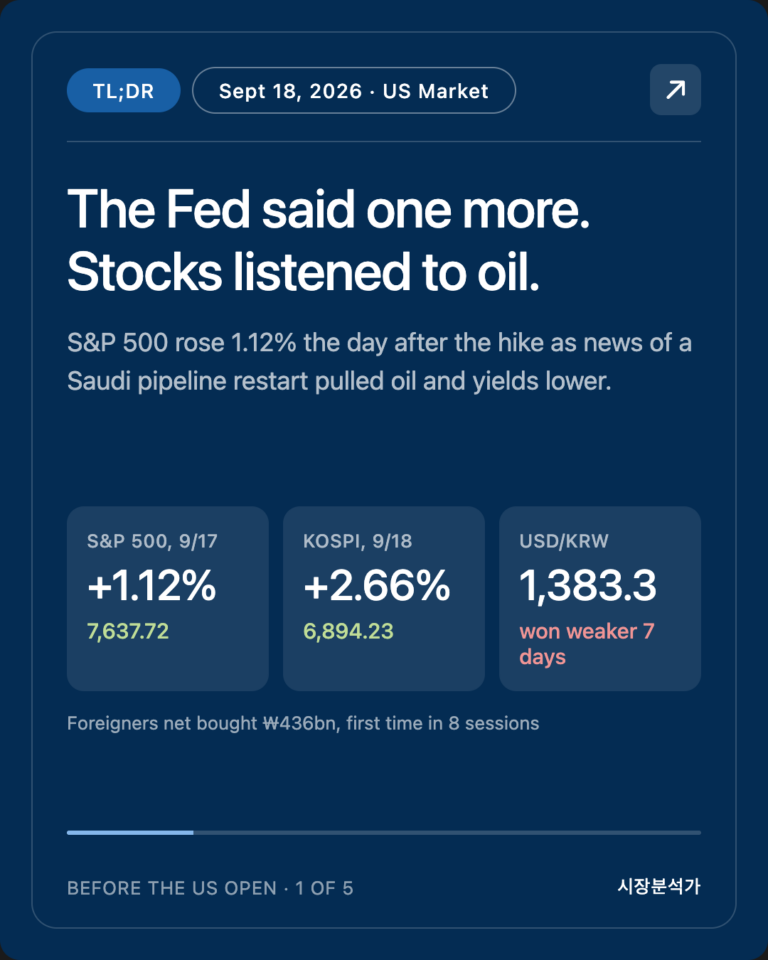
And on the same day the won strengthened by 22.8 won, its biggest one-day gain since July 8.
Three things to unpack below.
1. Scoring Yesterday's Checkpoints
Yesterday evening's question was whether last night's AI rally would spread into memory chips, or whether Seoul would simply copy New York's internal ranking. Korea has closed, so here is the scorecard.
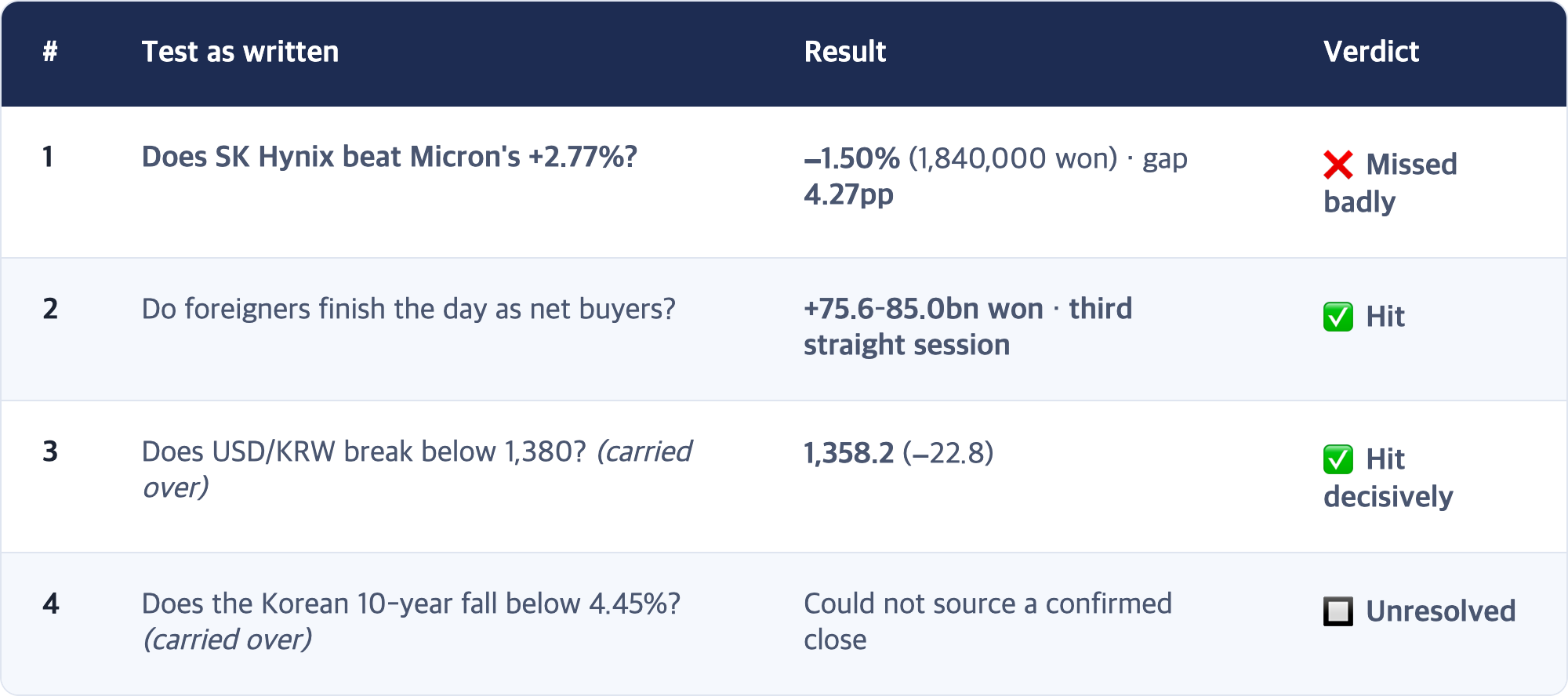
[Interpretation] Right about the direction, wrong about who did the selling
Yesterday I wrote two things. One held up; one did not.
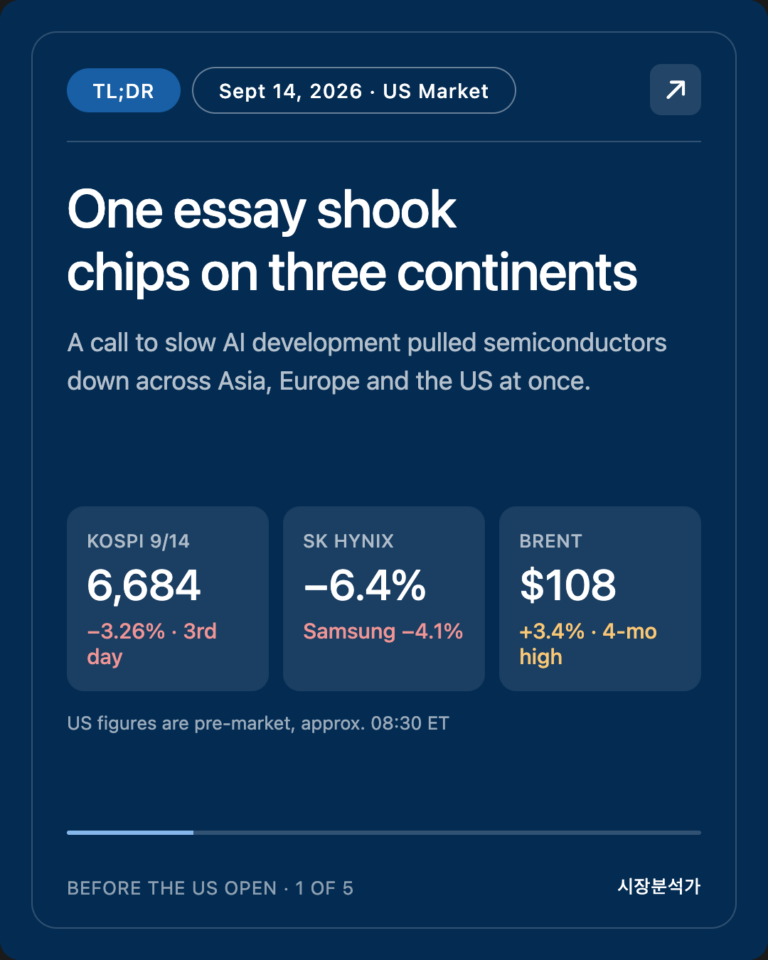
What held up. I argued that a 4.29% move in the SOX should not be read as a 4% move coming for Korean chipmakers, because the names that rallied were CPU names and Korea sits in memory. Today SK Hynix did not just underperform — it fell 1.50%, trailing Micron by 4.27 points. The thesis that the story would not travel to memory was correct.
What did not. I expected foreigners to trim ahead of the holiday, and wrote that another late-session flip to selling would mean they did not trust the four-day gap. Foreigners bought, for a third straight session. The selling came from retail investors, to the tune of 1.609 trillion won.
[Interpretation] The "holiday avoidance" I described was real. I simply attached it to the wrong participant. Foreigners decided to hold through the gap; households decided to sit in cash. Two groups looked at the same calendar and reached opposite conclusions.
2. Today's Core: Foreigners Bought and the Index Still Went Nowhere
[Fact] Korea's close (9/22 KST)
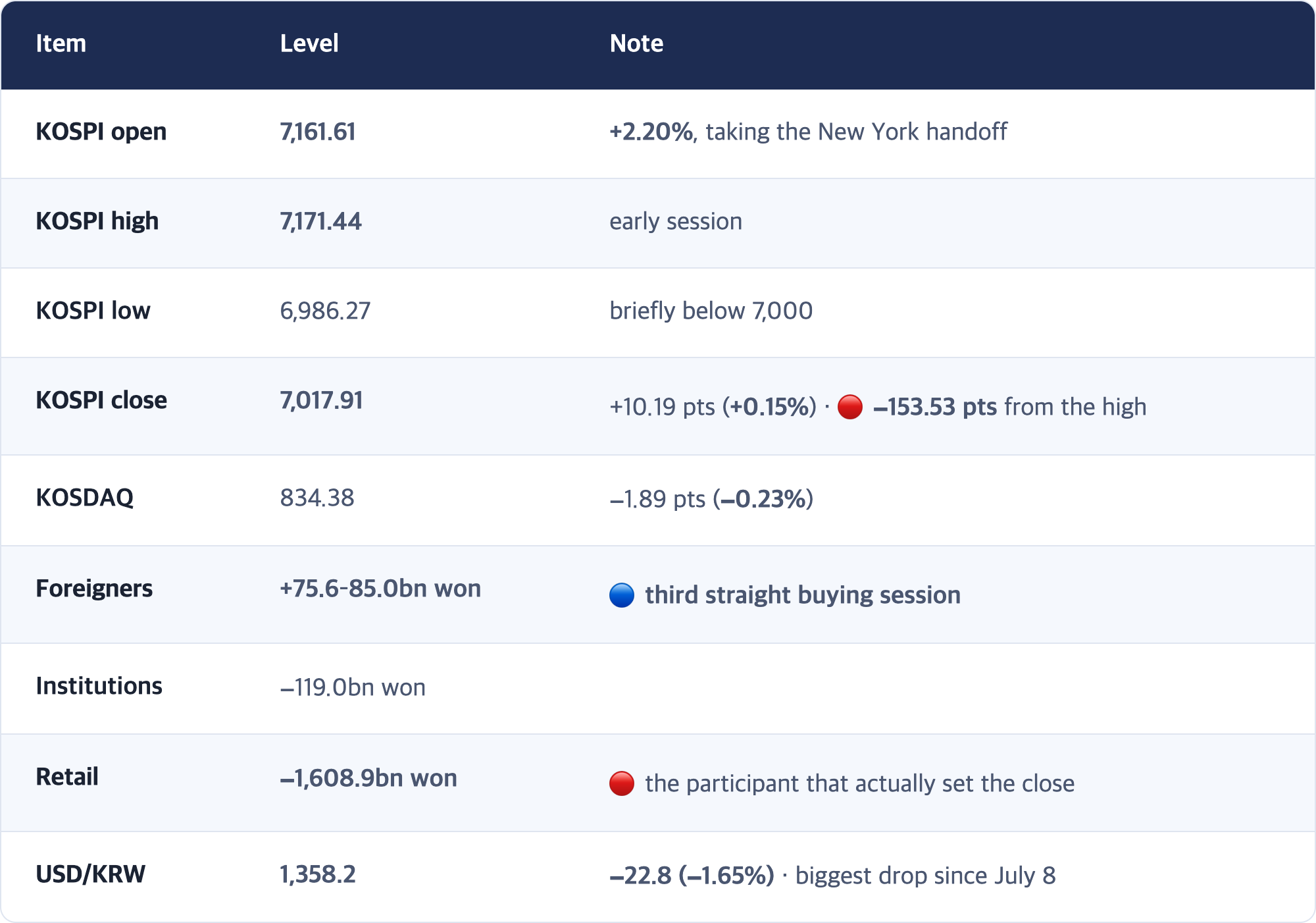
Key stocks: Samsung Electronics 276,500 won (+0.91%) · SK Hynix 1,840,000 won (−1.50%)
🔴 [Fact] Korea's two memory names moved apart for a second day
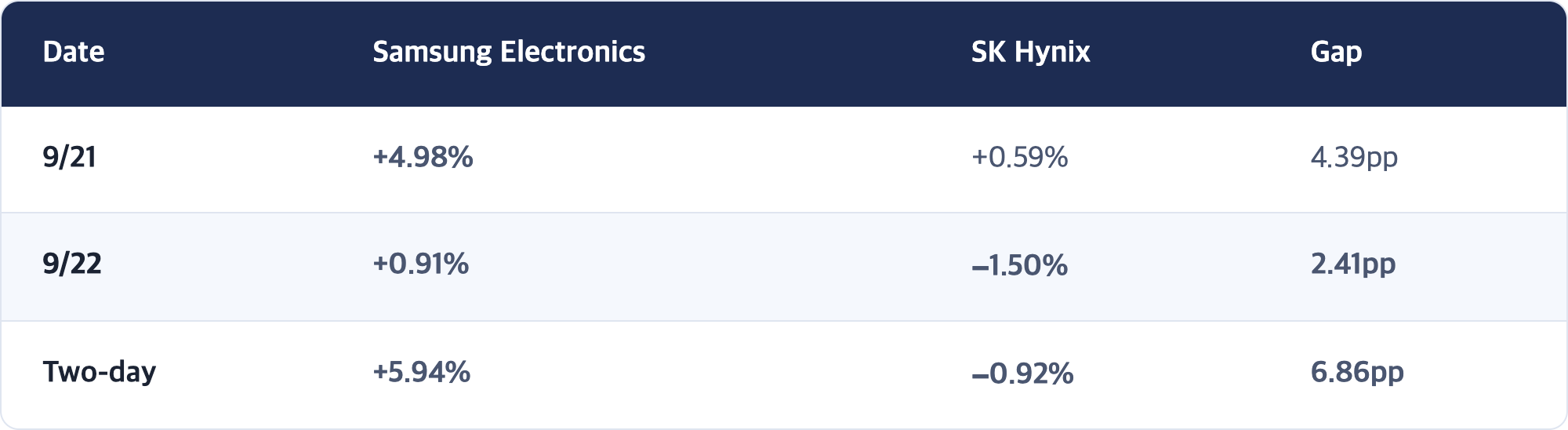
Two sessions have opened a 6.86-point gap between two companies in the same country, the same industry, and the same product category.
Part of the answer is that Samsung is not purely a memory company. It also runs a foundry business, making chips to other companies' designs. If agentic AI lifts server CPU demand, Samsung has a second path to that money. SK Hynix does not.
✅ [Interpretation] The accurate sentence for today
Reading today as "the KOSPI held its ground" captures half of it. The precise version is:
Foreigners bought for a third straight day while retail investors sold 1.6 trillion won, dragging a session that opened +2.20% down to +0.15%.
Why that framing matters, in three parts.
First, foreign buying means they chose to carry risk through the gap. The Trump–Xi summit falls on Thursday, when Seoul is closed. Buying into that anyway leans toward treating the summit as an opportunity rather than a hazard — precisely the condition I set yesterday.
Second, retail selling looks like a calendar decision, not a market call. Declining to leave money in a market you cannot exit for four days is different from thinking the market is going down. Holiday cash needs overlap as well. That makes this a kind of selling that tends to disappear once the holiday ends.
Third, today was still not a good session. The KOSDAQ fell, and what held the index up was largely one stock, Samsung, at +0.91%. Breadth was thin.
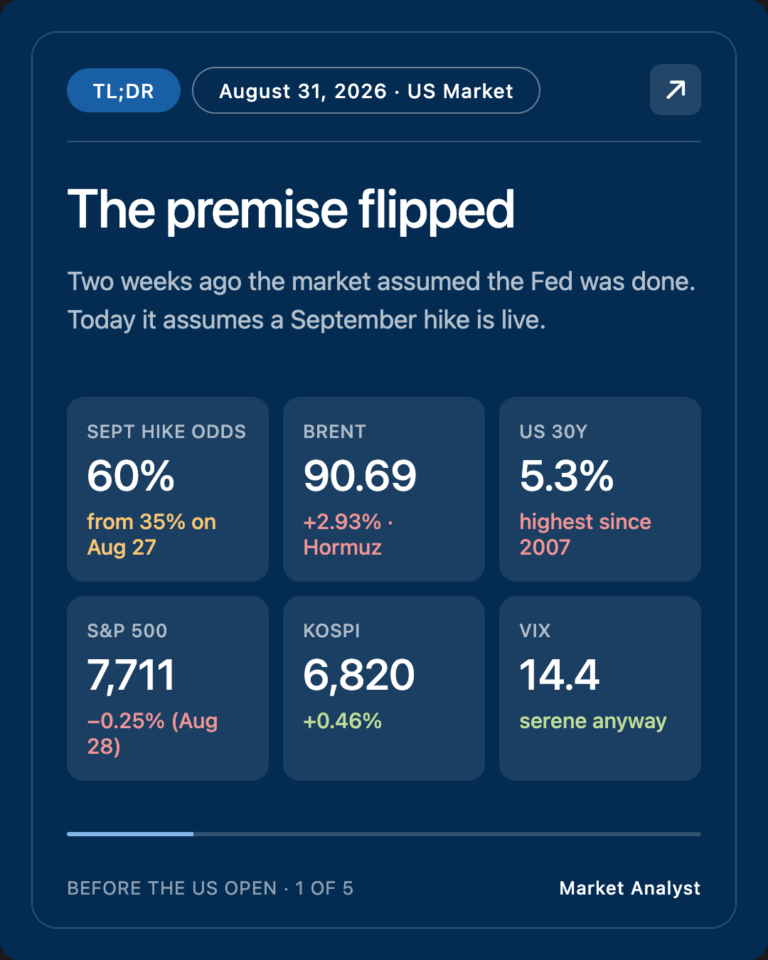
[Interpretation] ⭐ A principle already written into this project applies again: look at who bought before you read the index. On August 31, corporate buybacks alone lifted an index while every other participant sold. Today, one participant alone pinned an index down. When the index number and the flow data tell different stories, the flow data usually lasts longer.
3. The US Variable: A Quiet Pre-Market, and Two People Speaking
[Fact] Last night's New York close (9/21 ET)
[Fact] Pre-market and rates (early 9/22 PDT)
🔴 [Fact] Today's US calendar (ET)
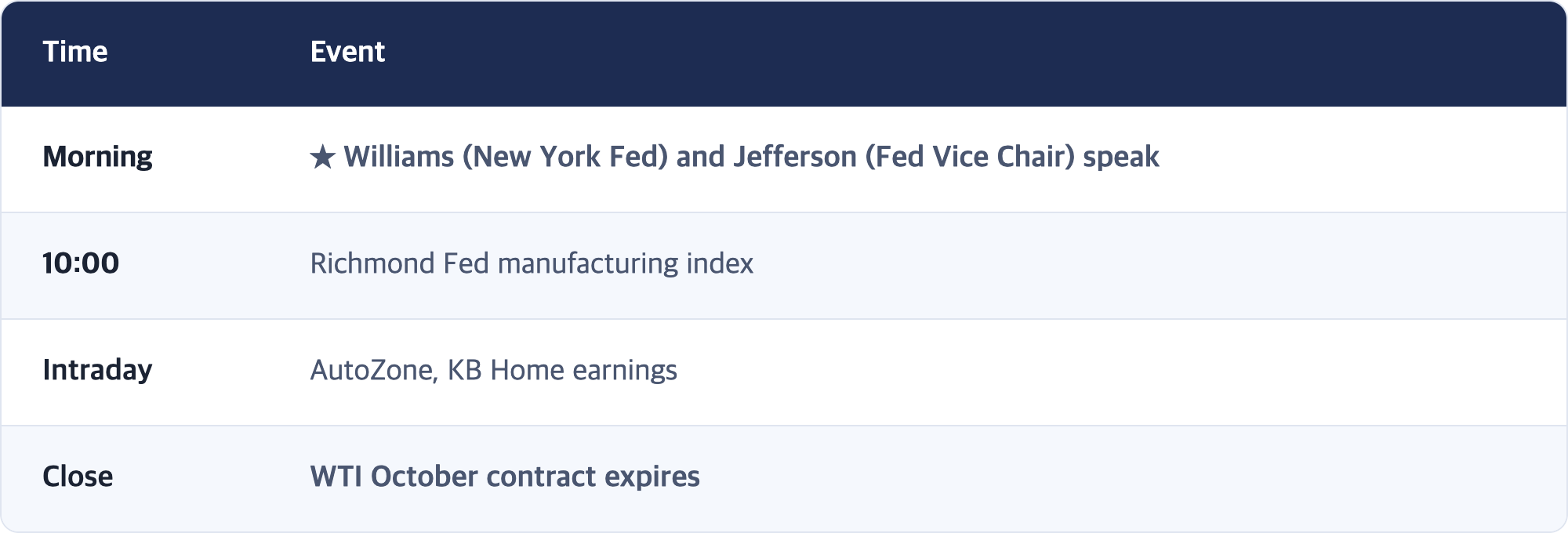
✅ [Interpretation] Today's weight sits with two speakers
Yesterday I described a market and a central bank reading the same facts in opposite directions. Markets saw oil falling, concluded inflation pressure was easing, and bought growth stocks. Two Fed officials, Kashkari and Goolsbee, answered that inflation is still too high even excluding energy and food.
Today is the first place those two views meet.
Kashkari and Goolsbee are regional presidents, classified as hawkish and centrist respectively. The two speaking today are different.
- Williams is president of the New York Fed and the only regional president with a permanent FOMC vote. He also serves as Vice Chair of the Committee.
- Jefferson is Vice Chair of the Federal Reserve Board.
[Interpretation] Their tone reads closer to leadership positioning than individual opinion. If both lean the way Kashkari and Goolsbee did, the last two days stop being scattered commentary and start being the committee's direction. If instead they acknowledge falling oil, it would be the first time the Fed validates what the market bought yesterday.
The dot plot currently shows a 4.1% median for both 2026 and 2027, implying at least one more hike. Falling oil does not relieve that pressure until that number moves.
[Observation] Flat futures are themselves information
The Nasdaq set a record last night and futures are at +0.06% this morning. The market is neither extending nor reversing it. The VIX has been flat at 14.87 for two sessions.
[Interpretation] That looks like a market waiting for this morning's Fed remarks, with the Trump–Xi summit two days out. This is a week where price waits for events rather than leading them.
4. Macro Backdrop: Oil, the Won, and Hormuz
🔴 [Fact] Oil quotes disagree right now, because the contract is rolling
Yesterday I flagged that the WTI October contract expires on 9/22, that coverage would shift to November, and that any "oil plunges" headline should be checked for contract month first. That happened this morning.
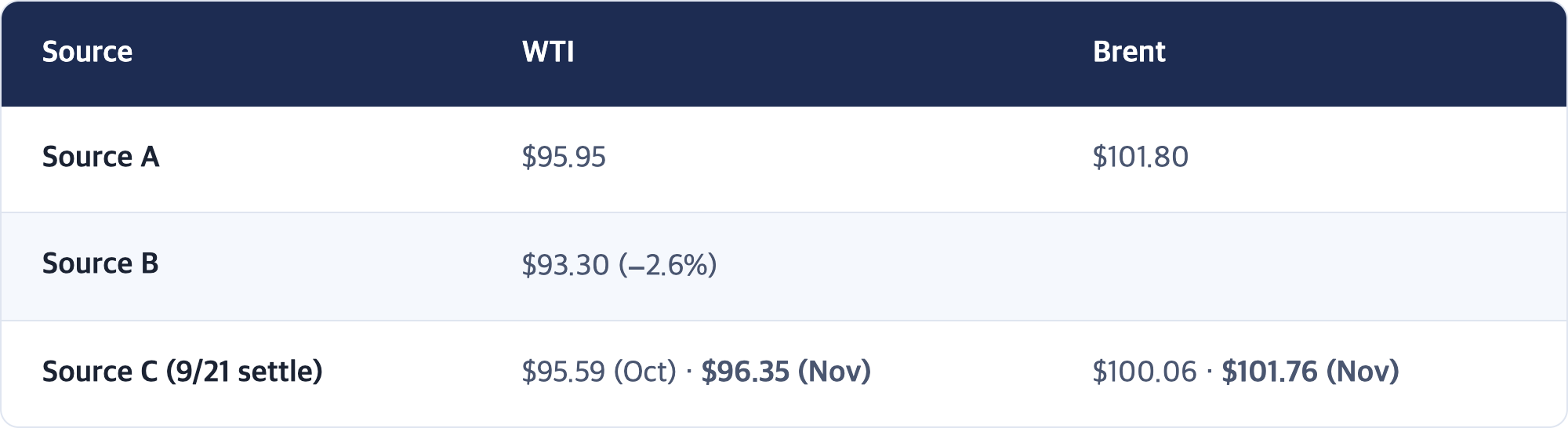
Three sources spread across $2.65. My own October settle yesterday was $97.56.
[Interpretation] I am not publishing a single WTI print today. Direction only: four to five sessions of clear decline, with the slide pausing and turning slightly higher during European hours. Front-month sits in the mid-$90s. ⚠️ After today's close the October contract is gone, so every WTI quote from tomorrow is November. A headline saying oil rose may simply mean the benchmark changed.
🔴 [Fact] Hormuz is what moved oil
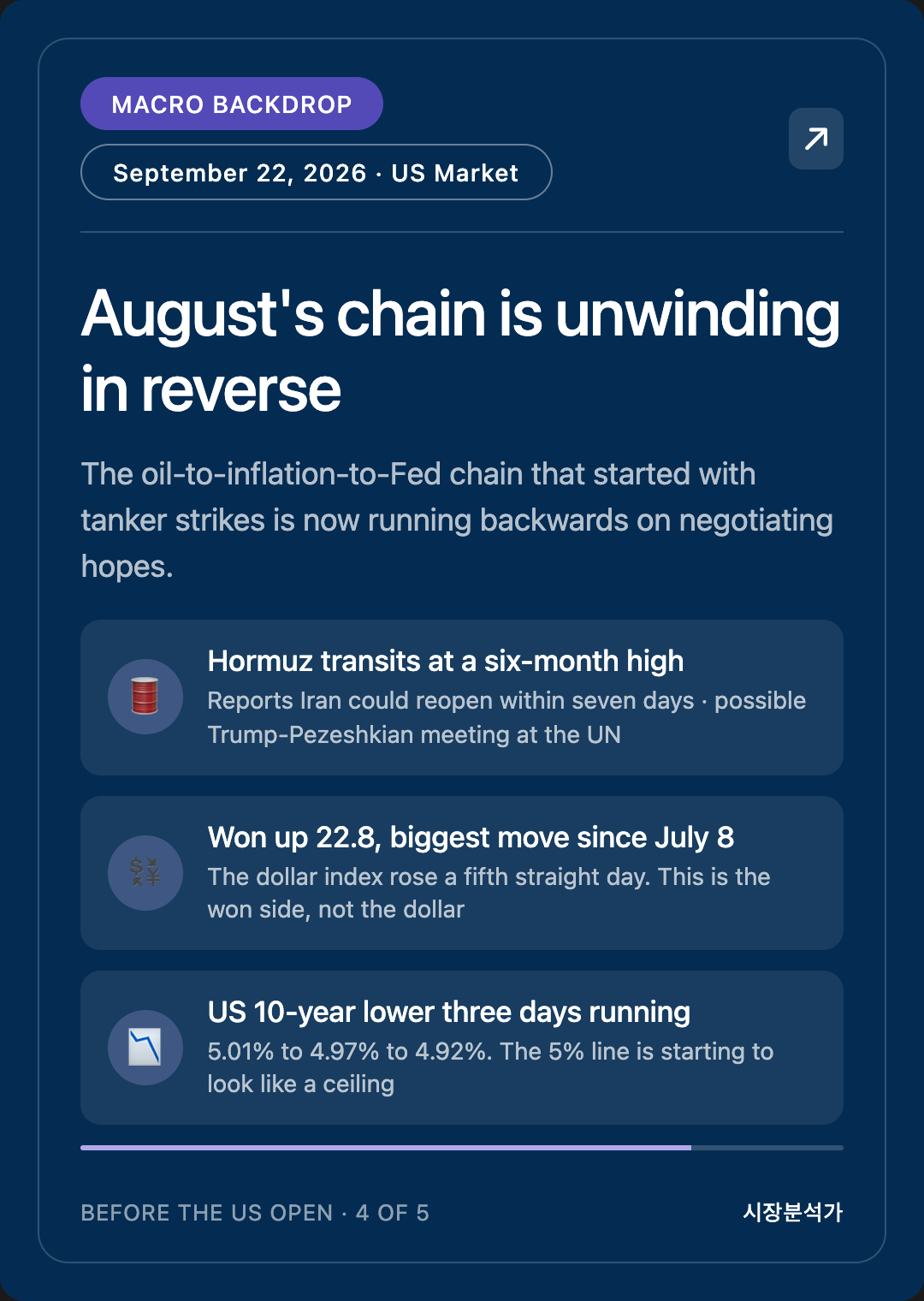
- US Central Command's commander said crude and LNG transits through the Strait of Hormuz over the past two weeks hit a six-month high.
- Reports indicated Iran could reopen Hormuz within seven days, alongside a shift in tone from the Revolutionary Guard.
- President Trump signaled he would probably be open to meeting Iranian President Pezeshkian at this week's UN General Assembly.
- Trump was also reported to have declined a Saudi request to strike the Houthis.
[Interpretation] In late August this report was tracking a chain that ran tanker strikes in Hormuz → higher oil → higher inflation expectations → pressure on the Fed to hike. That chain is now unwinding in reverse. The important caveat is what is unwinding it: negotiating expectations. Expectations, unlike physical supply, can reverse in a single headline.
[Fact] The won moved a long way
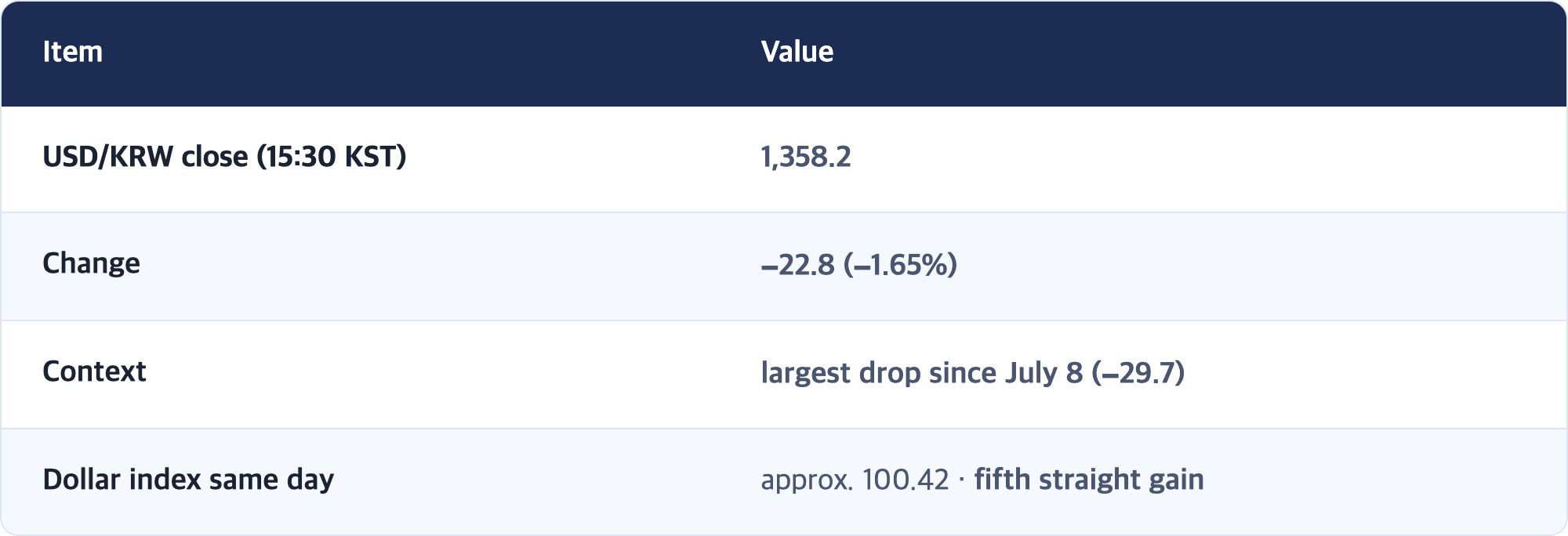
Two reasons were reported: exporters selling dollars ahead of the Chuseok holiday, and renewed risk appetite on US–Iran talks.
✅ [Interpretation] The dollar rose and the won strengthened anyway
The dollar index has now risen five sessions in a row, and the won still gained 1.65% on the same day. That is not dollar weakness. Something happened on the won side.
[Interpretation] If the driver is mostly flow — exporters converting before a holiday — it can reverse once the holiday passes. If instead it reflects cheaper oil feeding through to Korea's trade balance, it lasts longer. Korea imports all of its crude, so falling oil helps both the trade balance and inflation. Which one it was becomes visible when Seoul reopens on September 28.
[Fact] Asia and Europe
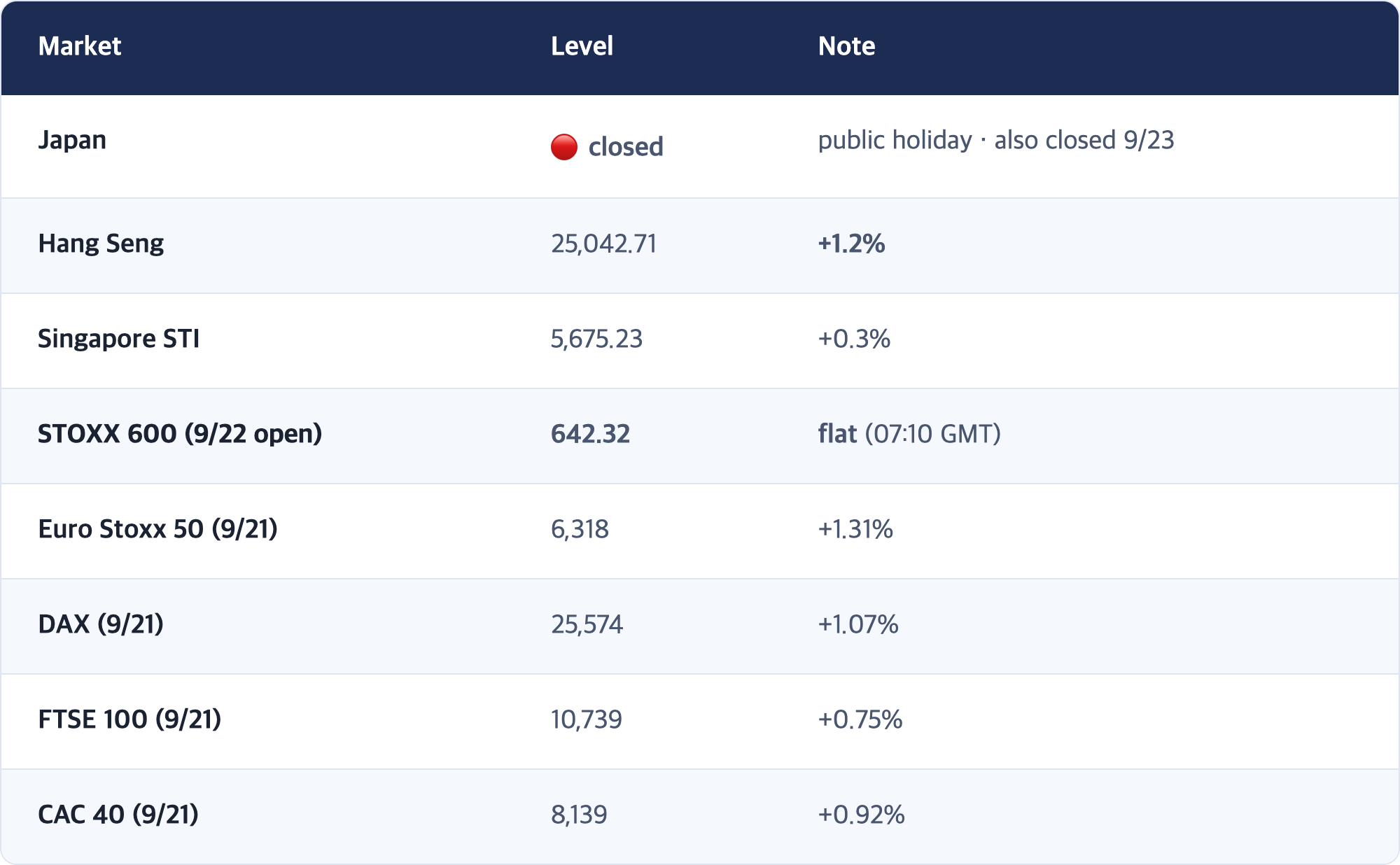
[Observation] Korea converted last night's New York session worse than anywhere else in Asia. Hong Kong kept +1.2%; Seoul opened +2.20% and closed +0.15%. With Japan shut for a second day, Asian price discovery is concentrated in Seoul and Hong Kong this week.
5. US Session Preview (9/22 ET)
[Observation] How it sets up
- Futures are flat. Yesterday's record is neither extended nor unwound.
- Yields are drifting lower. 5.01% (9/18) → 4.97% (9/21) → 4.92% this morning. A third day down, and the 5% line is starting to look like a ceiling rather than a floor.
- Today's catalyst is people, not data. Richmond Fed manufacturing is second-tier. The weight is on Williams and Jefferson.
- The week's real events are tomorrow and Thursday: flash PMIs on 9/23, the Trump–Xi summit on 9/24.
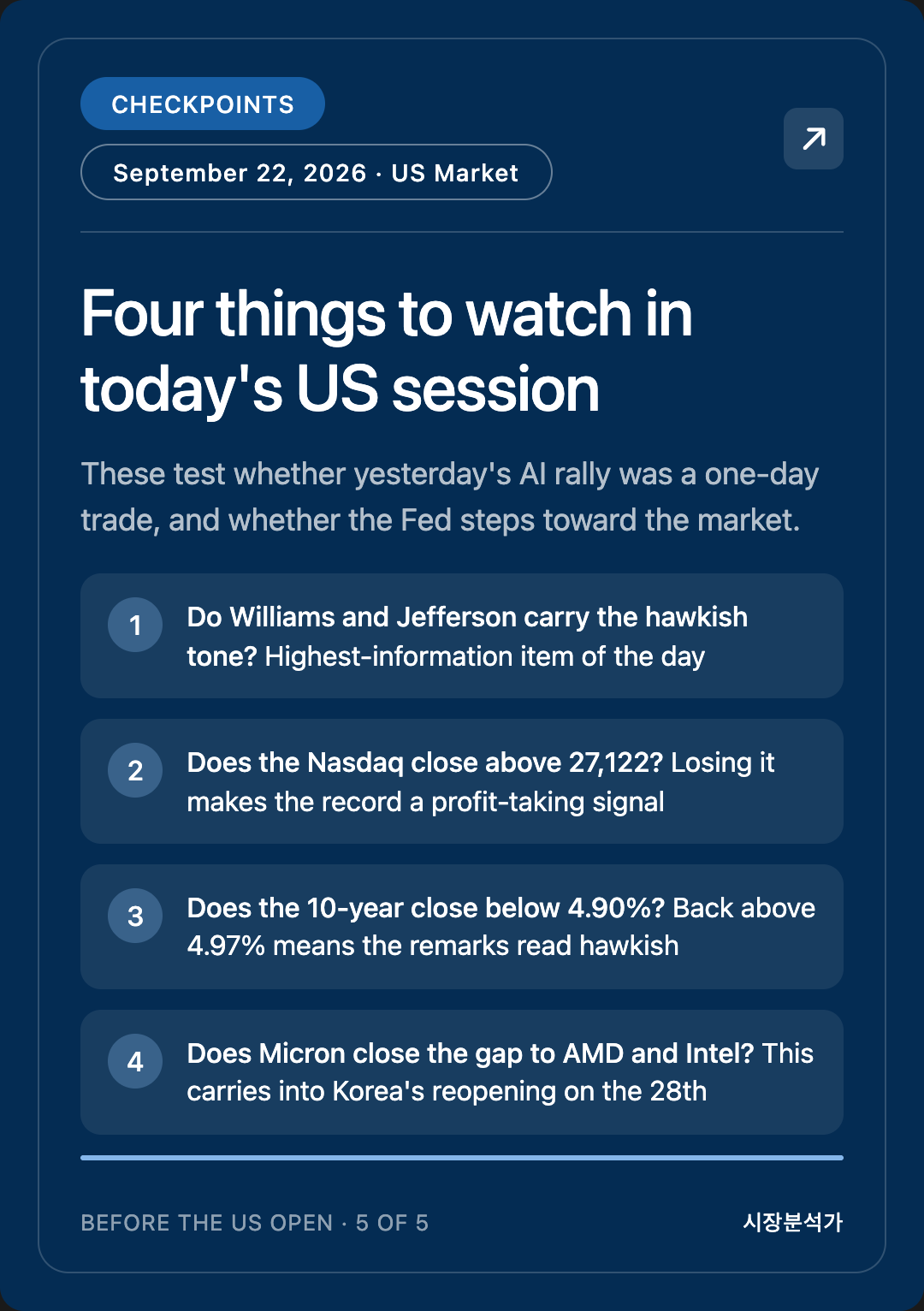
✅ Four Checkpoints (US open to close)
These four test whether yesterday's AI rally was a one-day event, and whether the Fed moves a step toward the market.
- Do Williams and Jefferson match the Kashkari–Goolsbee tone? If yes, the last two days were the committee's direction, not scattered opinion. If no, the Fed is validating what the market bought yesterday for the first time. The highest-information item of the day.
- Does the Nasdaq hold 27,122.09 on a closing basis? Holding it means the agentic-AI and CPU story was not a one-day trade. Losing it means the record was a profit-taking signal — the same reversal Seoul just showed.
- Does the US 10-year close below 4.90%? Below, and the break under 5% is three days old and firming. Back above 4.97%, and this morning's Fed remarks were read as hawkish.
- Does Micron close the gap to AMD and Intel? CPUs gained 10–17% yesterday against memory's +2.77%, and SK Hynix confirmed the split at −1.50% today. If Micron outperforms the index, the story is spreading to memory. If it lags again, this divergence has legs — and it carries straight into Korea's reopening on the 28th.
6. Study Note: Why Didn't the Index Rise if Foreigners Were Buying?
If you watched the tape today, this is the first question.
Concept: net flows and the index measure different things
Net buying measures who bought more than they sold. The index measures where prices finished. Related, but not the same.
Today's numbers side by side:
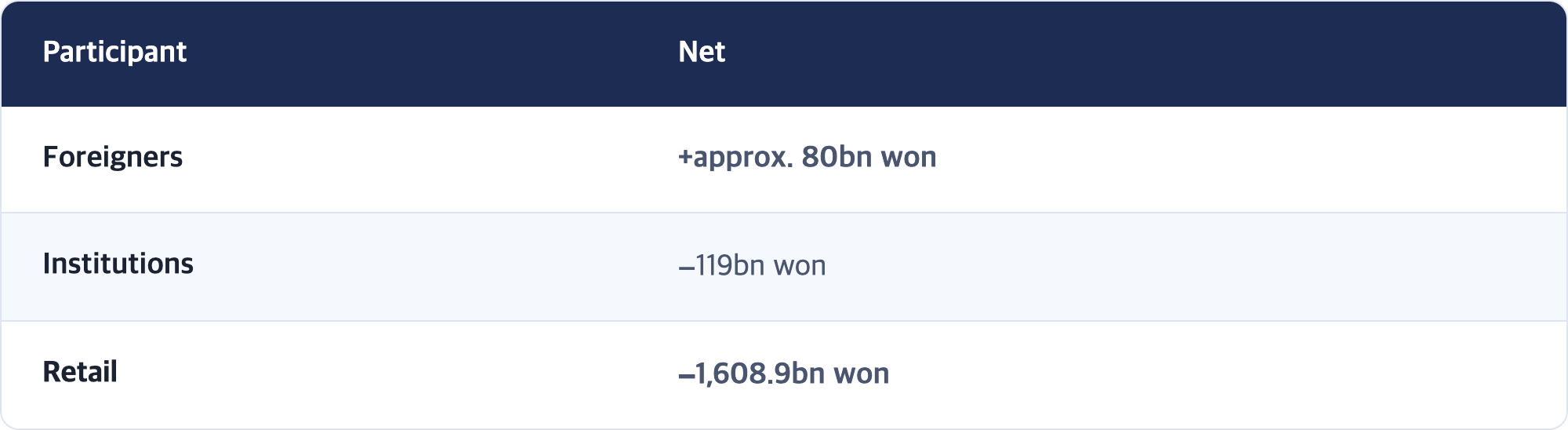
The 80 billion won foreigners bought is roughly one-twentieth of what retail sold.
Analogy: one tap and one drain
Picture filling a bathtub.
- The foreign tap is running. Thinly.
- The retail drain is open. Much wider.
If there is any water at all in the tub at the end — today's +0.15% — that is not because the tap was strong. It is because New York filled the tub overnight before anyone got there. That is what a +2.20% open means.
So should we ignore net flows?
No. The opposite.
- The index (+0.15%) is today's outcome, heavily contaminated by a one-off: holiday cash-raising.
- Three straight sessions of foreign buying is a judgment about direction — a decision to carry risk across a four-day closure.
One-off factors disappear. Directional judgments persist. On days like this, the flow data carries more information than the print.
A real case: August 31 was the same thing in reverse
On August 31 the KOSPI traded down 3.55% intraday and closed up 0.46%. All three major participant groups — retail, institutions, and foreigners — sold, and the index still rose, because 1.54 trillion won of corporate buybacks from Samsung and SK Hynix absorbed everything.
The lesson recorded in this project reads:
Equating the index with sentiment leads to misreading. On days when one participant makes the index, its direction can be the opposite of participants' conviction.
Today is that sentence's mirror image. On August 31 everyone sold and the index rose. Today foreigners bought and the index didn't. Reading either day off the index alone gets you the wrong answer.
One-line summary
The index tells you "how much today." Flows tell you "who, and why." When one participant's one-off selling makes the print, the information is in the flows, not the print.
7. Corrections and Open Items
🔴 Yesterday's checkpoint 1 failed (interpretation revised)
I set "does SK Hynix outperform Micron's +2.77%" as the single most useful lens for today's Korean session. The answer was −1.50%, trailing Micron by 4.27 points.
The nature of the miss matters. The judgment was not wrong; the test was too loose. I was trying to measure whether the story spread to memory, and the actual result was not merely "no spread" but the opposite direction. → Going forward I will frame divergence tests as "is the gap widening or narrowing" rather than "does A beat B." That captures direction as well as magnitude.
🔴 Yesterday's foreign-flow expectation was wrong
I leaned toward foreigners trimming ahead of the holiday. The result was a third straight session of net buying, with the holiday-avoidance selling coming from retail. → I will stop treating "holiday avoidance" as a single market-wide sentiment and separate it by participant. Foreigners and households can reach opposite conclusions about the same calendar.
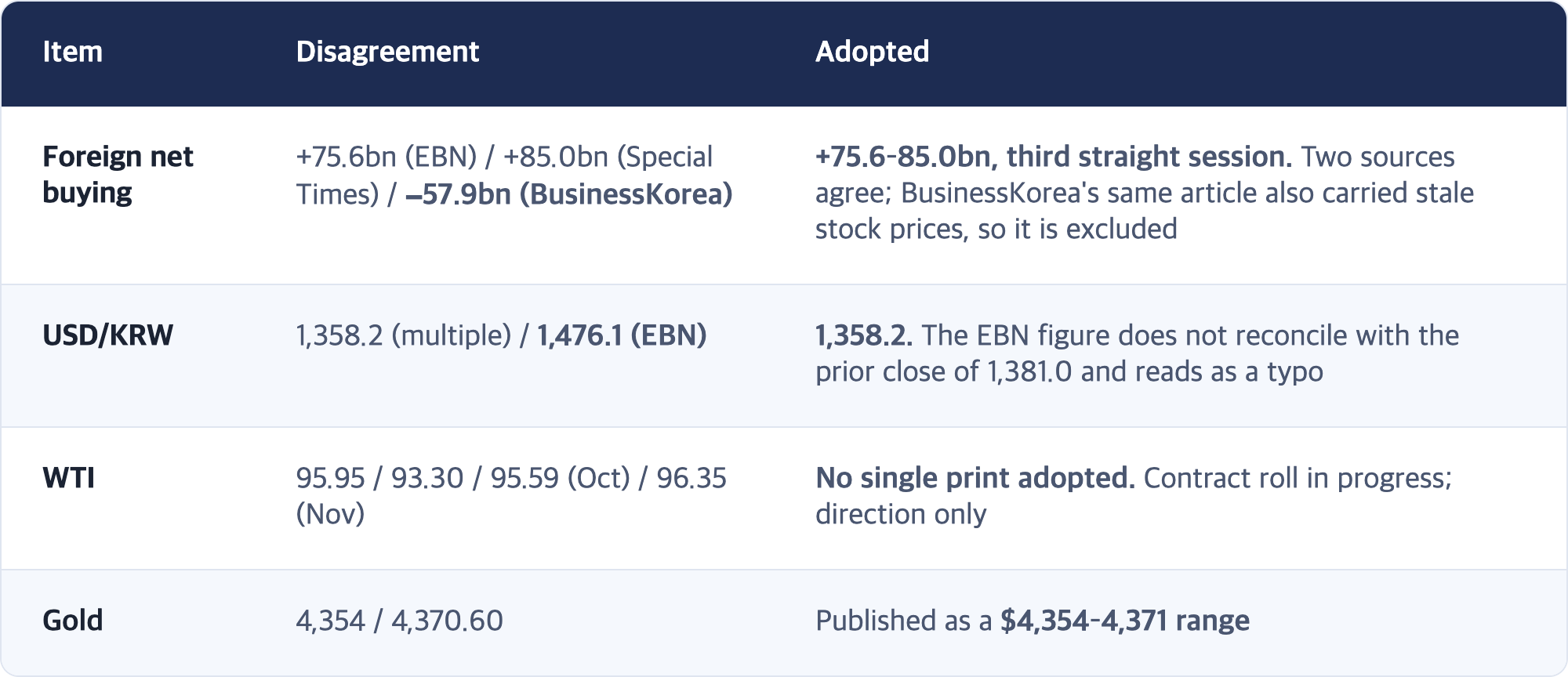
Source discrepancies (value adopted in this report)
🔲 Unresolved (to re-check next edition)
- Korean 10-year government bond close for 9/22. Two sessions in a row I could not source it. The 9/21 level was 4.457%, and with the US 10-year down three straight days, whether Korea followed remains unverified. I will secure it on 9/23, the last session before the holiday.
- The start date of the foreign "three-session" buying streak. Yesterday's report recorded 9/21 foreign flows as −17.19bn won (net selling), which does not reconcile with today's "third consecutive session." Either that figure was wrong, or the two are measured on different KOSPI/KOSDAQ bases. Until verified, "three straight sessions" is carried as a source citation only.
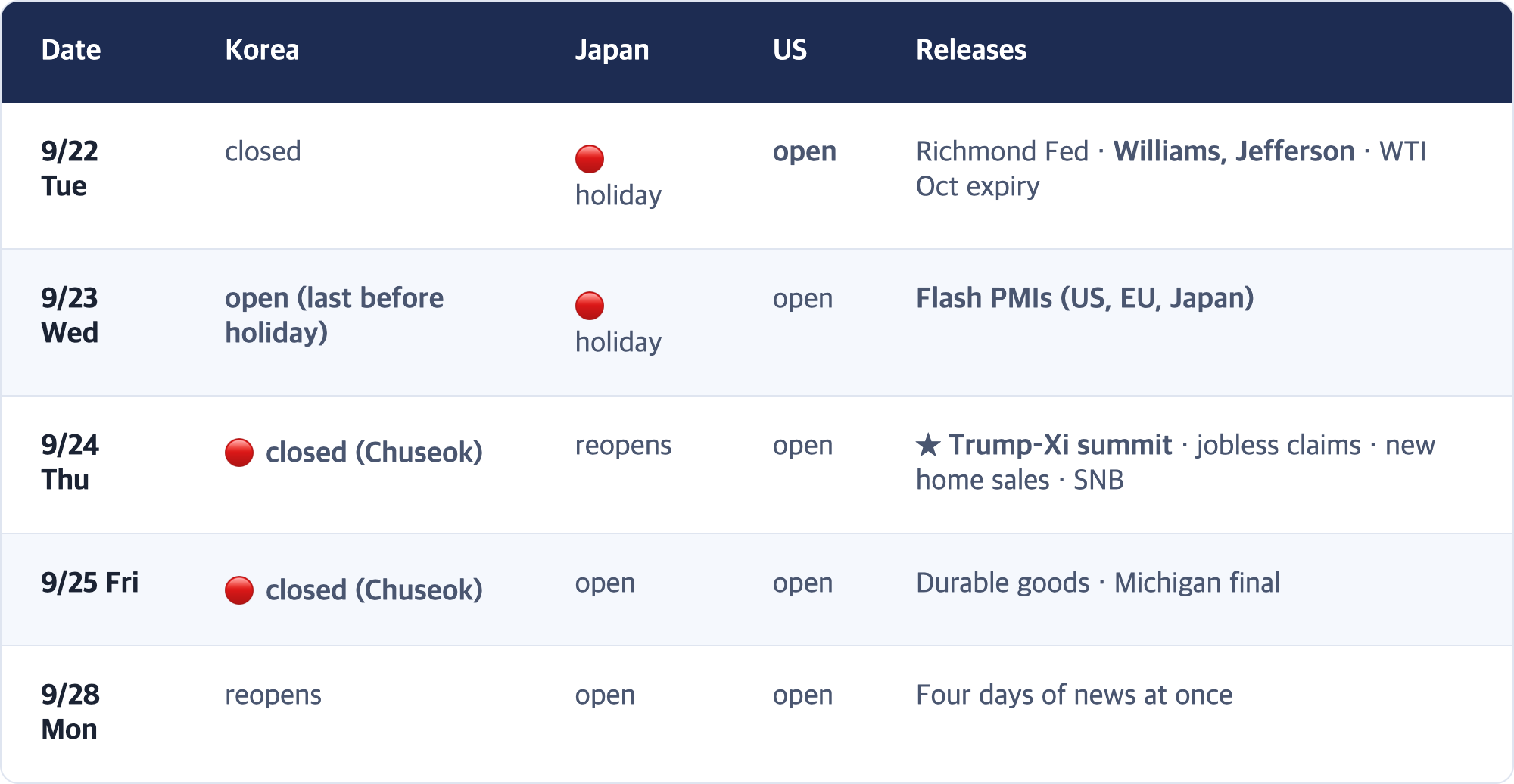
8. Event Calendar
Sources
- Seoul Economic Daily — KOSPI Opens 2.20% Higher at 7,161.61
- EBN — KOSPI holds 7,000 on foreign buying
- Special Times — KOSPI settles above 7,000
- Businesskorea — KOSPI gives back a 2% opening gain
- TradingKey — South Korean Stocks Retreat After Rally, KOSPI Barely Holds 7,000
- Asiae — Won falls 22.8 to the 1,350s
- Money Today — Won closes at 1,358.2, down 22.8
- KB Think — FX daily, September 22, 2026
- Saxo — Asia Market Quick Take, 22 September 2026
- Newsquawk — Daily European Equity Opening News, 22nd September 2026
- AlgoTradeAlert — Stock Market Morning Update, Tuesday September 22, 2026
- CNBC — Stock market news for Sept. 21, 2026
- Trading Economics — Crude Oil / Brent
- FXStreet — Fed's Williams speech, 2026 Economic Calendar
This report interprets market flows and macro variables. It is not a recommendation to buy or sell any individual security.
📌 More market briefs
※ This post is market observation and organization intended to support your own judgment. It is not a recommendation to buy or sell any security. Figures are as of the time of writing and may differ between sources.
If this was useful, bookmark it or pass it along. It genuinely helps me write the next one.
I can survive. We can survive.