Sept 23, 2026 US Market Brief — Nasdaq and S&P 500 Before the Open
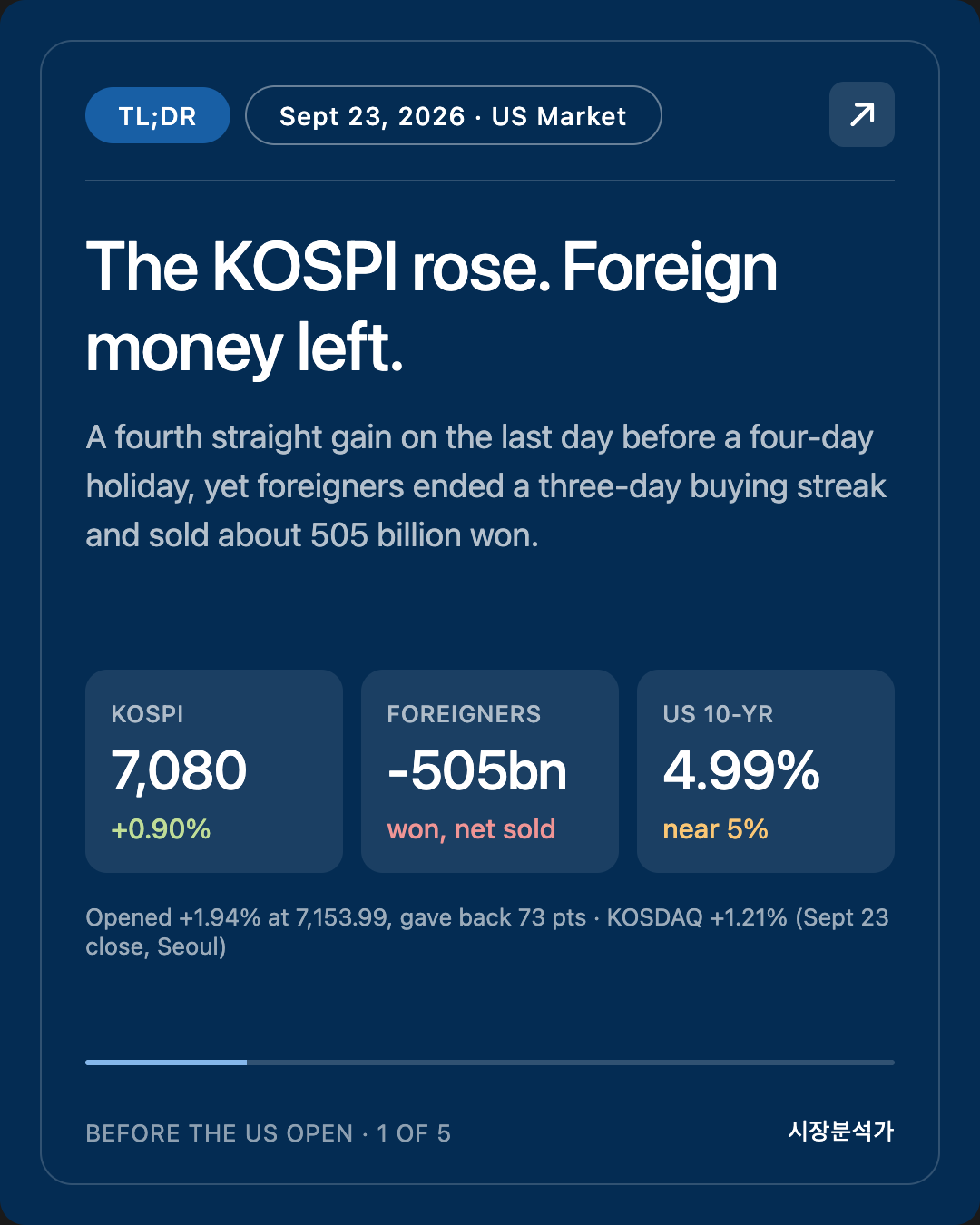
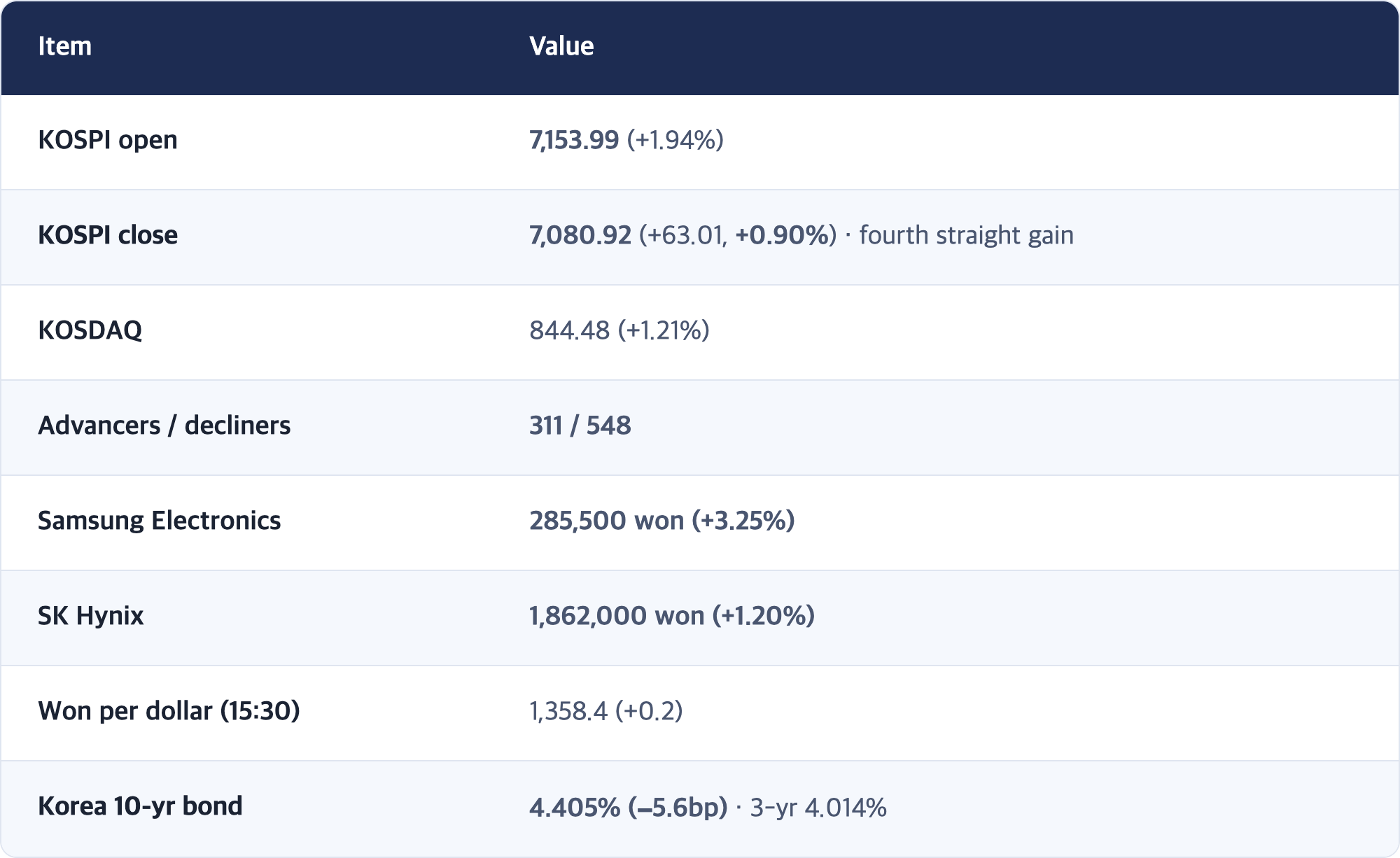
- KOSPI 7,080.92 (+0.90%), fourth straight gain — but it opened at 7,153.99 (+1.94%) and gave back 73 points. KOSDAQ 844.48 (+1.21%).
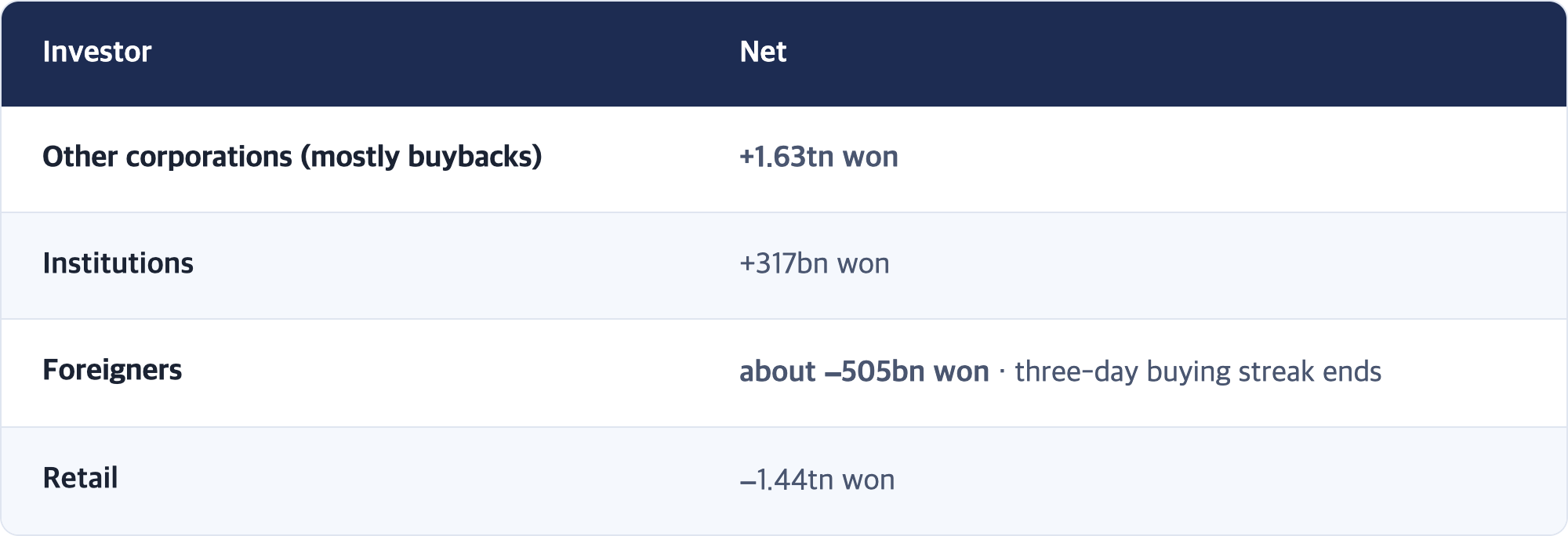
- ★ The checkpoint I called most important last night failed. Foreigners did not buy for a fourth day; they flipped to net selling of about 505 billion won. Facing a four-day gap and a US–China summit, foreign money chose not to hold through the holiday.
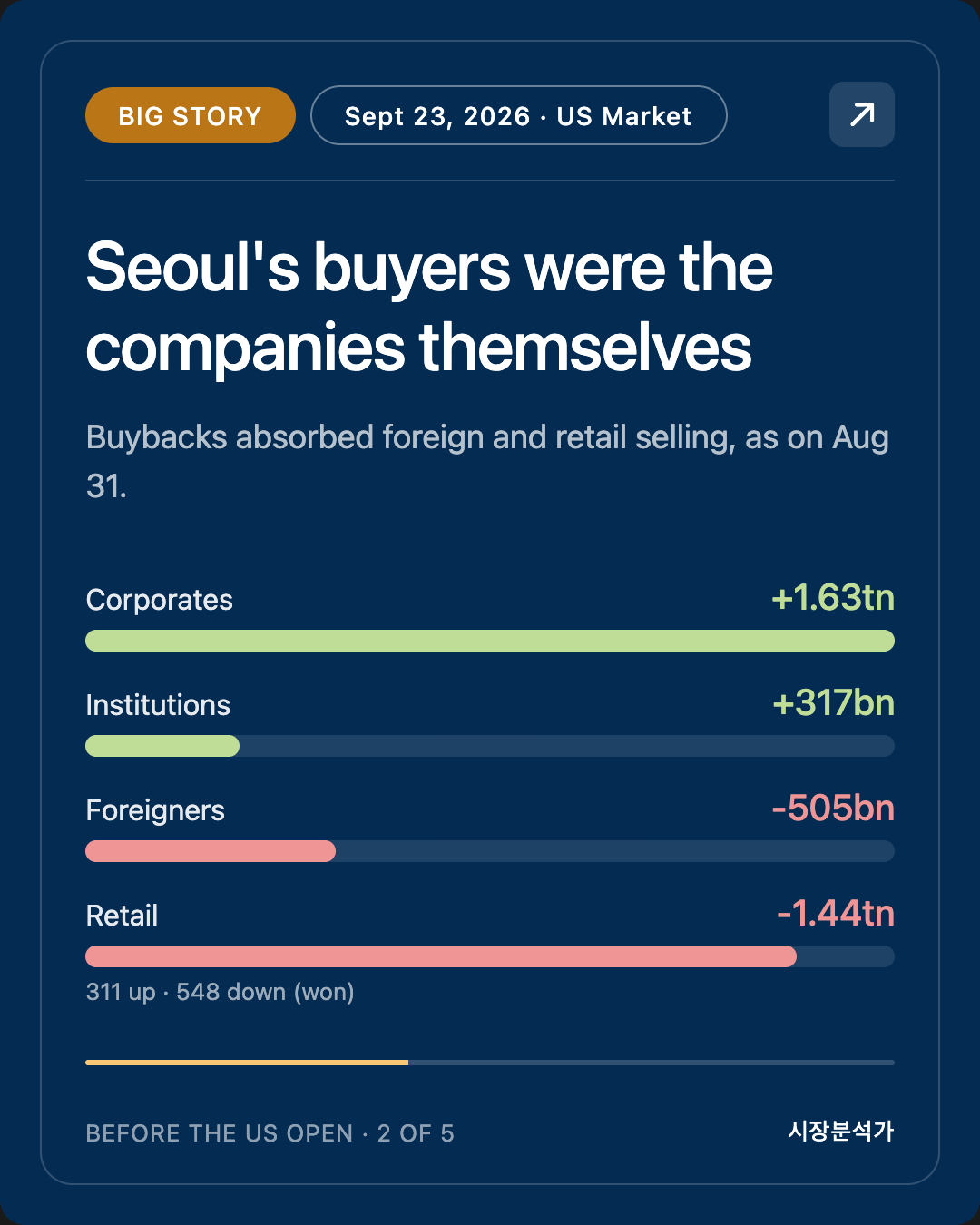
- ★ The index was carried by corporate buybacks: +1.63 trillion won. Same structure as August 31. Read today's KOSPI as a buyback number, not a sentiment number.
- The memory gap narrowed a little. SK Hynix +1.20% (1,862,000 won), Samsung Electronics +3.25% (285,500 won). But SK Hynix captured only about a third of what its New York ADR (+3.46%) had priced overnight.
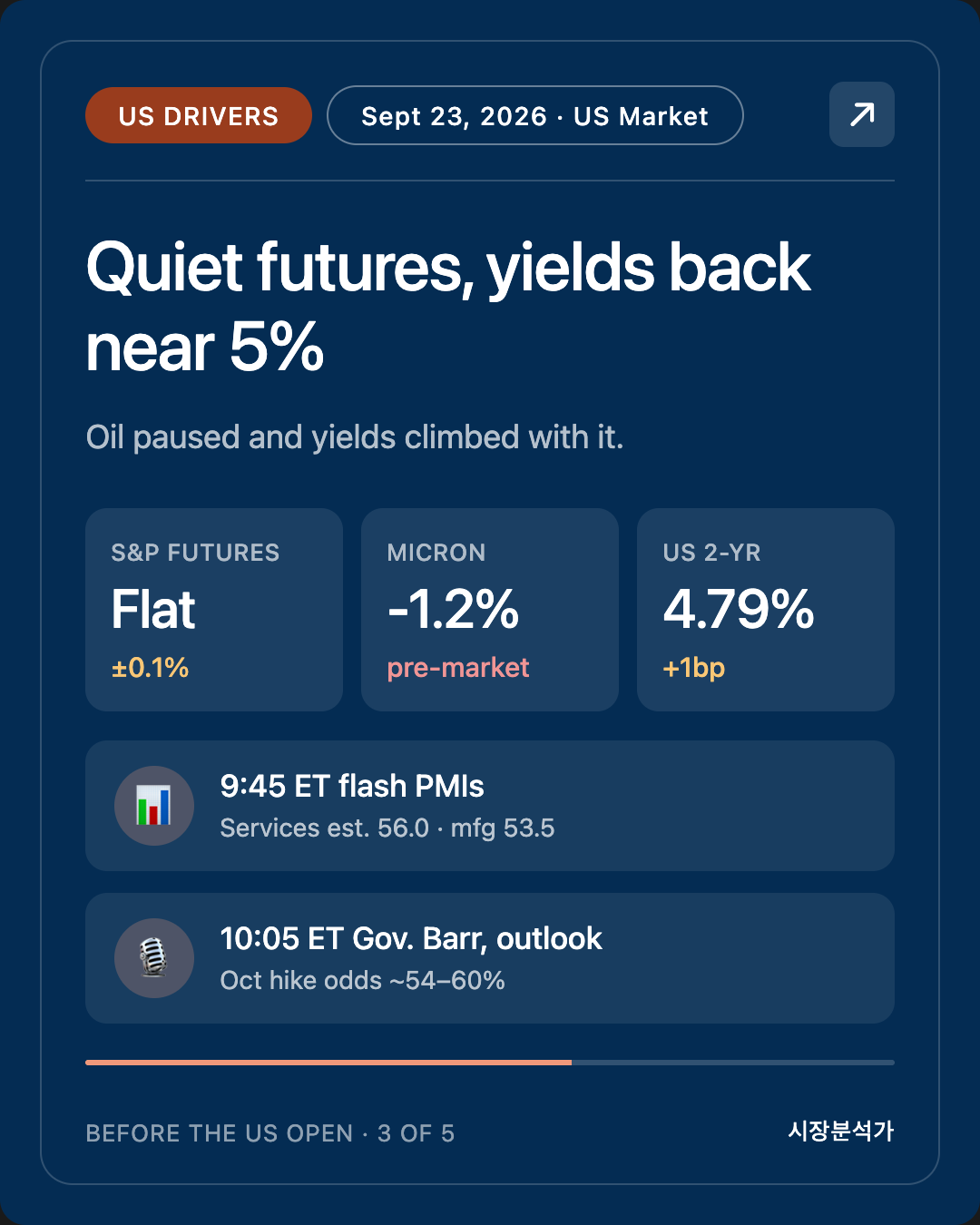
- The US opens quietly. S&P futures flat, Micron −1.2% pre-market. The 10-year Treasury is back near 4.99% as oil stopped falling. Today's events: 9:45 ET flash PMIs and Fed Governor Barr's 10:05 ET outlook speech.
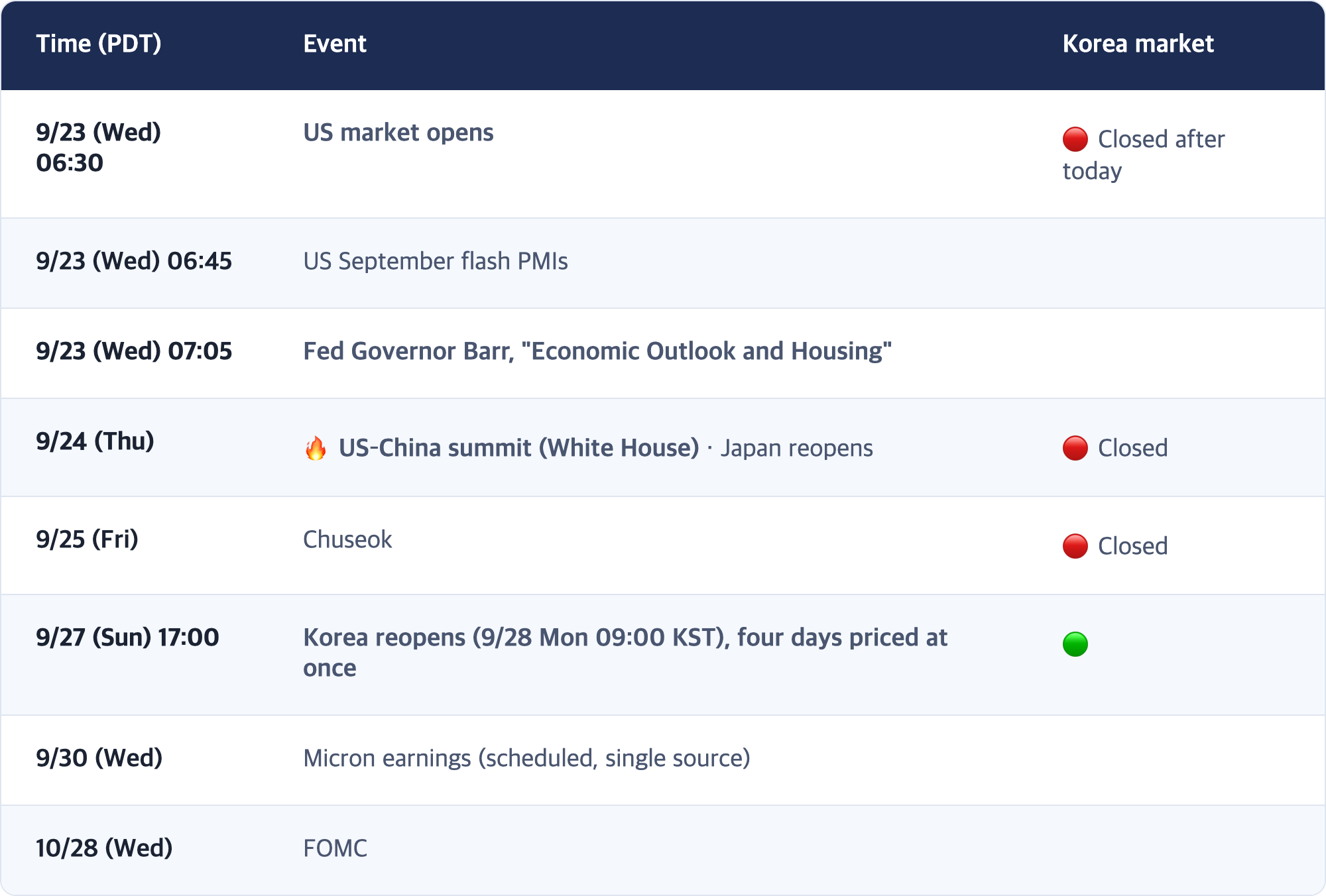
For readers outside Korea: Chuseok is the Korean harvest holiday. Seoul's stock market is closed Thursday and Friday (Sept 24–25), reopening Monday, Sept 28. The exchange has also shut its overnight derivatives session, so investors cannot hedge in between.
This is Mr. Can. Here is the Sept 23, 2026 brief ahead of the US market open.
Written: 2026-09-23 05:50 PDT (Seoul 9/23 21:50 KST)
Covers: Korea, China and Hong Kong close 9/23 · Europe intraday 9/23 · US pre-market 9/23 (Japan closed)
🟢 Published on time. Scheduled 05:30 PDT, work started 05:43 PDT. About forty minutes to the US open.
SEO Intro
On the last trading day before Korea's Chuseok holiday, the KOSPI rose — 7,080.92, up 0.90%, a fourth straight gain.
Look at who was buying, though, and the picture changes.
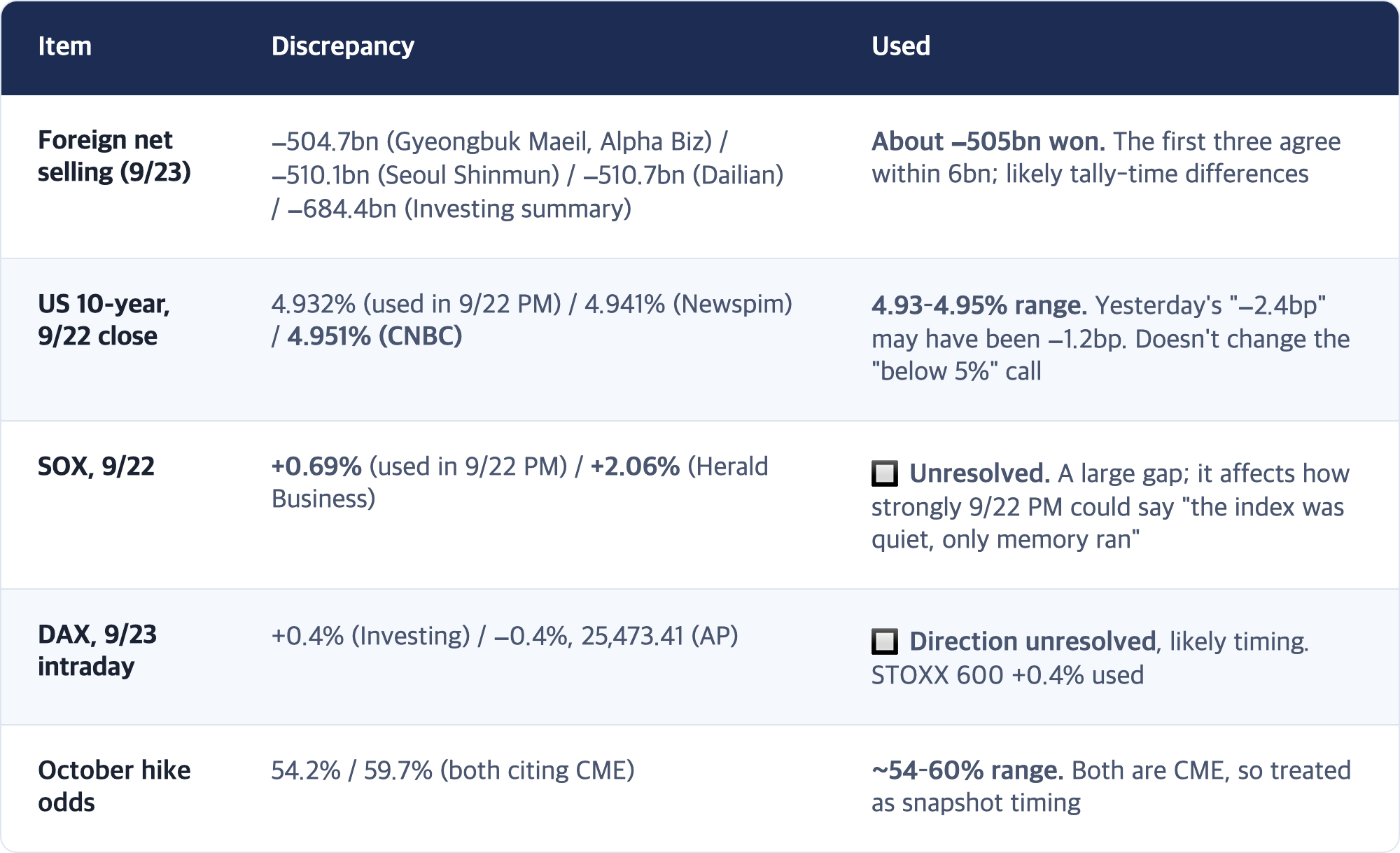
Foreign investors sold. Whether they would extend their buying streak to a fourth day was the single most important question I set last night. The answer: net selling of about 505 billion won (roughly $370 million). Retail investors sold 1.44 trillion won as well.
So who bought? "Other corporations" — 1.63 trillion won. In Korean market data, that bucket is mostly companies buying back their own shares. Institutions added 317 billion won.
In other words, what held the KOSPI above 7,080 was not investor conviction but corporate buyback programs.
Seoul now closes for four days. New York trades today, tomorrow and Friday. And the US–China summit is tomorrow at the White House.
1. Scoring Last Night's Checkpoints (Korea session)
The axis I set last night: "Can Korea absorb the memory rally in one day, or does the holiday weigh first?" Korea has closed, so here is the scorecard.
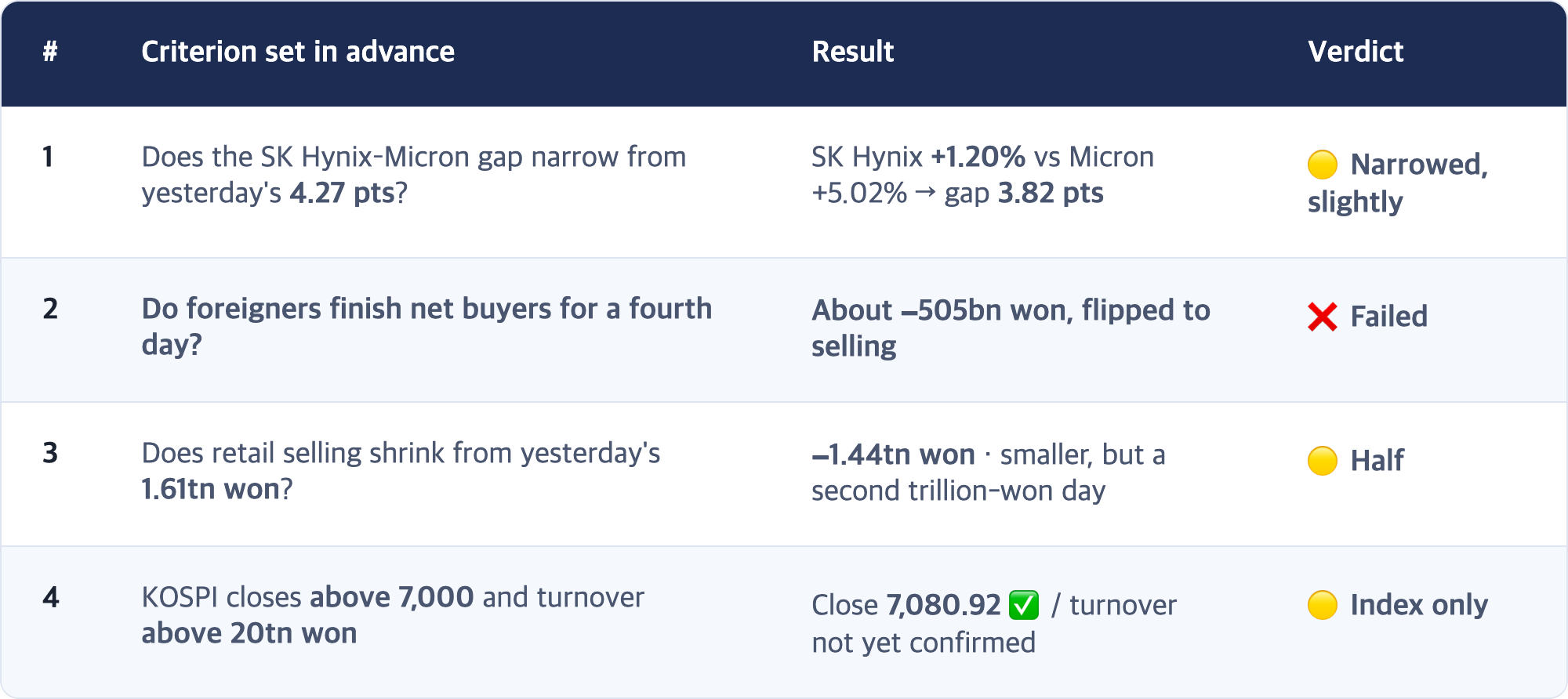
[Interpretation] The most important call was wrong — and the direction it went is the information
Last night I wrote that #2 carried the most information because it was "a decision made while knowing what sits on the other side of four closed days." I also wrote down in advance how to read a miss:
If they turn sellers into the close, the three days of buying were a pre-holiday round trip.
Foreigners sold. So I read it the way I said I would. [Interpretation] The three days of foreign buying now look less like a decision to hold through the holiday and more like short-term positioning that could be unwound before it. Yesterday morning I wrote that foreigners had "decided to hold through the four-day gap." I am withdrawing that after one day.
#3 landed in between. Retail selling shrank, but 1.4 trillion won is still a lot of money. It fits neither of the two readings I set out, so I am carrying the verdict to the Sept 28 reopening.
2. Big Story: The Buyers in Seoul Were the Companies Themselves
[Fact] Korea close (9/23 KST · 9/22 23:30 PDT)
🔴 [Fact] Net buying by investor type (KOSPI)
★ [Interpretation] The index rose, yet decliners outnumbered advancers 1.8 to 1
311 up, 548 down. On a +0.90% day, far more stocks fell than rose. Samsung Electronics alone (+3.25%) did much of the lifting.
This project first saw this shape on August 31. That day all three major investor groups sold, and corporate buybacks of 1.54 trillion won absorbed it all, leaving the index in the green. The principle I wrote then:
Do not equate the index with sentiment. Check who bought before you read the index.
Applied to today: both foreigners and retail lightened up ahead of the holiday. Buybacks and institutions took the other side. "KOSPI up four days in a row" is true as a headline, but it does not mean the market is optimistic about what comes after the break.
[Observation] The memory gap narrowed a little
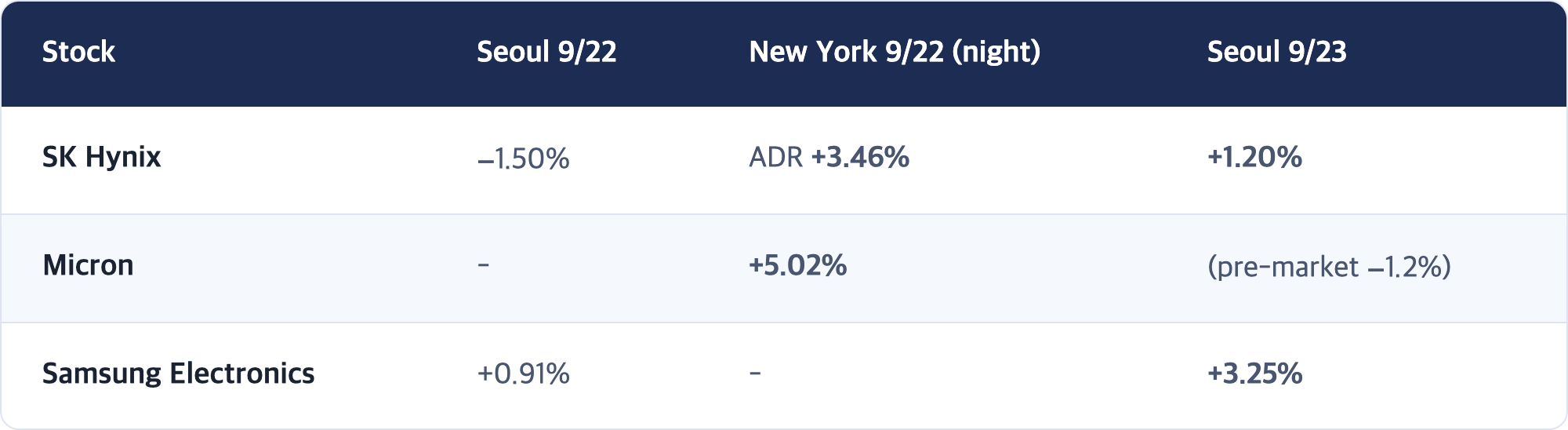
[Interpretation] SK Hynix took home only about a third of the gain its ADR priced overnight. Samsung, the index heavyweight, took more. On the eve of a long holiday, money seemed to prefer the biggest, most liquid name over a concentrated bet.
3. US Drivers: Quiet Futures, Yields Back Near 5%
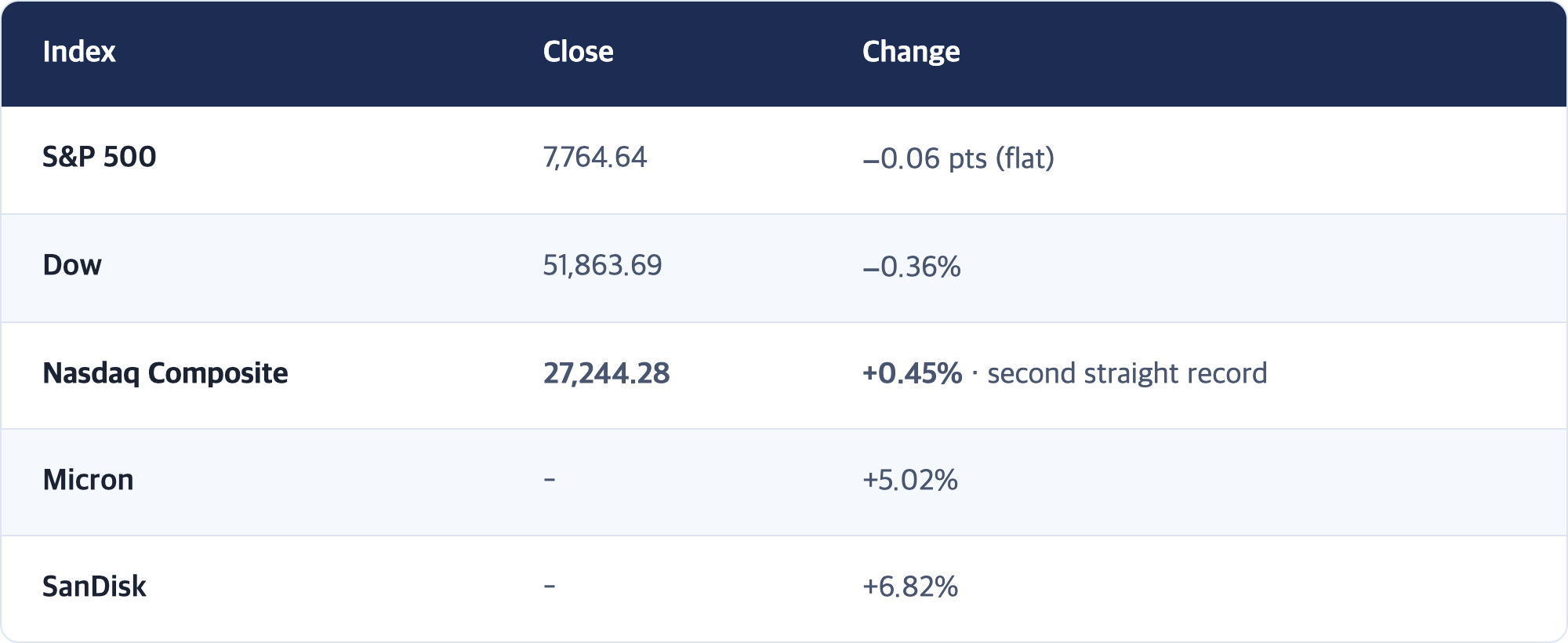
[Fact] New York close (9/22 ET) recap
[Fact] Pre-market and rates (9/23, early PDT)
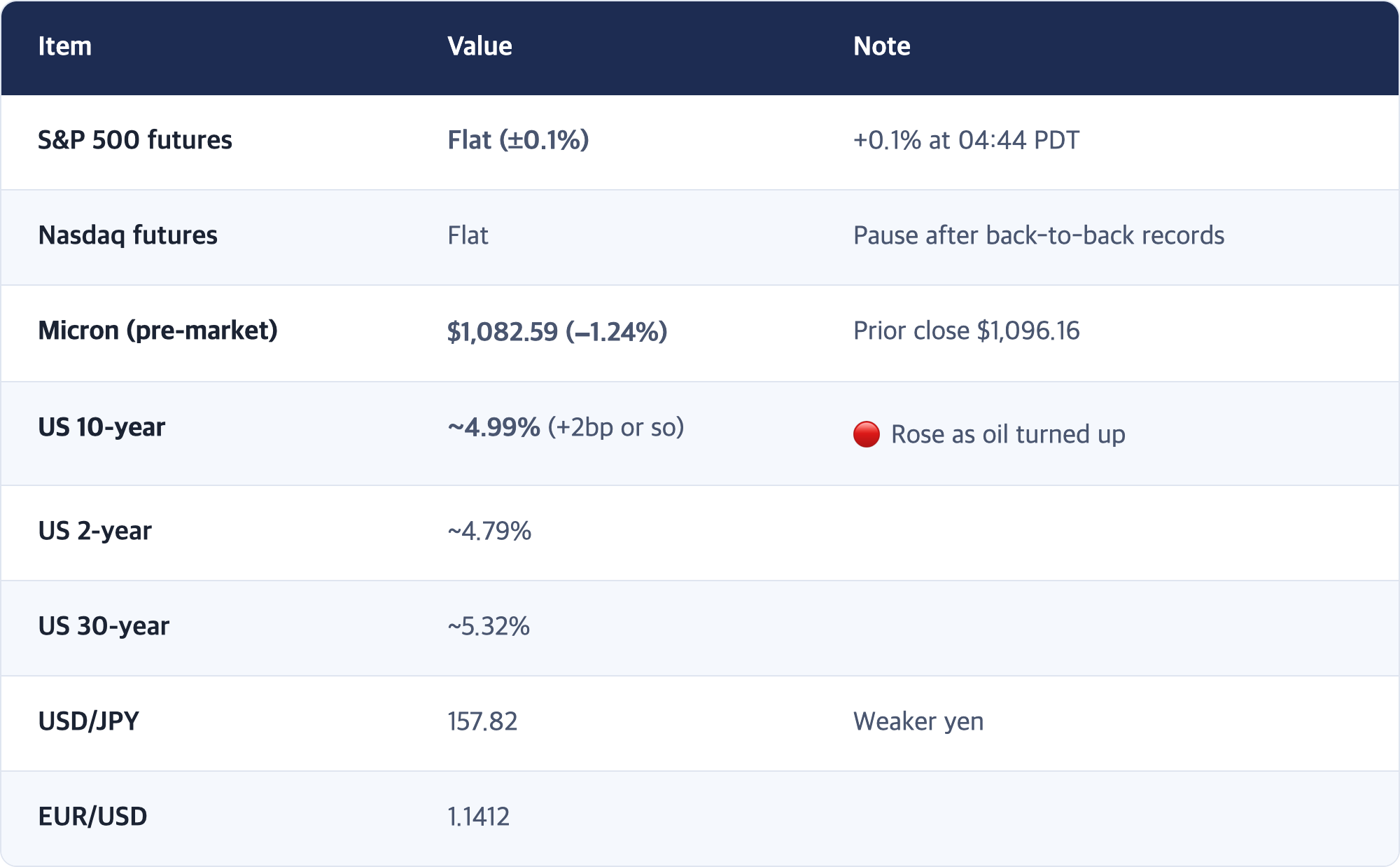
[Observation] Chips are resting pre-market. Broadcom, Micron, Intel and Lam Research were reported down 1–2%, which looks like profit-taking after this week's AI rally.
🔴 [Fact] Today's US calendar (ET)
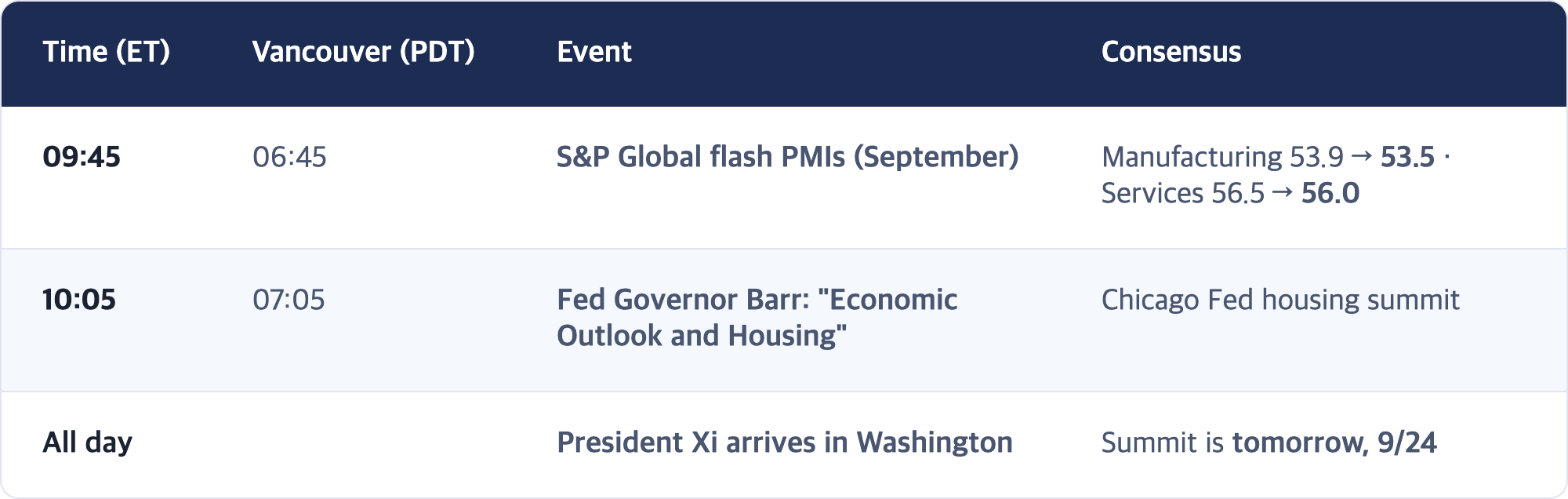
★ [Interpretation] This time the Fed speaker is at a venue built for policy talk
Yesterday I set Williams' and Jefferson's remarks as a checkpoint and couldn't score it at all — they spoke at a Treasury-market operations conference, about reserves and the discount window, not about rates. The lesson I took: check where someone is speaking before assuming what they'll say.
Barr's speech today is titled "Economic Outlook and Housing." The word "outlook" is in the title. This is a venue where rate direction can come up. October hike odds on CME FedWatch sit at roughly 54–60% depending on the snapshot, so a single line from Barr can move that number either way.
[Observation] Why yields came back: oil stopped falling
Overnight, yields first fell with oil, then rose as November Brent turned positive (CNBC). After six straight down days for crude, a pause in oil was enough to pause the bond rally. This week, oil is moving rates more than Fed speakers are.
4. Macro Backdrop: Oil, Dollar, Asia
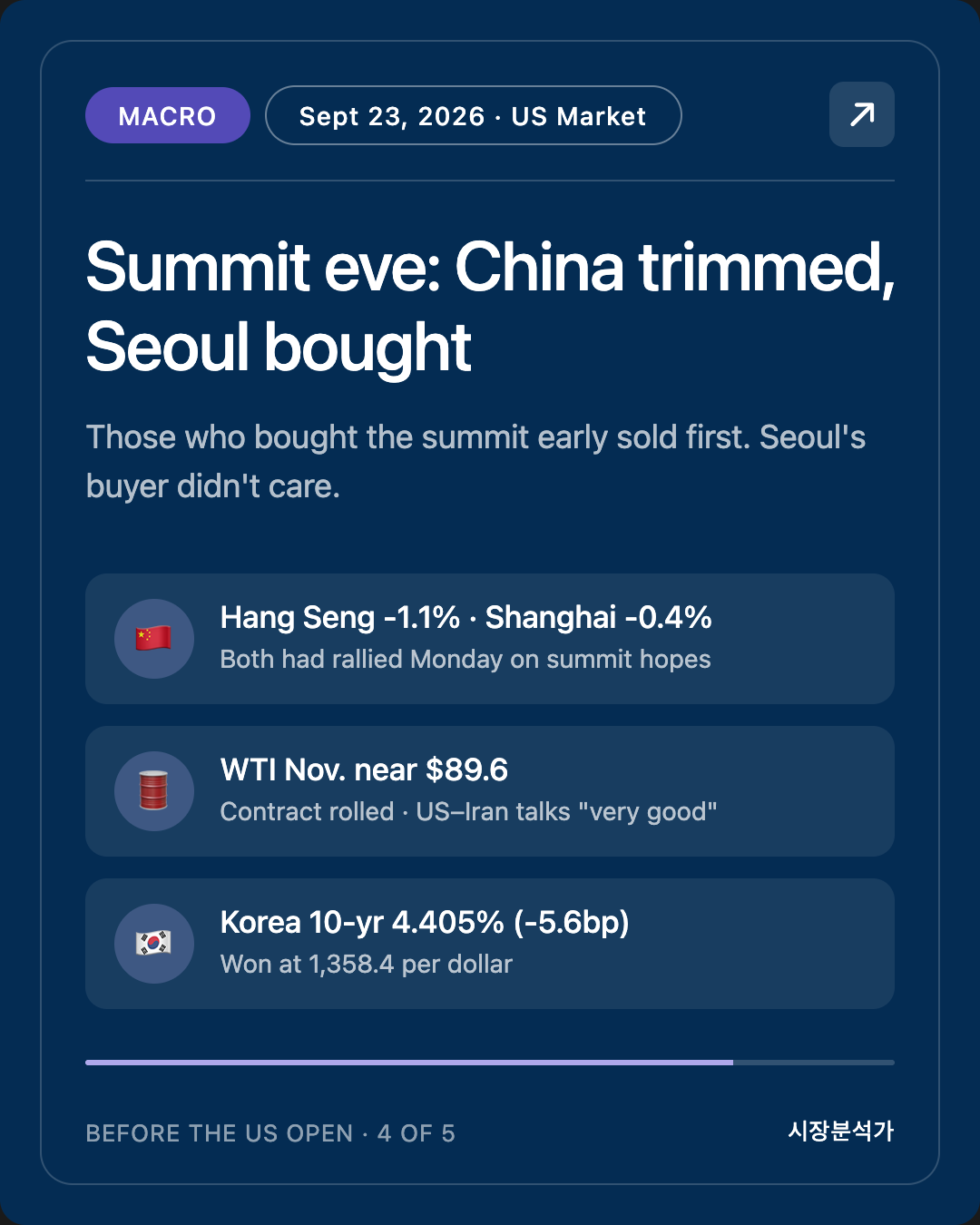
[Fact] Oil (WTI front month is now November)
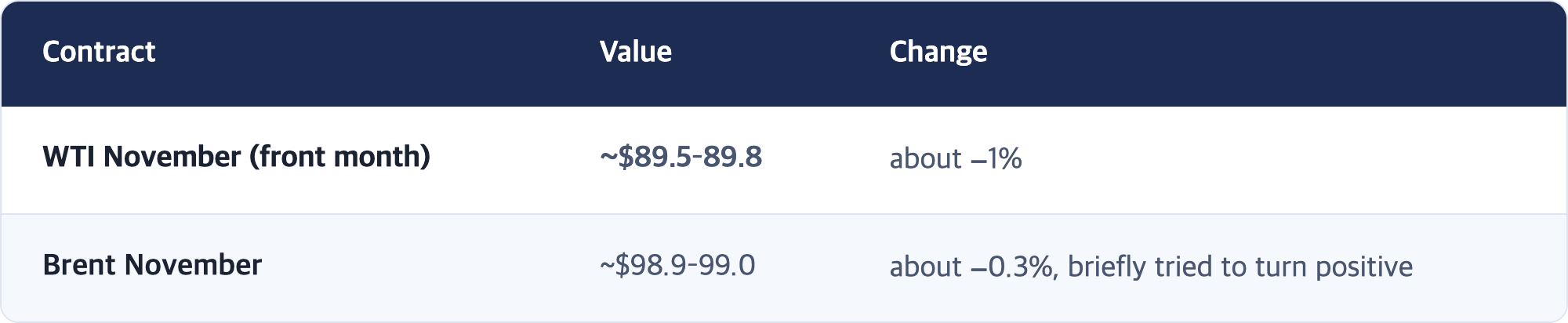
As explained yesterday, the "WTI" in today's headlines is the November contract. Most of the apparent drop from $95 to under $90 is the contract roll, not the market.
[Fact] The forces pushing oil down are still there: President Trump said US and Iranian officials had a "very good" meeting on the sidelines of the UN General Assembly, and Saudi Arabia's East-West pipeline is running again.
[Fact] Asia and Europe
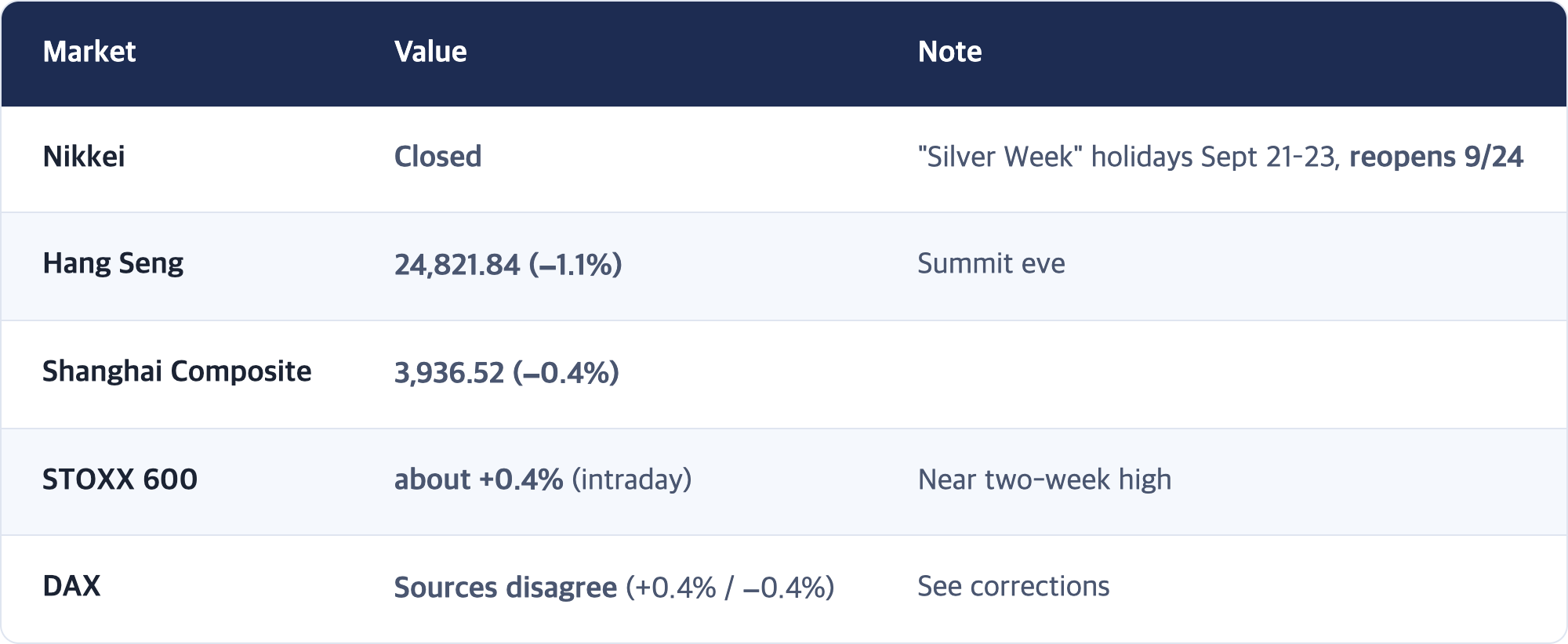
★ [Interpretation] On summit eve, China trimmed while Seoul bought
The markets closest to the summit pulled back the day before it. On Monday (9/21), the Hang Seng rose 1.2% and Shanghai 1% on summit hopes. Those who bought the hope first are now the first to take some off.
Seoul went the other way — but as shown above, Seoul was lifted by buybacks, not by summit hopes. So it is less that the two markets see the summit differently and more that Seoul had a buyer who did not care about the summit.
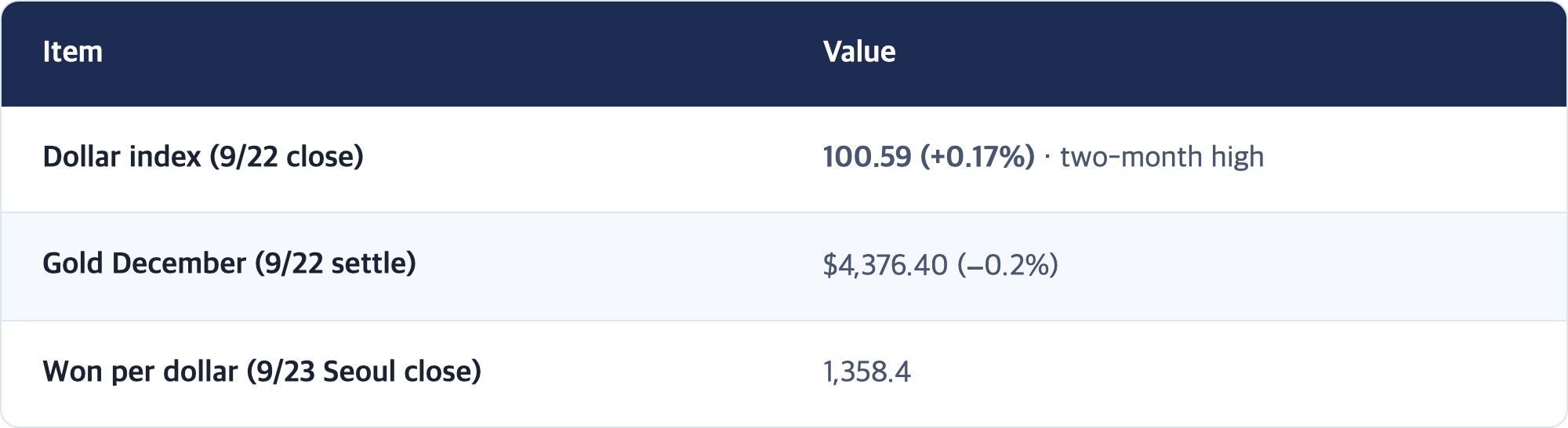
[Fact] Dollar and gold
5. US Session Preview (9/23 ET)
[Observation] How it opens
- Indexes open quietly. S&P futures flat; the Nasdaq catches its breath after two record closes.
- Chips take a break. Micron −1.2% pre-market, giving back part of yesterday's memory rally.
- Rates are the pressure point. The 10-year is back just under 5%. It touched 5.0% intraday on 9/18, drifted lower for four days, and has retraced most of that in one morning.
- The summit is tomorrow. Today is more likely a pre-summit positioning session than a reaction to any outcome.
🇰🇷 Why tonight matters for Korean investors
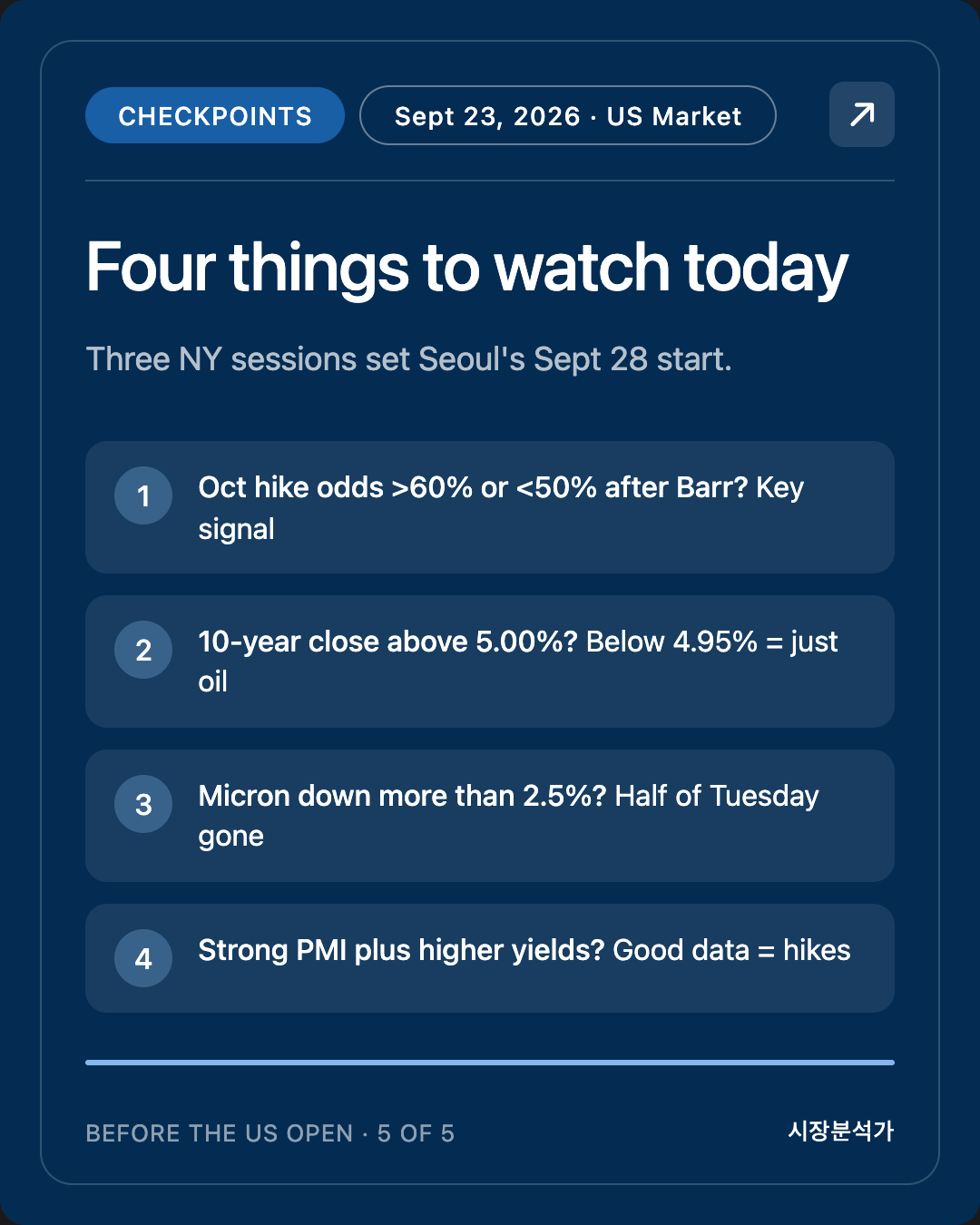
Korea is shut Sept 24–27. Three New York sessions — today, tomorrow (summit day) and Friday — will stack up before Seoul reopens on Monday, Sept 28. Those three sessions set Seoul's starting line.
✅ Four Checkpoints (US open to close)
The axis: "Does the memory rally hold ahead of the summit, and does the Fed lean further toward an October hike?" Both feed directly into Seoul's Sept 28 reopening.
- After Barr speaks, do CME October hike odds move above 60% or below 50%? This time the venue makes it scoreable. Above 60% means the Fed is sticking with hikes despite falling oil; below 50% means it is taking the oil relief on board.
- Does the 10-year close back above 5.00%? If yes, the drop since 9/18 was temporary. If it falls back below 4.95%, this morning's rise was just an oil blip.
- Does Micron close down more than 2.5%? Giving back more than half of Tuesday's +5.02% would make the memory rally a one-day event — and shrink what Seoul inherits on Sept 28.
- Do services PMI beat 56.0 and the 10-year rise at the same time? If they move together, "good data = hike pressure" is still the market's rule. If data is strong and yields don't budge, attention has already shifted to oil.
[Interpretation] The most informative of the four is #1 — yesterday's blank question, asked again at the right venue.
6. Study Note: A Market That Closes for Four Days Takes Four Days of News at Once — the "Gap"
Korea now closes for four days while the US trades three more. The concept worth knowing here is the gap.
Concept: a gap is a price nobody got to trade
Normally prices move continuously. To go from 7,000 to 7,010, the market passes 7,001, 7,002 and so on, and you can trade at any point along the way.
But news that arrives while a market is closed goes into the next opening price all at once. If Friday closes at 7,000 and Monday opens at 6,850, nobody had a chance to trade anywhere between 6,999 and 6,851. That empty stretch is the gap.
Analogy: four days of mail
If you check your mailbox daily, you read one letter at a time and respond as you go. Come back from a four-day trip and you read four letters at once. If one is a bill, you are reading it after the window to act on it has passed.
Why this holiday is especially gap-prone
- The US–China summit (9/24) happens while Korea is closed.
- Korea's overnight derivatives session is also shut, so the usual tool for hedging overnight risk is unavailable.
- The US trades three sessions in between — all of which land on Seoul's Monday open.
Real example: today's foreign selling
Foreigners selling about 505 billion won today reads as a choice to avoid exactly this gap: they declined to leave money where they couldn't act for four days. Corporate buybacks, by contrast, follow a fixed purchase plan rather than price, so they have little reason to care about the gap. That is why the two groups behaved so differently in front of the same holiday.
One-line summary
A gap is what happens when everything that occurred while a market was closed gets priced the moment it reopens. It grows with the length of the closure, the size of the events in between, and the absence of hedging tools. This Chuseok checks all three boxes.
7. Corrections and Open Items
🔴 Withdrawn interpretation from yesterday's AM report
On 9/22 AM I wrote that "foreigners decided to hold through the four-day gap, while retail chose cash." With foreigners flipping to about −505 billion won today, I withdraw the first half of that sentence. The three-day foreign buying looks more like short-term positioning that could be unwound before the break. → I will not read "N days of net buying" as directional conviction, especially right before a holiday or major event.
✅ Resolved: Korea 10-year yield
After two days without a confirmed figure: 9/23 close 4.405% (−5.6bp), 3-year 4.014%. The carried-over "Korea 10-year below 4.45%" checkpoint passes ✅ (single source; will recheck 9/28).
Source discrepancies (values used in this report)
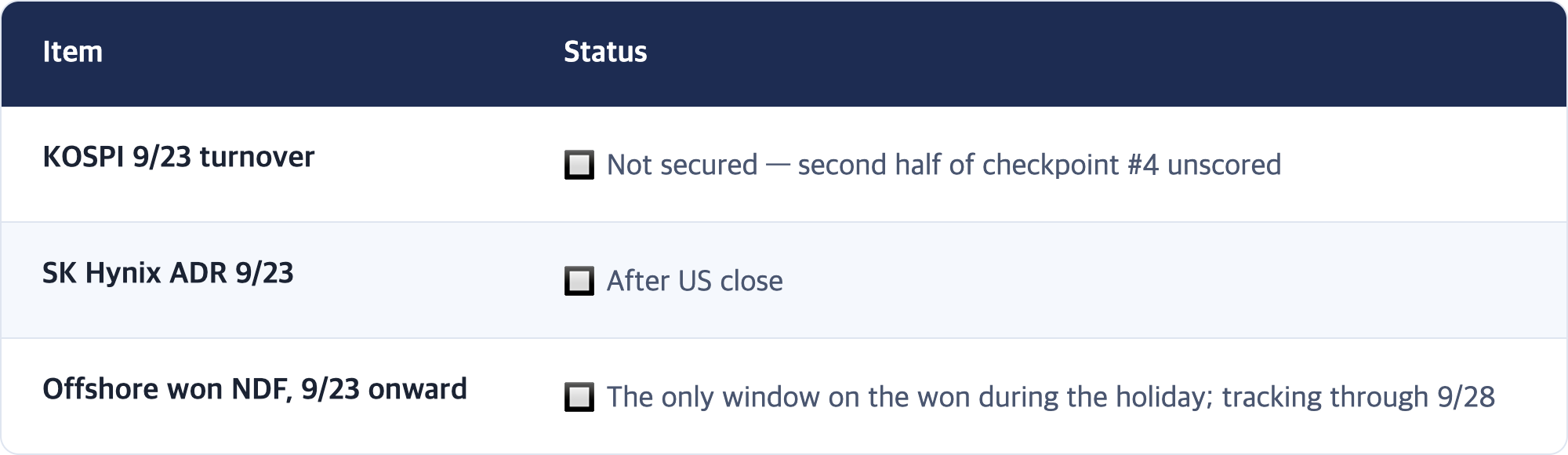
🔲 Still to confirm
8. Event Calendar (PDT)
Sources
- KOSPI closes at 7,080.92 — Seoul Shinmun
- KOSPI up 4th day, foreigners turn sellers — Gyeongbuk Maeil
- Retail and foreigners sell ahead of Chuseok — Dailian
- KOSPI market close — Newspim
- KOSPI "strong open, weak close" — Alpha Biz
- KOSPI intraday on chip strength — Herald Business
- Korean government bond yields fall — Supple
- Global market report, Sept 23 — Newspim
- Treasury yields little changed as oil price oscillates — CNBC
- US stock market — Trading Economics
- Asian shares are mixed and oil prices fall — AP/BNN Bloomberg
- European shares advance on Saudi pipeline restart — Investing.com
- Japan market closed Sept 21–23 — Webull
- Federal Reserve Board — Calendar: September 2026
- US PMI report preview — FXStreet
- CME FedWatch 54.2% October hike — Phemex
- Micron pre-market — Public.com
- Xi-Trump Summit Agenda — Bloomberg
Market Analyst · This report does not recommend buying or selling any individual security. It offers macro context and interpretation.
📌 More market briefs
※ This post is market observation and organization intended to support your own judgment. It is not a recommendation to buy or sell any security. Figures are as of the time of writing and may differ between sources.
If this was useful, bookmark it or pass it along. It genuinely helps me write the next one.
I can survive. We can survive.