Sept 24, 2026 US Market Brief — Nasdaq and S&P 500 Before the Open
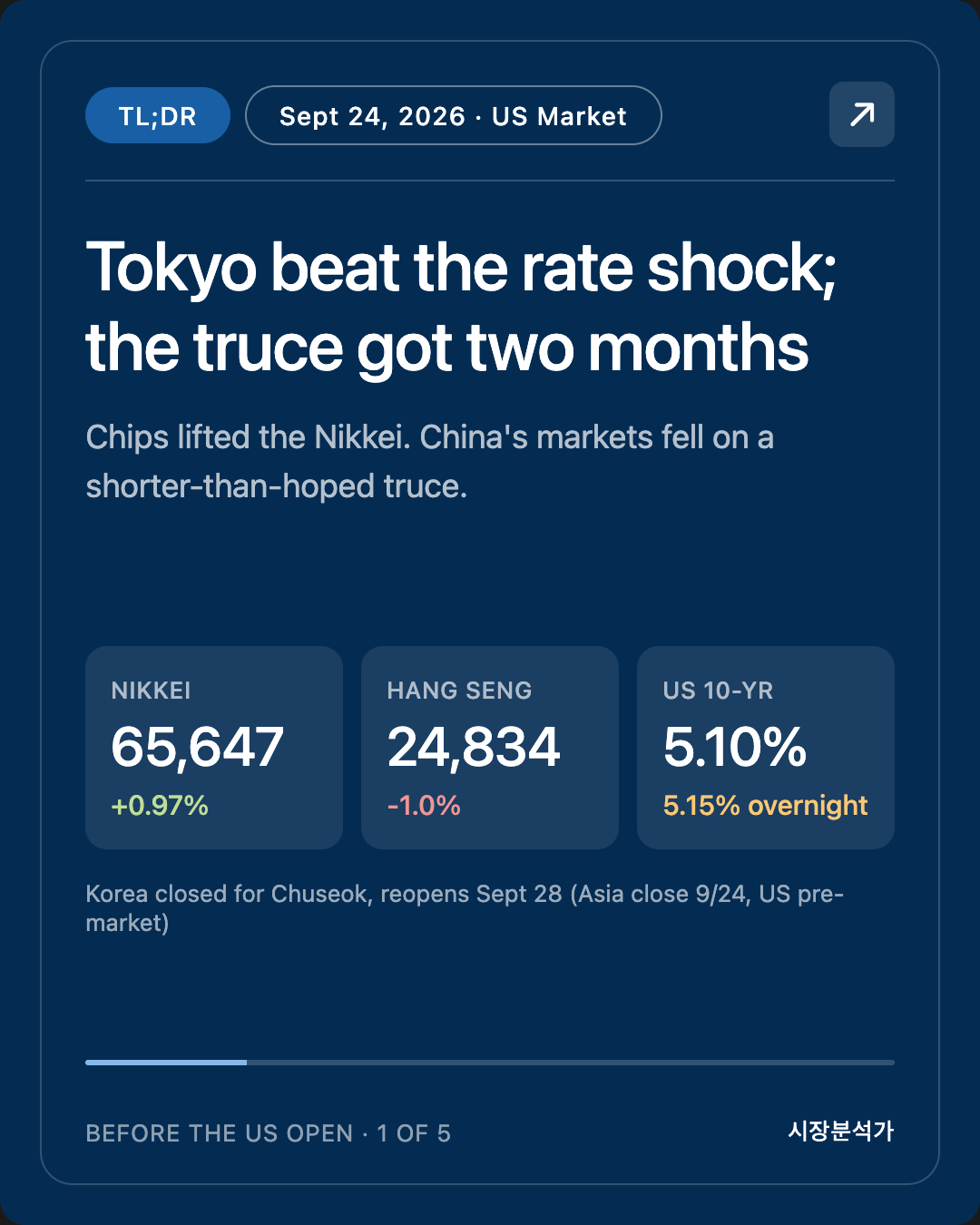
- ★ Tokyo beat the bond selloff, but narrowly. Nikkei 65,647 (+0.97%), intraday high 66,249. The TOPIX slipped to about 4,084. A few chip stocks made the gain.
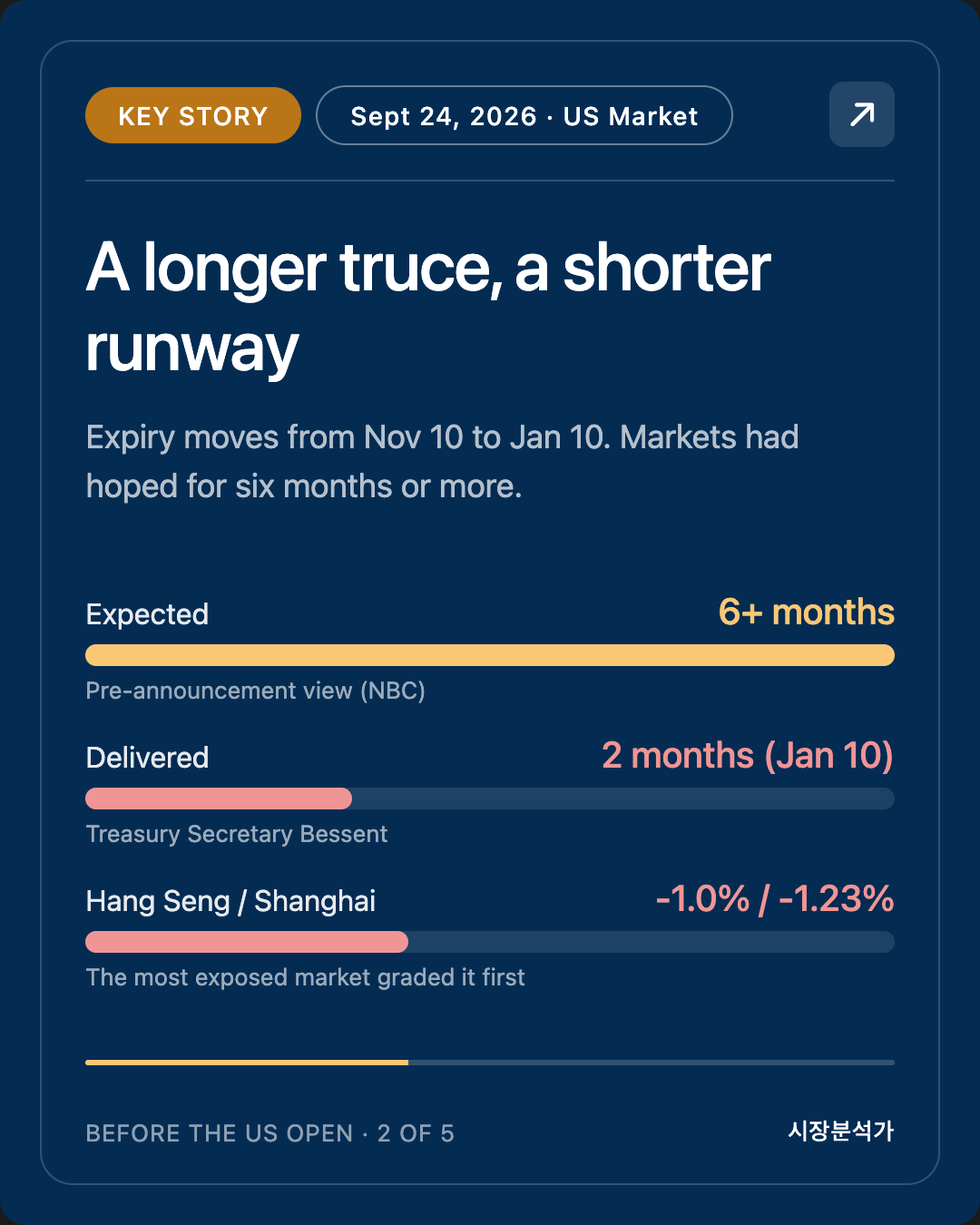
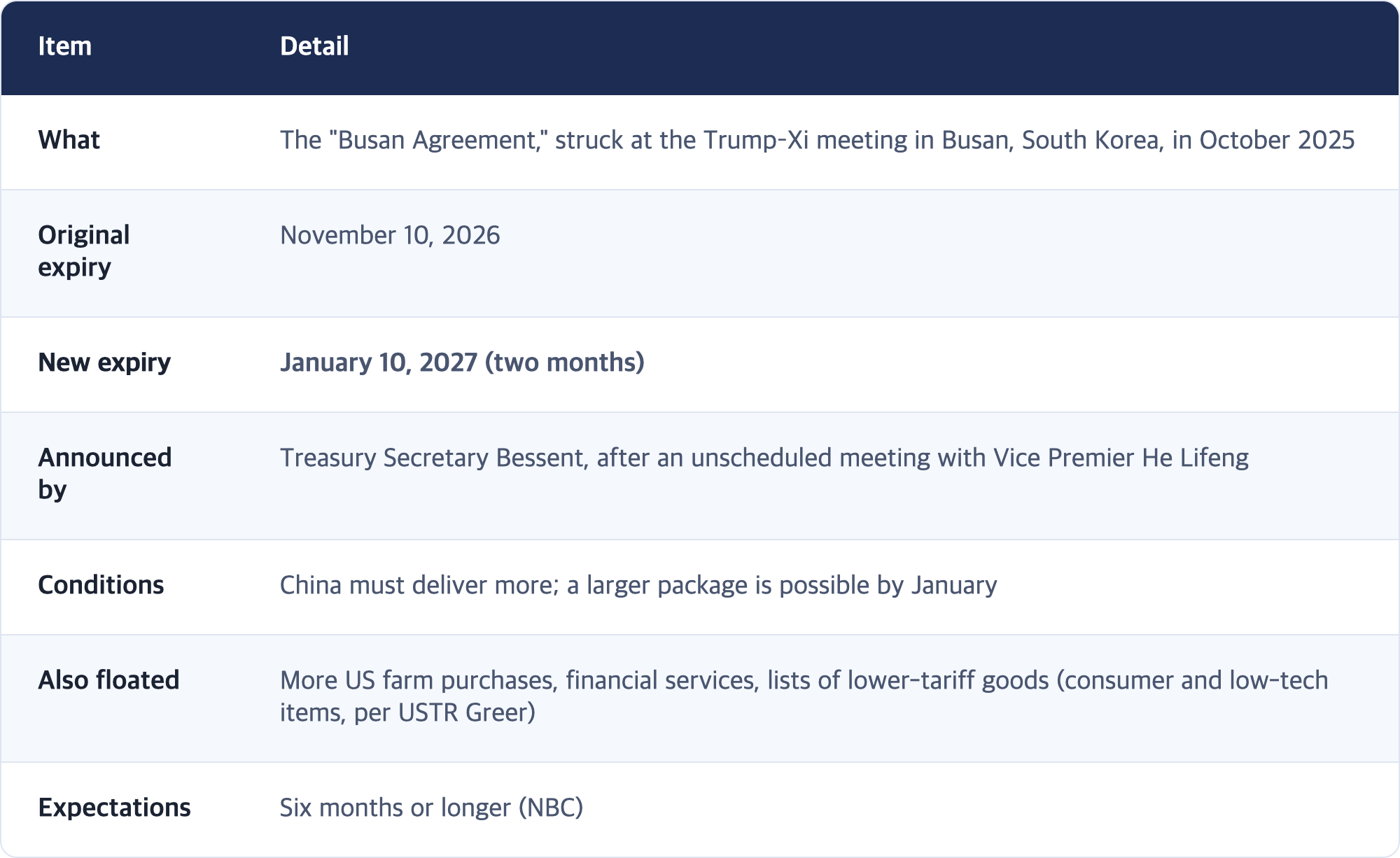
- ★ The truce extension is official. It is also only two months. Treasury Secretary Bessent: expiry moves from Nov 10 to Jan 10. Markets expected six months or longer; Hang Seng −1.0% (24,834), Shanghai −1.23%.
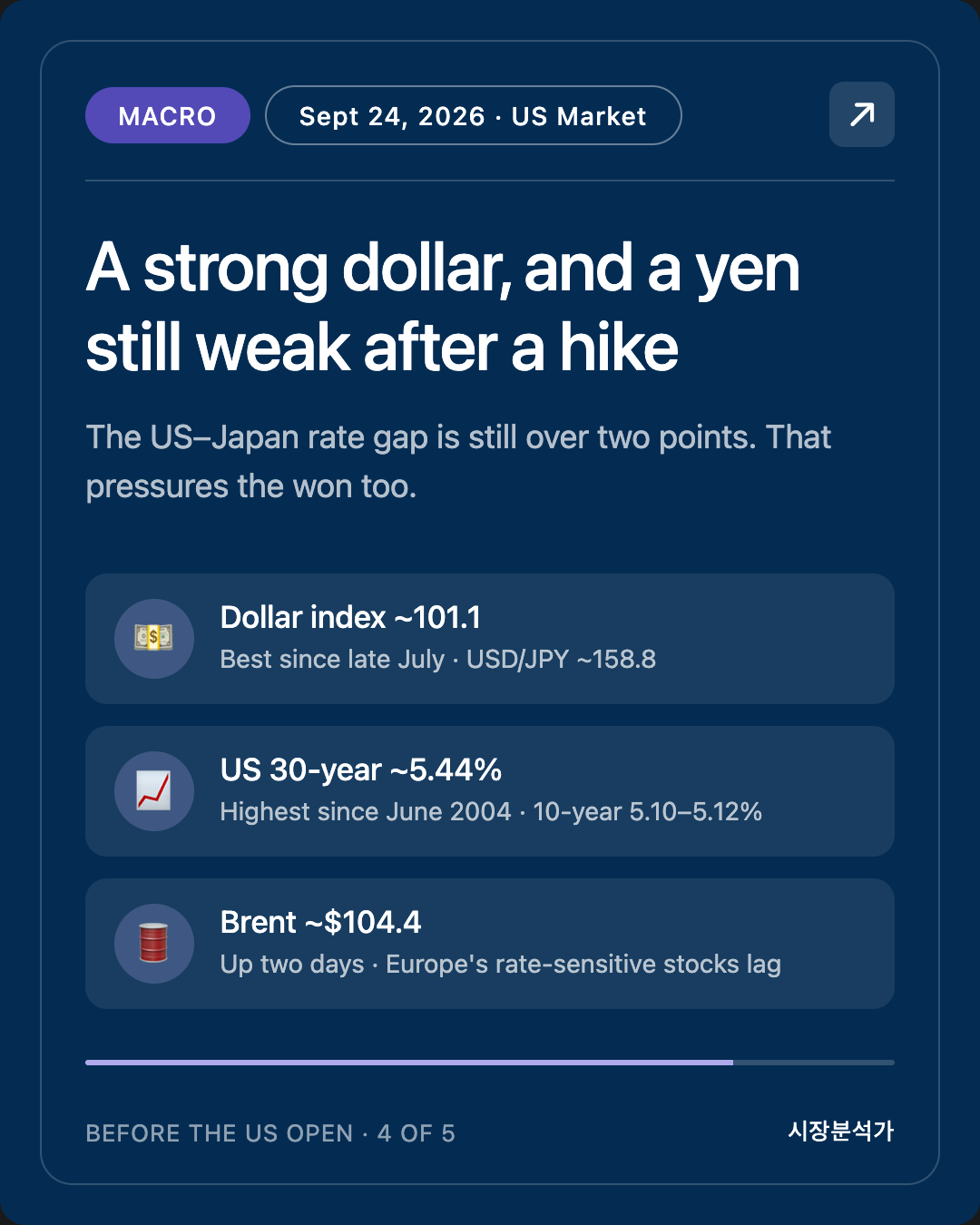
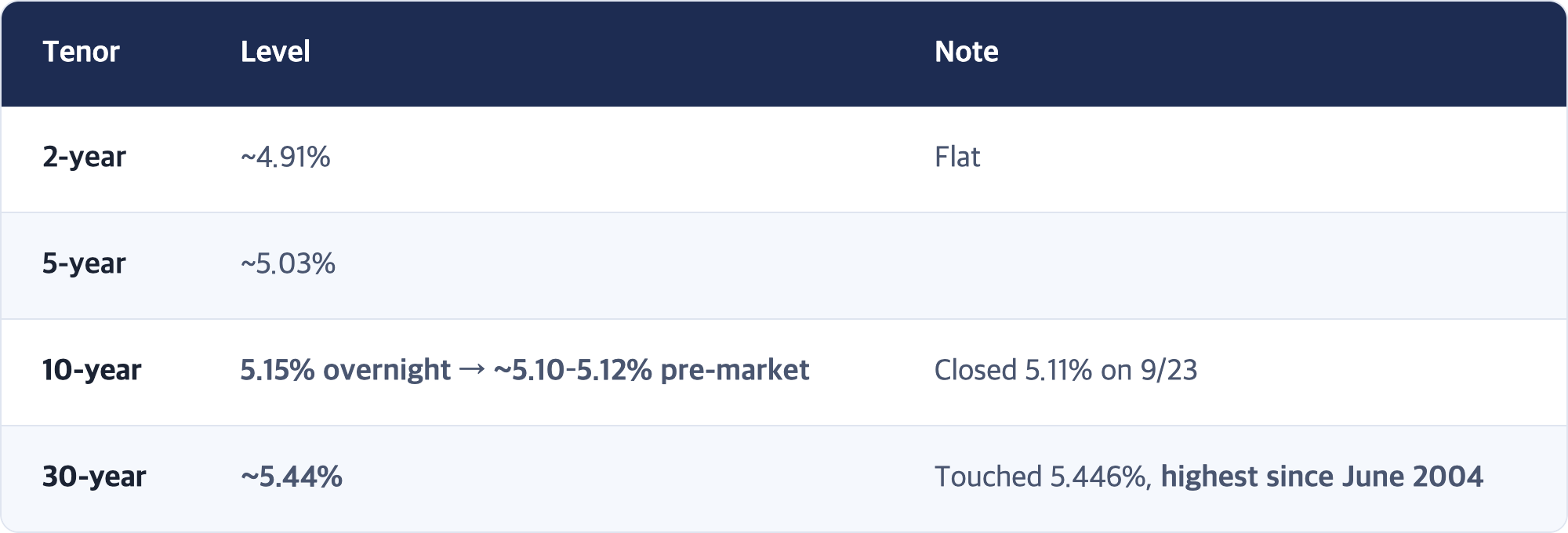
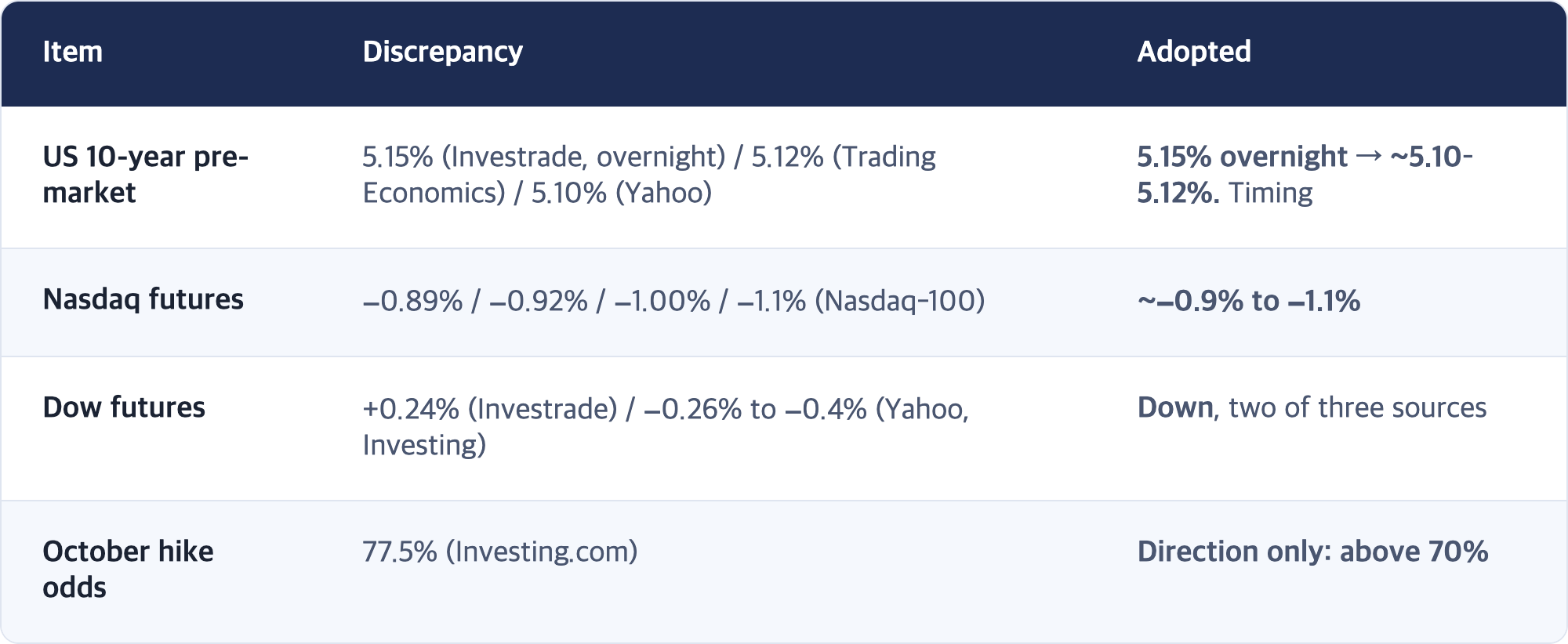
- Yields rose further overnight, then eased a little. The 10-year touched 5.15% (30-year 5.44%) before settling around 5.10–5.12% pre-market. The dollar index is near 101.1, its best since late July; USD/JPY about 158.8.
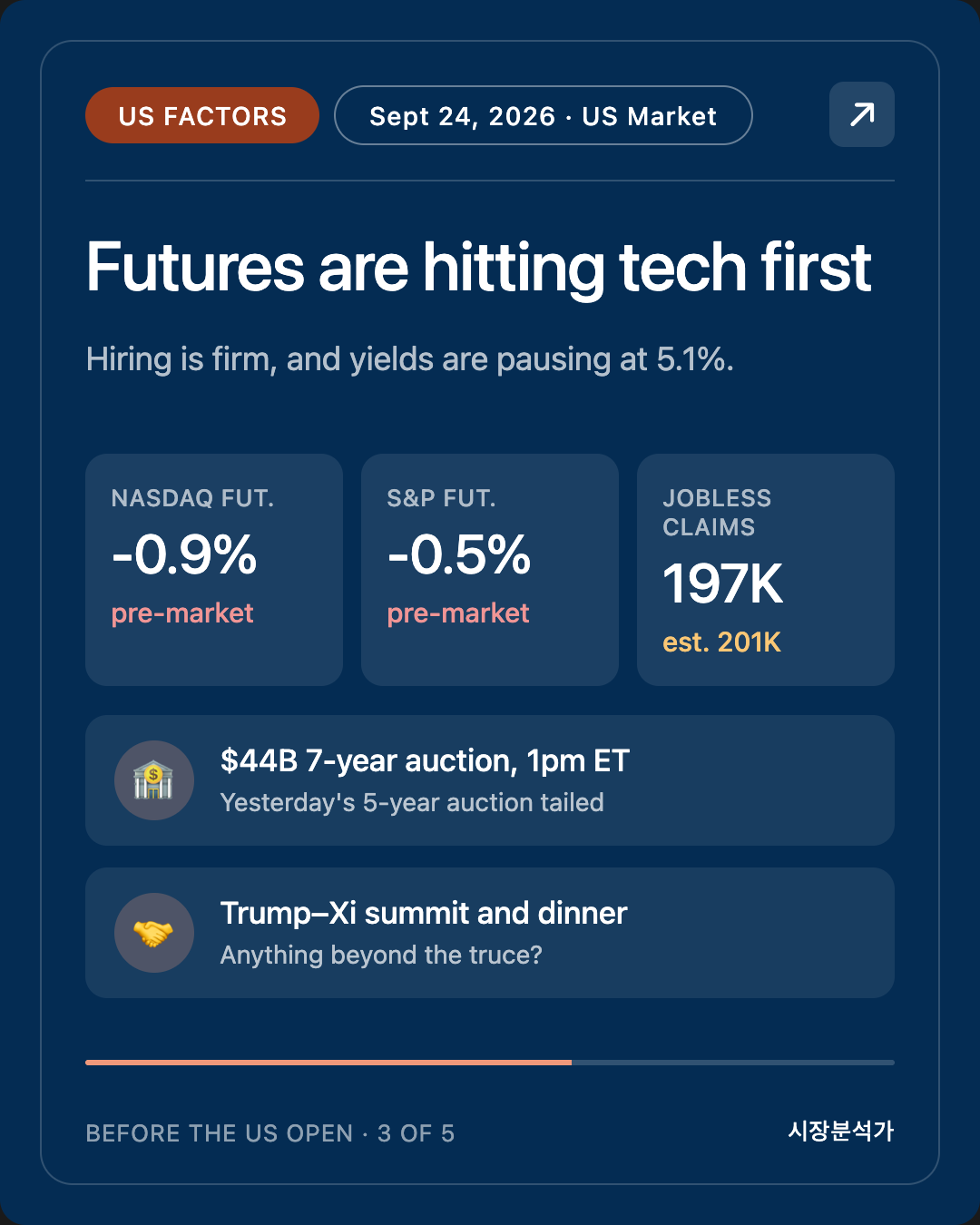
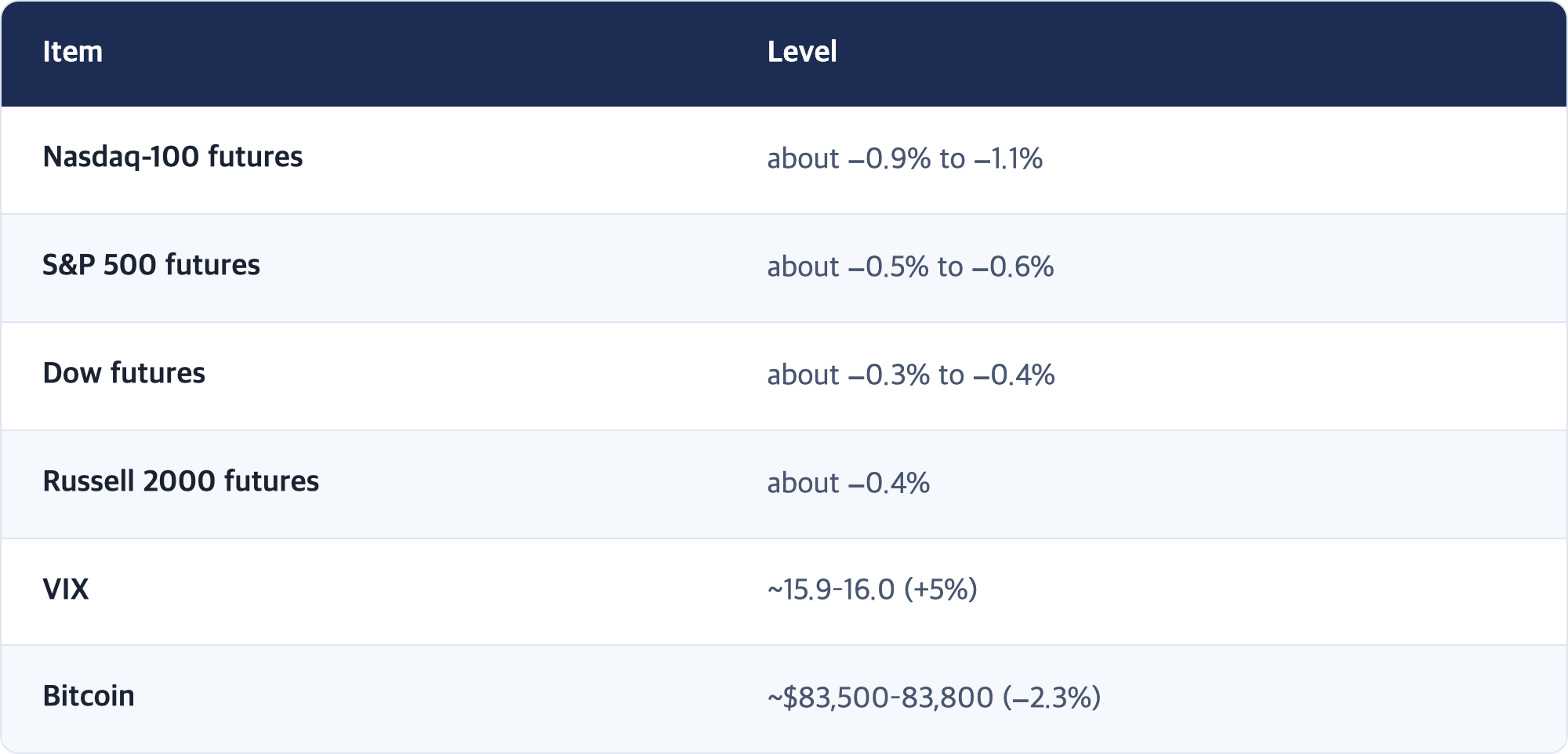
- US futures are hitting tech first. Nasdaq futures about −0.9%, S&P −0.5%, Dow −0.3%. Jobless claims 197,000 (consensus 201,000): the labor market is still firm, so good data still reads as hike pressure.
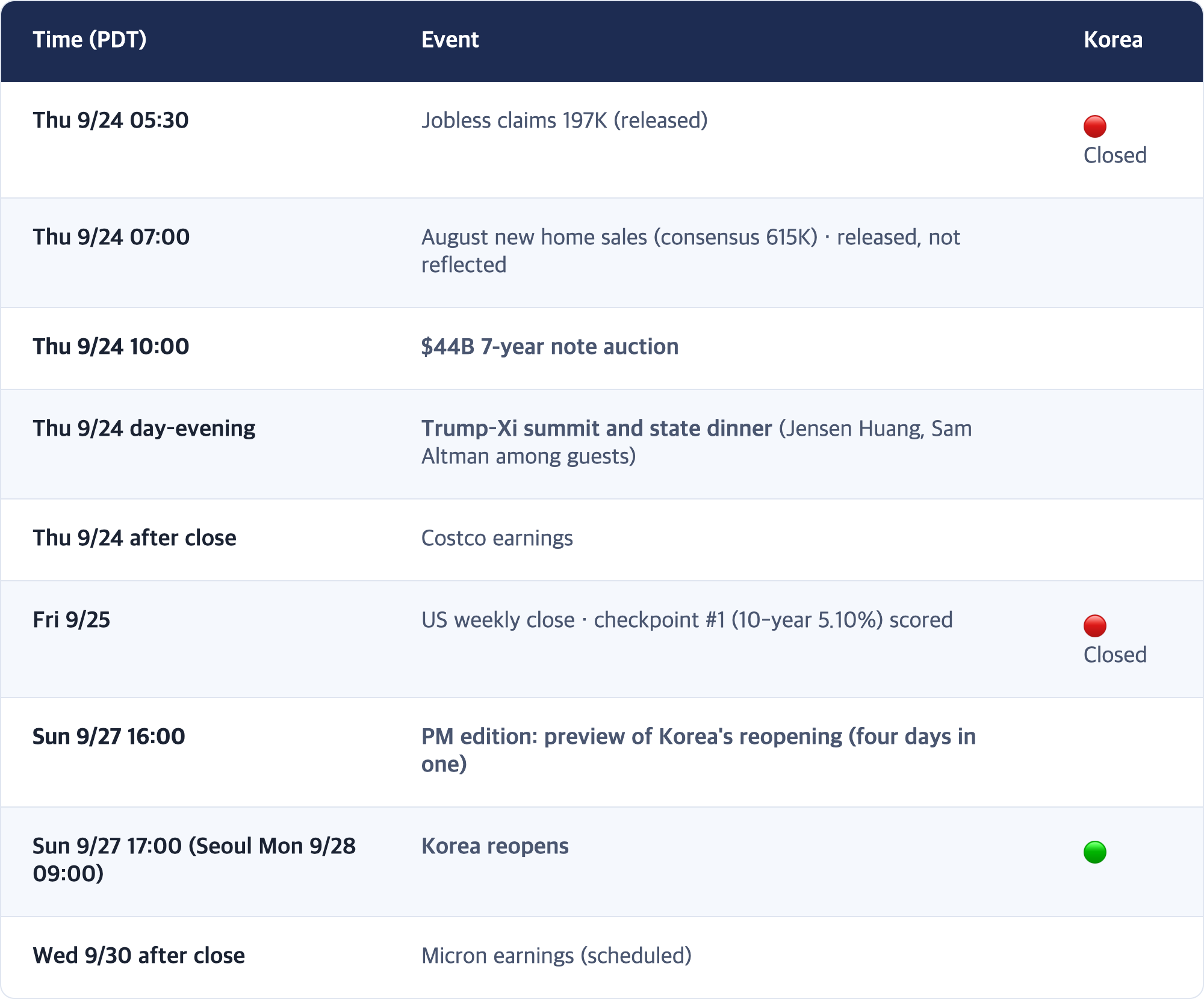
- Today in the US: $44B 7-year note auction at 1:00 pm ET, the Trump–Xi summit and state dinner, Costco earnings after the close. Brent about $104, WTI November about $93–94.
For readers outside Korea: Chuseok is Korea's harvest holiday. Seoul's market closed on Sept 23 and does not trade again until Sept 28, so four days of global news will hit Korean prices in a single opening.
This is Mr. Can. Here is the Sept 24, 2026 brief ahead of the US market open.
Written: 2026-09-24 07:55 PDT (Seoul 9/24 23:55 KST)
Covers: Japan, China and Hong Kong close 9/24 · Europe intraday 9/24 · US pre-market 9/24 (Korea closed for Chuseok)
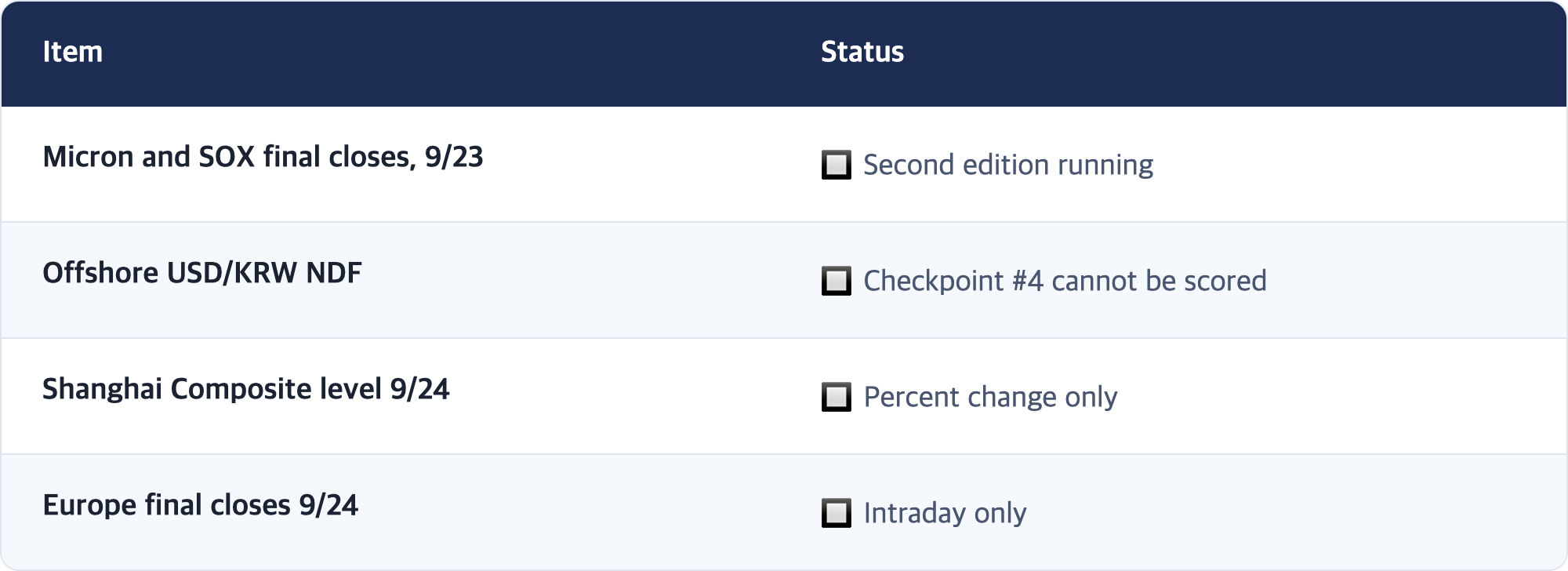
🟡 Published late. Scheduled 05:30 PDT, work started 05:42 PDT. The machine went to sleep mid-run and tools responded slowly, so this goes out about 85 minutes after the US open (06:30 PDT). All US figures below are pre-market; regular-session trading and the 7:00 PDT new home sales release are not reflected. Checkpoints still run to today's US close.
🟡 Korea is still closed. Chuseok holiday Sept 24–27, reopening Monday, Sept 28. "Asia close" in this edition means Tokyo, Hong Kong and Shanghai.
SEO Intro
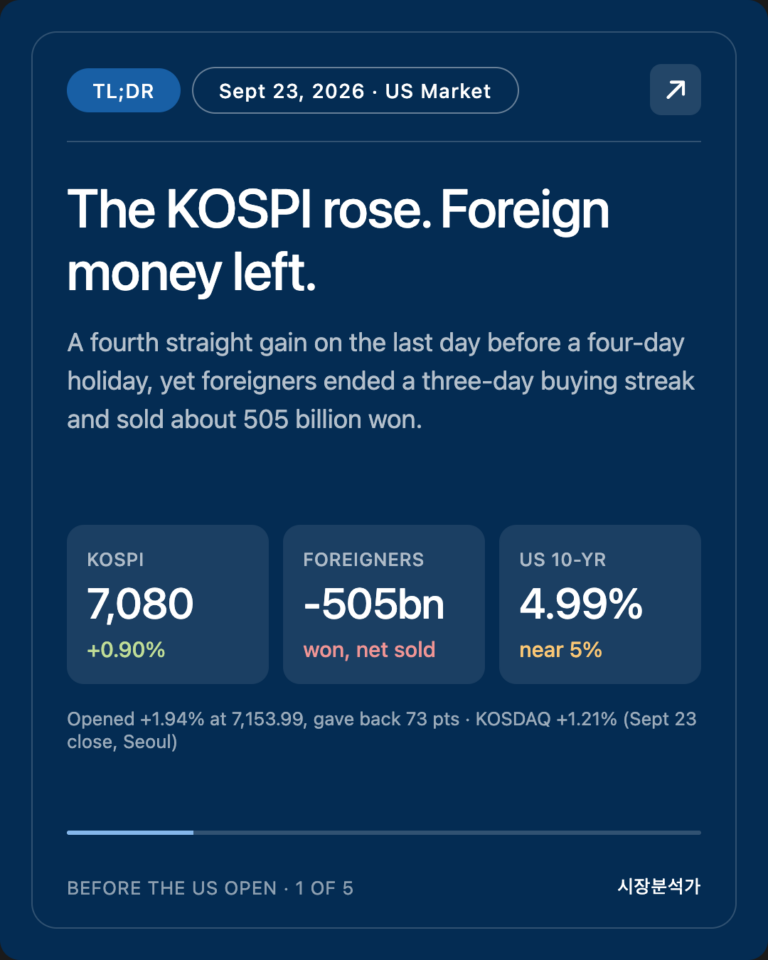
Last night the US 10-year Treasury yield hit 5.11%, its highest since 2007. This morning Tokyo went up anyway.
The Nikkei 225 closed at 65,647 (+628 points, about +0.97%). Returning from a three-day holiday, Tokyo priced not the bond selloff first but the 8%-plus rally in US chip stocks it had missed. Tokyo Electron and Advantest did the lifting.
The broader TOPIX fell, though. A handful of expensive chip names rose; the rest of the market absorbed the higher rates.
Meanwhile Washington delivered one answer early: the US–China tariff truce was extended to January 10. But that is two months. Markets had hoped for six or more. Hong Kong −1.0%, Shanghai −1.23%.
Seoul will take all of this in at once on the morning of Sept 28.
1. Mid-Holiday Scorecard (checkpoints set Sept 23, judged by Korea's Sept 28 reopen)
The axis I set last night: "Will Seoul's reopening gap lean toward the rate shock or toward the summit?" Here is where things stand on day two of four.
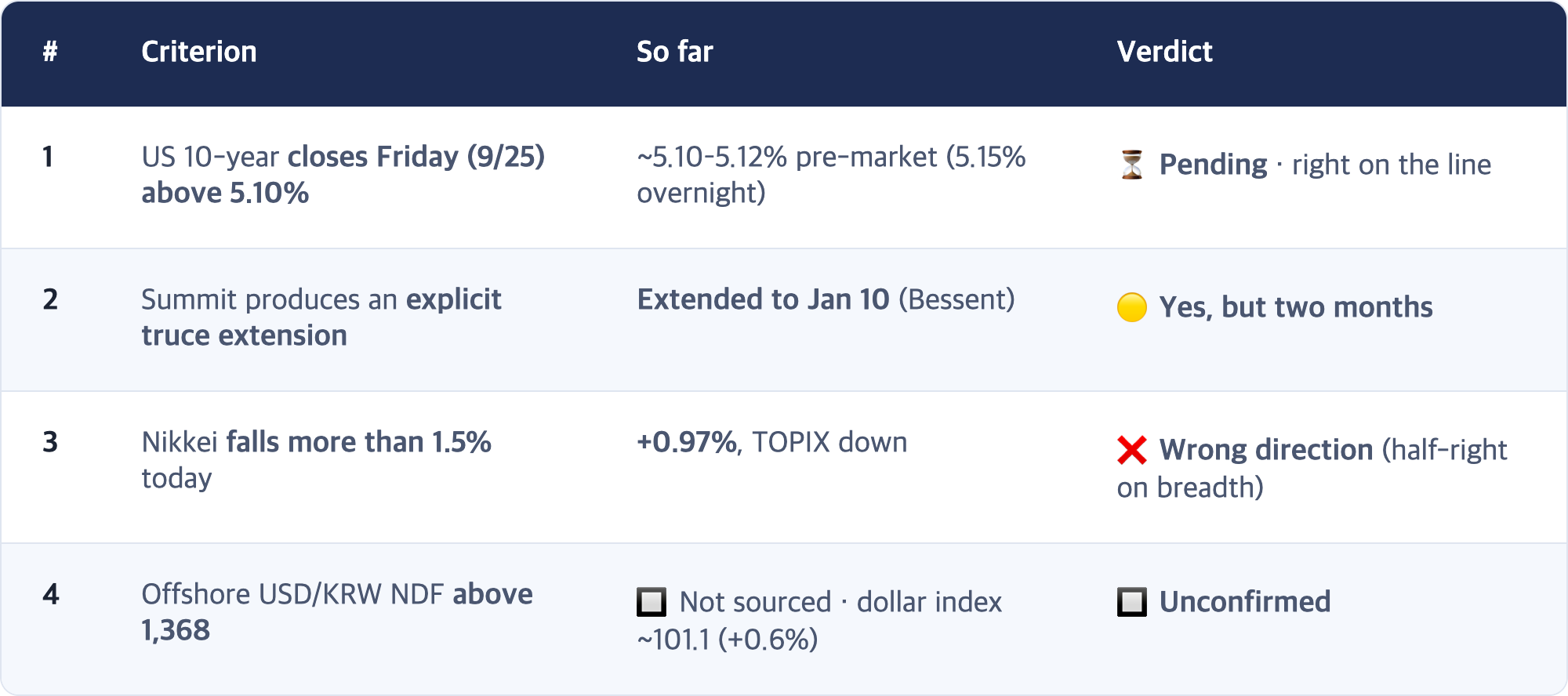
[Interpretation] #2 is a "yes," but a weaker one than I wrote about
Last night I said an extension would be good news for Sept 28, and "talks continue" would leave nothing to offset the rate shock. We got something in between. The extension is explicit, but short. Bessent said some Chinese commitments had been incomplete, and a larger economic package could come by January. Two months is less a truce than a homework deadline.
China's own markets graded it first: Hong Kong and Shanghai both fell more than 1%. "Extended" and "you can relax" turned out to be different things.
[Interpretation] I got #3 wrong, and the reason is worth keeping
I expected Tokyo to absorb three days of rate shock and set a −1.5% bar. But while Tokyo was shut (Sept 21–23), US chip stocks also surged (the Philadelphia Semiconductor Index reportedly gained more than 8% over the break). Tokyo priced both, and in the price-weighted Nikkei, chips won.
[Observation] The falling TOPIX says the broad market still took the rate hit. For Seoul on Sept 28, the preview is a split opening: chips carry the index, rates weigh on everything else. The KOSPI is heavily weighted toward Samsung Electronics and SK Hynix, so it could behave more like the Nikkei than the TOPIX.
2. The Main Story: A Longer Truce, a Shorter Runway
[Fact] US–China tariff truce (announced Sept 23–24 ET)
[Fact] Asia close, Sept 24
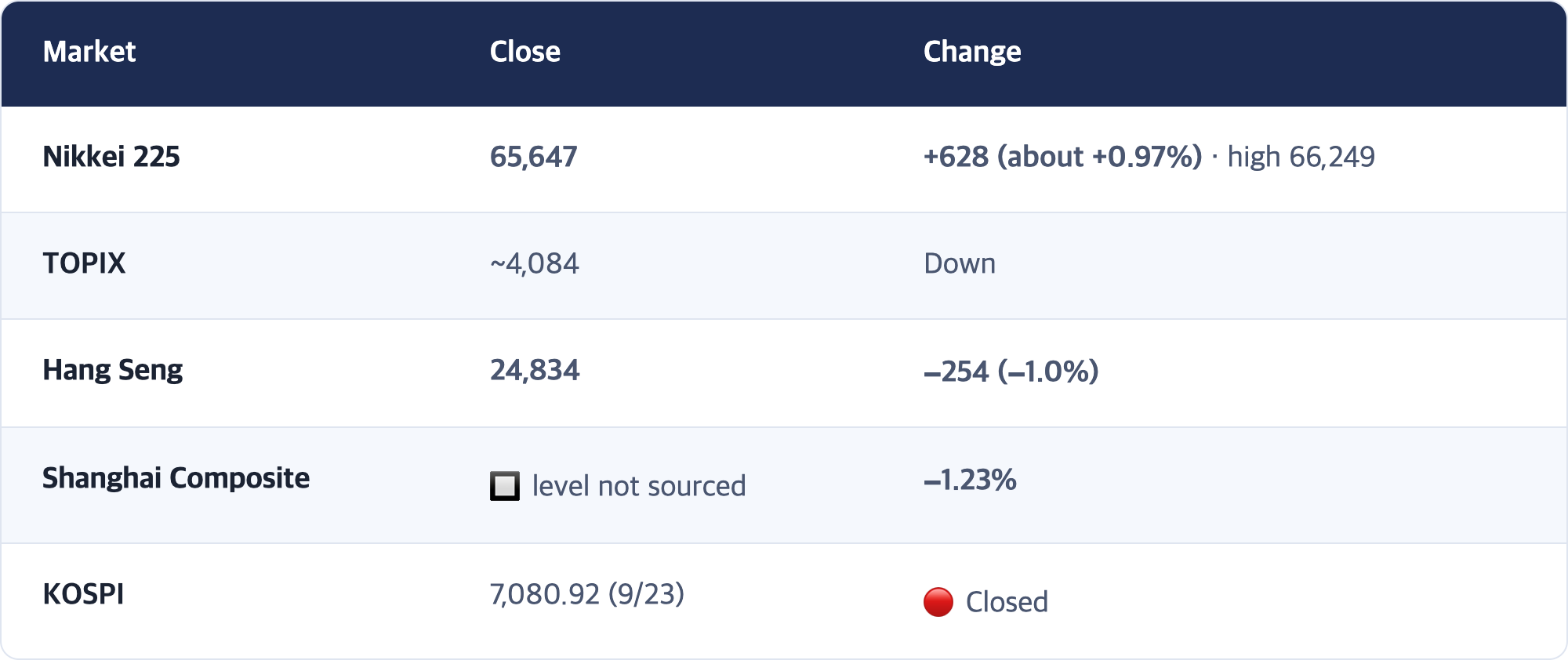
★ [Interpretation] Three markets, three readings of the same morning
- China (Hong Kong, Shanghai): the market most exposed to the truce read it as too short.
- Tokyo: looked past the truce to three days of chip gains.
- US futures: are reading neither; they are reading rates, with the Nasdaq weakest.
Of the three inputs Seoul will face on Sept 28 (rates, chips, trade), the trade grade is now in: two months. Rates and chips are still being decided in New York today.
3. The US Setup
[Fact] US close, Sept 23 (recap)
S&P 500 7,706.03 (−0.75%) · Dow 51,511.59 (−0.68%) · Nasdaq 26,936.04 (−1.13%) · Russell 2000 2,838.67 (−1.77%) · VIX 15.18.
[Fact] Pre-market, Sept 24 (around 06:00 PDT)
[Fact] Treasuries overnight
[Fact] Jobless claims (8:30 am ET)
Initial claims 197,000 (consensus 201,000, prior 198,000). Still historically low.
[Observation] October hike odds
Investing.com reported October hike odds at 77.5% (55.4% a week ago) and December odds above 58%. This project standardizes on CME figures, and I could not check CME directly today, so I am only adopting the direction: above 70%.
[Interpretation] Yields are pausing at 5.1%
Easing from 5.15% to about 5.10% looks like a breather after four drivers lined up yesterday. What decides whether the line holds is the 7-year auction at 1:00 pm ET. Yesterday's weak 5-year auction pushed yields up a second time; today's auction is effectively the day's second data release.
4. Macro Backdrop: Dollar, Yen, Oil, Europe
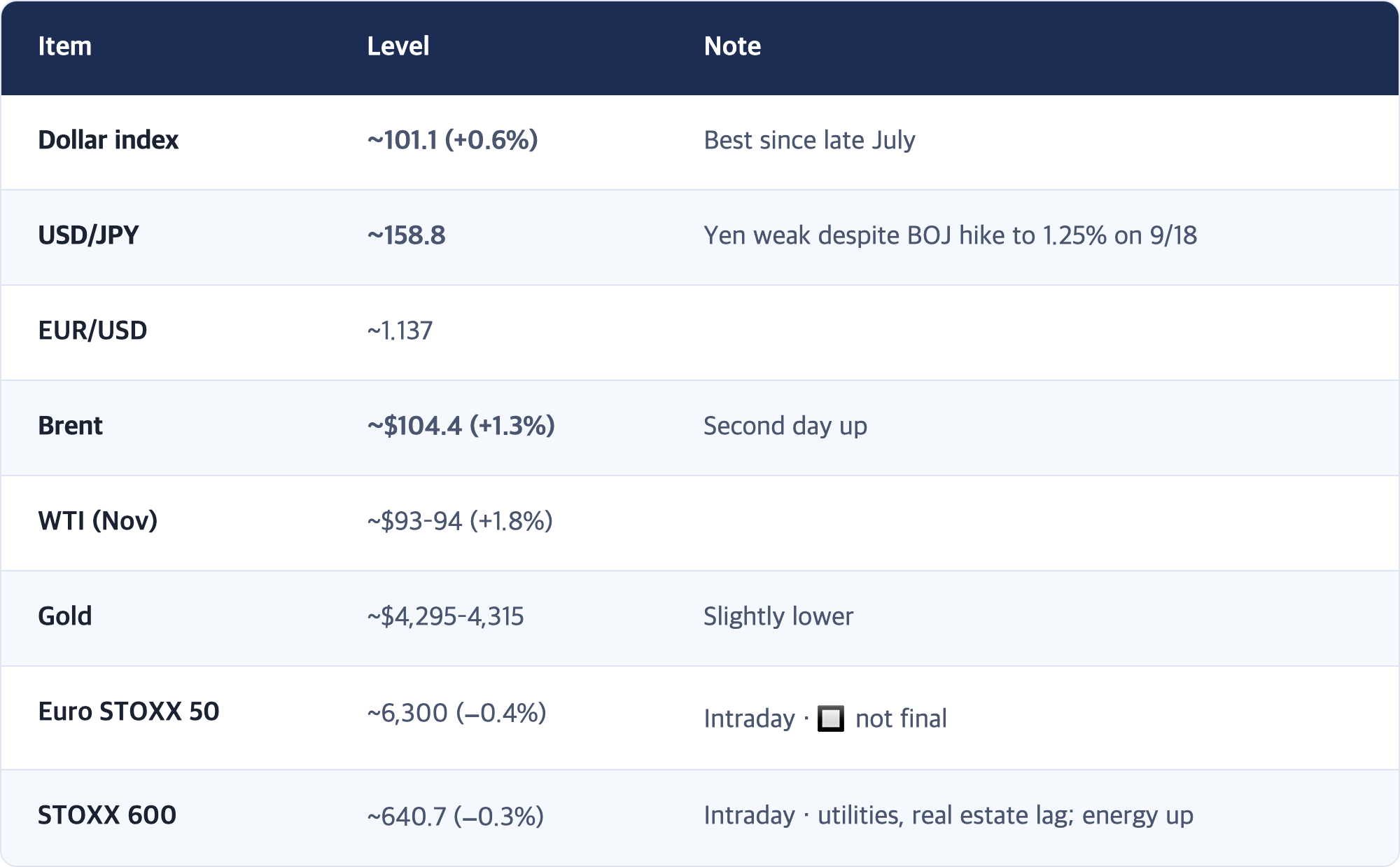
[Interpretation] Why the yen is weak even after a hike
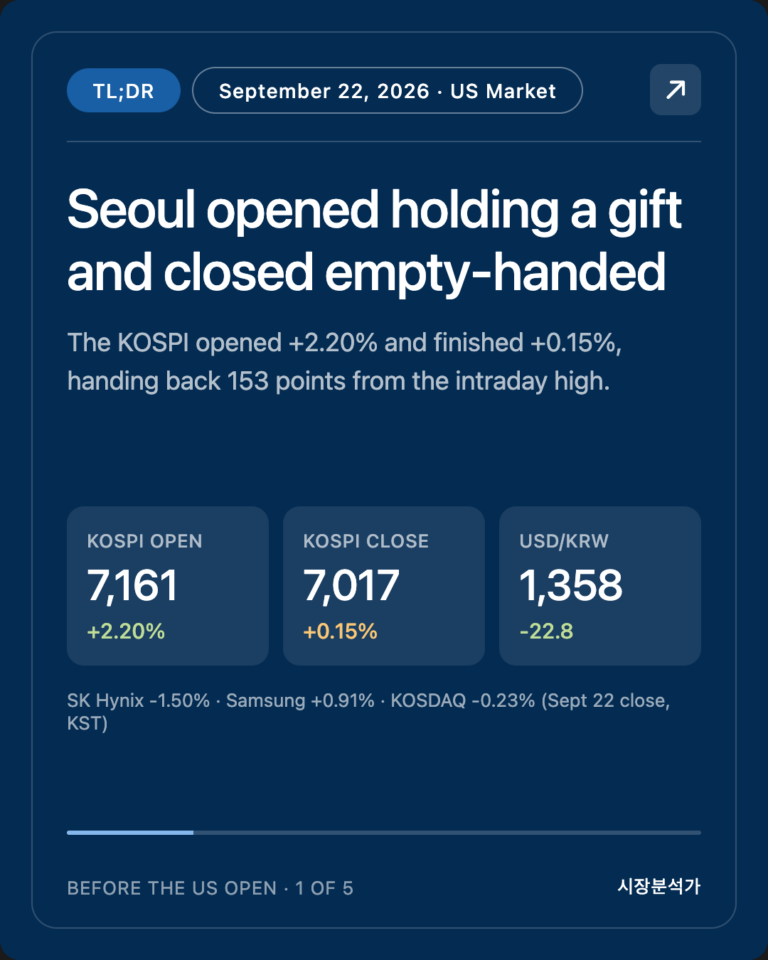
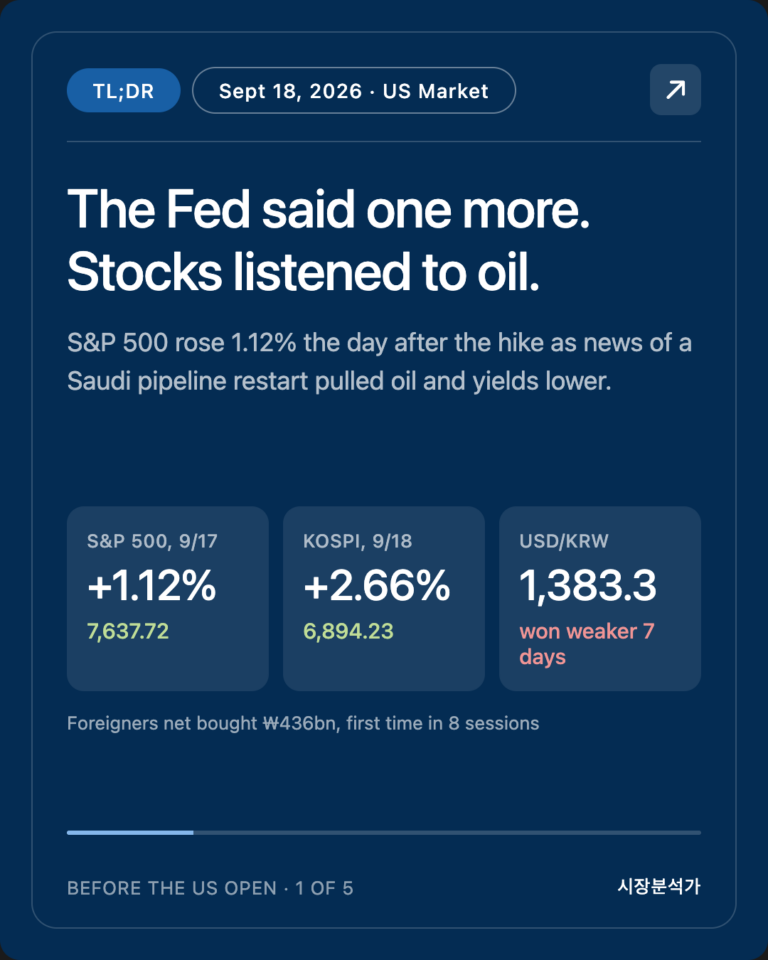
The BOJ raised rates on Sept 18, yet the yen trades near 158. With the US 10-year at 5.1% and Japan's around 3%, the gap is still more than two points. Japanese media spent the holiday on intervention watch. A dollar this strong is not comfortable for the won either: Seoul's USD/KRW open on Sept 28 is likely to start above the Sept 23 close of 1,358.4 (direction only; NDF not sourced).
[Observation] Europe is fighting the same battle
Eurozone yields are also near multi-decade highs, and rate-sensitive utilities and real estate fell first. Last night's rate move was not a US-only event. When growth and energy prices rise together, every central bank faces the same question.
5. Today's US Session (Sept 24 PDT)
✅ Four checkpoints
The axis: "Does last night's rate jump harden into a new level, and can chips withstand it?"
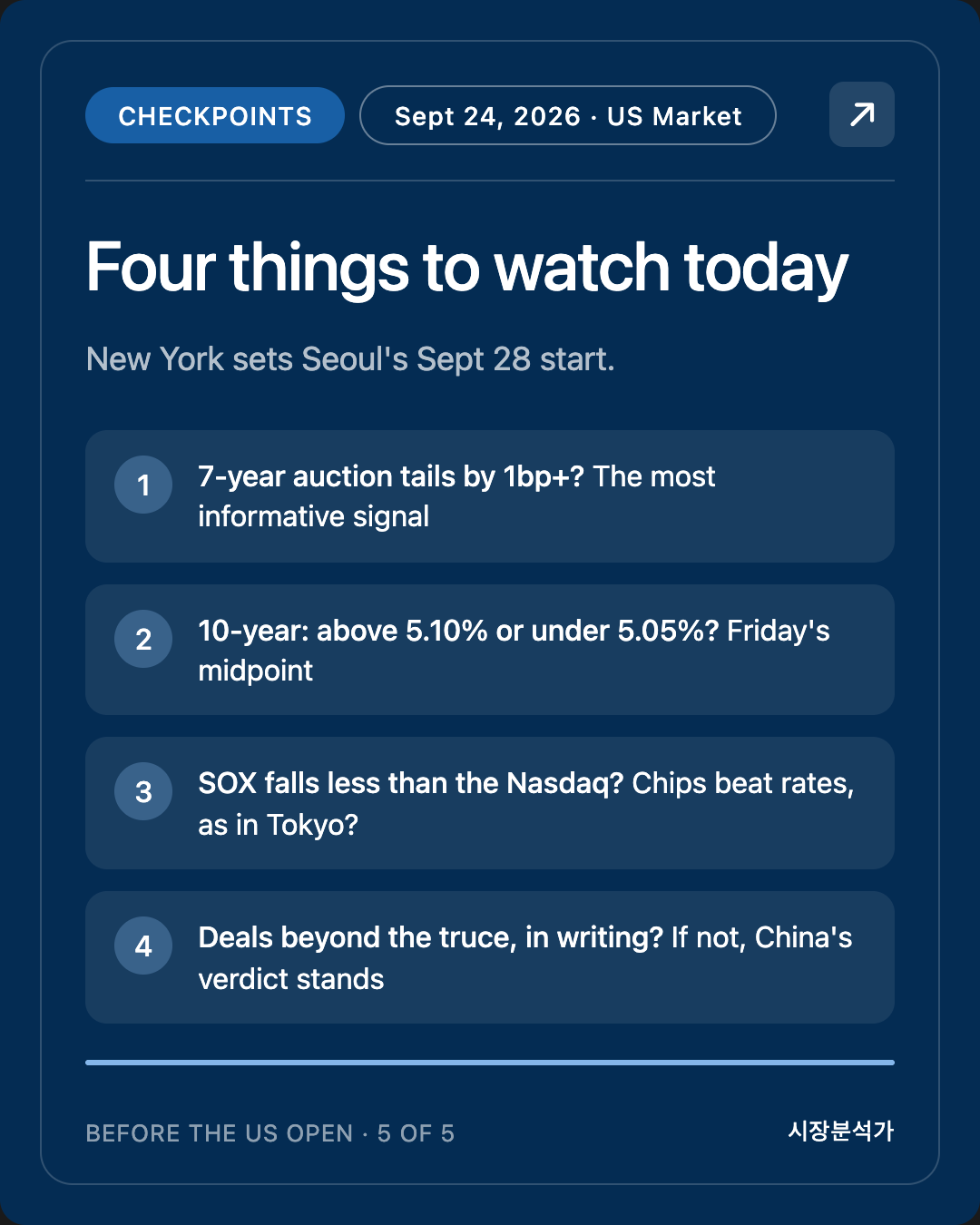
- Does the 7-year auction (1:00 pm ET) tail by 1bp or more? A tail would mean two straight days of weak demand, and 5.1% becomes the new floor.
- Does the 10-year close above 5.10% or below 5.05%? This is the midpoint for Friday's checkpoint.
- Does the SOX fall less than the Nasdaq (direction of the gap)? In Tokyo chips beat rates. If New York agrees, that favors Korea's two chip giants on Sept 28; if not, Tokyo's rally was a one-day event.
- Does the summit produce written deliverables beyond the truce (farm purchases, lower-tariff goods lists, an AI safety channel)? If so, the "only two months" disappointment eases; if not, China's own market verdict stands.
[Interpretation] The most informative of the four is #1. It tells us whether yesterday's jump was about data and Fed talk, or about money not showing up.
6. Study Note: Why the Nikkei Rose While the TOPIX Fell (Market Breadth)
Concept
Indexes are built differently. The Nikkei 225 is price-weighted: stocks with high share prices move it most. The TOPIX covers almost the whole Tokyo market, weighted by company size. So if a few high-priced chip-equipment stocks jump, the Nikkei can rise even when most stocks fall.
Breadth is how widely a move is shared. An index that rises on narrow breadth is being carried by a few names.
Analogy
Picture a class average where a few students' scores count extra, versus one where everyone counts equally. If three students ace the test and everyone else slips a little, the first average goes up and the second goes down.
Today's case
Tokyo Electron and Advantest pushed the Nikkei up 0.97%, while the TOPIX declined. Japanese coverage called it a rally of expensive index members and chip stocks, not a broad advance.
Applied to Korea
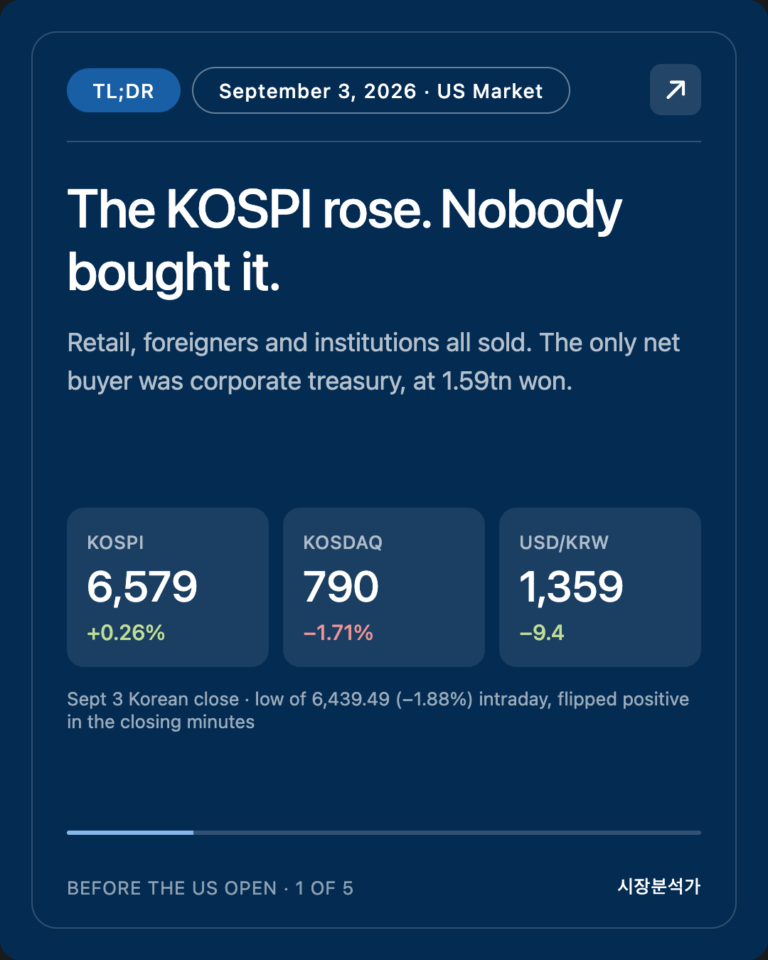
The KOSPI is cap-weighted, but Samsung Electronics and SK Hynix are a very large share of it. Korea often has days when those two lift the index while most stocks fall (Sept 23: 311 up, 548 down). Before reading the index, check how many stocks rose versus fell.
One line
On an up day, ask how many stocks did the lifting. Narrow rallies are the first to crack when their few leaders wobble.
7. Corrections and Open Items
🟡 Reframing yesterday's checkpoint #3
I called Tokyo "the market that solves Seoul's problem four days early," but the three days Tokyo absorbed included a chip surge, not only a rate shock. I set the bar counting one input. From now on, when a market reopens after a holiday, I will list every accumulated input by direction before setting a threshold.
🟡 Truce length needs checking
An earlier edition this week (Sept 21 AM) summarized the outcome of the Sept 20 trade talks as a "one-year truce extension." Today Bessent announced Nov 10 → Jan 10, two months. The two do not match. I am going with today's announcement and will recheck the Sept 21 source next edition.
Source discrepancies (adopted values)
🔲 Not yet confirmed
8. Event Calendar (PDT)
Sources
- Nasdaq, S&P 500 Futures Slide As Treasury Yields, Trump-Xi Summit Keep Traders On Edge | Yahoo Finance
- Stock market today: futures slide as bond sell-off troubles markets, Xi lands in US | Yahoo Finance
- Morning Preview: September 24, 2026 | Investrade
- U.S. stock futures dip after high yields batter tech; Trump-Xi summit begins | Investing.com
- U.S. and China agree to extend trade truce through Jan. 10, Bessent says | NBC News
- U.S.-China trade truce extended for two months, Bessent says | CNBC
- Nikkei Rises as AI and Chip Shares Lead Tokyo After Silver Week | News On Japan
- Hang Seng closes down 1% as Hong Kong selling outpaces Shanghai | 24/7 Wall St.
- United States Initial Jobless Claims | Trading Economics
- US 10 Year Treasury Note Yield | Trading Economics
- Euro Area Stock Market Index | Trading Economics
Market Analyst · This report does not recommend buying or selling individual securities. It offers macro context and interpretation.
📌 More market briefs
※ This post is market observation and organization intended to support your own judgment. It is not a recommendation to buy or sell any security. Figures are as of the time of writing and may differ between sources.
If this was useful, bookmark it or pass it along. It genuinely helps me write the next one.
I can survive. We can survive.