Sept 15, 2026 US Market Brief — Nasdaq and S&P 500 Before the Open
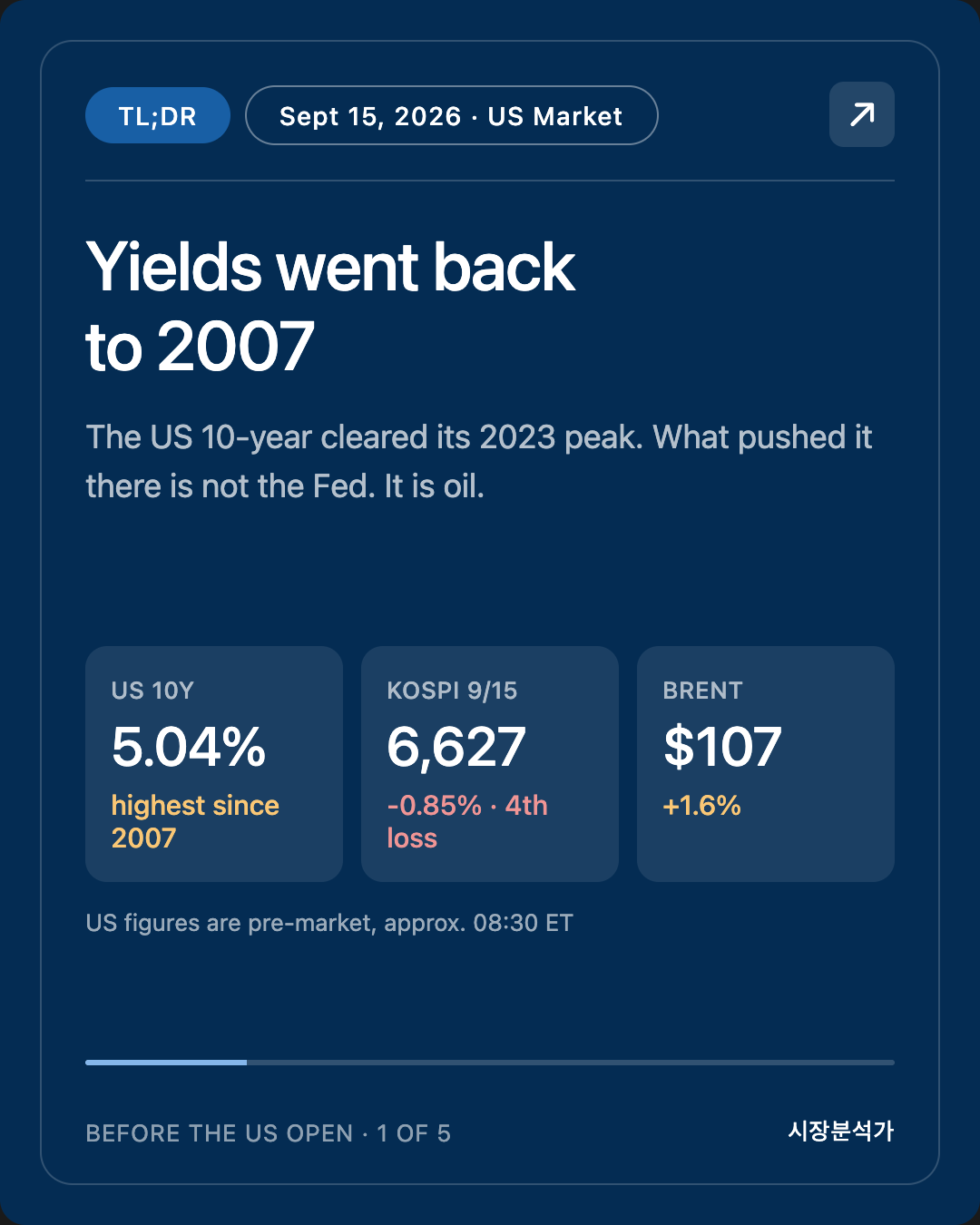
- The US 10-year hit 5.04%, the highest since July 2007 [observed], clearing the October 2023 peak of roughly 5.02%. The 30-year is at 5.40% and the 2-year at 4.686%. The whole curve is shifting up more or less in parallel.
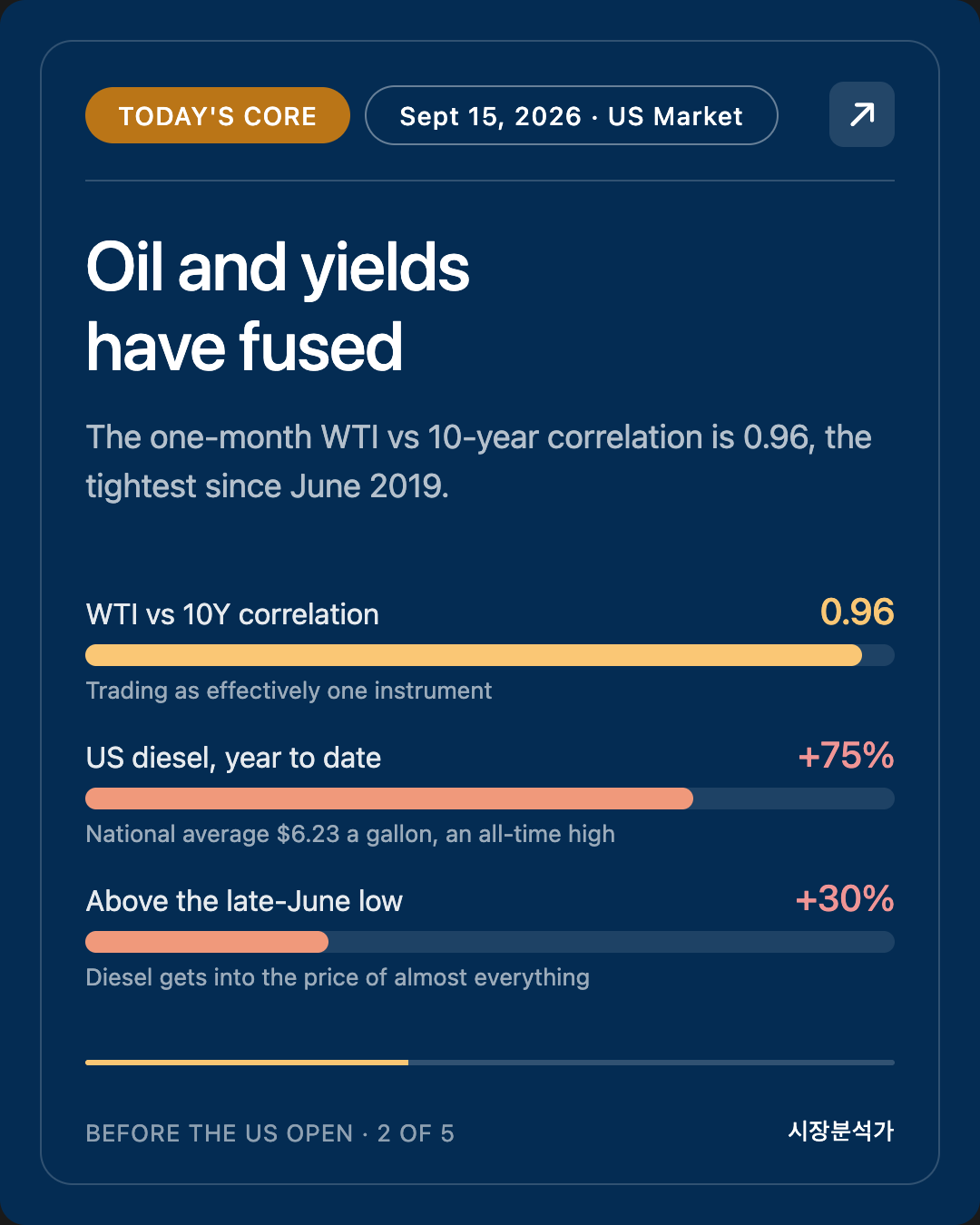
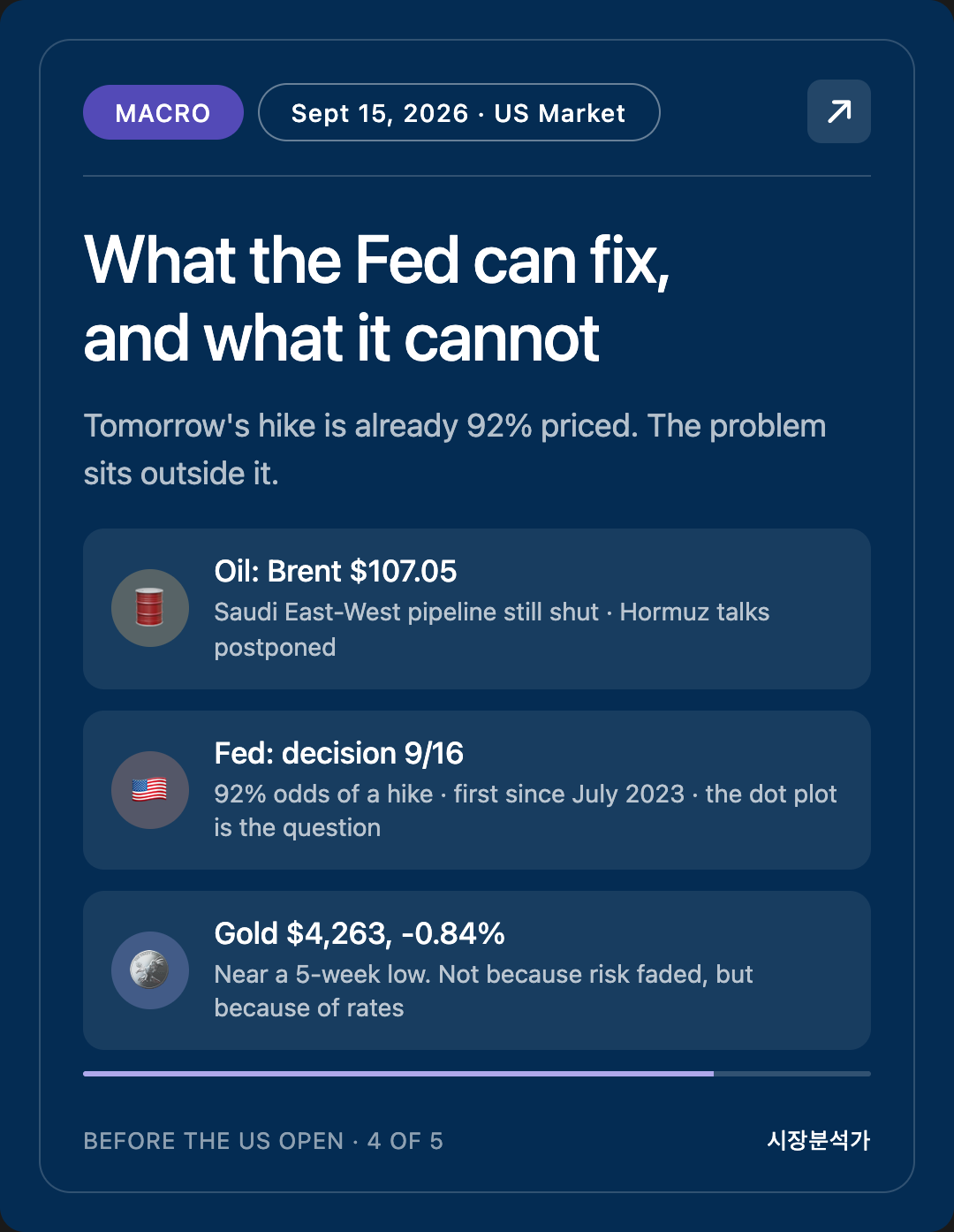
- Oil is doing the pushing. Brent $107.05 (+1.6%), WTI $102.9 (+1.5%). Per BMO Capital Markets, the one-month rolling correlation between front-month WTI and the 10-year yield is 0.96 — the strongest since June 2019. The two markets are trading as effectively one instrument.
- What hurt Korea yesterday was rates, not chips. The KOSPI closed at 6,627.26 (-0.85%) for a fourth straight loss, but Samsung fell only 0.20% and SK Hynix 0.41%. The index made its high of 6,715.46 and then broke down after 1 p.m. — the same window in which the 10-year crossed back above 5%.
- 🔴 Three of yesterday's four checkpoints came in as expected, and they point in opposite directions. The KOSPI held 6,600 (✅) and foreign net selling halved (✅), but the won closed at 1,359.4 per dollar, weaker by 12.1 won, clearing 1,350 (✅, the bad way). Money rotating inside Korea and money leaving Korea happened on the same day.
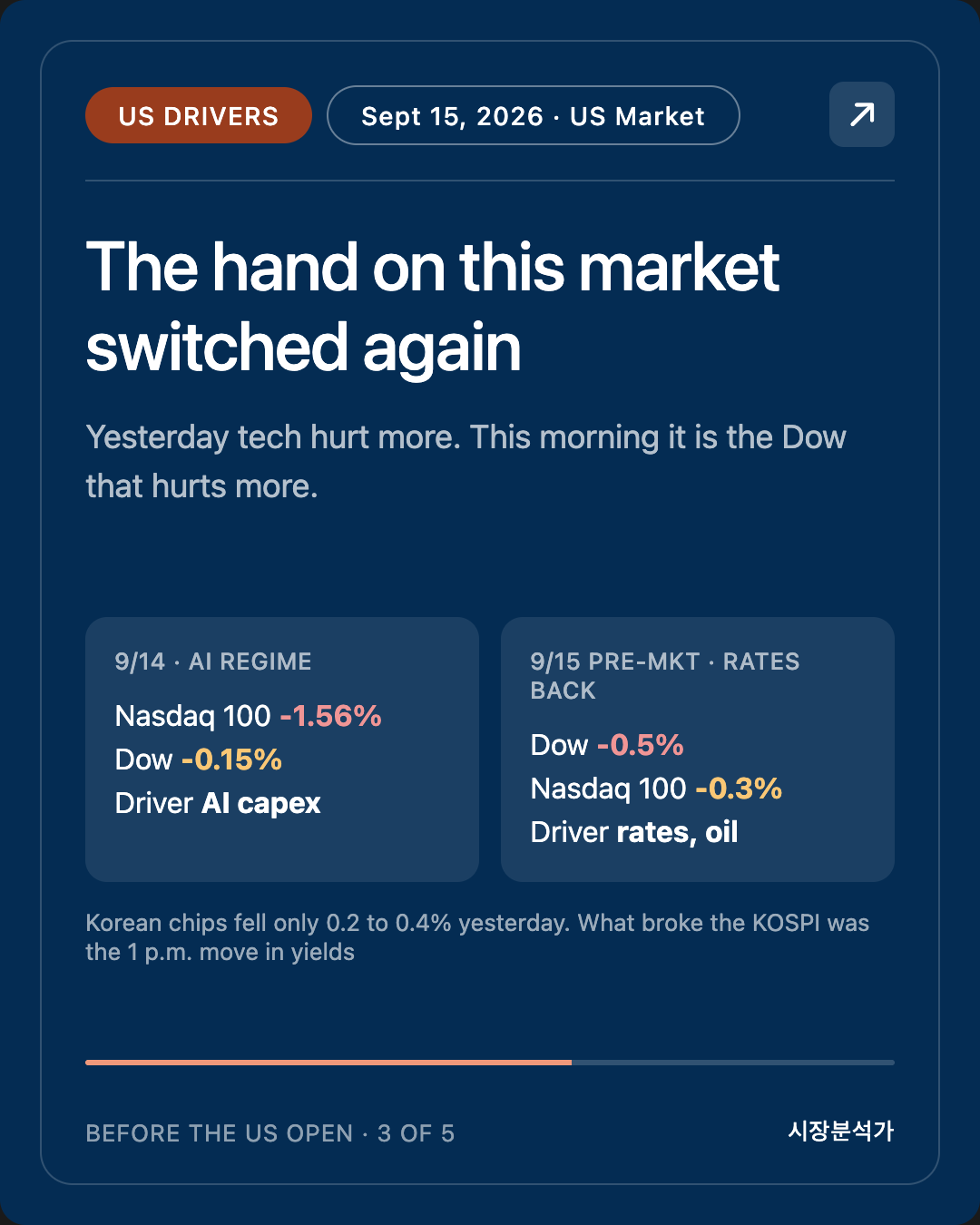
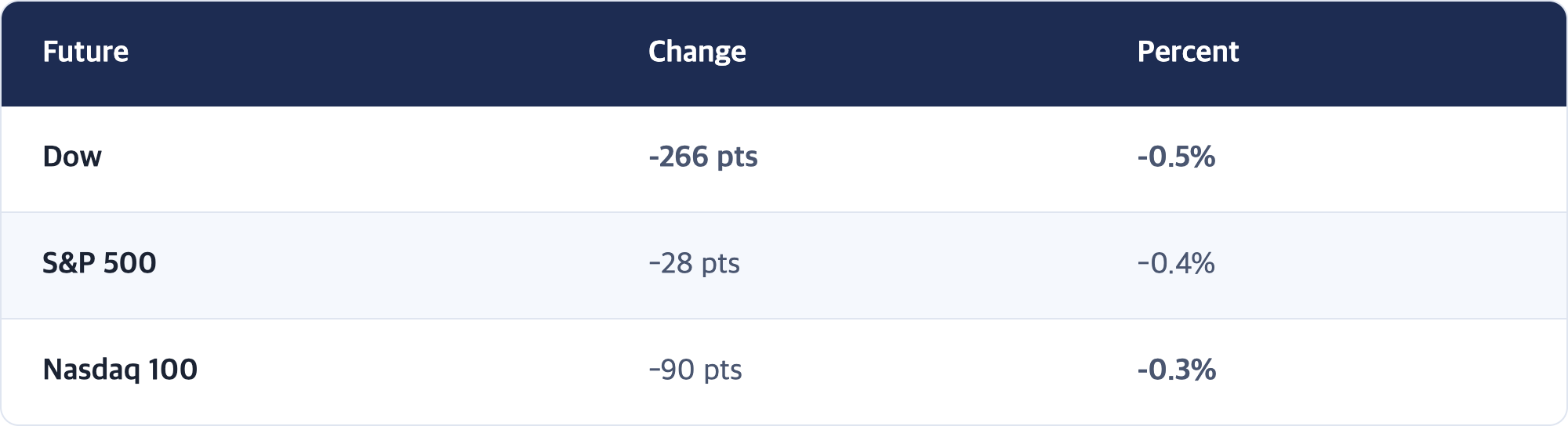
- The US pre-market is shaped the opposite of yesterday [observed]. Dow futures -266 pts (-0.5%), S&P 500 futures -28 pts (-0.4%), Nasdaq 100 futures -90 pts (-0.3%). Yesterday tech hurt more; today the Dow does. The hand pressing on this market changed again in 24 hours.
This is Mr. Can. Here is the Sept 15, 2026 brief ahead of the US market open.
Written: 2026-09-15 05:41 PDT (Seoul 9/15 21:41 KST)
Basis: Asia close 9/15 + Europe morning 9/15 + US confirmed close 9/14 + US pre-market 9/15 (approx. 08:30 ET)
✅ On schedule. Scheduled 05:30 PDT, started 05:41 PDT — the fifth consecutive on-time run.
Written roughly 50 minutes before the US regular session opens (06:30 PDT). Pre-market figures can still move; they are tagged [observed].
SEO Intro
Yesterday this report asked a question about semiconductors. The Philadelphia Semiconductor Index had fallen 5.86% in a single US session, and the question was whether that selling represented money leaving Korea or money changing seats inside Korea.
This morning, that question turned out to have a shelf life of one day.
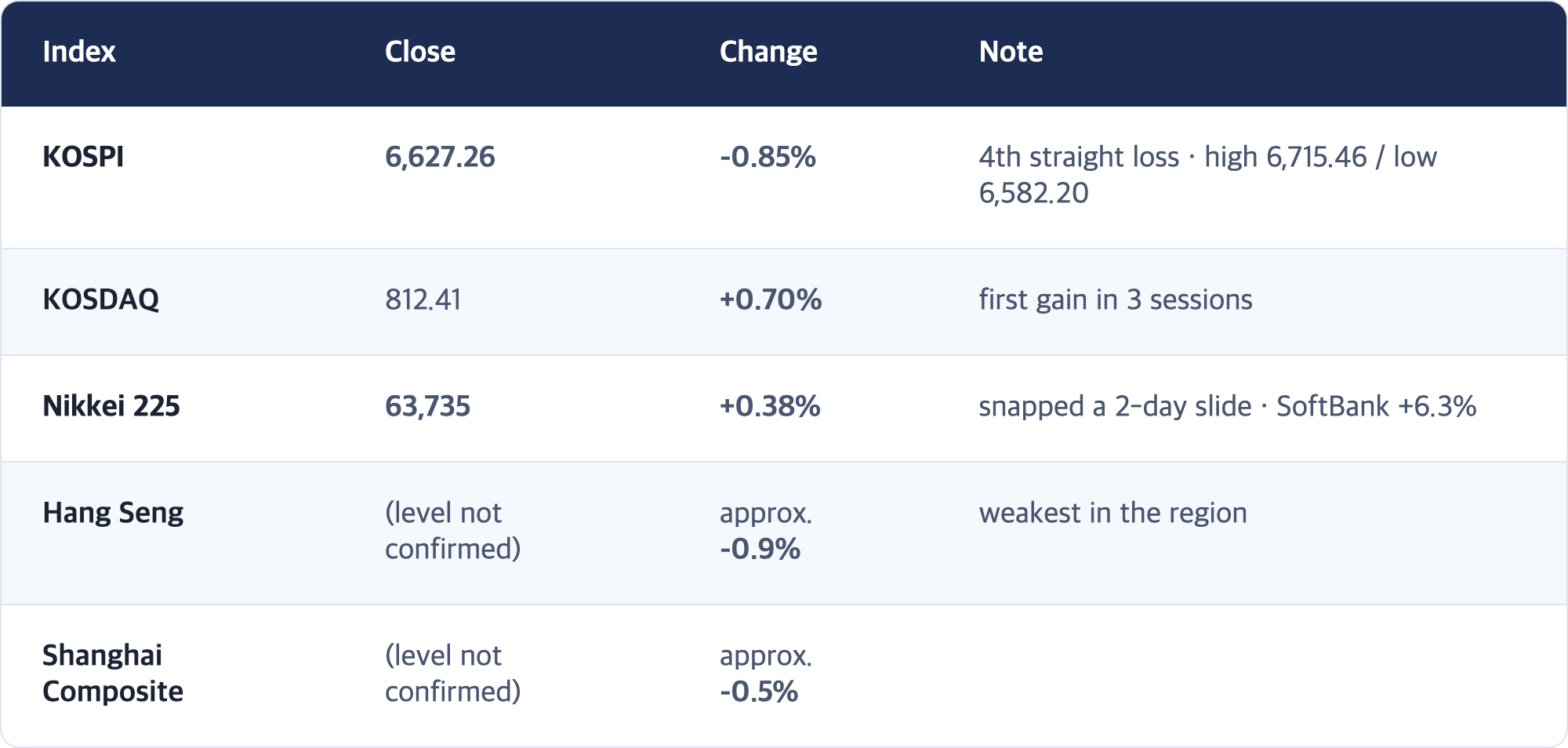
In Seoul yesterday, Samsung Electronics fell just 0.20% and SK Hynix 0.41%. Almost none of Wall Street's 5.86% carried over. And yet the KOSPI turned negative after 1 p.m. and closed at 6,627.26, down 0.85% — its fourth straight decline.
If it wasn't chips, what was it? At roughly that hour, the US 10-year Treasury yield traded back above 5% in Asian hours.
And right now, fifty minutes before the New York open, the 10-year is at 5.04% — above its 2023 peak and at the highest level since July 2007.
The Fed raises rates tomorrow. The market puts it at 92%. But the thing pushing this yield up today is not the Fed.
1. Today's core: the rate the Fed sets, and the rate the market sets
[Fact] The Treasury curve right now
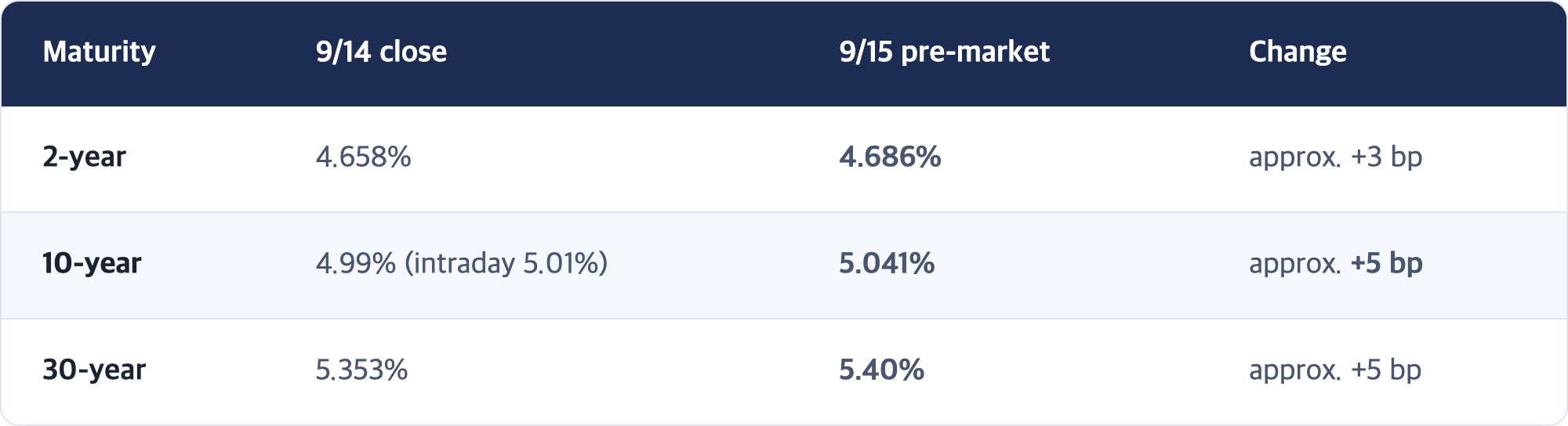
A 10-year at 5.04% is above the October 2023 high. To find a higher print you have to go back to July 2007. The 30-year at 5.40% is in the same territory.
ℹ️ Sources differ: some put the 10-year at 5.02% (+4 bp), others at 5.041% (+8 bp), depending on the snapshot time. This report reads it as roughly 5.04% and defers the precise call to today's close.
🔴 [Interpretation] The curve moved up in parallel
The shape matters more than the level here.
The 2-year rose, the 10-year rose, the 30-year rose. The long end is moving slightly faster, but broadly the entire curve shifted upward together. The 2s10s spread widened only about 2 bp, from roughly 33 bp to 35 bp.
That shape says two things are happening at once.
- Why the short end is rising: the Fed hikes tomorrow. CME FedWatch puts a 25 bp increase at about 92%, up from 84.1% on 9/14.
- Why the long end is rising: not the Fed. Oil.
[Fact] Oil and yields have fused
Per BMO Capital Markets, the one-month rolling correlation between front-month WTI and the US 10-year yield has climbed to 0.96 — the strongest positive relationship since June 2019.
A correlation of 0.96 means the two are nearly the same trade. Oil up, yields up. Oil down, yields down. There is very little room left for anything else to intervene.
One number from yesterday explains why.
The US national average diesel price hit $6.23 a gallon, an all-time high. That is 30% above the late-June low of $4.77 and up 75% year to date.
KPMG chief economist Diane Swonk put it plainly: diesel gets into just about everything. Anything that moves on a truck picks up the surcharge.
🔴 [Interpretation] Which is why tomorrow's dot plot cannot fix this
This is the single most important line in today's report.
The Fed sets a short rate. If it lifts by 25 bp tomorrow, the 2-year responds. But mortgages, corporate bonds and capital-spending decisions price off the 10-year and 30-year, and what is moving that part of the curve right now is the Strait of Hormuz and a Saudi pipeline.
There is an awkward structure underneath. A hawkish Fed does not quickly suppress oil-driven inflation, and a dovish Fed risks lifting inflation expectations and pushing long yields higher still. Neither branch is friendly to the long end.
So the thing to watch today is not the Fed itself but whether oil keeps dragging yields along. Checkpoints 1 and 3 below test exactly that.
[Interpretation] Without overstating it
In fairness: oil is not the whole story.
Bloomberg flags two other forces. First, governments are increasing issuance to refinance maturing debt and fund deficits. Second, large-scale corporate borrowing to fund AI buildouts is adding supply to the bond market.
So three things are stacked into long yields right now: ① oil-driven inflation expectations, ② heavier government and corporate bond supply, ③ Fed tightening. The Fed directly controls exactly one of them.
2. Grading yesterday's checkpoints (Korea, 9/15)
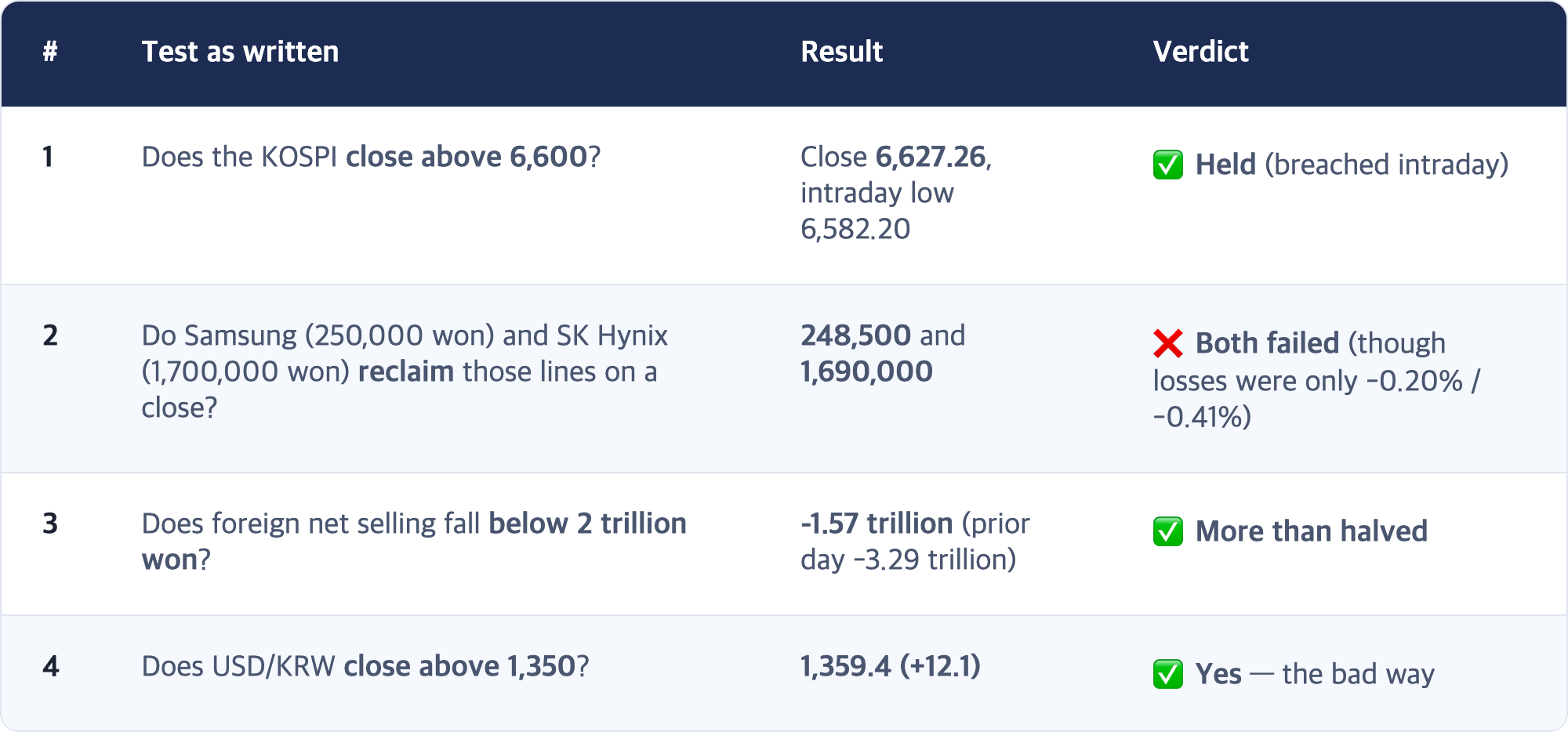
Yesterday's report set four tests for the Korean session, along one axis: is the chip selling money leaving Korea, or money changing seats inside Korea?
🔴 [Interpretation] Three hits, two opposite answers
Under yesterday's own decision rule, a ✅ on #3 meant sector rotation and a ✅ on #4 meant capital flight. Both printed.
And in fact both happened.
Evidence of rotation inside Korea: the KOSDAQ rose to 812.41 (+0.70%), its first gain in three sessions. Battery and refining names led: LG Energy Solution +3.98%, Samsung SDI +2.82%, SK Innovation +3.66%. Corporate buyers — largely companies repurchasing their own shares — took in 1.64 trillion won.
Evidence of money leaving: the won weakened 12.1 to 1,359.4, and foreigners sold for a fifth consecutive session even at the reduced size.
🔴 [Interpretation] Retracting half of a line from yesterday
Yesterday's report argued that Korea has no obvious place for money to rotate into, so a decision that stays inside the market in the US becomes an outflow in Korea.
Half of that was wrong. There was somewhere to go yesterday. It simply was not the destination the report imagined. Not hyperscalers — batteries and refiners.
The catalyst was also American. A US Department of Transportation letter asking Ford to unwind its relationship with China's CATL lifted expectations that Korean battery makers benefit by default, layered on top of growing US grid-storage demand. Refiners, for their part, are direct beneficiaries of $100 oil.
The lesson: before concluding there is no alternative destination, count which sectors the day's new catalysts attach to. Not all of the money that left Korean chips left Korea.
[Interpretation] But #2 is the heavier miss
Samsung and SK Hynix did not reclaim their psychological lines. Falling only 0.2–0.4% the day after a 5.86% US chip rout is resilience. It is not a recovery.
That matters for tonight's Seoul session. Chips have stabilized but have not begun to mend, and rates and the currency have moved in on top.
3. Asia and Europe (9/15)
[Fact] Asia
[Fact] Korean flows (KOSPI)
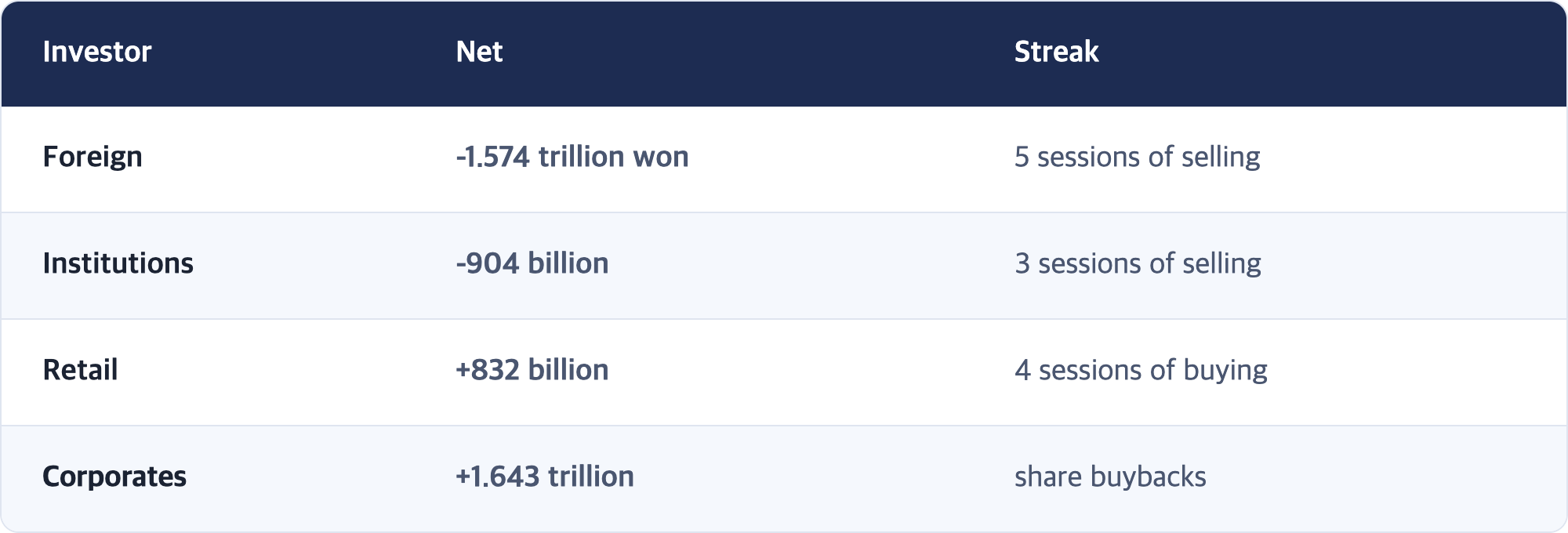
ℹ️ On the basis that includes the Nextrade alternative venue, the figures are foreign -1.706 trillion, institutions -1.143 trillion, retail +1.194 trillion, corporates +1.650 trillion. This report uses the Korea Exchange basis, consistent with prior editions.
🔴 [Interpretation] Buybacks built the index again
Corporate buying of 1.64 trillion won absorbed most of the 2.48 trillion sold by foreigners and institutions combined.
The same structure appeared on August 31 and September 3. On days when buybacks build the tape, the index direction can diverge from participant conviction. Yesterday's -0.85% would have been a larger number without them.
[Fact] Japan: SoftBank took it back
SoftBank Group, down 10.7% the previous day, rebounded 6.3% and carried the Nikkei. The company secured $11.87 billion in new two-year facilities from roughly 20 financial institutions. Kioxia added 2.5% on reports it is weighing a $10 billion ADR listing.
Japanese chip-adjacent names recovered in a day; Korean ones stood still. Within one sector, single-name catalysts are currently outranking the sector story.
[Observed] Europe
Europe closed 9/14 with the STOXX 50 -0.5% and STOXX 600 -0.1%, with ASML -4% and Infineon -6% at the bottom, while energy led the other way (Shell +1.1%, TotalEnergies +1.0%, BP +1.2%). The 9/15 morning tone tracks US rates and crude.
4. The US: a pre-market shaped opposite to yesterday
[Observed] Futures (approx. 08:30 ET)
🔴 [Interpretation] The pressure switched twice in two days
Put three sessions side by side.
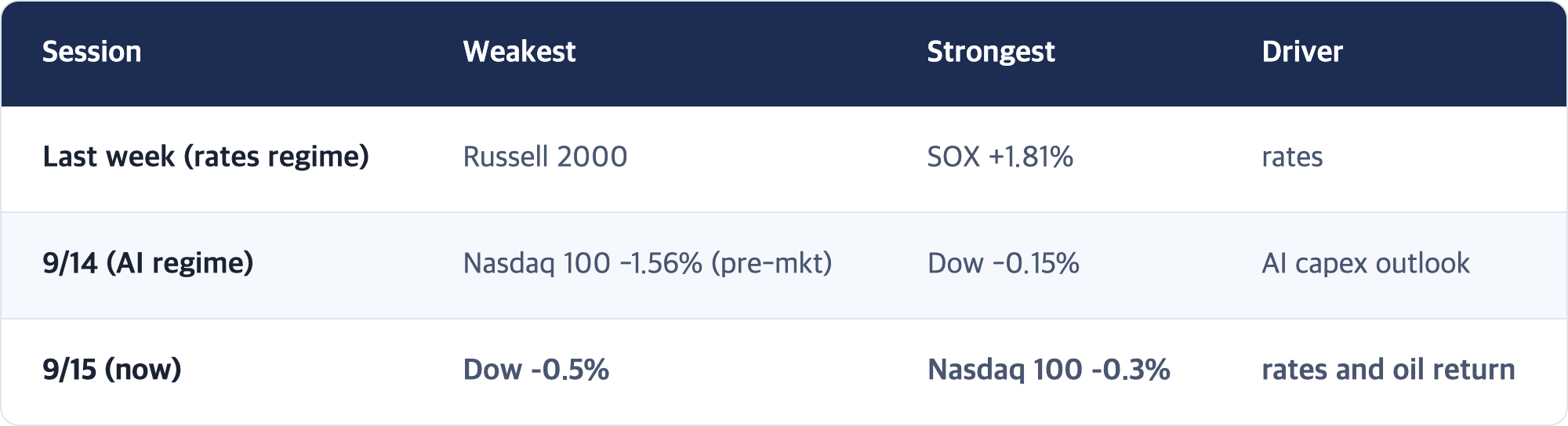
Yesterday tech hurt more; today the Dow does. That reads as the AI story being a one-day event and the rate story reasserting itself.
That said, this rests on pre-market futures alone and needs confirmation at today's close. On September 3 and again on September 14, this project drew the wrong axis by comparing index against index. Today's checkpoints therefore do not ask about index spreads.
[Fact] Everything else [observed]
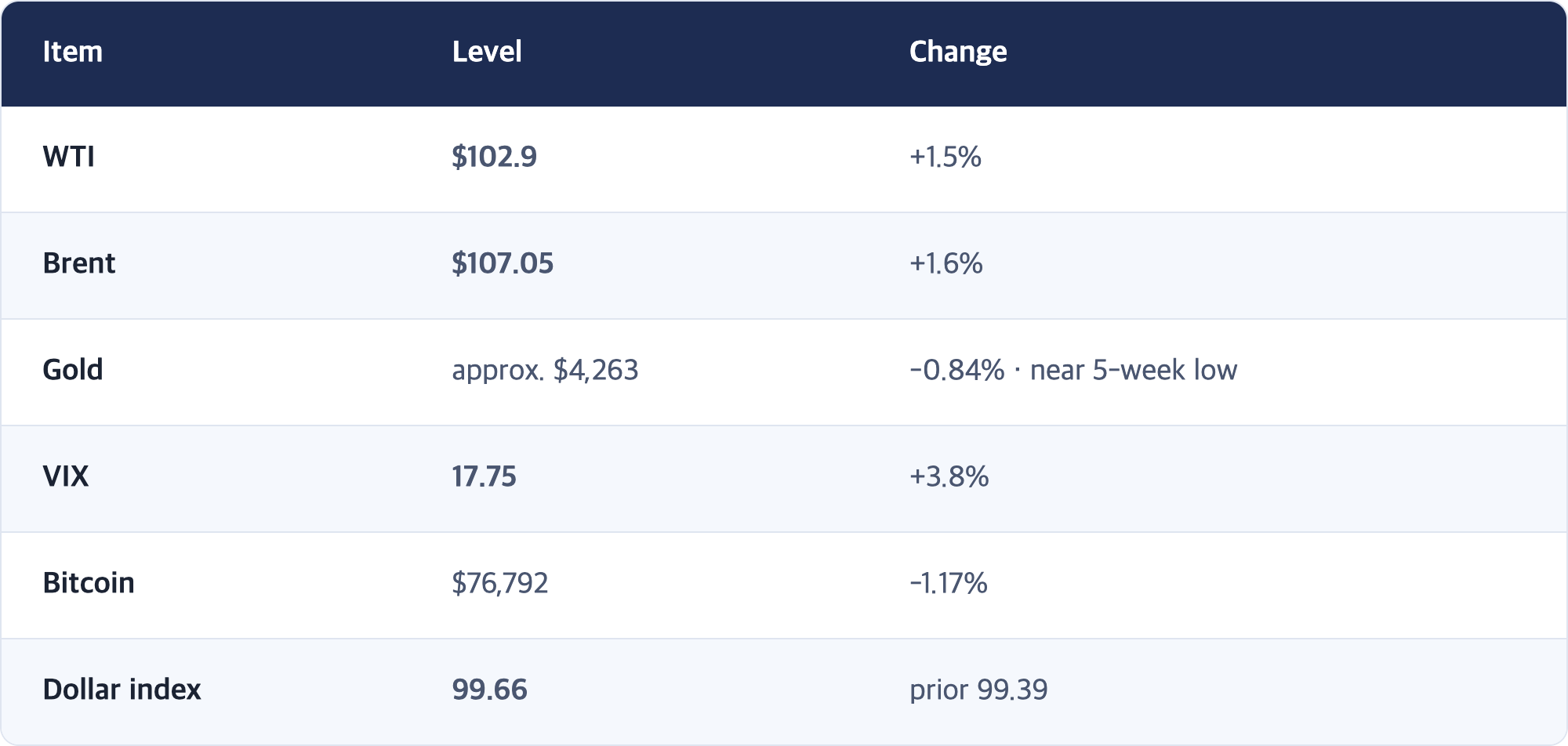
Note gold near a five-week low. Rising yields penalize an asset that pays no interest. Gold is weak not because risk has receded but because of rates. Gold falling while geopolitical risk builds tells you, again, which variable is running this market.
5. Macro backdrop: the Fed tomorrow, and 8:30 a.m. ET today
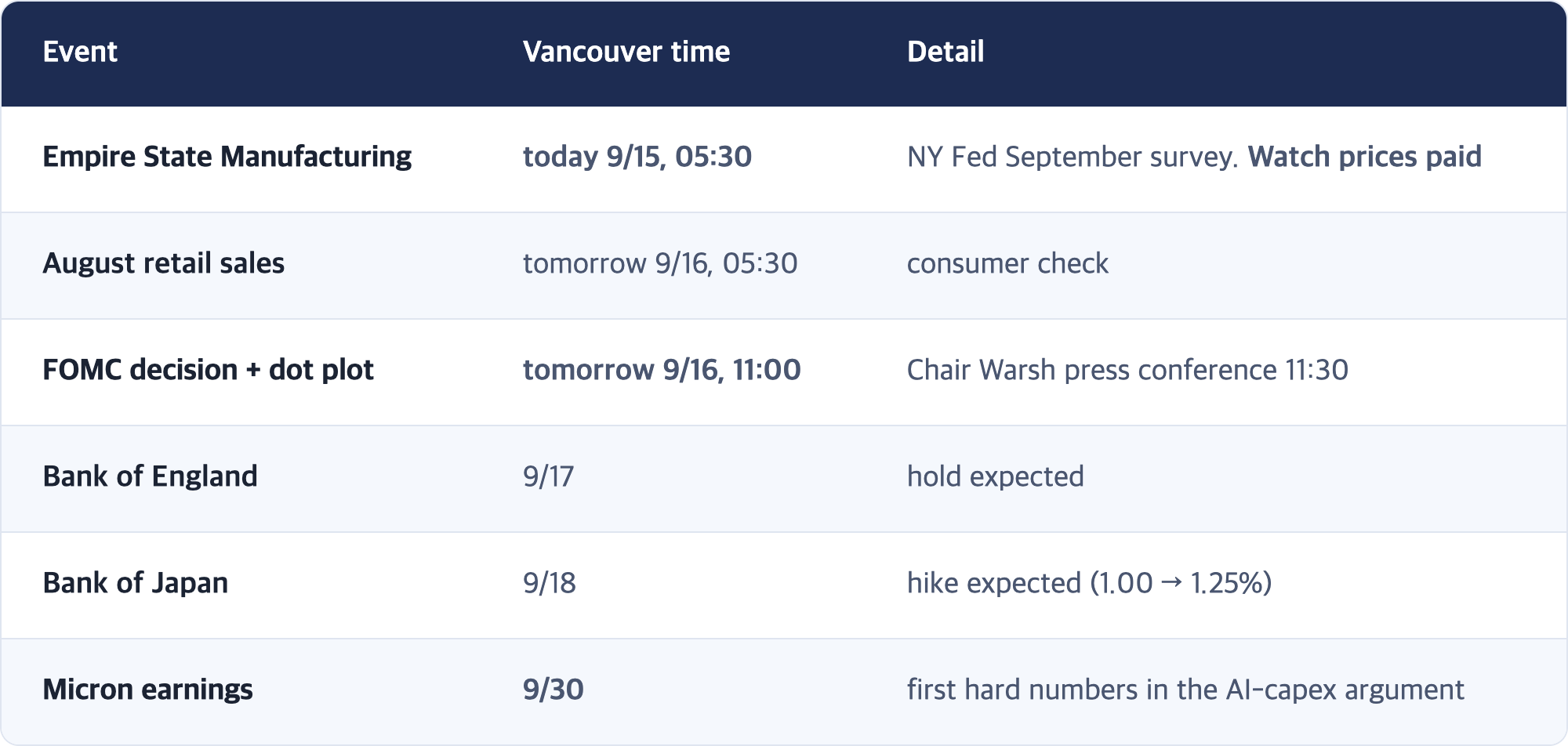
[Fact] Calendar (PDT)
[Fact] Hike odds
CME FedWatch puts a 25 bp September hike at about 92%, up from 84.1% on 9/14. If delivered, the target range moves from 3.50–3.75% to 3.75–4.00% — the first hike since July 2023.
🔴 [Interpretation] Today's 8:30 a.m. print is small but load-bearing
The Empire State survey is usually not a market mover. Today it is different.
Diesel is at a record $6.23 a gallon. The fastest read on whether that cost has actually been passed into producer costs is the prices paid component of a manufacturing survey. It belongs to the same family of signals as the early-September ISM services prices-paid print of 72.6, the highest since mid-2022.
If it rises, the story changes shape: oil has moved from an expectations problem to a realized-cost problem. In that case the inflation premium sitting in long yields does not come out easily.
[Interpretation] Why this week is awkward for Korean investors
In Seoul time, the FOMC lands at 3 a.m. Thursday. Tonight's and Wednesday's Korean sessions have to trade two full days without knowing the answer.
And the pressure Korea is under right now is the kind the Fed cannot fully relieve in either direction. The won at 1,359.4 is weak because the dollar is strong; the dollar is strong because US yields are high; US yields are high in large part because of oil. A dovish Fed relieves the currency but risks lifting inflation expectations and long yields; a hawkish Fed does the reverse.
6. Previewing today's US session (9/15 ET)
[Observed] Starting line
The S&P 500 opens from 7,619.98, the Nasdaq from 26,186.41, the Dow from 52,421.20. The SOX sits at 11,131.3, about 24% below its June 22 high.
All three futures are lower but only by 0.3–0.5%. Today's character is more likely to show in composition than in direction.
[Interpretation] The fork
If rates are the protagonist: the Dow and the Russell hurt most, energy gains, and chips actually settle — exactly the shape Seoul printed yesterday. In that case the 10-year establishes itself above 5%.
If the AI story gets another day: chips fall again while Alphabet, Microsoft and Meta rise again. Indexes finish inside 0.5% once more, and Korea carries chip pressure into tonight.
If both arrive: the session rolls over in the afternoon, as Seoul did.
The deciding variable is oil. WTI holding above $100 means rates are the protagonist; WTI slipping below means the rate pressure eases first.
✅ Four checkpoints for today's US session
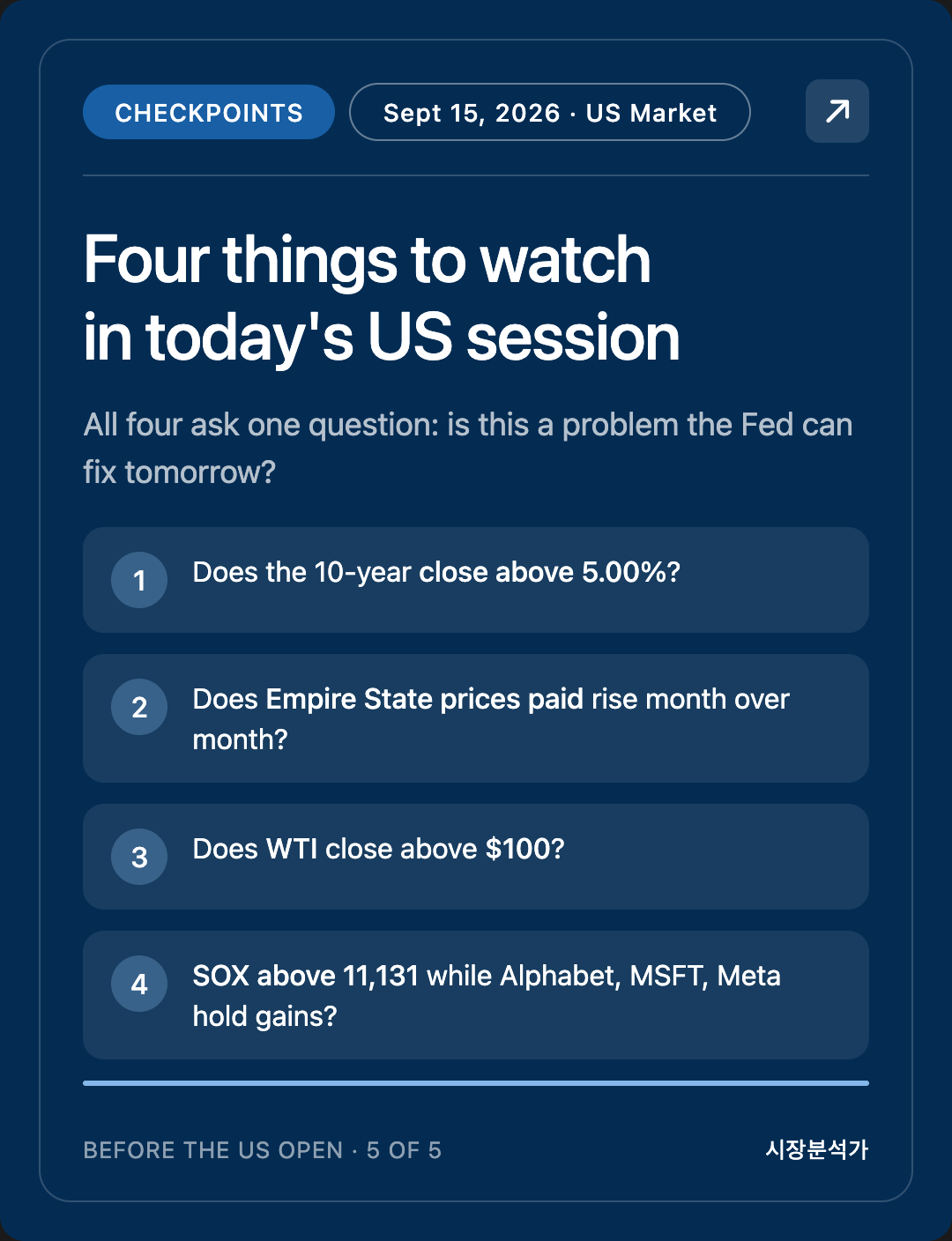
- Does the 10-year close above 5.00%? On 9/14 it touched 5.01% intraday and settled at 4.99%. Two rejections at the same level would make 5% a wall rather than a floor
- Does Empire State prices paid rise month over month? The first read on whether $6.23 diesel has reached producer costs
- Does WTI close above $100? Tests whether the cause of the rate move is still in place
- Does the SOX close above 11,131.3 while Alphabet, Microsoft and Meta hold yesterday's gains? Both means the rotation is done; SOX alone means a simple bounce; neither means it is spreading
Stating the axis: all four tests ask the same thing — is this a problem the Fed can fix tomorrow? Checkpoints 1 and 3 test the cause, 2 tests pass-through, 4 tests the breadth.
7. Study note: the rate the Fed sets versus the rate the market sets
A phrase recurred above. Here is the structure behind it: why the Fed can raise rates while long yields do something else entirely.
The concept
There is no single interest rate. Rates differ by maturity — and by who sets them.
- The policy rate (fed funds): the Fed picks a number in a meeting. It is an overnight rate. A person sets it.
- Treasury yields (2y, 10y, 30y): set where buyers and sellers meet. The Fed influences them but does not decide them. A price sets them.
A long yield decomposes into roughly three pieces:
Long yield = expected average short rate + expected inflation + term premium
- Expected average short rate: the market's arithmetic on future Fed policy. The Fed can move this.
- Expected inflation: what prices do over ten years. Oil attaches here.
- Term premium: the price of tying money up for a decade. Heavier issuance lifts it. Deficits and AI corporate bonds attach here.
The analogy
Think of a bank branch.
The overnight deposit rate is set by the branch manager. If the sign says 3.5% this morning, it is 3.5%.
The price of a ten-year bond is not the manager's to set. If fewer people want to buy, the price falls and the yield rises. The manager can insist the bank is sound all day; if people believe prices will climb for the next ten years, they demand more interest anyway.
The Fed is the branch manager. The long yield is the queue at the window.
The live example: this morning
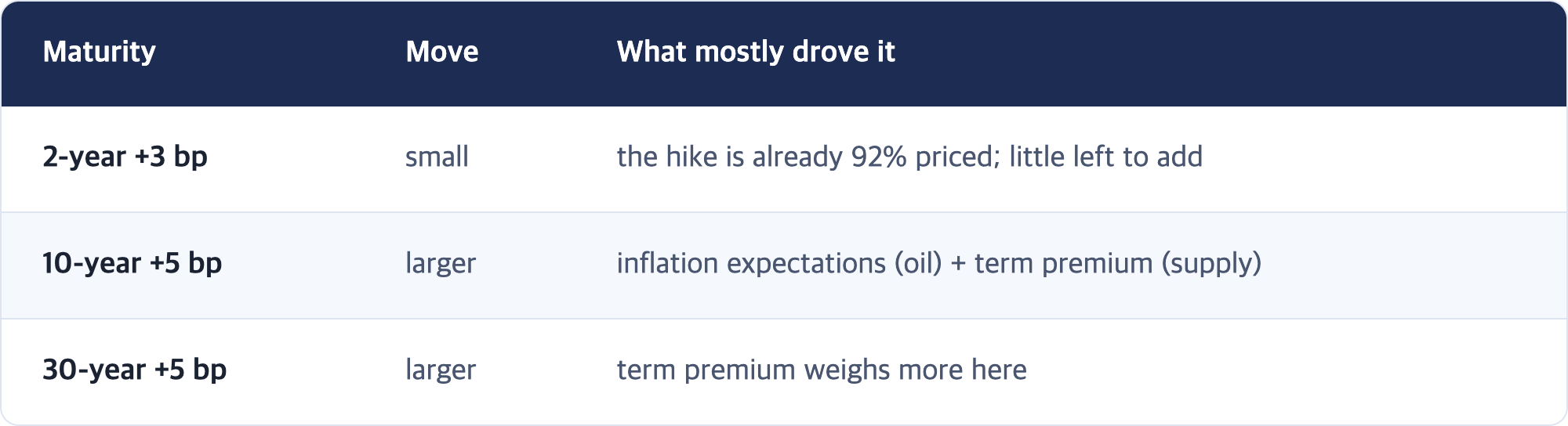
The piece the Fed controls barely moved. The pieces it does not control did.
Knowing this makes tomorrow night far easier to read. Right after the release, a big move in the 2-year is a story about the Fed; bigger moves in the 10- and 30-year are a story about what the dot plot did to the inflation outlook. The two maturities reacting differently to one announcement is the normal case, not an anomaly.
One line
The Fed owns the short rate. Oil and fiscal policy own the long one. What is hurting markets right now is the long end.
8. Corrections and open items
🔴 Partial retraction (1)
Part of yesterday's claim about rotation destinations is retracted. That report argued Korea offered no obvious alternative sector. The KOSDAQ rose 0.70% and batteries (LG Energy Solution +3.98%, Samsung SDI +2.82%) and refining (SK Innovation +3.66%) served as exactly that. Outflow and internal rotation occurred on the same day.
Source discrepancies (3), with adopted values
![Item · Competing values · Adopted / Samsung / SK Hynix 9/15 close · 248,500 won (-0.20%) / 1,690,000 (-0.41%) [Money Today, NewDaily] vs 247,500 (-0.6%) / 1,688,000 (-0.53%) [Seoul Economic Daily EN] · 248,500 / 1,690,000 (majority of domestic outlets) / Korean flow basis · KRX only: foreign -1.574tn vs Nextrade-inclusive -1.706tn · KRX basis, consistent with prior editions / US 10-year 9/15 · 5.02% (+4 bp) [Bloomberg] vs 5.041% (+8 bp) [CNBC] · stated ...](https://wecansurvive.ca/wp-content/uploads/2026/09/tbl_10-21.png)
Open items (3)
- Hang Seng and Shanghai 9/15 index levels not confirmed — only percentage changes (-0.9%, -0.5%) were sourced
- Dollar index 9/11 settlement not confirmed — carried since the 9/11 AM report (fifth edition). The 9/15 Asian-hours print of 99.66 is confirmed
- USD/KRW daily change differs by source — +12.1 (Newsis, Money Today, Seoul Finance) / +13.2 (Infostock) / +11.0 (NewDaily). The 1,359.4 close is consistent, so +12.1 is adopted
✅ Resolved (1)
FOMC probability remains sourced from CME FedWatch only (about 92%). No competing prediction-market figures were cited.
Sources
- 10-year Treasury yield rises to highest since 2007 as Fed rate-hike expectations rise — CNBC
- US 10-Year Treasury Yields Rise to Highest Level Since 2007 — Bloomberg
- Oil and U.S. Treasury yields correlation: WTI, Brent, 10-year yield — CNBC
- Stock Market Today (Sept. 15, 2026): Dow futures slide as oil prices surge and Treasury yields hit 2007 highs — TheStreet
- Diesel prices push to new all-time high as key Saudi pipeline shut — NBC News
- Oil climbs as Saudi pipeline outage, fresh attacks heighten supply concerns — The Irish Times
- Postponed Iran talks and attacks on Saudi push oil higher — AGBI
- KOSPI Falls 0.85% to Close at 6,627.26 — Seoul Economic Daily
- KOSPI Hovers Near 6,600 as Investors Await U.S. Fed Decision — Seoul Economic Daily
- 0915 market close check: KOSPI down a fourth day on rates and oil — Infostock Daily (Korean)
- KOSPI closes below 6,600s on the triple burden of oil, rates and AI — NewDaily (Korean)
- USD/KRW closes at 1,359.4, up 12.1 won — Newsis (Korean)
- LG Energy Solution closes up over 3% on US pushback against Chinese batteries — EBN (Korean)
- Nikkei 225 Today, September 15: Japan Stock Market Rises 0.4% Above 63,700 — Sunday Guardian
- Hang Seng closes down 0.9%, leading Asia's session losses — 24/7 Wall St.
- Gold — Trading Economics
- European stocks kick off September on gloomy note as bond yields rise — KFGO
- Empire State Manufacturing Survey release calendar — FRED
- Advance Monthly Sales for Retail and Food Services — U.S. Census Bureau
This report interprets market flows and macro variables. It is not a buy or sell recommendation on any individual security.
📌 More market briefs
※ This post is market observation and organization intended to support your own judgment. It is not a recommendation to buy or sell any security. Figures are as of the time of writing and may differ between sources.
If this was useful, bookmark it or pass it along. It genuinely helps me write the next one.
I can survive. We can survive.