October 16, 2026 US Market Brief — Nasdaq and S&P 500 Before the Open
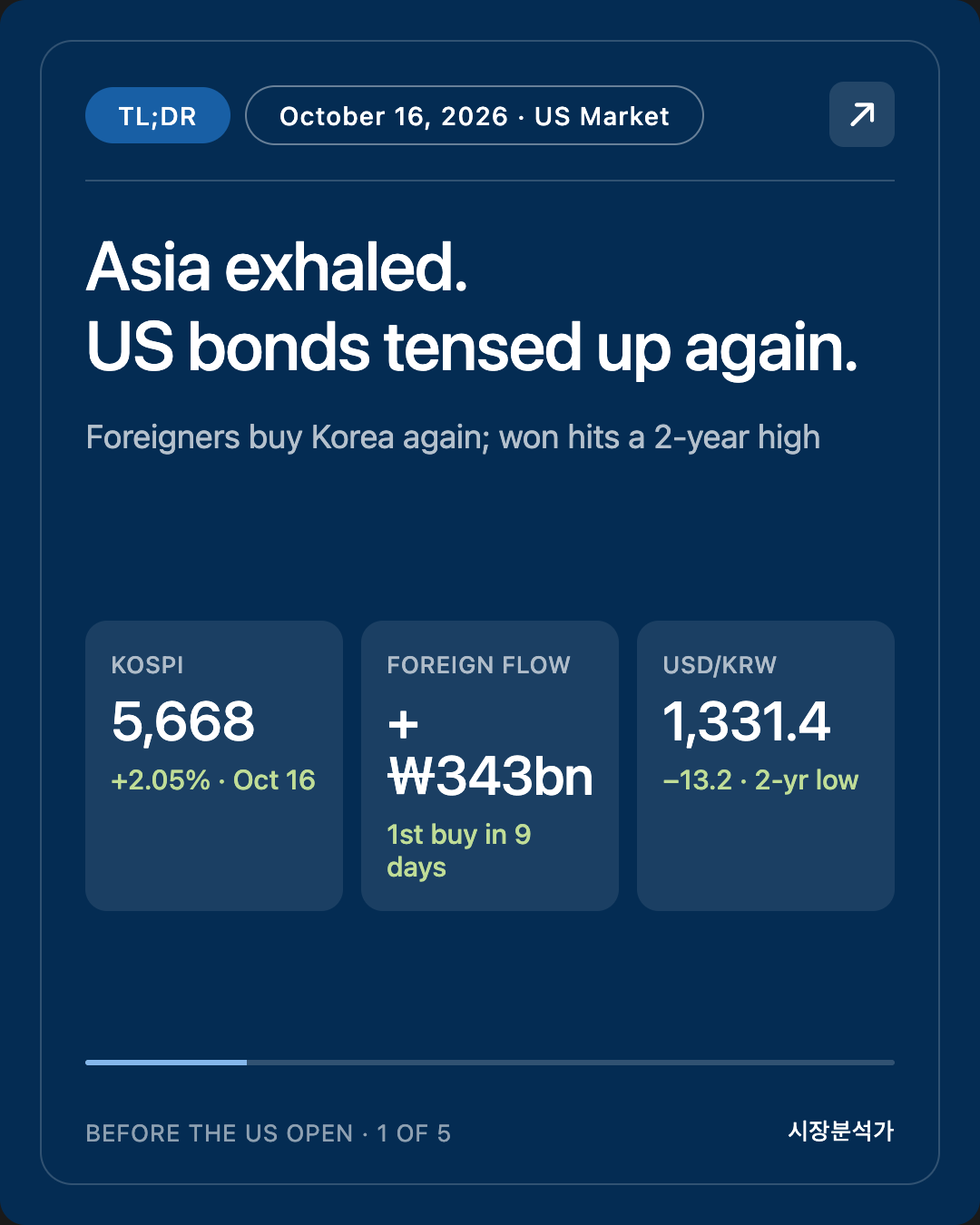
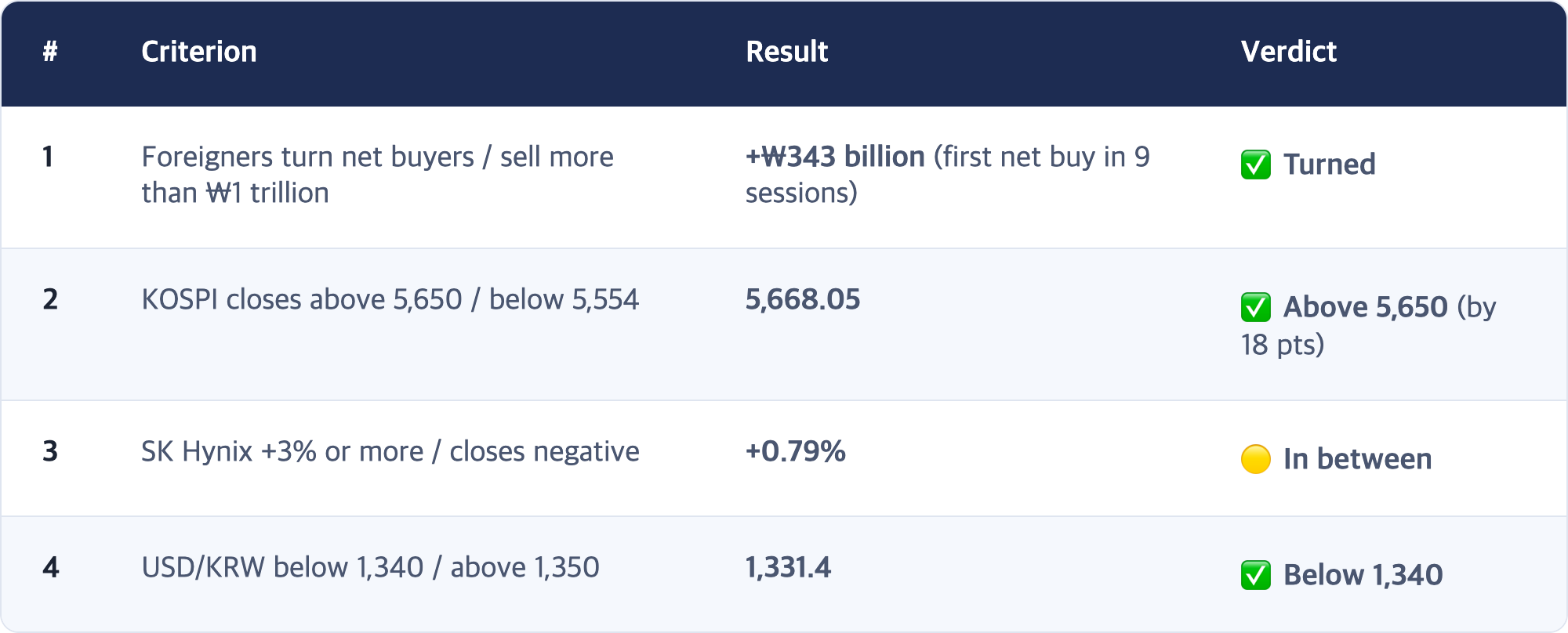
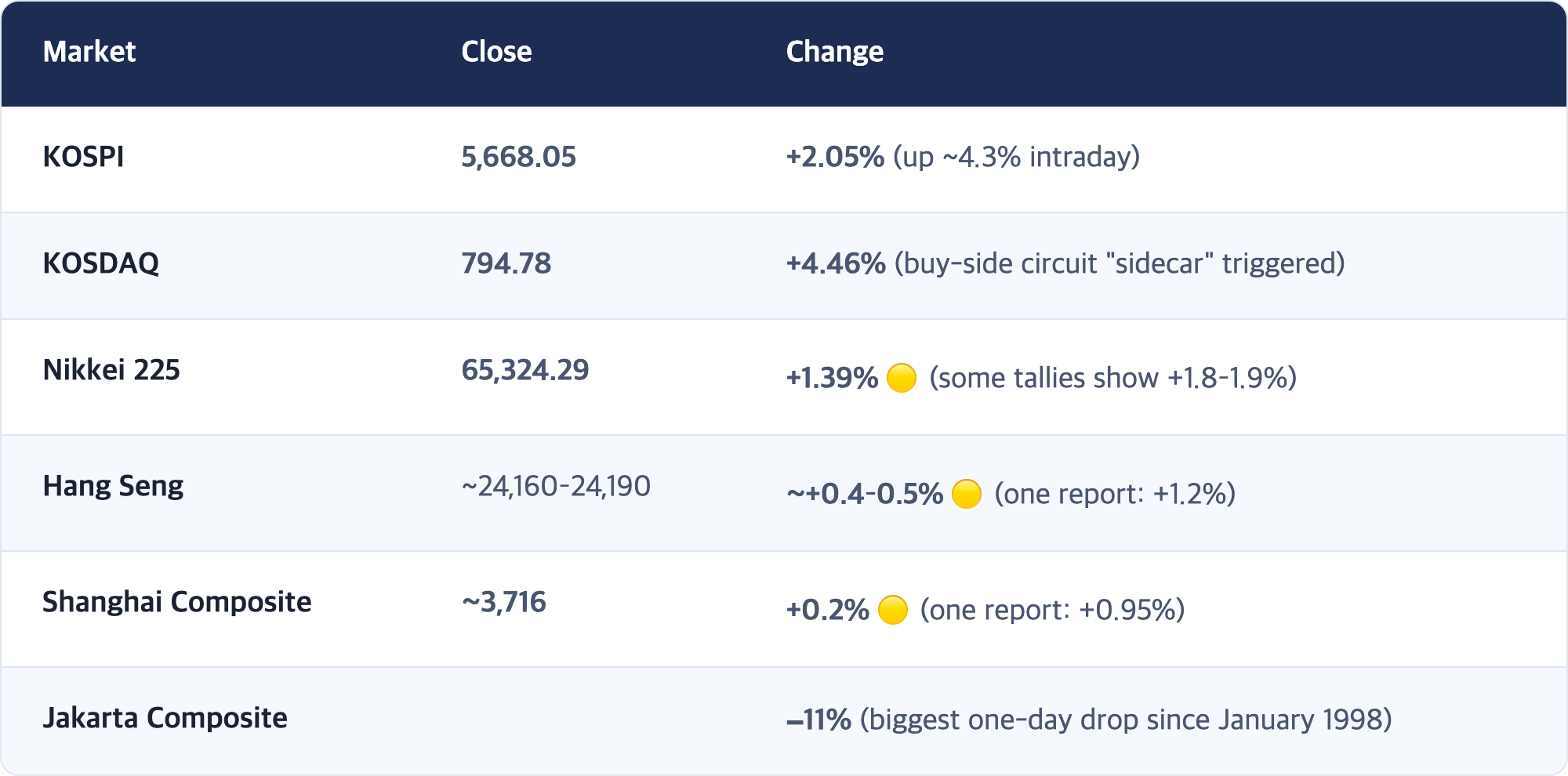
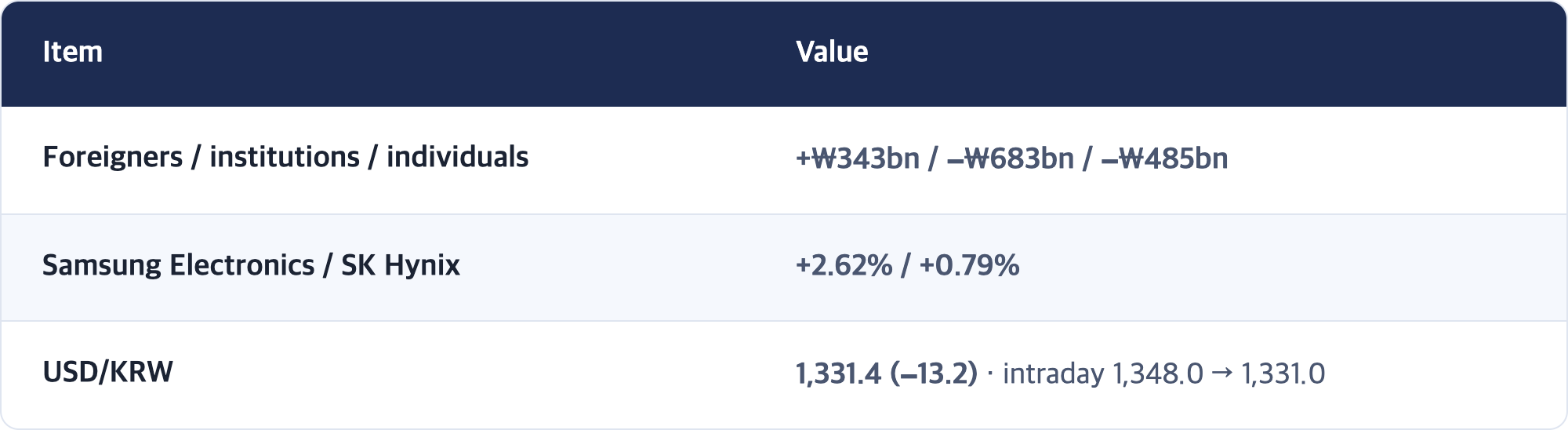
- ★ Seoul caught its breath first. KOSPI 5,668.05 (+2.05%), KOSDAQ 794.78 (+4.46%). Foreigners bought a net ₩343 billion, ending an eight-day, roughly ₩18 trillion selling streak. But the KOSPI gave back half of an intraday gain of over 4%.
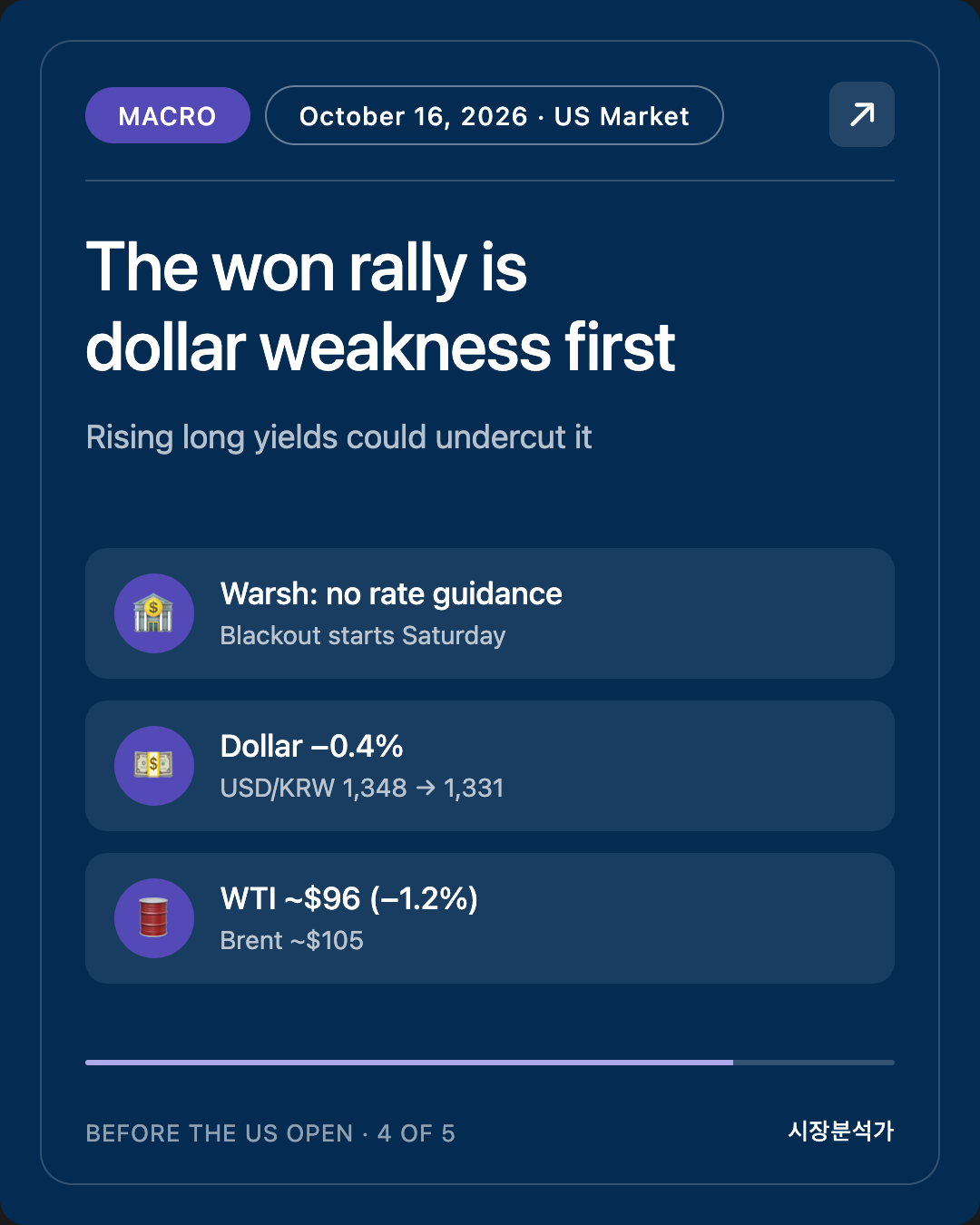
- ★ The won is at a two-year high. USD/KRW 1,331.4 (−13.2), the lowest since October 2024. A stronger won the day after a crash is the most surprising number of the week.
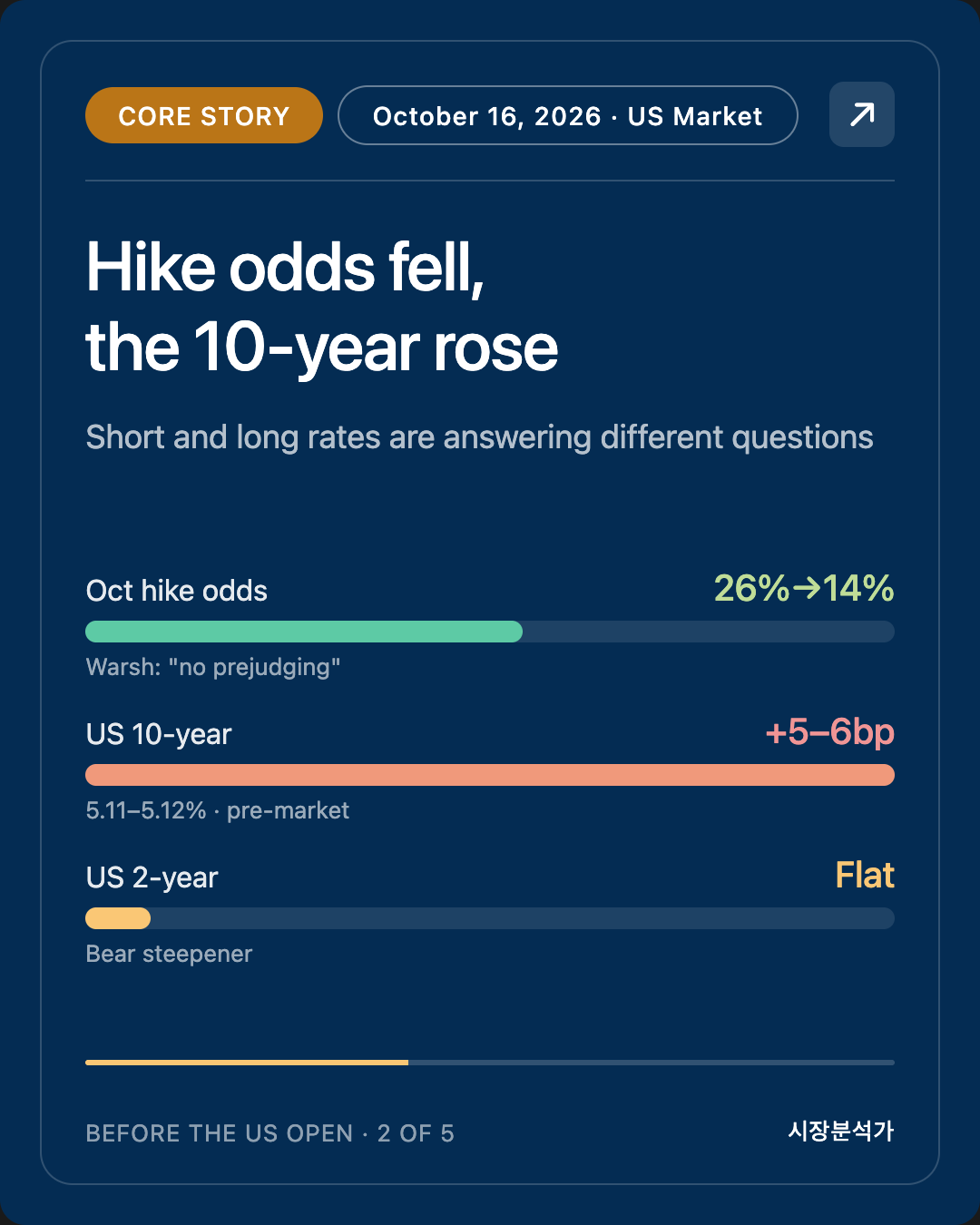
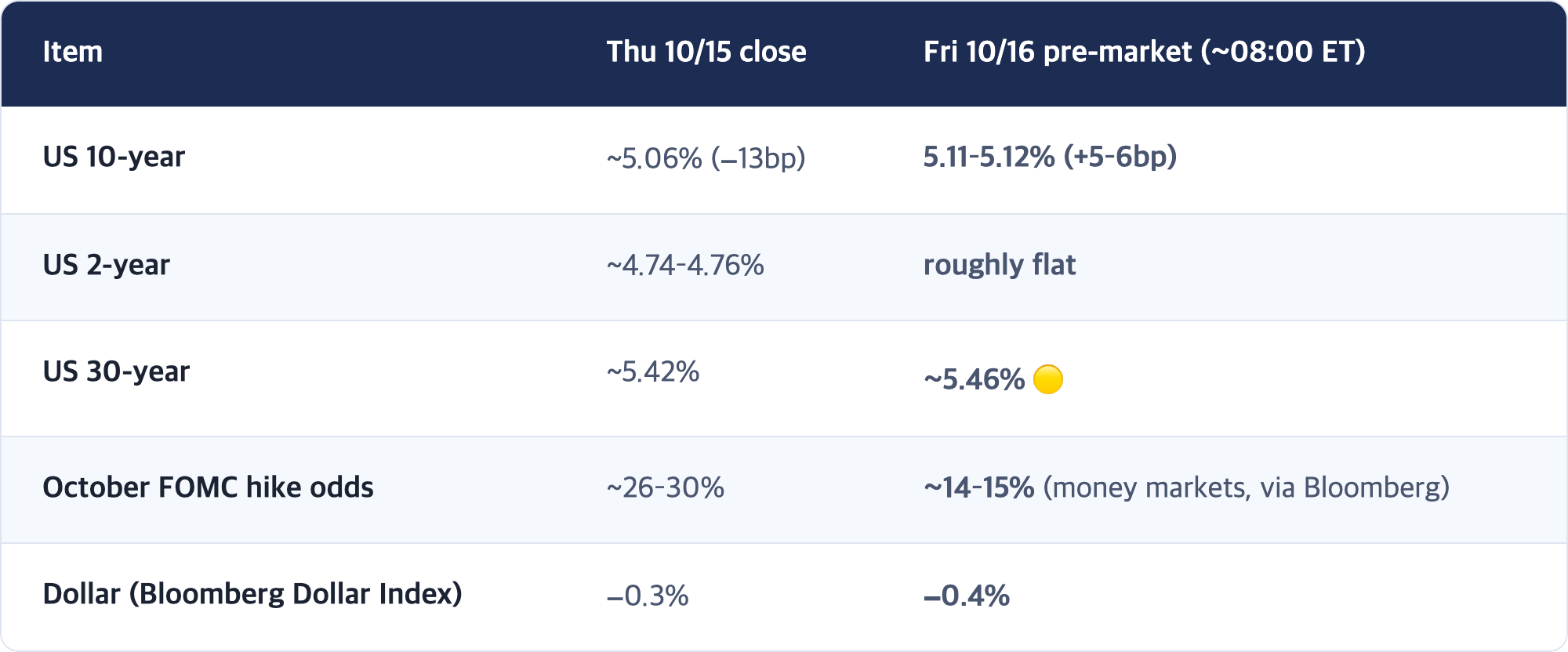
- ★ Hike odds fell, yet the 10-year rose. October hike odds ~26% → ~14–15%, but the 10-year yield is 5.11–5.12% (+5–6bp) while the 2-year is flat. That's a "bear steepener" (see the study note).
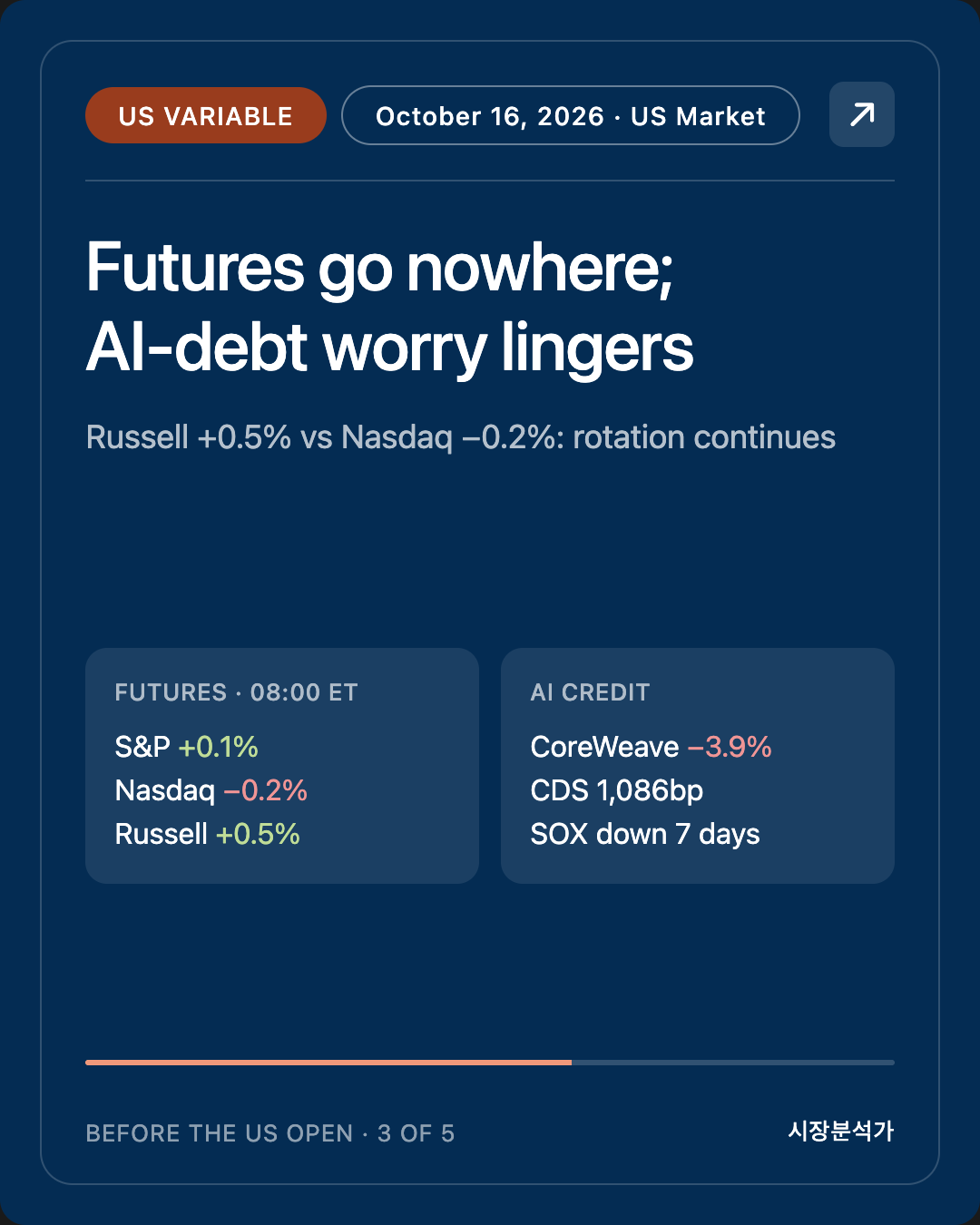
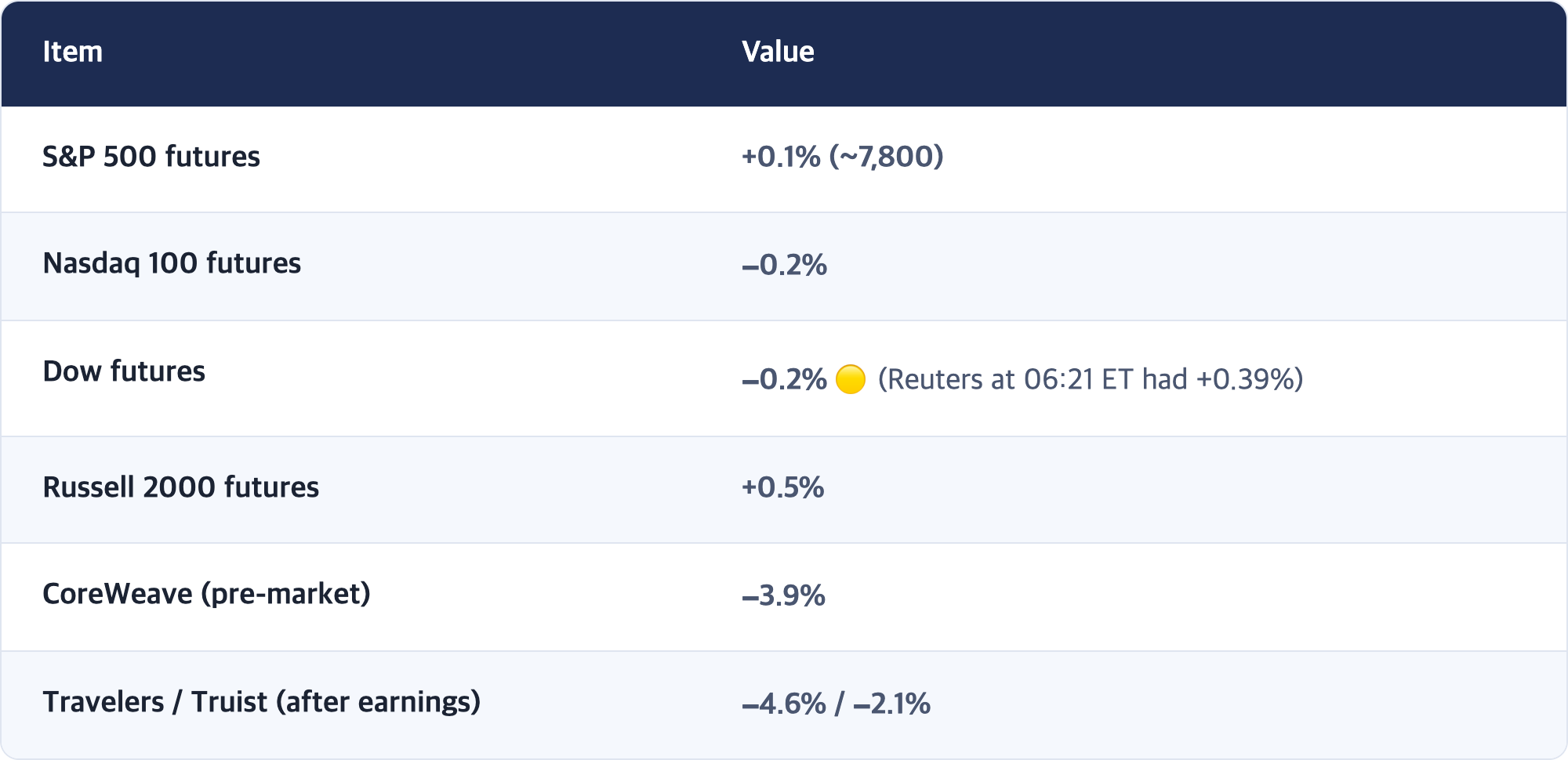
- US futures have no direction. S&P 500 +0.1%, Nasdaq 100 −0.2%, Russell 2000 +0.5% (08:00 ET). CoreWeave is −3.9% pre-market; regional banks and insurers that reported this morning are also weak.
- Europe is catching money leaving AI. STOXX 600 +0.5–0.6% (~643.7), DAX +0.9%. Bloomberg says Europe is on track for its biggest weekly outperformance over the S&P 500 since March.
This is Mr. Can. Here is the October 16, 2026 brief ahead of the US market open.
Written: 2026-10-16 07:05 PDT (Korea 10/16 23:05 KST)
Basis: Seoul, Tokyo, Hong Kong and Shanghai closes on 10/16 + Europe intraday + US pre-market (around 08:00 ET) + overnight Treasury moves
🔴 Scheduled for 05:30 PDT, started at 06:01 PDT — 31 minutes late, and finished after the US open (06:30 PDT). US figures are pre-market and may differ from the cash session.
🟢 No missed editions. The previous one was the 10/15 Korea-open brief.
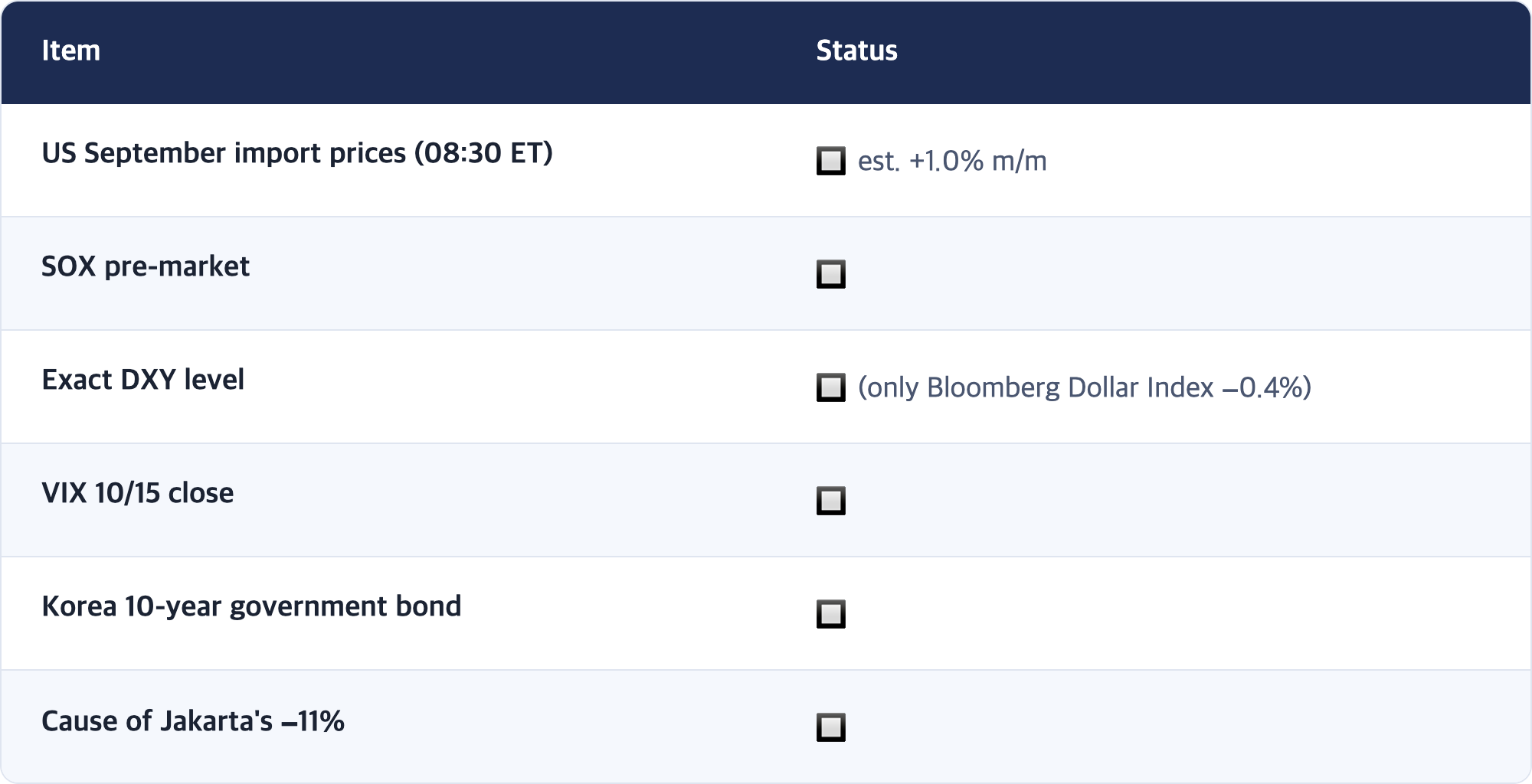
🟡 The result of today's 08:30 ET September import price release was not captured (see section 7).
SEO Intro
Asia exhaled; US bonds tensed up again. On Friday, October 16, Korea's KOSPI rebounded 2.05% to 5,668.05 — its first gain in eight sessions — and foreign investors turned net buyers for the first time in nine sessions (+₩343 billion, about $258 million). The Korean won strengthened to 1,331.4 per dollar, its strongest level since October 2024. Japan's Nikkei rose about 1.4%.
The picture in New York before the open is less tidy. The 10-year Treasury yield, which fell 13 basis points on Thursday, climbed back about 5–6bp to 5.11–5.12%. The odd part: over the same hours, the market-implied odds of a Fed hike at the October meeting fell from about 26% to about 14%, after Fed Chair Kevin Warsh declined to give any rate guidance ("I do not believe in prejudging meetings").
Less fear about the next meeting, more fear about the long run. Today's question for Wall Street: does Asia's relief rally carry over, or do long-term yields take it back?
1. Scoring Yesterday's Checkpoints
The four set by the 10/15 Korea-open brief (Seoul close, 10/16)
The question was: "Is today's bounce the result of foreign selling stopping, or just a one-day breather after a crash?"
★ [Interpretation] The "flow accident" reading gained weight — but chips weren't the lead
The 10/15 brief said that if items 1 and 2 both held, the case for reading this week's crash as a flow-driven accident (forced selling, not a change in fundamentals) would strengthen. Both held, and the won strengthened too.
Item 3 is the catch. SK Hynix, the stock foreigners dumped hardest in October, rose only 0.79%; Samsung Electronics gained 2.62%. Meanwhile the small-cap KOSDAQ rose 4.46%, more than double the KOSPI. The rebound wasn't "buying back AI chips" — it was a broad snap-back in beaten-down smaller names.
[Observation] Friday's foreign net buying (₩343 billion) is about 2% of the prior eight days' selling (~₩18.1 trillion). The direction changed; the size is still symbolic.
2. Today's Core Story: Hike Odds Fell, but the 10-Year Rose Again
[Fact] What changed overnight
[Fact] Warsh's remarks (10/15, IMF event)
- "Since the September FOMC, the world has broadly conformed to our expectations."
- "Will make judgements at the October and December meetings. I do not believe in prejudging meetings."
- "Right now, we have structural growth and an investment surge" — framing AI as a demand shock before a supply shock.
- Despite hot CPI and PPI this week, he did not push back on market pricing for an October hold. The Fed's pre-meeting blackout starts Saturday.
★ [Interpretation] Short and long rates are answering different questions
The 2-year answers "what will the Fed do at the next few meetings?" With Warsh not pushing for an October hike, that answer tilted toward "probably hold," and the 2-year sat still.
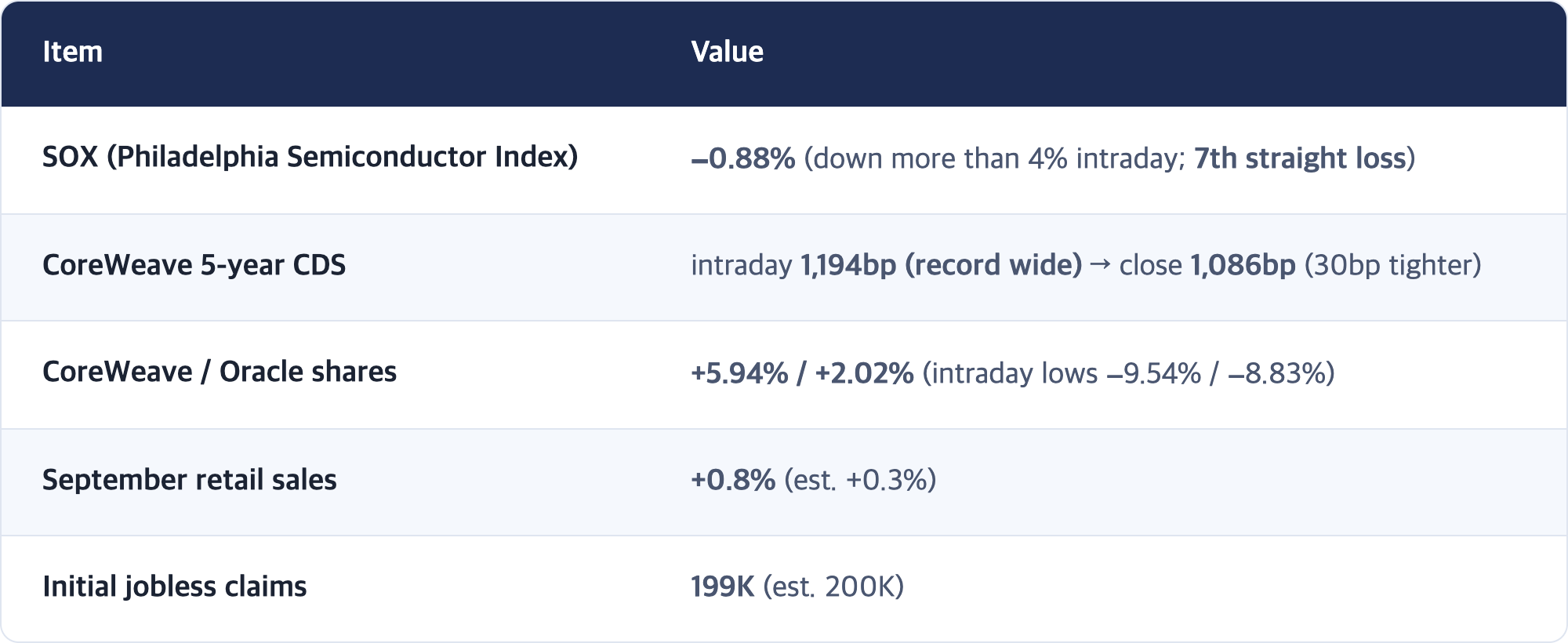
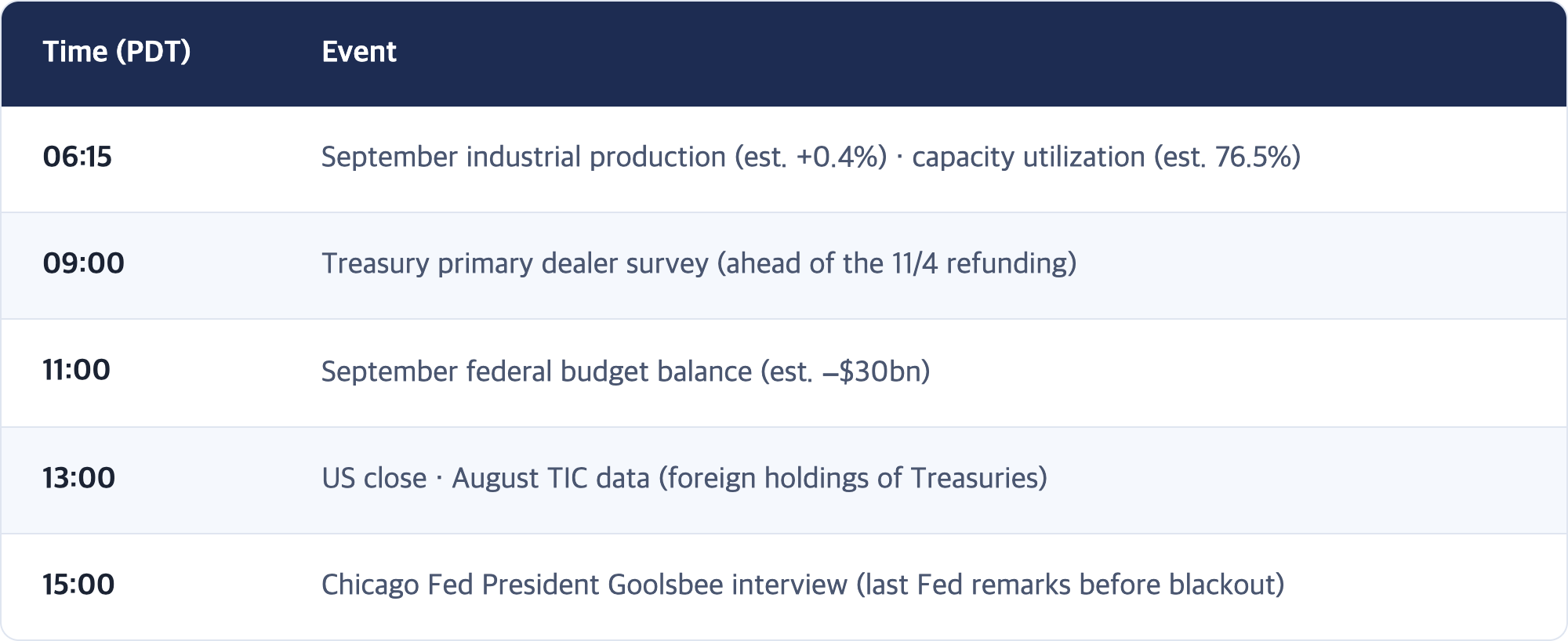
The 10-year answers something else: "what happens to inflation and government debt over the next decade?" Put September PPI at 6.3% y/y, retail sales at +0.8% (vs. +0.3% expected) and the Atlanta Fed's Q3 GDP tracker at +3.6% side by side, and a Fed that hikes less now can also be read as "more inflation left later." On top of that, the Treasury surveys primary dealers at noon ET today ahead of its November 4 refunding announcement.
As we noted on 9/18: score stocks and bonds separately. This morning, equity futures heard "no hike"; the 10-year heard "inflation sticks around." Today's 10-year close is the first real test of which was right.
3. The US Variable: Futures Are Directionless, and AI-Debt Worry Hasn't Gone
[Fact] US pre-market (~08:00 ET)
[Fact] Thursday 10/15 US close, filled in
★ [Interpretation] Russell +0.5%, Nasdaq −0.2%: that 0.7-point gap is today's US variable
Small caps rising while tech slips extends the week's "out of AI, into everything else" rotation. The same move shows up in Seoul (KOSDAQ +4.46% vs. KOSPI +2.05%) and in Europe (STOXX 600 beating the S&P 500). Three markets are saying the same thing (observation).
One caution: CoreWeave's CDS — the cost of insuring its debt against default — tightened 30bp at Thursday's close but is still above 1,000bp. As our 10/15 study note put it, a falling insurance premium is a more reliable signal than a bouncing share price, and the premium has barely moved. Today's −3.9% pre-market says the worry didn't resolve overnight.
4. Macro Backdrop: A Weaker Dollar, and the Won at a Two-Year High
[Fact] Asia closes, 10/16
[Fact] Seoul flows and FX (10/16)
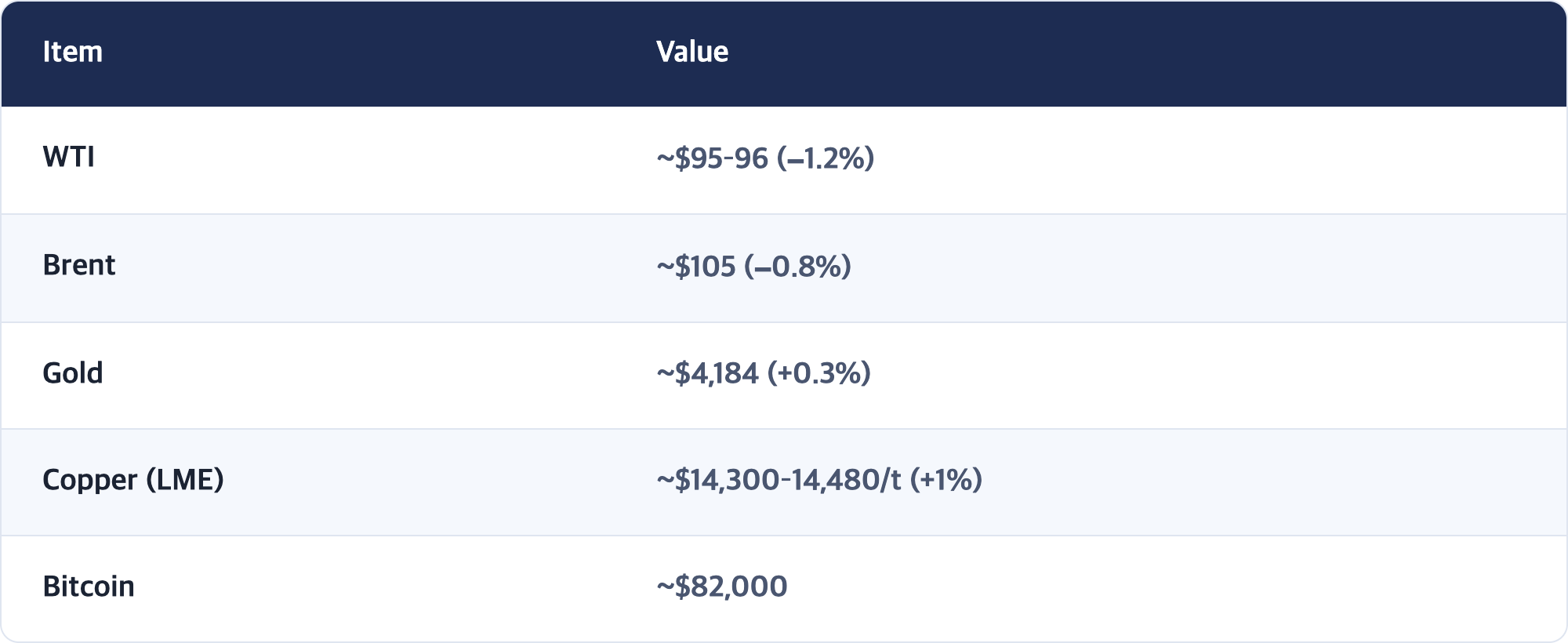
[Fact] Commodities (10/16 morning)
★ [Interpretation] The won's rally is more "weaker dollar" than "foreigners are back"
A 13-won drop in USD/KRW is too big to explain with ₩343 billion of foreign stock buying alone. FX dealers cited three drivers: the dollar index falling after Warsh, foreign custody-account dollar selling, and exporters converting dollars. Dollar weakness came first; Korean equity flows came second (interpretation).
That distinction matters because of tonight's 10-year close. If US long-term yields keep rising, the dollar can regain strength — and the foundation of today's won rally weakens.
[Observation] Jakarta's −11% is the biggest number in Asia this week, but there's no sign yet of it spreading to other markets. We could not confirm the cause in this edition.
5. Today's US Session (Fri 10/16): Checkpoints
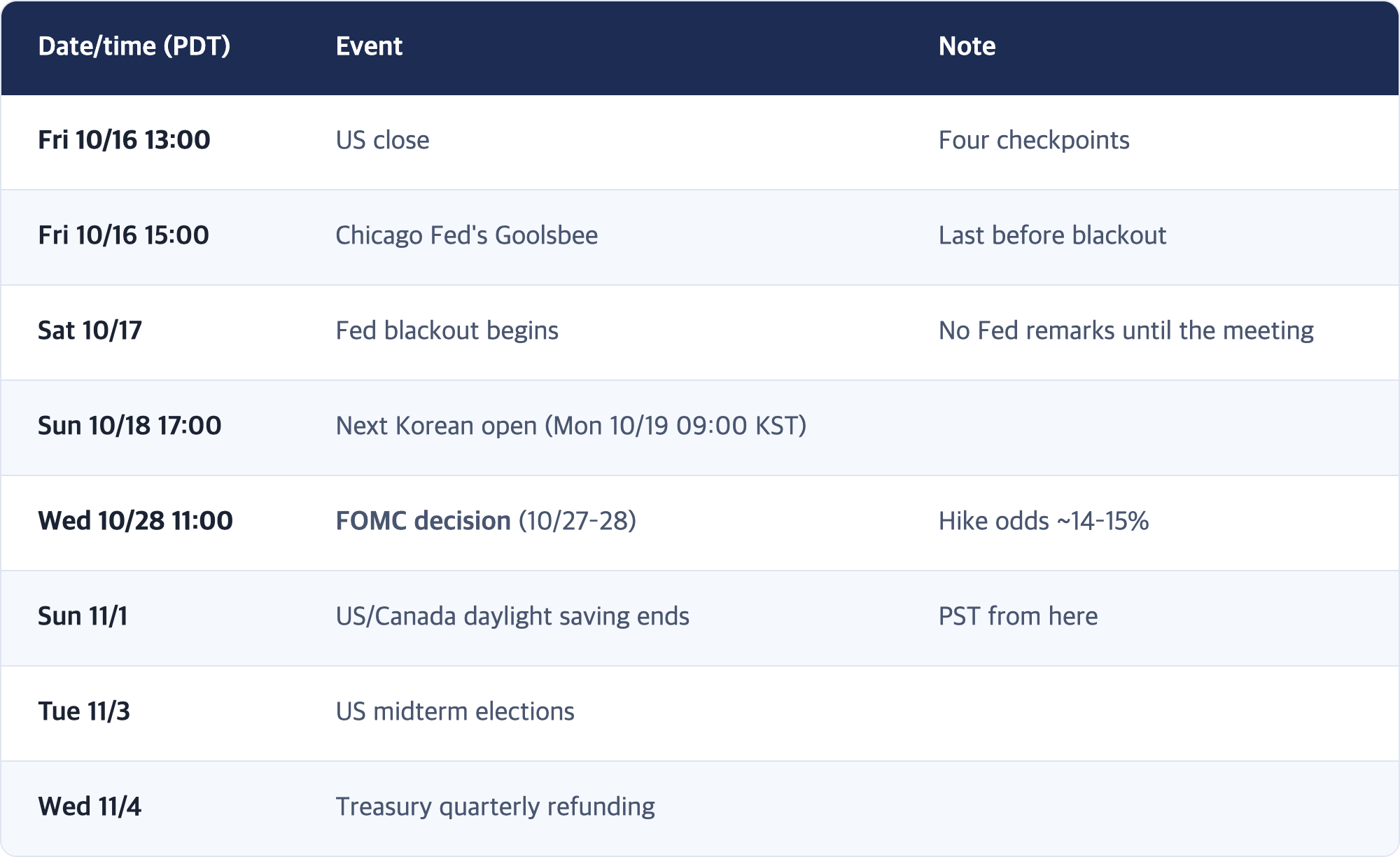
[Observation] Remaining schedule (PDT)
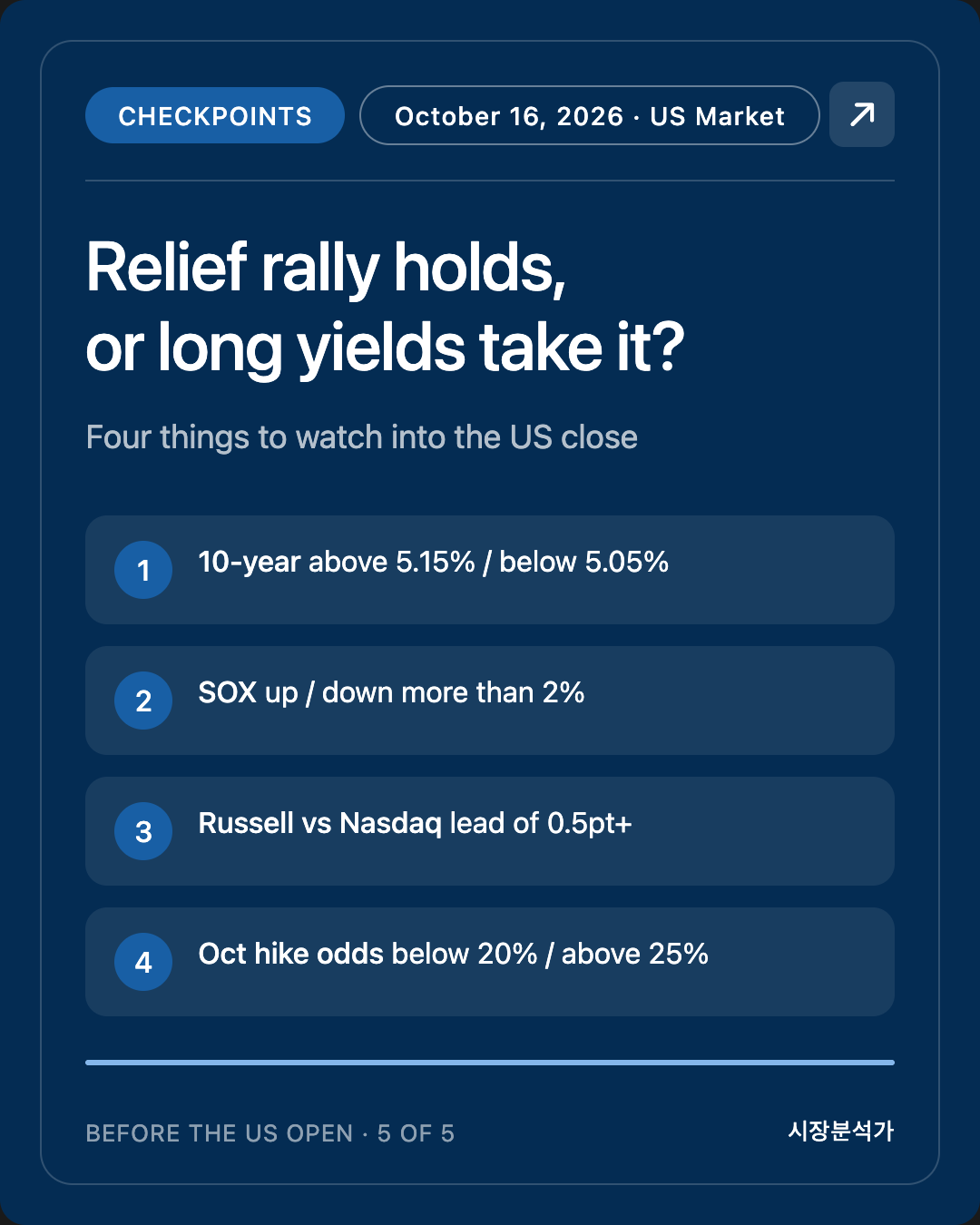
✅ Four checkpoints (through today's US close)
The axis: "Does New York take Asia's relief rally, or do long-term yields take it back?"
- 10-year closes above 5.15% / below 5.05%. Above 5.15% means Thursday's drop is mostly undone; below 5.05% extends it. (Most important)
- SOX closes up / falls more than 2%. Does it become an eighth straight loss?
- Does the Russell 2000 beat the Nasdaq by 0.5 points or more? Whether the rotation out of AI holds in the cash session.
- CME October hike odds stay below 20% / rebound above 25%. Check before and after Goolsbee.
[Interpretation] If #1 is above 5.15% but #3 holds, the market is saying "rate worries remain, but just avoid AI." If #1 is above 5.15% and #3 breaks too (small caps falling as well), long yields are starting to weigh on the whole market again — a headwind for Seoul on Monday.
6. Study Note: The Bear Steepener — When Short Rates Sit Still and Long Rates Rise
The concept
The yield curve connects Treasury yields across maturities. When the gap between the 2-year and 10-year widens, the curve steepens; when it narrows, it flattens. "Bear" means it happens with yields rising (bond prices falling); "bull" means with yields falling.
So a bear steepener is "long-term yields rising more than short-term yields, steepening the curve."
An analogy
Imagine setting interest rates on a loan due in one year and another due in ten. If the bank president says "I won't raise rates right now," the one-year rate stays put. But if lenders worry "if you don't raise now, inflation will be worse later — and the government is borrowing so much," the ten-year rate goes up. The longer your money is tied up, the more extra compensation for uncertainty (the term premium) you demand.
This morning's example
- October hike odds: ~26% → ~14–15% (less near-term worry)
- 2-year: flat (short rates unchanged)
- 10-year: +5–6bp, 30-year ~+3bp (long rates up)
- JPMorgan's tally: 2s flat, 10s +4bp, 30s +3bp — a textbook bear steepener.
Why it matters for stocks
On 10/14, after CPI, the 2-year jumped more than the 10-year — a bear flattener. That's a "the Fed will hike soon" worry, which can fade once the meeting passes. A bear steepener means "long rates rise even if the Fed doesn't hike," so it doesn't resolve on the meeting calendar. It weighs longer on growth stocks, whose value depends on profits far in the future.
One-line summary
Short rates reflect the Fed's next step; long rates reflect worries about inflation and government debt. When they diverge, the long end tends to win the longer argument.
7. Corrections and Open Items
Corrections
- The 10/15 Korea-open brief listed "US September retail sales, Fri 10/16 night (date unconfirmed)." That was wrong. Retail sales came out on Thursday 10/15, alongside PPI (+0.8% vs. +0.3% expected).
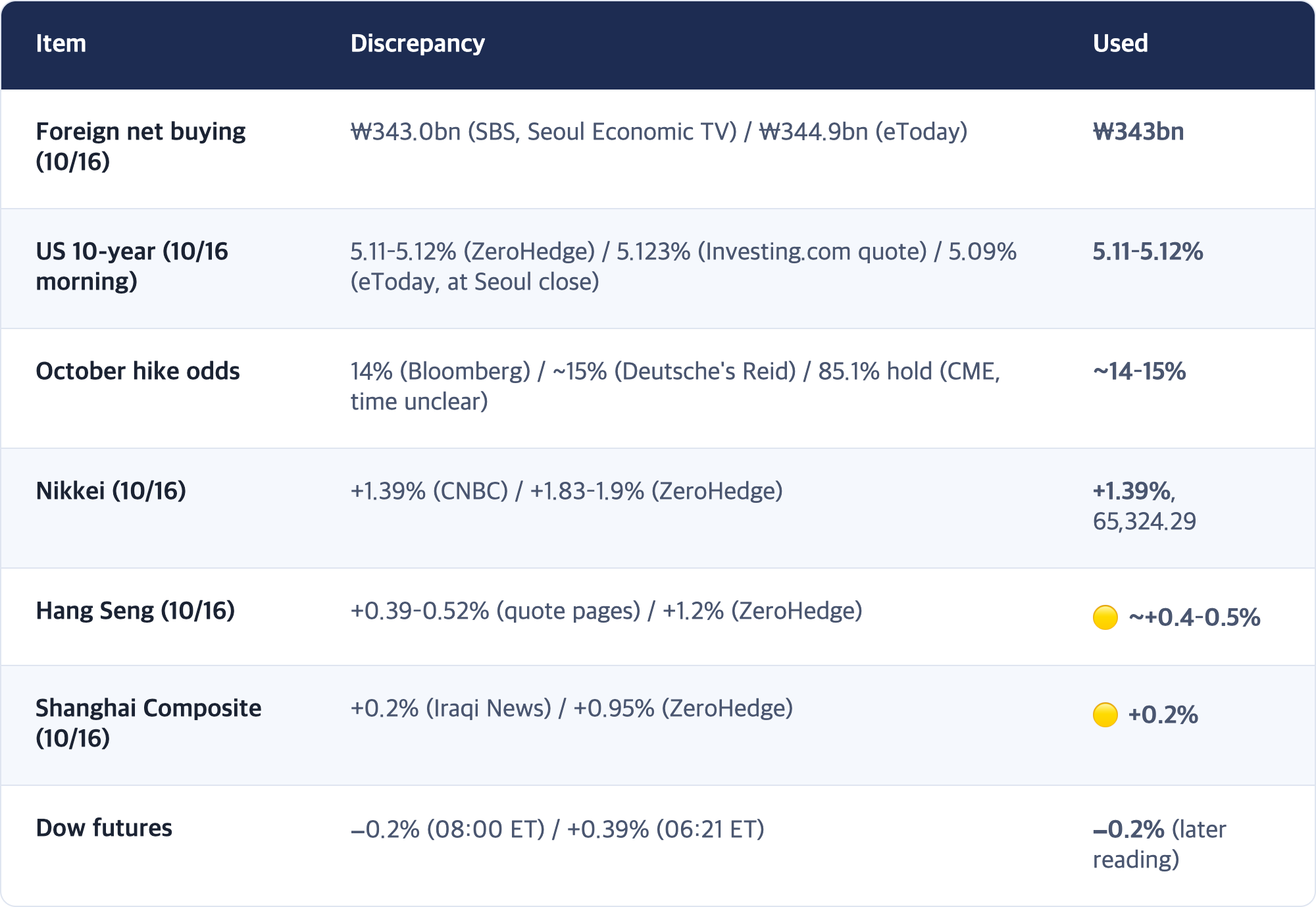
- The 10/15 brief's September PPI table has a source discrepancy. It showed a headline estimate of +0.5% and core at +0.7% (vs. 0.3%); ZeroHedge's tally shows a headline estimate of +0.6% and core at +0.5%. We could not settle which is right in this edition. Both sources agree the headline came in at +1.3%.
Source differences (value used in the text)
🔲 Not confirmed
8. Event Calendar (PDT)
Sources
- KOSPI rebounds after 8 sessions, retakes 5,600; foreigners turn net buyers | eToday (Korean)
- KOSPI ends higher for first time in 8 sessions | Seoul Economic TV (Korean)
- Foreigners turn net buyers after 9 sessions | SBS (Korean)
- KOSPI rebounds on bargain hunting and foreign buying | Seoul Finance (Korean)
- Won closes at 1,331.4 per dollar, down 13.2 | Seoul Finance (Korean)
- Won at two-year high on flows and a dovish Warsh | Supple (Korean)
- Futures Rise As Warsh Stays Mum, Tesla "Flying Car" Interrupts AI Liquidation | ZeroHedge
- Warsh avoids rate guidance; Tesla's Roadster turns in air – what's moving markets | Investing.com
- US Stock Market Today: Dow Jones Futures Rise 0.39%… as AI Debt Fears | Sunday Guardian
- Asia Market Quick Take – 16 October 2026 | Saxo
- Stock market today: Live updates | CNBC
- Asian stocks rise as tech bounces from rout, Warsh upbeat on AI | Iraqi News
- European Shares Outperform S&P 500 Amid Defensive Tilt From AI | Bloomberg
Market Analyst · This brief does not recommend buying or selling individual securities. It provides macro context and interpretation.
📌 More market briefs
※ This post is market observation and organization intended to support your own judgment. It is not a recommendation to buy or sell any security. Figures are as of the time of writing and may differ between sources.
If this was useful, bookmark it or pass it along. It genuinely helps me write the next one.
I can survive. We can survive.